Author: James DiEugenio

  • Fred Litwin, On the Trail of Delusion – Part One

    Fred Litwin, On the Trail of Delusion – Part One


    “One of the many blessings of this project was getting to know Hugh Aynesworth … He’s one of the great reporters in America, and it’s been an honor to know him.” ~Fred Litwin


    Anybody who is familiar with the John Kennedy assassination should realize that a writer who could make the above statement has severe objectivity problems as far as the JFK case goes. Aynesworth is the man who once said that refusing a JFK conspiracy was his life’s work. Employing Aynesworth on the Kennedy case would be like using Donald Trump on the issue of where Barack Obama was born. Yet, the above statement is a quote from the Acknowledgements section of Fred Litwin’s book about the Jim Garrison inquiry. I would like to give that quote a page number but I can’t. The reason being that those pages––and some others which have text on them––do not contain numbers. Which, in my long reviewing career, is actually a first for me. But this is just the beginning of enumerating the bizarre features of this bizarre book.

    For every Breach of Trust or JFK and the Unspeakable, there are at least a dozen volumes in the JFK field that are just plain shabby––or worse. Back in 1999, Bill Davy and I reviewed Patricia Lambert’s volume about Jim Garrison, False Witness. That was a particularly unpleasant experience. In fact, the estimable Warren Commission critic Martin Hay (deservedly) placed that book on his list of the ten all-time worst on the JFK case. But in light of Fred Litwin’s latest, Martin may have to revise and replace Lambert’s entry with Litwin’s On the Trail of Delusion. For Litwin has done something I did not think was possible: he wrote a book that is even worse than Lambert’s.

    If the reader knows anything about New Orleans and the Jim Garrison inquiry, it is fairly easy to see what Litwin is up to. The problem is––and I cannot make this point forcefully enough––too many writers and interested parties think they know the Garrison inquiry and New Orleans, when they really do not. Many of these self-proclaimed “authorities” have never even been to the city. Many more have never even bothered to look at Jim Garrison’s files. But this never stopped them from voicing their biased and rather ignorant viewpoints: e.g., the late Sylvia Meagher. This was and is a serious problem among critics, and it has caused many people to be misled about the New Orleans aspects of the case. I will further elucidate this factor later in this review.

    The above warning is apropos to what Litwin has produced. If I had to compare his latest to another volume in a related field it would probably be Thomas Reeves’ book on John Kennedy, A Question of Character. In my two part article, “The Posthumous Assassination of John F Kennedy”, I wrote that what Reeves had actually done was to compile a collection of just about every negative Kennedy book and article that came before him. He then assembled it together by chapter headings. He never fact-checked or source-checked what was in those materials and, as far as I could see, he never talked to anyone in order to clarify, or qualify, what he wrote; for example, the case of the deceitful Judith Exner. This allowed him to go exponentially further than anyone had done up to that time in smearing Kennedy. Because I knew the field and understood the game he was playing, I called it out for being what it was: so godawful that it ended up being pretty much a humorless satire.

    The difference between the JFK field of biography and Jim Garrison and New Orleans is the time element. In my above mentioned JFK essay, I noted that the character assassination of Kennedy did not begin in any serious way until after the Church Committee hearings in 1975. This was not what happened with Jim Garrison. In his case it began very soon after the exposure of his investigation by local New Orleans reporter Rosemary James. As we shall see, in one way, it began with Aynesworth.

    In my book, the second edition of Destiny Betrayed, I portrayed the real manner in which Rosemary James exposed Garrison’s inquiry. Contrary to what James tried to imply, it is not at all what Garrison wanted to occur (pp. 221-23). In fact, it was a serious body blow to his efforts. Yet, to this day, she still attacks Garrison. But again, to anyone who knows New Orleans, the smears are transparent. For instance, on a show she did In New Orleans with film-maker Steve Tyler and historian Alecia Long, she said that as soon as Shaw was indicted by Garrison, the wealthy Stern family of New Orleans dropped him like a hot potato. This is provably wrong. The Stern family hosted dinner parties for reporters sympathetic to Shaw’s defense once they arrived in New Orleans. What is surprising about this howler is that the contrary information is available throughout the forerunner to Lambert and Litwin, namely James Kirkwood’s obsolete relic of a book American Grotesque (see pp. 47, 88, 111). That book was published back in 1970. 

    But beyond that hospitality function, the Sterns owned the local NBC television affiliate WDSU. Ric Townley, who labored on the infamous 1967 NBC hatchet job on Garrison, worked for WDSU. That show’s producer, Walter Sheridan, worked through that station while he was in New Orleans. (William Davy, Let Justice be Done, pp. 78, 156) In addition to that, the Stern family helped start the Metropolitan Crime Commission, a private local watchdog organization. They also lobbied to bring in former FBI agent Aaron Kohn to be its first manager. Kohn took a large and important role in the effort to undermine Garrison; working hand in hand with Sheridan, Townley and Shaw’s lawyers. (Davy, p. 156) As we shall see, Kohn covered up an important piece of information about Shaw that would have strengthened Garrison’s case and shown the defendant to be a perjurer. So here is my question: After all this, who could use Rosemary James as a credible source on either Shaw or Garrison? The answer is, Fred Litwin can. He uses her frequently in his book. And as Thomas Reeves did, he does so without any qualifications or reservations. In other words, he doesn’t prepare the readers by informing them of the above.

    What Litwin does is a bit more ingenious than what Reeves did. In addition to his secondary sources, like James and Kirkwood, he visited certain archives. What most of these archives have in common is that they house the papers of Garrison’s critics; for instance. Life reporter Dick Billings, Washington Post reporter George Lardner, and Shaw’s friend, author James Kirkwood. He then augments this by using the papers of Shaw’s legal team, Irvin Dymond and the Wegmann brothers, Ed and William. Some of these collections, like the Historic New Orleans Collection, were found by the Assassination Records Review Board (ARRB) to be highly sanitized. (ARRB memo from Laura Denk to Jeremy Gunn, 6/7/96) Which leads to another question: What did Fred think he was going to find in these places? Something objective? Something revelatory about Shaw’s secret intelligence background with the CIA? Something about Guy Banister’s career of covert infiltration of liberal groups in New Orleans? Nope.

    There is something to this cherry picking that makes Litwin look even worse. The Wegmanns did know about the Banister undercover aspect, because Bill Wegmann worked at the law firm which handled some of Banister’s projects. In fact, Bill Wegmann notarized the papers for the incorporation of Banister’s so-called detective agency. (DiEugenio, p. 390) And that piece of quite relevant information was declassified in the nineties by the CIA, under the direction of the ARRB, even though the document dated back to 1958––that is, it took well over 30 years for it to see the light of day. This shows that Shaw’s own lawyers knew that Garrison was correct about Guy Banister. But it’s even worse than that. Bud Fensterwald later discovered through a New Orleans attorney that Banister, Shaw and former ONI operative Guy Johnson made up the intelligence apparatus for New Orleans. (Davy, p. 41) In the fifties, Guy Johnson worked with Bill Wegmann at the above-referenced law firm. Therefore, not only did Shaw’s defense team know about Banister, they likely knew about Shaw. And they still let him deny in public, and on the stand, that he was ever associated with the CIA.

    In addition to James and Aynesworth, this leads to a third complaint to the reader: Try and find this rather important connection in Litwin’s book. Any objective person would understand that this declassified evidentiary point is important to Litwin’s subject matter. Both for what it says about Banister, and what it reveals about Shaw’s attorneys. Knowing that, anyone with an ounce of objectivity would realize that the Wegmanns would not have kept it in their archives.


    II

    Right after his acknowledgements to people like Aynesworth, and a listing of the archives the author will use, Litwin begins his narrative. He does so in a way that naturally follows from these prefatory matters. He describes a report from the military which eventually allowed Garrison to be discharged from the service on his second tour in 1951. Garrison had served on very dangerous air reconnaissance missions during World War II. At a very low altitude and speed, his team searched out enemy artillery sites. They flew so low, they could have been hit by rifle fire. And once they were sighted, they were attacked by much faster German fighter planes. (Joan Mellen, Jim Garrison: His Life and Times, pp. 18-19) They therefore sustained high fatality rates.

    When Garrison reenlisted during the Korean conflict, he reported for sick call at Fort Sill. It turned out that he suffered from what used to be called “battle fatigue”, what we today call PTSD. (DiEugenio, p. 168; Mellen, pp. 36-37). What Litwin does with this is again, bizarre, but telling. He brings it up in the first paragraph of his text (p. 3, another non-numbered page). Less than one page later, Garrison is the DA of New Orleans. Clearly, what the author is trying to indicate is that somehow a mentally disabled person is now in high office. One way he does this is by leaving out the fact that after he left the service Garrison was recruited by the mayor of New Orleans, Chep Morrison. He was assigned to run the Public Safety Commission which supervised Traffic Court. (Mellen, p. 41). To put it mildly, Garrison did a crackerjack job. Mellen spends three pages showing, with facts and figures, that Garrison was such an excellent administrator that he just about revolutionized that branch. He was so good that Morrison offered him a judgeship over that court, which Garrison turned down. He said he would rather be on the DA’s staff, which Morrison then appointed him to. (Mellen, p. 44) It would appear to most objective people that Garrison had overcome any functional disability from his PTSD. Litwin eliminates this remarkable performance. I leave it up to the reader to figure out why.

    At the DA’s office, Garrison handled a variety of criminal cases: burglary, lottery operations, prostitution, homicide and fraud. (Mellen, pp. 44-45) Again, this would indicate that Garrison had overcome his PTSD. Again, Litwin eliminates it.

    Once Garrison enters into the DA’s office, we begin to understand why Litwin began his book as he did. Again, ignoring all the reforms and tangible improvements he made in the office and the praise he received for doing so, Litwin is going to strike two major themes in order to smear Garrison and his tenure. Both of these have been used before, they are nothing original. But Litwin tries to amplify them to the point of using chapter subheads to trumpet them. They are: 1) That Garrison spent much time prosecuting homosexuals; and 2) That the DA was a paranoiac about surveillance over his investigation.

    Concerning the first, this motif was first utilized by Kirkwood in his aforementioned book. What Litwin does not reveal is that Clay Shaw commissioned that book. I discovered this through a friend of novelist James Leo Herlihy on a research trip down south. Lyle Bonge knew Herlihy from his college days. Shaw asked Herlihy to write a book about Garrison and the trial. Herlihy declined, but he suggested his young friend Kirkwood. All three men were gay, and that is not a coincidence. Shaw wanted a book that would portray Garrison as having no case against him. Therefore, the product was designed to suggest Garrison was simply out to prosecute Shaw because he was a homosexual. Anyone who reads Kirkwood’s useless relic will understand this was his mission: the denigration of Garrison, and the canonization of Shaw.

    To further this concept, Litwin quotes a passage from the book on Garrison’s case co-authored by Rosemary James. The passage says that Garrison charged someone for being in a place that served liquor because the person was a homosexual. And that Garrison did this in order to attain a string of homosexual informants. (Litwin, pp. 8, 21) One would think from the reference that this information originated with reports from a primary source. When one looks it up, that is not the case. The source is Bill Stuckey. (James and Jack Wardlaw, “Plot or Politics?” pp. 21-22) Litwin does not reveal this either in his text or his references, which frees him from telling the reader who Stuckey was.

    As Bill Simpich writes, Stuckey was both a CIA and FBI informant. He was the host for two interviews that Oswald did in the late summer of 1963 in New Orleans. These were originally arranged for by Carlos Bringuier of the CIA funded Cuban Student Directorate (DRE) branch in the Crescent City. The second debate featured Bringuier and CIA asset/propaganda expert Ed Butler facing off against Oswald.

    Prior to the second debate, Stuckey was in contact with the FBI and they read him parts of Oswald’s file, including the information about his defection to the USSR. It was that information which was used to ambush Oswald since he was supposed to be representing the Fair Play for Cuba Committee. The defection exposed him as being not a fair participant but a communist. Stuckey crowed about how the debate ruined the FPCC in New Orleans. (DiEugenio, p. 162) Within 24 hours of the assassination, the DRE produced a broadsheet connecting Oswald to Castro and blaming the latter for Kennedy’s murder. In light of all this, would anyone besides Fred Litwin call Stuckey a neutral observer of the Kennedy case? But the reader does not know this because of Litwin’s excision.


    III

    The Stuckey non-mention is by no means an outlier. At the beginning of Chapter 2, Litwin prints an FBI memo. It originates with someone in Louisiana state Attorney General Jack Gremillion’s office. It strikes the same chord that Stuckey does above: Garrison was somehow doing a shakedown operation with homosexuals in New Orleans. Gremillion’s office wanted the FBI to do something about it. 

    I had to giggle while reading this. For two reasons. First of all, back in 1967, who would go to J. Edgar Hoover and the FBI on such an issue? If the point was genuine one would go to an agency like the ACLU. Or, since the state AG was above the local DA in New Orleans, why not pursue the case oneself? Which leads to my second reason for chuckling. Jack Gremillion was one of the most reactionary state AG’s there was at the time. Considering the era, that is really saying something (go here and scroll down). If there was a Hall of Shame for state AG’s not standing up for minority groups, he would be in it.

    Again, to anyone who knows the New Orleans milieu of the period, this is clearly the residue left over from the famous James Dombrowksi case. Dombrowksi ran a pro-civil-rights group called the Southern Conference Educational Fund (SCEF). It operated out of New Orleans. The SCEF was clearly a left-leaning group, and Dombrowski was a communist sympathizer. There was nothing illegal or unconstitutional about what he did. So the rightwing forces in the area, including Banister, Gremillion and Mississippi Senator James Eastland––encouraged by Hoover––decided to create a law in order to prosecute Dombrowksi. It was called the Communist Control Law. The idea was to somehow show that groups advocating for civil rights emanated from Moscow. So Gremillion raided the SCEF and arrested Dombrowski and two assistants. Garrison decided to take over the case since the SCEF was in New Orleans and he did not want Gremillion to do so. As Garrison critic Milton Brener later said, Garrison did as little as possible in order to get the case to the Supreme Court where he knew it would be thrown out. Which it was. Gremilion and his ilk did not like it. Hence the retaliatory smear. (Mellen, pp. 162-69).

    This leads to more unintentional humor. Litwin is so desperate to do something with the homosexual angle that he displays a cover from the pulp magazine Confidential (p. 85). The cover depicts Shaw waving from a car, and the title denotes some kind of homosexual ring killed Kennedy. Litwin says the author of the article, Joel Palmer, worked for Garrison. Having gone through Garrison’s extant files, I can find no evidence for that statement. What the files reveal is that Palmer, a reporter who was planning a book on the case, worked with Bill Boxley, a CIA plant in Garrison’s office. (See Garrison blind memo of 2/21/70) And he worked on furthering certain leads with Boxley that ended up being ersatz, like Edgar Bradley. (DiEugenio, pp. 278-85)

    Litwin pushes the homosexual angle so hard and down so many cul de sacs that he ends up reminding one of the Keenan Wynn/Bat Guano character in the classic film Dr. Strangelove. If one recalls, Guano thought that the attack on the military base was ordered because the commanding general had learned about a mutiny of “preverts” under him. Wynn said this with a straight face. So does Litwin. (See the first part of this film clip)

    For the record, there is not one memo I have read that shows Garrison ever outlined such a homosexual-oriented plot. At the beginning of the inquiry, there is evidence that Garrison was suspecting a militant rightwing plot. And as Garrison developed cases against Shaw and Ferrie, he was checking out leads that would connect them in the gay underworld. But nothing that either Peter Vea or Malcolm Blunt ever uncovered shows what Litwin is trying to impute to Garrison. Those two men are the two best pure archival researchers ever on the JFK case. And Vea specialized in the Garrison files.

    Beyond that, I have had authors who have written about Kirkwood call me in utter bewilderment about his book. They have asked me where he got some of the stuff he wrote about, since they could not find any back-up for it. And I have patiently explained to them what Kirkwood was up to, and how he deliberately distorted things, with Clay Shaw pushing him along. In fact, Shaw was indirectly putting out stories about Garrison being a homosexual to the FBI as early as mid-March of 1967. (FBI memo of March 16, 1967) Was the idea behind this to impute that Shaw was charged over some homosexual rivalry or rejection? That is how nutty this angle gets. This is how far Shaw would go to escape suspicion and denigrate Garrison.

    In his further attempt to smear the DA, Litwin subheads a section of the book with the following: “The Paranoia of Jim Garrison”. This is largely based on Garrison’s belief that the FBI was monitoring his phone calls. Litwin tries to dismiss this charge through––try not to laugh––Hugh Aynesworth. (p. 32) The declassified record reveals that the FBI was monitoring Garrison’s phone. (DiEugenio, p. 264) As we shall see, so was the CIA. When I revealed the name, Chandler Josey, as one of the FBI agents involved, former FBI agent Bill Turner recognized it and said he had been directly infiltrated into certain phone companies to do the tapping. What makes this worse is that Shaw’s defense team knew this was happening early on. In a multi-layered scheme, their ally, former FBI agent Aaron Kohn, was privy to the transcripts. (DiEugenio, p. 265) The reason for this was simple: Hoover did not like what Garrison was discovering since it showed up his phony investigation of the JFK case.

    Gordon Novel, who was working for Allen Dulles, had also wired Garrison’s office. (DiEugenio, pp. 232-33) Novel had sold himself as a security expert to Garrison through their mutual friend, auto dealer Willard Robertson. In a sworn deposition, Novel revealed his close relationship with Dulles. But he also said that the FBI would be at his apartment every day in order to get a briefing on what was going on at Garrison’s office. This is how worried Hoover was at the exposure of his rigged investigation of the Kennedy case. (DiEugenio, p. 233). So, in light of the declassified record, just what is there that is fanciful about Garrison saying he was being surveilled by the FBI?

    There is also nothing fanciful about another statement Litwin utilizes to smear Garrison: namely, that many of the lawyers for the other side were being paid by the CIA. Again, this has turned out to be accurate. We know today that the CIA helmed a Cleared Attorneys Panel in major cities, and there was one in New Orleans. (Letter from attorney James Quaid to Richard Helms, 5/13/67) Quaid had heard about this easy employment from his law partner Ed Baldwin. Baldwin enlisted in the anti-Garrison campaign and was busy defending people like Walter Sheridan, Ric Townley and later Kerry Thornley. There is further evidence of this in another ARRB disclosure. This one was a CIA memo of 3/13/68 which reveals that Shaw’s former partner at the International Trade Mart, Lloyd Cobb, was on the panel. Corroborating this, under oath, Gordon Novel did not just admit his cooperation with Allen Dulles, he also admitted he had lawyers who were being “clandestinely renumerated” [sic]. (DiEugenio, p. 263) So again, what is the basis for implying this statement is fanciful? The CIA itself admitted it in declassified documents.

    But Litwin is not done with his character smears. Another one of his subheads reads: “Garrison the Irrational Leftist”. (p. 24) Again, anyone who studies this case and knows New Orleans understands that Garrison was in no way a leftist prior to his involvement with the Kennedy case. He was a moderate. For instance, he was anti-ACLU. He once said that it had “Drifted so far to the left it was now almost out of sight.” (Mellen, p. 217) Even more demonstrative, he favored the Cold War. He once said in a speech that the US had to counteract communist aggression in Korea and Vietnam. (Mellen, p. 208) This is an “irrational leftist”? What changed his view on these matters was his investigation of the Kennedy case.


    IV

    As we have seen, in a variety of ways, the initial part of Litwin’s book is a rather blatant and barren attempt at character assassination. For anyone who knows New Orleans, it does not stand up to scrutiny. Therefore, we can term it an attempt to confuse the uninformed reader. We will now get to Litwin’s description of Garrison’s stewardship of the Kennedy case and the evidence underlying it. But before we do, this reviewer should comment a bit more on the format of the book.

    Litwin has placed the overwhelming majority of his reference notes at the rear, with no numbers. The standard academic procedure is to link the note at the rear to the book’s pagination. Litwin does not do this. So one has to search for the proper note by the textual lead in the chapter. Because of this unusual sourcing method, I did something I found morally offensive: I bought the paperback version of the book, for it had become too time consuming to hunt for the textual references by shifting back and forth in the electronic book version. To top it off, the book has no index. Thus, for purposes of review, unless one takes notes, this makes it difficult to locate information.

    But it is even worse than that. Because in his reference notes, he will often refer to his source with a rubric like “The Papers of George Lardner, Library of Congress”; or “Papers of the Metropolitan Crime Commission”. Again, this is not acceptable. In these kinds of references, the proper method is to annotate the information to a box number and folder title at that archives. Does Litwin really expect the reviewer to search through the online listing to find the information and then check if it is available? In sum, without an index, it’s hard to locate information; with this kind of nebulous referencing, it’s even harder to check out the information. With that in mind, let us proceed.

    Litwin begins his assault on Garrison’s methods by writing that the DA stacked the grand jury with his friends and colleagues, many from the New Orleans Athletic Club. I expected to see some primary source back-up for this, like names and terms of service. When I looked up the reference it turned out to be David Chandler (see p. 345, not numbered). Again, because Litwin doesn’t, one has to explain why this is problematic.

    Chandler was a part of the whole journalistic New Orleans wolfpack, which included Jim Phelan, Aynesworth, Billings and Sheridan. After the James disclosure, they went to work almost immediately at defaming Garrison in the press, thereby handing a pretext for governors not to extradite witnesses to New Orleans. Chandler was one of the very worst at inflicting the whole phony Mafia label on Garrison. That was another smear which turned out to be completely false. (Davy, pp. 149-67). In fact, the infamous Life magazine story of September 8, 1967 implicating Garrison with the Mob was largely written by Billings and Chandler. Chandler was a close friend of Shaw. When Garrison wanted to call Chandler in for questioning about the sources for his article, Life magazine did something rather interesting. The editors called up the governor of the state. They told him to make Chandler a part of the state trooper force thus granting him immunity. There was an ultimatum attached to the demand: if he did not do it, they would write a similar article about him. He caved. (1997 interview with Mort Sahl)

    Again, for the record, urban grand juries in Louisiana are chosen similarly to the way trial juries are chosen. They are picked randomly from voting rolls. (Louisiana Law Review, vol. 17, no. 4, p. 682) Further, Garrison did not choose or run the grand juries. He assigned that function to his deputies who ran them on a rotating basis. (1994 interview with ADA William Alford)

    But Litwin is not done with Chandler. He uses him to say that Garrison started his Kennedy investigation out of boredom. (p. 12) As we should all know, Garrison began his inquiry back in 1963 over a lead about David Ferrie. Ferrie had driven to Texas with two friends on the day of the assassination. His excuse was he wanted to go duck hunting and ice skating. The problem was that after Garrison investigated the strange journey he found out that Ferrie did not bring shotguns, and he never put on skates at the rink. He stood by a public phone and waited for a call. This took two hours. (DiEugenio, p. 176) What made it all the more fascinating is that Ferrie had called the rink owner a week before. (Davy, p. 46). Suspicious about Ferrie’s story, he turned him over to the FBI. The FBI dismissed it all and let Ferrie go. Three years later, on a plane ride with Senator Russell Long, the subject of the assassination came up. Long expressed extreme doubts about the efficacy of the Warren Report. This provoked the DA to order the report and its accompanying 26 volumes of evidence. As any criminal lawyer would, the DA found gaping holes, along with many unanswered questions. (Davy, pp. 57-58) The same reaction was later duplicated by experienced criminal lawyers Richard Sprague, Al Lewis and Robert Tanenbaum when they helmed the first phase of the House Select Committee on Assassinations. (interview with Bob Tanenbaum; interview with Richard Sprague; 1996 Interview with Al Lewis) This is what caused Garrison now to reject the FBI dismissal of Ferrie and reopen his own inquiry. Which would eventually cost him his office. It was not out of Chandlerian boredom.


    V

    The above marks a good point at which to bring up another strange presentation by Litwin. As mentioned above, in reality, Garrison was only focused on David Ferrie in his aborted 1963 inquiry. He then passed him on to the FBI. The Bureau allowed Ferrie to depart.

    This is not how Litwin presents it in his book. On page 39 he writes that the FBI and Jim Garrison were trying to find Clay Bertrand in late 1963. He then repeats this on page 41. The obvious question is: How could Garrison be looking for Bertrand in 1963 if he did not know about him? As noted above, Garrison had not studied the Commission volumes at that time, for the good reason that they would not be published until a year later. The only way I could explain this Twilight Zone temporal confusion is that Litwin is so hellbent on trying to show that Garrison was bereft of any reason to suspect anything about either Shaw or Ferrie, that he mixed the two elements together. He then minimized what had really happened or just cut it out.

    For example, Litwin writes that after Garrison questioned him, Ferrie told the FBI that Oswald might have been in his CAP unit at the time, he just was not sure. (Litwin, p. 37) He leaves it at that. This is stunning because Ferrie repeatedly perjured himself in his statement to the FBI. He said he never owned a telescopic rifle, never used one, and would not know how to use one––a blatant lie, since we know Ferrie was a trainer for both the Bay of Pigs and Operation Mongoose. (DiEugenio, p. 177) He also said he had no relations to any Cuban exile group since 1961. For the same reason as just given, this was another lie.

    In the FBI report Ferrie––and Litwin––try to have it both ways about knowing Oswald. Let us quote the report:

    Ferrie stated that does not know LEE HARVEY OSWALD and to the best of his knowledge OSWALD was never a member of the CAP Squadron in New Orleans during the period he was with that group. Ferrie said that if OSWALD was a member of the squadron for only a few weeks, as had been claimed, he would have been considered a recruit and that he (FERRIE) would not have had any contact with him. (CD 75, p. 286)

    When someone says, “to the best of his knowledge,” most people would consider that a denial. Litwin doesn’t. And in his footnote he uses the work of the late Stephen Roy to say that, well, Ferrie had literally hundreds of CAP students and he might have just forgotten about Oswald. (Litwin, p. 346)

    For a moment, let us forget the people who saw Ferrie with Oswald that summer, and this includes two INS agents among others. (Mellen, A Farewell to Justice, p. 48) From the day of the assassination, Ferrie was looking for evidence that would link him to Oswald. In the wake of the assassination, this happened three times. On the day of the assassination, he went to Oswald’s former landlady, Jesse Garner. He wanted to know if anyone had been to her home referring to his library card being found on Oswald. (HSCA interview of 2/20/78) Within days of the assassination he repeated this question with a Mrs. Doris Eames. Again, he wanted to know if Oswald, who her husband had talked to at the library, had shown him Ferrie’s library card. (NODA memorandum of Sciambra to Garrison, 3/1/68) On November 27th, Ferrie was on the phone calling the home of his former CAP student Roy McCoy. He wanted to know if there were any photos at the house depicting Ferrie in the CAP. He also asked if the name “Oswald” rang a bell. Mr. McCoy called the FBI about this episode and he quite naturally told them he thought that Ferrie was looking for evidence that would depict him with Oswald. (FBI report of 11/27/63)

    Attorneys call this kind of behavior “consciousness of guilt”. But that does not just refer to Ferrie, it also refers to the FBI. With the report by Mr. McCoy they knew Ferrie was lying to them. It is a crime to lie to an FBI agent while you are under investigation. The fact that Ferrie committed perjury did not interest J. Edgar Hoover. If it had, with a little initiative, he would have discovered the other instances indicating the lie, and he would have found the picture revealing Ferrie with Oswald that PBS discovered in 1993. What this clearly shows is that Hoover was not interested in the Kennedy case. In other words, right after Kennedy was killed, Ferrie was lying on numerous material points, and the FBI was covering up for him.

    Try and find any of this in Litwin’s book. Let me know when you locate it.

    Click here for Litwin and the Warren Report.

    Click here for Fred Litwin, On the Trail of Delusion – Part Two.

  • Litwin and the Warren Report

    Litwin and the Warren Report


    It is not possible to understand Fred Litwin’s second book on the JFK case, dealing with Jim Garrison, without addressing his first book, which tried to uphold the Warren Commission. David Mantik did an excellent job in critiquing that first work. (Click here for details) But I Was a Teenage JFK Conspiracy Freak is such a shabby book that no one person could expose the scope and depth of its tawdriness.

    One of the most startling remarks Litwin makes in the first book—and one which shows how politically slanted his work is—appears relatively early. (Since this review is based on the e-book version, the pages I quote may differ slightly for the reader.) On page 51, Litwin writes: “The authors of the Warren Report were honorable men who conducted an honest investigation and reached the right answer.”

    In this day and age, for anyone to infer that Allen Dulles and John McCloy were honorable men indicates either:

    1. Staggering ignorance
    2. The writer lives in an alternative moral universe, one outside the bounds of a normal ethical system, or
    3. The writer does not care what he writes since he has an agenda a mile long.

    In reality, there were very few prominent Americans of the 20th Century who were more utterly dishonorable than Dulles and McCloy.

    While working in the War Department during World War II, John McCloy was one of the strongest advocates for the Japanese internment. This removal and detainment of mostly American citizens was so ethically indefensible that even J. Edgar Hoover opposed it. When his opponents argued that if American citizens were deprived of property and rights, they deserved due process, McCloy replied with one of the most shocking remarks an attorney could make:

    If it is a question of the safety of the country or the Constitution of the United States, why the constitution is just a scrap of paper to me. (Jacob Heilbrunn, The New Republic, “The Real McCloy”, May 11, 1992)

    Attorney McCloy was so determined to discard the Constitution that he used unethical means to keep the victims in detention. He deleted important evidence from the record in the appeals of the case. (Ibid) To any objective person, such behavior would be relevant to his performance on the Commission. Yet one will not read about it in Litwin’s book. And, make no mistake about this affair, the “honorable” John McCloy was also a racist. In a letter to a friend, he talked about how the internment was an opportunity to “study the Japanese in these camps.” The last part of this passage is a doozy in delineating McCloy:

    I am aware that such a suggestion may provoke a charge that we have no right to treat these people as guinea pigs. But I would rather treat them as guinea pigs and learn something useful, than merely to treat them…as they have been in the past with such unsuccessful results. (Kai Bird, The Chairman, pp. 165–66)

    Whatever McCloy meant by that last statement, I don’t think anyone could describe it, in Litwin’s phrase, as honorable and honest. I should add, McCloy never admitted he could have been wrong about this shameful exercise. In the seventies, with over twenty years to think about it, he objected to any monetary compensation to those who had their rights trampled, property confiscated, and lives detoured. He called even the consideration of compensation, “utterly unconscionable.” (Op. cit, Heilbrunn)

    McCloy’s bizarre sense of justice is further exemplified by his involvement in the other theater of World War II, in Europe. McCloy objected to the bombing of the Nazi concentration camps. He replied to this proposal with another of his jarring leaps of logic. He said that even if it were possible—which it was—it could lead the Germans to do something even more vindictive. (Heilbrunn, p. 42) As many have commented about that reply: What could be worse than the Holocaust?

    This lack of mercy for the Jews of Eastern Europe made an interesting contrast with McCloy’s sympathy for the Nazis responsible for slaughtering them. McCloy was involved with the escape of Klaus Barbie out of Germany to Bolivia after the war. There, the former Gestapo chief became a drug lord. (Bird, p. 346). Even for a Nazi, Barbie was sadistic. He liked torturing his victims before killing them. A favorite method was hanging them upside down by hooks. In the deportation of French Jews to Auschwitz, Barbie decided there should be no age barrier to an early exposure to poison gas. He emptied a French orphanage of 41 children ages three to thirteen and sent them to the gas chambers.

    But aiding Barbie wasn’t enough for the man who did not want to attack and liberate Auschwitz. After the war, McCloy became High Commissioner for Germany. He decided that many of the former Nazis who had been given prison sentences deserved to be set free early. In just six weeks, McCloy reviewed 93 cases. (Bird, p. 336) In 77 of those cases, McCloy’s board recommended reductions in sentencing. In some instances, this meant commutations of death sentences. That group included 20 former SS officers who served in the Einsatzgruppen. (Heilbrunn, p. 44) The Einsatzgruppen was Hitler’s first method of Jewish extermination. In this phase of the Holocaust, the SS troops, and, at times, the regular army, would round up the victims and herd them onto a bus. They would then drive them to a rural wooded area and, in this concealed area, they would machine gun them. Somehow, some way, McCloy thought the Allies had been too hard on these killers. After viewing this record, instead of calling McCloy honest and honorable, journalist Jacob Heilbrunn had a different opinion of the man. He called him a thoroughly despicable character. (Heilbrunn, p. 41)

    Again, none of the above is in Litwin’s book, which is doubly strange. Because, as we shall see, Litwin likes playing the anti-Semite card against Commission critics. But somehow, the Jewish Litwin is able to, not just stomach all of the above, he eliminates it from the record. Only in Fred Litwin’s moral universe does endorsing the Single Bullet Theory erase crimes of the magnitude of John McCloy’s.

    What I have done with McCloy, I could also do with Dulles and Commissioner Jerry Ford. And, in fact, I have done so. (James DiEugenio, The JFK Assassination: The Evidence Today, pp. 325–41). But further, by necessity, Litwin’s term “honest and honorable” extends to the man who provided the overwhelming majority of investigative materials to the Commission. Or else how could they have come up with the “right answer”? That would be the Director of the FBI, J. Edgar Hoover. (DiEugenio, pp. 237–40) But wisely, Litwin does not directly describe Hoover as honest and honorable. Probably because, with all that is now known today about the man, if he did, the reader would start laughing and throw the book into the trash can. But the key point to understand here is that Litwin is willing to censor or curtail important information, in order to disguise who the perpetrators of the cover up actually were—some of the worst Americans of that era. If you conceal that record, then you can hide from the reader the things they would be willing to do.

    II

    In any study of the Commission, the above information is crucial, because along with Dulles and Ford, McCloy dominated that body’s inner workings—from the beginning to the end. It is also important to know that McCloy and Dulles had a personal relationship that went back over thirty years. (Bird, pp. 76–77) As opposed to Commissioners Richard Russell, John Sherman Cooper, and Hale Boggs, the Dulles/Ford/McCloy trio attended the most meetings and asked, by far, the most questions. (Walt Brown, The Warren Omission, pp. 83–87)

    This might not have mattered if, as he was presumed to be, Supreme Court Justice Earl Warren had been the real chairman and arbiter of the Commission. But that was not the case. Warren never wanted the position. He only accepted it when President Lyndon Johnson told him that if he did not accept, thermonuclear annihilation threatened the world. Warren left the White house in tears after that meeting. (James Douglass, JFK and the Unspeakable, p. 83; Mark Lane, Plausible Denial, pp. 41–42) The atomic war threat was effective. When Commission attorney Wesley Liebeler interviewed witness Sylvia Odio in Dallas, he told her that Warren had given the lawyers instructions to avoid evidence indicating a conspiracy. (Church Committee interview, 1/16/76)

    In this regard, McCloy made two comments that recall his past cover up duties with the Nazis and the Japanese internment. He once said that the Commission had been “set up to lay the dust…not only in the United States but all over the world.” He then said he thought it was important to “show the world that America is not a banana republic, where a government can be changed by conspiracy.” (Bird, p. 549) Make no mistake, as with the internment, McCloy was firm in this belief for years afterward. In 1967, he secretly intervened in the production of the CBS four-night special on the Warren Report. His daughter was the secretary to network president Dick Salant. When it looked like producer Les Midgley might explore some sensitive areas of the case, and do so in a fair manner, McCloy stepped in to stop it. He wrote a long memorandum disputing Midgley’s approach. His view prevailed. Ellen McCloy became the back-channel through which her father was a secret consultant to the program. Like the veteran prevaricator and cover up artist he was, the “honorable and honest” McCloy lied about this clandestine and unethical journalistic role for the rest of his life. (Click here for details)

    As noted above, Earl Warren had been effectively neutered when Johnson conjured up images of millions of charred bodies amid a tableau of atomic annihilation. But that was not enough for Hoover and the three managing Commissioners. Once Ford and Hoover heard of Warren’s first choice for Chief Counsel, Warren Olney, they made it clear he was not acceptable. (Gerald McKnight, Breach of Trust, pp. 41–43) After a rump meeting including Dulles, McCloy, and Ford, McCloy came up with a list and their first choice was J. Lee Rankin. One of the initial things Rankin did was to deprive the accused, but deceased, Lee Oswald of any representation before the Commission. This was in January of 1964. (See Commission Exhibit 2033)

    Richard Russell wrote a letter of resignation in February, which he did not mail to Lyndon Johnson. (Gerald McKnight, Breach of Trust, p. 291) Why did he want to resign? As the reader can see from the above, Commissioners Russell, Cooper, and Boggs—who I have called elsewhere the Southern Wing—had been more or less marginalized. Very soon, Russell had lost faith in what the controlling faction was doing. He even accused the Commission of scheduling meetings behind his back. Like every other Commission zealot, Litwin conceals this split in the Commission ranks, which allows him to write about that body as if it were a monolith. This was not the case. And one only has to read the transcript of the September 6, 1964, examination of Marina Oswald to understand that.

    In a number of ways, this was an extraordinary session. It was held at a Naval Station in Dallas. (See WC Vol. V, p. 588) Very telling is this fact: Dulles, McCloy, and Ford were not there. But beyond that, Warren was not there. It was presided over by Russell, with Boggs, Cooper, and Rankin in attendance. It is important to note that Marina Oswald was a key witness for the Commission. She had been groomed and prepared by the FBI and Secret Service before she appeared as the first witness. She then appeared twice more, once in June and once in July. Many would call Marina—along with Ruth Paine, Kerry Thornley, Carlos Bringuier, and George DeMohrenschildt—a keystone witness for the prosecution. What is remarkable about this particular session is that it is pretty clear from the start that these three Commissioners do not buy Marina. Marina’s past statements figured strongly in the dialogue and the question of perjury hung in the air. Incredibly, Marina was even asked if she knew Clay Bertrand or Sylvia Odio. As Walt Brown notes, this hearing had all the earmarks of a hostile interrogation. (Brown, p. 238) In this reviewer’s opinion, this is where a real investigation should have begun, not ended. When one reads this record, one can understand why the others were not in attendance. As Warren told the staff, it would make little sense to impugn the testimony of their chief witness to the character of Oswald, which is what Russell was doing. (Edward Epstein, The Assassination Chronicles, p. 315)

    In practical terms, this might not have been the wisest step for Russell to take. Rankin clearly told the others—the people he was really working for—about what had happened. The final executive session of the Commission was held less than two weeks later. Rankin and Company had laid a trap for Russell. By this point, Russell simply did not buy the Single Bullet Theory, which was the ballistic underpinning of the Commission’s case against Oswald. This is the idea that one bullet hit both Kennedy and Governor Connally, created seven wounds in the two men and had emerged in almost pristine condition on someone’s stretcher at Parkland Hospital. (It was, in all probability, not Connally’s gurney: see Donald Byron Thomas’, Hear No Evil, pp. 392–99) But it became the working thesis of the Commission for a simple reason: if the two men were hit by separate bullets, it would be synonymous with saying there were two assassins. (Edward Epstein, Inquest, p. 46)

    The serious split in the Commission ranks is not a new revelation. It was first described by Edward Epstein back in 1966. It is quite clear from his rather skimpy rendition of what happened at the final meeting that Russell, Boggs, and Cooper were aligned against the four other Commissioners. But there is a key issue involved that Epstein did not write about. Russell thought that his objections, and the ensuing debate, were being recorded by a stenographer. He recalled there was a woman there and he thought she was taking notes. (McKnight, p. 295) But there is no stenographic record of this meeting on hand today. A six-page summary is what constitutes the record of this hours long meeting. (Click here for details)

    It is obvious to anyone what really happened. Rankin and his allies did not wish to record this debate over the Magic Bullet. They wanted to create the illusion that the Warren Report was a unanimous document which no one had any objections to. Therefore, the public should accept it without qualifications. To do this, they deceived three members of their own committee. Since, from their World War II experience, Dulles and McCloy were familiar with how an intelligence deception worked, they probably thought up the masquerade. Rankin and Warren went along with it.

    It later turned out that Russell, Cooper, and Boggs were the first Commissioners to openly denounce the Warren Report. (DiEugenio, p. 319) We also know today that Jerry Ford secretly agreed with their verdict. (Click here for details) In reality, the Warren Report was a minority report. And who knows what would have happened if LBJ had not scared the living daylights out of Warren?

    Is any of the above honorable and honest? Outside of Litwin’s world, it would appear to be purely Machiavellian. If you don’t tell the reader about it, then you can present it as otherwise. But that is just conducting a charade. As the Commission did at their final meeting.

    III

    The very title of Litwin’s book, I Was a Teenage JFK Conspiracy Freak, strikes this reviewer as being deliberately provocative, but at least a bit ersatz. The implication of that title would be that, at one time, the author really believed that a conspiracy killed President Kennedy. Litwin says this was so, yet somehow, he does not produce any evidence to demonstrate it was in his entire book. He notes articles and talks he gave which support the Warren Commission and ridicule the critics. (Litwin, p. 143)

    For instance, Litwin attended a talk given by Commission critic Rusty Rhodes in Montreal in 1975. He then wrote a piece for the student newspaper at Concordia University criticizing Rhodes as a sensationalist. (Litwin, p. 107) In 1976, he actually argued in a piece he did for People and the Pursuit of Truth that the bullet channel from Kennedy’s back out of his neck was genuine. (Litwin, p. 143) Another example in the nineties, he met with the Dallas ’63 group in UK. He again argued against conspiracy. (Litwin, p. 148) In August of 1994, he gave a talk for this group. He again argued for the Oswald did it side. (Litwin, p. 154) He then turned that talk into a paper called, “A Conspiracy too Big? Intellectual Dishonesty in the JFK Assassination.” This paper was not about anything the Warren Commission did that was dishonest—which I have outlined in detail above. It was about the critics of the Commission, who he says “have constructed a conspiracy so massive that it ultimately falls of its own weight.” Here, Litwin sounds indistinguishable to me from say, Dan Rather on a bad day. On this evidence, if there is anything freakish about Litwin, it is his refusal to accept any evidence that the Commission was wrong—at any time in his life.

    Early in 1994, Fred Litwin indirectly met his American soul brother, Paul Hoch. Someone brought Fred past issues of Hoch’s newsletter, Echoes of Conspiracy. Litwin describes Hoch as a man who wanted to follow the facts, no matter where they led. (Litwin, p. 147) Litwin then quotes Hoch as saying that pieces of physical evidence for a conspiracy in Dealey Plaza have gotten weaker over the years. That is not a misprint. Hoch then says that the House Select Committee did tests for the Magic Bullet which critics expected to negate the Single Bullet Theory—the NAA, trajectory analysis—but they did not. He then quotes Hoch as writing that, after the HSCA, the Magic Bullet was really not a joke anymore. It had to be taken seriously.

    As I was reading this, I had a hard time figuring out what was the worst part of this passage, that Hoch would write this stuff originally; or that Litwin would quote it; or that anyone could take it seriously. First of all, the very idea that Litwin would use Paul Hoch as a kind of model for the critical community is absurd in and of itself. If anyone can show me something that Hoch has written in the last thirty years that is a valuable contribution to any kind of criticism of the Commission, I would like to see it. Hoch finding evidence that a document about Jack Ruby’s alleged employment for the HUAC being a forgery is now rendered dubious. For the basis of his judgment, the premature use of zip codes, has turned out to be erroneous. (Click here for details) Frankly, I consider his journal Echoes of Conspiracy not worth reading today; but it was pretty much not worth reading when it was written. Hoch is a commentator who took Tony Summers’ book Goddess pretty much at face value. Hoch actually accepted Tim Leary’s nuttiness about Kennedy taking LSD tabs in the White House. Like the Ruby zip codes, these have both been discredited beyond repair today. (Click here and here for details) So how does any of this portray Hoch as a man possessed? As someone who was so incontinent in his search for truth that he would follow the facts wherever they led?

    Then, there is the following. In the early nineties at a Coalition on Political Assassinations conference, Lisa Pease met up with Hoch. He tried to recommend that she read Carlos Bringuier’s book, Red Friday. (Phone communication with Pease, 12/2/2020) With this, Hoch was vouching for a man who, within 24 hours of the assassination, helped put together a broadsheet, saying Oswald killed Kennedy for Castro. Bringuier’s group, the DRE, was being paid tens of thousands per month by the CIA. (Jeff Morley, Ghost, p. 145)

    This reviewer attended a JFK conference in Chicago in 1993, at which Hoch spoke. Also in attendance at this meeting were former Warren Commission counsel Burt Griffin and former Deputy Chief Counsel for the House Select Committee on Assassinations (HSCA), Robert Tanenbaum. Griffin, of course, defended the Commission and its conclusions. Tanenbaum attacked the Commission. After both men spoke, Hoch approached me and said he thought that Griffin’s speech was better, which would mean, by deduction, that he bought the Single Bullet Theory.

    Back in 1979, Harvey Yazijian and the late Carl Oglesby published a journal for the Assassination Information Bureau. Clandestine America was interested in chronicling the work of the HSCA. At the close of that committee in 1979, they surveyed a number of interested parties to get their opinion of what the HSCA had accomplished. Hoch was one of the very few, perhaps the only one, who preferred the work of the HSCA under Chief Counsel Robert Blakey than under Blakey’s predecessor Richard Sprague, which again would place Hoch in the Magic Bullet camp. This was in 1979.

    Just like he does not produce evidence of himself being a Commission critic, Litwin does not reveal any of this about Hoch. With that in mind, as referred above, just what HSCA tests are Hoch and Litwin referring to that actually endorsed the Single Bullet Theory and saved it from ridicule? The two tests were Vincent Guinn’s Neutron Activation Analysis, today called Comparative Bullet Lead Analysis (CBLA), and Tom Canning’s work on the trajectory of Commission Exhibit 399, the Magic Bullet. CBLA was used by the HSCA to say that only two bullets hit the limousine; that the fragments’ trace elements all showed that these specimens came from Western Cartridge Company—which made the ammo for the Mannlicher Carcano rifle allegedly used by Oswald—and fragments from Connally’s wrist matched the magic Bullet, CE 399, thereby showing the Single Bullet Theory was valid.

    The problem with what Hoch said then, and with Litwin quoting him today, is rather simple: Both “tests” have been demolished. A statistician/ metallurgist team, Pat Grant and Eric Randich, took Guinn’s claims apart and rendered them into rubbish in a milestone article for a peer reviewed publication. (Journal of Forensic Sciences, July 2006, pp. 717–28) For a less complicated explanation of how this test was destructed by Grant and Randich, read Gary Aguilar’s discussion of it (Click here for details) The demolition was so complete that the FBI will never use CBLA in court again. At a conference held by Aguilar in San Francisco, Randich said the judge in a case he testified in told the Bureau if they tried to do so, he would entertain charges of perjury from the defense. Does it get any worse than that? So just what is Litwin talking about?

    As per Canning, his work was a non-starter from the beginning. The HSCA had secured the autopsy photos and they had an artist do illustrations of them for the volumes. It is clear from these drawings that the posterior bullet wound that first hit Kennedy struck in his back. In Tom Canning’s drawings, that wound is moved upward where the Warren Commission had placed it—in the neck. (HSCA Volume 2, p. 170) In other words, the Commission had lied about this and Canning had repeated it for trajectory purposes. Secondly, the forensic panel of the HSCA said that the magic bullet went through Kennedy at a slight upward angle. (The Assassinations, edited by James DiEugenio and Lisa Pease, p. 79) Again, if one looks at Canning’s work, he flattened that angle to pure horizontal. (HSCA, op. cit.) This is important, because Canning admitted that if his calculations were off by just one inch, he would miss the firing point by 30–40 feet, which would mean that Canning missed the alleged sniper’s nest window by anywhere from three to four floors in the Texas School Book Depository. (HSCA Vol. 2, p. 196)

    But it’s worse than that, because in his calibrations for the fatal head shot, Canning used the revised position for that rear skull entry wound. (HSCA Vol. 2, p. 167) In other words, he raised it from the original autopsy, where it was in the lower skull, up into the cowlick area, a distance of about four inches. But here is the issue: if the doctors who actually saw and handled the body at the Bethesda morgue on the evening of 11/22/63 are correct, then Canning’s calculations are off by as much as 160 feet, which would likely place the assassin who killed Kennedy across the street in the Dal-Tex Building. And this is just the beginning of the problems with Canning. In his book, Hear No Evil, Don Thomas spends over 20 pages undoing Canning and his tests. (pp. 422–448). After reading that, if anyone needs any more proof that the HSCA trajectory analysis was pure bunk, please read what Pat Speer wrote about it. (Click here for details) The reader will see that Canning’s measurements, and his positioning of entrance and exit wounds, all changed over time. But what makes it all the worse is this: his illustrations—from side to front—do not match up with each other! Therefore, if one is thinking logically, with all the declassified information on the table, Hoch’s conclusion is ass backwards. The HSCA tried every piece of junk science available and they still could not make the Single Bullet Theory work.

    IV

    Let me add a rather important point to the above relationship between Hoch and Litwin. Although Randich and Grant applied the final kibosh to Vincent Guinn’s charade, Wallace Milam actually began to protest Guinn’s technique about a decade prior to that. The late Jerry Policoff pointed out the basic problem with Canning—that his underlying information was dubious—right after the HSCA closed shop. Milam was a high school teacher. Policoff was a journalist and TV/Radio advertising salesman. Paul Hoch has a PhD in physics. Neither Speer nor Thomas has such a degree. Further, Hoch had been studying this case since the sixties, much longer than either one of them. Yet, to my knowledge, physicist Hoch never raised a complaint about the scientific methods used in the above fraudulent tests, which, in light of what Litwin is up to, makes it natural for Fred to use him as some kind of authority. When, in fact—if one does not censor the material at hand—the question Litwin should have asked him is this: Paul, what has a physicist like you been doing for four decades?

    The answer to that question, as posed by the anecdotal evidence I listed above, would suggest some kind of innate bias, a bias that overrides the scientific skills and training Hoch acquired at university. The last thing in the world Litwin wants to do is to pose—or have the reader pose—this question: How could these unskilled and untrained people figure out the forensic hoaxes that physicist Hoch could not? To avoid that obvious question, Litwin does not go within a country mile of the area, because that, in turn, would pose this question: Why would Litwin use him as an expert?

    But, as David Mantik pointed out in his 44 questions for Litwin, this is all irrelevant anyway. The phony debate over CE 399, its trajectories, and chemical composition were always an example of a dog chasing its tail. We know today that CE 399 was worse than a joke: it was a smoke and mirrors illusion. The work of the ARRB—which Litwin avoids like CV-19—has made it superfluous. It was through that work that Gary Agular and Josiah Thompson proved that the FBI lied in its alleged identification process of CE 399. Bardwell Odum—the FBI agent who the Bureau said showed the bullet to witnesses for purposes of confirmation—admitted to both men that he never did any such thing. Yet, the fraudulent document saying he did—CE 2011—is in the Commission volumes. (DiEugenio and Pease, p. 284) The chain of custody for the Magic Bullet was therefore not confirmed by the witnesses who handled it. In other words, J. Edgar Hoover—implied by Litwin to be an honest and honorable man—played the Commission, also honest and honorable men, for suckers, which considering who McCloy and Dulles really were, was probably kind of easy.

    How bad is bad? The late John Hunt proved the worst about CE 399. To further certify the (phony) chain of custody, the FBI wrote that agent Elmer Lee Todd’s initials are on that bullet. As Hunt discovered at the National Archives, this is another lie. They are not. (Click here for details) But beyond that, there is another equally serious problem with the chain of custody. Todd was supposed to have delivered CE 399 to technician Robert Frazier at the FBI lab that night. Frazier’s notes say he was in receipt of the bullet at 7:30 PM. This presents a huge problem for the evidentiary record, because Todd did not obtain the bullet until 8:50 PM. How could he have given Frazier a bullet he did not have? (Click here for details)

    The fact that Todd’s initials are not on the bullet poses the gravest questions, but by avoiding all the evidence above, Litwin can say that it’s kind of ridiculous to insinuate that there was another bullet. (Litwin, p. 216) But if one analyzes the record above, that is what the evidence trail clearly suggests. Frazier already had a bullet at 7:30 PM. Todd was in receipt of another bullet at 8:50 PM. Therefore, one could likely have been switched out for the other. Recall, CE 399 is the only whole bullet in evidence. The bullet that missed the street entirely was not officially recovered. The bullet that struck Kennedy in the head was in fragments. Since there were only three shells discovered on the sixth floor, another bullet would indicate a second shooter.

    Further complicating this issue is the fact that when author Josiah Thompson first interviewed the head of security at Parkland, O. P. Wright, Wright denied that CE 399 was the bullet he turned over to the Secret Service on 11/22/63. He said the bullet he turned over was a sharp pointed bullet, not a round one like the Commission said it was. (DiEugenio and Pease, p. 283) Is that the bullet that was made to disappear? This is what the declassified records suggest, but J. Edgar Hoover was not going to confront such skullduggery, which is why he lied about this issue. He understood early that something was seriously wrong with the evidence. When asked if Oswald was the actual killer, he replied with, “If I told you what I really know, it would be very dangerous to this country. Our whole political system could be disrupted.” (James DiEugenio, Destiny Betrayed, Second Edition, p. 246) Therefore, Hoover did what Jerry Ford did, he covered up the facts and then lied to the public, which was natural for Jerry, since he was Hoover’s stoolie on the Commission. (DiEugenio, p. 336)

    In Litwin’s world, none of the above matters. (p. 216) In fact, he quotes John McAdams saying that even if CE 399 would not be admitted at trial, it would still be “absolutely dispositive where historical judgments are concerned.” Litwin is so monomaniacal, so freight train locomotive obsessed, that he does not understand how he has just undermined his own argument by having McAdams admit it would not be admitted at trial. That is the equivalent of saying there was no chain of custody.

    The chain of custody legal standard is designed to prevent the prosecution from either altering or exchanging an exhibit. Each step in the chain, from the crime scene, to the police HQ, to the lab, back to the evidence room, and into court must be accounted for. And the identification of the exhibit cannot change. With CE 399, any chain of custody pre-trial hearing would turn into a comedy show. (Click here for details) In fact, a defense lawyer would probably not call for a hearing. He would want to have it admitted at trial and watch the jury giggle as the evidence is presented. Can one imagine showing Todd the document saying he initialed the bullet and then asking him to find his initials on it? And that would just be for starters.

    In his attempt to revive the rather downtrodden HSCA, there is another story which Litwin has to bury. That is the sea change that overtook that committee once Richard Sprague was removed. That element of the story is integral to any honest evaluation of that committee. The first chief counsel, Sprague, was a career prosecutor in Philadelphia with an impeccable legal reputation and an excellent record in court. He had every intention of treating the Kennedy assassination as a homicide case and he hired attorneys and investigators who had this kind of criminal experience. For instance, Sprague’s choice for Deputy Counsel over the Kennedy case was Bob Tanenbaum. Tanenbaum was chief of homicide in New York. He had never lost a felony case. Sprague did not last long, because it became clear he was not going to accept any of the Warren Commission’s conclusions without testing them first. He was going to do a complete reinvestigation of the JFK case, from the bottom up. (DiEugenio and Pease, pp. 56–57) He was not going to use the FBI or Secret Service as his agents. He was going to hire a whole new independent team to do a fresh inquiry. With that kind of approach, it would be inevitable that, sooner or later, he would have uncovered what Hunt, Agular, and Thompson did years later. All one needs to know about what happened to the HSCA is that it took the ARRB to show us the depth of the fraud the Magic Bullet was mired in.

    With his homicide approach, I think Sprague also would have questioned the weapon in evidence. David Mantik did a fine job posing all the questions in the record that arise by the Commission’s acceptance of the Mannlicher Carcano, serial number C2766, as the rifle used in the assassination, but I would like to add one more evidentiary problem with the acceptance of that rifle. The Commission says that Oswald mailed a coupon and money order to Klein’s Sporting Goods in Chicago from a post office in Dallas. It was supposed to have been mailed on March 12, 1963. The Commission says it arrived in Chicago a day later. But not just that. It was also sorted at Klein’s and then walked over to their bank and deposited. All in about 24 hours. (Warren Report, p. 119)

    Needless to say, Litwin does not bat an eyelash at this transaction. But I think it’s important to add, this was in the days before zip codes. It is also in the days before computers and sensors. From Dallas to Chicago is nearly 1000 miles. This reviewer mails letters inside the city of Los Angeles that take more than one day to arrive at their destination. For his upcoming documentary, JFK: Destiny Betrayed, Oliver Stone decided to conduct an experiment. He had Debra Conway of JFK Lancer mail a letter from the same post office that Oswald allegedly mailed his payment for the rifle. She mailed it to Michael LeFlem, an author for this web site, who lives a mile from where Klein’s used to be located. The letter took five days to arrive. 

    V

    Towards the end of his book, Litwin mentions this reviewer specifically. (Litwin, p. 216) He writes that in my book The JFK Assassination: The Evidence Today, that I believe I have found “discrepancies” in the chain of possession of CE 399. Discrepancies? Can the man be real? Bardwell Odum denying he ever showed the bullet to O. P. Wright, or anyone else, is not a “discrepancy.” Frazier getting the bullet before Todd gave it to him is not a “discrepancy.” The FBI lying about Todd’s initials being on the bullet is not a “discrepancy.” His initials are not there. All of this constitutes fraud and evidence alteration.

    In this same passage, he then makes a leap—actually more like a Sergey Bubka pole vault. He says that I have written that all the evidence in the case is planted. (p. 216) In his references, he does not supply a footnote as a basis for that imputation to me. (See p. 270) I do not recall ever saying such a thing. For instance, I do not believe the David Lifton/Doug Horne body alteration concept. I am an agnostic on the Zapruder film being faked. I disagreed with just about everything in each of Nigel Turner’s The Men Who Killed Kennedy installments after the initial series was broadcast in America in 1991, e. g. the theories of the late Tom Wilson. I even disagreed with some of the original broadcast. I also have severe problems with writers like Robert Morningstar and Jim Fetzer and I consider most of their ideas to be outlandish. I have written about many of these disagreements and Litwin could have found them if he wanted to.

    What I do in The JFK Assassination: The Evidence Today is simply review the core evidence in the case in light of the revelations of the ARRB and the revisions in the record made after the Warren Report. The revelations and revisions in that record were both plentiful and disturbing. After distorting what I wrote, Litwin then applies another smear: he says I have no paperwork, witnesses, not anything to back up such a sensational claim. As noted above, I don’t recall making the claim he says I made. But each claim I do make is backed up with credible evidence. In that book, concerning the subject of evidence manipulation, I only go as far as the record establishes. And that record is not something I created or embellished. It’s there in the record for all to see. The JFK Assassination: The Evidence Today has over 1800 footnotes in it, many more than the book under review. Litwin does not want the reader to know that, so he air-brushes it out.

    But let me use one example to show just how untrustworthy Litwin is. On the subterfuges around CE 399, here is the evidence I outline.

    Witnesses:

    • O. P. Wright, security chief at Parkland Hospital who gave the bullet to the Secret Service
    • Bardwell Odum, FBI agent who allegedly showed the bullet in question to witnesses at Parkland Hospital
    • Josiah Thompson, who interviewed witnesses at the hospital in November of 1966
    • Gary Aguilar, who interviewed Odum in November, 2001
    • John Hunt, who examined Robert Frazier’s 11/22/63 work product

    Paperwork:

    • Interview of Wright in Six Seconds in Dallas
    • Interview of Odum in The Assassinations
    • Complete absence of FBI 302 reports on Odum’s alleged interviews about the bullet
    • Frazier’s work product as shown in Hunt’s essays
    • Receipt for transfer of Magic Bullet from Secret Service to FBI on 11/22/63
    • Blow up pictures of the Magic Bullet at the National Archives

    This is having no witnesses or paperwork? Most people would say it is a surfeit of witnesses and paperwork. I could do the same with other examples from my book. But an important point to understand is this: Litwin does make reference to my book, which means he had it in some form. I am not an attorney, but I do know the laws of libel in California. I will be making consultations about the issue. After that, I will do a cost-benefit analysis and then decide whether or not to file an action.

    VI

    Throughout his book, Litwin makes recurring references to the sanctity and the probative value of the medical evidence in the JFK case. (See p. 177) How does he do this? As David Mantik mentioned, Litwin does not specifically describe what the 1968 Ramsey Clark Panel did to the original autopsy. Yet, anyone can read that report. (Click here for details) Before we get to the radical revisions of that panel, we must mention two points. First, that panel did not exhume Kennedy’s body. Second, they did not call in the original autopsy team—the three pathologists, the official photographer, or the radiologist—to testify. Their review was largely based on the autopsy report in the Warren Report and the photographs and x rays. The following is what the Clark Panel concluded:

    1. They raised the entrance wound in the rear of Kennedy’s skull four inches upward, i.e. almost the entire height of the skull, into the cowlick area.
    2. The above conclusion was largely based on something that none of the original autopsy doctors saw on the x rays: a large 6.5 mm object in the rear of Kennedy’s skull.
    3. They denied any particle trail rising from low in the skull and connecting to a higher trail above.
    4. They saw particles in the neck area.

    Each one of these differed with the original autopsy report from 1963, although point 4 ended up being incorrect. (As Gary Aguilar and Milicent Cranor have pointed out, later inquiries concluded these were artifacts.) The Clark Panel smudged another point of difference with the Warren Report, but the HSCA did make this clear: the wound on the president’s body was definitively lowered from the neck to the back.

    Let us refer to my book for one of the original pathologist’s reaction to one of the differences in the record, specifically point 3. The following dialogue is between ARRB chief counsel Jeremy Gunn and James Humes. It was done with an x ray in front of the witness:

    Q: Do you recall having seen an X-ray previously that had fragments corresponding to a small occipital wound?

    A: Well, I reported that I did, so I must have. But I don’t see them. (DiEugenio, p. 152)

    In other words, the present X-ray differs from his autopsy report. Let us now go to point 2, the appearance of the 6.5 mm object in the rear of the skull. When Gunn asked Humes about it, he said, “The ones we retrieved I didn’t think were the same size as this….” He then added that they were:

    Smaller, considerably smaller…I don’t remember retrieving anything of this size.  Truthfully, I don’t remember anything that size when I looked at these films. (DiEugenio, p. 153)

    When Gunn asked another pathologist, Thornton Boswell about this issue, he replied “No. We did not find one that large. I’m sure of that.” (DiEugenio, p. 153) Why is this so important? Anyone can figure that out. In addition to its size in relation to the other fragments, the 6.5 mm dimensions of the object precisely fit the caliber ammunition that Oswald allegedly fired at Kennedy. Under those circumstances, are we really to believe that three pathologists, two FBI agents, the photographer, and the radiologist did not see it the night of the autopsy? When, in fact, this is what they were looking for: evidence of bullet remnants in the body.

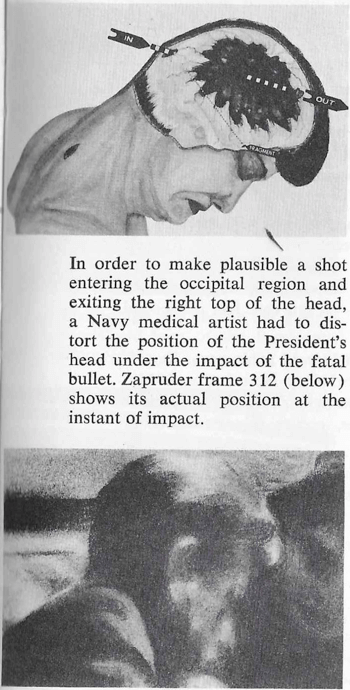
    One might ask: Why does Litwin not precisely deal with the Clark Panel’s modifications of the autopsy? Specifically, their raising of the rear skull wound and the appearance of the 6.5 mm object? Perhaps because, as the leader of that panel, Maryland Medical Examiner Russell Fisher, later said: the panel was formed to counter what the critics had pointed out about the Commission’s version of the autopsy. (Maryland State Medical Journal, March 1977) One way the 1968 panel did this was to raise the rear skull wound, so it would not misalign so much with both Kennedy’s positioning in the Zapruder film at frame 313 and also with where the exit wound on JFK was supposed to be: above and to the right of his right ear. Josiah Thompson had shown that the Commission had misrepresented these matters in illustrations in the volumes. (Six Seconds in Dallas, p. 111)

    What the Clark Panel did was help solve the problem of how the bullet came in: at a low point on the rear skull, on a downward angle; but exited at a higher point and, by necessity, at a rising angle. But, as David Mantik later pointed out, the Clark Panel’s “solution” left another huge problem. The base and nose of the skull bullet were found in the front of the car. (See Clark Panel Report p. 6; WR, pp. 557–58) This meant the 6.5 mm object, still in the rear of the skull, had to come from somewhere in the middle of the bullet. How could such a thing happen? Should we call it the Second Magic Bullet? Litwin does not tell the reader about this problem, so he does not have to explain it.

    In spite of all the problems in the official record, which he sidesteps, there is still another HSCA shibboleth that—in his apparent allegiance to Paul Hoch—Litwin trots out to uphold the findings of that committee, namely that the autopsy photographs were authenticated. As with so many aspects of the HSCA, the ARRB declassification process has made this issue problematic. The HSCA wrote that, even though they had not found either the camera or lens used during the autopsy, the pictures were authenticated due to features on the photos that showed internal consistency. (HSCA Vol. 6, p. 226, reference 1) In itself, this seems questionable, since there was no comparison with the original apparatus utilized at Bethesda Medical Center on 11/22/63. But, as the ARRB found out, it’s worse than that. The Pentagon had found the only camera in use at Bethesda in 1963. But when the HSCA tested it, they found that the test results disagreed with its analysis. As Gary Aguilar notes, perhaps there was a different lens and shutter attached to the camera afterwards. But when the ARRB tried to search for the actual tests performed by the HSCA on the camera, the Board could not find them. Whatever the case, the statement made by the HSCA on this matter does not align with the declassified record. (The Assassinations, edited by James DiEugenio and Lisa Pease, pp. 279–80)

    Let us go to another huge problem with the medical record, one I wrote about in The JFK Assassination. ARRB Chief Counsel Jeremy Gunn examined the official autopsy photographer, John Stringer. When he showed him photos of Kennedy’s brain, the witness was visibly puzzled. The pictures Gunn showed him were shot with a different film than what Stringer used and were performed with a different technique. The latter was betrayed by a series of numbers on the film. Stringer also said that, on the brain photos he originally saw, the cerebellum was both damaged and cut. Here it was presented as intact. When asked directly by Gunn if he would say these were the photos he took of Kennedy’s brain, Stringer replied “No, I couldn’t say that they were President Kennedy’s.” (Doug Horne, Inside the ARRB, Vol. 3, pp. 806–10) Again, can one imagine the impact of such testimony during a legal proceeding? How could the HSCA not discover this very important revelation? This new ARRB evidence leads to these questions:

    1. Who really took those photos?
    2. Why was a second set needed?

    As I demonstrated above, every single modification of the evidence I have mentioned in this review, or in my book, exists in the official records of this case. They are all there for the interested party to see. There is nothing fanciful about it. Litwin’s postulation that I had no witnesses or paperwork to support what I wrote in that regard has been shown above to be utterly false. It can only exist in his cherry-picked world. The problem with his doing that is that he leaves out proof which alters the contours of the evidence and changes the forensic conclusions in the JFK case.

    Post Script: In looking through my notes, I see that I left one point out which I think Litwin is correct about. The author dedicates the book to John McAdams and Paul Hoch. Today, for reasons stated above and throughout, I would have to agree that such a pairing is appropriate. I will deal more with this later in the series.

    Click here for Fred Litwin, On the Trail of Delusion – Part One.

  • Caitlin Johnstone, JFK, and the Insurrection

    Caitlin Johnstone, JFK, and the Insurrection


    Caitlin Johnstone is one of my favorite journalists. She is well-informed, bright, witty, and her sympathies are in the right place. In fact, we write for two common publications: the online Consortium News and S. T. Patrick’s paper magazine garrison.

    As everyone knows, January 6, 2021, will go down in history as one of the most frightening days of the new millennium. The only thing I can compare it to is the so-called “Brooks Brothers riot,” that took place in Dade County in 2000 that helped give George W. Bush his illegitimate presidency. That, of course, was not really a riot. It was arranged by people like Congressman John Sweeney and Republican political operative Roger Stone. The idea was to stop a recount of votes in the Miami area that would have likely given the election to Vice-President Al Gore. Through violent and intimidating means, it succeeded in that aim.

    What happened on January 6, 2021, was much more lethal. So far eight people have passed on because of that insurrection. Five died as a direct result of the violence and three took their own lives afterwards: two policemen and one man who was about to be arrested. Caitlin Johnstone has been trying to tell her audience that we should discount what happened on that day; it really was not an attempt to overturn the election and thereby keep President Trump in power. (Click here for details) Besides that, she says if we did maintain it as such, we may unleash something even worse; like attacks on and censorship of the web and social media. This could be used against progressives.

    Again, let me reiterate, I like Caitlin. But I beg to disagree with her about this importance of this event. To me, that scene at the Capitol resembled the climactic, surreal riot scene from Nathaniel West’s The Day of the Locust. It was so disturbing that I went out and bought a 12-pack of beer to dull the pain of watching it. To me, it is not something to discount or try to forget anytime soon. How does one forget a gallows constructed across the street from the Capitol while the insurrectionists were looking for Vice President Pence? Another insurrectionist was looking to shoot House Speaker Nancy Pelosi. Representative Alexandria Ocasio-Cortez said that, while in hiding, she literally feared for her life. (Click here for details) She should have, since another insurrectionist has now taken back his threat to shoot her.

    We, who study the John F. Kennedy assassination, should be able to point out certain similarities that betray the event as not simply a spontaneous Westian outburst. The night before at a “Stop the Steal” rally in front of the Supreme Court, Roger Stone compared Trump to Abraham Lincoln and cheered on the crowd by saying the president had “Freed This Slave!” (Click here for details) There were credible reports that there were explosives set outside both the Democratic and Republican National Committee headquarters. Investigators later theorized that the alerts about these bombs were diversions, meant to distract police from the marching crowd, but there were not many police on hand to distract. Because, as with the security stripping around President Kennedy in Dallas, there was definitely a real problem in supplementing the terribly outnumbered Capitol Police force. (Click here for details)

    Authors Michael Kurtz and the late John Davis noted reports of people being in Dealey Plaza and looking like they were lining up targets two days before the assassination. (Kurtz, Crime of the Century, second revised edition, p. 218) In the January 6th case, there are various reports by congressmen that fellow representatives were showing people with MAGA hats around the building in the days before the insurrection. One of the “Stop the Steal” rally organizers, Ali Alexander, admitted that he received help from three representatives in organizing the insurrection. (Click here for details) At least one of the men Alexander named—Representative Mo Brooks—spoke at the rally on the Ellipse before the insurrection. The two others named by Alexander reportedly requested pardons from Trump before he left office. (Click here for details)

    This would seem to suggest that the insurrection was, at least partly, an “inside job.” There are numerous parallels to this in the JFK case. I will name just two. On the recovered Air Force One Tapes, General Curtis LeMay’s aide de camp is seeking him right after the assassination, as LeMay is flying in from Toronto to Washington DC . The Air Force officer was reportedly seen at the autopsy that evening. (Click here for details) In the film, The Parkland Doctors, there is witness testimony that either a Secret Service man or an FBI agent pulled Dr. Malcolm Perry aside after he told the press that Kennedy had been shot from the front. This man told Perry, “Don’t ever say that again!” This was about 90 minutes after the assassination.

    While the insurrection was in progress and a mob was seeking Pence, Donald Trump and Rudy Giuliani were not seeking to quell the violence. They were calling in to the besieged Capitol, trying to locate certain senators in order to attempt to stall the tallying of the Electoral College final vote. (Click here for details) This recalls the military interference with the official JFK autopsy, exposed by Dr. Pierre Finck at the trial of Clay Shaw in New Orleans.

    What should make all of the above even more distressing is that the January 6th insurrection was not, as Caitlin would like to characterize it, an outlier. Six men have been indicted in a plot to kidnap Democratic Governor Gretchen Whitmer of Michigan. That indictment was handed down just over two weeks before the insurrection. (Click here for details) As people in the JFK field know, there was an attempt to kill President Kennedy in Chicago about three weeks before he was gunned down in Dallas.

    As readers of this site will recall, I criticized historian Steven Gillon six weeks before the insurrection. He had written an editorial for the Washington Post saying that those who had tried to create confusion over the results of Trump’s election loss were doing so under the influence of the late Mark Lane. (Click here for details) I replied that Gillon was utterly wrong on this. The section of the populace espousing such subterfuge seemed to me to originate with the rightwing followers who had fallen prey to the Red Scare demagoguery of Joe McCarthy, Roy Cohn, and later, the fruitiness of the John Birch Society. From the results of January 6th, I was correct on this and Gillon was wrong. I await his apology. But since Gillon worked on the JFK case with the likes of Dale Myers, I know I will not get one.

    President Kennedy was fully aware of the burgeoning power of these ultra conservative minions. He had requested reports on them, made speeches against them, and fully understood how they hindered what he really wanted to do as president. After UN Secretary General Dag Hammarskjold was murdered—and Kennedy had received reports that such was the case—Kennedy called in a Swedish diplomat to pay his respects. Kennedy told him that, in his opinion, Hammarskjold was the greatest statesman of the 20th century. He could never equal that stature, because he had to worry about the power of these reactionary forces and their leaders in the United States. I will point out two examples. Domestically, General Edwin Walker and the John Birch Society had organized the demonstration at Ole Miss to stop James Meredith from integrating the university. This turned into a full scale riot which killed two people. As many researchers have written, Kennedy was planning his withdrawal from Vietnam around his re-election in 1964. He felt he had to, since he told his confidantes he knew he would be pilloried as an appeaser if he did it beforehand. (Ken O’Donnell and Dave Powers, Johnny We Hardly Knew Ye, p. 16) Finally, we all know how upset JFK was when he read the infamous black-bordered negative advertisement against him in the Dallas News on the morning of his death. He told his assistant Dave Powers not to let his wife see it. (Ibid, p. 24)

    This movement has mushroomed in recent decades (e.g. QAnon). On January 6th, they came armed and dangerous. Since the security on the Capitol was so unprepared, only about 70 people were arrested that day, but the arms cache discovered was formidable. It included IED bombs, Molotov cocktails, assault rifles, thousands of rounds of ammunition, a crossbow, brass knuckles, stun guns, and “stinger whips.” (Click here for details) There were reports that some of them brought climbing equipment. God knows what would have been recovered if there would have been a systematic search of all the perpetrators. How can one dismiss an armed, frenzied mob that was searching for people to execute, especially when it had been warmed up by previous demonstrations?

    In mid-November, the Proud Boys had arranged a march in Washington. During the rally, Trump drove past in his motorcade. That evening after fights had broken out in the street, Trump tweeted, “ANTIFA SCUM ran for the hills today when they tried attacking the people at the Trump Rally, because those people aggressively fought back.” (Talking Points Memo, 1/25/21, by Tierney Sneed and Matt Shuham, hereafter referred to as TPM) On December 5th, at a rally in Georgia, attorney Lin Wood and former NSC member Mike Flynn endorsed a call for martial law. Wood tweeted that the governor of Georgia and the secretary of state would “end up in jail,” if they did not help Trump overturn the election. (TPM)

    On December 12th, there was another “Stop the Steal” rally in Washington DC. At this one, Trump did a helicopter flyover as the organizers pleaded for him to call up a citizen militia “now while he is commander in chief.” (TPM) That evening, there were several stabbings and over a dozen arrests, as the Proud Boys set aflame Black Lives Matter banners which had been torn down from historically Black churches. (ibid)

    At about this time, political activist Amy Kremer of Women for America First began a bus tour through the south, including the deep red states of Tennessee, Kentucky, and Louisiana. She and other speakers would arrive in a red bus, marked with large white lettering: “March for Trump.” The idea was to recruit the crowd for January 6th. Kremer’s effort was in large part financed by Mike Lindell, the CEO of My Pillow company and a vociferous Trump backer. Kremer would stop and then speak at a prearranged gathering from a stage. She would say, “It is up to you and I to save this Republic. We are not going to back down, are we?” (Reuters, 1/11/21, story by Joseph Tanfani) These Kremer rallies were televised by the Right Side Broadcasting Network. That network was started for the purpose of giving Trump’s rallies more broadcast exposure. On December 19th, Trump tweeted for his followers to be at the Ellipse on January 6th.

    In addition to Kremer’s group, Charlie Kirk of Turning Point Action also sponsored the January 6th rally. This is a conservative campus student group. Kirk also helped finance seven busloads of students in his group to attend the rally. (ibid)

    To say the effort paid off is putting it mildly. The rally itself had to have been attended by tens of thousands. The Trump clan was assembled in what appears to be a tent off of the Ellipse, monitoring the crowd through TV screens. They are laughing and joking while urging Mike Pence to do the right thing. If you have not seen this video, you should. (Click here for details) All the while the late Laura Branigan is singing her smash hit “Gloria” in the background. (CNBC report of 1/8/21 by Dan Mangan)

    During the rally, the two main speakers were Trump and his attorney Rudy Giuliani. One can cherry pick parts of their addresses, in order to defend both men. But taken as a whole, I think there is little doubt that those two speeches caused the crowd to march to the Capitol under Giuliani’s pretense of “trial by combat.” The aim was to somehow pressure the House, the Senate, and Pence to reject the electoral college vote tally and send it back to the state legislatures to be reconsidered. There had been a prior attempt to do this in 1960 by certain deep south electors who did not want Kennedy in the Oval office, but would have accepted Lyndon Johnson with Kennedy as his VP. (Washington Post, 12/12/21, story by Ronald Shafer)

    What makes this maneuver a bit bracing is this: Giuliani had prepared for it by visiting certain gatherings of state legislators and briefing them on how the election had been stolen by Biden’s allies from Trump. (TPM) Some of the states visited were Pennsylvania, Michigan, and Georgia. In the first instance, Trump spoke to the legislators directly by speaker phone.

    The problem with all these pre-planned efforts to claim a stolen election is this: Trump could not even get his own elections supervisors to back them. Chris Krebs is a lifelong Republican who had worked security for Microsoft before coming to Washington. He was Director of Cybersecurity, meaning that, if asked, he would check all voting systems states used in advance. His goal was to get as close as possible to a complete paper ballot back up system. He decried Trump’s claims of voter manipulation. He stated under oath that the 2020 presidential election was “the most secure in American history.“ Before the senate, on December 16th, he took the time to debunk several of Giuliani’s specific claims. He was fired. Bill Barr, Trump’s Attorney General also refused to back him. He was forced to resign. Trump tried to get the officials in Georgia to go along with his fraud claims. After all, Georgia’s votes had been recounted three times. There is a now famous recorded phone call of the president talking to Georgia’s Secretary of State, Brad Raffensperger, asking him to “find” 11, 800 votes for him. Raffensperger declined to cooperate. After the call, Gabe Sterling, his chief operating officer, took the time to, again, debunk individual claims. He later showed how Giuliani had edited a tape to make it mean something it did not. He concluded one of his press conferences by saying all of these propagandistic and incendiary claims were going to result in someone getting hurt, shot, or killed. He was correct. (Click here for details)

    But perhaps the most surprising scheme that Trump dreamt up did not surface until recently. Apparently, Trump was going to also terminate his acting Attorney General Jeff Rosen. He would replace him with Jeffrey Clark, because Clark was willing to do what Rosen would not: pressure lawmakers in Georgia to overturn their election results. The only reason this did not come to pass is there was a threat of mass resignations in the Justice Department if it did. Trump did not want to face a reprise of the infamous Saturday night Massacre of Richard Nixon. (Seattle Times, 1/24/21) But part of the plan seems to have been enacted, since Trump did replace the US attorney in Atlanta after he would not go along with the scheme.

    In light of the above, I personally think it is untenable to try and maintain that there was not a serious effort in the White House to overturn the results of the 2020 election, an election which even Republican officials in Washington and Georgia say was not rigged. In fact, I do not think it is an overstatement to write that Trump spent over two months trying to overturn that election by any means at his disposal: legal or illegal.

    Trump’s agents actively recruited his followers to come to the January 6th rally. They brought arms and explosives with them. They constructed a gallows. They were looking for Pence, Pelosi, and Ocasio-Cortez. Reportedly, a newly elected representative actually tweeted about Pelosi’s location as she was hiding. (Boston Globe, 1/12/21, by Shannon Larson) During the insurrection, the mob itself communicated through the computer platform Parler, set up by the rabidly conservative Mercer family. In other words, all the elements of a criminal conspiracy to overturn the election by violence were there. What more evidence would one need: Ocasio-Cortez and Pelosi’s dead bodies? A noose around Pence’s neck? The floor of the Capitol exploded by an IED?

    On December 4, 1964, at Beverly Hills High School, there was a debate over the Warren Report. Mark Lane fiercely criticized the work of the Warren Commission. One of the defenders of their work was A. L. Wirin, a famous liberal lawyer of that era. During the proceedings, Lane was shocked when Wirin stated that we should all be happy with what Chief Justice Earl Warren had done, because if he had not, there might have been pogroms against the left. The idea being that the Commission was correct in its lone assassin conclusion, and the assassin, Lee Oswald, was a communist.

    Unfortunately for Wirin, and the rest of us, Earl Warren was wrong on both counts. Oswald was not a communist and he certainly did not shoot President Kennedy. Those of us who follow that case understand it to be an utter failure of justice, which had severe ramifications. That should not happen again.

    This author is not one of those who despises Donald Trump. Neither do I think he is the worst president in history. Anyone who thinks that does not realize how bad some of the American presidents really were. In fact, I actually agreed with some of his early foreign policy decisions. And I appreciate the fact he did not start up any new wars, but what happened on January 6th was a heinous crime against the American system of government. And there was no legal basis for it. Back in 2000, Al Gore actually did have an election stolen from him. He pursued every legal avenue he could to overturn the result. He deliberately refused to turn it over to a mob. When faced with that alternative he replied: “What do you want me to do, put blood in the streets?” It appears to this author that Trump and Giuliani took that alternative.

    The country needs a full, rigorous, no holds barred criminal inquiry into what happened on January 6th, one that is not afraid to reach into the Capitol or the White House. And if it was in any part an inside job, that needs to be exposed to us all. As Jim Garrison said, “Let justice be done, though the heavens fall.”


    Below is a link to an article by Seth Abramson which links the Trump family and his own representatives to a “war meeting” the night of January 5th at a Trump-owned hotel. The FBI should thoroughly investigate this lead. If it is accurate, it clearly suggests that Trump, his family, and his inner circle understood what would happen the next day. The name of Ali Alexander seems central to any real inquiry.

  • James Saxon and John Kennedy vs. Wall Street

    James Saxon and John Kennedy vs. Wall Street


    In this author’s opinion, the best book ever written about President John Kennedy’s economic policies is Donald Gibson’s Battling Wall Street. It was first published in hardcover in 1994. It was re-released in 2014 in a trade paperback edition. Before addressing my main subject, I would like to review a bit of that important book. The main reasons being:

    1. It is relatively rare, and
    2. No other book I know of equals its thoroughness of subject matter.

    As Walter Heller, the Chairman of the Council of Economic Advisors, stated, Kennedy was very interested in the details of economic policy and he was a good student of worldly philosophy. One of his major goals as president was to attain higher rates of growth and productivity. (Gibson pp. 6, 20) As early as 1961, Kennedy said that he supported “long range planning for national economic growth.” (ibid p. 21) This included a multipronged program of tax policy, trying to balance the budget, investment in technology and education, and the use of fiscal policy for capital improvements.

    In the decades since, the Republican Party has tried to use Kennedy’s tax cut proposal—achieved after his death by Lyndon Johnson—as intellectual support for the whole Arthur Laffer/supply-side economics concept. There are many, many problems with this faulty comparison. First, any economist should know that Kennedy was a Keynesian, not an apostle of what we call today, the Austrian School, best represented by the late Milton Friedman. (Heller had nothing but disdain for Friedman, considering him something of a clown.) As Heller later said, Kennedy chose the tax cut option as a stimulant, because he knew it would be an easier sell to congress and it would cure the mild recession faster than a capital investment program. (Gibson, p. 21) Once the recession danger had subsided, he would then begin a capital investment program.

    Further, as Timothy Noah pointed out in 2012, when congressman Paul Ryan was selling this false comparison, there was a distinct difference between the Kennedy/Heller tax cut and the Mitt Romney/Ryan proposal. The latter was an across the board cut. The Kennedy proposal was weighted toward the middle and especially the lower classes. (The New Republic, 10/11/2012) As Noah wrote, this, in itself, demonstrates that it was a demand, not supply, oriented cut. As Noah also pointed out, Ronald Reagans’ 1981 tax cut was also supply-side oriented, since the higher ratio of tax cuts went to the upper class. Budget director David Stockman later admitted that the upper-class cuts were the point of the act. But it was hard to sell ‘trickle-down economics.’ So, they dressed it up with a new term: ‘supply-side’. (Ibid) And let us not forget: at the time JFK entered office, the top marginal rate was 91 percent. Kennedy was proposing to cut it to around 71%. When President Reagan was done with it, that top rate was eventually reduced to 28 per cent. In other words, Reagan cut it by more than 60 per cent. There can be little doubt that this colossal cut for the already wealthy contributed to the very serious problems of income inequality and the bankruptcy of the treasury.

    As Gibson points out, that marginal cut was only part of Kennedy’s tax reform program. He also wanted to encourage investment in plant and technology, so he provided an investment tax credit for corporations to do so. (Gibson, p. 21) Kennedy added a caveat to this: it was only good on materials located in the USA and had an operative life of six years or more. In other words, it was aimed at improving domestic production in the long term. One of the specific aims of this incentive was to make American goods more competitive in world markets by increasing productivity. (ibid, p. 22) In other words, it was a nationalist program.

    Related to this, Kennedy wanted to end the policy of tax deferral for companies investing abroad, especially in low tax countries and places like Switzerland. His tax reform program would move to eliminate these kinds of tax breaks. (The only exception to this was to preserve certain tax breaks if a company invested in a developing country emerging from colonialism, e.g. Indonesia.) As Gibson comments, Kennedy’s overall program was not anti-business. It was really pro-production and nationally oriented.

    II

    Kennedy’s tax proposal was also aimed at securing for the treasury billions of dollars “in income from interest and dividends going unreported and untaxed each year.” (Gibson, p. 23) His proposal was to use an annual withholding tax, as with middle class income. For dividends, he proposed a higher rate of tax on families with incomes over $180,000 per year—almost two million today. He also proposed tax code alterations to prevent the wealthy from concealing income garnered through advantages like investing in holding companies.

    As Gibson notes, many of these proposals—and others—did not make it through congress or to the ultimate revenue bill passed in 1964. It’s not possible to predict if Kennedy would have brought them back if he had lived. But even in their raw proposal state, they would indicate where Kennedy was headed. And that would be on a notably liberal—today the word is progressive—pathway. Kennedy felt that wealth should be acquired and used through productive investments that benefited society as whole. He was not in favor of profits accrued through financial speculation and inheritance. As Gibson notes, Kennedy’s overall program was trying to guarantee that the

    …search for profit would not end up destroying rather than creating economic prosperity for the country. In this he was very clear, consistent and coherent. (p. 24)

    Kennedy did not like running deficits, but if they were necessary, he would utilize them in aid of economic expansion and low unemployment, in other words, for Keynesian aims. (Gibson, p. 27) Part of that aim was to prepare a stand by program to prevent future economic downturns. A future downturn was to be alleviated through a combination of tax cuts, capital improvements—including direct grants in aid to cities and states—and expanded unemployment insurance. In this regard, and as we should all be cognizant of today after CV 19, JFK seems to be granting options to himself from the domain and prerogatives of the Federal Reserve. (Gibson, p. 29)

    The program as a whole was to be greater than the sum of its parts. In other words, Kennedy meant to have it perform in a synergistic fashion. As Gibson wrote, “each specific policy would reinforce and intensify the other initiatives.” (ibid, p. 30) Kennedy wanted to shift capital from non-productive to productive investments. He was specifically interested in expanding low cost energy production. (Gibson, p. 24)

    The above program, combined with Kennedy’s policies overseas (which this site had reviewed at length), made the president rather unpopular with the corporate aristocracy. The early sixties were the maturation of the multinational corporation. But beyond that, Kennedy had made himself a target for big business by his stand in the U.S. Steel case in 1962. As the late John Blair wrote about that conflict, it was “the most dramatic confrontation in history between a president and a corporate management.” (Blair, Economic Concentration, p. 635)

    Kennedy had taken much time to negotiate a freeze on both wages and prices in the steel industry, in order to head off an inflationary spiral in the economy. After he thought this had been accomplished, on April 10, 1962, Roger Blough of U. S. Steel requested a personal meeting with the president. This was about ten days after the agreement had been signed. Blough flew into Washington and handed the president a press release saying that his company would announce a 3.5% price increase in six hours. (Gibson, p. 10)

    Kennedy was outraged that Blough would turn on him at the last minute. He perceived that what the steel companies were trying to do was to humiliate him and cripple leadership of his economic program in public. Most readers of this site know how this turned out. Attorney General Robert Kennedy had FBI agents serve subpoenas on the chief executives of the steel consortium in the wee hours of the morning for suspicion of collusion and price fixing. JFK went on national television to condemn their actions. In no uncertain terms he said that the:

    …simultaneous and identical actions of United States Steel and other leading steel corporations increasing steel prices by some $6 a ton constitutes a wholly unjustifiable and irresponsible defiance of the public interest. (Click here for details)

    Beyond that, he then went even further in his priority of the pubic good over corporate greed. He stated that the American people would find it hard to accept,

    …a situation in which a tiny handful of steel executives, whose pursuit of private power and profit exceeds their sense of public responsibility, can show such utter contempt for the interests of 185,000,000 Americans.

    Within hours, one by one, the steel companies capitulated. (Gibson, p. 11) I don’t have to ask the reader the last time he recalls a president speaking up like this for the interests of the common man over the Wall Street oligarchy. In fact, Fortune magazine theorized that Blough may have been acting as an emissary for the corporate class to discourage the Kennedy example of cooperation between government and business. (Fortune, May, 1963) That article said that this hidden motive could explain the bizarre timing and inherent disdain of Blough’s audience with JFK. The article also stated that it was almost as if the intent was to provoke the maximum friction between the new president and the business world. Author Grant McConnell agreed that Blough’s awkward move was meant as a direct challenge to Kennedy. (Steel and the Presidency, 1962, pp. 6–7) McConnell then developed this idea further:

    Acceptance would have had the result of forcing the administration to abandon any hope of dealing actively with economic issues, which was of course, one of the chief desires of many business leaders.

    III

    There are indications that Blough was representing more than himself in his conflict with Kennedy. One such indication was the continual attacks on Kennedy and his administration in what many have called the Lucepress, that is Henry Luce’s Time-Life-Fortune magazine empire. In fact, one of the earliest and most lasting assaults on Kennedy was published in Fortune magazine. Fortune was a business-oriented monthly publication at that time, e.g. publishing the annual Fortune 500 and Fortune’s Investors Guide. It was designed for the Wall Street, high-end investor class to inform them about business directions and places where capital could be increased through speculation.

    Yet, in September of 1961, reporter Charles Murphy was allowed to publish an article called “Cuba: The Record Set Straight.” It was not at all a business article. Without exaggeration, it was an all out attack on Kennedy’s foreign policy. And it was not actually written by Murphy; he was the ghostwriter. It was actually designed by Howard Hunt, under the supervision of Allen Dulles. Hunt himself spent two days working on the formal composition with Murphy. (James DiEugenio, Destiny Betrayed, Second Edition, p. 54) That Luce would allow his flagship business magazine to be used in such a way tells the reader how highly he valued Dulles and, inversely, what he thought of Kennedy.

    The article is written in pure Hunt/Dulles, heightened Cold War style. Although its title refers to Cuba, it attacks Kennedy for seeking a neutralist solution in Laos and for not backing Ngo Dinh Diem strongly enough in Vietnam. It then leaps to the conclusion that because of those weak policies, Kennedy had to resort to the Bay of Pigs invasion of Cuba. It was this article which began the whole myth of the cancelled D-Day air strikes. The idea that, on the morning of the actual landing of the Cuban exiles, there was a scheduled air strike from Guatemala intended to knock out the last remnants of Castro’s air force and thereby allowing the invading force to land freely and proceed up the beach uncontested.

    At the time this article was being composed, President Kennedy had already decided to terminate Dulles as CIA Director. His brother Robert had served on the Taylor Commission, the White House inquiry into the Bay of Pigs debacle. RFK had the opportunity to examine Dulles and he had concluded that Dulles had lied to his brother about the operation’s chances of success and certain crucial elements of its staging. (DiEugenio, pp. 42–43) It was Robert who then motivated his brother to terminate Dulles for this subterfuge.

    As we know today, and as President Kennedy knew back then, there were no such D-Day air strikes scheduled from Guatemala or anywhere else except Cuba. Both the CIA and Kennedy understood that the president wanted further sorties to be flown from a secured air strip on the island. (DiEugenio, p. 45) As Bobby Kennedy later concluded, Dulles knew the operation would fail on its own. He was gambling that Kennedy would send in the Navy to save the expedition, rather than sustain a humiliating defeat. Dulles was wrong. Kennedy found out about his scheme and decided to relieve him. Through his friend Luce, Allen Dulles now had Hunt and Murphy covering for him. He would blame the failure of the Bay of Pigs on Kennedy.

    In 1963, Fortune opened up on Kennedy’s general economic policies. They scored his Keynesian approach to the economy. The editors said the real wise men of economics were monetarists like Milton Friedman and Friedrich Hayek. They also criticized JFK for running budget deficits to create growth. As Gibson observes, “Fortune was among the leaders in rejecting virtually every major aspect of Kennedy’s domestic economic program.” (ibid, p. 59)

    But that was not all. Charles Murphy wrote another article in Fortune in March of 1963. It was entitled, “Billions in Search of a Good Reason.” This one went after Kennedy’s foreign aid program. Murphy criticized Kennedy’s efforts to try to promote industrialization and growth in the Third World. He concluded that this process had gotten out of hand.

    Murphy also criticized Kennedy’s attempts to deal with these nations directly in bypassing international organizations, e.g. the World Bank. Murphy also scored his failure to stipulate that aid must be linked to agreements to purchase goods from America. This seems to be partly a reaction to Kennedy’s Alliance for Progress, which offered direct aid from the Treasury to Latin American nations. As Walter LaFeber notes in his book Inevitable Revolutions, that program was stripped down under Lyndon Johnson. When Nixon became president, he assigned Nelson Rockefeller to write a report on the program. Once Rockefeller’s report was submitted, the president eliminated the alliance. (Click here for details)

    Murphy concluded his article by saying that a large and important part of the banking community was against Kennedy’s foreign aid program. He specifically named the chairman of the board of Chase Manhattan and the president of First National Bank of Chicago. To even have Murphy writing these articles was clearly a conflict of interest on a personal level. Because once Kennedy had read the 1961 article on the Bay of Pigs, he was so angry that he stripped Murphy of his Air Force reserve status. In a letter to Edward Lansdale, Murphy said this did not bother him that much. Why? For his true loyalty was not to President Kennedy but to Allen Dulles. (DiEugenio, p. 46)

    As anyone who knows what Kennedy was trying to do in places like Congo and Indonesia, it would be fitting that the banking community would be opposed to his reformist policies. As John Perkins outlines in his book, Confessions of an Economic Hit Man, the aim of the international banking community was and is to keep emerging nations in debt so that they can control investment, thereby substituting imperialism for colonialism. Kennedy actually mentioned his opposition to this policy in his Inaugural Address: “…we pledge our word that one form of colonial control shall not have passed away merely to be replaced by a far more iron tyranny.” To this writer, that statement—and Kennedy’s policies in places like Indonesia and with the Alliance for Progress—seems to be in opposition to the emerging globalist agenda of the American banking community. As the European colonial era was ending, Wall Street saw an opening for American imperialism to take its place.

    IV

    Douglas Dillon was ambassador to France as part of the Eisenhower administration. He was quite familiar with the Rockefeller family, since he attended the elite private school of Pine Lodge in New Jersey with three of the Rockefeller brothers: Nelson, Laurence, and John. After the war, he became chairman of his father’s firm, Dillon, Read, and Company, a large investment bank on Wall Street. He was a lifelong Republican, who aided Dwight Eisenhower in his campaign to secure the GOP nomination in 1952. He was also a large contributor to Ike’s general election. As many authors have pointed out, John Kennedy did not really appoint his own cabinet. His brother-in-law Sargent Shriver and, to a lesser extent, Ted Sorenson and Phil Graham of the Washington Post organized a search list, which they then brought to Kennedy. (Arthur Schlesinger, A Thousand Days, p.132) According to Arthur Schlesinger, it was Paul Nitze who first suggested Dillon as Treasury Secretary. Then Graham and Joe Alsop pushed him on Kennedy. What made this even more odd is that Dillon had contributed to Nixon’s campaign in 1960. (ibid, p. 135) When Schlesinger pointed this out, Kennedy replied he really did not care about that issue. What he wanted to know was if Dillon was able and would he go along with his program?

    Dillon was able, but if Kennedy had demanded a bit more research, he would have found out that Dillon was a questionable enlistee in his program. For instance, from before he was elected, it was clear that Kennedy was going to support the democratically elected Patrice Lumumba in an independent Congo. Dillon had backed the Allen Dulles view that Lumumba was in the arms of Moscow—which he was not. He also feared Lumumba’s powers of oration to rally the army about him. (David Talbot, The Devil’s Chessboard, p. 379–80) Another African leader that Kennedy favored was Kwame Nkrumah of Ghana. Dillon thought that Nkrumah was a Castroite and, therefore, Kennedy should not aid Nkrumah’s pet project, the Volta Dam. (Philip Muehlenbeck, Betting on the Africans, pp. 84–85)

    As Donald Gibson notes, one of the things that many of his critics were disturbed about was Kennedy’s willingness to loan what they called “easy money” for credit purposes. Which, of course, is what the Alliance for Progress was about: low interest or no interest loans for infrastructure and capital improvement. By 1962, Dillon seemed to have gone over to the side of Kennedy’s critics on this and other issues. For example, he was pressing for less government spending, except for defense expenditures. The Wall Street Journal, another consistent critic of Kennedy, wrote in 1963 that the activists in the administration, like Heller, had gained the upper hand over the conservatives like Dillon. (Wall Street Journal, 10/3/63, article by Philip Geyelin) The article said that Kennedy did not want to rely on monetary policy to cure a balance of payments problem. And, in fact, the president had come to think that such problems were too important to be left to bankers. He also did not agree with another of their notions, namely letting interest rates rise. (Hobart Rowen, The Free Enterprisers: Kennedy, Johnson and the Business Establishment, p. 179)

    By 1963, there was a split within the administration over general economic policy. There was on one side the activist Kennedy group which included JFK, Heller, and Franklin Roosevelt Jr. of the Commerce Department. On the other side was Dillon, the Federal Reserve, and their outside backer David Rockefeller of Chase Manhattan. (Gibson, p. 74)

    V

    One way that it appears that Kennedy tried to get around this logjam was through James Saxon. Saxon was Kennedy’s Comptroller of the Currency. That position charters, regulates, and supervises all national banks and, back then, thrift institutions. It also had control over branches and offices of foreign banks in America. I first recall reading about Saxon in the late Jim Marrs’ book, Crossfire. As Marrs described it, Saxon had been:

    …at odds with the powerful Federal Reserve Board for some time, encouraging broader investment and lending powers for banks that were not part of the Federal Reserve System. Saxon also had decided that non-Reserve banks could underwrite state and local general obligation bonds, again weakening the dominant Federal Reserve banks. (p. 275)

    From here, Marrs went on to the controversy surrounding Executive Order 11110, where Kennedy authorized printing silver certificate currency out of the Treasury. I believe Marrs was wrong about that issue, as many others have been. (Click here and scroll down to EO 11110) But he was correct about James Saxon’s struggle.

    In November of 1963, Saxon granted an interview to US News and World Report. The interview was given before the assassination, but not published until after Kennedy’s death, in the issue of 11/25. In the introduction to the interview, the editors wrote that:

    A little-known federal banking agency suddenly has burst into the news, stirring controversy. James J. Saxon, Comptroller of the Currency, who has shaken up many banking regulations, now finds himself at odds with the Federal Reserve Board and some of this country’s leading bankers. The Comptroller approved scores of new national banks, and branches, spurred key mergers, revised outmoded rules. Result: Keener competition for deposits and loan customers.

    In this interview, Saxon explained why he was taking these rather exceptional measures. He attacked the banking establishment for not doing all they could to fulfill their customers’ needs; whether they be individuals or businesses. He specifically criticized low interest rates on saving accounts and the shortage of installment loans. He also complained about the reluctance of banks to make loans to farmers. He added that some of this was due to over-regulation, but he was also clear that banks “ought to be out working with all sorts of businesses, with industry, with farmers finding ways to be helpful. Many haven’t been doing it.” Saxon noted that he was attempting to relax rules in certain areas in order to encourage more widespread granting of credit. He said that he was very well received among commercial entities interested in borrowing.

    Saxon went on to say that his reform agenda had run into opposition within the banking industry itself, mainly from bankers of the older generation. He also specifically said he had problems with the Federal Reserve Board. He mentioned the Chairman of the Board, William McChesney Martin, as being in disagreement with him. The interviewer stated that when Saxon went to congress, Martin opposed all of his reform suggestions.

    Saxon thought the Fed had too much power over what banks could offer as interest rates on accounts and also too much control over loans on large construction projects. In regards to that, he specifically stated that the Fed should not determine how money can be used. In the interview, he said that Rockefeller’s Chase Manhattan had too much sway with the Fed. Saxon wanted more competition in banking and he wanted more new banks in more communities, since he felt banks had much to offer to the life of a community, no matter how small. I encourage everyone to read this remarkable interview.

    At the end, he clearly implies he had John Kennedy’s backing and no one had resisted his policies from above. In reading the interview, one wonders if Saxon was the man Kennedy sent forward to duel with Chase Manhattan, since Dillon would not. It turns out that Kennedy and Saxon had a common problem, namely Dillon.

    After Kennedy’s death, on May 18, 1964, Saxon sent Dillon a memo.  It was really more of a complaint. Saxon’s office had sent three bills to Dillon to pass on for approval to congress. They all coincide with the tenor of the Saxon interview. The first was to expand the comptroller’s office powers over foreign banking and financing corporations. The second was to clarify requirements of reports on conditions of national banks. The third was “to remove the power of the Board of Governors of the Federal Reserve System to examine National Banks.” Saxon was quite upset that Dillon had stalled on all three, to the point that he felt his office was being discriminated against. He complained that his views were being ignored, especially when the Federal Reserve took a contrary opinion, which they likely did in regards to the third bill he mentioned to Dillon. One has to wonder if, with Kennedy dead, Dillon felt free to marginalize Saxon.

    At the end of Part 6 of his “Creating the Oswald Legend” series, Vasilios Vazakas points to the upper levels of the American Power Elite as to where the final approval over JFK’s assassination came from. As Gibson points out, and as I have tried to indicate here, the economic powers in America had been pushing for a globalist agenda even during Kennedy’s presidency. They wanted European colonialism to be replaced by American imperialism, which would allow American business entities to be shipped abroad. They also wanted old-fashioned tight-money monetarist rules in banking. Kennedy opposed both.

    As David Talbot notes in The Devil’s Chessboard, Doug Dillon supervised the Secret Service back in 1963. Even Howard Willens of the Warren Commission was surprised as to how Dillon managed to escape a real grilling, including refusing to turn over certain Secret Service records. (Talbot, p. 584) Willens later found out that Dillon had enlisted Warren Commissioner John McCloy in his cause and McCloy had gone to President Johnson to give Dillon more backup. McCloy was employed at the time by the Wall Street law firm of Milbank, Tweed, Hadley, and McCloy. McCloy’s office was located in New York, at Rockefeller Center.

  • Neil Sheehan: In Retrospect

    Neil Sheehan: In Retrospect


    Neil Sheehan passed away on January 7th.  His death would have attracted more attention if it had not occurred the day after the Trump/Giuliani inspired insurrection at the Capitol in Washington DC. We will give his death more than passing notice because, in a real way, the Establishment-honored Sheehan represented much of what was wrong with the New York Times, and big book publishing in general.  So if our readers are looking for an adulatory or commemorative eulogy for Sheehan, they should go over to the NY Times.  It won’t be found here.

    Sheehan was born of Irish parents  in Holyoke Massachusetts and graduated from Harvard in 1958.  After his military service he went to work for UPI in Tokyo.  He spent two years as UPI’s chief correspondent covering the Vietnam War.  It was at this time––1962-64––that he became collegial and friendly with the Times’ David Halberstam. And he was then employed by the Grey Lady.

    halberstam sheehan

    As the reader can see from the picture above, Sheehan and Halberstam rode in helicopters with the military to cover the war. From the looks on their faces, they appear to have enjoyed the assignment.  In fact, in the Ken Burns/Lynn Novick documentary series The Vietnam War, Sheehan said he found these helicopter sorties exciting to be involved with.

    The commander in Vietnam at that time was General Paul Harkins.  Since those two reporters were intimately involved with the actual military operations, they knew things were not going well. Yet Harkins insisted they were going fine.  As author John Newman wrote in his milestone book JFK and Vietnam, this rosy outlook was an illusion perpetrated by both military intelligence and the CIA.  It was carried out by Colonel James Winterbottom with the cognizance of Harkins. (Newman, 1992 edition, pp. 195-97). In a 2007 interview that Sheehan did, he said that he and Halberstam had a conflict with Harkins over this issue of whether or not Saigon and the army of South Vietnam (the ARVN) was actually making progress against the opposing forces in the south, namely the Viet Cong.  He said that their impression was that Saigon was losing the war. Their soldiers were reluctant to fight, the entire military hierarchy was corrupt, and as a result, the Viet Cong forces in the south were getting stronger and not weaker.

    There is one other element that needs to be addressed before we move further. It is something that David Halberstam did his best to forget about in his 1972 best-seller The Best and the Brightest, but Sheehan was more open about in his 2007 interview.  The smiles in the picture above were genuine because Sheehan and Halberstam truly believed in winning the Vietnam War.  At any and all costs.  As Sheehan further explicated about the duo:

    … we believed it was the right thing to do. We believed all those shibboleths of the Cold War, all of which turned out to be mirages : the “domino theory” that if South Vietnam fell, the rest of––Cambodia, Thailand, Indonesia––they were all going to fall one by one.  We believed the Vietnamese Communists were pawns of the Chinese and the Russians, they were taking their orders from Moscow and Bejing.  It was rubbish.  They were independent people who had their own objectives, and they were the true nationalists in the country.  We didn’t know any of this really, but we did know we were losing the war.

    I was quite fortunate to find this interview. Because I had never seen Sheehan or Halberstam be so utterly explicit about who they were and what they were about at that time. In his entire 700 page book, The Best and the Brightest, and later in his career, I never detected such a confessional moment from Halberstam. The simple truth was that Sheehan and Halberstam were classic Cold Warriors who wanted to kick commie butt all the way back to China. They saw what America was doing as some kind of noble cause. They felt that we and they––that is, all good Americans––were standing up for democracy, liberty and freedom. As far as political sophistication went, they might as well have been actors performing in John Wayne’s propaganda movie, The Green Berets. They wanted a Saigon victory with big brother America’s help. Which is the message of the last scene of Wayne’s picture. And they didn’t think Harkins was up to the task. In fact, they did not even know what Harkins was up to with his attitudinizing about America winning the war.

    II

    Neither Harkins nor Winterbottom was unaware of the true situation on the ground. In fact, as Newman shows in his book, Winterbottom would simply create Viet Cong fatalities out of assumptions he made. Harkins understood this and went along with it. (Newman, p. 224) The idea was to control the intelligence out of Saigon in order to bamboozle Secretary of Defense Robert McNamara. (Newman, p. 225) There were honest records kept. But throughout that year of 1962, whenever McNamara would report back to President Kennedy after one of his SecDef Meetings––a conference in the Pacific of all American agency and division chiefs in Saigon––he would deliver to the president the same rosy message he had just heard. And that message was false in two senses: the number of Viet Cong casualties was exaggerated, and the number of ARVN casualties was being reduced. (Newman, p. 231)

    This intelligence deception was happening in the spring of 1962. In  November of 1961, with his signing of NSAM 111, Kennedy had agreed to raise the number of American advisors and ship more equipment to Saigon.  Therefore, the true results on the battlefield in the spring of 1962 would denote that this was not really helping the war effort. As Newman wrote, the Viet Cong “had been quick to alter their tactics to counter the effectiveness of the helicopter:  quick strikes followed by withdrawal in fifteen minutes to avoid rapid reaction … .” (p. 233)

    At about this time, in April of 1962, President Kennedy sent John Kenneth Galbraith to visit Robert McNamara in Washington. He told Galbraith to give him a report that JFK had requested the ambassador to India write about the American situation in Vietnam.  Kennedy knew that Galbraith was opposed to increased American involvement in Indochina, since he had voiced those doubts to the president before.  As James Galbraith, the ambassador’s son, said to me, Kennedy fully understood that what Galbraith would write would counter the hawks in his cabinet. (phone interview of July, 2019)  Kennedy wanted the report to go to McNamara since the Defense Secretary could then begin to withdraw the (failed) American military mission.  Galbraith did so and he then told JFK that McNamara got the message. (see this article)

    One month later, McNamara had a SecDef meeting in Saigon. After that meeting, he instructed Harkins––and a few others military higher ups––to stick around for a few minutes. He told them, “It is not the job of the U.S. to assume responsibility for the war but to develop the South Vietnamese capability to do so.”  (James Douglass, JFK and the Unspeakable, p. 120) He then asked them to complete the ARVN training mission and to submit plans for a dismantling of the American military structure in South Vietnam.  He concluded by telling Harkins:

    … to devise a plan for turning full responsibility over to South Vietnam and reducing the size of our military command, and to submit this plan at the next conference. (Douglass, p. 120)

    To me, and to any objective person, this has to be considered quite important information. First, the message is quite clear and unambiguous: McNamara is saying we can only train the ARVN.  Once that is done, we are leaving; we cannot fight the war for them. Second, it is multi-sourced: from both Galbraith, and the people at the SecDef meeting in Saigon. In addition, when word got out that Kennedy had sent the memo to McNamara, a mini war broke out in Washington over what was happening. (Newman, pp. 236-37). Then in May of 1963, the withdrawal schedules were delivered to McNamara at another SecDef meeting. (James DiEugenio, Destiny Betrayed, second edition, p. 366)

    Now, here is my plaint to the reader: try to find this step by step by step milestone in Halberstam’s book. That is, from:

    1. Galbraith visiting Kennedy, to
    2. Galbraith seeing McNamara, to
    3. McNamara ordering Harkins to begin the dismantling of the American mission, to
    4. The withdrawal schedules being presented to McNamara.

    If you can find it, let me know.  Because even though I read the book twice, I could not locate any of it.  Also, try to find it in any of the many interviews that Sheehan did that are online.  On the contrary, both men always spoke of the “inevitability” of the Vietnam War. You can only maintain such a stance if you do not reveal the above information. In fact, it can be fairly stated that, in 700 pages, Halberstam essentially gives the back of his hand to the influence of Galbraith on Kennedy. And he also completely reverses  the roles of McNamara with Kennedy in Vietnam.  Halberstam wrote that it was McNamara who went to Kennedy, “because he felt the President needed his help.” (Halberstam, p. 214) He then says, on the next page, that McNamara had no different ideas on the war than Kennedy did.

    Let us be frank:  This is a falsification of the record. It was Kennedy who, through Galbraith, went to McNamara.  And it was not for the purpose of promoting the ideas of the Pentagon on the war. Now, if the alleged 500 interviews Halberstam did were not enough to garner this information, there was another source available to him:  the Pentagon Papers––which Halberstam says he read. Moreover, he says they confirmed the direction he was going in. (Halberstam, p. 669)

    Either Halberstam lied about reading the Pentagon Papers, or he deliberately concealed what was in them. Because in Volume 2, Chapter 3, of the Gravel Edition of those papers, the authors note that because progress had been made, McNamara directed a program for the ARVN to take over the war and American involvement to be phased out. That phasing out would end in 1965.  Is it possible for Halberstam to have missed this? The information appears in the chapter explicitly headed, “Phased Withdrawal of US Forces, 1962-64.”  That chapter is forty pages long. (see pp. 160-200)

    III

    At that time period when the two reporters were in Vietnam, not only did they both want to urge America and Saigon to victory.  They thought they found the man to do it.  That was Colonel John Paul Vann. In fact, before he wrote The Best and the Brightest, Halberstam wrote another book on Vietnam, called The Making of a Quagmire. It is a book that he wished everyone would forget. Unfortunately for the deceased Halberstam, it’s still in libraries. In that book, Halberstam criticized every aspect of the Saigon regime as led by America’s installed leader, Ngo Dinh Diem. Halberstam writes toward the end that “Bombers and helicopters and napalm are a help but they are not enough.” (p. 321) He then adds, “The lesson to be  learned from Vietnam is that we must get in earlier, be shrewder, and force the other side to practice self-deception.” (p. 322) In other words, at that time, Halberstam and Sheehan wanted direct American intervention; as did Colonel Vann.

    What this reveals is something important about the trio:  They had no reservations about the war America had involved itself in. America got in by its backing of France.  When France was defeated, the USA took its place.  America then violated the Geneva Accords peace treaty that ended the war.  The USA would not hold free elections in order to unify the country. America created a new country called South Vietnam, one that did not exist before.  And they installed their own handpicked leader, Ngo Dinh Diem, to rule over it.  Diem’s early regime was stage-managed by General Edward Lansdale.  According to the first chapter of Sheehan’s book about Vann, A Bright Shining Lie, Lansdale was Vann’s hero.

    Both Sheehan and Halberstam fell in love with Vann.  They were completely unaware of what was happening in Washington, how Kennedy had decided to take Galbraith’s advice and begin to remove all American advisors.  They wanted to win, and they both felt it was only through Vann that the war could be won. They both maintained that he was the smartest man for Harkins’ position.

    There was a serious problem with the approach of these three men in 1965. None of them ever raised the fundamental question of what America was doing in Vietnam, or how we got there. Lansdale was not building a democracy.  He was building a kleptocracy. He also rigged elections so Diem could win by huge margins. (Seth Jacobs, Cold War Mandarin, p. 85) He was constructing  the illusion of a republic when, in fact, none existed. Diem was soon to become a dictator. (Jacobs, p. 84) For Vann to make Lansdale his role model is a troubling aspect of the man.

    One of the reasons Kennedy decided to get out is simple:  he did not think Saigon could win the war without the use of American combat troops.  Or as he told Arthur Schlesinger:

    The war in Vietnam could be won only so long as it was their war.  If it were converted into a white man’s war, we would lose as the French had lost a decade earlier.”  (Gordon Goldstein, Lessons in Disaster, p. 63)

    Kennedy said the same thing to NSC aide Michael Forrestal: America had about a one-in-a-hundred chance of winning. The president said this on the eve of his going to Dallas in 1963.  He then added that upon his return there would be a general review of the whole Vietnam situation, how we got there, what we thought we were doing, and if we should be there at all. (James Douglass, JFK and the Unspeakable, p. 183)

    The point about it becoming a white man’s war and the whole French experience echoes back to Kennedy visiting Saigon in 1951. There he met with American diplomat Ed Gullion who told him France would never win the war, and the age of colonialism was coming to an end. (Douglass, p. 93) That visit and the meeting with Gullion had a profound effect on Kennedy’s world view. He now saw nationalism as the main factor in these wars in former European colonies. He also thought that anti-communism was not enough to constitute an American foreign policy.  America had to stand for something more than that. (For the best short discussion of this, see James Norwood’s essay on the subject.)

    And there was a further difference between JFK and the Establishment on Third World nationalism. Kennedy did not see the world as a Manichean, John Foster Dulles split image.  Unlike President Eisenhower, he did not buy into the domino theory.  It was no one less than National Security Advisor McGeorge Bundy who said this about Kennedy in an oral interview he did in 1964. (Goldstein, p. 230) This is why, as Gordon Goldstein wrote in his book about Bundy, Kennedy turned aside at least nine attempts by his advisors to commit combat troops into Vietnam during 1961.

    IV

    It’s very clear from the interviews that Sheehan did later in his life that, like Halberstam, he had a problem with admitting Kennedy was right, and he, Halberstam and John Paul Vann were wrong about Vietnam. To fully understand Sheehan, one has to refer to the first chapter of A Bright Shining Lie, his book about Vann. That chapter is called “The Funeral”. It describes the ceremony preceding Vann’s burial. Consider this assertion about 1961:

    The previous December, President John F. Kennedy had committed the arms of the United States to the task of suppressing a Communist-led rebellion and preserving South Vietnam as a separate state governed by an American sponsored regime in Saigon.

    If Kennedy had thus committed himself, then why had he told McNamara in 1962 that he was to start a withdrawal program? And it’s no use saying that ignorance is an excuse for Sheehan.  Peter Dale Scott understood such was not the case when he wrote about Kennedy and Vietnam originally back in 1971.  Kennedy simply did not see South Vietnam as a place the USA should pull out all the stops for.  John Paul Vann did see it as such.  So did Halberstam and Sheehan.

    Sheehan also describes Ted Kennedy arriving late at the funeral and sitting in a back pew. He writes that Ted had turned against the war that his brother,  “John had set the nation to fight.”  Nothing here about President Eisenhower creating this new nation of South Vietnam that did not exist before. He then adds that John Kennedy wanted to extend the New Frontier beyond America’s shores.  And the price of doing that had been the war in Vietnam. 

    I think we should ask a question right here:  Why not mention Bobby Kennedy’s antagonism against the war in Vietnam, which was clearly manifest during Lyndon Johnson’s presidency?  In fact, as author John Bohrer has written, Robert Kennedy had warned President Johnson against escalation as early as 1964. (The Revolution of Robert Kennedy, p. 70). Kennedy had told Arthur Schlesinger that, by listening to Eisenhower, Johnson would escalate the war in spite of his advice. (Bohrer, p. 152)

    When Halberstam heard about this, he now began to criticize RFK.  How dare Bobby imagine that he was smarter than Johnson and Ike on the war. What did Robert Kennedy think? You could win the war without dropping tons of bombs and using overwhelming force?  Again, this exchange exposes who Halberstam and Sheehan really were in 1965. If I had been that wrong, I would have excised it also.

    As per extending the New Frontier beyond its borders, this is contrary to what Kennedy’s foreign policy had become after his meeting with Gullion.  JFK was trying for a neutralist foreign policy, one that broke with Eisenhower’s, and tried to get back to Franklin Roosevelt’s.  And as anyone who reads this site knows, this is amply indicated by his policy in places like Congo and the Dominican Republic.

    What Sheehan is doing here is pretty obvious.  He is transferring his guilt about who he was, and what he did while under Vann’s spell, onto Kennedy.  In fact, Kennedy was opposed to what both Halberstam was writing and what Vann was advocating for about Vietnam. As proven above, JFK did not want America to take control of the war––to the point that President Kennedy tried to get Halberstam rotated out of Vietnam. (David Kaiser, American Tragedy, p. 261) I also think this is the reason that Sheehan never acknowledged that Kennedy was withdrawing from Indochina in any interview I read with him.  And considering some of these interviews were done after the controversy over Oliver Stone’s film JFK, that is really saying something.

    V

    There are two other highlights to Sheehan’s journalistic career with the Times.  One concerned his association with Daniel Ellsberg and the Pentagon Papers.  Ellsberg had been in Vietnam on a voluntary tour under Ed Lansdale from 1965-67.  He went there from the Defense Department in order to see what the Vietnam War was really like. He spent six weeks being shown around Saigon by Vann. (Steve Sheinkin, Most Dangerous, p. 77)  As he notes in his fine book Secrets, Ellsberg came back a different man. He could not believe how badly the war was going, even though President Johnson had done what Kennedy refused to do:  insert combat troops.  By 1967 there were well over 400,000 of them in theater. This certified what President Kennedy had told Schlesinger about making it an American war and ending up like the French.

    When Ellsberg returned, he went to work at Rand Corporation.  This was a research and development company in Santa Monica.  Robert McNamara was getting ready to leave office.  One of his very last acts was to commission the secret study called the Pentagon Papers. Since Ellsberg had worked in the Pentagon, he was asked to work on the study.  He then decided that the Pentagon Papers were so powerful in exposing the lies behind the war, he needed to get them into the public record.  So he and his friend Anthony Russo decided to copy the study and make it public.

    Since the Pentagon Papers were classified, Ellsberg and Russo faced legal problems if they themselves gave the documents to a newspaper or magazine for publication. Therefore, Ellsberg approached four elected officials to try and get them entered into the congressional record.  That would have protected them legally since representatives and senators have immunity while speaking from the floor. The problem was that for one reason or another, all four refused to accept the documents. (Ellsberg, Secrets, pp. 323-30, 356-66)

    Ellsberg got in contact with Sheehan, whom he had met in Vietnam in 1965. Ellsberg had a teaching fellowship at MIT at this time.  So Sheehan drove up from New York to Cambridge in March of 1971.  Ellsberg made a deal with Sheehan:  he could take notes on the documents and copy a few pages.  He could then show those notes to his editors and they could make up their minds if they would publish the actual papers. Ellsberg left Sheehan a key to the apartment where he had them stored. Without telling his source, Sheehan ended up copying the documents with his wife and taking them to New York. (Ellsberg, p. 175)

    The Times did publish three days of stories from the papers before they were halted by a court order. What is interesting about this Times version of the Pentagon Papers––which was later issued as a book––is that it differs from the later edition previously mentioned.  For Senator Mike Gravel did read from a portion of the documents on the senate floor.  In his version, later published by Beacon Press, as noted above, there is an entire 40 page chapter entitled “Phased Withdrawal 1962-64”.  In the Times version of the papers, the section dealing with the Kennedy administration goes on over 200 pages. (The Pentagon Papers, New York Times Company, 1971,  pp. 132-344)  There is, however, no section on the phased withdrawal, and the transition from John Kennedy to Lyndon Johnson concludes with the declaration that somehow, Johnson had affirmed Kennedy’s policy and continued with it.  I cannot say that this was purposeful, since the Gravel edition of the papers is longer than the one the Times had. But whatever the reason, today that statement looks utterly ludicrous.

    Everyone who reads this site is aware of the My Lai Massacre, which occurred in March of 1968.  An army regiment slaughtered hundreds of innocent women and children at the small hamlet of My Lai. The incident was covered up within the military by many high level officers, including Colin Powell. But it finally broke into the press in 1969. It was an indication that the US military was disintegrating under the pressure of a war that could not be won.

    The exposure of My Lai caused many other veterans to come forward and tell stories about other atrocities. In 1971, Mark Lane helped stage what was called the Winter Soldier Investigation.  This was a three day event held in Detroit and broadcast by Pacifica Radio. There, many others told similar stories about what had really happened in Vietnam.

    The Nixon administration was not at all pleased with the event. White House advisor Charles Colson, with the help of the FBI, went to work on discrediting the witnesses. (Mark Lane, Citizen Lane, p. 218) Since Lane helped with the event, he knew many of the men and interviewed them. He turned the interviews into a book called Conversations with Americans. Some of the veterans expressed fear of reprisal for what they told the author.  So in the introduction, Lane explained that some names had been altered to protect the witnesses from the military. (Lane, p. 17) Lane then placed the actual transcripts with the real names at an attorney’s office in New York; a man who had worked for the Justice Department. (Citizen Lane, p. 219)

    Six weeks after the book was released, the New York Times reviewed it. The reviewer was Sheehan. In cooperation with the Pentagon, Sheehan now said that a number of the witnesses were not genuine and Lane had somehow fabricated the interviews. (Citizen Lane, p. 220) Sheehan did this without calling the lawyer in New York who had the original depositions with the real names.  It is hard to believe, but Sheehan did a publicity tour for his article. Yet he refused to take any of Lane’s personal calls or answer any of his letters.  When Lane finally got to confront Sheehan on the radio, Sheehan said that in three years of covering the war in Vietnam he had never found any evidence of any such atrocities.  When Lane asked him about My Lai, Sheehan said these were just rumors. (Citizen Lane, p. 221) Recall, this was very late in 1970 and in early 1971. The story had broken wide open in late 1969, including photos of the victims in Life magazine and the Cleveland Plain Dealer.

    In his 2007 interview, Sheehan said he became disenchanted with the war in 1967. But as the reader can see from the above, he was still covering up for the military in 1971. One of the worst parts of the 2007 interview is when Sheehan talks about his tour in Indonesia in 1965 before returning to Vietnam. He says that this was an enlightening experience for him. Why?  Because he says the communists had tried to take over the government, but they got no aid from Moscow or Bejing. He then adds that this showed him that communism was not a monolithic movement, and the domino theory was not really applicable.

    What can one say about that statement?  Besides him learning in 1965 what Kennedy knew in 1951, there is this:  There was no communist insurrection in Jakarta in 1965. And any reporter worth his salt would have known that––certainly by 2007. General Suharto used that excuse to slaughter over 500,000 innocent civilians. But in keeping with this, A Bright Shining Lie was an establishment project.  Peter Breastrup supplied the funds through the Woodrow Wilson Institute to finish the book. Breastrup worked for the Washington Post; he was Ben Bradlee’s reporter on Vietnam for years, and he always insisted that the Tet Offensive was really misinterpreted and blown out of proportion by the media. The book was edited by the infamous Bob Loomis at Random House. Loomis was the man who approached Gerald Posner to write Case Closed, a horrendous cover-up of President Kennedy’s assassination.

    Since the war had turned out so badly, Sheehan could not really make Vann the hero he and Halberstam had in 1963-65.  So they dirtied him up.  His mother was a part-time prostitute, he cheated on his wife, and he was a womanizer in Vietnam who impregnated a young girl. This was supposed to be part of the lie about Vietnam.  But Sheehan really never got over Vann, because in later interviews he said that it was really Vann who, at the Battle of Kontum, stopped the Easter Offensive. Which is a really incomprehensible statement. The tank/infantry assault on Saigon by Hanoi in 1972 lasted six months and was a three-pronged attack.  It was finally stopped by Nixon’s Operation Linebacker, which was perhaps the heaviest bombing campaign in Vietnam until the Christmas bombing of 1972.

    What Sheehan did––with his so-called inevitability of the war, disguising of Kennedy, his promotion of Vann, his misrepresentation of Mark Lane––is he helped promote a Lost Cause theory of Vietnam. This was later fully expressed by authors like Guenther Lewy in America in Vietnam, Norman Podhoretz in Why We Were in Vietnam, and more recently, Max Boot’s The Road Not Taken. The last pretty much states that Lansdale, Vann’s hero, should have been placed in charge. If so America likely would have won.

    So excuse me if I will not be part of the commemoration of Sheehan’s career. In many ways, both he and Halberstam represented the worst aspects of the MSM.  After being part of an epic tragedy, they then did all they could to promote a man who very few people would have ever heard of without them.  At the same time, they did all they could to denigrate the president who was trying to avoid that epic tragedy. 

    That is not journalism. It is CYA.  And it is CYA that conveniently fits in with an MSM agenda.

  • Sirhan’s Upcoming Parole Hearing

    Sirhan’s Upcoming Parole Hearing


    Anyone who knows anything about the assassination of Robert Kennedy should understand that his assassination is in some ways even more clearly a conspiracy than the murder of President Kennedy. The true facts of the case were covered up by the local authorities, and the defense team was—to put it mildly—rather less than zealous in their obligations to their client, Sirhan Bishara Sirhan. The best analysis of Sirhan’s phony trial is in Lisa Pease’s book A Lie Too Big to Fail. (See pp. 135–95) And in this author’s opinion, that is the best, most comprehensive book we have on the Bobby Kennedy case.

    As both Lisa Pease and the late Philip Melanson have noted, Sirhan’s defense was so inept—as we shall see, it may have been compromised—that they let the prosecution’s psychiatrist talk directly to their client. This is something he was not supposed to do and it would appear to be an ethical violation by Sirhan’s lead lawyer, Grant Cooper. What makes this more than just odd is that, as Pease notes, Cooper was accused of bribing a court clerk in order to pilfer grand jury transcripts and then lying to a judge about it. His investigation for these violations was going on at the time of Sirhan’s trial. (See Pease’s earlier article, “Rubik’s Cube”, Probe Magazine, Volume 5 Number 4)

    It then gets even more curious. After his inept defense of Sirhan, Cooper got off with a slap on the wrist for this offense: he was fined a thousand dollars. The late Larry Teeter, one of Sirhan’s attorneys, thought the light penalty for the serious violations was a result of Cooper’s rather dubious performance for Sirhan. Teeter voiced this opinion with the author in an in-person interview in late 2002.

    Perhaps that is one way to explain the direct interviews that the prosecution’s Seymour Pollack had with Sirhan. Pollack was a forensic psychiatrist from USC employed by the prosecution. That Cooper allowed this to occur was so unethical that defense assistant and later author on the RFK case, Robert Blair Kaiser, tried to say it did not happen. (Kaiser, RFK Must Die!, p. 151) But it did and the forensic psychiatrist spent hours with Sirhan trying to supply him with a motive for why he really killed Bobby Kennedy. What was that motive? Because he was standing up for the Arabs against Israel. (Philip Melanson, The Robert Kennedy Assassination, p. 152) In fact, Pollack went as far as to say that it would be better for his case if he did say this, than to say that he did not really know what his motive was. What is even more remarkable about this is that Cooper’s own psychiatrist, Bernard Diamond, ended up joining Pollack in trying to get Sirhan to say this. In fact, Diamond did this when he had Sirhan under hypnosis. (Pease, A Lie Too Big to Fail, pp. 417–18)

    One of the most oft repeated external indications of this motive was one that was used not just by the prosecution, but again, by the defense. And not just Sirhan’s original team, but later lawyers like Luke McKissack. It consisted of an entry in Sirhan’s notebooks which contained a notation on May 18, 1968, with the refrain “RFK must die”. The original story made up by the prosecution was that Sirhan saw a TV special that day in which candidate Kennedy endorsed a sale of fighter aircraft to Israel made by President Johnson. There is a very large problem with this allegedly incriminating scenario. The TV special did not air on May 18th, but on May 20th. (Philip Melanson and William Klaber, Shadow Play, pp. 136–37). Further, there was no mention of the weapons sale in the program. (ibid) Yet, the tall tale has grown so long, that years later Kennedy was supposed to be endorsing the deal in the program while in a temple wearing a yarmulke. This was a myth meant to supply Sirhan with some kind of motive, since initially he said he did not recall the circumstances of the shooting and did not know why he performed the act.

    As anyone who has read Pease’s book understands, not only did Sirhan not shoot Bobby Kennedy, he could not have shot the senator. It is simply a physical impossibility in light of Thomas Noguchi’s autopsy. (See Pease, pp. 65–69; pp. 255–91) All the indications are that Sirhan was under post hypnotic suggestion at the time of the shooting and, further, that he was being manipulated by a young, attractive woman in a polka-dot dress. This woman actually led Sirhan into the pantry after they had drank coffee together. And they were standing next to each other in the pantry while Kennedy was walking through. (Pease, p. 50) She was one of the very few people who actually ran out of the pantry area after the shooting.

    That young woman has all the indications of being the same person who Sandy Serrano saw after the shooting. Serrano was a Kennedy worker, who was standing outside the Ambassador Hotel to get some fresh air. The young lady ran down the stairs to the hotel and she yelled, “We’ve shot him! We’ve shot him!” When Serrano asked who she shot, the reply was, “We’ve shot Senator Kennedy.” When newsman Sander Vanocur interviewed Serrano live on national television, he had delayed reaction to what Serrano said. After a delay, he went back and asked, “Did this young lady say ‘we’?” Serrano replied in the affirmative. (Pease, pp. 35–36)

    Serrano never testified at Sirhan’s trial. Yet, her testimony clearly denotes some kind of a conspiracy. Combined with the incompatible forensics of the case, Sirhan should have been acquitted. As Pease demonstrates, for many, many reasons, this did not happen. Between the efforts of the LAPD to cover up the case, the incompetence—or worse—of Sirhan’s attorneys, and a rather sickening performance by the media, Sirhan was convicted. But it’s actually worse than that, because of the three monumental cases of the sixties—the murders of John Kennedy, Martin Luther King, and Robert Kennedy—that one became known as the “open and shut case”. In other words, you could not even ask any questions about it. When, as I noted earlier, it is the one in which the facts of the case most easily disprove the guilty verdict.

    Unfortunately for both Sirhan and justice, the defendant has been in prison since 1969, a total of over 51 years. The reason for this notice is that Sirhan has a new parole hearing that is coming up on March 21st. His current attorney, Angela Berry, is requesting that interested parties write the parole board.

    But, and this is important, do not focus on the facts of the case in order to prove his innocence. I have done so here only to try and motivate the reader into writing on his behalf. She suggests instead that the writer of the letter accent things like Sirhan’s age, his spotless record in prison, the fact that the prisons are overcrowded and he is not a threat to anyone.

    In fact, he once said that if he ever got out, he would like to live a quiet life somewhere and help people if he could. (Klaber and Melanson, p. 318) One might also add that Sirhan has served a much longer time than others convicted of homicide.

    Also, there is a new law (see pages 7 and 9 of Youth Offender Parole, prison.law.com) that says people under age 26 at the time of the crime—Sirhan was 24—should have their youth weighed higher in the parole decision. A key factor in a parole hearing can be public opinion. Hence this appeal for you to write.

    Letters should be mailed to:

    State of California Department of Rehabilitation and Correction
    Board of Parole
    P. O. 4036
    Sacramento, CA 95812-4936

    Open with “Dear Parole Board:” and ask them to parole Sirhan in accordance with the fact that he has served his time. Under normal conditions, being a model prisoner, Sirhan likely would have been released in 1985. (Shane O’Sullivan, Who Killed Bobby? p. 3)

    Thanks in advance. This kind of activism is what this site is about.

  • An Open Letter from James DiEugenio

    An Open Letter from James DiEugenio


    TO:

    Joe Scarborough, MSNBC Cable TV host

    Annette Gordon-Reed, Harvard historian

    Fredrik Logevall, Harvard historian

    Van Jones, CNN contributor and sometime host

    Kevin Young, U of Mass/Amherst historian

    Steven Gillon, U of Oklahoma historian, Scholar in Residence, The History Channel


    RE: John F. Kennedy and Civil Rights


    A reader of our web site, KennedysAndKing.com, recently sent me a clip of Mr. Scarborough’s 12/11/2020 program which featured Professor Gordon-Reed. The concept of the show was to enumerate certain past presidents and what our elected president, Joe Biden, could learn from them.

    When Mr. Scarborough got to President Kennedy, he said that Biden could learn from JFK how to “brush back” on the civil rights issue, which President Johnson then had to take up the mantle on. Professor Gordon-Reed replied to this that Kennedy talked to people and eventually came around on civil rights, since he did not want events to overtake him.

    On November 22, 2020, on the anniversary of Kennedy’s assassination, a similar declaration took place. Professor Logevall made an appearance on the radio program Speakola. During that appearance, he said that, until the last year of his life, Kennedy was not really moved by the plight of those who were denied their civil rights; he added that this only came late to Kennedy.

    Prior to this, in 2018, on the CNN documentary series, The Kennedys: An American Dynasty, Mr. Jones said that JFK was not really interested in civil rights when he entered the White House and he had to be lectured about the issue.

    Going back to May of 2010, Professor Gillon made a speech at the Miller Center in Virginia, where he briefly touched on the civil rights matter. Included in his remarks, he said that LBJ did not think Kennedy was pushing the issue enough and that Kennedy did not submit a bill on civil rights until after he gave his speech the evening of his confrontation with Governor Wallace at the University of Alabama in June of 1963. He concluded by saying that it was only through Johnson’s dogged determination and parliamentary wizardry that the bill passed.

    Professor Young might be the most extreme. In a much more recent article, November 21, of this year, at the web site Truthout, he wrote that Kennedy had done virtually nothing for civil rights for almost two and a half years. Only after the Birmingham violence did he finally send a civil rights bill to Congress, which passed the following year. Further, he said JFK only did this because of the threat of economic demobilization generated by a mass movement in the south. (I admit I really do not understand what Young means by that last statement.)

    Let me begin by saying that none of this comes close to aligning with the actual record of events. And the fact that four of you are history professors makes this rather embarrassing for your profession.

    The idea of making Lyndon Johnson some kind of hero on civil rights is, to be kind, misleading. From 1937–56, Congressman—then Senator Johnson—voted against every civil rights bill that was submitted to Capitol Hill. And this was not done passively. Johnson voiced the southern shibboleth of States Rights, which meant, of course, that there was never going to be any progress on the issue at all.

    It was only in 1957 that LBJ began to change his tune on the subject. Why? For two reasons. First, he was contemplating a run for the highest office and he had seen what Richard Russell’s anti-civil rights views had done to his mentor’s aspirations. So he knew he had to begin to alter his previous voting record. The second reason was even more a matter of political expediency. The White House had sent a bill to Congress on the issue. President Eisenhower and Vice-President Nixon did not care about civil rights themselves. In fact, Eisenhower had advised Earl Warren to vote against the Brown vs. Board case. But Nixon and Eisenhower understood that they could split the Democratic Party geographically on the issue: northern liberals against southern conservatives. Johnson tried to soften the blow to his party. So, he produced a pretty much papier mâché bill. One which Senator Kennedy did not like. In fact, Johnson had to send an assistant to make sure JFK would vote for it. Later, Kennedy wrote a constituent that he hoped the Senate would pass another bill; this time with some real teeth to it.

    That Robert Caro makes so much out of this, and the 1960 bill, is a classic example of the old adage: if you have lemons, make lemonade. As Harris Wofford wrote, the newly minted civil rights advisory commission, the new department of civil rights in the Justice Department, and the collection of voting data were all pretty much useless. For the simple reason that Eisenhower and Nixon had designed it that way; and LBJ went along with it. It was all a fig leaf to disguise the damaging facts that the White House did not support Brown vs. Board and Eisenhower had allowed Governor Orval Faubus to create a weeks long insurrection at Central High in Little Rock. Wofford should know, since he was the attorney for the Civil Rights Commission.

    As Judge Frank Johnson of Alabama later said, this all changed under Kennedy. He said that when Kennedy and his brother entered office, it was like an electric current going off in the south. As noted above, virtually all of you have said that President Kennedy waited until his third year to do something, since he needed wise counsel on the issue. This is simply false. I don’t see how you can act faster than on the first day of your presidency, which is what Kennedy did. After watching his inauguration ceremony, Kennedy made a call to Secretary of the Treasury Douglas Dillon that evening. He asked him why there were no black faces in the Coast Guard parade. Dillon said he did not know why. Kennedy told him: Find out.

    Following from that, at his first Cabinet meeting Kennedy asked the members to bring in statistics on how many minority employees were in each department. Kennedy was quite disappointed when he heard the numbers. This caused him to write America’s first affirmative action executive order on March 6, 1961. In other words, far from waiting for two and a half years, Kennedy was acting right out of the gate. In a bit over six weeks, he had done what none of his predecessors had. Kennedy later extended this order to include all federal contracting and all federal programs concerning loans and grants. In other words, if you ran a textile mill in North Carolina which made uniforms for the Army, you now had to hire African Americans to work in your mill or you risked closing your doors.

    I will not go through each of Kennedy’s actions as I did the above, since this letter would get too long. Let me just list some of them:

    • The administration filed charges against the Secretary of Education in Louisiana for scheming to dodge court orders under Brown vs. Board. This was in February of 1961.
    • When the state of Virginia refused to fund local education in Prince Edward County, the Kennedys assigned William Vanden Heuvel to attain private funds in order to create from the bottom up an entirely new school district.
    • Attorney General Robert Kennedy spoke at the University of Georgia Law Day. For the first time in anyone’s memory, he spoke about civil rights in the South. He concluded by saying he would enforce the Brown decision. This was on May 6, 1961.
    • RFK did this in part to aid the Fifth Circuit Court in the South. That federal court was made up of moderate to liberal judges on the issue. He would use that court in his future civil rights cases after losing in lower court.
    • By September of 1961, the administration successfully petitioned the Interstate Commerce Commission to integrate travel between states.
    • In his first year, Bobby Kennedy filed twice as many civil rights cases as the Eisenhower administration did in eight years. By 1963, the Department of Justice had quadrupled the number of lawyers in the Civil Rights Division.
    • The Kennedy administration was the first to raise private funds to finance large voting registration drives in the south. In today’s currency, the sum would be well over seven million dollars.
    • Kennedy was the first to get the FBI to detect voting rights violations and to use that information to grant African American voters suffrage in Alabama and Louisiana. This was before the Voting Rights Act.
    • Kennedy tried to get a voting rights bill through congress in 1962. That effort failed due to filibuster. It evolved into the 24th amendment eliminating the poll tax.
    • Kennedy established the Committee on Equal Employment Opportunity, which evolved into the EEOC to protect civil rights in hiring, employment and firing.
    • Kennedy was the first to use federal contracts and grants to force private universities in the south to integrate, e.g., Tulane and Duke.
    • The administration worked through the Fifth Circuit to sue the public universities of Mississippi and Alabama to force integration.

    I could go on. Yet, just that list is more than FDR, Truman, and Eisenhower did put together. (See part 3 below) But let me add: Kennedy did not submit a wide-ranging civil rights bill to Congress after the confrontation with Wallace or after the violent confrontations in Birmingham. He submitted his bill in February of 1963. And as Clay Risen notes in his book length study of the bill’s passage, it did not owe its success to Johnson. The four major players who got it through were JFK, Bobby Kennedy, Hubert Humphrey, and Senator Thomas Kuchel. In the summer of 1963, President Kennedy began what was probably one of the largest lobbying programs in contemporary history. He brought in over 1500 people from professional groups all over the country: lawyers, mayors, and clergy to convince them to back the bill. It was the last group that Richard Russell later said ultimately forced the collapse of the filibuster.

    Further, as most of us know, it was not Johnson who got the Voting Rights Act passed in 1965. He told Martin Luther King he probably could not do so by himself. So King began the Selma demonstration, in order to give Johnson the torque to do so. And it was not Johnson who got the expansion of Kennedy’s housing act through either. He actually could not. It was the occasion of King’s assassination that allowed it to pass.

    No post Civil War president ever did as much for civil rights as President Kennedy did. That is not conjecture, it is the undisputed record. And I demonstrated it in Part 3 of my series, which I attach below. The only reason he did not pass an omnibus civil rights bill sooner is that it would have been filibustered as his narrower bill was in 1962. And it was LBJ who advised him not to even try.

    For historians and TV hosts to parrot a compilation of rightwing and leftwing myths in the place of this historical record is simply irresponsible. It is, in fact, pernicious to the public. Lyndon Johnson commandeered a ruinous presidency. Contrary to what Mr. Gillon said in his talk, LBJ could not have won the nomination in 1968. After New Hampshire, his campaign started to collapse on every leg in Wisconsin. He was given the word he was going to lose in a landslide. Contrary to what President Johnson had said, he did not “continue” what President Kennedy had begun, not in foreign policy and not in domestic policy. (See my Part Four below) He did not just wreck his own presidency. He ripped asunder the Democratic party. Staffer Carl Marcy wrote to Senator William Fulbright after the senator had discovered Johnson had lied to him about American invasions of both Vietnam and the Dominican Republic. Marcy wrote that what these dishonest interventions had done was:

    … turn the liberal supporters of President Kennedy into opponents of the policies of President Johnson, and the rightwing opponents of Eisenhower and Kennedy into avid supporters of the present administration. … We have tried to force upon the rest of the world a righteous American point of view which we maintained is the consensus that others must accept. Most of the tragedies of the world have come from such righteousness.

    It was this false righteousness that polarized the Democratic Party and paved the way for the election of Richard Nixon.

    I would like to conclude by drawing your attention to a recent article in the Washington Post. It is entitled “Hijacking the Electoral College: the Plot to Deny JFK the Presidency 60 years ago.” Donald Trump was not the first to scheme to sabotage the electoral college. The electors from Alabama and Mississippi decided not to vote for Kennedy in 1960, even though he defeated Nixon in those states. They agreed to halt their scheme to negate the election results, if Kennedy would switch positions on the ticket with Johnson. In other words: Johnson would be President and Kennedy Vice-President. Kennedy had endorsed Brown vs. Board twice as a Senator, once in New York and once in, of all places, Jackson, Mississippi. These deep southern segregationists understood who JFK was in 1960. They had seen him up close. So should you.


    (I did not annotate the above letter since my material is properly referenced in the series attached below)


    The Kennedys and Civil Rights: How the MSM Continues to Distort History – Part 1


    The Kennedys and Civil Rights: How the MSM Continues to Distort History – Part 2


    The Kennedys and Civil Rights: How the MSM Continues to Distort History – Part 3


    The Kennedys and Civil Rights: How the MSM Continues to Distort History – Part 4

    Listen to Jim being interviewed on this subject on AM 1480 WLEA News.

  • Steven Gillon: Mark Lane Equals Donald Trump?

    Steven Gillon: Mark Lane Equals Donald Trump?


    On the 57th anniversary of President John Kennedy’s death, historian Steven Gillon was given a platform to write an opinion piece relating to Kennedy’s assassination, except he did not write about John Kennedy’s presidency; nor did he address any new facts about his assassination. The title of his column for the Washington Post was: “The Tie Between the Kennedy Assassination and Trump’s Conspiracy Mongering.” Gillon was going to comment on the refusal of President Trump to concede the election and the failure of his lawyers to turn his loss into a legal victory.

    As a lead in to his real subject, Gillon wrote:

    …conspiracy theories have a long history in right-wing politics. But tempting though it may be to chalk conspiracies up as a conservative phenomenon, the truth is more complicated.

    In itself, that statement is an historical humdinger, because what Gillon is trying to do is not just sweep the right-wing QAnon under the rug; which would be quite a magic trick in and of itself. But when he only alludes to the fact that “conspiracy theories have a long history in right-wing politics”, he is trying to somehow neuter the entire ultra-conservative movement that sprung up against President Dwight Eisenhower, because of his perceived mild reaction to the Cold War. To give that movement the back of one’s hand is both irresponsible and ahistorical, because it morphed and mushroomed into the pernicious and frightening far right force we live with today.

    That began with the pure force of the second Red Scare. In large part, this was caused by Richard Nixon as a member of the House Unamerican Activities Committee (HUAC). That committee was designed to pursue Nazi espionage activities in America, but the HUAC was quickly sidetracked by conservative Republicans. It now explored any kind of suspected domestic communist infiltration. Nixon used that committee to advance the questionable case of journalist Whitaker Chambers against former State Department employee Alger Hiss. Nixon, and FBI Director J. Edgar Hoover, used an array of questionable tactics both in congress and then at two trials. At the second trial, Hiss was convicted of perjury. He could not have been convicted for espionage simply because Chambers had so many liabilities as a witness. Plus, as we have come to learn, the typewriter produced at the trial was the wrong machine. (There has been a flurry of recent books on this case that show just how unethical the Nixon/Hoover case was e.g. Joan Brady’s America’s Dreyfus.)

    It was this case that added great torque to the second Red Scare of the fifties. This resulted in the faux senate investigations of Senator Joe McCarthy and his chief counsel Roy Cohn. Robert Kennedy was an attorney on the committee, but resigned after he saw what Cohn was really up to. He later returned as counsel for the Democrats. And it was through his efforts, plus the exposure of McCarthy on national television by Edward R. Murrow, that brought an end to the McCarthy/Cohn demagoguery.

    But there can be little doubt that a certain part of the Republican Party found the McCarthy/Cohn movement politically useful. The constant refrain of innumerable communists infiltrating 1.) the State Department, 2.) the Pentagon, 3.) the CIA and 4.) even the White House, this created a climate of fear, loathing, and paranoia. When this was turned on the Democratic Party, it could be used for political impact e.g. the slogan that the Democrats lost China.

    It was this emotional, almost pathological, anti-communist appeal that led to the rise of the John Birch Society (JBS) and its affiliated rightwing groups e.g. the Minutemen. The founder of the John Birch Society wrote a controversial book called The Politician. In the original draft of the manuscript, Robert Welch tried to insinuate that somehow President Eisenhower was really a kind of Manchurian Candidate, that is, he was a communist plant. (D. J. Mulloy, The World of the John Birch Society, pp. 15-16)

    Welch’s view of the worldwide communist plot is depicted in The Blue Book of the John Birch Society:

    Communism, in its unmistakable present reality is wholly a conspiracy, a gigantic conspiracy to enslave mankind; an increasingly successful conspiracy controlled by determined, cunning, and utterly ruthless gangsters, willing to use any means to achieve its end. (Mulloy, p. 3)

    But that was just the beginning of Welch’s accusations. Welch thought water fluoridation was a communist plot. The JBS thought the civil rights movement was run out of Moscow. For that reason, they ended up opposing John Kennedy’s civil rights bill. Their legal pretext was the doctrine of states’ rights. (Mulloy, p. 110) In that respect, it should be noted that both Fred Koch and Harry Lynde Bradley were early promoters and members of the JBS. (Mulloy, p. 9) Fred Koch was the father of Charles and David Koch. Bradley was a co-founder of the Lynde and Harry Bradley Foundation. These present clear and powerful ties to the GOP establishment of today, which, for whatever reason, Gillon wants to air brush out of the picture.

    It is significant to note that, through their publishing house, Western Islands, the JBS sponsored writers like Gary Allen. Allen propagated the idea that both the American government and the USSR were actually controlled by international bankers and financiers like David Rockefeller and Armand Hammer. Allen and the JBS saw the United Nations as a kind of front for this group to create a world government. Professor Revilo Oliver, a contributor to the JBS magazine American Opinion, wrote a two part essay about the Kennedy assassination for that journal. It was called Marxmanship in Dallas. (See Warren Commission, Vol. 15, p. 732) It turned out that some of the information Oliver used for that rather wild piece came from Frank Capell. Capell was another far right journalist and professional Red hunter who helped create the pernicious mythology about Robert Kennedy being involved in the “murder” of Marilyn Monroe. (Click here for details) Robert Alan Greenberg, in his book Enemies Within: The Culture of Conspiracy in Modern America, describes some of what Revilo Oliver thought about the murder of President Kennedy:

    The conspirators had become impatient with Kennedy when his efforts to foment domestic chaos through the civil rights movement and “economic collapse” had fallen behind schedule. (Greenberg, p. 110)

    By 1960, the JBS had become a fairly powerful political force that was threatening to enter the mainstream of the Republican Party and the conservative movement. It posed such a threat that, as Welch got further and further out in his conspiracy thinking e.g. Adam Weishaupt and the Illuminati, he sustained a series of attacks from first, the new publisher of the Los Angeles Times, Otis Chandler in 1961, then from William F. Buckley in his magazine The National Review. (February 13, 1962) In November of 1964, on the eve of the election, historian Richard Hofstadter wrote an article for Harper’s, “The Paranoid Style in American Politics”. This much misrepresented essay was really about how the McCarthy movement had influenced Welch and how, in turn, that had impacted the rise of Barry Goldwater.

    Although many observers thought that the defeat of Goldwater would end the JBS, that was not really true. It exists to this day. (Click here for their website) Note that they greet the viewer with the slogan “America Needs Patriots.” This is how its influence has stayed alive: through the birth of the Patriot Movement and the growth of armed militias, for Robert DePugh, who founded the Minutemen, was originally associated with the JBS. This group was militaristic and featured training camps with caches of arms. DePugh later formed something called the Patriotic Party in 1966. President Kennedy criticized both groups in a speech in November of 1961. (Mulloy, p. 43)

    Many commentators have noted that today’s militia groups are powerfully influenced by far-right conspiracy theories. D. J. Mulloy once wrote that, “The embrace of conspiracy theories by militia members is the most well-known and most thoroughly documented aspect of their ideological and rhetorical concerns.” (American Extremism, p. 169) As Mulloy writes, the themes of these theories center around an international cabal which is intent on disarming Americans and creating a formal One World government. A member group, the National Alliance, published what many consider to be the keystone piece of literature of the movement. The Turner Diaries has sold over half a million copies. Reportedly, after the Oklahoma City bombing in 1995, Tim McVeigh had a copy of that book when he was pulled over for speeding in a vehicle with no license tag.(The Medusa File II, by Craig Roberts, p. 130)

    In these anti-government/pro-gun circles, President Trump is depicted as a hero: exposing and expelling a Satan worshipping international pedophilia ring based in Washington. QAnon is also reminiscent of the JBS because of its not so lightly veiled anti-Semitism. (Revilo Oliver was expelled from the JBS when his anti-Semitism got too obvious.)

    Everyone, except maybe Gillon, knows that the QAnon movement is tied to the modern GOP. Marjorie Taylor Greene of Georgia, a former member of the group, is a Republican representative in Congress. So is Lauren Boebert of Colorado. (Click here for details) After Trump lost the election, QAnon followers began to send the bizarre claims of Trump election attorney Sidney Powell across the web. A movement follower was quoted as saying that Powell was “our attorney doing God’s work to preserve our Republic.” QAnon had to do this since the group was expecting Trump to win in a landslide. (CNN Business, 11/24/20, story by Donie O’Sullivan)

    But it’s even worse than that. Lisa Nelson, an employee of the sprawling Charles Koch political network, met with a group of conservative activists back in February of this year. She told them that, although she wanted Trump to win in the fall, they had already been working with three attorneys on how to dispute the election results if he lost. She specifically mentioned how to foul the electoral college. This talk is captured digitally. (Crooks and Liars, 11/23/20, story by Susie Madrak) And we all can understand by now that President Trump’s complaints about Jeff Bezos and his influence over the USPS was a pretext. Trump knew that the Democrats were most likely to use mail in ballots than Republicans. Once Trump installed Louis DeJoy as Postmaster General, he went to work disposing of high-speed automatic sorting machines in states where mail in ballots would be impacted. (Click here for details)

    Furthering this concept is the fact that certain key state legislatures would not allow mail in ballots to be counted on the day of the election. They had to be counted afterwards. This gave the White House an interval in which to create a controversy about election fraud. (USA Today, 11/4/20, story by Katie Wedell and Kyle Bagenstose) Trump cooperated with this by going on TV on November 5th and saying there should be doubts about continued counting of the ballots. He said, “They’re trying to rig an election and we can’t let that happen.” (Raw Story, November 9, 2020, “Has Donald Trump had his Joe McCarthy moment?”)

    But that is not all. On his twitter account, Trump has cross posted the rather weird ravings of actor Randy Quaid. This was part of an attempt by the president to attack Fox News and Tucker Carlson, because, on his show, Carlson kept asking Powell for her evidence of vote fraud. In other words, Trump was even losing Fox News. In one of his videos, Quaid talks about a day of reckoning coming, which is similar to QAnon and their idea about the Storm: the day when Trump will root out the Washington pedophilia ring. (NBC News, 11/24/20, story by Minyvonne Burke)

    In the face of all this discernible evidence about how the dispute over the election was foreseen and planned for by forces on the right, how does Gillon confront it? He doesn’t. He ignores it. Who does he blame for this instead? A man who has been dead since 2016: Mark Lane.

    The way he explains controversy within the Republican party is by saying that it was all really caused by the critics of the Warren Commission, beginning with Mark Lane back in 1966. I‘m not kidding. Gillon writes that, beginning with Lane’s book Rush to Judgment, an entire “conspiracy culture” arose in America “that now permeates every aspect of American society.”

    This is an historian? I have just pointed out how the rise of the so-called giant communist conspiracy preceded Mark Lane’s book by a decade. But Gillon has to discount that in order to create his phony argument. He then, of course, adds in Oliver Stone’s 1991 film JFK as contributing to all this disbelief in our government and institutions.

    I have to inform Gillon about the following: the assassination of Malcolm X, the war in Vietnam, the murders of Martin Luther King and Robert Kennedy, Watergate, the colossal Iran-Contra scandal, the CIA/cocaine scandal, the heist of the 2000 election in Florida, the 9/11 attacks, the debacle of the Iraq War, our prolonged involvement in Afghanistan, the heist of the 2004 election in Ohio, the rise of ISIS, the near collapse of the world economy in 2007–08, the bombing war on Gaddafi, and Operation Timber Sycamore in Syria. Steve, these are not attributable to Mark Lane. If many Americans are frustrated with the way our government works, they have a lot of good reasons to feel that way. And this is what Trump was suggesting with his Make America Great Again slogan.

    It is also logical to think that, since many people are fed up with this sorry trail of folly, they voted for a perceived outsider like Trump in 2016. In fact, if the powers that be in the Democratic Party would have not worked against him, another outsider, socialist Bernie Sanders, likely would have won the Democratic nomination that year.

    What makes Gillon’s argument even more nonsensical is this: Trump does not think the JFK case was a plot. One only has to look in the pages of Michael Cohen’s book Disloyal, to understand that. Trump and his pals at the National Enquirer used a phony relationship between Ted Cruz’ father and Lee Harvey Oswald to defeat the Texas senator in the GOP primaries in 2016. Obviously that could only have an effect if one assumes Oswald was the killer the Warren Commission says he was. Somehow Gillon missed that important point also.

    Gillon is a scholar in residence at History Channel. If you know what he did there at the 50th anniversary of Kennedy’s death, it helps explain his rancidly over the top column. In 2013, Gillon co-produced a documentary—with the liberal use of recreations—called Lee Harvey Oswald: 48 Hours to Live. All one needs to know about this program is that, in addition to Gillon, two of the other talking heads were the late Gary Mack and Dale Myers. Myers was the guy who, in 2003, got on national TV and said that the single bullet theory was not a theory but a fact. In other words, he was telling the public that something that never happened—and could not have happened—actually occurred. Gillon put this guy on his show.

    The result was predictable. This program was made 15 years after the Assassination Records Review Board closed its doors. One would think that a “scholar-in-residence” like Gillon would utilize at least some of the massive amount of new information made available by that body. Wrong. In the face of a veritable flood of new documents and interviews—which altered the calculus of the JFK case—this program was nothing more than a regurgitation of the Warren Report.

    This helps explain why Gillon wrote what he did on November 22nd. People who back a lie as big as the Warren Report are always eager to attack those who know just how utterly false their position is. This helps explain why Gillon ignores the real reason why Trump’s claims of electoral fraud can prosper in the modern GOP, because followers of QAnon and the militia movement are daily stoked and amplified. Due to Ronald Reagan’s striking down of the Fairness Doctrine and Equal Time provisions of the Federal Communications Act, plus the liberalization of ownership laws under Bill Clinton, the Right has been able to create a giant communications network. It exists in television (Fox, OAN, Sinclair Network, Newsmax), in radio (iHeart and Cumulus), and in print, both online and newspapers (Newsmax, New York Post, Washington Times). The reach of this network is nothing less than staggering in scope. It’s hard to believe Gillon is not aware of it, since he worked for Rupert Murdoch and Fox News for two years.

    Now that we know a little more about Gillon, it helps explain his vituperative column for the Washington Post. The professor definitely has a dog in this fight. And that is something a real historian should not have.

  • The Jakarta Method by Vincent Bevins

    The Jakarta Method by Vincent Bevins


    Vincent Bevins’ book, The Jakarta Method is an ambitious volume. It essentially tries to tell the story of the Cold War, largely from its impact in what we today call the “Third World.” In his introduction, Bevins writes that he has avoided speculation entirely. (p. 7) He then adds that there is much we do not know. As we shall see, he fails to deal with some things we do know and he does not avoid speculation.

    I note upfront, Bevins is not an academic, let alone an historian. He is a journalist who has been employed by the LA Times, Washington Post, and the Financial Times of London. He gives acknowledgements to several academics, including Bradley Simpson of the University of Connecticut. As we shall see—and as I will explain—that is a rather revealing statement by the author.

    I

    The book has no index. But I took extensive notes. Oddly—considering his subject—Bevins gives rather short shrift to the origins of the Cold War. One of the strangest things about the book is this: I could find no mention of George Kennan. Any writer dealing with the subject would have to at least make mention of the crucial importance of Kennan in how it all began. Bevins does not.

    George Kennan enlisted in the American diplomatic corps out of college in 1925. He was stationed in Prague during the Anschluss and in Berlin until the American declaration of war against Germany in December of 1941. Kennan had studied the USSR and sided with the likes of former ambassador William Bullitt and State Department experts like Loy Henderson and Chip Bohlen on the subject, thereby disagreeing with Franklin Roosevelt’s former Russian ambassador Joseph Davies about the possibility of any kind of reliable alliance with Joseph Stalin against the Third Reich. Yet, as anyone who has studied the era understands, this was what Roosevelt was relying on in his pre-war strategy and his actual tactics during the conflict.

    At the end of the war, Kennan was appointed deputy chief of mission in Moscow. What makes what he did there so important is that FDR had passed on in April of 1945. Davies’ influence was now weakened. In February of 1946, Kennan cabled his famous/infamous Long Telegram to Washington. It’s called that since it was well over 5,000 words in length. (Click here for more information)

    Many observers consider the Long Telegram crucial in understanding what came afterwards. It provided an intellectual underpinning for the hardliners in the White House and State Department to sanction the Cold War and depict it as a life and death struggle over the fate of mankind. Whatever one thought of Kennan, he was an intelligent, well-read man who could write. So even if one disagreed with him, one had to admit he knew how to construct an argument. It was the Long Telegram and Kennan’s article in Foreign Affairs magazine the following year that set the stage for the American policy of containment against the—according to Kennan—naturally expansive Soviet Union. President Harry Truman adapted it and it governed American policy towards the USSR for the next forty years. And some would say longer.

    Now, one of his implicit arguments—never formally stated, but clearly implied—is that the Cold War, and all its accompanying savagery, was somehow inevitable. That pall hangs over The Jakarta Method as thickly as it does David Halberstam’s similarly flawed—and today obsolete— book on Vietnam, The Best and the Brightest. But, if FDR and his Secretary of State Cordell Hull had stayed in power, it is highly suspect that Kennan’s Long Telegram would have carried the day. In fact, Kennan spent a large part of his later career denying that he ever meant his cable to be carried to the extremes it was taken to. (Oliver Stone and Peter Kuznick, The Untold History of the United States, pgs. 211, 229–30) The Kennan-induced hysteria led to Paul Nitze’s complete militarization of the Cold War with his 66-page document labeled NSC 68, presented to Truman in 1950. Nitze was not satisfied with containment. He advocated rollback. (Click here to read NSC 68)

    It’s not just important to mention FDR’s cooperation with the USSR before and during the war. We should also note his plans for after the war. In a secret interview with Robert Sherwood in 1946, Anthony Eden, Churchill’s foreign minister, said that he blamed the present state of affairs on the death of Roosevelt. He spoke of Roosevelt’s subtlety and contrasted that with Truman and Winston Churchill. Eden told Sherwood that, had Roosevelt lived and maintained his health, he would have never let the Soviet/American situation deteriorate as it had. He concluded that FDR’s “death therefore was a calamity of immeasurable proportions.” (Roosevelt’s Lost Alliances, by Frank Costigliola, p. 2)

    This relates directly to Bevins’ subject. For instance, FDR did not want Indochina to be returned to France after the war. He said, “The people of Indochina are entitled to something better than that.” Stalin supported Roosevelt on the decolonization issue. FDR also said, one week before his death, that once the Japanese had been cleared from the Philippines, that archipelago would be granted its independence. (Stone and Kuznick, pp. 112–13). Neither of these occurred. Winston Churchill resisted this decolonization movement. It was Truman who befriended Churchill even after he was defeated for reelection for prime minister. He then allowed Churchill to make his wildly Manichaean Iron Curtain speech in the USA in March of 1946. It came less than a year after FDR’s death. Five months later, Eden made his comments to Sherwood about the calamitous loss of Roosevelt.

    When looked at in this manner, the so-called inevitability—or the ineluctable tragedy of the Cold War—is not so inevitable and not so ineluctable. With Roosevelt and Hull in power, it might not have happened. Or at least it would not have been so epochal. I could not detect that alternative in the Bevins book. In my view, any real historian would have noted it.

    II

    When I got to Chapters 2 and 3, I detected another historical lacuna in The Jakarta Method. This is where Bevins begins to focus on Indonesia and also the rise of the CIA as an overseas arm of American foreign policy. I got the impression that somehow Bevins thought that CIA clandestine operations officer Frank Wisner and American ambassador to Indonesia Howard Jones were more important in those two areas than the Dulles brothers and Dwight Eisenhower. This is the impression a novice would get in reading those two chapters (pp. 31–75).

    Blanche Weisen Cook noted in her book, The Declassified Eisenhower, that while he was serving as president of Columbia University in New York, Dwight Eisenhower was attending a tutoring course at the Council on Foreign Relations. He concentrated on economics and how America was influencing the world through the Marshall Plan. In all likelihood it was through this process, plus his disagreement with the dropping of the atomic bombs on Hiroshima and Nagasaki, that Eisenhower became enamored with both covert action and the use of economic forces in order to confront communism and control nationalistic revolution in the Third World. This was much more attractive to him than risking a final and devastating war with Russia. As she wrote, “For Eisenhower, missiles represented deterrence. Yet covert operations, misinformation, nonattributable intervention were part of his active arsenal.” (Letter to the New York Times of August 2, 1981) I should also add that, in her book, the key role of C. D. Jackson as a propaganda expert was first fully revealed. It was through people like Jackson that Eisenhower made propaganda and psychological warfare a constant in countries like Poland, Hungary and Italy. (ibid)

    Eisenhower actually asked at an NSC meeting in 1953 why it was not possible “to get some of the people in these downtrodden countries to like us instead of hating us.” (Stone and Kuznick, p. 258) Eisenhower never really learned how to answer that question in any practical way. As historian Philip Muehlenbeck notes in his study of African colonial liberation, from 1953 to 1960 nineteen independent states emerged on that continent. Not once did the USA ever vote against a European power over a colonial dispute at the UN. (Betting on the Africans, p. 3) Eisenhower rarely, if ever, criticized colonial rule by an ally. He would often find a reason to go golfing when a new African head of state arrived in Washington. (ibid)

    His vice-president had the same lack of empathy and understanding of the Third World. Richard Nixon made his reputation in the Alger Hiss case. That case helped launch the Red Scare of the 1950’s. Therefore, a virulent strain of anti-communism now existed domestically as well as in American foreign policy. Nixon was part of both. In 1954, Nixon was the first high official to advocate for inserting American troops into Vietnam. (John Prados, Operation Vulture, E book version, Chapter 9) To say Nixon was rather condescending to the peoples of the Third World is an understatement. At an NSC meeting the vice-president claimed that “some of the peoples of Africa have been out of the trees for only about fifty years.” (Muelhenbeck, p. 6) These personal traits carried over into action. While Nixon was president, the military wanted to cut back on Operation Phoenix in Vietnam, Nixon had it renewed. (Anthony Summers, The Arrogance of Power, p. 334) Bevins covers Phoenix as part of his theme of brutalization of third world populations. (p. 267) Yet, I barely recall Nixon being mentioned in the book in relation to Indochina.

    For this reviewer, there was another lacuna in the book which I also found strange. In large portion, Bevins draws the Cold War in terms of ideology. Certainly that is the way that operatives like Frank Wisner and Tracy Barnes saw it. But as one goes up the ladder the motivational funnel broadens. Secretary of State John Foster Dulles and his brother, CIA Director Allen Dulles, both worked for decades at the giant international law firm Sullivan and Cromwell. That firm represented sprawling corporate interests in varying fields e.g. banking, petroleum and mining. Many of these were part of either the Rockefeller or Morgan empires. Those business interests had large holdings in the Third World. As international corporate lawyers, the Dulles brothers were beholden to these interests and therefore sensitive to them. This is why Michael Parenti has said that the acronym CIA could also stand for Corporate Interests of America. The book doesn’t have a bibliography, but from scanning his notes, Bevins would have benefited in reading A Law unto Itself, a history of Sullivan and Cromwell. Concerning the CIA’s 1954 overthrow of the democratically elected Arbenz government in Guatemala, he just says the Dulles brothers worked on Wall Street and they did some things for United Fruit. (p. 46) Later, he does supply a bit more information, but this is in his footnotes. (p. 279)

    Bevins follows this pattern with Operation Ajax in 1953 in Iran, the overthrow of Mossadegh. Bevins spends all of six paragraphs on the overthrow. Considering the subject of the book, this was so skimpy as to be jarring. Bevins did not have to devote a full chapter to Iran, but to deal with this very important subject in just six paragraphs was, for me, a non-starter, because it does not do justice to the event, the people involved in it, its importance in history and therefore to the story he is telling. And that story relates to Iran, the Third World, and the United States.

    III

    In 1933, the Anglo-Iranian Oil company—later to become British Petroleum—was formed. It was a combination in ownership of the British government and private business, i.e. British Shell. That entity purchased a 100,000 square mile claim of land in Iran. The company then sold off 20% of it to Exxon and Mobil. The terms were a 20 year sublease expiring in 1953. (John Blair, The Control of Oil, pp. 43–44) The interests of the American ownership in the company were represented by Allen Dulles at Sullivan and Cromwell. And the Shah of Iran was a longtime acquaintance of Mr. Dulles. (Nancy Lisagor and Frank Lipsis, A Law unto Itself, p. 210)

    The Anglo-Iranian Oil Company was the pride and joy of Winston Churchill. He looked at it as a way of supplying the great British navy with an endless supply of cheap fuel. (Robert Dreyfuss, Devil’s Game, p. 109). The company was rather stingy in its arrangement with the Iranian government. The split between the two was 84–16% in favor of the company. There was a lot of money involved since the company was the third largest producer of crude in the world. (Stone and Kuznick, p. 258). From the time he was in the Iranian parliament, Mohammad Mosaddegh detested dealing with the British. Like another secular Arab leader, Gamal Abdel Nasser, he considered them the worst colonizers on the globe. As early as 1944 he advocated nationalizing their holdings. (Dreyfuss, p. 109) This was made worse when Mosaddegh learned that the American owned Arabian American Oil Company had a 50/50 profit sharing deal with Saudi Arabia.

    Shah Reza Pahlavi did not really want to be a monarch. He admired what Kemal Ataturk had done in Turkey. So he also wished to turn Iran into a republic. But the powerful set of mullahs, named the Ulema, resisted this. (Dreyfuss p. 110) They were backed by the radical fundamentalist terrorist group the Muslim Brotherhood. The Brotherhood resorted to assassination of members of the Shah’s government between 1949–51. In a very important point, completely missed by Bevins, this extremist group was backed by the British who supplied them with suitcases full of money to bribe the mullahs and to purchase followers in the Grand Bazaar of Tehran. (Dreyfuss, pp. 111–13) As Robert Dreyfuss points out in his fine book Devil’s Game, the British did not want the Middle East turned into a Pan Arab union of republics, for this would mean that they would not get the favored oil arrangements they had from the royal monarchies.

    Mossadegh led the political group called the National Front. The Shah appointed him prime minister in 1951. He announced a series of progressive and democratic reforms; peasantry was banished, unemployment insurance was begun, land reform was instituted. On May 1, 1951 Mossadegh nationalized Anglo-Iranian. He wished to use the profits for the betterment of Iranians. In another key point slighted by Bevins, when Mossadegh visited Washington in 1951, Truman warned London not to attack Iran. A policy which his Secretary of State Dean Acheson was in agreement with. (Dreyfuss, p. 113; Stone and Kuznick, p. 259) Therefore, Churchill decided to wage economic war on Tehran. Mossadegh cut off diplomatic relations with London.

    The British knew they needed an ally in their goal of overthrowing Mossadegh. He was being granted emergency powers because of the economic warfare. Under Truman and Acheson, the USA would not volunteer. Under the new administration, America did so. In fact, people in the CIA understood something had now changed with Iran policy. Previously, they liked Mossadegh and he was seen as a bulwark against the Tudeh, Iran’s small communist party. (William Blum, The CIA: A Forgotten History, p. 69) They were now going to work with the British MI-6 to displace him, and the issue was oil. (Dreyfuss, p. 115) When the CIA station chief in Tehran resisted, Allen Dulles removed him. (Stone and Kuznick, p. 260)

    With his brother Allen as CIA Director, the blueprint to overthrow Mossadegh was designed in John Foster Dulles’ office in the State Department in June of 1953. (John Ranelagh, The Agency, p. 261) The idea was to get the Shah to dismiss Mossadegh, which he was reluctant to do. In August of 1953, he finally did. Then the Shah fled to Rome. Once Mossadegh was formally dismissed, the idea was to portray him as a tool of Tudeh, which Foster Dulles knew he was not. But both the New York Times and Allen Dulles said he was. (Blum, pp. 70, 75). In fact, during the entire crisis, the Russians did not try and extend aid to ease the economic embargo, even in the face of the actual overthrow. And Mossadegh did not ask for Russian aid. (Blum, p. 75) Step three was the CIA, under their ground supervisor, Kermit Roosevelt, would now enlist the British allied Muslim Brotherhood and the Ulema to raise violent demonstrations against Mossadegh. They even got some of the Brotherhood to masquerade as members of the Tudeh. Under disguise, they threw rocks at mosques and mullahs and wore placards saying they would hang the mullahs from lampposts in all major cities in Iran. (Dreyfuss, p. 117; Stone and Kuznick, p. 260) Step five was, in the face of this CIA created chaos— which weakened Mossadegh—to secretly supply the army and enlist them on their side. (Blum, p. 73) In the midst of this violent and deadly maelstrom, step 6 was now taken: the Shah was to appoint a new leader, handpicked by the CIA and Kermit Roosevelt. After a final tank battle was waged in front of his home, Mossadegh stepped down. He was first imprisoned and then placed under house arrest. His followers were jailed, many were executed. Allen Dulles, who had temporarily stationed himself in Rome, now ordered a plane to transport the Shah from Italy back to Tehran. (David Talbot, The Devil’s Chessboard, pp. 235–38)

    I have outlined what happened in Tehran from 1951–53. I invite anyone to compare the above six paragraphs with what Bevins has written on the subject. (See pgs. 38–40). I guarantee the reader will learn more, in every way, from the above. Recall, this was the first successful overthrow of an elected government through covert action by the CIA.

    The results, for the American oil companies allied with the Anglo-Iranian company, were tangible. They got an increased share of the company. (Blair, p. 46) The Shah was now the recipient of well over 100 million dollars in aid in the first year he was restored. (Stone and Kuznick, p. 260). He gratefully joined the Baghdad Pact. The Dulles brothers were quite pleased with what had occurred in Tehran, as was Eisenhower. Kermit Roosevelt was not. When Foster Dulles asked him to repeat the performance later, he declined. In 1958, he quit the CIA and went to work for Gulf oil. (Ranelagh, p. 264). As anyone can understand, except perhaps Vincent Bevins, the forces that the Dulles brothers helped unleash to bring down Mossadegh in 1953 were, in large part, the same forces that overthrew the Shah in 1979. This included the Ayatalloh Khomeini, who, in 1979—with the help of the BBC and ABC—turned the USA into the Great Satan of the Middle East. (Stone and Kuznick, p. 260) Khomeini also ushered in the explosion of Islamic fundamentalism that—as we shall see, but Bevins does not—Senator John Kennedy warned about in 1957.

    IV

    I have tried to show above how there was a discernible darker gradation from Franklin Roosevelt, to Harry Truman, to Dwight Eisenhower in regards to the Cold War. I did not really detect this in Bevins’ book. It was under Ike that Allen ran the CIA and Foster was Secretary of State. It was then that the CIA tried to perfect the art of the overthrow. Prior to this, the Agency was run by two military men. On and off, Allen Dulles had served in both the State Department and the Office of Strategic Services, as well as at Sullivan and Cromwell, for virtually his entire life.

    With that in mind, and in this reviewer’s opinion, to leave out Truman’s regret at what Allen Dulles had done to the CIA is not being candid with the reader. Those regrets were real and he shared them with others like Admiral Sidney Souers. Appointed by Truman, Souers briefly ran the Central Intelligence Group, the immediate forerunner to the CIA. Years later, Truman had communicated with Souers about what Allen Dulles had done to the CIA. Both men were gravely disappointed in the result. Souers wrote to Truman that Dulles “caused the CIA to wander far from the original goal established by you, and it is certainly a different animal than I tried to set up for you.” (James DiEugenio, Destiny Betrayed, Second Edition, p. 379)

    This was not an isolated opinion. Both Robert Lovett and David Bruce also lamented what the Dulles brothers had done. Both were scions of the Power Elite e.g. Bruce was a longtime ambassador who married into the wildly wealthy Mellon family. Lovett worked for Brown Brothers Harriman as well as serving under Truman as Secretary of Defense. As well established in the upper circles as these men were, they were highly critical of what the Dulles brothers had done with the CIA. They filed a report while serving on the civilian control board for the Agency. Bruce referred to what Allen Dulles was doing as “king-making”. Agreeing with Truman, both men wrote that intelligence collection had been superseded by covert action under Dulles. And this was not what Truman had in mind at the outset. (DiEugenio, p. 49) Their complaints fell on deaf ears since Eisenhower was president at the time.

    This is important because it touches on what is supposed to be the main focus of Bevins’ book: Indonesia. In the Bruce-Lovett report, it specifically points out that Foster Dulles had removed ambassador John Allison in advance of the attempted coup against Sukarno in 1958, for the reason that Allison opposed it. (DiEugenio, p. 49). He was replaced by Howard Jones, who was kept in the dark about what was upcoming.

    Before addressing the attempted 1958 coup against Sukarno, I think it’s important to mention the Bandung conference of 1955, Bevins does deal with this event, but I think its notable to point out a chronology. Many commentators believe that Sukarno of Indonesia and Nehru of India called the Non-Aligned Conference at this time because the CIA had overthrown elected governments in Iran and Guatemala in the two consecutive years prior. These leaders specifically singled out their lack of trust and belief in John Foster Dulles. (Robert Rakove, Kennedy, Johnson and the Nonaligned World, p. 3) But it was not just Dulles’ interest in Third World overthrows that made him suspect. It was also his penchant for ringing the world with anti-communist treaties. Nehru specifically called this out as “a wrong approach, a dangerous approach, and a harmful approach.” (Rakove, p. 5) For instance, Dulles created the Baghdad Pact just two months before Bandung. As noted, the Shah joined. Gamel Abdel Nasser of Egypt did not. (ibid, p. 6) Foster Dulles counted this against Nasser. It was one of the reasons why the USA pulled out of the Aswan Dam deal, which led to the Suez Crisis of 1956, which led to Nasser going to the Russians for co-financing of Aswan. (See this essay for an in depth treatment of this event) This is what Nehru meant when he said Foster Dulles’ penchant to divide up the world was a harmful approach. The Baghdad Pact was especially offensive to the non-aligned leaders since the United Kingdom—the greatest colonizer in the modern world—was part of it.

    Bevins deals with Washington’s reaction to Bandung in five sentences. (p. 59) Yet, Dulles’ State Department called the expansion of the non-aligned movement “one of the most dangerous political trends of the fifties.” Foster Dulles was so predisposed against the movement that he thought of staging a shadow conference featuring conservative, American allied nations. At a speech in Iowa in 1956, the Secretary of State said that the idea of neutrality was simply a false pretense. He added that his alliance system had eliminated that alternative. After his death, Dulles was reviled in the non-aligned world as the man who made their foreign policy immoral. (Rakove, pp. 6–10) There is even evidence that the CIA plotted to blow up Zhou En Lai’s plane as he was traveling to the conference. (NY Times, November 22, 1967, p. 23)

    In 1957, the CIA decided to enlist a group of officers in the outer islands of the Indonesia archipelago to rebel against Sukarno. This ended up being the largest covert action project the Agency had attempted prior to the Bay of Pigs invasion. But to fully understand what Eisenhower and Foster Dulles were doing, one must keep this in mind: Sukarno was not a communist. There were no communists in the high echelons of the military or in his government. That included D. N. Aidit, the leader of the PKI. In fact, the military was opposed to the PKI.

    Then what was this really about? One way to reply is that it was part of the CIA’s war on neutralism. If we recall, there were no real indications that Mossadegh was a communist either. Therefore, one way to interpret the almost mad reaction to both men is simply that Foster Dulles meant what he said about there being no room for neutrality in the Cold War. As a result, and due to a wide examination of the record, Audrey and George McT. Kahin ended up agreeing with Blanche Weisen Cook. In 1995, in. a book length study of the attempted overthrow, they wrote that “Probably at no time since World War II has violence—especially on a militarized level—in the execution of American foreign policy been so widespread as during the Eisenhower administration.” (Subversion as Foreign Policy, p. 8)

    The 1958 overthrow attempt against Sukarno failed. It was climaxed by the shooting down of a CIA pilot, Alan Pope. This exposed the denials of U.S. involvement by the American government and the New York Times. (Bevins, pp. 68–69) Australian Indonesia scholar Greg Poulgrain postulates that Allen Dulles saw the fail coming. He, therefore, shifted allegiance in the conflict for the purposes of giving the army Strategic Reserve Command, Kostrad, more power and stature in the government. (The Incubus of Intervention, pp. 8–10) As we shall see, Allen Dulles knew something about Indonesia that neither Eisenhower nor Sukarno did.

    V

    Up until this point, I was ready to call Bevins’ book fair to middling. If I was a professor, I would have given him a passing grade. When I got to his writing about John Kennedy, I altered that grade downward. It is important to note just what he does.

    Kennedy’s first appearance in The Jakarta Method is as a senator. (Bevins, p. 59) The author spends two paragraphs on JFK and what he labels as a speech he gave in the senate opposing Eisenhower’s backing of France in Algeria. He does make a vague reference to other speeches Kennedy made after Bandung, which occurred in 1955. But Bevins references this as a speech by Kennedy on European colonialism from 1952, before Bandung. (Bevins, p. 281) In that reference, he says this speech took place in the senate. But Kennedy was not in the senate in 1952. He was still in the lower House. It gets worse. Because the rebellion in Algeria did not begin until 1954, two years after the date Bevins puts on this speech. Kennedy’s milestone speech against Eisenhower and Foster Dulles on Algeria did not occur until 1957. And, as I have noted, in that speech Kennedy warned about the possible explosion of Islamic fundamentalism in north Africa.

    Whatever the reason for this sloppiness, it indicates something faulty in Bevins’ depiction of Kennedy. For Kennedy did not begin his crusade against the State Department’s approach in the Third World in 1955 or in 1957. It began in 1951, owing to his meeting with diplomat Edmund Gullion in Saigon amid France’s attempt to retake Indochina after the war. (Richard Mahoney, JFK: Ordeal in Africa, p. 108) There, at a rooftop restaurant, Gullion told the young Kennedy that France would not win their colonial war in Vietnam. (Click here for a full discussion)

    As several authors have described, this meeting had an impact on Kennedy. He immediately began to communicate his doubts about supporting the French effort—and the State Department’s overall performance in the Third World—to his constituents. (Mahoney, pp. 14–15). In other words, from 1951 to the end of his senate term, Kennedy was in opposition to both Truman/Acheson and Eisenhower/Dulles. At times, he specifically said both political parties were wrong in their approach to the problem of nationalism in emerging nations. (Mahoney, p. 18) He was upset that Eisenhower had greatly increased aid to France for its colonial war in Indochina—going way beyond what Truman had been willing to give in that lost cause. (Mahoney, p. 16) Therefore, at the start, Bevins’ portrayal of Kennedy in relation to his main theme is both foreshortened and inaccurate.

    This continues with president elect Kennedy and the Congo. What Bevins does with this episode is startling. He leaves out the fact that Kennedy was the chair of a senate subcommittee on Africa in 1959–60. During the 1960 campaign, the senator mentioned Africa close to 500 times. (Muehlenbeck, p. 37) The problem was, unbeknownst to Kennedy, Eisenhower and the CIA had marked out Patrice Lumumba, the elected leader of Congo, for assassination. Allen Dulles was backing the Belgian plan to split off the mineral rich Katanga province from Congo, thereby depriving Lumumba of Congo’s main source of wealth. When the USA would not help the democratically elected Congo leader expel the uninvited Belgian paratroopers, Lumumba turned to the USSR. That sealed his fate in the eyes of Eisenhower and Allen Dulles. The CIA now put together a series of murder plots to assassinate Lumumba. (John Newman, Countdown to Darkness, pp. 236–68)

    They did not work. But the CIA cooperated with the Belgians to capture Lumumba and have him shipped to Katanga. There, he was executed by firing squad, his corpse soaked in sulphuric acid and then set aflame. (Newman, pp. 295–96). Bevins writes that Lumumba was killed three days before Kennedy was inaugurated. He does not note that the CIA never told Kennedy about his murder. He found out about it through Adlai Stevenson at the UN almost a month later. Bevins also fails to note that some authors think the CIA hurried the plots in order to kill Lumumba before Kennedy took office. (John Morton Blum, Years of Discord, p. 23) And he does not show the reader this picture.

    Kennedy gets the news of Lumumba’s death on 2/13/61 from Adlai Stevenson. This picture was taken by Jacques Lowe who said Kennedy groaned and said “Oh no.”

    But perhaps most importantly, Bevins does not tell the reader that—not knowing he was dead—Kennedy immediately began to alter American policy in Congo. He even removed the ambassador and replaced him with Gullion. (Mahoney, pp. 77–78) He did these things because, unlike Eisenhower who wanted him killed, he favored Lumumba. And unlike Allen Dulles, he did not back the Katanga secession. He admired UN Secretary General Dag Hammarskjold, who moved to stop the secession. (Susan Williams, Who Killed Hammarskjold?, p. 239)

    And, this only tells the reader half the story, for Bevins then makes a Bob Beamon historical leap to Josef Mobutu taking control of Congo. (Bevins, p. 84) Again, this is startling, since it did not formally happen until 1965. But by making that elision, he cuts out the whole two year struggle Kennedy went through with Hammarskjold—and then after Dag’s murder—to keep Congo independent and stop it from reverting back to European imperialism. Kennedy did this mostly on his own. Because after the assassination of Hammarskjold in September of 1961, the UN was not that eager to spend more money on this conflict. Kennedy went to the UN twice to convince them to see the mission through. Partly perhaps because Gullion had cabled Washington that he suspected the Hammarskjold plane crash was not an accident, it was done by sabotage. (Interview by Oliver Stone with Richard Mahoney for the upcoming documentary JFK: Destiny Betrayed. For a concise treatment of this whole tragic episode, click here)

    And here is the capper. By avoiding all of this, Bevins can dodge the fact that President Lyndon Johnson reversed Kennedy’s Congo policy and essentially reverted back to what Eisenhower and Allen Dulles were advocating. (Mahoney, pp. 230–31; Jonathan Kwitny, Endless Enemies, pp.79–85). This is how Mobutu took over and became a 30-year dictator, imperial stooge and, perhaps, the wealthiest man in Africa.

    VI

    Following the lead of the late Alexander Cockburn and author Roger Morris, Bevins tries to implicate Kennedy in the Ramadan Revolution of February, 1963. This was the overthrow of the leader of Iraq, Karim Qasim, by the Baath Party. (Bevins, p. 89) Morris made this implication in an article he did for the New York Times in March of 2003. This was at the height of the MSM’s wild propaganda war against Saddam Hussein and Iraq. We know, through the disgraced work of Times reporter Judith Miller, that the Times was an armature for Dick Cheney to build a huge broadcast and print communications wave. That wave was created to prepare America for President George W. Bush’s (ultimately) disastrous invasion of Iraq. That pointless attack ended up being the worst American foreign policy disaster since Lyndon Johnson landed ground troops in Vietnam. In the face of all this, Bevins uses a Times newspaper column as his source for the Qasim overthrow. Even though there have been much more scholarly sources—books and dissertations—written on the subject since that time. Let us use those to indicate the quality of his scholarship.

    In 1958, Qasim led a violent coup against the Hashemite monarchy, one which killed both the king and the crown prince. Qasim then tried to navigate amid four sources of power in the country: the communist party (CPI), the Baath party, which admired Gamal Abdel Nasser of Egypt, the army, and the Kurds of Northern Iraq. The main outside influence was the Iraq Petroleum Company, owners of the large oil concession which was of major value to both Iraq, and the world’s, supply. To put it mildly, Qasim was not up to this juggling task. In 1959, in a plot which Hussein was a part of, the Baaths tried to assassinate him. (Bryan Gibson, US Foreign Policy : Iraq and the Cold War 1958–75, London School of Economics dissertation, 2013)

    In the beginning, the problem for Qasim was posed by the Pan Arabists and a demonstration they held in Mosul. This caused him to withdraw from the Baghdad Pact, which angered Allen Dulles. (Gibson, p. 47) But according to both Gibson and another dissertation by Brandon Wolfe-Hunnicutt, done at Stanford in 2005, nothing Dulles had planned for was ever approved or put in action. There is no evidence, according to Wolfe-Hunnicutt, that the Baath had any connections to the CIA prior to the 1959 plot. (p. 42, The End of the Concessionary Regime.) Gibson agrees with this, saying the CIA did not even know about it. (pp. 57–58)

    What is striking about the Kennedy administration is that it does not appear that President Kennedy was very interested in Qasim, especially in comparison with Eisenhower, who had set up a special committee on Iraq. (Gibson, p. 49) That committee was, for all practical purposes, rendered null during the Kennedy administration. (Gibson, p. 68) By this time, 1961, Qasim had abandoned the CPI. In fact, he had actually turned on the communists. (Wolfe-Hunnicutt, pp. 52–56). As time went on, he had serious problems with the British, because he had revised the concessionary agreement with the oil consortium, the IPC. This was a largely British owned company centered in London. Qasim now claimed all the land IPC had not used for oil development as Iraq’s. (Wolfe-Hunnicutt, pp. 68–71)

    An even more serious problem was the Kurdish rebellion in the north, which evolved into a civil war. This went on for months on end. The Kurds were good guerilla fighters who inflicted a series of defeats on the Iraqi army at the end of 1962. This caused a drop in morale in the military ranks. (Gibson, p. 92) And that set the stage for the February 8, 1963, coup against Qasim. Because the Baaths, after the Kurdish victories, now infiltrated the army. But in addition, representatives of that party now negotiated with the Kurds. (Ibid) There is no credible evidence that the CIA or State Department commandeered this plot either. (Peter Hahn, Missions Accomplished?, p. 48) Consequently, the underlying tenets of what the author presents in this passage are dubious.

    That includes the idea that the CIA supplied names of hundreds of communists for the Baath Party to eliminate. Bevins says the number ended up being 5000. (p. 267) Neither the CIA station nor the State Department had even 1/20 of that many names in their files. (Wolfe-Hunnicutt, p. 85) Finally, although Bevins says Hussein was part of this overthrow, most biographies of Saddam place him in Egypt studying law at the time. For that reason, the idea that this led to his rise to party leader is both questionable and illogical. But beyond that, the Baaths were removed just eight months later. When Saddam returned to Iraq, he was placed in prison.

    VII

    The author gives the Alliance for Progress the back of his hand. (Bevins p. 88. For an objective view of that socio-economic effort, click here) In my view, he makes a mess of the Bay of Pigs invasion, and Operation Mongoose. (pp. 85–88) Predictably, he leaves out President Kennedy’s attempt at détente with Castro after the Missile Crisis. He also makes the spurious statement that Bobby Kennedy suspected Castro may have been involved in his brother’s assassination. (Bevins, p. 106)

    Next to Indonesia, his second area of concentration is Brazil. He writes that Janio Qadros, who was president from January to August of 1961, angered the Kennedy administration because he admired neutralists like Nehru and Nasser. This is nonsense. Anyone who has read anything about Kennedy—going as far back as 1983 and Richard Mahoney’s book—would know that Kennedy liked and worked with both men.

    Kennedy made a mistake in approving Lincoln Gordon as ambassador to Brazil. In that position, Gordon proved to be a Henry Jackson type Democratic cold warrior. Today, his cables are almost legendary in their rhetoric against Qadros’ successor, Joao Goulart. In one Gordon compared the turn of Brazil to the left as equivalent to the fall of China to Mao Zedong. Unfortunately, Kennedy and his Secretary of State Dean Rusk took these seriously. This began a program to weaken Goulart in 1963. (Anthony Pereira, June 20, 2016, Bulletin of Latin American Research).

    But Kennedy did not approve his overthrow. In fact, he refused to take a meeting with David Rockefeller for that reason. (A. J. Langguth, Hidden Terrors, p. 104). In January of 1964, President Johnson—who was quite friendly with the Rockefellers—did take the meeting. Quickly, the coup planning was on. There is a debate today over whether or not the American arm of the overthrow was necessary. Some, like the late scholar Thomas Skidmore—a Brazil specialist—believed that Goulart had alienated the military to the point that they would have gotten rid of him themselves. But there is no doubt that the USA was involved. Bevins tries to say that few people knew about that at the time. (pp. 110–11) Yet there were demonstrations in Rio de Janeiro against Hanna mining, a Rockefeller company. And pro-Goulart newspapers wrote that John McCloy, the point man for David Rockefeller, was in Rio in late February of 1964 negotiating with Goulart. (Kai Bird, The Chairman, p. 551) In his biography of McCloy, Bird tends to agree with Skidmore: the Brazilian military did not need the outside help. (ibid, p. 553)

    Robert Kennedy was quite upset with what Johnson had done with the Alliance for Progress. He was also outraged that Johnson had sent troops to the Dominican Republic to stop Juan Bosch, who JFK had favored, from returning to power. Bosch said at the time that the aims of the Alliance stopped when JFK was killed in Dallas. (Arthur Schlesinger, Robert Kennedy and his Times, p. 722) When Bobby became senator from New York, he arranged a tour of Latin America. When he got to Brazil he met with the new leader, Castelo Branco. After that meeting, he was being driven back to his hotel when he saw some of the crowd being struck by soldiers trying to keep them away from his car. He jumped out of the car and shouted, “Down with the government! On to the palace!” (John R., Bohrer, The Revolution of Robert Kennedy, p. 245)

    McCloy was doing his mission for Rockefeller while he was serving on the Warren Commission, the official inquiry—some would call it the official cover up—of President Kennedy’s assassination. That subject greatly interested Goulart when McCloy visited him. (Bird, p. 552) In 1968, Lincoln Gordon was on the nominating committee for the Ramsey Clark panel. He helped pick the doctors who reevaluated the medical evidence in the JFK case. By reviewing the autopsy photos and x-rays, the panel radically altered the original autopsy findings. But, even at that, it still decided that Lee Harvey Oswald was the lone assassin. (Lisa Pease, “The Formation of the Clark Panel”, Probe Magazine, Vol. 3 No. 1) Bevins is oblivious to these two rather disturbing ironies.

    VIII

    We conclude with what is supposed to be the heart of The Jakarta Method. That is the author’s discussion of the 1965 coup that resulted in the house arrest of President Sukarno and the rise to power of General Suharto. At the start, Bevins makes the following statement: “Indonesia was one place where Lyndon Johnson took a different approach from his successor [sic].” The idea that Indonesia was the one place where Kennedy and Johnson differed is ludicrous. Several scholars have proven that, as Johnson was freezing out Sukarno in 1964–65, he was also getting ready to reverse Kennedy’s policy in Vietnam. He was going to do what President Kennedy would likely never have done: insert thousands upon thousands of American combat troops to fight the war for Saigon. Johnson also appointed Thomas Mann as his czar over Latin America, and Mann would begin to cut back on the Alliance for Progress. (Walter LaFeber, Inevitable Revolutions, pp. 156–60) LBJ also swung strongly against Nasser and toward Israel in the Middle East. (Robert Rakove, Kennedy, Johnson and the Nonaligned World, pp. 245–47) Further, Kennedy was thinking about returning Mossadegh to power in Iran. (Robert Dreyfuss, Devil’s Game, pp. 224–25)

    Bevins also underplays both the speed and completeness of this alteration. Roger Hilsman, an Asian specialist under Kennedy, noted that everyone was taken aback when Johnson refused to sign continuing aid to Indonesia, since they knew it would have been a matter of routine with Kennedy. Beyond that, Johnson made sure that whatever aid America was sending went to the military. (Hilsman, To Move a Nation, p. 407)

    A problem with Sukarno in 1964 was the confrontation with the British over the creation of Malaysia. Bobby Kennedy was sent by Johnson to try and get a cease fire there, which he did. But RFK was surprised that he only had one meeting with Johnson over this issue. Bobby later felt “he had been used as a decoration to paste the Kennedy name over the politics of another man.” (Hilsman, p. 409)

    When Johnson called off the visit to Jakarta that Kennedy had scheduled for 1964, everyone realized the obvious. As Hilsman wrote:

    The United States, in fact, had made a major shift in its policy. It had abandoned its effort to steer the new nationalism of Indonesia into constructive channels, and moved to a hard line in support of the British effort to isolate Indonesia politically and contain it militarily. (ibid)

    Bevins’ underplaying of the shift toward Indonesia is strange since he greatly appreciates what Bradley Simpson has done in this field. Simpson clearly states in his book, Economists with Guns, that there is no question that Johnson immediately reversed Kennedy’s policy. He repeated this on camera in an interview with Oliver Stone for the director’s upcoming documentary, JFK: Destiny Betrayed.

    Once LBJ signaled the change, the dam broke. Howard Jones, a moderate, was replaced as ambassador by Marshall Green, a hardliner. (Bevins, p. 126) As Simpson is at pains to elucidate in his book, the CIA and the State Department now began to do what they could to undermine Sukarno and search for an alternative. This traffic was especially marked in the late summer and fall of 1964. Then, in December of 1964, there were reports in intelligence circles that Indonesia would fall amid a premature leftist coup. That would provide the opportunity for the army to crush the PKI and make Sukarno a prisoner of their goodwill. (Lisa Pease, “JFK, Indonesia, CIA and Freeport Sulphur”, Probe Magazine, June/July 1996)

    But someone else also seemed to know what was coming. That was the board members and owners of a company called Freeport Sulphur, later Freeport McMoran. As Lisa Pease noted in her milestone article, there were reports that Freeport had made large mining plans as early as April 1965, when Sukarno was threatening to nationalize American industries. Then, just one month after the first outbreaks of the September 30th Movement, Langbourne Williams of Freeport called Forbes Wilson. a chief engineer for the company. He asked him if he had the time to work on Freeport’s project in West Irian. (Click here for more information) As Pease points out, this is quite notable. Since, at that time, no one could possibly determine what the outcome of the huge upheaval taking place was going to be. But as both Pease and author Greg Poulgrain have shown, Freeport had tens of billions of dollars riding on the outcome. And Gus Long, another director of Freeport, was sitting on the Foreign Intelligence Advisory Board under Johnson. It was his reward for supporting LBJ in 1964. That board advised, reviewed and recommended intelligence operations.

    As far as I could detect, Bevins spends all of two sentences on Freeport. (pp. 152–3) By doing so, he underplays the role of the Power Elite in this the Indonesian atrocity. To be specific, and as Pease points out, Freeport was a Rockefeller controlled company. Therefore, this reveals Johnson’s closeness to that clan, but also his overall friendliness with big business, which is what Bobby Kennedy warned the USSR about in his and Jackie Kennedy’s secret letter to the Kremlin in late November of 1963. They said that the détente President Kennedy was working on would be put on hold for this precise reason. (David Talbot, Brothers, pp. 29–34). This pattern is also notable in Vietnam and in Johnson’s weakening of the Alliance for Progress.

    Bevins does not make any clear statement as to what really happened with the abduction and killing of the generals by the September 30th Movement, which triggered the horrible reaction by the army against the PKI. Bevins outlines three theories as to what the plan may have been. (pp. 130–31) In this reviewer’s opinion, Greg Poulgrain’s solution, outlined in his new book, is the best explication we have yet.

    Finally, I must say that the book’s title indulges in a bit of poetic license. The concept of the American government assembling names of people in the Third World for elimination purposes actually began in Guatemala in 1954. (Larry Hancock, Nexus, p. 19) And Bevins is not the first to show that the threat of this kind of extermination was used later in Chile. Don Freed and Fred Landis pointed it out way back in 1980. (Death in Washington, p. 93)

    As I said at the outset, this book had a quite ambitious aim. For the reasons stated throughout, it does not achieve it. America’s Cold War reaction was not a monolithic type movement. It was impacted by the death of Roosevelt, which gave an opening to the messianic fear mongering of Kennan and Nitze. That, in turn, impacted Truman in a way it would not have Roosevelt. Eisenhower and the Dulles brothers made this all the worse since they combined the ideological imbalance with an allegiance to the Eastern Establishment and its monetary agenda. If we view Kennedy objectively—which he does not—he was trying to move back to Roosevelt. Kennedy was not in the grasp of the Power Elite as the previous administration was, e.g. Kennedy never joined the Council on Foreign Relations; the Dulles brothers almost ran that group.

    Bevins was too beholden to his journalistic roots and his MSM background. Like journalist David Halberstam and his useless relic about Vietnam, The Best and the Brightest, he built a narrative first. He then fitted his ordained facts into that narrative. Historians, at least good ones, don’t settle for that.