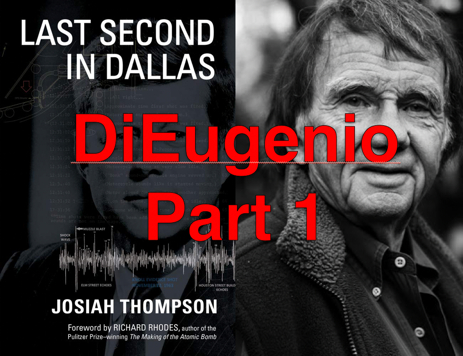
Author: James DiEugenio

  • Last Second in Dallas, part 1

    Last Second in Dallas, part 1


    This will be a decidedly mixed review of Josiah Thompson’s new book on the JFK case, Last Second in Dallas. I hope it does not discourage anyone from buying or reading it. There are some good things in the volume. And I will try to be as fair as I can about what I think they are. But I will also not shrink from what I believe to be the book’s shortcomings.

    I

    Thompson has fashioned the book as a kind of one man’s journey into a labyrinth. He begins the book even before the Warren Report was issued. On the day Kennedy was killed, Thompson heard that a doctor performed a tracheostomy over a throat wound on President Kennedy. But yet all the news stories said that the alleged assassin worked at the Texas School Book Depository, which was behind the motorcade. In what is, in retrospect, a monumental piece of unintentional humor, Thompson went to the local FBI office to alert them to this paradox. (Thompson, p. 6)

    When the Warren Report was issued, it was received in the press and broadcast media with almost universal praise, but Thompson noticed that a curious and pesky young Philadelphia lawyer disagreed with the unanimous chorus. That was the late Vincent Salandria. Thompson, who was now a newly made professor of philosophy at Yale, decided to check up on Vince’s work. So, he consulted the Commission’s volumes of evidence and found out that Vince was correct.

    This gave him a bit of a shock. The author now tries to fill in a bit of his conservative Republican background to explain why. This is where I had my first perturbance with the book. The author writes that he thought Alger Hiss was innocent in that case. He then adds that when Allen Weinstein’s MSM endorsed book on Hiss came out, he changed his mind and agreed with Weinstein that Hiss was guilty. (Thompson, p. 9)

    For several reasons, this was puzzling to me. For one, Weinstein was later sued and settled with one of his interviewees. (Click here for details) He also promised to show some of his evidence to other Hiss scholars—he never did. He later became a sexual predator, while supposedly doing his job as chief archivist of the United States. He was protected from legal liability by the George W. Bush administration. (Click here for details) In fact, there are three relatively recent books that pretty much show that Weinstein was really a hired gun and that is how he got the job at the National Archives. One is by Joan Brady, one by Martin Roberts, and one by Lewis Hartshorn. The last shows that Whittaker Chambers, Hiss’s accuser and a man who Weinstein took at his word, was surely a pathological liar. I will return to this political aspect with Thompson later.

    During a Vietnam protest in the Philadelphia area, the author was arrested. The ACLU lawyer sent to bail him out was Salandria. Vince now introduced Thompson to the critical community. They went to NARA to view the Zapruder film and look at 35 mm slides. (Thompson, p. 10). He then visited Dealey Plaza with an Abney level tool and figured out that the angle through John B. Connally was a 27 degree down slope, which he figured most likely came from the Records building. (Thompson, p. 15)

    On the strength of this visit to Dallas, Thompson was signed by the Bernard Geis publishing company. He got a rather small advance, though they agreed to pay his expenses, but Geis knew some people at Life magazine. And they had decided to do a reinvestigation of the JFK case based on the critiques of the Warren Report by Mark Lane and Edward Epstein. (Thompson, pp. 16–17)

    What is next tells the story of Thompson’s field investigation in Dallas. This is where the author encountered witnesses in Dealey Plaza and at Parkland Hospital. Thompson interviewed hospital employees Darrel Tomlinson and O. P. Wright about the discovery of the Magic Bullet, aka CE 399. From here, he pieced together the chain of custody that linked the transport of the bullet to Washington and then the FBI lab. This led to one of the most sensational discoveries in the early days of critical research. Wright insisted that CE 399 was not the bullet he turned over to the Secret Service. The bullet he turned over was sharp nosed, not a round nosed bullet. And since Wright had worked in law enforcement for many years prior to his occupation as a security officer at Parkland Hospital, he knew the difference. (Thompson, p. 25)

    At Parkland, Thompson made another stunning discovery. This one was about the location of CE 399 when it was discovered. In all probability, it was not on Governor John Connally’s stretcher—which is where it had to be located if the Commission’s Single Bullet Theory was to hold any water. In all likelihood, it was found on a child’s stretcher and his name was Ronnie Fuller. (Thompson p. 24. For a more complete explanation, see Six Seconds in Dallas, pp. 156–65)

    From here, the book describes the witnesses in Dealey Plaza. First off are Bill and Gayle Newman who were to the limousine’s right, at the base of the grassy knoll. They were never called by the Commission, but filed affidavits and were interviewed by the FBI. (Thompson, p. 30) They may have been the closest witnesses to Kennedy’s shooting. The couple said the shots came from behind them and Kennedy was hit in the right temple, which would be clear evidence that a rifleman was behind the picket fence. But in addition to the Newmans, Thompson adds Abraham Zapruder and Emmett Hudson, who were in the same area, to this list. He later notes that it appears the FBI altered Hudson’s original statement to the Secret Service. (Thompson, p. 43) Hudson was the first witness Thompson located who indicated that there was another shot after the fatal head shot.

    II

    The author transitions over to witnesses who were further away from the limousine or not in as good a position to see or hear what had happened to JFK, but whose testimony is still important. In the cases of the motorcycle escorts, he notes that it was Bobby Hargis and B. J. Martin who were struck with blood and tissue from the fusillade. The significance of this is that they were riding to the left of Kennedy. Hargis told a reporter he was splattered with blood and the impact was so hard he thought he himself might have been hit. Later, while walking to the Sheriff’s Department, a colleague told him he had something on his lip: it was a piece of Kennedy’s brain and skull bone. (Thompson, pp. 55, 56) Martin’s cycle was also splattered with blood and flesh and he said that the left side of his helmet was also hit. In this profusely illustrated book, one can see that Martin was looking toward the president right before the firing sequence began. (Thompson, pp. 50, 58) Some have said this kind of evidence is eyewitness testimony. I disagree. It qualifies as physical evidence which indicates directionality.

    Officer Joe Smith smelled gunpowder near the underpass, but this testimony was then altered by the FBI. Smith also said he met up with a Secret Service agent, which was not possible as they were all at the hospital. (Thompson, pp. 58, 59)

    The author then proceeds to two men who have become famous to both the public and in the JFK case: Lee Bowers and S. M. Holland. Although Thompson says that Holland was more important, I believe they are of equal importance.

    Bowers was made famous by Oliver Stone’s film JFK. Memorably played by actor Pruitt Taylor Vince, in a riveting sequence he described how three cars came into the area behind the picket fence, circled around and then left by about 12:25. One of the men seemed to have some kind of electronic communication in the car. Bowers said that at the time of the shooting, something out of the ordinary, some commotion, occurred in the area behind the picket fence—where Elm Street dips down at the underpass. To be mild, Joseph Ball of the Commission did not do a good job in pursuing this line of inquiry, so Mark Lane took it up later for his film, Rush to Judgment. Bowers said he saw a flash of light or smoke “which caused me to feel like something out of the ordinary had occurred there.” (Thompson, p. 66)

    Bowers died in August of 1966. It was later discovered, through Debra Conway of JFK Lancer, that there was more to Bower’s story. Bowers had actually seen someone holding the trunk of a car open, placing something in it, and driving off. This was told to her by Olan DeGaugh, a supervisor a couple of levels above Bowers. Barney Mozley was a colleague of Bowers who replaced him on the later shift. Mozley said that Bowers was very fearful of telling all he knew: to the point of having to place a lock on his tower door so no one could interview him. But he told Mozley something which coincided with what he told DeGaugh: at the time of the shooting Bowers saw someone coming around the wooded area in a trench coat and what looked like a rifle underneath. Clearly Bowers was petrified of telling anyone about everything he witnessed.

    Holland was standing on the overpass at the time of the shooting. In his original affidavit, Holland said he heard four, perhaps five gunshot sounds. (Thompson, p. 68) Two of the shots were extremely close together. The sound came from the grassy knoll area and as he turned in that direction he saw smoke rising, so he and three companions ran there. Holland was looking for shells. What they found were a series of footprints at one end of a car. These were accompanied by muddy spots on the bumper and cigarette butts on the ground. In other words, it was as if someone was behind the fence and waiting for the motorcade. (Thompson, pp. 70–72) An obvious question was: Why would someone view the motorcade from behind the fence? (Thompson, p. 79)

    Thompson and his partner, Ed Kern, were impressed by Holland. The witness drew them a diagram of what he saw when he got to the scene. (Thompson, p.77) The episode is capped by Thompson’s photo comparison of Holland standing at the position he was that day, behind the fence, with an anomalous shape in the famous Mary Moorman photo taken from across the street looking toward the knoll. They appear to match. (Thompson, p. 80) Since the author found out that there were no trunks searched, he concludes the chapter with a postulation as to what happened: the rifleman (men) could have just opened the trunk, thrown the rifle in, milled around for a few minutes and later just walked away. This scenario would correspond with what Bowers saw.

    The next step in the Life inquiry was an interview with Dr. Charles Gregory, one of the two doctors who performed surgery on Governor John Connally; who was sitting in front of President Kennedy in the limousine. Gregory, along with his colleague Dr. Robert Shaw, both concluded that the bullet that hit Connally did not strike anything previously. They deduced this from the clean edges, and also since no cloth fibers were carried into the governor’s back wound; yet “his wrist wound was fouled with numerous fibers from his wool suit.” (Thompson, p. 85) The other key development was that Gregory thought the shot that did hit Connally came in approximately at Zapruder frames 237–240. Which again, separate it from the shot that hit Kennedy, since the timing was too late. Gregory was very accomplished. He was a field physician in the Korean War and had spent much time studying gunshot wounds.

    Thompson was disappointed by the essay eventually printed in Life. It was called “A Matter of Reasonable Doubt” and was published as the cover story on November 25, 1966. Featuring frames from the Zapruder film, which Time-Life owned, the piece was largely based upon John Connally’s estimation of when he was hit versus when JFK was. In other words, all the material reviewed, thus far, was eliminated (e.g. Bowers, Holland, the Newmans, Gregory, the splatter pattern, etc.). Beyond that, there was space given to Arlen Specter to respond and the ending included a roundup of Kennedy assassination books described with snide and smug remarks. The only book that was recommended was Edward Epstein’s Inquest, which, as most of us know, was not at all a comprehensive critique of the Commission’s evidence. What is striking about this article is that, although it stated at the end the case should be reopened, it did not include the evidence the magazine had that likely would have reopened it: the backward head snap of JFK which begins at Zapruder frame 313. As Thompson points out, it also mistakenly said that the bullet angle through Kennedy’s body matched up to Connally’s, which was not remotely true. (Thompson, p. 90).

    From here, Thompson relates his retirement by Life and his determination to create a book out of his materials. Life made it difficult by suing him over artist renditions of the Zapruder film in what became Six Seconds in Dallas. But the judge upheld his right to do so.

    III

    In this reviewer’s opinion, the approximately first hundred pages of Last Second In Dallas represent the best part of the book. Its combination of witness testimony, professional observation, and physical evidence is compelling. And this presentation is combined with another virtue. Thompson is an accomplished writer. He has a simple, supple style that is quite easy to read. He also knows how to carve out “scenes” in prose. As noted, like Six Seconds in Dallas, the book uses illustrations adroitly. For example, in addition to the one with Holland, the picture comparing the condition of CE 399 to two bullets fired into tubes of cotton is quite effective. (Thompson, p. 22)

    After giving the author his due, I must add that I did have some reservations with this part of the book. Some of it emerges from Thompson’s point of view, which is pretty much a first-person journey. Therefore, he cannot help but describe the shutting down of Life magazine’s inquiry into the JFK case. He only mentions in passing that the New York Times had fielded an inquiry and also shut it down. (Thompson, p. 92)

    There was an interesting crossover between the two inquiries. His name was Tom Bethell. Bethell ended up being a pal of Dick Billings. Billings was the member of the Life team who told Thompson the inquiry was being closed down. (Thompson, p. 91) Bethell was the Englishman who ended up working for Jim Garrison, but not before he journeyed to Texas to live and hang out with Penn Jones. Billings had been part of the infamous Bayo/Pawley raid into Cuba, an event which the author does not mention. The two B’s agreed that there was not a covert effort by the government, the Commission, or the FBI to conceal the truth in the JFK case. They also agreed that Life did not really suppress the Zapruder film, since interested parties could see it at the National Archives. This seems a bit ridiculous in light of what happened when the film was nationally viewed in 1975.

    Both Billings and Bethell were cognizant of the New York Times inquiry. Bethell said that in November of 1966 he had met up with Times reporter Martin Waldron in Dallas. Waldron had a 4–5 page questionnaire of items they were looking into as problems with the Commission. Many of these questions were about New Orleans and they focused on David Ferrie. This was independent of Jim Garrison. (Click here for details)

    This is important in two ways. Apparently, Thompson was unaware that around the time he was retired, early February of 1967, Billings was also in New Orleans. He had been tipped off by Life stringer David Chandler that Jim Garrison was investigating the JFK case. Garrison had agreed to share information with Billings in return for some photographic services. This links directly to the following quote:

    What Patsy [Swank] and I did understand was that there was a level of the Life investigation beyond our participation or understanding. I never knew what [Holland] McCombs was supposed to be doing, and it was apparent that I was not supposed to know. (Thompson, pp. 26–27)

    With the help of British researcher Malcolm Blunt, we now can shed some light on what McCombs was doing. As noted above, it seems that when the Times started delving into New Orleans, they decided to drop the case. That parallels what happened with Life. McCombs retired Ed Kern and Thompson, but Billings and Swank stayed. In fact, Swank was writing reports to McCombs on the case well into 1968. (Swank to McCombs 7/16/68) With Kern and Thompson gone, McCombs now began to turn his guns on Garrison. Why? Because as Blunt has shown, he was best of friends with Clay Shaw. (See letters of 3/9/68, 3/22/68, 6/20/68, 7/31/68 and beyond) McCombs now began to work with and encourage the likes of hatchet men like Chandler and Hugh Aynesworth. (See letter of 5/13/67 to Duffey McFadden)

    What makes this even more interesting is that, in February—around the time Thompson and Kern were cashiered—Billings had received a telegram marked confidential. It said Ferrie had been seen by two witnesses at White Rock Airport in Dallas in October and November of 1963. They also discovered a pilot in Dallas who knew Ferrie and flew to New Orleans to meet with him in 1964. (message of 2/26/67) Therefore, like the Times, Life now had interesting information about Shaw’s friend Ferrie. And make no mistake, Chandler knew of this relationship. His son emailed this reviewer in the early part of the millennium and said that his father knew that Shaw and Ferrie were friends. By May, McCombs was referring to Life’s reopening as a joke. (McFadden letter)

    In June, it got worse. McCombs was in direct contact with Ed Wegmann, Shaw’s lead lawyer. (See letters of 6/14 and 7/25/67) By 1968, Shaw was congratulating McCombs on making speeches against the critics of the Warren Report. About reading their works, Shaw wrote: “It is almost unbelievable how much nonsense I have had to absorb.” (Letter to McCombs, 6/20/68)

    The evidence adduced by Blunt would indicate that McCombs was there to ensure that what he labeled Life’s “so called reinvestigation” did not stray too far from the homestead, which was Rockefeller Center in New York City. In addition to these two inquiries, which were clearly neutered, there is a third parallel with what happened at CBS. Through the late Roger Feinman, we know those circumstances in detail, since Roger worked there. In that case, the middle level employees like Dan Schorr wanted to do a real investigation into what happened to President Kennedy. They were turned back by upper level management like Dick Salant, Bill Paley, and Frank Stanton. And then, as in the case of McCombs, John McCloy was employed as a secret consultant for the program. I know Thompson has this article since I sent it to him. (Click here for that essay)

    I bring this up for two reasons. In this book, Thompson says he and Kern were retired because Time-Life did not want to pay for a continuing inquiry plus the time to educate its reporters on the case (Thompson, p. 92) With what we know today, this is rather underplaying it, especially with Swank and Billings staying in place. I think I understand why Thompson underplays what I believe was a significant pattern. At a conference in Chicago back in 1993, we were both on a panel focusing on the media. As I recall it, he was the only person arguing that there was no broad pattern of editorial coercion on the JFK case. At that time, he chalked it up to the fact that there were too many editorial levels in the chain. When one has people like McCombs as a circuit breaker, one does not need such an institutional hierarchy.

    IV

    As Thompson transitions out of Life magazine and into the production of Six Seconds in Dallas at Bernard Geis, another rather awkward note is struck. That is this: somehow the critical community has gone off on a wild tangent and he has become isolated. Predictably, Jim Garrison gets the back of his hand. (Thompson, p. 112) He then writes the following about Vince Salandria:

    Vince Salandria, my mentor and guide to all this, was behaving like a wigged-out conspiracy theorist, rethinking raw facts to make them mean what he wanted them to mean. (Ibid)

    Since both Garrison and Salandria have passed on, I would like to say a few words in their defense. Back in late 1967, when Thompson was on his book tour, he did an interview with Pacifica radio. He said that he had just heard Garrison saying that Kennedy’s murder was really a coup d’état. Thompson then said that a coup was a shift in power and that there was precious little evidence to back that up. He then added that a good reporter could make Garrison look foolish on this point. (James DiEugenio, Destiny Betrayed, 2nd edition, p. 381)

    What makes this odd is that Thompson refers a few times in this book to his attendance at Vietnam protests, yet he does not make any connection between the sudden escalation of the war and JFK’s murder. Jim Garrison was the first critic to do this. In the view of several intelligent and documented studies, and the declassified record, he was correct: there was a shift between JFK and LBJ on Indochina. (For example, see books by David Kaiser, James Blight, John Newman, Howard Jones, and Gordon Goldstein.) Further work by scholars like Richard Mahoney, Greg Poulgrain, Robert Rakove and Philip Muehlenbeck have furthered Garrison’s thesis into areas like the Middle East and Indonesia. I have little problem referring to Kennedy’s murder as Garrison did today. (Click here as to why)

    As per Salandria, Vince was one of the very, very few people who predicted that if Robert Kennedy won the California primary he would be assassinated. I don’t think that portrays him as being “wigged out.” And I can pinpoint when he began to disagree with Thompson. The first or second time I met Vince at his home in Philadelphia, he escorted me into his study and pulled down a copy of Six Seconds in Dallas. He immediately turned to page 246 and pointed out lines he had blocked off in brackets. After a space break in the text, Thompson says that what he had written in the book did not prove a conspiracy and it did not prove Oswald was innocent. After Vince pulled the book away, he said: “Jim, that is just what he spent almost 250 pages doing! And now, in the last sentences of the text, he denies what he just did?”

    I had to admit: Vince had a point, one which got buried in all the photos and illustrations and sketches which made Six Seconds in Dallas unique. To further elucidate where Vince was coming from, by the end of the Clay Shaw trial, he had seen enough of what the likes of Holland McCombs, Dick Salant, and Punch Sulzberger were up to. And he now differed in his approach from other critics. Vince had started the whole field of micro studies in the JFK case. His early articles for Liberation and The Minority of One, were milestones in the field. (For an example, click here)

    By 1969, he did not see any further point in doing that kind of thing. Salandria had supervised the Dealey Plaza portion of Shaw’s trial where, among other things, Pierre Finck had imploded and spilled the beans on what happened at Bethesda the night of Kennedy’s autopsy. In his opinion, that part of the case was now obvious. The questions for Vince were: Why was Kennedy killed, and why in such an execution style at high noon manner, with hundreds of spectators in attendance? To Vince, it was to show that, no matter how many explications one made exposing the official story, it did not matter. Democracy had ended. The CIA and the Pentagon were now running things. To him, the escalation in Indochina and the following murders of Malcolm, King and RFK proved that, especially since the RFK case was even more obviously a conspiracy than the JFK case. Agree or disagree, I understood the position. I did not think it was “wigged out.” There was nothing wrong in trying to configure the Big Picture.

    V

    The narrative picks up with the infamous 1967 four-part CBS special and Luis Alvarez. Again, Thompson introduces this in a rather puzzling way. He writes that, “The whole CBS program was so unconvincing that I just let it slide.” (Thompson, p. 117) Which makes me wonder: Did Thompson or his editors look at Six Seconds in Dallas? That book has an appendix entitled “A Critique of the CBS News Documentary, ‘The Warren Report’”. It is written in small print, but in normal size lettering it would probably be about 5–6 pages long. This is letting CBS slide?

    But it is through this program that Thompson brings into the story the figure of scientist Luis Alvarez. There can be very little doubt that the author does a nice job in portraying him as a quite pernicious character in the JFK case. And it was not just with CBS. Alvarez’ participation in the case extended past the years of the House Select Committee on Assassinations, into the eighties. Through this long portrait, we understand a theme that Gary Aguilar and Don Thomas have written about. Namely, that for several scientists, the JFK case was not really science. Politics trumped the science they were supposed to be applying, e. g. Vincent Guinn, Tom Canning, Michael Baden. The Alvarez case is extraordinary, because of the blatancy of the falsehoods he told and because he entered into areas that he knew little or nothing about. It did not matter to Alvarez, it was all about saving the Warren Commission verdict.

    Therefore, to explain away the very fast backward movement of Kennedy’s body in the Zapruder film, Alvarez dreamed up the so-called “jet effect” theory. Thompson shows that Alvarez, to put it mildly, cooked his research on this and then lied about it. (Thompson, pp. 124–29) This was the infamous shooting of the melons experiment. It was meant to show that Kennedy’s head rocketed backward because of the explosion of blood and tissue toward the front. Alvarez announced that he did not use the Edison method in this experiment. That is, he did not try and try and try over and over until he got the desired result. But then, years later, it was revealed that this is what he did.

    At another time, to limit the shooting sequence in Dealey Plaza to just three shots, he created something called the jiggle effect. This meant that there were just three places in the Zapruder film where Abraham Zapruder “jiggled” his camera. Therefore, there were only three shots fired in Dealey Plaza. There was a big problem with this: it was false. There were six places. And Alvarez must have known it. (Thompson, p. 121) He clearly had an innate bias, since he once wrote to the author that “the critics are a bunch of nuts and that the Warren Report is essentially correct.” (Thompson, p. 119)

    But even here, I beg to disagree with some of the nuances which he uses to portray Alvarez. He writes that “no single individual ever played a more central role in preserving a mistaken view of the shooting.” (Thompson, p. 115) He says that this is not an understatement and he does not qualify it by confining it to the field of science. What are we to make then of the roles in this case of Arlen Specter, Dan Rather, Larry Sturdivan and David Belin? Rather worked on several CBS specials that were all rigged to back up the Warren Report and all appeared at certain crucial times: e. g. anniversaries, during the Church Committee inquiry, right after Oliver Stone’s JFK appeared.

    Later he writes that, “Powerful forces did not contact Alvarez and ask him to come up with his theory.” (Thompson, p 121) This seems contradicted by the work of Roger Feinman. Feinman, working from pilfered files out of CBS headquarters, showed that what happened is that the secret executive committee running CBS—the CNEC—rejected the idea of a fair and objective look at the Kennedy case. CBS President Richard Salant then sent two high level CBS employees, Les Midgley and Gordon Manning, to the San Francisco area. They met with two powerful attorneys, Bayless Manning and Edwin Huddleson. It was these two lawyers who suggested the program concept be switched around to an attack on the critics. And it was Huddleson who suggested they use Alvarez to do so. (Click here for that essay)

    It was not Alvarez who created that awful series. He was an appendage to a larger Establishment enterprise. Is it just a coincidence that, in 1971, Bayless Manning left Stanford to became the first president of the Council on Foreign Relations?


    Go to Part 2

  • Jonathan Chait meets Michael Kazin

    Jonathan Chait meets Michael Kazin


    Almost any notice in the media about John F. Kennedy will supply an excuse for someone in the MSM to write a derogatory article about him. As we have seen, Michael Kazin used the occasion of a recent book about Kennedy to do a hit piece on him in The New York Review of Books. (Click here for details) Recently, a panel of scholars for C-SPAN did a poll ranking past presidents, including Donald Trump. Journalist Jonathan Chait didn’t like it. Why? Because Kennedy ended up in eighth place. Chait thinks this was unwarranted. Therefore, New York Magazine let him do a Kazin: that is a hit job on the slain president. (June 30, 2021)

    What is immediately noticeable about these rants is this: None of the writers knows very much about Kennedy or his presidency. But they pretend they do. For instance, Chait writes that Kennedy made some promises on civil rights in his presidential campaign, but abandoned them when he saw this would offend southern conservatives. The thinking being that it would stop the passage of his other domestic programs.

    As I have explained before, this is a liberal orthodoxy that has a serious problem with it. It isn’t true. This author spent months studying the issue for a four-part series about the Kennedys and civil rights. (Click here for that series)

    Kennedy did not abandon civil rights at all. He was advised by his specialist on the issue, Harris Wofford, that it would be very difficult to pass an omnibus civil rights bill in his first year and probably even in his second year. After all, there had been nine different attempts to pass such a bill since 1917 and they all failed. (Irving Bernstein, Promises Kept, p. 39) Wofford therefore advised Kennedy to issue executive orders and also to rely on the court system, through the Attorney General, to further the cause. The hope being that this would create a furor over the issue that would tilt the balance in the House and Senate. That would then make it possible to pass such a bill.

    That is what Kennedy did; and that is what happened. Anyone can read about this in more than one book (e.g. Wofford’s Of Kennedys and Kings, or Irving Bernstein’s Promises Kept). (Bernstein, pp. 40–41, 48–50)

    To list all the things that Kennedy did for civil rights in just his first year illustrates the utter fallacy of what Chait is trying to sell. Right out of the chute, JFK and his brother intervened in the New Orleans school segregation court case, something that President Eisenhower had avoided. (Jack Bass, Unlikely Heroes, p. 122) Eisenhower’s failure to act allowed the state legislature to pass laws attempting to curtail and avoid the court’s decision to implement Brown v Board. When Bobby Kennedy got the news about this scheming he replied, “We’ll have to do whatever is necessary.” (Bass, p. 131)

    The Kennedy administration did something that the Eisenhower administration would never have dreamed of doing. The Attorney General filed charges against the state Secretary of Education, Shelby Jackson. The idea was to stop the governor’s attempt to cut off funding for integrated schools. (Bass, p. 135) When a trial date was set, Jackson backed off and said he would not interfere. This episode began in February of 1961, a month after Kennedy’s inauguration.

    A similar case occurred in Prince Edward County, Virginia. Due to scheming by the governor and legislature, Prince Edward County had no schools to attend. Again, Eisenhower said he could not do anything about it. Shockingly, he even said states were not required to maintain a school system and, therefore, the president was “powerless to take any action.” (Brian Lee, Ph. D. thesis, A Matter of National Concern, p. 50)

    Again, the Kennedys reversed Eisenhower’s course. The president now began to remake the 4th Circuit Court of Appeals governing Virginia and nearby states. (Lee, p. 6) But the Kennedys also began doing two things that were, again, unprecedented. First, they joined the NAACP lawsuit as a plaintiff, not a friend of the court. Secondly, realizing the court reworking would take time, they appointed family friend William Vanden Heuvel to raise a large amount of money. The idea was to build, from scratch, a free school system to educate the African American students, so they would not fall further behind. (Lee, pp. 145–50)

    Did Chait miss all of this? Well, no surprise, since he also missed those two executive orders that Kennedy signed for affirmative action. The first was written in his first year, which again, no president had ever done before. (Bernstein, p. 56) Finally, Attorney General Bobby Kennedy made it a point to speak at the University of Georgia Law School. He spent half the address talking about civil rights. He said he would enforce the Brown v. Board decision. As historian Carl Brauer wrote, this was the first time anyone could recall an Attorney General speaking out on the issue in the South. (Carl Brauer, John F Kennedy and the Second Reconstruction, p. 95)

    That was in May of 1961. Again, we are to assume that Chait missed all of this, which is weird, since it was all unprecedented in the field. But that was just the beginning of a crescendo that led to the submission of Kennedy’s omnibus civil rights bill in February of 1963. (For the rest of the story, click here)

    Chait leads off his article by saying that Kennedy was elected due to his youth and his campaigning about the missile gap. He leaves out the fact that there was only a four-year difference in age between himself and his opponent Richard Nixon. Considering his second point, in Kennedy’s acceptance speech in Los Angles at the Democratic convention, there was no mention of a missile gap. He talked about things like separation of church and state, racial discrimination, the plight of the poor, and said this was no time to try and uphold a status quo that was not working. (Click here for the address) At a famous speech in September, which he gave before the Liberal Party in New York, again one will find no mention of a missile gap. But one will find the following: Kennedy tried to define what he thought the word liberal meant in a political sense, as opposed to how the Republicans defined it:

    But if by a Liberal, they mean someone who looks ahead and not behind, someone who welcomes new ideas without rigid reactions, someone who cares about the welfare of the people—their health, their housing, their schools, their jobs, their civil rights and their civil liberties—someone who believes that we can break through the stalemate and suspicions that grip us in our policies abroad, if this is what they mean by a Liberal, then I’m proud to say that I’m a Liberal.

    Kennedy went on to say that he also believed “…in a government which acts, which exercises its full powers and full responsibilities.” He continued by saying that when government “has a job to do, I believe it should do it.” This was then exemplified by his above actions in his first year on the civil rights issue, which, as I showed, were starkly different than Eisenhower’s. (For the whole speech click here)

    One of the nuttiest things that Chait writes is that Kennedy was a man out of his time period, because he thought there were no great problems to solve, no great dragons to slay, and no great compromises to be made. That Chait could borrow that comment from one of the worst biographers of Kennedy, the late Richard Reeves, tells you just what his game is, because Kennedy says just the opposite in both of these speeches. A constant refrain is his haranguing the GOP for not facing up to the problems as he perceives them: of the urban poor, of dispossessed farmers, of creating an imaginative foreign policy. And he clearly implies that a party of Coolidge, Hoover, and Taft simply could not really do anything about these dilemmas. He contrasted that with people like FDR, who chose to act in a time of crisis. And he compared the 1960 election to that of 1932. In other words, the Democrats could do something and would use government to solve problems.

    Chait tries to define Kennedy’s foreign policy by using the Bay of Pigs as an example. He then says, in regards to the Missile Crisis, that the president bungled his way into a nuclear showdown over Cuba. I hate to confront Mr. Chait with the facts, but I must. It was the Russians who placed a first strike capability in Cuba. This featured all three arms of the nuclear triad: long and medium range missiles, bombers, and submarines. In addition, they had 45,000 troops on the island and had also given Fidel Castro tactical atomic weapons. (James DiEugenio, Destiny Betrayed, second edition, p. 66) These would have annihilated any large invading force. This was all done in secret, knowing that Kennedy had insisted there be no offensive weapons in Cuba. And when, due to U2 photography, Kennedy inquired about them, the Soviet foreign minister lied to him about their presence. (Ernest May and Philip Zelikow, The Kennedy Tapes, p. 169) When it came time to confront the situation, Kennedy chose the least provocative action: no invasion, no air strikes, but a blockade. Choosing that option gave each side time to resolve the crisis peacefully. Anyone can read the transcripts of these taped conversations. Clearly, Kennedy was keeping the hawks at bay almost throughout. For a good example, read the record of his meeting with the Joint Chiefs, especially note their derisive comments about the president after he leaves the room. (May and Zelikow, pp. 173–88)

    As we can see, Chait’s article, like Kazin’s, is not factually based. His real point is to try and reverse the concept that somehow there was a step down in class and achievement from Kennedy to Lyndon Johnson. For instance, he writes that two programs that Kennedy was trying to get passed, but could not, were federal aid to education and health care for the elderly. As Irving Bernstein has written, Kennedy did get federal aid to education through the senate in October of 1963. (Bernstein, p. 241) Kennedy failed to get a Medicare bill through in 1962, but what Chait leaves out is that Kennedy was bringing it back for consideration through powerful congressman Wilbur Mills in 1963. And on the morning of November 22, 1963, Kennedy’s congressional liaison, Larry O’Brien wrote that “with Mill’s objections met, the passage of Medicare was assured.” (Bernstein, p. 258) In other words, Kennedy had set the table for Johnson on these two bills.

    This meme is continued when Chait lists the Civil Rights Act of 1964, the Voting Rights Act of 1965, and the War on Poverty as Johnson’s achievements, giving no credit to Kennedy or anyone else. As I have mentioned several times, the idea that Johnson got the Civil Rights Act of 1964 passed is a myth supported by establishment figures like Robert Caro. Clay Risen, who wrote a book about the passage of the act, has shown why it is a myth. (Click here for details)

    President Johnson told Martin Luther King that he could not get the Voting Rights Act passed on his own. The only way he could so was if King did something to give him the torque to implement it. King did so by staging the Selma demonstration, which he was already arranging before Johnson told him this. (Louis Menand, “The Color of Law”, The New Yorker, 7/1/2013)

    The War on Poverty began after Kennedy read Dwight MacDonald’s review of Michael Harrington’s The Other America. (Thurston Clarke, JFK’s Last Hundred Days, pp. 242–43) In June of 1963, JFK was already thinking past the Civil Rights Act he had submitted to congress. So he called in his chief economic advisor, Walter Heller, and they began to formulate a plan to counteract pockets of poverty. After Kennedy was assassinated, Heller told Johnson about this plan he and Kennedy had formulated. In other words, the War on Poverty was not Johnson’s concept. It was Kennedy’s. In his jihad to inflate LBJ and downgrade Kennedy, this is how anti-historical Chait becomes.

    If one can comprehend it, Chait even tries to elevate LBJ at Kennedy’s expense over what became Johnson’s disaster in Indochina. With all we know about Vietnam today, I would have thought no one would even think of doing this. But one should never underestimate the stubbornness and perversity of the MSM. Chait begins by saying that it is an unproven assumption that Kennedy would have pulled out of Vietnam. That worn out standby is not sustainable today. With all the information that the Assassination Records Review Board declassified, combined with the work of writers like Gordon Goldstein, Howard Jones, David Kaiser, Jim Douglass, James Blight, and the revised version of John Newman’s JFK and Vietnam, there is little or no question about the issue: Kennedy was getting out of Vietnam. We have a veritable cornucopia of evidence to prove it. And he was going to enact that withdrawal around the 1964 election. (Click here for details)

    Johnson was aware of this plan and within 48 hours of the assassination he started to reverse it. (James Blight, Virtual JFK, p. 310; also see Chapter 23 of the 2017 version of Newman’s JFK and Vietnam.) Contrary to Kennedy, Johnson’s concept was to work his escalation plan around the 1964 election. In other words, as he was saying things like he wished no wider war and he did not want to send American boys to die in a war that Asian boys should be fighting, he was arranging to do just that. This has been proven by too many scholars to belabor the point here. But to name just three: Gordon Goldstein’s Lessons in Disaster, Fredrik Logevall’s Choosing War, and Edwin Moise’s Tonkin Gulf and the Escalation of the Vietnam War.

    Chait now writes that Kennedy’s policies laid the groundwork for Johnson’s escalation; due to the calculation that no Democrat could lose a territory to communist expansion. I threw my arms up at this one. If Kennedy was withdrawing at the time of his death and Johnson stopped that withdrawal, planned on going to war in Indochina, effectively declared war on Vietnam, and then invaded the country with hundreds of thousands of combat troops—how did Kennedy lay the groundwork for that? In November of 1961, with NSAM 111, Kennedy drew the line: he refused to send combat troops to Indochina. He never crossed that line. There was not one more combat troop in Vietnam on the day he was killed than on the day he entered office. Johnson not only sent half a million combat troops there, he also initiated one of the largest American air wars ever devised, Rolling Thunder, to try to bomb North Vietnam into submission. Does any credible person think that Kennedy would have countenanced these things, let alone allowed them to happen?

    This relates to Chait’s other point about the fear of “losing Vietnam.” Kennedy simply did not think that Vietnam was worth going to war over. Just like he did not want to commit combat troops to Laos, even though Eisenhower had advised him he might need to do so. (Newman, p. 9) Kennedy was a more sophisticated thinker about the Cold War than Johnson was. For him, Berlin was a flash point, since he was not going to let the Atlantic Alliance be challenged, but Vietnam was simply not worth the price. And this indicates how uninformed Chait is about JFK. Kennedy understood just how hopeless an imperial conflict would be in Vietnam. He comprehended this due to his relationship with diplomat Edmund Gullion in Saigon way back in the early fifties, where he saw firsthand the doomed French effort to recolonize the area. (Click here for details) He also understood the problem from his Ambassador to India, John K. Galbraith who wrote him a memo to counter the hawks who wanted him to intercede in 1961. (Click here for more)

    Compare that to LBJ. Johnson actually said that, if he left Vietnam, he would be doing what Neville Chamberlain did at Munich with Hitler and Mussolini. He then compared losing Vietnam to losing China and that the former would be even worse than the latter. He concluded that reverie with the following:

    Losing the Great Society was a terrible thought, but not so terrible as the thought of being responsible for America’s losing a war to the Communists. Nothing could possibly be worse than that. (Blight, p. 211)

    Can anyone conceive of Kennedy saying such things? There is no evidence for it. In fact, as I noted in my review of John Newman’s revised version of JFK and Vietnam, Kennedy told many people that Vietnam was a hopeless struggle, which America could not win. Therefore, he was getting out. (James Douglass, JFK and the Unspeakable, p. 183) What is so incredible about Chait’s abomination is that, at the end, he concludes that Kennedy’s rating in the poll is due to a lack of analysis. We have just seen what analysis does to Chait.

    Make no mistake, Chait’s handiwork is not an accident. As Jeff Morley wrote in his recent e book about his lawsuit against the CIA, no one ever got ahead in the journalistic world trying to expose new facts about Kennedy’s assassination. Well, since 2013, the same figure applies to Kennedy’s presidency, especially in light of the fact that we now know what happened in Indochina as a result of his death. And since that switch in policy came so fast, perhaps—just perhaps—the two events were related. And if such was the case, how could the MSM have missed it with such completeness?

    As noted at the start, I recently wrote about Michael Kazin’s similar hatchet job about Kennedy’s presidency, disguised as a review of Fredrik Logevall’s book JFK: Coming of Age in the American Century. Well, if one looks back to 2013, Kazin did the same in the pages of The New Republic. At that time, he was allegedly reviewing Thurston Clarke’s book JFK’s Last Hundred Days. (July 15, 2013) As was the case of Kazin with Logevall, it was a review that was not a review. It was a way to downgrade Kennedy and wonder out loud: Geez, why does anyone pay any attention to this guy at all? The title of the article was: “On the Fiftieth Anniversary of JFK’s Assassination Don’t Bother with the Tributes.”

    As I have written before, the MSM drive to conceal who Kennedy really was has become as systematic and assiduous as the attempt to cover up the circumstances of his assassination. As noted above in regards to Vietnam, it’s pretty obvious as to why.

    Mr. Chait meet Mr. Kazin. Future employment for both is secured.

    Action suggested:

    Contact at twitter: https://twitter.com/jonathanchait

    The editor of New York Magazine is David Haskell, david.haskell@gmail.com


    See also Brian E. Lee’s Ph.D. thesis from 2015 on the Kennedy administration efforts to restore public education to Prince Edward County, VA.

  • Lee Harvey Oswald’s Cold War

    Lee Harvey Oswald’s Cold War


    Greg Parker’s Lee Harvey Oswald’s Cold War is quite appropriately titled. There have been many biographies of Oswald, some of them good, some adequate, and some downright poor. The dividing line, both temporally and in content, was Philip Melanson’s Spy Saga. Released in 1990, Spy Saga was the first work to make a book length case that Oswald was intimately tied up with the world of American intelligence—and most likely not in a casual way. Phil also did important work on the Martin Luther King and Bobby Kennedy cases. Unfortunately, he passed away in 2006. But when he appeared before the Assassination Records Review Board, he made a rather pithy and self-deprecating comment. He said he hoped when their mission was complete, the new database on Oswald would make Spy Saga look like a Cliff Notes pamphlet.

    There is no doubt that Melanson’s prognostication came true. For example, the declassified notes of HSCA researcher Betsy Wolf create an epiphany concerning the relationship between the CIA and Oswald before his defection to Russia. (Click here and go to Section 2) In his book, Parker has not gotten to that point yet. (This review is of the compilation Volumes 1 and 2.)

    Several books on Oswald track his character through the progress of the Cold War. But, quite naturally, the Soviet/American conflict is always in the background. The unusual thing about Parker’s book is that there really is no background. His volume blends so much of the Cold War into the story that background and foreground are almost indistinguishable. That is why I stated that the title is all too appropriate.

    To underline this point: the volume opens in a most unusual manner. Many books on the case, and some biographies of Oswald, discuss the overthrows of Arbenz in Guatemala, Mossadegh in Iran, and the killing of Patrice Lumumba in the Congo, not to mention the many attempts to assassinate Fidel Castro. This book begins with an assassination in Bogota, Colombia. It discusses the murder of Jorge Elicier Gaitan, who, quite frankly, I had never heard of before. (Parker, pp. 4ff) I sure as heck will not forget him now.

    Gaitan was a mayor of Bogota, a member of congress, Minister of Education, and Minister of Labor, Health, and Social Welfare. He was a lawyer who gradually shifted over to politics, especially after seeing the influence of the United Fruit company in his country, particularly after what is called the Cienega, or Santa Marta, massacre. (Parker, pp. 5–8) This event was more or less covered up for decades until Gabriel Garcia Marquez made it famous in his book One Hundred Years of Solitude. What enraged Gaitan about the event was that the American press and State Department tried to paint the massive machine gunning as a natural reaction to a communist plot. It was no such thing. United Fruit demanded the government intervene to halt a strike, since their policy was no negotiations. In fact, United Fruit’s influence may have extended up to having Frank Kellogg, the American Secretary of State, threaten to invade if United Fruit was not protected.

    Gaitan used this event to vault himself into the political arena. He was so effective as a speaker and organizer that he created a kind of rump group to the Liberal Party called the National Leftist Revolutionary Union, or UNIR. Gaitan was a combination Socialist and Populist. Land reform was very important to him. In 1946, he ran for president and lost, mainly because the Liberals ran two candidates, himself and Gabriel Turbay. As Parker makes clear, its odd how Turbay died a year later. (Parker, p. 26) And Gaitan was assassinated a year after that—on the verge of taking over the Liberal Party.

    Before reviewing Gaitan’s murder, the author discusses just how influential the American government was in Latin America. United Fruit’s law firm was the formidable Sullivan and Cromwell, which employed a young John Foster Dulles. Foster Dulles was a kind of roving ambassador for the company in that area. (Parker, p. 9) America was very powerful in Colombia due to the scheme used by Phillipe Bunau Varilla, William Nelson Cromwell, and Teddy Roosevelt to pretty much create the new country to the north in order to finish the Panama Canal. (Parker, pp. 10–13)

    Before the creation of the CIA, the FBI had domain in Latin America through its Special Intelligence Service or SIS. But by 1946, the SIS was on the way out due to the creation of the CIG, the Central Intelligence Group, and the CIA in the following year. Birch O’Neal was an SIS agent who joined the new group. He soon became one of James Angleton’s chief—and most secretive—assistants. (Parker, p. 20) Preceding both the SIS and CIA was the Office of Naval Intelligence. Founded in 1882, by 1929 it had widened its scope from just spying on the advancements of the navies of other nations. (Parker, p. 3)

    On April 9, 1948, Gaitan emerged from his office at about 1 PM. He was shot at four times with one bullet missing. The man apprehended for the crime was Juan Ros Sierra. He was immediately taken to a pharmacy by two policemen. But when they called for reinforcements, no one answered the phone at the station. When asked who put him up to the assassination the defendant only said, “Powerful things that I can’t tell you! Oh Virgin of Carmen! Save Me!” (Parker, p. 29)

    In a startling coincidence, both Gabriel Marquez and Fidel Castro were in direct proximity to the scene of the crime. Marquez later said that he saw a tall, well-dressed man urging the mob to break the police line and extract revenge by killing the suspect. Once this was successful, that man drove away in a new car. (ibid) What happened after must have clearly influenced Castro in his revolutionary career. It came to be called El Bogotazo: ten hours of violence, mayhem, and chaos that left four thousand dead and a large section of the city in ruins. (Parker, p. 30) In turn, that ignited La Violencia, a ten-year civil war that took the lives of about 200,000 people. This reveals not just how much Gaitan was a symbol of hope to the masses, but also how they collectively felt that the—now dead—accused was not working alone. (Parker, p. 30)

    They were correct. A man named John Espirito later made a confession to this effect. He said that the murder was timed for the meeting of the Latin American leftist group which Castro was there to attend. Although Espirito clearly implied that Roa performed the shooting, Parker disagrees. Roa was in the habit of performing mind control exercises that would place him in a trance state in front of a mirror. He then imagined someone emerging from the mirror. The author writes that it actually was a man and he was part of the set up. He corresponds to someone at the scene who had a trench coat draped over his arm. Parker writes that this was the main assassin and that Roa only fired the last shot, the one that missed. (Parker, p. 54)

    The chapter ends with a postulation: was this the CIA’s first assassination plot? If so, it certainly resembles the RFK scenario, not just in its intricacies, but because it stopped a liberal leader from taking power and produced years of chaos. In the American case, it prolonged the Vietnam War.

    II

    The Gaitan murder happened closely after the official opening of the Cold War, which is usually timed with George Kennan’s long telegram from Moscow. The author then jumps forward a few years to Korea. He focuses on two types of specialized warfare that emerged during the conflict. The first was what had been apparently used with Roa: mind control. The second was germ warfare. The United States coveted Japan’s so called “Devil Doctor,” Ishii Shiro and his infamous Unit 731. He was perhaps the most advanced microbiologist of his day and performed thousands of experiments on human guinea pigs, including American POW’s. Douglas MacArthur made sure he was not prosecuted and so he ended up at Fort Detrick, Maryland. (Parker, pp. 78–80) In other words, what happened with Operation Paper Clip in Europe also occurred in Asia, except in this instance it was not rocketry, but biological science. It was left to the Russians to expose Ishii for what he was and how he had experimented on American prisoners. This is how America developed the science for bacteria weapons in Korea and then, according to Parker, lied about its usage. (Parker, pp. 83–86) One way they did so was by saying the Chinese had brainwashed the men who said they did it.

    All of this clearly amped up domestic Cold War tensions. Ruth Paine started to attend Quaker meetings in 1947, but did not actually join the church until 1951. The author describes a kind of factionalism within the Quaker movement that gained traction over the forties and fifties. The Hicksites, a very pure and spiritual sect inside the church who had been strongly anti-slavery, now gave way to a more conservative evangelical strain. (Parker, pp. 94–95). This struggle was exemplified by a meeting of the Friends at Earlham College which Ruth attended. Earlham was a hotbed of this early kind of conservative evangelical movement. A future graduate of Earlham was Von Edwin Peacock. By the time of the FBI inquiry into Oswald’s alleged visit to Mexico City, Peacock was acting Director of the American Friends Service Committee (AFSC). The AFSC ran the Casa de los Amigos in Mexico City. A local Quaker said he saw Kennedy’s alleged assassin at that place while he was in Mexico City in 1963. (Parker, p. 96)

    What makes this interesting is that the latest work on this aspect indicates that Oswald was not in Mexico City. But yet, one of the things that Ruth Paine did complemented what the AFSC group did for the Warren Commission. She supplied articles that were allegedly returned to Dallas by Oswald from Mexico City. (James DiEugenio, Destiny Betrayed, second edition, p. 203)

    In an interesting piece of discovery, the book states that Marguerite Oswald once worked at a naval base in Algiers, Louisiana as a switchboard operator. (Parker, p. 104) This was during World War II, when Oswald was perhaps 2 years old. Parker believes this job involved some kind of research project through Pittsburgh Paint and Glass at that base. It was at this time, late 1941 or early 1942, that she met Edwin Ekdahl, an electrical engineer. Ekdahl would become her third husband and the step father to Lee since the child’s real father had died before he was born in October, 1939. Parker believes that Marguerite met Ekdahl while at the base and that the company he worked for, Ebasco, a division of GE, was also involved in that research project. (Parker, p. 106) You will not find this information in the Warren Commission report or that by the House Select Committee on Assassinations (HSCA).

    The two eventually married in 1945 and moved to Fort Worth, where Ekdahl was now working. The couple stayed together until 1948. Parker notes more oddities about Lee’s enrollment in 2 elementary schools: Ekdahl is listed as his father, but in the blank for mother, no one is listed. (Parker, pp. 117–18). Although the wife thought the husband was having an affair, it was the husband who filed for divorce first. The attorney he hired was Fred Korth, who had an office in close proximity to his own. (Parker, pp. 110, 118) Korth was a lawyer and a banker. He would eventually become Secretary of the Navy in 1962, succeeding John Connally. Both men served at Vice President Johnson’s request. Parker points out something about Korth here that may be more than just passing interest. Though Korth handled Ekdahl’s end of the divorce, the Warren Commission could not find any evidence that Ekdahl had legally divorced his first wife, Rasmina. What makes that even more odd is that Rasmina and Edwin ended up being buried together. (p. 119)

    III

    The scene now moves to New York City. As many have noted, it has never been entirely clear as to why Marguerite decided to move to the Big Apple. The ostensible reason is that her first son, John Pic, and his wife lived there. With Robert Oswald, Lee’s older brother, in the service, Marguerite said she did not want Lee to be alone while she was at work. (Warren Report, p. 675) But, as the author points out, Ekdahl was now living in New York and may have helped get Lee into Trinity Evangelical Lutheran School. (Parker, p. 128) And third, there is the mysterious issue of Lee’s “mental tests” that were likely done at Yeshiva University. This was discovered through an FBI interview with a house cleaner for Marguerite, Mrs. Louise Robertson.

    The living arrangement did not last long. Parker does a nice job in exposing the Warren Commission version of how it ended. In their attempt to show that somehow the 13 year old Oswald was already a sociopath, they wrote that Oswald threatened Pic’s wife with a knife and smacked his mother while this was going on. (Warren Report, p. 676) By going through the original sources, the author shows how the Commission completely distorted the whole affair. He shows that when first interviewed about it with the FBI, Pic said no one had ever informed him any such threatening incident. But by the time he testified before the Commission, his memory had been completely refreshed. Except for one telling point—he had to take out his notes to keep the details straight. (Parker, pp. 131–33) What likely happened is that Pic’s wife did not care for her mother-in-law and her son. And she completely exaggerated what had happened in order to get them out. The FBI and the Commission then did what they usually did. With Oswald having no attorney, they were allowed to turn the incident into something it wasn’t—as long as it was exaggerated to Oswald’s detriment.

    Parker does an equally adroit analysis with the famous Youth House report by Renatus Hartogs. Oswald was truant from his schooling and was referred to a kind of halfway house for three weeks in the spring of 1953. There he was examined by Dr. Hartogs. To this day, if one views the Wikipedia entry on Oswald, one will read about Oswald threatening Pic’s wife with a knife—which most likely did not occur. But also, various newspapers in 1963, like the New York Times and Charleston News and Courier, had written stories based on alleged reports Hartogs had made about Oswald back in 1953. According to those reports Hartogs had written that Oswald had “schizophrenic tendencies” and that Oswald was “potentially dangerous” and should be committed. (Parker, pp. 170, 179)

    Evidently, from reading the newspapers, Hartogs came to think that this was what he had written. And he never bothered to cross check this with his original reports. But Wesley Liebeler had the reports when he examined the doctor on April 16, 1964. It turned out that Hartogs made no such comment about having Oswald committed. He thought Oswald should be placed on probation. He also never wrote that he thought Oswald was capable of a possible violent outburst. As Liebeler also pointed out, there was no reference to Oswald as “incipient schizophrenic” or “potentially dangerous” in his report. Finally, there was no evidence that Oswald was suffering from either delusions or hallucinations. (Parker, pp. 174–78)

    Incredibly, in 1968, Hartogs was still claiming he had predicted Oswald was potentially dangerous. A few years later, he was successfully sued by one of his patients for sexual molestation. (Click here for details)  Some witness.

    IV

    Marguerite moved back to New Orleans in 1954. Although the HSCA tried to say that Uncle Dutz Murret served as a kind of surrogate father for Lee, that is in contradiction to what the man said to the Commission. He told them he did not take much interest in or pay much attention to the lad. (Parker, pp. 194–95) The author concludes that the only real father figure Oswald had was Ekdahl and he passed away in 1953.

    Another myth proposed by the HSCA regarding Oswald was that somehow Beauregard Junior High School had the reputation of being a spawning ground for future criminals. Yet again, this was contradicted by someone who should know, namely Marguerite’s sister, Lillian Murret, who lived in New Orleans her entire life. The reason that Marguerite used Lillian’s address was in order to register Lee for Beauregard, since “it had a good reputation as a good school.” Family friend Myrtle Evans said the same, that it was a good school and Marguerite had used Lillian’s address to get him in for that specific reason. (Parker, pp. 200–01)

    In 1955, Lee completed a personal history in class which said his career choices were the military and undecided. Two weeks later, his brother Robert Oswald returned from active duty. Two weeks after that, Oswald joined the Civil Air Patrol (CAP) with his friend Ed Voebel. As his mother tried to tell the Commission: Was it not odd that at the same time Lee was reading the Marine Corp Manual, he was also studying Karl Marx? (Parker, p. 216)

    In its original design, the CAP was designed to be, among other things, a kind of Loyalty Police. The author sources this to a NY Daily News story from 1948. To support this belief, he writes that the story was quickly withdrawn and then denied. But that story got a reaction from other papers who said that the CAP was “Fascism wrapped in the American flag.” (Parker, p. 221)

    From here, we shift to oil tycoon Harold Byrd and how he figured in both the creation of the CAP and the purchase of what would become the Texas School Book Depository (TSBD). Byrd was one of the founders of the group back in 1941. He then became commander of the Texas wing and then a Colonel in the patrol before he went off to the Department of War in 1943. He eventually ended up as Vice Chair and then Chair of the national organization in 1959. (Parker, p. 222) Byrd bought the building which became the TSBD in 1939 for a fire sale figure of $35,000. He go it since he had been a part of the original loan, which had been defaulted on for about ten times that price.

    Appropriately, the author now goes into the relationship between CAP leader David Ferrie and Oswald. For all his faults, which are well known, the author writes that Ferrie had the reputation of being a good trainer in the Cleveland CAP, which is where he was born. (Parker, p. 224) He describes how Ferrie was booted out of the CAP in New Orleans and then started his own renegade group. He focuses on the secret group that Ferrie had created inside his unit. Sometimes this was called the Omnipotents, at times it was given the longer rubric: Internal Mobile Security Unit. The members of this inner group were given special training and special assignments: like getting a passport so one could emigrate to Cuba through South America. (Parker, p. 227) This indicates the degree of control that Ferrie had over his cadets.

    In the fall of 1955, someone forged a letter in Marguerite’s name which stated that Oswald was leaving school for San Diego. Oswald attempted to drop out. But Marguerite fouled it up by enclosing his real birth certificate in a duffel bag. (Parker, p. 233) In fact, as is mentioned in passing, someone dressed and posing as a Marine recruiter showed up at the Oswald home to try and convince her to let him join, even though he was underage. In Bill Davy’s discussion of this episode, he suggested this may have been Ferrie. (Let Justice be Done, p. 6) As Parker notes once more, the Commission gravely distorted this episode by writing that Oswald was able to convince his mother to make a false statement about his age.

    V

    One of the highlights of the book is the discussion of Oswald’s employment at Gerald F. Tujague, Inc. The author brings in an aspect about this brief employment that I was not aware of. The founder of the company was A. E. Hegewisch and it was his name that was used in its original title. It was a freight forwarding business and it began in 1923. As a vociferous anti-communist, Hegewisch was plugged into the New Orleans higher circles. In fact, he was the second president of International House. (Parker, p. 236) It’s pretty easy to figure out why. He knew the CIA approved Dr. Alton Ochsner, CIA agent Clay Shaw, and CIA asset William Gaudet. He was also an early president of an Agency front, the Cordell Hull Foundation. That foundation originated in Nashville—Hull was born in Tennessee—but it moved to New Orleans in 1954 and was housed inside the International House. Ochsner took over the presidency in 1956.

    In 1953, Hegewisch turned over the company to five of his employees. This included Mr. Tujague, who became president, thus the name change. (Parker, p. 237) It appears that, as with Hegewisch, the Agency stayed in the background of the picture, because, later, Tujague was one of the founders of Friends of Democratic Cuba, which we know was associated with Ochsner and Shaw’s colleague, Guy Banister and also with the CIA associated Sergio Arcacha Smith. The author’s hypothesis is that Oswald was employed there in 1955, most likely through his acquaintance with Ferrie. His performance as a runner was a test of “Lee’s ability to deliver ‘goods’ and messages around the ports to the various networks of agents, informants and assets.” (Parker, p. 237) As Jim Garrison once noted, this is why New Orleans was so important to the CIA and FBI, because of its centrality as a portal to and from Latin America.

    After a bit over two months, Oswald went to JR Michels, Inc., which was located in the same building. His job there was “running Export Declaration forms to the Customs Office for authentication.” (Parker, p. 238) It required that a file with picture be kept of Lee at the Customs office. It was reportedly destroyed around 1958. As Joan Mellen later observed, that destruction was not solitary. Her research assistant Peter Vea later discovered that Oswald had meetings at Customs in 1963, yet those files were never recovered by the ARRB. (Mellen at Cyril Wecht’s Duquesne Conference of 2003)

    The author postulates that these temporary positions were more of less a dress rehearsal for Oswald’s ultimate enlistment, this time at a legal age. And he mentions programs like REDSOX, and REDCAP, and an ONI program which were supposedly designed for infiltration and false defectors. (Parker, pp. 230, 257) Parker notes that when Oswald wrote a letter to the Young Socialist League it was before he signed the Loyalty Certificate for Personnel of the Armed Forces. And that organization was listed on the certificate as being subversive. In the letter, he was asking to not just join, but perhaps start his own branch. There was no ambiguity about that. (Parker, p. 263) Yet this violation triggered no action against Oswald, even though an FBI check was done. Was this perhaps because, according to Ferrie’s friend Van Burns, Ferrie would meet with Oswald before his defection in 1959? Therefore, was everything cleared in advance?

    As we all know, in the Marines, Oswald was sent to Atsugi air base in Japan, one of the homes of the U2. An utterly fascinating revelation in the book is about Ruth Paine, more specifically about her sister Sylvia Hoke. It turns out that she was part of the FICON project, the precursor to the U2. In other words, Hoke was working under the guise of a civilian for the Air Force when, in fact, she was really employed by the CIA. She worked on that project through the auspices of George Washington University. (Parker, pp. 266–267). Is this why Ruth denied any knowledge of her sister’s employment when Jim Garrison questioned her before the New Orleans grand jury?

    Another provocative issue the author brings up is Oswald’s meeting with Rosaleen Quinn while in the service. Quinn worked for Pan Am Airlines, but she was taking a Berlitz class in Russian because she wanted to join the State Department. What is new here is that Pan Am had a close association with the CIA, “more specifically between the CIA and members of the flight crews.” (Parker, p. 276) But not just the CIA. Employees were participating with “State Department operations involved behind the scene mission in dangerous locations.” Parker is clearly postulating that the so called “Quinn date” was really another test, this time for Oswald’s ultimate mission to Moscow. If so, he passed, since Quinn said he spoke Russian better than she did. To amplify that opinion, the author notes that Quinn met with Oswald’s radar commander afterwards, John Donovan.

    Parker closes his book with the Albert Schweitzer College episode. Stephen Frichtman was the famous minister at the Unitarian church in Los Angeles. This was in easy driving distance to Santa Ana, where Oswald was stationed. Frichtman’s name was found in Oswald’s undercover cohort Richard Case Nagell’s notebook. (Parker, p. 287) The point being that Albert Schweitzer did very little advertising. And a person who was familiar with the college told the late George Michael Evica that recruitment was usually done through personal contact. The highest entry class was about 30 people and sometimes the place was near empty. As Evica found out, Hans Casparis and his wife—who were running the place—were both academic frauds. So in preparation for travel abroad, why and how did Oswald list this place on his passport itinerary and how did he find the application form? Parker seems to imply it was with the help of Frichtman and/or Kerry Thornley, his supposed friend at the base.

    Parker has written an unusual, provocative, and insightful work. I have some disagreements, but considering the overall quality, they are really too mild to bring up. He and Seamus Coogan and Frankie Vegas (real name) are all significant contributors to the case from down under (i.e. Australia and New Zealand). Parker has had some serious health problems of late. Let us wish him well. I would really like to see the concluding volumes of this intriguing series.

  • Morley v. CIA

    Morley v. CIA


    Jefferson Morley’s e-book Morley v. CIA is a brief tome, but if one is attuned to the scenario and the political times, it’s a work that is powerful in its overtones. On the surface, it tells the story of a journalist at the Washington Post who got interested in the JFK case. He decided to pursue a certain angle about Oswald’s activities in New Orleans with a certain Cuban exile group. He then filed a Freedom of Information Act request. The end result of that application had two long term results that were both negative for Morley and for the cause of open government and disclosure. They are really the heart of this story. But before we get to them, let us lay in some background.

    Morley was one of the very few MSM reporters who showed a real interest in the John Kennedy assassination. From his outpost at the Washington Post, he became acquainted with John Newman. He and Newman cooperated on what was one of the most fascinating and important discoveries in the early days of the Assassination Records Review Board. This was the interview those men did with CIA official Jane Roman in the fall of 1994. Morley had discovered that Roman had handled cables and communications about Oswald in the weeks before Kennedy’s assassination. Yet she had signed a communication to Mexico City saying that the latest information CIA had on Oswald was a State Department report from May of 1962. This was a key discovery in trying to comprehend what was going on in Mexico City, which the Warren Commission never came close to understanding. (For a fuller version of that incident click here)

    Morley actually got the Post to publish a few stories on the JFK case which were not cheerleading boilerplate for the Commission or slams against the critical community. This was a significant achievement. He has talked about the rather difficult process he had to go through to get the stories published. At times, it was almost a Catch 22 situation. His editors would ask him what theory he was trying to push. He would reply that he was not pushing any theory. They would then ask: “Well why do you want to run the story then?” Consider: Morley was a veteran reporter who had been with The New Republic and The Nation for a number of years prior to the Post. The fact he had to run this gauntlet shows how radioactive this issue was thirty years after Kennedy’s assassination.

    As he began to go through some of the declassified CIA documents, the reporter noted that, contrary to what the Agency had maintained for decades, they had a keen and continuing interest in Oswald. (Morley, p. 9). He was particularly struck by the fact that the Directorio Revolucionario Estudiantil—the DRE—had participated in a broadcast debate with Oswald. Afterwards, they had called for an inquiry into his group: the Fair Play for Cuba Committee. This was three months before the assassination. He was surprised when he discovered that not only did the CIA have a file on the DRE, they had three boxes of materials on that group. After going through the material, he concluded that the DRE was in reality a CIA front. (Morley, p. 10) They were getting a princely sum of $51,000/month to operate both domestically and abroad—the equivalent of nearly a half million today. (Morley, p. 11)

    He then went about tracking down some of the surviving DRE members. They all referred to a man named “Howard” as their contact with the CIA in 1963. In the boxes, there were lengthy monthly reports out of the Miami station on the DRE, yet these did not appear to exist in 1963. (Morley, p. 10) In 1998, the Review Board released a document which stated the case officer for the DRE in 1963 was not Howard Hunt, but George Joannides. (p. 14) The plot thickened when Morley learned that, in 1978, while he was recovering from a heart operation, Joannides was recruited by Scott Breckinridge. Breckinridge was the chief liaison for the CIA with the House Select Committee on Assassinations (HSCA). Unfortunately, when Morley unearthed all of this, he also found out that Joannides had passed on in March of 1991. The Post obituary had described him as a Defense Department attorney. (Morley, p. 15)

    Once he had this information in hand, the reporter contacted Robert Blakey, the Chief Counsel for the HSCA during its last two years of operation. He asked him if he knew what Joannides was doing in 1963. Blakey said he was not doing anything. He had a deal with the Agency that no one operative in 1963 would be working with the committee. In other words, the Chief Counsel had been snookered. (Morley, p. 15)

    Morley thought, quite naturally, that this all added up to an interesting story that the Post should run. Bob Woodward agreed. But the investigative reporting chief ended up vetoing the story. The author’s summary of this episode is notable:

    They just didn’t want to deal with a JFK assassination story, which amounted to prudent careerism manifested by a difference in news judgment. Nobody had ever gotten ahead in Washington by challenging the CIA’s account of JFK’s assassination…The truth was, I had a good story that didn’t serve the newsroom’s collective agenda. (Morley, p. 18)

    It then got worse. The Post, in the person of managing editor Steve Coll, denied his suggestion to file a Freedom of Information Act (FOIA) request to get more documents on Joannides. Therefore, Morley had to publish the story with the Miami New Times, an alternative weekly.

    Though he switched over to the online version of the Post, he did not lose interest in Joannides. Morley ended up joining forces with the very experienced Washington FOIA attorney Jim Lesar. Lesar agreed to take the case, because the precedent in the field was that if the CIA lost, the Agency would have to pay his fees. (Morley, p. 19)

    Prior to working with Breckinridge, since he spoke fluent Greek and French, Joannides had worked as an undercover agent at the Athens station. The author makes clear that Joannides was an operations man, not a desk jockey. (Morley, p. 21) But in 1962, he was sent to the Miami station. At around this time, Deputy Director Richard Helms decided to redo the Agency contract with the DRE. Whoever became their case officer would have full access to Helms. (p. 22) In some documents the CIA gave up, Morley discovered that Joannides took out a second home in New Orleans in 1964, while the Commission was holding hearings there. This may have been important, because Helms never disclosed that the DRE had a CIA code name, AMPSELL, to the Warren Commission. This was the case even though Helms was the key officer controlling CIA relations with that body.

    Lesar filed for the missing monthly reports and the reasons why Joannides was chosen as the HSCA liaison. (p. 26) Dan Hardway became co-counsel. Hardway had worked for the HSCA and had direct contact with Joannides. Recall, when Fletcher Prouty first went to the HSCA for a pre-interview, he saw Joannides there. He immediately realized what had happened. So, he chose to cooperate in only a perfunctory manner.

    In interviews this reviewer did with Hardway, and based on a speech Hardway’s partner Eddie Lopez gave in Chicago in 1993, Prouty was absolutely correct. Up until Joannides coming in, Danny and Ed worked out of the CIA offices in Langley. It was a relatively cooperative and informal arrangement. And the two made good progress on their studies of the CIA and Oswald, and the Oswald in Mexico City mystery. This changed under Joannides. As Lopez said in Chicago, now they were shifted out of Langley to offices at the HSCA headquarters. A huge safe was moved into the office. Ed and Dan had to file formal written requests that were now courier-delivered to a secretary. They then had to sign in and out and also for each batch of documents. They also had to hand in their notes. But further, according to Hardway, they now did not get completely unredacted documents or all the documents under request. This violated the agreement that the HSCA had made with CIA. In other words, Joannides acted as a hatchet man.

    Judge Richard Leon oversaw Morley’s case at the district level. To put it mildly, he did not look upon it with sympathetic eyes. And here, in addition to the struggle at the Post, comes a second sub theme to the book. That is, how the GOP has stacked the judiciary through The Federalist Society. Leon was appointed to the court by George W. Bush and, according to the late Robert Parry, that may have been an appreciative familial gesture. (Click here for details)

    Leon consistently ruled against Morley and Lesar, but, on appeal, Lesar got about 300 pages of newly declassified material. It should be revealed here that, in his interview with Oliver Stone for the director’s upcoming JFK documentary, ARRB chair John Tunheim stated that he was also deceived by the CIA about Joannides. The Agency told the Board that all they had on the former operator was his personnel file. That turned out to be, at the very least, an exaggeration. Tunheim felt that he also had been snookered. For example, Joannides told Blakey that the CIA cut off contact with the DRE in April of 1963. Not accurate. The CIA funding of the DRE went on all the way until late 1966. (Morley, p. 41)

    After the 300 pages—which declassified an award that included his domestic actions, which Morley thinks may have been his work with the DRE—Leon attempted to end the case. This was with about 100 documents still outstanding. (Morley, pp. 43–45). This time, the appeals court—with Brett Kavanaugh on it—agreed with Leon.

    This led to the second part of the suit, which was an attempt to have the CIA compensate Lesar for the work he had done on the filings, hearings, and other parts of the case. Here, Brett Kavanaugh proved crucial. Prior to the Morley case, there had been a four-part test over the issue of compensation. (Morley, p. 47) If the plaintiff prevailed, those four parts came into play. Clearly, Morley had prevailed, since he got hundreds of pages out which had been secret. These benefited the public, since he wrote many articles about it. Further, the JFK case was and is an issue of substantial interest.

    In the end, Kavanaugh reversed his initial vote on the fees. In 2013, he agreed with Lesar. In 2018, he did not. The main issue that changed was that he was now on the verge of attaining his life’s ambition as a member of the Federalist Society. (Morley, p. 55) As the author writes, Kavanaugh’s elevation to the Supreme Court was sealed with a “decision that can only be described as arbitrary, self-serving, and detrimental to the spirt of the Freedom of Information Act.” (Ibid)

    And that statement is not hyperbole and it is not sour grapes either. The author includes Kavanaugh’s decision along with Karen Henderson’s in his appendix to the book. Henderson dissented and her opinion pretty much takes apart Kavanaugh’s in every way. And make no mistake, this is an important issue, for the simple reason that it is difficult for a private individual to take on the FBI or CIA on his own. And the people who file these cases are usually not those of extreme wealth (e.g. the late Harold Weisberg). This is what keeps the scales a bit more even and what helps secure an open government. But once one gets a judge like Leon, who defers to the judgment of the CIA, and one like Kavanaugh, who saw his future beckoning, past precedents were forgotten. Henderson’s dissent is very much worth reading.

    Morley has written an unusual book. I don’t recall one like it dealing with the JFK case. It seems to me more than just a profile of a FOIA lawsuit. It tells us about problems with not just the JFK case, but through that with the press and our court system. Both of which weighed in on the side of secrecy.

    Joannides must be smiling.

  • John Newman’s  JFK and Vietnam, 2017 version

    John Newman’s JFK and Vietnam, 2017 version


    Working in the field of historical revisionism, I understand how difficult it is to challenge an established paradigm. The meme could be that Pearl Harbor was a complete surprise attack or that the Germans bear the blame for the outbreak of World War I. Whatever it is, once an alleged authoritative determination has been made in the historical field, it is very difficult to alter it in any significant manner.

    That is what made John Newman’s 1992 publication of JFK and Vietnam so startling. The author had set himself to work at, not just altering, but reversing a historical paradigm, one that had been set in stone for decades. That paradigm said this: After President Kennedy was assassinated, Lyndon Johnson continued what Kennedy was doing in Vietnam. If one looks back at college textbooks or virtually any history of the Indochina conflict, that is what one will read (e. g. David Halberstam’s massive bestseller The Best and the Brightest or Stanley Karnow’s Vietnam: A History). The mass indoctrination of the American public into this mindset was pretty much complete. Any dissenting voices were essentially marginalized. And there were some, like State Department official Roger Hilsman, former White House advisors Ted Sorenson and Arthur Schlesinger, and authors Ken O’Donnell and Dave Powers in their book Johnny, We Hardly Knew Ye. There were also essayists specializing in hidden history, like Peter Scott and Fletcher Prouty. But as per their combined effect, as the old saying goes, they might as well have been pissing in the wind. The entire media/political/academic establishment had bought into the “continuity” between Kennedy and Johnson on Vietnam: the history of Indochina would have been no different if Kennedy had lived. Altogether—between Vietnam, Cambodia and Laos—about six million people would have died no matter what.

    Which shows just how ignorant, and also pliant, these Establishment forces were. Because, if one was really looking, the journalist could have found sources that would have indicated that Kennedy differed from Johnson in his dealings with the Third World in general, and Vietnam in particular. In addition to the above, as far back as 1980, in the first volume of his biography of Kennedy, The Struggles of Young Jack, Herbert Parmet spent about 12 pages describing Kennedy’s opposition in the fifties to the Republican administration’s maneuverings in the Third World; and, specifically, Dwight Eisenhower’s policy in support of French empire in Vietnam and Algeria. In 1989, one could read about these differences at greater length and depth in Richard Mahoney’s milestone book, JFK: Ordeal in Africa. Both of those books review Kennedy’s watershed senate speech on Algeria in the summer of 1957. That remarkable oration had been available in book form since 1960. (The Strategy of Peace, edited by Allen Nevins, pp. 66–80) No one with any objectivity can read that declaration and not see that Kennedy was throwing down the gauntlet on the issue to both Eisenhower and Secretary of State John Foster Dulles. He was trying to find a new path in America’s approach to the Third World.

    I note all this in order to preface the battle that broke out over the issue when Oliver Stone’s film JFK debuted in late 1991. Stone’s staff had become aware of Newman’s dissertation on the subject. Stone had already worked the Vietnam angle into the script through military advisor Fletcher Prouty. The director decided to augment that work by making Newman a consultant on the film. Newman had direct input into the script and also has a bit part in the picture.

    No one who was around at that time can forget the unprecedented, almost collectively pathological attempt to discredit JFK several months before it opened in December of 1991. These included attacks on the film’s thesis about Vietnam: namely that Kennedy was withdrawing from Indochina at the time of his assassination and Johnson changed that policy within a matter of weeks, if not days. In fact, in one of the earliest assaults on the film—in May of 1991—Washington Post reporter George Lardner wrote that Johnson carried out a thousand man troop withdrawal as JFK had wished and, “There was no abrupt change in Vietnam policy after JFK’s death.” (JFK: The Book of the Film, by Oliver Stone and Zachary Sklar, p. 197) Newman quite effectively shot back at this in The Boston Globe. He accused Lardner of creating historical fiction and playing politics with the issue. He also questioned Lardner’s traditional sources who had swallowed the Kennedy/Johnson continuity line: Karnow and William Gibbons. Newman used several solid primary sources to counter this mythology, including General James Gavin and senators Mike Mansfield and Wayne Morse. (ibid, pp. 401–03)

    II

    In 2017, Newman issued a new version of JFK and Vietnam. It turns out that the original publisher of the hardcover edition essentially sandbagged the book. Even though the thesis was red hot at the time of first publication—early 1992—John got no book tour to promote his work, in spite of the fact that Arthur Schlesinger had written a positive critique for the New York Times Book Review. (March 29, 1992) Further, Warner Books pulled the volume from bookstores and refused to take the author’s calls about it. (Newman, JFK and Vietnam, 2017 version, p. 479) After the intervention of the family of John Kenneth Galbraith, the author got the rights back to his work. (Ibid, pp. 489–90) He set about refashioning it.

    I did not realize just how much this version of the book differed from the 1992 edition. But while working on Oliver Stone’s upcoming documentary, I had the opportunity to read certain sections. I concluded that it was a substantial rewrite. Because of that, plus the fact that I never critiqued the early version, I decided that this 2017 edition deserves to be, however belatedly, reviewed.

    Right at the start, in his prologue, the author makes two additions to the book. The first deals with how he struck upon the idea of using such a hypothesis as the subject for his dissertation. It was due to a challenge from his former boss, Lt. General William Odom. (Newman, p. xiii) Then, by serendipity, Newman was stationed in Arizona with a man who was instrumental in working on what ended up being part of the main framework of his book: Col. Don Blascak. When John told him the subject of his dissertation—Kennedy and Vietnam—Blascak said, “Well, that’s when the big lie started.” (ibid, p. xiv) Blascak then gave him a list of people involved in MACV—Military Assistance Command, Vietnam—in 1962.

    From these men, and a visit to the army’s Carlisle Barracks in Pennsylvania, Newman developed the evidence for one of the main tenets of his book, namely that General Paul Harkins and Colonel Joseph Winterbottom had devised an intelligence deception about how the war was going in 1961–62, because they knew that, in fact, it was not going well. (ibid, p. xvi)

    When the dissertation was completed in late 1991, Newman sent a chapter dealing with that issue to former Secretary of Defense Robert McNamara. McNamara declined to see him, but he did write back that he did not think he was lied to. After the book was published, McNamara did agree to a visit. Over a series of meetings, the author provoked the former secretary to write his memoir about the war, entitled In Retrospect. Published in 1995, McNamara stated for the first time in public that President Kennedy would not have escalated the war as Johnson did. In fact, he wrote that JFK would have pulled out of the war. (McNamara, p. 96) Newman, as we shall see, was quite influential in McNamara denying the academic/MSM verdict on this subject: History would have been different had Kennedy lived.

    The powerful impact of the publicity surrounding McNamara’s book caused McGeorge Bundy, Kennedy’s National Security Advisor, to write his own study of his part in the Indochina debacle. (See Lessons in Disaster, p. 22) Unfortunately, Bundy passed away before his book was completed. But a capable scholar, Gordon Goldstein—who Bundy had chosen as his writing partner—finished the volume after his death. Bundy had the same message: Kennedy would not have escalated in Vietnam. (Click here for details)

    It should be noted that those two books are not purely memoirs drawn from random reminisces. The co-authors, Goldstein and Brian Van DeMark, did copious research. They recovered hundreds of pages of documents to replenish both men’s memories. Both works are supported by documentation.

    As the reader can see, Newman’s work had a direct impact on major players involved in creating the history of the Indochina conflict. Today, with so much of the documented record finally declassified, my only question is: Why did the reevaluation take so long to occur? We will address that question later.

    III

    The textual opening of the 2017 version of JFK and Vietnam is also different. Following a brief section about General Edward Lansdale and Deputy National Security Advisor Walt Rostow directing Kennedy’s attention toward Vietnam after his inauguration, the author adds a new chapter on Laos. When President Eisenhower met with Kennedy during the transition, he told the president-elect that Laos was a key area in the struggle for Southeast Asia. (Newman, p. 9) To Ike, it was so important that he would not consider a neutralist solution. If needed, he wanted SEATO—Southeast Asia Treaty Organization—to enter the country, yet France and England did not think Laos was really worth such an investment.

    Largely agreeing with Mike Swanson, Newman argues that what American intervention did under Eisenhower was to essentially prevent any neutralist solution from occurring. (Click here for a review of Swanson’s book) The CIA then funded the pro American, anti-communist forces led by Phoumi Nosavan. They augmented this by recruiting a group of tribal hillsmen—the Hmong under Vang Pao—to fight for them and against the leftist Pathet Lao. (Newman, p. 12) Assigned a CIA case officer, Phoumi became the leader of the American backed forces. This was resisted by a neutralist leader, Kong Le. When his resistance failed, he joined the Pathet Lao. The Soviets began a large airlift to the leftist forces. (Newman, p. 18) This allowed the Pathet Lao to inflict some defeats upon Phoumi.

    In reaction, the Pentagon wanted to insert troops in South Vietnam and send them to Laos; and to also consider an atomic option if necessary. (p. 19) When the Pathet Lao began a new offensive in late March of 1961, the Joint Chiefs now pushed for a 60,000 man insertion, with air cover and atomic weapons in reserve. (p. 22) The idea behind the last was simple: the military wanted no more Koreas.

    Kennedy decided against this. Instead, he sent a naval task force into the area, accompanied by a speech saying he favored a neutralist solution. On April 24, 1961, Moscow signaled they would be agreeable to such terms. (p. 27) Up until the very end, Admiral Arleigh Burke was pushing for direct American intervention, posing the question: Where do we fight in Southeast Asia? Agreeing with Swanson, Newman ends this chapter by saying that once Laos was settled, the Joint Chiefs began to aim at Vietnam as their target. (p. 29)

    At this point, the author sketches in the background of the conflict, describing central characters like Bao Dai and Ngo Dinh Diem. (Although he writes the Bao Dai was a puppet installed by Japan, he was actually installed decades earlier by France. See p. 31) Bao Dai was asked to appoint Diem as his prime minister and Diem eventually shoved Bao Dai aside with help from the USA. Secretary of State John Foster Dulles initially approved of Diem and sent him to Saigon in July of 1954. Veteran black operator Ed Lansdale became the chief protector and benefactor for Diem. In a secret operation, Lansdale used psy war techniques to encourage Catholics from the north to migrate south. This was done to boost Diem’s popularity, since he was a Catholic, not a Buddhist. Backed by Lansdale and American funds, Diem set about building an army. Diem concentrated power by defeating the drug traffickers, the Binh Xuyen, and thus mollified the Cao Dai religious sect. (Newman, pp. 31–32)

    As many authors have pointed out, the problem with Diem is that his whole regime was built around him and his family. Lansdale rigged elections as Diem concentrated more and more power in his own hands—while stamping out freedom of debate and dissent. This went to the point of closing down newspapers and prosecuting, imprisoning, and doing away with political opponents. (p. 33) It was quite clear to any objective reporter that, contrary to what Dwight Eisenhower was saying, America was not backing democracy and Diem was not a Miracle Man. This led to serious inroads by the Viet Cong and also to plotting against Diem within his own government apparatus. To no avail, Ambassador Eldridge Durbrow tried to advise Diem to change his ways. (p. 33)

    Lansdale decided to visit Saigon in December of 1960. He was quite critical of Durbrow and his attitude toward Diem. By this time, the ambassador had essentially given up on America’s mandarin. There were two coup attempts in about seven months between the end of 1960 and the beginning of 1961. Durbrow now said he would rather see Vietnam fall than continue with Diem. (p. 34)

    As advised by Rostow, Kennedy read Lansdale’s report about his visit. Lansdale recommended that Durbrow be removed, which Kennedy agreed to do. Lansdale was not so subtly angling for the position, but Secretary of State Dean Rusk made sure he was not appointed. State Department veteran Frederick Nolting became the new ambassador.

    IV

    Kennedy was very disappointed by the advice he got on the Bay of Pigs invasion and the use of atomic weapons against Laos. Naval Chief Arleigh Burke retired in August of 1961. Shortly after, Kennedy let it be known that the Army’s Lyman Lemnitzer would not retain his position as Chairman of the Joint Chiefs. One reason for this is that Lemnitzer made it clear in the summer of 1961 that he thought America should directly intervene in Vietnam. Chief of the Vietnam MACV, Lt. General Lionel McGarr, also thought intervention would be the smart choice. (p. 67) At around this time, JFK decided he needed to talk to General Maxwell Taylor for the purposes of first, being his personal military advisor, and later, to replace Lemnitzer.

    In May of 1961, Kennedy decided to send Lyndon Johnson to Saigon on a goodwill tour. He made it clear that he wanted no one to suggest to Diem that American ground troops could or should enter the theater. (pp. 67–68) By this time, Kennedy must have understood that many of his advisors were leaning this way and, therefore, he wanted to head it off at the pass.

    Prior to Johnson’s arrival, the Joint Chiefs sent a message to McGarr saying that Diem should be encouraged to request troops from LBJ. (p. 73) And Johnson did suggest this to Diem. At this point, Diem politely declined. Instead, he asked for funding to increase the South Vietnamese army, the ARVN.

    Kennedy agreed to the increased funding for the ARVN. He refused the military request for 16,000 combat troops. (pp. 89–90) Yet in October, Diem did request American combat troops. (p. 126) Right after this, Deputy Defense Secretary U. Alexis Johnson also suggested the insertion of combat troops. Kennedy was so upset by these requests that he planted a story in the New York Times saying the Pentagon was not advising him to send in combat troops. (p. 131) Clearly, Kennedy did not like this ascending crescendo towards direct intervention. Yet that October—after Kennedy sent Taylor, Rostow, and Lansdale to Vietnam—they returned with a recommendation to insert several thousand troops under the guise of flood control. Kennedy was shocked by this request, so much so that he recalled each copy of the report. He did not want it to get into the press. (p. 138)

    At this point, I wish Newman had brought the role of John Kenneth Galbraith into finer focus. As many have pointed out, the above pushing and pulling was all headed towards a showdown debate. This happened in November, 1961. (See, for example, Chapter 3 of James Blight’s, Virtual JFK). Due to the work of Harvard professor Richard Parker, we can now detect the direct and substantial influence of Galbraith in these crucial November decisions.

    Stationed as Ambassador to India, and as part of the State Department, Galbraith had a close view of the Indochina conflict. He was strongly opposed to any further American intervention. Before the showdown meeting on Vietnam, Galbraith had flown into Washington with the ruler of India, Nehru. He arranged a meeting between the two leaders outside the Beltway area. The idea was that India could help arrange a neutralist solution to the Indochina conflict. Hearing about the Taylor/Rostow report, Galbraith later visited Rostow’s office. As a call came in, he pilfered a copy of the report which recommended inserting American combat troops. When he read it in his hotel room, he was horrified. He spent two days writing up a point by point broadside against it. When Kennedy got Galbraith’s memo, he compared it to the official report. He decided to postpone the climactic meeting. In the meantime, certain senior White House officials—perhaps Robert Kennedy—began leaking to the press that the president was opposed to sending combat troops into Vietnam. At the long-delayed meeting, it was RFK who would parry all attempts to adapt that part of the report. (Click here for details)

    Kennedy rejected combat troops, allowed for no mutual defense treaty, and did not provide any commitment to save Saigon from communism. He did allow for more American intelligence advisors, military trainers, and equipment. But as both Newman and Galbraith’s son Jamie have noted, the written result of this meeting, NSAM 111, marked a dividing line, one which Kennedy never crossed: Americans could not fight the war for Saigon. (Newman, p. 140)

    V

    It also triggered the beginning of Kennedy’s plan to begin to get out of Indochina. When Galbraith left Washington, Kennedy told him to visit Vietnam and to write a report on the situation. As Galbraith’s son Jamie told this reviewer, Kennedy knew how his father felt about American involvement there and it was his way to keep the hawks at bay. (Phone interview of July 2019)

    While this was happening, Kennedy had a meeting with some higher-ups in the national security hierarchy. This occurred on November 27, 1961, and included Rusk, Taylor, Lemnitzer, Lansdale, and McNamara among several others. Kennedy was frustrated about the repeated calls for American troops in Vietnam. To him, this showed a lack of support for his policy in the area. He went as far as to say, “When policy is decided on, people on the spot must support it or get out.” (Newman, p. 146) He said there should be whole-hearted backing for his decisions and he then asked who at the Defense Department would carry out his Vietnam policy. McNamara replied that he and Lemnitzer would. As Newman notes, this was a kindness by McNamara, since he understood that Lemnitzer would be replaced by Taylor, which is why Taylor was there. McGeorge Bundy later agreed that this had happened: Kennedy had told the Defense Secretary that there should be no talk from him about escalation or combat troops from here on out. (Blight, p. 130)

    To illustrate his function, McNamara called for and attended the first of what would be called “SecDef” meetings in Hawaii on December 16, 1961. One reason for this was to oversee how the new support Kennedy was supplying was working out. What is remarkable about all this is that, even after Kennedy issued his warning about his policy, there were still requests to escalate. Air Force Chief Curtis LeMay complained about the Farm Gate program—air attacks with an American and Vietnamese in the cockpit. LeMay said atomic weapons were needed. (Newman, p. 165) The military put together something called the Joint Strategic Survey Council, which recommended direct American intervention. (ibid) Another such recommendation followed in January of 1962 by the Joint Chiefs. This one said if America did not go to war in Vietnam, the dominos could fall all the way to Australia and new Zealand. (ibid, pp. 166–67)

    With the hawks swirling around him, Kennedy decided to use Galbraith and his report to counter them. By early in 1962, Galbraith had filed not one, but three back-channel cables to Kennedy. All of them frowning derisively on further American involvement in Indochina. (The Nation, 3/14/2005) Galbraith had pointedly written Kennedy that if the USA increased its support for Diem, “…there is consequent danger we shall replace the French as the colonial force in the area and bleed as the French did.” (James Douglass, JFK and the Unspeakable, p. 118) In early April, Galbraith met with Kennedy at his retreat in Glen Ora, Virginia. Kennedy had him write still another memorandum discouraging American involvement:

    We have a growing military commitment. This could expand step-by-step into a major, long-drawn out indecisive military involvement. We should resist all steps which commit American troops to combat action and impress upon all concerned the importance of keeping American forces out of actual combat commitment. (Gordon Goldstein, Lessons in Disaster, p. 236)

    As Newman and others have noted in discussing Galbraith’s proposal, Kennedy made a significant comment about it. He said that he wanted the State Department to be prepared to ”seize upon any favorable moment to reduce our commitment, recognizing that the moment might yet be some time away.” (Newman, p. 235; Goldstein, p. 236) That comment was recorded in a memorandum of April 6, 1962. He then had Galbraith make a personal visit to McNamara. The ambassador later reported to Kennedy that he had a long discussion with the Defense Secretary and said that they ended up being in basic agreement on most matters. (James Blight, Virtual JFK, p. 129, p. 370) We know that McNamara got the message, because his deputy Roswell Gilpatric said, “McNamara indicated to me that this was part of a plan the President asked him to develop to unwind the whole thing.” (Goldstein, p. 238) And, as we shall see, McNamara conveyed that request to Gen. Paul Harkins at the SecDef conference of May 1962.

    There is an important key that Newman now sketches in. It’s important, because it fulfilled the request Kennedy made to “seize upon any favorable moment to reduce our commitment.” As the author learned from Don Blascak, in Saigon there was a deception being perpetrated. Max Taylor appointed Harkins to lead the entire Vietnam military operation, this included intelligence gathering. Harkins made Air Force Col. James Winterbottom his chief of intelligence for MACV. This allowed Winterbottom to control the intelligence coming into CINPAC—the entire Pacific command—since that was led by another Air Force officer, General Patterson. From CINPAC it went to the Joint Chiefs and McNamara. (Newman, pp. 181–86)

    Harkins and Winterbottom did not know about the April 1962 Galbraith/McNamara meeting. Nor did they know what Kennedy had told representatives of the State Department about seizing on a moment to reduce our commitment. So, in February of 1962, at the third SecDef conference, Harkins said that things were improving in Vietnam, based upon new equipment supplied by the Pentagon. He could say this since Winterbottom was rigging the figures. (Newman p. 188, p. 195) In fact, at times, Winterbottom would actually make up numbers of Viet Cong being killed. (Newman, p. 222) The author makes clear that this deception was deliberately aimed at McNamara, since Harkins and Winterbottom thought that the illusion of progress would keep the American commitment going. (Newman, pp. 242–43)

    But there was one agency in Vietnam that actually was telling the truth about how badly the war was proceeding. This was the US Army Pacific Command or USAR-PAC. Somehow, Lyndon Johnson’s military aide, Howard Burris, had access to these reports and he passed them on to LBJ. (Newman, p. 225; 246–51) As we shall see later, this is important in relation to Johnson’s reversal of Kennedy’s withdrawal plan.

    In May, 1962, at the Fifth SecDef meeting, McNamara was presented with another rosy picture conjured up with phony figures. By now, Winterbottom was counting civilians as dead Viet Cong. Meanwhile, the communists were finding it easier to recruit, because of Diem’s increasingly corrupt and despotic rule. (Newman, p. 303)

    After the presentation was over, McNamara met with Harkins and a couple of his assistants behind closed doors. He now passed on Kennedy’s orders about beginning to reduce the American commitment, because the Pentagon could not actually fight the war for Diem. (Newman, pp. 263–65) Harkins was blindsided at being hoisted on his own petard. He replied that he would need time to begin a withdrawal schedule. McNamara said he would like the schedules at the next conference. The secretary repeated his request to Harkins in July. McNamara was now telling the press how America was winning the war.

    Newman writes that this was the beginning of Kennedy’s withdrawal plan, but it might have begun earlier with Galbraith’s visit to McNamara. As mentioned above, the Defense Secretary understood he was to be Kennedy’s stalking horse on the issue. (Blight, p. 129)

    VI

    To show how set Kennedy was on getting out, and how unawares Harkins was he was aiding him, Newman devotes another chapter to Laos. Under the cover of the June 1962 cease fire and the July settlement, the Pathet Lao and Hanoi got what they wanted: infiltration routes into Vietnam. American advisors gradually left, but Hanoi’s did not. Harkins attempted to keep the enemy advantage a secret by recalling a report on it. (Newman, pp. 276–78) But the information did get to Roger Hilsman of the State Department. Kennedy was aware of the situation and how this increased the number of Viet Cong, but he still had diplomat Averill Harriman proceed with the neutralist agreement. (Newman, pp. 280–82)

    At the July 23, 1962, SecDef meeting, Harkins continued his faux good news. He told McNamara that the training of and transfer to the ARVN, and the phase out of the major US operational support activities were, per the secretary’s request, on schedule. At this meeting, McNamara announced a three-year deadline for withdrawal of all American forces, which matches the 1965 termination date that Kennedy would endorse the next year. (Newman, p. 293)

    The real situation in Vietnam was getting worse, not better. One reason being that Diem did not want his major forces to meet the enemy in large scale battles. He wanted them preserved in order to protect Saigon. Joseph Mendenhall, a State Department advisor on Vietnam and Laos, admitted that, in reality, Saigon was losing the war. (Newman, p. 298) He blamed it on Diem and his brother Nhu. He said the status of the war would not improve unless there was a change in leadership. There were people in the State Department who shared this (accurate) view. They will loom large in 1963.

    As other commentators have noted, the full exposure of the inability of Diem and Nhu to field a functioning army came in January of 1963 at the battle of Ap Bac. With almost every advantage—more men, helicopter support, better weaponry—the ARVN were still routed. The Pentagon tried to cover up this humiliating defeat, which exposed the cover story put together by Harkins and Winterbottom. But Roger Hilsman was in country at the time and he understood what had happened. (Newman, pp. 311–13) Hilsman and his colleague Mike Forrestal wrote a memo to Kennedy about their trip, which included a questionable view of both the progress of the war and the Viet Cong casualty count. (Newman, p. 319) Ap Bac and this memo are strong indications that Kennedy knew something was wrong with the MACV information. The author also uses a 1971 NBC documentary on the killing of Diem which said that Kennedy realized the intelligence he was getting was not sound. (Newman, p. 329) The author concludes that, by March of 1963, Kennedy understood an intelligence charade was being enacted.

    One of the most important ARRB disclosures—if not the most important one—was the full record of the 8th SecDef Conference. This was held in Hawaii on May 6, 1963. Harkins was still insisting Saigon was winning. McNamara now requested the withdrawal schedules he had asked for many months prior. He looked at them and said they were too slow and asked they be speeded up. The secretary also said that he would ask for a thousand man withdrawal by the end of the year. (Newman, pp. 324–25) The declassified minutes include that it was understood this would be a part of a complete withdrawal by 1965. (Probe Magazine, Vol. 5 No. 3, p. 20) McNamara had achieved what Kennedy had asked him to do the previous year. Everything was now in place for Kennedy to execute his withdrawal plan around his re-election, which is why McNamara specified it as being completed in 1965.

    The author references a famous quote from the book Johnny, We Hardly Knew Ye. In that volume, Ken O’Donnell and Dave Powers describe the aftermath of a meeting that Kennedy had with Senator Mike Mansfield on Vietnam:

    After Mansfield left the office, the president said to me, “In 1965, I’ll become one of the most unpopular presidents in history. I’ll be damned everywhere as a communist appeaser. But I don’t care. If I tried to pull out completely now from Vietnam, we would have another Joe McCarthy scare on our hands, but I can do it after I’m reelected. So we had better make damned sure that I am reelected.” (O’Donnell and Powers, p. 16)

    This is a revelatory comment. As Newman, Jim Douglass, and Gordon Goldstein have noted, Kennedy told several friends and acquaintances he was getting out of Vietnam. But this particular quote is important, because it delineates his conscious effort to design that withdrawal around the 1964 campaign, which is why the end date was 1965. This is a key point we will return to later.

    VII

    In 1963, few could fail to see that things were not as Harkins and Winterbottom said they were. The strategic hamlet program, which was actually requested and started by Diem and McGarr, was not working. (Newman, pp. 179, 196) The Viet Cong were strong in the countryside, but the infamous Buddhist uprisings, which began in Hue in April and May of 1963, now spread the revolt against Diem and Nhu into the cities. The Buddhists were a clear majority in numbers, yet they felt they were being discriminated against by the regime—which they were. The archbishop of Hue was Diem’s brother. In April, he held a celebration on the anniversary of his ordination. Papal flags were flying everywhere. But several days later, before the celebration of Buddha’s birthday, Buddhist flags were banned. This ban was created by another brother of Diem. (Newman, p. 340)

    The regime could hardly have made a worse blunder. But they then aggrandized it by not admitting it and then trying to enforce it with arms. The deputy province chief ordered gunfire against the protesting crowds. This resulted in 7 dead, 15 wounded, and 2 children crushed under an armored vehicle. Diem ratcheted up the tensions even higher by lying about the casualties. He said they were caused by a Viet Cong grenade. A localized demonstration now expanded into a full blown political crisis. (Newman, p. 341) This featured hunger strikes and mass demonstrations in other cities like Quang Tri in June. Diem and his brother Nhu resorted to tear gas and even mustard gas. Embassy spokesman Bill Trueheart told Diem’s representative that American support “could not be maintained in the face of bloody repressive action at Hue.” (Newman, p. 342)

    Making it all worse was the presence of Nhu’s wife, Madame Nhu. She blamed the demonstrations on the communists. This set the stage for the now famous televised immolation of Buddhist monk Thich Quang Duc on June 11th. Madame Nhu responded to this shocking event by calling it a “barbecue.” She then said if any more monks wished to do the same, she would supply the gasoline. (Newman, p. 343) The White House was shocked by all this. Dean Rusk now cabled Trueheart. He wrote that he should tell Diem he must modify his relationship with the Buddhists or the USA would be forced to re-examine its relationship with Saigon. The modification did not occur. Seven more monks and one nun burned themselves in public. Diem then ordered martial law throughout the country. His brother used the declaration to raid the pagodas, arresting 1,400 Buddhist practitioners. Nhu then ordered the phone lines in the American embassy cut. (Newman, pp. 349–50)

    Blindsided, Kennedy decided to switch ambassadors. Although the author says it was Kennedy’s decision to replace Nolting with Henry Cabot Lodge, this is not the whole story. As Jim Douglass has pointed out, Kennedy wanted to appoint his longtime friend Edmund Gullion as ambassador. Rusk objected to this and they then agreed on Henry Cabot Lodge. (JFK and the Unspeakable, p. 151) As Douglass points out, this was a mistake.

    If one reads Newman’s fine chapter entitled “Cops and Robbers,” and follows that with Jim Douglass’ JFK and the Unspeakable on the role of Lodge in the downfall of Diem—pp. 190–210—those combined 33 pages give the reader perhaps the finest brief summary of the nine-week period that led to the assassination of the Nhu brothers. What I believe occurred was that Lodge and CIA officer Lucien Conein, acted in league with a cabal in the State Department—Mike Forrestal, Averill Harriman, and Roger Hilsman—in order to enable an overthrow, stop Kennedy from neutralizing it, and then the two Americans in Saigon made sure the coup plotters polished off the Nhu brothers. I should add, I also believe that Lodge and Conein moved to get rid of the CIA station chief in Saigon, John Richardson, in order to make their scheming easier to accomplish. (Douglass, p. 186) All of this is why the president had recalled Lodge to Washington at the time of his death, in order to terminate him. (ibid, p. 374)

    While all this intrigue was going on behind the scenes, Kennedy had sent Taylor and McNamara to Saigon, not to write a report, but to present him with his report. In his book, Death of a Generation, Howard Jones writes that the Taylor/McNamara report was actually written before the plane ride over to Saigon. (Jones, p. 370) Newman says it was written while the mission was in progress. The chief author was Prouty’s boss General Victor Krulak who, although he is listed as a trip passenger, was really back in Washington. It was through this back channel that Kennedy meant to make the report his fulcrum for withdrawal. This is why an early sentence reads as follows: “The military campaign has made great progress and continues to progress.” What then follows is that training of the ARVN should be completed by the end of 1965 and it “should be possible to withdraw the bulk of US personnel by that time.” (Newman, 409)

    VIII

    The author shows that even at this late date, the fall of 1963, there was resistance to Kennedy’s plan. William Sullivan of the State Department insisted that the ’65 withdrawal date was too optimistic, so that part was taken out. Kennedy was alerted to this upon the return from Saigon. At a private meeting with Taylor and McNamara, he ordered it put back in. (Newman, p. 411) Others, like the Bundy brothers and Chester Cooper of the CIA, also objected. Kennedy overrode them. There was one more tactic the opponents of withdrawal used: they began to rewrite intelligence reports from the battlefield. They now admitted Saigon was losing. Kennedy still proceeded. (Newman, p. 432)

    In the face of all this evidence of Kennedy’s determination, it surprises me that in his latest book Vince Palamara argues that this was all a mirage: Kennedy was not really withdrawing. He bases this on the advice of someone named Deb Galentine who, quite frankly, I never heard of. (Honest Answers, pp. 142–49). Vince quotes her as saying that Kennedy was a hard-core Cold Warrior and the domino theory was alive and well in the Kennedy White House.

    My eyebrows jumped up a couple of feet when I read this for the simple reason that it is pure and provable bunk. (Click here for details) She then says that Kennedy had no real intention of withdrawing from Vietnam at all. Really? Then are all these people wrong?

    • Senator Wayne Morse
    • Senator Mike Mansfield
    • General James Gavin
    • Marine Corps Commander David Shoup
    • Journalist Charles Bartlett
    • Prime Minister of Canada, Lester Pearson
    • National Security Advisor McGeorge Bundy
    • Defense Secretary Robert McNamara
    • Chair of the JCS Max Taylor
    • Assistant Press Secretary Malcolm Kilduff
    • State Department assistant Mike Forrestal
    • Congressman Tip O’Neill
    • Assistant Secretary of State Roger HIlsman
    • Assistant Secretary of Defense Roswell Gilpatric
    • Ambassador to India John Kenneth Galbraith
    • Journalist Larry Newman
    • White House assistants Ken O’Donnell and Dave Powers
    • Commanding General of North Vietnam, Vo Nguyen Giap

    Many of these are taken from either JFK and the Unspeakable, the volume under discussion, or JFK: The Book of the Film. Another source would be Virtual JFK by James Blight, or Gordon Goldstein’s Lessons in Disaster. The last listed source is from Mani Kang who interviewed Giap’s son. (Click here for the details) So all of them are wrong and Deb G is right? Kennedy faked all these people out? She makes no attempt at all to explain Kennedy’s 12 refusals—as explicated by Goldstein and Newman—to send in combat troops during 1961–62.

    The worst part of this is that she bases her argument on an issue that was first brought up by the late Post reporter George Lardner back in 1991. It was then replied to by Newman in his aforementioned column and also the first edition of his book. Lardner said all this “posturing” by Kennedy was done to threaten Diem so he would reform; and that is borne out by Kennedy’s reluctance to make NSAM 263—his withdrawal order of 1,000 troops by December of 1963—public at first, and to embody the Taylor/McNamara Report (i.e. the eventual withdrawal of all advisors by 1965).

    The idea that Kennedy was still trying to manipulate Diem into reforms is undermined by a rather simple fact: Kennedy had all but given up on Diem by this time. How anyone can know about the Torby MacDonald mission and not understand this is bizarre. (Douglass, p. 167) When you are using a secret channel to tell the President of South Vietnam to exile his brother and his wife and take refuge in the American Embassy, I think you are at the end of your rope. The late attempts to try and get Diem to reform were sponsored by Taylor not Kennedy. (Newman, p. 399) Finally, it would appear that by October, 1963, Kennedy decided he could not stop the forces pushing for an overthrow. If Kennedy did not order the overthrow, he ended up acquiescing to it—which is why he sent MacDonald to try and save Diem. (Newman, p. 421) So what would be the point of trying to manipulate Diem? In fact, Kennedy explicitly told Taylor and McNamara not to raise the withdrawal issue with him. (Newman, p. 416)

    Finally, the reason that Kennedy was reluctant to make NSAM 263 public—and to include the Taylor/McNamara Report as part of it—had nothing to do with his exit strategy. It had everything to do with the 1964 election. As noted, Kennedy was all too aware of how weak Diem’s administration had become. This is why he had ordered an evacuation plan in November. The problem for JFK was the political impact of a Hanoi takeover before the election—in the middle of a withdrawal. Kennedy was clear about this in conversations with Mansfield, Bartlett and O’Neill. He explicitly said to Bartlett that he could not give up South Vietnam and then expect the public to reelect him. (Douglass, p. 181) Therefore, he wanted to be able to adjust the withdrawal schedule in order to prevent such a political calamity from occurring. (Newman, p. 414, p. 419)

    The evidence is overwhelming. The only way to reverse a withdrawal from Vietnam was by doing so over Kennedy’s dead body.

    IX

    It was Max Taylor who decided on the OPLAN 34 operations against North Vietnam. He approved a design for these naval provocations in September, without showing it to McNamara. So Kennedy never saw it. It was not shown to McNamara until the November 20th Honolulu meeting. Taylor had only cleared it with the Pentagon and these were not hit-and-run operations. They clearly needed much American support. (Newman, p. 385, p. 444) Also, at this meeting, the intelligence reports had been rewritten and the true war conditions were apparent. Therefore, Taylor also tried to reduce the withdrawal plan by having it made up of individuals instead of the whole units that JFK wanted. (Newman, p. 442)

    When McGeorge Bundy returned from this meeting, Johnson was in the White House. His NSAM 273, written for Kennedy, was altered by the new president. Johnson’s revised version allowed expanded operations into Laos and Cambodia. The withdrawal plan was more or less neutralized and it granted the vision of OPLAN 34 that Taylor wanted: using American assets, not just Saigon’s. Therefore, coastal raids were allowed with American speedboats and some personnel, accompanied by American destroyers fitted with high tech radar and communications gear. The American aspect is what Johnson altered in these coastline operations, as the South Vietnam navy could not have performed these any time soon. (Newman, pp. 443, 456–7) These essentially American patrols/provocations led to the Tonkin Gulf incident in August, which—misrepresented by the White House—was used for a declaration of war by the USA.

    The author ends his book here before NSAM 288 of March 1964, which mapped out a large—over 90 target air campaign—against Hanoi. (Fredrik Logevall, Choosing War, p. 129) Something Kennedy would not countenance in three years, Johnson had done in three months. LBJ used 288 as a retaliation list for what he considered an attack on Americans on the high seas at Tonkin Gulf. As Newman noted, since LBJ was getting the genuine intel reports, he understood that our side was losing. And this is what he used to confront McNamara and turn him around on the issue. These conversations occurred in February and March of 1964. In the first one, the president said he always thought it was

    …foolish for you to make any statements about withdrawing. I thought it was bad psychologically. But you and the president thought otherwise, and I just sat silent.

    He then added that he could not understand how America could withdraw from a war it was losing. (James Blight, Virtual JFK, p. 310) In the March conversation, LBJ now wanted McNamara to revise his announcement of withdrawal to say that Americans were not coming home, even though the training of the ARVN was completed. (ibid)

    What Johnson was doing was the first swipe at creating the myth that he was not breaking with Kennedy—even though he knew he was. In a later call with McNamara in 1965, Johnson reveals that what is left of the Kennedy war cabinet understands what he is up to, which is “to put the Vietnam War on Kennedy’s tomb.” (ibid, p. 306) LBJ’s fabrication—that there was no breakage—was then picked up by NY Times reporters David Halberstam and Neil Sheehan and utilized in their best-selling books The Best and the Brightest and A Bright Shining Lie. (For Halberstam, click here and for Sheehan click here) The combination of those three men helped create the pernicious national mythology of Kennedy/Johnson continuity, which left McNamara holding the bag.

    Halberstam went the last nine yards in making Vietnam out to be McNamara’s War. And there lies both an epic and personal tragedy, because it was not his war. By 1967, it was clear that McNamara was going through a severe mental crisis. (Tom Wells, The War Within, p. 198) Johnson thought he was going to have a nervous breakdown. According to his secretary, he would break out into rages about the uselessness of the bombing; and then he would end up crying into the curtains on his office window. Johnson retired him in late November of 1967.

    Newman’s relationship with McNamara eventually revealed the reasons for the secretary’s tears and, also, the motive behind his order to begin a classified study of the war called The Pentagon Papers—which he kept secret from Johnson. When he left office, McNamara went through a debrief session. Newman learned of this and asked the former Defense Secretary if he could hear it. McNamara agreed and the author drove out to the Pentagon. They clearly did not want him to listen, so he had to call McNamara and get him on the phone with the archivist. It became clear why they were reluctant to let John listen in. (Vietnam: The Early Decisions, edited by Lloyd C. Gardner and Ted Gittinger, pp. 165–67)

    In those debriefs, McNamara said he and Kennedy had agreed that America could train the ARVN, advise them, and give them equipment. And that was it. When the training mission was completed, America would leave, even if the South Vietnamese forces were in a losing situation:

    I believed we had done all the training we could and whether the South Vietnamese were qualified or not to turn back the North Vietnamese, I was certain that if they weren’t it wasn’t for lack of our training. More training wouldn’t strengthen them; therefore we should get out. The President agreed. (ibid)

    This was the secret and tragedy of Robert McNamara. He knew what had really happened and couldn’t say it until it was too late. I don’t think one can get a more graphic illustration of the adage that the man sitting in the Oval office makes a difference.

    John Newman did a true service to the truth and to his country. And the new version of his book is even better than the first one.

  • Michael Kazin and the NY Review vs JFK

    Michael Kazin and the NY Review vs JFK


    Michael Kazin is a professor of history at Georgetown. The New York Review of Books is a leftwing, tabloid formatted political, cultural, and intellectual review. It specializes in contemporary political events, books, and the arts. In their May 27th issue, this respected publication allowed Mr. Kazin to do something that should have been prevented. Kazin was supposed to be reviewing part one of Fredrik Logevall’s, two volume biography of John F. Kennedy, JFK: Coming of Age in the American Century.

    What’s disturbing about Kazin’s review is this: it is not a review. After reviewing books for approximately two decades—and studying literary criticism for longer than that—I understand what the process entails. The most important thing about critiquing a book is an analysis of the text of the book. What that means is the critic describes what the author has written and analyzes both what is there and also what the author left out that might have altered his argument. When that process is completed, the critic evaluates the book in relation to other works in the field as a measure of value. Of course, there are many, many biographies of John F. Kennedy that Kazin could have used as a measuring rod.

    What is striking about Kazin’s review is that it is really a polemic against John Kennedy. Kazin used Logevall’s book as a springboard to trash the man and his career. One can easily detect this by noting how much of Kazin’s “review” deals with matters outside the time frame of the book, which only goes up to 1956. In fact, one can see what the “reviewer” is up to in his first sentence:

    Why, nearly six decades after his murder, do Americans still care so much about and, for the most part, continue to think so highly of John Fitzgerald Kennedy?

    If one has to ask that question, then obviously one is about to assault those people who do so. Kazin follows that up by pulling a page out of the Larry Sabato/Robert Dallek playbook. He now writes that Kennedy achieved little of lasting significance in his presidency.

    Again, please note: this is a review of a book that only extends itself to 1956. But Kazin is now talking about something Logevall has not gotten to yet. Beyond that, he is making a judgment about the years that the book does not address! Clearly, Kazin has an uncontrollable agenda about the Kennedy years in the White House that his editors allowed him to spew. He more or less writes that Kennedy achieved nothing of value either domestically or in foreign policy. I would think that signing two executive orders for affirmative action in his first year would count as something of value. (Irving Bernstein, Promises Kept, p. 56) After all, no previous president had done that. In foreign policy, I would think that constructing the Alliance for Progress and refusing to recognize the military overthrow of the democratically elected Juan Bosch in Dominican Republic would be something to address.

    But if Kazin did note just those two things about Kennedy’s foreign policy, then he would create a polemical problem for himself, because then the reader would ask: What happened to those two programs? The answer would be that Lyndon Johnson pretty much neutralized both of them. (Click here for details)

    In the last instance, concerning Dominican Republic, LBJ did more than that. In 1965, he launched an invasion to preserve the military junta and prevent Bosch from regaining power,which was a clear reversal of what Kennedy’s policy was. (Donald Gibson, Battling Wall Street, pp. 78–79) Pretty clever guy that Kazin.

    As one can see from the above linked article, Bobby Kennedy was very upset about what Johnson had done to the Alliance for Progress. As was RFK, Senator William Fulbright was beside himself about the Dominican Republic invasion. Fulbright’s staff had done some research by consulting sources on the ground. They concluded that Johnson had lied about the true state of affairs, especially concerning alleged atrocities by Bosch’s forces. (Joseph Goulden, Truth is the First Casualty, p. 166)

    That Johnson deception in the Caribbean paralleled another, even larger one: the Gulf of Tonkin resolution. In fact, it was Fulbright’s outrage over LBJ’s subterfuge in the Dominican Republic that provoked him into reviewing what Johnson had done to get America into Vietnam. One of Fulbright’s staffers, Carl Marcy, had reviewed both instances and he now believed Johnson had lied about each. He wrote a memo to Fulbright about it. He concluded that what Johnson had done in the last 24 months helped explain what happened to:

    …turn the liberal supporters of President Kennedy into opponents of the policies of President Johnson, and the rightwing opponents of Eisenhower and Kennedy into avid supporters of the present administration. (ibid)

    Feeling that he had been suckered, in 1966 Fulbright began his famous televised hearings on the Vietnam War. This is what began to split the Democratic Party asunder and aided the election of Richard Nixon. This is why it was smart for Kazin not to go there.

    The above points out just how wildly askew Kazin is in foreign policy. But as far as domestic policy goes, in addition to the two affirmative action laws, Kennedy granted federal employees the right to form unions and, by 1967, there were 1.2 million who had joined. That idea then spread to state and local government. In 1962, Kennedy signed the Manpower Development and Training Act aimed to alleviate African-American unemployment. In April of that year, Kennedy went on national television to begin what economist John Blair later termed “the most dramatic confrontation in history between a president and a corporate management.” (Gibson, p. 9) This was Kennedy’s battle against the steel companies who had reneged on an agreement he had worked out with them between management and labor. Kennedy prevailed after his brother, the attorney general, began legal proceedings against the steel cartel. If Kazin can indicate to me a recent president who has made such an address against another corporation or group of aligned businesses, I would like to hear it.

    In 1962, Kennedy tried to pass a Medicare bill. It was defeated by a coalition of conservative southern senators and the AMA. At the time of his death, Kennedy was planning to revive the bill through Congressman Wilbur Mills. (Bernstein, pp. 246–59) But also, on June 13, 1963, Kennedy made a speech to the National Council of Senior Citizens. This was part of those remarks:

    There isn’t a country in Western Europe that didn’t do what we are doing 50 years ago or 40 years ago, not a single country that is not way ahead of this rich productive, progressive country of ours. We are not suggesting something radical and new or violent. We are not suggesting that the government come between the doctors and his patient. We are suggesting what every other major, developed, intelligent country did for its people a generation ago. I think it’s time the United States caught up.

    In fact, one can argue that Kennedy proposed universal healthcare way before Barack Obama did. All one has to do is just look at this speech:

    How did Professor Kazin miss that one? It didn’t take deep research. After all, it’s on YouTube. Please note: in this speech Kennedy talks about how progressive goals for the public can be attained through government leadership and action.

    By 1960, because of his vote to table the measure, it was established that Richard Nixon was not going to advocate for federal aid to education. President Kennedy favored such aid and appointed a task force to study the issue. (Bernstein, p. 224) By October of 1963, Congress had passed the first federal aid to education bill since 1945. It would be signed into law by President Johnson.

    That last sentence is also apropos of the War on Poverty. It was not Lyndon Johnson who originated the War on Poverty, it was John Kennedy. Kennedy was influenced by the publication of Michael Harrington’s book The Other America. This provoked Kennedy to begin a series of talks with his economic advisor Walter Heller concerning the subject of how best to attack poverty. (Thurston Clarke, JFK’s Last Hundred Days, pp. 242–43) Kennedy decided he would make this an election issue and he would visit several blighted areas to bring it to national attention.

    Bobby Kennedy set his close friend David Hackett to actually study the problem of geographical areas of poverty and how it caused juvenile delinquency. (Edward Schmitt, President of the Other America, p. 68) In fact, JFK had allotted millions for demonstration projects to study possible cures for the problem. Hackett was also allowed a staff of 12 to do investigations and research for him. (Allen Matusow, The Unraveling of America, pp. 111–12) At his final meeting with his cabinet, Kennedy mentioned the word “poverty” six times. Jackie Kennedy took the notes of that meeting to Bobby Kennedy after her husband’s death. The attorney general had them framed and placed on his wall. (Schmitt, pp. 92, 96)

    So, between Heller and Hackett, and his plans around the 1964 election, the president seemed off to a good start. It took very little time for Johnson to place his own stamp on the program. Over RFK’s protests, Johnson removed Hackett from his position. (Matusow, p. 123) Heller resigned in 1964 in a dispute over the Vietnam War. LBJ then did something really odd. He appointed Sargent Shriver to run the War on Poverty. As Harris Wofford notes, everyone was puzzled by the decision to retire Hackett and replace him with Shriver, for the simple reason that Shriver already had a job in the administration: running the Peace Corps. (Wofford, Of Kennedys and Kings, p. 286) Consequently, the management of the program suffered. By 1968, Shriver had gone to Paris to serve as ambassador and LBJ had more or less abandoned the program. (Matusow, p. 270)

    This relates to the whole shopworn mythology that Kazin uses on the race issue. If anything shows his almost monomaniacal obsession, it’s this. Recall, Logevall’s book goes up to 1956. Kazin says that young JFK avoided the race issue for purposes of politics. Then how does one explain that in 1956 Kennedy made these remarks in New York:

    The Democratic party must not weasel on the issue…President Truman was returned to the White House in 1948 despite a firm stand on civil rights that led to a third party in the South. We might alienate Southern support, but the Supreme Court decision is the law of the land.

    Again, it takes no deep research to find this speech, because it was printed on page 1 of the New York Times of February 8, 1956. Kennedy did the same thing the next year in, of all places, Jackson, Mississippi. He said the Brown v. Board decision must be upheld. (Harry Golden, Mr. Kennedy and the Negroes, p. 95) How could doing such a thing gain him political advantage in that state? As author Harry Golden notes, at this point Kennedy began to lose support in the south and to receive angry letters over his advocacy for the Brown decision.

    It was obvious what Senator Kennedy was pointing at: President Eisenhower and Vice President Nixon were not supporting Brown vs. Board. In fact, as many historians have noted, Eisenhower had advised Earl Warren to vote against the case. (The Atlantic, “Commander vs Chief”, 3/19/18) The other civil rights issue that Kazin brings up is even fruitier. His complaint is that Kennedy did not try and pass his own civil rights bill in the Senate. Kennedy was elected to the Senate in 1952 and Lyndon Johnson became the senate Democratic leader in 1953. LBJ became the Majority Leader in 1954. As most knowledgeable people know, Johnson voted against every civil rights bill ever proposed in Congress from the time he was first voted into the House in 1937. Was the junior senator from Massachusetts going to override the powerful Majority Leader from his own party? It was Johnson and Eisenhower who were responsible for fashioning a civil rights bill. And they didn’t.

    After Eisenhower had been humiliated by Republican governor Orval Faubus during the Little Rock Crisis at Central High in 1957, he tried to save face. He and Nixon sent up a draft for a Civil Rights Commission to investigate abuses. The concept behind it was to split the Democratic Party: Norther liberals vs Southern conservatives. Johnson cooperated by watering down the bill even more to prevent the schism. Why did LBJ cooperate? Because he was thinking of running for the presidency and he saw what being against the issue had done to his mentor Richard Russell’s national ambitions. Senator Kennedy did not like the bill; he thought it was too weak. Johnson had to personally lobby JFK to get him to sign on. (Rowland Evans and Robert Novak, Lyndon Johnson: The Exercise of Power, pp. 122–25; 136–7) In a letter to a constituent, Kennedy wrote that he regretted doing so and hoped to be able to get a real bill one day with real teeth.

    From the day he entered the White House, Kennedy was looking to write such a bill. Advised by Wofford that such legislation would not pass in the first or second year, he did what he could through executive actions and help from the judiciary. He then submitted a bill in February of 1963. As Clay Risen shows in his book The Bill of the Century, it was not Johnson who managed to get it through. This was and is a myth. JFK began with a tremendous lobbying effort himself. After he was assassinated, it was Bobby Kennedy, Hubert Humphrey, and Republican senator Thomas Kuchel who were the major forces to finally overcome the southern filibuster. Also, as most knowledgeable people know, it was not Johnson who managed to pass the 1965 Voting Rights Act. That was owed to Martin Luther King’s galvanizing demonstration in Selma, Alabama. Johnson could not get an extension of Kennedy’s housing act through either. It was the occasion of King’s assassination that allowed it to pass.

    Plain and simple: Kennedy did more for civil rights than FDR, Truman, and Eisenhower combined. That is an historical fact. (Click here for the short version and here for the long version)

    Kazin writes something that I had to read twice to believe. He says that in his congressional races, from 1946–58, Kennedy never said or did “anything that might annoy his largely Catholic, increasingly conservative white base In Massachusetts.” I just noted his 1956 speech about civil rights in New York. But just as important, as readers of this web site know, from his visit to Saigon in 1951 and onward, Kennedy spoke out strongly against the establishment views of both Democrats and Republicans on the Cold War, especially as it was fought in the Third World. Kennedy assailed both the policies of Dean Acheson and John Foster Dulles as being out of touch and counter-productive in the struggles of former colonies to become free of imperialist influence. He noted this in 1956 during the presidential campaign:

    …the Afro-Asian revolution of nationalism, the revolt against colonialism, the determination of people to control their national destinies…In my opinion the tragic failure of both Republican and Democratic administrations since World War II to comprehend the nature of this revolution, and its potentialities for good and evil, has reaped a bitter harvest today—and it is by rights and by necessity a major foreign policy campaign issue that has nothing to do with anti-Communism. (Richard Mahoney, JFK: Ordeal in Africa, p. 18)

    Kennedy’s five year campaign to find an alternative Cold War foreign policy culminated with his famous Algeria speech the next year. There, he assailed both parties for not seeing that support of the French colonial regime would ultimately result in the same conclusion that occurred three years previous at Dien Bien Phu in Indochina. Kennedy’s speech was such a harsh attack on the administration that it was widely commented on in newspapers and journals. The vast majority of editorials, scores of them, decried the speech in no uncertain terms, as did Eisenhower, Foster Dulles, Nixon, and Acheson. But it made him a hero to the peoples of the Third World, especially in Africa. (Mahoney, pp. 20–24) This completely undermines another comment by Kazin: that Kennedy had “to surrender to the exigencies of cold war politics and the ideological make up of his party as he rose to the top of it.” As John Shaw wrote in his study of Kennedy’s senate years, JFK’s challenge to Foster Dulles allowed him to become a leader in foreign policy for his party and “to outline his own vision for America’s role in the world,” which Kennedy then enacted once he was in the White House. (JFK in the Senate, p.110) These were almost systematically reversed by Johnson. (Click here for details)

    Toward the end of his article, Kazin goes off the rails. He says there is no memorial statue of JFK in Washington. Well Mike, there is none of Truman or FDR either. He says there is no holiday for JFK. Again, there is none for Franklin Roosevelt either. And they have recently combined the Lincoln and Washington holidays into a single President’s Day. He also says that President Joseph Biden made no mention of the Kennedys in his campaign or during his brief presidency. Biden did make reference to RFK as his hero in law school, more than once. (See for example NBC news story of August 23, 2019, on a speech Biden gave in New Hampshire.) And Biden has RFK’s bust in the Oval Office and he transported a wall painting of President Kennedy from Boston to place in his study.

    If Kazin did not know any of the above, then it must be pretty easy to get tenure at Georgetown. If he did and ignored it all, then his editors should have never let this travesty pass. It does a disservice to the readers and it should be corrected. In a fundamental and pernicious way, it misinforms the public.

    Addendum:

    We urge our readers to write Mr. Kazin and complain to the NY Review of Books. There is no excuse for this kind of display of factual and academic ignorance and arrogance.

    JFK addressed the definition of a liberal and why he was one in a 1960 campaign speech. This speech is a good source to reference in any response to Mr. Kazin. (Click here for details)

  • A Special Request from Editor and Publisher Jim DiEugenio

    A Special Request from Editor and Publisher Jim DiEugenio


    As every reader of this site understands, we barely get by. The reason Kennedysandking.com is able to survive is simple: our main workers—that is our webmaster and I—are not paid; and our contributors are not either. We do get some contributions and this helps us get along. For example, we do not have to pay the upkeep on the site out of our pockets.

    As of now, we have a very small number of regular contributors, that is people who make small donations regularly each month. If we could increase that number of people by a factor of three we could do what I personally have always wanted to do. We could increase the reach and scope of our site and articles.

    One does that by hiring what is called an SEO company. That acronym stands for Search Engine Optimization. What this kind of company does is it places your web site strategically into the search engines, so that it comes up on the first page of searches, by either general or specific topic, that is, in comparison to other sites or with specific articles. One method is: by auditing your web site and then doing key word searches it can greatly increase your exposure. These companies know how the algorithms on the major engines work and they can help increase traffic to the site. Not just nationally, but in some cases internationally.

    All we need is about ten of you to donate $35 monthly and we can do this. I personally think that there is no other site out there like Kennedys and King. I also think that the quality of our work deserves a wider horizon line. Don’t you? But, in a small way, we need you to help us do it.


    Please consider supporting our efforts

    and

    checking the “Make this a monthly donation” checkbox

    when you make a donation.


  • Sirhan’s New Parole Hearing

    Sirhan’s New Parole Hearing


    Update:

    If you have sent a letter and still have a copy on your computer, please email a copy to contact@kennedysandking.com with your name on it. If you have not sent the letter yet, please send us a copy, before you snail mail it. Thanks. This is important. We would not ask you if it wasn’t.


    We now have a definite date for Sirhan Sirhan’s upcoming parole hearing. As we all know, the plague of CV–19 has set back trials and hearings throughout the country (e.g. the trial of the notorious millionaire Robert Durst in Los Angeles).

    The revised date for Sirhan’s parole hearing is August 27th, about three months from now, which gives our readers that much longer to compose letters asking for Sirhan to be properly released. This particular hearing should have another advantage to it. The new LA District Attorney, George Gascon, has a different policy than most of his predecessors concerning parole hearings.

    Gascon will not allow his assistant DA’s to attend these hearings. That, in itself, is a reversal of a longtime procedure, because almost inevitably, these deputies would argue that the criminal should not be paroled. To his credit, Gascon’s policy has broken with this concept. (Click here for details) As he has said, that former policy assumed the individual had not evolved. Under Gascon’s policy, he will support parole for low or moderate risk cases, which the record says Sirhan certainly was and is.

    Due to what former California Attorney General, and now Vice President, Kamala Harris did with the Sirhan case, he probably will not get a new trial. The ambitious Harris understood that if this new trial was granted, Sirhan would likely go free. (Click here for details) She did not want that to occur on her watch.

    As Lisa Pease proves in her milestone book on the RFK case, A Lie too Big to Fail, Sirhan was convicted because his defense team was both incompetent and compromised. The case of the murder of Robert Kennedy is even more obviously a conspiracy than the case of John F. Kennedy. As anyone who reads Pease’s book will understand, not only did Sirhan not shoot Bobby Kennedy, he could not have done so. Not with the facts of Thomas Noguchi’s autopsy on the table and demonstrated in court, which they were not. (See Pease, pp. 65–69, 255–91)

    Because of the inept performance by Sirhan’s defense team, Sirhan was convicted. And the defendant has been in prison since 1969, a total of about 52 years. The reason for this updated notice is that Sirhan has a new attorney and part of her specialty is these types of hearings. His current attorney, Angela Berry, is requesting that interested parties write the parole board.

    But, and this is important, do not focus on the facts of the case in order to prove his innocence. I have done so ever so slightly here only to try and motivate the reader into writing on his behalf. Berry suggests instead that the writer of the letter accent things like Sirhan’s age, his spotless record in prison, the fact that the prisons are overcrowded, and that he is not a threat to anyone.

    In fact, he once said that if he ever got out, he would like to live a quiet life somewhere and help people if he could. (William Klaber and Philip Melanson, Shadow Play, p. 318) One might also add that Sirhan has served a much longer time than others convicted of homicide.

    Also, there is a new law in effect (see pages 7 and 9 of Youth Offender Parole here). This says that people under age 26 at the time of the crime—Sirhan was 24—should have their youth weighed higher in the parole decision. Berry adds that a key factor in a parole hearing can be public opinion. Hence, this appeal for you to write. That, plus Gascon’s new policy, could be influential in the outcome.

    Letters should be mailed to:

    State of California

    Department of Rehabilitation and Correction, Board of Parole

    Post Office Box 4036

    Sacramento CA 95812-4936

    Open with “Dear Parole Board” and ask them to parole Sirhan in accordance with the fact that he has served his time. Under normal conditions, being a model prisoner, Sirhan likely would have been released in 1985. (Shane O’Sullivan, Who Killed Bobby?, p. 3)

    Please do this ASAP. You will get a note in reply to certify your letter has arrived.

  • The Ordeal of Malcolm Perry

    The Ordeal of Malcolm Perry


    On the afternoon of the JFK assassination, within an hour or two after his death, there was a press conference at Parkland Hospital. Three important pronouncements were made. In fact, they were so important that they should have shaped the case in a permanent manner.

    First, acting press secretary Malcolm Kilduff talked about how Kennedy had died.

    Malcolm Kilduff at Parkland press briefing

    When he did so, he pointed to his right temple and said something like: it was a matter of a bullet through the head. Very shortly after, Chet Huntley said the same thing live on NBC television. On the air, he revealed his source to be Dr. George Burkley, President Kennedy’s own personal physician.

    Dr. Kemp Clark, chief of neurosurgery—the man who actually pronounced Kennedy dead—said he observed a large gaping hole in the rear of Kennedy’s skull. (Michael Benson, Who’s Who in the JFK Assassination, p. 80) Dr. Malcolm Perry, who cut a tracheostomy across the bullet wound in Kennedy’s neck, said that the wound was one of entrance. (James DiEugenio, The JFK Assassination: The Evidence Today, p. 367)

    Therefore, from these three pieces of evidence, one would have had to conclude that Kennedy was hit from the front. That implication would be almost inescapable. Therefore, some strange things happened with this key press conference. First of all, there is no film available of it today, which is remarkable in and of itself, because, as one can see from pictures and film snippets, there were many reporters in that conference room. It is very hard to comprehend how not one of them called for a film camera to cover the initial public pronouncement of President Kennedy’s death. Second, initially, the Secret Service told the Warren Commission that they did not even have a transcript of this conference. According to former Assassination Records Review Board (ARRB) analyst Doug Horne, there are two real problems with the Secret Service saying this. First, according to Horne, the Secret Service went around collecting the films of this press conference. Thus making it disappear. (See Horne at Future of Freedom Foundation conference of May 18th. This is at the FFF web site.)

    But further, the Secret Service lied to the Commission about having the transcript. In responding to Commission counsel Arlen Specter’s request, Chief of the Secret Service James Rowley wrote a letter to chief counsel J. Lee Rankin. He said that he could not locate either the films or the transcript of this press conference. (DiEugenio, p. 367) As the ARRB proved, this was a lie, because they found a transcript of that press conference that was time stamped, “Received US Secret Service 1963 Nov. 26 AM 11:40”. (ibid) Does it get much worse than that? In other words, the Warren Commission’s own investigators were keeping important pieces of evidence from them—and then lying about it.

    As most of us know, Perry was pressured to alter his first day story. By the time of his appearance before the Commission, he now said that the edges of the wound were neither ragged nor clean and that the wound could have been an exit or entrance. Gerald Ford got him to say that the reporting from the press conference was inaccurate. Allen Dulles applied the icing on the cake: he said Perry should issue a retraction—which, of course, he just had. (DiEugenio, pp. 166–67)

    The reason Ford and Dulles could do this is because, in all probability, the Secret Service had absconded with the films and the transcript. But further, Perry had been worked on. As the Church Committee had discovered, a man named Elmer Moore had taken it upon himself to convert Perry to the Commission’s point of view. Moore was a Secret Service agent who was forwarded to work for the Commission. One of his first assignments was to take up a desk at Parkland Hospital and convince the doctors there that they were wrong and the autopsy report was correct. One of his priority targets was Perry. (DiEugenio, p. 167)

    As Pat Speer later discovered, this story about Moore gets even worse. After he performed his assignment in Dallas so effectively, he got a promotion to a longer term one. He became the aide de camp to Commission Chairman Earl Warren. (DiEugenio, p. 168)

    But it was not just Moore—and it was not just a couple of weeks later. As Horne stated during that FFF conference, Nurse Audrey Bell testified that Perry told her he was getting calls that evening directing him to alter his testimony.(DiEugenio, p. 169) This is now backed up by a startling piece of evidence surfaced by author Rob Couteau. Martin Steadman was a reporter at the time of the JFK assassination. Couteau discovered a journal entry by Martin that is online. Steadman was stationed in Dallas for several days after the assassination gathering information. Some of it got in print and some of it did not. From all indications, the following did not.

    One of the witnesses he spent some time with in Dallas was Malcolm Perry. Steadman was aware of what Perry had said at the press conference about the directionality of the neck wound. Steadman wrote that, about a week after the assassination, he and two other journalists were with Perry in his home. During this informal interview, Perry said he thought it was an entrance wound because the small circular hole was clean. He then added two important details. He said he had treated hundreds of patients with similar wounds and he knew the difference between an exit and entrance wound. Further, hunting was a hobby of his, so he understood from that experience what the difference was. And he could detect it at a glance.

    Steadman went on to reveal something rather surprising. Perry said that during that night, he got a series of phone calls to his home from the doctors at Bethesda. They were very upset about his belief that the neck wound was one of entrance. They asked him if the Parkland doctors had turned over the body to see the wounds in Kennedy’s back. Perry replied that they had not. They then said: how could he be sure about the neck wound in light of that? They then told him that he should not continue to say that he cut across an entrance wound, when there was no evidence of a shot from the front. When Perry insisted that he could only say what he thought to be true, something truly bizarre happened. Perry said that one or more of the autopsy doctors told him that he would be brought before a Medical Board if he continued to insist on his story. Perry said they threatened to take away his license.

    After Perry finished this rather gripping tale, everyone was silent for a moment. Steadman then asked him if he still thought the throat wound was one of entrance. After a second or so, Perry said: yes, he did.

    What is so remarkable about this story is that it blows the cover off of the idea that the autopsy doctors did not know about the anterior neck wound until the next day. Not only did they know about it that night, they were trying to cover it up that night.

    But things always get worse in the JFK case. And this issue does also, because, if the reader can comprehend it, that night was not the first time Perry was told to revise his story—or to just plain shut up. Bill Garnet and Jacque Lueth have written, produced, and directed a documentary called The Parkland Doctors. It was shown at the CAPA Houston mock trial a few years back, but only to those in attendance, not to the viewing audience. Robert Tanenbaum is the host of the documentary. He let me see it at his home two years ago. It is a good and valuable film, since it features seven of the surviving doctors at that time, 2018.

    Towards the end of the program, Dr. Robert McClelland made a bracing comment about Perry. He said that as Perry was walking out of the afternoon press conference, a man in a suit and tie grabbed him by the arm. After he got his attention, he forcefully said to Malcolm, “Don’t you ever say that again!” I turned to Tanenbaum and said: “This is about ninety minutes after Kennedy was pronounced dead.” Tanenbaum said, “Jim, they knew within the hour.” At the very least, someone knew that there had to be a cover story snapped on.

    Malcolm Perry was a victim of a large-scale crime. The evidence above indicates that the cover up was planned with the conspiracy. I would love to know who that well-dressed man who accosted him was.

    One last point. When Elmer Moore was asked to appear before the Church Committee, he brought a lawyer with him. (DiEugenio, p. 168)

  • The Woman who Predicted JFK’s Assassination

    The Woman who Predicted JFK’s Assassination


    As Joan Didion once said, the things that Jim Garrison dug up were, at times, miraculous. As the famous authoress noted to James Atlas, “The stones that were turned over. Fantastic characters kept emerging—this whole revealed world…” As Malcolm Blunt later added, considering what Washington threw at him, someone must have known that the DA was getting too close for comfort. (Click here for my review of Blunt’s interview book)

    To take some kind of measure of those two judgments, consider the following facts.

    The Warren Report, and its accompanying 26 volumes of testimony and exhibits, clocks in at over 17,000 pages. Yet in that endless forest of material, the assassination of President Kennedy is an event that appears like a bolt of lightning across a clear summer sky: completely unexpected and, therefore, shocking. There was no premonition or warning about it. Kennedy’s murder happened out of nowhere.

    That imputation was false. As the New Orleans DA found out, it was not even close to the truth. The fact that the Commission portrayed it that way says more about its investigatory failings than about the circumstances surrounding Kennedy’s assassination. As revealed in Secret Service agent Abraham Bolden’s book, the New Orleans DA learned about the prior (unsuccessful) plot to kill Kennedy in Chicago. Which occurred just three weeks before the successful one in Dallas. (Click here for details)

    Garrison also sent an investigator to interview Richard Case Nagell in prison. Nagell had been hired by the KGB to track down and prevent the assassination of JFK. The Russians had information that such a conspiracy was brewing. They did not want it to succeed, since they thought Kennedy’s murder would be blamed on them. Handed the assignment, Nagell was tracking the plot to kill Kennedy in advance of the assassination. He had determined such a plot was real and was going to happen. (James DiEugenio, Destiny Betrayed, second edition, pp. 93–98)

    Then there was the 1963 version of Shakespeare’s soothsayer in his play Julius Caesar, warning of impending doom.

    Garrison had been alerted to the case of a woman who—on the eve of the assassination—had been discarded by her cohorts on a drug run from Miami to Dallas. While hitchhiking on US Route 190 outside of Eunice Louisiana, she was struck by a car driven by one Frank Odom.

    Odom took her to Moosa Memorial Hospital in Eunice. The hospital administrator, Louise Guillory, recognized she was in some kind of drug withdrawal. Since he was experienced in these kinds of cases, she called State Trooper Francis Fruge. Because of the manifest withdrawal symptoms, Fruge called for a doctor to give her a sedative and then for an ambulance to transport her to Jackson State Hospital.

    It was on this drive, under routine questioning, that something stunning occurred. She gave her name as Rose Cherami, which was not her real name—it was one of the aliases she worked under in the drug and call girl trade. When asked what she was doing, she related the story of a heroin shipment she was working on. She also said she had been abandoned by the two Cubans whom she was working with on that assignment. But further, and most importantly, those two men had talked about how they were going to kill Kennedy when they got to Dallas. Even though Fruge told the House Select Committee on Assassinations that, under the influence of the sedative, Rose looked and sounded lucid to him, he did not take that statement seriously. (4/18/78 HSCA deposition of Fruge; parts of this are excerpted in Michael Marcades’ book Rose Cherami: Gathering Fallen Petals)

    When he dropped her off at the hospital, she said the same thing to the two doctors who first checked her in and then talked to her. These were Dr. Victor Weiss and intern Wayne Owen. (Marcades, p. 327; DiEugenio interview with Edwin McGehee, July of 2019 in Jackson, Louisiana) Even more startling is that Cherami mentioned the name of Jack Ruby before the assassination. She told Weiss that she had worked for Ruby. (Ibid, Marcades; DiEugenio, p. 78)

    Fruge was shocked when, as Rose predicted, Kennedy was assassinated in Dallas. He called up the hospital and told them not to release her to anyone until he picked her up. As a State Trooper, he understood just how important a witness she was. It turned out that Cherami predicted what was going to happen a fourth time. This was in the TV room after a news announcement that Kennedy was arriving in Dallas. (Memo from Frank Meloche to Lou Ivon, 5/22/67)

    On November 26th, Fruge flew Cherami into Houston. On the flight, she picked up a newspaper. She glanced at a story which denied any connection between Oswald and Ruby. She giggled when she read it. She said that was utter baloney; they knew each other for a long time. (Marcades, p. 256)

    Quite naturally, Fruge thought that Cherami was an important witness. But to show just how shabby the inquiry into Kennedy’s assassination was, the Dallas Police—in the person of Captain Will Fritz—did not, even though, in cooperation with Customs agents, Fruge discovered that what she had said about the heroin deal she was involved in checked out. (Marcades, p. 256) When Fruge tried to get her to call the FBI instead, she declined. Thus ended, to say the least, a potentially explosive lead in the JFK case.

    But what no one knew, including Fruge, was that this may have marked the end of Rose Cherami.

    Her real name was Melba Christine Youngblood. She was born in Texas and raised on a farm outside of the small village of Fairfield, about 90 miles from Dallas. (Marcades, p. 20) She had a brother who died quite young and two surviving sisters, Mozelle and Grace. At the age of 12, she was diagnosed with encephalitis. (Marcades, p. 23) Her son, Michael, believes this was responsible for many of her problems later in life. Encephalitis can cause personality changes, seizures, overall weakness, and other personality defects. She was in the hospital for one month at this time.

    The Youngbloods then moved to Aldine, near Houston, so her father Tom could work two jobs. (Marcades, p. 37) Melba ran away from home twice; the second time it was permanent. At age 18, she ended up with a waitress job in San Antonio. As Michael entitles one of his chapters, this started her down the road to Hades. In 1941, she began working for a man who dealt in alcohol, drugs, and liquor, since there were soldiers nearby on post in Texas and Louisiana. (Marcades, p. 69) Trying to escape an impending downward spiral, she stole her boss’s car. She was captured, arrested, and jailed. Since her boss had an official residence in Shreveport, she was extradited to Louisiana.

    Convicted for auto theft and drug dealing, she was sent to the infamous prison at Angola. She found a way off the onerous work detail by volunteering for the “party list.” That is she became one of the women who would entertain the guests who attended the catered gatherings at the main administration building. (Marcades, pp. 100–05) She was released in November of 1942.

    Upon her release, she went back to Aldine to become a switchboard operator. She married a man named Robert Rodman. For two years she managed to lead a straight life with no drugs or alcohol. But she left her husband and ended up in New Orleans working at a club called The Blue Angel. There she met the man who would become her second husband, Edward Joseph Marcades. (Marcades, p. 126) They were married in Metaire in 1952 and he was the father of her son, Michael, who was born the following year. But again, this marriage did not last very long, as Melba left Eddie. (Marcades, p. 167) Michael ended up being raised by his grandparents. The divorce officially took place in 1955, but they had been separated long before.

    At this phase in her life, the author brings up a rather interesting aspect. Off and on, until her death in 1965, Melba became a secret law enforcement informant. At first, this was for the Houston police, specifically for Detective Martin Billnitzer. (Marcades, pp. 172–76; email communication with the author 5/4/21) After Billnitzer’s death, which was termed a suicide—a judgment Marcades seriously questions—a journal of his was discovered and her name was listed as a part of his informant organization. Later on in the mid-sixties, before her death, she was an FBI informant in Montgomery, Alabama. (Marcades, pp. 384–85) Oddly, the HSCA knew about this and did not place it in their report about her. But the author does place this in his substantial document annex. (Marcades, pp. 384–85)

    When Jim Garrison reopened the Kennedy case, he managed to get Fruge assigned to his office so he could pursue what had happened to the woman he met as Rose Cherami. He found out she had passed on in September of 1965. As Joan Mellen notes in her book, A Farewell to Justice, Garrison had some suspicions about her death, to the point that he wanted her body exhumed, but the Texas authorities resisted. (Mellen, p. 208)

    It turned out that Garrison was most likely correct on this and the HSCA did not pursue this angle properly. The HSCA concluded there was no evidence of foul play in her death. Rose died as a result of being hit by a car while hitchhiking. (Vol. X, pp. 199) Marcades makes a good case that this was the wrong conclusion.

    It is unlikely that the driver who delivered Rose to Gladewater Hospital was the man responsible for her death. It is more likely that the woman was seriously injured prior to Jerry Don Moore encountering her. It was Moore who delivered her to a doctor in Hawkins and then the doctor called for an ambulance to take her to Gladewater Hospital. At both places, the physicians noted what is called a punctate stellate wound to the right temple. (Marcades, p. 376 using hospital records; see also Chris Mills’ online essay “Rambling Rose”) Although her death certificate says she was DOA at the hospital, this was not the case. She survived for about eight hours after her arrival. As Marcades notes, it is hard to comprehend why she would be hitchhiking in the middle of the night on a Farm to Market back road—specifically number 155—with her suitcases sprawled out in three directions and with some of their contents on the ground. The author makes a credible case that Cherami/Youngblood was killed by the punctate stellate wound. Whoever killed her then placed her body near the edge of the pavement and arrayed the suitcases so a driver would have to swerve and then run over, or just miss, her body, thus thinking that he had caused her death. (Marcades, pp. 293–94)

    When Garrison got hold of the Cherami case, he had Fruge track down the saloon where she was last seen with her two Cuban companions prior to being discarded by them near Eunice. Fruge walked into the Silver Slipper and talked to Mac Manual, the bartender who was on duty the November night that Rose was there. Fruge brought with him several photographs for Manual to look at and, perhaps, identify. Manual remembered the incident, because the men she was with had been there before. He identified photos of Sergio Arcacha Smith and Emilio Santana. (DiEugenio, p. 182) In other words, the Cherami lead traced back to New Orleans and two men Garrison had already been investigating. According to Garrison’s chief investigator Lou Ivon, Santana disappeared from New Orleans into the Miami underground. Garrison tried to extradite Arcacha Smith back to New Orleans from Dallas, where he had been living since about 1963. But Governor John Connally was reluctant to cooperate. (ibid)

    What makes the above information even more relevant is the following. As noted, Fruge was interviewed by the HSCA in 1978. Toward the end of his deposition, he said something rather startling. He asked attorney Jonathan Blackmer if they had found the diagrams of the sewer system under Dealey Plaza that Arcacha Smith had in his Dallas apartment. He was not sure, but he thought it was Captain Will Fritz who had told him about this. (The Assassinations, edited by James DiEugenio and Lisa Pease, p. 237) It is hard to comprehend, but this bombshell revelation is not in the HSCA report on Cherami.

    Garrison had corresponding evidence that made the Arcacha Smith information even more compelling. As mentioned previously, Richard Case Nagell was actually investigating an assassination plot before it occurred. One of the locales he was inquiring into was New Orleans. During his first interview with a representative from Garrison’s office, he told William Martin about a tape he had safely hidden and locked. Nagell told Martin that this tape would be the icing on the cake of Garrison’s investigation. Nagell said he had infiltrated the plot in New Orleans and had a recording of four men talking about it. The conversation was mostly in Spanish, but parts of it were in English. When Martin asked Nagell who the people were, he said one of them was Arcacha and the other he would only identify as “Q.” Sergio Arcacha Smith has to be one of the men, and the other is, in all likelihood, his sidekick Carlo Quiroga. (ibid, pp. 236–37) Nagell had placed his valuable belongings in foot lockers in Tucson. After his death, his son found them. The one with the JFK evidence in it was stolen. (Dick Russell, The Man Who Knew Too Much, pp. 451–52). Martin, an attorney who had volunteered for Garrison’s inquiry, quickly resigned and returned to private practice. His office was in Clay Shaw’s International Trade Mart. (DiEugenio, p. 184)

    Michael Marcades spent years researching his mother’s life. He then constructed a narrative out of the facts he unearthed. Occasionally, he will use a fictional device, like a false name, to help move the narrative along, but the research he did to find out who his mother was and what she was doing is salutary. The information just from 1963 to 1965 is extraordinary. The document annex, the list of sources, and the photos the author recovered are, to my knowledge, unprecedented in the literature. Michael’s mother was one of the most important witnesses in the Kennedy case. Her son makes the case that this might be the reason she was killed.