Author: James DiEugenio

  • Alecia Long Lays an Egg

    Alecia Long Lays an Egg


    The Assassination Records Review Board did some good work in New Orleans. For one, they made available the Clay Shaw trial transcript, which made James Kirkwood’s book, American Grotesque, obsolete. Today, in these post ARRB days, with 2 million pages of declassified documents available, Kirkwood’s wildly biased book—towards the end he actually compared Garrison’s assistants to the guards at the Nazi death camps—is a museum piece. In 2021, any writer on the New Orleans scene has to tell the reader about what the ARRB record reveals about things like AMSPELL (CIA code name for the DRE, Student Revolutionary Directorate), about David Phillips and the Fair Play for Cuba Committee (FPCC), about CIA officer George Joannides, about Oswald’s false friend Kerry Thornley, etc. In fact, kennedysandking.com has led the way on many of these issues. (Click here for the FPCC and click here for Thornley)

    What makes Alecia Long’s book, Cruising for Conspirators, rather shocking is this: 23 years after the closing of the ARRB, she deals with none of these matters. Her book looks backward to Kirkwood—which means 1970. The ARRB uncovered many, many new documents from the FBI and CIA about the Crescent City and there were literally thousands of pages from Jim Garrison’s inquiry that finally entered the public domain. With all this new material now available, why would anyone—except maybe Paul Hoch—want to even pick up Kirkwood? But Long does something even worse. She uses Hugh Aynseworth. And while doing the latter, she does not tell the reader what these declassified documents reveal about the man. Namely that Aynseworth was a secret, and prolific, FBI informant on the JFK case.

    This serves as a good introduction for what is to follow.

    I

    Unlike what Long depicts, photographer Lyle Bonge told Romney Stubbs and myself in the mid-nineties that Shaw was actively involved in pursuing a writer to compose a book on his case. He first tried to get Bonge’s longtime friend, James Leo Herlihy, to do such a volume. Herlihy declined, but he told Shaw that he knew a young up-and-coming writer who would probably be willing to take the assignment. And that is how then novelist Kirkwood wrote his book. It was, for all intents and purposes, commissioned by Shaw. And this is why it has today, an almost ludicrous, impenetrable Maytag dryer spin to it.

    As opposed to what Long implies, Shaw was quite active in smearing Garrison, while portraying his indictment as completely unwarranted. He had previously gotten a friend of his to go to the FBI and spread rumors that somehow Garrison was involved in an approach to a 14-year-old boy. (FBI memo of March 16, 1967) This is most likely a reference to the so-called Bezou incident, which Long writes about. (Long, p. 178, all references to eBook version) Long says that the alleged episode at the New Orleans Athletic Club is shrouded because of grand jury secrecy. Not so. This reviewer talked to Bill Alford in his office back in 1994. Alford was the assistant DA who was running the grand jury at the time. As he related, Shaw’s lawyers had planted a ringer on the grand jury who would repeatedly bring this up. The grand jury chair said, fine, bring in the witness. No one showed. The pattern repeated itself twice more. Again, no one showed up. As Alford said to me, you can repeat this kind of stuff over and over, but if no one shows up what is one to make of it?

    And Shaw was not just on the offensive with the homophobic smear. He was also involved in witness harassment and obstruction of justice. Either Long did not read the following memo from Garrison’s files or she chose to ignore it. Nina Sulzer worked in the Sheriff’s Department and was a friend of Clay Shaw’s. In May of 1967, Sulzer entered the prison to talk to Vernon Bundy. During the preliminary hearing Bundy said that he had seen a man he identified as Shaw approach Oswald with an envelope in hand and leaflets in his pocket at the seawall near Lake Pontchartrain. Sulzer began talking to Bundy, telling him he was on the losing side and pointing out articles in magazines like Newsweek and Saturday Evening Post attacking Garrison. She was there for about twenty minutes working him over. She accused him of taking rewards and asked what they were doing for him. Bundy denied both charges and said, “There is no one doing nothing for me.” He then added, he did not want anyone doing anything for him. Sulzer then went further. She concluded by saying, “You’ll see, somebody will get you out there.” After this, Sulzer was tracked to a residence where Shaw was staying and spent about three hours with him. (William Davy, Let Justice be Done, pp. 126–27) Because of the above, and much more, many of us are not predisposed to comparing Shaw with a suffering Jesus Christ, which, quite literally, Long does. (Long, p. 76)

    Quoting Shaw’s lawyers, she writes that somehow Garrison bartered for Bundy’s testimony by dropping narcotics charges against him which could have resulted in a five-year sentence. (Long, p. 118) This is contradicted by memos in Garrison’s files. His office contacted local narcotics officers. Bundy was in prison on a voluntary basis, in order to break his drug habit. The most serious crime he committed was breaking into cigarette machines. (Davy, p. 125; also 1995 interview with investigator Gary Raymond by the reviewer) Back then, a pack of cigarettes cost about 30 cents.

    But more importantly, this reviewer interviewed assistant DA John Volz in 1994. Volz was a skeptic on Garrison’s JFK case, but the DA assigned him to interview Bundy. Volz decided to test the witness. He asked him: When you picked up the leaflet that Shaw had dropped, what color was it? Bundy had a rather unusual reply: he said it was yellow. Volz was impressed by this reply, since he had checked some of the flyers distributed in New Orleans and some were yellow. After conducting the interview, this reviewer visited the Royal New Orleans Collection. In a glass case was one of the yellow flyers the authorities had collected. Long lists the Royal New Orleans Collection, today, called the Historic New Orleans Collection, in her bibliography.

    II

    But Long goes off the rails even before she gets to New Orleans. Somehow, she feels she has to pay lip service to the Warren Commission, so she describes Jack Ruby’s shooting of Oswald in about two paragraphs and calls him, “an eccentric local nightclub owner with a history of violent volatility…” (Long, p. 32) Well, I guess that’s one way to dispose of Mr. Ruby. Another way is to buy into his polygraph test for the Commission, which, no surprise, she does, even though the House Select Committee on Assassinations, and author Don Thomas, exposed that test as being so fundamentally flawed as to be worthless. (Long, p. 67 and Don Thomas, Hear No Evil, pp. 537–53)

    And she abides by this Commission standby: Lee Oswald, as a boy in New York, pulled a pocket knife on his stepbrother’s wife and threatened her. (Long, p. 33) Greg Parker did a nice job in casting doubts on this story and showing how it appears to have been created by the FBI with some witness coaching. (Parker, Lee Harvey Oswald’s Cold War, pp. 129–35)

    But the above is just her warm up about Oswald. She mentions his days in the Civil Air Patrol—without bringing up David Ferrie. (Long, p. 34) That is quite a disappearing act, because many people who have written about Oswald consider his friendship with Ferrie to be a key event in his life. For instance, Greg Parker spends about seven pages on the topic. (Parker, pp. 223–29) And he describes the powerful influence that Ferrie had on some of his CAP students. With Oswald, this included an apparent charade: Ferrie masqueraded as a Marine Corps recruiter, in order to convince Oswald’s mother to have her son join the service before he was age eligible. (See Parker, pp. 232–33; Davy, p. 6)

    Long deals with Oswald’s entire military service in five lines. This allows her to skip over crucial issues. For instance, if Oswald was intent on joining the Marines, why was he writing letters to the Socialist Party of America? This was just two weeks before he enlisted. (Parker, p. 249) In that letter, Oswald said he was a Marxist and had been studying Marxist principles for over a year. Does Long know any students at LSU who studied Marxism and joined the Marines? To most objective observers, this double agent masquerade would suggest the influence of Ferrie. She also fails to bring up the military matters of his Russian language test and his association with the U2 spy plane. (Philip Melanson, Spy Saga, pp. 8–12) Was it just a coincidence that, when he left the service, he hightailed it to Russia and offered them radar secrets? (Melanson, p. 13)

    Long then spends all of one sentence on Oswald’s journey to and his stay in the USSR. This radical ellipsis allows her to avoid questions like: How did Oswald know that, in all of Europe, the city of Helsinki granted the fastest visas into Russia? Secondly, how did the impoverished Marine afford to stay in two five-star hotels when he got to Helsinki? (James DiEugenio, Destiny Betrayed, second edition, pp. 137–39)

    I could go on and on. My point is that Long seems intent on discounting or avoiding all the earmarks that, in the words of Senator Richard Schweiker, branded Oswald with the “fingerprints of intelligence.” (Henry Hurt, Reasonable Doubt, p. 192) This includes the fact that the KGB did not believe he was a genuine defector. And this is why they shipped him out of Moscow to Minsk and surrounded him with a ring of human and electronic surveillance. (DiEugenio, pp. 144–49) As John Newman will state in Oliver Stone’s upcoming JFK Revisited, Tennent Bagley, a veteran CIA counter intelligence officer, agreed with the KGB on that. Upon Oswald’s return to Texas, the most influential figure for him was George DeMohrenschildt. And before George died, he admitted that he would never have befriended Oswald on his own. He was told to do so by the Dallas CIA station chief, J. Walton Moore. (DiEugenio, pp. 152–53)

    All of this is important information, and not just in understanding Oswald, but because it helps explain a fundamental paradox about Oswald’s life after he returned from the Soviet Union. One that Long does not in any way make explicit. Why, in 1962 and 1963, did the Warren Commission’s Marxist abide amidst two of the most right-wing communities in America? This would be, of course, the White Russians in Dallas/Fort Worth and the Cuban exiles in New Orleans. As many writers have shown—Phil Melanson, Jeff Morley, John Newman—both of these groups were tied in with the CIA and FBI. One example: when the wife of one of the White Russians saw the book Das Kapital at Oswald’s apartment; the couple called the FBI about it. The FBI told them not to worry, “Oswald was alright.” (Harold Weisberg, Whitewash II, p. 46)

    III

    Another character slighted by Long is Guy Banister. And, like many things in the book, this is weird. Why? Because back in May of 1989, in an interview with Dave Mendelsohn of Pacifica Radio, Jim Garrison said that, as far as the New Orleans aspect of the conspiracy went, Banister was the most important personage. The duality of the pinko Marine Oswald, which Long plays down, fits in adroitly with what Banister was doing in the Crescent City—which she also plays down.

    As one of his preoccupations, Banister had taken up the habit of recruiting spies on local college campuses. These would be conservative students who would infiltrate leftist groups. How did Banister find his way into this occupation? After retiring from the FBI in 1955, he came to New Orleans to work for Mayor Shep Morrison. Morrison wanted him to serve as a kind of ombudsman over his problematic police force. The mayor then shifted him over to study communist subversion with the aid of the conservative Senator James Eastland of the Senate Security Sub-Committee. (Davy, p. 12)

    In January of 1958, Banister filed articles of incorporation to open a private detective service. It is notable that the articles were written up by William Wegmann, the brother of Ed Wegmann, Clay Shaw’s attorney. It gets even more interesting, because Banister forwarded for clearance the names of prospective student spies to attorney Guy Johnson, who was a partner to Bill Wegmann. (Letter from Johnson to Wegmann, 1/5/59) Through an informant to Garrison’s office, George Eckert, the DA learned that the former FBI agent never really severed himself from government service, which is why he could charge such low investigative fees. (Davy, p. 14) For instance, one of his spies, Dan Campbell, said “Banister was a bagman for the CIA and was running guns to Alpha 66 in Miami.” (Campbell interview with the reviewer, 9/6/94) Joe Oster, who used to work for Banister, remembered his boss calling Washington and speaking directly to J. Edgar Hoover. (HSCA interview with Oster, 1/27/78) Another former Banister employee saw George Lincoln Rockwell, who ran the American Nazi party, in Banister’s office. (NODA interview with Vernon Gerdes, 10/30/68)

    This is all ignored by Long, as is the following information from Tommy Baumler, an attorney who had worked for Banister as one of his student spies. In 1981, Baumler told researcher Bud Fensterwald that “Clay Shaw, Banister, and Guy Johnson made up the intelligence apparatus of New Orleans.” He also stated that Shaw and Banister were close and that Oswald worked for Banister. (Baumler interview with Fensterwald, 12/30/81) Guy Johnson was with the Office of Naval Intelligence and was Shaw’s first criminal lawyer after Garrison indicted him. As everyone except Long seems to know, Banister was involved with preparations for the Bay of Pigs invasion. (Davy, p. 26) Later, according to HSCA Deputy Counsel Bob Tanenbaum, he was also involved with training for Operation Mongoose. (Probe Magazine, July/August, 1996, p. 24) In fact, at a hearing that David Ferrie called to try and salvage his position with Easten Airlines, Banister said,

    I have had high-ranking Cuban refugees in my office asking me how to go underground and I gave them diagrams for that. I have talked to military and leaders from the various provinces of Cuba that have slipped out and slipped back. (Grievance hearing for Ferrie, 8/5/1963, p. 841)

    Now that we have established the profile of the pinko Marine and the role of Guy Banister in New Orleans subterfuge from the fifties on to 1963, let us turn to Oswald in New Orleans at that time, which, no surprise, Long also wants to discount. She does this by relying on two sources to filter the raw data, namely the FBI and the HSCA. But today, with the declassifications of the ARRB, plus the further work done on this subject since then, it’s not possible to deny the association of Oswald with Banister or his 544 Camp Street address.

    For example, in April of 1968, Garrison’s office interviewed George Higginbotham, who was familiar with Banister and 544 Camp Street in 1962 and 1963. He said he kidded Banister about sharing a building with people passing out leaflets on the street, to which the former FBI man replied: “Cool it, one of them is one of mine.” (NODA memo of interviews, April 12, 16, 17 of 1968) Recently, this writer wrote an article in which I quoted a man named Richard Manuel, who worked in New Orleans in the mid-sixties. He knew two men who worked near Banister’s office and saw him at Mancuso’s coffee shop with Oswald. (ARRB notes of Manuel call of 2/1/96) Dan Campbell, a student spy and Cuban exile trainer for Banister, saw Oswald come into the 544 Camp Street office one day that summer to use the phone. (DiEugenio interviewed Campbell in both New Orleans and Los Angeles in 1994) His brother, Allen Campbell, also worked out of the Camp Street office. He recalls Banister’s secretary, Delphine Roberts, going to see her boss to tell him about Oswald’s leafleting. She got the same reaction that Higginbotham did: Don’t worry, he’s with us. (DiEugenio interview with Allen in New Orleans, 1994) William Gaudet was a CIA asset who had an office in Clay Shaw’s International Trade Mart. He told the HSCA that he had observed Banister talking to Oswald on a street corner. (HSCA Report, p. 219) Two INS agents were tracking illegal Cubans in New Orleans at the time. They got onto to David Ferrie’s association with them. They followed Ferrie to 544 Camp Street and observed Oswald going in also. (DiEugenio, p. 113) With all the above, and more that I left out, her strategy, borrowed from the HSCA—to insinuate that somehow Jack Martin, who worked for Banister, and his secretary, Delphine Roberts, were insufficient—gets turned upside down. Their testimony is bolstered by these other corroborating witnesses.

    IV

    Harold Weisberg is an author that Long knocks almost as badly as she smears Jim Garrison, but she does not give Harold credit for uncovering some rather interesting information about Oswald in New Orleans. When Marina Oswald was sequestered at the Inn of the Six Flags in Dallas, she was interrogated by the Secret Service. They asked her questions about her husband: about whether he owned a rifle, a handgun, or had been to Mexico City. But they also asked her about a “Mr. Farry.” And also if she knew about a Leonard Reisman at Tulane University, who was part of the Committee for Peaceful Alternatives. (Weisberg, p. 19)

    As a reader later wrote to Harold, what makes these questions so startling is that they seem to have been asked on November 24th, before Garrison brought Ferrie in for questioning. “Farry” is obviously a misspelling for Ferrie. In other words, the FBI was on to Ferrie before the DA even talked to him. But it’s the Reisman query that is perhaps even more crucial, because as John Newman points out in his book on Oswald, this leafleting at Tulane was done while the pinko Marine was in his undercover mode in New Orleans. That is when Banister was secretly trying to smoke out suspected Cuban sympathizers in the Crescent City. (John Newman, Oswald and the CIA, pp. 309, 331–32) This was before Oswald got into an overt and direct conflict with a CIA funded Cuban exile group run by Agency officer and psychological warfare expert George Joannides.

    With that, let us proceed to place another layer over all this New Orleans activity. One that Long completely avoids. That is the CIA’s operations against the Fair Play for Cuba Committee (FPCC) and in support of the DRE, the Student Revolutionary Directorate. Oswald was the only member of the FPCC in New Orleans. He stamped Banister’s office address—544 Camp Street—on one (or more) of the pamphlets he passed out that summer in the Crescent City. Beginning in 1961, that particular pamphlet went through several printings and the CIA ordered copies of the first edition, which is the printing that Oswald had in New Orleans. According to Roberts’ first interview with the HSCA, Banister was very upset about Oswald placing his address on his pamphlets. (Bob Buras interview with Roberts, 7/6/78)

    It is even more provocative than that. And again, Long somehow missed it. The FBI knew about Oswald’s faux pas. After retrieving several of Oswald’s pamphlets, they did two things to conceal the association of Banister with Oswald from the Warren Commission. They either used the alternative address for Banister’s office, which was 531 Lafayette Street or, in their messages to headquarters, they scratched out the fact that Oswald had actually stamped the Camp Street address on his flyers. (Newman, p. 310; Tony Summers, Official and Confidential, p. 325) It would appear that J. Edgar Hoover was trying to conceal Oswald’s association with his former agent, because, as John Newman has written, both the FBI and CIA had ongoing operations against the FPCC at this time. (Newman, pp. 241–44)

    The man who began those CIA operations against the FPCC was David Phillips. And according to Howard Hunt’s testimony to the HSCA, it was also his friend Phillips who started up the DRE. (Interview of 11/3/78, p. 77) As we all know AMSPELL—the CIA code name for the DRE—collided with Oswald’s FPCC during a mild ruckus on Canal Street in August. After which, Oswald was arrested, apparently for receiving a punch from local DRE leader Carols Bringuier. After this, Oswald was part of a broadcast debate between Bringuier and Ed Butler, manager of the anti-communist organization Information Council for the Americas. It was these activities, and the photos and films of his leafleting, that got injected into the media very quickly after the assassination. They provided a public image and background for Oswald. And it was this which the Commission and the press used to incriminate him, as well as his alleged journey to Mexico City, which incredibly, Long just leaves out.

    As Jeff Morley has pointed out, immediately after the JFK shooting, Bringuier placed stories about Oswald in the Miami Herald and Washington Post. About 24–48 hours after the assassination, Bringuier and the DRE published a broadsheet clearly suggesting Oswald had killed Kennedy for Castro. In other words, CIA assets were shaping the story at the start. That publication was at the CIA’s expense, as the DRE was being subsidized to the tune of $51,000 per month by the Agency. George Joannides was the case officer. He later lied about this to the HSCA, when he came back to stymie their investigation of Oswald in 1978. (Morley, Miami New Times, 4/12/2001). Needless to say, the other immediate result was the long time CIA goal of the destruction of the Fair Play for Cuba Committee.

    As many authors have pointed out, what is so notable about the confrontation on Canal Street is that Oswald wrote about it to the New York City branch of the FPCC about a week before it happened. (Click here for Paul Bleau’s fine article) What we did not know prior to Paul’s milestone two-part essay was another fact that is important to understand Oswald’s role in the street theater. The host of the debate was local radio personality Bill Stuckey. Stuckey had written to the FBI in April of 1962 about their knowledge of any FPCC chapter in New Orleans. (FBI Memo of April 6, 1962) Beyond that, Paul also discovered that Oswald had written the Fair Play for Cuba Committee in New York, not in 1963, but in 1962.

    To cap it all off, there is evidence Phillips was in Banister’s office in late 1960 planning a TV telethon to benefit the Cuban exiles with Banister and Butler. (Davy, pp. 21–24)

    From all the above, and more, one can understand why CIA officer William Kent, who worked out of the Miami JM/WAVE station, once said that Oswald was a useful idiot. You will learn almost all of this from Paul Bleau’s article. You will learn virtually none of it from Alecia Long. In other words, there is more current and cogent information about Oswald in New Orleans in Paul Bleau’s two-part essay than there is in Long’s entire book. Whether this failing is by design or a matter of poor scholarship is a question only she can answer.

    V

    Then what is Long’s book about? For one, it’s the weirdest interpretation of the Warren Report I have ever read. She writes that the Commission placed the sex lives of Oswald and Ruby under scrutiny for what that could mean as far as motivation went. (Long, p. 65)

    This is balderdash. I am quite familiar with the Warren Report and I do not recall anything like this in those nearly 900 pages. Long later uses the testimony of Dean Andrews about Oswald as her source. Yet Andrews is shuffled on and off stage in that report in the space of one paragraph. (Warren Report, p. 325) The other reference she uses is another throwaway paragraph about the Commission searching for a nexus point between Oswald and Ruby. In going through a list of possibilities, they wrote that there was not any homosexual relationship between the two men. (Warren Report, p. 364) Two paragraphs out of 900 pages is grasping at straws.

    In further desperation, she trots out the whole White Russian rigamarole about Oswald having problems satisfying his wife. Long writes that perhaps this was because Oswald harbored a hidden preference. She then says this was an obvious question. (Long, p. 66) Obvious to who? After several pages of these eccentric and groundless comments, it struck me that Long was grafting her own agenda onto the facts—to such a degree as to be solipsistic. And when I saw her describing the Jack Gremillion complaint to the FBI about a homosexual ring in New Orleans that the DA was using, I understood the idea behind the book. (Long, p. 58) And also why she discounted Banister: he was not gay.

    State Attorney General Gremillion was a notorious racist and rabid McCarthyite. He opposed Garrison and his treatment of the famous James Dombrowski case, because Dombrowski was an active leftist who supported civil rights in the New Orleans area. Garrison took control of the case, in order to guide it to the highest court to invalidate the phony charges grafted onto a Gremillion/Eastland/Banister fabrication: the state’s Communist Control Law. Garrison thought this was unconstitutional. Dombrowski was smeared as a communist, because he was standing up for the civil rights of African Americans. In 1965, the Supreme Court ruled against Gremillion. (Click here for details) It is clear that Gremillion greatly resented what the DA had done and he retaliated with this almost incomprehensible complaint, which he filed with, of all agencies, the FBI. For a scholar to side with riffraff like Gremillion in order to smear Garrison indicates that she has lost her compass.

    When one combines that with the fact that she fails to give the reader a full portrait of Shaw and his association with the CIA, how can one come to any other conclusion? There is no mention of the ARRB declassified documents that reveal Shaw had a covert security clearance. (Davy, p. 195) Or that he was a highly valued and well-paid contract agent for the CIA. (Joan Mellen, Our Man in Haiti, pp. 54–55) Or that the Agency tried to hide all of this. Going as far as destroying Shaw’s 201 file. (Click here for details) Need I also add that I could not detect any mention of Shaw and Permindex, which after the release of Michele Metta’s important book on the subject, is again, quite a disappearing act.

    Throughout, Long tries to deny that Shaw was Clay Bertrand. In an amazing piece of sleight of hand, she even acknowledges the FBI memo which states such was the case—and further that the Bureau knew Shaw was Bertrand before Garrison arrested him, data they had from two sources. One being Aaron Kohn, a staunch Shaw ally. (FBI memo of March 2, 1967) I could detect nothing in the text concerning the FBI inquiry back in December of 1963, where Cartha DeLoach wrote to Clyde Tolson that Shaw’s name “had come up in our investigation…as a result of several parties furnishing information concerning Shaw.” (DeLoach memo of 3/2/67, italics added) Lawrence Schiller, a prolific FBI informant on the JFK case, sent information to the Bureau that he had several sources in New Orleans and San Francisco saying that Shaw went by other names, including Clay Bertrand. (FBI memo of March 22, 1967) At the Shaw trial, FBI agent Regis Kennedy admitted that he was investigating the Kennedy case prior to his interview with Dean Andrews and that he was searching for Bertrand as part of that investigation. He was then stopped from answering any other questions by Washington. (Trial transcript, 2/17/69)

    The information about Shaw using the Bertrand alias was common knowledge in the French Quarter. But many sources did not want to tell Garrison about it due to their resentment over his prior crusade against B girl drinking, which caused a lot of economic dislocations there. Two such witnesses were Barbara Bennett and Rickey Planche, the latter bought a house Shaw had owned previously. (Jim Garrison: His Life and Times-The Early Years, by Joan Mellen, p. 117) Need I add that she also ignores Andrews’ own secret admission to Weisberg that Shaw was Bertrand. (Mailer’s Tale, Weisberg unpublished manuscript, Chapter 5, p. 11) Only by eliding all this data from one’s text can one write that the identity of Bertrand remained a mystery. (Long, p. 59)

    VI

    Another important aspect of Oswald in New Orleans that Long discounts is Oswald’s leafleting in front of Shaw’s International Trade Mart in mid-August. This also had some interesting telltale points to it. First, Bringuier and his right hand man Carlos Quiroga said that they went to see Oswald in an attempt to infiltrate his FPCC “group” after the ITM incident. The visit occurred before it happened. And Quiroga arrived with a stack of flyers about a half foot thick. In other words, the DRE appears to have been supplying Oswald with his leaflets in preparation for the incident. Secondly, the reason we have films of the event is that Shaw’s first assistant at the ITM, Jesse Core, had summoned the cameras. (Davy, p. 38) Beyond that, it was this leafleting episode that caused George Higginbotham to alert Banister, and his reply was “One of them is one of mine.” (Oswald had hired two helpers from the unemployment office to aid him.) But there was something else to note. In addition to calling the cameras for the ITM incident, Jesse Core picked up a pamphlet from the prior Canal Street episode, the one which got Oswald arrested. He noted that it had Banister’s address on it. He mailed it from the Trade Mart to the FBI with a message attached: “note the inside back cover.” (John Armstrong, Harvey and Lee, p. 568) This would suggest that both Shaw and Core knew about Oswald’s mistake. How would they know unless they were aware of Banister’s operation? Which recalls the work done for Banister by Bill Wegmann and Guy Johnson. But further, the FBI then knew about Oswald at 544 Camp Street before the assassination.

    In light of all the above, for Long to say that the connection of Banister, Oswald, Ferrie, and Shaw was a Garrison innovation which relied on our culture’s suspicions about homosexuals—this is simply fruity. (See p. 90) If one leaves out everything I wrote above about the CIA, then maybe you can sidestep someone with that bunk. But since the first two were not gay, it’s kind of hard to buy. But what makes it harder is all the relevant material she leaves out, like the fact that Ferrie was so desperate to separate himself from Oswald in the wake of the assassination that he committed obstruction of justice and perjury. He went to two sources to see if they recalled Oswald using his library card and he called a former CAP cadet to find any picture he might have depicting him with Oswald. He then lied to the FBI about not recalling Oswald. (See The JFK Assassination: The Evidence Today, by James DiEugenio, pp. 175–77; Destiny Betrayed, pp. 176–77) Those four instances indicate, as prosecutors term it, consciousness of guilt. I won’t even discuss the illustration of Dealey Plaza that Ferrie had in his desk at work. (Destiny Betrayed, p. 216) And then there were Ferrie’s admissions to investigator Lou Ivon right before he died about his association with both Oswald and Shaw and Shaw’s hatred of JFK. (Davy, p. 66) In the face of this, Long is again ludicrous in saying that Garrison had little evidence against Ferrie. (Long, p. 111)

    We can do the same with Shaw. Since he committed perjury as many as six times on the stand during his trial. Long admits that Shaw lied about his CIA association to the press. She does not admit he did the same under oath at his trial. (Click here for details)

    Let us conclude this silly, utterly superfluous book with this. Long quotes Shaw as saying: Well if I was innocent, why didn’t we just go to trial and get it over with back in 1967? (Long, p. 138) Well Alecia, that might have something to do with another declassified document you missed. It describes 24 folders the CIA titled Black Tape. James Angleton collected them from September of 1967 until March of 1969. He then deemed them classified until 2017. Is it just a coincidence that the beginning date matches the first meeting of the Garrison Group at CIA, which was specifically set up to counter Garrison? At that meeting, Ray Rocca, Angleton’s assistant, said that if things proceed as they are, Shaw would be convicted. (Destiny Betrayed, pp. 269–71) When they set up the Garrison Group and the Black Tape files, the Agency made sure things did not proceed that way, which makes Shaw’s comment likely more revealing than he meant it. (ibid, pp. 271–85)

    But that is the kind of book this is. It’s an almost humorous diversion created for one purpose. It wants us to forget virtually everything we have learned about New Orleans since the creation of the ARRB back in 1994. Sorry Alecia, no sale. It was too difficult to get those files opened in the first place. And when they were opened, we understood why Angleton wanted them closed for fifty years. Consciousness of guilt.

  • Revising the JFK Cover Up: via Malcolm Blunt

    Revising the JFK Cover Up: via Malcolm Blunt


    As I have stated before, British researcher Malcolm Blunt is perhaps the most valuable continuing source of new information on the JFK case. (Click here for details) I am lucky enough to be a recipient of his work, which he sends me by both snail mail and through email via his friend and colleague Bart Kamp. On his web site, Bart stores much of Malcom’s archival work. (Click here for details)

    Some of the recent mailings I have received from Malcolm are thematically linked enough to form a mosaic about the construction of the cover up about the JFK case. As most of us today understand, Lee Harvey Oswald had all the earmarks of being a combination CIA agent provocateur/FBI informant. Through the stellar work of HSCA researcher Betsy Wolf, we have noted that someone in the Agency seems to have rigged Oswald’s file even before his official defection to the USSR. (Click here for details) But further, the whole concept of Oswald’s creation of the Fair Play for Cuba Committee in New Orleans now seems to have served as a kind of Venus flytrap enclosing around the alleged assassin. Paul Bleau explained this in riveting new detail with help from some new Malcolm Blunt documents. If you have not read his two-part milestone article, do so today.

    The Warren Commission did next to nothing in excavating the issue of Oswald being an intelligence agent. Allen Dulles had a central role in this. After a rumor surfaced in Dallas about Oswald being an FBI informant, there was an emergency meeting of the Commission. Dulles, since he had been former CIA Director, had a prime role in the discussion. After stating how difficult it would be to prove someone was an informant or undercover agent, Dulles added that, “I would believe Mr. Hoover, some people might not.” And that was the general conclusion of the January 27, 1964 emergency meeting. (Peter Grose, Gentleman Spy, p. 546) The Commission ended up accepting denials of the issue from both the FBI and the CIA. What they did not know was that Dulles was coordinating the replies behind the scenes. (Grose, pp. 547–48; see also Gerald McKnight’s Breach of Trust for the FBI/CIA coordination, p. 93)

    There is a possibility it may have been a slightly different story if Earl Warren had been able to appoint his first choice as Chief Counsel. But as we know, Warren Olney was not in the cards for Warren. In many renditions of how Warren was frustrated in his choice of his longtime friend and colleague, commentators credit J. Edgar Hoover, John McCloy, and Gerald Ford for the parry. But this might not be accurate.

    In what is now a completely declassified document, Cartha DeLoach wrote up a two-page memorandum on his private conference with Commissioner Gerald Ford. (DeLoach to John Mohr, 12/12/63) The congressman wanted his information to be kept in the strictest confidence. DeLoach said it would be. Ford started by saying he was disturbed by Warren’s conduct of the Commission. He said that at their first meeting, Warren attempted to appoint Olney as Chief Counsel. The congressman then described what happened:

    Ford stated that after the mention of Olney’s name by the Chief Justice, at their first meeting, Allen Dulles, former Director of CIA, protested quite violently. Because of Dulles’ protest, the other members told Warren that they would like to know more about Olney prior to giving their consent.

    In other words, the initial violent reaction to Olney was not begun, as previously reported, through Hoover and John McCloy, but actually by Dulles. And if one looks over Olney’s past performance, one can get an idea of why Dulles would object to him. (Click here for details) Olney appears to have been a dogged criminal investigator who was not afraid of going after government officials, including several congressmen.

    In the DeLoach memo, Ford says this dispute spread itself over the Commission’s first two meetings. At the second session, representative Hale Boggs and Ford joined Dulles in opposing Olney. Warren was now stymied. He relented and settled on Lee Rankin. As Gerald McKnight has noted, “Rankin was a supremely cautious bureaucrat, a consummate insider, not a boat-rocker like Olney.” (McKnight, p. 45) Rankin centralized control of the Commission so there was very little interplay between the staff lawyers and the Commission members. The man who served as the courier between Rankin and the staff was Howard Willens.

    II

    Willens had been appointed by Nicholas Katzenbach out of the Justice Department. The acting AG picked him, when he thought Olney would be appointed by Warren. According to McKnight, Katzenbach chose Willens as a backstop, because he too did not like the possible appointment of Olney. (ibid, p. 42) It’s easy to understand why. Katzenbach had already written his infamous memo about what he saw as the Commission’s function. (Click here for details) Those functions were to certify Oswald as the assassin, show that he did not have confederates still at large, and demonstrate that he would have been convicted at trial. He also wanted the FBI to lead the inquiry.

    Katzenbach’s memo was carried out. And make no mistake, Howard Willens was a major player in carrying his water. Sylvia Meagher once wrote in a letter that the Commission was about to falter in the summer of 1964. By that time, David Belin, Leon Hubert, and Arlen Specter had left. (Philip Shenon, A Cruel and Shocking Act, p. 404) Only David Slawson, Burt Griffin, and Wesley Liebeler were there regularly into the autumn. As Griffin later told the House Select Committee on Assassinations, one of the reasons Hubert may have left is because Willens did such a lousy job in facilitating their requests for information to the CIA. (HSCA Vol. XI, pp. 271, 276, and especially 279–86)

    After these departures, Willens decided to bring in reinforcements. To say they were green recruits does not get the import across. Murray Laulicht had not even taken his law school exams when Willens approached him. The night he got his degree, he left for Washington to work for the Warren Commission. (Shenon, p. 404) Further, his field of concentration was in trusts and estates, yet his assignment was to complete the Commission’s biography of Jack Ruby! This is how little Willens thought of the Commission’s aims. Laulicht told Philip Shenon he had no problem with the Commission’s version of Ruby walking down the Main Street ramp to kill Oswald, which today is a concept that is all but indefensible. (James DiEugenio, The JFK Assassination: The Evidence Today, pp. 222–230)

    But that was not enough for Willens. Unlike Laulicht, Lloyd Weinreb had graduated from law school and clerked for one year on the Supreme Court. Lloyd was surprised when he got to the Commission offices, because there were so many empty desks in front of him, so many had gone. (Shenon, p. 405) What was going to be the 24-year-old’s main assignment? Albert Jenner had given up trying to complete a biography of Oswald. Willens was determined it be done. Even if he had to hire people who were pretty much legal amateurs. Weinreb admitted that when he started going through FBI and CIA files, many pages were missing. This did not bother Willens. And he had to understand that, as opposed to a veteran attorney like Leon Hubert, someone as inexperienced as Weinreb would not raise a ruckus.

    Willens also understood how the Commission really worked. When Jeff Morley had parts of Willens’ working Commission diary on his web site, the lawyer was describing a sensitive matter he had to get agreement on from the Commission membership. As Willens stated, once he talked to Warren he then just needed to talk to the other three members. If anyone needed any more proof about how the Commission worked, there it was. Did Willens forget how to count? There were seven members of the Warren Commission. But he understood that the three southern members—Hale Boggs, John Sherman Cooper, and Richard Russell—had more or less been marginalized by the three much more powerful members: Dulles, Ford, and John McCloy. This split in the ranks—neatly covered up by spokesmen like Dulles in the press—would break into the open in the early seventies, when those three southern members would end up denouncing the Warren Report.

    Howard Willens was a very effective part of what became the entire Warren Commission facade. In retrospect, it’s hard to think of how Katzenbach could have chosen someone better to carry out the demands of his November 25, 1963, memorandum. As can be seen in the recent Fox web special JFK: The Conspiracy Continues, Howard is still at it.

    III

    The Warren Commission would have never been accepted by the public unless it was supported by the media. At that time, in 1964, the major media consisted largely of big city newspapers, the major magazines, and the three TV networks. There was one reporter who went beyond the call of just being a New York Times Anthony Lewis type flack for the Warren Report. Today, it is fair to name Hugh Aynseworth as the most active journalistic participant in the entire JFK assassination cover up. In fact, it would be more accurate to label him a participant in journalistic guise.

    Aynseworth worked for the Dallas Morning News at the time of the assassination. He later claimed that, on that day, he was in the following places: 1.) Dealey Plaza 2.) the scene of patrolman J. D. Tippit’s murder and 3.) the Texas Theater where Oswald was arrested. But that was not enough for Hugh. He also said that he was in the Dallas Police Department basement when Oswald was killed. Sort of like getting four aces in five card poker. It was obvious from all this bravado that Hugh was going to make a career out of the JFK case. (Click here for details)

    This started even before the Warren Report was issued. In a column published on July 21, 1964, Hugh’s colleague Holmes Alexander wrote that, since he did not trust Earl Warren, Aynesworth was conducting his own inquiry. In that column, it appears likely that Aynesworth created the myth that Oswald had threatened to kill Richard Nixon. This was something that not even the Commission could buy into. (Warren Report, pp. 187–88) The column ended with a threat. Either the Warren Report would jibe with Aynesworth’s findings or there would be “some explaining to do.”

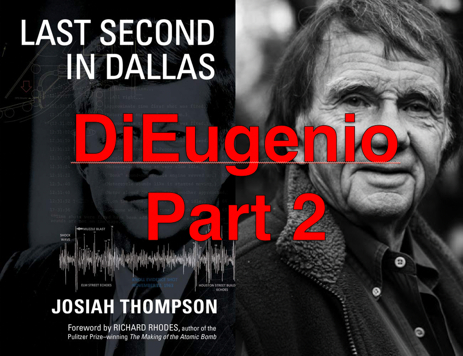
    As this writer has shown, Holland McCombs of Life magazine was the overseer of that publication’s aborted reinvestigation into the JFK case. In February of 1967, he terminated the efforts of Josiah Thompson and Ed Kern. (Thompson, Last Second in Dallas, pp. 26–27). In my review of Thompson’s new book, I presented evidence that those two were retired, while Patsy Swank and Dick Billings stayed on the case. (Click here for details) In this author’s opinion, that was not just happenstance. Thompson and Kern were turning up evidence that the Commission was wrong: Kennedy’s assassination was the result of a conspiracy. The problem for McCombs was simple. A Life stringer, David Chandler, had discovered that New Orleans DA Jim Garrison had reopened the Kennedy case. As noted in that review, McCombs was best of friends with Clay Shaw. Therefore, after cashiering Kern and Thompson, McCombs began to sponsor Chandler and Aynseworth.

    As we all know, the eventual article that Life magazine published as a result of what McCombs referred to sneeringly as “a reinvestigation” was a pretty weak bowl of porridge. (Life magazine, 11/25/66 “A Matter of Reasonable Doubt”) None of the very interesting material that Thompson and Kern had dug up was used. The article essentially centered on the testimony of John Connally; that he was hit by a different shot than struck Kennedy.

    But as noted in my review, McCombs did not just neuter the work of his better reporters on the JFK case. Due to his friendship with Shaw, he now began to communicate with the defendant’s lawyers and to urge on the work of his pal Hugh Aynesworth. (Letter by McCombs to Duffey McFadden of 5/13/67) Aynesworth wrote one of the first, most extreme and wild attacks on Garrison. This appeared in the May 15, 1967, issue of Newsweek. Something that Hugh never admitted, at least in public, is that he sent an advance rough draft of this article to both the White House and the FBI. (Western Union teletype of May 13, 1967) In that message, he ended with these words: “I intend to make a complete report of my knowledge available to the FBI, as I have done in the past.” In other words, Hugh was admitting he was a continuing informant for J. Edgar Hoover.

    Aynesworth essentially placed himself in the middle of Clay Shaw’s defense team for at least two years, and probably longer. In addition to the work he did for the FBI, there was evidence he also was in touch with the CIA. Accompanied by his colleague and fellow FBI informant James Phelan, Hugh drove up to the Clinton/Jackson area. Through the sources he had developed in Jim Garrison’s office—perhaps Tom Bethell and Bill Boxley—he knew how damaging these witnesses would be to Shaw at trial. They placed Shaw with both Dave Ferrie and Oswald. The witness Aynesworth figured as potentially the most incriminating was Sheriff John Manchester, because Manchester had actually approached and talked to Shaw and the defendant had shown him his identification. Aynesworth wanted Manchester to leave the state and stay gone until after the trial. What was in it for the sheriff? The presumed Newsweek reporter said, “You could have a job as a CIA handler in Mexico for $38,000 a year.” Today that would be over three hundred thousand dollars. We can easily assume this was significantly more than what Manchester was making in that rather small town.

    The sheriff did not take kindly to an attempt at obstruction of justice and what had all the appearances of being an Agency sponsored bribe. In no uncertain terms, he told Aynesworth the way he felt about the offer: “I advise you to leave the area. Otherwise I’ll cut you a new asshole!” (Joan Mellen, A Farewell to Justice, p. 235) Irvin Dymond, Shaw’s lead defense attorney, was very much appreciative of all the subterfuge Aynesworth was attempting on his client’s behalf. After all, he was saving Dymond a lot of work. In one of the most revealing and insightful statements about the reporter’s real role, Dymond went as far as to say that Aynesworth eliminated troublesome aspects to the point that they did not surface at the trial. (Columbia Journalism Review, Spring 1969, pp. 38–41, italics added) In other words, Aynesworth was so wired into the DA’s office that he would get to potential witnesses and suspects before Garrison could secure them. This reviewer inadvertently stumbled upon this meme many years ago. Julian Buznedo was a friend and colleague of David Ferrie’s. In discovering material about him in Garrison’s files, I phoned him in Denver to talk about his interview with the DA’s representatives. He told me that a week or so prior to that interview two men visited him in suits and ties, as he recalled, they either were from the FBI or Secret Service. (Interview with Buznedo, August of 1995)

    This is how plugged in Aynseworth likely was with the feds.

    IV

    After having dinner with Shaw, on August 2, 1968, Aynseworth wrote a note to the defendant on Newsweek stationary. That note shows just how inserted Aynseworth was into Shaw’s legal team, not just as a tactician working outside, but as a strategist from the inside. He is advising Shaw and his personal attorney Ed Wegmann to bring in another counsel. In that regard, he said he was going to try and talk with none other than Percy Foreman about this possibility. Foreman was a highly publicized and effective defense attorney, who would soon sell James Earl Ray down the river in Memphis over the assassination of Martin Luther King.

    Besides Aynseworth, the only other “journalist” who did as much to sabotage Garrison’s inquiry into the JFK case was probably Walter Sheridan. (For a chronicle of Sheridan’s misdeeds, see Destiny Betrayed, second edition, by James DiEugenio, pp. 237–43) Sheridan had worked for the FBI, the Office of Naval Intelligence, and rose to a high position in the National Security Agency before joining the Justice Department and working for Robert Kennedy. (ibid, pp. 255–56) He then went to NBC and worked on several documentaries, one of them being the infamous hatchet job on Garrison broadcast in the summer of 1967. As we shall now see, it appears that both Aynseworth and Sheridan combined in attempting to spread some rather ugly mythology in order to smear both the Kennedys and Garrison.

    Let me first quote a CIA memo of May 8, 1967, from Richard Lansdale to the Counter-Intelligence staff. Lansdale says that the source for the following information is Sheridan. Sheridan had arranged a trip to Washington for Alvin Beaubouef, who was one of two companions who accompanied David Ferrie on his mysterious trip to Texas on November 22, 1963. The lawyer Sheridan arranged for Alvin, Jack Miller, has told the CIA that Beaubouef, “…would be glad to talk with us or help in any way we want.” But as striking as that statement is, it is not the most interesting part of the memo. Sheridan also conveyed the following:

    …it is said that Garrison is going to subpoena an FBI agent and a former FBI agent. The thesis that Garrison is allegedly trying to develop is that Oswald was a CIA agent, was violently anti-Communist, and was recruited by CIA for an operation, approved by President Kennedy, the purpose of which was to assassinate Fidel Castro. The thesis further has it that when Oswald assassinated President Kennedy, it became necessary to show him as a Communist in order to conceal the original plan.

    It is further alleged that Garrison has said that he has letters signed by CIA representatives or by Senator Robert Kennedy which authorize certain Americans to work with Cubans for the assassination of Castro.

    As has been proven by the declassification of the CIA’s Inspector General report, President Kennedy never knew about such Castro assassination plots, let alone authorized them. (Click here for the IG Report, see pages 132–33) In all the years I have studied the New Orleans inquiry, Garrison never claimed to have such letters. This was a ploy used by the likes of Layton Martens, one of Ferrie’s friends, in order to try and deter Garrison. Sheridan has now altered the evidence record, in order to somehow make Garrison into an enemy of the Kennedys. To show how bad the information was, when the FBI learned of this information, J. Edgar Hoover acknowledged to Attorney General Ramsey Clark that the CIA replied with the rather pointed rejoinder that no such letters ever existed. (FBI memo of 5/17/67)

    Did Aynseworth pick up a few tricks in constructing fear and paranoia from his buddy Sheridan? Perhaps. In another FBI memo dated a few months later, December 27, 1967, Aynseworth appears to be playing a similar misleading banjo. On December 22, 1967, one of the owners of the giant industrial firm Brown and Root got a phone call from Aynseworth. The “reporter” told George Brown that he had documents revealing Garrison was going to reveal that Brown was involved with the CIA in covering up the plot to kill Kennedy and they were doing it for President Johnson. This one is, of course, meant to demonstrate the old MSM meme that somehow there was no rhyme or reason to the Garrison inquiry. That it was just a wild mélange of accusations bouncing around between the CIA, President Johnson, and Texas business titans. It’s the technique that Johnny Carson used at the beginning of his interview with Garrison on The Tonight Show. Again, I have never seen any such documents. The only way they could possibly exist is through either the manuscript of Farewell America or the musings of CIA infiltrator Bill Boxley. But this is how determined Aynseworth was to somehow get people in high places to fear and distrust the DA.

    It should be noted, to this author’s knowledge, Sheridan and his family never gave up his files to the NBC program The JFK Conspiracy: The Case of Jim Garrison. Sheridan passed on in 1995. So he was around for the congressional hearings dealing with the JFK Act, the attempts to pass that act, and the early part of the Assassination Records Review Board (ARRB) being functional. In fact, he requested those files be returned to him from the JFK Library in October of 1993. According to interviews this writer did with Deputy Chief Counsel Tom Samoluk and Chairman of the ARRB John Tunheim, even though they requested these documents, they were unable to garner them. When the Board tried to get them from Sheridan’s family after his death, they sent them back to NBC. One of the last things the Board did, in September of 1998, was to designate to the National Archives that these were considered Kennedy assassination related files. (Letter from General Counsel Ronald Haron, to Amy Krupsky at NARA, 9/24/98)

    V

    As time has gone on and more files from the House Select Committee on Assassinations (HSCA) have been recovered due to declassification, we see just how problematic the work of that committee was. The latest example being Tim Smith’s tour-de-force article about their diddling with the autopsy illustrations. What makes Smith’s essay so powerful is that he actually shows the reader the documents revealing that HSCA attorney Andy Purdy, researcher Mark Flanagan, and pathologist Dr. Michael Baden were all aware of and cooperating with this alteration of Kennedy’s rear skull wound. This shows just how obsessed the HSCA was in raising that wound from low in the skull to four inches higher, into the cowlick area. (Click here for Tim’s article) After all, they had to have a way to account for the 6.5 mm object which now appeared on the x-rays, which no pathologist or FBI agent saw the night of the autopsy.

    In those same HSCA volumes, specifically Volume 10, there is a discussion of the issue of Guy Banister, Oswald, and Dave Ferrie at 544 Camp Street. With the declassification of the HSCA files, we can see that, again, there are some real problems with this report. I won’t go into all of them, that would take another long essay in and of itself. But, for example, in their all too brief review of Kerry Thornley, they conclude that Thornley was telling the truth when he said that he never had any contact with his Marine buddy Oswald after Kerry left the service. (See HSCA Vol. 10, p. 125) Apparently, Thornley’s father had died or the committee never got in contact with the Los Angeles County Sheriff’s office, because Kerry’s dad had told them that Oswald had been in correspondence with Thornley and some of the letters were of recent vintage. (Mellen, p. 276, based on report of 11/26/63) Allen Campbell, who worked out of Guy Banister’s office, told Joan Mellen that Oswald had been in contact with Thornley in the summer of 1963. (Mellen, p. 276; for a detailed expose of just how bad the HSCA was on this subject, click here)

    In that HSCA volume, the report also says that the branch of the Cuban Revolutionary Council in New Orleans had left its office at 544 Camp Street in January or February of 1962. But yet, the owner of the building, Sam Newman, was inconsistent on this point. On November 25, 1963, he told the FBI that he rented space to the CRC in March of 1963 and they were there for 4–5 months. Two days later, he changed his story. He now told the New Orleans Police that they had left 15 months previous. (DiEugenio, Destiny Betrayed, second edition, p. 113)

    In a newly discovered letter from Sam Newman, it appears that the HSCA should not have trusted the Cuban exiles in that organization for information on this issue, because Sam Newman wrote a letter to Dr. Tony Varona of the CRC in Miami on March 9, 1962. He says that he is owed money for the rent at that time, but the space is still being used. So, unlike what the HSCA report states, the exiles were not out in January or February. What is even more odd about this letter is that Newman knows Varona’s exact address and he talks to him like this is not the first time he did so. This tends to undermine the whole façade of naivete about the group at his building that Newman tried to convey to both Jim Garrison and the HSCA. (Ibid, DiEugenio, pp. 113–114) So as of now, with this new evidence, it is indefinite as to when the CRC left Sam Newman’s building.

    Further, in that same volume, on page 125, it mentions Mancuso’s Coffee Shop. This was on the ground floor of the Newman Building. The report say that Jack Mancuso did see Guy Banister at his place, but not Oswald. Again, the HSCA inquiry was apparently incomplete, for a man named Richard Manuel was in contact with Anne Buttimer of the Review Board in 1995. Manuel later got in contact with the Board’s Jeremy Gunn. He told Gunn that he moved to New Orleans in the mid-sixties and worked in advertising on Lafayette Street near the Newman building. His company owned a print shop and he got to know two men who worked there who were New Orleans natives. These two men, Ray Ohlman and Lloyd Reisch, also knew Banister. They frequented Mancuso’s. And they had seen Banister with Oswald at the coffee shop. (ARRB Notes of Manuel call dated 2/1/96)

    VI

    Gladys and Arthur Johnson owned the boarding house where Oswald lived at on North Beckley Avenue in Dallas. Oswald lived there after his return to Texas from New Orleans in October and November of 1963. Oswald seemed like a nice, friendly young man and he got along with their grandchildren. One of whom was named Pat Hall, who was eleven at the time. Pat’s brothers were younger than she was and they played catch with Lee. Pat recalled him watching TV with the other boarders.

    Stella Fay Puckett was Gladys Johnson’s daughter. She was the owner of Puckett Photography. That place of business was directly across from the Texas Theater. On November 22, 1963, she was at work when she saw a fleet of cruiser cars out her front window. She then noted the officers forcibly pushing a man into a police car. She did not know who this man was, but she did recognize his face, because she had seen him tossing the football with her young sons in the front yard of the Beckley address.

    After watching the officers push Oswald into the police car, Stella Fay called her mother up at the family business, Johnson’s Café, but they were not there. She later learned that the news of Kennedy’s assassination had disturbed them so much that they closed the café and went to the Beckley Avenue address. Stella then called the boarding house. When Gladys answered, Stella said to her, “One of your boarders is being arrested for something.” She was quite surprised at her mother’s reply: “Well, that explains why the FBI is here searching his room.” (Sara Peterson and K. W. Zachry, The Lone Star Speaks, pp. 173–75)

    This is doubly surprising, because the official story has Oswald registered at the boarding house under the name of O. H. Lee. (Warren Report, p. 737) But also, as Peterson and Zachry point out, the address that Oswald had given to his employer at the Texas School Book Depository was not Beckley Avenue. He had left the address of the Ruth and Michael Paine residence in Oak Cliff and this is where his wife Marina was staying. The hired landlady Earlene Roberts and the Johnson couple did not recognize their boarder as Lee Oswald until they saw his name on TV. (Peterson and Zachry, p. 176)

    Let us set the time. Oswald was arrested at approximately 1:50pm. (Warren Report, p. 179) At that time, no one knew who he was until, according to the official story, the officers driving him to the police station secured his wallet. At 2:15, Captain Will Fritz told Sgt. Gerald Hill that they needed to swear out a warrant to search Oswald’s residence on Fifth Street in Irving, which was the Paine residence. In reply, Hill told Fritz that Oswald was already at police headquarters. (Warren Report, pp. 179–80) In other words, the police, as late as 2:15, thought Oswald was living at the Paine home. How did the FBI know where he really was at about 1:55, 20 minutes earlier, right after his arrest?

    There is more. After about the first week of March, Earlene Roberts picked up in the middle of the night and left. She never returned. She waited until all the boarders were in bed and then left with destination unknown. She did not leave a phone call, much less a resignation letter. (Peterson and Zachry, pp. 176–77)

    What makes this even more interesting is that Roberts’ sister was Bertha Cheek. (Warren Report, p. 363) Cheek was upset Earlene had left with no notice but said she did not know where she went. Cheek also owned a boarding house in Dallas. Jack Ruby had approached her in the fall of 1963 about a business proposition. The Warren Commission brough this issue up, and in its usual manner, disposed of it in short order. (ibid) This is a relationship that Jim Garrison found interesting, because it was a point which could provide a nexus for Ruby knowing Oswald.

    Garrison pursued this possibility. In November of 1964, a man named Raymond Acker, who worked for Southwestern Bell, came to the Dallas Police. He was waving a handful of phone company records, which he said constituted proof that Ruby had called Oswald. The DPD confiscated the records and told Raymond to go home and shut up. Acker had a pretty decent job in management at that time. He did shut up. He then got a promotion that moved him out of Dallas. In fact, he became a company Vice President and General Manager. He was number four on their executive listing in 1967. (NODA Memorandum of 9/18/67, Matt Herron to Garrison)

    Acker was fearful of losing his job if the story ever came out. With that at one end, and the oh so corrupt Dallas Police at the other, the lead seemed like a dead end, but not quite. Chuck Boyles was a local disc jockey who ran a night talk show at station KLIF. Chuck knew little about the JFK case, but understood it was an attention magnet for his audience. One evening a local phone operator called in. She would not say who she was for fear she would get terminated. In fact, her husband was telling her to hang up as she was talking. She said she was an operator in the Whitehall area, which was where the boarding house phone was located.

    She said even though these were local calls she had made records of them. She had to, since Ruby would use the emergency break in technique if someone else was using the Beckley Avenue phone. After her husband got her off the line, she called Boyles back and talked to him privately.

    As John Armstrong noted, there is no indication that the FBI ever checked phone company records for emergency calls between the two. (Harvey and Lee, p. 769) As we can see, and as more material gets discovered, from the Commission obstruction by Allen Dulles, to the crucial role of Howard Willens, to the attempts by pseudo journalists to falsely involve the Kennedy brothers in the Castro assassination plots, to more probable evidence of a Banister/Oswald relationship, to the likely knowledge of the FBI about Oswald, the cover up about almost every aspect of the Kennedy case is even worse than anyone thought.

  • The One and Only Dick Gregory

    The One and Only Dick Gregory


    The only comedian I can think of who I would compare to the late Dick Gregory is Mort Sahl. They were both socio-political themed stand-up comedians who, at the peak of their careers, decided to gamble fame and fortune for their political ideals. Sahl did it by deciding to become an investigator for Jim Garrison on the JFK case. Gregory did it for civil rights activists Medgar Evers and then Martin Luther King. He later became involved with people like Robert Groden and Mark Lane on the JFK case and the King case.

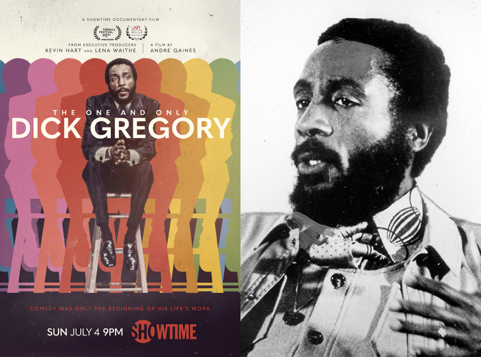
    The current documentary about Dick Gregory on Showtime, The One and Only Dick Gregory, makes note of the fact that, by 1962, Gregory was probably the hottest comedian in America. In fact, one of the interview subjects, Harry Belafonte, calls him the greatest political comedian ever.

    Gregory was born in St. Louis, went to high school there, and then attended Southern Illinois University on a track scholarship. He was drafted into the army and won some talent shows as a comedian. When he returned from the service, he dropped out of college and went to Chicago to try and become a professional comedian. He was one of the very few comedians who decided to make racial issues funny: “Segregation is not all bad. Have you ever heard of a collision where the people in the back of the bus got hurt?”

    This kind of comedy got him noted in both Chicago and New York City. One of his first record albums, East and West, was done in New York. (Between 1961 and 1964, he did seven albums.) When he returned to Chicago, he received what most commentators note as his big break. He replaced Professor Irwin Corey for what was supposed to be one night at the Playboy Club. One of the jokes he cracked that night went like this: “I understand there are a good many Southerners in the room tonight. I know the South very well, I spent twenty years there one night.” He was such a hit that the one-night stand turned into six weeks. One notice read as follows:

    Dick Gregory, age 28, has become the first Negro comedian to make his way into the nightlife club big time.

    Another said:

    What makes Gregory refreshing is not only that he feels secure enough to joke about the trials and triumphs of his own race, but that he can laugh, in a sort of brotherhood of humor, with white men about their own problems…

    This highly successful Chicago appearance caught the attention of Jack Paar. After Steve Allen, Paar was the second steady host of The Tonight Show. It was Paar who made the show into the institution it became. Paar was not just funny. He was intelligent, informed, curious, and principled. In other words, he was just the kind of late-night host who Dick Gregory would appeal to. As the comedian later added, it was not just the fact that Paar had him on national television, it was what happened afterwards. The host invited him over to the panel to talk. That is what was important. At that time, such a display of integration was unusual. According to the film, it blew the NBC switchboard out. Because of his new notoriety, CBS newsman Mike Wallace did a profile of him.

    From there it was on to the likes of Ed Sullivan and Merv Griffin. Greg, as his friends called him, also wrote an autobiography called Nigger, co-written with Robert Lipsyte. Amazingly, in nearly sixty years, that book has never been out of print.

    II

    At this point in the film, director/writer Andre Gaines begins to describe his subject’s transition from a pointed stand-up comic to a socio-political activist. As the sixties heated up, it wasn’t enough for Dick Gregory to say things like, “Football is the only place where a black man can knock down a white man and 40,000 people cheer.” Or, in satirizing liberals, “They all say, some of my best friends are colored, but there just aren’t that many of us.” Or in pointing out the hypocrisy of the court system: “A black guy robs a bank of $20,000 and he gets four years in Alcatraz. A white guy embezzles 3 million and he gets three years.” As civil rights demonstrations broke out in the south, Greg began to empathize with what was happening. As he put it, since he was from the north, he was not really aware of how bad the Jim Crow situation was down south. Even though he was making a lot of money at this time and he was peaking in his professional career, he decided that, whatever the consequences, he was going to get involved with the struggle for civil rights.

    And he began to adjust his humor as this happened: “A white guy kills 2 black demonstrators with his car and the cop arrests the dead guy 500 yards away for leaving the scene of an accident.” He did civil rights work first for Medgar Evers, who he very much admired for his voter registration drives. Gregory also became involved with the famous case of the three missing civil rights workers in Neshoba County, Mississippi—James Chaney, Andrew Goodman, and Michael Schwerner. He suspected the sheriff’s office was involved. He then offered a reward for information on the case. The FBI followed his lead of offering reward money. It worked. The bodies were found and the case was solved.

    The film notes that his publicist sued him at this time, since Greg had sacrificed $100,000 worth of appearances—the equivalent of about a million bucks today—in order to work the South with Medgar. At this time, Gregory was getting $5,000 per nightclub/concert appearance. Instead, he chose to risk getting arrested by participating in civil rights drives in places like Mississippi and Alabama.

    As the film shows, he did get arrested. Beyond that, he got his arm broken while being battered with a baseball bat. (Dick Gregory and Mark Lane, Murder in Memphis, ebook version, p. 29) He was very much depressed when Evers was assassinated in the summer of 1963. But he pressed on, getting arrested even more. As he put it, what these activists were doing was more important than what he was doing. When the famous 1965 Watts riots broke out in Los Angeles, he said on TV, “I just got back from Los Angeles, Vietnam.” The film dramatizes his message at the time. Greg was saying that this was not a problem confined to the black community, it was an American problem. The film then juxtaposes excerpts from rioting in Harlem in 1964 with those from Ferguson in 2014.

    From here, the film begins to show that, as Gregory now became associated with Martin Luther King, like King, he began to become a vociferous critic of the Vietnam War. And as this occurred, J. Edgar Hoover and the FBI began to keep files on the comedian; they also tapped his phone and drew up methods of neutralizing his impact. Greg decided that, for this particular anti-war message, he had to speak at colleges and universities. He began to attract large crowds and he would harangue the United States for building this Military Industrial Complex and using it against the people of Vietnam. The regents of the University of Tennessee banned him from speaking on campus. They said he was an “extreme racist” and his presence would insult much of the state’s citizenry. The students sued and they hired noted radical lawyer William Kunstler to present their case. They won in court and Gregory finally spoke there in 1970. In 1969, Gregory spoke at the huge moratorium against the war in Washington DC.

    Not mentioned by the film are the comedian’s political races. Dick Gregory (unsuccessfully) ran against Richard J. Daley for the office of mayor of Chicago in 1967. He then ran as a write-in candidate for the President of the United States in 1968. (Gregory and Lane, p. 7) In some states, Mark Lane was his running mate. In some other states, his running mate was Dr. Benjamin Spock, the famous pediatrician. Gregory later wrote one of his many books about this campaign. That election attempt landed him on Richard Nixon’s enemies list.

    As the film depicts, King’s assassination resulted in a huge wave of riots in well over 100 cities across America. The year 1968 almost brought the United States to a point of civil war. Gregory humorously commented on this state of siege. On stage, he would bring out a large violin case. He opened it and pulled out a tommy gun. He then pulled out a bow and started playing the machine gun.

    III

    At this point, the film notes that one of the methods Greg used to protest the war was by fasting. And I thought that it would be at this juncture that writer/director Andre Gaines would cut to the event that was probably the crystallization of Greg’s political career. I am, of course, referring to the night of March 6, 1975. That was when the Zapruder film was shown for the first time on national television. The three main guests that night on the program Good Night America were Geraldo Rivera as host, Robert Groden as the photo technician who had recovered a copy of the film from Life magazine, and Dick Gregory. It is not an understatement to say that the showing of this film on national TV electrified America. It put the Kennedy assassination back on the national agenda. It now became a topic of conversation at lunch and around water coolers at work.

    By this time, Dick Gregory had become convinced that something had gone politically wrong with America after 1968. And, on top of that, the fact that JFK, Malcolm X, King, and Bobby Kennedy had all been snuffed out in a span of five years—that was just too much to swallow as simply a coincidence.

    Gregory had known King and President Kennedy. Greg was at the March on Washington, which was sponsored by the White House and at which King had spoken so memorably. (Gregory and Lane, p. 6) He had been asked to come down to Birmingham in 1963 for the huge demonstration that several civil rights leaders had combined forces on. President Kennedy called him at home and asked him not to go, since they were working on a solution to the conflict and further demonstrations could imperil it. Greg appreciated the call, but said he felt he had to go. (ibid, pp. 30–33)

    As the comedian told this reviewer, when he returned from Birmingham, his wife told him that Kennedy had called again and wanted him to return his call the moment he got in. Gregory noted the late hour, but his wife said JFK told her it did not matter what time it was. So Dick Gregory called the White House and Kennedy picked up the phone. The president said to the comedian words to the effect that he needed to know everything that happened in Birmingham. Greg went on for about ten minutes describing the whole ugly mess. When he was done, Kennedy replied with “Oh, we’ve got those bastards now!” At this comment, Gregory started weeping. (2003 Interview with Joe Madison and Gregory in Washington on WOL Radio One)

    This is probably the reason he was quite interested in Kennedy’s assassination. But Greg was even closer to King. And the film shows them on stage together. In 1977, Mark Lane and Dick Gregory combined to author a book on King’s assassination. At that time, it was titled Code Name Zorro, since they had learned from FBI agent Arthur Murtaugh that “Zorro” was the FBI’s moniker for King. When it was republished in a revised version in 1993, the volume was now titled Murder in Memphis. To this day, it is a seminal book on the King case.

    Very early in that volume, Gregory notes that it was when King turned against the Vietnam War that his image in the public mind was altered.

    When King made his famous speech on April 4, 1967, in New York condemning the conflict in Vietnam, he was now perceived as an enemy of the Power Elite. (Gregory and Lane, p. 6) Later in the book, Greg outlines how even those involved in the civil rights movement were taken aback by King’s harsh stand on the Vietnam issue, for the simple reason that they knew that Vietnam had become President Johnson’s personal fiefdom. He was the one who had escalated that war to a magnitude beyond President Kennedy’s imagination. These other civil rights leaders understood that there was a danger that Johnson would take King’s condemnation as a personal assault and the president would turn his back on their cause. (Gregory and Lane, p. 51) And as Greg said so perceptively later in that book, King was expanding his vision of American civil rights to universal human rights. (ibid, p. 56)

    King’s anti-Vietnam War speech was criticized by both the New York Times and Washington Post. It’s hard to comprehend today, but both of those MSM outlets were still supporting what Johnson was doing in Indochina at that time. (Click here for details) As Gregory notes in Murder in Memphis, it was William Pepper’s famous photo essay in Ramparts magazine that had energized King in this regard. (Click here for details)

    IV

    But as Gregory also points out in Murder in Memphis, the antipathy for King amid the Power Elite was exponentially increased when he also announced his plans for a Poor People’s March in Washington. There was a good reason for this march. As many commentators have noted, what had happened under Johnson was simple to comprehend. And, in fact, he himself knew it. Johnson’s vision of a Great Society had crashed on the shores of Da Nang in Vietnam. Or as King himself had declared:

    Many of the very programs we are talking about have been stifled because of the war in Vietnam. I am absolutely convinced that the frustrations are going to increase in the ghettoes of our nation as along as the war continues. (Gregory and Lane, p. 54)

    In other words, as King said to newsman Sander Vanocur, the dream he talked about in his March on Washington speech in 1963 had, in some respects—between the race riots and Vietnam—become a nightmare. As Gregory noted, the Poor People’s March posed the possibility of exposing this nightmare, and not just to LBJ, but congress. In fact, Murder in Memphis contains an appendix in which Senator Robert Byrd made a vituperative speech against it. (Speech of March 29, 1968) The Poor People’s March provoked meetings at the White House, the Department of Justice, the Pentagon, the Metropolitan Police, and the FBI. (ibid, p. 57; the best book on this is probably Gerald McKnight’s The Last Crusade published in 1998) The combination of King’s assassination, plus the massive interference and surveillance with the march turned it into a failure.

    Dick Gregory was correct when he described King as turning in his last years towards a different agenda. About that there should be little or no doubt:

    In a sense you could say we are engaged in a class struggle, yes. It will be a long and difficult struggle for our program calls for a redistribution of economic power…I feel that this movement in behalf of the poor is the most moral thing—it is saying that every man is an heir to a legacy of dignity and worth. (Speech of March, 1968)

    Or as King—echoing Bobby Kennedy—put it more succinctly: “What good it is to be allowed to eat in a restaurant, if you can’t afford a hamburger.” (Sylvie Laurent, King and the Other America, p. x) As Gregory wrote in Murder in Memphis, the dilemma that King was trying to expose was multi-dimensional. It not only would pose problems for Johnson, the White House, and Congress, but it would probably be an international problem. As the comedian wrote:

    What would this do to our image as the richest nation in the world? What about those countries who were not aware of America’s racial problems of poverty and hunger? … White reaction to the planned Poor People’s March was astonishing. A headline in Readers’s Digest magazine a few days before King was killed read, “The United States may face a civil crisis this April when a Poor People’s Army pitches camp in the nations’ capital. (Gregory and Lane, p. 57)

    As Dick Gregory was saying, and as Sylvie Laurent amplified later, King was now trying to stretch his populist coalition. And MLK explicitly stated it in his own terms:

    The unemployed poverty-stricken white man must be made to realize that he is in the very same boat with the Negro. Together, they could exert massive pressure on the government to get jobs for all. Together, they could form a grand alliance. (Laurent, p. 8)

    Due to King’s murder and the powerful forces arrayed against what was left of the Poor People’s March, it failed. As Laurent wrote:

    On June 24, 1968, the makeshift housing Martin Luther King Jr. had dreamt of, built on the mall in Washington DC and known as Resurrection City was wiped out. Police tear gas filled the air. Hundreds of people were arrested. Bulldozers smashed the plywood shacks. (Laurent, p. 1)

    As Richard Nixon later said, it was that image and the dispersal of those people that combined to help elect him. (ibid) The grand alliance King was designing ended up dissipated. The reverse, namely Nixon’s southern strategy, was later used by Ronald Reagan, and then given broadcast voice by Rush Limbaugh and Fox News. King’s unification strategy was now somewhere in the ozone. Roger Ailes’ and Pat Buchanan’s polarization policy ruled the day.

    That would have been a powerful coda with which to end The One and Only Dick Gregory.

    V

    The only trace of this that I could detect was near the very end of the film. On a last kind of 2015 comeback tour, two years before Greg died, there is a brief glance at Pepper’s book The Plot to Kill King on a chair. If I missed something, I hope someone can remind me of it.

    So, what does approximately the last third of the film deal with? Gregory turning into a fitness expert and a health foods businessman. He moved his family to a forty-acre farm in Plymouth, Massachusetts, in 1973. He began to sell vitamins and nutrition products. He also was one of the first to argue for the primacy of natural water in everyone’s diet. He stopped playing nightclubs and there was no more alcohol consumption or smoking for him. Harking back to his college days, he became an avid runner. And his cause now was to erase world hunger. He fasted for that one also.

    He created something called the Bahamian Diet nutrition drink. This ended up being very successful. After having some legal problems in the mid 1980’s which tied up much of his assets, he settled the lawsuit and sold the business for millions.

    But Greg never really lost his affinity to protest injustice. Another part of his life was devoted to exposing the CIA/cocaine scandal of the late nineties. At that time, he actually went out to CIA HQ in Langley, Virginia, and unspooled yellow tape around the building. Because as he said, “We know where the criminals are.”

    Andre Gaines’ film is a passable chronicle of the showbiz side of Dick Gregory, but it does not do justice to what made the man the true icon he was. Perhaps that was the price of getting people like Chris Rock and Dave Chappelle and Kevin Hart to appear. If it was not, then Gaines made a mistake. His film should be called The One and Only Dick Gregory (Censored Version).

  • Cotton Coated Conspiracy, by John Roberts?

    Cotton Coated Conspiracy, by John Roberts?


    What is one to make of authors who accuse men like Mark Lane and William Pepper of being cover up artists yet refuse to reveal their true identities? Which is why the question mark appears above, because that is what the book Cotton Coated Conspiracy does concerning the Martin Luther King case.

    This book may—or may not—have been written by three people. The name on the cover of the book, denoting the author, is John Roberts. Yet, the two characters who actually do the investigating of the King case in the text are named Randall Stephens and Marcus Holmes. But very early, in the Introduction, it is declared that these are all pseudonyms. Beyond that, they are composites, which means they are composed of a “conglomeration of several private researchers.” (p. xiii) And further “neither are those names the genuine titles of anyone who worked on this project.” When pictures appear depicting someone who is part of the research effort, their face is blocked out.

    In other words, we do not know who wrote the book, which is an important point since, as noted above, it is an accusatory and sensationalist volume. So much so that this is why the aliases may have been used: to prevent legal action.

    The ostensible subject of the book is the assassination of King in Memphis in April 1968, but the book is not really about the figure of Martin Luther King. In fact, one will learn very little, if anything, about the man from this book. And I will later attempt to explain why I believe that, whoever wrote the book, did that bit of foreshortening.

    This book is really about John McFerren and the small town he lived in called Somerville, Tennessee. As anyone can discover, McFerren was a noted civil rights leader in Fayette and Haywood counties. He was instrumental in organizing voting drives and in getting schools integrated. He also helped organize Tent City. This was needed because many of the whites in the area began to evict African Americans due to these integration efforts. (Click here and here)

    McFerren owned a business in Somerville. At the time of King’s murder, he had been married to his wife Viola since 1950. The business owner/activist, died in April 2020.

    I

    The book proper begins in 2015. Holmes is handing over research materials on the King case to Stephens. Holmes—or whatever his name is—does this since his parole is being revoked and he is going to prison. (p.6) His research refers to the role of Fayette county Tennessee in the death of King. I did not realize it at the time, but this is a key statement. Because, as we will see, the book really centers on the small town of Somerville, outside of Memphis, and its supposed role in King’s murder.

    Another revealing part of the book occurs just a few pages later, when Stephens says he will rely only on “hard documentation” and will remain objective. Since it did not matter to him if Ray was or was not guilty. (p. 9)

    The reason the above turns out to be puzzling is that, when the book is completed, its pretty clear that the main witness is McFerren. The authors begin with him and they end with him. It is his statements to Stephens and Holmes that rule all they do. The rather loose way they handle the question of whether or not Ray is guilty is but one indication of this. Because in any real inquiry, that particular question would seem to be paramount. Yet, in Cotton Coated Conspiracy, it isn’t.

    McFerren was born in Somerville in 1924. He dropped out of high school and worked as a quail hunter. (pp. 21–22) John served in World War II for the US Army. In 1950, he married his wife Viola Harris and they worked on a farm for eight years. As noted in this book, the immediate geographic area is deemed crucial. Therefore, the Burton Dodson case is dealt with, since it was a key event in McFerren’s life. Dodson was an African-American farmer who was accused of assaulting a white resident. The county sheriff organized the equivalent of a vigilante force to surround Dodson’s home, but the accused man was fired upon as he escaped. He fired back and one of his shots may have fatally wounded a deputy; or it may have been friendly fire. (p. 23)

    Dodson fled to East St. Louis and lived there under an assumed name for 18 years. In 1958, he was uncovered and returned to Fayette. He was defended by African-American lawyer James Estes. That trial was held in the county courthouse in Somerville. Since McFerren was a friend of Estes, he and his brother-in-law Harpman Jameson attended the trial. Since only registered voters could serve on juries, the verdict was predetermined. The all-white panel found Dodson guilty.

    Because of that result, Estes managed to get a verbal agreement and the Fayette County Civic and Welfare League (FCCWL) was formed. This created one of the first voter registration drives in the rural south. With help from Washington—both under the Eisenhower and Kennedy administrations—white resistance to the voter registration drive was overcome. The white power structure now used two other devices: economic embargo and eviction. The former—for example the cancelling of bank loans—led to the latter. McFerren, who had expanded his business into a combination gas station and grocery store, was deprived of his fuel supplies. The Justice Department filed charges against many local businesses.

    But the evictions were effective. Therefore, the FCCWL set up a tent city five miles south of Somerville. Finally, in 1962, the Justice Department—through illustrious civil rights specialist John Doar—got a consent decree that stopped landowners from using economic pressure to discourage African Americans from voting. (pp. 27–39; also click here)

    II

    In no book on the King case that I have read has any author gone into the Dodson case and never at this length. But since the book is so exclusively focused on McFerren, the authors feel justified in doing so. Starting off his business in 1960, McFerren expanded his gas station into a grocery store, café, maintenance garage, and laundromat. (p. 32) Befitting his starring stature, there are a few pictures of the construct in the book.

    McFerren later found out that certain African-Americans in prominent positions in the civil rights movement were working both sides of the street. This included famed civil rights photographer Ernest Withers and local NAACP president Allen Yancey Jr., a McFerren neighbor. Both were FBI informants. (pp. 42–43)

    The authors now turn to April 8, 1968, four days after King’s assassination. The scene is the Peabody Hotel in Memphis. Rev. Sydney Braxton had talked to McFerren about the King murder. Braxton then arranged a meeting with Memphis police officers and an FBI agent. This owed to the fact that McFerren dealt with a man named Frank Liberto for the produce in his store. Liberto was the chief owner of LL&L Produce Company in Memphis. About a week before the King assassination, Liberto had said something like, “They ought to shoot the son-of-a-bitch.” Liberto then asked McFerren what he thought of “King and his mess.” McFerren simply replied that, “I tend to my own business.” (pp. 45–46)

    The following Thursday—his regular day to drive in from outside Somerville to pick up his produce—was April 4th. McFerren said that he walked into the warehouse unnoticed. LIberto was on the phone. He said to the other party, “Kill the sonofabitch on the balcony and get the job done. You will get your $5,000.” The second owner, a thin white man with a scar, noticed he was there and asked him what he wanted. McFerren said he was just picking up his usual produce. A call came in that this second man picked up. He gave the phone to Liberto, and Liberto said, “Don’t come out here. Go to New Orleans and get your money. You know my brother.” (p. 47) McFerren then paid for his items and left.

    On April 6th, his wife showed McFerren a hand-drawn sketch of the suspected killer from The Commercial Appeal, the major newspaper in Memphis. John thought this man was a former employee of Liberto who he recalled from the summer of 1967. John described him as a cross between an Indian, Cuban, Mexican, or Puerto Rican. He had a very yellow complexion and had “jungle rot” on his neck. He was about 5’ 9”, slender, and was about 25 years old. (p. 48)

    The FBI interviewed McFerren again on April 18th. In this report, done by two agents named Fitzpatrick and Sloan, what McFerren said is pretty much the same as in the first interview. The only major difference was that, at the conclusion of this one, the agents showed the witness a set of six pictures and asked him to pick out the man he thought had the “jungle rot” on his neck. The report said that after being prompted by the agents about the name and photo of Eric Starvo Galt being the FBI’s chief suspect, John tentatively picked him out. (p. 53) McFerren disagreed. (p. 58) He said he picked the Galt photo out without being prompted. (Galt was one of the aliases for Ray; it’s the one he used most in the USA)

    From here, the book shifts to the capture of Ray in England, his extradition to Memphis, and the legal proceedings against him. At this point, the reviewer began to have some real trepidations about the path ahead. First, its apparent that the authors—whoever they are—want to go with the orthodoxy that Ray was a racist. Author John Avery Emison shows that such was not the case. There is no credible evidence for this and the evidence that has been produced has been made by rather suspect writers. (The Martin Luther King Congressional Cover Up, pp. 72, 73, 84, 88)

    Cotton Coated Conspiracy actually refers to Ray’s four-minute Q&A before Judge Preston Battle as a “confession.” The book leaves out two pertinent facts. First, during his Q&A with the judge, Ray made it clear to Battle that he did not agree with the theories of Ramsey Clark, J. Edgar Hoover, and the local attorney general, Phil Canale, about the conspiracy. (William Pepper, Orders to Kill, p. 46) Since they advocated no plot and Ray as the sole killer, it’s pretty obvious what Ray was implying. But secondly, a crucial part of the transcript was later forged. When Judge Battle asked the defendant if any pressure had been used to make him plead guilty, Ray actually replied with a question: “Now what did you say?” (Emison, p. 156) This is on the genuine transcript. An altered transcript states that Ray’s reply was “No. No one in any way.” Emison proves this fakery in a number of ways, including the fact that the typescript on the altered version does not match. These are two crucial points that undermine the contention about Ray’s “confession.”

    The authors note that, after his guilty plea and within 72 hours, Ray quickly switched and wished to plead innocent. They write that Ray was “claiming” he had been coerced into pleading guilty by his new lawyer Percy Foreman. (p. 56) The use of the word “claiming” is really inexcusable. These are not “claims.” Emison proves that Foreman used every trick in the book to get Ray to plead guilty. This included threatening to bring in his family as members of the conspiracy and also bribery. (Emison, pp. 151–53)

    III

    The reason I think the book lets Foreman off the hook is in order to somehow support McFerren’s alleged identification of Ray at Liberto’s. But anyone familiar with the KIng case would understand that the description by McFerren does not match Ray. Ray did not look Indian, Cuban, or Puerto Rican, was not yellow-complected, and did not exhibit “jungle rot” on his neck. Also, why on earth would Liberto—who the book sees as a very major figure in the plot—hire someone who had worked for him in public? Further, the Commercial Appeal sketch does not look like Ray. It actually resembles Richard Nixon. (See Appendix) That sketch does not resemble Ray, because it is based upon the memory of a man who, in all probability, never saw Ray on the day of the assassination.

    Charles Stephens’ identification was also used in England to extradite Ray back to the USA. (Harold Weisberg, Martin Luther King: The Assassination, pp. 24–25) Today, using Charles Stephens in the MLK case is the equivalent of using Howard Brennan in the JFK case. When you do this one forfeits credibility. Let me explain why.

    On the day of the assassination, Stephens was in the boarding house Ray stayed at. That night he told the police he could not give a description of the man coming out of the bathroom, since he did not get a good look at him. Further, he added that he could not see the man’s eyes. This statement was actually signed by Stephens the evening of the murder. (Emison, p. 43)

    The testimony of the manager of Bessie’s Boarding House was that Ray, under the name Willard, checked in at about 3:00–3:10 on the day of the assassination. (Mark Lane and Dick Gregory, Code Name Zorro, eBook edition, p. 164) The first stories circulating in the press were that Ray/Willard had left a fingerprint in his room and a palmprint in the communal bathroom; from where the authorities said, he fired a rifle and killed King. Neither of these items of evidence were mentioned in the stipulation of evidence that Foreman agreed to in court. (ibid, p. 163) When Mark Lane interviewed Mr. Stephens about a week after the murder, the witness described the man he saw in the hallway as small, quite short. Ray was not short, he was 5’ 10”.

    As the reader can see, Charles Stephens was an erratic witness. The more he talked in public the more dubious his story got. Therefore, the authorities placed him in detention with a $10,000 bond. The witness did not like being held. Stephens secured a lawyer in order to get released. Afterwards, police were around him most of the time. (Lane and Gregory, pp. 164–65)

    There was another problem with Mr. Stephens. He had a serious alcohol problem. In fact, his wife Grace said he could not have seen anyone go down the hallway, since he was dead drunk on his bed. Her statement was supported by cab driver James McCraw, who was supposed to pick Stephens up that day. But when McCraw got to his client’s room, Stephens was too drunk to walk. But further, the cab driver placed this encounter at about 2–5 minutes before King’s assassination. (Lane and Gregory, p. 166) Grace said the man she saw had an army jacket on and salt and pepper hair. That was not Ray either.

    Because her identification did not match Ray, the authorities placed Grace in a sanitarium. (ibid, p. 167) When you have to place one witness in detention and the other in an asylum due to their descriptions, how good is your case? But it gets worse. In 1974, Mr. Stephens filed an action to collect $185,000 in reward money that had been offered by three sources, since his testimony had been the chief evidence to place King’s killer behind bars. During this later hearing, as author Philip Melanson describes it, Charlie’s story was altered in at least three ways to make him seem more certain about the identification. (Melanson, The Martin Luther King Assassination, pp. 95–96)

    Try and find the above information about Charles Stephens in Cotton Coated Conspiracy.

    IV

    This is a serious problem with McFerren’s story. But the anonymous authors of this book don’t see it that way. In spite of all the above—and much more exculpatory evidence they do not mention—they maintain that McFerren is correct about Ray. For a large part of the book, they use this dispute over Ray between McFerren and authors Bill Pepper and Mark Lane, to create one of the most eyebrow arching conspiracy theories this reviewer has ever encountered.

    Because this is not all that McFerren was claiming. McFerren had a network of informants that he organized due to the civil rights strife in and around Somerville. He would secretly tape some of these informants. He kept the tapes and let certain people hear them, like Pepper. The authors of this book also heard them. The book summarizes some of these tapes. Evidently McFerren sometimes spoke about some of this information in declarative form on the tapes. From these recordings, McFerren stated in an affidavit that his informants gleaned information that the Mayor of Somerville collected money from local businessmen to pay for King’s assassination. That the mayor made two trips to London, one before and one after the murder. And that the mayor harbored Ray two days before the assassination. (pp. 80–81) If you are wondering who the mayor was, his name was Isaac Perkins Yancey. He served in that office from 1940–78. He has a park named after him with a plaque in it.

    The anonymous authors of the book are so intent to back up McFerren that they do not even note that this story clashes with what their witness said about Liberto. If one recalls, Liberto told the man on the phone he would get paid by his brother in New Orleans. Did the guy get paid twice? After all, only one shot killed King.

    Also, in looking up Somerville, it had a population of about 1,800 people in the sixties. So we are to believe that a town a bit bigger than Andy Griffith’s Mayberry pulled off the King assassination? With, as we shall see, the extraordinary military presence in Memphis at the time? Whether or not Yancey went to London, we know how Ray got there after the assassination. In one of the most intriguing chapters of Phil Melanson’s book, he describes the remarkable research he did on Ray after the alleged assassin fled America and ended up in Toronto.

    Ray was using the name of Ramon Sneyd in Toronto. Evading the FBI manhunt, he had fled there and was renting a room in late April and early May. (Melanson, p. 52–53) Early in his stay, he had ordered a passport and round trip ticket for London. He left his landlady’s phone number, and both items were ready for him on April 26th. But Ray, who was being searched for worldwide on the charge of murder, did not pick them up then. Both items stayed at the travel agency for almost a week, until May 2nd.

    On that day, at about noon, a tall, husky man arrived at his landlady’s door. (Melanson, p. 56) The man had an envelope in his hand with a typed name on it. He asked the landlady, “Is Mr. Sneyd in?” Ray, who usually wasn’t, was that day. When the woman went up to his room to tell him someone was there with a letter, Ray nodded and came downstairs. As Melanson notes, this is interesting. Under his circumstances, Ray should have jumped out the window and ran to his car. Instead he came downstairs and started talking to the man. This suggests that Ray knew he was coming. (ibid, p. 58) After this, he went to pick up his ticket and passport. Most would logically infer there was money in the envelope.

    Melanson tracked the man down in 1984. It was not Liberto or Yancey. This man told Phil that he refused to testify for fear of his life. As Melanson notes, it is shocking that the HSCA did not do what he did (i.e. locate the man). They should have done a full-court inquiry into the entire episode. (Melanson, p. 59)

    The point is: this is how Ray got to London. And there are no indications that Mayor Yancey was part of it. But again, as with the drunken Charles Stephens, there is no mention of Melanson’s fine and important work in Toronto in Cotton Coated Conspiracy.

    V

    Let us take two other points from McFerren’s oh so valuable recordings. First there is the idea that Yancey housed Ray two days prior to King’s assassination. (p. 113) Again, on its face, is this not ridiculous? The mayor of a small town would be seen in his house with the guy about to be accused of killing King in 48 hours? The other problem is that Ray was in Mississippi before he arrived in Memphis. And Harold Weisberg confirmed his stay at the DeSoto Motel on the night of April 2nd. (Pepper, Orders to Kill, p. 77) Other McFerren material states that Ray’s auto was seen on a car lot owned by Yancey. There is no information included in the book as to how this was known to be Ray’s white Mustang, of which there must have been thousands of at that time. (p. 145)

    In other words, there are many problems with McFerren’s evidence. And the authors seem to feign blindness about them. This allows them to launch the second part of their rather bizarre conspiracy theory. Which seems to suggest that everyone who heard this McFerren evidence was somehow in league to conceal what the authors think was the true plot to kill King: the one with Somerville and Yancey as the nexus. This wide ranging and, at times, interactive, ongoing, decades-long conspiracy, includes the following persons and agencies:

    1. Mark Lane (pp. 178–79)
    2. William Pepper (throughout)
    3. Donald Rumsfeld (p. 157)
    4. John Mitchell (p. 158)
    5. Journalist Ted Poston (p. 159)
    6. Author Robert Hamburger (pp. 159–62)
    7. The Department of Justice (pp. 162, 172–74)
    8. The HSCA (p. 167)

    What was the basis for this remarkable ongoing synergistic subversion? None of these people or parties wrote about McFerren’s tapes. It never seems to occur to the authors that maybe the individuals involved discerned some of the problems this reviewer noted above. Nosiree. The circumstances are cast in the darkest light. What the anonymous authors do with Lane and Pepper is kind of wild.

    Their idea is that, since Lane was already involved with Ray’s defense, he brought Pepper on board as his assistant in 1977. This is not in agreement with what Pepper writes in his book. The lawyer says that, after King’s funeral, he got away from the American political scene. The way he got back in was not through Lane, but Ralph Abernathy. Abernathy had been King’s second in command at the Southern Christian Leadership Conference. They knew each other from their mutual relationship with King. Abernathy called Pepper in late 1977 and said he had grown suspicious about the verdict in the case and thought they should both listen to Ray’s story in person. (Pepper, pp. 51–52) But before they talked to Ray, Pepper wanted to read up on everything in print up to that time. Unless he was allowed to prepare, he would not go through with the interview. Pepper made that demand clear to first Abernathy, and then Lane, who was Ray’s attorney at the time. In fact, Pepper did study everything he could, because the Ray interview did not take place until mid-October of 1978. (Pepper, p. 67) This was only about two months before the HSCA was disbanded.

    Which pretty much vitiates another premise of the book. This one proffers that Lane and Pepper worked together to prove Ray’s innocence and “infiltrate the federal government’s ‘76 through ‘78 King investigation.” (p. 178) According to Pepper, he had no real opinion about the case until after he interviewed Ray in late 1978, which, as noted, was just about near the end of the HSCA, pretty late to be infiltrating that body. But anyone familiar with what happened to that committee once Chief Counsel Robert Blakey took over would know that such an operation would be just about impossible for outside reserchers to do, because Blakey’s inquiry was done in secret. And every employee had to sign non-disclosure agreements about any information they were in receipt of from the executive intelligence agencies. As most people know, Blakey did not care for people like Lane or Harold Weisberg. In fact, it appears that the HSCA made an attempt to discredit Lane in public with the help of the New York Times. (James Earl Ray, Tennesse Waltz, pp. 193–97; Gallery, July 1979)

    But it’s too mild to say the authors have it out for Pepper. I have rarely seen such a personal attack rendered on someone involved in this kind of alternative research. He is characterized as a publicity seeker, and that is just the beginning. I don’t even want to mention what else they say, since I could find no back up for it in cyberspace, or elsewhere. As an example of his publicity seeking, they note that in 1989 Pepper served as a consultant and talking head on a documentary entitled Inside Story: Who Killed Martin Luther King. What the authors leave out is that Phil Melanson also consulted on this program. (Melanson, p. 161)

    But the book simply glosses over Pepper’s two stellar achievements in the King field. In an extraordinarily detailed and realistic mock trial for Thames and HBO television, Pepper won an acquittal for Ray. In Pepper’s book, Orders to Kill, the author describes all the work he went through to gather the evidence to win that case. (see Chapter 18) This and the 1995 release of Pepper’s book allowed an opportunity to reopen a criminal case for Ray. Pepper came close to doing just that with the help of Judge Joe Brown in Memphis. When they were on the eve of achieving a trial—and proving Ray innocent—the legal and political establishment crashed in on Brown. (see The Assassinations, edited by James DiEugenio and Lisa Pease, pp. 449–78)

    Even though it was aborted, this was an epochal event that received national attention. One of the accused assassins of the sixties was going to get a real trial. He was going to be represented by a skilled and knowledgeable attorney before a judge who would allow fair play and new evidence. But as with the examples of Jim Garrison and the HSCA’s first chief counsel, Richard Sprague, the Establishment was not going to let this occur. In the above reference, Probe Magazine took about 30 pages describing the extraordinary actions taken to snuff out a real trial. These consumed the better part of a year—from the summer of 1997 to the spring of 1998. Cotton Coated Conspiracy deals with all of this, which made national news, in less than two paragraphs. (p. 109)

    But that is not the worst part. The worst part is this, in the miniscule space alloted, the spin is toward the two men who did much to crush any criminal reopening: local Attorney General Bill Gibbons and assistant DA John Campbell. Incredibly, I could find no mention of Judge Joe Brown, which, considering the fact that Brown was featured on ABC NIghtline at that time, is a real magic act.

    Since the attempt at a criminal reopening was crushed, the last alternative left was a civil trial. This unfolded in Memphis in November and December of 1999. There was a conscious effort by the MSM not to deal with this trial at all. It was supposed to be broadcast, but those plans were cancelled. Court TV—today True TV—had sent a team there to prepare for the television coverage, but they were recalled. The only print journalist there for each day of the proceeding was Probe Magazine’s Jim Douglass. The local reporter for The Commercial Appeal, Marc Perrusquia, was not allowed to attend. He waited each day for Jim to emerge to get the details of what happened.

    VI

    There were two things that set off a light in my head about this book. The first was the failure to deal in any real way with the civil tiral. They belittle it as a “highly choreographed courtroom spectacle.” (pp. 120–21). In The Assassinations, Douglass took 17 pages to describe the two week long proceeding that resulted in a verdict in favor of the King family. In this reviewer’s opinion, The Assassinations is worth reading just for that essay.

    The other point that lit a fuse came near the end. Suddenly, when the authors say they are getting close to really solving the case, they give up. (p. 339) Whoever it is writing the book—this time under the alias of Randall Stephens—decides it would be too much dangerous work to do.

    Retroactively, these two parts of the book combined for a moment of recognition. I began to understand why the figure of King is always very distant in the background and only mentioned as a civil rights leader. King’s transformation in 1967–68 into a strong opponent of the Vietnam War—caused by Pepper’s pictorial essay in Ramparts—is barely mentioned. I also could find little about King’s growing criticism over the distribution of wealth. It was these stances that were the likely cause of a military intelligence program against King. In April of 1968, the 111th Military Intelligence Group was in Memphis. Some of them were in plain clothes. (Emison, p. 114)

    This aspect is gone into even more detail by Pepper. (Orders to Kill, pp. 439–41) Carthel Weeden was the captain at Fire Station 2, overlooking the Lorraine Motel. At noon that day, he allowed two officers to access the roof of the station in order to take photo surveillance of King. (ibid, p. 459) At the civil trial, former CIA agent Jack Terrell said that he knew of an Army sniper team that was practicing for an assassination. When they were ready, they were being transported to Memphis on April 4th. That mission was suddenly cancelled in transport. (DiEugenio and Pease, p. 503) One of the jurors at the civil trial said that the testimony of Terrell had a large impact on him.

    It apparently had no impact on the anonymous authors. As with this, and in MSM style, all the other things that Pepper brought out so saliently at both trials is apparently not worth mentioning. For example, the FBI’s propaganda effort to get King’s entourage moved to the Lorraine Motel and the mysterious personage who then changed his room there from an inside courtyard room to an external one facing the street. The fact that King had a special protective detail in Memphis and that unit was called off for this visit. Its chief testified at the trial that he would never have allowed King to stay at the Lorraine. Phil Melanson’s important discovery that four tactical units of police cars were pulled back from the Lorraine area that day is somehow bypassed. Yet, this allowed whoever the assassination team was to more easily escape.

    Although the book mentions the bundle that Ray allegedly dropped in front of a novelty store after the assassination, they leave out a key fact. Ray’s original attorney, Arthur Hanes Jr., interviewed the owner of the novelty story, one Guy Canipe. That package, which included a rifle, unfired bullets, and a radio with Ray’s prison identification number on it, was crucial evidence against Ray. Hanes testified at the civil trial that Canipe was going to testify that the bundle was dropped in the doorway,

    …by a man headed south down Main Street on foot and that his happened at about ten minutes before the shot was fired. (emphasis added)

    How could a book on the King case not have room for that kind of exculpatory evidence? But one could ask the same thing about why a King book would not mention the name of Raul, the mysterious gunrunner who had all the earmarks of being Ray’s CIA handler at the time of King’s murder. Many have questioned whether or not Raul existed. Turns out he did and there was tangible proof of it. Don Wilson was an FBI agent in 1968. He was sent to retrieve the car Ray had abandoned in Atlanta one week after the murder. When he opened the door, an envelope fell from the car. Several pieces of paper slipped out. On two of them, the name “Raul” was written, surrounded by other pieces of information. (DiEugenio and Pease, p. 479)

    Somehow, none of this matters to the authors of this book, whoever they may be. I leave it to the reader to decide which plot is more credible and cohesive and explains all the circumstances that occurred that day: Pepper’s or Somerville’s.

  • Into the Storm, by John Newman

    Into the Storm, by John Newman


    John Newman has finished his third volume on the JFK case. This entry is called Into the Storm. As readers of this site will know, I have already reviewed the first two volumes in the unprecedented series. (Click here for the first review and click here for the second)

    In foreign policy, the third volume focuses on the year 1962, up until the Missile Crisis. These events include the initiation of Operation Mongoose in Florida, the submission of the Northwoods provocation plans to Kennedy, the removal of Lyman Lemnitzer as Joint Chiefs chairman, and the assumption of that position by General Maxwell Taylor. These are all important developments. And one can argue that they may have had an impact of what happened to Kennedy in Dallas, but surprisingly the major part of the writing about them comes near the end of the book. And the weight of that description and analysis is outdone by the subjects the author deals with previously. For me, it made for an uneven and, in some ways, puzzling result.

    Prior to getting to those rather salient points, the author deals with four major topics at length. These are the activist group CORE and their Freedom Ride demonstrations in the south; the KGB/CIA spy wars over men like Pyotr Popov, Oleg Penkovsky, and Yuri Nosenko; the intelligence career of Cuban exile Antonio Veciana; and, finally, the false accusations of Agency officer Sam Halpern implicating the Kennedys in the CIA/Mafia plots against Fidel Castro.

    I

    Newman includes two chapters on the outburst of the race issue under the Kennedy administration. These amount to about 55 pages of text in a 400 page book. The vast majority of those pages deal with two topics: Martin Luther King’s arrest in Atlanta during the 1960 election and the Freedom Rides and the accompanying violence they incurred in 1961. This material has been dealt with many times in the past by several different authors. Newman maintains that they are integral to any story about Kennedy’s demise, since JFK would not have been president if not for the Kennedy brothers’ role in releasing Martin Luther King from a Georgia prison before the election. (p. 15)

    This may or may not be true. There have been several interpretations about how Kennedy won his narrow popular victory in 1960, which was wider in the Electoral College. This includes Robert Caro’s explanation of Lyndon’s Jonson’s campaigning in the south. But even if one were to grant the author his premise, I don’t see how that necessitates including them in a book that is subtitled “The Assassination of President Kennedy.” If, at the end of his series, Newman convincingly shows us how this racial strife somehow impacted Kennedy’s murder, I will be glad to make amends and thank him for his insight.

    In Chapter 2, the author brings up what I think is a more relevant subject, which he does not deal with at the length he does his four main fields of interest. This is the undeclared war of the Wall Street Journal—and all that powerful publication represented—against the introduction of Kennedy’s policy plans, both foreign and domestic. As Newman notes, that newspaper viciously attacked Kennedy right out of the gate, on both his domestic spending plans and level of foreign aid. (p. 39) One reason for this is because Kennedy’s policies posed a juxtaposition with President Eisenhower’s. But secondly, Kennedy had always been concerned about levels of joblessness and the length of unemployment benefits to those who could not find work. He was worried about the cumulative impact of structural unemployment on the economy.

    The author briefly deals with the rather controversial appointment of Douglas Dillon as Secretary of Treasury. (p. 43) Many liberals wondered about this, since Dillon had been a mainstay of Eisenhower and worked at three different positions in his administration. Newman then comments on Kennedy’s counterbalancing of the conservative Dillon with the liberal Keynesian Walter Heller at the Council of Economic Advisors (CEA). There can be little doubt that Heller’s ideas worked. The performance of the American economy was remarkable under JFK: in three years Kennedy doubled economic growth and increased GNP by 20 per cent. (See for example, John F. Kennedy: The Promise Revisited, by Paul Harper and Joann Krieg, pp. 169–224; Irving Bernstein, Promises Kept, pp. 118–217)

    The author also counteracts the accepted CW that Kennedy was unsuccessful at getting his proposals through congress. By late 1961, Kennedy had gotten 35 of his 55 bills passed. (p. 47) He declares that Kennedy had clearly sided with Heller and the CEA and his goals were to keep interest rates and mortgage rates low. (pp. 50–51). None of this success calmed down the attacks by the Wall Street Journal, especially when, recalling Franklin Roosevelt, Kennedy began to implement economic programs as a way of dealing with social problems. This meant things like placement services to find jobs for those seeking work and extending unemployment benefits from 26 to 39 weeks.

    In summing up Kennedy’s economic achievement, Newman writes that prices remained stable in a way they had not under Eisenhower, while wholesale industrial prices actually declined. Both happened under a rapidly expanding economy. (p. 59) My one complaint about this section of the book is that there was no mention of the rather important figure of James Saxon, Kennedy’s Comptroller of the Currency. It seems clear to me that Kennedy was relying on both Saxon and Heller to effectively counter the innate conservatism of both the Federal Reserve and Dillon. In my online discussions with British researcher Malcolm Blunt, he seemed to agree with me. (Click here for details)

    II

    One of Newman’s preoccupations, both in this book and in his public appearances, has been his disagreement with the late Cuban exile Antonio Veciana. To anyone who knows anything about the JFK case, I should not have to remind them that Veciana was first interviewed by Church Committee investigator Gaeton Fonzi. At that time, Gaeton was working under the Church Committee’s Senator Richard Schweiker. Fonzi was then transferred over to the House Select Committee on Assassinations (HSCA) by attorney Robert Tanenbaum. Senator Schweiker showed Tanenbaum some of what Fonzi had accomplished under his stewardship and the New York prosecutor was favorably impressed. (Fonzi, p. 431) Gaeton decided to stay on the HSCA even after both Tanenbaum and the first Chief Counsel, Richard Sprague, had left.

    There, partnered with another Tanenbaum hire—New York detective Al Gonzalez—the two pursued various leads out of Miami, Dallas, and New Orleans. These are vividly captured in Fonzi’s fine book on the case, The Last Investigation. In that volume, Gaeton described his first meeting with Veciana and then his following relationship with the man all the way through the closing of the HSCA. Fonzi details the difference in his belief in Veciana and the committee’s disagreement with that belief. This includes Veciana being shot at—four times—after the appearance of the HSCA Final Report. (Fonzi, pp. 392–93)

    In that book, Fonzi meets up with Veciana as he is being released from prison on what the Cuban believed was a trumped-up drug charge. (Fonzi, pp. 123–24) Veciana had a degree in accounting from the University of Havana. He was good at what he did and ended up working closely with Julio Lobo. Lobo was a millionaire known as the Cuban Sugar King prior to the Castro revolution. Since Veciana became one of the most militant of the exile leaders and was associated with Alpha 66, Fonzi asked him who he was tied in with as part of the American government. This turned out to be a man named Maurice Bishop. At one of their meetings, he said that he had seen Lee Oswald with Bishop in Dallas around the beginning of September, 1963. (Fonzi, pp. 125–26). This became the famous Southland Building meeting, where Veciana had arrived a bit early and had seen Bishop chatting with Oswald. When Veciana approached, Bishop disposed of Oswald rather quickly. Fonzi had a police artist sketch a picture of Bishop along the lines of the description that Veciana had given. Veciana and Fonzi spent hours working on the sketch with the illustrator. When this was later shown to Schweiker, he said it looked to him like CIA officer David Phillips. (Fonzi, p. 158) Later, when Gaeton showed the sketch to a brother of David Phillips, he exclaimed “Why, that is amazing! That certainly does look like David!” His office secretary said the same. Then his daughter, David Phillips’ niece, said “What that’s Uncle David!”(Fonzi, p. 315)

    Gaeton then decided to search for sources who had been in the Agency who could confirm that Phillips had used the alias of Bishop on occasion. He ended up finding three such sources. (Fonzi, pp. 308, 364) Former CIA Director John McCone told the HSCA that he did recall a Maurice Bishop who worked for the Agency. (Fonzi, p. 434. The CIA later made McCone walk back the statement.)

    It should be noted: throughout The Last Investigation, Veciana never flatly states that Bishop is Phillips. In fact, there are instances where he denied it. (Fonzi, p. 251) This included a face to face meeting between the two. (Which, as Fonzi notes, Phillips lied about. See p. 276) At the end of the book, Veciana admits that, if it was Phillips, he could not admit it without Phillips’ approving it. (Fonzi, p. 396)

    Gaeton’s widow, Marie Fonzi, wrote to Veciana after her husband’s death in 2012. She was preparing a new version of The Last Investigation. Marie asked permission from Antonio to quote him about Gaeton’s honesty and dedication in pursuit of truth. He agreed to do so. At this time, Veciana was working as an accountant for his son’s marine supply store in Miami.

    The next year, 2013, Marie asked Antonio to identify Bishop. She did not mention Phillips in that request. Veciana’s son typed the letter to her finally saying that Phillips was Bishop. His son asked Veciana if he was sure about what he was doing. Antonio said it was time. Marie alerted journalist Jerry Policoff to this fact and he wrote an online piece, which was picked up by other JFK sites; but got little if any MSM exposure. The following year, Veciana showed up at the 2014 AARC seminar and discussed what he wrote in public. (Email exchange with Marie Fonzi, 9/16/2021)

    There is more I could write about Fonzi’s work on Veciana. For instance about the personal profile he assembled about Bishop (pp. 155–56) and Bishop’s ultimate pay off to Veciana as witnessed by his wife. (p. 150) But I would just suggest that if you have not read The Last Investigation, you should.

    III

    Before beginning any discussion of Newman’s disagreement about the Veciana/Bishop relationship, I think it is important to state what is not in his argument. John never talked to Marie Fonzi or visited her home to look through what she still had left of her husband’s files. Even though Veciana died last year, he had time to talk to Antonio through his daughter who is a professional journalist. As most readers know, this reviewer has shown that Clay Shaw repeatedly lied on the witness stand at his trial. He also lied in public about his relationship with the CIA. This reviewer also believes that Shaw was part of the plot to set up Oswald in the murder of President Kennedy and this is why he called attorney Dean Andrews to go to Dallas to defend Oswald. But in spite of that, I interviewed three of Shaw’s four lawyers. I could not talk to Ed Wegmann, since he had passed on prior to starting the research on my first book.

    There are two main areas that Newman finds fault with in Veciana’s statements to Fonzi and others. The first is that, in his initial utterances, Antonio said that he first met up with Bishop in Cuba in 1960. As the author notes, Veciana later changed this to 1959. The first person to find a problem with this was Fabian Escalante. (Newman, p. 67) At the time of Kennedy’s murder, Escalante was part of Castro’s counterintelligence force. He eventually rose to helm Cuban state security forces. Probably no one on the island knew as much about anti-Castro CIA operations and Phillips as Escalante did. According to his information, Phillips had left Cuba in February of 1960. To his knowledge, he did not come back. (Newman, pp. 67–71)

    Newman’s other main point of contention is that, contrary to what Veciana told Fonzi, he was not primarily associated with the CIA. After leaving Cuba in October, 1961 Veciana was associated with the MRP. In late 1961, he was approved for CIA use in other operations, but did not like working for the Agency. The reason being that he wanted little or no restrictions placed on him. (Newman, p. 293)

    In Puerto Rico, Veciana helped create a group called Alpha 66. And he gained sponsorship from Army intelligence in November of 1962. (Newman, p. 299) The author concludes that, from his timeline, Veciana was working for the Army while he was participating in Alpha 66 activities. And he concludes that when Veciana told the Church Committee that the man behind Alpha 66 strategy was Maurice Bishop, he was being deceitful. (Newman, p. 313)

    John has done some good work with this and I think some of it is valuable. And he probably is not done yet. But let me point out what I see as a bit problematic. The author brings out his information about Veciana, Alpha 66, and Army Intel as if it had been buried underground. Yet it was written about as far back as ten years ago.

    In 2011, Larry Hancock penned a brief but valuable book called Nexus. In Chapter 11 of that work, he writes about how the success of Alpha 66 had drawn the interest of the Army in October of 1962. The CIA and G-2 then shared what information they had collected on the group’s projects. Cyrus Vance of the Army drafted a proposal for very select missions, but Vance’s proposal is marked “Not Used.” Everyone knows that after the Missile Crisis, the actions against Cuba were greatly slowed down and decreased. And, at Kennedy’s insistence, the little that was left was mostly moved off shore. (James DiEugenio, Destiny Betrayed, Second Edition, p. 70)

    The Missile Crisis concluded as a great success for Kennedy, but the Cuban exiles looked at it differently. The rumor in Miami was that somehow the Russians were lying and Castro was cheating. There were still missiles in Cuba and two defecting Russian officers were there willing to talk. As Hancock mentions both in Nexus and Someone Would Have Talked, the main source for this appears to have been Eddie Bayo of Alpha 66. (Respectively, p. 86, p. 337) If that group was only a G-2 operation at that time, 1963, then why did the reaction to this Alpha 66 rumor turn into a purely CIA project? I am referring of course to Operation Tilt, sometimes called the Bayo/Pawley mission. William Pawley was a zealous sponsor of the excursion into Cuba and presented it to CIA. Dick Billings of Life magazine was involved in this mission on Pawley’s yacht since Life was giving publicity to both the DRE and Alpha 66.

    Newman admits that there was a female contact who worked for Veciana, who communicated messages to him from Phillips. (Newman, p. 83) Delores Cao had been Veciana’s secretary and she recalled messages from a man who used the name Bishop. According to Hancock, in 1963, there was another woman who was used for messaging later. Veciana recalled her name as Prewett. This has to be be Virginia Prewett, who Phillips worked with in propaganda operations. (Hancock, Someone Would Have Talked, p. 177) John also admits that some CIA agents stayed on the island after the revolution. And Veciana named one of them who appeared to be an associate of Phillips, but he rules out the possibility that Phillips would have ever returned, because he had no diplomatic immunity since he was not under state department cover.

    IV

     One of the major themes that the author spends many pages on is the controversy surrounding the espionage battles between the KGB and CIA in the fifties and early sixties. This includes figures like Pyotr Popov, Oleg Penkovsky, George Blake, Anatoliy Golitsyn, and Yuri Nosenko, among others. In my discussions with John and in one of the talks I have seen him give, his assessment is going to be contra authors Tom Mangold and David Wise. What he appears to be saying is that there really was a high level mole inside the CIA, Golitsyn was somehow a credible source, and that Nosenko was a false defector.

    In 1992, British journalist Tom Mangold published a long biography of James Angleton and his reign over the CIA’s counterintelligence staff for two decades. That reign ended in 1974, when he was forced to resign by CIA Director Bill Colby, who had replaced Richard Helms. Mangold’s book was really the first full scale biography of Angleton. For too many reasons to mention here, it did not present an attractive portrait. In his review of CIA literature, in house historian Cleveland Cram praised the book as being honest and accurate. (October, 1993, Center for the Study of Intelligence, “Of Moles and Molehunters”)

    Much of Mangold’s valuable work focused on how Allen Dulles and Dick Helms had allowed Angleton to establish what was essentially his own fiefdom within the CIA, including his personal filing system which was not integrated with the Agency’s system. It is not much of an exaggeration to say that those two men allowed the very rightwing Angleton to more or less run roughshod, with little or no oversight. Another major theme of the book was Angleton’s firm belief in virtually anything that Golitsyn told him. Complimentary to that belief were the monetary rewards that Angleton bestowed on the man—no matter how wrong his predictions turned out to be. And many of them were.

    Within a year after Mangold’s book was released, much respected journalist David Wise—who had developed a reputation for dealing with intelligence matters—published his own book dealing with Angleton. This was called Molehunt. Wise traced all the organizational and personal damage to careers that Angleton had wrought in his search for what he thought was the mole in the CIA. This unhinged search was largely based on Golitsyn and the fact that he said the mole’s last name began with a K. To make a long story short, this resulted in the wreckage of CIA officer Peter Karlow’s career; along with Paul Garbler’s and Richard Kovich’s. And by agreeing with Golitsyn’s prophecy—that anyone who followed him would be ersatz—later defectors were either discounted or looked on with suspicion. This went on even beyond Angleton, with a man named Adolf Tolkachev, who later turned out to be a very valuable informant on Russian defense technology. His offer was turned down three times. President Carter later signed a bill called the Mole Relief Act in order to recognize and compensate Angleton’s victims. (Click here for more details)

    Nosenko had first tried to defect in 1962, but he wanted to act as an agent in place, so he stayed in the USSR. But after the assassination, he did defect at Geneva in January of 1964. His message was that while he was in Russia, and as part of the KGB, he was responsible for the Oswald file. The KGB had no interest in the Marine defector and little knowledge of his military background. They were still not interested even after Oswald married a Russian girl. (Michael Benson, Who’s Who in the JFK Assassination, pp. 316–17)

    Today, Newman is convinced that Nosenko was a false defector, to the point that he once told me that Bruce Solie, the CIA officer who helped rescue Nosenko from three years of torture and imprisonment, might have been the mole. What seems odd about all this to this reviewer is that the author also writes that the KGB had nothing to do with President Kennedy’s murder. (Newman, p. 339) Which means to me that, at worst, the Russians were trying to convince the USA that they had nothing to do with turning Oswald while he was in the USSR, or ultimately Kennedy’s murder.

    A lot of what the author writes in this section of the book is based on the works of Tennent “Pete” Bagley. An important part of what Newman writes about the longtime CIA officer concerns his relationship with esteemed British researcher Malcolm Blunt. This reviewer has material of value to add to their exchange over Oswald’s file that is not in the book under review.

    The Brit Malcolm became friendly with Bagley while the former agent was living in Brussels. By 2012, Malcolm had done some work on the declassified HSCA files of Betsy Wolf. One of her assignments was to investigate the Oswald file at CIA. Betsy was a thorough and conscientious researcher. One of the oddities about Oswald’s file that puzzled her was the fact that no 201 file had been opened on the man after he had defected in 1959. Betsy began to inquire with other CIA officers and to look up certain division charters. She found out that in not opening that file, the Agency was violating its own internal rules.

    The other problem she pondered was that Oswald’s files did not go where they should have gone, which was the Soviet Russia (SR) division. Instead, they went to the Office of Security (OS). The more people she talked to, the weirder this situation got. She came to suspect that somehow, someone had rigged the system so that no 201 file would be opened on Oswald. As she dug deeper, she realized such was the case. For OS did not open 201 files. This is why certain outside agencies were sending multiple copies of files on Oswald to CIA, but they were not getting distributed. After months of research work on this, Betsy interviewed the man who was the then present Chief of Security, Robert Gambino. He told her that the office of Mail Logistics is alerted in advance of where certain files should be headed in the system. She concluded that this is what had happened: someone had instructed that office in advance to misdirect Oswald’s files. (Click here for details, plus a diagram of how Oswald files were routed)

    Malcolm drew for Bagley the diagram of how Oswald’s incoming files were routed in 1959. That is, not going to where they should have been going, namely the SR division, where Pete had worked, but instead being diverted to OS where no 201 file would be opened. After looking at the diagram, Bagley asked Malcolm if Oswald was a witting or unwitting defector. Malcolm did not want to reply, but Bagley pushed him on the question telling him he had to know the answer. Malcolm said, “Okay, unwitting.” Bagley instantly countered with, “Oh no, he had to be witting!” (Newman, p. 339) What makes this even more interesting is that Bagley thought Oswald had killed Kennedy. So you had, for the first time, a veteran CIA counter intelligence officer—who thought Oswald had killed Kennedy—saying that the man was a witting false defector.

    V

    I would like to close this discussion on a high point, actually two of them.

    Newman’s analysis of how the CIA switched back their plots to kill Castro onto the Kennedy White House is very well done. In fact, it is unmatched in the literature. As the author explicates it, this deception started with Director of Plans Dick Bissell; it was then continued, expanded, and elongated by William Harvey’s assistant Sam Halpern. The author proves that both men knowingly lied about the subject. It is important, because this whole mythology became a way to confuse what had happened in the JFK case. The myth that arose from it was that Kennedy was trying to get Castro, but Castro got him. When, in fact, neither clause was true. And neither was the corollary: JFK dug the hole for his own death.

    Bissell was the first person who created the chimera that somehow “the White House” urged him to create an executive action capability. (Newman, p. 182) In fact, Bissell first told this story to William Harvey in 1961. But under examination by the Church Committee, Bissell said six times that he could not recall who the person at the White House was who first asked him to do this. Someone in the administration calls you about such a subject and you cannot recall who it was?

    But on its face, this was not credible. Because the CIA’s Staff D—which included this function—had already been created by then. Plus the CIA/Mafia plots were already in motion. The former began in October of 1960, the latter in August of 1960. And, in fact, it was Bissell’s idea to reach out to the Mafia. (Newman, p. 187) After doing depositions with Bissell, Harvey, and McGeorge Bundy, the Church Committee concluded that Kennedy had filed no such request with CIA and none had been discussed with him. (Newman, p. 191) In fact, the Church Committee was forced to ask Bissell: If the White House tasked you with that, why didn’t you reply that such actions were already proceeding?

    The reason that Bissell wanted to use this fabrication of White House approval was to egg on the Mafia plots in order to salvage the Bay of Pigs operation. This is most likely because he understood from the two designers of that operation—Jake Esterline and Jack Hawkins—that it would not succeed due to the revisions that had been made in their plans. In fact, they wanted to resign, since they sensed a debacle was upcoming. Bissell understood if that happened, he would be left holding the bag, since he was the main supervising officer. (Newman, pp. 191–92).

    Halpern took this fabrication and made it his own, with two alterations. First, he switched the pushing of the plots from JFK to RFK and he used a CIA man he knew, Charles Ford, as RFK’s “accessory.” What was quite revealing about the Church Committee inquiry was that Dick Helms did not seem to know much at all about Halpern’s RFK/Ford schemes. And what he did know was through Halpern. (Newman, pp. 237–39)

    The giveaway about Halpern was his frequent assertion that RFK deliberately left no paper behind about his dealings with Ford. This turned out to be utterly false. And as the author points out, for Seymour Hersh to have accepted this from Halpern for his 1997 book, The Dark Side of Camelot, tells you all you need to know about Hersh’s piece of rubbish.

    In fact, Charles Ford testified twice before the Church Committee. For whatever reason, we only have his second deposition. But it is clear from the references he makes to the lost first interview that he never did what Halpern said he was doing. That is acting as a liaison for RFK to the Mob for the purpose of killing Castro. Considering Bobby Kennedy’s war on the Mafia, this was preposterous on its face. But as the author points out, we have documents from both sides today—RFK’s and Ford’s—as to what Ford was doing for Bobby. The idea was that he was supposed to check out some American representatives of anti-Castro groups in Cuba and also explore ways to retrieve the prisoners from the failed Bay of Pigs project. (Newman, pp. 260—67). These prove that Halpern was passing gas on two levels.

    But the capper about this is that Halpern knew about it, since he signed off on one of Ford’s memos. In fact, Ford was working with Halpern and Harvey in 1961. And since Ford worked under those two men in 1961, within their domain at CIA, he could not have been working under Bobby Kennedy. The Church Committee examined Ford’s testimony afterwards and found it to be accurate. (Newman, p. 276)

    Perhaps the sickest statement that Halpern made to Hersh was this: “Bobby Kennedy’s primary purpose is dealing with Charles Ford was to do what Bill Harvey was not doing—finding someone to assassinate Fidel Castro.” As Hersh could have found out through declassified documents available at that time, this was an ugly lie. Harvey had found someone he was working with to kill Castro. That was John Roselli. And the CIA had lied to Bobby Kennedy about the existence of this plot. (Newman, p. 279)

    Does it get any worse than that?

    VI

    The book closes with what is a testament to its title. The author notes that Dwight Eisenhower and his National Security Advisor Gordon Gray had thought of using a false flag operation at Guantanamo Bay in the waning days of Ike’s administration. That is, they would employ Cuban exiles to simulate an attack on the base and that would suffice as an excuse to invade Cuba. In fact, Eisenhower had told Joint Chiefs Chairman Lyman Lemnitzer that he had little problem with that scenario, as long as they could manufacture something “that would be generally acceptable.” (p. 372)

    As the author then writes, it is clear that Lemnitzer recalled Eisenhower’s approval of this concept, since both he and Edward Lansdale, who was running Operation Mongoose, were going to try and push it on President Kennedy. As Newman, and many others have written, once Mongoose—the secret war against Cuba—was up and running in February of 1962, the three men supervising it were not well-suited for each other. That would be Lansdale, William Harvey, and Bobby Kennedy. RFK was there at his brother’s request. Since after the Bay of Pigs, the president did not trust the so-called experts anymore. Lansdale did not like this. He actually asked CIA Director John McCone for complete control over Mongoose. A request that was promptly denied. On top of this, Lansdale and Harvey despised each other and Harvey hated RFK. (Newman, pp. 376–77)

    Lansdale was quite imaginative—and deadly—in his plans to shake up things on the island. He thought up outlandish schemes like Task 33. This was a plan to use biological warfare against Cuban sugar workers, but this was only part of an even more wild menu: to create a pretext to attack Cuba. Lansdale now brought back the idea of staging a fake Cuban attack at Guantanamo to provoke an American invasion. There were two other scenarios that Lansdale thought up for this purpose.

    As the reader can see, what Lansdale had in mind actually preceded what the Joint Chiefs were going to propose to President Kennedy, which was the infamous Operation Northwoods. The problem was that President Kennedy not only did not want to provoke American direct intervention, he did not even want to hear about it. (Newman, p. 385) But yet, on March 13, 1962 the Joint Chiefs proposed Northwoods to the White House. This was a series of play acted events designed to manufacture chaos in Cuba in order to provoke an attack by American forces. One was a staging of a “Remember the Maine” scenario: blowing up a ship in Guantanamo Bay and blaming it on Castro. Another was to create a communist Cuban terrorism wave on cities like Miami. Kennedy rejected these proposals.

    Newman closes the book with Kennedy’s searing disagreements with Lemnitzer over both Cuba and Vietnam. About the latter, Lemnitzer said that Kennedy’s policy would lead to “communist domination of all of the Southeast Asian mainland.” In regard to Cuba, Lemnitzer would not let up on the idea of American intervention. This led to his eventual rebuke by Kennedy in mid-March of 1962. (Newman, pp. 391–94) If there was any doubt that Lemnitzer was leaving—and there was not much—this settled it.

    Kennedy did kick him out of the White House, but he sent him to NATO, which, of course, was secretly guiding the Strategy of Tension under Operation Gladio. In other words, the terrorist plan Lemnitzer had been turned down on with Cuba, he was now going to be part of in Europe.

  • Sirhan Sirhan Parole Letter

    Sirhan Sirhan Parole Letter


    To our readers:

    Sirhan’s case for parole has been decided in his favor—on the 16th try. If the entire parole board agrees with the original decision, then the case will be passed up to Governor Gavin Newsom. Please write him letters, in any way possible, and accent the following points:

    1. The Parole Board has spoken after a review of Sirhan’s case.
    2. Newsom’s decision should be made on the merits and legal doctrine, not on an angry outcry for vengeance.
    3. Sirhan has been through 16 parole hearings and at the 15th one, Paul Schrade, a victim in the Ambassador Hotel’s pantry that night, asked for his release.
    4. George Gascon, LA’s progressive prosecutor—who Newsom knows from San Francisco—did not send anyone to argue to the board that Sirhan be kept in prison.
    5. Sirhan has served a much longer time in prison, 53 years, than others who have been charged with the same crime. This indicates the reason to keep him behind bars is more political than legal.
    6. Sirhan has been a model prisoner. This should be a part of the governor’s decision, since it indicates he is not a danger to society.
    7. The law has been changed in regards to prisoners who committed a crime at a young age. The Board said this was a factor in their decision. It should also measure into the governor’s.
    8. Finally, at 77, Sirhan qualifies for elderly parole. He has also had his life endangered more than once while in prison, the last time being in 2019. (Click here for details)

    There are four ways to contact the governor: snail mail, fax, phone, and email. Click to this page for how to do all four:

    Contact the Governor

    Try and do this ASAP. There will be a lot of pressure on Newsom to decline the board decision. We need to act fast. This is what KennedysAndKing is all about.

  • Operation Dragon

    Operation Dragon


    Operation Dragon, by former CIA Director James Woolsey and the late Ion Mihai Pacepa, is a revealing book. Not for its ostensible subject, the JFK case. In fact, in that regard, it is qualitatively poor and misleading. It’s revealing, because of what it says about the current state of relations between the USA and Russia; and how badly the CIA wants to fan the embers of the Cold War, in order to set it aflame again.

    Pacepa was an advisor to the deceased President of Romania, Nicolae Ceausescu. At the time of Pacepa’s defection in 1978, he was acting chief of its foreign intelligence service. Once established in the USA, he worked for the CIA in operations against the client states of the former Warsaw Pact. His writings were published on the conservative blog PJ Media and in publications like the Wall Street Journal, National Review Online, The Washington Times, and FrontPage Magazine. He also wrote several books, including Programmed to Kill, which figures heavily in Operation Dragon. I will explain why later.

    I

    On the very first pages of the book, the authors set the overarching theme of what is to come. Consider the following: “America has always stood against tyranny from any ideological source.” (p. 1) One could argue quite cogently that what Dwight Eisenhower and John Foster Dulles constructed in South Vietnam was a tyranny. The Nhu brothers were pretty much a dictatorship and, in our blind obeisance to the strictures of the Cold War, not only did we back other dictators, we actually overthrew democratically elected governments. The most prominent examples being Iran in 1953, Guatemala in 1954, and Chile in 1973. We went further and cooperated in the assassination of a democratically-elected leader, Patrice Lumumba, in Congo in 1961. It’s quite an achievement to somehow wipe those instances from the pages of history; but in no time flat that is what this book does.

    The idea behind the book is to use the same old intel scheme that the CIA has always used. The classic propaganda model is to place white hats on the people the CIA backs and black hats on their perceived enemies, whoever they are. Considering what the authors are going to propose—that somehow Lee Oswald, under orders of the Kremlin killed Kennedy—the idea is to portray the USSR, and today’s Russia, as being the guys with the black hats.

    There is something weird about this whole experiment, because Russia is not a communist state anymore and has not been one for decades. Mikhail Gorbachev began the economic reforms of Perestroika back in the 1980’s. When Boris Yeltsin took power after Gorbachev was kidnapped, he introduced the economic Shock Doctrine to Russia under people like his own advisor Yegor Gaidar and the Americans Jeff Sachs and Larry Summers. It is not an exaggeration to write that, as the late Steve Cohen declared, the result might have been the worst thing to happen to Russia since the Nazi invasion, but Woolsey and Pacepa are only getting warmed up. On page 3, the man who many think was one of the finest prime ministers of England, Clement Attlee, is called an undercover Marxist. Need I add that, somehow, Russia caused the 9/11 attacks? (p. 5)

    The depiction of Russian history in this book might have been written by the late Richard Pipes. (See, for example, p. 15) Pipes was one of the intellectual godfathers of the neocon movement. He criticized any attempt at détente with the USSR, because the neocons ended up being to the right of the CIA. Pipes’ view of Russia fit in with the likes of Paul Nitze, who revived the rightwing, militaristic Committee on the Present Danger (CPD) in 1976.

    That Nitze ended up being wrong on every major point about the threat the USSR posed did not matter. (Article by Fred Kaplan in Slate, 9/7/2004) Accuracy about the military might of the Soviets was not the point, but the revival of the CPD did much to move the Republican Party to the far right—past Nixon and Ford—and set the stage for Ronald Reagan. Therefore, Pipes was on Reagan’s National Security Council in 1981–82. In a very real sense, one can say that the creation of the CPD in 1976, and its almost ludicrous exaggeration of the Soviet threat, marked the complete destruction of whatever was left—and there was not much left—of John Kennedy’s foreign policy.

    Reagan’s depiction of the USSR as the Evil Empire owed its dark coloring to Pipes and Nitze. Thirty-three members of the CPD ended up being part of the Reagan administration. With the rise of Reagan and Pipes, the depiction of the USSR grew more and more extreme—with no end in sight. It was due to this that America failed to recognize who Mikhail Gorbachev really was. He was not a disguised apparatchik; he was a real reformer. But partly because of this intentional demonization, both Reagan and George H. W. Bush missed an historic opportunity. One only has to recall the nuclear deal Reagan turned down at Rejkavik in 1986 and Gorbachev’s later peace plans for Afghanistan and Iraq, both also declined, to realize just how badly the neocons had mischaracterized the man. In this author’s opinion, and Cohen’s, the failure to recognize this moment is what eventually caused the fall of Gorbachev and the rise of the disastrous Boris Yeltsin.

    Cohen and Pipes bitterly argued about their two views of the USSR. Pipes wrote that Russia had somehow always been destined to be the home of a Marxist tyranny under Joseph Stalin and was, therefore, incorrigible. Cohen disagreed with this view. He argued against it cogently and eloquently in his first book, Bukharin and the Bolshevik Revolution. Needless to say, the neocons won. Cohen not only lost, but by the end of his life he had been pretty much vanquished from the public scene. (Click here for more on Cohen)

    Today, even though Russia is not a communist country, has let go of virtually all of its former provinces, and NATO has almost advanced to the Russian border, the neocon version of Russia and Vladimir Putin prevails. In other words, the two threats that men like Nitze and Senator Henry Jackson bandied about—communism and territorial expansion—are non-existent. Yet, with very little exaggeration, the continued demonization has not just continued; it has become an industry.

    II

    The above outline is necessary in order to explain the utter fruitiness of a book like Operation Dragon. James Woolsey was an Undersecretary of the Navy, a negotiator in atomic weapons with the USSR, and he then became President Clinton’s CIA Director in 1993. But, by all accounts, Clinton and the CIA Director were not close. After leaving that position, Woolsey became a member of the infamous Project for the New American Century. He was one of the signatories urging Clinton to overthrow Saddam Hussein in 1998. He also became a patron of the Henry Jackson Society. As I tried to explain in my article on the TFX pseudo-scandal, Senator Jackson represented the contrary foreign policy views of John Kennedy within the Democratic Party. And many of the founders and extreme zealots of the neocon movement came from Jackson’s staff (e.g. Richard Perle and Paul Wolfowitz). (Click here for details) Today, in keeping with that tradition, Woolsey is on many corporate and private interest boards that are focused on national defense and international affairs.

    All of the above helps explain what the book states about Attlee, but there is also the bothersome characterization of Robert Oppenheimer. Oppenheimer was a brilliant physicist who played a strong role in the development of the Manhattan Project. After the destruction of Hiroshima and Nagasaki, Oppenheimer had second thoughts about what he had participated in. He wanted to control nuclear power in order to halt proliferation and he was against the development of the H-bomb. This led to the loss of his security clearance in 1954. In 1963, President Kennedy awarded him with the Enrico Fermi Award.

    The ordeal Oppenheimer went through was not enough for Woolsey. Neither were any of the biographies of the scientist. With the help of Pacepa, the book does with Oppenheimer what it did with Attlee. Oppenheimer now becomes part of a Soviet apparatus to steal the secrets of the atomic bomb. Since the atomic age is his specialty, I consulted with author/historian Peter Kuznick about this. In an email of August 22nd, he wrote to me:

    There’s no evidence to indicate that Oppenheimer was the source. He was CP until he began the Manhattan Project, but he was careful to distance himself after that. Others close to him were still in the party. The Sherwin-Bird biography is the best source, though they are agnostic on whether he was ever in the party.

    As Peter said to me, the two main sources the Soviets had from the West were Klaus Fuchs and Theodore Hall. Much has been written about Fuchs, but little about Hall. Yet, he began informing the USSR in late 1944 about both the design of the bomb and who was working on it. His detailed information about the project flowed to Moscow until August of 1945. He was then re-recruited by the KGB in 1948. The National Security Agency (then known as Army Security Agency and, later, as Armed Forces Security Agency) had figured out who Hall was and what he was doing, but the FBI did not prosecute him since it endangered exposure of signals intelligence capabilities. (Kuznick e-mail)

    Significantly, and tellingly, Ted Hall’s name is not in this book. Why is Hall, who surely was an informant on the bomb not in Operation Dragon, but yet Oppenheimer, who in all probability was not, is.

    This odd selectivity is explained by the presence of Pacepa. He was the first of many intel defectors from the East Bloc and former USSR. This wave of defectors increased substantially with the collapse of the Berlin Wall, the disintegration of the USSR, and the reign of Yeltsin. Looking back, it’s fairly easy to see why. When most all of Gorbachev’s reforms and his entreaties to the West failed to create any real détente, his reign collapsed in 1991. This showed just how powerful the neocon faction had become domestically. It was fairly clear that, by then, the Jackson/Democratic Party wing was infected by the neocon philosophy also.

    This became rather clear when President Clinton decided to back Yeltsin’s shelling of the Russian White House, the home of the Duma in 1993. (Click here for details) There were hundreds of casualties during that ten-hour siege. Afterwards, Yeltsin ordered arrests and he banned certain political parties and their publications. This did not just reveal what Clinton and the Democratic Party was becoming; it also sent a clear signal to what was left of the Russian apparatus in the intelligence ranks. Yeltsin’s path was what the USA wanted and they would back him in almost any method he used to maintain it. For all intents and purposes, no matter what Yeltsin did, no matter what happened to Russia internally, Yeltsin was Clinton’s boy. (Click here for details)

    Seeing that Russia was now crumbling economically, Gorbachev was persona non grata, and Yeltsin was America’s new horse, former intel operatives decided to head west. People like Vasili Mitokhin and Alexander Vassiliev gave up on a crumbling country and were well rewarded for their literary efforts in England and America. As scholars like Amy Wright have noted, the MSM has been all too accommodating to them. (Click here for details)

    These men, and others, knew what the British and American intelligence community wanted from them. They delivered the goods in the form of “notes” they wrote down before they left. (As Wright asked: Somehow there was no copying machine in the KGB offices?) Two themes that these defectors realized would be welcome, were that first, there really was a large Soviet spy apparatus in America during the fifties and sixties. In other words, Joe McCarthy was correct; and this explains Operation Dragon’s spin on Oppenheimer. Secondly, that somehow and some way, the Soviets were involved in John Kennedy’s assassination: both actively and as contributing large amounts of disinformation into the press to confuse their true role.

    III

    To show how eager to please this trade in intelligence was, there have been some claims by these defectors that have been proven to be simply false. For instance, as with Attlee, British Labor Party leader Michael Foot, allegedly accepted funds from KGB agents. Foot sued for libel. Understandably, publisher Rupert Murdoch did not want to appear in court, so he settled in Foot’s favor. (Click here for details)

    Mitrokhin maintained that Mark Lane was also supplied with funds by the KGB. One donation was for $1500 and one for $500. Lane kept notes on the contributions he received for his JFK work. He said the only contribution he got that was even close to those amounts came from Corliss Lamont, an heir to the giant JP Morgan fortune. Probably not high on the list for KGB recruiting. Further, although Mitrokhin said the transfer occurred in New York in 1966, Lane was not living there at the time. He was living in Britain, finishing up Rush to Judgment. Finally, the next largest contribution Lane got was from Woody Allen for fifty bucks. (Lane, Last Word, pp. 92–93) In other words, the charges by Mitrokhin were manufactured, but they were what Western intel wanted to hear: Liberals were communists and Warren Commission critics were KGB funded.

    Another piece of confection from Mitrokhin, much appreciated by the CIA, dealt with Clay Shaw and the mysterious business entity, Permindex-CMC. Shaw was arrested by New Orleans DA Jim Garrison on March 1, 1967. Three days later, the Italian leftist newspaper Paese Sera began publishing a six part series on the activities of Permindex-CMC in Italy. In an article published in the Daily Beast by Max Holland, the Mitrokhin notes say that the USSR started this disinformation program in Paese Sera that was later picked up in New York. (Daily Beast, April 28, 2017)

    Since Shaw’s arrest preceded the publishing of the articles, it is unlikely they had any impact on Garrison’s indictment of Shaw. The late Bill Turner told me that in going over the Italian articles, he told the DA that, since the reportage concentrated on the entity’s business activities in Rome, it would have little relevance to his case against Shaw in the USA. And, in fact, at Shaw’s trial, they were not brought up.

    But the real point of the original series is not indicated by Holland or Daily Beast. I have read the articles in English translation. It was a lengthy six-part series which explored the business activities of the CMC in Italy. An investigative series like this would take a team of reporters weeks to research and then days to write and prepare for printing. But what makes the Mitrokhin story even more strained is this: there was every reason for the newspapers in Italy—and it was not just Paese Sera that printed stories—to be suspicious of Permindex. This business enterprise had previously been kicked out of Switzerland, due to there being a long, drawn out controversy over its sources of funding. In particular, one of the banks was rumored to be involved was Henry Schroder’s, which had been directly associated with CIA Director Allen Dulles. (William Davy, Let Justice be Done, pp. 96–97) Therefore, the Italian newspapers were wholly justified in investigating Permindex-CMC as a suspicious business entity when it moved to Rome and announced its real estate plans. In fact, with the Swiss example behind it, it would have been irresponsible not to.

    But as it turns out, there was nothing for the KGB to create and hand off in the first place, which is what gives the lie to Mitrokhin and shows what a hack Max Holland was and is. Clay Shaw was on the board of Permindex as it moved to Italy in late 1958. He himself noted this in his Who’s Who in the Southwest entry and it was also announced by Permindex and relayed to Washington in a State Department cable. (Ibid, Davy p. 98)

    Years later, looking through the papers of Montreal lawyer Louis Bloomfield, researcher Maurice Phillips discovered that the attorney was an important figure in the Permindex scheme. Bloomfield coordinated meetings and elicited investments in the enterprise for the titular leader of the organization, Ferenc Nagy. These contributions were requested from some of the wealthiest men in the world at the time, such as Edmund deRothschild and David Rockefeller. (Letter from Bloomfield to Dr. E. W. imfeld, 2/10/60) There can be no doubt of a CIA angle to the operation due to Shaw’s presence; plus Phillips discovered Nagy was a CIA asset who offered the Agency the use of Permindex in any capacity. (CIA memo of March 24, 1967)

    The worst suspicions about Permindex-CMC were pretty much certified in Michele Metta’s book, CMC: the Italian Undercover CIA and Mossad Station. The brother of Shimon Peres, one Gershon Peres, was on the board of Permindex from 1967. (Metta, p. 114) But further, Permindex shared the same office space with Propaganda Due. (ibid, p. 120) P2 was one of the very worst and deadliest secret societies to exist—not just in Italy—but in all of Europe. When it was led by the infamous Licio Gelli, it was implicated in numerous crimes and murders (e.g. the death of banker Roberto Calvi). With all of this evidence in the record today, we can see the Mitrokhin scheme as being nothing but a made to order distraction. Permindex was for real, and it was what Garrison suspected it was.

    IV

    All of the above is a necessary introduction to what is supposed to be the heart of the book. In borrowing from Pacepa’s Programmed to Kill, the authors will now state their main thesis about President Kennedy’s assassination, which is this: Oswald was somehow instructed to kill Kennedy by Nikita Khrushchev. (see pp. 62–78) His control agents on the mission in the West were George DeMohrenschildt in Dallas and Valery Kostikov of the Russian Embassy in Mexico City. Somehow the Russian leader changed his mind, but Oswald proceeded anyway with guidance from Cuban agents.

    To say there are more holes in this “plot” than a Swiss Cheese is an insult to Swiss Cheese. In fact, this Rube Goldberg contraption actually does the impossible: it makes the Warren Report look somewhat credible.

    First of all, to proffer today that Oswald shot Kennedy to any informed person that is simply a non-starter. The overwhelming evidence declassified by the Assassination Records Review Board (ARRB) has all but made that thesis untenable, but Woolsey is so intent on running away from that evidence that he does not even mention it. (see, for example, The JFK Assassination: The Evidence Today by James DiEugenio, particularly Chapters 5 and 6) One can only conclude that he understands how it would vitiate his “theory.” In fact, one will not find a reference to the ARRB in his index. It is like these declassifications did not occur.

    The other problem with this Woolsey/Pacepa confection is the very real doubts today about Oswald being in Mexico City. People like John Armstrong and David Josephs have made lengthy and detailed studies about his not being there. (Armstrong, Harvey and Lee, pp. 614-702; click here for David’s series) For example, if somehow Oswald was interacting with Kostikov at the Soviet Embassy in Mexico City, why is there no picture of him entering or leaving that structure, when in fact, there should be four of them. (DiEugenio, p. 291)

    And beyond that, Oswald’s calls to the Soviet Embassy are, to say the least, puzzling. According to analyst John Newman, they are a mixture of fluent Spanish and broken Russian. (Newman, Oswald and the CIA, p. 356) Yet as the authors of the Lopez Report maintain, the evidence is the contrary: Oswald spoke broken Spanish and fluent Russian. (Lopez Report, pp. 117, 121) There is also a call to the Soviet Embassy on Saturday, September 28, 1963; this is supposed to be a call by the Cuban consulate aide, Sylvia Duran to the Soviet Embassy. Yet, Duran insisted that Oswald did not call her back after Friday, so this could not be her on this Saturday call. (Lopez Report, p. 190) When the Commission asked the FBI for a picture of Oswald in Mexico City, they got a photo of what has come to be called The Mystery Man. This appears to be a husky, six foot male with a crew cut outside the Soviet Embassy. (Click here for details) When Dan Hardway and Ed Lopez figured out how this picture was sent up to the FBI, they deduced that not only did Anne Goodpasture of the CIA know it was not Oswald, she very likely knew who it really was, likely KGB agent Yuri Maskolev under diplomatic cover. (Lopez Report, p. 179)

    Finally, there is another question that the authors of this book do not bring up about Oswald in Mexico City. This addresses the question of what was Oswald doing there in the first place. If one buys the Warren Report, Oswald was there to get an “in transit” visa, which meant that he would go to Russia via Havana. Therefore, Oswald had to visit both embassies, but since he was so ill-prepared with the proper paperwork, he could not get either passport while in Mexico. Again, this is questionable. The State Department had approved his passport to Russia that summer, but had stamped it with a warning that anyone going to Cuba could be prosecuted. If Oswald wanted to return to Russia, he could have just gone the same route he had taken in 1959. But going through Cuba posed a legal problem. (Newman, Oswald and the CIA, p. 615) Neither of our authors address this or any of the other above problems. Yet Mexico City is a central tenet of their theory.

    What about their other chief suspect? As DeMohrenschildt told Edward Epstein, he did not approach Oswald and his wife Marina at the behest of the KGB. He did so at the request of J. Walton Moore of the Dallas CIA office. In fact, Moore had to push George into doing this and Moore did so on three separate occasions. As DeMohrenschildt stated to Edward Epstein, “I would never have contacted Oswald in a million years if Moore had not sanctioned it.” (The Assassination Chronicles, by Edward Epstein, pp. 558–59) I don’t see how one can make it more clear than that. And since Epstein’s work is used profusely in Operation Dragon, it’s hard to buy that Woolsey and Pacepa did not know this.

    The authors place a lot of weight on the letter Oswald allegedly wrote to the Soviet Embassy in Washington shortly after the first week in November. (Woolsey, p. 65) I strongly recommend to the reader that they read Peter Newbury’s excellent analysis of this document. (Click here for details) It brings up all the obvious questions about this letter and the fact that there were three versions of it. And the Warren Commission asked questions about, not the typed version, but the hand copied version which was done by Ruth Paine. (For an examination of the possible role of Ruth Paine with this letter, click here)

    V

    Woolsey describes the scene in Havana after Kennedy’s assassination with Jean Daniel speaking with Fidel Castro and Fidel getting a call telling him the president was shot. (pp. 141–43) But yet, his description of what was said does not match the one given by Daniel and written about in a famous New Republic article. (The New Republic December 7, 1963) The authors also leave out the entire background of the meeting between Daniel and Castro. Namely, it was the final step of what had begun in January of 1963 with an approach from Castro’s physician to Kennedy administration lawyer James Donovan. Donovan had been negotiating the return of the Bay of Pigs prisoners. Rene Vallejo broached the subject with him of normalizing relations between the two countries. Castro had not liked being the centerpiece of an arm-wrestling contest during the Missile Crisis. These negotiations continued through different messengers (i.e. Donovan, Lisa Howard, Bill Attwood and finally Daniel in November of 1963). (James Douglass, JFK and the Unspeakable, pp. 56–58)

    Castro was surprised at how eloquent, empathic, and forceful Kennedy’s final message through Daniel was. He replied by saying, “Suddenly a president arrives on the scene who tries to support the interest of another class…” Fidel was so elated he spent the next three days with Daniel, saying, among other things, that Kennedy could now become the greatest president since Lincoln. (ibid, pp. 85–89) On the third day, he got the phone call about Kennedy being shot and then the announcement he was dead. Like everything in the paragraph noted above, the authors cut out what Castro said to Daniel after he hung up the phone. Daniel described Castro as looking stunned. Fidel sat down and then repeated over and over: “This is bad news…this is bad news…this is bad news.” When the announcement about Kennedy’s death came on the radio, Castro stood up and said, “Everything is changed. Everything is going to change.” That line is also cut by the authors.

    So, what do the two ultra Cold Warriors substitute instead? If you can believe it, they say that Castro was really play acting about all this. Who is their source for Castro’s Oscar winning performance? You will not at all be surprised when I write the words Brian Latell. Brian, of course, was a longtime CIA analyst and then professor in the School of Foreign Service at Georgetown, which means he was teaching up and coming State Department and CIA officers. He became the Agency’s front man for their “Castro killed Kennedy” propaganda effort. His work has been pretty much perforated and his sources deflated by our own Arnaldo Fernandez. (Click here for details)

    But in reality, Operation Dragon falls apart when confronted with a stereo view of Oswald’s defection to Russia, that is, from his arrival in Moscow, and also what happened to his CIA file at Langley.

    From the day he arrived, in October of 1959, the KGB did not buy Oswald as a genuine defector. They always suspected he was an intel operative sent from either the CIA or the Navy. They had good reason to suspect this. Quite simply, the number and frequency of American defectors into the USSR had been increasing since about 1958. From single digits per year, it had grown almost exponentially. They were quite suspicious of Oswald, not just for that reason, but because he told his government tour guide he had classified information about airplanes. (James DiEugenio, Destiny Betrayed, second edition, p. 140) He also said he wanted to become a Soviet citizen. When his plea was turned down, he staged a faked suicide attempt and was sent to the psychiatric ward of Botkinskaya Hospital. Upon his release, Oswald was sent to the Hotel Metropole, which was under KGB electronic surveillance. Clearly, they were debating what to do with Oswald, while watching him interact with American reporters on the scene (e.g. CIA asset Priscilla Johnson).

    In early January of 1960, Oswald was called to the passport office. He was handed 5000 rubles and sent to Minsk, about 400 miles from Moscow. He was given a rent free apartment by the mayor and a generous salary of 700 rubles per month for his work in a radio factory. (ibid, p. 144) The Russians had decided Oswald was a false defector. They wanted him out of Moscow, but they did not want him to leave yet. So they made life easy for him, while turning the tables on the American. The KGB gave the Oswald case a handler. They then encased Oswald with a ring of human surveillance, including Pavel Golovachev, who worked at the radio plant.

    I ask the reader: Does this sound like a person the Soviets would recruit to kill Kennedy? A man they suspected from the start was a false defector meant to spy on them, while working for the other side? We know today that, almost beyond a shadow of a doubt, the Russians were correct on this. Through the work of the ARRB analyst and British researcher Malcolm Blunt, we now know that the Oswald file at CIA was rigged in advance of his defection.

    Betsy Wolf was assigned to work on the Oswald file at CIA by the HSCA. One of the things that puzzled her was why Oswald’s 201 file was not opened upon his arrival in Moscow. It took 13 months for that to happen. Wolf could not understand why this was the case. She could also not understand why Oswald’s files went to the Office of Security (OS), instead of where they should have gone: the Soviet Russia Division. According to its own internal rules, Oswald should have had a 201 file opened almost immediately, but Wolf later found out that the OS worked closely with the counter-intelligence division. In other words, knowing that OS would not open a 201 file was likely one of the objectives of counter-intelligence.

    It turned out that Betsy learned the system had been rigged in advance. This was done through a mechanism called CIA Mail Logistics. (Click here for details) Only someone who knew the system, and for whom Oswald was a special project, would have known how to do this and wanted to do so. In Oliver Stone’s upcoming documentary, John Newman points to this rigging of the system as proof that Oswald was a witting false defector. His source is none other than Pete Bagley, a veteran Counter intelligence officer of the CIA for 20 years. In the light of that, this book’s tenet that CIA never had any kind of operative connection with Oswald is ludicrous. (p. 137)

    Operation Dragon is also risible in that the authors say that somehow Oswald proved he could shoot JFK by his attempt upon General Walker. (p. 138) As more than one credible author has shown, and for solid evidentiary reasons, it is highly unlikely that Oswald took a shot at Walker. (Gerald McKnight, Breach of Trust, pp. 48–59)

    The authors follow with this, “On April 13th just before Oswald traveled to Mexico to show the KGB what a good shot he was.” I do not think this is an error. I think they actually are saying that Oswald took this early journey to Mexico, but they source this to Epstein’s book Legend. I could not find it there. Epstein seems to align with the late September, early October 1963 dates for Oswald’s Mexico journey.

    Finally, the authors blame Joachim Joesten and his publisher Carl Marzani as being responsible for the idea that Oswald was some kind of intelligence undercover agent. And presto, they are now Soviet agents. Naturally this comes from, respectively, Pacepa and Mitrokhin. (pp. 75–76) I don’t have to tell the reader how thoroughly investigated these two men were by both the FBI, State Department, and the CIA or the rather interesting and relevant fact that Oswald was suspected of being an FBI informant as early as January of 1964, and this information was printed in The Nation. In other words, the indications were there for anyone to see. (Click here for details)

    Operation Dragon is a complete, fall-on-its-face failure in what is tries to do. It does not in any way achieve its aim of showing that the JFK murder was a Russian/Cuban operation. It is so riddled with errors, constrained by censorship, and marred by unwarranted assumptions that it simply cannot be taken seriously on any level, except as an outdated, slightly humorous propaganda effort.

  • Kennedy’s Avenger?

    Kennedy’s Avenger?


    Dan Abrams and his writing partner David Fisher have now written their fourth book. The first three were about trials involving Abraham Lincoln, Teddy Roosevelt, and John Adams. All three books dealt with cases that presidents participated in as either advocates or defendants. Kennedy’s Avenger is about the trial of Jack Ruby for murdering Lee Harvey Oswald. Since Oswald did not shoot President John Kennedy, I don’t quite get the connection to the previous books. But since Abrams is a dyed in the wool, enthusiastic upholder of the MSM, one comprehends why fairly soon.

    Kennedy’s Avenger is an all-out defense of the Warren Report. And it takes very little time or analysis to come to that conclusion. By page 22, the book says Oswald killed Kennedy in a Warren Report, three-shot scenario. Oswald then shot patrolman J. D. Tippit. The authors follow that up with the following:

    Although no one made the connection at that time, it was later proven that a bullet fired from the same rifle Oswald had used to assassinate Kennedy had ripped into General Walker’s home seven months earlier, barely missing Walker. (p. 23)

    Like the two other cases, the authors present this as a fact they do not have to prove to the reader. The problem is simple: it’s not a fact, because the rifle found in the Texas School Book Depository handled different ammunition than the bullet originally described in the Walker shooting. The original bullet at the Walker scene was described in both police and newspaper reports as 30.06 in caliber. (James DiEugenio, The JFK Assassination: The Evidence Today, p. 100) Further, the original police report described the projectile as being steel jacketed. The ammo for the alleged Oswald rifle was copper jacketed. In the nearly eight months that the Dallas Police investigated the Walker shooting, there was never any hint that Oswald was a suspect. In fact, the police thought that two men were involved. (ibid, pp. 102–03) This was largely based on the testimony of witness Kirk Coleman, who ran out of his nearby house the second he heard a shot being fired. He saw two men driving away in separate cars. According to the Commission, Oswald did not drive. Therefore, just from the above evidence, how could Oswald be involved? But if you don’t tell the reader how the FBI and the Commission made their phony case, then you do not have to explain how it contradicted the actual evidence.

    Considering what we know today, Abram’s coinciding description of Oswald is quite shallow. It lasts about a paragraph. (Abrams, p. 23) The shooting of Oswald takes up about a page. Recall, this is really the main topic of the book, and it gets all of one page! (Abrams, pp. 24–25) Right after this, the book devotes about another page to a cliched description of Ruby, as “one of those likable characters who always had a smile and a scheme.” (Abrams, p. 25) And then, about as fast as they can get it in, the authors recite the holy creed about Ruby’s shooting of Oswald: Ruby felt compelled to kill the assassin due to sympathy for Mrs. Kennedy; “he did not want her to go through the ordeal of returning to Dallas for the trial of Oswald.” (Abrams, p. 26)

    Everyone, except maybe Abrams and Fisher, knows that this was exposed as fraudulent way back in 1967 by Newsweek. (3/27/67 p. 21; HSCA Report, p. 158) The House Select Committee on Assassinations described this pretext as “a fabricated legal ploy.” And we know this from Ruby himself. Ruby passed a note to one of his lawyers, Joe Tonahill, at his murder trial and it exposes the title of this book as unsound. It read:

    Joe, you should know this. Tom Howard told me to say that I shot Oswald so that Caroline and Mrs. Kennedy wouldn’t have to come to Dallas to testify.

    Tom Howard was Ruby’s first lawyer. The night Ruby shot Oswald, Howard was at a meeting that took place at Ruby’s apartment with Ruby’s roommate George Senator and two reporters. (Michael Benson, Who’s Who in the JFK Assassination, pp. 200–201) But it’s even more interesting than that. Howard entered the basement of the Dallas Police Department a bit after 11:20 AM. After Oswald was brought into the basement, the attorney told a policeman, “That’s all I wanted to see.” Ruby then shot Oswald. (CE 2002, p. 73)

    As the reader can see, it’s what Abrams leaves out that is the real story. But before we expose much more of what is not there, let us deal with what the authors actually write.

    II

    Jack Ruby and his family decided they needed a higher profile attorney than Howard to deal with all the media coverage of the trial. They contacted some of the emerging superstars of the court room from that era (e.g. Percy Foreman and Jake Ehrlich). They finally decided on Melvin Belli. (Abrams, p. 32) Belli was surely one of the most accomplished lawyers of that time. In addition to his achievements in court, he had written 18 books. The silver haired, silver throated, exquisitely dressed Belli cut quite an impressive figure in court. Belli arrived in Dallas on December 10th. His local associates were to be Tonahill and Phil Burleson. The former would try some of the case and advise Belli about Texas law; Burleson was their appeals specialist.

    As the book notes, after Belli’s first meeting with his client, he decided that something was imbalanced with Ruby. (Abrams, p. 38) And it was probably this—plus Belli’s vast background in medical law—that caused him to bypass the defense Howard was going to use. That was murder without malice (i.e. Ruby was “overtaken by the passion of the moment”) and, if successful, this could have amounted to spending no more than five years in prison. (Abrams, p. 29)

    But at the second bail hearing, Belli introduced something that would eventually be the key to his defense. Ruby he said recalled going down the ramp and seeing Oswald, but he did not recall anything else until the officers subdued him. (Abrams, p. 49) Some doctors labeled this as being in a “fugue state.” Belli was going to show that Ruby “suffered from a rare form of epilepsy and had been legally insane when he killed Oswald.” (ibid) The epilepsy Ruby was afflicted with was a newly discovered form. It was called psychomotor epilepsy.

    Going with his high risk, Hail Mary type of defense, Belli understood that he had to get the trial moved out of town. He could never get a neutral enough jury in Dallas to give him a fair shake. And here Abrams and Fisher do a decent job, much better than Mark Shaw, in describing just how unfair Judge Joe Brown was to the defense.

    Brown clearly looked at this trial as being an opportunity for him to become at least a local, if not a state, celebrity. He hired Sam Bloom, probably the most famous PR man in Texas to represent him. (Abrams, p. 38) With that kind of conflict of interest, he was not going to let his golden moment get away from him. Therefore, when Belli moved for a change of venue—based on the prior Billy Sol Estes case—Brown looked askance on the perfectly justified motion. According to the authors, Brown ultimately decided the motion when he learned he could not move with the trial. (Abrams, pp. 55, 85) Even Henry Wade, the local DA, thought that the media frenzy made a fair trial unlikely. (Abrams, p. 61)

    But in his pursuit of a star turn, Brown ignored the obvious. For instance, the chair of the board of directors of the Dallas Crime Bar Association said the only way to vindicate Dallas was to convict Ruby. (Abrams, p. 71) Ruby’s neighbor told the court she knew Ruby could not get a fair trial, because the newspapers had run stories quoting her saying things she did not say. (Abrams, p. 79) When Judge Brown ordered Ruby to Parkland Hospital for psychiatric tests, the hospital refused to run them. Belli thought this was due to Wade and his assistant Bill Alexander. When he posed that direct question, Wade objected and Brown upheld the objection. (Abrams, p. 73) And this was a real problem with the trial. The prosecution made many, many objections, some of which were made before the defense even finished their questions. No matter what, Brown sustained almost all the objections by the DA. (Abrams, p. 78)

    Brown also denied bail for Ruby. (Abrams, p. 66) To try to counteract Brown’s rulings, Ruby’s lawyers and siblings published a two-part article entitled “My Story,” which was released in many newspapers. Ruby specifically denied he was a gangster or racketeer or any kind of underworld character. In reply to any other conspiracy charges, he said that he was not a communist and he did not know Oswald. He also wrote that he had not “been employed by anyone to ‘silence’ Oswald.” (Abrams, p. 67) Of course, if any of these suspicions were true, it would be highly unlikely that Ruby would admit to them. Just as it would not be likely that his lawyers or family would either.

    But Abrams agrees with what was in those columns. Ruby was none of those things. He writes that in order to deal with mushrooming rumors, “President Johnson announced the creation of a fact-finding commission, headed by Chief Justice Earl Warren, to investigate the assassination.” (Abrams, p. 68) He then says that Warren took the job because LBJ told him he had to in order to prevent divisions in the country.

    In light of the declassified record, neither of these statements is accurate. It was not Johnson’s idea to create the commission. It was pressed on him by outside forces, namely, Eugene Rostow of Yale and journalist Joseph Alsop. LBJ was quite reluctant to create a federal commission and actually thought it should remain a state matter, which, legally, was the correct procedure. But after Ruby shot Oswald, men like Rostow and Alsop thought things had spun out of control and Washington had to stop what appeared to be a modern version of Tombstone. (The Assassinations, edited by James DiEugenio and Lisa Pease, pp. 8–15) According to both Warren and LBJ, the clinching arguments the president used to convince a very reluctant Chief Justice to head the commission was that if he did not there would be an atomic war with the Russians that could kill 40 million people. LBJ based this nuclear scenario on reports he was getting from the CIA about what Oswald had allegedly been doing in Mexico City. (Washington Post, 9/23/93, article by Walter Pincus; HSCA Vol. 11 p. 7) By avoiding this kind of underlying data, Abrams saves himself from posing some intriguing questions like: Was Oswald even in Mexico City? And if he was not what was the point of the reports?

    III

    For all intents and purposes, with no change of venue, and Brown’s bias, there was no way the defense was going to get a fair shake. Belli’s all or nothing defense made it even more difficult. But as the authors note, Belli had made a strong case for appeal. (Abrams, p. 85)

    Abrams touches on another problem for the defense before the trial began. In the first jury call up of 500 people, there was not a single Catholic, Jew, or member of a union. (Abrams, p. 59) Considering there were about 700,000 people living in Dallas at the time, this seems improbable.

    This gave the authors a convenient opportunity to review the once hidden record of DA Henry Wade. Yet, in the entire book, there is no mention of Errol Morris’ The Thin Blue Line. It was that film, plus the Lenell Geter case which first revealed the horrible corruption of the Dallas DA’s office under Wade. (Click here for the former and here for the latter) In the Geter case, Wade convicted the defendant for armed robbery, even though nine witnesses placed him at work, fifty miles away, that day.(Washington Post, 2/3/87, story by James McBride) In the Morris film involving defendant Randall Adams, the appeals court overturned Wade’s conviction due to improper jury selection. Wade then asked the governor to commute Adams’ sentence so a new trial would not be granted. But there was a hearing anyway and the judge ruled that the DA withheld key evidence about witnesses and that the real killer had charges dropped against him in another county after he testified against Adams. The daughter of another witness also got this kind of deal: charges dropped against her for the mother’s testimony against Adams. (D Magazine, April of 1998, article by Sally Giddens)

    Those were by no means isolated incidents. No other county has had as many felony cases reversed on appeal due to DNA evidence than Dallas. (Click here for details) In fact, Dallas had more cases overturned than some states did. (James DiEugenio, The JFK Assassination: The Evidence Today, p. 196)

    But if the authors opened up this door, then the reader would have to question their assumptions about the Kennedy case and the Tippit case, because those two murders were solved by the DA in less than 24 hours. And Wade was pronouncing Oswald’s guilt in the JFK case to the world at that time, which, of course, all went up in smoke when Ruby shot Oswald on NBC TV.

    During the voir dire process, that is when the attorneys interviewed potential jurors to be impaneled, Brown allowed people who had seen Ruby’s shooting of Oswald live to be on the jury. Belli objected since Texas law disallowed a witness to a crime to be on a jury. (Abrams, p. 90) Belli, as he would be continuously, was overruled. The authors do note that Texas law allowed only married men and women who owned property to be on juries at this time. The very few African-Americans who qualified were treated as second class citizens by the prosecution: they were called by their first names. (Abrams, p. 94) Needless to say, Belli ran out of peremptory challenges. When he asked Brown to give him 15 more, Brown granted him three. In other words, after denying a change of venue, Brown failed to begin to even the scales against bias. (Abrams, p. 96) When jury selection was all over, the tally was 8 men, 4 women, all white Protestants, four college graduates, and 11 of them saw the shooting. (Abrams, p. 102)

    With the defense that Belli had chosen, in 1964, the M’Naghten rule applied. This meant that the defendant was acting under such a defect of reason that he did not know what he was doing and could not tell the difference between right and wrong. Therefore, the prosecution had to show that Ruby had acted with intent. The trial opened on March 4, 1964. Belli made several motions that day before the first witness was called. Every one of them was denied. (Abrams, p. 112) There were no opening statements.

    IV

    The prosecution attempted to establish Ruby at the offices of the Dallas Morning News at the time of Kennedy’s assassination. They called three witnesses, yet, through Belli’s skillful cross examination, none of them could place Ruby in their sights at the exact moment of the shooting. (pp. 115–118) This had to be done circumstantially. Wade then tried to trace Ruby’s movements the rest of the day. Two things are interesting about this part of the book, one the authors describe, one they leave out. It turns out that very late that night, reporter Bill Duncan got a call from Jack Ruby. Ruby wanted to know if the reporter wished to talk to Wade, he then put the DA on the line. Belli played this up for all if was worth on cross examination. Less than 48 hours before the defendant killed Oswald, he was in the office of the man now prosecuting him. (Abrams, p. 120) Later, in court, Wade actually said he had never seen Ruby before that night. (Abrams, p. 127)

    Using reporter Wes Wise, the future mayor, the prosecution then placed Ruby outside the county jail on Saturday afternoon. This was about an hour before the first announced transfer to that destination. (Abrams, p. 123) At this point in the trial, the authors write that Belli was doing a bit too well. Therefore, Wade decided to take over the lead in the trial. The book does not reveal that Wade let Alexander go in 1967. This was after Alexander stated that Warren should not be impeached, he should be executed, preferable by hanging. Alexander also once said about JFK’s murder: “And as far as anybody giving a particular rat’s ass about John Kennedy getting his ass wiped in Dallas, who cares?” (DiEugenio, p. 198)

    The prosecution then called parking lot attendant Garnett Claude Hallmark. Ruby had parked his car in his lot on Saturday afternoon. He then made a phone call which Hallmark overheard. He told the person on the other end that Oswald would be transferred soon, but he did not know when; but when he was, he would be there. (Abrams, p. 128) For the Commission, Hallmark clarified this as being Ruby’s phone call with disc jockey at KLIF radio, Ken Dowe. The witness said he was about two feet away from Ruby while he let him use his office phone. Ruby was referring to what he thought would be a transfer on that day, Saturday. (WC Vol. XV, pp. 488–89)

    Doyle Lane then placed Jack Ruby at Western Union on Sunday. Belli tried to explain that, since he was there at 11:17 and could not know when the transfer was going to occur, this eliminated premeditation and therefore malice. (Abrams, p. 130) The prosecution then brought Ray Brantley to the stand and he testified he sold the handgun to Ruby which the accused used to shoot Oswald.

    At this point, the prosecution wanted to insert the testimony of certain police officers as to what Ruby allegedly said after his shooting of Oswald. Belli and Tonahill vigorously objected on the doctrine of self- incrimination. At that time, in Texas, after the point the defendant was arrested, his words could not be used against him. (Abrams, p. 133) Brown overruled the objection and decided it was part of the Res gestae, or part of the felonious act.

    Let me add this point: Wade and Alexander had lined up more than one witness who was willing to state that Ruby made incriminating remarks right after he shot Oswald. And this may have had an influence on the defense that Belli decided to follow. In this instance, Jim Leavelle said that Ruby uttered the words “I hope the sonofabitch dies” after shooting him. But the defense ended up finding ways to either counter or discount this kind of testimony. For instance, Detective L. C. Graves said he never heard Ruby say what Leavelle said he did. And it was Graves who snatched the weapon from Ruby’s hand. (Abrams, pp. 145–46) Officer Don Archer also stated he heard these kinds of incriminating statements from Ruby, yet as Belli examined him, he admitted he did not mention these statements to the FBI. (Abrams, p. 153) Thomas McMillon, Archer’s partner, said that Ruby leaped forward and said, “You rat sonofabitch, you shot the president!” Ruby then shot Oswald. Belli later demonstrated that this was far-fetched, since McMillon was separated from Ruby by three people and was looking the wrong way when Ruby burst forth. (Abrams, p. 159)

    V

    A man who became a very controversial witness also took the stand to testify against Ruby. This was Sgt. Patrick Dean. The book designates that Dean was in charge of security that day for the basement transfer. (Abrams, p. 173) And if the reader can comprehend it, that is all the book says about this crucial subject—which we will discuss a bit later. Dean testified that Ruby told him, “He…had thought about this two nights prior, when he saw Harvey Oswald on the show up stand.” Belli objected wildly and asked for a mistrial on the grounds that Ruby had been arrested at least ten minutes earlier. (Abrams, p. 174) No surprise, Judge Brown allowed it.

    One of the most serious flaws in this book is that it takes place in a time warp. That is, Abrams and Fisher wrote the book as if nothing had happened on this case since. In fact, much had happened. For example, the HSCA concluded that Ruby likely had help getting into the basement and he likely did not come down the Main Street ramp. He came in through an unsecured door off an alley to the rear. (James DiEugenio, The JFK Assassination: The Evidence Today, pp. 227–228) If that door was not secured, it was very likely due to Dean’s negligence, or perhaps his cooperation.

    What retroactively sheds light on Dean is this: he failed his department polygraph—even though he wrote his own questions! When the HSCA tried to find Dean’s polygraph test, they could not locate it. For these reasons, the Committee concluded that Dean was very likely a key figure in Oswald’s shooting. In fact, while subduing Ruby, Dean reportedly said, “Man, you got me in one hell of a shape,” to which Ruby apologized at the time. Dean failed to arrange a deposition with the HSCA and would not reply to written questions. (DiEugenio, p. 229)

    But one does not even need to go that far forward in time. Commission counsel Burt Griffin, one of two men on the Ruby case, strongly suspected Dean was lying to his question about whether or not Ruby could have gotten into the basement through that door. Dean said he would have needed a key to get in. When the HSCA investigated this issue, they found three witnesses on the custodial staff who denied such was the case. Griffin finally lost all patience with Dean. He wrote a memo saying that:

    1. Dean was derelict in securing all doors to the basement.
    2. He had reason to think Ruby did not come down the ramp.
    3. He suspected Dean was part of a cover up and advised Ruby to say he came down the Main Street ramp even though he knew he did not. (DiEugenio, pp. 229–230)

    In fact, the authors must know all this. Since they have Seth Kantor’s biography of Ruby in their bibliography. The HSCA found a new witness, Don Flusche, who said he was leaning up against his car outside the Main Street ramp at the time of Oswald’s transfer. He watched the whole thing and he knew Ruby. He said Ruby was nowhere near the ramp, let alone walking down it, before the shooting. (DiEugenio, pp. 227–228). All this leaves the question: did Dean leave that door unsecured for Ruby to enter the building?

    There is one last point which should be made about this key issue. After he got into the basement, Ruby insisted that he was not hiding behind anyone prior to Oswald entering the foyer. This is a lie. (See the film Evidence of Revision, Part 7, nine minute mark) He is seen hiding behind Blackie Harrison and, when this was conveyed to him, Ruby exploded in rage. The day Harrison was scheduled to be polygraphed about Oswald’s murder, he was on tranquilizers to disguise his reactions. His test turned out inconclusive. (DiEugenio, p. 229) To put it mildly, all of this puts a different spin on what Dean said under oath. In fact, it reveals just how bad the DPD was and how dedicated Wade was to cover it all up. But somehow, the authors were not interested in any of it.

    VI

    Because of Belli’s defense, perhaps the most important part of the trial was the duel between each side’s authorities. Belli used Dr. Roy Schafer, Dr. Martin Towler, Dr. Manfred Guttmacher, and Dr. Fredrick Gibbs. The key witness was Gibbs, who was given credit for discovering the sickness and was an expert in reading EEG’s. Wade brought in his own experts, like Dr. Robert Schwab, Dr. Francis Forester, and Dr. Roland MacKay, but one of the problems with Belli’s case is that his star authority, Gibbs, would not say whether or not Ruby knew right from wrong when he shot Oswald. (Abrams, p. 321)

    Brown concluded his poor stewardship of the trial with his charge to the jury. Tonahill called it “a road map to a verdict of guilty of cold-blooded murder.” Burleson wrote up 36 pages of suggested corrections. It took seventeen minutes to read the charge to the jury. Very few of Burleson’s corrections made it. (Abrams, pp. 322–24)

    As the reader can understand by now, although Belli and Tonahill put up a valiant fight, it was pretty much doomed by Judge Brown, but the defense never let up. In his summation, Burleson asked: why were none of these incriminating statements by Ruby in the first day police reports? (Abrams, p. 331) Tonahill said the reason the prosecution was so hotly after Ruby is that they let Oswald be shot on national TV. And he hammered home the message that police witnesses were not trustworthy. He even hinted that perhaps the police were in cahoots with Ruby, to which Wade wildly objected. (Abrams, p. 334)

    The prosecution rebutted Tonahill by saying his was the oldest defense in the book, “If you can’t defend the defendant, prosecute the prosecutor.” (Abrams, p. 336) Belli stressed the learned knowledge of Gibbs and the instability of Ruby. Wade stressed to the jury that they had to put a price on the laws of the state. Ruby had to pay for shooting an unarmed, handcuffed man in the stomach. He then said Ruby did what he did to be in the limelight. He then asked the jury to show Ruby the same mercy Ruby showed Oswald. (Abrams, pp. 342–43)

    Needless to say, after Brown paved the way for them, the jury agreed with the prosecution. They gave Ruby the death penalty. Belli sensed this would occur and counseled Ruby that they had tried the case for an appeal and they would win on appeal. But even at that, Belli exploded when he heard the verdict and his incendiary remarks were squarely aimed at Brown. He told Brown he had blood on his hands.(Abrams, pp. 348–50)

    Burleson prepared a good appeal, which Brown denied. Brown then retired from the case. The Texas appellate court overturned the verdict on appeal in October of 1966. One of the issues they dealt with was the wrongful admittance of Dean’s testimony, which they asked to be struck from the record. A new trial was scheduled for Wichita Falls in February of 1967, but Ruby was admitted to Parkland Hospital in December of 1966 with cancer. He died on January 3, 1967.

    As per Ruby’s rather fast acting and late detected cancer, although the book says that Ruby’s psychiatrist said he had delusions and was paranoid, there is no mention of who he was. (Abrams, p. 355) His name was Louis Jolyon West. West had worked for and with the CIA in their MK ULTRA program, doing experiments in drug induced hypnoprogramming. (Tom O’Neill, Chaos, pp. 359–65) West even wrote a letter to Earl Warren saying that Ruby had acted in an irrational and unpremeditated manner in order to prove that Jews loved the president and were not cowards. West edited lines from another psychiatrist’s report about Ruby’s running guns into Cuba. (Abrams, p. 386)

    I think we all know why a CIA asset like West would do the last. And why the authors would simply ignore the fact. As Henry Hurt noted in his book Reasonable Doubt, Ruby was involved in these kinds of illegal weapons operations with a man named Thomas Eli Davis. (Hurt, pp. 400–05) In fact, Ruby even told his lawyers about this, since he feared it would surface in the papers. On the day of Kennedy’s assassination, Davis was in Algiers and was using the name ‘Oswald.’

    Let me conclude with two points that, again, although important, are not dealt with by Abrams. In Chapter 18, the book deals with the polygraph test that Ruby insisted on taking. The book agrees with the official verdict about that test revealing no area of deception. What the book does not say is that the HSCA commissioned a study of the records of that test. That three man expert panel concluded Ruby’s test broke about 10 different accepted protocols of polygraph technique. (DiEugenio, pp. 267–70) They deduced that, contrary to what the Commission wrote, Ruby had lied during the test. The report is blistering. It strongly suggests the test was so worthless it was probably rigged.

    If such was the case, the rigging was done through the FBI, which relates to the issue of why Ruby was at the Western Union station, across the street from the Dallas Police Department, right before the Oswald transfer. Belli and Ruby always insisted that Karen Bennett, one of Ruby’s strippers, had asked Ruby for a small advance on the weekend. After examining this issue with the help of Greg Parker, this reviewer came to a different conclusion. Both the FBI and Secret Service worked on Karen and her common law husband Bruce Carlin to massage them into saying that this Sunday morning call was from them to Ruby. This was after Ruby had advanced her five dollars through a third party the night before. The agents were so insistent on making the couple say it was their idea that they literally harassed Bruce at work to the extent he lost a job. The couple would get calls in the middle of the night. Karen had been interviewed seven times before she appeared before the Commission. They were one of the few Commission witnesses who brought a lawyer with them. (DiEugenio, pp. 225–27) The bottom line is this: Karen first stated that it was Ruby’s idea for the Sunday call, and even Leon Hubert, the Commission lawyer on the Ruby case, once agreed with her.

    If Ruby arranged for the call, if he came in through an unsecured door, if he was hiding behind Harrison before springing forward to shoot Oswald, this indicates a much different picture than either the defense, the prosecution, or Abrams presents. And this is what makes Kennedy’s Avenger a superfluous book.

  • Last Second in Dallas, part 2

    Last Second in Dallas, part 2


    Another dispute Thompson had with Vince Salandria was the author’s theory about the small hole in JFK’s throat. On the day of the assassination, Dr. Malcolm Perry said to the public that this appeared to be an entrance wound. Thompson’s idea is that it was a piece of either brain or metal ejected from Kennedy’s skull. And he includes a diagram of this on page 98. The trajectory of this projectile is hard to fathom, especially since it would be traveling through soft tissue. But also, once it went into the throat area, it would be entering into all kinds of small bones and thicker cartilage. So in addition to the trajectory, it found an exit path through that maze?

    Thompson takes Howard Brennan at his word. (pp. 98-99) Which he also did in his previous JFK book. I am not going to go into the myriad problems with Brennan as a witness. That would be redundant of too many good writers. Let me say this: today, the best one can say about Brennan is that he was looking at the wrong building. The worst one could say is that he was rehearsed and suborned. As Vince Palamara wrote in Honest Answers, Brennan refused to appear before the House Select Committee on Assassinations. Beyond that, he would not answer written questions. When they said they would have to subpoena him, he replied he would fight the subpoena. Does this sound like a straightforward, credible witness? (Palamara, pp. 186-89)

    To supplement the dubious Brennan, the author uses the testimony of the three workers underneath the sixth floor. Vincent Bugliosi used one of them in a mock trial of Lee Oswald in England in 1986. I addressed the serious problem with using these men––in Bugliosi’s case it was Harold Norman––in my book The JFK Assassination: The Evidence Today. (pp. 54-55) To make a long story short, after they were interviewed by the FBI, their stories were altered by the Secret Service. At that mock trial, Norman could have been taken apart and spat out if defense lawyer Gerry Spence had been prepared––which he was not. (For a long version of how and why this happened, see Secret Service Report 491)

    Let me add one key point about this. One of the Secret Service agents involved in this mutation was Elmer Moore, a man who––since the declassifications of the ARRB––has become infamous in the literature. There is little doubt today, in the wake of the declassified files, that Moore was an important part of the coverup. (DiEugenio, pp. 166-69) Therefore, in my view, Thompson missed another pattern––one which could have been indicated to him by Gary Aguilar or Pat Speer, in addition to myself.

    The middle part of the book narrates much of the case history from the early to late seventies. For Thompson, this means the first showings of the Zapruder film by Bob Groden at conferences, then the big national showing on ABC in 1975. This was one of the factors that spurred the creation of the HSCA in 1976. Thompson says that he was invited to the so called HSCA “critics conference.” He says this was where he first heard of the dictabelt tape of a motorcycle recording of the assassination. He takes the opportunity to tell us how the HSCA actually recovered the tape. He also explains how it worked and some of the technology behind it. (pp. 147-51) Keeping with his personal journey aspect, in this part of the book he also tells us how he decided to give up his professorship at Haverford and become a private investigator.

    From 1979 until 2006 the author tells us he was very little involved with the case. (pp. 182-83) This is kind of surprising when one thinks about it. Thompson all but leaves out the yearlong furor that took place over the release of Oliver Stone’s film JFK. Which is odd, since that was the largest period of focused attention the case got since 1975. All he says is that he was called to testify by the Assassination Records Review Board about their purchase of the Zapruder film. And he testified, properly I think, that once the Secret Service knew about the film it should have gone to Abraham Zapruder’s home and taken possession of it right there as a piece of evidence in a homicide case. (pp. 189-90) About any of the rather startling disclosures of the ARRB, I could detect little or nothing.

    He spends several pages on a conference organized by Gary Aguilar in San Francisco which featured Eric Randich and Pat Grant. It was these two men who broke open the whole mythology of Vincent Guinn’s Neutron Activation Analysis, today called Comparative Bullet Lead Analysis. I was at that conference and Thompson does a good enough job summing up their scientific findings. (pp. 190-96). As the author notes, this “junk science” had been important to the HSCA in its findings that somehow Oswald alone did the shooting, and the acoustical second shot from the front missed.


    II

    In the second half of the book Thompson more or less forsakes the personal journey motif. He concentrates on what he sees as three important pieces of evidence, which he figures are crucial to the case. I will deal with each of these as candidly and completely as I can.

    Thompson devotes Chapter 16, well over twenty pages, to the medical evidence in the JFK case. He begins this part of his book by declaring that the JFK autopsy was “botched,” in other words, whatever shortcomings there were in that procedure, they were not by design. I was rather surprised by this supposition, for the simple reason that Dr. Pierre Finck said under oath at the trial of Clay Shaw that the reason the back wound was not dissected is because the military brass in the room stopped them from doing so. He also said that James Humes, the chief pathologist, was not running the proceedings. They were being so obstructed that Humes literally had to shout out, “Who’s in charge here?” Finck testified that an Army general replied, “I am.” Finck summed up the situation like this:

    You must understand that in those circumstances, there were law enforcement officials, military people with various ranks, and you have to coordinate the operations according to directions. (James DiEugenio, Destiny Betrayed, p. 300, italics added)

    The Department of Justice––among other groups––was monitoring the Clay Shaw trial in close to real time. When Carl Eardley, the Justice Department specialist on the JFK case, heard this, he almost had a hernia. He called up another of the pathologists, Thornton Boswell, and sent him to New Orleans, since they now had to discredit Finck for revealing what had happened. Eardley later thought better of this, probably because by any standard measure, Finck had better qualifications as a forensic pathologist then Boswell did. (ibid, p. 304)

    One cannot overrate the importance of this testimony. To give just one indication of its importance: I did a pre-interview with Dr. Henry Lee for Oliver Stone’s new documentary on the JFK case. I asked him this specific question, directly related to Finck’s testimony: Can you figure out a firing trajectory without a tracking of the wound? He said that under those circumstances, it was very difficult to do. Here is a man who has worked about 8000 cases all over the world and is recognized as one of the best criminalists alive.

    The same situation applies to the skull wound, except in this case, the situation is more complex. If one talks to Lee or Cyril Wecht they will tell you there is no evidence of a brain sectioning. But the Review Board did an inquiry into this subject, and Jeremy Gunn and Doug Horne came up with some evidence that such an examination may have been done. Under the scope of this particular review, this is not the place to do an expansive analysis of their evidence. Suffice it to say I found Thompson’s excuse for this lack rather strained: the doctors did not have the time to do so such a thing. (Thompson, p. 259) Yet in the Commission’s volumes there is a brain examination, dated 12/6/63. (CE 391) And there is no mention of sectioning; two weeks was not long enough? Yet without sectioning, how can one determine the bullets’ paths? On this matter, Lee was quite animated. He put his right hand up in front of his face and said words to the effect: You have this bullet coming in at a right to left angle: it then reverses itself and goes left to right? The lack of dissection in this instance is even more perplexing because the head wounding was how Kennedy was killed. And this is why Lee’s hand was piercing the air in bewilderment.


    III

    Thompson wrote something later that stunned me. On page 258 he says that the first time the autopsy doctors learned of a tracheostomy over the anterior neck wound was when they read about it in the next day’s newspapers. That passage is undermined by Nurse Audrey Bell’s 1997 testimony to the Review Board. Bell told them that Dr. Malcolm Perry complained to her the next morning (on Saturday, November 23rd) that he had been virtually sleepless, “because unnamed persons at Bethesda had been pressuring him on the telephone all night long to get him to change his opinion about the nature of the bullet wound in the throat, and to redescribe it as an exit, rather than an entrance.” (See DiEugenio, The JFK Assassination: The Evidence Today, pp. 167-68; also this discussion)

    In a very late discovery by writer Rob Couteau, Bell’s testimony was both certified and expanded. In the days following the assassination, many reporters were milling around Dallas, and some found their way to Malcolm Perry’s home, for the reason that he and Dr. Kemp Clark had held a press conference on the day of the assassination where Clark said there was a large, gaping wound in the back of Kennedy’s skull, and Perry said the anterior neck wound appeared to be one of entrance. One of the reporters who migrated to Perry’s home was from the New York Herald Tribune and his name was Martin Steadman. He asked Perry about this issue and Perry was frank. He affirmed that it was an entrance wound. But beyond that he said he was getting calls through the night from Bethesda. They wanted him to change his story. He said that the autopsy doctors questioned his judgment about this and they also threatened to call him before a medical board to take away his license. (See further “The Ordeal of Malcolm Perry”) To put It mildly, I disagree with Thompson’s next day thesis on this point.

    Another surprising aspect of this chapter is that Thompson agrees with the Ramsey Clark Panel. That panel’s findings were released on the eve of the Clay Shaw trial. They upheld the original autopsy’s conclusions about two shots from behind; but they made about four major changes that were rather bracing. One of them was that they raised the entrance wound in the rear of Kennedy’s skull 10 mm upward, into the cowlick area. (Thompson, p. 248)

    The way Thompson mentions this in passing was, again, jarring to the reviewer, one reason being that, in all likelihood, it was Six Seconds in Dallas which caused both the Clark Panel to be formed and the rear skull wound to be raised to the cowlick area. (DiEugenio, The JFK Assassination, p. 150). As Russell Fisher, the panel’s chief pathologist later said, Attorney General Ramsey Clark got hold of an advance copy of Six Seconds in Dallas. On page 111 of that book, Thompson shows that Kennedy’s head––as depicted in the Warren Commission to illustrate the fatal wound––is not in the correct posture as shown in Zapruder frame 312. The Commission had the film; therefore, all the indications are that they fibbed about this key point.

    How did the Clark panel elevate that wound into the cowlick area? Since Thompson does not show the anterior/posterior X-ray, the reader is in the dark about this point. The answer is they largely based it on a disk-shaped white object in the rear of the skull that stands out plain as day on the X-ray. The problem with this piece of evidence is that none of the autopsy doctors, or the two FBI agents in attendance, saw it on the X-rays in the morgue the night of the autopsy; and it is not in the 1963 autopsy report. All of which is incredible, for two reasons. First, it is by far the largest fragment visible; and second, its dimensions of 6.5 mm precisely fit the caliber of ammunition Oswald was allegedly firing. (DiEugenio, The JFK Assassination, pp. 153-54)

    I could go on from there, but I won’t. As the reader can see, I did not find this chapter at all satisfactory.


    IV

    One of the key points Thompson wants to make in this book is something he has been talking about for a rather long time. It is the work of Dave Wimp on what the author calls “the blur illusion.” In fact, Thompson calls Chapter 14, “Breaking the Impasse: The Blur Illusion.” Since I took Thompson at his word about this, several years ago, at a JFK Lancer conference, I mentioned Wimp and his work. I said the forward bob by Kennedy preceding the rearward head snap did not really exist. Almost immediately after I finished my address, first Art Snyder and then John Costella disagreed with me. Snyder disagreed with me on the mathematical analysis Wimp had done. Costella disagreed on whether or not this was really an illusion. In other words: did Kennedy’s head really bob forward before jetting backward? The two disagreements gave me pause. Why? Because both men are physicists.

    Back in the sixties, Thompson first learned of this forward bob between Zapruder frames 312-313 from one of the earliest students of the film, Ray Marcus. (See page 112 of Six Seconds in Dallas, footnote 2) The author and Vince Salandria then studied this in combination with the more dramatic and lengthier rearward slam at the Archives. (Six Seconds, pp. 86-87) The issue is one of the most interesting aspects of Thompson’s first book. He goes through a few explanations of how this could have occurred. He then decides on a term that became rather famous in the critical community––the “double hit” or “double impact.” (pp. 94-95) In other words, two projectiles hit Kennedy’s skull almost instantaneously: one from behind and one from the front. The first moved him forward, the second rocked him backward. He then adds that S. M. Holland had told him the third and fourth shots sounded like they were fired almost simultaneously. He backs this up with other witnesses who heard the same thing. Thus the double impact was credible.

    Why did Thompson change his tune on this point? There seem to be three reasons for this. The first is that he felt his first thesis allowed for too precise a synchronization of the shots. No firing team could be that well trained. The second and third are complementary: Dave Wimp’s work coincided with his gravitation towards the acoustics evidence.

    Since Thompson decided to go with the acoustics, he had to dump the “double hit” he wrote about in his earlier book, because the acoustics evidence allows for only one shot from the front at Zapruder frame 312. The following shot comes from behind at Zapruder frame 328. Dave Wimp aided this new scenario by somehow making the forward bob disappear, being dismissed as an illusion.

    But if such was the case, then why did the two physicists disagree with my statement about the Wimp thesis? Snyder objected to it on mathematical grounds. He did not think that Wimp’s work had absolutely proved his thesis. He told me that there was about a 20% chance Wimp was wrong. Snyder turned out to be correct, because in a reply to Nick Nalli’s review of Last Second in Dallas, Wimp admitted his calculations were not correct. He wrote:

    That I have a blur illusion hypothesis is the result mostly of people failing to distinguish between what people are saying and what people are saying people are saying, which seems to be a pervasive problem. The issue is not about illusions but rather about bad methodology.

    Today, Wimp now seems to admit that Kennedy’s head did go forward by about an inch. Evidently, Thompson oversold this idea to at least one person: me. And since he still insists on it in his book, perhaps others.

    Costella explained why Wimp made an error in a more practical, applicable sense:

    Wimp has always made a valid observation about trying to measure the position of a single (rising or falling) edge, in the presence of blur. That is fraught, especially in the presence of unavoidable nonlinearities. What he never seems to have considered, as far as I can tell, is that if you have two opposite edges (rising then falling, or vice versa) of an object, then it is quite simple to align the center of mass of the object between any two frames, even if the edges are blurred. You can do this even if the two frames are blurred differently––that’s effectively what all stabilized versions of the film do (including his own!). It’s even simpler if you either deblur the blurred 313 to match 312 (like I did back in the day, per my animation on my website), or else blur 312 to match 313 …. What I never did is put an exact number of inches on the forward head movement. I have no idea if his smaller number is accurate or not, because I didn’t quantify. What is certain, just from the visuals, is that the head moves forward in the extant Z film. (Email of 6/15/21)

    How proficient is Costella in his study of the film? After he approached me at JFK Lancer, he took out his cell phone and showed me how he had deblurred Zapruder and the forward head bob was still there. Yes, John is a man who carries his work with him.

    G. Paul Chambers, another physicist, probably has the most sensible explanation for this aspect of the case. He has told Gary Aguilar that what likely happened is that the first shot through Kennedy’s back likely paralyzed him. When the car began to brake, his limp body then went forward. (Phone call with Gary Aguilar, 7/18/21)


    V

    “Jim, there is no motorcycle where the HSCA says there is.”

    The above quotation is taken from a phone conversation in 1994 between this reviewer and the late Dick Sprague. I chose to lead this part of my review with it because, as with the head bob, I once believed in the acoustics evidence. So when the famous photo analyst Dick Sprague said the above to me, I was surprised.

    Let me explain why I had that reaction. When I visited the now deceased HSCA attorney Al Lewis at his office in Lancaster Pennsylvania, he told me about something his former boss had done in the early days of that congressional committee. Chief Counsel Richard A. Sprague had arranged a day-long study of the photographic evidence in the JFK case. There were three presenters on hand: Bob Cutler, Robert Groden, and Dick Sprague. They went in that order. Before Cutler began, the chief counsel turned to those in attendance and said, “I don’t want anyone to leave unless I leave, and I don’t plan on leaving.” As Lewis related to me, Cutler’s presentation was about 35 minutes. Groden’s was over 90 minutes, close to two hours. Dick Sprague’s went on for four hours. By the end of Sprague’s demonstration, 12 of the 13 staff lawyers believed Kennedy had been killed by a conspiracy. (James DiEugenio and Lisa Pease, The Assassinations, p. 57)

    Such was the photographic mastery of Dick Sprague. At that time, no one had a more expansive collection of films and photos than he did. In that phone call, he told me that Robert Blakey, the second chief counsel, only called him once. It was to ask him if there was a motorcycle where the acoustics experts said there had to be one. Dick spent a lot of time going through his massive collection. He eventually replied that no, there was not. It was Groden who said that there was.

    To this day this issue has not been settled to any adequate degree. And there is simply no papering it over. Because the motorcycle has to be at a precise point near the intersection of Houston and Elm for the acoustics evidence to be genuine. Modern experts on the motorcade, like Mark Tyler, insist that Sprague was correct. And Mark argues that point effectively at the Education Forum. (See his post of June 9th) What I found severely disappointing about Thompson’s book is this: he barely deals with the issue at all. This is what he says about the highly controversial but crucial point: he writes that he and author Don Thomas found the correct motorcycle in the films of Gary Mack. Afterwards, they had a few beers and called it a night. (p. 304)

    I could hardly believe what I was reading. I actually wrote “WTF” in the margin of my notes. Somehow, this trio, not experts on the photo evidence, easily accomplished something that Dick Sprague––who was the leading authority in the field––could not do? The cavalier way Thompson deals with this important point––throwing in the phrase “having a few beers and calling it a night”––underscores just how unconvincing his treatment of it is. If it was this easy to locate and demonstrate, then why is there no picture of the proper motorcycle in proper context to accompany the “few beers and calling it a night”––straight out of Sam and Diane at Cheers––motif? I was so puzzled by this carelessness, leaning toward avoidance, that I went back and read up on the acoustics evidence.

    These sound recordings first entered the legal case during the days of the HSCA. They were offered up by Texas researchers Gary Mack and Mary Ferrell. Thompson does a good job in explaining the rather primitive technology which the Dallas police used in these recordings. There were two channels being recorded that day, simply labeled Channel 1 and Channel 2. The latter used a Gray Audograph powered by a worm gear which drives a needle into a vinyl disk. (Thompson, pp. 304-06). Channel 1 “was done by a Dictaphone that used a stylus inscribing a groove onto a blue plastic belt called a Dictabelt mounted on a rotating cylinder.” (Thompson, p. 148). Channel 1 was used for basic police operations. Channel 2 was for special events, like Kennedy’s motorcade. Back at headquarters, the dispatcher would announce each minute that passed, and each time the dispatcher spoke to a unit he would announce the time. (p. 149)

    The HSCA did two tests of the acoustics. The first was by a company called Bolt, Beranek, and Newman. The main scientist on this was James Barger, who supervised a reconstruction test in Dealey Plaza. After doing this, Barger said that there was about a 50% chance of a shot from the Grassy Knoll. The HSCA then gave those results to another team of acoustic experts: Mark Weiss and Ernest Aschkenasy . After examining this data they decided there was a much higher probability, 95%. The HSCA announced this in their final days.

    Because he is wedded to this evidence for the finale of his book, Thompson has nothing but scorn for what is today called the Ramsey Panel. The Department of Justice asked the National Academy of Sciences to review the work of the HSCA. They set up a committee named after Harvard physicist Norman Ramsey. Alvarez ended up serving on this committee. Alvarez told Barger that no matter what he said he would vote against him. (Thompson, p. 287) The panel was biased from the start and the author does a good job proving that point. For Thompson, this is why they ended up rejecting the HSCA result.

    But I want to note two things about the closing 80 or so pages of Last Second in Dallas and how an author making himself a character in his book is a double-edged sword. Thompson mentions a 2013 debate he did for CNN moderated by Erin Burnett; his opponent was Nick Ragone. (p. 276) If one can comprehend it, Ragone brought up Gerald Posner’s discredited book Case Closed. Thompson says he did not do well since he did not have any new evidence to reply with. I don’t want to toot my own horn, but if I had been there, I would have had a lot of new evidence to throw back. This is how I would have replied:

    Nick, that book came out in 1993. Which was one year before the ARRB was set up. They declassified 2 million pages of documents. Have you read them? I read a lot of them, and here is what they said.

    When asked the old chestnut, “Well why didn’t someone squeal?”, Thompson could have mentioned Larry Hancock’s book Someone Would Have Talked. He then could have said: “Larry shows that two people did talk, Richard Case Nagell and John Martino. If you don’t know about them, that is a failure of the MSM.” As a point of comparison, when Oliver Stone and I did an interview this past June with Fox, I brought about eight of these new ARRB documents with me. Fox filmed me showing them while I described what they said. They then had me send them in email form. Whether or not they will exhibit them on the show, I don’t know. But I had enough rocks in hand to play David with his slingshot.


    VI

    But the reason I think Thompson plays up the CNN experience is that he wants to show that if the acoustics evidence had been reexamined, he could have mentioned that. As noted, Thompson harshly critiques the Ramsey Panel, and much of this is warranted. But he only briefly mentions how the Weiss/Aschkenasy ––hereafter called WA––verdict was rather hastily granted a stamp of approval by the HSCA.

    What makes this kind of odd is that the author mentions Michael O’Dell more than once in the book. But he does not go into O’Dell’s rather bracing criticism of WA. O’Dell is a computer scientist and systems analyst. O’Dell wrote that the WA conclusion was based upon a motorcycle rider having his Channel 1 microphone button stuck open for a continuous five minute period. This was thought to be H. B. McLain, who first said it was and then said it was not him. What O’Dell was trying to do was to replicate what WA had done, except with much more powerful computer tools, not available back then. He wrote a report called “Replication of the HSCA Weiss and Aschkenasy Acoustic Analysis.” In his report, he found that:

    Numerous errors have been found with the data provided in the report, including basic errors involved in the measurement of delay times, waveform peaks and object position. Some of the errors are necessary to the finding of an echo correlation to the suspect Dictabelt pattern. The Weiss and Aschkenasy report does not stand up to even limited scrutiny, and the results it contains cannot be reproduced. (p. 2)

    O’Dell revealed that WA had relied on a millimeter ruler and string to map out their bullet paths on a map of Dealey Plaza. O’Dell used Adobe Photoshop to scan the same map as WA and transferred the measurements into pixels after lining them up in Excel. He found multiple critical errors in WA’s work, including those of distance measurement of buildings from other objects like the stockade fence. (See p. 3) O’Dell wrote that the microphone was positioned in the wrong place by WA. (p. 9) There were errors in the original paperwork independent of a transfer to a virtual model. For the buildings list in Dealey Plaza, items 16 and 20 were described as the same object. (p. 4) He also found out that one of the bullet paths was supposed to rebound off of object 23, yet there were only 22 structures WA had listed. (p. 5). There were objects listed in the WA table that O’Dell could not find on the map. (p. 8) But perhaps the most bracing criticism O’Dell made was that

    … the values presented in Table 4 for the Dictabelt pattern do not appear to be valid measurements of the peaks in the recording. A test that supposedly identifies a gunshot on the Dictabelt recording must, at a minimum, correctly measure the sound being tested on the Dictabelt. (p. 11)

    I could go on. But before anyone comes back at me by saying, “Why would you use something like this after what Dale Myers did with his phony cartoon based on the Zapruder film?” After all, Jim, Myers went on ABC TV and said the single bullet theory was really the single bullet fact. All I can do is reply with the following. I used O’Dell because Thompson used him. In communicating with the man I found out that Thompson had signed him to a non-disclosure agreement about his book. It ended when the work was published.

    Another series of problems with this evidence was written about by Charles Olsen and Lee Ann Maryeski in June of 2014 for Sonalysts, Inc. out of Waterford, Connecticut. They stated that although McLain had claimed he had opened up his cycle to a continuous high speed after the shooting, that is not what they determined by placing the sound on a graph: “What Figure 1 shows is a motorcycle that variously speeds up and slows down and idles during this latter period.” (6/6/2014, Olsen and Maryeski, pp. 3-4)

    Let me add one other comment. As both O’Dell, and especially Dave Mantik have pointed out, one of the virtues attributed to this evidence is the so called “order in the data.” Or as Don Thomas puts it in his book, the best test matches correspond to a topographic order in Dealey Plaza and with the dictabelt. (Hear No Evil, p. 583) But as Mantik informed me, if one looks at Thompson’s own table, if the HSCA had chosen the bullet sound at the 144.90 point in the tape, they would have had two matches to the School Book Depository that very closely matched the one to the knoll area. (Thompson, p. 155) The same thing occurred at 137.70; the TSBD could have been chosen over the knoll. (interview with Mantik, 6/26/21)

    In addition to all the above, Thompson essentially brushes over the issue of heterodyne tones. (p. 296) This is an important point that the Sonalyst report examined. It’s important because it can result in words being scrambled in pronunciation as one listens to them. Meaning that they can sound like one phrase to one person and another phrase to someone else. And this has happened. (Olsen and Maryeski, p. 9)

    Even his heralded discovery, that voices saying “Hold everything” and “I’ll check it,” occur around the assassination is odd. First, the object is to show whether or not the bullet echo correlation is real, not the voices. Also, to get a more distinct peak for “I’ll check it,” Richard Mullen, Barger’s protégé, used a narrower sampling PCC (Pattern cross correlation) window of 64. Therefore Thompson concludes this is what should have been used from the start. Yet for “Hold everything,” a wider sampling window of 512 yielded a larger net peak than did a smaller sampling window of 64. Thompson offers no explanation for this seeming paradox. (See Figures 22-6 and 22-7; 6/26/21 interview with Mantik)

    If the “Hold everything secure” phrase is at the time of the assassination, then the acoustics is invalid, since this is spoken after the assassination. “I’ll check it” would be around the time of the shots. So the two phrases are in conflict if both were valid. The first phrase is at the wrong time, the latter one is at the right time. So Thompson argues that the “Hold” phrase has been altered and is really an overdub. (Thompson, pp. 345-47)

    This has also been placed in doubt by O’Dell. (See Dictabelt Hums and the “hold everything secure” Crosstalk) The “Check” phrase, as has been argued by many, is not really crosstalk at all. The same sound does not appear on both channels. (Email communication with O’Dell, 7/25/21). And further, Sonalysts showed that the spectrograms of the phrase differ on Channel 1 and 2. (Olsen and Maryeski, p. 6)

    I could go on. But I think the point has been made. There are simply too many uncertain variables with the acoustics evidence to rely on it as having a 95% probability. Much of this is due to the innate poor quality of the recordings themselves.

    When we were making JFK Revisited, producer Rob Wilson asked me to incorporate a section on the acoustics evidence. I recommended against it. I simply noted that with all the above problems with that evidence we would be making ourselves into a bull’s eye on a target range; a whole gallery of persons would take out their bows and arrows and start unloading their quivers on us.

    As I said in Part 1, there are good things in Last Second in Dallas. And as a responsible critic I have described them. In my opinion, they are important and valuable and have stood the test of time. But it is also my opinion that there are a lot of things which seem to me to be liabilities, including what the author thinks is the culminating arc of his book––and I have described those deficits also. This is why Last Second in Dallas is a decidedly mixed bag.


    Return to Part 1

  • CounterPunch Whiffs Again!

    CounterPunch Whiffs Again!


    On July 15th, CounterPunch did it again.  The occasion was an article comparing the final withdrawal of American troops from Afghanistan with the American debacle in Indochina.  Author David Schultz used the famous line, this time attributed to Hegel, that the only lesson we learn from history is that we do not learn from history. He wrote that as the Taliban now takes over some of us “wonder if this is not Déjà vu all over again and that what we thought we had learned from the Vietnam War proved to be a fleeting lesson.”

    Schultz goes on to note the Kent State shooting, helicopters over the embassy in 1975, the domino theory, over 58,000 dead American soldiers, tens of billions wasted.  He then mentions some of the literature on the Vietnam War.  First off is Francis FitzGerald’s Fire in the Lake which tried to accent how different the culture of Vietnam was and how the American military did not understand it.  Then, of course, since this is CounterPunch, Schultz has to mention David Halberstam and The Best and the Brightest.

    Here is how Schultz quantifies Halberstam’s book.  He writes that it pointed to:

    ….the arrogance of the Kennedy administration in failing to understand that Vietnam was more about colonial independence than it was about communism and Cold War rivalry.

    As I have indicated too many times to enumerate here, this misses two major points about Halberstam.  First, Halberstam completely revised his view of Vietnam between his first book, The Making of a Quagmire, and his second book on the subject The Best and the Brightest.  In that first book, Halberstam  criticized Kennedy for not being militant enough in Vietnam. In 1965, Halberstam said that Kennedy should have gotten America in earlier. In fact, that book is an utterly coruscating critique of American policy in Vietnam until 1965. The hero of the book is Colonel John Paul Vann.  Why?  Because Vann knew how to win the war! (See Chapter 11) Halberstam is even more explicit about this later when he declares, “Bombers and helicopters and napalm are a help, but they are not enough.” (p. 321)  He then gives us his Schultzian lesson about Vietnam: “The lesson to be learned from Vietnam is that we must get in earlier, be shrewder, and force the other side to practice self-deception.” (p. 322)

    Halberstam’s role model in 1965, Vann, thought that if America was going to win the war, American troops were needed. (See the Introduction to the 2008 edition by Daniel Singal, p. xi) Well, Lyndon Johnson gave Vietnam about 500,000 American troops and it did not work out very well. Since Halberstam started writing The Best and the Brightest in about 1968, when this had all clearly turned out to be a disaster, the author decided to cover his tracks.  Back in 1963, Kennedy did not like what Halberstam and Vann were trying to do––which was move toward escalation by criticizing what they saw as JFK’s timidity. (David Kaiser, American Tragedy, p. 261) So therefore, even though America had been involved in Vietnam for eleven years prior to Kennedy’s inauguration, Halberstam focused a large part of 1972’s The Best and the Brightest on the years 1961-63, virtually ignoring what the Eisenhower administration had done to secure a commitment to Vietnam.  Eisenhower had, in fact, created a new country there, one that had not existed prior to 1954. And since America had created it, then America was obliged to defend it.

    By relying on Halberstam’s museum piece, Schultz gets the other part he writes about wrong also. President Kennedy did comprehend what the Vietnam war was about.  He understood the true circumstances because of his association with Edmund Gullion going back to Saigon in 1951. (Click here for details) This is why he refused to commit combat troops in theater. During the crucial debates in November of 1961, Air Force Colonel Howard Burris took notes. They are contained in James Blight’s book, Virtual JFK (pp. 282-83)

    Kennedy argued that Vietnam was not a case of aggression as was Korea. Therefore, America would be subject to intense criticism from even her allies. He then argued that the French had spent millions there with no degree of success. He also argued that the circumstances were such that even Democrats in Congress would have a hard time defending such a commitment. Further, one would be fighting a guerilla force, “sometimes in phantom-like fashion.” That would mean whatever base of operations American troops had would be insecure. Burris noted that during the debate, Kennedy turned back attempts by Dean Rusk, Robert McNamara, McGeorge Bundy and Lyman Lemnitzer to derail his train of thought.

    I don’t see how one can locate a more defining moment, or show how well Kennedy really understood what the facts of the war were than this.  One can argue that Ed Lansdale had been the first person to suggest inserting combat troops into Vietnam, something Kennedy refused many, many times. (John Newman, JFK and Vietnam, first edition, p. 20; Gordon Goldstein, Lessons in Disaster, p. 52) After Kennedy’s death, when Lansdale returned to the White House, he recommended sending John Paul Vann back to Vietnam. Vann did return in 1965, when Lyndon Johnson overturned Kennedy’s policy by sending tens of thousands of combat troops into Vietnam. (David Kaiser, American Tragedy, p. 384). Using David Halberstam today as any measure of what happened in Vietnam would be like cranking up a Model T Ford to make a cross country trip.  Halberstam was the author who called 1964, the “lost year” in Vietnam. Geez Dave, wasn’t the Tonkin Gulf Resolution kind of important? (For more on Halberstam click here”>)

    Another issue with the article is its comparison with how America got into Vietnam and how America got into Afghanistan. Schultz writes that America got into the latter as a result of the attacks of 9/11. Which is only partly true.  America was involved even before the Russian invasion of Afghanistan in December of 1979. President Carter had allowed the CIA to operate in the country at his National Security Advisor’s request. The late Zbigniew Brzezinski predicted that such aid would likely induce a Soviet invasion and that would give the USA an opportunity to hand Russia its own Vietnam. (January, 1998, interview with Le Nouvel Observateur)  As most people know, the CIA now began to back the struggle of the Islamic radicals against the Russians. This included Osama Bin Laden. Much of this aid went through Pakistan.  And in return, America agreed to look the other way as that country built a nuclear weapon. (James DiEugenio, The JFK Assassination: The Evidence Today, p. 386)

    Unlike America’s commitment to Vietnam, the Russians never had more than 120,000 troops in theater. Mikhail Gorbachev recommended a peace agreement before the Russians formally withdrew in 1989. The concept was to leave behind Mohammad Najibullah as president and he would form a coalition government with some of the more moderate tribes. The goal was to marginalize the Islamic fundamentalists. For whatever reason, the USA would not sign onto this sensible agreement. (The New Yorker, 9/29/2009, article by Steve Coll) There were warnings from people like the late Benazir Bhutto that were quite frank and accurate.  She said, “You are creating a Frankenstein.” (Newsweek, 10/1/2001, article by Evan Thomas)

    Bhutto was correct.  Unlike the Tom Hanks depiction of the late congressman Charlie Wilson, the congressman backed this decision. (DiEugenio, p. 387) America actually gave aid to some of these deplorable fundamentalists, e.g., Jalaluddin Haqqani and Gulbuddin Hekmatyar. The one decent tribal leader in the area, Ahmad Shah Massoud, only got a fraction of what those two men received. (Alternet, 12/20/2007, article by Melissa Roddy)

    As Bhutto and Gorbachev predicted, the country descended into a horrifying civil war. After three years, Najbullah was dislodged.  Pakistan then sent in its own charges, the Taliban, who backed Sharia Law. Najbullah was taken prisoner, mutilated and killed in late 1996. Massoud held out for years until he was assassinated two days before the 9-11 attacks.

    This is not just an interesting story for what it says about Tom Hanks and his cartoonish movie Charlie Wilson’s War. But also because, after Massoud’s demise, the Taliban took over the country.  It became a hiding place for Osama Bin Laden.  More specifically, the Battle of Tora Bora, featuring American special forces, took place there in December of 2001. The result was, again for whatever reason, Bin Laden escaped into Pakistan.

    On October 7, 2001, George W. Bush launched his invasion of Afghanistan, which dislodged the Taliban. President Obama reduced this operation significantly. And now President Biden will, perhaps, finally end it.

    One can argue that, in all this, America was still fighting the Cold War, except this time it was in Afghanistan, not Indochina.  But was there really a reason to do this? Especially in light of Gorbachev’s peace offering? To me, that is the real resemblance of the two situations. In the first instance, America created a country in the name of the Cold War. In the second, America decided to radically Islamize a country in the name of the Cold War.

    In the first instance, we know Kennedy did not agree with the policy and was withdrawing at the time of his death.  With what this author has discovered about Kennedy and the Middle East, I doubt very much he would have sided with the radical Moslems. (Click here as to why )

    But that is a story CounterPunch could never tell.