Author: Joseph E. Green

  • Manning Marable, A Life of Reinvention

    Manning Marable, A Life of Reinvention


    “What I tried to say then, and will try to repeat now, is whatever hand pulled the trigger did not buy the bullet. That bullet was forged in the crucible of the West, that death was dictated by the most successful conspiracy in the history of the world, and its name is white supremacy.”
    ~James Baldwin, “No Name in the Street,” from The Price of the Ticket (510)

    “In our time, Malcolm X stood on the threshold with the oppressor and the endorsed spokesmen in a bag that they could not get out of. Malcolm, implacable to the ultimate degree, held out to the Black masses the historical, stupendous victory of Black collective salvation and liberation from the chains of the oppressor and the treacherous embrace of the endorsed spokesmen. Only with the gun were the Black masses denied their victory.”
    ~Huey Newton, “In Defense of Self-Defense,” from To Die For the People (88)

    “Such a man as Malcolm is worthy of death.”
    ~Louis Farrakhan, in Muhammad Speaks, Dec. 4, 1964

    “Do something about Malcolm X enough of this black violence in New York.”
    ~J. Edgar Hoover, telegram to the FBI New York office, June 5, 1964

    WHO WAS MALCOLM X?

    As permanent a fixture in American history as George Washington, brother Malcolm was a gangster, a thief, an inmate, a scholar, an orator, a demagogue, a revolutionary, a messenger of peace and a hero. He lacked formal education beyond the 9th grade but crossed swords with Arthur Schlesinger and William F. Buckley, knew and inspired Maya Angelou, Muhammad Ali, James Baldwin, Ossie Davis and Ruby Dee, met with countless foreign dignitaries, and grew into a man whose words carried massive international historical impact. In our own time he is a powerful influence on popular culture, perhaps even moreso than Martin Luther King, often considered his counterpart although they only met once. He is forever associated with the Civil Rights movement, although unlike many of his contemporaries he was not, for most of his life, congenial to its aims. And he had a genius for communication, both in terms of his ability to select a phrase for maximum effect and in deploying his gifts of diction and inflection; he was the Mozart of the spoken word.

    In his new book, the eminent founder of the African-American studies program at Columbia University, Manning Marable, attempts to decipher the contradictions and complexities of Malcolm X’s life and death. In a sad turn of events, Professor Marable died just as his book was released to the general public, meaning that this is truly his last word on the subject. It was a project that took him ten years to complete, with access to FBI files that have only been released during that period, and the resulting book has been worth the wait.

    The author points out that Malcolm’s life has always been understood as being made up of discrete, ascending chapters. The legend begins with little Malcolm Little, son of a Garveyite father murdered by the Klan. Then comes his gangster phase, wearing a conk inspired by Latino ‘Zoot Suit’ gangs and adopting the name Detroit Red. Then his prison education – (“I’m proving to you that Jesus is black,” he tells the chaplain) – and conversion to the Nation of Islam. Afterward follows his career as the chief spokesperson of that organization (“the white race is the devil.”) Then, finally, his expulsion from the NOI and pilgrimage to Mecca, at which time he becomes an ambassador for a much broader revolution. Marable finds this all too facile, too comfortable, too shaped by the man himself in collaboration with Alex Haley. What results us a mass of detail as self-contradictory and complex as any of our own lives would be.

    FATHER TO THE MAN
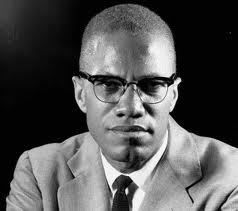
    Malcolm X

    Of all the key events that “created” Malcolm X in the early years, the one that may have played the largest role is his own father’s death. The inherent lesson in the disparity of justice for black and white could not have been plainer. Of Earl Little’s death at a set of railroad tracks, there were two versions: one, the accepted story of the authorities, and two, the one transmitted by their victims. “The Lansing coroner ruled Earl’s death accidental, and the Lansing newspaper account presented the story that way as well. Yet the memories of Lansing blacks as set down in oral histories tell a different story, one that suggested foul play and the involvement of the Black Legion.” (31) The Black Legion were a Klan offshoot that wore black robes instead of white ones.

    Another event that stained itself on Malcolm’s memory occurred once he had moved to New York. Struggling, but enchanted with the city, he found himself staying at the famous YMCA on west 135th in New York and washed dishes at Jimmy’s Chicken Shack, where Charlie Parker had done the same a decade earlier. (49,51) It was during this period that a singular event took place in Harlem.

    In 1943, the Metropolitan Life Insurance Company, known today for its association with “Peanuts” characters in friendly television commercials, brokered a deal to build a housing complex where the famous Savoy had stood in Harlem. The Savoy had been closed by a bogus campaign that blamed an explosion of venereal disease on prostitutes in the area. Met Life, with the agreement of Mayor LaGuardia, came forward with a plan to build a whites-only tenement. After much public outcry, it was determined that similar tenements in the future could not be segregated, but the Met Life tenement went on as planned. (57-58) Young Malcolm thus understood that racism in the North was every bit a structural component of everyday society as in the South. In some ways, things have not changed much to this day. One thinks of the Katrina situation, in which the Wall Street Journal immediately crowed how, after the terrible Katrina storm passed through Louisiana, natural disaster could provide an impetus for white businesses to move in.

    Malcolm determined it made little sense to fight in a white war. He was designated 4-F, in one of the humorous anecdotes of his life, after he told military recruiters he couldn’t wait to join the army in order to “steal us some guns and kill crackers.” (59)

    The final key event of his early life was, of course, being sent to prison. Under the tutelage of the Nation of Islam (NOI), writing letters directly to the Honorable Elijah Muhammad, he educated himself and began to effectively channel his gifts. It should be noted that the Nation of Islam had the respect even of revolutionaries who did not share their religious views at the time. The most important influence on Huey Newton, Robert Williams, wrote positively of Elijah Muhammad in his seminal work Negroes with Guns (Williams, 74). For its part, there is no doubt that the NOI gave a tremendous focus to Malcolm and helped him understand the nature of American propaganda. In one of the most famous passages in modern American literature, the former Detroit Red looks up definitions of the words “white” and “black,” finding their connotations anything but neutral. “I could spend the rest of my life reading,” he reflected. “I don’t think anybody ever got more out of going to prison than I did.” (91)

    Marable points out that Malcolm does not say that he ever perpetrated crime in Harlem, but the author finds this illogical. He feels that there is some revisionist history in Malcolm’s account. It’s not clear why Marable thinks this, except that Malcolm would have been struggling to make ends meet during this time and presumably it would have been easier to steal closer to home. Perhaps, but it’s unclear what his evidence would be. (61)

    Marable also calls attention to the odd passage in the Autobiography detailing Malcolm’s friend Rudy, who tells a story about putting talcum powder on an old rich man for money, which causes the old man to reach climax. (Autobiography, 143) From this, the author concludes: “Based on circumstantial but strong evidence, Malcolm was probably describing his own homosexual encounters with [his white friend] Paul Lennon.” (66) One looks in vain, however, for Marable’s source for this conclusion, although presumably it comes from some of the interviews he undertook that inform the rest of the chapter. For myself, it would not matter at all whether he was gay or not; but for Marable to throw this comment into his book without further elucidation or sourcing is both bizarre and unfortunately reminiscent of JFK books that have sex as their main theme.

    NOI DAYS

    Malcolm wrote a letter to President Truman that arrived on June 29, 1950 in which he asserted that he was a Communist. Not coincidentally, the FBI began its monitoring of Malcolm X on that day. (95) Seven years later, Malcolm’s position had grown to the point that the FBI realized that if they could insert a split between him and Elijah Muhammad, they had a chance at driving a stake into the Nation. (140)

    Marable’s key insight into the ultimately regressive nature of the Nation of Islam is in its position of separation: “The Nation found it difficult to make headway, largely because its appeal was apolitical; Elijah Muhammad’s resistance to involvement in political issues affecting blacks, and his opposition to NOI members registering to vote and become civically engaged, would have struck most Harlemites as self-defeating.”(109) Indeed, the NOI’s position is civically self-defeating by definition; non-involvement in political affairs is a means of draining one’s political power, not increasing it. There was always a tension between the NOI’s apolitical stance and Malcolm’s desire for change. His well-known August 10, 1957 speech, for example, is very early and yet sounds a bit like (a more militarized, to be sure) Martin Luther King in his alluding to “a full voting voice” and “equal rights struggle.” (133)

    The FBI never understood that the NOI did not seek the destruction of America’s legal and socioeconomic institutions; the Black Muslims were not radicals, but profound conservatives under Muhammad. They praised capitalism, so long as it served what they deemed blacks’ interests. Their fundamental mistake was their unshakable belief that whites as a group would never transcend their hatred of blacks.” (154)

    Malcolm preached misogynistic attitudes frequently as a member of the Nation of Islam. (116) This continued to be a problem throughout his life, as he does not appear – at least in Marable’s account – to have been entirely successful as a husband and father. And with a little thought, one finds this plausible. Malcolm was on the road all the time, and serving in an institutional framework that sets powerful boundaries on women’s activities. It should not be surprising that Betty Shabazz, as Marable reports more than once, was often unhappy. However, Marable also reports that Shabazz was unfaithful to Malcolm, although the principal instigator of these stories is Louis Farrakhan, who has his own agenda(s) to promote. Farrakhan (then known as Louis Walcott) was a young man at the time and a Nation of Islam recruit. He claims to have modeled himself after Malcolm and refers to him as “the father I never had.” (114)

    Nevertheless, it was never in the cards for Malcolm to have been a follower rather than a leader. One should remember that Elijah Muhammad was not merely the spiritual leader of the organization; he was also God. And, bearing this in mind, the Nation of Islam behaved like any similar monarchy in its obsession with bloodlines. This therefore made Malcolm not a candidate to take over the NOI, as many outsiders felt would be a natural progression. Marable notes: “…most members of the patriarch’s family rejected him as a potential heir apparent because he was not related by blood.” (118) This, of course, made Malcolm a rival – and, later a hated one – in Muhammad’s mini-fiefdom. Ironic that in an organization devoted to rising up against white power, that in large part it should duplicate some of the worst aspects of that power. This was certainly one factor playing into Malcolm’s eventual separation from the NOI. However, the main issue at hand was his incredible natural leadership.

    Most people are familiar with the Reese Poe incident, vividly dramatized in the Spike Lee biopic on Malcolm. On April 26, 1957, a pair of police officers nearly beat Poe to death, before they were stopped by several hundred Harlemites, which by the time of Malcolm’s arrival had grown to several thousand. After marching to the police station, Malcolm signaled his power to the police by using hand signals to direct the crowd away in lockstep unison. In the film, Peter Boyle delivers the line (drawn from life): “No one man should have that much power.” (128) Marable correctly notes that this is the Origin Story, the beginning of Malcolm X as a public figure on the national, and later world, stage.

    The NOI, and indeed Malcolm himself, made overtures to white racists. It came about, as Malcolm himself stated, that unlike dealing with Northern whites, there were “no illusions.” (138) They also, ironically, had the same goal: total segregation. As Marable points out, if you come from a framework in which racism will never be conquered and separation is the only means by which peace can be maintained, then there is a kind of devastating logic to the collusion. Marcus Garvey himself had made the same mistake – and Malcolm’s own father had been a Garveyite. The grouping of Nazis and NOI members never made practical sense, however, and the flirtation was short-lived. In 1961, the NOI did meet with George Lincoln Rockwell, who had been a mainstream conservative for a while, even working for William F. Buckley, but later turned into a deeply committed Nazi. Rockwell spoke of his admiration for the Elijah Muhammad in having, in effect, “cleaned up” the black population. (199)

    THE SEPARATION INCREASES

    Mike Wallace owes his career to the Nation of Islam; in 1956, he produced a short film called The Hate that Hate Produced, a tabloid, Bill O’Reilly-style piece about NOI racism against whites. Jack Gould of the New York Times dismissed it as journalism without a conscience, referring to the “…periodic tendency of Mike Wallace to pursue sensationalism.” This flies in the face of his later image as the Steadfast Seeker of Truths on 60 Minutes, the bastion of anti-sensationalism. “It gave him the break he needed,” writes Marable. (161-162) One thinks of Dan Rather, who became “the most trusted man in America” by breaking out as a cub reporter and lying about what he saw in the Zapruder film. However, as a practical matter, the film fueled white fear against black “extremists” and increased Malcolm’s public profile. He became a staple of television programs and did extraordinarily well on them.

    Malcolm tended to destroy all comers; his unflappable presence, speaking voice, intelligence and command of the facts caused him, in debates, to crush the talking heads on television. However, he did meet his match in a debate against Bayard Rustin. Rustin simply pointed out that for all Malcolm’s rhetoric about changing political conditions for blacks, this could not happen as long as the NOI remained a political nonentity. The author feels (with good cause) that this resonated with Malcolm and was one of the propositions that caused him to doubt the NOI’s ultimate efficacy, contributing to the break. (177) Indeed, in later speeches comparing the police to an occupying force in black ghettoes, he unconsciously echoed Frantz Fanon’s The Wretched of the Earth. (187)

    Publically, he continued to maintain disregard for the efforts of the Civil Rights movement, denouncing “the Farce on Washington” as having been co-opted by white liberals. (256) Marable calls his view on the events “a gross distortion of the facts” but this was a natural outgrowth of Malcolm’s perspective at the time. He could not accept that there was any level of sincerity on the part of Kennedy or other white liberals, nor could he appreciate the public relations coup it represented. The fact that white faces were interspersed with black faces on television during the March on Washington arguably did a great deal to get across the idea of the permanence of assimilation. For many, racial segregation would no longer be respectable or acceptable – a small victory, perhaps, but global change is measured in such small victories.

    As with his later remarks about the Kennedy assassination, that “the chickens had come home to roost” (267), Malcolm made an error of judgment. In his defense, however, his position (given the historical background) made some sense in terms of realpolitik. And in both cases he may not have been 100% wrong. In the last analysis, however, Malcolm failed to recognize that in the first case (the March), it actually did provide a benefit to his people, and in the second case (JFK), his death truly was a blow to the people’s struggle. This time change, as Sam Cooke sang, really was coming.

    Following the infamous “chickens” remark, Malcolm, as most people know, angered Elijah Muhammad for causing media trouble for the NOI. Muhammad silenced him indefinitely. Beyond this, of course, it also provided a ready excuse to rein in a powerful underling who had made himself potentially dangerous (in his mind, at least) to his power. “As the weeks lurched forward, the Nation boiled over with enmity toward Malcolm, spurred on by John Ali and Raymond Sharrief, who used their positions at the top of the NOI hierarchy to trigger a cascade of invective down through the ranks. Gross rumors of Malcolm’s disloyalty to Muhammad swept through the Nation…” (279) Malcolm’s imposed silence thus had the additional advantage of not allowing himself to respond to these rumors. There were several reasons for the NOI’s treatment of him: (1) Malcolm had discovered that Elijah Muhammad had been busy impregnating several of the Nation’s secretaries, including one of his old girlfriends; (2) as noted, many within the family monarchy, including Muhammad himself, grew concerned about the protégé’s massive public profile, and (3) the FBI had paying members of the NOI itself to stir up trouble.

    MECCA

    There were several reasons for Malcolm’s eventual separation from the Nation of Islam and Marable goes through them in some detail. It seems clear that, for someone as intelligent as Malcolm, it must have begun to seem obvious that those beliefs which he held above all others could not be correct. Elijah Muhammad had committed moral wrongs, and now the Nation folded itself on him to protect his secrets, including firebombing his home. Malcolm had an extremely difficult and no doubt painful correction during this period, in which he was forced to renounce some of his prior public statements and make a public declaration of a change of heart and mind. Malcolm wrote in a letter to Alex Haley, on April 25, 1964: “I began to perceive that ‘white man,’ as commonly used, means complexion only secondarily; primarily it describes attitudes and actions.” (310)

    For the first time, he publicly made the connection between racial oppression and capitalism, saying ‘It’s impossible for a white person to believe in capitalism and not believe in racism.’ Conversely, he noted, those who had a strong personal commitment to racial equality were usually ‘socialist or their political philosophy is socialist.’ What Malcolm seemed to be saying was that the Black Freedom Movement, which up to that point had focused on legal rights and legislative reforms, would ultimately have to take aim at America’s private enterprise system.” (336)

    It was at this point that Malcolm X became one of the most dangerous men in America. His removal from the NOI, although it brought many hardships, freed him; he became a general ambassador to the oppressed world. He embodied resistance to the Genghis Khan morality of mass capitalism.

    Malcolm decided to bring evidence of America’s racial crimes before a United Nations tribunal. FBI wiretaps recorded his plans and, recognizing their potential global impact, the FBI shared the information with the Department of Defense, military intelligence, and the CIA. (343) As Malcolm had embarked on a world tour of sorts, traveling to meet Castro in Cuba and with Saudi Arabian royalty, among others, the FBI followed him along every stop. Attorney General Nicholas Katzenbach sent a memo to J. Edgar Hoover suggesting at one point that Malcolm might be prosecuted under the “…Logan Act, which made it illegal for citizens to enter into unauthorized agreements with foreign governments.” (366) In a sense this underscores the incredible nature of Malcolm’s personal stature – greeted as a foreign dignitary at every spot, and tracked by a U.S. government that recognizes his extreme level of threat, despite his lack of resources. This in spite of the fact that, as the author points out, they were well aware that he had come to a “…spiritual epiphany in Mecca, [broken] with the Nation, and even [made] overtures to the Civil Rights movement.” (373)

    His movement away from his former views even distressed his new followers in the newly created MMI (Muslim Mosque, Inc.) and OAAU (Organization of Afro-American Unity). When Malcolm, after returning from Mecca, talked about equality for women, members of his own group grew confused and even angry. (374) “Yet in other ways Malcolm had become more tolerant. He announced his new views about interracial romance and marriage: ‘How can anyone be against love? Whoever a person wants to love, that’s their business.” (386) A remarkable statement for someone who had declined association with anyone white, in principle, just a few years before.

    Unfortunately, without the organizational structure of the NOI, Malcolm found himself surrounded by volunteers, friends of friends, and loose associates. This was a ripe opportunity for infiltration, and the government made the most of it.

    The most important police operative inside the MMI and OAAU was Gene Roberts. A four-year veteran of the U.S. Navy, Roberts was admitted to the NYPD academy…By late 1964 Roberts had become an integral member of the MMI security team, standing guard at public events as one of Malcolm’s bodyguards…Through Roberts, all of MMI’s and OAAU’s major decisions and plans would be promptly revealed to the NYPD.” (422)

    THE ASSASSINATION

    Like John Kennedy, Malcolm eventually found himself surrounded by powerful enemies capable of guaranteeing his death.

    Finally , the convergence of interests between law enforcement, national security institutions, and the Nation of Islam undoubtedly made Malcolm’s murder easy to carry out. Both the FBI and BOSS placed informants inside the OAAU, MMI, and the NOI, making all three organizations virtual rats’ nests of conflicting loyalties. John Ali was named by several parties as an FBI informant, and there is good reason to believe that both [Malcolm associates] James Shabazz of Newark and Captain Joseph fed information to their local police departments as well as the FBI…the CIA had kept up surveillance of Malcolm throughout his Middle Eastern and African travels.” (424)

    Malcolm X death
    Malcolm X after shooting.

    Although Marable does not definitively point the finger at government agency, he does point out that the FBI continues to refuse to reveal “thousands of pages of evidence connected with the crime.” What national security object would be threatened by revealing such evidence, from 1965, is unknown.

    Marable goes further than most academics in the direction of conspiracy, but we might be able to go still further. To the well-traversed political researcher, the assassination of Malcolm X has the morphology of a government hit. That is to say, the duck both walks and quacks.

    SECURITY STRIPPING

    Researchers are familiar with the details in other assassinations. Let’s run through them briefly:

    JFK – The car rode without a bubble top, and the secret service men (who had been out drinking all night) were ordered off riding on the car’s running boards. (There is video evidence showing this.) As Fletcher Prouty pointed out, the hairpin turn and open windows would never have normally been allowed for a presidential motorcade.

    RFK – Kennedy was led away from his security team at the main door due to a last-minute change of plans which caused him to go through the kitchen pantry in a huge crowd of people.

    Fred Hampton – Hampton’s friend and treasurer is an FBI informant who puts drugs in his coffee to ensure that Hampton is asleep when is murdered by Chicago police.

    9/11 – 9/11? Yes, 9/11:

    Captain Charles Leidig, the Deputy for Command Center Operations at the NMCC, takes over temporarily from Brigadier General Montague Winfield and is effectively in charge of the NMCC during the 9/11 crisis. Winfield had requested the previous day that Leidig stand in for him on September 11. Leidig had started his role as Deputy for Command Center Operations two months earlier and had qualified to stand in for Winfield just the previous month. Leidig remains in charge from a few minutes before the 9/11 crisis begins until about 10:30 A.M., after the last hijacked plane crashes. He presides over an important crisis response teleconference that has a very slow start, not even beginning until 9:39 A.M.” (Thompson, 364)

    Now, having said all this, can we guess what happened at the Audubon the day Malcolm was murdered? Marable tells us: “The principal rostrum guards that afternoon were Charles X Blackwell and Robert 35X Smith, unusual choices as they did not usually serve in this role and had little experience guarding Malcolm.” (436) His normal, more experienced security people were out of the area.

    On the day Malcolm gave his talk, just as he was getting started, a commotion broke out in the audience. The commotion had been staged to draw the attention of security, which it did. FBI man Gene Roberts was also in the room, toward the rear, and approached after the argument broke out. After this diverted the security guards, another distraction occurred in the form of a smoke bomb near the entrance to the building. Taking this as his cue, Willie Bradley stood up and shot Malcolm in the chest with a hand-held shotgun. Once this happened, two other men – Talmadge Hayer and Leon X Davis – came forward with pistols and emptied them into him as well. Bradley took off down a side door to make his escape, while the latter two instead tried to run out the main entrance, which meant they had to run all the way back from the stage through the people, smoke, and confusion. Hayer was shot, and then beaten up by several followers as the other men escaped.

    Both police and emergency services behaved appallingly on the day.

    Although one of the city’s major medical centers was only several blocks away, no ambulance arrived from the Audubon, which is why Malcolm’s own men had to run to the emergency room to pick up a gurney…MMI and OAAU members were outraged when the police finally showed up. ‘Their appearance was so ridiculously late,’ Mitchell recalled, ‘that one tearful woman yelled and waved them aside, saying, ‘Don’t hurry; come tomorrow!’” (441)

    The police conducted a leisurely investigation, with some officers literally with “their hands in their pockets.” For the rank and file, this was simply a case of a black man who had overstepped his bounds and had been asking to be killed, and brought to bear all the seriousness to which they normally investigated a gang shooting in a black neighborhood. For those in positions of authority within the police structure, more sinister activity had taken place. James 67X, an associate of Malcolm, had left the scene after the shooting and returned soon after. He found himself being asked why he left by the police. “…’How do they know that I left?…They must have photographed the whole thing.’ Days later the police showed him ‘a seating plan…where everybody was seated in the Audubon Ballroom.’” (443-444)

    For the detectives working the case, too many facts didn’t make sense. The request from Malcolm’s team that the usual police detail be pulled back several blocks from the Audubon seemed strange, as did the police’s agreement to do so in light of the recent firebombing. The detectives were also suspicious when they learned that nearly all the MMI and OAAU security had been unarmed and that none of the audience had been checked for weapons.” (445)

    However, none of this is as unbelievable as what happened that evening. Malcolm was killed at approximately three in the afternoon. Police arrived late, but nevertheless did eventually show up at the scene. However, no forensic examination was ever performed. The Audubon was a recital hall, after all, and there was a dance scheduled for seven that evening. In one of the more astonishing turn of events from all of the terrible history of the assassinations of the 1960s, the police agreed to leave the scene and allow cleaning people to take over by six. The George Washington Birthday Party went off as planned. (445) Four hours after Malcolm X was murdered, people were dancing in the very same hall.

    AFTERMATH

    The FBI had “at least five undercover informants [in the ballroom] at the time of the shooting.” (445) We will never how many really were in there, of course, but based on the released documents and interviews this was the number Marable came up with. These included Charles Kenyatta, who “cashed in one his political kinship with Malcolm for decades” (467) and Benjamin 2X Goodman (468). He notes:

    The NYPD had two priorities in conducting its investigation: first, to protect the identities of its undercover police officers and informants, like Gene Roberts; and second, to make successful cases against NOI members with histories of violence. Its hasty and haphazard treatment of forensic evidence at the crime scene suggested that it had little interest in solving the actual homicide.” (451)

    The media also had little interest in pursuing the facts. As with other high-profile assassinations in the 1960s, the major media immediately began a propaganda campaign in support of the state-approved version of events. Marable quotes several national publications on their reactions. The New York Times editorial characterized Malcolm as having used his “many true gifts to evil purpose” and blamed his own “exaltation of fanaticism” as leading to his own death. Henry Luce’s CIA-endorsing TIME Magazine went further, taking a similar line in blaming Malcolm for causing his own death, but then also invented a story in which “characteristically [Malcolm] had kept his followers waiting for nearly an hour while he lingered over tea and a banana split at a nearby Harlem restaurant.” Malcolm, a fastidious and militarily precise man, is thus made ridiculous in playing on the stereotype of the “lazy Negro” to its white, comfortably racist audience. (454-455) For his part, the Honorable Elijah Muhammad made a public statement: “Malcolm was a hypocrite who got what he was preaching.” (461) White America seemed to agree.

    As noted, one of the assassins had been captured and beaten by the crowd. He eventually faced trial along with two other former Nation of Islam members, selected seemingly at random by police.

    The prosecution’s star witness was Cary 2X Thomas (also known as Abdul Malik). Born in New York City in 1930, by his mid-twenties he had become a heroin addict and narcotics dealer. For years he was in and out of jail on drug charges, and in early 1963 was assigned to Bellevue Hospital after a nervous breakdown. In December of that year he joined Mosque No. 7, but soon left, siding with Malcolm in the split. Thomas’s extremely short tenure in the Nation meant that he knew relatively little about the organization, or the reasons for Malcolm’s separation. After detectives interviewed him, the district attorney’s office decided to arrest him as a material witness. For almost a year he was held in protective custody. On one occasion, highly disturbed, he set fire to his jail mattress.” (463)

    Shades of the state retaining Marina Oswald for months, or the embarrassing key witness in the James Earl Ray assassination, a man so drunk he was unconscious at the time of the assassination.

    Unfortunately, Cary 2X Thomas misidentified the shooter, and claimed to have seen the other two people (Johnson and Butler) at the scene of the murder, despite the fact we know they were not involved. During the court proceedings, Talmadge Hayer himself announced that Johnson and Butler were definitively not involved. Unfazed, the judge continued with the trial. Then Betty Shabazz took the stand. As she was leaving, she pointed at all three men and screamed, “They killed him!” Defense requested a mistrial, which was denied. The three men were convicted. (465)

    Perhaps the most incredible part of this story concerns Willie Bradley, the man who actually fired the first, killing shot against Malcolm X. He continued his life as a petty criminal afterward, but was arrested for bank robbery in 1968. Marable tells the story:

    On April 11, 1968, the Livingston National Bank of Livingston, New Jersey, was robbed by three masked men brandishing three handguns and one sawed-off shotgun. They escaped with over $12,500. The following year Bradley and a second man, James Moore, were charged with the bank robbery and were brought to trial. Bradley, however, received privileged treatment, and he retained his own attorney separate from Moore. The charges against him were ultimately dismissed; meanwhile, after a first trial ending in a hung jury, Moore was convicted in a second trial.

    Bradley’s special treatment by the criminal justice system in 1969-1970 raises the question of whether he was an FBI informant, either after the assassination of Malcolm X or very possibly even before. It would perhaps explain why Bradley took a different exit from the murder scene than the two other shooters, shielding him from the crowd’s retaliation. It suggests that Bradley and possibly other Newark mosque members may have actively collaborated on the shooting with local law enforcement and/or the FBI.” (475)

    It most certainly does, and it is very good of Dr. Marable to address the issue in his otherwise highly academically respectable book.

    There are many fascinating details and side stories to follow in the tangle of Malcolm’s life and murder. The weblike structure of personalities and events will also be familiar to those who have done research into the other major assassinations, and I am unable to chase them all in the course of this review. The reader is directed to Marable himself, whose book, for all its flaws, is a major entry into the field to be sourced and argued with for years. It’s a shame that Marable himself will not be around for those discussions. One thing, beyond everything, seems clear: The existing power structure had no use for post-Mecca Malcolm X. A dismissible ideologue, dangerous but containable, became a genuine threat to capitalism itself, which deals with such people as white blood cells do a virus.

    Malcolm had been in an almost constant state of transformation – indeed, his rise from Detroit Red to unofficial ambassador to the revolutionary is as outsized as myth. Marable calls its ‘reinvention’ and asserts that some of this myth was self-created. Perhaps, in the sense that all of us, consciously or unconsciously, invents or assembles a persona for ourselves. And yet the major events of his life all unquestionably happened; his public statements provide a record of his evolution.

    The real tension exists in one simple fact: Malcolm’s story is one of the great human stories, but it is not one of the great American stories. This is not Horatio Alger, Benjamin Franklin, or even John Galt. His success as a human being is not measured in terms of wealth or prestige. It is measured in moral terms. His was not a life to be evaluated within the basic assumptions of mass capitalism. He cannot be reduced to a postage stamp or a children’s book. In his final days, Malcolm recognized that this is a worldwide struggle of the people versus mass capitalism, which was out of control in 1965 and now out-Orwells Orwell. This marked him for death in our society. It also made him one of the great figures of world history. If we ever figure out why this is true, we might have a chance at social transformation – a reinvention, as Manning Marable puts it.


    References:

    Baldwin, James. The Price of the Ticket: Collected Nonfiction 1948-1985 (St. Martin’s Press: New York 1985).

    Breitman, George, ed. Malcolm X Speaks (Grove Press: 1965).

    Friedly, Michael. Malcolm X: The Assassination (Carroll & Graf: New York 1992).

    Haley, Alex, and Malcolm X. The Autobiography of Malcolm X (Ballantine Books: New York 1989).

    Marable, Manning. Malcolm X: A Life of Reinvention (Viking: New York 2011).

    Thompson, Paul. The Terror Timeline (Regan Books: New York 2004).

    West, Cornel. The Cornel West Reader (Basic Civitas Books: New York 1999).

    Williams, Robert. Negroes with Guns (Wayne State University Press: Detroit 1998).

  • Barry Ernst, The Girl on the Stairs


    Accidental History: The Girl on the Stairs, by Barry Ernest

    Reviewed by Joseph E. Green and Jim DiEugenio


    At first she thought it was firecrackers. But when she saw the chaos and the terror on all the faces below, she knew it was something far worse. She turned from the window and grabbed the arm of a co-worker. “Come on.” She whispered.”Let’s find out what’s going on down there.” In this split second, her innocence – and that of a nation’s – came to an end.


    The above is how Barry Ernest begins his interesting and unusual book, The Girl on the Stairs. The JFK assassination, like any historical event, had a ripple effect on the history of the country and, indeed, the world. And while many of these effects were foreseeable – for example, the expansion of the war in Vietnam – there were an infinite number of others that were not. Some of the most tragic stories that emerged in the wake of the assassination concern the deaths of those who became accidental players by hearing and seeing things they were not supposed to, and whose documentation began with Penn Jones in his Forgive My Grief series. Still others involved those who were not murdered, but instead were forced into a life of hiding and jumping at shadows.

    Barry Ernest’s book tells two stories. One is about himself: his journey from being a believer in the Warren Report to that of being a fierce critic of that now, quite discredited, volume. Therefore he begins the book at a rather appropriate place and time. In fact, it is actually beyond appropriate. It is almost symbolic. Barry was a student at Kent State in 1967. This is the college where the expansion of the Vietnam War would, in three short years, lead to the infamous shooting of students by the National Guard and produce one of the most iconic photographs of that tumultuous era. The first scene of the book is him sitting outside the cafeteria. A fellow student named Terry approaches and asks him about a dialogue from a previous class where Barry actually defended the Warren Report. The student then asks Barry if he had ever seen or heard of the Zapruder film, and if he had read the entire 26 volumes of the Warren Commission. Barry said no to each. The student left him a copy of an interview by Mark Lane, and said, “Read this.” Barry did – right then and there. Hours later, in twilight, he then went to a bookstore and searched for Lane’s book, Rush to Judgment. This is how the first story – that of personal discovery and evolution – begins.

    And it was through Lane’s book that Barry was introduced to the heroine of the second story he will tell. That second story is about the plight of one of these ordinary people who was swept up by events: Victoria Adams, the notable “girl on the stairs.” She was an employee who worked in the same building as one Lee Harvey Oswald. The problem caused by her presence is very simple and easily summarized. Adams, along with her friend Sandra Styles, stood on the fourth floor of the Texas School Book Depository at the moment of the murder. She testified to hearing three shots, which from her vantage point appeared to be coming from the right of the building (i.e., from the grassy knoll). She and Styles then ran to the stairs to head down. This was the only set of stairs that went all the way to the top of the building. Both she and her friend took them down to the ground floor. She did not see or hear Oswald. Yet, she should have if he were on the sixth floor traveling downwards. Which is what the Commission said he did after he shot Kennedy.

    This is the first problem, in a nutshell. Why did Adams not see a scrambling Oswald, flying down the stairs in pursuit of his Coca-Cola? Because of the Warren Commission’s timeline, we know Oswald had to have gone down the stairs during this period in order to be accosted in time by a motorcycle policeman. In addition, as we are later to discover, Adams also reports seeing Jack Ruby on the corner of Houston and Elm, “questioning people as though he were a policeman.”

    From here the parallel stories broaden out. For Barry began to read more books critical of the Commission. And he would then compare what was in these books with the testimony and evidence in the 26 volumes. Like many people before him, he found something rather disturbing: the evidence and testimony did not completely back up the summary conclusions in the Warren Report. The Commission had selectively chosen evidence to make their case. And they had deliberately tried to discredit witnesses and testimony that contradicted their guilty verdict about Oswald. And the witness that they did this to that really kindled Barry’s curiosity was Victoria Adams. As the author writes at the end of Chapter 1, “What if she was right?”

    Adams did not find the government eager to hear her story. This is why they badgered her day and night: the FBI, Secret Service, Dallas Police, and the Sheriff’s Department. And Victoria noticed something discriminatory about all the attention she was getting: the other witnesses in her office did not receive it, e.g., Sandy Styles who ran down the stairs with her, or Elsie Dorman or Dorothy May Garner who watched the motorcade with her.

    The attention didn’t stop. In fact, even when she moved to a different address these agents followed her. Even though she had left no forwarding address and her new apartment was not in her name. But they still found her. They followed her when she went to lunch. They followed her when she walked around town. When she sent a letter to a friend in San Francisco describing what she saw and did that day as a witness, the friend never got the letter. The question they posed was always the same: When did you run down the stairs after the shooting?

    Then, another odd thing happened. When David Belin and the Warren Commission requested her to testify, it was her alone. Sandra Styles was not with her. In fact, Barry could find no evidence that the Commission questioned Styles at all. Further, during her appearance, Belin had handed her a diagram of the first floor of the Texas School Book Depository, the place where she and Oswald worked at that time. He asked her to point out where she saw two other employees (i.e., William Shelley and Billy Lovelady) when she arrived at the bottom of the stairway. When Barry went to look up this exhibit in the Commission volumes – Commission Exhibit 496 – he discovered something odd. It was not the document in the testimony. It was a copy of the application form Oswald filled out for his job at the Depository.

    Further, although Styles did not testify that day, or at all, both Lovelady and Shelley did. And as Barry read their testimony it appeared to him that the Commission was making use of them to discredit Adams. Commission lawyer Joe Ball made sure he asked Shelley when and if he saw Adams after the shooting. And when Barry read Lovelady’s testimony his mouth flew open. Lovelady brought up Adams’ name before Ball did! And he called her by her nickname, “Vickie.” Barry was puzzled as to what prompted this spontaneous reference to Adams. Did Lovelady know in advance that Ball was going to specifically ask about her?

    Indeed, when she read her own testimony in the Warren Commission – and the Commission’s use of it – Adams was startled to find major discrepancies, including the time interval as to when she started down the stairs after she heard the shots. This began for her a lifelong burden of living in the shadows, avoiding any publicity dealing with her testimony or her treatment at the hands of the Commission. When her employer, publishing house Scott Foresman, offered her a chance to transfer out of Dallas to Chicago in 1966, she took it. (p. 35) While there, she actually now began to read the Warren Report. She now noted what they had done with Lovelady and Shelley. This stupefied her. Because she did not recall seeing either man after he and Styles arrived on the first floor. (p. 36)

    However, although the book drops in on her from time to time – and it builds towards Barry’s hunt for her, discovering documents that bear out her veracity, and interviewing her in a climactic scene – the principle narrative is the journey of the author himself, who was a teen-ager at the time of the assassination, and went on to became acquainted with some of the earliest critics. He and Terry became working partners at deciphering the fraud of the Warren Report. They would visit each other’s dorms to discus the latest deception they found in the volumes, e.g., how the Commission cut corners and accepted false witnesses to place Oswald on the sixth floor at the time of the shooting; the dubious way they reconstructed his movements after he left the Depository; the quality of the witnesses to the Tippit shooting, etc. These all begin to fuel doubts in him about his former belief in the Warren Commission.

    In fact, Barry became so obsessed with this mystery that he ignored his studies. He flunked out of Kent State. (p. 33)

    II

    Going home to Altoona, Pennsylvania, he could not find the 26 Commission volumes there. So he began to read the works of the first generation critics – every one of them. (Read about the first generation critics in John Kelin’s highly-acclaimed Praise from a Future Generation.)

    He then decided to visit Dallas. There he met a man named Eugene Aldredge. Aldredge had found a bullet mark on the sidewalk near Elm, which showed a missed shot. He told the FBI about it, but they ignored it. (p. 37) He interviewed Roy Truly a manager of the Depository about the incident right after the shooting where he and policeman Marion Baker encountered Oswald on the second floor drinking a Coke. (p. 41) And he learned something odd during their talk: No one other than employees were allowed onto the sixth floor. (p. 42) But Barry did go to the second floor. Here he examines the lunchroom area around where Truly and Baker allegedly encountered Oswald. (p. 43) Here he begins a quite interesting discussion about how Baker could have seen Oswald through the window of the pneumatic door. He makes somewhat the same argument that Howard Roffman did in his excellent book Presumed Guilty. Truly said he saw no one as he proceeded up the stairs in front of Baker. (ibid) So a question now emerged: “If that door already was closed as Truly passed in advance of the policeman, why would Oswald stand stationary behind it until Baker appeared?” (ibid) For this is how Baker said he noticed Oswald, through the window of the door. The author comes to the same conclusion that others who had read Roffman: If one takes Baker at his word, Oswald had to have come up to the lunchroom from another set of stairs, a one flight stairway from the first floor for Baker to have seen him as he said he did. This bolstered Victoria Adams’ story for Barry. He tried to visit her on this trip but found out she had left for Chicago already. (p. 44)

    He then made a visit to Penn Jones In Midlothian, Texas. Jones, who had two sets, sold him the 26 volumes for $76.00. (p. 39) Penn introduced him to Roger Craig, and he also became involved with Harold Weisberg early on. Both Jones and Weisberg immediately see something in him and venture to tap his skills to assist them; Weisberg as a researcher, Jones to interview people who would not talk to him because he was too well known. He also knew David Lifton long before he came onto the scene with Best Evidence. This is all quite intriguing, although the portraits of these men are a bit sketchy and lacking in depth. Jones sends Barry to interview a couple of witnesses. But they seem quite scared and apprehensive. S, M. Holland agreed to meet with him, but brought two men with him since he felt had had been abused and taken advantage of in the past. (p. 53) He talks to Carolyn Walther, a witness who told the FBI she had seen two men, one with a rifle, in either the fourth or fifth floor southeast window that day. Yet she had not been called to testify by the Commission. (p. 54) But she told Barry that she also told the FBI that she had seen two black men below where the man with a rifle was. This would put the two men on the sixth floor, since the black employees were on the fifth floor. She kept this to herself at the time since she thought the two men were some kind of guards. She said that after the shooting she encountered an acquaintance, Abraham Zapruder, who told her Kennedy had been shot from the front and pointed to his forehead. (p. 55)

    Barry then visited the scene of policeman J. D. Tippit’s shooting. Here, he meets a witness that no agent of government had talked to, a Mrs. Higgins who lived nearby. She offered him some very important information. She had heard the shots and ran out her front door to see Tippit lying in the street. Barry asked her what time it was. She said it was 1:06. He asked her how she recalled that specific time. She said because she was watching TV and the announcer said it. So she automatically checked her clock when he said it and he was right. Barry concludes that it was not possible that Oswald could have traversed the distance from his apartment to the scene of Tippit’s murder in time to do the shooting. (p. 58) This is when she heard the shots. She also said she got a look at a man running form the scene with a handgun. When Barry asked her what he looked like she replied it was definitely not Oswald. (p. 59)

    Barry then timed the Commission’s story on how long it would take Oswald to get to the Texas Theater from 10th and Patton, the Tippit murder scene. This, the Commission said, took 24 minutes. Yet it was shorter by a third than Oswald’s walk from his apartment to 10th and Patton. Yet it took twice as long for Oswald to traverse? (ibid) The Commission says it took Oswald 24 minutes to walk that distance. It took Barry ten minutes.

    When Barry got back to Pennsylvania he investigated a strange case near to his home, in Martinsburg. A woman named Margaret Hoover told agents she had discovered a discarded piece of paper in her back yard. On the paper were the handwritten words, “Lee Oswald” “Jack Ruby” “Rubenstein” and “Dallas, Texas”. The problem was that this discovery occurred not after the assassination but before. (p. 63) She had a brother who tipped off the FBI to this event. The woman told the Bureau that she had also found a railroad company ticket from Miami dated 9/25/63 to Washington. Both papers were found near where the trash was burned by a resident in her apartment house. This resident was Dr. Julio Fernandez, a Cuban refuge and a local junior high teacher. According to the FBI report, she furnished the FBI with the envelope and ticket stub, but not the scrap of paper with the names.

    When Barry tracked this story down, it turned out that Hoover showed the papers to her daughter and her daughter also recalled the name “Silver Bell” or “Silver Slipper.” But the FBI got the daughter to partially retract: she now said she only saw the names of Ruby and Dallas, and she was not quite sure of even that. When they interviewed Hernandez, he explained the ticket as being for his son to come north to see him from Miami. (p. 64)

    Barry wrote to Mrs. Hoover. He found out that the FBI had lied: the woman had given them the paper with the names on it. She also added that Fernandez had worked in Washington before moving to Pennsylvania. He had worked for the CIA after escaping Cuba post-Castro. (p. 65)

    He and Terry now decided to visit the National Archives to view the Zapruder film. Like everyone else they were shocked by what it depicted. But further, they were angered by the fact that the Commission had never mentioned the backward movement of Kennedy’s head and body, which was contrary to what would have happened if Oswald had shot the president from behind. Surely they had seen the film. Why did they ignore it? (p. 69)

    It was this event that evaporated any belief Barry maintained in the Commission. But it did something worse to Terry. The man who had first instigated Barry’s interest in that blind belief was now sapped and disgusted. He decided it was the end of the road for him. He gave up. Barry never heard from his after this trip.

    III

    At the National Archives, he located the November 24th FBI report that Victoria Adams had given. It was remarkably consistent with her later one on March 23rd. She said that she had immediately gone down the stairs with Styles after the shooting. And there was no mention of her seeing Shelley or Lovelady. (p. 75)

    Barry did some further digging into her testimony and statements. It turned out that the Dallas Police questioned her also. This was on February 17th. Way after the FBI and Warren Commission had taken over control of the case from the DPD. In reading this statement, Barry discovered that it was this report that inserted Lovelady and Shelley into her story. It was written by none other than the avuncular, smiling Jim Leavelle. The man who accompanied Oswald out of police HQ to be killed by Jack Ruby. (p. 76) But further, Barry noticed that there was no questioning of the other three women who were watching the motorcade with Adams: Styles, Elsie Dorman, and Dorothy Garner. He thought this was odd since they could confirm if Adams left the window quickly, as she said she had.

    Barry also discovered something else that was odd. The FBI did time-reconstructions to simulate Oswald coming down the stairs. They also did one to simulate Truly and Baker coming up the stairs. But he could find none that tried to replicate Adams coming down the stairs. (p. 78) Even though they were keenly aware of the problem she posed to their verdict about Oswald. So much so that counselors Joe Ball and David Belin wrote a memo about this subject that ended: “We should pin down this time sequence of her running down the stairs.” But Barry could find no evidence that they did. (p. 79)

    At the Archives, Barry met Harold Weisberg. Weisberg asked him to do some work for him. He thought that people would be more eager to talk to someone like him, since he had a low profile. So when he visited Dallas again in August of 1968, he did so. He asked some questions of Sheriff Bill Decker. One of them was if he had kept any more than the 92 pages of files he gave to the Commission. Weisberg did not buy that one. That question ended the interview. (p. 83)

    Barry also got the opportunity to meet Roger Craig via Penn Jones. Craig wanted to meet Barry outside Dallas. And he did at his sister’s house. Once there Barry asked him about all the secrecy. Craig replied that his problems began in 1965 when the first essays began to appear critical of the Commission. Many had his name in them. Then people wanted to talk to him, but Decker gave him strict orders not to talk to anyone. Then in July of 1967, Decker fired him. Then, in November of that year, there was an assassination attempt against him. (p. 93)

    Craig went on to repeat the famous story of Oswald getting in a Rambler station wagon and escaping down Elm Street with a Latin looking fellow driving. Craig then said he saw Oswald at the station later and Fritz asked him about the car Craig saw him run off in. Oswald replied that the car belonged to Mrs. Paine and then exclaimed with disgust, “Everyone will know who I am now.” (p. 94) When Barry asked him if he was sure the man he saw entering the car was Oswald, Craig said yes he was. And he added that the Commission had altered his testimony in 14 separate instances. (p. 95) Craig added something quite interesting about the lawyer who examined him, David Belin:

    When Belin interrogated me… he would ask me certain questions and, whenever an important question would come up… he would have to know the answer beforehand, he would turn off the recorder and instruct the stenographer to stop taking notes. Then he would ask for the question, and if the answer satisfied him, he would turn the recorder back on, instruct the stenographer to start writing again, and he would ask me the same question, and I would answer it.

    However, while the recorder was off, if the answer did not satisfy him… he would turn the recorder back on and instruct the stenographer to start writing again and then he would ask me a completely different question.

    He then added that none of these interruptions were noted in the transcript as entered in the Warren Commission. (p. 95)

    On the way back from Craig’s sister’s house, the police stopped their car. The pretext was that the car had gone through a red light. When Barry insisted the light was green, the cop came around to the passenger window and asked him for his ID. Noting he was from out of state, he asked him what he was doing in Texas. Barry replied that he was visiting friends. The two policemen then went to the front of the car out of earshot. They returned and said they would let it go this time. Craig look relieved. When Barry told the story to Penn Jones, Penn said that he was lucky Barry was with him. (p. 98)

    While in Dallas, Barry visited with newsman Wes Wise. He tells him a story about Ruby being in Dealey Plaza that Saturday before he shot Oswald. The reason he gave Wes was he wanted to see the wreath and flowers that were being laid there for Kennedy. But Wes expected a different reason. The county jail was nearby, which Oswald was going to be transferred to. But yet Garret Hallmark, a parking garage attendant said Ruby used his phone that day before proceeding to Dealey Plaza. He told the man on the other end that he had information the transfer would take place on Saturday, that afternoon. Garret got the impression that Ruby was looking for corroboration for that information. Ruby then said that because of all the people carrying flowers, the transfer could be delayed. (p. 101) Ruby’s odd Saturday activities were further described by policeman D. V. Harkness who saw Ruby at the entrance to the county jail that day. (p. 102) But when Harkness brought this interesting point up, Belin dropped it instantly.

    SOP for the Commission.

    IV

    On this trip, Barry tried to locate Adams. He searched various residences and left a message with Roy Truly, but nothing turned up.

    Adams had gone to college in California and attained a degree in Business Administration. She had graduated summa cum laude and gone into real estate. But one day in the library she came upon a set of Warren Commission volumes. She began to go over them very carefully this time. She recalled that a messenger had delivered her testimony to her at work and she was given the opportunity to make corrections. She did so. But now she saw they were not entered. (p. 106) She also noted that at the end of her appearance it said she waived her right to review her testimony. This was not so. And she noted that her own testimony had her actually talking to Shelley and Lovelady. But they were not on the first floor when she got there. (ibid) Further, she did not recall the Shelley/Lovelady stuff in the copy she had corrected in Dallas.

    Barry had enlisted in the Naval Reserve and had been overseas. When he returned it was after Garrison had lost the Clay Shaw trial. The critics were now divided against each other, e.g., Jones had accused Weisberg of being a CIA agent. (p. 128) America was withdrawing from Vietnam after losing the war. The movie Jaws was about to change Hollywood. And to top it off, Warren Commissioner Jerry Ford was now president. To the victors belong the spoils.

    Barry went back to college, got married, and had a son. One day he picked up Belin’s book defending the Warren Commission, November 22, 1963: You are the Jury. In leafing through it he saw that Belin used the testimony of Lovelady and Shelley to discredit Adams. This is the way it worked: Shelley and Lovelady had left the building and gone over to the railway yards about a block away. They then returned and said they saw Adams on the first floor. If this was accurate then the likelihood was that Adams came down the stairs later than she said, when Oswald would have been in the lunchroom already. (p. 129) Belin used these two men without referring to the fact that Lovelady seemed cued in advance. In fact, he spent three pages on the matter.

    Just when Barry thought the Kennedy case, and Victoria Adams, were now finis, something happened to change all that. In 1975, Geraldo Rivera showed the Zapruder film on national television. It caused a minor earthquake across the land. Now came the inquiries into CIA scandals by Representative Otis Pike and Senator Frank Church. With the exposure of the CIA–Mafia plots to kill Castro, and the writing of the Schweiker-Hart report about how poorly the Warren Commission and FBI performed their duties in the investigation of President Kennedy’s death, the time was ripe for a new investigation of the murder. Unfortunately, the House Select Committee on Assassinations was a disappointment. The author does a nice job briefly summarizing many of their shortcomings. Barry wrote them about Victoria Adams and Sandra Styles. He never got anything back. (p. 132)

    But now the nation was faced with two verdicts on the JFK case. The HSCA had concluded, however limply, that the murder was a result of a conspiracy. But now the critics were even more divided and scattered. Barry began to think that maybe Terry was right. It was time to quit.

    Victoria Adams had moved to Seattle. And she had become a successful businesswoman who was now listed in Who’s Who of American Women and Who’s Who in the World. Now she and her husband decided to travel the country back and forth in a five-wheel trailer. They did that for six years. (p. 142) She also wrote a newsletter called Principles in Action, a chronicle of what she saw and heard on her travels. She also wrote a cookbook called No More than 4 Ingredients. Ironically, she liked Pennsylvania so much, she and her husband stayed there for several months, near Harrisburg. Which is where Barry was living in 1991. Then Oliver Stone’s film JFK came out. This caused the creation of the Assassination Records Review Board.  After a visit with Weisberg, Barry decided to look through some documents. (p. 145) He also began to read through the HSCA volumes. After reviewing them thoroughly, and summarizing their major findings for us, he notes that they never found and reinterviewed Adams. (p. 148)

    From here, the book slows down – takes a detour so to speak – as Barry now looks back at the work of the Warren Commission through the declassified Executive Sessions. Barry also now reviews some of the newly declassified medical evidence showing that there was a hole in the back of Kennedy’s head. He also tried to get in contact with Francis Adams, one of the Warren Commission senior counsel. Adams worked for about a month and then left. His duties were assumed totally by Arlen Specter. It was never clear as to why. And when Lee Rankin, the Commission executive director, was asked about Adams, he replied he should have fired him the first day. (p. 171) Further, there was nothing left behind to explain exactly why he left. Nothing until a quote about leaving showed up in 1966 that said that he was too busy at his law firm and that he had a “different concept of the investigation.” (p. 172) There was no reply to any of Barry’s queries to Adams. But when he died, Barry wrote his surviving wife. He got a call back form his daughter Joyce Adams. She first wanted to know if Barry had spoken to ‘Specter.’ She said the name like the late Jean Hill would intone it. Barry said he had not. Joyce laughed when she heard about the “too busy at the law firm” excuse. He would have never joined up if that were the case. She thought the real reasons was he did not like the way they were proceeding, “If he didn’t think it was being run properly, he would be the type to leave.” (p. 173)

    Barry then asked if her father had many any notes, or writings or kept personal papers from his days with the Commission. Joyce quietly said that he had. They were kept in longhand. Barry asked to review the file. Joyce said this was in her sister Judith’s possession. She said she had to talk to her sister first and would get back to him after. She never did. It is unfortunate that this information was not turned over to the ARRB, for whatever was in those files would have been very important to discover.

    V

    In the nineties, Barry discovered a document from the Warren Commission that very much bolstered the Adams testimony. Addressed to Rankin, it summarized the corrections she wanted in her testimony – the ones that were not made. But it also helped explain why the Commission never talked to any of the possible corroborating witnesses who watched the motorcade with her. In the letter, the very last sentence says “Miss Garner, Miss Adams’ supervisor, stated this morning that after Miss Adams went downstairs she (Miss Garner) saw Mr. Truly and the policeman come up.” (p. 176)

    Obviously, if they had come up after, then Adams had left when she said she did. Barry notes that he felt like someone had punched him in the gut when he read this. The date of the letter was June 2, 1964. But even with this in their hands, the Commission went ahead and did all they could to discredit Adams. They wrote “…she actually came down the stairs several minutes after Oswald and after Truly and Baker as well.” (ibid) This was written in spite of the fact they had this new evidence in their hands saying the opposite. And this is why the Commission never formally deposed the three corroborating witnesses.

    When the author showed this letter from Marcia Joe Stroud, the Dallas US Attorney, to Weisberg, Harold told him to write a book about Adams. The author then makes one more try to find Adams or her corroborating witnesses. He visits Dallas and talks to Gary Mack, who Harold referred him to. Mack says he cannot help him.

    It was not until 2002, when his son convinced him to buy a computer to type his book, that he found Adams via email. What follows, in Chapters 27 through 29, is a fascinating, long interview with Adams, now aged 61. She goes over her experience that day in full detail: arriving at work, waiting for the motorcade, running down the stairs, seeing Ruby in suit and hat talking to people like a reporter, etc. This interview is really the high point of the book. What it reveals about Leavelle, the Dallas Police, and David Belin is powerful stuff. Adams concludes that Oswald could not have been on those stairs. He was not on the sixth floor at the time of the shooting, he was on a lower floor. (p. 211)

    Beginning to master the Internet, Barry then finds Sandra Styles. (p. 217) She confirms Adams. She says the two left the window when Secret Service agent Clint Hill jumped on the back of the car. (p. 218) And she said she neither saw nor heard anyone on the stairs on the way down. And she did not recall Lovelady or Shelley on the ground floor when they got there either. (p. 219) Styles said the only interview she gave was to the FBI and it was not in depth or probing.

    The book ends on a sad note. Adams died of cancer in 2007 at the rather young age of 66. We are lucky that Barry found her before she passed.

  • A Conspiracy Primer


    “I must frankly confess that the foreign policy of the United States since the termination of hostilities has reminded me, sometimes irresistibly, of the attitude of Germany under Kaiser Wilhelm II … It is characteristic of the military mentality that non-human factors (atom bombs, strategic bases, weapons of all sorts, the possession of raw materials, etc.) are held essential, while the human being, his desires and thought – in short, the psychological factors – are considered as unimportant and secondary … The general insecurity that goes hand in hand with this results in the sacrifice of the citizen’s civil rights to the supposed welfare of the state.”

    –Albert Einstein, The Military Mentality


    I am not a conspiracy theorist. Sometimes people label me that way. Many of my friends get labeled that way, and some of them might be – but some of them clearly aren’t. In order to know for sure, we would have to know what is meant by the term.

    Now the term ‘conspiracy theorist’ is meant to be dismissive, obviously. It’s a term used to put borders on thought, to reassure, to identify aberrant patterns in individuals and create distance between us and them. You call someone a ‘conspiracy theorist’ to put them down or accuse them of being an intellectual outcast without having to think hard about it. Talking heads on television often identify someone as a ‘conspiracy theorist’ when they want to indicate a clear separation: “Well, that sounds like conspiratorial thinking to me,” or “If I may sound like a conspiracy theorist for a moment …” or “I don’t want to get into conspiracy theory, so let’s take another topic …” The term is used, in essence, like profanity. It tends to connote ‘stupid,’ but also ‘outrageous,’ and – most importantly – not to be taken seriously. That idea you just had puts you on the outside. You are being stupid and outrageous. People aren’t going to like you if you keep thinking that way.

    CONNOTATION

    Let’s look at the term profanity. We all know what it means: bad words. Sometimes we say they are “curse” words, which gives them a slightly magical evocation. So: words that are intended to express strong disrespect or to invite the gods to visit heinous things upon someone. As the Woody Allen joke goes, “I told him to be fruitful and multiply, but not in those words.” Bad language. When we visit the origins of the word “profanity,” we find that it derives from the Latin “profanus,” which means “outside the temple.” There is a sense in which anything that is not sacred is profane – that is, not specifically holy – but the broader and more common definition is an insult to that which is sacred. That which cannot be done within the temple.

    Now I find that fascinating, and I say that the term ‘conspiracy theorist’ is a kind of profanity, because it fulfills the precise intent of its original meaning. When you call someone by that term, you are indicating that they are outside the temple. We are inside the temple and holy and sacred, and you are outside with the profane. The term is a psychological attack meant to marginalize the speaker of the improper thought.

    However, this is only one-half of the equation. The other half is that the term imbues the speaker with psychological reassurance and power. It is like saying, “By saying what you have said, you have proven yourself to be outside the norm, and I have hordes of people who will agree with me.” It is powerful bandwagon thinking. For human beings, whose social instincts are so strong that they carry over into the digital and beyond, this type of thinking is not only motivated but receives immediate reward. It is like being inside the Dallas Cowboys football stadium and making disparaging remarks about the Washington Redskins. The crowd will reassure and happily agree with you in solidarity.

    When this power is given over to television networks and beat reporters and those who provide opinions in voice and print, there is an incredible foundation laid to support the ‘sacred’ premises against the ‘profane’ ones. This is precisely why symbols are used – the flag itself, “old glory,” the “founding fathers,” and so on – to promote a dedication to certain ideas that shorts-circuits our reason. We hear certain concepts and are granted a pass from thinking about such unpleasantness. That guy is a conspiracy theorist.

    If the association becomes strong enough and the evocation powerful enough, the end result can be people dismissing anyone who disagrees with the position of the state. Which is precisely the point. And when this happens, otherwise intelligent individuals can make statements like “I support our troops in time of war,” when of course a war means that troops will die. That is the point of war – and indeed, the point of troops, but that is an argument for another day. For the moment, we only need to understand that the term ‘conspiracy theorist’ has force only in a context of the need for reassurance within the confines of the State.

    We also should understand that this state of affairs is in some sense necessary. All over the world, at any given moment, the United States is murdering or torturing people somewhere in the name of democratic ideals. Reading William Blum’s Killing Hope is one of the most distressing, but important, things one can do for oneself, even if it feels like losing part of one’s soul. In fact it is one of the bumps on the road to saving it.

    If the state did not provide a mythology and a process of identification of what is sacred and what is profane and a clear demarcation between party invitees and those to be excluded, the government – any government, for they tend to act in similar ways – would be untenable for most people. Psychologically, most human beings cannot simply tell themselves, “I value my comfort over the lives of millions of others, no matter how atrocious their conditions, because I can lose myself in electronic distraction and temporary entertainments.” I think – and this is pure speculation on my part – that most people are aware of this truth, in the back of their minds, but do not acknowledge it. Ursula K. LeGuin’s famous short story “The Ones Who Walk Away from Omelas” deals with this very topic. Those who see the horror that gives them their happiness either block it and remain happy, or are haunted by it and walk away.

    “The goal of modern propaganda,” writes Jacques Ellul, the author of the marvelous book Propaganda, “is no longer to transform opinion but to arouse an active and mythical belief.” Exactly – because belief does not require evidence. One cannot be allowed to question one’s own house, one’s own fathers. They know best.

    This type of thinking, for example, underlies the present Edward Snowden case. Snowden leaked documents showing, among other things, that the National Security Agency was not only spying on Americans but also on the European Union. This isn’t news to anyone who researches this sort of thing, but it has caused a sensation in the media. The reason Snowden leaked the documents was because of the disconnect between having faith in one’s country and seeing things that he thought were obviously wrong, by a different standard. That is, he used his intellectual judgment. Democrats John Kerry and Nancy Pelosi, among many others, lined up against Snowden, but some of the most telling remarks came from the Republican Lindsey Graham: “This government has been corrupted. They don’t have a real legislature. All institutions of democracies have been diminished in Russia, and when people do that inside their country they are not generally inclined to follow the rule of law outside their country … Putin’s handling of the Snowden issue is only the latest sign that Russia is backsliding when it comes to democracy and the rule of law.”

    Graham uses the evidence that Russia isn’t immediately doing what the United States wants it to do in order to denote a failure of democracy.

    In fact, the reason the media take the situation so seriously is that it breaks down one of the walls of government. To quote Mel Brooks’ character in Blazing Saddles, “We’ve got to protect our phony baloney jobs, gentlemen!” Prior to Snowden, anyone who argued that the NSA spied on every American in Orwellian fashion could be successfully labeled a paranoid conspiracy theorist. Not so anymore.

    CONTENT

    We’ve talked about how the term ‘conspiracy theorist’ is really just a kind of profanity, of insult and separation which protects and reassures the user of the term. And that is one reason I don’t like it. There is a secondary reason, however, that has to do with the words themselves: conspiracy and theorist.

    It can’t mean anyone who concludes, based on some evidence, that a conspiracy exists, because that would mean every District Attorney in the country is a conspiracy theorist. (They are, by the literal meaning.) So is Vincent Bugliosi, because the book that made him famous, Helter Skelter, posits an elaborate conspiracy theory in which Charles Manson was able to control other people to such an extent that they murdered in the name of creating a racial war. (Manson, the most notorious mass murderer in America, was never proven to have physically killed anyone himself.) Bugliosi may have been right, or not; that’s a subject for another essay. However, it is unquestionably a conspiracy theory.

    But that’s not what people mean, really. What people mean, beyond the psychological content discussed before, is an elaborate story: The use of evidence to posit an explanatory description. David Icke thinks that many people, including members of the Royal Family, are a kind of space lizard. He has written many books to that effect. There are many people who believe “the Jews” control everything – mostly Nazi types like Henry Ford, who received the highest award a non-German (the Grand Cross of the German Eagle) can receive from Hitler himself. The head of IBM, incidentally, got one too – see Edwin Black’s brilliant book IBM and the Holocaust.

    So I am definitely not a conspiracy theorist in this sense either. I don’t have a particular premise that I am attached to with regard to historical events. One has to look at whatever the evidence suggests and go from there. For example, in the Kennedy case, which is enormously complex, my emphasis has always been on proving the negative. That is, I cannot identify precisely who was the shooter who killed John F. Kennedy. However, I know – to a moral certainty, to coin a phrase – that it wasn’t Lee Harvey Oswald.

    The evidence is overwhelming. I’ve discussed some of it in previous writings, and many others have done brilliant work on the case. Of all the theories of what happened in Dealey Plaza on November 22, 1963, Oswald-as-the-shooter is the least likely. He was a mediocre shot, using a poorly designed low-velocity weapon, with a scope that was offline, shooting through Texas Live Oak trees at a tough angle, missing with the first shot but then deadly accurate the second and third times (just think about that for a second). He also used a bullet that created multiple wounds through skin and bone of two individuals but somehow emerged undamaged. He did all of this, by the way, while failing to leave any fingerprints on the weapon. Once arrested, he proceeded to vigorously protest his innocence before being shot to death by a local hood, Jack Ruby. Ruby, who had ties to the Dallas police and shot Oswald to spare Jackie Kennedy the indignity of a trial for her husband’s assassin.

    The story is idiotic. And this doesn’t even scratch the surface.

    Countless books have been written on the subject, some of them excellent, detailing the medical and photographic oddities and all the bizarre contextual information pointing in one singular direction: Oswald didn’t do it. The only reason you would believe this story – the absolutely only reason you might find it plausible on an intellectual level (that is, you weren’t being paid to promote a specific view) – is because of the psychological factors. Oswald-as-shooter is within the temple. Anyone-else-as-shooter is outside the temple.

    If this were a question of logic, we would conclude that of course conspiracies exist. High finance would be impossible without them, as would certain government operations. It’s a fact of modern life, and anyone who dismisses it is operating within the dichotomy illustrated here. That doesn’t mean that everything’s a conspiracy. That doesn’t mean we should believe everything. We go where the evidence takes us, parental controls be damned.

    There was a conspiracy in the Kennedy assassination, but I am no conspiracy theorist.

  • Hampton Sides, Hellhound On His Trail: The Stalking of Martin Luther King, Jr. and the International Hunt for His Assassin


    Hellhound On His Trail: Hampton Sides Wishes with all his Might


    Imagine you are an author. You’ve written a few books with some journalistic or historical credibility behind them; at least, Newsweek and Reader’s Digest think so.

    One day you receive a phone call from your agent, who says he has a big offer from an established publisher. A big advance. Guaranteed publicity. A run on the talk shows. Larry King will approve. Just one catch: Your book has to disprove the theory of gravity.

    But, you remark, not unreasonably, gravity exists. Throw a rock and watch the parabola.

    Did you notice, replies your agent, the dollar amount?

    Yeah, you say, but how do I disprove the theory of gravity?

    Look, says the agent – just assume it doesn’t exist and everybody will play along. Promise.

    OK, you say…

    At some point, one assumes, the process has to be something like this, because otherwise it is impossible to justify the existence of something like Hellhound On His Trail:The Stalking of Martin Luther King, Jr. and the International Hunt for His Assassin. It isn’t a poorly written book; in the main, except for its utter lack of factual accuracy in relation to James Earl Ray, it is perfectly adequate. It flows like an airport novel and seems ripe for movie adaptation. However, it also perfectly exemplifies what Samuel Johnson meant when he remarked of a fellow’s work that “What is good in your work is not original, and what is original is not good.”


    JAMES EARL RAY, PSYCHO AT LARGE

    The structure of the book is to follow the last days of Dr. King’s life and contrast it with the movements of his assassin, a creepy racist named Eric Stavro Galt. Then, once King is killed, it focuses on the FBI’s manhunt for this dangerous international criminal. The reason Galt is an international criminal, by the way, is that he managed to go to England and Canada following the assassination, eluding everyone despite an I.Q. of 80.[i]

    Eric S. Galt is, of course, James Earl Ray, but one of the book’s conceits is that the author calls him Galt for the first three-fourths of the book. The reason for this is obscure, but one might uncharitably observe that it’s because his account of the man is so utterly fictional. William Pepper, who was Ray’s lawyer and thus interviewed him many times, has described him as a petty criminal who tended to knock over corner stores and was uncomfortable with guns. In Sides’s book, Ray is a psychopath; openly racist, using methamphetamine, he regularly carries a .38 with him and is shown threatening to kill a Mexican prostitute in Puerto Vallarta.[ii] He also, Sides mentions twice, was unable to master the Rumba.

    With this structure in place, everything plays out like a fictional scenario in a pulp thriller like The First Deadly Sin. We switch back and forth from the target, Dr. King, and the “hellhound” tracking him, who reveals himself to be a racist aligned with George Wallace. And as the author himself notes, the Eric Stavro Galt name is itself bundled from literary references – Ayn Rand’s Atlas Shrugged and its famous opening line, “Who is John Galt?” and Stavro the middle name of Ernst Blofeld, arch-nemesis of Ian Fleming’s creation James Bond.[iii]

    Not only does this structure help the author from a literary standpoint – he can theoretically engage the reader with cross-cutting – but it also helps him with the main thrust of the book, painting Ray as the killer. Since the book ends with the capture of Ray, and much of the real craziness surrounding this particular case took place after his arrest, Sides gets rid of a lot of contrary information in one fell swoop. He doesn’t have to deal with it at all.

    ACCIDENTAL SUPPORT

    That’s not to say that Sides doesn’t get anything interesting into the narrative. The facts are still the facts, and in a book-length treatment some of them are bound to squirrel their way into the story. He does point out that the FBI was a racist organization, led by J. Edgar Hoover, and does allow that under COINTELPRO the Bureau attempted to coerce Dr. King into committing suicide. Of course, these facts are so universally well known that Sides could hardly keep them out without flushing his credibility. And it wasn’t just the FBI; Abraham Bolden, for example, relates a story that Secret Service agents placed a crude caricature in his agent manual and commonly used racial slurs.[iv] Institutional racism was just as common then as it is today, but more openly expressed.

    Unfortunately, this reveals a basic problem with Sides’s narrative. On the one hand, he allows that the FBI was so afraid of MLK that they explicitly wanted him dead. On the other, all of his information relating to the investigation and Ray’s alleged racism and psychopathy comes from FBI reports. All of which has to be taken with a large grain of salt, because the FBI are the prime suspects in the case. Sides writes that when FBI agent James Rose heard of the assassination, he immediately exclaimed, “They got Zorro!”[v] (“Zorro” was the FBI’s code name for MLK.) He also notes they controlled the investigation at Hoover’s specific behest. Hoover tells Cartha DeLoach, “Don’t let [Ramsey] Clark turn this into a political circus. You make it clear this is the FBI’s case.”[vi]

    In his doublethink handling of the FBI, Sides follows Gerald Posner’s lead from Killing the Dream. However, in his handling of the actual shooting, he makes some truly inane statements.

    THE ASSASSINATION

    The hellhound arrives at Bessie’s Boarding House, which Sides correctly describes as “a half step up from homelessness.”[vii] Naturally, so as not to attract undue attention at this flophouse, he is dressed in a suit and tie. He also unnerves the woman at the front desk, Mrs. Brewer, who says that “[Ray] had a strange and silly smile that she found unsettling.”[viii] He refuses to take the best room in the place but instead chooses a different room so as to be across from the Lorraine Motel, where Dr. King is staying.

    However, the assassin has a problem. He does not have a clear shot from his room.

    “Galt [Ray] found a solution: first down the hall, the moldy communal bathroom afforded a more promising angle.

    There, all he’d have to do was crack the window, rest the rifle barrel on the sill, and take aim.”[ix]

    First things first: a communal bathroom? That’s right; Bessie’s was such a dump that there were no individual bathrooms. So Ray’s plan is to – what? To sit in the communal bathroom waiting for Dr. King to come out? And presumably the various drunks going in and out will have no problem relieving themselves in his presence? And what is he going to do, keep the gun with him in the bathroom? Or does he keep watch, ready to run back to his room and get it, hoping that no one sees him or needs to use the toilet in the interim? For his part, Sides writes that “…he could raise his rifle with little fear of detection and fire directly at, and slightly down upon, his target.”[x] The only way Ray could count on going undetected is if he suddenly learned to turn invisible.

    In any event, this is exactly what happens in the book. Ray sees King by a stroke of luck, runs back to his room, puts together his rifle, and returns to perform the deed. “Once inside [the bathroom], he slammed and locked the door.”[xi]

    Second problem: Sides says that Ray rested the gun on the windowsill, and in fact there was an indentation mark found on the sill. (In order to take this shot, Ray would also have had to climb onto the bathtub which was attached to the wall, but we’ll leave that aside.) However, Judge Joe Brown, who presided over Ray’s attempt to get a new trial with his attorney William Pepper, has advised this is impossible. Brown is a ballistics expert who has testified as such in open court. “There’s a peculiar thing about this weapon…if you’re attempting to use a rest when you shoot it – the weapon does not shoot where it is sighted in. Any hunter will tell you, that if you are attempting to use a rest to shoot game, you put your coat, your hat, your pack, something under the rifle barrel – and you do not allow the rifle barrel to touch hard wood, rock, or anything else because your weapon will not shoot where you have sighted it in to shoot.”[xii]

    Ray now has another problem. Having successfully shot MLK, he must escape. His plan involves bundling all of the incriminating items in his possession and carrying them out of the building to his getaway car. Unfortunately, this plan has the downside that everyone in the vicinity will see him. “[Ray] made an impulsive decision he would later rue: he would have to ditch the rifle.”[xiii] He therefore decides to drop the entire bundle of incriminating items in front of a store called Canipe’s. He does indeed live to rue that decision.

    There is one slight problem with this, however. Guy Canipe, the owner of the store, told James Earl Ray’s first lawyer that the bundle appeared 10 minutes prior to the shooting. Canipe had been prepared to testify on behalf of the defense.[xiv]

    SINS OF OMISSION

    Ray eluded the police for about two months, and in that time he traveled to England and to Canada. One of the peculiarities about his travels was where he got the money to fund his escape. Ray himself attributed this to ‘Raoul,’ a mysterious figure who bankrolled him and told him where to go and what to do over that period. The ‘Raoul’ aspect of the case is one of the most well-known with respect to the King assassination, but Sides has nothing to say about it in his book.

    Another peculiarity is the fact that when Ray reached Montreal, he was able to obtain four identities, all of whom lived near each other and who looked like him. Sides explains this by saying that Ray went to the library and searched through microfiche to find people of similar age.[xv]

    More omission is present in the characterization of Marrell McCullough. McCullough is not a well-known figure, although he is present in one of the most famous photographs in U.S. history; he is the man bent over a dying Dr. King at the final moment of his life. Sides declares that he was “an undercover policeman who was spying on the Invaders.”[xvi]

    McCullough was in fact an FBI informant as part of the Invaders, a gang that allegedly modeled itself after the Black Panthers. The Invaders had started a riot during King’s March 28, 1968 appearance at Memphis, an incident which embarrassed him into returning for what would be the site of his murder. McCullough later admitted to Sam Donaldson on the program Nightline that he worked for the CIA, although when Donaldson told him he was calling about the MLK assassination, McCullough hung up. It was then admitted McCullough had worked for the CIA since 1974. [xvii] For its part, the House Select Committee on Assassinations (HSCA) investigated McCullough, although they eventually cleared him and accepted his statements about not working for the CIA, later proven to be lies.[xviii]

    Sides is silent about all this.

    He also has nothing to say, since he does not deal with the aftermath of Ray’s arrest, with one of the most stunning moments in the civil trial against Lloyd Jowers. In 1997, Dexter King met with James Earl Ray and, when the latter said he did not kill his father, stated that he believed Ray. The King family then decided to assist Ray in getting a new trial.[xix] Unfortunately, Ray was stabbed in prison; although he survived the attack, he developed hepatitis. He petitioned to be relocated so that he could obtain a new kidney, but this was denied and he died in 1998. However, following this, the family and William Pepper pursued a civil case against Jowers, a man who had made public statements about his involvement in the assassination. During the civil trial, the Reverend Billy Kyles, who was with King at the moment of his death, made an astonishing revelation:

    Then, as he described how he and Dr. King stood together on the balcony at the railing, he seemed to get carried away as he said, ‘…only as I moved away so he could have a clear shot, the shot rang out…’ The jury and the judge looked stunned.

    Juliet played the tape three times, so it became very clear that that Kyles had, in fact, somehow admitted stepping aside so that a shooter could get a clear shot. When she asked him who he was thinking about getting a clear shot, he said he supposed it would have been James Earl Ray.[xx]

    The King family won their case. In the final ruling, Jowers was found 30% responsible by the judge with 70% belonging to other unknown parties.

    REVISIONIST HISTORY

    Sides says that Ray was a racist. Not even the HSCA concluded this; in fact, they explicitly denied it.[xxi]

    Sides says that Ray dropped the rifle outside Canipe’s. Canipe himself says the bundle was dropped 10 minutes before the shooting.

    Sides says that Marrell McCullough was an undercover policeman. McCullough admitted to working for the CIA on national television.

    Sides says the rifle made the indentation on the window. A ballistics expert, Joe Brown, says this is not possible, assuming the shooter wanted to hit the target.

    This is far from the only problem with the murder weapon; as Brown pointed out, the sight was haphazardly attached to the rifle when to be accurate it needed to be bore-sighted. The bore-sighting for this weapon requires a machine.[xxii]

    The facts are so clear that even Noam Chomsky has said, “That’s the one case where we can imagine pretty good reasons why somebody would want to kill him. I would not be in the least surprised if there was a real conspiracy behind that one, and probably a high-level one.”[xxiii]

    If we are to be serious about historical revisionism, we need to have explanations built on the best facts available. If we ignore basic facts and instead present the facts as we would prefer, we are creating a work of fiction – which, as noted, this book resembles to a great deal. The author can try to wish his hellhound into existence all he wants, but wishes, as Allan Bloom once said, do not give birth to horses. As a result, the book has nothing to recommend it; the parts about MLK can be found in other, better biographies, and the material about Ray is as trenchant as Peter Pan. The book is a product of exactly the machinations discussed at the beginning of this article – greed mixed with propaganda in equal measure. Hellhound On His Trail is slick, fast-paced, and false.


    ENDNOTES

    [i] Dick Russell, “A King Sized Conspiracy,” High Times (1999). http://dickrussell.org/articles/king.htm

    [ii] Hampton Sides, Hellhound On His Trail: The Stalking of Martin Luther King, Jr. and the International Hunt for His Assassin (Doubleday:New York 2010), 37-38.

    [iii] Sides, 317-318.

    [iv] Abraham Bolden, The Echo from Dealey Plaza (Harmony Books: New York 2008), 22-23.

    [v] Sides, 194.

    [vi] Ibid, 200.

    [vii] Ibid, 145.

    [viii] Ibid, 147.

    [ix] Ibid, 150.

    [x] Ibid, 150.

    [xi] Ibid, 160.

    [xii] Joe Brown, “Judge Brown Slams Memphis Over the King Case,” The Assassinations, ed. James DiEugenio and Lisa Pease (Feral House: Los Angeles 2003), 468.

    [xiii] Sides, 170.

    [xiv] William Pepper, An Act of State (Verso: London 2003), 120.

    [xv] Sides, 272.

    [xvi] Ibid, 171.

    [xvii] Lisa Pease, “James Earl Ray Did Not Kill MLK,” The Assassinations, 447-448.

    [xviii] Doug Valentine, “The DOJ’s Strange MLK Report,” The Assassinations, 518.

    [xx] Pepper, 142.

    [xxi] Ibid, 311.

    [xxii] Joe Brown, Statement at COPA Conference, 4 April 1998, The Assassinations, 473. Also, the rifle problems are well summarized in John Judge’s “The Alleged Murder Weapon in the Assassination of Dr. Martin Luther King, Jr.,” http://www.ratical.org/ratville/JFK/JohnJudge/MLKrifle.html.

  • Jesse Ventura & Dick Russell, American Conspiracies: A Textbook for Alternative History

    Jesse Ventura & Dick Russell, American Conspiracies: A Textbook for Alternative History


    Jesse Ventura in Dealey Plaza
    (CTKA File Photo)

    In my recent review of Voodoo Histories by David Aaronovitch, I spent a lot of time explaining why the organization of the book destroyed its credibility. The topics it covered were dictated by media coverage rather than a serious study of history. Coming on its heels, just a month later, American Conspiracies by Jesse Ventura and Dick Russell, rushes right into the breach. Talk about good timing.

    The first three sentences of American Conspiracies set the tone of what will be good in this book that was not good in Aaronovitch: “First of all, let’s talk about what you won’t find in this book. It’s not about how extraterrestrials are abducting human beings, or the Apollo moon landing being a colossal hoax perpetrated by NASA, or that Barack Obama somehow is not a natural-born American citizen. I leave these speculations to others, not that I take them seriously.”

    And on that note we’re off.

    ORGANIZATION

    So how are Ventura and Russell going to explain conspiracies to us? They take 14 separate topics, in order: the Lincoln assassination; the attempt to overthrow FDR; the JFK, Malcolm X, MLK, and RFK assassinations; the Watergate scandal (however, not the Woodward version but the Jim Hougan version); Jonestown; the October surprise; the CIA drug connection; the stolen elections of 2000 and 2004; 9/11; Wall Street; and the “secret plans” to end American democracy. As I noted in my Aaronovitch review, these are much closer to the topics that make sense for a political researcher to investigate – note the absence of reference to Princess Diana.

    Each chapter begins with a little box explaining what the situation is, what the official word on it is, and Ventura’s take on the subject, and ends with a short paragraph on what he feels should be done about it. These add to the textbook feel of the work – the only thing missing are discussion questions. And, by and large, the book does a good job of synthesizing the main idea of each topic with solid information. One assumes that a great deal of the research came from Russell, and he gets this across well while keeping Ventura’s distinctive voice throughout.

    As noted, they begin with the Lincoln assassination, which is an acknowledged conspiracy, though seldom written about by political researchers. Their version is an interesting one, based largely on Blood on the Moon by Edward Steers, Jr., but leaves out some of the little details, such as the fact that Mary Todd Lincoln suspected Secretary of War Andrew Stanton’s involvement in the plot to her dying day. (The background for this is quite interesting but left to the reader to investigate. Stanton and Lincoln had prior very public disagreements, and Stanton, after Lincoln’s murder, had screamed at Mrs. Lincoln and ordered her removed from his sight because she was so upset.) Additionally, while there are conspiracists who assert that Jefferson Davis was involved or even the progenitor of the Lincoln assassination, it is not often noted that Davis had been the target of a Union assassination attempt just weeks before. (See James Hall’s article, “The Dahlgren Papers: A Yankee Plot to Kill President Davis,” Civil War History Illustrated No. 30 Nov. 1983). On the other hand, this is perhaps too academic a complaint. There is a real benefit to beginning the book with an established conspiracy to appeal to the general reader, and it might bog things down to get into too much detail too fast. In that mindset, it makes sense to take a more conservative approach.

    This is also true for the chapters on the various assassinations. In general, they rely on the best works (for example, Pepper and Melanson on MLK, Turner & Christian and O’Sullivan – the book, not the documentary – on RFK, and heavily on John Armstrong, Douglass, DiEugenio and Pease, and Russell himself on JFK) in each area. And in each case the chapters serve as solid introductions for their subjects. While some material should perhaps have been left behind (Barsten’s MK-ULTRA thesis in the MLK assassination is a little too out there to be explained in a few paragraphs, although the authors do a creditable job), the material is generally well-handled.

    With respect to new material, there is some new research in the book, mostly concerning Mike Connell and election fraud. Connell was an IT person who worked for Karl Rove. Not only had Connell built websites for George W. and Jeb Bush, but also for Swift Boat Veterans for Truth, famous for their poisonous and baseless attacks on John Kerry’s military record. (p. 137) Connell knew the dirty details behind both election-fixing and emails that would implicate Rove and Bush in multiple criminal dealings. In December 2008, three months after a subpoena was issued to Connell to testify about these matters, he died in a plane crash. (p. 140) Others have promoted this story – Mark Crispin Miller talked about it on television and raised the possibility of foul play – but Russell and Ventura did some legwork on this case and the conclusions are in book.

    BACKGROUND

    The best parts of American Conspiracies tend to rely on Ventura’s own background in politics and as a SEAL team member to enhance his credibility in drawing conclusions. This is especially true in the chapter on the CIA drug conspiracy, which draws together a lot of good information and makes some intelligent inferences about it. For example, he discusses the fact that in pure economic terms, drugs make more profit for the U.S. then they do for the countries actually growing and exporting them:

    But even though 90 percent of the world’s heroin is originating in Afghanistan, their share of the proceeds in dollar terms is only 10 percent of that. It’s estimated that more than 80 percent of the profits actually get reaped in the countries where the heroin is consumed, like the U.S. According to the U.N., ‘money made in illicit drug trade has been used to keep banks afloat in the global financial crisis.’ (p. 122)

    A simple but cogent observation. The book further illustrates:

    “Not including real estate transfers, there’s an estimated inflow of $250 billion a year coming into the country’s banks – which I suppose is welcomed by some as offsetting our $300 billion trade deficit.” (114) The authors also go into a timely history of the Mexican drug cartels and their relationship to the U.S. In 1947, when the CIA was created, the DFS was also created – the Mexican version of the CIA. Since that time, drug traffickers have been protected by the United States. This was clearly described by the late Gary Webb in his seminal book Dark Alliance, but also in several others. One example raised by the book involves the traffickers who murdered DEA agent Enrique Camarena, who were protected by their U.S. connections. (p. 124)

    As with all the chapters, there are certain omissions – to leave out Alfred McCoy from a bibliography in writing about drugs and covert operations is inexplicable.

    DISAGREEMENTS

    I have certain quibbles with the book – the information on the 9/11 attacks is a real mixed bag, including some things that I find to be disinformation. But 9/11 is always a contentious issue and Ventura and Russell do focus on several good points, including the all-important Norman Mineta testimony. However, Ventura talks about the Pentagon missile theories and actually urges people to see Loose Change. Like his television program on 9/11, he also relies heavily on the testimony of Willie Rodriguez, who has been a questionable figure in the movement. On the other hand, he does invoke the lack of military and FAA response, and unlike most critics does so having actually been in the military and seen traffic controllers at work. (p. 143) He also talks about a 2003 memo in which the idea to paint a U2 surveillance plane in U.N. colors to fly over Iraq is floated. If Saddam fired upon it, this could be played up as an attack on a U.N. plane and made the instigator of a war. As Ventura notes, this has certain echoes of the Operation Northwoods documents floated during the Kennedy presidency and turned down by JFK. (p. 185) He also notes, quite rightly, that 10 months prior to 9/11, Donald Rumsfeld had approved major “changes to the Army’s [Continuity of Government] plan.” He correctly identifies this as a “shadow government.” (p. 191) In the bibliography of the 9/11 chapter, one finds only Peter Dale Scott’s excellent book, The Road to 9/11, and the work of David Ray Griffin, which explains much of what is good and bad in his analysis.

    This does point out what is a flaw in the book and in Ventura himself: which is a certain excess of credulity at times. As anyone who has tried to navigate the minefield of political research in general, and 9/11 in particular, one encounters all sorts of bizarre claims and “witnesses” who may be telling no truth, some truth, or the whole truth at various times. It is a weakness of the book that, in having to jump quickly into a topic and then leave it behind for something else, the information tends to be muddled together, good, bad, and questionable, with a certain lack of prioritization. The bibliography shares this trait as well. In his chapter on the Jonestown case, the best work has actually been done in two articles, one by John Judge and the other by Jim Hougan. Hougan is greatly relied upon both in this chapter and the Watergate chapter, and one can find both authors’ work in the endnotes. However, there are only two books listed on Jonesstown, and one is John Marks’ The Search for a Manchurian Candidate, a fine work but with a limited connection to Jonestown.

    Having said all this, one can always find things to argue with in textbooks, and this one remains terrific as an introductory volume. For the dedicated researcher, there are tidbits of new material here and there, but the primary purpose of this book is to serve the uninitiated, and on that score Ventura and Russell park it. The book is readable, fast-paced, and short: well-tailored to today’s public. The hope is, of course, that some of those who read this book will move on to deeper and more complex books, but even if they don’t, American Conspiracies serves them well.

  • David Aaronovitch, Voodoo Histories


    An Incurious Man: David Aaronovitch’s Voodoo Histories


    On June 10, 1963, John F. Kennedy explained the foreign policy of the United States like so:

    World peace, like community peace, does not require that each man love his neighbor – it requires only that they live together in mutual tolerance, submitting their disputes to a just and peaceful settlement. And history teaches us that enmities between nations, as between individuals, do not last forever. However fixed our likes and dislikes may seem, the tide of time and events will often bring surprising changes in the relations between nations and neighbors. [1]

    On November 26, 1963, Lyndon Johnson expressed American foreign policy a little differently:

    It remains the central object of the United States in South Vietnam to assist the people and Government of that country to win their contest against the externally directed and supported Communist conspiracy …

    We should concentrate our own efforts, and insofar as possible we should persuade the Government of South Vietnam to concentrate its efforts, on the critical situation in the Mekong Delta. This concentration should include not only military but political, economic, social, educational and informational effort. We should seek to turn the tide not only of battle but of belief, and we should seek to increase not only the control of hamlets but the productivity of this area, especially where the proceeds can be held for the advantage of anti-Communist forces. [2]

    As historians, we might ask ourselves if there were any significant events that occurred in between these two events that might explain the difference. And we might, after a moment, think of the Kennedy assassination. However, if we were to do so, as logical as that might seem, we would be placing ourselves in opposition to most mainstream history of the last 47 years. Mainstream historians tend to ignore the significance of these changes, and some (like Noam Chomsky) have even argued that Kennedy was simply lying on June 10th and that JFK’s foreign policy would have been the same as Johnson. Recent revelations from various members of Kennedy’s cabinet have given the lie to this viewpoint, however.

    There is another possible position to take on this issue. One could, in principle, say that it is simply insanity to even ask the question. Asking the question is already to take leave of one’s senses, to lose touch with reality. That is David Aaronovitch’s position.

    His book Voodoo Histories: the Role of Conspiracy Theory in Modern History has a contradiction built right into the title. According to Aaronovitch, conspiracy theories play no role in modern history, except as diversion and nonsense. In order to make his case, the author discusses several different conspiracy theories from all over the world. And it is here where we find the real problem of his book.

    ORGANIZATION

    Books of this type (Gerald Posner’s Case Closed, Vincent Bugliosi’s Reclaiming History and so forth) generally rely on amateur psychology, failure to address the evidence, omission and falsification, and just plain illogic. Voodoo Histories has elements of all these things, although it far surpasses those works in terms of literary execution. However, the most important thing to note about the book is its organizational structure. In succession, the main topics of each chapter are the following: (1) The Protocols of the Elders of Zion, (2) Leon Trotsky and the Moscow Trials; (3) McCarthyism; (4) JFK; (5) the murder of Hilda Murrell; (6) the Da Vinci code; (7) 9/11 Truth; (8) the suicide or murder of Dr. David Kelly; and (9) the Obama birth certificate flap.

    Let us first note that these topics are, to put it mildly, eccentric. Mixed into these various broad topics are: the alleged murder of Princess Diana, the moon landing hoax, Holocaust denial, etc. He does show restraint in not discussing UFOs or Elvis, but virtually every other conspiracy theory gets addressed at some point. This is quite clever. With an assortment like this, one’s head is likely to be nodding in agreement at some point – maybe most of them. And there is the occasional fact that one might find intriguing; for example, I was surprised to learn that two-thirds of alien abduction “victims” are women. Granted, I’d never given the matter any thought before, but that is sociologically interesting.

    Most of these chosen targets are easy. The Protocols, among other things, were enthusiastically endorsed by Henry Ford. Ford’s anti-Semitism was such that he received the Grand Cross of the German Eagle, the highest honor that could be given to a non-German, by Adolf Hitler in 1938. [3] Unfortunately, this document remains relevant in our time, as there are some right-wing groups who cling to it, sometimes with the caveat that they don’t really mean the Jews as such, or not all Jews, or only the international banking Jews. People like Henry Makow and Alex Jones take the documents seriously, as did the late William Cooper. [4] In a case like this, the “conspiracy” plays second fiddle to the real issue, which is pure anti-Semitism. And though Aaronovitch’s discussion of the Protocols brings nothing new to the table, the subject matter is certainly worthy of attention.

    However, of the other topics addressed in his book, there are really only two that concern the vast majority of political researchers: JFK and 9/11. The Obama birth certificate flap is an extension of various right-wing fantasies, although calling this a “conspiracy theory” is a bit of a stretch. I’m not sure how many people believed that the birth certificate had been manipulated with the foreknowledge that one day Obama would be a presidential candidate – hopefully very few. The Moscow Trials, while interesting historically, are not terribly relevant to today’s world. McCarthyism is a curious topic for the author to address, but dealing with it in any detail would require a much longer essay in itself. However, there are many contradictions and problems in dealing with McCarthy, and Aaronovitch doesn’t really go into them; he takes the standard position that McCarthy’s delusionary conspiracy theory ran out of control. There are two British murder investigations, into Hilda Murrell, an activist, and Dr. David Kelly, who had inconvenient information. While the interest in both cases is understandable (Murrell’s body was allegedly in her garden for four days before being found, and Dr. Kelly’s death had numerous curious details), the historical impact of these deaths (with all due respect) is minimal. Meanwhile, the Da Vinci code is shoehorned incongruously into the book, a topic for which the author has only disdain (his title for this chapter is “Holy Blood, Holy Grail, Holy Shit,” which sums up his attitude).

    We can therefore see, looking at this organization, that there is an immediate flaw in the conception, for there are an infinite number of ways to organize any given dataset. Aaronovitch, for his part, has selected a structure with two great benefits: (1) much of the material will superficially appear to support his thesis, and (2) it guarantees that readers will find some things to agree with, even if they dispute other sections of the book – an excellent marketing strategy.

    Unfortunately, his decision is hardly satisfactory to anyone serious. Most political researchers, in doing analysis of certain significant events, discuss JFK, MLK, 9/11, and numerous other incidents of major world importance. But if one were to take the approach of, say, People magazine, one might write a book and include JFK alongside Marilyn Monroe and Princess Diana. That is, to say, in the world of commercial tabloids, or a star-obsessed perspective, the connection between the people or events involved ceases to be political. It rests, instead, on the fact that they are famous. “What makes the deaths of JFK, Marilyn Monroe, and Princess Diana so fascinating is the victims’ iconic status and their youth,” writes the author. [5]

    Note how reductive this point of view becomes. All information exists, in the word chosen by John McAdams, as a series of “factoids.” Aaronovitch’s book, by endorsing this structure, is a Procrustean Bed equalizing all inquiry. As in the game Trivial Pursuit, the questions “Who Shot J.R.?” and “Who Shot JFK?” are worth the same piece of pie. No one whose interest is truth can afford to take this approach to what amount to the most serious historical subjects of our time.

    JFK

    By and large, this is not an evidential book. He doesn’t address the major assassinations in any detail, apart from Kennedy. His entire take on RFK is summed up as: “And if you thought JFK had been killed by ‘them,’ then why not his brother, gunned down in California in 1968?” [6] Alas, in his chapter on the JFK assassination, although he does not rely on simple rhetoric for his attacks, the evidence he sites is vastly out of date. There is nothing new in his discussion, particularly in light of Bugliosi’s recent Reclaiming History. If Bugliosi can’t prove the Warren Commission thesis in 2600 pages, then Aaronovitch will not be able to do so in 30 or so. However, he at least gives it a try, which is more than we can say about his assessment of the other political murders.

    Aaronovitch’s point of view on Oswald is as follows:

    If one reads the Warren Report, the circumstantial evidence that Oswald was the lone gunman seems overwhelming. He worked at the Texas School Book Depository, where, on the sixth floor, after the shooting, his rifle was discovered inside an improvised sniper’s nest. People had seen a man at the sixth-floor window, had seen the rifle barrel, had heard the shots. Oswald was the only employee unaccounted for after the shooting, and he was picked up shortly afterward in a cinema, having just shot a policeman looking for someone of his description. The words ‘slam dunk’ come to mind. [7]

    Did I say the author was trying? OK, maybe not so much.

    Without going into the evidence for all of this (see Jim DiEugenio’s book on Bugliosi [8] for a detailed rundown, as arguing with Aaronovitch is both redundant and silly given the scale of the other battle), note that he just restates the Warren Commission’s conclusions. When one looks into the detailed evidence, the case falls apart. Aaronovitch isn’t going to volunteer that the rifle was ordered under a different name, that the FBI initially failed to get prints off the rifle, that the FBI’s own nitrate test cleared Oswald of the murder, that the rifle changed shape three times before settling into the form of a Manlicher-Carcano, and that the State would never have been able to make a case against Oswald for shooting the policeman J.D. Tippit, much less JFK. “The detail is overwhelming,” he complains. [9] Yes, it is; such is the price for doing the investigative work. Unfortunately, if you don’t do the work, you are going to end up ineffectually repeating the same balderdash that nobody believed in 1963.

    And, of course, he does. He calls the idea that Oswald shot at General Edwin Walker “an incontrovertible fact,” an embarrassing statement which he may want to delete in future editions. [10] He says of Norman Mailer’s book Oswald’s Tale that “It is suggestive that one of the eminent Americans who initially advocated the notion of conspiracy changed his mind when he began to study Oswald the man.” [11] It is indeed suggestive of the fact that Mailer desperately needed money to help him with the IRS, but apart from that it is unclear just how liberal Mailer was in the first place. Having gone through a substantial amount of personal correspondence located at the Harry Ransom Center at the University of Texas, I can say that his political views were not consistent with his public statements; among other things, one of his best friends was G. Gordon Liddy.

    The rest of his short JFK discussion, encased in a chapter entitled “Dead Deities,” will convince no one but the already convinced. And anyone convinced by his evidence doesn’t understand the concept.

    9/11

    Aaronovitch’s take on 9/11 is somewhat depressing. It is depressing because I am in the unfortunate position of having to agree with much of it. This is less a triumph on the author’s part and more a reflection on how disastrous the various truth movements have become. As a result of the large-scale illiteracy infecting those who would question the events of 9/11, many ridiculous notions have become commonplace memes. Aaronovitch goes right for them.

    He describes a conversation with the alleged MI5 whistleblower David Shayler, who has been promoted by Alex Jones and Webster Tarpley, among others, in which he makes the absurd statement that a “cigar-shaped missile” struck the World Trade Center. [12] He invokes Dylan Avery’s popular film Loose Change, itself an easy target because of numerous factual errors and its endorsement of the no-plane-hit-the-Pentagon theory. This leads naturally into the work of Thierry Meyssan, who invented the no-plane theory, and then Aaronovitch uses this same theory to undermine David Ray Griffin, who gave and continues to give credence to it. Meyssan, of course, has been linked to Michael Collins Piper, and to the right-wing American Free Press and Christopher Bollyn. [13] The anti-Jewish nature of AFP is apparent to anyone familiar with the publication, which is also a trait of Eric Hufschmid, who produced one of the first films about 9/11 called Painful Questions. There are a couple of pages dedicated to Tarpley, who although he has reportedly left the LaRouchies behind, continues to believe in a worldview indistinguishable from LaRouche, with a powerful and controlling central government producing Star Wars defense systems and nuclear plants.

    Now Aaronovitch doesn’t do a particularly good job of attacking these people – it is, for the most part, guilt-by-association – but in fact there is little I can say in their defense. I have dealt with a couple of these folks personally, and from my reading of the situation they arguably have done more damage than help in the 9/11 investigation. However, this could not have happened without the hordes of eager followers who read too little and watch too much. Aaronovitch doesn’t even exploit what may be the most incredible person to emerge from all this – Ace Baker – whose theory includes holographic planes at the Pentagon and WTC. As Horatio once said to Hamlet, “T’would be to consider too curiously to consider so.” And people continue to eat it up, not recognizing the contradiction in uniting behind a charismatic leader to oppose fascism.

    The author does not deal with Peter Dale Scott’s The Road to 9/11 nor with the more credible sections of Mike Ruppert’s Crossing the Rubicon because in doing so he would come up against the real questions of 9/11: the lack of military response, Norman Mineta’s testimony about Dick Cheney and the Pentagon plane, the fact that the Patriot Act was written prior to 9/11, the various business interests that gained from the attacks much the way Bell Helicopter profited from Vietnam. He doesn’t deal with these issues and he doesn’t have to, because the 9/11 movement has given him holograms and holes to fight instead.

    OCCAM’S RAZOR AND THE ‘TRIUMPH OF NARRATIVE’

    At some point in all of these books, there comes a point where the author must assert that conspiracists are psychologically damaged in comparison with the well-adjusted author. That happens a few times over the course of the book in different guises.

    One tool that the author uses is to bring in Occam’s Razor. I have written about this particular device at length elsewhere, [14] but the main point is to remember that Occam’s Razor is a bit of advice that may or may not be useful depending on the context. It is entirely useless in biology, for example. It also depends heavily on what one means by the “simplest explanation.” For example, in the 9/11 attacks, the “simplest explanation” is said to involve a man on kidney dialysis who trains and inspires a team of devout Muslims from a cave in Afghanistan and never mind his long ties with the CIA, the Bush family, the fact that his followers apparently enjoyed drink and drugs, [15] wrote suicide notes that appeared to contradict Islam, [16] and so on. Trying to find the simplest model for something may or may not be a fruitful approach depending on circumstances.

    The other tool is best exemplified by his discussion of a British biologist (yes, a biologist, but leave that aside for the moment) called Lewis Wolpert who theorizes that human beings have a “cognitive imperative” to attribute causes to the events of the world. The biologist tells us that all human beings have “a strong tendency to make a causal story to provide an explanation … ignorance about important causes is intolerable.” This represents, says this biologist, the “triumph of narrative.” [17]

    There is little more than a restatement of Hume (and a pinch of Foucault) in this, but we should first note that if we take Wolpert seriously, we not only destroy religious belief but undermine science as well. Wolpert proposes a torch, but his torch is actually a flamethrower, burning down all possibilities of understanding the world. If he is correct, we will always be projecting our private consciousness onto everything like the conspiracies proposed by the heroes of Umberto Eco’s hilarious novel Foucault’s Pendulum.

    What Aaronovitch wants to do, of course, is assert that opposition to the state will always follow a fantastical pattern desired by the conspiracists. Once again, however, his perspective on the issue has unintended consequences. In his chapter on the Moscow Trials, he reports how people were convinced of the guilt of the parties in the dock, and how the German novelist Lion Feuchtwanger gradually became convinced of the reverse. Feuchtwanger describes how he heard “what they said and how they said it,” and that “I was forced to accept the evidence of my senses and my doubts melted away …” [18] Does Aaronovitch take this opportunity to explain that Feuchtwanger is a conspiracy theorist, in opposition to consensus reality, and that his certainty is simply a symptom of his derangement? He does not. What is the difference? The identity of the state apparatus. Aaronovitch, like the Western press generally, is willing to accept conspiracy theories as they appear in other countries. Think back to when there was much speculation about Vladimir Putin’s role in the assassination of a political rival or Gerald Posner himself when discussing a possible Saudi conspiracy. [19]

    TO THE MAN

    To his credit, Aaronovitch does not engage in specific name-calling the way some have done in identifying certain people as idiots or lunatics. He is far too subtle for that. He works at creating associations to undermine the serious by lumping them in with the unserious. I will do him the same credit here. However, since he does decide to psychoanalyze conspiracy theorists, albeit with the assistance of a biologist, permit me to place him on the couch for a moment.

    The son of a well-known Communist and anti-American comic book activist, Aaronovitch grew up as a Communist himself. He staged a protest in 1975 as part of the Manchester team on a UK television show called University Challenge, in which he and his fellows answered every question with the name of a revolutionary. [20] However, like Christopher Hitchens, after 9/11 he ceased being a leftist gadfly and became a raving warmonger, arguing that the Iraq War was justified simply to remove Saddam even if no WMDs were found. [21] Even when the scale of the disaster was evident, he refused to back down:

    The government has lost a great deal of trust precisely because the weapons haven’t been found, and because the Gilliganesque charge that Number 10 somehow lied about their presence, has stuck. The trouble is that I find – partly as a result of the Hutton inquiry (the evidence, not the report) – that I don’t believe the government did lie. As the MoD intelligence dissident, Brian Jones, wrote to the Independent last week, “I cast no doubt on Mr Blair’s integrity. He evidently believed that Iraq possessed a significant stockpile of chemical or biological weapons and expected them to be recovered during or soon after the invasion… such a discovery would have enhanced, rather than undermined, ‘the global fight against weapons proliferation’.” [22]

    Of course this was nonsense, and the Blair government made no errors in analysis. They lied, as did the Bush administration. [23] And eventually Tony Blair resigned his position to take a job at J.P. Morgan. [24] We should not, of course, draw any conclusions from this.

    If we wanted to be amateur psychoanalysts, we could say that Mr. Aaronovitch is protesting too much; that is, that the former Communist is now bending over to prove his moderate credentials. And that he has become so blinded in his confusion that he now refuses to conform to reality in drawing his conclusions, continuing to defend the insanely corrupt Blair government despite voluminous physical evidence showing it to be a cesspool. He also reaches to defend the decision to remove Saddam because of the leader’s inherent evil, while not dealing with any of the geopolitical consequences in any sort of serious fashion. He thus transmutes himself into a less masculine version of Ann Coulter.

    Q.E.D.

    At one point in his book, Aaronovitch points out that “from 1933 to 1963, only Eisenhower was not the target of assassins.” [25] He doesn’t count the attempted overthrow of the Roosevelt government in this analysis, although one easily could. [26] He also doesn’t draw the conclusion that the U.S. is some sort of banana republic, given this history; instead, he notes how it provides ample evidence that America produces unmotivated psychopathy at a rate unparalleled in the Western world.

    And this really gets us to the crux of the matter. In order to believe Aaronovitch, you have to take a long string of incidents and pretend they are of no consequence in American history. JFK orders withdrawal from Vietnam, fires Allen Dulles, and is murdered on November 22, 1963. In 1965, Malcolm X is shot to death, shortly after the pilgrimage to Mecca that greatly changed his views on racial conflicts in society. On April 4, 1967, MLK begins to attack the Vietnam War directly in a great speech called “A Time to Break Silence.” On April 4, 1968, King is shot to death. Bobby Kennedy is running for President at the time. In June of 1968, he is shot to death. Fred Hampton and Mark Clark of the Black Panthers are shot to death in December of 1969. Huey Newton goes to prison, Bobby Seale goes through his infamous trial, Stokely Carmichael is forced out of the country during the 1970s. The Democratic National Convention of 1968 is a disaster, paving the way for both Kevin Phillips’s Southern strategy and a Nixon administration that changes the face of politics. There is no one for the left to unite under, although there is a lukewarm coalition behind Allard Lowenstein. Lowenstein was certainly not in the class of these former men, and in fact was a CIA informant, [27] but he was nonetheless shot to death himself in 1980. Also murdered in 1980 was John Lennon, not a political figure as such but greatly feared by the Nixon administration, and hated by an FBI that tried to deport him numerous times. Harvey Milk, the first openly gay man to receive public office in the United States, is shot to death in 1978.

    Now at the same time that this is happening, we have an insane war in Vietnam, the oil shocks of the 1970s, and a vast wave of rightward movement culminating in Reagan’s “morning in America” in the 1980 election campaign. After that, the right-wing has enough momentum to continue demolishing the left to such an extent that even when Bill Clinton is elected President, Clinton’s liberalism can hardly be said to exist in comparison to people like Dr. King or the latter-day Bobby Kennedy. Liberalism, in effect, is wiped out. Aaronovitch invokes the book The Assassinations but fails to deal with the evidence in favor of its basic premise, which is that there was an internal war against the Left to prevent what would have been a revolution.

    In order to decry this as some sort of conspiratorial fantasy, you have to say that none of this matters, that none of it had any real effect on history (the Chomsky structuralist interpretation), and to hold that believing otherwise makes you crazy. But look at what this means. In an ordinary criminal investigation, the closest parties to a murdered person become suspects. That is, if a woman is killed and she is married, all things being equal, the husband most likely did it. Children, overwhelmingly, are molested, beaten, and killed by their parents and not by strangers. That is because human beings operate from internal motives; they generally don’t kill at random or from a sociopathic perspective.

    But it’s even worse than this. This line of reasoning suggests that the higher the stakes, the more likely it is that a murder is committed for no motive. In other words, it is reasonable to suggest that a guy who desperately needs money to pay rent might rob a liquor store, but to suggest that Lyndon Johnson (for example) had Kennedy killed in order to become President of the United States is unreasonable. This is illogical. Obviously, the greater the stakes, the more attractive criminal undertakings become. The history of Europe is filled with the devious murders of kings for the purpose of usurpation; just read Shakespeare.

    The inherent lie in Aaronovitch’s work is that it is in any sense an honest review of “conspiracy theory.” I have many problems with this phrase in general, but putting those aside for the moment, the reason that there are conspiracy theories is because those models fit reality better than other models. For example, in the JFK case, there is a Warren Commission model that has been falsified by thousands of pieces of evidence out together in painstaking fashion by those who care about truth. In the course of this arose other models that attempt to better explain what happened, and some are no doubt closer than others. This is normal science. The distinction is that the WC model has a political value attached to it which is not dependent on its truth value.

    If the author had truly been serious about writing an overview of conspiracies, he might have left behind the large package of straw men gathered in this book. He might have instead chosen from any number of real historical events, such as the 1846 invasion of Mexico led by Zachary Taylor, the 1898 bombing of the Maine leading to the Spanish-American War, Operation Paperclip, Operation Gladio, the Manhattan Project, the coup of Salvador Allende, the Gulf of Tonkin incident, Iran Contra … there are endless examples, of which these are but a few. In doing so, he might have been to construct a model of how such things are done and thus produced some valuable work.

    It’s obvious why he doesn’t go into these other cases. For example, he doesn’t say anything about the RFK case in his book, because if you simply list the agreed-upon facts in order, any idiot can see that Sirhan didn’t kill RFK. It’s physically impossible. Aaronovitch has produced a book that resembles talk radio, in that it speaks in a mocking tone designed to appeal to an audience confident in their conclusions and unacquainted with evidence. In so doing he produces another in a long assembly line of tomes purporting to enlighten but instead steeped in a smear campaign.

    In a final bit of irony, Aaronovitch ends his book by using a long quote by the historian Stephen Ambrose, in which Ambrose complains that conspiratorial thinking led to the conditions that created McCarthy. [28] Why is this ironic? Because, rather like the disingenuous hack Gerald Posner, Ambrose was a serial plagiarist. [29] He, also like Posner, was heavily criticized for the shoddy research work that went into his books. [30] There was also the ugly incident involving James Bacque, for whom Ambrose had been a mentor. Bacque discovered evidence in the Soviet archives that Dwight Eisenhower had allowed Russian soldiers to starve to death while outside in prison camps. Ambrose initially supported the work, but then later denounced it, as Ambrose’s best known work was his allegedly definitive biography of Eisenhower. [31] Aaronovitch’s use of Ambrose is therefore very apt indeed. He was the perfect example of the modern American historian, a plagiarist maintaining the consensus by means of covering his eyes and ears.

    Aaronovitch learned his lessons well. Ultimately, Voodoo Histories is a perfect illustration in the art of not paying attention.


    Notes

    1. John F. Kennedy, speech at American University, 10 June 1963.

    2. National Security Action Memorandum No. 273.

    3. Neil Baldwin, Henry Ford and the Jews (Public Affairs: NY 2001), 284.

    4. For Jones and Makow, see http://www.prisonplanet.com/121504makow.html; for Cooper, see his book Behold a Pale Horse (Light Technology Publishing: Flagstaff, AZ: 1991), where he instructs the reader to replace the word “Jew” with “Illuminati” and the word “goyim” with “cattle.” No joke.

    5. David Aaronovitch, Voodoo Histories: The Role of Conspiracy in Shaping Modern History (Penguin: NY 2010), 268.

    6. Ibid, 131.

    7. Ibid, 127-128.

    8. James DiEugenio, Reclaiming Parkland.

    9. Aaronovitch, 129.

    10. Ibid, 134.

    11. Ibid, 136.

    12. Ibid, 249.

    13. Ibid, 260-261.

    14. http://wp.me/pPsLn-b

    15. http://www.telegraph.co.uk/news/worldnews/northamerica/usa/1340519/FBI-tracks-down-the-Florida-lair-of-flying-school-terrorists.html

    16. http://www.commondreams.org/views01/0929-07.htm

    17. Aaronovitch, 354.

    18. Ibid, 65.

    19. http://www.satribune.com/archives/sep7_13_03/P1_slept.htm

    20. http://www.newstatesman.com/society/2008/11/david-aaronovitch-hoggart-abba

    21. http://www.guardian.co.uk/Columnists/Column/0,5673,945551,00.html

    22. http://www.buzzle.com/editorials/2-16-2004-50627.asp

    23. http://www.thisislondon.co.uk/standard/article-23803734-french-accuse-tony-blair-of-soviet-style-propaganda-in-run-up-to-iraq-war.do

    24. http://news.bbc.co.uk/2/hi/business/7180306.stm

    25. Aaronovitch, 132.

    26. See The Plot to Seize the White House by Jules Archer & War is a Racket by Smedley Butler. The story is also retold in the superb documentary The Corporation.

    27. See The Pied Piper by Richard Cummings (Imprint.com, 1985).

    28. Aaronovitch, 356.

    29. http://www.forbes.com/2002/05/10/0510ambrose.html

    30. http://hnn.us/articles/504.html

    31. http://www.nytimes.com/1991/02/24/books/ike-and-the-disappearing-atrocities.html?pagewanted=1

  • The JFK 10-Point Program

    The JFK 10-Point Program


    This essay was inspired by a conversation with Robert Mezzone, who provided invaluable feedback in its construction.

    – J.E.G.

    During the Coalition on Political Assassinations (COPA) conference in Dallas in 2007, an after-hours conversation concerning Lee Harvey Oswald became a heated discussion. I decided to play peacemaker. “Look,” I said, “At least there’s one thing we can all agree on. Lee Harvey Oswald didn’t fire any of the shots at the President.”

    The fellow next to me pipes up, “Actually, I disagree with that, I think he was one of the shooters. Now, you see, this is what happened … “

    Of course. There’s always one.

    I had another conversation recently that led me to start thinking the following: What are the basic things that 99% of Kennedy researchers can agree upon? Suppose we, as Kennedy researchers, were going to present a 10-point program the way the Black Panthers did. What sort of things would be on that?

    This is not a trivial point. It goes toward our survival in the system. It behooves us to be more organized in our presentations to the public, and to learn to master the ability to deliver succinct points which are universally recognized to be true. We have to deal with the world as it is in terms of realpolitik, and that means being able to effectively communicate our principles to the outside world.

    The downside to not coming up with some sort of organizational structure is that opposing forces are strengthened and even galvanized. It is perhaps constructive to look at another debate to see the possible outcomes.

    Zetetics

    By way of demonstrating that virtually any position can draw followers, let’s for a moment take a look at the Flat-Earth Society. They claim to practice zetetics, which in normal terms simply means “looking at things in a different way.” The concept of the flat Earth is frequently invoked in discussions about ideological dementia, but it may serve us well to remember that there really is a Flat-Earth Society, that there are people who subscribe to its tenets, and that they generate long, complex chains of reasoning that purport to debunk the theory of a Round Earth. Indeed, Alfred Russell Wallace, a contemporary of Charles Darwin, seriously studied and promoted the idea of a flat Earth. And even to this day, you can find people who seriously put forth the idea that the Earth is a flat disc, unmoving, in the center of the universe, while the other objects in the sky revolve around it in an ether rather than the vacuum of space.

    http://theflatearthsociety.org/forum/index.php

    Take a look at the forums, if you dare. There are some truly astonishing exchanges lurking there, as posters argue back and forth in continuous strings of escalating lunacy.

    Now superficially there are concepts in the JFK community that may look, from the outside, like this sort of craziness. For example, if one puts forth the theory that the President’s brain was substituted by conspirators, without going into the evidence, it probably sounds crazy to the average person. The difference between the ‘second brain’ thesis and the Flat Earth Society is that in the former example, researchers are driven toward the conclusion by the facts. Flat-Earthers, on the other hand, have to concoct elaborate theories because their fundamental premise is totally at odds with the known facts. No honest researcher into the JFK assassination begins from a standpoint of creating some bizarre theory; it isn’t the fault of researchers that so many facts turn out to have bizarre implications.

    The JFK Assassination

    Because any science allows for honest disagreement, dissension can be found in the ranks of the JFK community. And whereas Round-Earth scientists are in privileged position – they have the facts, the media, world opinion, and establishment behind them, we do not. We have the facts and arguably world opinion, but we are beset on all sides by a self-congratulating media and professional disinformationalists. And the establishment is most definitely not with us.

    There is thus a central paradox with respect to the JFK situation. The establishment thoroughly promotes the Flat-Earth idea and is forced to come up with elaborate theories (such as the Magic Bullet thesis) to overrule the known facts. Meanwhile, for those who have studied the matter, the conspiracy at the heart of the JFK assassination is as obvious and well-supported as the Round Earth.

    Bitter disagreements crop up. This was true almost from the very beginning, as John Kelin wonderfully documents in Praise from a Future Generation, which shows how the Garrison investigation drove a wedge between the earliest researchers that ended friendships and associations. From a scientific perspective, this comes as no surprise and is consistent with JFK research being a relatively “young” science. However, this chaotic state of affairs has some detrimental effects. From the standpoint of an outsider’s perspective, it can look as though nothing is agreed upon and that the JFK case is simply a haven for kooks hatching their private fantasies on one another.

    In other words, it’s a problem of public relations.

    So much valuable and astonishing research has been done, and it has been done by non-professionals as often as not over the years. What sometimes gets lost, I think, is the plot. You and I might disagree about the relative involvement of the Joint Chiefs of Staff in the Kennedy assassination, or whether James Jesus Angleton was the prime mover or Lyndon Johnson, but in any such analysis there will be large areas of agreement between us. What I have tried to do is take those large areas of agreement and put them down as ten principles. These principles should underlie any discussion of the case. These represent areas of strength for the JFK community and should be promoted to the general public.

    I would suggest that it should be these elements which should be used in public pronouncements and to inform our organizational capacity. The “hard science” of the assassination can then be done within our own structures such as COPA or CTKA or the like. For the general public, however, these are easy-to-understand and simple areas in the investigation where the facts are overwhelmingly with us.

    So I present my 10-point program:


    1. It is both legitimate and important to question the government’s investigation of the Kennedy assassination.

    I think this is the most important statement in many ways. The media continually represents that our questions are at best unimportant and at worst ridiculous. As public citizens, we have the right to ask questions of our government and doing so makes us defenders of the Constitution, not “conspiracy buffs.” For the Posners and Bugliosis of the world who would say otherwise, we need only present the following statements for their perusal:

    “I never believed that Oswald acted alone, although I can accept that he pulled the trigger.” – Lyndon Johnson 1

    (Johnson also told Senator Richard Russell that he did not believe in the single-bullet theory either.)

    “It was the greatest hoax that has ever been perpetuated.” – Richard Nixon, speaking of the Warren Commission 2

    “Hoover lied his eyes out to the [Warren] Commission – on Oswald, on Ruby, on their friends, the bullets, the gun, you name it.” – Congressman Hale Boggs, one of the seven Warren Commission members 3

    “If I told you what I really know, it would be very dangerous to this country. Our whole political system could be disrupted.” – J. Edgar Hoover, in response to the question “Do you think Oswald did it?” 4

    “Goddamn it, Georgi … doesn’t Premier Krushchev realize the President’s position? Every step he takes to meet Premier Krushchev halfway costs my brother a lot of effort … In a gust of blind hate, his enemies may go to any length, including killing him.” – Bobby Kennedy to Soviet envoy Georgi Bolshakov 5

    (Bobby later enlisted Walter Sheridan to conduct a private investigation into the assassination, and planned to reopen the case if elected President.)

    “[I] never believed that Lee Harvey Oswald assassinated President Kennedy without at least some encouragement from others … I think someone else worked with him in the planning.” – Senator Richard Russell, one of the seven Warren Commission members 6

    “One of my greatest shames as a journalist is that I still don’t know who killed Jack Kennedy.” – Hunter S. Thompson 7

    “We really blew it on the Kennedy assassination.” – Dan Rather 8

    Now the point is not that all these people make it a fact that Kennedy was assassinated in a conspiracy. But how can it be impertinent to ask questions, if all these people – who presumably have far more access than we will ever have – don’t believe fundamental conclusions of the Warren Report? The matter is not settled, and we must keep asking.


    2. The medical and photographic record of the assassination does not support the government’s position.

    What is most readily understandable about the medical evidence is that eighteen witnesses at Parkland Hospital in Dallas, most of them doctors, all describe a blowout head wound at the back of the head. The autopsy photos entered into evidence do not show this wound.

    The medical evidence is the Pandora’s Box of conspiracy research, as Cyril Wecht, Gary Aguilar, and David Mantik, among others, have shown: The X-rays don’t match the eyewitness statements. The government somehow lost Kennedy’s brain. Dr. Humes testified to the House Select Committee on Assassinations that he burned not just his autopsy notes, but the first draft of his autopsy report. In 1968, a medical panel appointed by Ramsey Clark noted a 6.5mm fragment at the upper part of the rear skull in the x-rays that no one saw the night of the autopsy. Even though x-rays were taken that night. However, regardless of what one thinks of the various theories that have come about to explain the problems proposed by the medical evidence, we can all agree on the testimony of the Parkland doctors and what the “official” autopsy photos show and their manifest disagreement.


    3. The Zapruder film fails to support the government’s designation of a lone shooter.

    A tremendous controversy rests at the heart of the analysis of the Zapruder film. On one side are those who believe that the Z-film is the final record of the assassination; while on the other, there are those who believe that it has been altered beyond recognition. We might characterize this as the Robert Groden school v. the Jim Fetzer (or Jack White) school on this issue.

    More important than this discrepancy, however, is that however one looks at the film, neither interpretation supports Lee Harvey Oswald as the lone assassin.

    The Z-film, as everyone knows, shows the President moving violently backward upon the last shot striking his head. This movement supports the idea that the fatal headshot came from the front – specifically, the area around the grassy knoll. Now Groden himself has some amazing further revelations in his study of the Z-film, which he is going to publish soon, but I will say nothing of that here.

    Fetzer and Jack White believe they can prove that the film, rather than showing the actual assassination, has been altered into a kind of cartoon. I don’t wish to go into the reasons for that here, as they can do a much better job of explicating themselves than I can. However, if the Z-film has been altered, then obviously Oswald – at minimum – had at least one accomplice, presumably a capable film technician.

    Whether the Z-film has been altered or not, it contradicts the Warren Report‘s conclusions. (Like the other topics, there are further avenues; for example, Life Magazine published Z-film stills out of order in an apparent effort to fool the public, and the film itself was largely suppressed until Groden got his new rotoscoped version on Geraldo Rivera’s television program. However, the simple premise stands.)


    4. The initial tests performed by the Dallas Police and the FBI exculpate Lee Harvey Oswald.

    This one is also very simple. The FBI performed a nitrate test on Oswald to determine whether he fired a weapon. It was positive for his hands, and negative for his face, meaning that he had not fired a rifle that day but may have fired a pistol. However, since he worked with newsprint at his job, and nitrates can be contracted from newsprint, this is not definitive. In addition, no fingerprints were found on the alleged murder weapon, the Mannlicher-Carcano rifle. The Dallas Police found a palm print on it after Oswald was already dead, and after one of the finest fingerprint analysts in America, the FBI’s Sebastian LaTona, dusted the entire rifle and found nothing of value.


    5. The ‘magic’ bullet is precisely that.

    399

    This is the bullet which must have created seven separate wounds in both Kennedy and John Connally in order for Arlen Specter’s ‘magic bullet’ theory to be correct. If this bullet did not create all those wounds, then there are more than three shots and more than one shooter.

    When this bullet was found on a stretcher in Parkland Hospital, it had no blood on it. In fact, the bullet that struck Connally left some lead permanently in his wrist, while this bullet appears to be undamaged. Dr. Cyril Wecht, former President of the American Academy of Forensic Sciences and consultant to the House Select Committee on the Assassinations (HSCA), declared that this state of affairs is simply impossible, and he should know.


    6. The photograph of the man in Mexico whom the government says is Lee Harvey Oswald cannot possibly be Lee Harvey Oswald.

    oswald other
    Left: Lee Harvey Oswald.
    Right: The guy the Warren Commission claims is Oswald in Mexico City.

    Seriously.


    7. Lee Harvey Oswald was an FBI informant known to J. Edgar Hoover, and therefore cannot be declared to be an “unknown loser.”

    One of the anti-conspiracy advocates’ favorite tricks is to paint Oswald as a loser. The poor slob was just a lonely guy who wanted to be famous, and he could have been shooting at anyone. This was Norman Mailer’s premise in writing Oswald’s Tale. It underlies the idea that Oswald shot at General Edwin Walker, who was a right-winger.

    For a poor lonely slob, however, Oswald sure got around. He went to Russia claiming to be a defector, married the niece of a Russian Colonel, and then came back. Despite being a Marine and former radar operator who threatened to give away secrets to the Soviets, he was never charged with anything, and the CIA has always unconvincingly denied debriefing him upon his return. He was paid both by the Russians, the American military, and given money by the State Department. Then he was allowed to bring his Soviet wife Marina back to the U.S. with him. All this took place during the height of the Cold War. Unusual, to say the least.

    During the Warren Commission hearings, reports were discussed that Oswald was an agent of both the FBI and CIA. For instance, Texas Attorney General Waggoner Carr and District Attorney Henry Wade told the Warren Commission that Oswald was an FBI informant, made $200 a month, and provided his informant number of 179. 9

    Dallas DA Wade told Carr that his source told him Oswald had a CIA employment number. In addition to that, a June 3, 1960 FBI memo features J. Edgar Hoover complaining that someone was using Oswald’s identity and he was requesting information on Oswald from the State Department to clarify the situation. Hoover began: “There is a possibility that an imposter is using Oswald’s birth certificate…” This is three years before the assassination. FBI employee William Walter later confirmed that, in 1963, he saw an informant file with Oswald’s name on it. Hoover would later point out to Lyndon Johnson that the person in Mexico City neither looked nor sounded liked Oswald. 10


    8. Gerald Ford has admitted to moving Kennedy’s back wound, an act that cannot be objectively reconciled with an attitude of pursuing the truth.

    On July 2, 1997, the Associated Press ran a story in which Gerald Ford admitted that he raised the back wound several inches in the Warren Commission to better convict Lee Harvey Oswald as the lone assassin. Ford stated that he was only attempting to be “more precise” and that his change had “nothing to do with conspiracy theories.” Ford thus admits to falsifying the Warren Report. 11


    9. Whatever Jim Garrison’s motivations or the eventual failure of his trial, he was right about Clay Shaw, who did turn out to be a contract agent of the CIA, and did correctly identify the link between Lee Harvey Oswald and Guy Banister.

    Whatever one thinks of Jim Garrison, and he remains a polarizing figure to this day, there are two things on which he was indisputably right:

    The first is that Clay Shaw was definitely a contract agent with the CIA. Richard Helms testified in court (very reluctantly) that Shaw had this “domestic” relationship with the agency, as Mark Lane documents in regard to the civil trial of E. Howard Hunt v. Liberty Lobby. 12

    The second is that he discovered that 531 Lafayette Street and 544 Camp Street led to the same building, which meant that the supposedly Marxist Oswald was sharing an office with rabid right-wing reactionary Guy Banister. Banister’s connections (to the Bay of Pigs invasion, among other things) blow up any notion that Oswald was either a leftist or a lone nut. 13


    10. The Mob didn’t do it. (At least, not by themselves.)

    “I don’t doubt their involvement, Bill, but at a lower level. Could the Mob change the parade route, Bill? Or eliminate the protection for the President? Could the Mob send Oswald to Russia and get him back? Could the Mob get the FBI, the CIA, and the Dallas Police to make a mess of the investigation? Could the Mob get the Warren Commission appointed to cover it up? Could the Mob wreck the autopsy? Could the Mob influence the national media to go to sleep…This was a military-style ambush from start to finish … a coup d’Ètat with Lyndon Johnson waiting in the wings …” 14

    – Kevin Costner as Jim Garrison in the film JFK

    Lamar Waldron’s fantasies aside, these questions remain just as good now as they were in 1991.

    The Mob-did-it theories have been such a fertile area for the government (cf. Robert Blakey for just one example) that I think that we, as researchers, have to put some limits on the idea. Anyone who proposes that the Mob did it on their own or that the Cuban invasion somehow backfired on JFK, barring some new and stunning evidence, is simply not one of us. The Mob position is too damaging and the evidence too scant.

    That may sound dogmatic, but let’s go back to my Flat-Earth example for a moment, with a little twist. As researchers, we’ve compiled a large assortment of facts. And when we look at the total facts involved, in order to say the Mob is the prime mover in the assassination, we are forced to ignore the larger context of the Cuban invasion, Operation Northwoods, the Vietnam War, the reduction of the oil depletion allowance, and the sheer vastness of the operation required to kill the President and cover up the piles of evidence contradicting the official story. In other words, we have to do a series of logical backflips in order to leap over all the contrary evidence, rather than accepting what is staring at us right in the face. Mob-did-it is, now and forever barring some astounding, paradigm-changing evidence, in the Flat-Earth category. Did the Mob have some level of involvement? Sure. Probably, even. Were they running the show? Absolutely not.

    The investigative process is a scientific one at its best, and that means weeding out the ideas that don’t work as well as promoting the ones that do. As Karl Popper noted, knowledge proceeds by falsification. By falsifying certain notions and promoting those where the evidence is irrefutable, we present a more unified front to the world and help to streamline and organize our public relations. It may not be to everyone’s taste, but it has to be done, if we are to ultimately win over the generations to come.


    End Notes

    1. This quote comes from the telephone recordings of the Johnson White House and was publicized in The Atlantic Monthly in 2004 by, of all people, Max Holland! http://www.theatlantic.com/doc/200406/holland

    2. This quote comes from the Nixon tapes and was first reported by the BBC. John McAdams, who operates the “Kennedy Assassination Home Page,” disputes Nixon’s meaning in this comment. The interesting thing about his discussion of the context is that I believe the additional commentary further implicates Nixon rather than absolves him, but that is a discussion for another day. http://news.bbc.co.uk/2/hi/americas/1848157.stm

    3. This quote can be found in many places, but one interesting discussion – because it occurs in a mainstream magazine – is from the November 1998 issue of Texas Monthly. http://www.texasmonthly.com/preview/1998-11-01/feature23

    4. Once again, this quote can be found many places, but one book that contains many such quotes is Larry Hancock’s Someone Would Have Talked (JFK Lancer Productions & Publications: 2006).

    5. David Talbot, Brothers (Free Press: New York 2007), 32.

    6. Gerald McKnight, Breach of Trust (University Press of Kansas: 2005), 297.

    7. Maureen Farrell, “JFK, 9/11 and Conspiracy Theories,” http://www.buzzflash.com/farrell/03/11/far03002.html

    8. David Talbot, “The Mother of All Coverups,” http://archive.salon.com/news/feature/2004/09/15/warren/

    9. Jim Garrison discussed this information in an October 1967 interview with Playboy Magazine. It was ironically first reported in Gerald Ford’s book Portrait of the Assassin.

    10. For a great discussion of the “Mexico City stuff,” see John Newman, Oswald and the CIA (Sky Horse Publishing: New York 2008), 352-391.

    11. “Gerald Ford forced to admit the Warren Report fictionalized,” Associated Press, 2 July 1997.

    12. Mark Lane, Plausible Denial (Thunder’s Mouth Press: New York 1991), 218-225.

    13. For an excellent discussion of Garrison’s New Orleans discoveries, see James DiEugenio, Destiny Betrayed (Sheridan Square Press: New York 1992), 130-146.

    14. The screenplay for JFK was written by Zachary Sklar and Oliver Stone, based on the books On the Trail of the Assassins by Jim Garrison and Crossfire by Jim Marrs.