Author: Joseph E. Green

  • Requiem for William Pepper

    Requiem for William Pepper


    I’ve long thought that, under normal circumstances, Hollywood would have already made a movie out of William Pepper’s first meeting with Dr. Martin Luther King. Pepper, then a photojournalist, had gone to Vietnam in 1966 and taken some of the most horrific pictures in human history – Vietnamese civilians, most of them children, burned by white phosphorus.  Those photos were subsequently published in Ramparts magazine, with a foreword by Dr. Benjamin Spock, in an article called “The Children of Vietnam.” (A few years ago I helped Dave Ratcliffe obtain a physical copy of that magazine, which he then put up on Ratical. You can find that here, although I should warn you that the photos are nightmarish.)

    That magazine found its way into the hands of Dr. Martin Luther King. Going through his mail, he opened the magazine sitting down to breakfast one morning. Moments later he said he was no longer hungry. He soon announced that he wanted to meet that photojournalist, and wound up calling him on the phone. As Pepper tells the story, he was both amazed and dubious to get the call, not less so when King asked him to speak at his church. “Why did he want this honky to address his congregation?” he thought. He had no idea what to say. Nonetheless, he did so, and he and King became friends.

    Pepper’s article was the last straw in a line that MLK had been pondering for some time. King had wanted to address the war, but that it was futile to try and address the ravages of racism and poverty without dealing with the military industrial complex. His decision to speak about it not only increased the vitriol of his enemies but alienated many of his supporters. The major newspapers, never his friend, ran open attacks on him. His brilliant speech, “A Time to Break Silence,” given on April 4, 1967, provided a political and empathetic analysis of the situation: 

    What do the peasants think as we ally ourselves with the landlords and as we refuse to put any action into our many words concerning land reform? What do they think as we test out our latest weapons on them, just as the Germans tested out new medicine and new tortures in the concentration camps of Europe?

    On April 4, 1968, precisely one year to the day after Dr. King gave that speech, he was state executed in Memphis, TN. Needless to say, Hollywood has chosen not to dramatize this final episode of the great man’s life, or the role played by William Pepper in it.

    Into this void has stepped John Barbour with a new film, A Tribute to William Pepper. Barbour is the creator of the 1970s reality series Real People, as well as two films containing important interviews with Kennedy assassination investigator Jim Garrison, The JFK Assassination: The Jim Garrison Tapes (1992), and; American Media & The Second Assassination of John F. Kennedy (2017), the latter of which I was able to see at the Texas Theatre in Dallas with a number of other researchers in a screening hosted by Barbour. Aiding Barbour on this film is Black Op Radio’s  Len Osanic, who had been a good friend of Pepper.

    This new film consists essentially of two extended interviews of Pepper, conducted by Barbour, along with an introduction by Barbour as well as cutaways for additional information and clarification on Pepper’s statements. The approach is no-frills but effective: with the first interview exploring in the main how Pepper got involved in the case; while the second interview goes through many of the details captured in Pepper’s third book on the case, The Plot to Kill King

    One thing that comes through is how remarkably well-connected Pepper was in his life. He had worked in the Bobby Kennedy senatorial campaign as his citizens’ chairman in Westchester County beginning in 1964. Then, as noted earlier, he found himself in 1966 in Vietnam, taking the photos for what would become his 1967 Ramparts article. Pepper fills in the background in response to Barbour’s questions, relating that the article was also considered for Look magazine. At that time, Look was a huge magazine, with a massively greater circulation than Ramparts, a radical leftist publication that ran articles from the Black Panthers, among others. 

    The editor at Look was William Attwood, who was sympathetic to Pepper and wanted to run the piece. Unfortunately, Attwood received a personal visit from Averill Harriman, carrying a message from Lyndon Johnson. The message? “Don’t ever publish anything by William Pepper.” Needless to say, the article was not published in Look.

    Pepper also notes that he received an opposite opinion from Attood when going out to lunch with journalist Mike Wallace, who would eventually be the face of CBS’s flagship program 60 Minutesas I’ve had related elsewhere, Wallace was partly responsible for a film called The Hate that Hate Produced, back in 1959, which both popularized and demonized Malcolm X and the Nation of Islam. Pepper says that Wallace called him a traitor for his Ramparts piece. “I almost put him through the wall,’ Pepper notes dryly.

    ***

    Following Dr. King’s assassination in April 1968, and then Bobby’s assassination two months later, Pepper found himself exhausted and understandably unwilling to continue pursuing the case. A few years later, however, around the time the House Select Committee on Assassinations (HSCA) was getting started, Mark Lane asked Pepper to look into the MLK case and represent the accused assassin James Earl Ray. Pepper met with Ray. After a ten-year deep dive into the case, Pepper was finally willing to represent Ray in 1988. In the course of his representation, he managed to arrange for Dexter King to meet with Ray.  Since this was broadcast live on TV,  it caused a stir when Dexter stated he did not believe Ray had killed his father.

    Pepper first arranged for a mock trial of Ray for HBO television in 1993. This was a well-produced and objective proceeding. This is much better than the earlier mock trial of Lee Harvey Oswald broadcast in America by Showtime. Pepper won that mock trial. Pepper’s second major achievement in representing Ray was getting a civil trial against a man named Lloyd Jowers, who was an active participant in the assassination, in 1999. The jury in that civil trial found that Jowers was responsible, along with other unnamed parties, including the U.S. government, for the murder of Dr. Martin Luther King. Naturally, of course, the media failed to report in any substantive way, on what should have been seen as an Earth-shaking outcome. In fact, they sent Gerald Posner on a media tour to try and belittle and discount the result of the trial. But yet, no less than Coretta Scott King stated: “There is abundant evidence of a major, high-level conspiracy in the assassination of my husband.” Did that make any headway? Nope. Institutional media didn’t want the story. 

    John Barbour and Len Osanic have made this a fine tribute to an accomplished and driven man. Pepper didn’t stop after Ray died. When Larry Teeter died, he later took over as Sirhan Sirhan’s attorney, the accused assassin of Robert Kennedy. The energy that kept Pepper on track is clearly evident in his exchanges with Barbour as they explore some of the details of the conspiracy that Pepper uncovered, involving both state and federal military authorities. As with his films with Jim Garrison, the conversation is the star, and it is an invaluable contribution to history. The film will be of interest to anyone looking for the truth.

    One last note.

    A few days ago, as this is written, RFK Jr. made the decision to back Donald Trump for President. I don’t wish to unpack that here, but as a result of this, his former friend Greg Palast wrote an essay blasting him. It is a startling essay for several reasons, but one paragraph stood out to me.

    Palast writes: 

    His father was murdered by Sirhan Sirhan, a Palestinian who assassinated Bobby Senior because of RFK’s vociferous, militant support of Israel. Sirhan committed the killing on television. The murder is right there on film. Yet, Bobby Jr. could not believe his own eyes and that of a million horrified witnesses. To this day, he insists Sirhan did not kill his dad. Maybe it’s some kind of denial mechanism—having to watch your own father’s head blown apart. I don’t know, I’m a scribbler, not a shrink.

    Palast has done some good work in the past. His books The Best Democracy Money Can Buy and Armed Madhouse are both worthwhile, and he wrote well about voter fraud and the Bush v Gore case. This isn’t Gerald Posner or Malcolm Gladwell or something. But for an otherwise seemingly cogent journalist to write a paragraph as uninformed and frankly idiotic as that should be impossible.

    It points to Barbour’s frequent theme of his films: the continued failure of virtually all the media to deal with its skeletons. Palast is an American who allegedly moved to England to work for the BBC so he could write honestly about the U.S. And this is his level of insight?

    When people ask “Why are you guys still going on about JFK? Or MLK? Or RFK?” This is why. Even the reporters who are supposed to be worth a damn often aren’t. Good on John Barbour and Len Osanic for continuing the fight.

    John Barbour’s film may be viewed by clicking here.

  • Reflections on the 60th Anniversary of the Murder of President John F. Kennedy

    Reflections on the 60th Anniversary of the Murder of President John F. Kennedy


    The “Sixty Years’ War” is a term typically used by some historians to designate a period extending roughly from the French and Indian War, beginning in the mid-1750s, up to a climax in the War of 1812. There is some disagreement among this; notably, Canadian historians are more apt to give more emphasis to the French and Indian War, although all of these sequential conflicts are essentially colonial disputes over lands that already had Native inhabitants. No surprises there.

    November 22, 2023 is a marker in what has been a different kind of Sixty Years’ War, a war of propaganda and interpretation in which the stakes are not merely historical truth but the shape of future instruction. Oliver Stone memorably referred to his 1991 film JFK as a “counter-myth,” and while one might quibble about that verbiage, to my mind it evokes the counterculture and what that was supposed to represent – the dissent away from frozen attitudes about 1950s America. It is not “my country, right or wrong,” but rather right and wrong dependent on our own intellectual and moral responsibilities.

    The failure of the United States government to produce a coherent investigation in the JFK assassination forced certain individuals to fill the void. The earliest critics – people like Vincent Salandria, Sylvia Meagher, Ray Marcus, Harold Weisberg and many others – started out as amateurs but over time became experts in this new field of study, unpacking state-sponsored domestic murder. The CIA, for its part, labeled this “conspiracy theory” and its adherents “conspiracy theorists.” The major media organizations got the (literal) memo and followed suit. In doing this they became, as in the title of Meagher’s excellent book, Accessories After the Fact. And they have maintained this position, with remarkable consistency, ever since.

    In the teeth of overwhelming opposition, this field of study grew. Researchers emerged in each new generation, dedicated to pursuing truth both in this case and expanding the curriculum as new assassinations emerged: Malcolm, Dr. King, Bobby, and so many others.

    Looming behind all of this activity was “the files,” the last remaining documents that the intelligence agencies have had decades to destroy and/or alter. Some hope remained that one could glean items of interest. One of the supposed selling points for some researchers regarding a potential Trump presidency was that, as an outsider, he might “release the files.” However, most sensible researchers understood that there was a miniscule possibility Trump would follow through, despite his assertions to the contrary. Surely, then, with the election of Joe Biden, an Irish Democrat would finally release these near-60-year-old documents. Of course, he not only didn’t do that, he sealed the matter completely, in an effort to remove the whole debate from consideration.[1] And so it goes, as Kurt Vonnegut used to say.

    The latest salvo in this Sixty Years’ War is the expected barrage of nonsense emerging from establishment sources – would it be a ten-year anniversary without another National Geographic special? Or the History Channel? Of course not. And then the usual “new revelations,” in which the major media will glom onto any conspiracy theory – so long as it isn’t the right one. The most recent is Paul Landis, who has made a variety of conflicting assertions over the decades, now reveals that he found a bullet – strongly resembling CE 399 – in the back seat of Kennedy’s limousine and transferred it to the stretcher himself. As researcher Richard Bartholomew points out in his discussion of the story, the only real question is whether this constitutes an admission of guilt on the part of Landis.[2] And as the author rightly points out, Landis’s new testimony is not needed to kill the Single-Bullet Theory, as Arlen Specter’s elaborate ad hoc bit of nonsense was dead before it ever made it into print. Gibberish is not best contested with additional gibberish. Or, to paraphrase my mentor John Judge, jumping into a fight between two skunks is both generally inadvisable and stinky.

    Speaking of John Judge, for me personally that was the great takeaway from the 50th anniversary, as this marked the last Coalition on Political Assassinations conference. Standing outside in the sleet and cacophony, with Alex Jones leading a gang of idiots on the streets of Dallas, John struggled to lift his booming voice above the din. We lost him early the next year. More recently, earlier this year, the distinguished Kenn Thomas, creator of Steamshovel Magazine, left the ranks. A remarkable and fascinating researcher, he was always very kind and went out of his way to help the Hidden History Center and lent his support to John’s work. We also lost Daniel Hopsicker, author of Barry and the Boys and Welcome to Terrorland, who also did some fine work although I didn’t always agree with his conclusions. And JFK researchers felt the loss of David Lifton, an individual whose work is highly valued in some circles. And there were others, of course, as the inevitable years toll on, as more witnesses, researchers, and other figures pass from the scene. Anniversaries by their nature are natural times for reflection, and we all have much to reflect upon.

    BOOKS AND FILMS

    There have been several highly researched books written in the run up to the 60th anniversary, including titles by veterans Vince Palamara (Honest Answers About the Murder of John F. Kennedy) and Dr. Cyril Wecht (The JFK Assassination Dissected). There were also a couple of books by relative newcomers to investigation literature that made a great impact: one by Monica Wiesak, called America’s Last President, and another by Greg Poulgrain, called JFK V. Dulles: Battleground Indonesia. Both of these latter books share a reflective character, as reassessments of historical analysis that sift through old evidence while deriving new conclusions. In particular, there is much in the way of overturning the assumptions that so many academic historians have previously brought to this material.

    Those assumptions go beyond the JFK assassination and to the attitude regarding conspiracy in general. A good example of this can be found in the beginning of FBI Director J. Edgar Hoover’s origin story. In the years 1919-1920, the U.S. Attorney General Mitchell Palmer oversaw an attempt to deport radical leftists from the country. It was known as the “Red Scare” and the A.G.’s actions would become known as the Palmer raids. The Palmer Raids made a great impression on the young Hoover, who would later dedicate much of his life to fighting supposed Communists. Interestingly, Hoover would deny the existence of the Mafia, an actual criminal conspiracy, while chasing a largely invisible Communist conspiracy.

    In October 1962, both The Nation magazine and Time reported former FBI agent Jack Levin’s observation that out of the 8500 members of the Communist Party, 1500 were FBI agents, which meant that “the FBI [was] the largest single financial supporter of the Communist Party.”

    While Hoover’s FBI was busy funding Communists, the Mob built Las Vegas.

    The focus on how the government affects the media and its attitudes about the Kennedy assassination, and conspiracies in general, is taken up by two other recent books: Political Truth, by Joseph McBride, and Burying the Lead, by Mal Hyman. Professorial and clear-headed analysis can be found in both of these works as the authors perform a deep dive into how information has been disseminated and controlled in alphabet networks and their attendant newspaper organizations. There are gems littered throughout both these books. Hyman shows how there were occasionally individuals who wanted to report on the Kennedy assassination and developed solid leads in many cases, but were unable to get them through their editors. He cites the attempts, for example, of Anthony Summers to get both the New York Times and the Washington Post to notice his work. For his trouble, Summers received total silence from Tom Wicker and a flurry of expletives from Ben Bradlee.[3] (Summers seemed to have gotten the message, for in intervening years he changed the title of his book Conspiracy to Not in Your Lifetime, with a similar bowdlerization of the content.) Meanwhile, McBride tells a similar story as Hyman, but from the perspective of an insider, having been a journalist himself working for such entities as The Nation magazine. McBride also draws a connection from the initial coup d’etat in November 1963 to the more recent January 6th attempted coup, stating that one could argue that every presidency since the Kennedy assassination has been “illegitimate.”[4] That is, until that murder is solved, our hands will never wash out that damned spot.

    Even now, the media continues on its merry way, desperately trying to hide a stack of bodies under a tattered blanket. The QAnon phenomenon is blamed, but more importantly blended, with serious researchers to smear all with the same epithets. It is a moronic enterprise, only successful with the least curious among us. Just to take one example, the idea that, say, Peter Scott and the assorted QAnon idiots have anything in common in cognition is a leap into pure fantasy. Trying to group them together is both desperate and despicable.

    Most recently, a pair of sensational documentaries appeared in the last couple of years. Oliver Stone and Jim DiEugenio’s JFK Revisited: Through the Looking Glass, appeared in both two-hour and four-hour versions, as well as a beautiful book featuring transcripts of the interviews. There were two excellent decisions made in the presentation. One was to get as many mainstream academic historians as possible to remark on the truth about Kennedy’s motives and presidency, foreign policy and attitudes about self-determination, to maximize the credibility of the presentation. The other was to focus on revolutionizing the understanding of the whole history of the United States after World War II, which to my mind is absolutely key. The other documentary to come onto the scene was Max Good’s The Assassination & Mrs. Paine, which is not only brilliant in its own right but serves as a perfect partner for the Stone/DiEugenio work. Good obtained unprecedented access to Ruth Paine and her answers to his ever-polite questions is utterly fascinating. Good also got the late Vincent Salandria to agree to go on camera and participate in extensive interviews, so that the film also serves as a document for any researcher to get a glimpse into Salandria’s reasoning and the reason why he was so admired as a person by so many, including myself.

    FINAL THOUGHTS

    Aeschylus wrote that “God is not averse to deceit in pursuit of a just cause.” Plato, in the Republic, discussed the necessity of the “noble lie” to unite societies together. Both men were correct. However – and here we see the results of our discontinuity all around us – when you cannot get the people to agree on the preferred lies, or accept that the cause is just, the entire system is threatened. It becomes harder and harder for the citizenry to just accept a Manichean understanding of the world in which we are the Good Guys and anyone we don’t like are the Bad Guys, whether they be working-class Russians, Vietnamese peasant farmers, or whichever Latin Americans we have decided are our enemy this week. The lies, and the absence of a just cause, is unsustainable as rot sets in.

    It seems to me that we are in the middle of a sea change in the culture, in which a great many people are starting to wake up to these facts and to the central lie at the heart of all of these investigations: the government isn’t opposed to conspiracy. It just wants control of which conspiracies everyone takes seriously.

    Another decade brings another spike in interest and flurry of activity in the ongoing saga of the John F. Kennedy assassination. Sixty years have now gone by, but one thing remains the same: lies and obfuscation from the usual sources, attempting to bury the serious gains in research with endless red herrings. However, at the heart of this is what both Vincent Salandria and E. Martin Schotz called the “false mystery,” the drowning in irrelevant details of what is a frankly obvious state crime. I do not believe it to be an exaggeration to say that the failure to resolve that crime has resulted in the collapse of the republic, as the United States continues shakily moving forward like a train that is on fire. We may be able to ramble along for a little while longer, but it seems increasingly clear that if the flames are not put out, destruction is certain.

    NOTES

    1.
    https://www.dallasobserver.com/news/biden-washes-his-hands-of-jfk-assassination-records-16962174

    2.
    Bartholomew, Richard, “Many Theories & Single Bullets: False Beliefs of JFK’s Assassination,” https://bartholoviews.substack.com/p/many-theories-and-single-bullets

    3.
    Hyman, Mal, Burying the Lead: The Media and the JFK Assassination (TrineDay: Waterville OR, 2018/2019), 290.

    4.
    McBride, Joseph, Political Truth: The Media and the Assassination of President Kennedy (Hightower Press: Berkeley CA 2022), 214.

  • Oliver Stone’s Chasing the Light

    Oliver Stone’s Chasing the Light


    As I am writing this review of Oliver Stone’s fascinating new memoir, Chasing the Light, news agencies around the world report that director Alan Parker is dead. A terrific visual stylist, Parker made some fine films, Angel Heart being a particular favorite. And some films which took substantial liberties with true events e.g. Mississippi Burning, Evita, and were less artistically successful. He plays a role in Stone’s book because Parker directed Midnight Express, which is the script that broke Stone into the business as a young man and garnered him his Academy Award. And although they did not know it at the time, that script—based on the experiences of Billy Hayes—turned out to have been based on a fabrication. Hayes, as Stone explains in the book, was not forthcoming about certain details that change the nature of his experience. For instance, the protagonist Billy Hayes—played by the late Brad Davis—had made several trips to Turkey for purposes of smuggling hashish. His lawyer advised him not to reveal this to the authorities. (See the documentary Midnight Return for more of the details.)

    It is an ironic note for two reasons. The first is that no writer/director of Oliver Stone’s caliber has ever been attacked so widely and with such ferocity by the major media due to the controversial theses of his films. And for another, because Stone entered the project of adapting the story for screen with the same dedication to truth that he has revealed in all his work. Is that truth subjective to some extent? Of course. Such is the nature of experience.

    But before getting to the films—and this volume ends with the triumph of Platoon, leaving the rocky waters of JFK and Nixon hopefully for a future installment—Chasing the Light begins with Oliver Stone’s formative experiences. It begins with Stone being born in 1946, a little more than a year after V-J Day, in New York to his non-practicing Jewish father, Louis Stone, and his French mother, Jacqueline Pauline Cezarine Goddet. They were not well-matched, alas, but Stone writes eloquently about his relationship to both. Regarding his “sexy” mother, he meets Freud head on, musing that if he grew too attached to his mother, it at least did not give him a “distrustful” impression of women. (Stone, p.24)

    The first hundred pages or so of the book revolve around his impressions of his family life, his schooling, his attendance at Yale flunking out of Yale, and then his enlistment and experiences in Vietnam. The prose is lively, with bursts of observation and humor throughout, like a heady mix of Scott Fitzgerald and Bernard Fall. For example, Stone captures his feelings about his mother as he grew into a young man:

    She wasn’t really interested in history, art, literature, the things I was wrestling with; she was into people, friendship, the guts of real life. The interaction was what excited her to no end, and because of that she was a firecracker and lit many a spark in other people’s lives. As well as mine. But to be the son of such a person is not simple, and I could never satisfy her as a son or as the engine in her life. (52)

    And his father:

    My father had wanted to write plays when he got out of college, like Arthur Miller. They were now stacked in a drawer in his desk—never produced. His heart, part of it, resided in that drawer. (p. 53)

    What Stone struggles within this first section of the book is finding the through-line, in effect, of his life. He grew up with substantial advantages as a result of his birth and his parents, and it is quite possible to imagine another Oliver Stone in some other universe who does not become a film director and instead becomes a Wall Street broker or, worse, a lawyer. He threw away a Yale education, instead enrolling as a private in Vietnam. He was attuned to the times, failing to fit in, and mentions wanting to go into “the muck” as it had been described in the John Dos Passos novels. (p. 36) I find that reasoning entirely plausible and relatable; at the age of twenty, were I ever to join a war, it would not be for patriotic reasons but for experiential reasons. And although Stone does not cite him directly, the kind of crisis he describes is perfectly paralleled in John Barth’s classic 1967 short story “Lost in the Funhouse,” in which a young author first realizes that in some sense being an artist means looking at your own life from a certain distance, so that each decision has an overarching intent beyond the immediate. Barth describes it like this:

    He wishes he had never entered the funhouse. But he has. Then he wishes he were dead. But he’s not. Therefore, he will construct funhouses for others and be their secret operator—though he would rather be among the lovers for whom funhouses are designed.[1]

    Stone eventually gets over his malaise, growing to have contempt for the New York society people whose experience of Vietnam is at a vast remove from his own. Stone describes, with some detail, the astonishing bloodshed involved in his experiences, and contrasts it with his mother’s friends who ask him inane questions and then move on to more palatable topics.

    THE WORLD IS YOURS

    Following his success with the script for Midnight Express and his ensuing Oscar, Stone learns a brutal lesson that almost all Hollywood writers learn. Hollywood doesn’t give a shit about writers. Even Oscar-winning ones get hot for five minutes and then it’s on to the next one down. People always seem surprised when I tell them this; as one would naturally think the person who had to write everything down and come up with the story in the first place would be admired. Nope. Part of this comes with the ascension of the auteur theory in the sixties: the director as the creative kingpin, at least for the critics. But the truth is it was always more or less this way. And while it’s true that some great directors had a knack for inventing scenes on the spot, even experts like Howard Hawks would much rather put the work in first, as he did with Ben Hecht and Charles MacArthur for Twentieth Century, for example.[2]

    In any case, Stone decided he had to become a director. So after winning the Oscar for Midnight Express, he directed the psychological horror film The Hand, with Michael Caine. It didn’t go well (although it scared the pants off me when I was a kid). After that lack of success, he nevertheless co-wrote the scripts for Conan the Barbarian, directed by the nutty but talented John Milius, and Year of the Dragon, directed by Michael Cimino, and starring Mickey Rourke during his golden period. Both films have fascinating aspects to them and the stories are equally so, especially if you are interested in the Hollywood process. Ultimately, however, after a complicated sequence of events, detailed in the book, he ended up writing the screenplay for the film Scarface.

    In a recent interview with GQ (for video), Pacino discussed his reasons for wanting the role as simply being inspired by seeing the Howard Hawks original with Paul Muni. Pacino, devoted to theater, also recalled that Muni and gangster pictures in general were a favorite of Bertolt Brecht. Scarface was written by the screenwriter Ben Hecht and made before the moral self-censorship of the Hays code had been fully installed. The film was so potent that it nonetheless underwent some censorship to change the ending. Stone does not describe his experience with director Brain De Palma on their remake of the Muni film as a happy one, and for understandable reasons. Stone notes that the director was focused on “the big picture,” that is, large set pieces of action, rather than the intimate details. Indeed, Stone’s experience with Parker, a similarly distant director focused on artistic composition more than the nuances of performance or script detail, was duplicated on Scarface. (pp. 176-177) Stone was eventually thrown off the set.

    For his part, the director Brian De Palma gave a similar account in the recent film De Palma. He remembers that Stone was in the ears of the actors and he could not brook such negativity on his set. And indeed, it’s easy to see the obvious difficulties the two men would have coexisting on a film set. De Palma acknowledges that he is the main (and perhaps only) director to pursue the cinematic grammar established by Alfred Hitchcock. Stone’s grammar is derived from other sources, particularly the rapid cutting style of the Russian director Sergei Eisenstein. In any case, for Scarface the marriage—however difficult—worked, albeit in terms of pop iconography. The more serious elements of the script, including the amazing scene in which Alejandro Sosa (played by the late Paul Shenar) introduces Tony Montana (Pacino) to public officials as they watch a reporter discuss some of the truths of drug industry—tend to be lost.

    And at this point, Stone decides he is going to make his independent films happen, and direct them, and get them distributed. And, considering the projects he wanted to undertake and the Reagan era politics of the time, it is astonishing he ever got those projects made.

    SALVADOR and PLATOON

    The final section of the book presents an amazing chronicle of trying to carve a life inside the Hollywood system while retaining an independent determination to put reality on film. As a result, Stone winds up allied with some colorful and bizarre characters. The most decadent of these figures is probably Richard Boyle, a journalist in the Hunter S. Thompson mode, whose story became the inspiration for Stone’s film Salvador. Boyle ends up living with Stone for a while and contributing to the dissolution of his marriage. Stone’s wife did not enjoy waking up to Boyle asleep on the kitchen table having drunk all the booze and baby formula from the fridge. It is easy to imagine the husband/wife conversations that followed: Why are you making a film about this lunatic? And indeed, it’s a fair question.

    At first, the plan was to let Boyle play himself, but this idea went by the wayside. James Woods and Jim Belushi were brought in to star, with Belushi as Dr. Rock. Upon meeting Dr. Rock, Belushi remarked to Stone, “You don’t really want me to play that thoroughly fucked-up asshole, do you?” (p. 236) Note: Jim Belushi said this. In his generally positive review of the film, Leonard Maltin remarked that it was hard to get into Salvador at first because “the characters played by Woods and Belushi” are “such incredible sleazeballs.” Also not an unreasonable assessment.

    Having said that, my impression as an adolescent seeing the film is that it feels very real and visceral and suitably hopeless in its treatment of that period. As a young man I traveled extensively into southern Mexico, primarily in the Michoacan region, while a peasant revolt was taking place. Our eventual destination—Lazaro Cardenas—was roughly a 25-hour drive from our starting point, Laredo, in the back of a pickup truck. At the gas stations where we filled up, it was not uncommon to see men with machine guns guarding the fuel and asking questions. We had many encounters with various officials, and that feeling of imminent danger—the question of whether we were in real trouble or not at any given moment—is replicated better in Salvador than any other film I have seen. It has a documentary feel to it that more conventional Hollywood dramas lacked, e.g. Roger Spottiswoode’s Under Fire, mentioned by Stone as a film made with a similar theme. However, Under Fire, while being a solid picture with fine performances, plays more like a 1980s remake of Casablanca. Salvador owes more to films like Costa Gavras’s Z and documentaries like The Battle of Algiers.

    Salvador performed decently at the box office. This was good because it turned out that doors were opening for its director/writer to take a long-neglected script which had been shelved for a decade and get it made: (The) Platoon.

    It is in the creation and eventual success of Platoon, that Stone builds his book’s climax; a validation that the Yale dropout made good. Even here, however, the author does not hold back a critical eye from himself. In addition to the varying drug use, Stone describes how his zeal in the making of Platoon caused him to make nearly disastrous decisions. Besides literally kicking people around during the shooting, he also pushed them beyond their limits, which nearly caused a horrendous helicopter accident that would have killed himself and several people aboard. This causes him some reflection, although he admits that he “would have done the exact same thing over again, and gone up into those canyon walls.” (p. 284) He would have done this because he needed the shot—chasing the light—and contrasts his risk taking with the risk taking that went on in the Chuck Norris actioner Missing in Action 3. Does the aesthetic result justify the risk? Perhaps for oneself. But for others?

    It is easy to recall and contrast another helicopter accident, one that claimed actor Vic Morrow’s life along with two children. The director was John Landis, and the film was Twilight Zone: the Movie, and in that case Landis could be heard shouting “Get lower!” to the helicopter pilot before the incident occurred. Was that worth it? When I was at the Dallas International Film Festival in 2015, John Landis was in town doing Q&A for a celebration of The Blues Brothers in conjunction with a firing up of a new 35mm striking of that film which was shown at The Texas Theater. (At the same time, a film I co-wrote and co-produced which featured Oliver Stone among others, was closing the festival.) I went to Landis’s Q&A, which was in a small room with perhaps fifty people present, and it was hard not to think about Vic Morrow and those two child actors whose lives were ended. (For a good book on that horrible incident, read Outrageous Conduct by Marc Green and Stephen Farber.)

    Based on Stone’s reportage, something like this could have happened on his set. Stone admits he was reckless in his hellbent pursuit of the picture. Almost as though his filmmaking career has been an extension of that youthful decision to go Vietnam rather than go to Yale. Was it all macho posturing? Stone notes that Pauline Kael thought so, dismissing Platoon in her typically reactionary way. Others have thought so, and indeed this memoir will provide some fuel for that particular fire. On the other hand, it was precisely that warrior mentality and specificity of purpose that makes Oliver Stone’s films as vital as they are.

    Chasing the Light provides an insight into the creative process of one of the brilliant, if polarizing, minds at work in cinema. It is a hard book to categorize in some ways. Many showbiz memoirs tend to be a succession of, as Frank Langella titled his own such book, Dropped Names. Others are built on a formula built from The Man Who Shot Liberty Valance; that is, they print the legend. Instead, this memoir reflects his films: intelligent, uncomfortable at times, substantive, rough around the edges and straining for truth. And it is, in a very classical sense, a literary memoir. In that it contains references to Celine and scores of other authors which have clearly made an impression on Stone. Most of all, it reveals a man who is passionately engaged with the world; while one could argue about one decision or another, it is rare that an artist of this caliber allows such a detailed look into his process.

    And this is just part one. We haven’t even gotten to JFK and Nixon yet.


    [1] Barth, John, Lost in the Funhouse (Anchor Books: New York, New York 1968), 97.

    [2] McBride, Joseph, Hawks on Hawks (University of Kentucky Press 2013), 77.


  • Who Killed Malcolm X? (Review)

    Who Killed Malcolm X? (Review)


    On February 9, 1965, less than two weeks before he was murdered, Malcolm X was prevented from entering France. Police met him at the airport and denied him entrance into the country, forcing him to fly back to England where he had been speaking.

    This was not because the French government was afraid of Malcolm X.

    It was because Charles De Gaulle, the French President, was worried that the CIA would kill Malcolm while he was in the country and France would get the blame. As reported by Jim Douglass in his excellent essay, “The Murder and Martydom of Malcolm X,” the reasoning was revealed by a North African diplomat to journalist Eric Norden a couple of months later. “Your CIA is beginning to murder its own citizens now,” the diplomat said.[1]

    That story, and a great many other things, have been left out of streaming giant Netflix’s new six-part documentary Who Killed Malcolm X? In theory, this should be the kind of thing we should cheer about: For an estimated cost of $1.2 million, featuring a terrific theme song and fine craftsmanship behind the camera, the documentary has made such a splash that there is talk it may actually reopen the case. Great, right? Let’s light up cigars. Especially since, unlike the “other” major assassinations of the 1960s—JFK, MLK, and RFK—there is a substantial lack of mainstream interest. Most people, if they know anything at all about the man, assume that he was a violent man reaching a violent end, no more worthy of interest than intra-gang or mob warfare. (I have found this to be true even among political researchers, who also often demonstrate no interest in the COINTELPRO war against the Black Panthers.) If Who Killed Malcolm X? can get a more mainstream audience to pay attention to Malcolm’s story, this is terrific news.

    Unfortunately, this series falls short in most other aspects.

    So the first thing that seemed strange is that it lacks any major scholars who have dealt with Malcolm X in a comprehensive way. If somebody gave me money to make a documentary on Malcolm X, the first thing I’d want to do is make sure we get Karl Evanzz. And Baba Zak Kondo. And Dr. Jared Ball. And the aforementioned Jim Douglass. For starters. This series only features Zak Kondo. Now the filmmakers do get a number of folks—eyewitnesses and people on the ground—who are fascinating in the stories they have to tell, but the documentary doesn’t have any input from anyone who could put these stories into a bigger picture. Which is because, for whatever reason, the directors Phil Bertelsen and Rachel Dretzin choose to frame everything around the investigation of one man: Abdur-Rahman Muhammad.

    Abdur-Rahman Muhammad tells us right out that he is just a regular guy, an average person who took an interest in the case and studied it for thirty years. The case never sat right with him and he was determined to get at the truth. So this series makes out Muhammad to be their Jim Garrison. Which is a fair enough approach, all things considered. And one thing he is good at is getting people to go on-camera. His status as someone from the neighborhood, as well as his Muslim faith, gives him an edge to anyone else trying to do the man-on-the-street investigation he tries to do. However, what Muhammad does throughout the series, over and over through six parts, is continually tease the uncovering of the TRUTH, just around the next corner. This leads one to believe that the sixth part in this series will be a humdinger, the thing that will develop all the various themes into a strong finish. It doesn’t, but it will take a little explanation to understand why.

    For the first episode I was willing to go along with the ride. It seemed like it was at least citing some of the major aspects of the case. However, somewhere through the course of the second episode, it began to dawn on me that this was going nowhere. Part of this is a question of emphasis, but unfortunately there is a large element of omission.

    MALCOLM X IN HISTORY

    The story of Malcolm X and his assassination requires some knowledge of his background and the background of black civil rights. To begin at the beginning, Malcolm Little was born in Omaha, Nebraska, in 1925. His father was murdered by white supremacists—the Klu Klux Klan. His father, a preacher, had been a supporter of Marcus Garvey. This is an important point, because the Garveyites were separationists. Garvey created the ‘Black Star Line,’ which was supposed to transport black people back to Africa. Garvey had given up on assimilation; in his eyes, only a return to the Homeland could make African Americans come back into their own dignity, as equals with one another. For a variety of reasons, the Black Star Line never worked—one of the principal ones being that the ships were often barely usable, and Garvey eventually lost his grip on reality.[2] It is ultimately a tragic story.

    It’s also an incredibly important story, not the least of which because it underlines the two main approaches that would be taken over the course of the century—one line essentially assimilationist and another separationist. On the assimilationist side was Garvey’s rival W. E. B. DuBois, the first black man to graduate from Harvard with a doctorate. DuBois proffered a theory of the “talented tenth,” the idea that black political equality and civil rights would be gained through the achievements of the best and brightest among the people. It was the sort of theory one might expect from a man with a Harvard doctorate and one unlikely to ever win mass popular support. (DuBois was a strong proponent of the “great man” theory of history, writing short profiles of men he felt were especially important. This included Abraham Lincoln and Joseph Stalin.)

    On the separationist side, Garvey founded the United Negro Improvement Association (UNIA), an organization which—following the Bolshevik Revolution of 1917—grew large enough to attract the attention of a 22-year-old J. Edgar Hoover. Under President Woodrow Wilson, at the direction of John Lord O’Brian, Hoover went to work for the Alien Enemy Bureau. As would become a repeated pattern through the years, government agents were sent to infiltrate UNIA and retrieve intelligence. By 1919, Hoover himself grew to be the head of the General Intelligence Division of the Bureau of Investigation.[3] The next year he joined the Federal Lodge No. 1 in Washington, D.C. and by 1924 he was director—at the age of 29. That is to say, Hoover’s personal history mirrors the rise of black civil rights movements of the 20th century and his first connection with it was conflated with Communism and anti-Americanism.

    Returning to Malcolm, he would wind up in prison in 1946. As related in his classic autobiography, as “told to” Alex Haley, he met a man called John Bembry in prison who converted him to the Nation of Islam (NOI). He became an American Muslim. This is not the same thing as mainstream Muslim faith, but a peculiar strain of Islam with somewhat tenuous connections to other strains.

    Malcolm Little became Malcolm X, disposing of his “slave name.” The NOI, led by the Honorable Elijah Muhammad, dictated that adherents get rid of their surnames since they had nothing to do with their origins but rather served as a kind of American costume. It was no accident that so many American founder names grew to become stereotypically “black” names—Jefferson, Washington, Franklin, and the like. It is natural to bestow a name of distinction on oneself, lacking other options; however, in the case of black Americans, this state of affairs did not emerge from an adoption but from a kidnapping.

    THE DOCUMENTARY

    This is roughly the point at which the documentary begins. It details the rise of Malcolm X as a public figure from the late 1950s to his ultimate murder in 1965. Malcolm, later Malik El-Shabazz, gave everything to the Nation of Islam and received everything in return—his home, his wife, his place in the community.  However, Malcolm became so popular that he eventually posed a threat to Elijah Muhammad and his sons and they broke with one another. Eventually, there were threats and actual violence as Malcolm revealed that Elijah Muhammad had slept with several of his young secretaries and fathered children with them. This revelation had little effect on his believers, except to galvanize their opposition to Malcolm.

    And it’s this internal Muslim conflict that drives the film. In interview after interview shown in the documentary, Abdur-Rahman pursues the questions that personally bother him, which involve (for the most part) concerns about the importation of New Jersey mosque members to murder Malcolm. Curiously, however, he does not explore the fact that the current head of the NOI, Louis Farrakhan, has a connection. The former Louis Walcott, Farrakhan wrote and distributed a document which spelled out his feelings following Malcolm’s betrayal of his former master:

    The die is set, and Malcolm shall not escape, especially after such evil, foolish talk about his benefactor (Elijah Muhammad) … Such a man as Malcolm is worthy of death and would have met with death if it had not been for Muhammad’s confidence in Allah for victory over the enemies.[4]

    There is no doubt of a climate of hate surrounding Malcolm with respect to his former associates within the Nation of Islam. However, there was also continual harassment and violence emanating from the police and FBI.

    To take one example, in January of 1958 a pair of detectives working for the NYC police went to Malcolm’s apartment without a warrant to search for a woman called Margaret Dorsey. Malcolm told the detectives he wanted to see a warrant. Instead, the detectives opened fire on the apartment where his pregnant wife was also living. Although they did not hit anyone, this brought home the level of danger surrounding the minister even at this relatively early date.[5]

    However, in addition to these direct assaults, there were plots being developed within the government. CIA Director Richard Helms had made tracking Malcolm a “priority” beginning in 1964.[6] Strikingly, this was three years before the CIA began its own MH/CHAOS program, which was designed to track and destroy left wing and black resistance movements, and which began via the involvement of Helms and another name familiar to JFK researchers: James Jesus Angleton.[7]

    Further plots arose out of COINTELPRO[8], a program designed specifically to overthrow, neutralize, or kill black leaders and replace them with FBI-approved figures. (In other words, to mirror domestically what covert operations had been doing successfully in other countries.) William Sullivan, J. Edgar Hoover’s handpicked assistant for all investigative operations, helmed the project. Sullivan, through COINTELPRO, successfully infiltrated and damaged left-wing movements in the period between 1956 and 1971.

    In 1964, Sullivan circulated a memo proposing that a “new national Negro leader” be selected after first destroying their three main targets: Elijah Muhammad, Malcolm X, and MLK. Sullivan even had an idea for their replacement: a corporate lawyer named Samuel R. Pierce, Jr.[9]

    Later that same year, a rumour circulated that “Black Muslims” were planning to assassinate Lyndon Johnson. According to news reports, Malcolm X was wanted for questioning. Malcolm immediately realized what was going on—and although he had been meeting Alex Haley to discuss his life, he did not want to discuss the Johnson assassination rumor. If ever there was a day to be a little frightened, that would have been the day. He would have realized the scale of the forces aligned against him.

    Karl Evanzz notes that Elijah Muhammad would have understood the meaning as well:

    For Muhammad, the meaning of the report was readily apparent. He knew that the allegations were a fabrication, but he also realized the underlying message: if the FBI leaked a story linking Malcolm X with Lee Harvey Oswald and the Fair Play for Committee, Muhammad would once again find himself in Washington facing the microphones of the House Un-American Activities Commission. Another HUAC probe could land both him and Malcolm X in prison … There was no way he could permit Malcolm X to return to the Nation of Islam.[10]

    Similarly, in July of 1964, Malcolm went to an outdoor restaurant in Cairo. His food tasted strange to him and he realized that he recognized his waiter from having seen him before in New York. He had been poisoned. He was rushed to the hospital, had his stomach pumped, and barely survived. Malcolm of course understood that the Nation of Islam did not have global agents. This had to be a U.S. government operation.[11]

    THE NIGHT OF THE ASSASSINATION

    For the most part, the documentary shows the basic facts of the actual murder of Malcolm X with reasonable fidelity, although once again there are serious omissions. The assassination took place on February 21, 1965, in the Audubon Ballroom in New York City. Malcolm had been invited to give a speech at this location.

    The Audubon consisted of a long hall. Malcolm was on one side on a stage with a podium.

    At the other end of the hall, facing him, was the main entrance to the building. In between some folding chairs had been set up.

    Before the talk begins, as Malcolm arrived at the podium, there was a fake altercation between two men—that drew people’s attention to them. One of the men yelled, “Get your hands out of my pockets!” Meanwhile, a smoke bomb was thrown into the room.

    First, one man with a shotgun ran up to Malcolm and shot him. He then ran out a side door.

    Then, two men with .45 caliber pistols ran up and shot Malcolm some more, while he was on the ground. They fled out the back way, out the main entrance. One of the men who ran out the back was caught by the people outside, who proceeded to beat him almost to death.

    The documentary makes a big deal out of revealing the identity of William X Bradley as the man with the shotgun who murdered Malcolm X. However, this is not a reveal to anyone who followed the case. Also, the fact that he lived in the neighborhood and had been brought up on charges was well known. One of the bright spots in Manning Marable’s book, for all its flaws, is that Marable points out that Bradley appears to have been protected by the government—even years later:

    On April 11, 1968, the Livingston National Bank of Livingston, New Jersey, was robbed by three masked men brandishing three handguns and one sawed-off shotgun. They escaped with over $12,500. The following year Bradley and a second man, James Moore, were charged with the bank robbery and were brought to trial. Bradley, however, received privileged treatment and he retained his own attorney separate from Moore. The charges against him were ultimately dismissed; meanwhile, after a first trial ending in a hung jury, Moore was convicted in a second trial.

    Bradley’s special treatment by the criminal justice system in 1969-1970 raises the question of whether he was an FBI informant, either after the assassination of Malcolm X or very possibly even before. It would perhaps explain why Bradley took a different exit from the murder scene than the two other shooters, shielding him from the crowd’s retaliation. It suggests that Bradley and possibly other Newark mosque members may have actively collaborated on the shooting with local law enforcement and/or the FBI.[12]

    One of the real missed opportunities of the documentary is the stunning interviews with Senator Corey Booker and Lieutenant Governor Sheila Oliver in episode five of the series. The filmmakers spring the news to Booker that Bradley, the alleged assassin of Malcolm X, appeared in one of his campaign videos. When asked whether he knows Bradley, Booker says yes and that he’s a wonderful man in the community. Booker looks shocked and purports not to have ever heard of the fact that Bradley had a connection to Malcolm X.

    Except that in the other interviews in the documentary, individuals repeatedly assert that everyone in the community knows about Bradley. They just choose to “leave it alone.” However, instead of asking any follow up questions, the documentary moves on to other matters. It’s incredible. They just let Booker off the hook as soon as they catch him on it.

    Now, normally there were a lot of police officers when Malcolm X spoke anywhere, but there were none on the day of the assassination. The lack of police presence was notable and the documentary has interviews with witnesses who confirm this. They also describe how lackadaisical the police were in their response afterward to the shooting.

    What is glossed over is the fact that numerous FBI infiltrators were present in the Ballroom that day. One of them, John X. Ali, met with one of the shooters the day before the shooting. Another FBI man, Gene Roberts, was the man who got to the body of Malcolm X before anyone else and attempted CPR to revive him.[13] Meanwhile, Betty Shabazz screamed and tried to get to her husband.

    It is interesting that Roberts was the man who got to Malcolm X first, because it fits a pattern of other assassinations. Three years later, when Dr. Martin Luther King was murdered in Memphis, the first person to get to his body was an FBI informant named Marrell McCullough. McCullough later went on to work for the CIA.[14] Then, in December 1969, when the Black Panther organizer Fred Hampton was murdered by Chicago police, the man who drugged Hampton so he wouldn’t wake up was the BPP treasurer and also, an FBI informant.[15] When the assassinations take place, it seems efforts are made to have the FBI asset confirm the deceased.

    FINAL THOUGHTS

    Malcolm X was killed at about 3 PM.

    That night, the Audubon Ballroom was scheduled to host the George Washington Celebration.

    Instead of canceling the event, the body was removed, the blood cleaned off the floor, and by 7 PM the party went on as scheduled. Four hours after he was killed, people were dancing literally on the spot he died. They danced in honor of George Washington.

    Symbolism doesn’t get any more obvious than that. Or, as Malcolm himself put it: “The job of the Negro civil rights leader is to make the Negro forget that the wolf and the fox both belong to the same family. Both are canines; and no matter which one of them the Negro places his trust in, he never ends up in the White House, but always the doghouse.”[16]

    About a month before he was assassinated, Malcolm met with the poet and activist Amir Baraka. In that meeting, Malcolm proposed that activists needed to concentrate on making “…politically viable a Black united front in the U.S.” As Baraka points out: “This is the opposite of the religious sectarianism of the Nation of Islam. It is an admission that Islam is not the only road to revolutionary consciousness and that Muslims, Christians, Nationalists, and Socialists can be joined together as an anti-imperialist force in the U.S.”.[17]

    Malcolm was opening up in that last year of his life, which terrified the reactionary elements in the U.S. government who arranged his assassination. Any documentary worth its salt has to take that as its starting point and move forward from there, because it is frankly obvious. It also becomes even more obvious when the greater context of the other assassinations, the movements, and the specific government operations for which voluminous documentation exists. The ultimate message of Who Killed Malcolm X? sacrifices clarity and context by treating the assassination like an ordinary murder, chasing individual suspects and missing the underlying political structures. Unfortunately, that means the six hours of this series wind up in disappointment, as for the most part it relies on the most unedifying aspects of the story.

    But perhaps it’s to be expected. It was always unlikely that Netflix was going to bankroll something that really rocks the boat. In fact, we know what happens to people who try. The filmmaker Louis Lomax, in 1968, who originally brought The Hate that Hate Produced to the attention of Mike Wallace in the Fifties, wanted to make a film about Malcolm X. A film in which the intelligence agencies, not the Nation of Islam, would be blamed for the murder. In other words, it was an attempt to make an Executive Action-style film, an extremely radical project.[18]

    The film never got made. The brakes on Louis Lomax’s car stopped functioning one day in July 1970. Lomax died in the resulting crash.[19] That too, alas, is familiar.


    In the wake of the new documentary series, Jared Ball has also registered his dissent with it:

    New Netflix Documentary Avoids the Why in Favor of the “Who Killed Malcolm X?


    [1] DiEugenio, Jim, and Lisa Pease, ed. The Assassinations (Feral House: Los Angeles CA 2003), 404.

    [2] Grant, Colin, “Negro With a Hat: The rise and fall of Marcus Garvey,” The Independent, 10 February 2008.

    [3] Powers, Richard, The Life of J. Edgar Hoover: Secrecy and Power (The Free Press: New York 1987), 50.

    [4] Carson, Clayborne, Malcolm X: The FBI File (Carroll & Graf: New York 1991), 43.

    [5] Evanzz, Karl, The Judas Factor: The Plot to Kill Malcolm X (Thunder’s Mouth Press: New York), 73.

    [6] Randeree, Bilal, “The Malcolm X Story Lives On,” Alajazeera News, 28 April 2010.

    [7] Rafalko, Frank J., MH/CHAOS: The CIA’s Campaign Against the Radical New Left and the Black Panthers (Naval Institute Press: Annapolis, MD 2011), 15.

    [8] COINTELPRO documents

    [9] Evanzz, 172.

    [10] Evanzz, 175.

    [11] DiEugenio and Pease, 396.

    [12] Marable, Manning, Malcolm X: A Life of Reinvention (Viking: New York 2011), 475.

    [13] Marable, 439.

    [14] DiEugenio, Jim, “The 13th Juror,” (review).

    [15] Green, Joseph E. “The Open Assassination of Fred Hampton,”

    [16] X, Malcolm, The End of White World Supremacy (Arcade Publishing: New York 2011), 137.

    [17] Baraka, Amir, “Malcolm as Ideology,” Malcolm X in Our Own Image (St. Martin’s Press: New York 1992), 29.

    [18] Canby, Vincent, “Two Studios Plan Malcolm X Films: James Baldwin and Louis Lomax writing scripts,” The New York Times, 8 March 1968.

    [19] Evanzz, 319.

  • Nicholas Schou, Spooked: How the CIA Manipulates the Media and Hoodwinks Hollywood

    Nicholas Schou, Spooked: How the CIA Manipulates the Media and Hoodwinks Hollywood


    Sometime during production of the film All the President’s Men, the director Alan J. Pakula fired the screenwriter, William Goldman. This isn’t especially notable—writers are always the first people to get fired off any production—although this wasn’t just any screenwriter. In his book Adventures in the Screen Trade, Goldman writes that it seemed like everybody on the planet knew he’d been having issues with that script. He says he happened to meet Walter Cronkite during this period, and the only thing Cronkite said to him was “I hear you’re having script trouble.”

    In 1976, Goldman won the Oscar for writing All the President’s Men, despite having been fired off the picture.

    Other writers had done passes on the script, most notably Nora Ephron. Ephron was dating Carl Bernstein at the time, the reporter portrayed by Dustin Hoffman in the picture, who in turn was the partner to Bob Woodward, played by Robert Redford. Goldman later observed that Bernstein sure seemed to be “catnip to the ladies” in Ephron’s scenes.

    Did Goldman deserve the Oscar? He definitely built the structure to carry the story, which is not easy to do. All the President’s Men isaesthetically—a terrific movie, and it starts with the writing. Jason Robards got an Oscar for stealing every scene he’s in, but honestly the part is gift-wrapped for him. There is snappy dialogue, some terrific reversals, and a gripping story. It’s become a model for this sort of film—the recent Oscar-winning Spotlight showed its influence, for example.

    There’s only one problem. All the President’s Men is a lie. It’s the setting in stone of the public face of the Richard Nixon scandal, told with the help of Woodward and his ex-ONI buddies and Al Haig. It glorifies the myth of “Woodstein,” intrepid reporters taking down a criminal president. It also did for Bob Woodward what the JFK assassination did for Dan Rather—provide a platform to kick off a career serving the state through the media.

    Hollywood has had a complicated relationship with the government for a long time, partly for reasons of actual patriotism and partly because of money. (It’s always at least partly the money.) Right now on Netflix there is a wonderful documentary series Five Came Back, about how great directors like John Ford, Frank Capra, and John Huston, among others, helped make films supporting the U.S. against the Nazis. They took their job seriously in this regard. Joseph McBride details the background, for example, of the making of the film Mr. Smith Goes to Washington in his wonderful book Frank Capra: The Catastrophe of Success. Capra, a complex figure if ever there was one, felt conflicted by the thought he might have made a picture casting his adopted country in a negative light. “When a prominent man like the ambassador of England says this is going to hurt the war effort, that was serious. Would it do that? I wanted to do what was right.” (McBride, 423).

    However, it’s one thing to make pro-American films when the cause is just. When Indiana Jones says, “Nazis. I hate these guys,” we agree.

    Unfortunately, there are some Hollywood directors who are eager to cooperate with the U.S. in favor of more dubious causes, as with Kathryn Bigelow in The Hurt Locker and Zero Dark Thirty, or Michael Bay making the military look terribly exciting for young men in the Transformers series. Clint Eastwood took up the ridiculous cause of invading Grenada in Heartbreak Ridge and the Pentagon backed Top Gun: essentially a long commercial for fighter pilots. Ben Affleck celebrated the CIA in Argo and was rewarded for it by both the public and the Academy. Tom Hanks infamously backed Vincent Bugliosi—a project that united the typically fractious JFK research community.

    On the other side, films opposing the American military-intelligence-complex tend to face stiff opposition and little funding. Oliver Stone has been the exception rather than the rule in this arena, as the best political films tend to be either foreign or small-budget enterprises, such as Costa-Gavras’s Z. While controversy can help sell a picture, criticizing established structures of power isn’t the kind of controversy producers like. This even extends to actors. When Jean Seberg, the beautiful ingénue from Jean-Luc Godard’s famous film Breathless, began to donate money to leftist causes, the FBI opened a COINTELPRO operation against her. Among the things they did was falsely accusing her of fathering a boy with a Black Panther.


    II

    In the last few years, a slate of books about the unhealthy relationship between domestic intelligence agencies and media centers have emerged. Nicholas Schou’s Spooked is one of the newest, and it comes with heavy praise: a foreword by David Talbot, as well as endorsements from the likes of Oliver Stone and Peter Dale Scott. Schou’s own bona fides are formidable, having worked as an investigative journalist and written the Gary Webb biography Kill the Messenger, which was made into a film of the same title starring Jeremy Renner.

    The subtitle of the book is How the CIA Manipulates the Media and Hoodwinks Hollywood. Unfortunately, this subtitle is itself something of a hoodwink. A short book (less than 150 pages), the content really consists of a survey of some of the major news stories of the last half-century or so. The chapters deal with various aspects, for example, of WikiLeaks and its relation to the media, Julian Assange, Edward Snowden, the Iraqi war scandals, the Church committee, Seymour Hersh on the Osama bin Laden raid, Robert Parry and his work, and a short summation of the Gary Webb crack-cocaine CIA scandal. These are all worthy topics, and deserve longer treatments than they get here (and in fact did, since as noted Schou also wrote the Webb biography.)

    The short length of the book means that each topic is dealt with in a superficial manner. For example, he mentions that when CIA agent Valerie Plame was “outed,” it was by Richard Armitage (Schou, p. 67). However, he gives no further information on Armitage, who was Assistant Secretary of Defense for International Security Affairs under Ronald Reagan, and a key player in the Iran-Contra scandal. In addition to that, Armitage also met with General Mahmoud Ahmed, the leader of the Pakistani ISI, the week of 9/11. General Ahmed is important because he ordered a wire transfer of $100,000 to the alleged leader of the Saudi-Arabian hijackers, Mohammed Atta. There is a wealth of information lurking behind the stories that appear in Spooked, and while it’s understandable that he can’t get to everything, Schou misses some key aspects of the particular events he is trying to summarize. He also fails to cite much information in the way of demonstrating that CIA “manipulates the media” or “hoodwinks Hollywood.”

    First of all, the idea that the CIA “hoodwinks” or “manipulates” the media is a questionable premise to being with. In many cases, the CIA more or less is the media. We know because of Carl Bernstein’s famous article in Rolling Stone that the CIA quite often pays journalists directly to work for the agency. And Schou does mention this in his book, as well as citing examples like William Paley at CBS and other stories that are already pretty well known.

    Also, Hollywood isn’t hoodwinked. Like any other business, there are people who are willing to play ball and others who aren’t. For example, when it was announced that Antoine Fuqua was going to make a picture about heroin being smuggled into the United States in the caskets of American soldiers during the Vietnam War, I got excited. Fuqua tried to push the boundaries while he was hot off his film Training Day. Not hot enough, alas. Universal fired him, replacing him with Ridley Scott. Scott made American Gangster into a fairly standard cop and criminal picture, soft-pedaling the elements that might make the state nervous.

    This kind of thing happens all the time.

    So let’s get back to Schou. He should have a deep insight into at least one project in particular, right? Which would be Kill the Messenger. I remember when the film was announced, because of Peter Landesman, who had written and directed the disastrous JFK assassination film Parkland. That had the smell of cover-up all over it. Landesman, who had never helmed anything remotely the size of Parkland before, made a bad film that tanked at the box office.

    When Parkland was still in pre-production, I had been hired to work as a research and script consultant to a film called Dallas in Wonderland, directed by Ryan Page. Over the course of three years or more, we did location scouting, casting, and—while we were waiting to get Dallas off the ground—ended up making a documentary with Oliver Stone called King Kill 63. Anyway, I was in L.A. a lot during that time, and in a lot of meetings, and that Parkland script was everywhere. Everybody had seen it. And everybody said, “Hey, listen, don’t tell anybody, but I saw this script … ” It was well-known in the industry that the Parkland script was a pile of crap.

    At the time, the idea was that Dallas in Wonderland would be the anti-Parkland. And the script was good. It would have been a thriller in the tradition of 70’s thrillers like The Parallax View and, especially, Brian de Palma’s Blow Out (itself a quasi-remake of Antonioni’s Blowup, a film that alluded to the JFK assassination directly). Anyway, during this period I learned a lot about how films are made—in terms of the production aspect—and all the things that go into how decisions get made in Hollywood.

    Mostly, it’s accountants. You’d think that with a modestly budgeted picture (say $12-15 million) you could more or less cast who you want. You can’t. There were actors that I thought would be great to play the lead, for example, but we couldn’t do it because they had no juice in China. Or they’re considered TV actors (see the James Toback documentary Seduced and Abandoned for more on this). If we were going to get the picture made, we needed a male lead and that male lead needed to be a big star.

    But that’s another story. The point is, Parkland had NOTHING going for it. Not a thing. The director, Peter Landesman, was not only not a name director, he had never directed a film before. The script was bad—even Hollywood people who liked the message, thought it was bad. There’s really no foreign market. (JFK assassination pictures which mimic the Warren Commission don’t travel.) There were no big stars to build a campaign around; some fine actors, but no A-listers who can get a film made and then open it. But in spite of all that:

    The thing got made anyway.

    That’s what I would have loved to hear about from Schou. Why? Parkland disobeyed the natural laws of how Hollywood pictures get made. But it got made anyway. How did that happen?

    This is what Schou says about Landesman:

    Landesman, who worked as a foreign correspondent in Pakistan after 9/11 and wrote national security stories for the New York Times magazine, was equipped with a better bullshit detector than most filmmakers by the time he got to Hollywood. “I have had a number of dealings with the CIA, both as a journalist and a screenwriter,” he said. “I quickly learned that I could never, ever, take what any [CIA] officer says at face value. They are hardwired to deflect, even off the record.” (108)

    I felt like Jim Garrison (Kevin Costner) in JFK reading this part: Ask the question! Ask the question!

    What’s the question Schou needed to ask Landesman?

    If you learned you can’t trust anything the CIA tells you, why the hell did you make Parkland?

    That question doesn’t get asked.

    The punchline is that this director who laid an egg with Parkland wrote Kill the Messenger, and that ended up being a solid film. (see the review of the latter at Consortium News)

    Because Hollywood is weird. And complicated. And who knows what back-room deals got engineered—maybe it was “do this one for us, and we’ll let you do one for you.” There’s a story there somewhere. In the end, both films got buried. For Schou to write this book, on this topic, without even getting to the details of how his own book got made into a movie is inexplicable and inexcusable.

    The movie I worked on, Dallas in Wonderland, might never get made. The documentary I co-wrote and co-produced, King Kill 63, closed the Dallas International Film Festival at the Texas Theatre and played great. I answered audience questions afterward until they literally kicked us out of the theatre. The reason nobody can see it is that it’s long and complicated and I’ll write that book someday. Meanwhile, I cross my fingers that it gets released.

    One last anecdote.

    When Ryan and I arrived in Dallas for the DIFF showing in 2015, we had an email waiting for us from the Sixth Floor Museum. They were very disturbed about our movie being shown. We were using footage that belonged to them—by which they meant, essentially, all extant footage even vaguely involving the Kennedy assassination. They suggested we not show the film that night unless we were prepared to pay them, for example, for using the Zapruder film. These were not nominal fees, and this already was an expensive film—we had shot with a full film crew all over the country.

    We discussed our options, legal and otherwise. I talked to another documentary filmmaker friend who had recently gone through this with the Sixth Floor. At the end of the day, we decided to show it.

    The morning after our showing at the Texas Theatre, we got another email. The representative they sent from the Sixth Floor had liked the film, they said, and hoped we could work something out in the future. The person they’d sent had stayed for the Q&A session afterward but declined to identify himself.

    A little creepy, that.

    One more aside: when we were location scouting for Dallas in Wonderland, it was decided that I would not go with the producers that day because they were concerned Gary Mack or somebody on the Sixth Floor staff would recognize me. (I don’t think that would have happened, but they didn’t want to take chances.) So I went out with the second unit crew to shoot some stuff in Lee Harvey Oswald’s jail cell. Anyway, when we all met again that night, the producers said the Sixth Floor had a large board set up in the Sixth Floor offices that showed every single film or television project on the topic of JFK that was ongoing. Even if it was just in the option stage.

    We were on that list, and we hadn’t even been announced in Variety yet at that point.

    There’s a lot more to this story, much of which I can’t tell for various reasons, but the main point is that my expectation would be that Mr. Schou would have some insight into similar aspects in the making of Kill the Messenger.

    He doesn’t. He says he wasn’t at all involved. Okay. Contrast that with Jim DiEugenio’s recent interview with John Barbour, whose newest film is an extension and expansion of a long interview he did with Jim Garrison.


    III

    Having said all that, this is not a bad book. It just doesn’t really live up to the title and subtitle. However, if you’re looking for a short overview of important aspects of journalism and the government, there is good information here. It would make a good gift for someone who is getting introduced to this material and, as a quick read, does efficiently get across, for example, some of the key aspects of the Gary Webb story.

    Schou also directs attention to one of the real classics in this genre, Frances Stonor Saunders’s The CIA and the Cultural Cold War. That’s a fine book every researcher should have. There are many other good ones, like Hugh Wilford’s The Mighty Wurlitzer. Another classic, which is similar to this book but superior, is the anthology Into the Buzzsaw edited by Kristina Borjesson. (That book, among other things, tells the story of how William Casey bought ABC. For a while.) The books that deal best with the media in relation to the JFK assassination were written by Jim DiEugenio: The Assassinations, Reclaiming Parkland, and Destiny Betrayed. Very few other writers ever talk about people like James Phelan, for example, where you really get to see how the sausage gets made in the media.

    And that might be a good place to point out what I think the key issue is with this book versus more useful books. There are different kinds of thinkers on the left of the political spectrum. There are those who are so because they believe that people shouldn’t be denied basic human rights for their sexuality or religious preference, or that Social Security is a good thing and that having a post office and health care is desirable for everyone, rather than just those who can afford them (people with these views usually refer to themselves as “progressives”). This is all well and good.

    They stop, however, at the Kennedy assassination or anything tainted by “conspiracy.” Noam Chomsky-type “structuralists” can be like this; and corporate democrats run away from the word.

    The trouble is, if you don’t understand that the state killed JFK, and MLK, and RFK, and Malcolm X, and a whole lot of others besides, you’re never really going to fundamentally understand how the world works. Spooked is written for the first type of progressive, and that’s OK. But for people who are serious political researchers, it’s not good enough. Spooked is limited in scope, and therefore limited in impact.

  • Vincent Palamara, The Not-So-Secret Service

    Vincent Palamara, The Not-So-Secret Service


    leader not so secret

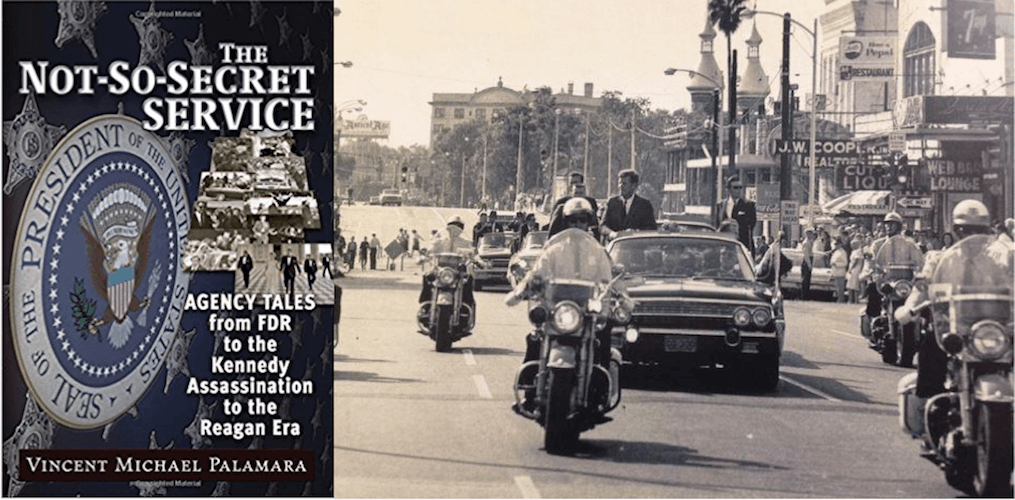
    The Kennedy researcher and film historian Joseph McBride often cites Penn Jones’s suggestion that one should “find a single aspect of the case, and research the hell out of it.” The living embodiment of that suggestion is Vincent Michael Palamara. Vince has specialized in the Secret Service protection for decades, producing the books Survivor’s Guilt, JFK: from Parkland to Bethesda and now The Not-So-Secret-Service: Agency Tales from FDR to the Kennedy Assassination to the Reagan Era. As a result of his frequent contacts with members of the Secret Service, he has information in his books that cannot be accessed elsewhere.

    The first thing to know about this new collection is that it does not solely focus on John F. Kennedy, although much of it reflects on or fills in the historical background of the Secret Service. Palamara, via his correspondence, for example, is able to supply significant first-hand reports about the quality of Presidential protection from an historical perspective prior to 11/22/1963, and the quality of the protection on that day. As is well-known, Fletcher Prouty had referred to the poor quality of the protection supplied on the day of the assassination, pointing out, for example, that there were strict procedural measures that had been ignored. He criticized the route itself, the open windows in the buildings, the slow speed of the parade route, and a few other things (cf. Dave Ratcliffe, Understanding Special Operations, 205-210).

    Palamara contrasts the Secret Service performance in Dallas and compares it to a trip taken just four days earlier in Tampa. Why, he asks, did the motorcade not proceed in a wedge formation, with agents physically on the president’s limousine, as was customary? He also points to an interesting article from December of 1963, from U.E. Baughman, a former Secret Service Chief, who also indicates a violation of what he calls “basic, fundamental” rules. (Palamara, 87). Fascinating.

    For researchers, perhaps the most important chapter in the book is called “Debunking Agent Gerald Blaine’s The Kennedy Detail.” It’s the longest chapter in the book, and goes into detail to counter Blaine’s book, which—as Palamara points out—has no footnotes and uses the sheen of authority to put forward questionable history. To use just one example, he asserts that Admiral Burkley, Kennedy’s physician, ran late and therefore had to catch the bus rather than riding in a staff car; while Burkley himself stated for the record that it was the Secret Service who put him on the bus. (122) The Kennedy Detail (co-written by Lisa McCubbin, who served the same function for Clint Hill’s series of books), focuses entirely away from “conspiracy theories,” as Palamara observes, largely on the grounds they are disrespectful to the family.

    A few words should be said about Lisa McCubbin, both Blaine’s and Hill’s co-author. McCubbin, a journalist by trade, found in Clint Hill both a boyfriend and a new business. Hill had promised he would never write a memoir, but having met McCubbin, he then decided to write three of them: Five Presidents, Five Days in November, and Mrs. Kennedy and Me. “He credits Lisa McCubbin for bringing him out of his ‘dungeon, where he languished for years in [his] emotional prison’ and for helping him ‘find a reason to live, not just exist,’” says the bio on Lisa McCubbin’s webpage: Quite interesting. The major media likes to criticize the “cottage industry” of JFK books; but as usual, it seems like the best supported and promoted works are those with the least interesting content. In addition, Hill’s exit from the “dungeon” and hooking up with McCubbin has also mysteriously coincided with Hill no longer saying anything to upset the defenders of the Warren Commission. In fact, if you want to hear him speak on the subject in your town, all you need is cash.

    There is also some interesting background on McCubbin at this AEI site:

    In July of 2001, just two months before September 11, Lisa gave up her news anchor chair and moved with her family to Riyadh, Saudi Arabia, where her husband was being transferred by his company. After September 11, KGET-TV asked Lisa to report as a foreign correspondent with an insider’s view of Saudi Arabia. Her reports from inside the Middle East captivated the southern California audience by providing a personal connection to the Arab world.

    In Riyadh, Lisa met Prince Abdullah bin Faisal bin Turki Al-Saud, a great-grandson of the founder of Saudi Arabia. After learning that Lisa was an experienced journalist, Prince Abdullah convinced her to work for the Saudis as a media consultant and trainer. In a country where women are not allowed to work with men, it was extraordinary that Lisa had direct meetings with the prince and his male staff—often held secretly at Prince Abdullah’s private villa. Her rare experiences in Saudi Arabia are the subject of her first book, Undercover in Islam: Spinning the News from Saudi Arabia.

    McCubbin is the daughter of Gay and Wyman Harris. Wyman Harris graduated from the USAF, class of ’63. His background can be seen here:

    Mr. Wyman C. Harris is a Principal at Harris, Hoimes, Sutton & Allen, LLC. He was the Chief Operating Officer and Chief Executive Officer at Wyndham Foods, Inc. Mr. Harris is a Director of Sagus International, Inc. He served six years in the United States Air Force in Germany and the Pentagon. Mr. Harris completed the Program for Management Development at Harvard Business School and received an M.S. in Industrial Engineering at Purdue University and a B.S. from the United States Air Force Academy.  (See this link; a little more can be found here)

    Anyway, it’s all a bit interesting.

    To return to the main topic, Blaine contends that conspiracy theorists are just nasty people who want to think ill of our government. The trouble is, the behavior of the Secret Service tends to belie that. Palamara gives a full list of the contents of the two boxes that the Secret Service had deliberately destroyed in January of 1995, just a few months after the Assassination Records and Review Board had been established. Those records concerned the Protection of President John F. Kennedy and the Protective Survey Reports from presidential trips ranging from September 1963 right up until November 8, 1963—two weeks before the assassination. As Palamara writes, this cannot be an accident. How did the Secret Service respond to this?

    … the Secret Service attempted to wriggle out of its predicament by simultaneously suggesting that perhaps the destruction was really the Review Board’s fault because it was not in receipt of the ARRB’s expanded definition of what constituted an “assassination record” until February 1995, after the records were destroyed …. [Ralph] Basham [the Administrative Director of Administration] also tried to downplay the significance of the missing Chicago protective survey reports for the cancelled November 2, 1963 trip (during which conspirators had planned to assassinate President Kennedy) … (137)

    Needless to say, all of these trip reports would be of tremendous significance to any investigative body reviewing the protection of the president during a completed assassination. But the Chicago report is critical because it resulted in the cancellation of a trip and the possible saving of Kennedy’s life. Because there were strong indications that a plot was afoot in Chicago, as first reported by Edwin Black in his landmark essay “The Chicago Plot,” and also supplemented by Abraham Bolden, who later wrote about the incident in The Echo from Dealey Plaza. For the Secret Service to “accidentally” destroy these most important records, just before the ARRB was about to request them, is ever so slightly suspicious.

    There is more to be found in the book: for example, I had not heard the story of Thomas Shipman, who was one of three people to drive President Kennedy while he was in office and who died shortly before the assassination. Although not much is known about him, it is certainly of interest.

    Overall, there are two great strengths of the book. One is that it is relatively short yet fairly dense with information. Palamara is not selling any particular theory throughout the text (except the general thesis that the Warren Commission was wrong) and this is an excellent feature. The second great strength of the book is the obsession with obtaining direct reports and interviews, and when using secondary sources he reprints many of them right in the book so we can look at them. I was very appreciative of this aspect. The book’s subtitle is “Agency Tales from FDR to the Kennedy Assassination to the Reagan Era,” and that is what it delivers; so there is some information in the book that JFK researchers might regard as trivial. However, much of the material, especially the historical background work that the author has done with the agents themselves, is invaluable. And his persistence in attacking the work of Blaine/McCubbin/Hill is thoroughly admirable, if for no other reason than to continue our collective insurgency against the falsified historical record that the establishment wants to carve into stone.

  • Antonio Veciana, with Carlos Harrison, Trained to Kill (1)

    Antonio Veciana, with Carlos Harrison, Trained to Kill (1)


    Pulp Nonfiction: Trained to Kill by Antonio Veciana with Carlos Harrison


    In September of 1979, Antonio Veciana was driving in Miami when an unknown assailant began shooting at him with a .45. The bullets blew out his car window, struck him in the head, his arm, his stomach, but he survived. Recovering in the hospital with a bullet embedded above his left ear,1 he first thought it might have been a CIA hit. But it was an awfully clumsy attempt, and he had earlier been told that Cuban leader Fidel Castro put him on a hit list.

    So he decided to get back at Castro with a model airplane and some C4.

    Now Veciana is the kind of guy who knows how to get explosives if he needs to, and this isn’t the first time he’s been part of an operation to assassinate Castro. So he starts working on his plan, and a few days later an FBI agent greets him on his front porch. The upshot of their conversation is that the agent knows he’s been trying to get some explosives. Then the agent says he already talked to Veciana’s explosives expert and knows he already has the C4.

    Veciana tells the agent to get lost. The agent had to be lying, because he hadn’t given his explosives guy the C4 yet. As a matter of fact it was hidden under the house, not far from where they were having the conversation.2

    Trained to Kill: The Inside Story of CIA Plots Against Castro, Kennedy, and Che is the incredibly improbable memoir written by Veciana (with Carlos Harrison), and the most incredible thing is how much of the story is demonstrably true. Already a major presence in books by HSCA investigator Gaeton Fonzi and well-respected researcher Dick Russell, the author takes the opportunity to tell his own story in his own clear, direct manner.

    This is a man who began life in a shack in the wake of the Great Depression, before growing up to work for Cuba’s richest banker. A hard left turn later, he became the leader of the CIA-backed revolutionary army, Alpha 66, ending up as a peripheral witness to the mechanics behind the assassination of John F. Kennedy.

    However, before we go into his story, let’s take a brief look at the background of American foreign policy in this time period. What changed after World War II? How did funding and training paramilitary groups and overthrowing countries become key functions of the American intelligence services?

    For that, I want to start with one Sir Ian Fleming.

    A DINNER PARTY

    On March 13, 1960, the novelist and intelligence agent Ian Fleming met his friend Mary Leiter (whose husband provided the name for Bond’s CIA friend Felix Leiter) in Washington, D.C. Leiter, driving around town, happened to spot a friend walking on P Street: Senator John F. Kennedy, who would in a few months become President of the United States. She asked the Senator if it would be all right to bring her guest to dinner. A fan of James Bond, and in particular the novel From Russia, with Love, he eagerly assented.3

    Fleming, now world famous as the inventor of James Bond, had a long career in “special services” and left his mark on U.S. intelligence history. During World War II, as a secretary of Admiral John Godfrey (then Director of Naval Intelligence of the Royal Navy), he served as a liaison to MI6 (British intelligence) and was something of an “idea man” with respect to covert operations. He was in the know to arguably the biggest secret of the war: that Alan Turing and his Bletchley Park colleagues had cracked the German Enigma Code. He had even proposed a plan to get an Enigma machine early in the process, but the plan, Operation Ruthless, was never realized, to the frustration of the Bletchley mathematicians.4 Fleming’s plan was as follows:

    I suggest we obtain the loot by the following means:

    1. Obtain from Air Ministry an air-worthy German bomber.
    2. Pick a tough crew of five, including a pilot, W/T operator and word-perfect German speaker. Dress them in German Air Force uniform, add blood and bandages to suit.
    3. Crash plane in the Channel after making S.O.S. to rescue service in P/L.
    4. Once aboard rescue boat, shoot German crew, dump overboard, bring rescue boat back to English port.

    In order to increase the chances of capturing an R. or M. with its richer booty, the crash might be staged in mid-Channel. The Germans would presumably employ one of this type for the longer and more hazardous journey.5

    Researchers in parapolitics will recognize this sort of operation. It was the kind of thing that would become standard in the American intelligence services. It is perhaps most associated with CIA planner Edward Lansdale of Operation Mongoose, dedicated to the removal of Fidel Castro. (Lansdale famously was thought to have been the model for Graham Green’s The Quiet American, with some cause.) It was in these elaborate plots that names familiar to JFK researchers appear: Allen Dulles, Richard Helms, James Jesus Angleton, Bill Harvey, David Morales, and many others.

    Fleming himself served as a liaison to Wild Bill Donovan, the famous first head of the Office of Strategic Services (OSS) that itself grew out of U.S. Naval intelligence (ONI). Indeed, he wrote a 72-page outline that would serve as a foundational document for the OSS and the Central Intelligence Agency. For his efforts, Fleming was awarded a Colt revolver with the inscription “For Special Services.” (In another odd connection, the friend – Mary Leiter – who introduced Fleming to Kennedy in 1960, lived on an estate in Langley, Virginia, owned by her husband’s father. That estate would end up being purchased by the government and converted into CIA headquarters.)6

    In any event, at that March 13, 1960 dinner, Kennedy would have known that his dinner guest was no mere spy novelist. A lively conversation ensued among the group, which also included the reporter Joseph Alsop and a CIA operative named John Bross. Bross had been the assistant general counsel to the U.S. High Commissioner to Germany, John J. McCloy, from 1949 to 1951. One of the things that Bross did was help McCloy make certain key decisions such as – for example – declining to pursue Klaus Barbie and other hardcore Nazis. Bross remained an important voice in the organization for decades; at the time of his death in 1990, CIA Director Richard Helms reflected on how often he had relied on his “wise counsel.”7 Meanwhile, Alsop would later be the man who planted the seed in Lyndon Johnson to form the Warren Commission instead of using local authorities to investigate the Kennedy assassination. Donald Gibson points out in his excellent essay that Alsop, in the transcript of a conversation with Johnson less than a day after Oswald’s shooting by Jack Ruby, baldly states that a formal commission will agree to keep out of the investigation things that the FBI will want to keep out.8 What those things might be is unspecified.

    Fleming, although fairly sedate during the course of the discussion, became aroused as talk turned around to Cuba. What should the U.S. do about Fidel Castro? For this, Fleming had a three-step plan, which shows a familiar pattern of thinking:

    1. The United States should send planes to scatter Cuban money over Havana, accompanying it with leaflets showing that it came with the compliments of the United States.
    2. Using the Guantanamo base, the United States should conjure up some religious manifestation, say a cross of sorts, in the sky which would induce the Cubans to look constantly skyward.
    3. The United States should send planes over Cuba dropping pamphlets, with the compliments of the Soviet union, to the effect that owing to American atom-bomb tests the atmosphere over the island had become radioactive; that radioactivity is held longest in beards; and that radioactivity makes men impotent. As a consequence the Cubans would shave off their beards, and without bearded Cubans there would be no revolution.9

    One might imagine that Fleming had his tongue in cheek when making that last suggestion, except the CIA invented equally absurd plans, including a scheme to make Castro’s beard fall out using thallium.10 Within half an hour of the dinner party ending, CIA Director Allan Dulles heard about Fleming’s visit and expressed dismay that he hadn’t been able to discuss Cuba with him in person.11 During the War, Dulles had shared office space with the “Man Called Intrepid,” the famous spy William Stephenson. Stephenson had a “license to kill,” and in fact was one of the inspirations for the character of James Bond.12 Dulles was so intrigued with James Bond that he actually tried to duplicate some of the spy’s gadgets. Mostly he seemed fond of the image of Bond, a man who will resort to violence to accomplish great ends in the line of duty.13

    It is common to speak of the United States and Great Britain having a “special relationship,” and it is no clearer than in the spy business. Even if Fleming’s document had more to do with the form than the letter of what American intelligence would be, it nonetheless carried an enormous influence. From its Ivy League origins and Wall Street orientation, to its determination to meddle in the affairs of other sovereign states, to its emulation of a superficial kind of “class.” Allen Dulles maintained outward respectability, smoked a pipe, and made the decision to obtain Russian intelligence from a Nazi, Reinhard Gehlen. Due to the Gehlen Operation’s inflated reports of Russian weaponry, it is not too far from the point to say that these men invented the Cold War. For his part, Gehlen referred to Dulles as the “Gentleman.”14 Gehlen also took credit for the American success of the Cuban Missile Crisis while simultaneously deploring Kennedy’s approach to solving it.15

    ENTER KENNEDY

    John F. Kennedy became President in the context of a burgeoning covert operations business used to destabilize and overthrow foreign governments, as well as “wet work” used to assassinate foreign leaders. Just as the British Crown had seen India and Africa as possessions, so did the United States gaze upon Latin America. This enormous intelligence apparatus, modeled on British intelligence, had grown to the extent that it represented a parallel government in many ways run out of the office of Allen Dulles.16

    The great “successes” of the 1950s included the overthrow of Mohammad Mossadeq in the Iranian coup of 1953 and Jacob Arbenz in Guatemala in 1954, among other atrocities.17 To give some idea of what continuity was like in the government, the original plan to overthrow Arbenz had been approved by Harry Truman and then continued under Dwight Eisenhower with no ideological objections along the way.18

    CUBA

    On January 1, 1959, Fidel Castro’s revolution, which had been a four-year guerilla struggle against the dictator Fulgenico Batista, successfully overthrew the government. Batista fled to the Dominican Republic.

    To the extent that Americans today know much about the Cuban revolution, it is assumed that Castro had always been a Communist. This is actually a much-debated point. At the time of the insurrection, the Atlantic Monthly informed its readers that there was “abundant evidence” that Castro was not a Communist.19 During a visit to the United States just six months previously, Castro had indicated he was not, and got favorable press. The ex-pitcher grabbed a hot dog at Yankee Stadium and was referred to by no less than Dean Acheson as the “first democrat in Latin America.”20 However, in 1958 Allen Dulles had told President Eisenhower that he did not think a Castro victory would be good for the United States. Meanwhile, Castro’s right-hand man Che Guevara had been in Guatemala during the Arbenz overthrow and undoubtedly carried that distrust with him to Cuba.21

    Fidel Castro’s overthrow and takeover of the Cuban government had widespread effects for being such a tiny island. In addition to legal trade with the United States, there was considerable mafia influence. Meyer Lansky had rolled into Miami in 1933, and during the War made inroads into Havana. By the time the 1950s came around, Santo Trafficante was running the (illegal) show in Cuba. The operation grew so large that he delegated Havana to his son, Santo Jr. The elder Trafficante and Batista became close.22 Batista had opened his doors to Trafficante and the Mafia to foster a welcome business environment for gambling and heroin.23

    And then in one fell swoop, the entire business was upended and the old arrangements went the way of the Dodo. (The effects of Castro’s overthrow are effectively dramatized in Francis Coppola’s film The Godfather Part II). It was also bad news for U.S. foreign policy since Cuba was a short distance from Florida. At least if you were in the hawkish frame of mind of the Pentagon and the intelligence services. And it was in this milieu that the son of Spanish immigrants, a young man named Antonio Veciana, found himself a budding revolutionary.

    VECIANA’S STORY

    Antonio Veciana was no James Bond. He was an asthmatic, lapsed-Catholic accountant who had gone to the University of Havana at the same time as Fidel Castro, although the latter studied law.24 He claims to have distrusted Fidel from the moment he first met him, seeing in him an inclination toward fascism rather than Communism. Fidel had tried to take control of the university, participating in assassinations and assaults on campus.25 Later, of course, in 1953, Castro would lead a failed coup attempt in Santiago de Cuba, winding up in prison only to be released two years later. Castro would head to Mexico with Ernesto ‘Che’ Guevara for a year, only to return on a boat to begin his revolutionary path – legend has it with less than twenty men and only two rifles.

    Castro’s eventual victory in 1959 was astonishing. Equally astonishing, Veciana – the asthmatic accountant, would instigate a plot to fire a bazooka at Se &‌#241; or Fidel Castro.

    However, Veciana had no sympathy for Batista. In May 1953 Veciana married, and two months later his best man Boris Luis Santa Coloma was tortured to death by Batista government thugs. Later that same year, the young man accepted a position with the Banco Nacional, which he described as “Cuba’s federal reserve,” even as Batista’s atrocities increased. At the same time, the revolutionary movement known as the July 26 movement, led by Castro and Che Guevara, began to expand.26

    In late September of 1959, a man named Maurice Bishop came to visit Veciana. At this time, Veciana worked for a bank owned by Julio Lobo, by some accounting the richest man in Cuba. This gave him some visibility. Veciana notes that, perhaps “coincidentally,” Maurice Bishop came to visit him a few days after a certain Jack Ruby left the island, according to their records.27

    This was the beginning of a relationship that lasted for many years. And there was something about Bishop that fired a spark in Veciana. Bishop made a vague proposal that he should help him defeat Castro, and he found himself agreeing, even without details or knowing which intelligence agency Bishop worked for. Although his first guess was CIA.28

    This relationship would also set off one of the most intriguing mysteries of the Kennedy assassination. Because through largely the efforts of HSCA investigator Gaeton Fonzi, Valencia came to believe that Maurice Bishop’s real name was David Atlee Phillips. A former playwright, Phillips had been recruited into the CIA. He had correctly guessed in 1958 that Castro would come to power.29 Veciana states in this book his certainty that Bishop was in fact Phillips, but we will come back to that.

    Bishop invited Veciana to work for him. He tells Veciana there will be many things he won’t know, and he can’t tell anyone, but he is eager to join, even with so many uncertainties. The initial process involves a grueling question-answer session lasting several hours. He gets past the first hurdle and is invited to go to another session. This second time, he is told to swallow a pill, which Veciana assumed was some sort of truth serum. It made him dizzy. At this second interrogation, he was asked many personal questions, including numerous inquiries about his sexuality – seemingly to find out whether he was gay.30

    He passed the test and went to work for the American intelligence apparatus, with the goal of overthrowing or assassinating Fidel Castro.

    THE BAY OF PIGS

    On April 17, 1961, the United States launched the failed Bay of Pigs invasion against Cuba. Veciana, through his contact Bishop, had received payment and training for the Cuban insurgency against Castro, and also had weapons provided. However, the invasion was a disaster, often blamed in history books as precipitated by Kennedy’s failure to provide “air cover.” However, as L. Fletcher Prouty observed, the plan did not have air cover as a kind of backup operation. If the Cuban planes were not destroyed, the invasion was not supposed to have gone forward.31 Indeed, there were many problems with how the plan was explained to Kennedy, as it was first presented in the context of a necessary Cuban uprising and then later without the uprising happening (to match the reality of a lack of popular will to overthrow Castro).32 And Veciana knew this to be true as well: “Agency officials told Kennedy that the people would rise up once the invasion began. That wasn’t true. It wasn’t close to true. The Pentagon knew it wasn’t.”33 The whole history of the Bay of Pigs has, in essence, been rewritten in a long section in Destiny Betrayed.

    Veciana describes the ridiculous situation like so:

    Twelve hundred men landed. Castro had two hundred thousand. The CIA knew that beforehand … What CIA director Allen Dulles was counting on was his ability to pressure young president John F. Kennedy into launching an all-out U.S. military invasion of the island after the Bay of Pigs brigade got bogged down on the beaches. But Kennedy shocked Dulles and the other gray-haired military and intelligence advisors by refusing to buckle. JFK had told them all along that he didn’t want a “noisy” invasion, and he refused to expand the CIA operation into an all-out war, even if it meant sacrificing the brave brigadistas.34

    Following the failed invasion, Veciana notes that Bishop began to describe Kennedy in negative terms. Bishop tells him: “It’s easy to be a liberal when your belly’s full.”35

    U.S. money began flowing to the terrorist group Alpha 66. The plan – according to Veciana’s reportage of what Bishop was telling him – was that they were trying to force Kennedy’s hand. The idea was that if the President failed to take action to remove Castro, he would be on a collision course with Krushchev and the Soviets.36 Bishop then tells Veciana to focus on attacking ships arriving into Cuba, which prompts this exchange:

    “When the Soviets start complaining and rattling their sabers, Kennedy has to act,” he said.

    “What if he doesn’t take aim at Cuba?” I asked, “What if he takes aim at the CIA?”

    “That’s exactly why we have Alpha 66. When they accuse us, we’ll tell him that we had nothing to do with it. It’s a bunch of anti-Castro exiles acting on their own.”37

    Alpha 66 was not the only one of these groups who were acting against Castro on behalf of the government. For example, Dave Morales was head of CI at the CIA Miami station, a hotbed of anti-Castro activity, and their stated mission was – among other things – to infiltrate the 26th of July movement.38 For his part, Veciana does not talk about the work of agency assets like Morales or anyone outside the scope of his activities. It’s one of the things that make his book so useful, in that it is both efficiently told and limited in outlook. Veciana does not tend to talk about things he did not experience personally, which lends greater weight to his encounters with Che Guevara, for example, and his rather startling statement that he met Lee Harvey Oswald in the company of Maurice Bishop.39 He had told investigator Gaeton Fonzi that Bishop had taught him how to recognize faces. He was positive it was Lee Oswald he had seen that day – or a double. “Exacto, exacto,” he told Fonzi.40

    CHILE

    In addition to these nuggets, Veciana discusses the U.S. government’s involvement with the Chilean coup of 1973 against Salvador Allende. According to the author, when Allende took office, Bishop’s focus went to Chile.41 Meanwhile, in 1967 Phillips had been made Chief of the Cuban Operations Group in the CIA’s Western Hemisphere Division. The Church Committee found that with regard to Chile, there had been a Track Two plot to start an insurrection against Allende – one that cost the U.S. government millions of dollars. Coincidentally, Phillips led that project.42

    The overthrow of Allende is interesting due to its broad similarities to the Kennedy assassination, as the author had previously told researcher Dick Russell. For Allende, there was a patsy lined up who would be killed shortly after the assassination with papers on him indicating he was a Russian Castro agent.43

    WAS MAURICE BISHOP DAVID ATLEE PHILLIPS?

    Bishop lines up with David Atlee Phillips in important ways. For example, Phillips was the Chief of Covert Action from 1961 to 1963 in Mexico City. Phillips had been involved in propaganda operations during the Bay of Pigs and became Chief of Cuban Operations just before the Kennedy assassination, interestingly.44 As Fonzi points out, that means Phillips should have known all the answers with regard to Lee Harvey Oswald’s alleged movements in Mexico City.45 When it came time for Phillips to testify to the House Select Committee on Assassinations, his testimony was a disaster. He was forced to admit he had simply invented a story about Oswald, although he insisted some elements of his testimony were true.46

    There are other small details. Phillips’s 1977 autobiography, Night Watch, cites a particular Cuban restaurant as his favorite eating spot. It was the same restaurant that Veciana mentioned to Fonzi – more than a year before Phillips’s book came out – as a casual meeting ground between himself and ‘Bishop.’47

    Certainly JM/WAVE, the CIA’s Miami station led by Ted Shackley, located on the campus of the University of Miami, would have been a logical place to practice the assassination. We know that Operation Mongoose operated out JM/WAVE.

    “[The CIA] had created an operations headquarters in Miami that was truly a state within a city – over, above, and outside the laws of the United States, not to mention international law, with a staff of several hundred Americans directing many more Cuban agents in just such types of actions, with a budget in excess of $50 million a year, and an arrangement with the local press to keep operations in Florida secret except when the CIA wanted something publicized.”48

    As noted, this is far from the complete story, but this is the main part of the story that reflects on Veciana. The author adopts a straightforward prose style and appears to be doing his best to give the truth as he sees it. For that he deserves some kudos. And though I have touched on many of the themes in the book, there is a great deal more of information regarding the nuts and bolts of the operations.

    EPILOGUE

    I began this essay talking about Ian Fleming and his influence on the American intelligence services. This did not end with his formal contributions to the charters of those agencies. In his books, James Bond is a tough customer who enjoys casual misogyny and has some bizarre notions (Fleming uses the vulgar term “chigroes” to refer to what he calls “Chinese negroes” and seems to think that gay men cannot whistle).

    It is a little striking to reflect on the former American spies who wrote pulp novels. The American CIA agent William F. Buckley, famous for his work at the National Review, wrote a series featuring his spy Blackford Oakes in battle with the evil Soviets. His friend E. Howard Hunt (they served together in Mexico City in the fifties) similarly churned out pulp novels with titles like Bimini Run. In fact, when Arthur Bremer shot George Wallace, and a “diary” was discovered in Bremer’s apartment, Gore Vidal wrote that he recognized Hunt’s literary style in the diary. In that famous essay, Vidal also dissected several Hunt novels and found the same casual racism and sexism within, along with the two-fisted America First attitude.49

    David Atlee Phillips didn’t write pulp spy novels. But his brother did.

    James Atlee Phillips, under the pen name Phillip Atlee, wrote hard-boiled pulp with the same points of view evidenced in Fleming, Hunt, and Buckley. In one of his novels, his hero Joe Gall knows he is in Mexico because he smells Mexicans.50 You get the idea.

    Atlee started his writing career publishing The Green Wound Contract in 1963. In this novel, his hero Joe Gall begins by investigating a murder in the sleepy town of Laredo, Texas. That investigation later leads him to New Orleans. Those two locations are, by themselves, interesting in relation to the JFK assassination already.

    Then, when Gall is inevitably captured by the villain Azmodeus, the latter gives a villain speech listing all the disasters of the CIA: “… in 1961 you armed and trained a pro-Batista force and sent it to the Bay of Pigs, losers. Bo Dai, Rhee, Diem, Nosavan, Pahlevi, Nasser, Castillo Armas, Castro. Am I in error yet, Mr. Gall?” Gall tells him no, so he continues. “ … Gehlen the ex-Nazi in your employ, the gentleman who armed the Hungarian patriots, and Radio Free Europe, which piped them out to be butchered … when the Peronistas got half the vote, you agreed that if the Argentines are going to vote like that, the whole election should be canceled.”

    Gall concedes the points, then clobbers the guard with an ashtray.51

    When, at the end of the book, weary from his adventures and having mailed in his report, he is given another possible mission, he gets contemplative:

    In the meantime, an interesting situation had arisen in one of the new desert republics. The United States had recognized this republic, and Carl said they have confirmation on a murder plot against Tallal, head of the new country. Unfortunately, the plot was being financed by two Arab kings who were ostensibly our allies; therefore the whole matter was delicate.

    A fee was involved, $250,000, cash … They wanted me to ambush and assassinate the assassin.

    From a technical point of view, it was interesting. Kicking at the log smoldering in the fireplace, I wondered what would be the best way to handle it. From the inside out, or the other way around …

    Just the same, it did beat selling insurance; that smiling for a living makes your face hurt. And even if I got caught, drawing a bear down the scope sight I’m sure they would understand that nobody can impugn the motives of a real Christian. Not if his heart is pure.52

    I don’t want to make too much about this point, but it is interesting. We know, for example, that Dwight Eisenhower was enthusiastic about psychological warfare, including the use of the arts.53 Perhaps – and this is just a thought – but it may be that as Reinhard Gehlen was producing internal propaganda from his network to keep the Cold War going from the inside, these CIA-connected novelists were doing the same thing for public consumption.

    All of this apparatus, including the part that Antonio Veciana reports on from the front lines, was already in place when these operations, aimed at foreign targets, suddenly were diverted to a domestic assassination. Once Kennedy declined to take the bait arranged for him during the Cuban Missile Crisis in October of 1962 – and now I enter into the realm of informed speculation – it appears that forces within the government decided to move forward with his assassination. A memorandum dated March 4, 1963 reads: “The President does not agree that we should make the breaking of Sino/Soviet ties a non-negotiable point. We don’t want to present Castro with a condition he obviously cannot fulfill.”54 He wants to improve relations with Cuba. He wants to pull out of Vietnam. The evidence for the latter is now overwhelming.

    As a practical matter, the people doing the killing had already established an industry of propaganda operations, assassination teams, and operational plans. The same people, and the same style of operations, would be involved. There was no need to reinvent the wheel to kill a President, and they didn’t.


    See also the review by Arnaldo Fernandez


    Notes

    1 Williams, Dan. “Anti-Castro Leader Shot in the Head.” The Miami Herald, September 22, 1979.

    2 Veciana, Antonio, with Carlos Harrison. Trained to Kill: The Inside Story of CIA Plots Against Castro, Kennedy, and Che. Skyhorse Publishing: New York, 2017, 195-196.

    3 Pearson, John. The Life of Ian Fleming (McGraw-Hill: New York, 1966), 321.

    4 Cox, David. “The Imitation Game: How Alan Turing Played Dumb to Fool US Intelligence.” The Guardian (The Guardian), February 22, 2017. https://www.theguardian.com/science/blog/2014/nov/28/imitation-game-alan-turing-us-intelligence-ian-fleming

    5 Memo from Ian Fleming to Director of Naval Intelligence, September 12, 1940, British National Archives.

    6 CIA. “What Do James Bond, Downton Abbey, and the CIA Have in Common?” 2015. Accessed February 3, 2017. https://www.cia.gov/news-information/featured-story-archive/2015-featured-story-archive/james-bond-downton-abbey-and-cia.html

    7 “John Bross Dies at 79.” The Washington Post. October 17, 1990. Accessed February 10, 2017. https://www.washingtonpost.com/archive/local/1990/10/17/john-bross-dies-at-79/473069e8-372d-426f-8f55-adfbb5194f22/?utm_term=.decc0326d6d9

    8 DiEugenio, James, & Lisa Pease, ed. The Assassinations: Probe Magazine on JFK, MLK, RFK and Malcolm X. Los Angeles, CA: Feral House,U.S., 2002, 11-16.

    9 Pearson, 322.

    10 St. Clair, Jeffrey, “Roaming Charges: The CIA’s Plots to Kill Castro,” Counterpunch, December 2, 2016. http://www.counterpunch.org/2016/12/02/roaming-charges-the-cias-plots-to-kill-castro/

    11 Pearson, 323.

    12 Talbot, David. The Devil’s Chessboard: Allen Dulles, the CIA, and the Rise of America’s Secret Government. HarperCollins: New York, 2015, 21-22.

    13 Kinzer, Stephen. The Brothers. Times Books – Henry Holt and Company: New York, 2013, 274.

    14 Talbot, 276-279.

    15 Gehlen, Reinhard. The Service: The Memoirs of General Reinhard Gehlen. Popular Library Edition: New York, 1972, 257.

    16 Talbot, 366-367.

    17 Dehghan, Saeed Kamali and Richard Norton-Taylor. “CIA Admits Role in 1953 Iranian Coup.” The Guardian (The Guardian), August 19, 2013. https://www.theguardian.com/world/2013/aug/19/cia-admits-role-1953-iranian-coup.

    18 “CIA and Assassinations: The Guatemala 1954 Documents.” Accessed January 24, 2017. http://nsarchive.gwu.edu/NSAEBB/NSAEBB4/.

    19 Ajaka, Nadine, Noah Gordon, Rumana Ahmed, The Editors, Elaine Godfrey, David Epstein, ProPublica, et al. “Castro is not a communist or a Dupe.” The Atlantic, December 31, 2014. https://www.theatlantic.com/international/archive/2014/12/castro-is-not-a-communist-or-a-dupe/384110/.

    20 Glass, Andrew and Jack Shafer. Politico. “Fidel Castro Visits the U.S., April 15, 1959.” April 15, 2013. Accessed February 25, 2017. http://www.politico.com/story/2013/04/this-day-in-politics-april-15-1959-090037.

    21 Luxenberg, Alan H. “Did Eisenhower Push Castro into the Arms of the Soviets?” Center for Latin American Studies at the University of Miami, Journal of Interamerican Studies and World Affairs, Vol. 30, No. 1 (Spring, 1988), 41-44. http://www.jstor.org/stable/165789

    22 McCoy, Alfred. The Politics of Heroin: CIA Complicity in the Global Drug Trade. Lawrence Hill: Chicago, IL, 1991, 41.

    23 Escalante, Fabián. JFK – the Cuba Files: The Untold Story of the Plot to Kill Kennedy. Melbourne: Ocean Press, 2006, 19.

    24 Veciana, Antonio, with Carlos Harrison. Trained to Kill: The Inside Story of CIA Plots Against Castro, Kennedy, and Che. Skyhorse Publishing: New York, 2017, 24.

    25 Ibid, 35.

    26 Ibid, 28-29.

    27 Ibid, 40.

    28 Ibid, 45.

    29 Ibid, 32.

    30 Ibid, 56.

    31 Ratcliffe, David T. Understanding Special Operations: And Their Impact on the Vietnam War Era. Rat Haus Reality Press: Santa Cruz, CA, 1999, 65-66.

    32 DiEugenio, James. Destiny Betrayed, Second Edition. Skyhorse Publishing: New York 2012, 42.

    33 Veciana, 99.

    34 Ibid, 100.

    35 Ibid, 101.

    36 Ibid, 112.

    37 Ibid, 113.

    38 Memorandum for the record, Interview with Dave Morales, June 2, 1961. https://www.maryferrell.org/showDoc.html?docId=16200&relPageId=38

    39 Ibid, 124.

    40 Fonzi, Gaeton. The Last Investigation. United States: Sky Pony Press, 2016, 142.

    41 Veciana, 157.

    42 Fonzi, 271-272.

    43 Russell, Dick. On the Trail of the JFK Assassins: A Groundbreaking Look at America’s Most Infamous Conspiracy. New York: Skyhorse Publishing, 2008, 150.

    44 Veciana, 190.

    45 Fonzi, 266.

    46 Simpich, Bill. State Secret. The Mary Ferrell Foundation, Chapter 5: The Mexico City Solution.” https://www.maryferrell.org/pages/State_Secret_Chapter5.html

    47 Russell, Dick. The Man Who Knew Too Much. 2nd ed. New York: Carroll & Graf Publishers, 2003, 270.

    48 Blum, William. Killing Hope: U.S. Military and C.I.A. Interventions Since World War II–Updated Through 2003. 2nd ed. Monroe, Me: Common Courage Press,U.S., 2003, 197.

    49 Vidal, Gore. “The Art and Arts of E. Howard Hunt.” The New York Review of Books, December 13, 1973. http://jfk.hood.edu/Collection/Weisberg%20Subject%20Index%20Files/V%20Disk/Vidal%20Gore/Item%2001.pdf

    50 Atlee, Phillip. The Death Bird Contract. Fawcett World Library: 1966, 5.

    51 Atlee, Phillip. The Green Wound Contract. Fawcett World LibraryL 1963, 128-129.

    52 Ibid, 205-206.

    53 Wilford, Hugh. The Mighty Wurlitzer: How the CIA Played America. Harvard University Press: Cambridge, Massachusetts: 2008, 153.

    54 Douglass, Jim. JFK and the Unspeakable. Orbis Books: Maryknoll NY: 2008, 56.

  • Randy Benson, The Searchers

    Randy Benson, The Searchers


    Through a Lens, Clearly: Randy Benson’s The Searchers

    Since President Kennedy’s assassination on November 22, 1963, many films have attempted to document that horrific event and unearth its meaning. The first one, of course, was filmed by Abraham Zapruder, held in place by his secretary on his famous perch in Dealey Plaza. The initial 12 year public disappearance of Zapruder’s original home movie also marked the beginning of the federal government’s attempts to cover up the true facts about the case. In addition to hiding evidence, and ignoring (and in some cases, perhaps eliminating) key witnesses, the CIA literally invented the term “conspiracy theorist” to attack those who disagreed with the official investigation. In spite of all this, there has been a modest stream of credible films and features over the last fifty-four years.

    One of the earliest, Rush to Judgment, featuring Mark Lane and directed by Emile de Antonio, appeared in 1967 and continues to be one of the better films ever made on the case. It contains some of the earliest interviews ever obtained. But these kinds of efforts have been opposed, and sometimes drowned out, by the less honorable efforts of the mainstream media on the JFK case. The major media has done a generally awful job of even reasonably objective reporting, much less showing commitment to the truth. CBS broadcast a special in 1964, on the day the Warren Report was released—without telling the public how they could possibly do that unless they knew the results well in advance. And they then agreed to go along with them without any independent analysis.

    Then, in 1967, NBC produced an infamously slanted ‘special report’ on Jim Garrison’s investigation. That hatchet job was produced by former NSA counter-intelligence chief Walter Sheridan. It was done with permission from corporate headquarters in New York to, literally, “shoot him down.” (Destiny Betrayed, by James DiEugenio, Second Edition, p. 239) Sheridan literally surveilled and harassed witnesses in order to get them to change their stories from what they had originally told Jim Garrison. They then put these witnesses on the air without telling the viewer what they had done.

    Like Old Reliable, CBS would then produce one special in 1967, and another one in 1975; the latter was designed to defuse interest in the Church Committee. With the help of memoranda obtained by the late CBS employee Roger Feinman, Jim DiEugenio has carved these productions up and shown how fundamentally dishonest they were. For instance, Dick Salant, president of CBS, beat back an attempt by his employees—e.g. Daniel Schorr and Les Midgley—to do a fair minded, probing program. By pulling rank, Salant turned the fair-minded proposal into a one-sided defense for the Warren Report. CBS then hired compromised “experts”, like urologist John Lattimer and Dallas Policeman Jerry Hill, as their consultants to make sure that is what the program ended up as (Click here https://kennedysandking.com/john-f-kennedy-articles/why-cbs-covered-up-the-jfk-assassination)

    In 1986 Vincent Bugliosi prevailed in a ridiculous “show trial” in London over an unprepared Gerry Spence. That program was later broadcast in America on Showtime. Later network productions have been as bad. In 2003, Peter Jennings hosted Beyond Conspiracy for ABC, another inane effort. That one featured the notorious duo of Gus Russo and Dale Myers. The latter helped bring us the hilarious spectacle of ABC proclaiming the Single Bullet Theory, as the Single Bullet Fact, all done by the alchemy of Myers’ computer graphics. (Click here for more on Myers https://kennedysandking.com/john-f-kennedy-articles/dale-myers-an-introduction)

    More recent years have brought about the (now deceased) Gary Mack-assisted Inside the Target Car; Oswald’s Ghost from PBS, directed by a man who had a spiritual awakening that told him Oswald was guilty; JFK: The Lost Bullet, in which Max Holland claimed he could see Oswald walking by on the Sixth Floor; and JFK: The Smoking Gun, in which an Australian detective tries to sell us on George Hickey having fired the fatal shot into JFK. The common thread in all these films is they either support a lone nut verdict or try to “solve the case” in such a way as to let the government off the hook.

    rbenson
    Filmmaker Randy Benson

    Randy Benson’s The Searchers is not one of those films. Instead, his film takes two essential tracks—on the one hand, providing a brief history of the state of the case over the last fifty years, and on the other, filling out portraits of the men and women who provided most of the breakthroughs—the “searchers” of the title. For the former track, he uses some milestones in the history of the JFK case. For example, the Garrison inquiry, the convening of the House Select Committee on Assassinations because of the 1975 broadcast of the Zapruder film on ABC, and the 1991 release of Oliver Stone’s film JFK.

    The other track Benson pursues is rather bracing in its simplicity. From about 1966, it became the strategy of the MSM not to let the Warren Commission critics speak without being interfered with, or caricatured. After Stone’s movie came out, provoking a year long firestorm, that was changed. Now the MSM simply would not place the critics on their programs at all.

    Benson counters that by simply letting the critics speak about the case without being interfered with. People like Gary Aguilar, Debra Conway, and Lisa Pease simply answer questions or address issues. And once the viewer sees this, he or she understands why it’s not done. Because without the interference, or the caricaturing, the critics would carry the day. Simply based on the strength of their arguments and their in-depth knowledge of the JFK case. Because of media censorship, these are aspects of the case that the public is not allowed to see today, but which Benson munificently supplies.

    In a more perfect world, it is the sort of film that would have been done long ago by PBS, with a substantial budget and a major release. But as we know from their Gus Russo/Dale Myers 1993 fiasco Who was Lee Harvey Oswald?, PBS is part of the MSM on this case. Instead, mirroring the struggle of the researchers, this film arrives after a fourteen-year odyssey largely by one man—Benson—and unfortunately after the deaths of two of the participants, John Judge and Mark Lane.

    The great achievement of the film is to humanize the researchers themselves. After years of being portrayed as kooks (or worse, as in Larry Schiller’s book The Scavengers and Critics of the Warren Report), here is a film that depicts them as they are. The earliest researchers were not themselves part of any government tribunal; instead, they were people who had to be coaxed away from their trust in the federal government. They were not born anarchists or people in search of fame, or money. They were housewives, lawyers, doctors, teachers, and professionals, who found—much to their chagrin—that the government was lying, and over the matter of a murdered president, they would not stand for it. The Warren Commission never thought anyone would read their 26 volumes of evidence. Surely, the reporters of the MSM did not. Or how could they issue their kudos about the Warren Report in September when the 26 volumes of evidence were not issued until October? But some interested parties did read the 26 volumes. And they noticed that the evidence in the volumes did not support the conclusions in the Warren Report. Once they took that stand based on the evidence, people like Shirley Martin, Vincent Salandria, Penn Jones, Sylvia Meagher, Mae Brussell, and Harold Weisberg simply couldn’t let it go. And it is to their credit that they did not.

    Unfortunately, while these folks were unavailable to interview (all but Salandria are now deceased, but John Kelin ably fills in some of the details on their backgrounds), the interviews that were obtained for the film are formidable. Crosscut throughout the documentary are insights from Mark Lane, John Judge, Robert Groden, Dr. Cyril Wecht, Dr. Gary Aguilar, Jim DiEugenio, Lisa Pease, Jim Marrs, Josiah Thompson, Rex Bradford, Walt Brown, and Debra Conway. And because Benson was able to shoot most of these interviews on-location with the researchers, we get to see them in contexts we might otherwise not see them. At home with Mark Lane, showing us his personal copy of the Warren volumes, or in the garage with Tink Thompson tinkering with his motorcycle, or watching Robert Groden age over the years as we see the famous footage from the 1975 Geraldo Rivera program with Dick Gregory—right up to the present as he greets people on the grassy knoll in Dealey Plaza.

    Another great strength of the film is that it is made for an audience that is not necessarily expert in all things JFK. The director made it, in his words, for “himself, before I got into all this.” In other words, he was a person who thought of himself as informed, college-educated, granted many benefits in this society, but unaware of the real history that lies underneath what is called history. We see that play out, in rough chronological order, but instead of hearing from established media, we see that history through the eyes of real historians like Judge and DiEugenio.

    At the same time, there is little attention paid to some of the great schisms that have occurred in the research community—for example, the question of the Zapruder film’s authenticity—instead focusing on the great areas of agreement between researchers. The great majority of us know that Oswald didn’t do it, and that the cover-up could only have been performed by those in positions of great power. We might argue about who that might be, but we all agree on most of the basics. It is to this majority to which this film speaks. And it makes heroes out of the ordinary men and women who chose to devote their lives to this mostly thankless duty. If they had been listened to instead of marginalized and caricatured, America might not be in the situation that it is in today.

    The latest election in the United States has revealed, more than ever before, the deep-set corruption in both our government, and our media. In a stunning turn of events, we have elected a person who is as far away from John Kennedy as one could imagine. It’s worth reflecting, for a moment, what we once had, and what we have now. For all intents and purposes, the assassination of President Kennedy began our long national nightmare, and Donald Trump seems to be only the latest chapter. This is a time when we need to look to each other and find spaces of agreement, rather than conflict, and it seems to me The Searchers aids that end.

    If The Searchers has a central thesis, it would seem to be that, on complex cases, the best work is often done by ordinary people with an extraordinary tenacity to get at the truth. Where the government has failed us, where official investigations have failed us, we might succeed. In this new age of friendly fascism, each other might be all we’ve got.


    The Searchers is currently available for purchase in a DVD edition for researchers that includes 37 hours of full interviews with all of the researchers in the movie.

  • Randy Benson, The Searchers

    Randy Benson, The Searchers


    Through a Lens, Clearly: Randy Benson’s The Searchers

    Since President Kennedy’s assassination on November 22, 1963, many films have attempted to document that horrific event and unearth its meaning. The first one, of course, was filmed by Abraham Zapruder, held in place by his secretary on his famous perch in Dealey Plaza. The initial 12 year public disappearance of Zapruder’s original home movie also marked the beginning of the federal government’s attempts to cover up the true facts about the case. In addition to hiding evidence, and ignoring (and in some cases, perhaps eliminating) key witnesses, the CIA literally invented the term “conspiracy theorist” to attack those who disagreed with the official investigation. In spite of all this, there has been a modest stream of credible films and features over the last fifty-four years.

    One of the earliest, Rush to Judgment, featuring Mark Lane and directed by Emile de Antonio, appeared in 1967 and continues to be one of the better films ever made on the case. It contains some of the earliest interviews ever obtained. But these kinds of efforts have been opposed, and sometimes drowned out, by the less honorable efforts of the mainstream media on the JFK case. The major media has done a generally awful job of even reasonably objective reporting, much less showing commitment to the truth. CBS broadcast a special in 1964, on the day the Warren Report was released—without telling the public how they could possibly do that unless they knew the results well in advance. And they then agreed to go along with them without any independent analysis.

    Then, in 1967, NBC produced an infamously slanted ‘special report’ on Jim Garrison’s investigation. That hatchet job was produced by former NSA counter-intelligence chief Walter Sheridan. It was done with permission from corporate headquarters in New York to, literally, “shoot him down.” (Destiny Betrayed, by James DiEugenio, Second Edition, p. 239) Sheridan literally surveilled and harassed witnesses in order to get them to change their stories from what they had originally told Jim Garrison. They then put these witnesses on the air without telling the viewer what they had done.

    Like Old Reliable, CBS would then produce one special in 1967, and another one in 1975; the latter was designed to defuse interest in the Church Committee. With the help of memoranda obtained by the late CBS employee Roger Feinman, Jim DiEugenio has carved these productions up and shown how fundamentally dishonest they were. For instance, Dick Salant, president of CBS, beat back an attempt by his employees—e.g. Daniel Schorr and Les Midgley—to do a fair minded, probing program. By pulling rank, Salant turned the fair-minded proposal into a one-sided defense for the Warren Report. CBS then hired compromised “experts”, like urologist John Lattimer and Dallas Policeman Jerry Hill, as their consultants to make sure that is what the program ended up as (Click here https://kennedysandking.com/john-f-kennedy-articles/why-cbs-covered-up-the-jfk-assassination)

    In 1986 Vincent Bugliosi prevailed in a ridiculous “show trial” in London over an unprepared Gerry Spence. That program was later broadcast in America on Showtime. Later network productions have been as bad. In 2003, Peter Jennings hosted Beyond Conspiracy for ABC, another inane effort. That one featured the notorious duo of Gus Russo and Dale Myers. The latter helped bring us the hilarious spectacle of ABC proclaiming the Single Bullet Theory, as the Single Bullet Fact, all done by the alchemy of Myers’ computer graphics. (Click here for more on Myers https://kennedysandking.com/john-f-kennedy-articles/dale-myers-an-introduction)

    More recent years have brought about the (now deceased) Gary Mack-assisted Inside the Target Car; Oswald’s Ghost from PBS, directed by a man who had a spiritual awakening that told him Oswald was guilty; JFK: The Lost Bullet, in which Max Holland claimed he could see Oswald walking by on the Sixth Floor; and JFK: The Smoking Gun, in which an Australian detective tries to sell us on George Hickey having fired the fatal shot into JFK. The common thread in all these films is they either support a lone nut verdict or try to “solve the case” in such a way as to let the government off the hook.

    rbenson
    Filmmaker Randy Benson

    Randy Benson’s The Searchers is not one of those films. Instead, his film takes two essential tracks—on the one hand, providing a brief history of the state of the case over the last fifty years, and on the other, filling out portraits of the men and women who provided most of the breakthroughs—the “searchers” of the title. For the former track, he uses some milestones in the history of the JFK case. For example, the Garrison inquiry, the convening of the House Select Committee on Assassinations because of the 1975 broadcast of the Zapruder film on ABC, and the 1991 release of Oliver Stone’s film JFK.

    The other track Benson pursues is rather bracing in its simplicity. From about 1966, it became the strategy of the MSM not to let the Warren Commission critics speak without being interfered with, or caricatured. After Stone’s movie came out, provoking a year long firestorm, that was changed. Now the MSM simply would not place the critics on their programs at all.

    Benson counters that by simply letting the critics speak about the case without being interfered with. People like Gary Aguilar, Debra Conway, and Lisa Pease simply answer questions or address issues. And once the viewer sees this, he or she understands why it’s not done. Because without the interference, or the caricaturing, the critics would carry the day. Simply based on the strength of their arguments and their in-depth knowledge of the JFK case. Because of media censorship, these are aspects of the case that the public is not allowed to see today, but which Benson munificently supplies.

    In a more perfect world, it is the sort of film that would have been done long ago by PBS, with a substantial budget and a major release. But as we know from their Gus Russo/Dale Myers 1993 fiasco Who was Lee Harvey Oswald?, PBS is part of the MSM on this case. Instead, mirroring the struggle of the researchers, this film arrives after a fourteen-year odyssey largely by one man—Benson—and unfortunately after the deaths of two of the participants, John Judge and Mark Lane.

    The great achievement of the film is to humanize the researchers themselves. After years of being portrayed as kooks (or worse, as in Larry Schiller’s book The Scavengers and Critics of the Warren Report), here is a film that depicts them as they are. The earliest researchers were not themselves part of any government tribunal; instead, they were people who had to be coaxed away from their trust in the federal government. They were not born anarchists or people in search of fame, or money. They were housewives, lawyers, doctors, teachers, and professionals, who found—much to their chagrin—that the government was lying, and over the matter of a murdered president, they would not stand for it. The Warren Commission never thought anyone would read their 26 volumes of evidence. Surely, the reporters of the MSM did not. Or how could they issue their kudos about the Warren Report in September when the 26 volumes of evidence were not issued until October? But some interested parties did read the 26 volumes. And they noticed that the evidence in the volumes did not support the conclusions in the Warren Report. Once they took that stand based on the evidence, people like Shirley Martin, Vincent Salandria, Penn Jones, Sylvia Meagher, Mae Brussell, and Harold Weisberg simply couldn’t let it go. And it is to their credit that they did not.

    Unfortunately, while these folks were unavailable to interview (all but Salandria are now deceased, but John Kelin ably fills in some of the details on their backgrounds), the interviews that were obtained for the film are formidable. Crosscut throughout the documentary are insights from Mark Lane, John Judge, Robert Groden, Dr. Cyril Wecht, Dr. Gary Aguilar, Jim DiEugenio, Lisa Pease, Jim Marrs, Josiah Thompson, Rex Bradford, Walt Brown, and Debra Conway. And because Benson was able to shoot most of these interviews on-location with the researchers, we get to see them in contexts we might otherwise not see them. At home with Mark Lane, showing us his personal copy of the Warren volumes, or in the garage with Tink Thompson tinkering with his motorcycle, or watching Robert Groden age over the years as we see the famous footage from the 1975 Geraldo Rivera program with Dick Gregory—right up to the present as he greets people on the grassy knoll in Dealey Plaza.

    Another great strength of the film is that it is made for an audience that is not necessarily expert in all things JFK. The director made it, in his words, for “himself, before I got into all this.” In other words, he was a person who thought of himself as informed, college-educated, granted many benefits in this society, but unaware of the real history that lies underneath what is called history. We see that play out, in rough chronological order, but instead of hearing from established media, we see that history through the eyes of real historians like Judge and DiEugenio.

    At the same time, there is little attention paid to some of the great schisms that have occurred in the research community—for example, the question of the Zapruder film’s authenticity—instead focusing on the great areas of agreement between researchers. The great majority of us know that Oswald didn’t do it, and that the cover-up could only have been performed by those in positions of great power. We might argue about who that might be, but we all agree on most of the basics. It is to this majority to which this film speaks. And it makes heroes out of the ordinary men and women who chose to devote their lives to this mostly thankless duty. If they had been listened to instead of marginalized and caricatured, America might not be in the situation that it is in today.

    The latest election in the United States has revealed, more than ever before, the deep-set corruption in both our government, and our media. In a stunning turn of events, we have elected a person who is as far away from John Kennedy as one could imagine. It’s worth reflecting, for a moment, what we once had, and what we have now. For all intents and purposes, the assassination of President Kennedy began our long national nightmare, and Donald Trump seems to be only the latest chapter. This is a time when we need to look to each other and find spaces of agreement, rather than conflict, and it seems to me The Searchers aids that end.

    If The Searchers has a central thesis, it would seem to be that, on complex cases, the best work is often done by ordinary people with an extraordinary tenacity to get at the truth. Where the government has failed us, where official investigations have failed us, we might succeed. In this new age of friendly fascism, each other might be all we’ve got.


    The Searchers is currently available for purchase in a DVD edition for researchers that includes 37 hours of full interviews with all of the researchers in the movie.

  • Philip Nelson, LBJ Mastermind of JFK’s Assassination


    A Texan Looks at Nelson: LBJ Mastermind of JFK’s Assassination

    It seems like such a natural conclusion. The king is dead, long live the king. If you are studying the Kennedy assassination, and you ask the immortal question cui bono, you might first land on the name Lyndon Johnson. From “MacBird” to A Texan Looks at Lyndon to Ed Tatro in “The Guilty Men” episode in Nigel Turner’s The Men Who Killed Kennedy, many people have analyzed Johnson’s doings and cried foul.

    Into this tradition comes Phillip F. Nelson with a sizable work on the subject, wanting to go further than anyone has before. His view of Johnson is comparable to Sherlock Holmes’s description of Professor Moriarty: “He is the Napoleon of crime…He sits motionless like a spider in the centre of its web, but that web has a thousand radiations, and he knows very well every quiver of each of them.”[i] Nelson’s thesis is in his title: LBJ Mastermind of JFK’s Assassination.

    This particular genre of Kennedy book is admittedly one I find less useful than others. It is possible to see the JFK assassination as a game of Clue, deciding whether you think it is David Morales with the candlestick in the conservatory or J. Edgar Hoover with the lead pipe in the study. To my mind, this tendency often becomes engrossed in the less important details of assassination mechanics and (to my way of thinking) the more important mechanics of how states operate, how that affects us, and how best to combat the forces behind it. But that is my bias, so let the reader be informed. As for Nelson, he makes his intent clear. Noel Twyman, he says, names “…Lyndon Johnson and J. Edgar Hoover as having been involved in the plot and in the cover-up, though he failed to determine that Lyndon Johnson was the mastermind of the conspiracy. This book merely adds that last element in a case that has already been proven beyond a reasonable doubt.” [ii]

    Let’s see if Twyman’s ‘failure’ is Nelson’s gain.

    BEGINNINGS

    The book is divided into 10 chapters that purport to show LBJ’s hand in every aspect of the assassination, from the planning to the execution to the aftermath. It begins, however, by spelling out his basic criteria. Nelson argues that Johnson has motive, means, and opportunity, and that further he was a psychopath who would stop at nothing to achieve power.

    The author discusses Johnson’s rise to power, the ins and outs of the all too familiar tale of Box 13, and Johnson’s many distasteful characteristics. These are, by and large, taken from Johnson’s multi volume biographer Robert Caro. In the first chapter alone, at one point there are 26 consecutive footnotes going back to Caro. To this summary he also sprinkles a few quotes from Robert Dallek, but here also begins his penchant for questionable sources. He quotes from Jack Valenti, Victor Lasky, and (of all people) Seymour Hersh, just for starters. Now the problematic aspects of using those particular writers – at least without some qualification – is apparent to most Kennedy scholars. I won’t explain the nuts and bolts here, but instead direct the reader to Jim DiEugenio’s essay “The Posthumous Assassination of John F. Kennedy” for details. But suffice it to say that each of these writers has a rather large axe to grind and a willingness to use any means necessary to grind it.

    Now these sources do little harm to the early part of the book because Johnson’s character is well-established. He was a low-class sort of a person, prone to vulgar and over bearing displays of machismo in public, and employing men like Mac Wallace who were murderous criminals. And if you take allthese famous incidents a face value, and then string them in tandem over the years, then hey! Maybe LBJ does seem like the sort of man who, were it within his power, could have had the president killed and not be halted by any moral barriers.

    In Chapter 2, Nelson focuses on Kennedy’s relationship with the Joint Chiefs and their disagreements over foreign policy. Or were they disagreements? The author seems confused on this point. On the one hand, he seems to agree that Kennedy wanted peace and Johnson was more accommodating of the CIA and Department of Defense. Nelson describes, for example, how the CIA cut off aid to South Vietnam at a time when he was pondering whether to take this very action. They took the action automatically, following a playbook unknown to Kennedy. “But the larger point was that it was a message the CIA was sending to the president, who was being told who was really in control…it wasn’t John Kennedy.”[iii] He also describes how JFK and the military did not get along. And he then builds to this crucial statement: “Over the course of the next two years, those relationships would continue growing even further apart and become so well established that it could be argued that in the larger scheme, Lyndon B. Johnson had assumed the mantle of commander-in-chief.”[iv]

    To say the least, this last bit seems overstated. However, that aside, the peculiar part of Nelson’s analysis is that he seems to buy into the CIA’s version of the Bay of the Pigs. He writes that Kennedy wanted a second set of air strikes but was intimidated into not doing so by Adlai Stevenson. He then goes on to criticize Dean Rusk for agreeing with the president’s refusal to provide air cover during the invasion.[v] (He gets all this, incidentally, from Lasky.) To call this particular version of events simplistic is to be generous; but things only get worse from here.

    SMEAR CAMPAIGN

    Further going into the Cuban situation, Nelson blithely quotes Alexander Haig as saying that Robert Kennedy ran the hit teams killing innocents, although “…he took care to keep his own name out of most of the documents…” Haig goes on to say that with respect to the Cuban assault teams, “Bobby was the President!”[vi] (Haig, who is obviously not the most credible witness in this context, gave this interview to Gus ‘Single Bullet Fact’ Russo.) Hiag, or course, was the man who on an installment of Nightline actually said that Lyman Lemnitzer had told President Kennedy outright that the Bay of Pigs would fail without air cover. It was this kind of past-debacle CYA that provoked Kennedy to install a taping system in the White House. And this is how we know precisely what was said during the Missile Crisis. Yet, once again, Haig is all OK with our erstwhile author, who doesn’t stop to mention that maybe the sources for this information are a bit problematic.

    But Nelson steams ahead unabated. He now quotes Richard Helms’ aide Nestor Sanchez as saying that “The buck stops with the President on operations like that…All the other conspiracies [about] the agency was running amok, that’s baloney…” He isn’t quoting this to isolate a point of view; he’s using Sanchez as a viable witness. He does the same with the notorious Sam Halpern and even Richard Helms himself. He then writes that “The Kennedys’ campaign to get rid of the Castro ‘problem’ was doomed from the start…”[vii] Just so there is no question, he elaborates: “Documents prove…Bobby Kennedy had authorized the plots…”[viii] In fact the CIA Inspector General report on the Castro plots actually says the opposite: that the Agency could not use presidential approval as a fig leaf for what they had done. So where does Nelson get this contrary view? One will not be surprised to learn that Nelson also got this from Russo i.e.from his asinine book Live by the Sword. Readers can take a look for themselves, but be aware that Russo believes in the “jet-effect theory,”[ix] (i.e., the desperate attempt to show that Kennedy’s violent rearward motion could have happened from a rear shot), claims that Lee Harvey Oswald left fingerprints all over the alleged sniper’s nest (!!!), and argues that the backyard photograph (with its obvious chin splice) is genuine.[x] You get the idea.

    The pièce de résistance of this line of argument comes with Nelson’s assertion that Kennedy was aware of the assassination plots against Castro, but the CIA kept the Joint Chiefs in the dark.[xi]

    Let the reader judge, but let me say that I find this a tad implausible.

    Just for the record, please note the following list of people who testified to the Church Committee that Kennedy had never been informed of any assassination plots against Castro:

    • Dean Rusk
    • Maxwell Taylor
    • John McCone
    • McGeorge Bundy
    • Richard Helms
    • Bill Harvey[xii]

    To put it mildly, these are not perceived as friends of JFK.

    David Talbot put it like this:

    In the ideological war to define the Kennedy administration, which broke out soon after the president was laid to rest in Arlington and continues to this day, national security officials insisted that the Kennedy brothers were ‘out of control’ on Cuba, pushing them to take absurd measures against Castro like the Mongoose folly. This would become the standard version of the Kennedys’ Cuba policy in countless books, TV news shows, and documentaries – it was rash, obsessive, treacherous, even murderous. But this is not an accurate picture of the Kennedy policy.[xiii]

    Bill Harvey went so far as to say that he would have been the last person that JFK would have ever put in charge of a Castro assassination venture, even if he had desired it.[xiv]

    HERE WE GO AGAIN

    Enough about Cuba. Let’s get to the sex!

    Nelson reports blandly the same things that the CIA friendly Sy Hersh wrote in his long since discredited hatchet job The Dark Side of Camelot. For example, JFK tried to get Judith Exner in a three-way, then impregnated her, then told her to go see Sam Giancana for assistance in getting an abortion![xv] I grant this would make for a very exciting telenovela on Galavisión, but is dubious at best and has zero to do with Lyndon Johnson. (Remember him?) Surprisingly, the author doesn’t seem to notice this: the fact that he is losing his focus. Instead he actually acknowledges that the reader may well be more interested in more prurient detail, but he or she should seek other books for this. The first one to read, he sagely recommends, is another CIA attached journalist: Ronald Kessler’s Sins of the Father.[xvi] Incredible.

    It does point out the long-term damage books like these can do, however. My own local public library around the corner has perhaps a half-dozen books on JFK, and one of them is The Dark Side of Camelot. The name ‘Seymour Hersh’ is stronger than the book’s own infamy, which partly consisted of the investigative reporter being snookered into buying fake documents.[xvii]

    In any event, please accept my apologies. We were talking about sex. Nelson actually writes the following sentence, unawares of the ironic humor: “In the interest of brevity, we will consider further only JFK’s relationships with Marilyn Monroe, Mary Pinchot Meyer, Judith Exner, and Ellen Rometch…”[xviii] In the interests of brevity! Nelson then goes on to discuss these stories with no discernment at all, using as his sources material not just from Nina Burleigh and Deborah Davis, but also Hersh, Donald Wolfe, etc., without any analysis or elaboration on how credible the information is that he’s using. From the likes of Wolfe, he gets the observation that “…Hoover had warned Jack about exposing his affairs with Judith Campbell [Exner] and Marilyn Monroe, so he had resigned himself to give up both, no doubt because there were so many others to replace them.”[xix] If you can believe it, Nelson asserts that Wolfe “made a compelling case” of RFK’s involvement in Monroe’s death, and brings up rumors that JFK and Mary Meyer used drugs together. There are several astonishing claims made in the text, but here is one of my favorites: “It may be just a coincidence that, concurrently with his affair with Mary Pinchot Meyer and their rumored use of drugs together, Kennedy had become less tolerant of the CIA’s intelligence breakdowns and the Pentagon’s aggressive provocation for military actions, especially in Vietnam.”[xx]

    OK, let’s think about this. Which of these conclusions is more likely?

    1. JFK grew apart from his military advisors because of the Bay of Pigs invasion and the Cuban Missile Crisis, where they revealed themselves to be prepared to destroy the entire planet in defense of American interests.
    2. JFK grew apart from his military advisors because he was toking it up with a girlfriend.

    I am going to go with option 1 myself, particularly since we have no evidence (2) ever happened.

    There is a larger point here, which I raise again: What does this have to do with the book? We were talking about Lyndon Johnson, right?

    And so we are. Sometimes. Phillip Nelson’s book is truly a rambling one, taking 700 pages to express a claim that he could have made in 200 pages. If you delete material which consists of summaries of other people’s books, you might have as little as 20 pages of original material. And these 20 pages largely consist of his analysis of the Altgens photograph. We’ll get to that later.

    LYNDON’S SCANDALS

    Having dealt with Caro’s stories about LBJ and cheapjack authors’ versions of Kennedy’s involvement in Cuba and women, the middle section of the book turns its attention to the scandals that clung to the Vice-President. Most of these are familiar to anyone who has studied Johnson. They involve Bobby Baker, Mac Wallace, and the various people Johnson is alleged to have murdered, including his sister. Much of this appeared in The Men Who Killed Kennedy, although Nelson gets most of the juicy bits from Barr McLellan and the hoary volume by J. Evetts Haley A Texan Looks at Lyndon.[xxi]

    Any book that posits Johnson’s involvement in the assassination is going to use this material, and whether you buy this or not depends a great deal on testimony from people who may not be the most reliable witnesses. Nelson has little to add here, and if you are familiar with the McLellan book nothing here will be news. At least LBJ’s scandals have the virtue of being on-topic.

    THE MEAT OF THE ARGUMENT

    The last third of the book starts to deliver on some of Nelson’s conclusions. To this point, the main ideas of the book (that is, the ones that relate to LBJ) could be summarized as follows:

    1. LBJ was a scoundrel, hungry for power, and possibly psychopathic.
    2. LBJ got along better with the Department of Defense than JFK did. (Although Nelson does, curiously, quote Howard Burris from John Newman’s book JFK and Vietnam, saying that he didn’t believe Johnson had a “very deep” understanding of political issues.) Which is odd for a “mastermind.”[xxii]
    3. LBJ had very possibly committed several murders, or at least ordered them done, had stolen elections, and had generally shown little regard for the law.

    Having tried to show all these things, the author now has to demonstrate Johnson’s mastery. And one must give Nelson his due in this regard – he doesn’t mess around. He doesn’t lack for boldness. He has Johnson planning the entire assassination, and ordering people around who were not used to taking orders.

    The ‘Johnson plan’ would be based upon the concept that the operational and tactical plans would be carefully kept away from the highest level planners; Johnson and Angleton, possibly Hoover and LeMay as well, consistent with the precepts of ‘plausible deniability’ and interagency secrecy protocols would protect others throughout the ‘hierarchical’ chain.[xxiii]

    Not only does he plan the assassination, he controls the Secret Service, [xxiv] putting in orders for the Secret Service to compromise themselves. Nelson has no evidence for this, but it is, in his view, a “reasoned conjecture.”[xxv] We are assured that “Johnson’s hand would be kept invisible through his having three levels of staff separating him from motorcade planning.”[xxvi]

    As noted, Johnson is the boss, resulting in some dubious statements. One mid-chapter heading reads:

    J. Edgar Hoover: Johnson’s Willing Lieutenant[xxvii]

    I had to put the book down for a moment upon reading that. Hoover was not anyone’s willing lieutenant, and the idea that he would have kowtowed to the big Texan – well, I suppose it’s not impossible, but it is awfully hard to imagine. Similar to his saying that Johnson would “…undoubtedly recruit…General Curtis LeMay, who shared many of Johnson’s attitudes, especially about the president, whom he regarded as an indecisive coward and avowed socialist.”[xxviii] Johnson recruited LeMay into the operation? Just so there is no confusion: “Just as Vice President Johnson had been feeding secrets to his friends in the CIA (as noted in chapters 2 and 3), it is a reasonable presumption that he was doing the same with his friends in the Pentagon, probably including General LeMay, who was cut from the same, practically identical, bellicose cloth as Johnson.”[xxix]

    This last remark simply isn’t true. Even in pro-LeMay biographies, one gets the clear sense that LeMay counseled Lyndon Johnson in full commitment, an immense bombing campaign into North Vietnam, which he declined to do. Johnson only kept him on board for a year, listening to LeMay complain the whole time that air strikes were not timely or powerful enough for his liking.[xxx]

    INTERPRETATION

    Much of the rest of Nelson’s arguments rely upon his specific interpretation of specific events. For example, John Connally was “insistent upon the selection of the Trade Mart,”; but instead of throwing suspicion upon Connally directly, Nelson writes that “…it suggests the unseen hand of his mentor, Lyndon Johnson.”[xxxi]

    Nelson tells the story of how Johnson got into an argument about wanting Connally rather than Ralph Yarbrough to sit next to him during the assassination. JFK told Johnson that seating arrangements would not be changed and the latter became very upset. To Nelson, this is sinister; his foreknowledge intact, Johnson is trying to keep his buddy Connally out of harm’s way. However, Nelson also does note that Johnson hated Yarbrough, so he has another reason to not want to sit next to him. So, one assumes, LBJ would have been upset even if he was not the criminal mastermind behind the operation. [xxxii] That is to say, if you already believe in Nelson’s thesis, this becomes further corroborative evidence.

    The author also provides the solution to why Lyndon Johnson began crying hysterically on Air Force One shortly after the assassination, as appeared recently in Steven Gillon’s book. We must consider the “…likelihood that it was a result of his finally finding enough privacy to allow himself a moment to physically release the built-up tension that he had suppressed for hours – actually days, and weeks of intense anticipation – as he planned the critical action that would save his career: the murder of JFK.”[xxxiii]

    A story that Nelson does not use in his book occurs on board Air Force One, when new President Johnson tells Bill Moyers, “I wonder if the missiles are flying.” That is, Johnson was aware that certain factions within the national security state were interested in a war with the Soviets, and he thought they might use this excuse to get it. James K. Galbraith, the son of Kennedy advisor John Kenneth Galbraith, felt that Johnson understood that Kennedy and McNamara had been holding them off from blowing up the world, and that LBJ himself thought of the assassination as a potential coup.[xxxiv] However, this story obviously does not fit the program.

    Since so much of the argument for this book depends upon the author’s interpretation of various events, it is fair to ask whether we have what literature professors call “an unreliable narrator.” We have already seen, curiously, that he accepts material about the Kennedys promulgated by their ideological enemies. He also seems to buy into a rather facile description of Lee Harvey Oswald.

    The author blames Oswald’s “…fatherless childhood and his early life with a cold and distant mother…” for his willingness to be used. He quotes his brother Robert about the show ‘I Led Three Lives’ and how much young Oswald loved Ian Fleming novels. “It is ironic,” Nelson writes, “that Oswald shared one thing in common with Lyndon Johnson…a determined obsession with fulfilling the fantasies which he dreamt about as a child.”[xxxv]

    “Oswald thought that, finally, he would achieve his ultimate lifetime goal: becoming a full-time well-paid spy just like his hero from I Led Three Lives.”[xxxvi] In this day and age, in light of the work of writers like John Newman and John Armstrong, how can any serious author still write the above? Nelson’s analysis of Oswald is so fatuous it could have come from someone like Norman Mailer. As most everyone knows who studies the Kennedy assassination for any length of time, a mass of contradictions surrounds Lee Harvey Oswald. He was allegedly a Marxist, but his best friend was George de Morenschildt, a much older man, in a higher social class, who was a White Russian. He managed to travel unperturbed from the U.S. to the Soviet Union and back, despite being ostensibly a marine, and also brought his Soviet wife back with him, although she had belonged to a Communist youth organization.[xxxvii]

    But that’s not all. Nelson has this to say about Officer J. D. Tippit: “It remains unclear whether the murder of Tippit had anything to at all to do with Kennedy’s assassination: A more likely scenario was that it was simply retribution by the husband of the woman Tippit was known to have been sleeping with.”[xxxviii] Nelson writes this even though it has been discovered that someone left Oswald’s wallet at the scene of the crime.

    Curiouser and curiouser.

    It should also be specifically noted that Nelson supports, for the most part, the scenario presented in David Lifton’s Best Evidence. Whether or not this counts in his favor or not will depend on the reader’s allegiances. But let us observe that adopting Lifton’s premises means a whole other set of problems.

    He is wise enough not to assert, as Lifton did in his book, that all of the shots came from the front. This is untenable given the works of people like Don Thomas, for example, who in his recent book finds five shots, with four emanating from behind.[xxxix] Robert Groden, another serious analyst, has four shots, with three coming from the rear.[xl] These conclusions emerge from serious examination of the available forensic evidence.

    However, Nelson claims that there was evidence of body alteration, rather than photographic alteration. The author does try to make a case for it, and again he has Johnson as part of it, directing traffic to his swearing-in ceremony, which is mere cover for the snatching of the body. This was done, in accordance with Lifton’s thesis, so that JFK’s body was placed in a body bag.[xli] Even if we assume that it is plausible that persons unknown were able to sneak the body away for a time in order to perform this surgery – at any point in the swearing-in, the flight, or the arrival home – there are still enormous problems with this scenario.

    If Lifton is right, then “…the plot to alter the body was integral to the plot to shoot the President – i.e., that it was planned, as part of the murder, to secretly falsify the circumstances of his death.”[xlii] The mind staggers at this prospect. Why would you plan such a bizarre episode as part of your plot? There isn’t an easier way to kill a president? Lifton also writes that “…the plotters could know, once they saw the body, how much ammunition was needed, and so could coordinate the planting of bullets with the fabrication of trajectories.”[xliii]

    So all the bullets were planted – but they were also planted in such a way as to fool the FBI: “The central fact was that if President Kennedy’s body was altered, and false ammunition planted, then within twenty-four hours of the murder, the U.S. Department of Justice had been deceived.”[xliv] Deceived? Would this be the same Department of Justice that got a palm print off Oswald’s dead body?

    As questionable as one might find aspects of Lifton’s thesis, it gets even worse for Nelson. Because he has to have LBJ coordinating all this! And he dutifully theorizes: Johnson knows the body can be stolen, and he also knows “…that a ‘special’ autopsy would be necessary, one that would obliterate any evidence that Kennedy was shot anywhere but from behind…”[xlv] The chapter in which this appears is entitled ‘A More Plausible Scenario.’ A less plausible scenario can hardly be imagined.

    AND, FINALLY, THE ALTGENS PHOTOGRAPH

    Nelson spends many pages claiming that Lyndon Johnson cannot be seen in, and is therefore ducking in, the Altgens photograph.[xlvi] He claims that this is smoking-gun evidence that cannot be ignored. It has been sitting in front of all of us this whole time and we’ve missed it. How can LBJ be ducking so early? He must have known what was coming.

    Except I can see LBJ in the photograph, as can most others.

    Nelson realizes some might argue this. However, people who see Johnson in the photo are lying to themselves.[xlvii]

    TOWARD A MORE COHERENT SCENARIO

    We know, thanks to Hoover’s famous comment, that someone seemed to be impersonating Lee Harvey Oswald years prior to the Kennedy assassination. And we know that the CIA repeatedly tried to distance itself from Oswald, despite all evidence to the contrary. A couple of good questions in this regard were asked by Gerald McKnight: “Why did the supersensitive SIG have a file on an ex-marine defector? Why did the CIA wait for a year before opening a file on Oswald after learning about his defection?”[xlviii] To this let me add a third question: Is it because Lyndon Johnson said so? And another: Why would the CIA cover for Johnson? In the House Select Committee investigation, Robert Blakey made a pact with the Devil in allowing the CIA to vet the final report pre-publication. Investigator Gaeton Fonzi at first thought Blakely was being too careful, then began to harbor thoughts that Blakey was cooperating with the CIA for other reasons. [xlix] It was the CIA, for example, that classified the Lopez Report. [l] Why would they do this? What interests are they protecting if LBJ and the Del Charro cronies did it?

    Did Johnson also arrange the Chicago plot, exposed by Edwin Black in his fine 1975 article in Chicago Reader? If they had killed him in Chicago, Thomas Arthur Vallee would be the “lone nut.” Would we then have theories that Mayor Daley was the mastermind of the Kennedy assassination?

    Good questions, all.

    If you want to be serious about it, you can make a better case for Allen Dulles being the mastermind of the assassination than Lyndon Johnson. His oil ties, for example, are actually stronger than Johnson’s. The Dulles brothers had worked hard to destroy the antitrust suit filed against Standard Oil of New Jersey all the way back in 1953.[li] Dulles was a key planner in the overthrow of Mossadeq; under the latter’s rule, the Anglo-American Oil Company suffered huge losses. The company was a client of Dulles’s firm, Sullivan & Cromwell.[lii] Nor was Dulles a stranger to Cuba. As Morris Morley proves in his masterly study, Imperial State and Revolution, it was Dulles who pushed Eisenhower into his policy of isolating Castro, and then mounting a covert campaign against him.[liii] Also, Dulles had been involved in the recruitment and first interviews of General Reinhard Gehlen, the Nazi-turned American spy.[liv]

    As Jim Douglass points out:

    Dulles got Prouty to create a network of subordinate focal point offices in the armed services, then throughout the entire U.S. government…The consequence in the early 1960s, when Kennedy became president, was that the CIA had placed a secret team of its own employees through the entire U.S. government.[lv]

    According to Nelson, LBJ was afraid he was going to lose his job and go to prison – but Dulles had already lost his, due to the Bay of Pigs. LBJ was a wildly ambitious man who would do nothing to stop at getting power – but Dulles was head of the CIA, arguably a more powerful position than President. LBJ was a sonofabitch – but so was Dulles. He was a different kind of sonofabitch, sure, but his whole life Dulles had been making decisions that got people killed, and he exhibited nothing more than a dry sense of humor about it. There are some fruitcakes in government; it’s one of the first things you learn when you start doing research into this stuff.

    Now all that being said, am I going to write the book Allen Dulles: Mastermind of JFK’s Assassination? Of course not. The operation is bigger than any one man, even people like Dulles or James Angleton. The head of the snake is the snake.

    FINAL REMARKS

    Fidel Castro had a much deeper and insightful analysis of the situation than anything in this book:

    I haven’t forgotten that Kennedy centered his electoral campaign against Nixon on the theme of firmness toward Cuba. I have not forgotten the Machiavellian tactics and the equivocation, the attempts at invasion, the pressures, the blackmail, the organization of a counter-revolution, the blockade, and above all, the retaliatory measures which were imposed before, long before there was the pretext and alibi of Communism. But I feel that he inherited a difficult situation; I don’t think a President of the United States is ever really free, and I believe Kennedy is at present feeling the impact of this lack of freedom, I also believe that he now understands the extent to which he has been misled, especially, for example, on Cuban reaction at the time of the attempted Bay of Pigs invasion.[lvi]

    To say the least, Lyndon Johnson was an unappealing personality. It would not necessarily be surprising, in the abstract, if he had foreknowledge or tacitly approved of the assassination. He might even have been directly involved, although one can argue that. I do not think, however, that at this date, given the documentary evidence, an explanation which ignores the larger political forces of the national security state can be taken seriously.

    It is less important, ultimately in my view, to understand how he was killed than why he was killed. This is not addressed when one says ‘LBJ did it for power,’ or ‘Allen Dulles did it for revenge.’ Again I quote Douglass:

    Those who designed the plot to kill Kennedy were familiar with the inner sanctum of our national security state…The assassins’ purpose seems to have encompassed not only killing a president determined to make peace with the enemy but also using his murder as the impetus for a possible nuclear first strike against that same enemy.[lvii]

    JFK’s fateful decision was to go against the same system that profited his family and assisted his rise to power, and to lead with his conscience. That decision literally killed him. Our whole form of government, and indeed our entire consumer society, depends entirely on suppressing our consciences and destroying our empathy. Our economic and political system is devoid of it – for good reason. If we allowed ourselves to feel empathy for all the people in the world who suffer on our behalf, the system could not be maintained.

    This is why there is a constant and pervasive stream of anti-Kennedy books, shows, and films, and why that fervor slides into seemingly irrelevant places likes Nelson’s current book. The major media is desperate to tear down the Kennedy legacy – to make him a criminal, a cad, or a dope fiend. “He was like all the others,” the Victor Laskys of the world will tell us. And Philip Nelson then echoes it.

    He might have been when he came in. But he clearly changed.

    This is the key point. The essence of the Kennedy assassination is the state destroying conscientious leadership like white blood cells killing a virus; understanding this fact changes the assassination from a puzzle to be solved to a cause to be championed. Anything less is an insult to both history and JFK. And therefore a disservice to ourselves.


    NOTES

    [i] Doyle, Arthur Conan, “The Final Problem,” The Complete Sherlock Holmes Vol. 1 (Barnes & Noble Classics: NY 2003), 559.

    [ii] Nelson, Phillip F., LBJ The Mastermind of JFK’s Assassination (Xlibris Corporation: 2010), 138.

    [iii] Nelson, 571.

    [iv] Nelson, 151.

    [v] Nelson, 148-149.

    [vi] Nelson, 156-157.

    [vii] Nelson, 171-172.

    [viii] Nelson, 217.

    [ix] Russo, Gus, Live By the Sword (Bancroft Press: 1998), 298.

    [x] Russo, 444.

    [xi] Nelson, 147.

    [xii] DiEugenio, James, and Lisa Pease, The Assassinations (Feral House:Los Angeles CA 2003), 328

    [xiii] Talbot, 100.

    [xiv] Talbot, 111.

    [xv] Nelson, 197.

    [xvi] Nelson, 203.

    [xvii] There is a quick summary of these events in Thomas Powers’ contemporaneous review of the book in the New York Times: http://www.nytimes.com/books/97/11/30/reviews/971130.30powerst.html.

    [xviii] Nelson, 191.

    [xix] Nelson, 195.

    [xx] Nelson, 193.

    [xxi] I did find it curious that the book never once mentions Ed Tatro, who is well-known for his research on Johnson.

    [xxii] Nelson, 131.

    [xxiii] Nelson, 379.

    [xxiv] Nelson, 360.

    [xxv] Nelson, 425.

    [xxvi] Nelson, 426.

    [xxvii] Nelson, 346.

    [xxviii] Nelson, 125-126.

    [xxix] Nelson, 369.

    [xxx] Cronley, Major T. J., “Curtis LeMay: The Enduring ‘Big Bomber Man,’ (United States Marine Corps Command and Staff College Center, Quantico VA 1986).

    [xxxi] Nelson, 355.

    [xxxii] Nelson, 422.

    [xxxiii] Nelson, 448.

    [xxxiv] Talbot, David, Brothers (Free Press: NY 2007), 252.

    [xxxv] Nelson, 385.

    [xxxvi] Nelson, 493.

    [xxxvii] Parenti, Michael, Dirty Truths (City Lights Books: San Francisco CA 1996), 163-164.

    [xxxviii] Nelson, 529.

    [xxxix] Thomas, Don, Hear No Evil (Mary Ferrell Foundation Press: Ipswich MA 2010), 604.

    [xl] Groden, Robert and Harrison Livingstone, High Treason (The Conservatory Press: Baltimore MD 1989), 224. Actually, Groden seems likely to revise his thesis in his upcoming book, since he has since found at least one other shot on the Zapruder film itself.

    [xli] Lifton, David, Best Evidence (Macmillan: New York 1980), 680.

    [xlii] Lifton, 346.

    [xliii] Lifton, 359.

    [xliv] Lifton, 362.

    [xlv] Nelson, 546.

    [xlvi] Nelson, 501.

    [xlvii] Nelson, 507.

    [xlviii] McKnight, Gerald, Breach of Trust (University Press of Kansas 2005), 308.

    [xlix] Fonzi, Gaeton, The Last Investigation (Thunder’s Mouth Press: NY 1993), 257.

    [l] Fonzi, 267.

    [li] Lisagor, Nancy, and Frank Lipsius, A Law Unto Itself (William Morrow and Company: New York 1988), 203-204.

    [lii] Lisagor and Lipsius, 210.

    [liii] Morley, 95

    [liv] Mosley, Leonard, Dulles (The Dial Press/James Wade: NY 1978), 477-478.

    [lv] Douglass, Jim, JFK and the Unspeakable (Orbis Books: NY 2008), 86.

    [lvi] Douglass, Jim, 197.

    [lvii] Douglass, 242.