Author: Jeff Carter

  • Review of Eric Tagg’s “Brush With History”

    Review of Eric Tagg’s “Brush With History”


    cover.jpg

    Literally thousands of books on the topic of the John Kennedy assassination have been published, from tomes by major publishing houses down to limited-edition self-published work. Brush With History: A Day in the Life of Deputy E.R. Walthers is an example of the latter, made available in 1998. The author, Eric Tagg – a musician by trade, based in a Dallas suburb, and well-read in JFK assassination literature – consulted primary records and engaged his own research in the Dallas area to compose the book, by which its ostensible subject – Dallas Deputy Sheriff Eddy Raymond “Buddy” Walthers – serves as a pivot for detailed accounts of several otherwise unrelated sub-topics.

    Walthers remains of interest due to his proximity to events on November 22, 1963. Over the course of about three hours, Walthers witnessed the President’s motorcade pass by; heard the shots; searched for evidence and identified witnesses in Dealey Plaza; witnessed Oswald’s arrest at the Texas Theater; and was among the first officers to arrive at (and search) the Paine home in Irving. This activity resulted in Walthers placing into the record a series of observations which would prove uncomfortable for the later emerging official story.

    Consisting of five concise chapters (along with appendixes, notes, and index), spread across a relatively brief 217 pages, Brush With History makes its mark by attention to the details of specific, if tangentially related, events, rather than attempting another broad or over-generalized survey. In this manner it could be described as a book authored by a “buff”, written for fellow “buffs”. [1]

    Walthers himself was killed during the botched arrest of a fugitive at a Dallas-area motel in 1969, the focus of the book’s fifth chapter. Attention to this somewhat sordid event is necessary as it occurred only a month before Walthers was scheduled to testify in New Orleans at Jim Garrison’s trial of Clay Shaw. This coincidence was responsible, in part, for the inclusion of Walthers in versions of the “mysterious deaths” list, referring to the possibly untimely, possibly sinister, demises of various witnesses tied, directly or not, to the JFK assassination. Author Tagg is convinced there was no such connection to Walthers’ sudden unexpected misfortune, and includes the transcript of an interview with Walthers’ policing partner Al Maddox, who was present in the motel room, to make that case.

    The Maddox interview also sheds light on the culture of the Dallas Police Department in the 1960s, a topic addressed in the second chapter of Brush With History , which focusses on Deputy Roger Craig. Tagg, to his credit, does not shy away from acknowledging the Dallas PD of the time was riven with internal resentments and personality conflicts, which includes Craig’s assessment that Walthers was, in his opinion, a “chronic liar” who was never where he claimed to be on the afternoon of November 22, 1963. [2] Other department members are, conversely, quoted expressing poor personal opinions of Craig. Tagg chooses to emphasize the material record, and the pivot point which links Walthers and Craig, for discussion purposes, are photographs from Dealey Plaza, minutes after the shooting, which depict Walthers in the foreground examining possible bullet marks in the grass while Craig, in the background, can be seen making his controversial sighting of a station wagon, with a luggage rack, which may have picked up Oswald as a passenger. When this sighting was brought up to him, after his being placed in custody, Oswald was said to have responded “That station wagon belongs to Mrs Paine…” Later in the afternoon, Walthers could confirm seeing a station wagon, with a luggage rack, at the Paine household.

    walthers_search.jpgHow Walthers came to be in Dealey Plaza after the shooting, and other places across the afternoon, is the subject of the book’s first chapter. Walthers heard the shots from his position on the east side of Houston Street, between the Records building and the Sheriff’s department, where he had watched the passing motorcade along with Mrs Decker, the wife of the Sheriff. From there, Walthers had dashed across Houston Street towards the grassy knoll area where he presumed the shots had originated. After seeing nothing that could be described as of immediate concern, amidst a fair size crowd which had also converged on the area, Walthers joined two other officers in searching the grassy area between Main and Elm for evidence of gunfire, motivated by one of the officers believing to have seen an indent. (Walthers colourfully told the Warren Commission they were checking in case some of the bullets “might have chugged into this turf here.” [3] This search was documented by at least ten photographs, of which some appear to show the discovery of a “gouged-out hole” in the grass and the pocketing of a found object there by an unidentified man. Also at this time Walthers was approached by James Tague – eventually conceded as the third person injured during the shooting sequence. It was Walthers who first noticed a bloody mark on Tague’s cheek, and first identitied a scuff from a bullet on the Main Street curb where Tague had been standing. [4]

     About twenty minutes or so after the shooting, as the Texas School Book Depository building was increasingly becoming a focus of police attention, Walthers had the presence of mind to start “gathering up witnesses, herding them into the Sheriff’s Office where they could be deposed before their stories were contaminated by others or news reports.” [5] While in the office, at about 1:15 PM, word arrived that a Dallas police officer had been shot in Oak Cliff. Being available for the call, Walthers, along with two civil deputies, drove to the neighborhood, during which he heard over the radio the President had died. Seeing that others were already on the scene of the downed officer, Walthers instead followed a dispatch call directing officers to the Texas Theater, where a suspect was believed to have fled. At the theater, Walthers witnessed the arrest of Oswald, and assisted in clearing a path to the squad car waiting to transport the suspect to police headquarters.

    Back at the office, around 2:15, Walthers was assigned by Sheriff Decker to the Dallas suburb of Irving, to check an address associated with a “missing” Texas School Book Depository employee named Oswald, who was already in custody. Arriving at 2515 West Fifth St at about 3 PM, Walthers, along with a handful of other officers called to the scene, was greeted at the front door by Ruth Paine with the words: “Come on in – we’ve been expecting you.” [6] While officer Gus Rose spoke with Paine, the others had a look around. Walthers staked out the garage. There, as he would later attest, he noted a pasteboard barrel filled with Fair Play for Cuba leaflets, and six or seven “metal filing cabinets full of letters, maps, records, and index cards with names of pro-Castro sympathizers.” [7] Eventually, all relevant items were placed in the trunk of Walthers’ car and taken to the Sheriff’s office. [8]

    Tagg sums up this rather full and consequential afternoon’s work:

    “I hope that this study of the assassination case will make more people aware of (Walthers) role in virtually every aspect of the crime investigation and his uncanny ability to be at the right place at the right time that fateful day, discovering the key pieces of evidence both at Dealey Plaza and the Ruth Paine house. His off- the-cuff determinations of the sources of the shots, trajectories, and gathering of evidential artifacts ranks as the best police work done that day. His instincts took him immediately to the picket fence, the manhole cover on Elm, the curb on Main, the Texas School Book Depository and Dal-Tex Building, the Texas Theater, the Paine garage, and the Cuban headquarters on Harlandale…No one man was associated with more elements of first-hand primary involvement in the Kennedy assassination.“ [9]

    house at 3126 Harlandale 2.jpgThe “Cuban headquarters on Harlandale”, mentioned above, refers to discussion in the third chapter of Brush With History regarding a house in the Oak Cliff neighborhood said to be frequented by militant Cuban exiles, well-known local right-wing personalities, and, according to some witnesses / informants, on occasion Oswald. Walthers received a tip on this house on the evening of November 22 (provided by his mother-in-law who also lived on Harlandale). Walthers’ memo on this subject, passed in the next morning, put 3126 Harlandale on the radar of the burgeoning investigation. Tagg takes the opportunity to follow numerous trails involving Cubans associated with this house, along with exile political activity, gun-running, and possibly the assassination itself. This includes a quite detailed account of a burglary on a Schlumberger Corp. munitions bunker in 1961, pulled off by Cuban exiles of interest based in New Orleans, and was an operation apparently ultimately tied to Kennedy administration foreign policies involving France.  

    Again, this ability to enthusiastically veer off into seemingly tangential yet fully contextual directions is one of the distinct charms of this book – a sort of Six Degrees of Buddy Walthers exercise – which will appeal to readers who appreciate the coincidental or associative minutiae of the Kennedy assassination’s expansive web.

    Abundant Life 2.jpg

    Another fascinating detour is motivated by mention of the Abundant Life Temple, also located in Oak Cliff, a possible hideout for the Tippit gunman and therefore a focus of police attention before the diversion to the Texas Theater. This temple was part of a network under the umbrella of the American Council of Christian Churches, whose disparate organizations strangely featured membership of persons of interest in the Kennedy assassination such as Fred Crisman, David Ferrie, and Albert Osborne.

    Tagg includes, in the appendix, a memorandum written by Jim Garrison in 1977 for the HSCA on the subject of Thomas E Beckham. [10] Garrison recounts some of the extremely interesting information uncovered by his investigators back in the late 1960s:

    “We are, in short, dealing with bits and pieces of a clandestine structure and the harlequin roles of most of the key players are quite literally designed to make the traditional law-enforcement approach both time consuming and irrelevant.”[11]

    In the case of Crisman, Garrison acerbically notes that he was an otherwise “intelligent, cool and forceful” Air Force pilot and Boeing employee “who, for no perceivable reason, at a critical stage in the Cold War, mutated into a roving bishop in a non-existent church…” [12] Cutting to the chase, Garrison concludes:

    “I suggest that the most likely rational conclusion is that here, again — except with more particularity — we have a clandestine substructure developed to serve the intelligence community’s concept of national security. A bizarre structure, to be sure, but its very strangeness — its threadbare irrelevance — makes it all the more safe from possible investigators who are looking for spies wearing trenchcoats and carrying, like so many James Bonds, gold cigarette cases. The churches — like all churches — are virtually free from official inquiry by virtue of the Constitution, not to mention American custom. The ‘ministers’ and ‘bishops’ can accumulate money (religious fund-raising) without serious inquiry as to the source.” [13] (emphasis added)

    Such bizarre coincidences such as the confluence of “roving bishops” with national security backgrounds into the fabric of the JFK assassination’s layers and layers of cover and deception is part of what gives this unsolved crime its continuing juice six decades on. Against that, it can be noted the application of traditional police investigative work, as conducted by Walthers on the afternoon of November 22, 1963, remains highly effective in establishing important factual information which could not be dismissed. For this reason, Brush With History remains useful and is worth seeking out.


     End Notes

    [1] Although the term has been utilized as a derogatory aspersion by various Lone Nutters over the years, “buff” is in fact an informal noun referring to “a person who is enthusiastically interested in and very knowledgeable about a particular subject.”

    [2] Eric R. Tagg, Brush With History, Shot In The Light Publishing, 1998 p41, p43

    Craig denied Walthers was ever inside the TSBD or the Texas Theater on November 22, 1963. Craig also described Walthers as “a small man with a very arrogant manner” in his manuscript “When They Kill A President”.

    [3] Testimony of Eddy Raymond Walthers, Warren Commission Hearings Vol. VII. P546

    [4] A photograph captioned “View From Main Street Curb Where Tague Stood” is included with this chapter, and demonstrates definitively how inconceivable it really is that a gunman situated in the TSBD’s sixth floor “sniper’s nest” could be responsible for the Tague shot. Warren Commission member Richard Russell’s dissent – that he didn’t believe a situation where a gunman could “miss the street” – receives visual confirmation with this photo. Tagg remarks: “It remains a mystery how the sniper in the sixth floor window could have missed so badly as to strike the curb way down Main Street. Only a shot from another location begins to make sense…” Tagg, Brush With History, p14

    [5] ibid p15

    [6]  p 25

    [7] ibid p27  This was later a controversial observation as the “index cards with names of pro-Castro sympathizers” was never listed in the record, and may have belonged to Michael Paine. In his Warren Commission testimony, Walthers followed Wesley Liebeler’s leading questions to claim not to know what was inside the filing cabinets, but his November 22, 1963 investigation report specifies: “Also found was a set of metal filing cabinets containing records that appeared to be names and activities of Cuban sympathizers.” )

    [8] This as well was controversial, as the official story would claim that the evidence at the Paine household was not secured by police officers until the following day, when proper warrants had been arranged. But it is not in dispute that these items ended up with the FBI on the Friday night, and were the following day returned to the Dallas police in time for them to be officially and legally “found”. Tagg states that Walthers also discovered backyard photos on Friday, but this item is neither specified in Walthers’ Warren Commission testimony or his November 22 report. However, if the backyard photos were indeed discovered inside “a box of pictures” found in the garage and brought in to headquarters by Walthers, as he says to the Commission, along with the other Oswald possessions, it could explain how at least one backyard photo was seen by several persons, including Michael Paine, at the police station on the Friday night.

    [9] Tagg, Brush With History p141

    [10] Beckham’s reputed presence in Dealey Plaza in the shooting aftermath is discussed by Tagg in Chapter One of Brush With History.

    [11] July 18, 1977 Memorandum to Jonathan Blackmer, HSCA, from Jim Garrison, re: Thomas E. Beckham   see Tagg, Brush With History, p 143

    [12] ibid, p 152

    [13] ibid, p 154

  • Prouty on Vietnam: NSAM 263 and 273 60 years on

    Prouty on Vietnam: NSAM 263 and 273 60 years on


    “This was the most important fallout of working on this movie JFK for me personally. As soon as we put into the movie the fact of history that John F. Kennedy had signed a White House paper, (a) National Security Action the highest most formal paper the executive branch could publish, number 263, it was dated 11 October 1963, in the month before he died. And that paper clearly said he was not going to put Americans into Vietnam. It went even further, in so many words it said that all American personnel were going to be out of Vietnam by the end of 1965. And the minute we put that into the script of the movie, even before the movie was made and put in the theaters, the newspapers and other pseudo-historians began to say ‘there’s no such thing. Prouty and Oliver Stone are wrong’.” (Col. Fletcher Prouty, May 5, 1994)

    1 Fletcher Prouty 1997

    Prior to the release of Oliver Stone’s blockbuster film JFK, few people were aware of the implications contained within two policy directives generated about seven weeks apart in the autumn of 1963. These directives concerned American involvement in Vietnam, specifically crucial decisions regarding whether to expand or decrease the U.S. military’s role in the country’s future. The eventual decision to expand – massively – became one of the most polarizing events in American history–with consequential effect continuing to reverberate at the time of the release of Stone’s film in late 1991. The George H.W. Bush administration, for example, had been celebrating the supposed vanquishing of the “Vietnam Syndrome”, which had been lamented as a brake on the use of the military as a means of enforcing US foreign policies. With a presidential election looming in 1992, and the generation most directly affected by the Vietnam war fully coming into positions of influence, the dominant Cold War establishment, focused on global hegemony, was not interested in critical reassessments which might reveal cold calculation rather than tragic “mistakes”.

    Retired Air Force Colonel L. Fletcher Prouty served as an advisor for Oliver Stone as the script for JFK was developed. Prouty was the key initial source influencing the insertion of information regarding the policy directive known as NSAM 263 into the film. While active in the Pentagon in 1963, Prouty had directly witnessed the development of the policy while serving under his boss, General Victor Krulak. Prouty’s later descriptive work on this subject, as it appeared across numerous essays and interviews, remains insightful, through its combination of personal experience with close readings of the documentary record.

    Sixty years after the fact, the texts for NSAM 263 and 273 remain a controversial point of contention. Sharp differences regarding their actual meaning continue to influence the understanding of the historical record of the Vietnam war and both the Kennedy and Johnson administrations’ conduct of the war. On the occasion of Prouty’s birthday, and the 60th anniversary of JFK’s murder, it is useful to re-examine these policy initiatives through the work of Fletcher Prouty.

    NSAM 263

    Expressed interest in reducing U.S. military involvement in Vietnam, on behalf of the Kennedy administration, dates back at least as early as the spring of 1963. In a memorandum of discussions between Secretary of Defense McNamara and the Joint Chiefs held on April 29, 1963, McNamara is said to be “particularly interested in the projected phasing of US personnel strength” in Vietnam and the “feasibility of bringing back 1000 troops by the end of this year.”[1] McNamara specifically noted two aspects for consideration: “a) phased withdrawal of US forces, and b) a phased plan for South Vietnamese forces to take over functions now carried out by US forces.” Shortly thereafter, a high-level military meeting in Honolulu featured discussion along the same lines, and indicated that South Vietnam President Diem had already been advised of withdrawal plans.[2] McNamara at this time emphasized a withdrawal plan was necessary for purposes domestic and foreign “to give evidence that conditions are in fact improving”.[3] Both the withdrawal of 1000 troops by year’s end and a lengthier phased withdrawal based on training South Vietnamese to replace US personnel, were key elements of National Security Action Memorandum 263, which was certified as official policy little more than five months later.2 NSAM 263 Official

    For the Kennedy administration, Vietnam was an inherited problem. The partition of the country, the installation of Diem, the Viet Cong insurgency, and a growing U.S. “advisor” population was attributable to the influence of the Dwight Eisenhower era’s Dulles brothers combination at CIA (Allen) and the State Department (John Foster). In 1961 and 1962, crises in Berlin, Laos and Cuba were more immediately acute. However, in the summer of 1963, internal divisions and protests, exacerbated by South Vietnam President Diem’s harsh treatment of political dissenters and the huge Buddhist crisis, these called into question the near-term stability of his government. An American backed coup was contemplated in August, and then walked back, leaving unresolved divisions of power to percolate in an atmosphere intensified by the imposition of Diem’s approval of martial law.

    At noon on August 26, 1963, with President Kennedy in attendance, a meeting was held at the White House to discuss pressing issues regarding Vietnam. At least fourteen such meetings were held from this date through October 11, when NSAM 263 was made official policy.[4] As head of the Pentagon’s Office for Counterinsurgency and Special Activities, General Krulak was assigned to attend most of those meetings. From his position in Krulak’s office, Prouty observed: “…such a full schedule in the White House, and with the President among other high officials in such a concentrated period is most unusual. It shows clearly Kennedy made an analysis of the Vietnam situation his problem, and it relates precisely the ideas he brought to the attention of his key staff on the subject.”[5]

    The initial meetings dealt with the immediate political crisis in South Vietnam, and were concerned with the implications of a potential coup against Diem. It was hoped that a well-chosen approach or negotiation with Diem could isolate Ngo Dinh Nhu – the headstrong Diem brother deemed responsible for the current troubles, whose removal became the minimum requirement derived from these meetings. By September 6, the topics under discussion expanded to hard talk on the political realities in South Vietnam, whether the counter-insurgency programs could be successful with Diem remaining in power, and what should otherwise be done.[6] It was generally agreed a “reassessment” of Vietnam was necessary, and it was recommended that Krulak be sent to Vietnam to gather informed opinions at ground level.

    Krulak left immediately and returned from Vietnam in time to appear at a White House meeting convened September 10.[7] Krulak reported the counter-insurgency effort was not too badly effected by the political crisis, and that the war against the Viet Cong “will be won if the current U.S. military and sociological programs are pursued.” Others disagreed, claiming success would not be possible short of a change in government. Kennedy called for another meeting the following day, and asked that “meeting papers should be prepared describing the specific steps that we might take in a gradual and selective cut of aid.” At that meeting, frank views across a spectrum of options were expressed. A following gathering, on September 12, continued to hone in on a precise description of “objectives and actions”, and the “pressures to be used to achieve these objectives.”[8]

    Other than the unanimous resolve that Diem brother Nhu should be separated from the South Vietnamese government, the expression of opinions during this process could vary in emphasis and focus dependent on who the receiving party was. For example, in a draft letter to Diem at this time, Kennedy emphasized the need for frank discussion, while acknowledging “it remains the central purpose of the United States in its friendly relation with South Vietnam to defeat the aggressive designs of the Communists.”[9]Five days later, Kennedy would express in a memorandum to Robert McNamara: “The events in South Vietnam since May 1963 have now raised serious questions both about the present prospects for success against the Viet Cong and still more about the future effectiveness of this effort unless there can be important political improvement in the country.”[10] McNamara, and Chairman of the Joint Chiefs General Maxwell Taylor, were about to be dispatched to Vietnam for an “on the spot appraisal of the military and paramilitary effort”.

    McNamara and Taylor met with the President on the morning of September 23, just ahead of their departure. This was an unusual meeting on the Vietnam topic due to the small number of participants: four plus the President (previous meetings over the past month had featured at least a dozen, and upwards to twenty, partakers).[11] After Kennedy expressed his opinions on the most appropriate means of convincing Diem to heed to advice from American officials, Taylor referred to a “time schedule” for direct U.S. support of South Vietnam, similar to the theme expressed in late April / May by McNamara:

    General Taylor thought it would be useful to work out a time schedule within which we expect to get this job done and to say plainly to Diem that we were which we expect to get this job done and to say plainly to Diem that we were not going to be able to stay beyond such and such a time with such and such forces, and the war must be won in this time period. The President did not say yes or no to this proposal.

    The McNamara-Taylor trip to Vietnam occurred September 23rd to October 2nd, 1963. During this time, information pertaining to Vietnam generated by the White House meetings of the past month were being collated in Krulak’s office. According to Prouty, this was the work which appeared in a thick bound volume known as the McNamara-Taylor Trip Report, presented to Kennedy in the Oval Office on the officials’ return. Prouty maintained the contents reflected “precisely what President Kennedy and his top aides and officials were actually planning, and doing, by the end of 1963. This was precisely how Kennedy planned to ‘wind down’ the war.“[12] These “plans” appeared in the McNamara-Taylor Trip Report Memorandum, generated from the October 2 meeting with Kennedy, as specific recommendations to withdraw 1000 troops by year’s end, and to wind up direct U.S. involvement by end of 1965. Previously, in a missive to Diem dated October 1, Taylor had written: “… the primary purpose of these visits was to determine the rate of progress being made by our common effort toward victory over the insurgency. I would define victory in this context as being the reduction of the insurgency to proportions manageable by the National Security Forces normally available to your Government.”[13]

    At a meeting of the National Security Council followed at 6PM on October 2, President Kennedy opened the meeting by summarizing what he considered the points of agreement on Vietnam policy going forward, as derived from the past weeks of concentration. “We are agreed to try to find effective means of changing the political atmosphere in Saigon. We are agreed that we should not cut off all U.S. aid to Vietnam, but are agreed on the necessity of trying to improve the situation in Vietnam by bringing about changes there.”[14]McNamara emphasized the “value” of the language on withdrawal of U.S. personnel as it answered domestic political criticism of being “bogged down” in Vietnam by revealing there was in fact a “withdrawal plan.” As well, “it commits us to emphasize the training of Vietnamese, which is something we must do in order to replace U.S. personnel with Vietnamese.” A Record of Action resulting from this NSC meeting noted, echoing Taylor’s words to Diem, “major U.S. assistance” was needed only until the insurgency had been either suppressed or until the national security forces of South Vietnam are capable of suppressing it.”[15]

    The official statement of U.S. national policy, National Security Action Memorandum No. 263, is dated October 11, l963.[16] It was typed on White House stationary and signed by Special Assistant to the President McGeorge Bundy. It records that President Kennedy approved “the military recommendations contained in Section 1 B (1-3) of the (Taylor McNamara) Report.”[17] The specified recommendations are:

    1. General Harkins review with Diem the military changes necessary to complete the military campaign in the Northern and Central areas by the end of 1964, and in the Delta by the end of 1965…
    2. A program be established to train Vietnamese so that essential functions now performed by U.S. military personnel can be carried out by Vietnamese by the end of 1965. It should be possible to withdraw the bulk of U.S. personnel by that time.
    3. In accordance with the program to train progressively Vietnamese to take over military functions, the Defense Department should announce in the very near future presently prepared plans to withdraw 1000 U.S. military personnel by the end of 1963. This action should be explained in low key as an initial step in a long-term program to replace U.S. personnel with trained Vietnamese without impairment of the war effort.

    Antecedent and Context

    In several of his essays, Prouty emphasized two important antecedents to the Kennedy administration’s Vietnam policies which culminated in October 1963 with NSAM 263. Both antecedents were related to operational programs run by the CIA, and both featured an expansion of scale during the period between Kennedy’s election and his inauguration.

    The first involved the introduction of helicopter squadrons in response to “the worsening of internal security conditions in Viet Nam.” Described as an “emergency measure”, an initial total of eleven H-34 Sikorsky helicopters were requested December 1,1963.[18] As Prouty described:

    “In December 1960 just after Kennedy’s election, Eisenhower’s National Security Council did direct the Defense Dept. to send a fleet of helicopters to Saigon under the operational control of the CIA …This was the situation Kennedy inherited by the time of his inaugural. It all happened between the election in Nov 1960 and the inaugural of Jan 1961.”[19]

    The provision of the helicopters would require additional resources, as acknowledged by the JCS as they recommended the plan, including personnel attached to “ground support equipment” and “helicopter maintenance capability.”[20] In this way, the U.S. effort was bound to expand. Prouty:

    “On Oct 30, 1963, there were 16,730 U.S. military personnel in Vietnam. A study performed at that time at the request of the senior military commander, General Harkins, revealed that barely 1,000 of them were in what might be called combatant roles.The rest were in such logistics tasks as helicopter maintenance, supply and training functions for the newly formed and unskilled Vietnamese armed forces.”[21](Ed. Note, by “might be called combatant roles” Prouty means Special Forces and combat advisors, since elsewhere he stated there was not one more combat troop in Vietnam when Kennedy died than when he took office.)

    A few months after Kennedy’s inauguration, the Bay of Pigs invasion/uprising directed at Fidel Castro’s Cuba failed ignominiously. This CIA project had also notably expanded in scope during the lame duck period after Kennedy’s election. The fallout from this failure was magnified by the scale the project had accumulated, leaving a large number of persons directly affected and embittered. During the event, Kennedy had faced enormous pressure to escalate using US military assets directly, and a source of this pressure came from the clandestine milieu assembled by CIA’s regime-change program. Kennedy responded by creating a Cuban Study Group,[22] which was given two formal tasks:

    a) to study our governmental practices and programs in the area of military and paramilitary, guerrilla and anti-guerrilla activity which fell short of outright war with a view to strengthening our work in this area.
    b) and to direct special attention to lessons which can be learned from the recent events in Cuba.

    The first task – to study clandestine “practices and programs” with the aim of “strengthening our work in this area” – resulted in two National Security Action Memoranda which foreshadowed some of the policy directives later applied to Vietnam. These policies would represent a direct challenge to the CIA’s control over covert activity, as established by Allen Dulles during the Eisenhower administration. Prouty identified a moment during the Study Group’s May 10, 1961 interview with Gen. Walter Bedell Smith, Dulles’ immediate predecessor as Director of Central Intelligence, as articulating the need for a new direction. Prouty:

    “This meeting with General Smith emphasized the direction that President Kennedy and his closest advisors were taking on the two related subjects: the future of the CIA and of the warfare in Vietnam. Both were going to be put under control, and ended…at least as they had been administered up to that time.”[23]
    Question: Should we have intelligence gathering in the same place that you have operations?
    General Smith: I think so much publicity has been given to CIA that the covert work might have to be put under another roof.
    Question: Do you think you should take the covert operations from CIA?
    General Smith: It’s time we take the bucket of slop and put another cover over it.

    Taylor submitted an 81-page report on the Bay of Pigs to Kennedy on June 13, 1961. Two weeks later, on June 28, NSAM 55 was signed and disseminated. Its subject was “Relations of the Joint Chiefs of Staff to the President in Cold War Operations” ( Prouty identified the phrase “Cold War Operations” as a reference to Clandestine Operations).[24]As delivered directly to the Chairman of the JCS Lyman Lemnitzer, the document began:

    a) I regard the Joint Chiefs of Staff as my principal military advisor responsible both for initiating advice to me and for responding to requests for advice. I expect their advice to come to me direct and unfiltered.
    b) The Joint Chiefs of Staff have a responsibility for the defense of the nation in the Cold War similar to that which they have in conventional hostilities…”.

    Kennedy clearly felt that the Pentagon had let him down in their advice on the Bay of Pigs operation and that the CIA had lied to him. Because this was a distinct change in direction from the Eisenhower administration’s National Security Council directive 5412 (1954), which designated responsibility for clandestine or covert operations (Cold War Operations) to the CIA. Kennedy was redirecting this responsibility to the Department of Defense.[25]A subsequent memorandum, NSAM 57, was drafted with the subject heading: “Responsibility for Paramilitary Operations”. This document outlined a more detailed breakdown of responsibilities:

    Where such an operation (clandestine) is to be wholly covert or disavowable, it may be assigned to CIA, provided that it is within the normal capability of the agency.
    Any large paramilitary operation wholly or partly covert which requires significant numbers of militarily trained personnel, amounts of military equipment which exceed normal CIA-controlled stocks and/or military experience of a kind and level peculiar to the Armed Services is properly the primary responsibility of the Department of Defense with the CIA in a supporting role.

    Examples of “large paramilitary” operations run by the CIA would, from the vantage of the summer of 1961, include the inconclusive Indonesia campaign from 1958 and the disastrous Bay of Pigs a few months before. However, this description would also apply to the CIA’s ongoing operations in Vietnam, which were then expanding, beginning with the infusion of the helicopters. In his discussions of this policy statement, Prouty made note of specific differentiating language appearing in NSAM 263, identifying separately “U.S. military personnel” followed by “U.S. personnel”. Prouty averred this distinction was deliberate, that the term “U.S. personnel” referenced in particular the ongoing CIA programs operational in Vietnam. In this way, NSAM 263 had continuity with the earlier policy developed after the Bay of Pigs, intended to shift responsibilities for covert paramilitary operations from the CIA to the Defense Department, and to reduce their scope.

    NSAM 273

    On November 6, 1963 Kennedy sent an Eyes Only telegram to Ambassador Lodge, referring to “a new Government which we are about to recognize.” South Vietnam’s President Diem had suffered a coup, resulting in his, and his brother’s, death, a few days before. While the coup had been tacitly accepted in advance (although not anticipating loss of life), there were attendant loose ends and adjustments requiring attention as Kennedy referred: “I am sure that much good will come from the comprehensive review of the situation which is now planned for Honolulu, and I look forward to your own visit to Washington so that you and I can review the whole situation together and face to face.”[26]

    On November 13, the upcoming meeting in Honolulu was discussed at the daily White House staff meeting.[27] Kennedy’s Special Assistant for National Security McGeorge Bundy, who would attend the meeting, was briefed on what to expect by his assistant Michael Forrestal: “From what I can gather, the Honolulu meeting is shaping up into a replica of its predecessors, i.e. an eight-hour briefing conducted in the usual military manner. In the past this has meant about 100 people in the CINCPAC Conference Room, who are treated to a dazzling display of maps and charts, punctuated with some impressive intellectual fireworks from Bob McNamara.”[28] The Record of Discussion also notes: “When someone asks Bundy why he was going, he replied that he had been instructed.”[29]

    The autumn Honolulu Conference was held on November 19-20. The summary of discussion which begins the official Memorandum expresses optimism: “Ambassador Lodge described the outlook for the immediate future of Vietnam as hopeful. The Generals appear to be united and determined to step up the war effort. They profess to be keenly aware that the struggle with the Viet Cong is not only a military program, but also political and psychological. They attach great importance to a social and economic program as an aid to winning the war.”[30]

    This optimism carries over to the summary’s concluding views, which reflect the policy articulated in NSAM 263:

    “Finally, as regards all U.S. programs – military, economic, psychological – we should continue to keep before us the goal of setting dates for phasing out U.S. activities and turning them over to the Vietnamese; and these dates, too, should be looked at again in the light of the new political situation. The date mentioned in the McNamara-Taylor statement on October 2 on U.S. military withdrawal had and is still having – a tonic effect. We should set dates for USOM and USUS programs, too. We can always grant last-minute extensions if we think it wise to do so.”[31]

    The New York Times published a briefing on the Honolulu Conference on November 21, 1963 (datelined November 20). Titled “U.S. Aides Report Gain, 1,000 Troops to Return”, and said to be reflecting “assessments” from the “first full-scale review of the Vietnamese situation since the military coup”, the brief report “reaffirmed the United States plan to bring home about 1,000 of its 16,500 troops from South Vietnam by Jan 1.”

    The decision to remove these troops was made in October after a mission to South Vietnam by Secretary McNamara and Gen. Maxwell D. Taylor, chairman of the Joint Chiefs of Staff, who also attended today’s conference. Officials indicated that although there were no basic changes in United States policies and commitments to South Vietnam, the conference would probably recommend some modifications in American aid programs in an effort to intensify the campaign against the Vietcong guerrillas.” [32]

    McGeorge Bundy attended sessions of the Honolulu Conference on November 19 and 20, and then boarded a plane headed back to Washington either very late on the evening of November 20 or very early on November 21. Defense Secretary McNamara was on the same flight, which landed in D.C. after Kennedy’s Presidential party had already left for Texas. Briefings scheduled for President Kennedy regarding discussions in Honolulu were to be held after his return from Texas. Bundy authored the first draft of National Security Action Memorandum 273 on November 21, perhaps on the plane. Kennedy, of course, was killed the following day. There is no indication that Kennedy received any direct reports on the discussions in Honolulu, although he may have seen the New York Times article. Regardless, the draft penned by Bundy on November 21 anticipates a result:

    The President has reviewed the discussions of South Vietnam which occurred in Honolulu, and has discussed the matter further with Ambassador Lodge. He directs that the following guidance be issued to all concerned:
    1. It remains the central object of the United States in South Vietnam to assist the people and Government of that country to win their contest against the externally directed and supported Communist conspiracy. The test of all decisions and U.S. actions in this area should be the effectiveness of their contribution to this purpose.
    2. The objectives of the United States with respect to the withdrawal of U.S. military personnel remain as stated in the White House statement of October 2, 1963…”[33]

    The difference within this draft, as compared to the language of NSAM 263, is alluded in these first two sections. The second section, for example, affirms the “withdrawal of U.S. military personnel” (1,000 by the end of the year) will remain policy (emphasis added), while the absence of reference to the corresponding withdrawal of the “bulk of U.S. personnel” by 1965 infers, by its omission, that this facet of the withdrawal plan does not, as a policy, remain. This omission is also relevant to the first section, which differs from NSAM 263 by situating US Vietnam policy as primarily concerned with assisting South Vietnam “win their contest” versus the North (and therefore primarily focused on the “effectiveness” of the U.S. effort to do so), whereas NSAM 263’s primary concern was transferring the “essential functions” of the war effort to South Vietnam in the interests of removing U.S. personnel altogether. This revision is also misrepresented as the continuation of previous policy, as the opening words assert “it remains the central object…” (emphasis added)

    This crucial difference, moreover, does not find articulation in the official Memorandum on the Honolulu Conference, which instead notes that deadlines for turning U.S. activities over to the Vietnamese were exhibiting a “tonic effect”. It is neither mentioned in the New York Times article dated November 20, based on an official briefing, which flatly states there were “no basic changes in United States policies and commitments to South Vietnam.”

    Prouty, having worked under Krulak throughout September 1963 assembling the information apprising the Taylor-McNamara Trip Report, working from direction they understood as Kennedy’s himself, was skeptical of NSAM 273’s provenance:

    Strangely, this NSAM #273, which began the change in Kennedy’s policy toward Vietnam, was drafted on Nov 21, 1963…the day before Kennedy died. It was not Kennedy’s policy. He would not have requested it, and would not have signed it. Why would it have been drafted for his signature on the day before he died; and why would it have been given to Johnson so quickly after Kennedy died? Johnson had not asked for it. On Nov 21, 1963 Johnson had no expectation whatsoever of being President…”[34]

    “We have the full record of the development of Kennedy’s Vietnam policy in the Foreign Relations of the United States series, 1961-1963 Volume IV, Vietnam, August-December 1963. There can no question of that policy as formally approved on Oct 11, 1963, and that the draft of NSAM #273 was the beginning of a change of that policy, and of the enormous military escalation in Vietnam much to the satisfaction of the military industry complex…Who could have known, before Kennedy died, that he intended to begin an escalation of the warfare in Vietnam contrary to his decision of Oct. 11th? Someone wanted to make it appear that he did. Thus this National Security Action Memorandum with its origin before his death. Or should the question be, ‘Did those connected with the creation of this document know – ahead of time – that Kennedy was scheduled to die?’ This is a measure of the pressures of that time.”[35]
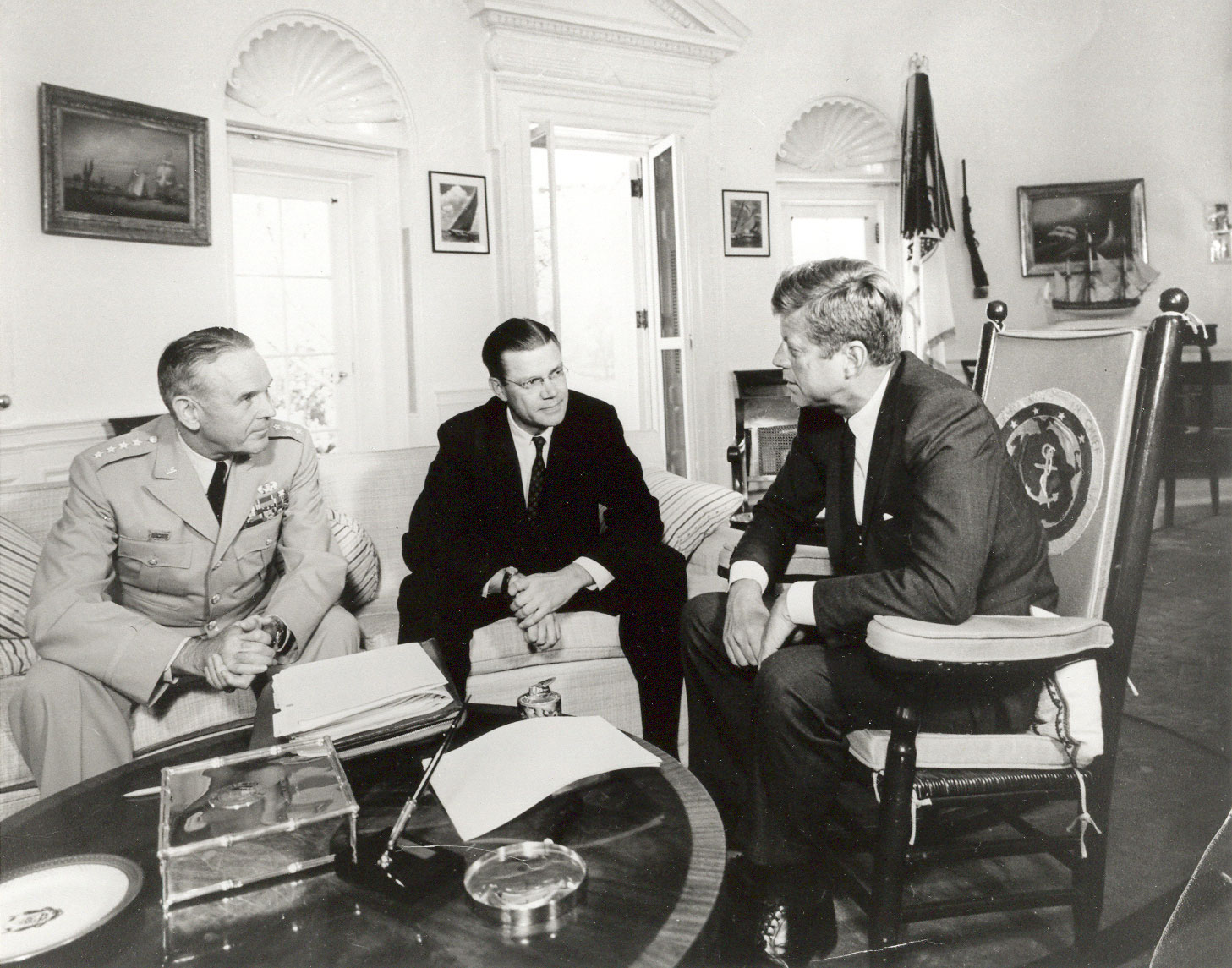
    3 JFK McNamara Taylor Oct 63Prouty believed, based on having seen numerous copies of the November 21 draft, that it was relatively widely distributed across the senior layers of the national security apparatus. A cover note attached to a copy distributed to Bundy’s brother William, a deputy within the Defense Department, asks him to review and also consult on the draft with McNamara.[36] The draft also appears to have been distributed on November 23 to newly appointed President Johnson, ahead of a meeting with Ambassador Lodge scheduled for the following day which, in an instance of macabre irony, had already been anticipated in the draft’s opening sentence: “the President…has discussed the matter further with Ambassador Lodge”.[37] A State Department Briefing Paper put together for Johnson ahead of the same meeting refers to a “draft National Security Action Memorandum emerging from the Honolulu meeting, which Mr. Bundy has initiated.” (Emphasis added).[38]
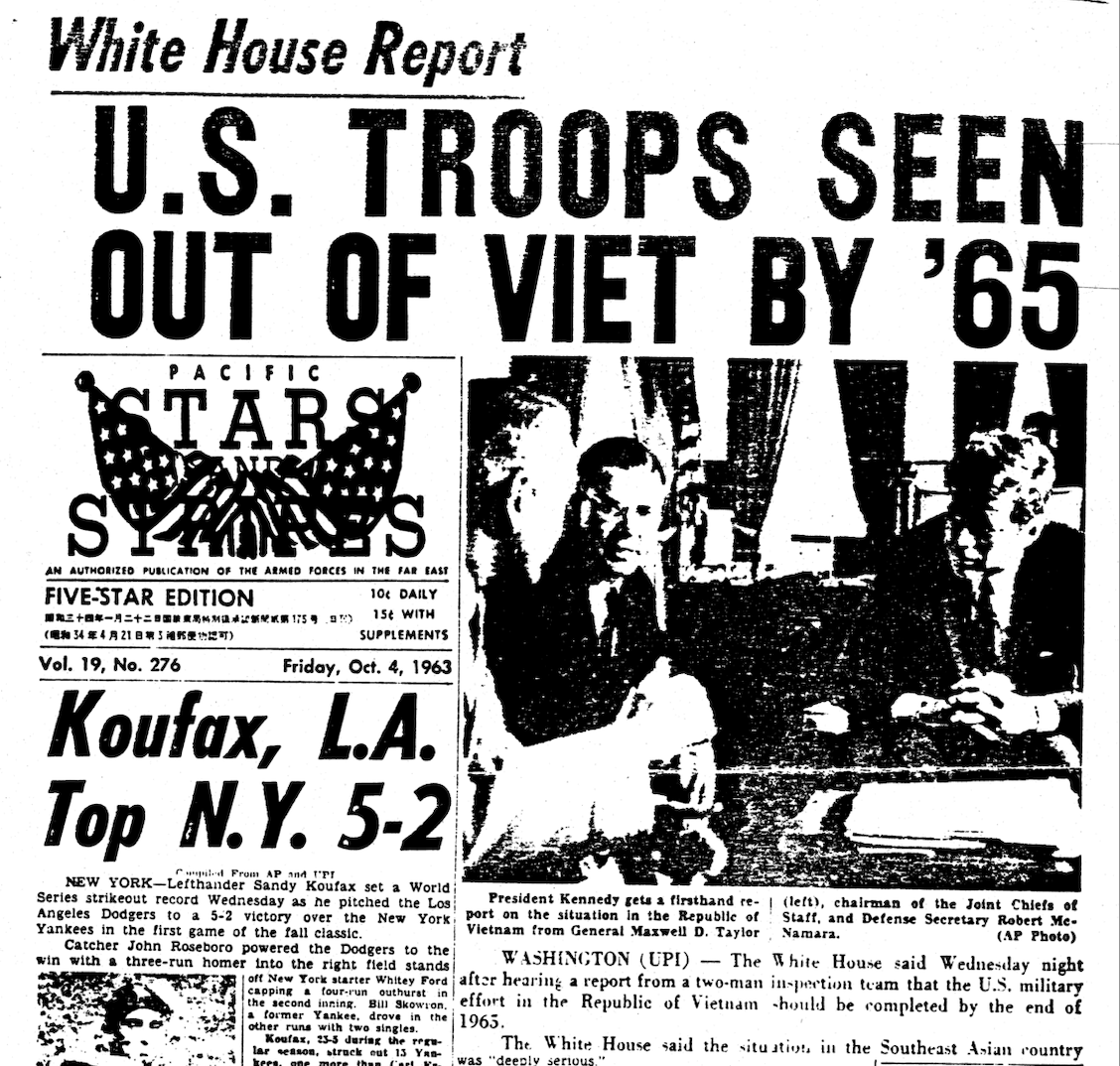
    4 Stars and Stripes Oct 1963A second draft of the proposed NSAM 273 was composed on November 24. Changes in the draft were notable in paragraph 7, which originally discussed “the development of additional Government of Vietnam resources” to be used for “action against North Vietnam.” The revision appeared to address kinetic activity generated directly by U.S. forces, in accord with established covert protocols (i.e. the “plausibility of denial”).[39]

    That same day, the anticipated meeting to discuss the South Vietnam situation was held, with LBJ, Rusk, McNamara, Ball, Lodge, McCone and Bundy in attendance.[40] This briefing for the President, focused on recommendations and updates, it represents – other than the one thousand man withdrawal slated for year-end – the internment of Kennedy’s Vietnam policies as developed in NSAM 263. Ambassador Lodge, for example, suggested that talk of a 1965 withdrawal – or “indication” thereof – was merely a negotiating ploy: “Lodge stated that we were not involved in the coup, though we put pressures on the South Vietnamese government to change its course and those pressures, most particularly on indications of withdrawal by 1965, encouraged the coup.” If ever there was a piece of high level CYA, this was it for, as James Douglass shows, Lodge was actually guiding the Diem brothers to their deaths.

    CIA Director John McCone, contradicting the conclusions delivered in Honolulu to the press, said the situation was “serious” and the paucity of optimism regarding the future of South Vietnam was evidenced by large increases in Viet Cong attacks and their advanced preparations for more. For his part, LBJ expressed misgivings with poor handling of controversial situations in the country, exacerbated by internal bickering. He rejected the idea that “we had to reform every Asian in our own image” in reference to political and economic strategies discussed in Honolulu. “(Johnson) was anxious to get along, win the war – he didn’t want as much effort placed on so-called social reforms…”

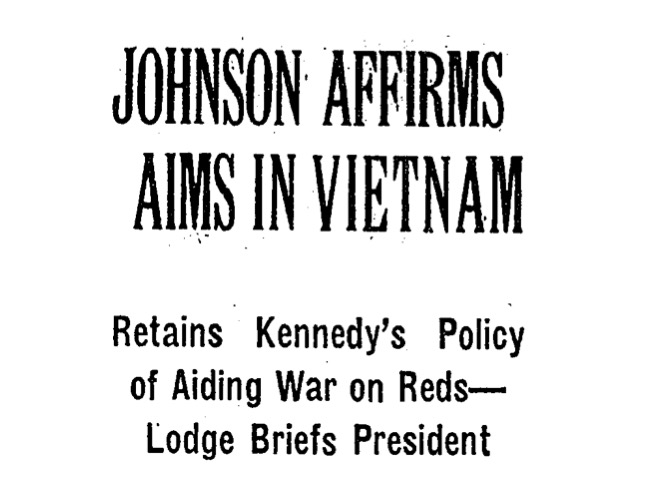
    “The meeting was followed by a statement to the press which was given out by Bundy to the effect we would pursue the policies agreed to in Honolulu adopted by the late President Kennedy.” This statement was given prominence in a New York Times report published November 25, 1963 (datelined Nov 24) entitled “Johnson Affirms Aims in Vietnam, Retains Kennedy’s Policy of Aiding War on Reds”. The opening sentence, presumably echoing Bundy: “President Johnson reaffirmed today the policy objectives of his predecessor regarding South Vietnam.” This reporting features the first three paragraphs of what would be published as NSAM 273 two days later, including the iteration that the “central point of U.S. policy on South Vietnam remains; namely, to assist the new government there in winning the war against the Communist Vietcong insurgents.” There is also a discussion of the political and economic measures advocated at Honolulu, but downplayed by Johnson shortly before (which is not mentioned), as well as the need for unity within the U.S. bureaucracy assigned in support South Vietnam.[41]
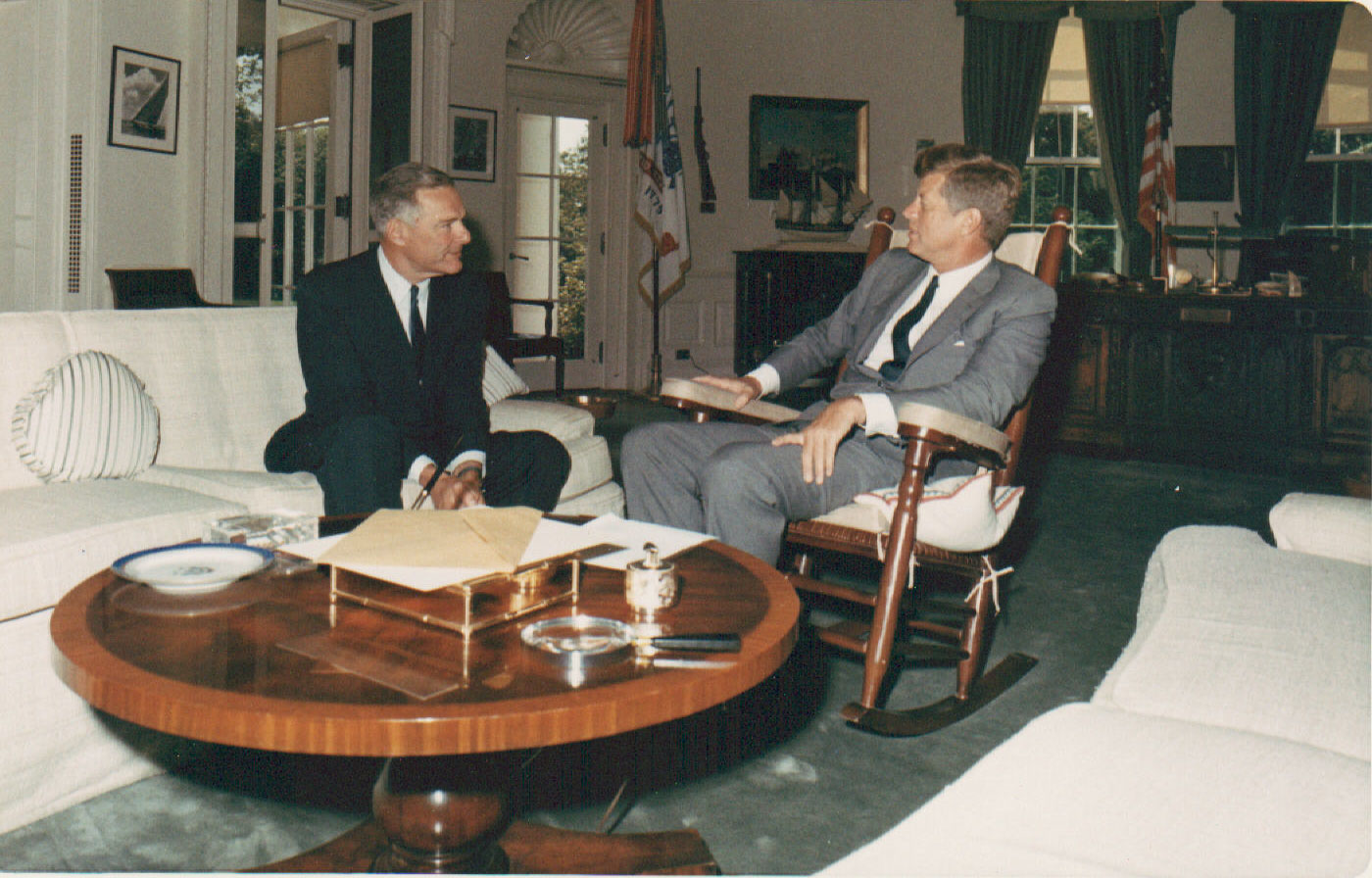
    5 JFK LodgeOn November 26, 1963, National Security Action Memorandum No. 273 was signed by McGeorge Bundy and updated NSAM 263 in United States official policy for South Vietnam.[42] Kennedy’s policy of effecting the removal of all “U.S. personnel” (i.e. military and CIA) from South Vietnam by the end of 1965, clearly referenced during conversations held at the Honolulu Conference, had been essentially erased from memory, even as NSAM 273 and its components were being described as a continuation of, or consistent with, Kennedy’s policies. The intent is now to win the war. Prouty:

    “Two months later, January 22,1964, one of the same authors of NSAM #263, General Maxwell Taylor, wrote to the Secretary of Defense, McNamara: ‘The Joint Chiefs of Staff consider that the United States must: (i) commit additional U.S. forces, as in support of the combat action within South Vietnam, and (j) commit U.S. forces as necessary in direct actions against North Vietnam.’

    These were the same two top level officials who under JFK had gone along with the Kennedy plan for the withdrawal of U.S. men. Then, less than 3 months later, under LBJ, they made totally different recommendations. The only difference was that President Kennedy was against escalation and wanted the men home, and Kennedy had never approved at any time the introduction of combat soldiers under U.S. military commanders for combat purposes in Vietnam. President Johnson, with George Ball in a top position, was doing just the opposite.”[43]

    That was how fast Johnson’s militant position infected Kennedy’s advisors.

    What many consider the true milestone on the road to an American war, NSAM 288, was approved in March, based on recommendations generated from yet another review of South Vietnam’s national security situation, presented by McNamara (working from an initial draft written by Bundy). Among the recommendations: a pledge to “furnish assistance and support to South Vietnam for as long as it takes to bring the insurgency under control”; to put South Vietnam on a “war footing”; to increase and upgrade Air Force, Army, and Naval heavy equipment; to prepare “hot pursuit”, “Border Control”, “Retaliatory Actions”, and “Graduated Overt Military Pressure” against North Vietnam.[44] By August, the increased tempo of activities supported by U.S. military assistance had created the Tonkin Gulf incident, and the inevitable slide to a shooting war. Prouty:

    “By March 1964 the U.S. approach to the situation in Vietnam had changed 180 degrees from the Kennedy policy of NSAM #263 and on March 17, 1964, President Johnson signed NSAM #288 which broadly expanded U.S. policy. About one year later, March 8, 1965, the first U.S. Marines operating under Marine commanders invaded South Vietnam at Da Nang. This was the true beginning of military action in Vietnam.”[45]

    What Kennedy had not done in three years, Johnson had done in three months.

    Obfuscation of NSAM 263

    On January 6, 1992, the New York Times published an opinion piece by Leslie Gelb titled “Kennedy and Vietnam”. Gelb could be described as the consummate Washington insider, with a c.v. laden with high-profile appointments across government, think tanks, and the media, specializing in foreign affairs. In the late 1960s, Gelb served as the director of the so-called Pentagon Papers project, leading the team of analysts in setting down an extensive history of the Vietnam War. Gelb’s authority to criticize premises expressed in Oliver Stone’s then current blockbuster film JFK ensured his opinions would hold some influence in the culture at large.

    In the piece, Gelb angrily accuses Stone (and by extension Prouty) of distorting the record of NSAM 263 and making “swaggering assertions about mighty unknowns.” Gelb claims of NSAM 263 that “some officials took the directive at face value”, but “most” saw it as a “bureaucratic scheme” to fudge the numbers of in-country personnel. He argues that “whatever JFK’s precise intentions” or “underlying thinking”, it was best to understand them as malleable and subject to changing circumstances and complications. Gelb ends his piece with an appeal to recognize the burden of the Presidency, particularly as involved Vietnam: the “private soul-searching” of Eisenhower, the “documented dilemmas ” and “torments” of Johnson and Nixon, matched by the “murky” musings represented by Kennedy’s occasional contradictory public statements. Stone (and Prouty) are therefore attacked for their “foolish” confidence over “decisions J.F.K. would have made in circumstances he never had to face.”[46] Prouty responded:

    “It is almost beyond belief that (Gelb)… in 1992, finds it easier to say that this was a decision ‘he never had to face’ instead of telling it as it is – the reason ‘he never had to face’ that decision was because he had been assassinated.”[47]

    6 McGeorge BundyThe one specific reference Gelb uses to respond to the supposed misrepresentations which had him so vexed, is itself distorted with some lawyerly spin: “Most officials also viewed the withdrawal memo as part of a White House ploy to scare President Diem of South Vietnam into making political reforms…That is precisely how the State Department instructed the U.S. Embassy in Saigon to understand NSAM 263.” What Gelb is referring to (and this became a talking point for other critics as well), is a State Department telegram to Lodge’s Vietnam embassy dated October 5, 1963.[48] While this communication is cited within the body of NSAM 263, it appears as an item of business separate from the primary matters, namely the planned withdrawal of “1000 U.S. military personnel” and the intention of withdrawing “the bulk of U.S. personnel” by the end of 1965.[49]
    7 NY Times 11 25 63Prouty’s issues with Gelb extended beyond the latter’s simplistic denial that Kennedy was just “going to abandon South Vietnam to a communist takeover.” Gelb’s previous role as director of the “Pentagon Papers” project could not be overlooked. Prouty:

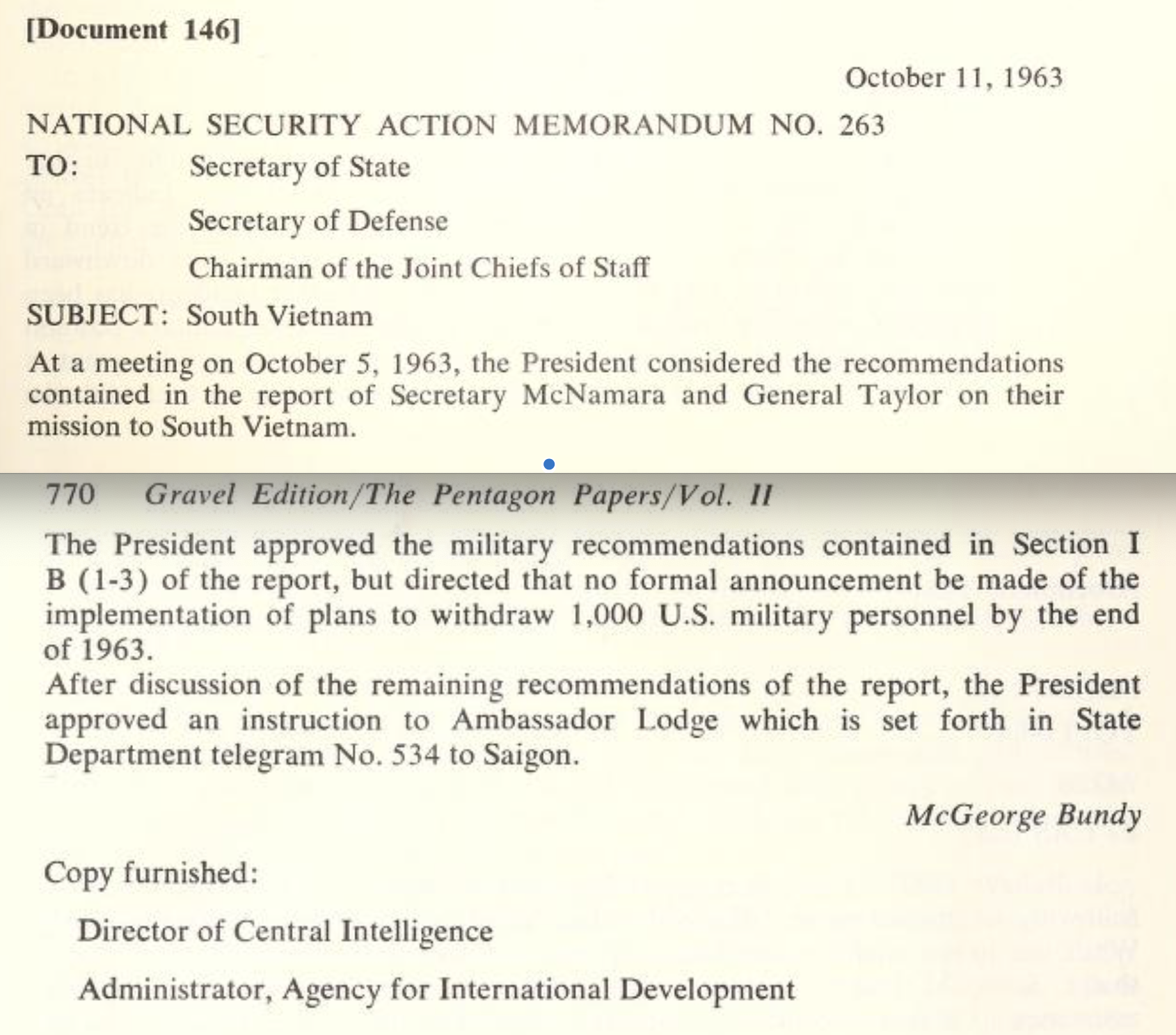
    “However it was in the ‘Pentagon Papers’ that the intrigue to distort and misrepresent major episodes of the Kennedy era began. Pre-eminent among these distortions is the Pentagon Papers presentation of the NSAM #263 record. What was done was quite simple, and effective. The title, ‘National Security Action Memorandum No. 263’ appears as Document #146 on page 769 in Volume II of the Gravel Edition, i.e. Congressional Record. But, this is published as only three, single-sentence paragraphs of non-substantive material with no cross referencing. This is like publishing the envelope; but not the letter.”[50]

    This is a good point. While NSAM No. 263, as it appears on pp 769-770 of the Gravel Edition (Vol.II), is accurately transcribed from the original, the presentation, lacking cross reference, is opaque.[51] Since McGeorge Bundy’s original wording is not precise, in that it dates the discussion of the crucial McNamara-Taylor report (October 5, 1963) but doesn’t attribute identifiers to the report itself (dated October 2, 1963), the reader is either left to their own devices to put the pieces together, or must remember to consult a lengthy Chronology which appears some 550 pages previous. Prouty:

    Those few who already know what a true-copy of NSAM #263 looked like will find that the ‘Memorandum For The President’ that is the McNamara-Taylor Trip Report of Oct. 2, 1963 appears as Document 142 on page 751 through 766 with no reference to NSAM #263 whatsoever. This may be why so many ‘historians’ and other writers remain unaware of this most important policy statement.[52]
    8 NSAM 263 Pentagon PapersThe Chronology in Vol. II of the Pentagon Papers begins May 8, 1963 and concludes on November 23, 1963.[53] The Report of the McNamara-Taylor mission appears as a listing for October 2, 1963 (p216). In the brief description, the withdrawal of “1,000 American troops by year’s end” is noted, but there is no mention of the recommendation to withdraw “the bulk of U.S. personnel” by the end of 1965. The publication of NSAM 263 as an official document, October 11, 1963, is not listed.

    The Chronology’s concluding three items feature a description of the Honolulu Conference (20 November 1963), which observes a press release “gives few details but does reiterate the U.S. intention to withdraw 1,000 troops by the end of the year.” That the press release also indicated “no basic changes to U.S. policies” is not mentioned. Then, incongruously, the Chronology concludes:

    22 Nov 1963: Lodge confers with the President Having flown to Washington the day after the Conference, Lodge meets with the President and presumably continues the kind of report given in Honolulu.
    23 Nov 1963: NSAM 273
    Drawing together the results of the Honolulu Conference and Lodge’s meeting with the President, NSAM 273 reaffirms the U.S. commitment to defeat the VC in Vietnam

    9 PP chronologyNeither of these final two items actually occurred as described. Lodge did not meet with either President Kennedy or newly sworn-in President Johnson on November 22, the day on which President Kennedy was assassinated. NSAM 273 was not made official on November 23, and the specific meeting pertaining to the document was not held until the following day. Prouty:

    “NSAM 273 was signed by President Johnson on Nov. 26, 1963. It must be noted, that until an NSAM is approved and signed it does not have a formal number; therefore the subject matter that Lodge and Johnson conferred about could not have been designated NSAM #273 on the 23rd of Nov. 1963.”[54]

    Conclusion

    A separate attack on Oliver Stone’s JFK movie, published by the New York Times during the film’s initial release, was written by Tom Wicker.[55] Prouty’s response to this piece provides a good summary of his position:

    (Tom Wicker) also attacked Stone’s use of Kennedy’s Vietnam policy statement, NSAM #263, with the comment, ‘I know of no reputable historian who has documented Kennedy’s intentions.’ NSAM #263 is the official and complete documentation of Kennedy’s intentions. It was derived from a series of White House conferences and from the McNamara-Taylor Vietnam Trip Report, and it stated the views of the President and of his closest advisers as is made clear in the U.S. government publication Foreign Relations of the United States, 1961-1963, Vol. IV, ‘Vietnam: August-December 1963’. That source is reliable history. Wicker’s December 15, 1991, Times article was a lengthy and unnecessarily demeaning diatribe against Stone and his movie…

    The inclusion of this little-known NSAM #263 in the film became the principal point of attack of the big guns that were leveled at Stone, Garrison, and myself. It really is amazing that the most vitriolic attacks were those that attempted to inform the public that there was no such directive. The furor over that one item, NSAM #263, was evidence that Stone had hit his target. This alone uncovered the ‘Why?’ of the assassination.[56]

    Prouty’s insights pertaining to National Security Action Memorandums numbers 263 and 273 remain vitally important to understanding the development of Kennedy’s Vietnam policy. It is clear that the recommendations described in NSAM 263 were the result of a period of concentrated attention directed by the President. It is much less clear what motivated McGeorge Bundy to draft what became NSAM 273, and how it was that the changes to the earlier document initiated by 273 were long described as representing continuity with Kennedy’s policies. Clearing the web of obfuscation over these directives, as begun in Stone’s JFK, provides clarity to the historical record.

    The Vietnam War, with its intensive U.S. military commitments, proved a massive disaster for the people of Southeast Asia and the American public, although it remains often officially portrayed as a “tragic” event borne of circumstance and not design. As well, the missed opportunity to rein in the CIA’s operational capabilities opened the door to ever larger corrupt cynical undertakings such as Iran-Contra and Timber Sycamore, with the clandestine services’ lack of accountability ever more entrenched. The documented record strongly infers that Kennedy’s potential re-election in 1964, as a “what-if?”, would have been consequential.


    Bibliography:
    L. Fletcher Prouty, Collected Works. CD-ROM
    www.prouty.org


    Notes

    [1] JCS – Sec Def Discussions April 29, 1963 https://www.maryferrell.org/showDoc.html?docId=144

    [2] JCS Official File. May 6, 1963. https://www.maryferrell.org/showDoc.html?docId=122#relPageId=47

    [3] ibid https://www.maryferrell.org/showDoc.html?docId=122#relPageId=115

    [4] The concentrated interest in Vietnam policy during these months is recorded in Foreign Relations of the United States, 1963, vol 3 Vietnam: January-August 1963 & vol. 4 Vietnam: August-December 1963, assembled by the Department of State and published by the U.S. Government Printing Office, 1991 https://www.maryferrell.org/php/showlist.php?docset=1036

    [5] Prouty, JFK: New Preface, 1996. Collected Works

    [6] FRUS Vol. 4, p117. 66. Memorandum of a Conference with the President, White House, September 6, 1963 https://www.maryferrell.org/showDoc.html?docId=945#relPageId=143

    [7] FRUS Vol. 4, p 161. 83. Memorandum of a Conversation, White House, September 10, 1963 https://www.maryferrell.org/showDoc.html?docId=945#relPageId=187

    [8] FRUS Vol. 4, p199, Memorandum for the Record of a Meeting, White House, September 12, 1963 https://www.maryferrell.org/showDoc.html?docId=945#relPageId=225

    [9] FRUS Vol. 4, p231, Draft Letter from President Kennedy to President Diem, September 16, 1963. https://www.maryferrell.org/showDoc.html?docId=945#relPageId=257

    [10] This document would also be described as “draft instructions” from the President for McNamara to guide his upcoming trip to Vietnam with General Taylor. FRUS Vol. 4, p 278. 142. Memorandum from the President to the Secretary of Defence (McNamara) September 21,1963. https://www.maryferrell.org/showDoc.html?docId=945#relPageId=304)

    [11] FRUS Vol. 4, p 280. Memorandum for the Record of a Meeting, White House, September 23, 1963. https://www.maryferrell.org/showDoc.html?docId=945#relPageId=306

    [12] Prouty, The Highly Significant Role Played By Two Major Presidential Policy Directives, 1997. Collected Works. Prouty does make the point that neither McNamara or Taylor would have had the time or resources to compose let alone print the volume seen in photographs from October 2.

    [13] Taylor also wrote: “I am convinced that the Viet Congress insurgency in the north and center can be reduced to little more than sporadic incidents by the end of 1964. The Delta will take longer but should be completed by the end of 1965.” FRUS Vol. 4, p 328. Letter From the Chairman of the Joint Chiefs of Staff (Taylor) To President Diem, October 1, 1963. https://www.maryferrell.org/showDoc.html?docId=945#relPageId=354

    [14] FRUS Vol. 4, p 350. 169. Summary Record of the 519th Meeting of the National Security Council, White House, October 2, 1963. https://www.maryferrell.org/showDoc.html?docId=945#relPageId=376

    [15] FRUS Vol. 4, p 353. 170. Record of Action No 2472, Taken at the 519th Meeting of the National Security Council, October 2, 1963. https://www.maryferrell.org/showDoc.html?docId=945#relPageId=379

    [16] Item 194 Foreign Relations of the United States 1961-1963 Vol. IV p395 https://www.maryferrell.org/showDoc.html?docId=945#relPageId=421)

    [17] Item 167 Memorandum from the Chairman of the Joint Chiefs of Staff (Taylor) and the Secretary of Defense (McNamara) to the President, October 2, 1963 https://www.maryferrell.org/showDoc.html?docId=945#relPageId=362)

    [18] Foreign Relations of the United States 1958-1960, Vietnam Vol 1. p705 Item 255. Special Staff Note Prepared by Department of Defense.

    [19] Prouty, The Hidden Role of Conspiracy, 1993. Collected Works “(Kennedy) inherited it and revisionist historians have saddled him with the ‘Vietnam build-up’ and the ‘creation of the Special Forces’ ever since.”

    [20] Foreign Relations of the United States 1958-1960, Vietnam Vol 1. P703 Item 254. Memorandum From the Joint Chiefs of Staff to the Secretary of Defense (Gates)

    [21] Prouty, 30th Anniversary of Coup, 1994. Collected Works

    [22] The members of this Group were General Maxwell Taylor, Admiral Arleigh Burke, CIA director Allen Dulles, and Robert Kennedy representing the Executive

    [23] Prouty, 30th Anniversary of the Coup, 1994, Collected Works

    [24] copies of NSAM 55-57 as saved in Prouty’s own files can be found at https://ratical.org/ratville/JFK/USO/appE.html

    [25] “When I read to (Chiefs of Staff) President Kennedy’s statement from NSAM #55…you could have heard a pin drop in the ‘Gold Room’. They had never been included in the special policy channel which Allen Dulles had perfected over the past decade, that ran from the National Security Council (NSC) to the CIA for all clandestine operations.” Prouty The Highly Significant Role Played By Two Major Presidential Policy Directives 1997. Collected Works

    [26] Item 304 Telegram from the Department of State to the Embassy in Vietnam November 6, 1963. https://www.maryferrell.org/showDoc.html?docId=945#relPageId=605

    [27] Item 312 Memorandum for the Record of Discussion at the Daily White House Staff Meeting, Washington, November 13, 1963 8 a.m. https://www.maryferrell.org/showDoc.html?docId=945#relPageId=619

    [28] Memorandum to Mr Bundy https://www.maryferrell.org/showDoc.html?docId=146534#relPageId=6

    [29] That might infer he was instructed specifically by President Kennedy, but his reply as recorded does not actually clarify who had so instructed. Since Bundy was the author of NSAM 273, such instruction might explain the how’s and why’s of the original draft, dated November 21, which Bundy later described as drafted “for the President”. The record, however, nowhere indicates any instruction or dialogue involving Kennedy seeking revision to NSAM 263, which had been drafted only weeks previously.

    [30] FRUS Vol. 4, p 608 Item 321 Memorandum of Discussion at the Special Meeting on Vietnam, Honolulu November 20, 1963 https://www.maryferrell.org/showDoc.html?docId=945#relPageId=634

    [31] FRUS Vol. 4, p 610 Item 321 Memorandum of Discussion at the Special Meeting on Vietnam, Honolulu November 20, 1963 https://www.maryferrell.org/showDoc.html?docId=945#relPageId=636

    [32] U.S. Aides Report Gain,1,000 Troops to Return New York Times November 21, 1963, p8

    [33] a copy of the draft, along with John Newman’s discussion of it can be found here: https://jfkjmn.com/new-page-77/

    [34] Prouty, Hidden Role of Conspiracy,1993, Collected Works

    [35] Prouty The Highly Significant Role Played by Two Major Presidential Policy Directives 1997. Collected Works

    [36] “I have other copies of this draft document that were done on various typewriters and they certainly indicate that this draft document had to have been quickly circulated through all of the highest governmental levels…on the 21st. On these draft copies there are some notes, and line outs.” Also: “in this original draft that he circulated among many of the top echelons of the Government, with personal “Cover Letters” to the Director of Central Intelligence, John McCone and to his brother William in McNamara’s office…” Prouty The Highly Significant Role Played By Two Major Presidential Policy Directives 1997. Collected Works

    [37] Item 324. Memorandum From the Secretary of Defense (McNamara) to the President https://www.maryferrell.org/showDoc.html?docId=945#relPageId=653

    [38] Item 326 Briefing Paper Prepared in the Department of State for the President, November 23, 1963 https://www.maryferrell.org/showDoc.html?docId=945#relPageId=657

    [39] The first draft of NSAM 273, and a brief discussion of it, can be accessed on scholar John Newman’s site https://jfkjmn.com/new-page-77/. In an interview, McGeorge Bundy explained to Newman his first draft approach to paragraph 7: “he tried to bring these recommendations ‘in line with the words Kennedy might want to say.’” Which, considering the change in responsibility for activity from Government of Vietnam to U.S. forces from first to second draft, is a back-handed way of admitting the difference in policy, not just of words.

    [40] Item 330 Memorandum for the Record of a Meeting, Executive Office Building, Washington, November 24, 1963, 3 p.m. Subject. South Vietnam Situation https://www.maryferrell.org/showDoc.html?docId=945#relPageId=661

    [41] The concept of “unity” informs one of the paragraphs from the first draft of NSAM 273, which Prouty discussed at some length in a few of his essays. In Bundy’s draft, Paragraph Four reads: “It is of the highest importance that the United States Government avoid either the appearance or the reality of public recrimination from one part of it against another, and the President expects that all senior officers of the Government will take energetic steps to insure that they and their subordinates go out of their way to maintain and to defend the unity of the United States Government both here and in the field.” As published, reference to unity is clarified as “support for established U.S. policy in South Vietnam” – which produces a different reading than the potentially ominous warning written on the eve of the presidential assassination. It could be fairly argued, however, even lacking the precise term “South Vietnam”, that the paragraph in the first draft was referring to policies thereof, as there had been a lot of concern in the period between the Diem coup and the Honolulu Conference with perceived divisions, stoked in part by an article written by David Halberstram. These concerns are reflected in the documents published in Foreign Relations of the United States Aug-Dec 1963 from those weeks in November. That said, Prouty’s alert reading has a context, and it should not be overlooked that McGeorge Bundy was responsible for, among other things: a) called off the flight meant to destroy Castro’s last T33, ensuring failure of the Bay of Pigs b) wrote first draft of NSAM 273 c) believed to have contacted Air Force One from White House Situation Room Nov 22/63 to report lone gunman responsible for JFK assassination d) wrote first draft of NSAM 288.

    [42] Item 331 National Security Action Memorandum No. 273 November 26, 1963 https://www.maryferrell.org/showDoc.html?docId=945#relPageId=663

    [43] Prouty, Kennedy and the Vietnam Commitment, Collected Works

    [44] Memorandum From the Secretary of Defense (McNamara) to the President, March 16, 1964. https://history.state.gov/historicaldocuments/frus1964-68v01/d84

    [45] Prouty, Hidden Role of Conspiracy, 1993, Collected Works

    [46] Leslie Gelb, Foreign Affairs; Kennedy and Vietnam, Section A Page 17, New York Times, January 6, 1992

    [47] Prouty, Vietnam Daze With McNamara, Collected Works

    [48] Item 181 Telegram from the Department of State to the Embassy in Vietnam October 5, 1963. https://www.maryferrell.org/showDoc.html?docId=945#relPageId=397

    [49] The Memorandum states: “After discussion of the remaining recommendations of the report” – that is, recommendations other than those involving the planned withdrawals – “the President approved an instruction to Ambassador Lodge which is set forth in State Department telegram No. 534 to Saigon.” This telegram’s featured “instruction” refers specifically to a series of proposed Actions to guide approaches to Diem, none of which refer to troop withdrawals. The attempt to tie the matters together is strained, but notably had also found expression by Lodge during the meeting with LBJ on November 24, 1963 (i.e. talk of withdrawal simply a negotiating ploy)

    [50] Prouty, Vietnam Daze with McNamara, Collected Works

    [51] In contrast, the presentation of NSAM No. 263 in Foreign Relations of the United States, 1963, vol. 4 Vietnam: August-December 1963, published in 1991, is properly cross-referenced.

    [52] Prouty, Vietnam Daze with McNamara, Collected Works

    [53] Chronology, Pentagon Papers Gravel Edition Vol II, Beacon Press pp 207-223

    [54] Prouty, Vietnam Daze with McNamara, Collected Works

    [55] Tom Wicker, Does JFK Conspire Against Reason?, New York Times, December 15, 1991

    [56] Prouty, Stone’s JFK and the Conspiracy, 1996, Collected Works

  • Old Wine in New Bottles: Fletcher Prouty’s New Critics Recycle the Past

    Old Wine in New Bottles: Fletcher Prouty’s New Critics Recycle the Past


    (Disclosure: the author is a friend and colleague of Len Osanic, who befriended and worked with Fletcher Prouty in his later years. Len continues to run the Fletcher Prouty online reference site www.prouty.org)

    Recent years have seen a resurgence in reputational criticism of the late Col. L Fletcher Prouty, the former Pentagon official responsible for numerous influential books and essays, and the real-life model for the fictional Mr X character in Oliver Stone’s 1991 film JFK. Curiously, these efforts – by a small but vocal faction – gathered momentum following the passing of John McAdams, a self-styled “debunker” of JFK assassination theories who had been a central source of reputational disparagement of Prouty dating back to the early 1990s.[1]The renewed efforts have added little to what had been previously articulated, but are notable for a distinctly strident tone and a smug certainty in presenting harsh conclusions which are not at all supported by the available record. By this, the new anti-Prouty crowd appear distinguished by being actually worse, or at least more irresponsible and reckless, than their late mentor.

    I

    A central focus for these critics has been Prouty’s 1996 appearance before a panel of ARRB staffers. While this event earned little more than a passing mention in the McAdams compendium, to contemporary debunkers it serves as the effective immolation of Prouty’s entire assassination-related oeuvre as, over the course of a long interview, he allegedly “could not substantiate any of his allegations.”

    Prouty’s Appearance at the ARRB 1996

    The Assassination Records Review Board was created by the US Congress in the wake of Oliver Stone’s JFK film and the resulting outcry over the continuing classification of much of the official record and subsequent investigations. The Board had the mandate to identify records and oversee the process by which they would be made public. In certain circumstances, the Board had the authority to interview persons whose input could assist with locating records or whose personal experiences might help clarify circumstances which were yet incomplete. An interview was arranged with Fletcher Prouty for September 1996, with the intention of both clarifying experiences and identifying records.

    The 9/10/96 letter from Chief Counsel Jeremy Gunn read as follows: “We will ask you to recount your personal experiences from around the time of the assassination of President Kennedy, as well as whatever information you have regarding military activities and procedures in effect. I would also like you to bring with you any relevant documents or notes related to these topics, especially any contemporaneous records (such as personal correspondence, telephone notes, daily diary entries, or the like) you might have.”

    A month previous to this communication, a memorandum had been distributed to Gunn from Tim Wray, a Pentagon veteran who was then running the ARRB’s Military Records Team. Wray understood a potential interview with Prouty would be assisting an effort known as the “112 Military Intelligence Project”, specifically interested in information previously published by Prouty concerning a possible “stand down” order directed to a Texas-based Military Intelligence unit related to presidential protection duties in Dallas 1963.[2]

    Wray’s 8/9/96 memo on Army Intelligence in Dallas read as follows: “We should eventually interview Prouty as well, though I frankly do not expect much from this—everything about his story that we’ve been able to check out so far appears to be untrue….Its only slightly more difficult to check the factual basis for the other elements of Prouty’s story….Prouty’s assertion to the contrary notwithstanding—it appears that military collaboration with the Secret Service was in fact, extremely limited, and that there certainly were no such thing as “military presidential protection units” per se.

    Wray would also later write, “Among other purposes, an important goal of this interview was to ask Prouty about three specific allegations he made in his book, “CIA etc”. These allegations were of particular significance to use because Prouty claimed they were based on his own firsthand knowledge.” (Wray Memo of 2/21/97)

    That there was an identified “important goal” for the interview was not shared with Prouty in the communication from September 10, 1996. Similarly, Wray’s Military Records Team assistant Christopher Barger composed a memo the following day, September 11,1996, identifying specific “allegations” appearing in Prouty’s 1992 book JFK: The CIA, Vietnam, and the Plot to Assassinate John F Kennedy, and proposing a line of questioning marked by an innate skepticism directed to Prouty’s “personal experiences”.[3] This doubting approach to his published work was also not shared with Prouty ahead of his appearance.

    The interview was conducted on September 24, 1996. According to some, referring to his performance, Prouty suffered severe damage to his reputation and the integrity of his rendering of the historic record.[4] This version of events relies on an interview “Summary”, produced by Military Records Team assistant Barger, which frames the exchange as a contentious deposition.[5] The integrity of this Summary relies on the assumption that the Team participating in this interview spoke from a position supported by the confirmed record.

    If It Walks Like A Duck…

    Wray wrote, about a month later:

    “…we should make (Prouty’s) interview with the ARRB easily available in written form so people can see for themselves what’s behind the fluff…There’s no way we can fairly represent the interview in summary form without it looking like a hatchet job.” – (Tim Wray, ARRB Memorandum October 23, 1996.)[6]

    1.TranscriptThe interview transcript was published along with the Summary so that, according to Wray, the process wouldn’t merely appear as a “hatchet job”.

    It might seem obvious that if one cannot “fairly” describe an interview process without it appearing as a “hatchet job”, then the proposition that the process was, in fact, a hatchet job is in play. Wray, to the contrary, asserts, literally, that “the emperor has no clothes” and declares therefore the ARRB Military Records Team is “not planning to do much of (Prouty’s) laundry.”[7] Beyond the strained analogy, Wray’s memorandum establishes the Team engaged the interview as an adversarial contest, tied to their own biases and skewed to a partisan acceptance of the JFK assassination’s Official Story. In a telling example, Barger opines: “Prouty also admits that he has never read or even seen the Warren Commission Report. No reputable historian would write a criticism of a source document without having read the source document first.”[8]

    Barger’s Summary begins by noting the panel’s interest in Prouty stemmed from “claims”, “theories” and “conclusions” often based on “special, firsthand knowledge that he gained through his own experiences” during his years at the Pentagon. The purpose of the interview is therefore, in part, to determine the extent to which his “various allegations or statements” were based on “personal knowledge or experience”, and, “should he disavow factual knowledge”, to determine if he is aware of other “factual data that could tend to prove or disprove his allegations.” The Summary proceeds to itemize ten supposed “allegations” Prouty had articulated or published in his work, and putting them to a test, such as locating reference in official documents or finding confirmation through the identification of other individuals. In conclusion, The Summary insists the Team “intended on hearing his story”, but found “in the face of numerous contradictions, unsupportable allegations, and assertions which we know to be incorrect, we have no choice but to conclude that there is nothing to be gained or added to the record from following up on anything he told us.”[9]

    While this Summary conclusion has apparently convinced some persons that Prouty should not be taken seriously, it represents a prejudiced interpretation reliant on a concept of allegation introduced solely by the Team’s own initiative. The concept of a “hatchet job” is confirmed by the notable reliance in the Summary on this term – allegation – a word never articulated in the communications with Prouty ahead of the interview, and used sparingly during the interview itself.[10] Within the Summary, however, its prominent use is naturalized by repetition, and contemporary endorsements of the Summary’s conclusions repeat the word liberally.

    Put another way, and considering the range of experiences across Prouty’s professional career, one might refer to his “observations” instead of the more obviously loaded preferred description. The difference between the two is quite sharp, particularly since the stated purpose of the interview, from the Team’s perspective, was to “prove or disprove” and “confirm or deny”:

    ob·ser·va·tion |(ə)n |

    a remark, statement, or comment based on something one has seen, heard, or noticed

    al·le·ga·tion |noun

    a claim or assertion that someone has done something illegal or wrong, typically one made without proof

    2.allegationThe Summary of the ARRB interview framed Prouty’s personal experiences as a series of “allegations”.

    There are ten separate “allegations” described in the Interview Summary, each with a “Result or Conclusion by ARRB” attached. Three “allegations” refer to content in the JFK film; one refers to Prouty’s work as a military liaison with the CIA; and six have to do with presidential protection, a field outside of his professional responsibility and of which he had no practical experience.

    The first “allegation” refers to Prouty’s trip to Antarctica in November 1963, noting, in the JFK movie, this trip was portrayed as “out of the ordinary or unusual in some way.”[11] Although, in a later publication, Prouty had surmised retrospectively if there was a hidden reason to being selected for the journey, he otherwise spoke consistently, including to the ARRB panel, of the trip as routine.[12] The assumed “sinister connotations”, portrayed by the ARRB panel as an “allegation”, is in fact a dramatic embellishment attributable to the JFK screenwriters, not to Prouty – who, regardless, is described as unable “to back up the suspicions he mentioned in the excerpt from his book.”[13] The second “allegation” concerns information appearing in wire service news reports and published in a New Zealand paper approximately 5-6 hours after the shots in Dallas.[14] While the Team’s “Result or conclusion” of this minor affair doesn’t refer to an actual result or conclusion, it does suggest “Prouty’s allegation of a ‘cover story’ will be weakened”. The point missed, however, is by his presence in New Zealand Prouty was outside and apart from the common shared experience stateside on that day, dominated by the visceral shock of the initial news followed by a steady drip of information which appeared to follow a sequential logic. Outside the simulacrum, Prouty could make the obvious, and correct, observation that there had quickly appeared a great deal of information about a suspect who had yet to be even arraigned on the JFK case, and in fact wouldn’t be for another 6-7 hours.[15] Having made this first observation, it is fair for him to point out the incorrect reports of “automatic weapons fire” – as others did as well.

    “Allegation” numbers three through five, and ten, concern Prouty’s information – published in his book JFK: The CIA, Vietnam and the Plot to Assassinate John F. Kennedy and in his Foreword to Mark Lane’s book Plausible Denial — regarding an apparent case of security stripping in Dallas involving a military intelligence outfit based in San Antonio.[16] Prouty had privately received information that the 112th Unit had been advised to stand down in Dallas by the Secret Service, This was referring to a Presidential protection capability within the military. According to internal memoranda, the ARRB Military Records Team was skeptical such units existed and was determined to “debunk” Prouty’s information. In the fullness of time, Prouty’s veracity regarding both the actual fact of military intelligence support for presidential protection, and the private communication he received, has been confirmed and the Team’s skepticism debunked.[17]

    Allegations six and seven refer to Prouty’s knowledge of Secret Service presidential protection protocols. When mentioning these, Prouty is referring to events specific to his military career, including several days in Mexico City, 1955, with a Secret Service advance team ahead of an Eisenhower visit. Prouty’s observations from these episodes inform his published statements and his statements during the ARRB interview. He qualifies his interactions as having “logistics purposes, not to learn all about the system.” The ARRB’s Summary characterizes the “allegations” as lacking corroborative documentation. This lack included failing to answer the question: “How many Secret Service agents would you have expected to be providing coverage in Dallas?”[18] Figurative speech is also interpreted literally, such as Prouty’s reference to the Secret Service working from a long-established “book” (he is asked if he has a copy of the “book”), or his impression that the Secret Service was deficient in Dallas stated as “they weren’t there” (he is asked if he meant they literally were not there).[19] This exchange is referred in the Summary as follows: “Prouty makes the very serious charge that the Secret Service was not even on duty in Dallas on November 22, then admits he has no experience upon which to base this statement.”[20] In truth, the deficiencies of the Secret Service during the Dallas motorcade have been well-catalogued, if not by the sources who appear to have influenced the Team.

    “Allegation #8” concerns whether some of Oswald’s activity during his Marine service in Asia – specifically with radar at Atsugi air base (where the U2s were based) and potentially in support of operations directed at Indonesia – could be described as part of CIA-directed programs. Although Prouty correctly describes the existence of the programs and Oswald’s proximity, the Panel jumps on his lack of specific documentation (“substantiating evidence”) as a means of dismissing the notion Oswald was involved. Even though Oswald himself specifically hinted at insider knowledge of U2 activity (at Atsugi) during his communications in Moscow related to his defection to the USSR, the Team presumes to consign this “allegation” as based merely on open-source rumors.

    “Allegation #9” refers to Prouty’s identification of Ed Lansdale in one of the well-known “Tramps” photos, which is portrayed in the JFK film. The Team acknowledges that a “search of travel records” might confirm or deny Lansdale’s presence in the Dallas region at the time, but factors such as the “small likelihood” of finding such records and their “relative unimportance” indicated that such effort was “not worth checking out.” (Summary ,p 11) In 1991, at the time of the JFK film, Lansdale could be traced to Fort Worth, Texas mid-November 1963. Subsequent information has placed Lansdale in Denton, a Dallas suburb, on the evening of November 21, 1963.[21]

    In sum, despite the brutal Summary composed in the aftermath of Prouty’s appearance before the ARRB’s Military Records Team, none of the ten points presuming to “debunk” his “allegations” actually hold up under scrutiny. That is, while the ARRB’s panel makes much of Prouty’s supposed failure to produce information outside his jurisdiction, such as Secret Service “manuals” (of which they aren’t even sure exist in the first place), and proceed to criticize his lived experiences, there is nothing actually incorrect or overstated in his observations. Latter-day critics lionize the Military Records Team’s Summary conclusions using a superficial reading based largely on the Team’s own predetermined finger-pointing, which was biased and subject to partial knowledge later superseded. However, there was one data point appearing in the Summary which has held up over the years as an accurate statement:

    “Fletcher Prouty was where he says he was during the period from 1955-1964. His position can be documented.” (P. 13)

    II

    Prior to the release of Oliver Stone’s JFK in late 1991, L. Fletcher Prouty was a relatively inconspicuous figure known to few outside of aging participants of early Cold War military/intelligence circles, or committed parapolitical researchers and their small followings. The backlash directed against the film – which began while it was still filming – attacked the intellectual foundation of the screenplay, as personified by director Oliver Stone (purportedly being “fooled” by Warren Commission critics), the film’s “compromised” protagonist (Jim Garrison) and, to a lesser extent, the insider Fletcher Prouty (known in the film as “Mister X”).

    3.NYC.Guardian.1991A photocopy of Diamond’s Guardian article was anonymously submitted to the JFK production office, along with several typewritten pages of “opposition research” directed at Prouty.

    All three were in the crosshairs of an article published in the November 1991 issue of Esquire Magazine. With the punning title “The Shooting of JFK”, author Robert Sam Anson put together one of the key contributions to the anti-JFK literature from the period, covering the film’s production. While bashing first Stone, then Garrison, and then turning to Prouty in a late-article segment which combined character assassination with an offhand revelation of why it was exactly the establishment had problems with the film.[22]

    Anson introduces Prouty as a genial grandfather type, at least as so impressing the JFK production office, but notes the whispers of “cautious buffs” who are “leery” and wary of Prouty’s background and “claims.”[23] Suddenly, in the production office, a “small thing” starts “the trouble”, and reporter Anson, despite the staff’s nondisclosure agreements, manages to be in the know and in the loop. Anson reports that some of the office’s research staff had been paging through “a tiny left-wing New York weekly” and, by chance, discovered an article identifying Fletcher Prouty “as a cause célèbre in the virulently anti-Semitic, racist Liberty Lobby.”[24]

    The article in question – ‘Populists’ Tap Resentment of the Elite – written by Sara Diamond and published in the July 3, 1991 issue of The Guardian (NYC) – was a legitimate investigative work, and the specific references to Prouty’s activities were accurate. While, to those who knew Prouty, the concept he was a racist fellow-traveler in step with the most virulent members of the Lobby, or even a “right-winger” as portrayed, appeared fringe and absurd, within Stone’s production office the general consensus was Prouty’s associations “looked bad” and could be a “public-relations time-bomb” for the JFK film.[25] The top researcher on staff told Stone: “Basically, there’s no way Fletcher could be unaware of the unsavory aspects of the Liberty Lobby.”[26]

    The Connections to the Liberty Lobby

    The finger-pointing directed at Prouty associating him with the Lobby was based on essentially four items: guest appearances on a syndicated radio program – Radio Free America – hosted by Tom Valentine and sponsored by The Spotlight, the Lobby’s weekly newspaper (numerous appearances 1988-94)[27];a speaking engagement at The Spotlight’s annual national convention (September 1990); the re-publication of Prouty’s The Secret Team by the Lobby’s imprint Noontide Press (autumn 1990)[28]; and Prouty’s being named to a national policy advisory board for the Lobby’s Populist Action Committee, (spring 1991).[29]

    4.Valentine.showCassettes from Radio Free America, Tom Valentine’s syndicated AM radio program. Prouty was a popular guest with both the host and the audience, appearing several times a year through 1994.

    Taken at face value, in addition to the radio program which he appeared several times a year from 1988-94 as a popular guest, the links may stem from the longer association of Prouty’s colleague Mark Lane with the Liberty Lobby, representing them across several lawsuits in the mid-to-late 1980s. The experiences would result in a book, Plausible Denial, published in 1991, for which Prouty wrote the Foreword. In his book, Lane describes how his interest in representing the Liberty Lobby was piqued by the convergence of the initial litigation, which involved E. Howard Hunt, with the JFK assassination. Lane felt it was an opportunity to litigate a facet of that lingering controversy, and potentially assist its eventual resolution.

    Prouty’s brief direct association with Lobby-related groups in late 1990 / early 1991 is coincident with the preparation of Plausible Denial.

    When You’re A Hammer, Everything Looks Like A Nail

    As it happened, there were at least three researcher/reporters working the far-right “beat” in 1990-91, observing activity sponsored by the Liberty Lobby. One was working for the Anti-Defamation League.[30] The second was Sara Diamond, the author of the piece published in the “tiny left-wing New York weekly”, and at the time working on a UC Berkeley sociology PhD, eventually producing a dissertation entitled “Right Wing Movements in the United States 1945-1992”. The third was activist Chip Berlet, concentrating on the influence of America’s political right with particular concern directed to overlap, or convergence, of the right with the left.[31] Both Berlet and Diamond were outspoken with their opinion that alliances between the extreme right and the Left, initiated through mutual disagreement with official policies such as the Gulf War, was a “bad idea” and perhaps part of a strategic plot by the right to co-opt or discredit Progressives.[32]

    Berlet was in attendance at the 1990 Spotlight conference, at which Prouty spoke, and at which both Mark Lane and Dick Gregory also appeared.[33]Acknowledging the conference’s attention to looming foreign policy controversies in the Middle East,Berlet wrote: “There was considerable antiwar sentiment expressed by speakers who tied the U.S. presence in Saudi Arabia to pressure from Israel and its intelligence agency, Mossad…No matter what actual political involvement, if any…the themes discussed at the Liberty Lobby conference tilted toward undocumented anti-Jewish propaganda rather than principled factual criticisms.”[34] However, rather than analyze the contrasts between the propaganda and the factual criticisms, Berlet is more interested in highlighting links between individuals and organizations, and connecting overarching thematic concepts between them. So the content of Prouty’s remarks, with the topic “The Secret Team”, is not discussed, but his acknowledgment during the presentation of Noontide Press for republishing his book is.[35] Similarly, the reader learns who followed Prouty to the podium, who participated in a panel Prouty moderated, how The Spotlight paraphrased the event, and even how persons “associated” with the Liberty Lobby later circulated antiwar literature “at several antiwar rallies.”

    Researcher Laird Wilcox, editor of the annual Guide To the American Right surveys, criticized in the 1990s what he termed an “anti-racist industry”, claiming anti-racist groups had consistently overstated the influence of what are in fact fringe movements, and named both the ADL and Political Research Associates as having engaged questionable tactics to support their conclusions.[36] “Mr. Wilcox says what most watchdog groups have in common is a tendency to use what he calls ‘links and ties’ to imply connections between individuals and groups.”[37]

    ‘Links and ties’ is certainly not an uncommon technique, particularly for political research. It does however produce a lot of “false positives”, and researchers are perhaps therefore best served exercising a degree of due diligence and establishing secondary sources before jumping to conclusions – such as Diamond’s linking Prouty to the “extreme right” or Berlet labelling him a “fascist”.[38]This can be compounded by a rhetorical strategy of using broad brush strokes to establish and portray monolithic racialist structures – a tendency which may be effective as a partisan effort to “sound the alarm”, but which can be misleading and reduce political complexity to simple and skewed dichotomies.[39]In this fashion, the Liberty Lobby’s weekly newspaper The Spotlight was assumed by the three researchers as necessarily a tool of the anti-Semitic foundation of the Lobby, and was therefore, in their perception, obviously engaged primarily in disseminating that message (although much of that effort may appear in code).[40] Other information portrays The Spotlight, at least during the time in question, as servicing a broader populist conservative community. The publication is described in Kevin Flynn’s 1989 investigative The Silent Brotherhood as “one of the right wing’s most widely read publications”, attracting “a huge diversity of readers, from survivalists and enthusiasts of unorthodox medical treatments to fundamentalist Christians and anti-Zionists.”[41]Daniel Brandt’s NameBase, a parapolitical research tool, described The Spotlight in 1991 as “anti-elitist, opposed to the Gulf War, wanted the JFK assassination reinvestigated, and felt that corruption and conspiracies could be found in high places.”[42]

    Prouty himself responded to the criticisms of his “links and ties” to the Liberty Lobby as follows:

    “I’ve never written for Liberty Lobby. I’ve spoken as a commercial speaker, they paid me to speak and then I left. They print a paragraph or two of my speech same as they would of anybody else, but I’ve never joined them. I don’t subscribe to their newspaper, I never go to their own meetings, but they had a national convention at which asked me to speak and they paid me very, very well. I took my money and went home and that’s it. I go to the meeting, I go home, I don’t join.”[43]

    III

    An honest review of the “hatchet-jobs” directed at Fletcher Prouty invariably sources to the time frame of 1991-1992, coinciding with the U.S. establishment’s attack on Oliver Stone’s JFK film, conducted through its legacy media. In light of that, a curious feature of Robert Sam Anson’s Esquire piece is its concluding section, following directly from the Liberty Lobby “cause célèbre” takedown of Prouty, which had in turn followed a concentrated bashing of Stone and then Jim Garrison. Rather than continuing with the overt criticism, the concluding section hastily endorses a new personage with a point of view said to gel with Stone’s general thesis of JFK’s intention to exit Vietnam, but with a non-conspiratorial spin.

    5.Prouty.with.JudgeProuty with John Judge in early 1992. Small circulation VHS interviews were among the limited options available for efforts to support and supplement Stone’s “JFK”.

    The new personage was John Newman, well-regarded these days with a solid thirty-year run of intensively detailed histories of the Kennedy administration’s national security challenges. Upon this introduction, Anson sets out immediately to contrast Newman with Prouty, utilizing complementary adjectives: Newman is described as “meticulous, low-key, methodical, highly experienced, characteristically cautious” while Prouty is “ever-voluble” and prone to jumping to conclusions. Anson strongly infers that Newman expresses what amounts to the “good” interpretation of events, while Prouty embodies the misshapen “buff” perspective.

    On the other hand, Newman’s perspective still confirms the previously fringe viewpoint that Kennedy had developed a Vietnam policy anticipating an eventual complete withdrawal of “military personnel”, which the JFK film had adopted. Anson opts to promote a presumed back-channel “secret operation” designed to “systematically deceive” the White House so to encourage expansion of the US effort in Vietnam. This secret operation is proposed to be “the real story” above and beyond Fletcher Prouty’s musings regarding the distinctions between National Security Action Memorandums 263 and 273. In the fullness of time, the “back-channel secret operation” never proved a viable hypothesis, while Prouty’s intuitive commentary on NSAM 263 and 273 has been effectively accepted even if debate over motivation continues.

    Therefore, the two express “hatchet-jobs” directed at Prouty in 1991 and 1996 – the Esquire piece and the ARRB interview – both promoting the pretension that Prouty was unstable and his concepts were easily “debunked” by the official record, have proved to be fundamentally in error, first over the NSAMs and second over the military intelligence units. To this day, Prouty’s detractors still cannot articulate where exactly he is wrong – about the assassination or about his experiences during his military career. This is why such criticisms invariably fade into a drab curtain of distraction, stained with reference to the Liberty Lobby, Scientology, Princess Diana, and other irrelevancies.

    Oliver Stone put it well in his published response to Anson’s Esquire piece: “(Prouty’s) revelations and his book The Secret Team have not been discredited in any serious way. I regret his involvement with Liberty Lobby, but what does that have to do with the Kennedy / Vietnam issue?…I have not, nor do I intend, to ‘distance’ myself in any way from Garrison’s or Colonel Prouty’s long efforts in this case. They may have made mistakes, but they fought battles that Anson could never dream of.”


    NOTES:

    [1] Mcadams’ Prouty entry on his JFK assassination website was an oft-cited compilation of disparaging talking points. Most if not all of this concerted “debunking” has in turn been debunked. Disputes over the factual record and Mcadams’ seeming influence over certain Wikipedia gatekeepers (editors) resulted in a classic essay discussing narrative management and the internet: Anatomy of an Online Atrocity: Wikipedia, Gamaliel, and the Fletcher Prouty Entry

    [2] See Fletcher Prouty vs the ARRB by Jim DiEugenio for the full story.

    [3]Memorandum dated Sept 11, 1996.

    [4]L. Fletcher Prouty Talks to the ARRB

    [5]Interview Summary, prepared October 23, 1996 by Christopher Barger

    [6]Memorandum is found on page 70 of this link.

    [7] Ibid

    [8] Interview Summary p11. In context, Prouty’s reference to the Warren Report is based on the understanding it was fully part of a cover-up operation and therefore wholly unreliable as a “historic” record and, in that regard, useless as a “source document.” Prouty’s work never had the pretension to specifically “criticize” the Report for this reason.

    [9] In some instances, the panel holds Prouty as “unreliable” due to his reluctance to identify individuals, despite his specific caution at the interview’s start that he will not identify individuals who are/were operational – “I never name a man who is operational. Never.” He was also labelled unreliable by being unable to produce particular documentation, although he had explained that the types of documents they sought either never existed or had been long destroyed.

    [10] The full transcript of the September 24, 1996 interview with Prouty can be accessed here.

    [11] Allegation #1: Trip to Antarctica may have had sinister connotations. Interview Summary p2

    [12] L. Fletcher Prouty, JFK: The CIA, Vietnam and the Plot to Assassinate John F. Kennedy, Introduction by Oliver Stone (New York: Citadel Press, 1992), p. 284. “I have always wondered, deep in my own heart, whether that strange invitation that removed me so far from Washington and from the center of all things clandestine that I knew so well might have been connected to the events that followed.”

    [13] “Result or conclusion by ARRB:…Prouty made no statements for the record to back up the suspicions he mentioned in the excerpt from his book cited above.” Interview Summary p3.

    [14] “it is alleged that the Christchurch Star, when running its first story about the assassination, included biographical information on Lee Harvey Oswald and named him as the accused before he had actually been arraigned for the crime in Dallas. The allegation is also made that the first reports from Dealey Plaza, which were not entirely accurate, were sent out as a part of a ‘cover story’ of some sort.” Interview Summary p3.

    [15] The rapid identification of Oswald as first the main and eventually the only suspect remains to be accounted for, particularly as the evidence was sparse and the suspect was denying everything. It is not known how or why the FBI concluded Oswald “did it” an hour after his arrest, or the process by which the wire services soon after were presumably signalled that Oswald’s identity and biography was newsworthy. There were other arrests made in connection with Dealey Plaza, but none other than Oswald featured names and personal biographies splashed across the evening news.

    [16] L. Fletcher Prouty, JFK: The CIA, Vietnam and the Plot to Assassinate John F. Kennedy, Introduction by Oliver Stone (New York: Citadel Press, 1992 p. 294. Plausible Denial p XV.

    [17] See: “Fletcher Prouty vs the ARRB” by Jim DiEugenio

    [18] interview transcript p36 Prouty’s tone in reply is noted: “(testily) See, we’re overdoing this. I went to Mexico City once, so I’d know the business…”. In the Summary, the descriptive “(testily”) is changed to “(Very agitatedly)” Summary Barger p8

    [19] Wray: “…When you say “the Secret Service was not in Dallas” do I understand you are speaking a little bit figuratively there? That they may have been there, but weren’t doing their job thoroughly? Or do you mean literally, that they were not there?” Interview transcript (P36).

    [20] Barger Summary p8. Prouty in fact discussed his experience, which was in 1955 in Mexico City

    [21] pp 261-262 Alan Dale with Malcolm Blunt, The Devil Is In The Details, self-published 2020. Prouty’s identification was confirmed by his Pentagon boss Victor Krulak in a personal letter written in the 1980s. There have been claims such letter never existed, but it is be found in the Prouty document archive maintained by Len Osanic.

    [22]Anson had previously written They’ve Killed the President, Bantam 1975, in which he first bashed Garrison and his truncated investigation.

    [23]According to Anson, the whispers suggested Prouty “had a tendency to see the CIA’s dark hand everywhere…Another liability was Prouty’s fondness for putting himself at the center of great events.” These suggestions seem to refer to Prouty’s military career, during which, most everyone agrees, he worked closely with CIA and “was where he says he was…his position can be documented.”

    [24]This may not be an accurate account of this discovery, as around the same time the research staff had been forwarded a photocopy of the article in question, along with several typewritten pages referring to complementary research by a researcher with the Anti Defamation League. Both sources supplied similar reference to associations between Prouty and groups linked with the Liberty Lobby. It is possible the chance “discovery” was more accurately described as the arrival of unsolicited opposition research forwarded to the Stone office. Exactly how Anson got word of this is not known.

    [25]Anson writes: “When questioned, Prouty, the intelligence expert, pleaded ignorance. He had not known of (Liberty Lobby founder) Carto’s Nazi leanings, he insisted…As for (Carto’s) assertion that the Holocaust was a lie, (Prouty)…would say only, ‘I’m no authority in that area.’ ‘My God,’ moaned a Stone assistant after listening to the rationalizations. ‘If this gets out, Oliver is going to look like the biggest dope of all time.’” This paragraph can be read as inferring Stone’s team confronted Prouty and were listening directly to his response. Anson’s sentence structure, however, is not exactly precise and leaves open the possibility, or likelihood, that someone else conducted this questioning of Prouty, under unknown circumstances, and that the staffers “listened” to the “rationalizations” second-hand.

    [26]This opinion is something of an extrapolation, also expressed by Anson i.e.: “When questioned, Prouty, the intelligence expert, pleaded ignorance.” This presumes Prouty’s attention to detail in his professional capacity necessarily carried over to other aspects of his life. Such presumption is not entirely accurate as, for example, at the time they first met, Prouty was entirely unfamiliar with Oliver Stone and had not seen any of his films, despite the publicity associated with Stone’s career momentum in the 1980s and his three Oscar wins.

    [27]Prouty’s appearances, across several years, were cited as a clear indication of his “being up to his neck in the racist right movement”. Len Osanic has copies of Prouty’s Radio Free America appearances on cassette, and says the claim, sourced to Anti Defamation League researchers, that the program engaged in routine anti-semitism and Holocaust Denial are “nothing”. Osanic says Prouty’s appearances were essentially similar to the contemporaneous Karl Loren Live broadcasts from Los Angeles which Prouty also appeared during this period. The author has reviewed several of Prouty’s interviews with Valentine and concurs with Osanic. The discussions cover ground exactly similar to most other interviews Prouty gave at the time, the content of which are entirely uncontroversial.

    [28]Prouty told Len Osanic the publication was a “one-time” commitment, a limited press run for which Prouty received a small amount of money. Prouty told Osanic that he understood Noontide as specializing in editions of books which had fallen out of circulation. Noontide, at the time, had also republished Leonard Lewin’s Report From Iron Mountain. The original edition of The Secret Team in 1973 was subject to distribution problems. Prouty discussed this in a note to the 1997 edition: “ After excellent early sales of The Secret Team during which Prentice-Hall printed three editions of the book, and it had received more than 100 favorable reviews, I was invited to meet Ian Ballantine, the founder of Ballantine Books. He told me that he liked the book and would publish 100,000 copies in paperback as soon as he could complete the deal with Prentice-Hall…Then one day a business associate in Seattle called to tell me that the bookstore next to his office building had had a window full of the books the day before, and none the day of his call. They claimed they had never had the book. I called other associates around the country. I got the same story from all over the country. The paperback had vanished. At the same time I learned that Mr. Ballantine had sold his company. I traveled to New York to visit the new “Ballantine Books” president. He professed to know nothing about me, and my book. That was the end of that surge of publication. For some unknown reason Prentice-Hall was out of my book also. It became an extinct species.” The Secret Team book, and its unavailability, was referred several times on the Valentine radio program ahead of the republication.

    [29]Prouty agreed to the use of his name, but said he had no other involvement with the Committee, i.e. he never provided advice or attended any meetings.

    [30]This may have been Kenneth McVay, whose work, later published online, corresponds to the cited information sent to Stone’s office; see this and this.

    [31]Berlet’s divisive rhetoric targeted “virtually every independent critic of the Imperial State that the reader can name”, which at the time in question (1990-91) included “the Christic Institute, Ramsay Clark, Mark Lane, Fletcher Prouty, David Emory, John Judge, Daniel Brandt” et al. Ace Hughes, Berlet for Beginners, Portland Free Press, July/August 1995.

    [32]Berlet, Chip. Right Woos Left: Populist Party, LaRouchite, and Other Neo-Fascist Overtures to Progressives, and Why They Must Be Rejected, 1999, Political Research Associates.

    [33]“Other conference speakers and moderators at the September 1990 Liberty Lobby convention included attorney Mark Lane, who has drifted into alliances with Liberty Lobby that far transcend his role as the group’s lawyer, and comedian and activist Dick Gregory, whose anti-government rhetoric finds fertile soil on the far right.” Berlet, Chip. Right Woos Left p40

    [34]ibid

    [35]A public expression of gratitude to the publishers is a routine dedication for authors.

    [36]Wilcox, Laird The Watchdogs 1997 self-published.

    [37]Researcher Says ‘Hate’ Fringe Isn’t As Crowded As Claimed, Washington Times, May 9, 2000. p.A2

    [38]NameBase is a cross-indexed database tool for “anti-Imperial” researchers, initiated by Daniel Brandt. Chip Berlet, along with Fletcher Prouty, was on the NameBase Board of Advisors in 1991 when Berlet, describing Prouty as a “Larouche-defender”, announced his refusal to remain on the same Board. Brandt encouraged Berlet to leave, saying “When it came to making a choice between Prouty and Berlet, it was a rather easy decision for me to make.” Berlet took three other Board members with him, and a lingering feud percolated for many years after. See this.

    [39]Via “links and ties”, it was common for right-wing rhetoric in the 1960s to label ideological opponents as literally Communist agents embedded within civil rights and other movements. Debates over methodology – such as links and ties – which were frequent in the 1990s, highlighted the expanding scope of identified political “enemies” (a debate again familiar in today’s polarized political and social landscape). This expansion resulted in erroneous claims such as that Prouty held right-wing, or even “extreme right-wing” political views, claims which are unfortunately being currently recycled by a small faction of researchers.Prouty never openly discussed his personal politics, other than to say “the only club I’ve joined is the Rotary Club.” Prouty, in the author’s opinion, could be fairly described as a “mid-century main-street Rotary Club American”.

    [40]Diamond is referred: “to understand where the Liberty Lobby and its supporters are coming from, you have to understand their code language, which seldom if ever attacks Jews directly, but instead refers to ‘the big medical establishment, the big legal establishment, the major international bankers’, all of them controlled by you know who.” The obvious problem with this proposition is that determining what is “code” and what is legitimate criticism is often a wholly subjective enterprise. Also, a “code” requires both the disseminators and the receivers to be “in” on the cipher interpretation.

    [41]The Spotlight “regularly featured articles on such topics as Bible analysis, taxes and fighting the IRS, bankers and how they bleed the middle class, and how the nation is manipulated by the dreaded Trilateral Commission and the Council on Foreign Relations.” p. 85. Flynn, Kevin and Gerhardt, Gary, The Silent Brotherhood: Inside America’s Racist Underground, The Free Press, 1989.

    [42]“we found only rare hints of international Jewish banking conspiracies or the like in The Spotlight.” See this.

    [43](Col. L. Fletcher Prouty Responds to Accusations of Involvement in Right Wing Extremist Groups Interview Date: April 3, 1996. – Col L. Fletcher Prouty Reference Site. There is no record of Prouty expressing extremist or racist views, as the researchers cited admit: “Diamond says that Prouty himself has, as far as she has been able to determine, made no public racist or anti-semitic utterances.” “Berlet states that Prouty himself has never made any overt anti-semitic or racist comments…” (typewritten document submitted to Oliver Stone’s production office) “Nothing here shows Prouty to have been a Nazi or an anti-Semite…” John Mcadams. This has not prevented a few contemporary critics from asserting that Prouty was, in fact, anti-semitic. This notion appears to be based on two items: an advance notice for a 1991 Liberty Lobby event which lists Prouty as a prospective speaker (Prouty did not in fact appear); and a 1981 private letter authored by Prouty in which, discussing the looming AWACS deal some months ahead of Reagan’s controversial public announcement, Prouty uses the phrase “Jewish Sgt” during a discussion of potential military logistic compromises associated with computerized systems relying on multiple inputs from different locations. The cherry-picked phrase, as presented, reveals essentially a lack of basic knowledge of the historic issue and perhaps a misunderstanding of the term “anti-semitic”. For a balanced perspective on the AWACS controversy see: Gutfeld, Arnon, The 1981 AWACS Deal: AIPAC and Israel Challenge Reagan, Begin-Sadat Center for Strategic Studies.

  • MLK / FBI

    MLK / FBI


    Sam Pollard’s MLK / FBI is a new documentary addressing the extensive surveillance apparatus established by the FBI and directed at Dr. Martin Luther King Jr. and others in his organization during the 1960s. The film has been generally lauded by the mainstream press and therefore enjoys a higher profile in the cultural pecking order than may be enjoyed by other projects tackling controversial issues involving government wrongdoing. While mainstream endorsement might encourage skepticism, MLK / FBI generally supports positions long held by the critical community, despite a glaring tendency to hand the FBI the benefit of the doubt.

    The film is based on historian David Garrow’s book The FBI and Martin Luther King, Jr: From ‘Solo’ To Memphis, but it seems to have been specifically generated by the 2017–18 release into the National Archives of a series of summaries of FBI surveillance transcripts. These summaries cast an extremely negative light on King’s character with their salacious, but unverified, detail. They were first publicized in 2019—by Garrow—in controversial fashion.[1] However, although these summaries are referred to specifically at both the beginning and end of the film—as well as obliquely at times between—they are not exactly representative of the documentary’s content. That overall subject matter is primarily concerned with the process by which the FBI would seriously violate King’s constitutional rights and, by extension, let a federal investigative agency intervene directly in domestic politics.

    It’s important at this point to bring in more textural background on the issue than the film does. As the Bureau’s Director of Domestic Intelligence, William Sullivan, told the Church Committee, Hoover had secretly wiretapped King for years. (Harris Wofford, Of Kennedys and Kings, pp. 214–15) He had done this because he had suspected two close associates of King were communists: Stanley Levison and Jack O’Dell. His goal was to show that, somehow, King and the civil rights movement were Moscow inspired; his other surveillance goal was to show that King was embezzling large amounts of money. Either way, King would be discredited.

    Despite the egregious nature of the FBI’s wiretapping of King, ostensibly begun in 1962, MLK / FBI delves into this history with a notable tendency to emphasize the FBI’s viewpoint, described at times as “seeing events through (the agency’s) eyes.” This leads to, for instance, something like an acceptance that the FBI had sound reason to determine that King’s advisor Stanley Levison was in fact a communist agent, even as one of the narrators (Garrow) lays out the weakness of such determination. This, in turn, serves to buttress the FBI’s later developing position that the wiretaps were justified because King had somehow “misled” President Kennedy when he supposedly agreed to sever his ties to Levison. A more astute review of the FBI’s position might see the King/Levison controversy as entirely a pretext, particularly as the ties between the two had lasted years without generating attention and that King’s presumed “dishonesty” to Kennedy was tied to an assessment of Levison which King knew to be incorrect.

    This narrative strategy—allowing the FBI the benefit of the doubt (or even allowing the doubt in the first place)—leads the film to describe the unearthing of King’s extra-marital relationships, through wiretaps on his colleague Clarence Jones, as “accidental”. Again, a more realistic analysis might see—as noted above—that the FBI’s program was always specifically intended to “dig up dirt” on King, so as to compromise his leadership position should it become necessary. It is generally conceded that Hoover endorsed such practices and had amassed a fairly extensive collection of kompromat on dissidents and mainstream politicians alike. Although the film takes care to correctly portray the status quo of mid-century America as decidedly Caucasian and male, the film’s narrative strategies, at least through its first half, serves to avoid grappling in detail with the extensive active role of federal agencies in enforcing this status quo. This serves to reinforce a longstanding ideological consensus that deviations from constitutional norms are always best understood as “unfortunate mistakes.”[2]

    Similarly, there are associative edits which serve to subtly undermine the good character of both RFK and King, a technique not similarly applied to FBI officials. In the first instance, the film’s coverage of Robert Kennedy’s decision, in his position as Attorney General, to support the FBI’s request to wiretap King is immediately followed by newsreel footage of RFK eloquently espousing his support for Black America’s aspirations. Later, after the reality of King’s extra-marital relationships are discussed, the films cuts immediately to an MLK appearance on a Merv Griffin television program where he describes himself as a “Baptist preacher” not interested in New York City’s “fun side.” While this may be considered an effective shorthand means to reflect the complexities of both men, the associations are manufactured by the editor, as there is no direct linking context of the newsreel/Griffin clips to the discussion they follow.

    And again, there is an important context that is missing. By 1963, Bobby Kennedy was pressing Hoover to have the FBI take a stronger role in civil rights cases, especially against the Ku Klux Klan. (Wofford, p. 215) As Sullivan noted, as this pressure increased, Hoover incessantly badgered Kennedy to wiretap King. The implicit threat being that he would go to the press with his rumors of communist influence. As most commentators have concluded, since Hoover was already tapping and surveilling King, this was done simply as a pretext to get RFK on board. Hoover now had the potential to smear them both. (Wofford, p. 215) Finally, Bobby Kennedy gave in and the wiretapping was approved on October 21, 1963. (Ibid, p. 217) Kennedy applied a 30-day contingency to the plan. It would be reviewed at that time to see if anything substantive had been captured. We all know what happened a month later in Dallas. As many commentators have noted, with his brother gone, Bobby Kennedy lost control over the FBI. And when Hoover’s friend Lyndon Johnson came into office, the FBI campaign against King was greatly expanded. (Gerald McKnight, The Last Crusade, p. 2)

    That said, and just as this reviewer was fearing the worst for this film, at about the halfway mark MLK / FBI moves on from its at-times muddled narrative strategies to find a clearer tone. A strong sequence associating notions of “Black deviancy” with long-standing racialist white conservative obsessions is followed by a deservedly harsh condemnation of the FBI’s so-called “suicide letter” (and related recording) which had been sent to King’s home. This was an alleged “sex tape” of King accompanied by a warning that unless he either resigned or ended his life, the tape would be given to the press.

    This is followed by another strong sequence covering King’s political activities in 1967–68. Then, reversing the sequential linear exposition, the recently released summaries (dating from 1964), presumedly featuring MLK’s participation in coercive sexual acts, are reviewed. In this instance, Garrow’s certainty of the credibility of the transcript contents are effectively undermined by the other narrators.

    In a concluding coda, anticipating the 2027 release of the controversial transcripts, much is made of personal “complexity” (while the FBI agent among the several narrators argues that the transcripts should not see the light of day at all). However, despite contradictory narrative threads and effective cancellations of firm constitutional principle—expressed with far more vigor and certainty when the FBI programs against King were revealed during the 1970s—this film does, in fact, open up a lot of space for receptive viewers to consider these events in ways outside of the revisionist establishment narrative the film toys with in its first half. Not many mainstream films have time for William Pepper’s 1967 Ramparts article “Children of Vietnam”, let alone allowing Andrew Young—who reflects a strong gravitas with his remarks throughout the film—opine “I don’t think James Earl Ray had anything to do with Dr King’s assassination.”

    If anything, what the film is missing is a wider exploration of morality. While King’s “moral leadership” of the civil rights movement is frequently referred to and eventually contextualized through the lens of sexual infidelity (and found “complex”), morality is more accurately a broader conception of good/bad right/wrong against which the FBI’s unconstitutional programs in defense of an ossified status quo could be properly considered. For instance, the FBI did give the “sex tapes” to a reporter working for The Washington Post. Editor Ben Bradlee told Justice Department official Burke Marshall and Marshall complained to Johnson about it. Now, LBJ told Hoover that Bradlee could not be trusted and the Director then spread smears about Marshall being a liar. (Wofford, p. 220) As it stands, the film concludes that the FBI is also “complex,” as is the support for it by “mainstream society.”

    That last observation is rather interesting and may help situate the position of the filmmakers. Assuming the intended audience is a largely (liberal) mainstream one—and given the general applause for the film by mainstream media—an adversarial position directed at the FBI from the film’s start might not be a wise strategy at the vantage of post-Trump America. The successful contemporary positioning of the FBI, and other agencies, as noble “whistle-blowers” who assisted the effort to blunt Trump’s presidency has led to a crest in the agency’s popular reputation (deserved or not). Further, the appellation of the dread term “conspiracy theory” has also risen to an effective peak in its ability to discredit or dismiss alternative or uncomfortable viewpoints.[3]

    To what extent the filmmakers consciously decided to tap dance their way around this problem—by, for example, going out of their way to express the FBI’s presumed point-of-view in the film’s first half—this reviewer is not aware. But the issue cannot be ignored by those who strive to tackle controversial topics while maintaining a popular forum. Sometimes a prudent framing of the issues at hand allows the expression of viewpoints outside establishment consensus, without the gatekeepers even noticing. On the whole, a generous view of this film is warranted and the widest distribution to a mainstream audience should be encouraged in anticipation that to the receptive viewership will seek out more information.


    [1] This was discussed by the reviewer in a 2019 article for Kennedys and King: “Garrow’s Interpretive Guesswork Presumes The Worst”.

    [2] This point of view—i.e. “mistakes”—depends on the omission of uncomfortable facts, many of which appear only years after events in question. Recently released documents, for example, suggest Hoover’s FBI to have been a far more direct participant in the state-directed assassination of Chicago Black Panther Fred Hampton than has to date been understood. New Documents Suggest J. Edgar Hoover Was Involved in Fred Hampton’s Murder.

    [3] The contemporary FBI, in context of potential “domestic terrorism”, warns of beliefs which “attempt to explain events or circumstances as the result of a group of actors working in secret to benefit themselves at the expense of others” and which are “usually at odds with official or prevailing explanations of events.” Note that the FBI, in this context, avows that it cannot “initiate an investigation based solely on First Amendment based activity”—as history shows, not least with Dr. King but also seen more recently with FISA abuses, pretexts can and will be manufactured in the interest of interrupting precisely activity subject to constitutional protections. The degree to which this has always been the case is one of the least acknowledged factors in American political history. “FBI Document Warns Conspiracy Theories Are A New Domestic Terrorism Threat”.

  • Henry Wallace, JFK, and The Nation

    Henry Wallace, JFK, and The Nation


    Books Reviewed:

    Nichols, John. The Fight For The Soul of the Democratic Party.

    Verso Books. 2020.

    Gibson, Donald. Battling Wall Street: The Kennedy Presidency.

    1994 Sheridan Square Press. reprinted 2014 Progressive Press.

    1

    Longtime liberal/progressive journalist John Nichols, associated with The Nation and The Capital Times, has authored a new book examining Democratic Party politics through the lens of Henry Wallace, who served as FDR’s vice-president from 1941-44. He was poised for a second-term as such before the Establishment wing of the Party intervened against him at the 1944 Democratic National Convention. While Wallace was personally liked and his New Deal policies enjoyed widespread support across the Party, his internal opponents controlled the mechanisms of procedure at the Convention. They were able to see Senator Harry Truman through to the vice-presidential slot.

    The story of Wallace and the 1944 Democratic Party infighting was portrayed in Oliver Stone and Peter Kuznick’s book/documentary series The Untold History of the United States. It was portrayed as a critical event leading to the advent of the Cold War and the domestic political repressions of the late 1940s and 1950s. Nichols also designates the events at the 1944 Convention as crucial, but tones down the Cold War hyperbole to focus on the consequences to the internal politics of the Democratic Party in the years and decades following. This approach has resonance with contemporary Democratic Party politics which post-date the 2012 release of the Stone/Kuznick series. The echo of 1944 was readily apparent in the Party’s abrupt treatment of maverick progressive Bernie Sanders in 2016 and again in 2020. Nichols identifies a progressive New Deal platform, as espoused by Wallace and later figures such as George McGovern and Sanders, as representing the true “soul” of the Democratic Party, otherwise understood as a spectral effusion often shackled by blinkered Party centrists and compromisers.

    In 1944, ahead of the Democratic National Convention which would confirm a vice-presidential candidate for the national election in the Fall, Wallace had the advantage of incumbency as well as overwhelming support amongst the rank-and-file party members. He did not have the support of the Democratic Party establishment and its related vested interests, who were determined to install their own candidate in Wallace’s place. A popular attempt at upending the Party bosses by forcing a vote for the vice-presidential candidate in the immediate aftermath of FDR’s own confirmation as presidential candidate was finally stymied by a desperate motion to adjourn, accepted without a proper voice vote. The installation of Truman as the vice-presidential candidate was then sealed in the backrooms ahead of a more controlled vote the next evening.
    Moving ahead seven decades, self-described “democratic socialist” Bernie Sanders, although not as dynamic a figure as Wallace, was also to enjoy a widespread coalition of supporters, visible as the most enthusiastic and numerous at campaign rallies in 2016 and 2020. While the Democratic Party’s establishment was mostly confident during the 2016 contest that the combination of DNC control of campaign events plus the super delegate votes at the convention would see Hillary Clinton through to the presidential nomination, the 2020 campaign would require a sudden decisive intervention to blunt Sanders’ popular momentum. It’s reasonable to speculate internal Democratic Party polling ahead of the March 3 Super Tuesday round of state primaries revealed that Sanders was on the verge of a significant victory which could create problems with plans to upend him at the national convention. Something like that almost certainly motivated the senior leadership of the party to contact the campaigns of Pete Buttigieg and Amy Klobuchar—the two candidates who at the time were promoted as the best “moderate” alternatives to Sanders—in the interest of abruptly closing their shops and shifting their full support to the, then, rather lackluster campaign of former Vice President Joe Biden.[1]

    That Sanders had already been sidelined before the publication of The Soul of the Democratic Party (released May 10, 2020) removed much of the urgency and relevance that may have animated the book’s later chapters, where the prospects of realizing a renewed commitment to a New Deal progressivism within the Democratic Party are considered.[2] The history therefore verges on the futile, as the Democratic Party establishment is understood as posting a decisive track record in disrupting popular candidacies espousing progressive/New Deal policies. Further, the George McGovern presidential run in 1972, which Nicholls highlights as exemplifying a true progressive platform, ended in a total rout aided by the defection of establishment Democrats who would for years afterwards use the loss to discredit the Party’s “left” in favor of often unappealing centrists.[3] Despite this legacy, the book retains purpose and relevancy through its focused contextual examination of the uneasy relationship between the Party and its progressive wing. Beyond McGovern, disparate persons such as Michael Harrington, Tom Hayden, and Jesse Jackson are discussed not as quixotic figures, but rational actors who understood the real structural limitations of third parties in modern U.S. politics, but who could not overcome a Democratic Party establishment which had “made itself a managerial movement that softly promised it would never be quite so bad as the Republicans.”

    2

    There is a rather notable shortcoming with The Soul of the Democratic Party and that rests with the extent to which the administration of Democrat John F. Kennedy does not at all factor in Nichols’ narrative. To readers familiar with Professor Donald Gibson’s unique and valuable 1994 book Battling Wall Street: The Kennedy Presidency, this omission should appear baffling, because Gibson is able to chart, in some detail, policy initiatives which derive from or are in the spirit of progressive/New Deal concepts. “As president, and before,” Gibson writes, “[Kennedy] had a very definite and coherent set of goals and a consistent overall strategy to achieve them.”[4]

    Kennedy assumed the presidency…with a program which had as its central purpose the advancement of the productive powers of the nation. This progress was to be achieved through an intense effort to expand and improve both the human and the technological capabilities of the country…Kennedy attempted to use the power of his office and of the federal government to achieve this goal through tax measures, government programs, government spending, and monetary and credit policy.[5]

    Gibson notes that, in response to Kennedy’s initiatives in both domestic and foreign policies, “the Establishment’s rejection of Kennedy became increasingly intense during his time in office.”

    Working through both volumes—Nichols and Gibson—it becomes readily apparent that the opposition to Wallace and, later, Kennedy came from the same interests and for much the same reasons. The opposition rejected, as Gibson puts it, an ideology “based on the idea that economic and social progress were the goals and that the power and policies of government were important parts of the means to achieve those goals.”[6]

    Further, this rejection extended to the means employed by Kennedy (i.e. government actions to shape economic decisions). It extended even to the goal itself (i.e. economic progress—global and national).”[7]

    Gibson claims, with considerable documentation: “Kennedy’s economic program could be compared to Roosevelt’s Economic Bill of Rights, but Kennedy’s program went beyond Roosevelt’s statement of goals to an actual program to achieve those goals…In the process of elaborating on and adding to Roosevelt’s Economic Bill of Rights, the 1960 party platform included many of the initiatives later taken by Kennedy…Kennedy went beyond the platform.”[8]

    In contrast, while noting that a bloc of “young liberals” had been elected to Congress in 1958—and so were in position to contribute to the 1960 Party platform—Nichols sees their agency emerge only in 1965, with Johnson’s Great Society programs. While observing that Wallace in the 1940s had the “necessary vision to combine a commitment to social progress at home with a commitment to peace,” and that “it was impossible to delink the two,” Nichols goes on to assert that “Democrats did not get the connection in the 1950s and early 1960s and only rarely have they done so in the years since then.”[9] The thesis of the Gibson book is that some Democrats did in fact get the connection and were seeing movement on these fronts under the capable leadership of John Kennedy. Gibson is able to transform the analysis of progressive platforms and policies vis-a-vis the Democratic Party from a lament over lost opportunities and betrayals, towards concrete examples of what an “actual program” to achieve what otherwise was limited to a statement of goals would look like.[10]

    An example of a practical program was the administration’s tax reforms—“a part of the overall strategy of using government to further economic progress…Tax reform was intended to increase investment in plant and equipment and to stimulate economic growth. This amounted to an aggressive effort to channel the flow of money and credit away from short-term, speculative, and nonproductive investments.” Additional measures, directed at closing favorable tax loopholes for dividends and charitable contributions, eliminating special tax preferences, and introducing a specific anti-speculation tax, never made it out of Congress (but might have during a prospective second term).

    In his tax reform proposals Kennedy was willing to give breaks to businesses if they were making productive investments…His tax policy was not anti-business; it was pro- production, equitable, and nationally oriented. Changes were intended to benefit the United States as a whole, as well as small business, underdeveloped countries, and the poor. The special rights and privileges of large corporations, investors, and others were to be curtailed.[11]

    Further practical measures included federal programs to ensure affordable energy across the economic spectrum.[12] Education policy would recommend a significant increase in high-level degrees, complemented by programs of grants, fellowships, student loans, and financial assistance, as well as proposed assistance towards a national system of public community junior colleges.[13] These would all contribute to an over-arching plan:

    … each specific policy would reinforce and intensify the other initiatives. The tax credit for investment and the numerous changes designed to shift capital from non-productive to productive investments would contribute to and be reinforced by the programs to develop and expand various forms of energy production. The educational policy would generate the creators and operators of a growing and more productive economy…Maintaining an adequate growth in money and credit and keeping interest rates down would allow for improvements in and expansion of the productive base of the economy. Budget and monetary policy would enhance the effects of the tax policy and other initiatives.[14]

    In foreign policies, Gibson notes that Kennedy, in a 1959 speech, had articulated an “enduring long-term interest in the productive economic growth of less developed nations.” As president, Kennedy “set out to expand economic aid to poorer nations and to shift the purpose of such aid from military support to economic development.”[15] He observes that Kennedy “opposed neo-colonialism and wanted to offer an economic development program that would give progressive forces in the Third World an alternative to communism.”[16] While Kennedy was never passive in response to the Soviet Union—as seen in Berlin and during the Cuban Missile Crisis—he was comfortable with the non-aligned movement, in contrast to prevailing orthodoxies.

    3

    A point of comparison between Wallace and Kennedy was the public face of their critics, such as the Luce media empire; in particular the business magazine known as Fortune, which purported to represent a consensus viewpoint, but actually spoke for the interests of the international financial community.[17] Both Wallace and Kennedy were subject to stern editorials espousing concepts for the proper role of government which assumed, disingenuously, that no countervailing concentration of private power existed to extend influence, let alone control of policy.

    Ahead of Kennedy’s inauguration, the Wall Street Journal editorialized against any inclination by his administration to create a “planned economy.”[18] Later, Fortune Magazine would accuse Kennedy of exhibiting “little understanding of the American political economic system” due to the pursuit of policies deemed to “undermine a strong and free economy,” and of attempting to implement controls, for instance through his tax initiatives, which would “erode away basic American liberties.”[19] Further, “Kennedy’s intention to use government-to-government coordination for development purposes and his determination to avoid using military force to subdue nationalist forces in the Third World caused the Establishment to view him as the major problem in world affairs.”[20] This after two concurrent administrations—Truman followed by Eisenhower, spanning 1945 through 1960—in which an establishment consensus had managed the postwar order according to private interests, initiated by the actions to neutralize Henry Wallace in 1944.

    Whereas Kennedy had kept the ideological challenges and differences low-key,[21] Wallace, in the wake of the Second World War and looming postwar reset, faced an entirely different context. In 1944, the ideological challenge was starker and the direction the postwar world would take was still up for grabs. Wallace articulated policies which explicitly rejected colonialism abroad and championed economic development and opportunity for all, while directly warning that entrenched private interests harbored proto-fascist tendencies. This led to a run of editorials in outlets such as the Wall Street Journal and New York Times denouncing his rhetoric. Wallace, for his part, took to endorsing within the FDR cabinet a pushback against what he referred to generally as “the Time-Life-Fortune crowd.”[22]

    The competing world-views at the time were encapsulated first by a widely read essay, followed by a heralded speech. The former was written by media baron Henry Luce and published in 1941 with the title “The American Century”. The response, delivered by Henry Wallace to the Free World Association in New York a year later, was titled “The Price of Free World Victory”. Luce articulated a vision of an American Century which would see the United States assuming “the leadership of the world” based on being “the dynamic center of ever-widening spheres of enterprise” by which to “exert upon the world the full impact of our influence.” In contrast, Wallace posited what he termed the “Century of the Common Man”. This was based on “the greater interest of the general welfare” and, as he would later say, “prioritizing human rights above money rights.”[23] It is this clash of viewpoints which informed the events which sidelined Wallace at the Democratic National Convention in 1944.

    A similar dichotomy, although occurring again within an altogether different context, appears during the Kennedy administration. In generalized terms, Kennedy’s advocation of human development, progress and cooperation contrasted sharply with what one could describe as an Allen Dulles worldview based on elite control and resource extraction.[24] It is notable that while Kennedy was a reformist capitalist who was not a threat to the free enterprise system, his policies, which sought to improve indices which would later inform the United Nation’s Human Development Index, were treated as such. The blunt refusal to accept a fair distribution of wealth within a win-win growth-oriented social polity is a hallmark of both the American financial aristocracy and the regional proxies they have cultivated since the end of the Second World War. Dulles, through his work with the corporate law firm Sullivan and Cromwell, his long association with the Council on Foreign Relations, and his personal friendship with David Rockefeller, represented and epitomized that aristocracy. As David Talbot chronicled in his book The Devil’s Chessboard, President Dwight Eisenhower abided by the CIA Director for seven years. It took very little time for President Kennedy to have serious problems with Dulles and his world view. Dulles was gone within ten months.

    The Democratic Party itself, in fact, would eventually come to fully support a worldview based on neo-colonialism and resource extraction, known in the contemporary lexicon as “neoliberalism”, while continuing to espouse vague New Deal progressive platitudes to its ever-hopeful base. In large measure, this sleight-of-hand depends on a “lesser evil” argument which underpins the current two-party system. President Obama, for example, widely understood by Americans as a “progressive” leader, oversaw a determined multi-faceted rollback strategy directed at left-leaning development-oriented governments in Latin America, in favor of “market-oriented” center-right regimes. Rhetoric explicitly celebrating and rationalizing such policies were reserved for foreign visits, and rarely articulated domestically.[25]

    Despite being once poised to control a significant number of delegates going into the 2020 Democratic National Convention, Bernie Sanders—for a second time—accepted a token personal role and limited representation in the platform and presidential campaign.[26] Henry Wallace responded to his sleight by running on a radical third-party ticket for President in 1948, only to be criticized for attempting to split the vote. But his proposed policies in that campaign would poll very well today.


    [1] The abrupt turnaround apparently came after phone calls from former president Barack Obama and former Senate Majority Leader Harry Reid. https://www.nbcnews.com/politics/2020-election/looking-obama-s-hidden-hand-candidate-coalescing-around-biden-n1147471. Certainly Biden had little momentum other than a single victory in a largely Republican state, an effort greatly assisted by the local Democratic machine and resulting in a relative handful of delegates. No clear momentum-swinging event occurred – other than the phone calls – which could be identified as motivating the sudden switch to Biden by the two candidates, particularly as they were receiving far more favourable media coverage at the time. It is also noteworthy that exit polling for the Super Tuesday primaries favoured Sanders in states he would lose, commonly by about 8 percentage points https://tdmsresearch.com. Biden may have been considered an acceptable placeholder, behind whom the “moderate” Democrats could agree to coalesce in the immediate interest of preventing Sanders from achieving decisive momentum which might be difficult to overcome at the later Convention.

    [2] Sanders perhaps could have challenged the Super Tuesday results based on the exit polls, but he responded as if an effective checkmate had already been played. This may have been the case, as a vote-rigging scandal facilitated by the Democratic Party would have presumably led to consequences affecting the campaign to defeat the detested president Trump. More apparent in retrospect, US Senators, such as Sanders, had already been briefed on the impending coronavirus public health disaster, and the prospect of a divisive and possibly bitter political feud within the Democratic Party would not have been considered appropriate during the pandemic.

    [3] Nicholls is able to argue effectively that McGovern’s platform was, if anything, ahead of its time, and that the platform’s policies consistently find favour in contemporary polling.

    [4] Gibson, Donald. Battling Wall Street: The Kennedy Presidency, p. 1.

    [5] ibid, p. 19.

    [6] ibid, p. 24.

    [7] ibid, p. 51. (emphasis in original)

    [8] ibid, pp. 31–32

    [9] Nichols, John. The Fight for the Soul of the Democratic Party, p. 151.

    [10] There has long been an inclination towards dismissal of the Kennedy administration in American left/liberal/progressive dialogue. Much of this seems related to attitudes and positioning over Kennedy’s assassination, motivated by both a rejection of “conspiracy theories” derived from the event and also a rejection of so-called conspiracy theorists. These rejections have generally coalesced around a conclusion which determines the theorists as incapable of accepting JFK was killed by a nobody loner, and therefore projections of a vast deep state conspiracy represent some form of cult which necessarily features an over-estimation of Kennedy’s values and accomplishments which, it is argued, in reality amount to mediocre centrist domestic policies and murderous Cold War repressions directed at the colonized world. This position found its fullest expression during the controversies over Oliver Stone’s JFK film, and notably has not yet been re-examined in the almost thirty years since, despite the enormous amount of information available as result of the ARRB.

    [11] Gibson, p. 23. Kennedy as well went beyond the 1960 Democratic platform with the following: “tax proposals to redirect the foreign investments of U.S. companies; distinctions in tax reform between productive and non-productive investment; eliminating tax privileges of U.S.-based global investment companies; cracking down on foreign tax havens and other proposals to eliminate tax privileges enjoyed by the wealthy; his tax proposals concerning large oil and mineral companies; his version of the investment tax credit; and expanding the powers of the president to deal with recession.” Gibson, p 32-33

    [12] ibid, p. 24. In a 1962 speech on conservation issues Kennedy stated: “The goal of this administration is to ensure an abundance of low-cost power for all consumers—urban and rural, industrial and domestic.”

    [13] ibid, p. 26. In 1963, the president’s Science Advisory Council noted: “it is clearly contrary to the national interests to have the number of graduate students limited by the financial ability of those able and interested in pursuing advanced degrees.”

    [14] ibid, p. 31. In comparison, it is fairly obvious that today’s environment features tax and monetary policies favouring speculative and financialized interests; higher education often leads to punitive student loan burdens while enrolments in STEM programs whither; and domestic energy and other basic utilities favour profit extracting private interests.

    [15] ibid, p 38. While this shift would face Congressional opposition, aid for economic development would be larger than military aid during the run of the administration.

    [16] ibid, p 38. Colonialism is defined by Gibson as “ the direct and formal control of other territories for the purpose of extracting wealth. The policy of colonialism was also one of suppressing economic development in the captured territories in order to keep them weak and dependent on the production and export of agricultural products and raw materials. Neo-colonialism, or imperialism, refers to the same policy of suppressing economic development and extracting wealth, but the process is carried out without direct and formal control of other societies.”

    [17] ibid, p 62. “The criticism of Kennedy’s international economic policy was aimed at the purposes of aid and loans, the manner in which the policy was carried out, and the roles to be played by nations and private interests, particularly banks…Kennedy’s initiatives were significantly at odds with the preferences of the international banking community.”

    [18] ibid, p. 64. “It noted his comments about pursuing the spirit of the Employment Act of 1946, and advised him that the purposes of the Act were purely a response to the depression and were not relevant to the 1960s.”

    [19] ibid, p. 57.

    [20] ibid, p. 84.

    [21] A low-key rather than direct or explicit approach may explain why the Kennedy administration’s progressive/New Deal orientation remains a black hole in consensus reflection. Kennedy had already served in Washington for fourteen years before becoming President—six years in the House and eight years in the Senate. He was familiar with the power structure. At the time of his assassination, Kennedy was genuinely popular and a second term by which to continue to pursue his development oriented policies seemed well in hand.

    [22] Nichols, p. 43.

    [23] ibid, pp. 36–55.

    [24] Dulles, as head of the CIA, was a carry-over from the Eisenhower administration, during which the U.S. covert apparatus pursued dirty tricks and regime-change across the globe in the interests of private enterprise. Dulles would assume an outsized role in the Warren Commission, which did much to establish the official cover-up of the true circumstances of Kennedy’s death.

    [25] This was exemplified by Obama’s trip to Argentina in 2016, to bolster a newly elected government headed by Mauricio Macri, who pledged to restore the same neoliberal policies—described by Obama as “the universal values and interests that we share” —which led the country to the edge of ruin fifteen years earlier. https://www.nytimes.com/2016/03/24/world/americas/obama-argentina-president-mauricio-macri-brussels-attacks.html Macri was decisively voted out of office four years later after turning to the hated IMF to prop up a faltering federal budget, weakened in part by a decision to pay off a large public debt purchased on the cheap by vulture fund Wall Street speculator Paul Singer (rationalized by Obama in the NY Times article).

    [26] Sanders, for his part, had the opportunity after withdrawing to name members to what would become the Biden-Sanders Task Force, responsible for a detailed list of recommendations meant to shape potential Democrat domestic policies ahead of the 2020 presidential campaign. https://joebiden.com/wp-content/uploads/2020/07/UNITY-TASK-FORCE-RECOMMENDATIONS.pdf. As an aspirational document, pretty much every possible progressive social policy – from health to education to employment equity to housing to racial politics to the environment—is highlighted with attendant promises of large federal investments for each sector. Many of the proposed policies are direct reversals of initiatives undertaken by the last two Democratic presidents. Furthermore, the document makes no referral to foreign policies—where Democrats are already committed to massive investments pursuing a renewed “great-power” rivalry directed at both China and Russia, as well as a trillion-dollar program to facilitate a new generation of nuclear weapons (an Obama administration initiative). Exactly how both programs—domestic and foreign—are expected to be realized is left unstated by their advocates, and in fact are discussed as if the other did not in fact exist. By past precedent, most of the Unity Task Force recommendations will not proceed much beyond the recommendation phase.

  • The Assassin Next Door Focuses On the Wrong Target

    The Assassin Next Door Focuses On the Wrong Target


    This past July, venerable The New Yorker Magazine, as part of an ongoing series captioned Personal History, published “The Assassin Next Door”, by Hector Tobar. The relatively short essay reflects a contemporary trend by using biography to negotiate the intersection of personal identity within larger cultural currents. Here, the author reflects on the individual trajectories of his Guatemalan immigrant parents and himself, born and raised in Los Angeles in the late 1960s, in a set contrast to the life and personal trajectory of the officially designated assassin of Martin Luther King, James Earl Ray. Ray, apparently, lived for a period of time in the same East Hollywood neighbourhood as Hector Tobar, a fact revealed by his reading Gerald Posner’s book on the MLK assassination Killing The Dream (1998), which he describes as an “excellent reconstruction of Ray’s life and King’s murder.”

    Cued by the Posner book, Tobar understands Ray as holding “an abiding hatred of black people” and who murdered King “in the name of white supremacy.” His pathology assumes an essentialist nature—“his whiteness meant that he deserved better than what he had”—from which the author can free associate: “I felt Ray’s presence on the building’s front steps, beneath a stunted palm tree. I imagined his ghost lurking about, disgusted at the polyglot city around him, and raging at the futility of his act of murder.” The function of this essay, it seems, is a sort of riff on various levels of meaning imbued by racial identity in America. It is Tobar’s “personal history” in conjunction with Gerald Posner’s version of James Earl Ray.

    James Earl Ray himself consistently denied holding a racist viewpoint. Those who met him during his thirty-year struggle to clear his name, including members of MLK’s immediate family, did not believe Ray to be a racist. The racial angle, such as it was initially applied, could be considered a conclusion arrived ahead of the evidence—a useful conclusion which promoted a motive for the assassination (other than a rumoured bounty), assigned to a man who otherwise lacked one. Posner also seems to start from this position, as he builds his portrait through uncorroborated statements of men who were Ray’s fellow prisoners, and over-emphasis on certain ambiguous details (such as presumed campaign work for George Wallace, discussed below).[1]

    How is it possible, in the year 2019, that an author such as Gerald Posner—whose work has been variously criticized for plagiarism, non-existent sourcing, bias, and misrepresentation of the documented record—could be considered by anyone as an “excellent” resource for historical understanding?[2] Posner’s notorious Oswald-lone-nut book Case Closed (1992) had been roundly criticized for its factual errors and fake interviews and was described by academic David Wrone (who was interviewed by Posner) as “one of the stellar instances of irresponsible publishing on this subject.” In both of his books on the 1960s political assassinations, Posner assumes the role of plucky investigator even as he presents a prosecutor’s brief, emphasizing the points which support his case and downplaying, if not ignoring, the evidence which doesn’t. Both books were timed to be released on the thirtieth anniversaries of their central event and both books became heavily promoted in the mainstream establishment media. In the case of Killing The Dream, as reporter Mike Golden put it, Posner’s legacy “is that his bogus narrative of what happened in the MLK case has become the traditional hack standard of what the (mainstream) media will allow to be considered what really happened in Memphis, April 4, 1968.”[3]

    In the mainstream media, Posner’s “bogus narrative” received rave four-star reviews. Anthony Lewis, for example, writing in the New York Times Book Review, effused that Killing The Dream was “a model of investigation, meticulous in its discovery and presentation of evidence, unbiased in its exploration of every claim.”[4] In the Times itself, Richard Bernstein praised it as “the most comprehensive and definitive story of the King assassination”.[5] This trend line continues in most all the contemporary reviews and related content, which served as the only coverage most Americans would be exposed to. These reviews, particularly from the core establishment newspapers, would create a “seal of approval” of Posner’s scholarship, largely determined by reviewers who themselves knew little of the case beyond what appeared in the book itself. The “seal of approval” carries on through the years, presumably informing Tobar’s characterization of excellence two decades later.

    A more savvy reader of Killing The Dream, understanding this is contested subject matter, would eventually pick up on Posner’s evasiveness despite his posture of certainty, particularly as applied to problematic witnesses and Ray’s contradictory behaviour. For a book praised for its biographical portrait of an assassin, the James Earl Ray presented is curiously meticulous and crafty when necessary, but lazy and drifting otherwise. Posner, in general, fails to apply honest reflection on Ray’s odd meandering journeys in 1967-68, preferring to first dismiss speculation and then speculate on what “likely” happened. A reader’s tolerance for such tactics depends on the extent the mainstream establishment’s endorsement of Posner’s investigative prowess holds sway. A sceptical attitude seems invited by his divergent descriptions of Ray as either settled in obscurity or a desperate fugitive, which serves to rationalize behaviour which never really ties together in his earnest account.

    For example, Posner steps very carefully around the salient coincidence that three of Ray’s aliases, beginning as he arrived in Montreal on July 18, 1967, were actual persons living in close proximity on the outskirts of Toronto. He argues Ray must have randomly “stumbled across” the Eric Galt name and speculates the other two were found by perhaps consulting old birth notices and phone books. The account of Ray’s quick journey from Los Angeles to New Orleans and back in January 1968 presents a jumble of motivations from participants who all seem to possess reason to be less than forthright, which doesn’t prevent Posner from highlighting the least plausible scenario as it fits seamlessly with the “white supremacist” narrative (and which Tobar jumps on).[6]

    Later on, Posner announces his intention to directly confront the fact that the only witness to place Ray near the rooming house bathroom at the time of MLK’s shooting was falling down drunk (or “less than sober” as he prefers), but he never actually does. Instead, he switches attention from Charlie Stephens’ alcoholism to Grace Waldron’s alcoholism and mental health issues and manages to make her the unreliable witness, even as the most important fact is it is Stephens’ inebriation that afternoon which calls his ID of Ray into question. That Posner must frame this entire section as responses to legal arguments made by Ray’s representatives over the years should alert any reader that his book is functioning as a prosecutorial argument rather than investigative objectivity.

    In fact, Killing The Dream eventually becomes so focussed on answering issues raised by Ray’s then attorney William Pepper, who would later represent the King family during the 1999 civil trial, that serving as a public rebuke to Pepper appears one of the book’s operative functions. Contemporary reviewers evidently picked up on this. The Washington Post Book-World noted that “members of King’s family are among the many who doubt that Ray had anything to do with it…Posner has taken on the task of liberating everyone from surmises.” The Tampa Tribune used its review to editorialize: “The King family should read Killing the Dream instead of asking the Justice Department to open a new investigation into the assassination.” If the wide publicity afforded Posner’s book had the effect of pre-conditioning the public to pay less attention to the King family’s efforts, that may have been its intention all along. The federal Department of Justice did not participate in the civil trial, and rather conducted its own review which actually referred often to Posner’s work, epitomizing the effort to shut the door on inquiry and understanding.

    Ironically or not, in his New Yorker piece Tobar relates a facet of his own personal history while, following Posner, withholding the same privilege to the late James Earl Ray, other than one filtered through presumed malignancies such as racial bigotry and “supremacy”. To be sure, Ray, on his own admission, would prove to be an unreliable narrator, such that it is difficult to really know his own motivation or reasons for anything, but the racist angle seems particularly contrived and void of hard corroborating fact. Of course, imbuing Ray with the stigma of white supremacy as determinedly as Posner does allows the negative trait to be embodied solely with the alleged assassin, such that the messier reality can be neatly sidestepped: federal and local police forces of the time were racially biased as well. If Ray’s supposed date with destiny was motivated by his innate prejudice, as Posner seems to argue, then why does the same motivation not hold for provably biased figures in the FBI or Memphis police? That Tobar does not ask that question is not entirely his fault, as it takes a fair amount of inquiry from different sources to understand it is a question worth asking in the first place. Subtle conditioning favouring establishment voices and narratives often, consciously or not, promotes deferral to whatever history the New York Times says is worth four stars. As Douglas Valentine put it : “Was institutionalized, government-sanctioned racism one of the reasons Dr. King was assassinated? You bet it was.”[7] That it is these institutionalized forces which are more in alignment with, for instance, the pressures which caused Tobar’s parents to flee Guatemala in the first place than an allegedly racist lone-nut career criminal ever could be—well, there’s a personal history also worth mulling over.

    It’s worth noting that, along with The New Yorker’s casual promotion of one side of a disputed narrative, this past summer witnessed a renewed wave of calls for various levels of censorship and fact-vetting directed at social media platforms, culminating recently in Twitter’s announcement it would not accept political advertising during the US 2020 political campaign. Two years previously, Google had announced a change in its search algorithms to promote “authoritative sources” over “alternative viewpoints.” Facebook’s CEO Mark Zuckerburg, not a free-speech firebrand, was shouted down in the mainstream media after publicly declaring “I don’t think it’s right for a private company to censor politicians or news in a democracy.” This has sparked a debate about money, politics, and free speech which has itself been largely detached from the factual realities of the intersection between the three in the real world. A deliberate focus and over-emphasis on “crazy” marginal (and marginalized) points of view has had the effect of implicitly endorsing the authority of the establishment, which is responsible for the overwhelming majority of political advertising. The point is, ultimately, not to reduce the level of spending on information management, but to reduce voices and viewpoints through vetting against “fake news” or unauthorized expression. The vetting of Gerald Posner two decades ago should caution against mis-attributed faith in establishment institutions to be somehow trustworthy.

    A groundswell of support for critical thinking and media literacy programs in the education system seems called for. Instead, a fear has been cultivated, most often by college-educated liberals, of “lies” and “fake news” lurking unseen in the water, producing an “incredibly dangerous effect on our elections and our lives and our children’s lives.”[8] Average citizens, it is declared, are not able to “discern the veracity of every political ad” and should therefore be protected from fake news in favour of the “diplomats, intelligence officers and civil servants” which “provide the independent research and facts” which are “legitimate”.[9] The New Yorker itself joined the fray, knocking Facebook for creating “the world’s biggest microphone” only to allow access for “liars, authoritarians, professional propagandists, or anyone else who can afford to pay market rate.” It is then noted approvingly that Facebook recently announced its own “official news tab…where users can find high-quality news from trusted sources”, (which, it turns out, includes The New Yorker).[10] One might get the impression that the lack of a level playing field or abandonment of professional journalistic practice is not the real concern of these self-appointed gatekeepers, it is the loss of control over the creation and reinforcement of official narratives which must be restored.

    Similarly, the term “conspiracy theory” has recently returned to some prominence, serving as an evil twin of sorts to the scourge of “fake news.” The week before “The Assassin Next Door” appeared in the New Yorker, NBC’s website featured a generalized thesis attacking “conspiracy theorists” written by Lynn Stuart Parramore, PHD,[11] which conflated the Moon landing, lizard people, and the assassinations of the 1960s while faithfully parroting—knowingly or not—a number of the directives offered by the infamous 1967 CIA memorandum on the topic.[12] Attempting to redefine the alleged “problem” as based in psychological deficiencies and narcissistic traits, Parramore rather encourages the normalization of the “paranoid style” she warns about, as the utterance of “conspiracy theory” ( or non-vetted information) becomes associated with a form of mental illness, just as the latest federal judicial theories encourage active “disruption” of “potential threats” based in part on “symptoms of mental illness.”[13] Through their own blinkered logics, the liberal intelligentsia in America are setting the foundation stones for exactly the country they claim they are trying to prevent. Critical thinking skills and clear-minded analysis remain the best tools moving forward.


    [1]On Posner’s investigative techniques see Mike Vinson “Nailed To The Cross: Gerald Posner on the King Case” Probe Magazine Vol. 6 No. 3 https://kennedysandking.com/martin-luther-king-reviews/nailed-to-the-cross-gerald-posner-on-the-king-case

    [2]Jim DiEugenio “He’s Baaack! The Return of Gerald Posner” https://kennedysandking.com/martin-luther-king-reviews/he-s-baaack-the-return-of-gerald-posner

    [3]Mike Golden “Assassination By Omission: Another Look At Serial Plagiarist Gerald Posner” Exiled Online Sept 30, 2010 http://exiledonline.com/assassination-by-omission-another-look-at-serial-plagiarist-gerald-posner/

    [4]Anthony Lewis “Beyond A Shadow of a Doubt” New York Times Book Review April 26, 1998 https://archive.nytimes.com/www.nytimes.com/books/98/04/26/reviews/980426.26lewist.html

    [5]Richard Bernstein “‘Killing The Dream’: Ray Was King’s Lone Assassin” New York Times April 22, 1998 https://archive.nytimes.com/www.nytimes.com/books/98/04/19/daily/posner-book-review.html

    [6]Tobar writes, following Posner’s lead: “In December, 1967, Ray visited the North Hollywood Presidential-campaign office of George Wallace, the former governor of Alabama, who had become a folk hero among segregationists… Ray had gathered signatures to help get Wallace on the California ballot.” Rather than “gathering signatures”, Ray claimed he stopped at the Wallace office on the request of his passengers, just ahead of the New Orleans trip. One of these passengers claimed to the FBI that Ray appeared very familiar with the office, but subsequent investigation cast doubt on this. It was suggested that Ray offered to cover the expenses to New Orleans in return for his acquaintances registering with Wallace, but that is possibly if not likely a weak rationale for behaviour and motivations the participants prefer to be less than honest about. There is no other instance of overt political activity on behalf of Ray. Posner acknowledges the overall sketchy milieu of this incident.

    [7]Douglas Valentine “Deconstructing Kowalski” Probe Magazine Vol. 7 No. 6. https://kennedysandking.com/martin-luther-king-articles/deconstructing-kowalski-valentine

    [8]Aaron Sorkin “An Open Letter To Mark Zuckerburg” New York Times October 29, 2019 https://www.nytimes.com/2019/10/31/opinion/aaron-sorkin-mark-zuckerberg-facebook.html

    [9]Thomas Friedman “Trump, Zuckerburg, and Pals Are Breaking America” New York Times October 29 2019 https://www.nytimes.com/2019/10/29/opinion/trump-zuckerberg.html. Note that The New York Times had been at the forefront of promoting two of the most consequential instances of “fake news” in this young century—Iraq WMD and Russiagate.

    [10]Andrew Marantz “Facebook and the Free Speech Excuse” The New Yorker October 31, 2019 https://www.newyorker.com/news/daily-comment/facebook-and-the-free-speech-excuse. Note that The New Yorker, not shy to publish reflexive support for one side of contested official narratives as discussed above, also bought into the empty Mueller / Russia collusion narrative with some enthusiasm.

    [11]Lynn Stuart Parramore “From Trump to Alec Baldwin, Conspiracy Theories, Narcissism, and Celebrity Culture Go Hand In Hand” https://www.nbcnews.com/think/opinion/trump-alec-baldwin-conspiracy-theories-narcissism-celebrity-culture-go-hand-ncna1029941

    [12]thelastheretik “CIA Memo 1967: CIA Coined & Weaponized The Label ‘Conspiracy Theory’” https://steemit.com/history/@thelastheretik/cia-coined-and-weaponized-the-label-conspiracy-theory

    [13]Whitney Webb. “AG William Barr Formally Announces Orwellian Pre-Crime Program” Mint Press News, October 25, 2019 https://www.mintpressnews.com/william-barr-formally-announces-orwellian-pre-crime-program/262504/

  • Garrow’s Interpretive Guesswork Presumes the Worst

    Garrow’s Interpretive Guesswork Presumes the Worst


    As everyone who reads this web site knows, the attempt to smear the four people that it focuses on—JFK, RFK, Malcolm X and Martin Luther King—is an ongoing affair. The idea is to indulge in character assassination, and few organizations are better at it than the FBI and CIA. Occasionally a lower body like the Los Angeles Police Department will dip into the dirty waters. For instance, before he passed on LA assistant DA John Miner called a press conference to publicize tapes that were supposed to reveal a relationship between President Kennedy and Marilyn Monroe. This story was eagerly picked up domestically and universally misreported. Miner did not have tapes. He had notes on tapes and some observers have shown his notes turned out to be dubious (see this article).

    Longtime Martin Luther King scholar David Garrow has written a new and controversial essay on King, informed by an interpretive analysis of recently released FBI documents. The documents, according to Garrow, reveal darker and more troubling character flaws to the revered civil-rights icon which require, according to Garrow, a harsh reevaluation of King’s personal legacy. By accepting the veracity of summaries of FBI surveillance transcriptions from the mid-1960s, Garrow is using material which cannot be verified to, in effect, publicize the ugliest features of the FBI’s acknowledged campaign to discredit King. This question of veracity led to the essay’s rejection by major mainstream news outlets such as, among others, The Guardian and Washington Post, to whom an apparently determined Garrow had been offering his essay since late last year. The essay has since been published by a lesser-known British online journal called Standpoint.

    There is nothing, on the surface, factually incorrect in Garrow’s presentation, as links to the documents in question confirm the accuracy of his source quotations. The controversy, and an accompanying peer rejection, rests on Garrow’s stated belief that the material as presented represents an accurate objective rendering of the content of surveillance audio tapes and their transcriptions, currently stored under seal at the National Archives. These items are not scheduled for release until 2027 and Garrow himself did not have access to them. In context, as Yale historian Beverly Gage noted in response to Garrow’s claims: “This information was initially gathered as part of a deliberate and aggressive FBI campaign to discredit King. That doesn’t necessarily mean that the information is false. But it does mean that we should read the documents in that context, understanding that the FBI was looking for information that it could weaponize, and was viewing events through the lens of its own biases and agenda.”1

    John Hopkins University professor Nathan Connolly struck a similar theme: “If the FBI had had information about King having been party to a sexual assault or observing a rape, that would be exactly the kind of information they would have used to bury him. The fact that this had not come to light and was not used for any previous campaign to discredit King gives me pause about considering it a credible accusation.”2

    Garrow’s essay, as published by Standpoint, is titled “The Troubling Legacy of Martin Luther King”, with a sub-heading proclaiming “Newly-revealed FBI documents portray the great civil rights leader as a sexual libertine who ‘laughed’ as a forcible rape took place.”3 This alleged incident, supposedly occurring at Washington, D.C.’s Willard Hotel in January 1964, has been the most referenced “revelation” following publication. Other incidents highlighted by Garrow include supposed “orgies” at both the Willard and in Las Vegas, a possible illegitimate child, and references to numerous supposed liaisons with individual women in various locales. While the latter information has been generally known for some time, and has been understood in the context of severe violations of personal privacy by the FBI, Garrow now maintains that the number of alleged sexual partners, as revealed in the new documents, shocked him and has forced his reevaluation: “I always thought there were 10 to 12 other women. Not 40 to 45.”4 The FBI documents, however, appear to describe any female acquaintance of King as a “girlfriend”, and assume any private meeting as a sexual liaison.

    King, it is apparent, did maintain intimate friendships outside of his marriage. This has been noted for decades, most recently in the three volume biography by Taylor Branch, who did not rely on FBI documents alone to present his case. These friendships were lasting and involved the mutual consent of adult persons. These friendships, in other words, were the private business of individuals and are largely none of anyone else’s business. If King had been publicly advocating against sexual activity or assumed a position of strict morality, then revelation of a core hypocrisy would be of public interest. That is not the case here, and the revelations over the years have been rightly seen as an attempt to discredit King and blunt his influence. Garrow’s new presentation of King as a selfish perverse “libertine” who would react indifferently or even encourage sexual assaults is an outlier, and it is worthwhile taking a closer look at the documentation he claims supports this position.

    Willard Hotel

    Garrow’s most explosive claim involves a sexual assault which allegedly occurred at the Willard Hotel in Washington D.C. in early January 1964. King and an accompanying party travelled to Washington to monitor a Supreme Court hearing which involved a large punitive fine directed by a state court against several colleagues. King and his party had reserved two rooms at the Willard, information which made its way to the FBI.

    The Church Committee interviewed former Special Agent Wilfred Bergeron of the FBI’s Washington field office in June of 1975. Bergeron described being instructed by FBI Assistant Director William Sullivan to bug the King party’s rooms at the Willard Hotel: “(Bergeron) advised that he had placed a transmitter in each of two lamps and then through the hotel contact, it was arranged to have the housekeeper change the lamps in two rooms which had been set aside for King and his party.”5 Two nearby rooms held FBI agents, wireless receivers, and tape recorders. Bergeron told the Committee that, at the time, he only listened briefly to the transmissions to check that they were functioning properly. He was also asked if he ever reviewed logs or transcripts of these recordings, to which he replied he “probably” had, but could not recall any of the content.

    Having described the King party as a “variety of ministerial friends”, Garrow then refers to the recently released documents’ description of the assault: “On January 5, 1964, King and several SCLC officials checked into the Willard Hotel in Washington, D.C. In a room nearby was a Baptist minister from Baltimore, Maryland, who had brought to Washington several women “parishioners” of his church. The group sat in his room and discussed which women among the parishioners would be suitable for natural or unnatural sex acts. When one of the women protested that she did not approve of this, the Baptist minister immediately and forcibly raped her.” A handwritten note next to the typewritten text states “King looked on, laughed, and offered advice.” An FBI file number is typed below (100-3-116-762).

    Garrow identifies the Baltimore minister as King’s friend Logan Kearse, and also claims that Kearse was staying “in one of the two targeted rooms.” Garrow insists the alleged assault was therefore tape-recorded and the description of the event appearing in the document must have been derived from the transcription of the recording. This is by no means a sure thing, and it is not clear how Garrow could have arrived at such an assertion other than a series of assumptions. The FBI’s description quoted above differentiates “King and several SCLC officials” checking into the hotel, from Kearse who is said to be in a “room nearby”. Further, Bergeron “probably” reviewed transcripts from the two rooms, but could not recall a sexual assault, even as he knew King specifically was being targeted by senior FBI officials.

    The description of the January 5 alleged incident also does not include any specific quotation of recorded dialogue, unlike a description of events the following evening (January 6) which the document turns to next. In this instance, according to the text, a dozen persons “nearly equally divided between men and women and including King, officers of the SCLC, and others bearing the title of ‘Reverend’—participated in a sex orgy. Excessive consumption of alcohol and the use of the vilest language imaginable served only as backdrop to acts of degeneracy and depravity … Many of those present engaged in sexual acts, natural as well as unnatural.” Dr King is directly quoted twice in reference to “unnatural” sexual acts. This event, then, may well have been recorded, but whether the activity constituted an “orgy” or is better described as a group of persons unwinding over drinks and bawdy discussion cannot be determined at this time. What specifically from the presumed audio recording led investigators to determine that “sexual acts, natural as well as unnatural” were occurring, may yet prove to be largely imaginative speculation.

    Las Vegas

    The document goes on to refer to an event which allegedly occurred several months later in Las Vegas, “the scene of another of King’s sex orgies.” Garrow details the supposed liaison over four prurient paragraphs, working from the original description presented in a letter delivered to the Las Vegas FBI office from a “confidential source” who worked for the Nevada Gaming Control Board.6 This official, having received information which “indicated” a local prostitute may have “been laying up” with King during his late April visit to the city, took on his own initiative to track the woman down and interview her as “it might shed an interesting side light to King’s extra curricular activities.” There is no indication the FBI tried to independently verify any of the story’s information, so it stands as a second-hand account which may or may not be accurate. Certainly the graphic detail may be more indicative of the subjective intent of the interviewer than the objective recollections of the interview subject. That is, a degree of coaching the witness or after-the-fact embellishment cannot be ruled out.

    The bizarre tale involves the distinguished gospel singer Clara Ward, who, according to the story, acts as both procurer and participant in activity which gradually involves four persons. According to the report, the prostitute eventually became “scared” due to the inebriation and “vile language” of her clients, and she managed to make an exit, telling her interlocutor “that was the worst orgy I’ve ever gone through.” Skepticism regarding this report is warranted. The identification of King is hardly conclusive. Additionally, according to a biography written by her sister, Clara Ward had earlier in life been relentlessly driven by a domineering mother toward career success and away from romantic attachment and sexual expression. Her personal unhappiness, which led to alcoholism and poor health, was offset only by a long attachment to Reverend C.L. Franklin, whose daughter Aretha was mentored by Ward.7 Despite this background, the incident as described, which would have occurred about a week after Ward’s fortieth birthday, sees her as experienced and comfortable in group sex scenarios with famous civil rights leaders and strangers, including activity which even a Las Vegas prostitute would claim as “disgusting.”8

    This is salacious gossip, or “opposition research” in current parlance, not meant to be fact-checked. The confidential source from the Nevada Gaming Control Board finishes his account with: “the good doctor (King) doesn’t exactly practice what he preaches, or does he?” The Las Vegas field office would retransmit the information in form of a secret document sent directly to Hoover, where it joined other collections of gossip and rumor, along with wiretap results, in the King file. As the FBI’s Alan Belmont once said, quoted by Garrow, referring to the Willard Hotel: “We do not contemplate dissemination of this information at this time but will utilize it, together with results of additional future coverage, in our plan to expose King for what he is.”

    MeToo?

    So is Garrow not, albeit decades later, assisting Hoover’s FBI in exposing King “for what he is”, or rather what the FBI says he is (was)?

    Garrow explained to the Atlanta Journal-Constitution: “I felt a complete obligation to confront this stuff. I did not feel I had a choice. I have always felt spiritually informed by King and yes, this changed it. I have not heard his voice much this past year.”9

    Referring to the alleged rape at the Willard Hotel and King’s alleged callous response, Garrow continued: “I think that this is very important in the whole #MeToo context. Not only is (King) witnessing this, but the FBI is in the next room and doesn’t do anything.”   Garrow picked up on this during an interview with the Pittsburgh Post-Gazette, claiming the new material “is more about gender than about race”, and expressing his concern on having publicized this information that no one “has asked me about the woman who was raped.”10

    This theme is picked up by the British publisher of the essay, who describes King as a “sexual predator.” An editorial justifying the publication of Garrow’s information states: “When the sexual mores of cardinals, presidents, writers, film directors and producers have all been exposed, why is it that questioning the behaviour of a civil rights icon is still beyond the pale? Is not the whole point of the #MeToo movement that no one, regardless of their stature or position, should be above examination of their personal behaviour?”11

    The editorial’s author, Michael Mosbacher, continues: “The wiretaps reveal (King) to be the Harvey Weinstein of the civil rights movement. They show that he was sexually voracious, frequented orgies and was present when his friend, pastor Dr Logan Kearse, raped a woman in a hotel room.”

    As detailed above, while wiretaps may reveal King as possessing “a very off-colored, obscene sense of humor”, as has long been acknowledged, as far as the major sexual allegations discussed by Garrow—that King witnessed and responded callously to a rape, that he participated in an orgy, and then a second orgy in Las Vegas—were, first, not in fact “wiretapped” or completely verified; second, may possibly be recorded but subject to imaginative interpretation and as yet unverified; and third, relies entirely on second-hand information, which may have been coached, was initiated by a non-objective source, and is unverified.

    Unfortunately, the #MeToo movement has displayed at times a certain neo-Jacobin zeal whereby, in the rush to a better world, reputations have been destroyed with little regard to establishing fact or due process. Garrow’s appeal to such forces may be an effort to gain traction for his essay, but there is a danger that the reputational smearing of King’s character based on unverified information might snowball into unpredictable misunderstandings of civil rights history.

    Garrow’s 1981 book on King and the FBI remains a solid account of the serial violations of MLK’s constitutional rights, including the obvious inference that King’s ties to Stanley Levinson were used as a pretext to justify surveillance and that the FBI was less concerned with supposed communist infiltration than they were with gaining the means to disrupt King’s influence through “weaponizing” information on his private life. There is a fair amount in Garrow’s new essay which updates information regarding these programs, and it is worth a look for that, at least. In context, the unverified salacious content which Garrow has unfortunately chosen to highlight was fully part of a policy to use official powers to gain advantage over those who would challenge the status quo.


    Notes

    1Historians Attack Pitt Professor David Garrow’s Martin Luther King Allegations”, Pittsburgh Post-Gazette, May 31, 2019, https://www.post-gazette.com/ae/books/2019/05/30/Historians-attack-David-Garrow-s-Martin-Luther-King-allegations-1/stories/201905300167

    2Biographer Garrow Pens Explosive Report on Martin Luther King, Jr”, Atlanta Journal-Constitution May 30, 2019, https://www.ajc.com/news/breaking-news/biographer-garrow-pens-explosive-report-martin-luther-king/fqPKW1dndGA5g4oAkzRoIJ/

    3 https://standpointmag.co.uk/issues/june-2019/the-troubling-legacy-of-martin-luther-king/

    4 “Biographer Garrow Pens Explosive Report on Martin Luther King, Jr”, Atlanta Journal-Constitution, May 30, 2019

    5 https://www.archives.gov/files/research/jfk/releases/docid-32989614.pdf#page=142

    6 https://www.archives.gov/files/research/jfk/releases/docid-32989551.pdf#page=82

    7 https://en.wikipedia.org/wiki/Clara_Ward

    8 https://www.archives.gov/files/research/jfk/releases/docid-32989551.pdf#page=77. It is possible that Clara Ward did secure the services of a prostitute in Las Vegas, on or around the time described, coinciding with King’s presence in the city. It is possible that rumors grew from this, such that a local official initiated contact with the prostitute and managed to link whatever occurred with King. That doesn’t make the local official’s report in any way true, or worthy of contemplation decades later. Neither King or Ward are available to dismiss this tale, and so, by focusing on the graphic depictions over four entire paragraphs, Garrow seriously disrespects their memory and legacy.

    9 “Biographer Garrow Pens Explosive Report on Martin Luther King Jr”, Atlanta Journal-Constitution, May 30, 2019

    10 Note that “the woman who was raped” was never identified, and there is no verification that the incident ever happened in the first place. “Former Pitt Professor Reassessing View of MLK After He Uncovers New FBI Documents”, Pittsburgh Post-Gazette, June 1, 2019, https://www.post-gazette.com/local/region/2019/06/01/david-garrow-martin-luther-king-jr-fbi-files-bearing-the-cross-pulitzer-prize-pitt/stories/201905310145

    11 Standpoint editorial by Michael Mosbacher, https://standpointmag.co.uk/telling-difficult-truths/

  • VICE News Botches the King Case

    VICE News Botches the King Case


    What is one to make of a scenario whereby a journalist on the “fake news” beat of a highly-capitalized upstart media empire posts material which is not only factually-challenged but actually proposes the family of slain civil rights leader Martin Luther King have been motivated by selfish money interests and are easily led? Well, anyone who is unfortunate to encounter the VICE News article “A History of the King Family’s Attempt to Clear the Name of James Earl Ray”, from January 2016, can read it for themselves and discover what to make of it on their own.1 This review will offer a contextual response.

    VICE News is a subsection of VICE Media, which in turn was an outgrowth of VICE Magazine. VICE Magazine built a cachet in the 2000s as it was distributed free of charge and available in various bars, eateries, video stores, record stores, and the like which catered to a younger hipper clientele. The magazine was glossy, slick, full-color, and relatively substantial, with most editions averaging about 100 pages. Most notably, VICE’s content specialized in an edgy cynical amorality, veering at times into exploitation, which was somehow appealing and seemingly appropriate during the dark days of the W. Bush administration.

    From modest beginnings in the 1990s, VICE Media has since become a global presence with thousands of employees, a virtual network with numerous online platforms and streaming entities largely focused on its cultivated younger demographic. VICE News was launched in 2014 as a multi-platform news and information service, partnered with HBO and enjoying a wide international presence both in content and reach. However, despite claims that VICE’s news department would apply critical scrutiny to the state of the world, at a “certain level of seriousness”,2 VICE News has received criticism for biased coverage by its reporters in Ukraine, Syria, Venezuela, and other geopolitical hotspots,3 and also has been criticized for adopting tabloid-style simplifications of complex subjects, relying on “exaggerated characters that create an extreme view of reality.”4

    A brief examination of a recent VICE News story may help identify some of the worst tendencies of this brand’s take on journalism, and also help put the article of concern in due context. A May 4, 2018 posting was titled “Trump Just Pulled Funding for Syria’s ‘White Helmets’ Rescue Group”.5 In reporting an unexpected cut in funding shortly after the White Helmets participated directly in the aftermath of a disputed “gas attack” in Syria’s Douma region, the author lists a number of familiar talking points concerning the integrity of the controversial organization, leading him to state: “Though their work has largely gained them international recognition as brave rescue workers, they’ve come under attack from a propaganda campaign pushed by Russian state media to discredit their work.”

    This assertion of a Russian state media propaganda campaign gets sourced to a December 2017 opinion article from The Guardian: “How Syria’s White Helmets Became Victims of an Online Propaganda Campaign”, written by Olivia Solon.6 Solon claims that negative publicity attached to the White Helmets is simply a collection of “half-truths” and “conspiracy theories” propagated by Russian state media and repeated uncritically by a motley group of anti-imperialists, alt-right bloggers, and malicious “Twitter bots”. Evidence of the alleged “Russian influence campaign” amounts to a review of clusters and patterns of online activity, which appears to resemble the clusters and patterns of effectively all online activity featuring breaking news and analysis. In effect, Solon herself spins a conspiracy theory, which is repeated uncritically by the VICE News writer.

    More accurately, the single article which did the most to establish awareness of the controversial aspects of the White Helmets appeared on the Alternet site in October 2016, written by Max Blumenthal.7 Blumenthal, in the guise of an actual journalist, traced the funding streams, identified the myriad organizations which directly connect to the group, and made the case that, rather than simply a neutral volunteer rescue agency, the White Helmets have a second primary task producing audio-visual evidence of presumed Syrian government atrocities, which integrates seamlessly into a larger coordinated apparatus used to shape public opinion towards a regime-change policy in Syria. The White Helmets, therefore, could be accurately described as a propaganda operation. Blumenthal noted the group operated exclusively in “rebel” zones, including areas held by UN-designated terrorist groups out-of-bounds to other NGO personnel and journalists. Blumenthal’s article was widely shared at the time and the information he presented has not been disputed. Therefore, the focus on an alleged “Russian” propaganda effort can be seen as a dubious misdirection. The VICE News author disagrees, referring to his own attempt to investigate: “The first three results for a ‘White Helmets’ search on YouTube are videos posted by RT, Russia’s state news agency.” Case closed.

    Examining this brief VICE News article, the following pattern or tendency is suggested: the journalist appears unaware of the history and context of his subject; in place of history or context, the journalist echoes an objectively biased mainstream or establishment source; the journalist is lazy and content with one side or position to a story; in the face of controversy, the journalist will employ the term “conspiracy theorist”; the journalist will refer to results from unsophisticated Google searches or cite unscientific statistical data of his own making.

    Unsurprisingly, these tendencies are also on display in the 2016 article on the King family and the civil trial. The author is Mike Pearl, whose byline is lately associated with a VICE News subject header called Can’t Handle The Truth, which often is concerned with debunking the distribution and dissemination of false information (aka “fake news”). Many of his numerous stories are innocuous renderings of current trending information, presented in the irreverent VICE style, with often snappy enticing headlines. Chronologically, the King article appeared a few days after Pearl posted his “The Ted Cruz Birther Question Just Became a Central Issue in the 2016 Campaign”, and the day before Pearl posted “Has This Microbiologist Found the Answer to Antibiotic Resistance?”. The story presumes a “stranger than fiction” approach with the tag “Martin Luther King’s son and convicted killer were on friendly terms.”

    That the author probably doesn’t know much at all about this particular story is revealed in the second sentence of the article: “(Ray) was arrested at London’s Heathrow Airport of all places …” (emphasis added). While yes, that might seem unlikely, other details of Ray’s flight are even more so, particularly the mystery of how he found the resources for his international travel and how he managed to secure the false identity he was travelling with. The author does not seem aware of either of those two pertinent issues, which factor directly in an appraisal of Ray’s position and therefore directly to the “surprising” fact the King family “briefly devoted their lives to his cause.” According to the public statements of the King family, they devoted that time in hopes of establishing a true record of the death of their husband and father (and part of that effort might, yes, “clear the name” of the designated assassin). The author assumes a more limited view—that the family “allied themselves with the legal team hell bent on freeing Ray” and were “utterly sold on the most daring claim made by any of the King conspiracy theorists: not just that Ray hadn’t acted alone, but that he wasn’t even involved.” That this “daring claim” was articulated by close associates of King in the 1970s, and was a focus of the work by the House Select Committee on Assassinations in those same years, seems to be something the author is not aware of.

    This is not surprising, as can be quickly discerned by examining the author’s sources, which appear as links dispersed across the body of the story. The first link, apparently the source of the initial paragraphs, arrives at a BBC News “On This Day” story which reprints coverage from Ray’s conviction on March 10, 19698. An “In Context” sidebar attached to the story notes that “federal authorities insisted there was no evidence of a cover-up” (which is technically true, although information from the FBI and Memphis police compiled by others seems to provide exactly such evidence), that Ray had “a fanatical hatred of black people” (strongly denied by those who knew him), and that forensic tests in 1997 on the rifle “proved inconclusive” (not exactly correct, as the testing was in fact curtailed to prevent any conclusions). So, here too is the BBC contributing its own half-truth fake news on this controversial topic.9

    The author then turns his attention to the aforementioned “hell bent legal team”, namely attorney William Pepper, with one of the most egregious slurs since Vincent Bugliosi: “Pepper, who has in recent years devoted himself to the 9/11/ truther movement …” Most anyone aware of Pepper knows that recent years had seen him finish the third of his books on the King case, represent Sirhan Sirhan in a series of extensive court challenges, and research a proposed book on political assassinations through history. Not aware of this, the author instead consults a YouTube search of his own, which discovered a talk by Pepper from 2006 as the keynote speaker at a conference titled “9-11: Revealing The Truth, Reclaiming Our Future,” where he discussed his direct experience with a government cover-up and conspiracy in the King case.10 To claim that someone is “devoted” means to “give all or most of one’s time or resources”, a standard to which a single keynote address does not apply. The author apparently does not have a dictionary, or is simply careless with language, a poor trait for a journalist. William Pepper’s own website might have served as a better indicator of what he was up to, but perhaps the YouTube searches are what VICE’s editors believe their young demographic want. Still, even on YouTube, there are many more relevant examples of Pepper’s work.11

    This is followed by the author presuming motive in a scenario he seems to know little about, influenced presumably by an opinionated news story which appeared in the Washington Post in January 1995 concerning the then current dispute between the King family and representatives of the local Park Service over the future of the King Historic District in Atlanta.12 Written by veteran Post reporter Ken Ringle, the piece takes every opportunity to question the judgment and ability of the King family while portraying their opponents as model citizens with the best intentions. The information in the article presents the viewpoints from only one side in the dispute, which should raise red flags to a trained journalist considering using it as a source. Instead, the author accepts the article’s portrayal of King family members at face value and then proceeds to sketch out his own conspiracy theory postulating that Dexter King had become focused on “ways to derive revenue from the work and likeness of his father,” and this may have motivated his interest in Pepper’s work. The author appears unaware that Pepper was friends with Martin Luther King in 1967-68, that Pepper worked directly with King on a possible third-party political campaign in late 1967, that Pepper’s work as a journalist in Vietnam in 1966 had directly influenced King’s policy of opposition to the Vietnam War, and, again, Pepper’s own interest in the conspiracy aspects of King’s death were generated by close associates of the King family in the 1970s.13

    The author proceeds with a brief summary of the 1999 civil trial in which he complains that some information presented to the court “flies wildly in the face of accepted wisdom”, wisdom which he associates with the opinions of author Hampton Sides.14 The author makes light of the civil trial verdict, and stresses the Justice Department conducted its own probe which found “no conspiracy at all”, allowing him to cue the applause line: “unsurprisingly, (this) doesn’t impress conspiracy theorists much.” The Justice Department refused to test the “weight of all relevant information” in an adversarial courtroom at the King civil trial, which belies the confidence expressed by its report.

    This is simply a terrible article, although it is not apparent that the author holds specific animosity towards the King family or William Pepper, and might instead be reflecting a personal attitude towards “conspiracy theorists” assisted by his limited grasp of the historical record. More recently, Pearl wrote about the mandated JFK document release acknowledging there is “still quite a lot of unexamined and important history there,” even as he insists there is “zero proof” Oswald was in fact a patsy.15 Nevertheless, he maintains—in a VICE kind of way—the newly released information provides a “good example of deep-state shit the public has an interest in knowing.” Which is true, but the VICE News quasi-journalist crew are not really going to be the best sources to consult.

    If there are conclusions to be reached, I would suggest they rest less with the inadequacies of the author’s journalistic practice, and more with the core function of VICE News itself. It is part of a capitalized company whose core business is to exploit the value of its consumers: a lucrative hard-to-get young demographic. VICE Media is worth an estimated $6 billion based largely on the appeal of its “brand”. It has received capitalization from Hearst, Murdoch, A&E Network, and recently $400 million from Disney and $450 million from private equity firm TPG Capital. VICE (despite its origins in Montreal) is a version of a classic American business story: the upstart winner which, when examined up close, is much less than the sum of its marketing strategies. If the journalism does not meet professional standards, it is because journalism is not the actual product VICE News is peddling.


    Notes

    1 https://www.vice.com/en_us/article/av38ab/a-history-of-the-king-familys-attempt-to-clear-the-name-of-james-earl-ray.

    2 See the Columbia Journalism Review’s “The Cult of Vice” from 2015.

    3 For example, watch this Mint News interview on how VICE often promotes official narratives.

    4 “About That VICE Charlottesville Documentary”.

    5 https://news.vice.com/en_us/article/xw7edn/trump-just-pulled-funding-for-syrian-white-helmets-rescue-group.

    6 https://www.theguardian.com/world/2017/dec/18/syria-white-helmets-conspiracy-theories. The Guardian has an established partnership with VICE Media.

    7 https://www.alternet.org/grayzone-project/how-white-helmets-became-international-heroes-while-pushing-us-military.

    8 http://news.bbc.co.uk/onthisday/hi/dates/stories/march/10/newsid_2516000/2516725.stm.

    9 According to The Guardian’s Olivia Solon, two half-truths and an incorrect assertion is certain proof of a Russian disinformation campaign.

    10 https://youtu.be/bXgPnaQKcyw?t=2703. The term “9/11 Truther” is just the latest in a long series of “conspiracy theorist” smears, often employed as a form of ridicule. That the 9/11 events were subject to a massive cover-up and that strong evidence of what might constitute a high level conspiracy—including the failure of America’s air defense systems and the CIA’s deliberate withholding of information ahead of the attacks—has been hiding in plain sight since that day.

    11 Another poor trait for a journalist is bad reading comprehension, which the author displays as he misattributes the name of Ray’s handler Raoul to the civilian shooter in back of Jim’s Grill as he summarizes Pepper’s book Orders To Kill.

    12 https://www.washingtonpost.com/archive/lifestyle/1995/01/16/whose-dream-is-it-now-the-family-of-martin-luther-king-is-battling-the-government-and-atlanta-is-losing/04369405-b416-48d7-8670-93c728146c4a/?utm_term=.bebe4720b36d.

    13 https://ratical.org/ratville/JFK/WFP020403.pdf.

    14 Hampton Sides is described as an “enemy of conspiracy theorists everywhere,” and the author links to a Newsweek article by Sides which serves as a source for many of the James Earl Ray references in his VICE News article. Sides’ 2010 book Hellhound On His Trail is reviewed here.

    15 “The JFK Conspiracy Shows Us What’s Dumb About Today’s Fake News,” Oct 28, 2017.

  • Alexandra Zapruder, Twenty-Six Seconds: A Personal History of the Zapruder Film (Part 2)

    Alexandra Zapruder, Twenty-Six Seconds: A Personal History of the Zapruder Film (Part 2)


    Part 1 of this essay


    What the Zapruder Film Is (and Isn’t)

    The Zapruder film is (most probably) an intact and authentic 8mm motion picture sequence. Information appearing in the film corresponds with common segments of other amateur films taken in Dealey Plaza during the assassination event, as well as existing still images. The extant images match the general description provided by Abraham Zapruder, the man who filmed the images, during his live televised appearance at WFAA studios in Dallas approximately two hours after the shooting. Later suspicions Zapruder film frames may have been removed or altered, after the film was processed and initial copies printed, gradually gained momentum in the late 1970s/early 1980s as a previously unacknowledged analysis of the film was revealed which challenged the established chain of custody with the film’s possession. Suspicions increased after the Assassination Records Review Board took specific interest in authenticating the film in the late 1990s. Although there is not currently any hard evidence that tampering took place, the presence of a Zapruder film (original or copies) at the CIA’s National Photographic Interpretation Center (NPIC) on the weekend of the assassination has been effectively established, even as official records of this event have inexplicably failed to appear.


    Limits to Fakery

    NPIC analysts at work
    during Cuban Missile Crisis

    The most precise description of a possible how and when pertaining to alteration of the Zapruder film was developed by Doug Horne, who had worked as Chief Analyst for Military Records for the Assassination Records Review Board (ARRB) in the 1990s. Horne assisted in the joint efforts between the ARRB and Kodak to preserve and assess the authenticity of the Zapruder film. During this process, as former employees of NPIC added detail to events on the weekend of the assassination, Horne came to realize two things: two separate teams developed distinct sets of briefing boards from selected frames of the film; and, from recollection (albeit many years after the fact), each team believed they were handling the original Zapruder film—one group working from an 8mm film reel, and the other from an unslit 16mm reel.1 Horne postulated that, in the approximately twelve-hour period between the work of the two teams, the original film could have been sent to a top-secret CIA film facility attached to a Kodak plant in Rochester, NY (Hawkeye Works) and there revised over the course of the day on an optical printer. A freshly altered “original” film was then presumedly returned to NPIC for a new set of briefing boards, and the existing prints of the original film were swapped out.2.

    Information pointing to two separate briefing boards, and two different film formats used to create them, should not be dismissed. Official clarification may yet be discovered, perhaps in the still missing official history of the Zapruder film’s presence at the NPIC written by Dino Brugioni. As speculation has otherwise filled the vacuum, it’s worth considering what was, and was not, possible to do manipulating film images in 1963. Evidence of an 8mm reel of film on one night, and an unslit 16mm reel the next does not automatically or logically lead to an alteration hypothesis.3

    The alteration argument vis-à-vis the Zapruder film has been prone to a certain illiteracy regarding the mechanics and science of special-effects filmmaking, specifically the use of the optical printer, which ranges from mildly informed to wildly uninformed, even as the whole of the argument requires intervention of such machines. Roland Zavada, a retired Kodak specialist hired by the ARRB to authenticate the Zapruder film, explained technical issues mitigating against alteration in a patient, if somewhat exasperated, response to Doug Horne’s theories and criticism published in the fourth volume of Horne’s Inside the Assassination Record Review Board.4 The substance of Zavada’s response can be, and is, supported by relevant professional technical and descriptive texts, as well as, if sought, personal affidavit from technicians experienced in practical application of optical printers for celluloid-based motion pictures (a skill set largely displaced since the advent of digital technologies). The notion that elements within the Zapruder film’s frames could be removed or rearranged at will, let alone done so without evident and obvious trace, is completely mistaken. Such sorcery was not possible with the available optical printer technology, and, for what was possible, the relatively short time period available in Horne’s hypothesis would not allow for anything but very limited—very limited—activity.

    An Oxberry 1600 aerial optical printer,
    a common commercial model

    In an article titled “The Cinemagic of the Optical Printer”5, Linwood Dunn lists the variety of visual effects achievable on the optical printer: creating transitions such as dissolves and wipes of varying complexity; changing image size and position on screen; frame modification such as speeding up or slowing down a sequence, or “freezing” a select frame; optical zooms; superimpositions; split screens; adding motion, e.g., creating a rocking effect for a scene set in a boat or aircraft. He then describes “special categories” of effects work: travelling mattes “used to matte a foreground action into a background film made at another time”; blow-ups and reductions used to convert formats, e.g., 16mm film converted to 35mm; anamorphic conversion to change aspect ratio; and “doctoring and salvaging” which includes salvaging unusable scenes due to mechanical or human error on set or adding elements to previously filmed scenes.6.

    Claims of Zapruder film alteration usually cite changing image size, frame modification, superimposition, travelling mattes, and doctoring. Where these claims tend to fail is by misunderstanding necessary limitations in the use of these techniques. A common claim is that an altered Zapruder film has removed or repositioned bystanders along the visible motorcade route through doctoring and superimposition combined with a travelling matte of the Presidential and Secret Service limousines. What is not understood while making such claims is, prior to the introduction of digital workspaces, mattes and superimpositions found seamless effect by utilizing hard vertical and horizontal lines within the frame to join separate elements, or by adding images to a flat uniform background. Consistent vertical or horizontal separation points or uniform backgrounds within the Zapruder film are virtually nonexistent because a) the sequence is always in motion as Zapruder panned with the motorcade, b) the motorcade varies in size within the frame as it approaches and passes Zapruder’s zoomed-in lens, and c) the shaky hand-held filming is inconsistent (i.e., this is not a steady locked-off pan performed with a tripod).7

    Any element within the frame said to have been removed from the Zapruder film would require an equal consistent element to replace it; for instance, removing a bystander from the Dealey Plaza lawn would require additonal lawn in place for the requisite number of frames, just as a replaced bystander closer to Elm Street would require a replacement background consistent with what already is visible (portions of road, sidewalk, landscaping and other persons). These replacement elements must also adjust plausibly in perspective as Zapruder’s camera drifts and pans, and blur when the camera is unsteady. Again, this is long before digital technologies, and the workspace of each individual celluloid frame was 8mm in diameter. Theoretical radical alteration of the Zapruder film would require exacting work in multiple areas of each frame, for many dozens of frames, which would require many weeks, at least, to accomplish.8 At the end of such a process, it would be necessary for the results to appear as a seamless element of the original, an impossible task to conceive. Any removal of persons, geographic features, or even splatter from a large exit wound, should be obvious through inconsistencies produced by attempting to replace the lost information. If the Zapruder film was in fact somehow radically altered, appearing as it appears today, then it would stand as the single greatest trick shot in cinema history, even as the technique developed by these magicians would never be exploited for any other purpose, or even rumor of such incredible feat leaked as the magicians never sought credit.

    Another important consideration for determining what is possible with an optical printer is the requirement for precise testing related to exposure and color temperature, to maintain consistency as film stocks have varying exposure indexes and grain structure. Print stocks used with optical printers are different from those used in the field, and production of an intermediate internegative with these stocks is a necessary part of the process,9 adding generational loss. Alteration of the Zapruder film would then require not only seamless work within the frames, but also assuring the resulting altered film’s colour, exposure, and grain is consistent with the original 8mm film stock, a feat with no known precedent.10 Discussing this, Roland Zavada determined that the minimum time to evaluate these factors, including filming, processing, and viewing the necessary tests, would have been more than seven hours,11 which factors poorly in considering an alteration scenario limited to Sunday November 24.

    Z-313: a painted blob and debris removal?

    Incredibly, although Zavada’s peer-supported professional opinion mitigating against alteration to the Zapruder film should have largely diminished the controversy, the notion of alteration has since hardened, and a substantial number of persons have somehow become convinced that radical alteration is a proven fact. In truth, time constraints and technical limitations make plain that if alteration was in fact engaged in that Sunday, it would necessarily be limited to, for example, a “blob” added to a frame or a black mask added to a few frames. However, even this work appears unlikely due to the difficulties in returning the altered product to an undetectable plausible 8mm “original”.12.

    Aside from the technical reasons mitigating against Zapruder film alteration and substitution, a set of other considerations was articulated by Josiah Thompson in his 1998 article “Why The Zapruder Film Is Authentic.” 13 Thompson notes, from the officially vetted timeline, the original Zapruder film was in the possession of either Abraham Zapruder or representatives from LIFE Magazine that entire weekend. This notion is no longer assured. Even so, Thompson makes the point there was no means to ensure additional copies of the original intact version were not created before the film could be presumedly delivered to Hawkeye for alteration. For example, an extra copy could have been printed surreptitiously at the facilities in Dallas on the first day, or a copy perhaps made by the FBI from a borrowed Secret Service print, as discussed in memos from Saturday November 23.14 Thompson also notes that there are numerous films and photographs depicting the same sequence (or portions thereof) which potentially could require alteration as well (some thirty-eight persons had cameras in use during this sequence), and, as important, on the weekend of the assassination it could not be known if all photos and film had been accounted for—that is, a then unknown film or photograph could appear later to reveal the forgery.

    Finally, other than a painted “blob” or black mask to hide wounds, it is unclear what exactly it is believed the alleged alteration is concealing. In the numerous films and still photographs which feature portions of the exact sequence captured by Zapruder, and in sequences taken before and after Zapruder was filming, there is nothing to suggest a person or event which would require excision, such as during the limousine turn which does not appear in the Zapruder film (although Abe Zapruder suggested he had filmed it during his Warren Commission testimony). One frequently cited presumed alteration is the slowing down and near complete stop of the Presidential limousine in the moments ahead of the fatal (Z312) shot which, it is claimed, was removed from the film. This is not true, but can appear that way because Zapruder is panning his camera to follow the passing vehicle; the camera itself in motion assumes a certain pace even as the vehicle slows within the frame. The slowing of the limousine becomes apparent if the viewer is able to identify Zapruder’s panning motion as a separate element from the motion of the vehicle, and follow as the pan in turn slows to keep the limousine relatively centered in frame. The camera pan actually gets ahead of the vehicle, highlighting its decrease in speed. That the limousine had come near to a complete halt can be observed in the person of Secret Service Agent Hill who rapidly gains on the static chassis. The acceleration of the vehicle is also obvious, and is even more so in the Nix film.


    The Zapruder Film Is Not A Precise Clock

    According to Dino Brugioni, one of the NPIC staff interviewed in the late 1990s and 2000s, representatives from the Secret Service were at NPIC on Saturday evening November 23, 1963 and were “vitally interested in timing how many seconds occurred between various frames.” Brugioni’s colleague Ralph Pearse informed these men that the Zapruder Bell & Howell Zoomatic 414PD was “a spring-wound camera, with a constantly varying operating speed”, and attempts to determine precise timing would be “unscientific” and could lead to false conclusions.15 The Secret Service agents insisted, and Pearse apparently used a stopwatch to gauge time between “various frames of interest.” Later testing by the FBI would determine that the Zapruder camera ran at an average speed of 18.3 frames per second, and, with that established, it was claimed that a count of frames between significant events appearing in the Zapruder film, divided by 18.3, could produce a precise reading of the time between which these events occurred, particularly the timing between presumed shots.

    This formula unfortunately bypasses the important qualifier “average”, as it became commonly reported that the camera’s film speed was 18.3 frames per second, and thereby it was claimed the Zapruder film could serve as a precise clock for the assassination sequence.16 This is not the case, due to the spring-wound mechanism of Zapruder’s camera which, as Ralph Pearse noted, had a “constantly varying operating speed.” This factor is apparent in the results of the tests done by the FBI’s Lyndal Shaneyfelt, “focusing the camera on a clock with a large sweeping second band”, later counting frames from the developed film to ascertain the number of frames per second as determined by the sweeping second band. A “sync” motion picture camera, with a crystal sync oscillator maintaining consistent operating speed, would indeed produce repeatedly the exact same number of frames per second, but a spring-wound camera would vary.17 This spring-wound effect is reflected in the FBI report:

    “This study has been made by checking the film speed of the Zapruder camera at ten second intervals throughout the full running time of a fully wound camera. Several checks were made on a full roll of film and it was found that the film speed of the camera when fully wound runs at an average speed of from 18.0 to 18.1 frames per second (fps) for the first ten seconds. It gradually increases to 18.3 to 18.5 fps for the next 20 seconds, then gradually decreases slightly to 18.1 fps for ten seconds before the final twenty seconds that run at an average speed of 17.6 to 17.9 frames per second. Mr. Zapruder has stated that the camera was fully wound when he started filming the President’s motorcade.”18.

    According to the above calculation, the Zapruder film, once the Presidential car comes into view (the 132 frames of the head of the motorcade accounts for approximately 7.3 seconds) was exposed at 18 to 18.1 fps for about three seconds, and then “gradually” increased to 18.3 to 18.5 fps for its duration. The 353 frames, according to the FBI’s calculation, occurred over somewhere between 19.138 seconds to 19.332 seconds (without accounting for the “gradual transition from 18/18.1 to 18.3/18.5). The shooting sequence (LIFE 12/6/63 frame Z-190 to Z-312) occurred from somewhere between 6.595 seconds and 6.666 seconds (again not accounting for the “gradual” transition), a difference of between one and two frames. So, while not demonstrating extreme variation, the FBI’s work, at least as described, demonstrates that, giving or taking even two frames in a short span, the Zapruder film cannot be considered an exact clock. Other tests on similar cameras noted even greater disparity between individual “checks” than a few tenths of seconds.19 Such disparity is more in keeping with the advice of NPIC’s Ralph Pearse that a spring-wound camera’s operating speed was constantly varying and that attempts to measure precise timing could lead to false conclusions. In fact, the FBI’s “average” speed seems unusual for these cameras in that the results inferred suggest comparatively minute differences.

    Might the FBI have dropped a high frame count pass and a low frame count pass recorded by the Zapruder camera during their speed tests, in the interest of arriving at a more precise statistical average? This statistical method is known as a “truncated mean.”20 An odd reference to frames-per-second appears in a chart presented to the Warren Commission in January 1964, presenting timing scenarios for the Presidential limousine’s approach to Dealey Plaza, based on measurements which identify a high and low miles-per-hour determination (15 mph and 12 mph) with a similar constant frames-per-second count (“22 fps” and “17.6 fps”).21 It is very tempting to speculate that these numbers—22 fps and 17.6 fps—might represent the high and low markers of the FBI’s speed tests with the Zapruder camera. Shaneyfelt told the Warren Commission “we ran through several tests of film … and averages were taken.” (WCH Vol. 5, p. 160)


    In 1967 CBS time-tested five same-model cameras and got varying results


    If so, the presumed “average speed” of 18.3 frames-per-second is, as Pearse told the Secret Service, meaningless in context of the assassination as there is no possibility or means to determine the frame rate when Zapruder’s camera actually ran on November 22. In theory, the “constantly varying operating speed” of the spring-wound camera would mean the frame rate varied across the duration of any filmed sequence. Although Pearse articulated this, and Brugioni apparently attached this information to the first set of prepared briefing boards, the insistence of the Secret Service agents suggests determining a time sequence for the assassination was an investigative priority. This insistence would create for the developing lone assassin narrative a series of problems.


    How Did LIFE Magazine Know The Camera Ran At 18fps?

    Before the FBI ran their speed tests with the Zapruder camera, LIFE Magazine’s article “An End To Nagging Rumors” (December 6, 1963) already states: “from the movie camera’s known speed of 18 frames a second—two frames a second faster than it should have run—it is possible to reconstruct the precise timing …” Zapruder’s Bell & Howell camera, according to its operating manual, was supposed to run at 16 frames per second in its RUN setting. That it actually ran some two frames faster could only be determined through tests similar to what the FBI would later do—filming a clock with the original camera. The LIFE Magazine article does not directly state that LIFE itself conducted tests and determined the speed, it says only the speed is “known”.

    Although there is nothing in the record about testing Zapruder’s camera before the FBI took possession of it on December 4, 1963, it appears highly likely that a test to determine the speed of that camera was undertaken as part of an official investigation, connected with the Secret Service and CIA, sometime during the week following assassination. Information derived from this test was subsequently shared with LIFE Magazine. 22 Philip Melanson’s 1984 essay “Hidden Exposure: Cover-Up and Intrigue in the CIA’s Secret Possession of the Zapruder Film” first noticed a brief aside in an December 4, 1963 FBI memorandum discussing the possession of the camera: “(Zapruder) advised this camera had been in the hands of the United States Secret Service Agents on December 3rd, 1963 as they claimed they wanted to do some checking of it.”23 If the Secret Service were in possession of Zapruder’s camera on December 3rd, they may well have been in possession of the camera before that date. The memorandum certainly does not clarify.

    When the Secret Service visited NPIC on the evening of November 23, 1963, “vitally interested in timing how many seconds occurred between various frames” Dino Brugioni recalled: “Ralph Pearse informed them, to their surprise and dismay, that this would be a useless procedure because the Bell and Howell movie camera (that they told him had taken the movie) was a spring-wound camera, with a constantly varying operating speed.” A 1975 CIA description of the same NPIC event states that since “the film had been taken in a spring-powered movie camera, it was not possible to determine precise time between shots without access to the camera to time the rate of spring run-down.”24 Access to the camera was necessary to determine the information the Secret Service was intent on establishing. That the Zapruder camera, and even the Zapruder film original, may have been, or probably were, examined at NPIC shortly after the assassination should have been an expected procedure. The Secret Service considered themselves holding “primary jurisdiction in a case of this nature”,25 and, as Philip Melanson notes, “the Secret Service of the 1960s and early 1970s had some sort of technical dependence upon the CIA.”26.

    An FBI memorandum dated November 29, 1963, generated by Dallas field agents, discusses a meeting with Secret Service Special Agent John Howlett, in which Howlett described an ability to determine the distance from the alleged sniper’s nest to the Presidential limousine at the time of shots striking the President, ascertained from 8mm movies of the assassination.27 Howlett places the first shot, “where the President was struck the first time in the neck”, at “approximately 170 feet”. Paul Mandel’s LIFE article also places the first shot at 170 feet ( “The first shot strikes the President, 170 feet away…”, also identified as Zapruder frame 190 since 122 frames are then counted to the third shot which “over a distance of 260 feet, hits the President’s head.”). Howlett would inform the FBI the fatal shot was at “approximately 260 feet”. As Howlett was meeting with the FBI men, LIFE’s issue with Mandel’s article was being readied for the printers. It is hard not to believe that Special Agent Howlett and LIFE Magazine’s Paul Mandel received their information from the same or similar sources, derived from analysis conducted at NPIC.

    A later chart created by the Secret Service, listing distances which differed slightly from Howlett’s,28 and associating these distances with Zapruder film frames (CE884), would situate the given distance of the first shot as equivalent to Zapruder frames 200 or 201, shortly before JFK disappears behind the Stemmons Freeway sign in the film. A certain flexibility in determining position and frame number has been introduced as early as Howlett telling the FBI men on November 29 that the Secret Service “using the 8 millimeter film have been unable to ascertain the exact location where Governor JOHN B. CONNALLY had been struck.” This uncertainty reflects the difficulties for the developing official story, as the FBI’s Robert Frazier had determined on November 27 that the bolt-action rifle in evidence required at least 2.8 seconds to operate between shots at moving target, the equivalent to approximately fifty Zapruder frames. Determining that Connally was not struck until somewhere around Z-250 (in relation to a first hit on JFK at frame 200) is not supported by the Zapruder film, where it appears the strike occurred at least 20 frames earlier.29 Differing from Howlett, Mandel in the LIFE article, provides a precise frame for a shot striking Connally (Z-264):

    “The first shot strikes the President, 170 feet away, in the throat; 74 frames later the second fells Governor Connally; 48 frames after that the third, over a distance of 260 feet, hits the President’s head. From first to second shot 4.1 seconds elapse; from second to third, 2.7 seconds. Altogether, the three shots take 6.8 seconds—time enough for a trained sharpshooter, even through the bobbing field of a telescopic sight.“ (Paul Mandel, “End To Nagging Rumors: The Six Critical Seconds”, LIFE Magazine, December 6, 1963)30

    In her book, Alexandra Zapruder ponders the irony that her grandfather’s film had displaced the view from the purported sniper’s nest; standing in, so to speak, for “seeing the assassination through Oswald’s eyes”. In actuality, the true irony is that, by insisting on establishing exact timing and ignoring Ralph Pearse’s advice, federal investigators wrapped themselves into a straightjacket trying to explain the visible shooting sequence, and the “exact” timing of the film, against the self-imposed limitation of three shots and one bolt-action rifle. Ultimately the Warren Commission had to go with both the single bullet theory and the claim that it could not determine when the first shot was fired. For its part, the HSCA’s photographic panel seemed to determine that the President was struck before disappearing behind the freeway sign in the film and also endorsed the single bullet theory, which are mutually exclusive.


    What Happened At The NPIC November 23-25, 1963?

    Dino Brugioni in 1962

    It appears that two sets of “briefing boards” were independently created—one through the Saturday evening into Sunday morning and one through Sunday evening into Monday morning—both using frame blow-ups derived from a copy of or the original of the Zapruder film. Dino Brugioni was involved with the Saturday night event, and Homer McMahon the Sunday evening event, as developed by Doug Horne. Brugioni’s recollections are corroborated by a CIA submission to the Rockefeller Commission made in May 1975.31 This document, describing an analysis of the Zapruder film at NPIC, matches Brugioni’s account of the presence of the Secret Service, that establishing elapsed times between rifle shots was of primary concern, and the subsequent production of briefing boards. The document states the Secret Service “were present during the process of analysis” and took away one set of briefing boards, while CIA Director McCone retained another. The briefing board set “was controlled carefully; very few people saw it.” Notably, the document does not date the event, instead choosing to vaguely locate it in “late 1963.” Results of the analysis are deflected: “We assume the Secret Service informed the Warren Commission about anything of value resulting from our analysis of the film, but we have no direct knowledge that they did so.”

    On the day following this first disclosure of a Zapruder film analysis at NPIC, the Rockefeller Commission requested “memoranda or other textual information provided to the Secret Service by CIA after NPIC’s analysis of the Zapruder film.” The CIA responded a week later, claiming they “had no indication in our records that any such written material was provided to the Secret Service. Attached are copies of the only textual matter in our files pertaining to the NPIC’s analysis of the Zapruder film.”32 Xerox copies of six “written or typed papers” were attached, described as the total existing documentation of an analysis process which spread over a thirty-six hour period and featured the production of two separate briefing board sets. That the May 7 CIA Addendum included information about the “spring-powered camera” which appears directly derived from Brugioni’s briefing board notes attached, but no such notes are among the sparse released documentation on May 14, does not inspire confidence that the CIA is on the level here.33.

    Among the six papers provided to the Rockefeller Commission is a typed page which features an undated columned list featuring four “panels” with Zapruder frame numbers listed below each panel. Each frame number has a corresponding “print” number, totalling 28 prints. This appears to be for a set of briefing boards presumably created the weekend of the assassination, perhaps the second session, as Brugioni said his boards consisted of less than twenty prints. Handwritten notes on another page calculate time needed to “shoot internegs”, process, test, and make three prints. During interviews in the 1990s, Homer McMahon and Ben Hunter recognized their handwriting on this document, and also on portions of another handwritten document recreating the previously described typed briefing board chart.34 Three more handwritten pages are included, author unknown, which appear to have been created at a later date than the November 23-25 analysis as these pages feature charts and calculations which refer directly to information appearing in LIFE ’s December 6 article “An End To Nagging Rumors.”


    These relatively unsophisticated charts were presented as artifacts of the 1963 NPIC analysis,
    even though they were clearly drawn up later.


    In fact, these pages seem to have been drawn up by a person completely unaware of the first weekend briefing boards, or that the Secret Service had already possessed the information that appeared in LIFE. The hand drawn charts feature phrases from the Mandel article in quotation marks: “74 frames later”; “48 frames after that”; “2 FPS than it should have been run”. A question is written out: “how do they know frames of first and second shot?” Timing calculations cluster the page, with division tables setting scenarios of 18fps (attributed to LIFE) and 16 fps (the camera’s speed according to its operating manual). Alternative shooting scenarios, most of which feature Zapruder frame 242 as a second shot, appear next to the LIFE attributed shooting sequence of Z-190—Z-264—Z-312. Whatever is going on with these unsophisticated charts, the impression left by the CIA’s 1975 presentation on the NPIC analysis—from lack of documentation to the sketchy attribution of “late 1963”—is of a conscious decision not to admit analysis occurred on the weekend of the assassination. Making it appear the NPIC, the premiere image analysis lab anywhere at the time, relied on timings and frame numbers printed in LIFE Magazine served to deflect attention from the actual analysis done, as did the diversion of highlighting the Secret Service’s supposed sole responsibility to share “anything of value resulting from our analysis.” The NPIC analysis event had been effectively disappeared from the record.


    The typed frame chart produced as part of NPIC’s records. This may be from the second analysis event, Nov. 24-25, 1963.

    The briefing panels in the record seem derived from the above typed chart.
    Dino Brugioni was certain these were not the charts he had created during the first analysis event Nov. 23-24, 1963.


    This motion sequence features the selected frames from the above chart.
    That the panning of Zapruder’s camera gets ahead of the slowing vehicle is apparent.


    For its part, the Secret Service had nothing to add, claiming that by 1979 all documents relating to the assassination had been passed to the National Archives. Nothing directly attributed to an NPIC analysis appears. The Warren Commission—which sponsored two conferences in April 1964 at which the Zapruder film was closely analyzed in the presence of Bethesda and Parkland doctors, ballistics experts from Edgewood Arsenal, FBI agents, Commission attorneys, and even John and Nellie Connally—did not receive any information regarding the November 1963 NPIC analysis.

    In her book, Alexandra Zapruder asks about the NPIC event: “Who cares when it happened?” That is not the appropriate question. More appropriately: Why was the NPIC analysis hidden from the official record and the official investigation, and then, when uncovered in 1975, its “when” was obscured and its documentation was obviously incomplete?

    A reason for this may be the NPIC analysis clearly demonstrated that a lone gunman conclusion was not viable; that something like the “flurry” of shots described by Secret Service Agent Roy Kellerman—seated in the passenger seat of the Presidential limousine—was more apparent. Homer McMahon, during his 1990s interviews, said it was his impression that “he saw JFK reacting to 6 to 8 shots fired from at least three directions.”35 Robert Kennedy would tell Arthur Schlesinger Jr., on December 9, 1963, that CIA Director John McCone, who received the NPIC’s first briefing boards, had indicated to him “there were two people involved in the shooting.”36 A few hours after McCone’s briefing on Sunday November 24, LIFE Magazine’s publisher C.D. Jackson sent instructions to Dallas to negotiate the remaining rights to the Zapruder film which had been explicitly left out of the contract signed the previous day. An internal LIFE memo would note that “C.D. Jackson bought the copyright to Zapruder’s film to keep it from being shown in motion.”


    The Zapruder Film Proves Conspiracy

    A week after the assassination, the Secret Service was continuing its investigation utilizing a shooting sequence which commenced with a first hit at either Zapruder frame 190 or frame 200. At the same time, LIFE Magazine was preparing its December 6 issue featuring an article which placed the first shot at Zapruder frame 190. Years later, a House Select Committee on Assassinations photographic panel systematically analyzed the Zapruder film in a manner similar, if not more extensively, to that done previously by the NPIC.37 The HSCA panel would report: “At approximately Zapruder frame 200, Kennedy’s movements suddenly freeze; his right hand abruptly stops in the midst of a waving motion and his head moves rapidly from his right to his left in the direction of his wife. Based on these movements, it appears that by the time the President goes behind the sign at frame 207 he is evidencing some kind of reaction to a severe external stimulus.”38


    Zapruder frames 190, 200, and 207. Analysis determined Kennedy began to react to a “severe external stimulus” at this point.


    The Warren Commission Report would claim “it is not necessary to any essential findings of the Commission to determine just which shot hit the Governor.”39 This is not true, as essential findings of the Commission included the determination that only three shots were fired, all from a particular bolt-action rifle found on the sixth floor of the Texas School Book Depository. If the President was reacting to a “severe external stimulus” (i.e. a shot) before disappearing behind the Stemmons freeway sign, as seen in the Zapruder film and as determined by both expert panels in 1963 and 1978, there was not enough time to operate the rifle’s bolt and fire a second shot to strike Connally consistent with his observed reaction (struck approximately Z224-230). The Commission’s Single Bullet Theory proposes that Kennedy and Connally react to the same bullet as they come into view at Zapruder frame 222-223, although in the film it appears obvious the President is already reacting to external stimulus while Connally is not. It has been suggested that Connally’s reaction is somehow delayed, although the smashing of his rib bone by the passing bullet would initiate an immediate involuntary reflexive response.

    Since the time of the HSCA, independent researchers have been successful in aligning close analysis of the Zapruder film with eyewitness testimony and with other photographic evidence.40 With this work, the determination advanced by the analysis in 1963 and 1978 that the President was struck by a shot at a point between Zapruder frames 190-200, before disappearing behind the Stemmons Freeway sign as seen in the film, has been corroborated by the accounts in the official record of at least a dozen witnesses, and their interlocking observations are further supported by the photographic record apart from the Zapruder film.

    The testimony of Jacqueline Kennedy exemplifies this support for a first shot circa Z-190. She told the Warren Commission that she turned in her seat to directly face her husband as the result of a commotion, a noise, which can be identified as this first strike (which probably hit in the back, as witnesses located behind the Presidential vehicle described his reaction as a slump to his left). Mrs. Kennedy can be observed in the Zapruder film as turning just ahead of the disappearance behind the sign, and afterwards her hat remains largely visible holding this position, looking directly at her husband. Proponents of the single bullet theory are suggesting that a shot from a high-powered rifle blasted through Kennedy’s neck and struck Connally, while Mrs Kennedy looked directly on, closely positioned, and she didn’t realize what had just happened. What is observable in the Zapruder film is that Jackie Kennedy, looking directly at her husband in the moments before the devastating shot at Z-312, is bewildered as to the source of her husband’s distress.


    Mrs. Kennedy turned to look at her husband as the result of an audible commotion,
    generally conceded as the strike of a first shot. She is doing so before the vehicle disappears behind the sign.


    Dino Brugioni, during his 2009 interviews, recalled that the Secret Service agents who arrived with the Zapruder film at NPIC on November 23, 1963, and who directed the analysis of the film “in individual stop frames”, paid particular attention to the portion of the film which showed the Presidential limousine just ahead of the Stemmons sign, its subsequent disappearance behind the sign, and then the frames after it reappeared. The Zapruder film is unique in the photographic record as capturing this portion of the assassination sequence, and what it shows cannot be reconciled with the official conclusion of a lone assassin—as the Secret Service, and its CIA partner, surely realized less than forty-eight hours after the event.


    NOTES

    1 The 8mm film in Zapruder’s camera was actually a spool of 16mm film, exposed along one side and then flipped and exposed on the other. After processing the film would be slit down the middle, the two halves spliced together to make one continuous roll of developed 8mm film.

    2 For an overview of the National Photographic Interpretation Center and excerpts from Horne’s work, see Bill Kelly, “Washington Navy Yard NPIC”, JFK Countercoup blog http://jfkcountercoup.blogspot.com/2010/02/washington-navy-yard-npic.html.

    3 That the Saturday 8mm reel is assumed to be the Zapruder original relies on Dino Brugioni’s recollection that there was film information between the sprocket holes. Brugioni’s memory appears fairly solid, and is corroborated on crucial points by the available sparse official documentation, but the Zapruder film possession timeline is tight because LIFE Magazine did its own work with the film at some point over the first weekend. If Brugioni is mistaken on this detail, then he was working from a Secret Service first generation copy of the film. Brugioni remembers an 8mm projector was used to view the film, but it is hard to believe NPIC employees projecting the actual original due to risk of damaging the film. It could also be that the Zapruder original was retrieved from LIFE on Sunday, possibly delivered to Hawkeye to create additional copies, and then sent to NPIC for creation of a second briefing board. Roland Zavada determined in his authenticity report that the Zapruder original initially remained as an unslit 16mm reel, as seen at NPIC Sunday night. The compartmentalization of the two briefing board sessions may reflect that the first was an “in-house” analysis, and the second featured a differing set of impressions.

    4 Zavada’s open letter can be read here: http://www.jfk-info.com/RJZ-DH-032010.pdf It is a response to Chapter 14: “The Zapruder Film Mystery”, Douglas P. Horne, Inside the Assassination Record Review Board, Volume Four.

    5 Linwood G Dunn, ASC., “Cinemagic of the Optical Printer”, American Cinematographer Manual, Fifth Edition, 1980. The Fifth Edition features a unique section on special effects cinematography. Dunn’s company Film Effects of Hollywood was established in 1946, and Dunn was a pioneer in optical printer technology. The American Cinematographer Manual has served as an essential professional reference book since its first edition was published in 1935. The latest Tenth Edition appeared in 2013. These volumes are compiled and published by the American Society of Cinematographers.

    6 The specific examples for this final category are much simpler than might be inferred by the term “doctoring”. In the film It’s A Mad, Mad, Mad, Mad World, a gag was to feature a truck bumping into a wooden shack which subsequently collapses. During filming, the breakaway shack was pulled before the truck had backed up far enough for the gag to work. Using the optical printer, the frame was split vertically between the truck and the shack, and the frame portion of the intact shack was held (frozen) until the other frame portion saw the truck reversed to the position that would sell the intended gag. Note that the ability to achieve this effect depended on a lack of moving elements in the portion of the frame featuring the shack, as can be seen in the movie itself. A second example was of using split screens, trick cuts, and superimpositions to create close explosions and artillery fire near a group of actors playing refugees for a film titled One Minute To Zero (the desired effect was unsafe to attempt on the set.)

    7 ”A Hollywood or other film production requiring postproduction optical effects is a product of a carefully planned and executed script in advance. The key subject matter, foreground and background scene content, camera image focus, depths of field, masks or mattes, etc., are carefully executed ahead of time and incorporated into the camera film that becomes the optical master…(the Zapruder film) was handheld, unsteady, panned to follow the limousine causing bystanders and background to be blurred and Zapruder jerked as reflex reaction to rifle shot reports or other stimuli.” Zavada, p. 19.

    8 Consider the time required to produce relatively simple shots of the USS Enterprise against a black space background, as described in an online article (http://memory-alpha.wikia.com/wiki/Film_Effects_of_Hollywood) discussing Film Effects of Hollywood’s association with the first Star Trek television show. This indicates the time-consuming and sometimes imperfect results using optical printers. The effects seen in the original Star Trek program are nothing compared to claims of Zapruder film alteration.

    9 “Preparation of an internegative which closely simulates the characteristic of the original has always been the goal of optical houses throughout the industry. In spite of the superb quality frequently achieved in internegatives, it seems virtually impossible to attain characteristics identical to those of the original negative in the duplicate generations for the following reasons: 1) The non-linear response of photographic film limits the range over which the following generations can duplicate an original. The internegative is one or two generations away from the original, depending on the stock used. 2) Many variable elements are introduced during the processing of the internegative. 3) The exposure characteristics of the optical printer may vary from time to time.” Mehrdad Azarmi, “Exposure Control of Optical Printers”, American Cinematographer Manual, Fifth Edition, 1980.

    10 “There is no known film production history that would provide a technology reference for the use of an 8mm KODACHROME II camera film as a printing master to allow subsequent significant optical special effects into selected scenes and then reconstitute the adjusted images on to an 8mm KODACHROME II daylight film ‘indistinguishable’ from the camera original.” Zavada, p. 18.

    11 Zavada, pp. 30-32.

    12 One text cited as “proof” that altering the Zapruder film was plausible has been Techniques of Special Effects Cinematography by Raymond Fielding. When excerpts of alteration arguments were shared with Fielding by Zavada in 2006, Fielding’s response included: “in my judgment there is no way in which manipulation of these images could have been achieved satisfactorily in 1963 with the technology then available … if such an attempt at image manipulation of the footage had occurred in 1963, the results could not possibly have survived professional scrutiny … challenges regarding the authenticity of the NARA footage and assertions of image manipulation … are technically naïve.” Zavada, p. 18.

    13 The article is derived from a presentation made at a conference in Dallas November 20, 1998. (http://www.jfk-info.com/thomp2.htm)

    14 DeLoach to Mohr, “8 Millimeter Color Film Taken At Scene of Assassination” https://www.maryferrell.org/showDoc.html?docId=62256#relPageId=43&tab=page.

    15 Horne, Inside the Assassination Records Review Board, Volume Four, p. 1233. This fascinating and important information, derived from an interview conducted by Peter Janney, is worthwhile considering in full: “… He also said that the Secret Service was vitally interested in timing how many seconds occurred between various frames, and that Ralph Pearse informed them, to their surprise and dismay, that this would be a useless procedure because the Bell and Howell movie camera (that they told him had taken the movie) was a spring-wound camera, with a constantly varying operating speed, and that while he could certainly time the number of seconds between various frames if they so desired, that in his view it was an unscientific and useless procedure which would provide bad data, and lead to false conclusions, or words to that effect. Nevertheless, at the request of the two Secret Service agents, Ralph Pearse dutifully used a stopwatch to time the number of seconds between various frames of interest to their Secret Service customers. Dino Brugioni said that he placed a strong caveat about the limited, or suspect, usefulness of this timing data in the briefing notes he prepared for Art Lundahl.”

    16 The HSCA’s photographic panel did note in its report “only the average, and not the precise, running speeds for the camera are known.” Despite this, the panel would go ahead and calculate time between frames anyway. HSCA Report Appendix, Volume VI, p. 31.

    17 “In crystal drive systems, a crystal oscillator of extremely high accuracy at, or in, the recorder, provides the sync pulse. The camera, in turn, is driven by a specially designed D.C. motor and control circuit which is capable of operating in exact synchronism with a self-contained crystal oscillator of comparable accuracy…both camera and recorder reference to self-contained crystal oscillators which are so accurate the effect is the same as if they had been tied together.” Edmund M. Di Giulio, “Crystal Controlled Cordless Camera Drive System”, American Cinematographers Manual, Fifth Edition, pp. 469-472.

    18 FBI Memorandum, Griffith to Conrad, January 31, 1964. https://www.maryferrell.org/archive/docs/062/62298/images/img_62298_37_300.png.

    19 CBS did their own tests for their 1967 news special on the Warren Report. Using five cameras, the same model as the Zapruder camera (not the actual camera), their tests filming a clock with a sweeping hand resulted in a fair amount of disparity. Roughly matching the timing of the shooting sequence, the common exposed frames came in at 6.16, 6.70, 6.90, 7.30, and 8.35 seconds. Pat Speer: “IN 1967, CBS PURCHASED FIVE IDENTICAL CAMERAS AND FOUND THAT THEY RAN 15.45, 17.7, 18.7, 19.25, AND 20.95 FRAMES PER SECOND, A SIMILAR RANGE WITH A SIMILAR AVERAGE OF 18.4 FPS.” A New Perspective On the Kennedy Assassination, Chapter 2B http://www.patspeer.com/chapter2b%3Athesecretservicesecrets.

    20 “It involves the calculation of the mean after discarding given parts of a probability distribution or sample at the high and low end, and typically discarding an equal amount of both.” https://en.wikipedia.org/wiki/Truncated_mean.

    21 CD 298, p. 59 (https://www.maryferrell.org/showDoc.html?docId=10699#relPageId=59&tab=page) and CD 298, p. 62 (https://www.maryferrell.org/showDoc.html?docId=10699#relPageId=62&tab=page). It should be noted that 17.6 frames per second is cited in the FBI’s January 31, 1964 memorandum in reference to average running speed during the final twenty seconds of the Zapruder camera’s wind. This does not explain how “22 fps” entered the record. Further discussion is found in Pat Speer, A New Perspective On the Kennedy Assassination, Chapter 2B http://www.patspeer.com/chapter2b%3Athesecretservicesecrets.

    22 LIFE’s publication schedule was such that editions were assembled a week ahead of publication date. So the December 6 edition would have been largely prepared by the weekend of November 29-Dec 1, and on the newsstands by mid-week.

    23 FBI 105-82555 Oswald HQ File, Section 16, pp. 30-31 https://www.maryferrell.org/showDoc.html?docId=57688#relPageId=30&tab=page. This report also states the “camera was set to take normal speed movie film or 24 frames per second.” This is incorrect: the Bell & Howell camera’s normal run speed, as noted in its operating manual, was 16 frames per second. The camera had no setting to reproduce 24 frames per second.

    24 This comment was most likely derived from Brugioni’s briefing board notes. https://www.maryferrell.org/showDoc.html?docId=7135#relPageId=4&tab=page.

    25 Memorandum 11/25/63, CD 87, p. 91.

    26 Philip H. Melanson, “Hidden Exposure: Cover Up and Intrigue in the CIA’s Secret Possession of the Zapruder Film”, The Third Decade, Vol. 1, Issue 1, November 1984. https://www.maryferrell.org/showDoc.html?docId=48721#relPageId=15&tab=page.

    27 Barrett/Lee, Dallas, 11/29/63. https://www.maryferrell.org/archive/docs/010/10406/images/img_10406_120_300.png.

    28 Howlett’s measurement for the fatal shot is “approximately 260 feet”, whereas the Secret Service chart (CE 884) notes the distance as 265.3 feet.

    29 The FBI’s Frazier would tell the Warren Commission that Connally’s wounds could not have occurred past Z-231, if the shot was fired from the designated TSBD 6th floor window. A week after Howlett shared information with the FBI, the Secret Service would promote a different set of measurements, extending the shooting sequence to the equivalent of Z-217, Z-283, and Z-343 (CE 585). A Visual Aid Guide presented in January 1964 by the FBI to the Warren Commission (CD 298) would include a similar extended measurement whereas the first shot strikes at “167 feet”, the second at “262 feet”, and a third at “307 feet”—a full 45 feet beyond the location of the headshot seen in the Zapruder film. This Visual Aid Guide is therefore saying the fatal shot at Z312 is the second shot in the sequence. See Pat Speer, A New Perspective On the Kennedy Assassination, Chapter 2B (http://www.patspeer.com/chapter2b%3Athesecretservicesecrets) for more discussion.

    30 Mandel goes on to describe a sharpshooter test, using the “director of the National Rifle Association”, firing “an identical-make rifle with an identical sight against a moving target over similar ranges for LIFE last week. He got three hits in 6.2 seconds.” Later, at the request of the Warren Commission, the FBI investigated this sharpshooter test. It was determined that the sharpshooter used by LIFE was not “the director” of the NRA, and the test had no connection to the NRA. The test target was approximately fifty yards away and moved “from right to left and back, running for a distance of thirty-three feet in one direction.” (CD 1309) This test may not have been directly related to the Zapruder camera speed test results, as numerous media outlets, including LIFE, were interested in timing tests with a similar rifle very soon after the assassination, even in the absence of any published exact time for the shooting sequence. The “nagging rumor”—that there wasn’t enough time for three shots—probably derived from observation of the bolt action mechanism of the purported assassination weapon. Five decades later, well-founded skepticism remains.

    31 “Addendum To Comment On Zapruder Film” https://www.maryferrell.org/showDoc.html?docId=7135.

    32 “NPIC Analysis of Zapruder Filming of John F. Kennedy Assassination” https://www.maryferrell.org/showDoc.html?docId=31994.

    33 A handwritten note written by then NPIC Director John Hicks, Brugioni’s boss in 1975, attests that these are “the only known” documents available. In a 2009 interview, Brugioni recalled discovering one of his briefing boards from 1963 during the 1975 review, and that Hicks was distressed about this.

    34 Douglas P. Horne, Inside the Assassination Record Review Board, Volume Four, p. 1230.

    35 Douglas P. Horne, Inside the Assassination Record Review Board, Volume Four, p. 1224.

    36 For discussion of this see Bill Kelly, “CIA Director Told RFK Two People Shooting at JFK” http://jfkcountercoup.blogspot.ca/2013/01/cia-director-told-rfk-two-people.html.

    37 “The Zapruder film was viewed by this group on a frame-by-frame basis and at various speeds approximately 100 times.” HSCA Report Appendix, Volume VI, p 16. https://www.maryferrell.org/showDoc.html?docId=958#relPageId=22&tab=page.

    38 HSCA Report Appendix, Volume VI, p. 17. https://www.maryferrell.org/showDoc.html?docId=958#relPageId=23&tab=page.

    39 Report of the President’s Commission on the Assassination of President Kennedy, p. 19.

    40 see, for example, Pat Speer, A New Perspective on the Kennedy Assassination, Chapter 12 http://www.patspeer.com/chapter12%3Athesingle-bullet%22fact%22. Barb Junkkarinen, “First Shot/First Hit Circa Z-190”, Kennedy Assassination Chronicles, Volume Five, Issue Two, 1999 https://www.maryferrell.org/showDoc.html?docId=4884#relPageId=24&tab=page.

  • Alexandra Zapruder, Twenty-Six Seconds: A Personal History of the Zapruder Film (Part 1)

    Alexandra Zapruder, Twenty-Six Seconds: A Personal History of the Zapruder Film (Part 1)


    azapruder leader

    With a new book, Twenty-Six Seconds: A Personal History of the Zapruder Film, author Alexandra Zapruder offers her unique perspective to discuss issues surrounding and contained within the brief filmstrip which is the best visual record of the John Kennedy assassination. As the granddaughter of Abraham Zapruder, the man responsible for the film, the author can balance historic and technical details with a personal family story. Her status also allows for privileged access to archives and persons associated with the film, and reveals some new – albeit not earth-shattering – information. However, the book is imbued with a certain partisanship, not limited to family interests, which dulls the author’s critical thinking in some key areas. The shortcomings will seem acute to those in the critical research community, less so to those who come to the book as the personal memoir of unassuming folks who become accidentally fused with an historic event.

    A self-described “conventional thinker”, Zapruder is comfortable and reasonably adept dealing with conventional narrative themes in her extraordinary tale – public and personal tragedy combine; family legacy and memory; legal and ethical questions encountered and choices made – but her annoyance with the spoiler element in this story is perceptible each time she types “conspiracy theorist”, which she does a lot.1 Current respectable mainstream opinion, it appears, continues to resist the critical literature developed since the JFK Records Act. Such denial was exemplified by Joyce Carol Oates in a review of Twenty-Six Seconds at the Washington Post, in which she categorized criticism of the Warren Commission as a “farce” which undermined “trust in the U.S. government and in authority in general that continues to this day.”2


    The Zapruder Film and LIFE Magazine

    Print rights for the film were purchased for LIFE Magazine by the Time Inc. media conglomerate Saturday morning November 23, less than twenty-four hours after the event. Rights for the film as a motion sequence were purchased the following day, although these latter rights would never be utilized. In total, LIFE paid $150,000 for the film. The author is somewhat defensive about this transaction, although it could be reasonably contended that after the authorities decided not to seize the film, Abraham Zapruder was simply a good businessman who negotiated a price the interested party was willing to pay. He also expressed to his family a sensitivity over the graphic presentation and felt that LIFE could be trusted to restrain any urge to exploit the images.

    Zapruder appeared on WFAA-TV
    a few hours after the shooting

    In the LIFE archives, the author would years later find evidence of internal debates over how to handle the more graphic frames. Leading up to the special JFK memorial issue of LIFE, published two weeks after his death, art director Bernard Quint cautioned that “momentary opportunism displayed in the use of these details in colour will be to our everlasting discredit”, and promised to publicly resign if they were printed. Zapruder recites LIFE’s own understanding of this memorial issue: a responsible public service, sold at lower cover cost, with any profit donated to the Kennedy Library. Previously, Abe Zapruder had donated a portion of his proceeds to the family of slain police officer J.D. Tippitt. Many sides to these complexities find reflection, as author Zapruder has skills in retelling personal experiences and thought processes, and in clear description of various facets of controversies with the film. Just not all the facets.

    LIFE’s JFK Memorial issue, and also the December 6 regular edition, featured a one-page article attributed to associate editor Paul Mandel titled “End To Nagging Rumors: The Six Critical Seconds”. Acknowledging there were growing rumors and doubts pertaining to the official explanation of the assassination as the work of a single lone-nut shooter, the article purported to “answer some of the hard questions” and reassure the American people that Oswald was the guilty man based on the available evidence, including the Zapruder film. Briefly discussing Mandel’s article, author Zapruder concedes that “some of his facts are mistaken” but leaves it at that without further clarifying that one of these mistaken facts is directly related to a gross misreading of the film.

    Abraham Zapruder can be seen filming
    in this frame from the Nix film

    One of the featured “nagging rumors” concerned how the President could have a wound of entry in his throat, as reported to the public by Dallas Parkland Hospital doctors, when the alleged shooter was positioned directly behind during the shooting sequence. Mandel, referencing his employer’s exclusive possession, writes: “the 8mm film shows the President turning his body far around to the right as he waves to someone in the crowd. His throat is exposed – towards the sniper’s nest – just before he clutches it.” In fact, at no time during the entire filmed sequence was Kennedy ever facing back towards the alleged sniper’s nest. So how could Mandel have been so wrong? He possibly had not seen the film himself and repeated a description from another source, or there had been a conscious editorial decision to assist the government in shutting down rumors which challenged the lone-nut verdict regardless of the veracity of the published information.3 The full measure of this incident – a wholly incorrect description of what is seen in the film used to help deflect concerned inquiry as to what may have happened to JFK (and American democracy) – does not support confidence in LIFEs responsible handling of the Zapruder film.

    What could explain this? Shortly after news of the assassination broke, LIFE’s Los Angeles bureau chief Richard Stolley was assigned to Dallas where, shortly after establishing a base of operations, he received word that the assassination had been captured on 8mm film. Stolley’s persistence enabled access to Abe Zapruder that evening, and by Saturday morning a contract had been signed for the print rights to images from the film. This contract specifically excluded rights to the film as a motion sequence, although a one-week window was stipulated before Zapruder could shop those rights to others. The following day, word came from corporate headquarters, specifically from LIFE publisher C.D. Jackson, to proceed in purchasing these motion rights, which was done for an additional $100,000. That huge sum, doubling the print rights, was paid for rights not apparently as useful to Time-Life, which specialized in print-based media. In fact, Time-Life never exploited the film as a motion sequence during the whole time the film was in its possession. Nevertheless, as an internal LIFE memo cited by Zapruder states: “C.D. Jackson bought the copyright to Zapruder’s film to keep it from being shown in motion.” 4

    C. D. Jackson

    In 1977, Rolling Stone published a landmark story by renowned journalist Carl Bernstein titled “The CIA and the Media.” Using information uncovered by the Church Committee and interviews with CIA officials, Bernstein revealed to the general public a longstanding and friendly relationship whereby journalists and management from America’s established mainstream media secretly “carried out assignments for the Central Intelligence Agency.” Time Inc., parent company of LIFE, was named, along with CBS and the New York Times, as the “most valuable” organizations to the CIA. Henry Luce, the founder of Time and LIFE, was a longtime close friend to CIA Director Allen Dulles. Bernstein adds: “For many years, Luce’s personal emissary to the CIA was C.D. Jackson, a Time Inc., vice‐president who was publisher of Life magazine from 1960 until his death in 1964. While a Time executive, Jackson coauthored a CIA‐sponsored study recommending the reorganization of the American intelligence services in the early 1950s.”5

    A Princeton graduate, C.D. Jackson began working for Time Magazine in 1931, he would soon be described as founder Henry Luce’s right hand man. In 1940 Jackson organized an “anti- isolationist propaganda group” called the Council For Democracy, funded by Luce and designed to counter America First movements and promote intervention in Europe; the members included Allen Dulles, Joseph Alsop, and Dean Acheson.6 Jackson served in the OSS in 1943 with Frank Wisner, later organizer of the CIA’s Operation Mockingbird.7 In 1944, Jackson was appointed Deputy Chief of the Psychological Warfare Division at Allied Supreme Headquarters. After the war he became Manager-Director at Time-Life International, while a long association with the CIA began in 1948. Jackson served the executive branch during the Eisenhower administration, advising on psychological warfare tactics. Peter Dale Scott noted that Jackson guided LIFE’s involvement in other aspects of the Kennedy assassination: “In an arrangement covered up by Warren Commission testimony, Jackson and Life arranged, at the urging of Dulles, to have Marina’s story ghost-written for Life by Isaac Don Levine, a veteran CIA publicist.”8 Author Zapruder does not bring up Jackson’s fascinating background, and claims he was motivated to purchase the motion rights after he “was personally upset by the film” and felt “the public should not see the images” because of their graphic content.9

    life warren reportLIFE Magazine would also publish an Oswald backyard photo on its cover in February 1964, after an unauthorized leak from a contact within the Dallas Police Department, exposing millions at supermarkets and newsstands to a rather prejudicial image. This was accompanied by a long biographical article, which portrayed alleged assassin Oswald as a sociopathic loser, the position later adopted by the Warren Commission. In concert with the release of the Warren Report, LIFE’s October 2, 1964 issue featured Zapruder frames on its cover and an approving review of the Report, including an article penned by Warren Commission member Gerald Ford. Author Zapruder refers to the issue as an “examination” of the Warren Report, although the Report itself had not yet been released as the issue went to the printers.10 The issue in fact went to the printers several times, as captions below reproduced Zapruder frames were revised. In retrospect, LIFE’s coverage of the assassination, in the year immediately following, featured dodgy reporting and an eagerness to support the emerging official story, an eagerness which went beyond that of a supposedly objective “trusted” news source.

    By 1966, the critics – who had actually read the Warren Report – earned a great deal of public attention publicizing many serious flaws in the assembled evidence. LIFE, as with other mainstream outlets such as CBS, decided to keep pace with public opinion and called editorially for a re-examination of the evidence. They then assembled a team to do just that for LIFE itself.11 An assistant philosophy professor named Josiah Thompson, who had developed a serious interest in the assassination, was hired as a consultant. Thompson, who had seen a second generation copy of the Zapruder film at the National Archives, now had access to the original film (“… the colors were there, the clarity was there. It was really something, really, really something”). Author Zapruder does a good job describing how competing interests suddenly came to coalesce around the film: Warren Commission critic Thompson and CBS News, which wished to broadcast the film as part of a news special, advocated public release – while LIFE’s editors resisted, insisting that their ownership of the film rights gave them the final word.

    Thompson surreptitiously made his own copy of the film from LIFE’s own frame-by-frame transparencies. In 1967 he published Six Seconds In Dallas, a powerful critique of the Warren Commission’s methodologies. When LIFE refused to allow him to use frame reproductions from the Zapruder film for the book, Thompson had drawings made depicting selected frames and published those.12 LIFE sued over breach of copyright. In discussing this, author Zapruder sides with LIFE, describing Thompson’s unauthorized use of the film images as copyright infringement. Working from internal documentation, and accepting at face value the good faith of the LIFE management as they wrestled with what to do, she lays out the legal and moral supporting arguments for LIFE’s position, and asks: “so what made this circumstance different?”13

    As Thompson’s case headed to court, Walter Cronkite at CBS publicly scolded LIFE for holding the film back from the public.14 Thompson and his publisher would eventually beat back the LIFE lawsuit when the judge ruled that their presentation of portions of the film fit the doctrine of “fair use”. That the Zapruder film was important and salient to the controversies surrounding the assassination was now understood by growing numbers of an increasingly skeptical public (or “small army of committed conspiracy theorists” as author Zapruder puts it). It was also becoming understood that the film contained “confusing visual information” (also Zapruder’s term) as the President is hit by the fatal shot.


    Garrison Subpoenas the Zapruder Film for the Shaw Trial

    The “confusing visual information” led to New Orleans prosecutor Jim Garrison’s subpoena of the film, so it could be screened as part of the trial of Clay Shaw. As later described in the movie JFK, the “back and to the left” movement of the President’s body immediately after receiving a shot at Zapruder frame 312, was thought by Garrison to be compelling proof of a conspiracy. Author Zapruder is skeptical. She offers a then contemporary analysis by physicist Luis Alvarez, known as the “jet effect”, as an “an important example of how scientific analysis, and not political bluster, could be applied to the question” of the assassination.

    Discussing the Clay Shaw trial, Zapruder does her readers a great disservice by relying heavily on an obviously biased and subjective source, namely the 1970 book American Grotesque by James Kirkwood.15 Certainly, a fair-minded author would have noted the overt one-sided character of the book and at least seek out a second source for balance. Zapruder apparently did not. In fact, she allows Kirkwood’s at times harsh and demeaning descriptions to color her discussion of this event. Therefore, using Kirkwood’s take of the courtroom during the screening of the Zapruder film – “the anxious, ill-tempered and, if not bloodthirsty, most definitely morbid craning mob of voyeurs who were glued to the screen” – serves to deflect attention from the actual effect of the screening itself, and the centrality of the film to the prosecution’s analysis of the Dealey Plaza event. If unable to fit Shaw into the plot, the jurors were, in fact, convinced by the presentation that there was indeed some form of conspiracy involved in Dallas. The acknowledgment of this is muted, because the focus is instead drawn to Kirkwood’s descriptions of the courtroom viewing as representing a bloodthirsty mob: “a hungry look of salivating eagerness seemed to draw their faces to a point…”16

    The genie, however, was out of the bottle, as the Zapruder film became bootlegged from a variety of sources, and public screenings were arranged at college campuses and other venues.


    The Zapruder Film Goes Public

    1975 – Robert Groden & Dick Gregory screen
    a bootlegged copy of the Zapruder film
    on national television

    Author Zapruder dismisses “the familiar tropes of conspiracy arguments that came from viewing the film”, without really addressing such tropes. Instead, she laments the trampling of LIFE’s property rights and engages in metaphysical reflection on possible neurological deficiencies to explain the “conspiracists.” In fact, the effect of the film on audiences in the 1970s can be seen for oneself. For the public reaction to the first televised showing is readily available in a clip from the 1975 ABC program Good Night America. On that March 6th program, Geraldo Rivera hosted Robert Groden and Dick Gregory. They then presented the film to a studio and national television audience. The gasp of the audience as the President is hit in the head is audible, a response partly to the gruesome imagery, but also to the unmistakable impression the man had been shot from the front, even as established wisdom placed the assassin directly behind. Warren Commission staff lawyer David Belin conceded during the Rockefeller Commission – one of several official inquiries of the era into the assassinations of the 1960s and the activity of intelligence agencies – that “a major portion of the public controversy concerns the Zapruder film.”17 Author Zapruder complains that the bootleg screenings in the 1970s lacked a presence “to offer a dissenting interpretation of what the film showed.” She again refers to Alvarez and his “jet effect” theory as a plausible and scientific interpretation. She is apparently unaware that Alvarez’ methods (always controversial) explaining and reproducing this effect have recently come under a rather damaging analysis.18

    Much of the remainder of Twenty-Six Seconds follows the relinquishing of the original Zapruder film from Time Inc. back to the Zapruder family, its storage at the National Archives, and the legal wrangling over the film in the 1990s leading to a large payment to the family. Author Zapruder handles this aspect of the story solidly, again moving fluidly from the documentary record to personal experience as her father assumes responsibility for the family’s interests (Abraham Zapruder passed away in 1970). If not for the historic controversy which is embedded directly within the frames of this film, Alexandra Zapruder would be responsible for a decent non-fiction account of ordinary people accidentally conjoined with sudden historic events, which is certainly the story she wants to tell here. So what seems to have happened here is understandable, as the controversy is complex and multi-faceted but the author has presumably neither the time or patience to delve deeply into it, and her conventional thinking has her leery of those she identifies as “conspiracists.” The author acknowledges that she received guidance in the issues of controversy from certain advisors.

    A key advisor on the subject of the assassination controversies for this book appears to be author Max Holland, a longtime reliable defender of the Warren Commission, who has been writing on the topic for major newspapers and publications such as The Nation since the 1990s, as well as appearing in mainstream cable documentaries. Holland has written five books on national security topics and has been awarded numerous Fellowships, including a Studies In Intelligence Award from the CIA in 2001.19 Holland is best known recently for his fairly well publicized contention that the first shot in the JFK assassination sequence occurred much sooner than previously believed, and at a time not captured in the Zapruder film (author Zapruder finds this theory “compelling” and backed by “extensive additional evidence.”) Zapruder says the two met in 2015, late in the writing process for Twenty-Six Seconds, and in the book’s acknowledgements Holland is praised as “one of the most thorough, careful, and thoughtful thinkers I’ve ever met … He clarified my thinking on many important issues, gently challenging me on my assumptions …” (For a differing view of Holland, see “The Lost Bullet: Max Holland Gets Lost In Space“.)

    In December 2016, Zapruder provided an opinion piece to the New York Times titled “There Are No Child Sex Slaves At My Local Pizza Parlor”, which dissected a brief hysteria surrounding an armed man who thought to disrupt a purported kiddie ring fronted by a Washington D.C. area pizzeria. Although her points are well-taken as far as they go with the immediate story, she claims additional authority to speak of the phenomenon from encounters with “conspiracy theorists” who directed certain speculations at her grandfather.20 Fair enough, but Zapruder then analyzes: “If one outcome of Kennedy’s assassination was a loss of trust in government and the news media, we have now entered an era in which such suspicions have mushroomed into something far more dangerous — a rupture in the very idea of shared truth.” Which sounds alarming, and is alarming in the sense that a shared consensus reality is vital to bind our material lives within a peaceful society, but do the actions of one confused young man really portend the fracturing of reality?21 What is she talking about? In part she is talking about the Kennedy assassination and its aftermath, but in doing so Zapruder is unable to acknowledge that the loss of trust accorded the government and news media has been well earned. And that the mainstream “shared truth” of the Kennedy assassination is factually incorrect, despite what her advisors may have told her.

    It may well be that the ultimate readership for Twenty-Six Seconds has little interest in formulating an opinion on the JFK assassination controversy, and would have a mild curiosity at best regarding the state of the case. Still, since the book’s accumulation of questionable activity falls heavily on the side of the “conspiracy theorists”, while investigating authorities and representatives of the mainstream media are frequently portrayed as responsible and even-handed, a rather misleading notion is presented of what the Kennedy assassination has revealed about the “trusted” stewards of the nation. It also trips up an author’s attempts at finding a poetic, or metaphoric, truth in her grandfather’s film. Utilizing Holland’s 2014 Newsweek article “The Truth Behind JFK’s Assassination”, Zapruder repeats his contention that the “film displaced Oswald’s view from the sixth-floor window”, that its necessarily partial visual record now “had to stand in for seeing the assassination through Oswald’s eyes and hearing it described in his words.” Though one might be tempted to reach for a cappuccino and ponder varieties of historical irony, what is being advanced is a purely sophist construction, as the overwhelming weight of the evidence shows that Oswald was not on the sixth floor of the TSBD at the time of the shooting and did not fire a rifle that day.22 That the author does not seem to know this will harm the book’s reputation in the future, although its more valid, and better presented, insights will likely retain some interest.


    NOTES

    1 Critics of the official Warren Commission findings are, as a rule in this volume, referred to as “conspiracy theorists”. Late in the proceedings, reference is briefly made to “assassination researchers”.

    2 Joyce Carol Oates, “Twenty-Six Seconds of the Kennedy Assassination – and a Lifetime of Family Anguish.” Washington Post, November 17, 2016.

    3 Other information in the article, such as determining the film ran at 18fps or determining frame counts between presumed shots, likely was not generated by LIFE and came to it from government sources, as discussed in Part Two of this review. Although author Zapruder is fuzzy about it, the official FBI findings were still a week away from publication as the memorial issue and Dec 6 edition were put to press, suggesting an official source contributed to handling the “nagging rumors”, as an official source assisted LIFE’s later Warren Report coverage.

    4 The memo is quoted on page 194 of Twenty-Six Seconds.

    5 Carl Bernstein, “The CIA and the Media.” Rolling Stone Magazine, October 20, 1977. The article is also available on Bernstein’s website. Bernstein writes: “the Agency has cut back sharply on the use of reporters since 1973 primarily as a result of pressure from the media.” As the main source of information for the article was interviews with unnamed CIA officials, the cooperation may have served as a limited hang-out after Bernstein had uncovered the story from Church Committee sources. Certainly these CIA officials go out of their way at times to identify media outlets and journalists as CIA friendly despite firm denials from the outed parties. However, the historic information – including Luce and C.D. Jackson – has never been refuted, and since publication largely confirmed through document releases.

    6 In other words, Jackson was involved within an internationalist (“globalist”) Eastern Establishment milieu which lobbied for US participation in a European war, and then helped staff the OSS, create the CIA and construct the foundations of the Cold War National Security State. In the Eisenhower years, this milieu developed a foreign policy which relied on covert manipulation and regime change around the globe. John Kennedy’s nascent challenge to this world view has been focus of much recent scholarship. C.D. Jackson died in 1964.

    7 Operation Mockingbird was the CIA’s program to influence the American media, and was disclosed in the 1977 Bernstein article.

    8 The Marina Oswald story was not ultimately published, but she was well-paid for the rights. Peter Dale Scott, Deep Politics, p 53. See also Warren Hinckle and William Turner, Deadly Secrets: The CIA-Mafia War Against Castro and the Assassination of JFK (1981).

    9 Twenty-Six Seconds, p. 97.

    10 LIFE joined the New York Times and CBS News in providing instantaneous reviews, or “examinations”, of the Warren Report, all three trusted news sources referring to it appreciatively as a thorough and complete explanation of the President’s assassination, even though there had not yet been the opportunity to actually read it.

    11 Both LIFE and CBS soon afterwards abandoned critical inquiry and dissolved their investigating teams. CBS would continue to create television documentaries supporting the Warren Commission, such as the 1967 multi-episode CBS News Inquiry: The Warren Report.  (For an analysis of the genesis of the 1967 special, see now James DiEugenio, “Why CBS Covered Up the JFK Assassination“.)

    12 Due care was taken to ensure the accuracy of the drawings, unlike certain exhibits created for the Warren Commission.

    13 What made it different is the overwhelming sense that justice had not been served in the aftermath of the assassination, that it was still an open case, and that an apparent establishment cover-up of the true reasons for Kennedy’s death presented serious challenges to the American democratic system and the understanding of contemporary events. However, if one believes, as author Zapruder appears to, that the Warren Commission essentially got it right and “conspiracy theorists” have been not just historically wrong but prone to psychological malady which influences their fuzzy thinking, then accepting LIFE’s decision to effectively sequester the film becomes a lot simpler.

    14LIFE’s decision means you cannot see the Zapruder film in its proper form, as motion picture film. We believe that the Zapruder film is an invaluable asset, not of Time Inc., but of the people of the United States.” CBS News Inquiry: The Warren Report, 1967. The program supported the basic conclusions of the Warren Commission. It is possible that CBS sought to acquire the film so that it could be “explained” to the public in a manner favorable to the official conclusions, while maintaining a plausible facade of the fearless Fourth Estate.

    15 American Grotesque is notable as the source for the oft-repeated claim that Garrison’s primary motivation for prosecuting Clay Shaw was rampant homophobia.The premise for the book had been first suggested by defendant Shaw himself ahead of the trial, pitching the concept to others before Kirkwood agreed to take it on. Kirkwood and Shaw had been friends for two years ahead of this. During the trial Kirkwood was close to the extremely compromised reporters James Phelan and Hugh Aynesworth, both engaged in sabotaging the trial to the extent possible.

    16 Zapruder lists the Kirkwood book, courtroom transcripts, and contemporaneous newspaper accounts as her source material for the Shaw trial, her discussion of which concludes: “The Garrison trial went down in history as a gross abuse of power … Garrison’s actions deeply discredited the conspiracy movement and drove it back underground for many years.” This opinion, not gleaned from the transcripts or newspaper accounts or Kirkwood’s book, and obviously not Zapruder’s own, is likely that of an advisor discussed below, and is challenged by more recent work from Joan Mellen and Jim DiEugenio.

    17 Memorandum, David Belin to James B. Weidner. April 21, 1975

    18 Alvarez claimed, in the American Journal of Physics, September 1976, that his shooting mock-up in 1969 “showed retrograde recoil in the first test … If we had used the ’Edison Test,’ and shot at a large collection of objects, and finally found one which gave retrograde recoil, then our firing experiments could reasonably be criticized.” But Josiah Thompson, who is also a figure in Zapruder’s book, gained access to Alvarez’ experimental resources and discovered that, contrary to Alvarez’ statement, a large collection of objects were fired upon until one was found which gave retrograde recoil. Thompson’s access to the materials was provided by Paul Hoch, who is listed as an advisor for this book specifically on the jet effect. Thompson presented this new information on Alvarez and his jet effect experiments at the Passing The Torch Conference in Pittsburgh, October 2013.

    19 Holland reviewed Peter Dale Scott’s Deep Politics in 1994, writing of the controversy: “The field already brims with books that conjure up fantastic conspiracies through innuendo, presumption, and pseudo-scholarship while ignoring provable but inconvenient facts …Yet there remains something truly remarkable and disturbing about Deep Politics, and it’s not that a tenured English professor wrote its opaque prose. Rather it’s that Deep Politics is a University of California Press book … this means an editorial committee consisting of 20 UC professors, including four senior historians, approved Deep Politics for publication. This peer approval by a major university press illustrates the boundless and utter disbelief in the Warren Report … and it also reveals the gross inattention given to the subject by serious historians.” One man’s “serious historian” is of course another’s “pseudo-scholar”, and Holland demonstrates through this review/article that there are few elements of the official story to which he does not subscribe, despite the obvious challenges to credulity the Warren Report invokes. Lamenting a lack of “serious historians” on this subject while casually accepting that Oswald attempted to assassinate General Walker or that Oswald’s FPCC activity in New Orleans should be taken at face value, necessarily leads to a position which praises generally poor books by Patricia Lambert or Jean Davison or Gerald Posner while positioning Scott as suffering from a “fevered imagination.” That is, Marina Oswald’s wild and ever-changing stories from 1964 regarding her husband’s alleged stalking of Walker, which is just about the only evidence that such a thing ever happened, is legitimate fact, while Scott’s carefully annotated scholarship is not. Apparently, developing pseudo-psychoanalytic theories regarding Oswald’s state of mind is a hallmark of “serious history”, while recognizing the official record can’t even place Oswald in the so-called sniper’s nest is the domain of fantasizing conspiracists. 

    20 Abraham Zapruder’s name has, over the years, suffered speculation of sinister relationships or agency in the assassination. As well, the Zapruder film has suffered numerous incorrect interpretations, often from viewing poor multi-generational copies. The most well-known incorrect assumption is that Secret Service driver Greer turned and shot JFK with a pistol. The fallacy of this interpretation should not disguise that Greer slowed the limousine to a crawl and turned twice to view the chaos in the seats behind him, including a direct view of the fatal shot before turning back and accelerating.

    21 After all, it wasn’t so long ago a cudgel of fake facts, many promoted by the New York Times, was used to bludgeon the body politic into supporting a US Air Force-led “shock and awe” campaign in Iraq, followed by an invasion and brutally careless occupation, ending or ruining the lives of several million people, and destabilizing an entire region. For that matter, even a cursory reading of Establishment reporting on the Kennedy assassination reveals an array of poor and misleading information. Or, consider C.D. Jackson’s work in psychological warfare during the Eisenhower administration, which would include portraying a vicious right wing coup against Guatemala’s democratic government as a populist uprising.

    22 We know this because at the exact time Oswald was said to have dashed down the Texas School Book Depository’s rear wooden staircase moments after the shooting, two witnesses were descending the same staircase and they saw and heard nothing at all. The bad faith by which the Warren Commission discredited the witnesses and created a wholly different timeline has been described by author Barry Ernest in his book The Girl On The Stairs. While researching this topic, Ernest discovered a Commission memo from June 1964 which confirmed the timing as stated by the witnesses, and which was subsequently buried as the Warren Commission proceeded to publish their false account. Not a single piece of hard evidence places Oswald on the sixth floor with a gun in his hand, as Dallas Police Chief Curry conceded in his own book written in 1969. Paraffin tests of Oswald’s cheek conducted by the Dallas Police on the night of the assassination did not show traces of nitrate as should be expected, and therefore show with a high degree of certainty that he did not fire a rifle.


    Continue with Part 2