Author: Johnny Cairns

  • The Oswald Puzzle: The Pieces That Won’t Fit – Part 2

    The Oswald Puzzle: The Pieces That Won’t Fit – Part 2

    The Oswald Puzzle: The Pieces That Won’t Fit – Part 2

    By Johnny Cairns


    U.S. Military Policies on Communist Affiliation: A Zero-Tolerance Stance

    “I am a Marxist and have been studying Marxist principles for well over 15 months”. Letter to Socialist Party of America, October 3rd, 1956; (Greg Parker, Lee Harvey Oswald’s Cold War; p.250)

    Larry Hancock recently said to me that “as an individual (Oswald) was an American citizen and free to espouse any beliefs that were legal and did not espouse violence.” (Dave Boylan. Private Correspondence with Johnny Cairns.) This argument is fundamentally incompatible with the rigid security measures, legal precedents, and ideological purges of Cold War America.

    Yes, as a private citizen, Oswald would have had the constitutional right to hold Marxist beliefs. However, as we’ve already explored, such beliefs were not merely frowned upon but actively treated as subversive and dangerous. Even vague associations with leftist ideology were enough to end careers, prompt surveillance, and trigger legal repercussions.

    But more importantly, Oswald was not a private citizen—he was an active-duty U.S. Marine, bound by the strict regulations of a military institution that explicitly prohibited Communist affiliation. His open, repeated expressions of Soviet allegiance, his reverence for Marxism, and his vocal disdain for American capitalism weren’t just ideological posturing—they were direct challenges to the national security apparatus of the United States. And yet, the Marine Corps did nothing.

    Oswald’s status as an active US Marine placed him under an even stricter loyalty standard than a civilian. Upon enlistment, he swore an oath:

    “I, Lee Harvey Oswald, do solemnly swear that I will support and defend the Constitution of the United States against all enemies, foreign and domestic; that I will bear true faith and allegiance to the same.”

    Oswald also signed the Loyalty Certificate for Personnel of the Armed Forces. The number one provision of this certificate read: The Department of Defense has the authority to establish procedures implementing the national policy relating to loyalty of persons entering on duty with the Armed Forces. This has been determined by proper authority to include restrictions as to certain standards of conduct and membership in, or sympathetic association with, certain organizations.” (Parker, p.263)

                                                 II

    Let us add, the Uniform Code of Military Justice (UCMJ) Article 134; Marines found possessing, distributing, or promoting Communist literature could face disciplinary action, dishonourable discharge, or court-martial. Disloyalty statements, such as Oswald’s repeated praise of the Soviet Union and his accusatory references to fellow Marines as You Americans, American imperialism” and “exploitation” were grounds for immediate scrutiny. (Epstein, p.82)  https://www.govinfo.gov/content/pkg/USCODE-2011-title10/html/USCODE-2011-title10-subtitleA-partII-chap31-sec502.htm

    And how about this: The Communist Control Act of 1954 (CCA) made membership in or association with the Communist Party USA (CPUSA) illegal, classifying it as a subversive organization working to overthrow the U.S. government. The CPUSA’s official publications, The Daily Worker and The People’s Daily World—which Oswald openly subscribed to and read while stationed at Santa Ana, California—were directly linked to this illegal organization. Under Cold War-era policies, merely consuming Communist literature was considered a national security threat. 50 USC CHAPTER 23, SUBCHAPTER IV: COMMUNIST CONTROL

    Beyond the CCA, federal policies actively sought to root out any Communist influence within government and military institutions:

    The Attorney General’s List of Subversive Organisations; (AGLOSO) catalogued groups deemed Communist-affiliated, and association with these groups led to termination, blacklisting, and potential prosecution. Prelude to McCarthyism: The Making of a Blacklist | National Archives

    Executive Order 9835 (1947); established by President Harry S. Truman, mandated the Federal Employee Loyalty Program, mandating investigations into federal employees and military personnel suspected of disloyalty. https://www.trumanlibrary.gov/education/presidential-inquiries/trumans-loyalty-program

    Executive Order 10450 (1953); President Dwight D. Eisenhower further expanded these investigations, stating that even sympathies toward subversive organisations could be grounds for dismissal. https://www.dni.gov/files/NCSC/documents/Regulations/EO_10450.pdf

    House Un-American Activates Committee; (HUAC) hearings paraded suspected Communists before Congress, demanding loyalty oaths and public confessions. Government employees lost their jobs for past associations, and yet an active-duty U.S. Marine, stationed at a military base, openly consuming Communist literature, escaped scrutiny? If loyalty investigations were aggressively enforced across all levels of American society, how did Oswald’s Marxism on a military base not trigger an immediate inquiry? House Un-American Activities Committee – Wikipedia

    Yet the historical record simply does not support the idea that such behaviour was tolerated in the U.S. military. Other servicemen—guilty of far less—were swiftly discharged, disgraced, or investigated under Cold War security measures.

    Radulovich, Abramowitz, Peress: The Harsh Reality of the Red Scare

    The Cold War’s loyalty purges were merciless, cutting through government, academia, and the military with ruthless efficiency.

    One of the most infamous cases was that of Milo Radulovich, a U.S. Air Force reservist who was discharged. But not for his own political beliefs. But because his father, a Serbian immigrant, subscribed to a Serbian-language newspaper that the U.S. government deemed to have Communist affiliations. His sister, too, was suspected of leftist sympathies. 

    Radulovich himself had never engaged in subversive activity, but mere association with “questionable” individuals was enough to end his military career. He became yet another casualty of Cold War hysteria, a victim of an era that demanded absolute ideological purity. https://en.wikipedia.org/wiki/Milo_Radulovich

    Simply getting Russian magazines, books, or progressive news magazines, etc. was perfectly legal.”
    – Larry Hancock, via Dave Boylan (Private Correspondence with Johnny Cairns)

    Oswald did not simply “get” Russian or progressive news magazines—he subscribed to publications directly linked to the Communist Party USA. His subscription history alone would have been enough to trigger an investigation, security clearance review, or outright discharge under Cold War loyalty policies. His fellow Marines confirmed that Oswald did not hide his Communist affiliations.

    Paul Edward Murphy provided an affidavit stating:

    “Oswald had a subscription to a newspaper printed in English which I believe was titled either The Worker or The Socialist Worker. Members of the unit saw copies of this paper as they passed through the mailroom; when the paper was identified as being directed to Oswald, few were surprised.”

    Erwin Donald Lewis, another Marine, corroborated this:

    “It was a matter of common knowledge among squadron members that Oswald could read, write and speak Russian. I knew from personal observation that he read the ‘Daily Worker.’ I heard he had a subscription to that publication.” (WC Vol VIII; p. 323.)

    The People’s Daily World, another Communist newspaper Oswald subscribed to, gained infamy shortly after World War II when several of its editors were convicted under the Smith Act for conspiring to overthrow the U.S. government! (Summers; p.147)

    While Radulovich was expelled over his father’s newspaper, Oswald was actively subscribing to CPUSA newspapers while serving in the military.  And not only was he not investigated, but he was also allowed to continue service without disruption.  The inconsistency is staggering.

    Howard Abramowitz & Irving Peress: Expelled Without Evidence of Subversion

    Radulovich was far from alone. In 1954, Howard Abramowitz, a decorated Korean War veteran, was forcibly discharged from the Enlisted Reserve. But not for active Communist ties, but simply for past membership in leftist organizations. Even honorable military service was not enough to protect him from the Red Scare. Howard D. Abramowitz – Wikipedia

    Captain Irving Peress, a U.S. Army dentist, was expelled from the military after refusing to answer questions about his political affiliations. He had not been caught in any subversive activities, nor had he been accused of actively promoting Communist ideology. Yet his silence alone was enough for Senator Joseph McCarthy to brand him a “Fifth Amendment Communist,” leading to his immediate discharge. Irving Peress – Wikipedia

    III

    The military was not the only institution where ideological purity was ruthlessly enforced. The Red Scare cast its shadow over every facet of American society, reaching deep into government offices, university halls, and even the glamour of Hollywood. Professors, civil servants, and filmmakers alike were compelled to renounce any association—real or perceived—with leftist ideology or risk professional and personal ruin.

    Academics and scientists saw their careers disintegrate for nothing more than distant affiliations with suspected radicals, while schoolteachers were blacklisted for the simple act of refusing to sign loyalty oaths. In this climate of paranoia, there was no room for nuance, no distinction between passive interest and active subversion. Mere suspicion was a death sentence for livelihoods—proof was optional.

    And then there was Lee Harvey Oswald—a man who openly and unapologetically declared his allegiance to Marxism. A man who spoke Russian in the barracks, studied Communist texts, and loudly praised the Soviet system while serving in the military at the height of the Cold War. A man who, by every precedent of the era, should have been immediately arrested, blacklisted, or imprisoned.

    And yet, he faced nothing. No investigation. No dishonourable discharge. Why was he tolerated? The answer is inescapable.

    U2 Realties?

    “Nothing Lee Oswald knew or could have provided had to do with the loss of the U2 aircraft…” (The Oswald Puzzle; p.50)  To put it mildly, this is contested by the testimony of Francis Gary Powers and works such as Oswald & The CIA, Spy SagaDestiny Betrayed, etc. 

    The Motherland Awaits

    “Oh, what a tangled web we weave, when first we practice to deceive!”  Walter Scott.

    Lee Harvey Oswald’s hardship discharge from the U.S. Marine Corps remains one of the most striking anomalies in his so-called “legend.” Discharges of this nature typically took months. Yet, for Oswald, the process unfolded with astonishing speed; as if the bureaucracy had stepped aside to expedite his path to the Soviet Union.

    Nelson Delgado recalled the rapidity of the process: Oswald’s discharge “must have been a fast processing, because I wasn’t gone over 15 days and when I came back, he was already gone.” (WC Vol. VII; p.255)

    Even those familiar with standard military procedures were perplexed by the urgency of Oswald’s departure. Delgado continued: “I knew he was putting in for a hardship discharge… but, like I say, it usually took so long to get a hardship discharge.” (WC Vol. VII; p.257)

    Colonel B. J. Kozak, a military officer with direct knowledge of dependency discharges, provided an even more specific timeframe: “It normally took between 3 to 6 months for a hardship discharge to be approved.” (DiEugenio, Destiny Betrayed; p.136). Yet, for Oswald, all standard protocols were seemingly cast aside. He submitted his request on August 17, 1959—and by August 28, just eleven days later, the Dependency Discharge Board had already approved it.(WCR; p.688)

    Why did the system move mountains to ensure that Oswald could leave his post without delay? Why was “Oswaldovich” granted a swift exit from a fiercely anti-Communist institution at the height of the Cold War?

    Serious Questions arise about Oswald’s pilgrimage to the USSR

    Lee Harvey Oswald’s journey to the Soviet Union is riddled with contradictions, logistical anomalies, and inexplicable conveniences. It is a tale of a man who, by all accounts, was of limited means. Yet, he managed a journey that required substantial finances, elite accommodations, and a series of improbably smooth bureaucratic processes—each step raising more questions than answers.

    Oswald has long been characterized as frugal, a man of limited financial resources. As The Oswald Puzzle states, “Oswald had limited funds and was frugal by nature.” (The Oswald Puzzle; p.68) 

    Yet how do the authors reconcile this claim with the fact that, upon his arrival in Helsinki, Oswald did not seek out a modest or budget-friendly hotel but instead took residence in two of the most opulent establishments the city had to offer?

    His first stop was the Hotel Torni, a five-star hotel renowned for hosting VIPs, including former U.S. President Herbert Hoover. The late Ian Griggs, a highly respected researcher and founder of Dealey Plaza UK, who visited the hotel, described it as the Finnish equivalent of the Savoy in London. (Destiny Betrayed;p.138.)

    Oswald then moved to the Klaus Kurki Hotel, another prestigious institution, located on Bulevardi, one of Helsinki’s most exclusive streets. According to Griggs, if the Torni was Helsinki’s premier luxury hotel, the Klaus Kurki was not very far behind. (Ibid; p.138.)

    So, how do we square this with the image of a cash-strapped, penny-pinching Oswald? Why did a supposedly frugal ex-Marine, who had only just embarked on an arduous defection journey, opt for deluxe accommodations that would have strained his already limited funds?

    IV

    Then, there is the larger financial mystery: How did Oswald fund this trip at all? At the time of his departure from the United States, Oswald’s bank account contained a mere $203.00, yet the cost of his journey to the Soviet Union amounted to at least $1,500(Melanson p.13)  Nelson Delgado was also baffled: “I couldn’t understand where he got the money to go… it costs at least $800 to $1,000 to travel across Europe, plus the red tape you have to go through.” (WC Vol.VIII; p.257.)

    This raises the obvious question: Where did Oswald obtain the additional funds? Travel expenses aside, what about his day-to-day living costs? How did he afford food, toiletries, laundry, clothing, and grooming essentials over a period of over a month?  How did he pay for Soviet “tourist vouchers” which cost a total of 300 dollars. (WCR, p. 690) Every journey requires sustenance—so how did Oswald survive on what was, by all accounts, an insufficient sum?

    Even more suspicious is the manner in which Oswald was granted a visa for the Soviet Union.

    The Oswald Puzzle claims, “It is true that Oswald’s tourist visa for Russia was granted relatively quickly in Helsinki, but that was not particularly exceptional for that location.” (The Oswald Puzzle; p.68) Yet this claim obscures a crucial detail: Oswald’s visa was processed in record time, in just 24 hours, at the Soviet consulate in Helsinki—an embassy known for expedited handling of special cases. Normally, a tourist visa took at least a week to process. (Destiny Betrayed; p.139.) In fact, the only Soviet embassy in Europe where a visa could be issued in such a short span of time was the one in Helsinki. (Ibid.)

    Who arranged for this remarkable convenience?

    The answer may lie in a man named Mr. Golub, an official at the Soviet consulate in Helsinki, who handled Oswald’s visa. Mr. Golub had direct ties to the American Embassy in Helsinki, where U.S. officials reportedly sent select individuals to him for “priority processing.” (Ibid, p.138.) So, was Oswald simply the recipient of a string of coincidental bureaucratic miracles? Or was someone ensuring his seamless transition into the Soviet Union?

    Upon his arrival in Moscow, Oswald wasted no time in making his intentions known. “I was warned you would try to talk me out of defecting,” Oswald declared at the U.S. Embassy in Moscow in 1959. ( John Newman, Oswald & the CIA; p.5). This statement alone raises an obvious question: Who warned Oswald that U.S. officials would attempt to dissuade him from defecting? Who had prepared him for this moment?

    V

    Yet the most damning aspect of Oswald’s embassy visit was not his declaration of intent. It was the information he freely offered to American officials. According to The Oswald Puzzle, “Even though he did not state that such information was classified—if he had, he might well have been detained by security on the spot.” (p.72).

    This claim is demonstrably dubious. Because, by multiple accounts, Oswald did state that he had classified information and was prepared to share it with Soviet officials.

    According to CIA records, Oswald openly declared that he had been a radar operator in the Marine Corps.  Also, he had voluntarily informed unnamed Soviet officials that, as a Soviet citizen, he would make known to them the information he possessed concerning the Marine Corps and his specialty. He even intimated that he might know something of special interest. (Newman, p.6). John McVickar, an official at the U.S. Embassy in Moscow, later recalled that Oswald explicitly stated his intent to turn over “classified things” to Soviet authorities. (Ibid)


    Rimma Shirakova, an Intourist guide who met Oswald upon his arrival in Moscow, agreed with this. She recalled that Oswald told her outright that he was in possession of classified information about U.S. airplanes. (Destiny Betrayed;p.140)

    Oswald’s open declaration at the U.S. Embassy in Moscow that he intended to provide classified military information to the Soviet Union constituted serious violations of U.S. law, military regulations, and his sworn oaths. 

    Espionage Act of 1917 (18 U.S.C. § 793-798) Violation: Wilfully conveying or attempting to convey classified national defense information to a foreign government. Espionage Act of 1917 – Wikipedia

    Penalty: Up to life imprisonment, or the death penalty in cases of extreme national security risk. 

    Treason Clause of the U.S. Constitution (Article III, Section 3) Violation:Levying war against the U.S. or “giving aid and comfort” to an enemy nation. Penalty: Death or imprisonment. U.S. Constitution | Constitution Annotated | Congress.gov | Library of Congress

    Uniform Code of Military Justice (UCMJ) Article 94 (Mutiny and Sedition) –Encouraging or aiding an enemy. 10 USC 894: Art. 94. Mutiny or sedition

    Article 104 (Aiding the Enemy) – Attempting to supply intelligence to a foreign power. 904. Article 104. Aiding the Enemy – UCMJ – Uniform Code of Military Justice – Military Law

    Article 134 (General Article) – Conduct unbecoming a Marine. Penalty: Dishonorable discharge, court-martial, life imprisonment, or death. What is Article 134 of the UCMJ? – UCMJ – Uniform Code of Military Justice – Military Law

    Communist Control Act of 1954 Violation: Affiliation with or providing assistance to a Communist government or organization. Penalty: Denaturalization, deportation, or imprisonment. 

    Oath of Enlistment – United States Marine Corps Violation: Oswald swore to “support and defend the Constitution of the United States against all enemies, foreign and domestic.” Penalty: Immediate dishonorable discharge and legal action under military law. 

    What Should Have Happened at the U.S. Embassy in Moscow?

    Immediate Detainment:

    Any U.S. citizen, let alone a Marine veteran with a security clearance, admitting to plans of turning over classified information should have been immediately detained by security personnel. 

    Interrogation by Military & Intelligence Agencies: On the spot, Oswald should have been subjected to intense questioning by CIA and military intelligence officers to determine: What classified information he had already revealed. If he was acting alone or under foreign influence. And his true intentions and affiliations. 

    Revocation of U.S. Passport & Citizenship Review: Oswald’s passport should have been confiscated immediately. The State Department should have initiated proceedings to revoke his U.S. citizenship under laws barring Americans from aiding enemy nations. 

    Legal Charges & Potential Arrest: Oswald’s admission that he was offering classified material to the Soviets should have resulted in formal espionage or treason charges. The FBI and CIA should have been notified immediately to launch an investigation. 

    Monitoring & Surveillance: At the very least, Oswald should have been flagged as a national security threat, placed under continuous surveillance, and denied re-entry into the U.S. until a full security review was conducted. 

    And yet, despite these laws, despite his explicit statements, Oswald walked out of the U.S. Embassy a free man.

    Had any other American—especially an active-duty Marine—made such declarations during the height of the Cold War, their fate would have been sealed in an instant. But Oswald? Oswald was allowed to continue on his Soviet adventure.

    The question is: why?

    Click here to read part 1.

  • The Oswald Puzzle: The Pieces That Won’t Fit – Part 1

    The Oswald Puzzle: The Pieces That Won’t Fit – Part 1

    The Oswald Puzzle: The Pieces That Won’t Fit – Part 1

    By Johnny Cairns

    “I worked in Russia. Er… I was… er, under the protection… er, that is to say, I was not under the protection of the American government, but as I was at all times… er, considered an American citizen.” Lee H. Oswald, New Orleans- 1963. 

    Who was Lee Harvey Oswald? That is the $64,000 question, isn’t it? A question that has been debated endlessly since that fateful afternoon in November of 1963 when he was dragged from the darkness of the Texas Theatre and thrust into history. He was cast as an assassin, charged, murdered without trial, and sentenced to a posthumous verdict of guilty—his name forever etched in infamy. Truly as it was written long ago; The evil that men do lives after them; The good is oft interred with their bones. 

    Oswald’s death remains a festering wound on the soul of a nation—a nation that, for over sixty years, has continued to grieve the loss of one of its finest leaders: President John F. Kennedy.

    The name Oswald will forever be synonymous with one of the gravest injustices in history. And yet, his short life remains an open contradiction—an enigma that defies easy explanation.

    On one hand, we have the Marxist Marine—a contradiction in itself. A public ‘defector’ to the Soviet Union. A man who, throughout his life, openly espoused socialist, Marxist, and communistic ideologies at the height of Cold War America.

    On the other, we have a man who always seemed to be at the center of American intelligence operations. A man who was impersonated multiple times—including once when he wasn’t even in the country. A man whose closest acquaintances were a who’s who of the most fiercely militant anti-communists of the late 1950s and early 1960s.

    Men such as:

    David W. Ferrie

    George De Mohrenschildt

    Clay L. Shaw (alias Bertrand)

    Guy Banister

    These were not just random acquaintances. This was a who’s who of intelligence-linked operatives, far-right extremists, and shadowy figures operating at the nexus of covert operations.

    Their connections to Oswald were so striking that Senator Richard S. Schweikerwould later remark: “The fingerprints of intelligence are all over Oswald.”

    And it is this very contradiction that compelled me to write this review of The Oswald Puzzle.

    II

    In the interest of full transparency, I must first acknowledge my respect for co-authors Larry Hancock and Dave Boylan. They are serious researchers, meticulous in their methodology, and their work is thorough, well-sourced, and deeply considered. In fact, it was through the generosity of Dave Boylan that I was able to write this review at all. With the book’s UK release delayed until mid-March, Dave was kind enough to send me a copy from the U.S.—a gesture I greatly appreciated. 

    And on the surface, Larry and Dave stand on solid ground here. They follow Oswald’s own writings, a literary North Star, which guides them through the “swamp” of “conspiracy” research and into their contrarian conclusion on his true ideology. 

    In essence, Oswald’s writings are a literal treasure trove of Marxist ideology. But you know what they say: actions speak louder than words, but Inaction screams loudest of all. 

    For example, if we take the view that I espouse, that Oswald’s Marxism was a facade, a carefully constructed legend, then his writings should be the first thing held as suspect. After all, a good intelligence operative doesn’t just prove their loyalties with actions; they do it with words designed to be seen. And Lee Oswald was seen.

    But before we jump into that, I think we need to remind ourselves what the culture surrounding Socialism, Marxism, and Communism looked like in the United States of the 1950s. Would there even be a distinction between the three? 

    Though Senator Joseph McCarthy himself had faded from power by the time Oswald’s ‘Marxism’ emerged, the suspicion and paranoia he unleashed still gripped America’s national psyche in a stranglehold of fear. The spectre of Communist infiltration loomed large, fuelling an era where mere suspicion could end careers, shatter reputations, and destroy lives. The machine of McCarthyism had been set into motion, and even in his absence, it continued to devour those deemed ideologically impure.

    This unrelenting witch hunt led to the blacklisting, expulsion, and imprisonment of Americans—men and women whose constitutional rights were shattered, cast into political exile for even the faintest whiff of leftist affiliation. Careers were obliterated, reputations tarnished beyond repair, and lives upended—all in the name of eradicating the Communist spectre.  Yet, in the midst of this ideological purge, Oswald—the overt, self-proclaimed Marxist—stood untouched.

    Why?

    For nothing about Oswald’s documented behavior, affiliations, or the way he was treated by the U.S. government aligns with the paranoia and persecution of Cold War America.  How did Oswald escape the fate of so many “suspected” leftists before him? Men whose mere associations with Communism—often far less explicit than Oswald’s—led to ruin?

    • Alger Hiss.

    • Langston Hughes.

    • Milo Radulovich.

    • Dalton Trumbo.

    • Irving Peress.

    • Howard Abramowitz.

    Yet Oswald—a man who openly espoused Marxism, declared his allegiance to Communist ideology, and even attempted defection to the Soviet Union—remained inexplicably untouched. What made him so exceptional that he was able to avoid a national security investigation?

    And here lies the dichotomy at the heart of the Oswald Puzzle—a contradiction too glaring to ignore. If Lee Harvey Oswald’s blatant Marxist/Communist ideology was truly genuine, then why was it tolerated by the staunchly conservative, fervently anti-Communist institutions of Cold War America?

    Why did the Civil Air Patrol, the United States Marine Corps, and ultimately the U.S. government itself turn a blind eye?

    It is a question Larry and David, in my opinion, fail to answer. 

    Civil Air Patrol

    “Oswald and Ferrie were in the unit together. I know they were because I was there. I specifically remember Oswald. I can remember him clearly, and Ferrie was heading the unit then. I’m not saying that they may have been together; I’m saying it is a certainty.” (Bill Davy, Let Justice Be Done; p.5) 

    Who was David Ferrie? Was he a pivotal figure in the life of Lee Harvey Oswald? If you were to judge by The Oswald Puzzle—where he is mentioned only once in passing—you’d think not. And if that glaring omission isn’t shocking enough, then the book’s characterization of Ferrie as merely a “commercial airline pilot” should leave you a bit dumbfounded.  Because, to put it mildly, David Ferrie was far more than that.

    He was a dangerous, militant right-wing extremist, a rabid anti-communist, and a man with deep, verifiable connections to U.S. intelligence, paramilitary operations, and underground networks.

    His absolute hatred for Communism is best captured in a letter he wrote to the U.S. Air Force, offering his services in the fight against the “Red menace”:

     “There is nothing that I would enjoy better than blowing the hell out of every damn Russian, Communist, Red or what have you. We can cook up a crew that will really bomb them to hell… I want to train killers, however bad that sounds. It is what we need.” (Davy, p. 7) 

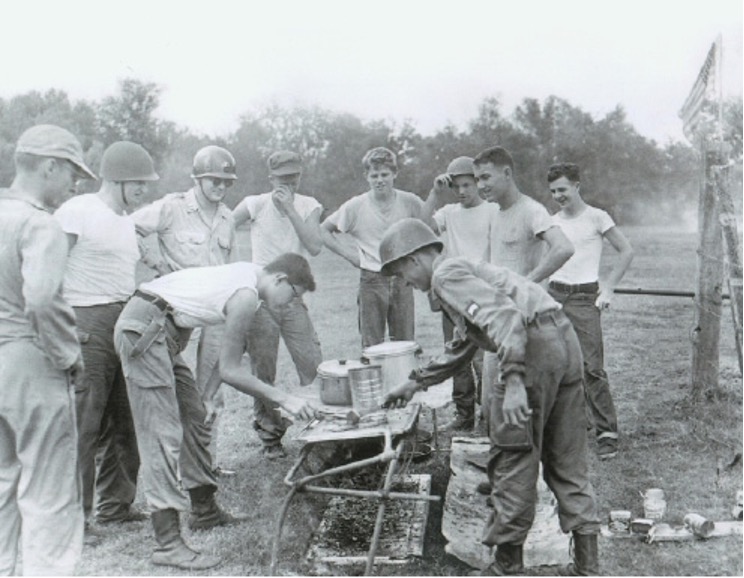
    CairnsPt1CAP

    And this fanatic wasn’t just some peripheral character in Oswald’s orbit. As one can see from the above, he was the squadron leader of Lee Harvey Oswald’s Civil Air Patrol unit.

    So now we must ask the question: Are we truly expected to believe that a man who wanted to “train killers” to obliterate Communists would have had a benign, indifferent view of a cadet who—according to The Oswald Puzzle—was already:

    “forceful in the expression of his own views on government, social issues, and geopolitics”? A cadet who, according to William Wulf, “started to expound the Communist doctrine? Who was allegedly “highly interested in communism” and believed that “communism was the only way of life for the worker”

    Most astonishingly, however, was the revelation that Oswald “was looking for a Communist cell in town to join” (The Oswald Puzzle; p.40) ( WC Vol VIII; p.18)

    Would such a cadet have been tolerated under the leadership of a rabid “Red” hater like Ferrie?

    We do, however, have testimony on record that directly contradicts the characterisation of Oswald as a budding Marxist in his youth.

    His fellow Civil Air Patrol cadet, Ed Voebel, who joined the CAP alongside Oswald, dismissed the notion outright when testifying before the Warren Commission:

    “I have read things about Lee having developed ideas as to Marxism and communism way back when he was a child, but I believe that is a lot of baloney”. Voebel also stated that he saw no evidence whatsoever that Oswald was studying communism in 1954.

    Robert Oswald’s testimony would further reinforce this:

    “If Lee was deeply interested in Marxism in the summer of 1955, he said nothing to me about it… Never in my presence, did he read anything that I recognised as communist literature”

    So what changed?

    If Oswald showed no interest in Marxism in 1954-55, then what triggered his sudden transformation? The evidence suggests that his introduction to Marxist literature was not organic but rather coincided with his encounters with David Ferrie.

    Can’t you see the contradiction?

    Even more damning is that The Oswald Puzzle explicitly states:

    “It is around this time that Oswald is showing clear and consistent indications of his beliefs regarding political and social systems.” (The Oswald Puzzle; p.40) Yet if this were true, then why—just a year later—would Oswald, the supposed overt Marxist, voluntarily enlist in the United States Marine Corps—an institution built to uphold and defend American capitalism and imperialism? The very antithesis of Marxist ideology.

    Oswald’s half-brother, John Pic, testified before the Warren Commission that Oswald had no ideological motivation behind his enlistment. Instead, he suggested that Oswald joined the Marines simply “to get from out and under the yoke of oppression from (his) mother”, Marguerite. (WC Vol. XI; p.10) 

    Possible. But I believe the answer lies elsewhere—at the feet of David Ferrie.

    One of Ferrie’s primary roles in the Civil Air Patrol was to encourage and recruit young men into the U.S. military—particularly the Marines. He frequently boasted about his connections to intelligence and military operations, and he would speak to cadets about the orders he received from those channels.

    In fact, when Lee, underage, tried to join the Marines just after his 16th birthday, his mother was visited by a man passing himself off as a Marine Corps recruiter. As Bill Davy rightly points out, “this was a clear violation of the law”.

    Ferrie, as it turns out, “often posed as a military officer and exhibited domineering and controlling behavior towards his cadets”. (Davy, p.6; James DiEugenio, Reclaiming Parkland, pp. 152-153) 

    Now, consider this. If Oswald was truly the overt “Marxist”, why, while preparing to enlist in the U.S. military, did he begin to do two opposing things simultaneously? He starts to obsessively study his brother’s Marine Corps manual, memorizing it “by heart.” While, at the same time, devouring Communist literature. (WC Vol I, 198.)

    Now take a moment to really let that one sink in for a second. 

    That’s tantamount to me, as a supporter of the Glasgow Celtic, turning up each week to Ibrox Stadium to cheer on the Glasgow Rangers. It defies all logic. (And would never happen). And logic should be an easy trail to follow, especially if one is as intelligent as Oswald. 

    To just ever so briefly skim over Oswald’s relationship with Ferrie is not presenting the totality of the evidence.  As James DiEugenio, a specialist in New Orleans, wrote: “Oswald’s relationship with Ferrie had a powerful, perhaps crucial, effect on his life.” (The JFK Assassination: The Evidence Today, p. 177). Which is likely the reason that, in the wake of the assassination, Ferrie was frantically trying to conceal that relationship. (ibid, p. 176)

    The Marxist Marine

    “At the time he entered the Marine Corps, Lee Oswald… was very much interested in socialism and Marxism. (The Oswald Puzzle; p.40) 

    Yet, which is the real Oswald?

    “Oswald was not a Communist or a Marxist. If he was, I would have taken violent action against him, and so would many of the other Marines in the unit.” James Bothelo

    Two statements. Two conflicting realities. Both cannot be true. So, which one is the illusion? With this, we enter a phase of Oswald’s life that defies explanation—at least if one assumes his Marxist convictions were genuine. His enlistment in the United States Marine Corps (USMC) stands as a glaring contradiction, compounded by the military’s staggering negligence in addressing his overtly pro-Soviet behavior.

    How could a staunch Marxist thrive within the staunchly anti-Communist U.S. military? How was his open admiration for the Soviet Union and Castro’s Cuba tolerated—at the height of the Cold War? And why did none of it trigger the alarm bells that destroyed so many others?

    Some have suggested that the Marine Corps simply viewed Oswald as an eccentric ideologue, dismissing his vocal admiration for the Soviet Union and his praise for Fidel Castro’s revolution as nothing more than a harmless personality quirk. But is that even remotely plausible in the rigid, hyper-vigilant, anti-Communist climate of the 1950s?

    Had Oswald merely harboured private sympathies for leftist ideals, perhaps this argument could be entertained. But that is not what happened. His behavior was neither subtle nor sporadic. He was a Marine who, while actively serving in the U.S. military—a force dedicated to opposing Communism—repeatedly and publicly expressed Marxist ideology, Soviet allegiance, and disdain for American capitalism.

    This is not just an inconsistency—it is a contradiction. And one that requires rigorous scrutiny.

    The Marxist Résumé

    “He must have had a secret clearance to work in the radar center, because that was a minimum requirement for all of us”. John Donovan. (WC Vol VIII; p.298)

    “We all had secret clearances.” Nelson Delgado. (Vol VIII; p.232)

    Below is a documented list of some of Marine Radar Operator Oswald’s openly pro-Soviet activities while serving in the U.S. Marines, under normal Cold War security policies. Any one of these actions should have immediately marked him as a severe national security risk.

    • Openly Studying/Declaring interest in Marxist/Communist Ideology. (WCR; p.388) (Oswald Puzzle; p.57)
    • Declared publicly his support for the Soviet system. (WCR, p.388) 
    • Believed that communism was “the best system in the world”. (WCR, p.686)
    • Gigged by his fellow Marines about “being a Russian spy”. (WC Vol; VIII; p.322)
    • Described by his commanding officer as a “Little nuts on foreign affairs”. (WC Vol VIII; p.290)
    • Complained about the incompetence of the “American Government”. (WC Vol VIII; p.292)
    • Made Remarks About “American Imperialism” and “Exploitation”. (Edward Epstein, Legend; p. 82)
    • Referred to Fellow Marines as “You Americans”. (Ibid)
    • Made serious references to “American Capitalist Warmongers”. (WC Vol; VIII; p. 315)
    • Denounced Capitalism and praised the Soviet economic system to fellow Marines. (WCR; p.868)
    • Nicknamed “Oswaldovich”. (WCR; p.388)
    • Made remarks stating his preference for “The Red Army”. (WC Vol VIII; p.323) (WCR; p.388)
    • Had his name in Russian on one of his jackets. (Vol VIII; p. 316)
    • Played Russian records at extremely loud volume (particularly Tchaikovsky’s “Russian War Dance”) (Ibid)
    • Studied The Russian Language. (WCR; p.388) (Oswald Puzzle; p.55-56)
    • Made remarks in Russian frequently or used expressions such as “da”“nyet,”or “comrade” to his fellow Marines. (Vol VIII; p. 315) (WCR; p. 686)
    • Read a Russian language newspaper. (Vol. VIII, p. 315-321-292)
    • Read Karl Marx’s Das Kapital, which is fundamentally a Marxist work but is also foundational to Communist ideology. (Vol. VIII, p. 254)  
    • Read and subscribed to publications directly linked to the Communist Party USA: The Daily Worker-The People’s World. (Elaborated on later). (WC Vol VIII; p.292-320-323) (Tony Summers Conspiracy; p.147)
    • On February 25, 1959, Oswald sat for a Marine Corps Russian proficiency exam—an event that, in itself, is rather shocking in its improbability. The Oswald Puzzle states that “Oswald may have been motivated by the fact that scoring at certain levels of proficiency would add to his monthly base pay” or “he just wished to test himself” in the Russian language. In other words, Oswald—a Marine assigned to anti-aircraft radar operations, with a secret clearance—chooses to take a Russian language proficiency exam.  But it’s not because it had any bearing on his military duties. But either for a small financial bonus or as a personal intellectual challenge. This explanation, however, is so weak that it collapses under even the slightest scrutiny.


    The late District Attorney of New Orleans, Jim Garrison, famously ridiculed the absurdity of such a test for someone in Oswald’s position. He noted, “In all my years of military service during WWII and since, I had never taken a test in Russian… I could not recall a single soldier EVER having been required to demonstrate how much Russian he had learned… A soldier genuinely involved in anti-aircraft duty would have about as much use for Russian as a cat would have for pyjamas.” (On The Trail of The Assassins, p. 23). (WCR; p.685) (The Oswald Puzzle; p.56) 

    • Received mail on base suspected to be from the Cuban government. And openly supported Fidel Castro and the Cuban revolution.  (WC Vol VIII; p.240-243)

    By any rational metric of Cold War security policy, Oswald’s conduct should have led to:

    1. A full-scale investigation by the USMC and the Office of Naval Intelligence (ONI).
    2. Immediate dishonourable discharge.
    3. Blacklisting from any future government employment.
    4. Court-martial proceedings.
    5. Possible imprisonment for espionage or subversive activities.

    And yet, none of this happened.

    If one attempts to reconcile Oswald’s “radicalism” as nothing more than a mere “personality quirk”, then the U.S. Marine Corps was running the most reckless, incompetent security operation imaginable—hardly consistent with the military ethos of Cold War America. And if The Oswald Puzzle expects us to swallow that narrative, the real scandal isn’t just Oswald—it’s the alarming possibility that other “personality quirks” were freely roaming U.S. military bases, unchecked, with the potential to defect to the Soviet Union.

    Even more alarming, Oswald had access to one of the most sensitive military installations in the world—Atsugi, Japan. This base housed the U-2 spy plane program, one of America’s most closely guarded Cold War secrets. And yet, this proclaimed Marxist, who referred to his fellow Marines as “you Americans,” was reportedly seen strolling around the base, casually taking photographs (Philip Melanson, Spy Saga, p.8).

    Oswald’s Ability to Follow Orders and Authority

    It has often been argued that Oswald’s temperament—frequently characterized as rebellious, defiant, and resistant to authority—would have made him wholly unsuitable for intelligence work. Detractors paint him as a loose cannon, a man who bristled under orders and was incapable of following directives. 

    However, as with so much else in the Oswald enigma, this portrayal is contradicted by testimony on the record. Nelson Delgado testified that;

     “He used to take orders from a few people there without no trouble at all…If he had respect, he would follow, go along with you.” (WC Vol VIII; p262)

    This statement suggests that Oswald’s alleged inability to follow orders was not an intrinsic trait, but rather a selective disposition—he was fully capable of obedience when he deemed it warranted. A quality, one might argue, that could be highly desirable in certain intelligence circles. 

    How Did Oswald Learn Russian?

    The Oswald Puzzle makes the case that Oswald’s Russian proficiency was solely the product of his own self-discipline, a testament to his determination to master the language through solitary study. The book cites various Marines recalling his commitment to learning Russian, as if this alone explains how a young radar operator—without formal instruction—somehow acquired an impressive grasp of one of the most notoriously difficult languages in the world. (The Oswald Puzzle; p.55)

    This argument, however, begins to unravel when faced with a striking omission from the book—a name that should have been central to the discussion but is instead left out entirely: Rosaleen Quinn.

    Quinn was the aunt of Oswald’s fellow Marine, Henry J. Roussel, Jr., and she had a personal stake in learning Russian. She was preparing for a position at the American Embassy in Moscow, which required passing a State Department exam in the language. To achieve this, she undertook a Berlitz course and received formal tutoring for more than a year. (WC Vol. VIII; p.321) (XXIV; p.430)

    At her nephew’s arrangement, Quinn spoke with Oswald one evening for over two hours in Russian. She later recalled that Oswald spoke the language better and more confidently than she did! (Melanson; p.11)

    That revelation alone should be enough to pierce the myth of Oswald as a self-taught Russian student. Here was a woman who had received structured, professional training, yet she found herself outpaced in fluency and confidence by a 19-year-old Marine with no formal instruction.

    It gets even more implausible when we consider the timing. This conversation took place after Oswald had already failed his Russian proficiency test in February 1959. According to The Oswald Puzzle: 

    “Oswald got two more questions right than wrong, however, his overall rating on the test was poor. Oswald scored -5 for “understanding” (listening to spoken Russian) +4 for reading and +3 for writing. Those scores suggest that he had been teaching himself Russian from a book up to that point in time”. (p.56)

    So we are supposed to believe that a man rated as “poor” in Russian just months earlier—who had a negative score in listening comprehension (-5)—could, by the time he spoke with Quinn, outclass a trained Russian speaker? 

    Jim Garrison captured the absurdity of this contradiction perfectly when he wrote“I am reminded of the man of said his dog was not very intelligent because he could beat him three games out of five when they played chess.” (Garrison, p.22)

    But beyond the numbers, there is an even larger problem. Russian is not an easy language for an American to master, even with professional training. Dr. James Weeks, a professor of modern languages at Southeastern Massachusetts University, taught Russian himself and underwent military language training. He was consulted by researcher Phillip Melanson and was asked whether Oswald’s supposed rate of progress was feasible.

    Weeks stated that attaining Russian fluency requires more than twice as many hours as Spanish or French—1,100 hours or more, including instruction. Weeks opined that the kind of progress described in Oswald’s case would be exceedingly difficult, if not impossible, to attain in such a short time by using only the radio and self-study props. (Melanson, p.12)

    This is not an opinion—it is a fact supported by decades of linguistic research. 

    We must also consider a particularly revealing exchange from the January 27, 1964, executive session of the Warren Commission, in which Chief Counsel J. Lee Rankin made a rather curious admission:

    “We are trying to run down to find out what (Oswald) studied at the Monterey School of the Army in the way of languages”. History Matters Archive – January 27, 1964 transcript, pg

    This single sentence raises profound implications. Why was the Warren Commission investigating Oswald’s possible enrolment at Monterey?

    The Monterey School (Defense Language Institute) was not some casual language academy—it was a top-tier training ground for U.S. military and intelligence personnel. Students did not elect their own courses; they were assigned languages based on operational requirements.

    If Oswald had indeed studied at Monterey, this would explain both the speed and depth of his Russian proficiency, as well as why his behavior in the Marine Corps—so outwardly pro-Soviet and politically suspect—never raised alarms within the military establishment.

    The very fact that Rankin and the Warren Commission found it necessary to “run this down” suggests they had reason to believe Oswald’s Russian training was more than just the efforts of a self-motivated Marine flipping through textbooks in his spare time. (Melanson, p.12)

    Click here to read part 2.

  • The Dallas Police Convicted Oswald without a Trial – Part 2/2

    The Dallas Police Convicted Oswald without a Trial – Part 2/2


    Let us continue with the pervasive and relentless attempt by the local authorities to convict Lee Harvey Oswald, a man without a lawyer.

    KRLD-TV Interview of Jesse Curry.

    In an interview with KRLD-TV on November 23rd , Jesse Curry revealed that Lee Harvey Oswald was charged with the attempted murder of Governor John B. Connally.

    Curry. We have one more thing. We have filed on him for assault to murder—
    Q. Assault to what?
    Curry. Assault to murder against Governor John B. Connally. That charge had been filled. (CE2150, Volume XXIV; p. 782.)

    This decision introduces a significant aspect to the case, particularly when contrasted with the Dallas Police’s emphasis on Oswald’s alleged attempt to ‘kill’ Officer Nick McDonald during his arrest—although Oswald was never formally charged with McDonald’s attempted murder.

    Testimonies highlight the incident involving McDonald: Gerald Hill reported that “the gun was fired one time by the suspect but luckily it misfired, the pin hit the shell but did not fire” (Volume XXIV; CE2160; p.804)

    Henry Wade noted that Oswald “struck at the officer, put his gun against his head, and snapped it, but the bullet did not go off.” (Volume XXIV; CE2168; p.820)

    Additionally, Jesse Curry confirmed that “Oswald was attempting to shoot one of the officers in the theater and did snap the pistol.” (See this)

    WFAA-TV Press interview of Jesse Curry.

    Q. Has he named an attorney?
    Curry. I understand now that he is trying to contact attorney Abt, I believe, A-B-T, I believe out of New York… it’s my understanding that this attorney, Abt, had been involved in some of the defense of some communists. (Volume XXIV, CE2152. p. 786.)

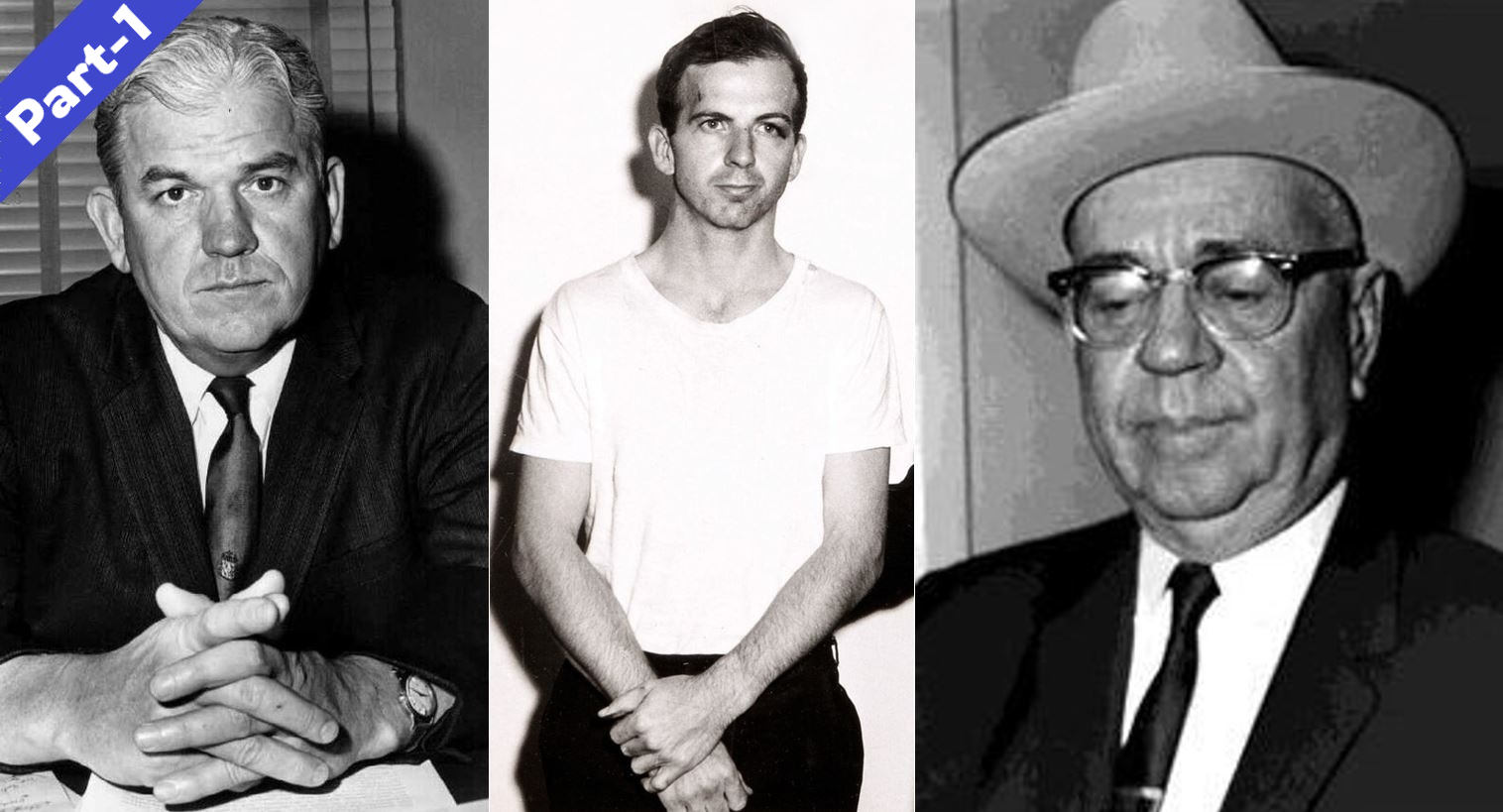
    Interview of Louis Nichols, WFFA TVPicture1

    Nichols Testimony to the Warren Commission.

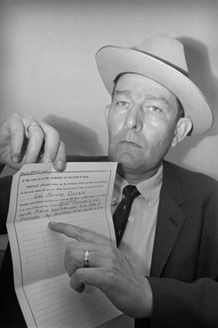
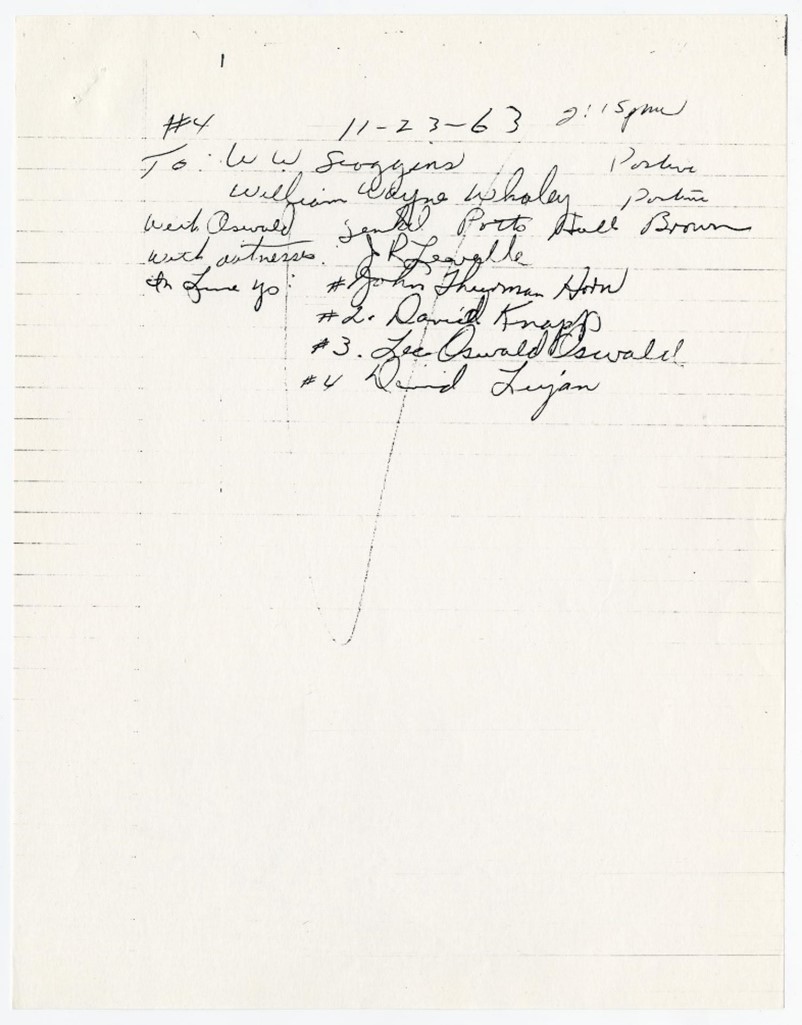
    H. Louis. Nichols, President of the Dallas Bar Association was permitted a short audience with Oswald in his cell on the fifth floor of the Dallas City Jail. Nichols, who publicly stated he did not practice criminal law, was permitted this time with Oswald, rather than the ACLU, whom Oswald was a member and who was a preference for representation. Many people have charged, that this proves that Oswald did not want legal representation, as Oswald declined the services of Nichols, but ask yourself this question: If you were in Oswald’s position, accused and vilified as a communist, presidential assassin, would you not want the absolute best defense available to you? Also, there is another important caveat to this narrative, Oswald would have no way of knowing that this would be his final chance at legal assistance, because in less than 24 hours, he too would be dead.

    For clarity this section has been written in narrative form.

    Nichols. (Do you have) a lawyer,
    Oswald. Well, I really didn’t know what it was all about, (I have) been incarcerated, and kept incommunicado.
    Nichols. (I am here to) see whether or not (you) had a lawyer, or wanted a lawyer.
    Oswald. (Do you) know a lawyer in New York named John Abt.
    Nichols. I don’t know him.
    Oswald. Well, either Mr. Abt or someone who is a member of the American Civil Liberties Union…I am a member of that organization, and I would like to have somebody who is a member of that organization represent me and If I can find a lawyer here who believes in anything I believe in, and believes as I believe, and believes in my innocence as much as he can, I might let him represent me.”
    Nichols. I’m sorry, I don’t know anybody who is a member of that organization…what I am interested in knowing is right now, do you want me or the Dallas Bar Association to try to get you a lawyer?
    Oswald. No, not now. You might come back next week, and if I don’t get some of these other people to represent me, I might ask you to get somebody to represent me.

    Nichols then testified; “My inquiry was intentionally very limited. I merely wanted to know whether he had a lawyer, if he had a lawyer then I had no problems.”

    November 24, 1963.

    Kevin Costner as Jim Garrison. “Who grieves for Lee Harvey Oswald? Buried in a cheap grave, under the name Oswald? Nobody.” (Oliver Stone; JFK)

    WFAA-TV Press interview of Captain Will Fritz. 11/23

    Q. Captain, is there any doubt in your mind that Oswald was the man who killed President Kennedy?
    Fritz. No, sir, there is no doubt in my mind about Oswald being the man. Of course, we’ll continue to investigate and gather more and more evidence, but there is no question about it.
    Q. Is the case closed or not, then, Captain?
    Fritz. The case is cleared… (Volume XXIV, CE2154. P. 788)

    WFAA-TV. NBC. KHLD. WBAP. Press Conference of Henry Wade.

    Sylvia Meagher. District Attorney Henry Wade held a press conference on Sunday night after Oswald was murdered, of which it has been said that he was not guilty of a single accuracy. (Accessories After the Fact; p. 75)

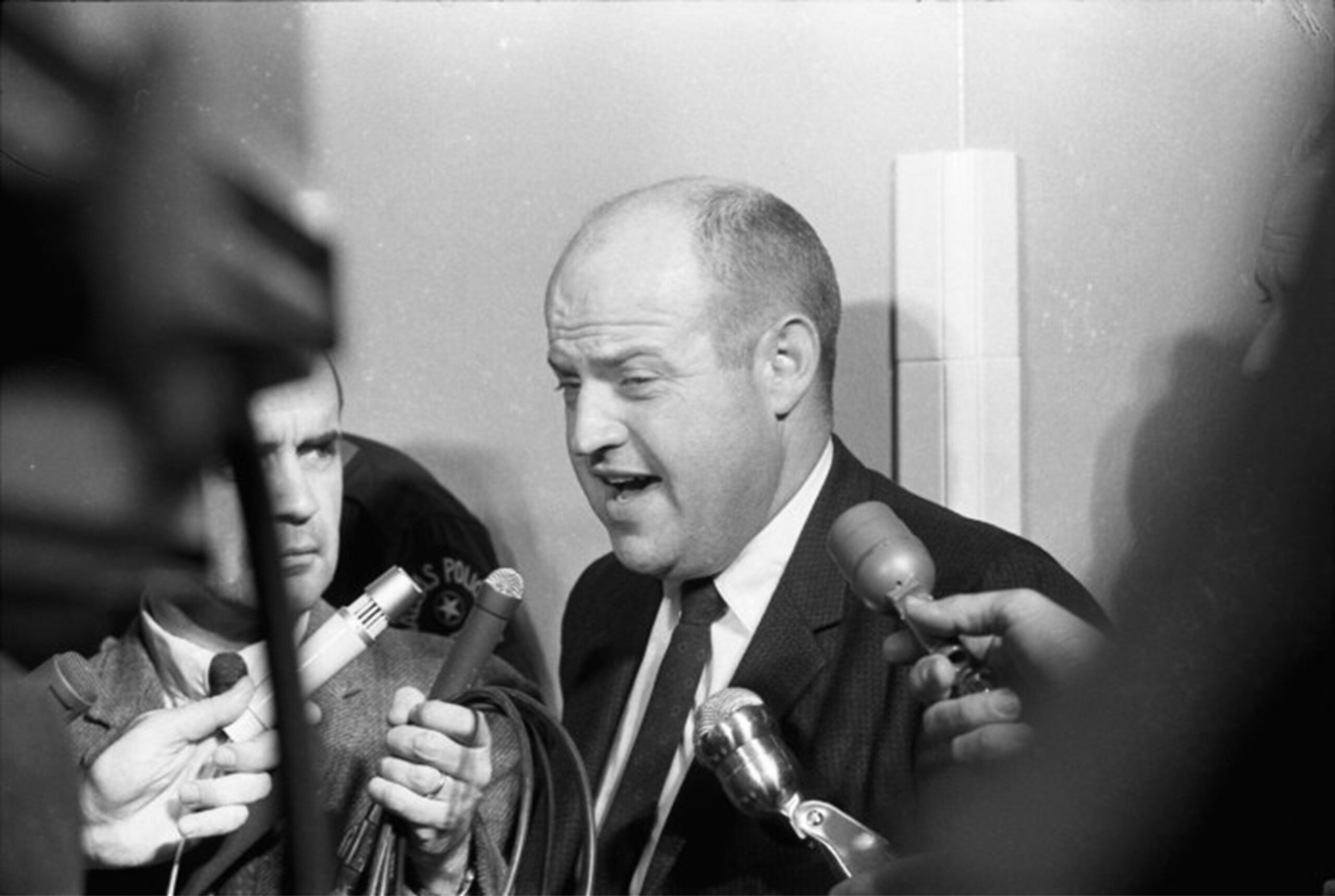
    Before Oswald’s body had even grown cold, District Attorney Henry Wade stood before the assembled television cameras at the Dallas City Jail to ostensibly ‘detail some of the evidence against Oswald for the assassination of the President.’ In this briefing, Wade delivered several dramatic assertions that further skewed the already precarious case against the accused. This press conference, fraught with such distortions, has been meticulously dissected by Mark Lane in ‘A Lawyer’s Brief.’ Lane’s critical examination reveals how Wade’s statements not only tainted public opinion but also demonstrated a stark disregard for the principles of judicial integrity. (See this)

    Wade asserted that a palm print identified as Oswald’s was found on a box situated near the sixth-floor southeast corner window of the Texas School Book Depository.

    Wade. On the box that the defendant was sitting on (around the sixth floor, southeast corner window), his palmprint was found and was identified as his.

    However, this evidence was later significantly qualified. Commission lawyer Wesley Liebeler, in a radio interview on December 30, 1966, pointed out a crucial flaw: “The fact that Oswald’s fingerprints were on cartons has no probative value whatsoever on the issue of whether he was in the window or not, because he worked at the Depository, he could have put his prints there at any time.” (Accessories After The Fact; p. 13)

    Q. Would you be willing to say in view of all this ‘evidence’ that it is now beyond a reasonable doubt at all that Oswald was the killer of President Kennedy?
    Wade. I would say that without any doubt he’s the killer—the law says beyond a reasonable doubt and to a moral certainty which I—there’s no question that he is the killer of President Kennedy.
    Q. The case is closed in your mind?
    Wade. As far as Oswald is concerned, yes.
    Q. How would you evaluate the work of the Dallas Police in investigating the death of the President?
    Wade. I think the Dallas Police done an excellent job on this and before midnight on when (JFK) was killed had (Oswald) in custody and had sufficient evidence what I think to convict him.
    Q. Is there any doubt in your mind that if Oswald was tried that you would have, have him convicted by a jury? With the evidence you have?
    Wade. I don’t think there is any doubt in my mind that we would have convicted him…
    Q. As far as you are concerned, the evidence you gave us, you could have convicted him?
    Wade. I’ve sent people to the electric chair on less. (CE2168, Volume XXVI, p. 819- 823-826.)Picture2

    KRLD-TV Press interview with Jesse Curry.

    Q. Could you tell us sir, (of) the possibility that somebody else might be involved? We’ve had statements in the last couple of days saying; “This is the man, and nobody else”.
    Curry. This is the man, we are sure, that murdered the patrolman and murdered—and assassinated the President. (CE2147. Volume XXIV, p-772.)

    KRLD-TV, Press interview with Jesse Curry.

    Henry Wade. I told them that the man’s wife said the man had a gun or something to that effect… that isn’t admissible in Texas. You see a wife can’t testify. It is not evidence, but it is evidence, but it is inadmissible evidence. (Volume V; p. 223)
    Curry. (We) felt yesterday morning that we were capable of presenting our case to the court and had ample evidence for a conviction…
    Q. What do you consider the high points?
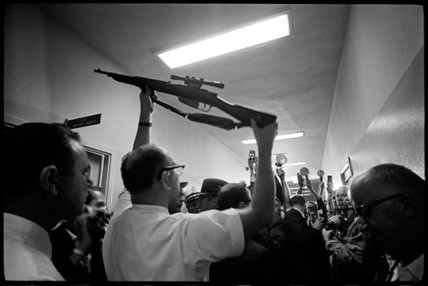
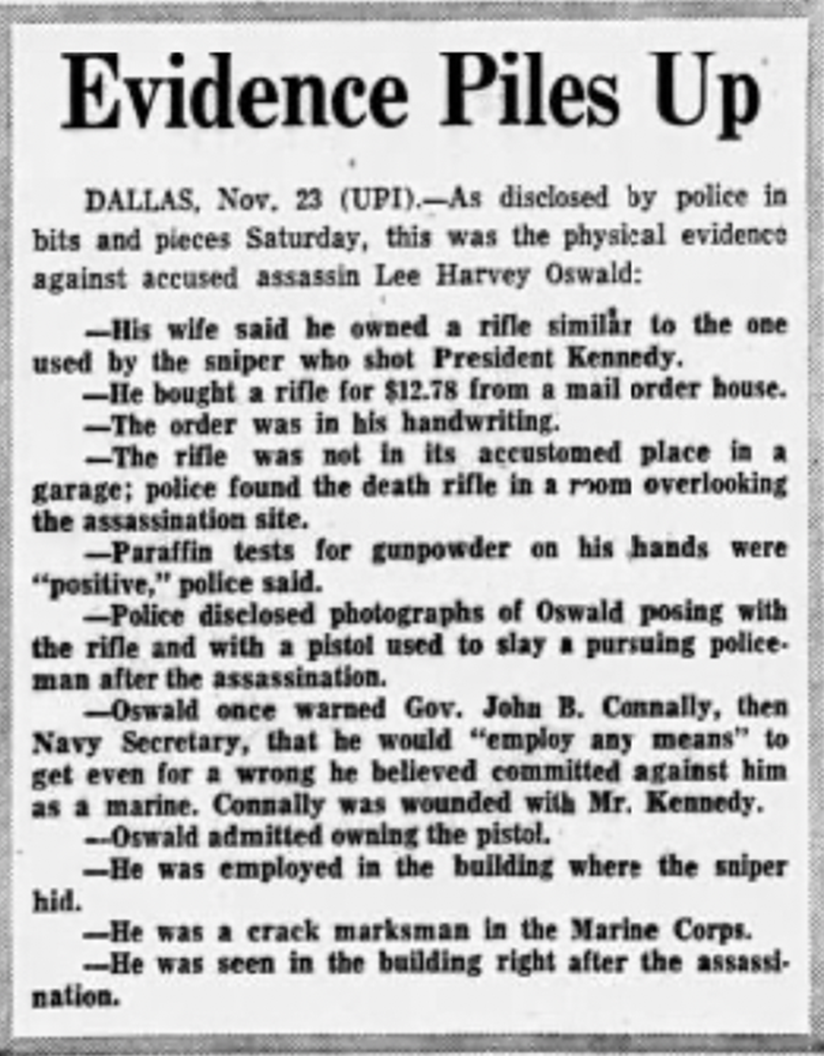
    Curry. We have been able to do this. We have been able to place this man in the building, on the floor at the time the assassination occurred. We have been able to establish the fact that he was at the window that the shots were fired from. We have been able to establish the fact that he did order a weapon… and we feel (this) is the weapon that was used. We have been able to establish the fact that we do have the murder weapon… this is the gun that fired bullets that killed President Kennedy and wounded the Governor.
    Q. How much importance do you attach to this picture?
    Curry . Well, it’s important to us. Whether or not we will be able to introduce it as evidence will be left up to the attorney and judge, of course, but it establishes beyond a reasonable doubt in our mind that he is our man with our guns. (CE397; Volume XVII; p.780-781)

    In point 20 of ‘Assassination 60,’ this issue is addressed; “The question of whether Marina Oswald could have legally testified against her husband, Lee Oswald, raises interesting forensic considerations for the case. Under Texas law, spouses are generally permitted to serve as witnesses for each other in criminal cases. However, a crucial exception exists they cannot testify against each other unless one spouse is being prosecuted for an offence committed against the other. In the context of Oswald’s hypothetical trial, Marina’s testimony would have been excluded based on this spousal privilege. This means that the controversial backyard photographs, which were allegedly linked to Lee, could not have been admitted into evidence to be used against him. This is because Marina’s testimony, which was the sole source of corroboration for the photographs, would have been inadmissible due to the spousal privilege.”

    The Federal Bureau of Investigation.

    In a declassified document from Alan Belmont to Clyde Tolson, Belmont lays out the plan to convince the public of Oswald’s guilt.

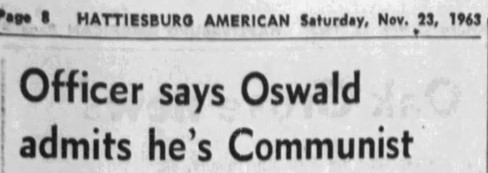
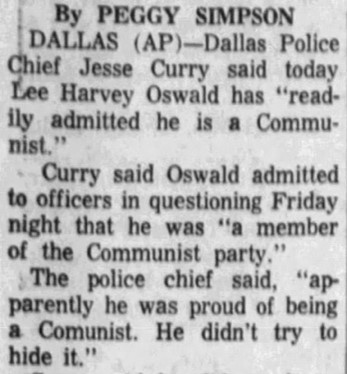
    “We will set forth the items of evidence which make it clear that Oswald is the man who killed the President. We will show that Oswald was an avowed Marxist, a former defector to the Soviet Union and an active member of the FPCC, which has been financed by Castro.

    Despite the fact that Oswald is dead, this evidence will be necessary to back up any statement that Oswald was the man who killed the President. At 4:15pm Mr. DeLoach advised that Katzenbach wanted to put out a statement, we are now persuaded that Oswald killed the President…” (See this)

    For a detailed examination of the circumstances surrounding Oswald’s murder, please refer to part 2 of ‘Assassination 60.

    Widespread Condemnation of the Dallas Police.

    The concessions to the media resulted in Oswald being deprived not only of his day in court, but of his life as well. American Civil Liberties Union.

    Theodore Voorhees, chancellor-elect of the Philadelphia Bar Association Stated that Lee H. Oswald had been “lynched” by the Dallas Police & Prosecutorial officials. Although some concern was expressed that Oswald be provided counsel, he said, no member of the legal profession protested the publication of the evidence, the 24-hour interrogation and the violations of the prisoners’ rights. (New York Times, Dec. 5th, 1963, p. 32)

    Ben. K. Lerer, President of the Bar Association of San Francisco. We believe that television, radio and the press must bear a portion of the responsibility which falls primarily on the Dallas law-enforcement officials. Both press media and law enforcement officials must seek to protect the rights of accused persons against the damage to them, and consequently to our system of justice, which can come from revealing information concerning the accused at times when the revelation might inflame the public. (New York Times, Dec. 28th, 1963, p. 23)

    Percy Foreman, Texas Attorney. Federal decisions for at least five years have held that a defendant has a right to legal counsel at every level including arraignment before a justice of the peace. It’s not being done in Texas, but it’s the law, and (Oswald) is entitled to counsel whether he requests it or not.

    Another legal doctrine requires that an appellant show that an alleged abridgement of his rights caused him substantial harm. Foreman stated this could be shown if Oswald is persuaded to sign a confession before he has had the benefit of legal counsel. Foreman said a lawyer should be advising Oswald to insist on an examining trial, as a preliminary hearing is called in Texas. An examining trial requires the state to produce its witnesses and lay out its line of evidence against the accused.

    Foreman said Oswald might be able to show that his trial was prejudiced by inflamed public opinion if he is brought to trial before a lapse of, say, two years. Television and press are far more persuasive than the bill of rights or the code of criminal procedure. Try (Oswald) a month from now, and you might just as well march him out on the courthouse lawn and lynch him.” (St LouisPost Dispatch, 11/24/1963, p.10)

    John De J. Lamberton Jr. Executive Director of the American Civil Liberties Union.

    The American Civil Liberties union charged yesterday that the police and prosecuting officials of Dallas committed gross violations of civil liberties in their handling of Lee H. Oswald, the accused assassin of President Kennedy. The ACLU said that it would have been simply impossible for Oswald, had he lived, to have obtained a fair trial because he had already been tried and convicted by the public statements of Dallas law enforcement officials.

    The ACLU indicted television, radio and the press for the pressure they exerted on Dallas officials. They described the transfer of Oswald from the city jail as a theatrical production for the benefit of the television cameras. The ACLU hold the Dallas police responsible for the shooting of Oswald, saying that minimum security considerations were flouted by their capitulation to publicity.

    If Oswald had lived, he would have been deprived of all opportunity to receive a fair trial by the conduct of the police and prosecuting officials in Dallas. From the moment of his arrest until his murder, two days later, Oswald was tried and convicted many times over in the newspapers, on the radio and over television by the public statements of Dallas law enforcement officials. Time and again high-ranking police and prosecution officials stated their complete satisfaction that Oswald was the assassin.

    As their investigation uncovered one piece of evidence after another, the results were broadcast to the public. All this evidence was described by the Dallas officials as authentic and incontestable proof that Oswald was the president’s assassin. The cumulative effect of these public pronouncements was to impress indelibly on the public’s mind that Oswald was indeed the slayer. With such publicity, it would have been impossible for Oswald to get a fair trial in Dallas or anywhere else in the country, the trial would have been nothing but a hollow formality. (New York Times, December 6th 1963, p.18)

    Harvard Law School. Released a statement in the New York Times, commenting on the deplorable incidents in the Dallas Police station ending in the death of Lee Oswald. From Fri, Nov. 22, through Sunday (24th) the shocking manner in which are processes of criminal justice are often administered was exhibited to ourselves and to the world. The process of investigation and accusation can only be described as a public spectacle, carried on in the Dallas Police station with its halls and corridors jammed with a noisy, milling throng of reporters and cameramen.

    Precisely because the president’s assassination was the ultimate in defiance of law, it called for the ultimate vindication of law. The law enforcement agencies, in permitting virtually unlimited access to the news media, made this impossible. 

    Not only would, it have been virtually impossible to impanel a jury which had not formed its own views on those facts which might come before it, but much of the information released such as statements by Mrs Oswald might have been legally inadmissible at trial. 

    It is ironic that the very publicity which had already made it virtually impossible for Oswald to be tried and convicted by a jury meeting existing constitutional standards of impartiality should, in the end, have made such trial unnecessary. 

    For the fact is that justice is incompatible with the notion that police, prosecutors, attorneys, reporters and cameraman should have an unlimited right to conduct ex-parte public trials in the press and on television.

    (New York Times, December 1st, 1963, p. 10E.)

    New York Times Editorial, The Spiral of Hate.

    The shame all America must bear for the spirit of madness and hate that struck down President John F. Kennedy is multiplied by the monstrous murder of his accused assassin while being transferred from one jail in Dallas to another.

    The primary guilt for this ugly new stain on the integrity of our system of order and respect for individual rights is that of the Dallas police force and the rest of its law-enforcement machinery.

    The Dallas authorities, abetted and encouraged by the newspaper, TV and radio, press, trampled on every principle of justice in their handling of Lee H. Oswald. It is their sworn duty to protect every prisoner, as well as the community, and to afford each accused person full opportunity for his defense before a properly constituted court. 

    The heinousness of the crime Oswald was alleged to have committed made it doubly important that there be no cloud over the establishment of his guilt.

    Yet—before any indictment had been returned or any evidence presented and in the face of continued denials by the prisoner, the chief of police and the district attorney pronounced Oswald guilty. “Basically, the case is closed,” the chief declared. The prosecutor informed reporters that he would demand the death penalty and was confident “I’ll get it.”

    After two days. of such pre-findings of guilt, in the electrically emotional atmosphere of a city angered by the President’s assassination and not too many decades removed from the vigilante tradition of the old frontier, the jail transfer was made at high noon and with the widest possible advance announcement. Television and newsreel cameras were set in place and many onlookers assembled to witness every step of the transfer-and its tragic miscarriage.

    It was an outrageous breach of police responsibility—no matter what the demands of reporters and cameramen may have been—-to move Oswald in public under circumstances in which he could so easily have been the victim of attack. The police had even warned hospital officials to stand by against the possibility of an attempt on Oswald’s life.

    Now there can never be a trial that will determine Oswald’s guilt or innocence by the standards of impartial justice that are one of the proudest adornments of our democracy. (New York Times, Nov. 25th, 1963, p. 18)

    J Edgar Hoover, Director of the FBI. I dispatched to Dallas one of my top assistants in the hope that he might stop the Chief of Police and his staff from doing so damned much talking on television. Curry, I understand, cannot control Capt. Fritz of the Homicide Squad, who is giving much information to the press.… we want them to shut up. All the talking down there might have required a change of venue on the basis that Oswald could not have gotten a fair trial in Dallas. There are bound to be some elements of our society who will holler their heads off that his civil rights were violated—which they were. (see this)

    Warren Commission.

    The Commission agrees that Lee Harvey Oswald’s opportunity for a trial by 12 jurors free of preconception as to his guilt or innocence would have been seriously jeopardized by the premature disclosure and weighing of the evidence against him.

    The news policy pursued by the Dallas police, endangered Oswald’s constitutional right to a trial by an impartial jury. Neither the press nor the public had a right to be contemporaneously informed by the police or prosecuting authorities of the details of the evidence being accumulated against Oswald….It would have been a most difficult task to select an unprejudiced jury, either in Dallas or elsewhere. The disclosure of evidence encouraged the public, from which a jury would ultimately be impaneled, to prejudge the very questions that would be raised at trial. (WCR, pp. 238-240)

    The American Bar Association.

    The widespread publicizing of Oswald’s alleged guilt, involving statements by officials and public disclosers of the details of ‘evidence’ would have made it extremely difficult to impanel an unprejudiced jury and afford the accused a fair trial. It conceivably could have prevented any lawful trial of Oswald due to the difficulty of finding jurors who had not been prejudiced by these public statements.

    Official laxity resulting in excessive, and prejudicial publicity reached its climax in the pre-announced removal of Oswald from the City jail, and the spectacle of his murder– literally in the arms of police officers, and before the eyes of the television audience. (CE2183, Volume XXVI; pp. 856-857)

    Nicholas Katzenbach.

    The Dallas police have put out statements on the Communist conspiracy theory, and it was they who were in charge when (Oswald) was shot and thus silenced. The matter has been handled thus far with neither dignity nor conviction. Facts have been mixed with rumour and speculation. We can scarcely let the world see us totally in the image of the Dallas police when our President is murdered. (see this)

    Henry Wade.

    Wade testified that on November 23, various lawyers reached out to him, expressing their concern and outrage over the handling of Lee Oswald.

    Henry Wade. “Saturday November 23. we had calls from various people and most of them was from people here in the East calling lawyers there in Dallas rather than me, and them calling me.”
    Lee Rankin. “ What were they saying to you about that?”
    Henry Wade. “Well, they were very upset, one, in looking at American justice where the man didn’t have an attorney, as apparently, and two, that too much information was being given to the press too, by the police and by me.” (Volume V; p. 239)

    Ruby, The Hero?

    The depth of the animosity towards Oswald, cultivated by the Dallas police, is starkly illustrated by the flood of congratulatory telegrams sent to Jack Ruby following his murder of Oswald. These messages prompt a disconcerting reflection on the state of justice in America: Have we really descended to a point where such an act is celebrated? Is this what we consider justice? (see this)Picture3

    Picture4DA of Dallas County, Craig Watkins.

    Prosecutors in Dallas have said for years, any prosecutor can convict a guilty man, it takes a great prosecutor to convict an innocent man. Melvyn Carson Bruder. (See this)

    Craig Watkins, who was the first African American in history to be elected as Dallas District Attorney in 2006, stated in a 2008 interview that the DA’s office under Henry Wade’s tenure was rife with; “Negligence, prosecutorial misconduct and faulty witness identification. It’s just been a mindset of conviction at all costs around here.

    Q. You talk about the mindset of winning convictions at all costs. The legendary Dallas prosecutor Henry Wade, who held the job you now hold for many, many years, embodied that philosophy. He’s known to have actually boasted about convicting innocent people—that convincing a jury to put an innocent man in jail proved his prowess as a prosecutor.

    Watkins. Oh yeah, it was a badge of honor at the time—to knowingly convict someone that wasn’t guilty. It’s widely known among defense attorneys and prosecutors from that era. (See this)

    Win At All Costs.

    Attorney Kenneth Holbert. “(Wade) was a brilliant attorney. He got the maximum that was available. The maximum is what he always got.

    Dallas Assistant District Attorney Edward Gray “Even in cases where evidence was weak, Wade would go all out, go for broke, be super-competitive.”

    Innocence Project of Texas. “ When someone was arrested, it was assumed they were guilty. I think prosecutors and investigators basically ignored all evidence to the contrary and decided they were going to convict these guys.” (See this)

    Below I have highlighted the legacy of injustice which occurred under the tenure of DA of Dallas County, Henry Wade.

    Randall Dale Adams (1976): Wrongfully convicted of the murder of Dallas police officer Robert Wood. His conviction was overturned in 1989 after new evidence emerged from the documentary The Thin Blue Line.

    Adams describes an all too familiar story regarding his interrogation at the hands of the Dallas Police;

    “The day they picked me up, December 21st, they took me upstairs—they put me in a little room. Gus Rose walked in; he had a confession there he wanted me to sign. He said that I would sign it, he didn’t give a damn what I said, I would sign this piece of paper he’s got. I told him I couldn’t. I don’t know what the hell you people expect of me but there’s no way I could sign that. He left, he came back in 10 minutes and threw a pistol on the table. Asked me to look at it. Which I did, I looked. He asked me to pick it up. I told him no; I wouldn’t do that. He threatened me, again I told him no. He pulled his service revolver on me, we looked at each other, to me seemed like hours, I do not like looking down the barrel of a pistol. I do not like being threatened… I kept telling them the same thing, they did not want to believe me. Never once was I allowed a phone-call. Never once was an attorney there. I don’t know how long this had been, I know I had smoked two packs of cigarettes, I had been out for a long time. (See this)

    Lenell Geter (1982): Convicted of armed robbery and sentenced to life imprisonment. His conviction was overturned in 1983 after investigative journalism by CBS News and others demonstrated his innocence. (See this) Guilty of Innocence|The Lenell Geter Story 1987

    James Woodard (1981): Convicted of murder and spent 27 years in prison. Exonerated in 2008 through DNA testing. (See this)

    Thomas McGowan (1985): Wrongfully convicted of rape and burglary based on misidentification. Exonerated in 2008 after DNA evidence proved his innocence. (See this)

    David Shawn Pope (1986): Sentenced to life in prison for a rape he did not commit. Exonerated in 2001 through DNA evidence. (See this)

    Joyce Ann Brown (1980): Brown was wrongfully convicted of a fur store robbery and the murder of the store employee. She was exonerated in 1990 after proof emerged that Wade had withheld critical evidence from the defense. (See this)

    Richard Miles (1994): Though slightly after Wade’s tenure, this case reflects ongoing issues from practices during Wade’s era. Miles was wrongfully convicted of murder and attempted murder based on weak evidence and prosecutorial oversights. He was released in 2009 and officially exonerated in 2012. (See this)

    Johnnie Earl Lindsey (1983) was wrongfully convicted for a rape he did not commit, a verdict which was significantly influenced by flawed eyewitness identification procedures, particularly the use of a photographic line up. In this lineup, Lindsey and one other individual were the only two shirtless men depicted, a factor that had unduly influenced the victim’s identification. This line up process, which lacked procedural safeguards, was a pivotal factor leading to Lindsey serving over 26 years in a Texas prison. His innocence was finally proven through DNA testing facilitated by the Innocence Project, leading to his exoneration in 2009. (See this and this)

    Tommy Lee Walker (1955):Tommy Lee Walker was undeniably innocent, yet his life was tragically taken due to the deeply flawed and corrupt practices under Henry Wade’s tenure as Dallas County DA. The aggressive pursuit of convictions over fairness, a hallmark of Wade’s leadership, led to a gross miscarriage of justice in Walker’s case. This wrongful execution was carried out despite the complete absence of physical evidence and relied heavily on a confession that was coerced without legal representation. L.A. Bedford, Dallas County’s first black judge and a respected attorney, expressed profound outrage over the case, describing it as the “greatest injustice I have ever seen in my life.”

    During Tommy Lee’s interrogation, the Dallas Police used tactics similar to those later employed against Buell Frazier. Captain Fritz, who led the questioning, spent hours grilling Lee who said that; “Fritz told him he had received a phone call implicating him in the murder of Venice Parker. Fritz had received no such call. Fritz said that there were witnesses and that police knew what he had done. Fritz had a reputation for being unusually effective at wringing admissions of guilt out of suspects, and his techniques worked in this case as well. Years later, we know much more about how often false confessions occur and what can trigger them—fear, cultural differences, sleep deprivation, and feelings of hopelessness, all of which played a role in this case.”

    “Tommy Lee said later that he was intimidated when Fritz shouted at him again and again that he was lying about the murder. He said Fritz asked repeatedly if he had to bring in the men from upstairs when Tommy Lee balked at signing a confession. He believed that was a reference to the two officers he’d earlier seen beating a man. (see this and this)

    Since 2001, there have been a total of 44 exonerations in Dallas, according to the District Attorney’s office, while 100s of cases are still waiting to be reviewed. (See this)

    Summation.

    “No one has ever been able to put Oswald in the Texas School Book Depository with a rifle in his hand.” Jesse Curry. (Dallas Morning News-11/6/1969)

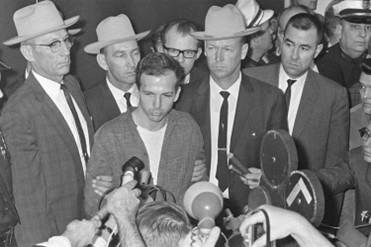
    While in the grasp of the Dallas Police, Oswald’s life was significantly diminished, it was reduced to being a central figure in a highly charged and publicized criminal case, without the benefit of the usual legal protections afforded to a suspect. Under intense scrutiny, both by law enforcement and the media, Oswald was paraded before cameras, leading to widespread speculation and judgment by the public. This spectacle overshadowed his rights and dignity, casting him as a villain in a predetermined narrative rather than a suspect with the right to a fair trial.

    Moreover, Oswald’s ability to defend himself or to present his side of the story was virtually non-existent, as he was quickly labelled the assassin of President Kennedy before any trial could take place. The immediate and overwhelming presumption of his guilt, coupled with the hostile and chaotic environment of the Dallas Police headquarters, meant that Oswald was deprived of the presumption of innocence. His life, in those final days, became a mere footnote in a broader national tragedy, overshadowed by the grief and anger of the entire world.

    Mark Lane once posed this question;If Oswald is innocent—and that is a possibility that cannot now be denied—then the assassin(s) of President Kennedy remain(s) at large.” (See this)

    More by Johnny Cairns.

    Assassination 60

    Our Lady of the Warren Commission

    A Presumption of Innocence: Lee Harvey Oswald

    Deanne Stillman’s American Confidential Exposed


    Go to Part 1 of 2

  • The Dallas Police Convicted Oswald without a Trial – Part 1/2

    The Dallas Police Convicted Oswald without a Trial – Part 1/2


    “The dead cannot cry out for justice. It is a duty of the living to do so for them.” – Lois McMaster Bujold

    History is replete with injustice, which often blooms from the seed of tragedy. In the tumultuous aftermath of the Dealey Plaza catastrophe, the roots of such an injustice would weave itself tightly around Lee Harvey Oswald, accused assassin of President John F. Kennedy.

    In little under the 48 hours from his arrest to his violent execution, within the bowels of the Dallas City Jail, Oswald found himself ensnared in a caricature of justice at the hands of the Dallas Police. Faced with concocted accusations and deprived of his right to counsel, Oswald’s final hours were characterized not by the proclamations of a political assassin, but by the desperate protestations of his innocence.

    “I don’t know what dispatches you people have been given but I emphatically deny these charges. I have nothing against anybody, I have not committed any acts of violence.” (See this)

    Yet, amidst these protests, the authoritative voices in Dallas relentlessly pronounced his guilt. They nourished the fears of the American public with a narrative designed for convenience rather than for justice.

    However, the case of the lone assassin is not founded on a bedrock of empirical evidence, but rather it is entrenched in a brew of circumstantial conjecture and outright fabrication. The case stands as a carefully crafted facade tailored to meet the demands of expediency. Under scrutiny, it falls, as Senator Richard Schweiker said, like a house of cards.

    As you navigate the vast array of guilt-laden assertions, consider these critical questions: During his all-too-brief detention, did the Dallas Police ever uphold Oswald’s constitutional right to be presumed innocent? Could Oswald have received a fair trial in Dallas? Or anywhere in the United States for that matter? Or had the actions of the Dallas officials made Oswald’s hypothetical trial a perfunctory charade devoid of justice? You decide.

    November 22, 1963

    Picture1A Perpetual Rush to Judgement.

    Sylvia Meagher. The Dallas Police are not so bad. Look how quickly they caught Jack Ruby.(Accessories After the Fact; p. xxvi)

    Within just 76 minutes of his arrest, Lee Oswald was publicly identified as a suspect in the assassination of President John F. Kennedy.Brandishing a photograph of Oswald for the television cameras, a newsman declared, “This is what the man charged with the assassination of the President looks like.” This rapid transition—from a man “sneaking” into a movie theater to being universally acclaimed as a communist Presidential assassin—was nothing short of remarkable. (WCR; p. 241; WCR, p. 206)

    The media worked fast, broadcasting to an anxious nation the erroneous events surrounding Oswald’s arrest.

    “Here in Dallas the man that all America is looking at this time is 24-year-old Lee H. Oswald, being interrogated at the Dallas City Police building. At the time of his arrest in a theater of the Oak Cliff section of Dallas he was subdued after ‘killing’ a Dallas Police Officer with a snub-nosed revolver. Struggling with another officer and striking him with that pistol and during that struggle he was heard to shout It’s all over now. I’ve got me a President and a cop, and I’ll try for two more. A fanatic in every sense of the word.” (See this)

    Air Force One was informed of Oswald’s sole guilt in the murder as it transported the body of the martyred President back to Washington. The narrative carried was unequivocally dismissive of any well-orchestrated conspiracy behind Kennedy’s murder, preferring to lay the heinous crime squarely on the shoulders of a ‘lone-nut assassin’.

    Simultaneously, the plane carrying President Kennedy’s cabinet members from Honolulu back to DC, was fed the same story. As Pierre Salinger details in With Kennedy. Salinger was provided with extensive information about Oswald’s background, his ‘defection’ to the Soviet Union and his affiliations with the Fair Play for Cuba Committee.(Praise From A Future Generation; by John Kelin p.5, With Kennedy p; 28)

    The Line-Ups.

    As I documented in point 24 of “Assassination 60”, the line-ups Lee Oswald was subjected to by the Dallas Police should be regarded as “utterly worthless.”Yet, the most outrageous incident occurred during the parade attended by witnesses Ted Calloway, Sam Guinyard, and Cecil McWatters. Calloway testified that before their viewing of the suspects, he was told by the Dallas Police that:”We want to be sure. We want to try and wrap him up real tight on killing this officer. We think he is the same one that shot the President, and if we can wrap him up tight on killing this officer, we have got him.( WC Volume III; p. 355)

    As Gerry Spence quipped to Calloway during the London mock trial of Lee Oswald,“Do you think that’s a fair and impartial way to make a line-up on somebody? I mean if you were standing in the line-up, innocent, charged with a crime and somebody said, we want to wrap him up real tight— because if we can show he killed the Officer, we got the man who killed the President, do you think you would have got a fair shake?” (For more on the line-ups, please see point 24 of Assassination 60. And this)

    NBC Press Interview with Sergeant Gerald Hill.

    In this interview, Sergeant Gerald Hill discusses Oswald’s insistence on his rights and firmly asserts his absolute conviction of Oswald’s guilt in both the Kennedy and Tippit murders.

    Hill. Oswald started demanding that he be allowed to see a lawyer…and demanding his rights.
    Q. Do you believe that he is the same man who killed the police officer?
    Hill. Having been in it from the very beginning, as far as the officer’s death is concerned, I am convinced that he is the man that killed the officer. I am convinced that the man we have is the man who shot the officer.

    Yet, Hill knew fine well that hours before this interview, he had declared to the police dispatch that:the shell at the scene indicates that the suspect is armed with an automatic .38 rather than a pistol. (WC Volume XXIII; CE1974-78; p. 870)

    Why is this significant? Because the weapon alleged to have been taken from Oswald at the Texas Theatre was a revolver, not an automatic.

    The interview then pivots to the capabilities of the cannibalized and defective WWII, Mannlicher Carcano, the alleged rifle used in the murder of President Kennedy. Hill assures the newsmen that it required ease, rather than extraordinary skill, to obtain from the Carcano the performance required to accomplish the assassination single-handedly.

    Hill. (From the Texas School Book Depository, Oswald) would have had a clear shot, and with a scope it would have probably been real easy.
    Q. (President Kennedy) was struck from behind, wasn’t he?
    Hill. I understand that he was, yes, sir. That the shots were fired from behind. ( WC CE2160, p. 804-805)Picture2

    Picture3Despite these critical revelations by Hill, the true shock emerges from the admissions of Assistant District Attorney William ‘Bill’ Alexander. Known as a staunch right-winger infamous for his provocative rhetoric, Alexander shocked many in 1968 when he advocated publicly for the hanging of Chief Justice Earl Warren. Notably, he likely would have served as the prosecutor in Oswald’s trial for the Tippit murder.

    Alexander admitted to author Henry Hurt that; “Once Oswald was charged as the assassin of President Kennedy, the District Attorney’s office ceased collecting evidence in the Tippit case.”

    This abrupt abandonment of due process is startling, yet Alexander continued: “The Tippit case just went by the boards. When Oswald was killed two days later, official interest in developing evidence in the Tippit case ceased altogether. There was never an indictment in the case or further investigation.”

    Alexander then told Hurt this whopper; “We all knew the same man who killed the President had killed Tippit. We had made up our minds by the time we got to (10th and Patton, scene of the Tippit murder). The two acts were so similarly drastic and unusual that it was virtually impossible that they were committed by separate killers.” (Henry Hurt, Reasonable Doubt, p.157)

    This premature judgment underlines a miscarriage of justice, where subjective assumptions supplanted a rigorous investigation. How could such critical legal determinations be made with such disregard for factual accuracy and fairness?

    Further compounding the investigative failures, the public assertions Hill made about the bullet trajectories in Dealey Plaza predated the autopsy of President Kennedy. So how could Hill know that all the wounds suffered by the president would jibe with the results of the autopsy?

    The autopsy was so poorly conducted that it prompted Dr. Milton Helpern, the highly respected and decorated Chief Medical Examiner of New York City—once described as’Sherlock Holmes with a microscope’—to comment on the utter incompetence of the career Navy forensic pathologists, Dr. James Humes and Dr. Thornton Boswell, who performed President Kennedy’s autopsy. Dr. Helpern likened their skills to:“It’s like sending a seven-year-old boy who has taken three lessons on the violin over to the New York Philharmonic and expecting him to perform a Tchaikovsky symphony. He knows how to hold the violin and bow, but he has a long way to go before he can make music.” (NY Times, 4/23/1977; p. 22)

    Moreover, in a recently uncovered video by Secret Service expert Vince Palamara, Dr. Malcolm Perry describes the neck wound of President Kennedy on November 22 as;“a small penetrating wound, which appeared to be the entrance wound of one of the missiles.” (See this)

    (For a deeper look into the President’s autopsy, please refer to part 3 of Assassination 60.)

    The Procession of the Rifle.

    Picture4Newsman. “This is room 317 of the homicide bureau, here at the Dallas Police station. As you see, they are bringing the weapon that was allegedly used in the assassination of President John F. Kennedy, this afternoon at 12:30pm here in Dallas. This is the weapon that was used. A rather well-worn military rifle, with a scope.” (See this)

    In the claustrophobic corridors of the Dallas City Jail, the 6.5 Mannlicher Carcano, incontrovertibly labelled as the death weapon of President Kennedy, was ostentatiously displayed before a throng of avid television and newspaper reporters. Cameras snapped relentlessly as journalists jostled to capture images of the notorious rifle, which Lieutenant Day brandished.

    The intentional public display of the Carcano was not merely a lapse in protocol—it was a deliberate strategy to influence public opinion and prematurely brand Oswald as the assassin of President Kennedy. This act effectively sidestepped the judicial process by contaminating the jury pool. Which depends on a neutral panel to carefully examine the evidence.

    Mayor Earle Cabell.

    Dallas Mayor Earle Cabell, whose brother Charles Cabell was the Deputy Director of the Central Intelligence Agency and was dismissed by President Kennedy following the Bay of Pigs debacle, appeared on national television to assert Lee Oswald’s sole responsibility for the assassination of President Kennedy.

    Mayor Cabell described the assassination as “the irrational act of a single man” and went on to depict Oswald as someone with “a deranged mind,” further embedding this narrative into the public consciousness. (See this and this)

    Buell Wesley Frazier.

    Detectives Gus Rose and Richard Stovall from the Dallas Police Department had arrested and had under interrogation at the Dallas City jail, 19-year-old Buell Wesley Frazier, a co-worker of Oswald’s at the Texas School Book Depository.

    The young and vulnerable Frazier was not informed of any rights he had nor was he offered the opportunity to have an attorney present. During the interrogation, officers Rose and Stovall ruthlessly bombarded him with repetitive questions, aiming to catch him in a contradiction. Frazier vividly recalled the ordeal, noting, “They asked the same questions, over and over…they were trying to see if they could trip me up”,After they had exhausted their tactics, another team of detectives took over, prolonging the gruelling interrogation for several more hours.

    The pressure intensified when Dallas Police Captain Will Fritz presented Frazier with a pre-typed confession as to his involvement in the assassination.: “In his hand was a sheet of white paper. He sat it down in front of me with a pen and said, sign this. I quickly realized this was a confession.”Stunned and appalled, Frazier stood his ground, asserting to Fritz, “I’m not signing this, this is ridiculous.” Enraged by Frazier’s refusal, Fritz menacingly raised his hand as if to strike him. Frazier bravely retorted,“There’s some policemen outside that door but before they get in here, we’re gonna have one hell of a fight.” Fritz then snatched the confession, wadded it up and stormed out of the room.” (Frazier, Steering Truth; p. 48-49)

    This episode starkly exemplifies the Dallas Police Department’s propensity to deploy deeply unethical tactics in their investigative processes. The fact that 19-year-old Frazier was not informed of any rights he had and was subjected to hours of repetitive questioning without legal counsel is a glaring indicator of the coercive strategies employed by the police. As assistant DA Bill Alexander confirmed to Larry Sneed in No More Silence, “What most people don’t realize is that we had Miranda in Texas before the Miranda decision.” (p. 553)

    This method of interrogation—relying on intimidation and psychological pressure—aims to wear down an individual to the point of vulnerability, increasing the likelihood of extracting a confession, regardless of its veracity. As Greg Parker pointed out, it is popularly termed the Reid technique, after its originator John Reid, a polygraph expert and former Chicago police officer.

    The incident with Frazier is not an isolated one but rather a snapshot of a systemic issue within the Dallas Police Department. As further detailed through multiple cases, these underhanded tactics appear to be a standard operating procedure rather than exceptions. The repetition of such methods across different cases demonstrates a disturbing pattern of behavior, pointing to a deeply ingrained culture of disregard for legal norms and civil rights.

    This pervasive abuse prompts a deeply unsettling question: when Buell Frazier was subjected to such harsh treatment, what kinds of threats and tactics were employed against Lee Oswald to coerce a confession or an admission of guilt from him?

    Assistant DA William ‘Bill’ Alexander.

    Around 10 p.m., in the office of Capt. Fritz, Bill Alexander, received a phone call from Joe Goulden, a seasoned reporter formerly associated with the Dallas Morning News.

    Joe Goulden. What’s going on down there?
    Bill Alexander. This Communist son of a bitch killed the President!
    Joe Goulden. Well, I can’t run with that.
    Bill Alexander. Well, I’m getting ready to write the complaint, how about if I wrote up did then and there, voluntarily, and with malice aforethought, take the life of John F. Kennedy in furtherance of a Communist conspiracy? Could you run with that?
    Joe Goulden. You got it.

    Picture5Alexander’s motivations for leaking this information to Goulden were later revealed to Larry Sneed, where Alexander expressed his desire; “to expose Oswald for what he was, a Communist.” Regarding the public’s reaction to John Kennedy’s murder, Alexander was disdainfully dismissive: “And as far as anybody giving a particular rat’s ass about John Kennedy getting his ass wiped in Dallas, who cares? A goddamn Yankee comes off down here and gets killed, for whatever reason, big deal!” (No More Silence; pp. 550/554)

    Tragically, this remarkable perspective was pretty widespread within Dallas law enforcement. Detective Jim Leavelle, who was handcuffed to Oswald during his murder, expressed a similarly indifferent attitude towards the President’s murder in a 1992 conversation with author Joe McBride. “(The Assassination of President Kennedy) wasn’t no different than a South Dallas nigger killin’…It was just another murder to me, and I’ve handled hundreds of ‘em, so it wasn’t no big deal. (Into The Nightmare; p.240)

    The American Civil Liberties Union.

    Commission Conclusion. On Friday evening, representatives of the American Civil Liberties Union visited the police department to determine whether Oswald was being deprived of counsel. They were assured by police officials and Justice of the Peace (David) Johnston that Oswald had been informed of his rights and was being allowed to seek a lawyer.” (WCR, p.201)

    At approximately 10:30pm, Gregory Lee Olds, the President of the Dallas chapter of the American Civil Liberties Union (ACLU), initiated contact with Captain Fritz to discuss Oswald’s rights and his entitlement to legal counsel. Fritz’s response, which suggested Oswald had declined legal representation, was the first in a series of unsettling assurances that painted a picture of a suspect uninterested in his fundamental rights. And as documented in point 17 of Assassination 60, “Oswald consistently expressed his desire for legal representation during his detention.” (see this)

    Sam Stern: Did Captain Fritz say that Oswald did not want counsel at that time, or that he was trying to obtain his own counsel?
    Greg Olds : What I was told, that he had been given the opportunity and had not made any requests.

    Mr. Olds, not satisfied with this explanation, sought direct confirmation from Oswald and, along with three other attorneys, arrived at the Dallas City Jail around 11:35pm, aiming to engage with Oswald directly. Yet, their pursuit of justice was stonewalled under the pretext that Oswald, now charged with the assassination of President Kennedy, had knowingly waived his right to an attorney.

    Greg Olds: Captain King (assistant to Chief Curry) assured us that Oswald had not made any requests for counsel. Justice of the Peace David Johnston…assured us that Oswald’s rights had been explained, and he had declined counsel. Chief Curry was quoted to us as having said that Oswald had been advised of his rights to counsel…We felt fairly well satisfied that Oswald probably had not been deprived of his rights, so, we then broke up.

    These assurances from police officials, painted a misleading and complacent picture of Oswald’s understanding and waiver of his rights. These reassurances were enough to momentarily placate the ACLU representatives, leading them to disband— a decision that would soon be cast in a regrettable light.

    In a twist of fate, Olds was present when Oswald made a public declaration of his desperate need for legal assistance—a plea he issued not once, not twice, but three times during the famous midnight press conference. For a few moments, Oswald addressed the American public, where he would declare his innocence.

    Lee Oswald: I positively know nothing about this situation here. I would like to have legal representation. Well, I was questioned by a judge however I protested at that time that I was not allowed legal representation during that very short and sweet hearing. I really don’t know what this situation is about, no one has told me anything except I am accused of murdering a policeman. I know nothing more than that and I do request someone to come forward to give me a legal assistance. (See this)

    Picture6Oswald’s public plea contradicted the police narrative and highlighted a chilling disregard for his rights. Yet, despite Oswald’s membership in the ACLU and his clear request for help, no immediate action was taken to ensure his access to legal representation.

    This oversight—a missed opportunity for advocacy at a critical juncture—later emerged as a profound regret for Olds, who acknowledged the failure to engage with Oswald directly as a significant misstep. “I have always been sorry that we didn’t talk with Oswald…which I think was a mistake on my part.” (Volume VII; p. 322-325)

    Press interview with Chief Jesse Curry, Capt. J. Will Fritz and DA Henry Wade.

    Commission Conclusion. Wade told the press on Saturday that he would not reveal any evidence because it might prejudice the selection of a jury. On other occasions, however, he mentioned some items of evidence and expressed his opinions regarding Oswald’s guilt.” (WCR; p. 235)

    Q. Do you think you have got a good case?
    Wade. I figure we have sufficient evidence to convict (Oswald).
    Q. Was there any indication that this was an organized plot or was there just one man?
    Wade. There’s no one else but him…(Oswald) has been charged in the State court with murder with malice. The charge carried the death penalty which my office will ask in both cases.
    Q. Sir, can you confirm the report that his wife said he had in his possession as recently as last night, or some recent time, the gun such as the one that was found in the building?
    Wade. Yes, she did…she said that he had a gun of this kind in his possession.
    Q. A rifle? Last night?
    Wade. Last night. The reason I answer that question—the wife in Texas can’t testify against her husband…
    Q. Do you think you’ve got a good case against him?
    Wade. I think we have sufficient evidence.
    Q. Sufficient evidence to convict him of the assassination of the President?
    Wade. Definitely. Definitely. (Volume XXIV, CE2142, CE2169 p. 750-751, 829-830-837-838-840.)

    November 23rd, 1963.

    J. Edgar Hoover. “This man in Dallas. We, of course, charged him with the murder of the President. The evidence that they have at the present time is not very, very strong…The case as it stands now isn’t strong enough to be able to get a conviction.” (See this)

    NBC Press interview of Jesse Curry.

    Q. Chief Curry, how would you describe (Oswald) is he a prime suspect?
    Curry. Yes.
    Q. Is he the only suspect?
    Curry . Yes.
    Q. (Oswald) was yelling and complaining about no attorney. Does he have an attorney here now?
    Curry. Not that I know of.
    Q. Chief, are you convinced this is the man?
    Curry. Well, we don’t have positive proof. We feel he is a prime suspect.
    Q. What do you think personally?
    Curry. Personally, I think we have the right man.( Volume XXIV, CE2143, p. 753-754.)

    WFAA-TV. Press interview of Jesse Curry.

    Commission Conclusion. “ Curry stated that Oswald had refused to take a lie detector test, although such a statement would have been inadmissible in a trial. The exclusion of such evidence, however, would have been meaningless if jurors were already familiar with the same facts from previous television or newspaper reports.” (WCR; p.238)

    Q. Chief, was the subject of a polygraph, a lie detector test, broached with Oswald, and if so, what was the outcome?
    Curry. I understood that it was offered to him, and he refused it.
    Q. Did he give any reason for refusing to take the lie detector test?
    Curry. I understand he said he didn’t have to take it and he didn’t want to.(Volume XXIV; CE2144. p.755-756)

    WFAA-TV. Press interview of Captain Will Fritz.

    Q. Captain, can you give us a resume of what you know concerning the assassination of the President and Mr Oswald’s role in it?
    Fritz . I can tell you that this case is cinched— that this man killed the President. There’s no question in my mind about it.
    Q. Well, what is the basis for that statement?
    Fritz. I don’t want to get into the basis. In fact, I don’t want to get into the evidence. I just want to tell you that we are convinced beyond any doubt that he did the killing. (CE2153. Volume XXIV, p. 787.)

    KRLD-WFAA-TV- Press interview with DA Henry Wade.

    Commission Conclusion. “The disclosure of evidence was seriously aggravated by the statements of numerous responsible officials that they were certain of Oswald’s guilt…Wade told the public that he would ask for the death penalty.” (WCR; p. 239)

    Q. What sort of man is he? How would you describe Oswald?
    Wade. I, I couldn’t say. I can’t describe him any other than—the murderer of the President…since I have been District Attorney I’ve tried 24 death-penalty cases, in which we asked for the death penalty.
    Q. And how many verdicts did you get?
    Wade. Twenty-three.
    Q. Are you going to try this personally?
    Wade. Yes sir, yes sir…this is a proper case for the death penalty.
    Q. Well, from what you have seen, how do you sum (Oswald) up as a man? Based on your experience with criminal types?
    Wade. Well, I think he’s the man that planned this murder weeks or months ago and has laid his plans carefully and carried them out and has planned at that time what he’s going to tell the police that are questioning him at present. (CE2170, Volume XXIV, p. 842-843-844.)

    Press Interview in the Office of Jesse Curry.

    Q. (Is Oswald) Communist or Marxist?
    Curry. They say he said he was a communist.

    Regarding surveillance on Oswald prior to the President’s visit to Dallas, Curry stated that The FBI “usually let us know when these communist sympathisers or subversives come into the city and why they hadn’t got round to informing us of this man, I don’t know.”

    When asked about Oswald’s movements before and after the assassination, Curry stated, ” a man (Buell Frazier) brought (Oswald) to work yesterday morning and (Oswald) had a large package with him which we believe to be the rifle.” Regarding Oswald’s movements after the assassination, Curry asserts that: “(Oswald)shot our officer over in Oak Cliff.”

    Curry then qualifies Oswald as an“Expert Marksman”, when in reality Oswald was considered “a rather poor shot”,whilst serving in the U.S. Marine Corps. (See this)

    Q. What did you find in his apartment Chief? Did you find some communist literature…
    Curry. Yes we did. (See this)

    The Paraffin Test.

    Commission Conclusion.Wade might have influenced prospective jurors by his mistaken statement that the paraffin test showed that Oswald had fired a gun. The tests merely showed that he had nitrate traces on his hands, which did not necessarily mean that he had fired either a rifle or a pistol.” (WCR; p. 238-239)

    Henry Wade.

    Q. What about the paraffin tests?
    Wade. Yes, I’ve gone into that. The paraffin tests showed (Oswald) had recently fired a gun. It was on both hands. (CE2168; 821)

    Jesse Curry.

    Q. Chief, we understand you’ve had the results of the paraffin tests which were made to determine whether Oswald had fired a weapon. Can you tell us what those tests showed?
    Curry. I understand that it was positive…it only means he fired a gun.
    Q. That he fired a gun, Chief, not the rifle or the pistol.
    Curry. That’s right…

    Jesse Curry.

    Q. What does the paraffin test prove then Chief?
    Curry . It just proves that the man fired a weapon.
    Q. But you believe he is the man who fired the rifle that killed the President?
    Curry. Yes, I do. (See this)

    For more on the paraffin tests, which strongly indicates Oswald’s innocence, please refer to Point 23 in Assassination 60.

    WFFA-TV Press Interview with Jessie E. Curry.

    Federal Bureau of Investigation. “Our investigation has revealed that Oswald did not indicate on his application that others, including an “A.Hidell” would receive mail through the box in question, which was Post Office Box 2915 in Dallas. This box was obtained by Oswald on October 9, 1962, and relinquished by him on May 14, 1963.” (Volume XXV; p. 857-862)

    Newsman. This is a statement from Dallas Police Chief Curry.

    Q. Chief Curry, I understand you have some new information in this case. Could you relate what that is?
    Curry. Yes, we’ve just been informed by the Federal Bureau of Investigation, that they, the FBI has just informed us that they have the order letter for the rifle…they received from a mail order house in Chicago. The order letter (has been) compared with known handwriting of our suspect, Oswald and the handwriting is the same on the order letter as Oswald’s handwriting. The return address on this order letter was to the post-office box in Dallas, Texas, of our suspect, Oswald and it was returned under another name. But it had definitely been established by the FBI that the handwriting is the handwriting of Oswald.
    Q. Was it a recent purchase?
    Curry. This purchase was made on March 20th of this year.(Ed. Note: The Hidell rifle was ordered on 3/12/63)
    Regarding the backyard photographs, who’s existence was publicly disclosed by the Dallas Police, Chief Curry states the following
    Curry. There is a photograph of him with a revolver on his hip and holding a rifle in his hand.
    Q. Does this rifle look like the one that you have, that you think is the murder weapon, sir?
    Curry. it does.
    Q. Does it have a telescopic sight?
    Curry.It does.
    Q. Chief, has the order for this gun been connected definitely to the order for the rifle which you found?
    Curry. It has.
    Q. Chief, was the post office box rented by Oswald?
    Curry. The name- the return-the name on the return address was A.Hidell. A.Hidell.
    Q. How do you spell Hidell?
    Curry. H-I-D-E-double L.
    Q. Chief, do you feel pretty certain that this is the rifle which killed the President?
    Curry. Yes. (Volume XXIV, CE2145. p. 759-760 WCR, p. 233) (See this)

    (For further details on the mail-ordered rifle and Oswald’s alibi for ordering it, please refer to Part 4 of ‘Assassination 60’.)Picture7

    Press Interview of Captain Will Fritz.

    Q. Captain where does your investigation stand now? Does it look good?
    Fritz. Yes it looks real good, I think we are in good shape. I think we are in good shape on both cases, both the killing of the President and the killing of the police officer later.
    Q. You said a little while ago sir that you thought you had it cinched, do you feel that strongly about it sir?
    Fritz. Yes sir I do. I feel that its alright.
    Fritz then declares that Oswald, enroute to the Texas Theatre; encountered Officer Tippit, who he killed.
    Q. That’s pretty well nailed down.
    Fritz. That’s it, yes sir. (See this)

    WFAA TV Press interview with Jesse Curry.

    Picture8Commission Conclusion. If the evidence in the possession of the authorities had not been disclosed, it is true that the public would not have been in a position to assess the adequacy of the investigation or to apply pressure for further official undertakings.” (WCR; p. 240)

    Q. How would you describe his mood during the questioning?
    Curry. Very arrogant. Has been all along.
    Q. Is there any doubt in your mind, Chief, that Oswald is the man who killed the President?
    Curry. I think this is the man who killed the President.
    Q. Chief, could you tell us what you might have found in his rooming house in the way of literature or any papers connecting him-?
    Curry. We found a great, great amount of Communist literature, Communist books…(Hattiesburg American, Nov. 23, 1963. P. 8)
    Q. Chief, can you tell us in summary what directly links Oswald to the killing of the President?
    Curry. Well, the fact that he was on the floor where the shots were fired from immediately before the shots were fired; the fact the he was seen carrying a package to the building…
    Q. Do you figure that was a disassembled rifle?
    Curry . I don’t think it was disassembled; the package was large enough for a rifle to be intact.
    Q. Was it in a box or was it wrapped?
    Curry. Wrapped. Wrapped in a bo—, in a paper.
    Q. Has Oswald made any request for a lawyer?
    Curry.He has, but he didn’t say who he wanted or anything, so we couldn’t just go out and start calling lawyers for him. That’s not our responsibility. (CE2146. Volume XXVI, p. 763-764-769-770.)Picture9

    (For a more in depth look into the origins and scientific tests ran on the paper sack, designated as Commission Exhibit 142, please refer to Part 6 of Assassination 60)


    Go to Part 2 of 2

  • Deanne Stillman’s ‘American Confidential’ Exposed

    Deanne Stillman’s ‘American Confidential’ Exposed


    “I think the Evidence clearly demonstrates that Oswald was entirely innocent of this crime and indeed of the two other crimes charged to him, the murder of Tippit and the alleged attack on General Walker.” – Sylvia Meagher

    When asked by Jim DiEugenio to review Deanne Stillman’s American Confidential, I was not propelled by a surge of eager anticipation, but rather moved by a sense of duty. My pursuits have yielded works such as JFK Case Not Closed, “A Presumption of Innocence–Lee Harvey Oswald”, “Assassination 60”, and “Our Lady of The Warren Commission”. Through these endeavours, I have meandered across the vast expanses of cinematic narratives, pored over literary tomes, scrutinized declassified documents, and engaged in discourse with the dwindling cadre of witnesses who observed the cataclysm at Dealey Plaza.

    As I ventured deeper into the quagmire of Ms. Stillman’s narrative—marred by historical creations and egregious inaccuracies concerning the assassination—my initial sense of obligation dissolved, supplanted by a tidal wave of frustration and disenchantment. Sadly, this piece emerges as the most regrettable encounter for me within the extensive Kennedy assassination literature. This outcome hardly surprises, given that the author cites the following works as her foundation: Oswald’s Tale, Libra, Marina and Lee, A Mother in History, Mrs. Paine’s Garage, Reclaiming History, and Case Closed. (Stillman, pp. 220-224)

    Lee Oswald, Schizophrenic Assassin?

    “If there’s any conspiracy in the case of the murder of John Fitzgerald Kennedy, it was of mother and son in a silent pact…”(Ibid, p.208)

    The problem I had with American Confidential is the serious lack of any concrete evidence supporting the authors speculative assertions on Lee Oswald. While Stillman boldly asserts that “Lee Harvey Oswald had killed the President,” she offers no tangible evidence to back up this serious charge. Mrs Stillman laments that the intricacies of the Kennedy murder “have been reduced to mind-numbing debate about forensics and ballistics that really misses the whole point.” Well Mrs Stillman, evidence is the currency of truth in the courtroom; without it, justice is bankrupt. Without tangible evidence, you’re just another person with a theory. On the question of Oswald’s motive, she borrows one of the pitiful explanations offered by the Warren Commission in that Oswald had an “urge to try and find a place in history.” she writes:

    “…in a general sense, he (Oswald) always had it in mind (the assassination of JFK). He wanted to be famous, had an urge to kill a famous person, a figure of gravitas, in order to attain fame… it’s of little consequence if (Oswald) was a patsy, a spy, a double agent… that whether or not he had accomplices or was used, whether he acted alone, as a solitary figure, a nobody, the act of destroying America’s most powerful and adored figure, a somebody, was his only route to immortality…In the end, for all the questioning and riddling over his motives in the assassination of President John Fitzgerald Kennedy, Lee Harvey Oswald was simply fulfilling his mother’s lifelong dream—to matter. In the end, they were a conspiracy of one.”. (Stillman p. xiii; xvi, p. 14) (see this)

    In my work “Assassination 60,” I dissect the flawed reasoning surrounding Lee Oswald’s purported motive—a motive both the Commission and Mrs. Stillman speculate upon with certainty. Oswald himself, with fervent denial, rebutted the allegations thrust upon him. Among his numerous declarations of innocence, he assertively stated, “I don’t know what dispatches you people have been given, but I emphatically deny these charges. I have not committed any acts of violence.” If Oswald truly yearned for the notoriety and the dark allure of being branded as Kennedy’s assassin, as Stillman confidently suggests, then why would he eschew his purportedly sought-after moment in the limelight by professing his innocence? This stark discrepancy between Oswald’s vehement denials and the motivations ascribed to him by Stillman strikes a critical blow to the speculative foundation of Oswald’s alleged intent to murder.

    Moreover, Stillman’s analysis ventures further into speculative territory with claims that verge on the fantastical. She posits that; Lee himself—was a distant relative to Robert E. Lee,” the illustrious Confederate general of the American Civil War. This leads to the insinuation that on November 22nd, “Lee Harvey Oswald, an ordinary young man out of the South by way of the (Wild) West would commit the ultimate act of defiance, (by) blowing the head off the President of the United States, in this case, an American king.” Her insinuation that Oswald was enacting a role as a Confederate revenger, emerging as a nebulous entity from “deep in the heart of Dixie,” propelled by a delusional mantra that “The South shall rise again…took out the head of an iconic family from the North.” This conjecture not only demands a significant leap of the imagination but also places Oswald in the peculiar position of being the first, and likely only, Marxist Confederate in documented history. (Stillman, p.26 p. 44)

    Stillman then comments on Oswald’s mental state. She reports; “When (Oswald) began getting into trouble in New York, aged 13, he was diagnosed as having various behavioural disorders, including early signs of schizophrenia.” (Ibid, p.58) This assertion raises further questions about the veracity of Mrs. Stillman’s claims when scrutinized against the evidentiary record.

    To assess the accuracy of these claims, we turn to the deposition of Dr. Renatus Hartogs, conducted by Commission Counsel Wesley J. Liebeler on April 16th, 1964, this testimony is crucial for understanding the context and accuracy of the psychiatric evaluation mentioned by the author.

    Wesley Liebeler. In your capacity as chief psychiatrist for the Youth House did you have occasion at any time to interview Lee Harvey Oswald?
    Renatus Hartogs. Yes.
    Wesley Liebeler.Would you tell us when that was and all that you can remember about that interview in your own words.
    Renatus Hartogs. I reconstructed this from what I remembered from the seminar. We gave a seminar on this boy in which we discussed him, because he came to us on a charge of truancy from school, and yet when I examined him, I found him to have definite traits of dangerousness…this child had a potential for explosive, aggressive, assaultive acting out which was rather unusual to find in a child who was sent to Youth House on such a mild charge as truancy from school.

    Wesley Liebeler. Can you recall what kind of institution you recommended that Oswald be committed to?

    Renatus Hartogs. I never make a recommendation as to the name, the specific institution.

    Wesley Liebeler. Do you make a recommendation as to the type of institution to which you recommend a child?
    Renatus Hartogs. Yes; I do that, either a mental hospital or training school or residential treatment center…

    Wesley Liebeler. But you do recall quite clearly that you did recommend…

    Renatus Hartogs. He should not be placed in the community.
    Wesley Liebeler. Or placed on probation?
    Renatus Hartogs. Yes; that is right.

    Wesley Liebeler. Do you recall being interviewed on this question by the FBI? … Do you remember that you told them the same thing, that is, that you recommended institutionalizing Oswald as a result of his psychiatric examination which indicated that he was potentially dangerous?
    Renatus Hartogs. Yes.

    Wesley Liebeler. Dr. Hartogs, do you have in your possession a copy of the report which you made at the time you examined Oswald?
    Renatus Hartogs. No.
    Wesley Liebeler. Have you had any opportunity to examine a copy of that report since the assassination?
    Renatus Hartogs. No.
    Wesley Liebeler. So, the recollection that you have given us as regards your diagnosis and your recommendations is strictly based on your own independent recollection, plus the reconstruction of your interview with Oswald from the seminar that you recall having given?
    Renatus Hartogs. Right.

    Wesley Liebeler. I want to mark “Exhibit 1” on the examination of Dr. Renatus Hartogs, April 16, 1964, in New York, a photostatic copy of a document entitled “Youth House Psychiatrist’s Report,” indicating a report on case No. 26996; date of admission, April 16, 1953, exactly 11 years ago; date of examination, May 1, 1953, with regard to a boy by the name of Lee Harvey Oswald… on the last page of the report there is a section entitled “Summary for Probation Officer’s Report,” is there not?
    Renatus Hartogs. Yes.
    Wesley Liebeler. And you wrote there, about two or three sentences down, did you not, “We arrive therefore at the recommendation that he should be placed on probation under the condition that he seek help and guidance through contact with a child guidance clinic, where he should be treated preferably by a male psychiatrist who could substitute, to a certain degree at least, for the lack of father figure.

    Renatus Hartogs. Yes. It contradicts my recollection.

    Wesley Liebeler. It would not appear from this report that you found any indication in the character of Lee Oswald at that time that would indicate this possible violent outburst, is there?
    Renatus Hartogs.
    I didn’t mention it in the report, and I wouldn’t recall it now.
    Wesley Liebeler. If you would have found it, you would have mentioned it in the report?
    Renatus Hartogs. I would have mentioned it; yes…

    Wesley Liebeler. And in fact, as we read through the report, there is no mention of the words “incipient schizophrenic” or “potentially dangerous” in the report.
    Renatus Hartogs.
    No; I don’t know where she has it from… (Volume VIII; p. 214-224)

    Adding to this, the esteemed Sylvia Meagher meticulously documents in her seminal work, Accessories After the Fact, “The Marine Corps medical records on Oswald for 1956-1959 consistently show no sign of emotional problems, mental abnormality, or psychosis… Oswald was the subject of psychiatric evaluation in the Soviet Union after his effort to avoid deportation by feigning an attempt at suicide. Soviet Records (CE985) show that (Oswald) was found to be not dangerous to other people…clear mind…no sign of psychotic phenomena…no psychotic symptoms. (Meagher, p.244)

    In “Assassination 60,” I delved into the narratives of various individuals who had personal connections with Lee Oswald and were, to put it mildly, completely astonished upon learning of his arrest for the Kennedy assassination. Within this collection of insights, Robert Oswald, a figure often referenced by Stillman in her work, offered a poignant declaration to the Commission. He firmly stated, “The Lee Harvey Oswald I knew would not have killed anybody.” (Volume I; p. 314). Part 1 of 6: No Motive, plus the Silenced Witnesses

    Skill with a Rifle

    “In turn they (John Pic and Robert Oswald) taught Lee how to hold a rifle… Robert’s recollection is at odds with the countless assertions from many quarters over the years that Lee didn’t know his way around guns except what he learned in the Marines (itself not inconsiderable) and even that wasn’t sufficient to have enabled his apparent facility with firearms in Dallas…”(Stillman, p. 45)

    In this section, I couldn’t help but chuckle and shake my head at the suggestion of Lee Oswald’s rifle proficiency. One has to wonder why Stillman overlooks the documented evidence. Instead, she relies heavily on the memories of Robert Oswald and an unnamed section chief at Camp Pendleton, who claimed Oswald “was good with a rifle.” (Stillman, p. 119)

    Well, I hate to break it to Mrs Stillman but there is a significant body of evidence which directly challenges this portrayal, calling into question Oswald’s capabilities with a rifle. An examination of the evidentiary record concerning Oswald’s marksmanship reveals a more nuanced picture. In 1956, Oswald scored 212 on a rifle test, marginally exceeding the threshold for a sharpshooter classification—a level that signifies moderate proficiency, achieved after rigorous training focused on stationary targets. Yet, Oswald’s subsequent performance deteriorated, with his last recorded rifle score falling to 191. This placed him in the “marksman” category, barely scraping by and indicative of subpar shooting skills.

    Lieutenant-Colonel Allison G. Folsom’s testimony to the Commission starkly highlights Oswald’s unimpressive performance:

    John Hart Ely – “He was not a particularly outstanding shot.”

    Col. Folsom – “No, no, he was not.”

    Such assessments position Oswald as a markedly mediocre shot, a perspective carried even further by author Henry Hurt’s 1977 investigation. Hurt, who interviewed over fifty of Oswald’s Marine colleagues, as a researcher for Edward Epstein’s book, Legend, collectively depicted Oswald as significantly lacking in marksmanship skills. These direct observations were then noted in Hurt’s book Reasonable Doubt. Sherman Cooley’s commentary to Hurt vividly illustrates this consensus: “If I had to pick one man in the whole United States to shoot me, I’d pick Oswald. I saw the man shoot. There’s no way he could have ever learned to shoot well enough to do what they accused him of.”

    James R. Persons and Nelson Delgado similarly attributed Oswald’s deficient performance to a pronounced lack of coordination. Delgado’s accounts to both the Commission and Mark Lane further illuminated Oswald’s notoriety for inaccuracy, highlighted by numerous misses—an aspect of his skill set that Oswald himself seemingly disregarded with nonchalance. (Reasonable Doubt; pp. 99/100. picture section)

    Oswald was such a good shot that they shipped him off to radar school… (Watch this and read this)Picture0

    Oswald & The Soviets

    Predictable as it is, the narrative here is that Lee Oswald was a genuine defector to the Soviet Union in 1959. Stillman relies heavily on The Warren Commission and Oswald’s ‘Historic Diary’ in this regard. She writes after Oswald’s ‘suicide’ attempt, that “Oswald visited the American Embassy…(and stated) I affirm that my allegiance is to the Union of Soviet Socialist Republics…(but) Recognizing that while Lee may have been unstable…temporarily denied his request.” (Stillman, p. 126)

    Stillman relates that “at some point amid his stay, Lee began to tire of Russia… it was while he made plans for departure that he met Marina.” (Oswald) and Marina applied for exit papers… (and) On June 1st, they (along with June Lee, the couples new born) left for America.” (Stillman pp.135, 136)

    Yet, this portrayal conspicuously omits several critical aspects of Oswald’s time in the Soviet Union, rendering the narrative incomplete. The exclusion of these details is not merely an oversight; it is bewildering, given their significance to understanding Oswald’s motives, and the complexity of his eventual return to the United States.

    1. Whilst serving in the United States Marine Corps, Oswald had been given a Russian language test on February 25, 1959. As Jim Garrison remarked, “A solider genuinely involved in anti-aircraft duty would have about as much use for Russian as a cat would have for pajamas. (Volume VIII; pp. 303-311; On The Trail Of The Assassins; p.23)
    2. Whilst stating his desire to renounce his US citizenship, Oswald declared to consul Richard Snyder, “I was warned you would try to talk me out of defecting…Oswald (also) offered the information that he had been a radar operator in the Marine Corps and that he had voluntarily stated to unnamed Soviet officials that as a Soviet citizen he would make known to them such information concerning the Marine Corps and his specialty as he possessed. He intimated that he might know something of special interest.” Snyder hypothesised that Oswald was speaking for Russian ears in my office.” (John Newman, Oswald and the CIA; pp. 5 -6)
    3. Oswald wrote after the embassy episode that “I’m sure Russians will except me after this sign of my faith in them.” (WR p. 393)
    4. The State Department played a crucial role in Oswald’s return from Russia to the United States, extending him a loan of $435.71 to cover travel expenses. (Meagher, p. 328)
    5. In a 1963 radio interview, when asked by Bill Stuckey how he managed during his stay in the Soviet Union, Oswald hesitantly responded, “I worked in Russia. I was under the uh the protection of thee uh, that is to say I was not under the protection of the American Government but at all times uh considered an American citizen.” (Watch this)
    6. Tennent Bagley, celebrated as one of the most skilled counterintelligence officers in CIA history, emphatically told researcher Malcolm Blunt regarding the paper pattern tracing Oswald’s defection, “He had to be witting! He had to be witting!” This statement confirms that Lee Harvey Oswald’s defection to Moscow was a deliberate act of false defection. (James DiEugenio, JFK Revisited; pp.193-194)

    One must pose a critical question to Ms.Stillman regarding the credibility of her narrative: If Lee Oswald was indeed a genuine defector to the Soviet Union in 1959, then how does she account for the lack of legal repercussions or intelligence debriefing upon his return to the United States in 1962? The absence of his arrest upon disembarking in New Jersey, or at the very minimum, a thorough debriefing by the FBI or CIA concerning his public defection and proclaimed disclosure of sensitive information to Soviet officials, casts a shadow of implausibility over her claims. This glaring omission challenges the logic of Stillman’s portrayal and invites skepticism about the veracity of Oswald’s defection narrative, rendering it perplexingly incongruent with standard protocols for handling defectors who return home.

    The Backyard Photographs

    Regarding the controversial backyard photographs depicting ‘Lee Harvey Oswald,’ Mrs. Stillman’s narrative is laden with exaggerated interpretations concerning Oswald’s thoughts and demeanor in these images. She initiates her analysis by dubiously labelling the photo as “The first selfie of a killer in the modern era,” a claim that stretches the bounds of credibility. (Recall, the pictures were supposedly taken by Marina Oswald.) Furthermore, she draws an ambitious comparison between Oswald and “Davy Crockett, King of the Wild Frontier,” suggesting that the iconic image of Crockett serves as a precursor to the Neely Street photograph. Oswald is then depicted with “the rifle at his side, pistol in his pocket, brandishing a copy of the militant,” and according to Mrs. Stillman, he even autographed the still with; “Killer of fascists, Lee Harvey Oswald” for a friend.

    The author’s interpretation ventures into the realm of the fantastical when she insinuates that Oswald, through his pose, seems to challenge the viewer with a defiant “You looking at me?… You looking at ME? Who’re you looking at—me?”—echoing a bravado reminiscent of fictional characters like the Joker and Robert De Niro’s portrayal in Taxi Driver yet predating them. She further suggests that by posing with ‘his’ rifle, Oswald aligns himself with the archetype of American gunslingers, en route to their own metaphorical ‘high noon.’ Taking her analysis to a contentious climax, Stillman posits that Oswald has become an “influencer” to modern mass shooters, a statement that not only imbues the photograph with an unwarranted level of influence but also ventures into speculative territory far removed from substantiated facts.

    Firstly, in my article, In “Our Lady of the Warren Commission”, I countered the contention that Oswald had in fact posed with these weapons at the backyard in Neely Street. Oswald told Capt. Fritz when accosted with the photograph that “the picture was not his, that the face was his face, but that this picture had been made by someone superimposing his face, the other part of the picture was not him at all and that he had never seen the picture before… He told (Fritz) that he understood photography real well, and that in time, he would be able to show that it was not his picture, and that it had been made by someone else”.

    Secondly the text at the back of the photograph Stillman is describing is the wrong version!! The George DeMohrenschildt version of the photo was not discovered until 1967, in the DeMohrenschildt storage unit. This read “To my friend George from Lee, 5/V/63”. But written in a different hand is the words, “Hunter of Fascists, Ha! Ha! Ha!” It is this photo, with its different resolution and perspective that has puzzled many writers as to its origin. As he said in his manuscript, “I am a Patsy” George was puzzled to find it in his belongings, amid record albums, upon his return from Haiti. Reportedly, the Ruth and Michael Paine had access to the storage unit. (James DiEugenio, The JFK Assassination: The Evidence Today, p. 106)

    Stillman then delivers this stunning smear. She writes; “What Lee Harvey Oswald tapped into and made his own has taken the country into years of years of violence.” This statement left me appalled and deeply troubled by the insinuation. She essentially accuses Lee Oswald of being the precursor to all mass shootings in the United States today. Further, she argues, “the bullets fired by Lee Harvey Oswald are still ricocheting across the land…the plague of gun violence and mass shootings…all over America, in malls, schools and places of work.” She describes people such as John Hinckley Jr, Robert Crimo III and Kyle Rittenhouse as “Oswald fans” and compares Oswald to Billy the Kid saying; They were not so different to mass shooters of today. I think it’s safe to say that Billy the Kid ran through Oswald’s blood— as he does through the veins of all Americans, taken over when roused by the fates.” This characterization of a man who was murdered whilst vehemently protesting his innocence, it’s nothing short of out-right slander and by doing so sets a highly dangerous precedent to future tragedies yet to unfold.

    When I related this portrayal to my good friend Walt Brown, Walt quipped; “If modern mass shooters all had Mannlichers, the population would be a lot safer.” One might also add that the first modern mass shooter preceded Oswald by five years, namely Charles Starkweather. One might also add that Principal Leonard Redden opened fire into a classroom of students at William Reed Elementary in 1960, killing two teachers.

    Due to the Marital Privilege Law, the backyard photos would not have been admissible in a court of law, had Oswald been allowed to stand trial. (Stillman, pp. xvi, 36, 158, 159, 190, 191, 193; for the problems with the custody chain of the so-called Oswald rifle see DiEugenio, p.82; WCR, pp. 607-609)

    Stillman Reels in Walker

    To further cement her claims about Oswald’s culpability, Mrs. Stillman unequivocally states, “That on April 10th, 1963, Lee had attempted to assassinate General Edwin Walker in Dallas.” Presumably aiming to paint a comprehensive picture of Oswald’s predisposition towards violent acts. (see p. 157)

    The discourse surrounding the Walker case is one I have delved into thoroughly in my article, “Our Lady of The Warren Commission.” This piece serves as a pointed critique against the assertions made by Ruth Paine and Thomas Mallon, which I had the opportunity to witness in person during a talk I attended at Irving’s Dupree Theatre on November 20th, 2023. With this context in mind, let’s critically examine the more dubious claims presented by the author concerning the Walker case.

    Claim. Mrs. Stillman makes a compelling assertion when she claims that after hastily departing from the Walker residence, Lee Oswald concealed the Mannlicher Carcano rifle within the confines of the Neely Street house.

    Testimony. Marina Oswald testified: That she accosted Lee over the Carcano’s whereabouts in the immediate aftermath of the Walker attempt; “Where is the rifle? What did you do with it? ‘Lee’ said that he had left it somewhere, that he had buried it…(by railroad tracks) (Stillman ; p.158; WC Volume I; p.16)

    Claim. Stillman provides a narrative suggesting that merely three days following the birth of his daughter Rachel, Oswald found himself amidst an assembly spearheaded by General Walker. Here, she ventures into the realm of conjecture regarding Oswald’s inner musings as he observed Walker speaking. She hypothesizes, “Perhaps he considered the fame that was almost his, if only he hadn’t missed. Maybe he thought, ‘You lucky son of a bitch… one of these days, I might try again.’

    Fact. This raises a significant question: How could Stillman possibly know what was going through Oswald’s mind? Such assertions enter the realm of fiction writing. (Stillman, p. 165)

    Claim. Stillman recounts that a mere three days post-event, upon Oswald’s acceptance of Michael Paine’s invitation to a meeting of the ACLU, a secretive exchange occurred. Oswald, in a whispered confidence to Marina, insinuated, “If only Michael knew what I wanted to do to Walker! Wouldn’t he be scared.” Like many such provocative quotes, the author does not footnote this exchange.

    Source? Given the extensive documentation questioning Marina Oswald’s credibility, and her outright denial of any knowledge when confronted with the Walker note, skepticism toward any of her accounts in these matters is duly warranted. Notably, Sylvia Meagher had explicitly stated that “Marina Oswald fabricated the whole story of the attack on General Walker—which is exactly what much other evidence suggest.” (Stillman, p. 165, Meagher, p. 130)

    Claim. Stillman notes that Oswald had taken lodging at his rooming house (1026 North Beckley) under a “assumed name—the one that, it later turned out, he had ordered the rifle used to shoot at Walker…”

    Fact. Oswald is alleged to have rented the room on Beckley under the name O. H. Lee. The Rifle and Revolver were alleged to have been purchased by an A.Hidell. (Stillman p.166, WR, pp.181-182)

    Claim. Stillman illuminates an oversight “when the FBI confiscated all of the Oswald’s possessions in the Paine house, including the garage, for some reason they left behind Marina’s childcare books, the ones that were in Russian”. She recounts “Ruth’s attempt to ensure these books reached Marina, sending them through the ‘Dallas’ police station, though she remains uncertain of their eventual delivery to her friend.”

    Facts. Firstly, it was Ruth Paine who transported the books to the Irving Police station, distinctly not Dallas, thereby ensuring the geographic accuracy of events. Secondly, the task of searching the Paine residence on November 23, 1963, fell to the Dallas & Irving Police, not the FBI. Thirdly, the question of Ruth Paine’s awareness regarding the delivery of the books to Marina Oswald comes into sharp focus, especially when considering that one of these books contained the infamous ‘Walker note.’ This note was later unearthed by the Secret Service, who subsequently confronted Ruth about it since they suspected she wrote it. Such details question the plausibility of Ruth’s claimed uncertainty about the books’ contents and their significance. This correction is further explored in “Our Lady,” (Stillman; p.205) (see this)

    Claim. (It was only after) JFK was killed that Marina came forward with a note and an incriminating picture.

    Fact. The emergence of the note occurred not merely after President Kennedy’s death but also following Lee Oswald’s, revealing its discovery to be entirely postmortem. The note surfaced when the Secret Service found it concealed “inside a little book of advice to Russian mothers.” This item had been passed to them by the Irving Police, courtesy of Ruth Paine. Upon uncovering the note, a Secret Service agent confronted Marina Oswald via phone, during which she expressly “disclaimed any knowledge of such note.” Additionally, the referencedincriminating picture’ wasn’t voluntarily provided by Marina Oswald. Instead, it was unearthed in the garage of the Paine residence on November 23, 1963, by Dallas detective Gus Rose, as part of a broader search. (Stillman; p.158, Volume VII; p.231) (see this)

    In response to Stillman’s assertion about Oswald’s involvement in the attempt on General Edwin Walker’s life, I must reiterate with absolute clarity: the body of evidence firmly aligns with the conclusion that Lee Oswald did not attempt to assassinate General Walker on April 10th, 1963. For a more detailed exploration of the Walker case and the evidence supporting this position, I recommend consulting “Our Lady of the Warren Commission.” This statement underscores a critical examination of the facts, advocating for a comprehensive understanding of the case against Oswald. (see this)

    Oswald’s Rights

    “Marguerite too often raised the subject of rights—and their violation—whenever she was talking about what happened to Lee. It was a family tradition and mother and son lived under the umbrella of defiance.”(Stillman; p. 181)

    Marguerite would often speak…when it came to how Lee was treated following the assassination…It was all about a violation of rights, and it proved once again that someone or something was out to get the Oswald family.(Ibid, p. 74)

    In my November 2023 presentation at JFK Lancer, I explored the critical issue of Lee Harvey Oswald’s rights during his detention, an issue meticulously addressed in “Assassination 60,” particularly in point 17. The Dallas Police’s handling of Oswald starkly illustrates a grave infringement of his human and constitutional rights, as evidenced by instances of unjustifiable police line-ups, extensive interrogation without legal counsel, and the propagation of unfounded ‘facts’ by law enforcement. This series of violations reached a tragic climax with Oswald’s assassination by an individual with connections to the Mob, Dallas Police and FBI. The notion that such a blatant disregard for Oswald’s rights might be dismissed as figments of Lee and Marguerite Oswald’s imaginations is not only perplexing but deeply troubling.Picture1

    Even J. Edgar Hoover, acknowledged the severity of the situation. He admitted, “There are bound to be some elements of our society who will holler their heads off that his civil rights were violated—which they were.” (see this)

    From the outset of his detention, Oswald faced a litany of rights abuses that should concern any advocate for justice and due process.

    Furthermore, Stillman’s portrayal, which attempts to trivialize the egregious violations against Lee Oswald by attributing them to a familial tradition of defiance, significantly downplays the gravity of his situation. The case against Oswald should remind us of the importance of the presumption of innocence, not as a mere formality, but as a cornerstone of justice and democracy. In this context, the words of John F. Kennedy resonate with profound relevance: The rights of every man are diminished when the rights of one man are threatened.” We should never forget that Oswald requested a lawyer come forward but the attorney he wanted, from the ACLU, Greg Olds, was bamboozled by the police. (Vol. 7, p. 323)

    Lee & Robert Oswald, November 23, 1963

    On Saturday, November 23, 1963, Robert Oswald had a conversation with his brother Lee, who was detained in the Dallas City Jail. This moment is detailed in American Confidential as;

    Robert Oswald. “Lee, what in the Sam Hill’s going on.”

    Lee Oswald. “I don’t know what you’re talking about.”

    Robert Oswald. “Now wait a minute. They’ve got you charged with the death of a police officer and the death of the President. They’ve got you’re pistol. They’ve got your rifle, and you tell me you don’t know what’s going on?”

    And then he searched Lee’s eyes, looking for a sign pf something, some emotion, and finding nothing. Finally Lee responded.

    Lee Oswald. “Brother, you won’t find anything there.”

    Does the dialogue depicted in American Confidential align with the established evidentiary record, specifically Robert Oswald’s testimony before the Warren Commission and the photostatic copies of his diary, as documented in the Commission’s volumes under CE323?

    The following details, notably absent from Stillman’s narrative, significantly alter the context and substance of the conversation.

    Robert Oswald. “…I did try to point out to him that the evidence was overwhelming that he did kill Police Officer Tippit and possibly the President. To this (Lee) replied do not form any opinion on the so-called evidence. All the time we were talking I searched his eyes for any sign of guilt or whatever you call it. There was nothing there—no guilt, no shame, no nothing. Lee finally aware of my looking into his eyes, he stated you will not find anything there.” (Volume XVI; CE323; p.13)

    The portrayal of the conversation between Lee Oswald and his brother Robert in American Confidential contrasts starkly with the version documented in the Warren Commission’s records. Stillman’s rendition omits critical details that suggest Oswald contested the evidence against him, instead presenting a dialogue that portrays him as evasive and detached. This selective omission appears to serve the purpose of reinforcing her argument that Oswald was mentally unstable and guilty of the murders attributed to him, simplifying a complex interaction to fit this narrative. By excluding Oswald’s expression of innocence and critique of the evidence, Mrs. Stillman not only alters the reader’s perception of Oswald’s demeanour but also manipulates the narrative to align with her thesis of his guilt and mental state, significantly impacting the interpretation of Oswald’s innocence or guilt.

    The Author Backs Pricilla

    One of the books the author heavily relies on is Marina and Lee by Priscilla Johnson. This is the women whom Ruth Paine and Thomas Mallon paid tribute to at the dog and pony show last November at the Dupree Theatre. Buried in the authors endnote section of the book, Stillman acknowledges “that there is some controversy surrounding Marina and Lee…(The charge is) that you shouldn’t trust anything McMillan says or writes; she probably had an affair with Kennedy and/or is/ was working for the state department…much of her testimony for the House Select Committee on Assassinations in 1976 has been redacted, which has further fuelled speculation about her possible involvement with the US intelligence community. After Marina and Lee was published, McMillan (also) translated Stalin’s daughter’s memoir into English, which added yet more heat to the fire.” However, Mrs Stillman assures us that “(McMillan’s) book is so good and so palpably authentic that (Mrs Stillman) is giving her a pass. And that “any connection with the intelligence community, while worth noting, in and of itself, is probably not relevant.” (American Confidential; p. 221-222)

    For more on Mrs McMillan, please see this.

    Basic Error in the Book Surrounding the Case

    There are numerous errors in American Confidential regarding both the JFK and Tippit cases. Below I have listed some with the factual corrections underneath each claim.

    Claim.Mrs Stillman charges that on November 22, 1963 Oswald had killed, “J. D. Tippit of the city’s police department as the officer tried to nab the fugitive on his beat in the Oak Cliff neighbourhood. (Stillman, p. 45)

    Fact. Based on the tangible evidence and eyewitness testimony, it is this reviewer’s opinion that Lee Oswald did not kill Officer Tippit. Also,Tippit was not in his assigned district at the time he was killed. In fact, he was more than three miles from where he was supposed to be.” (Reasonable Doubt; p.159)

    Claim. When describing the arrest of Lee Oswald at the Texas Theater, Stillman claims that Nick McDonald, Dallas Police Officer and Oswald fought inside the Texas Theatre. She then asserts that “The fight spilled out into the street, with the burly McDonald finally overpowering the amped-up though smaller Oswald… (American Confidential; p. 47)

    Fact. Oswald was apprehended inside the Texas Theatre, contrary to narratives of a one-on-one altercation with Officer McDonald that supposedly spilled onto the street. This is clearly evidenced by the photograph in question.Picture2

    Picture3Claim. With regards to the shocking murders of Jack Kennedy & Lee Oswald, Stillman writes, That shocking incident (Oswald’s murder) was televised, just like the JFK assassination— with the fleeing limousine and Jacqueline Kennedy trying to clamber her way out of it until she was shoved back in by a Secret Service agent… Oswald’s murder became the second homicide within a period of two days that millions of Americans watched in real time.” (American Confidential; p. 176)

    Facts. Boy there’s a lot to unpack here. Firstly, the assassination of President Kennedy was not broadcast live, meaning it wasn’t witnessed in real-time by millions of Americans on television. It wasn’t until March 6, 1975, during an episode of ABC’s late-night show “Good Night America,” hosted by Geraldo Rivera, that the Zapruder film was shown on television for the first time. This presentation, facilitated by assassination researchers Robert Groden and Dick Gregory, sparked significant public response and outrage. The reaction to the broadcast was a catalyst for the establishment of the Hart-Schweiker investigation into the assassination.

    Secondly Mrs. Kennedy climbed on the back of the limousine to retrieve a piece of her husband’s skull which had been blasted out. Clint Hill testified; “Mrs. Kennedy – the second noise that I heard had removed a portion of the President’s head, and he had slumped noticeably to his left. Mrs. Kennedy had jumped up from the seat and was, it appeared to me, reaching for something coming off the right rear bumper of the car, the right rear tail. Whilst at Parkland Hospital Mrs Kennedy approached one of the doctors in the ER, “her hands cupped one over the other. She was holding her husband’s brain matter in her hands.”(Volume II; p. 138-139, Not In Your Lifetime; p. 18)

    Claim. In her comprehensive listing of entities, groups, and individuals implicated by various sources in the assassination, Stillman identifies notable figures such as Guy Bannister, David Ferrie, Clay Shaw, Carlos Marcello, and even LBJ. Yet, the inclusion of Mark Lane is especially astonishing. Celebrated for his pioneering investigation into the assassination, Lane’s mention in this context is not merely surprising but profoundly unsettling. It prompts a crucial and stirring inquiry: Is Stillman implying that Mark Lane, contrary to all anticipations based on his investigative contributions, might have played a part in the assassination itself? (American Confidential; p. 178)

    Claim. “The rifle was hidden in that garage… November 22, (Oswald) smuggled it out, still in the blankets and he got into the car of his friend who had been driving him to work every day since he had started at the book depository, and he headed up to the sixth floor, package in hand. (American Confidential; p. 173)

    Fact. Firstly, the Commission’s claim is that Oswald transported and hid the disassembled Carcano in a homemade paper bag (CE142), allegedly using materials from the Texas School Book Depository on November 21, 1963. Secondly, the narrative suggests that Buell Wesley Frazier, described as Oswald’s ‘friend’, consistently drove Oswald to work. This claim is flawed, considering Oswald’s visits to Irving, where Frazier lived, were limited to weekends. This discrepancy prompts a critical question: Is it being suggested that Frazier made a significant detour to collect Oswald from 1026 North Beckley for their journey to the TSBD, a scenario that diverges from well-documented facts?

    Claim. Stillman’s portrayal of the moments leading up to the assassination on the sixth floor is highly imaginative and ventures into more speculative fiction. By suggesting that; “the moment was nearly at hand, and (Oswald) may have heard more voices, had some second thoughts. The ghosts of Presidential assassins past began to appear; there was John Wilkes Booth, and Charles Guiteau and then Leon Czolgosz and they all urged him not to waiver, to join them and Oswald cocked his rifle and was ready to fire. (American Confidential; p173) When, in fact, as the film JFK Revisited shows with four witnesses it is almost impossible to believe Oswald was on the sixth floor at the time. For the simple reason that none of them saw or heard him on the stairs descending down, and they were on the 4th floor.

    The book is replete with fictional narratives akin to this, punctuating its pages with imaginative yet historically unsubstantiated accounts. It is with these observations in mind that my critique of the book concludes. (American Confidential; p. 173)

    “The evil that men do lives after them; the good is oft interred with their bones.” Mark Anthony.

    Sources:

    Feldman article on Margurite Oswald

    Martin Hay on Case Closed

    Reclaiming Parkland

  • Our Lady of the Warren Commission: Part 2/2

    Our Lady of the Warren Commission: Part 2/2


    The Inconvenient Witness

    Thomas Mallon. “And he (Oswald) had gotten away with it. The bullet had almost grazed the top of Walkers head, the hair, and he got away on foot, he didn’t drive a car… (And) he hid the rifle by the railroad tracks…”

    To rebut Mr. Mallon’s claims, it is crucial to highlight that there is a substantial and irrefutable body of evidence indicating that Lee Harvey Oswald was never seen at or near General Walker’s home at4011 Turtle Creek Boulevard before, during, or after the attempted Walker assassination on April 10th, 1963. This point is not merely speculative but grounded in well-documented and verified accounts.

    Furthermore, the weight of the evidence supports the conclusion that the assassination attempt involved not just one, but two individuals. Particularly compelling testimony comes from Walter Kirk Coleman, a 15-year-old residing near the General’s residence. On the night of April 10th, 1963, Coleman reported hearing a gunshot, an ominous sound aimed at ending General Walker’s life. In a swift reaction, Coleman dashed outside and peered over his fence. His vantage point provided a clear view of the church parking lot adjacent to General Walker’s residence. What he witnessed there is crucial to understanding the events of that fateful night.

    Coleman observed:

    A man getting into a 1949 or 1950 Ford, which was parked headed towards Turtle Creek Boulevard, with the motor running and the headlights on. (Before the man got into the car, he) glanced back in the direction of Coleman and (took) off. Also, further down the parking lot was another car, a two door, black over white, two-door Chevrolet sedan and a man was in it. He had the dome light on, and Kirk could see him bend over the front seat as if he was putting something in the back floorboard. Kirk described the car as; “black with a white stripe.” The man who took off in the Ford was described as; “a white male, about 19 or 20 years of age, about 5”10 tall, and weighing about 130 pounds. He was attired in “Kakhi pants and a sports shirt with figures in it. Kirk stated, “that this man had dark bushy hair, a thin face with a large nose, and was real skinny”. The second man was described by Coleman as, “a white male, about 6”1, about 200 pounds, wearing a dark long sleeve shirt and dark pants. Kirk could furnish no information on this man’s facial features nor his age.

    Was one of the men Kirk Coleman saw, Lee Harvey Oswald?

    “Coleman stated that he had seen numerous pictures of Lee Harvey Oswald, and he was shown a photograph of Oswald among several other photographs. He stated that neither man resembled Oswald and that he had never seen anyone in or around the Walker residence or the church before or after April 10, 1963, who resembled Lee Harvey Oswald”.

    This testimony is a significant piece of evidence, as it directly challenges any claims that Oswald was present at the scene of the attempted assassination. (see this and this)

    Coleman’s account is corroborated by Walker himself who testified to the Warren Commission that; “As I crossed a window coming downstairs in front, I saw a car at the bottom of the church alley just making a turn onto Turtle Creek. The car was unidentifiable. I could see the two back lights, and you have to look through trees there, and I could see it moving out. This car would have been about at the right time for anybody that was making a getaway. (Volume XI; p. 405)Picture1

    April 8th, 1963.

    Between 9:00-9:30pm on April 8th, 1963, Robert Surrey, a disciple of General Walker’s, was proceeding up Avondale Avenueto the house at 4011, Turtle Creek Boulevard. It was Surrey’s intention to enter the General’s property via the alleyway entrance. However, just prior to turning off Avondale, Mr. Surrey, “Observed a 1963 dark brown or maroon, four door Ford, parked on Avondale with two men sitting in it.” Surrey decided to avoid taking the alley, instead continuing around to block the car-park near the Mormon Church. Surrey observed the two men, “Get out of the car, walk up the alley and onto the Walker property and look into the windows of the Walker house.” At this point Surrey went to their automobile, where he checked the rear of the car, and observed there was no license plate. He then opened the door and looked into the car and opened the glove compartment. He observed nothing in the car or glove compartment which would help identify the occupants. He then went back to his car and drove to a position where he could observe the 1963 Ford leave.

    Surrey testified to the Commission regarding the strange behavior of these two individuals…

    Robert Surrey.“Well, the gist of the matter is that two nights before the assassination attempt, I saw two men around the house peeking in windows and so forth, and reported this to the general the following morning, and he, in turn, reported it to the police on Tuesday, and it was Wednesday night that he was shot at. So that is really the gist of the whole thing.”Picture2

    Surrey told the FBI that, “He had never seen either of these two men before or since this incident, and (believed) neither of these two men was identical with Lee Harvey Oswald. (Surrey) “Described one of the men as a white male, in his 30s, about 5’10” to 6’ tall and weighing about 190 pounds. (Surrey) described the second individual as a white male, in his 30’s, 5’10” to 6’ tall, and weighing about 160 pounds. Both men were well dressed in suites, dress shirts and ties.FBI 105-82555 Oswald HQ File, Section 186 (maryferrell.org)

    The Ballistics Evidence

    From April 10, 1963, the bullet which was fired at General Walker, “Appeared to be from a high-powered, 30.06 rifle, and was a Steel jacketed bullet”. (see this)

    This information was highly disseminated throughout the press and was reported in a New York Times article of April 12, 1963.Picture3

    A Mystifying Metamorphosis: The “Magic Bullet” Phenomenon

    From the ashes of President Kennedy, Officer Tippit and Lee Oswald’s tragic murders, a bewildering transformation occurred within the confines of the Dallas Police Evidence Room. Here, the “Walker bullet” performed a baffling act of alchemy, transforming from its official initial classification as a 30.06 steel-jacketed projectile into a 6.5 Mannlicher Carcano bullet—its steel guise mysteriously supplanted by copper. This near-miraculous change provided the Warren Commission with a serendipitous twist in their narrative, allowing them to lay the blame for the attempted assassination of Maj. Gen. Edwin A. Walker squarely on the now-silenced Oswald. This switch, a masterpiece of evidentiary sleight of hand, was instrumental in allowing the Commission to fortify their case of circumstantial evidence, confidently proclaiming in their report: “Oswald had attempted to kill Maj. Gen. Edwin A. Walker (Retired, U.S. Army) on April 10, 1963, thereby demonstrating his disposition to take human life.” (WCR; p. 20). Through this narrative legerdemain, the Commission could weave a more compelling, albeit convenient, story of guilt. (WCR;p..20)

    A Dichotomy of Possibilities: Incompetence or Subterfuge?

    The ballistic evidence bifurcates into two realms of possibility. One path leads to a conclusion of stark incompetence on the part of General Walker and the Dallas Police Department investigators, a lapse in judgment and identification that stood unchallenged for over seven months. The alternate path veers towards a more sinister landscape, positing that the bullet now residing in the National Archives (CE573) and officially linked to the Walker case was, in fact, a posthumous plant designed to frame Oswald. While this theory may initially seem steeped in the realms of far-fetched conjecture, it gains a semblance of plausibility when juxtaposed against the backdrop of questionable evidence marshalled against Oswald in both the JFK and Tippit cases.

    The FBI’s Spectrographic Analysis: A Tale of Suppressed Evidence

    Adding to the enigma, the FBI’s spectrographic analysis of Q-188 (CE573) painted a divergent picture. Special Agent Henry H. Heilberger, in his analytical report (PC-78378), discerned that the lead alloy comprising the Walker bullet bore no resemblance to the lead alloy from the two large bullet fragments allegedly retrieved from beneath the presidential limousine’s jump seat. This revelation, chronicled in Breach of Trust (pp. 49-50), never saw the light of public scrutiny, as both the FBI and Warren Commission elected to sequester Heilberger’s findings from the official record, and notably, his testimony was conspicuously absent from their proceedings. One ponders the alacrity with which the Commission might have embraced Heilberger’s testimony had it tilted the scales of evidence towards Oswald’s guilt in the Walker affair.

    In the police report filed by Officers Van Cleave and McElroy, the authors noted that the projectile was steel jacketed. Both local Dallas newspapers, and an Associated Press story depicted the projectile as being 30.06 in caliber. (James DiEugenio, The JFK Assassination: The Evidence Today, p. 100) But three weeks after the assassination, the FBI now had transformed the bullet to a 6.5 caliber, copper jacketed projectile. In fact, the bullet today in the National Archives, allegedly shot at Walker, is copper coated. But none of the Dallas policemen who handled that bullet were called to testify under oath before the Commission. (ibid) In other words, unlike what Mallon and Ruth Paine told their spectators, the eyewitness testimony and the ballistics evidence is exculpatory of Oswald.

    I now wish to posit some questions to Mrs. Paine & Mr. Mallon regarding some substantial inconsistencies in their narrative surrounding Oswald’s guilt in this case.

    Marina testified that Lee allegedly extracted the rifle from their Neely Street residence three days before the attempt, concealing it in bushes near Walker’s home. However, this raises significant questions about the practicality and rationality of such a decision. Why would a logical individual choose to stow this surplus WWII, Mannlicher Carcano, in a bush for an extended period, subjecting it to various environmental elements, only to later retrieve it for an assassination attempt? This scenario, frankly, challenges the bounds of credibility. (Breach of Trust; p.53)

    Storing a rifle in a bush for three days before committing a crime poses several significant issues:

        1. Weather Damage:The rifle’s exposure to rain, humidity, or extreme temperatures could impair its functionality, leading to potential malfunctions.
        2. Rust and Corrosion: Continuous exposure to moisture and air might result in rust, which could negatively affect the rifle’s accuracy and reliability.
        3. Dirt and Debris: Accumulation of dirt and debris could obstruct the barrel or jam the firing mechanism, hindering the rifle’s operational efficiency.
        4. Visibility and Discovery Risk: Concealing a rifle in a public or semi-public area substantially increases the likelihood of it being discovered by others, potentially leading to premature arrest or the foiling of the planned crime.
        5. Damage to Ammunition: If ammunition is also stored under similar conditions, its efficacy and reliability could be compromised.
        6. Mechanical Failures:The rifle’s prolonged exposure to outdoor elements could lead to mechanical failures in its moving parts, affecting its performance.
        7. Inconsistent Performance: Environmental conditions may alter the rifle’s condition, resulting in inconsistent performance and reduced accuracy.
        8. Legal Risks: Discovery of the rifle by authorities could lead to early detection and intervention, preventing the crime.
        9. Compromised Concealment: The need to retrieve the rifle from a public location heightens the risk of being seen and identified before committing the crime.
          Marina Oswald testified: That she accosted Lee over the Carcano’s whereabouts in the immediate aftermath of the Walker attempt; “Where is the rifle? What did you do with it? ‘Lee’ said that he had left it somewhere, that he had buried it, it seems to me, somewhere far from that place, because he said dogs could find it by smell. I don’t know—I am not a criminologist”. (Volume I; p.16)
        10. How did Oswald bury a rifle in the ground without using a spade and shovel or any implement other than his bare hands?
        11. How did he protect the rifle from corrosion and other damage to be expected if the rifle was buried in soil for some four days or more?
        12. If he used no protective wrappings, why did the microscopic examination of the rifle by FBI Expert Paul Stombaugh on November 23, 1963 reveal no traces of soil?
        13. Since Oswald ostensibly buried the rifle in the dark of night, how did he locate the place of burial some four days later? And how did he dig it up without a shovel or any other implement?
        14. How is it that many searches of Oswald’s property and possessions by local officers and federal agents uncovered no rifle cleaning equipment.(Sylvia Meagher, Accessories After The Fact; p.129)
        15. During his testimony before the Warren Commission, General Edwin Walker was not presented with Commission Exhibit 573 for authentication, despite his role in the custody chain. Why?
        16. Why was the DPD officers, who were present that night at the Walker residence, Van Cleave, McElroy, Tucker and Norvell not called to give testimony before the Warren Commission?
        17. Why was Walter Kirk Coleman not called to testify before the Warren Commission?
        18. Why are there no contemporaneous photographs of the Walker bullet, taken on April 10, 1963, in the record?
        19. Who were the two men observed by Robert Surrey scoping out General Edwin Walker’s residence two nights before the attempt on his life, and what were their motives for such reconnaissance?
        20. What is the chain of custody for the Walker bullet?
        21. How do you interpret the fact that Lee Oswald was not considered a suspect in the Walker case until after his death, which means the charge is post-mortem.

    If Lee Harvey Oswald had been brought to trial for the alleged attempt on General Edwin Walker’s life, the task facing Dallas District Attorney Henry Wade would have been daunting, to say the least. The prosecution’s case would have been fraught with a series of significant hurdles, each casting a shadow of doubt over Oswald’s culpability. Key among these were the logistical improbabilities – the complex chain of events leading up to the incident that seemed almost too convoluted to be feasible. Coupled with this were glaring inconsistencies in the evidence presented, gaps large enough in the witness testimonies to drive a truck through, and serious procedural questions that begged to be answered.

    To surmount these formidable challenges, the prosecution would have needed more than just the usual evidentiary fare; it would have required exceptionally strong and unimpeachable alternative evidence, alongside coherent and convincing explanations to iron out the existing inconsistencies. The absence of direct testimonies and conclusive photographic evidence only compounded the issue, necessitating an even more persuasive argument to bridge these gaps.

    It’s noteworthy that, to this day, no one, whether officially or unofficially, has truly grappled with these glaring deficiencies in the case against Oswald for the attempted assassination of General Walker. The shortcomings in the case are not merely minor quibbles or legal technicalities; they represent fundamental flaws that go to the very heart of the judicial process and the principles of fair trial and justice. For any defense attorney, these issues would not just be talking points; they would be central pillars of a defense strategy rooted in the bedrock of reasonable doubt.

    “I had no way of knowing that Oswald attacked me. I still don’t. And I am not very prone to say in fact he did.” Edwin Walker. (Volume X1; p.426)

    Thomas Mallon Praises the Warren Commission

    “Before publication of the Warren Report, there was the irresistible reaction against the audacity of those who loudly proclaimed the dead man’s guilt but asked those who had doubts to keep silent. After the Report, there was something even more irresistible: the feeling that, in this case, silence would give consent to injustice.” Leo Sauvage. (see this)

    Thomas Mallon. All these years later, how do you feel The Commission, that Report, it still essentially holds up?

    Ruth Paine. Oh yea, oh yea. They were very thorough…

    Advocating for the Warren Report’s conclusions, 60 years after the fact, is not just a matter of differing historical interpretation; it’s a position that, quite frankly, borders on the delusional or suggests a profound misapprehension of the facts. In my detailed analysis in ‘Assassination 60’, particularly in point 13, I underline the profound skepticism held by key figures regarding the Report. Notably, Bobby Kennedy dismissed it as ‘a shoddy piece of craftsmanship,’ a stark indictment from a figure intimately connected to the events.

    Sylvia Meagher.”It was appalling to find how many of the Commission’s statements were unsupportable or even completely contradicted by the testimony and/or exhibits. I began to list what is now a long series of deliberate misrepresentations, omissions, distortions, and other defects demonstrating not only extreme bias, incompetence, and carelessness but irrefutable instances of dishonesty.” (Praise from a Future Generation; pp. 149-150)

    Penn Jones Jr. “I really believe that the only way you can believe the Warren Report is not to read it.” (Praise from a Future Generation; p. 130)

    The Commission’s credibility is further eroded by the dissent within its own ranks. Commissioners Richard Russell, Hale Boggs, and John Cooper explicitly expressed their disbelief in the Single Bullet Theory (SBT), a cornerstone of the Commission’s findings. John Sherman Cooper was unequivocal: “I could not convince myself that the same bullet struck both of them. No, I wasn’t convinced by [the SBT]. Neither was Senator Russell.” (James DiEugenio, JFK Revisited, pp. 30-31)

    Hale Boggs voiced similar concerns, “I had strong doubts about it [the single bullet theory], the question was never resolved.” (Edward Epstein, Inquest; pp.149-150)

    Commissioner Gerald Ford told French President d’Estaing that the President’s murder “was something set up. We were sure it was a set up, but we were not able to discover by whom.” (JFK Revisited; p. 57)

    Even more damning is the disbelief expressed by Richard Russell, a sentiment shared by President Lyndon Johnson himself: “…they said that they believed…that the Commission believed that the same bullet which hit Kennedy hit Conaolly… well I don’t believe it.” To which Johnson replied, “I don’t either.” (Phone call of 9/18/64).

    In the fantastic new collaborative book The JFK Assassination Chokeholds by Jim DiEugenio. Paul Bleau, Matt Crumpton, Andrew Iler and Mark Adamczyk, Professor Bleau presents a modern, critical examination of the Warren Report, demonstrating conclusively that the official record challenges, rather than supports, the Commission’s findings. This contemporary analysis further undermines the Report’s standing.

    Perhaps the most scathing indictment comes from the late United States Senator Richard Schweiker, who declared, “The Warren Commission has in fact collapsed like a house of cards and I believe it was a set up at the time to feed pablum to the American people for reasons yet known, and one of the biggest cover-ups in the history of our country occurred at the time.” (JFK Revisited, p. 108)

    A Tumultuous Marriage?

    Thomas Mallon. “Not everybody knows (this) about Oswald, he was not a good husband… he beat Marina, this is very well documented in Pricilla McMillian’s book…”

    Lee and Marina Oswald’s marriage remains a subject of intrigue and speculation. While Lee’s character has often been scrutinised, Marina’s role in their relationship is less frequently examined.

    In a memorandum written in 1964, Norman Redlich reports that, “James H. Martin stated that (after the assassination) he had consciously attempted to create a public image of Marina Oswald as a simple, devoted housewife who had suffered at the hands of her husband and who was now filled with remorse for her husband’s actions and deeply grateful for the generosity and understanding of the American people… As Martin’s testimony indicates, there is a strong possibility that Marina Oswald is in fact a very different person— cold, calculating, avaricious, scornful of generosity, and capable of an extreme lack of sympathy in personal relationships. A wife who married him for selfish motives, degraded him in public (and) taunted him about his inadequacies…” (see this)

    The George and Jeanne De Mohrenschildt testimonies also revel the mutual abuse the young couple would engage it.

    George DeMohrenschildt.“I don’t like a woman who bitches at her husband all the time, and she did, you know. She annoyed him. She bickered. She brought the worst out in him. And she told us after they would get a fight, you know, that she was fighting also. She would scratch him also. ‘He has been beating me’, but she said, ‘I fight him back also…She was annoying him all the time ‘Why don’t you make some money?’, why don’t they have a car, why don’t they have more dresses, look at everybody else living so well, and they are just miserable flunkeys. She was annoying him all the time. Poor guy was going out of his mind. She openly said he didn’t see her physically–right in front of him. She said, ‘He sleeps with me just once a month, and I never get any satisfaction out of it.’ A rather crude and completely straightforward thing to say in front of relative strangers, as we were.” (Volume IX; p. 166-284)

    Jeanne De Morenschildt.…His greatest objection was that people helped them too much, they were showering things on Marina. Marina had a hundred dresses given to her…He objected to that lavish help, because Marina was throwing it into his face. He could never give her what the people were showering on her. So that was very difficult for him, no matter how hard he worked–and he worked very hard. (Volume IX; p. 309)

    The Assassination & Mrs Paine

    Mrs. Paine, in a response to a question from Mr. Mallon, then highlights her displeasure at the recent documentary by researcher Max Good, The Assassination and Mrs. Paine. She states;

    Ruth Paine. “What troubles me is, for instance there is this new DVD out… Mrs Paine and the murder of John F. Kennedy… I asked him, you know, what do you think, what is your opinion about the attempt on Walker and he (Max) says well I don’t think that happened. So that’s how some of the plot people, follow their stories, they just take what they want and leave the rest alone, and that is not good research.”

    Thomas Mallon.“Yea, which is the way they pick and choose from the Warren Report, the different ‘facts’”.

    I was interested if Max had seen this segment, so I reached out to him and asked what his thoughts were on it;

    Max Good.“I think Ruth was referring in this talk to my meeting with her several months ago, which was set up and filmed by the producers of “Four Died Trying.” She did ask me my thoughts on the Walker shooting. I believe I said that I had doubts that it happened the way the official story describes. The way Ruth states it in this talk with Mallon, it sounds like I am denying that anything happened. In reality, I believe the Walker shooting was probably a staged event and that if Oswald was involved, it was as a pawn. The evidence throws all kinds of doubt on the official story, including the type of bullet not matching Oswald’s rifle and a witness seeing two suspects each leaving in separate cars. I’ve never heard Ruth discuss any of these details of the investigation. She seems to depend solely on the dubious “Walker note” and testimony of Marina, and the conclusions of the Warren Commission. It seems that she’s just as guilty of “taking what she wants and leaving the rest alone.” (Personal Correspondence) (buy the documentary here)

    With the session now moving into its question-and-answer phase, Mr. Mallon assumed the role of a careful gatekeeper, sifting through and discarding the numerous inquiries presented to him. He selectively allowed only a subset of questions, primarily the less challenging ones, to be presented to Mrs. Paine. More demanding questions put forward by Dealey Plaza UK members in the audience were amongst those discarded. In this sea of generally unremarkable questions, however, there was one that emerged as notably intriguing. This question is detailed below.

    Thomas Mallon. “Ruth someone asks, do you think Dallas being The City of Hate, as it was sometimes called, because there was such fierce opposition to Kennedy, do you think any of that motivated Oswald”

    Ruth Paine.“No… no… no, he (Oswald) saw an opportunity on Wednesday morning, and he fired the gun on Friday.

    Thomas Mallon.And the really awful part of the journey home (from New Orleans to Dallas) was you didn’t know that one of the items, that was in the car, that he had packed, that was with everything… and one of the things in the car was the rifle.

    Ruth Paine.“It has to have been.”

    Thomas Mallon.“Yes.”

    Ruth Paine.“There were two large Marine duffel bags, standing this high, he could have easily put a full-fledged rifle, it wouldn’t even have to have been broken down to fit in there, so yea, looking back it has to have been in there.”

    In a notable deviation from recent disclosures, Mrs. Paine had testified to the Warren Commission about Oswald’s luggage and the alleged concealment of the Mannlicher-Carcano rifle within. When probed specifically about the possibility of these bags containing a long, slim object like a rifle, Mrs. Paine firmly denied noticing anything that would suggest the presence of such an item, asserting that the bags appeared to be filled with clothes and showed no signs of concealing a weapon. (Volume II; p. 462-463)

    Let He Who is Without Sin, Cast the First Stone

    Thomas Mallon.“He (Oswald) was not shy about asking for favours sometimes, one of the extraordinary things he did on the Saturday (November 23rd) after the assassination, when he was in the Dallas City Jail, he called and what did he want?

    Ruth Paine.“… he called and wanted me to contact a man named John Abt, who had acted as a lawyer for the American Communist Party, he gave me a phone number, this is Saturday, the day after the assassination. So, I did as he asked, rang up the phone and nobody answered, which is not really a surprise.

    Thomas Mallon.“But he was still willing to be helped by you, a day after he had upended, you’re own life.”

    Ruth Paine.“Oh yes”

    Michael Paine was a Christian Unitarian, and Ruth came from a Quaker background. Quakerism is sometimes called the Society of Friends. Quakerism arose in England as a religion without creeds, or clergy. A religion coming from an Inner Light. Quakerism is usually attributed in America to the founding of Pennsylvania by William Penn. In addition, that state is usually considered one of the hotbeds of the American Revolution and the Bill of Rights, the latter of which is perhaps what the revolution was about. Oswald had a right to counsel, he was also supposedly granted the presumption of innocence. Therefore according to both religion and the American Creed what was so jarring about Oswald requesting Ruth to make a call for an attorney?

    What makes this even worse is that neither Mallon nor Paine ever refer to how Greg Olds of the local American Civil Liberties Union (ACLU) was apparently bamboozled in his attempt to represent Oswald by the Dallas Police. (WC Vol. 7, pp. 322-25) But here is the capper that Mallon never asked: “Ruth were not you and your husband members of the ACLU? And did not your husband take Oswald to an ACLU meeting? And did not Oswald later join that group?” (Philip Melanson, Spy Saga, pp. 56-57) The icing on the cake would be this: the ACLU came to prominence due to the deprivation of legal rights during the Palmer Raids.

    The Final Curtain

    Facts do not cease to exist because they are ignored. Aldous Huxley.

    Thomas Mallon. “Fundamentally as we look back… do you think the assassination fundamentally was more of a psychological crime rather than a political crime? Meaning it grew form Oswald’s psychology more than from any ideology he picked up?”

    Ruth Paine.“His life wasn’t going well at all, and he wanted to be a big shot and he was not.”

    From the moment of Lee Oswald’s arrest on November 22, a narrative of presumption has shrouded him in guilt. This presumption was swiftly embraced by Dallas Police and Prosecution officials and eagerly disseminated by the media. As the soul of the nation was entrenched in grief, the martyred President’s remains were solemnly returned to Washington, and Oswald’s guilt was prematurely declared aboard Air Force One.

    The Dallas officials quickly branded Oswald—a man without an attorney– as the sole assassin, casting an unjust shadow over his reputation and grossly violating that bedrock of American jurisprudence: the presumption of innocence. Yet, a crucial inquiry persists: What definitive evidence did they possess to warrant such a precipitous rush to judgment?

    A critical examination of the evidence reveals a narrative fraught with inconsistencies, credibility issues with key evidence, and outright fabrications, suggesting a narrative far more complex and disturbing than Oswald’s solitary guilt. The tampering with evidence, the distortion of facts, and the neglect of judicial fairness hint at a conspiracy that does not include Lee Oswald.

    The failure to conduct a comprehensive and impartial investigation into the full scope of President Kennedy’s assassination has not only failed Oswald but has veiled the truth from both the American people and the world at large.

    Faced with such profound doubts, it becomes our imperative duty to challenge the oversimplified and unfounded assertions advanced by Mrs. Paine & Mr. Mallon. In the face of such overwhelming doubts, it is our fundamental duty to reject the simplified and unsupported claims of Oswald’s guilt.

    “The worst form of injustice is pretended justice.” Plato.

    The full talk is on YouTube.


    Go to Part 1 of 2

  • Our Lady of the Warren Commission: Part 1/2

    Our Lady of the Warren Commission: Part 1/2


    “I frankly don’t like to talk to the people who think it was a conspiracy….” Ruth Paine (November 20th, 2023). 

    “The committee believes, on the basis of the evidence available to it, that President John F. Kennedy was probably assassinated as a result of a conspiracy.” House Select Committee on Assassinations (HSCA)

    On November 15th, 2023, I set course for a place once dubbed the ‘city of hate’ Dallas, Texas, a city forever haunted by the specter of November 22nd, 1963. This journey was not just a traversal across the Atlantic; it was a pilgrimage borne of a reverence for President Jack Kennedy

    My itinerary in the United States was bursting with pivotal events, among these seminal moments was a night imbued with historical significance at Irving’s Dupree Theater on November 20th. Attending ‘An Evening of Conversation: (with) Ruth Paine & Thomas Mallon,‘ I wanted to take an opportunity to see Mrs. Paine and delve into her narrative, all be it one entrenched in the lore of the Warren Commission Report.

    The Dupree Theatre, usually pulsating with the dynamism of the arts, had metamorphosed into a solemn sanctuary of contemplation that evening –its seats filled with an eclectic mix of individuals— Warren Commission stalwarts and those who advocate for the innocence of Lee Oswald, sat side by side united by a shared reverence for history.

    We had all gathered to witness Mrs. Ruth Paine, a figure whose role in the Kennedy case oscillates between acclaim and controversy. As the most frequent witness before the Warren Commission, her accounts played a significant role in condemning Oswald as the lone assassin of President Kennedy— a portrayal I find quite contestable. Her testimonies, often cited as crucial in cementing Oswald’s culpability, added layers of complexity to an already convoluted historical puzzle. As she spoke, the air brimmed with a mix of reverence and skepticism.

    Right on cue and wielding a tone steeped in certainty, Mrs. Paine delivered her highly questionable condemnation of the late Lee Oswald;“It was Lee who murdered President Kennedy, and he acted alone,”she declared, her voice imbued with a conviction that brooked no opposition.

    Voltaire’s words echoed in my mind, “It is better to risk saving a guilty person than to condemn an innocent one.” Yet, in the Dupree Theater, Ruth Paine’s stance was unyielding, projecting Oswald’s guilt as an indisputable fact to the captivated audience.

    When Mrs. Paine declared Lee Oswald guilty of assassinating President Kennedy, she entered a realm where ethics and legal principles intersect. Such public declarations, especially from those closely linked to a high-profile event, carry an inherent moral duty to provide evidence, even though not legally required. Her statements, lacking substantial corroboration, significantly influence public opinion, placing on her an implicit obligation for fairness and evidence-based assertions. Moreover, her avowed disdain for Oswald, highlighted by a remark about regretting her association with him, raises questions about her objectivity in this historical discourse.

    Mr. Mallon, assuming a notably sanctimonious demeanor, then steered the discussion towards the attempted assassination of General Edwin Walker on April 10, 1963. His shift in focus, however, was not underpinned by the presentation of empirical evidence, eyewitness accounts, or ballistic analysis against Oswald. Instead, he chose to spotlight the highly contentious backyard photographs, just then projected onto the overhead screen.Picture1

    Thomas Mallon. Something which helps to explain the Assassination of The President and that was Oswald’s attempt in April of 63, to shoot General Edwin Walker… This is Oswald in the backyard of the house on Neely Street in Dallas, holding a rifle and a copy of the Daily Worker and he has got his pistol at his waist. Marina took these photographs in the backyard in Neely Street, I think on March 31st 1963. About 10 days later, he used that rifle, which was the same rifle he would kill the President with, to shoot at General Walker”.

    Mr. Mallon, I must press upon a critical point: How do you reconcile the significant leap in logic required to use photographs, taken weeks before the attempt on General Walker’s life and months prior to President Kennedy’s assassination, as conclusive or even suggestive evidence of Oswald’s involvement in both crimes? These photographs, temporally distant from the events in question, seem to offer scant connection to the actual incidents. Could you elucidate how such a substantial leap in deductive reasoning is justified in this case, especially in the absence of more direct, contemporaneous evidence?

    Marina Oswald, A Credible or Compromised Witness?

    The issue of Marina Oswald’s credibility is not only discussed in depth in my series, ‘Assassination 60’’, but is also a well-acknowledged concern among experts on the case. Freda Scobey, a lawyer on the staff of Warren Commission dissenter Richard Russell, was one of the first to highlight the inconsistencies and contradictions in Marina’s testimonies, casting serious doubt on her reliability as a witness. Scobey’s observations underscore the problematic nature of using Marina’s testimony as a reliable source. (see this)

    Moreover, as highlighted by my compatriot, Scott Reid, an expert on the Walker shooting, in his critical article ‘Oswald and the Shot at Walker:Redressing the Balance,’ zealous prosecutor, Norman Redlich, voiced similar reservations regarding Marina in a 1964 memorandum. He specifically addressed Marina’s pattern of deception: ‘Marina Oswald has repeatedly lied to the (Secret) Service, the FBI, and this Commission on matters which are of vital concern to the people of this country and the world… (Marina) may not have told the truth in connection with the attempt on General Walker.’ (see this)

    Fellow commission counsel, J. Lee Rankin also voiced similar concerns to FBI director J. Edgar Hoover, stating; “Marina’s testimony on the Walker shooting to the FBI and Secret Service was giving the Commission lawyers fits because it was riddled with contradictions.” Marina’s statements, Rankin complained, “Just don’t jibe.” (Gerald McKnight, Breach of Trust; p. 57)

    And for those still harboring any skepticism, I earnestly encourage delving into the House Select Committee on Assassinations (HSCA) 29-page report, “Marina Oswald-Porter, Statements of a Contradictory Nature.” This segment offers a thorough exploration of the discrepancies within her testimonies. It diligently documents the divergences in her narratives across different aspects of the case, presenting a compelling study of inconsistency. (see this)

    Taken together, these factors paint a picture of a witness whose credibility has been seriously compromised. As such, the reliance on Marina’s testimony by Mr. Mallon to link Oswald to the Walker case becomes a weak foundation for his argument, raising profound questions about its overall validity.

    Oswald Denies the Backyard Photographs

    According to the report by Captain Will Fritz, chief of the Homicide & Robbery Division, regarding the interrogation of Lee Harvey Oswald, Oswald himself contested the authenticity of the Neely Street photographs. Fritz’s account reveals that Oswald denounced the backyard photographs as sophisticated forgeries. He reported that Oswald claimed: “I again asked him about his property and where his things might be kept, and he told me about the things at Mrs. Paine’s residence and a few things on Beckley…I showed Oswald an enlarged picture of him holding a rifle and wearing a pistol. This picture had been enlarged by our Crime Lab from a picture found in the garage at Mrs. Paine’s home. He said the picture was not his, that the face was his face, but that this picture had been made by someone superimposing his face, the other part of the picture was not him at all and that he had never seen the picture before. When I told him that the picture was recovered from Mrs. Paine’s garage, he said that the picture had never been in his possession… He denied ever seeing that picture and said that he knew all about photography, that he had done a lot of work on photography himself… and (that it) had been made by some person unknown to him. He told me that he understood photography real well, and that in time, he would be able to show that it was not his picture, and that it had been made by someone else”. (WCR; p. 607-609)

    The Legal Considerations of the Backyard Photographs

    “As far as I know, according to the local laws here, a wife cannot be a witness against her husband”, Marina Oswald. (Volume I; p.18)

    As I also highlighted in ‘Assassination 60’, the question of whether Marina Oswald could have legally testified against Lee raises interesting forensic considerations for the case. Under Texas law, spouses are generally permitted to serve as witnesses for each other in criminal cases. However, a crucial exception exists they cannot testify against each other unless one spouse is being prosecuted for an offense committed against the other. In the context of Oswald’s hypothetical trial, Marina’s testimony would have been excluded based on this spousal privilege. This means that the controversial backyard photographs, which were allegedly linked to Lee, could not have been admitted into evidence to be used against him. This is because Marina’s testimony, which was the sole source of corroboration for the photographs, would have been inadmissible due to the spousal privilege.

    A Tribute to Priscilla

    “…Priscilla Johnston [sic] … also had contact with Oswald in Russia. [Priscilla was] formerly [a] State Department employee at the American Embassy and [her] contact with Oswald was official business.” (FBI Memo, November 23rd 1963.)

    Thomas Mallon. “Ruth, could you speak, to why you think this (Walker shooting) is so key to understanding the assassination?”

    Ruth Paine.It certainly is.”

    At this, Mrs. Paine paid tribute to Priscilla Johnson McMillan, symbolized by a folder in her possession. Addressing the audience, Mrs. Paine conveyed, “That she (Priscilla) described it (the attempt on Edwin Walker) as the Rosetta Stone to understand the attempt on the President (Kennedy), (Oswald’s) trying to kill the President. That knowing what was going on in his mind and how he plotted and did all the preparation for trying to shoot General Walker. Said so much about his personality, his sense of being, not recognized and that he wanted to have notoriety.”Picture2

    During the tribute, an image of Mrs. Johnson-McMillan suddenly appeared on the screen. Just then, my phone vibrated with a message. Neale Safety, the secretary of Dealey Plaza UK, had sent a message to the DPUK WhatsApp group. It read “Michael, Priscilla & Ruth at a CIA BBQ…” This one liner had undoubtedly become the highlight of the evening.Picture3

    For those interested in learning more about Mrs. Johnson, I strongly recommend the insightful series ‘Priscilla and Lee; Before and After the Assassination,’ authored by Peter R. Whitmey. (see this)

    The Oswald Paradox: Seeking Fame or Framed by Fate?

    Mrs. Paine & Mr. Mallon’s narrative is a rehash of the weary, well-worn trope that the Warren Commission clung to in their attempts to explain Oswald’s hypothetical motives in the assassination of President Kennedy. As I dissected in ‘Assassination 60’, this theory buckles under the weight of its own contradictions. If Oswald was indeed driven by a deep-seated craving for notoriety, a thirst to bask in the infamy of such a heinous act, then why did he vehemently and persistently proclaim his innocence during his harrowing detention at the hands of the Dallas Police? His resolute denials, voiced with an unwavering firmness even in the face of grave accusations, starkly undercut the narrative that he was a man hungry for the dark spotlight of historical infamy. This incongruity casts a long shadow of doubt over the simplistic explanation offered by the Warren Commission and echoed by Mrs.Paine & Mr. Mallon, challenging us to look beyond the surface in our quest for truth.

    Pleading Innocence: The Forgotten Voice of Lee Oswald

    Reporter. “Did you shoot the President?”
    Lee Oswald. “I didn’t shoot anybody, no sir.”

    Reporter. “Oswald did you shoot the President?”
    Lee Oswald. “I didn’t shoot anybody sir I haven’t been told what I am here for.”

    Reporter. “Kill the President?”
    Lee Oswald. “No sir I didn’t. People keep asking me that.”

    Reporter. “Did you kill the President?”
    Lee Oswald. “No, I have not been charged with that in fact no one has said that to me yet. The first thing I heard about it was when the newspaper reporters in the hall asked me that question.”

    Lee Oswald. “I don’t know what dispatches you people have been given but I emphatically deny these charges… I have not committed any acts of violence.” (see this)

    Oswald’s Last Defense: Proclaiming Innocence Against History

    On November 24, 1963, in the dim, oppressive confines of the City Hall basement, a critically wounded Lee Harvey Oswald lay in a dire state. Surrounded by the urgency and chaos of the moment, his life precariously hanging by a thread, a profound silence enveloped him. Officer B.H. Combest of the Dallas Police Department, amidst the turmoil, sought to extract a final confession or declaration from Oswald, particularly about the assassination of President Kennedy. This was Oswald’s moment, if ever there was one, to claim the notoriety that some believed motivated him. Yet, in this charged atmosphere, where each second could have been his last, Oswald chose silence. He uttered no words of confession, no statements of guilt or pride; he merely shook his head in response to direct prompts. This silence, in such a critical juncture, resonated with a powerful implication of innocence. It stood in stark contrast to the allegations that he sought fame through infamy. Oswald’s refusal to embrace a narrative of notoriety in these final, fleeting moments, where a single word could have immortalized him in infamy, spoke more emphatically than any verbal declaration could. His silence in the face of death, under the weight of such grave accusations, became his most resounding and final testament to his claim of innocence. (Volume XII; p. 176-186)Picture4

    Mrs Paine: On what firm bedrock of evidence do you anchor your assertion that Oswald was propelled by a voracious yearning for infamy and fame? This supposition appears to starkly contrast with the profound narrative woven by his actions, most notably his resolute silence in the face of imminent mortality.

    This pivotal silence speaks volumes, challenging the notion of his supposed thirst for recognition.

    As Mrs. Paine’s trenchant condemnations of Oswald continued, they resonated powerfully with the audience, evident in the synchronized nods of her supporters, symbolizing a shared conviction. She complained; “I seem to think that the shooting of Walker is absolutely crucial to understand what was going on with Oswald and what happened… not enough has been said about it!”This crescendo of influence reached its zenith when she directed a leading question to the assembled crowd, skillfully crafted to further cast Oswald in the role of the guilty. Her inquiry, loaded with implication and designed to sway opinion, hung heavily in the air, compelling the audience to view the situation through her lens of accusation; “How many of you know that Oswald, and most of you should because you are here, but how many of you ‘know’ that Oswald tried to kill Edwin Walker in April” (1963).Picture5

    In a choreographed motion, her hand ascended first, soon echoed by a sea of hands in the crowd. Recognizing this solidarity, Mrs. Paine responded with a mix of satisfaction and camaraderie, remarking, “There you go, good crowd, “laughing as her supporters returned the favor. I would call it kind of a dull crowd. It was hard to comprehend that no one asked the obvious question:

    Why would Oswald try to kill a right-wing fascist like Walker and then shoot the most liberal president since FDR? I mean, you must know Ruth that Kennedy sent in troops to put down a riot over integration at Ole Miss staged by Walker in 1962? You do know that don’t you? And you also must know that Kennedy retired Walker from the service for distributing John Birch Society material to his troops?Picture6

    Absent one sentient person, the dog and pony show continued.

    Thomas Mallon.“How did it finally come to light that he had shot Walker?”

    Ruth Paine.“ When he went out to try and shoot Walker, he wrote a note for Marina… it started out here is the key to the post office box, if I am arrested here is where the police station is and of course she was frightened, terrified as she didn’t know what to do, who to tell… so she (Marina) tried to threaten him, I am going to hide this and if you ever do anything crazy like this I will go to the police with it, but it didn’t work. The amount of preparation that he did, for trying to shoot Walker, is in no way mimicked in the preparation he did before shooting Kennedy, because that was an impulse. He was working on a place that turned out to be on the parade route, with the car going by. He learned that when he was at work on Wednesday (November 20th) called and came and got right out to my house, he had never come out on a weekday, he had never come out before asking permission, this was very different… He came out to get his rifle which was hidden in my garage, which I did not know. Got it and went in and shot the President as we ‘know’. It was a little bit later that the note came to light.

    Thomas Mallon.“How did the note reach her?”

    Ruth Paine.“…I sent the book to Marina (which contained the note). Of course, what is the first thing a Secret Service man going to do when he sees a book? See what falls out, and out came this note. She was confronted with this note and had to explain that it was the note he wrote when he went out to try and shoot Walker. If that note had not been found then I don’t think that we would ever have found out, because she was not going to tell”.

    The Walker Note

    “Did it seem strange to you at the time, Marina, that Lee did make these careful plans, take pictures, and write it up in a notebook, and then when he went out to shoot at General Walker, he left all that incriminating evidence right in the house so that if he had ever been stopped and questioned and if that notebook had been found, it would have clearly indicated that he was the one that shot at General Walker?” Wesley Liebeler.

    If Exhibit A in the case against Lee Oswald—anchored by Mrs. Paine and Mr. Mallon’s account of the attempt on General Walker—draws heavily from Marina Oswald’s testimony, then Exhibit B is undoubtedly the infamous ‘Note,’ which surfaced, via Mrs. Paine, only after Oswald’s death. This ‘Note,’ has become a cornerstone of controversy. Its posthumous discovery raises pressing questions: What does the ‘Note’ truly prove? At the heart of this debate, several critical concerns undermine the ‘Note’s’ validity and its connection to Oswald:Picture7

    1. Absence of Mention of General Edwin Walker: The note’s content does not reference General Edwin Walker, which is a significant omission if it was intended to be related to the assassination attempt on him. This raises questions about the note’s intended purpose and relevance to that specific incident.
    2. Lack of Signature and Date: The note’s anonymity and lack of a temporal marker further cloud its authenticity. An unsigned and undated note lacks the definitive characteristics necessary to firmly tie it to a specific individual or time frame, undermining its credibility as a piece of evidence.
    3. Fingerprint Analysis Results: The FBI’s analysis revealed that none of the seven latent prints found on the note matched Lee Harvey Oswald or Marina Oswald. This forensic evidence is crucial as it directly challenges the assumption that Oswald had physical contact with the note, casting serious doubts on its connection to him.View Source
    4. Secret Service Inquiry into Mrs. Paine’s Possible Involvement: Mr. Gopadze of the Secret Service accosted Mrs. Paine over the “Walker note” suspecting her potential role in its creation. “
    5. Expert Consensus on the ‘Walker’ Note’s Authenticity: The House Select Committee on Assassinations (HSCA) consulted three experts to assess the authenticity of the ‘Walker’ note. Notably, there was no majority consensus that the note was written by Lee Harvey Oswald. This raises serious doubts about the note’s legitimacy and its alleged connection to Oswald.View Source
    6. Oversight in Dallas Police Search: Despite an extensive search of the Paine residence on November 22-23, 1963, specifically aimed at uncovering evidence that could incriminate Lee Oswald, the Dallas Police failed to uncover the ‘Walker’ note. This oversight is particularly striking given Ruth Paine’s testimony indicating the thoroughness of the search. The fact that such a potentially incriminating item eluded the police during their detailed search adds a layer of mystery to the case and raises questions about the note’s whereabouts during this critical period.

      Ruth Paine:“I was just preparing to go to the grocery store when several officers arrived again from the Dallas Police Office and asked if they could search…and held up their warrant and I said, yes, they could search. They said they were looking for something specific… Before I left, they were leafing through books to see if anything fell out but that is all I saw… “(WC Volume III; p. 86-87)

      th, 2023, and Mrs. Paine stated that the note was contained within “a little book we had, a small book of advice to Russian mothers. It happened to be in the kitchen where we were reading, which made it different from the things in the garage… but they didn’t get that note because it was in my kitchen.”Picture8

      Considering your statement, Mrs. Paine, that the note was hidden “inside a little book of advice to Russian mothers’”in your kitchen – a location and item distinct from those in the garage – several deeply perplexing and troubling questions arise.

      Firstly, if this book was indeed in regular use by Marina in the days or weeks prior to the President’s assassination, it seems utterly baffling that neither of you noticed a note concealed within its pages? This oversight becomes even more confounding when considering the ease with which the Secret Service later discovered it. How is it possible that this note remained undetected in a book that was actively being used?

      Secondly this is 1960’s Texas, this period was marked by intense suspicion towards anything remotely associated with communism or the Soviet Union, it stretches credibility to suggest that a book intended for Russian mothers would go undetected by Texas police officers during a property search. My own visit to the property at 2515 W Fifth Street, in November 2023, offered insightful perspectives on this matter. As I toured the house, I found that the garage could be accessed directly from the kitchen/dining area, a detail clearly illustrated in the floor plan I have referenced above. This observation becomes critical when considering Mrs. Paine’s own admission of having given the police unfettered access to search her home in her absence, thus leaving them unsupervised. Given this level of access, and the fact that the garage is directly connected to a central living area of the house, the suggestion that their search would exclude the kitchen, and by extension, overlook a culturally and politically charged item like the book, seems strained. (see this)

    7. Marina Oswald’s Initial Disavowal of Knowledge: In a striking turn of initial testimony, Marina Oswald professed complete ignorance regarding the existence of the ‘Walker’ note. This initial declaration of ignorance is pivotal, casting a veil of doubt over her subsequent revelations and the evolution of her narrative. View Source
    8. Evidence Destroyed? The scenario as detailed in Marina Oswald’s testimony regarding the Walker shooting incident indeed unravels into a web of paradoxes and inconsistencies. Her claim that she urged Oswald to destroy a notebook, rich with intricate details of the attack on General Walker, stands in stark contrast to their apparent preservation of the ‘Walker’ note. This dichotomy is not just perplexing but contradictory. If Oswald, as suggested by Marina, felt compelled to incinerate the notebook due to its incriminating nature, it is logical to assume that similar caution would extend to all related materials, including the ‘Walker’ note, pictures of Walkers home found in the Paine garage and the notorious Neely Street photographs. The decision to eradicate one potential piece of evidence while seemingly safeguarding others defies logical reasoning and casts a shadow over their approach to handling such sensitive materials.

    Marina Oswald. “I was so afraid after this attempt on Walker’s life that the police might come to the house. I was afraid that there would be evidence in the house such as this book… I told him that it is best not to have this kind of stuff in the house…I suggested to him that it would be awfully bad to keep a thing like that in the house.” (Volume XI; p.293-294)

    The scenario presented by Marina Oswald’s testimony regarding the Walker shooting incident is fraught with paradoxes and inconsistencies. It is indeed paradoxical that while she claimed to have urged Oswald to destroy a notebook detailing plans for the attack on General Walker – an act acknowledging the danger of retaining incriminating evidence – she seemingly allowed the ‘Walker’ note to remain in their possession. This contradiction is puzzling. If Oswald took the drastic step to burn a notebook for fear of its incriminating nature, logic would dictate that all related materials, such as the ‘Walker’ note, the infamous backyard photographs, and the photographs of Walkers property would also be destroyed to eliminate any trace of involvement.

    This inconsistency in the handling of evidence is succinctly highlighted by Wesley Liebeler’s poignant question:’If Oswald was guilty in the Walker shooting, why would Oswald keep the photos and the note around for almost eight months?’


    Go to Part 2 of 2

  • Part 5 of 6: The Rifle and the Ammunition

    Part 5 of 6: The Rifle and the Ammunition


    41. The Ammunition Clip.

    “No link between the [Ammunition] clip and Oswald has been established. By either purchase, possession, fingerprints or other methods.” (Accessories After The Fact; p. 120)

    42. The Same Prefix?

    Commission Conclusion. “Information received from the Italian Armed Forces Intelligence Service has established that this particular rifle was the only one of its type bearing serial number C2766”  WCR P119.

    Documentation In The Record Refutes Commission Conclusion.

    In a memorandum from FBI director J Edgar Hoover to General Council of the Warren Commission, J Lee Rankin, Hoover discloses the following information: “The Mannlicher-Carcano rifle was manufactured in Italy from 1891 until 1941; however, in the 1930’s Mussolini ordered all arms factories to manufacture the Mannlicher-Carcano rifle. Since many concerns were manufacturing the same weapon, the same serial number appears on weapons manufactured by more than one concern.” In her fantastic study of the origins of the rifle, Martha Moyer reported that Dr John K. Lattimer had in his possession a Mannlicher Carcano which bore the serial number C2766. (Volume XXV; p. 808. p 30) (see this)

    43. The Refurbished Carcano.

    The credibility of the Mannlicher-Carcano as evidence has been significantly undermined due to its refurbishment at the hands of the US Army. This refurbishment seriously compromises the integrity of the weapon in evidence. The addition of shims to correct the telescopic sight indicates that the rifle required modifications to function properly during the Warren Commission tests. While an azimuth correction could have been made without the shims, using the available adjustment range, the shim provided a more permanent means of correction. This suggests that the alleged murder weapon of President Kennedy was not suitable for accurate use on 11/22/63 and required alterations to be operable.

    Given these circumstances, the credibility of C2766 as evidence is severely compromised. In a court of law, evidence that has undergone substantial modifications or alterations to render it functional would be deemed inadmissible due to concerns of tampering and lack of reliability.

    Eisenberg – “Was it reported to you by the persons who ran the machine-rest tests whether they had any difficulties with sighting the weapon?”

    Simmons – “Well, they could not sight the weapon in using the telescope and no attempt was made to sight it in using the iron sight. We did adjust the telescopic sight by the addition of two shims, one which tended to adjust the azimuth and one which adjusted an elevation…the azimuth correction could have been made without the addition of the shim, but it would have meant that we would have used all of the adjustment possible and the shim was a more convenient means – not more convenient, but a more permanent means of correction.” (Volume III; p. 443.)

    The testimony provided by Simmons further supports the conclusion that refurbished Carcano cannot be considered credible evidence. Their acknowledgment of the difficulties encountered in sighting the weapon and the subsequent adjustments made reinforce the notion that the rifle’s original condition was compromised, casting doubt on its value as reliable evidence in legal proceedings.

    44. The Hardships Of C2766.

    “Indeed, common sense suggests that if he [Oswald] had practiced with that rifle, he would have lost no time in dumping it for a bow and arrow.” Sylvia Meagher.

    The testimonies of US Army Officer Ronald Simmons and Special Agent Robert Frazier, provides us with an insight into the operational deficiencies of the Mannlicher-Carcano [C2766]. The weapon, test fired by three master riflemen, who the Commission neglected to call, gives us a detailed account of the problems connected with the rifle.

    Testimony of US Army Officer Ronald Simmons. “Yes, there were several comments made particularly with respect to the amount of effort required to open the bolt. As a matter of fact, Mr. Staley [Master rifleman] had difficulty in opening the bolt in his first firing exercise. He thought it was completely up and it was not, and he had to retrace his steps as he attempted to open the bolt after the first round. There was also comment made about the trigger pull which is different as far as these firers are concerned. It is in effect a two-stage operation where the first – in the first stage the trigger is relatively free, and it suddenly required a greater pull to actually fire the weapon…. In our experiments, the pressure to open the bolt was so great that we tended to move the rifle off the target, whereas with greater proficiency this might not have occurred.” None of the Master Riflemen were called to testify to the Commission.” (Volume III; p. 441/451)

    Testimony of Special Agent Robert Frazier.When we attempted to sight in this rifle at Quantico, we found that the elevation adjustment in the telescopic sight was not sufficient to bring the point of impact to the aiming point.”

    In attempting to adjust and sight-in the rifle, every time we changed the adjusting screws to move the crosshairs in the telescopic sight in one direction, it also affected the movement of the impact or the point of impact in the other direction.”

    That is, if we moved the crosshairs in the telescope to the left, it would also affect the elevation setting of the telescope. And when we had sighted-in the rifle approximately, we fired several shots and found that the shots were not all landing in the same place but were gradually moving away from the point of impact.”

    This was apparently due to the construction of the telescope, which apparently did not stabilize itself -that is, the spring mounting in the crosshair ring did not stabilize until we had fired five or six shots.” (Volume III; p. 405) (Accessories After The Fact; p. 133)

    45. Marksman Vs Masters.

    “Let me tell you what we did at Quantico. We reconstructed the whole thing, the angle, the range, the moving target, the time limit, the obstacles, everything. I don’t know how many times we tried, but we couldn’t duplicate what the Warren Commission said Oswald did.” Carlos Hathcock.

    Commission Conclusion: “Based on testimony of the experts and their analysis of films of the assassination, the Commission has concluded that a rifleman of Lee Harvey Oswald’s capabilities could have fired the shots from the rifle used in the assassination within the elapsed time of the shooting. The Commission has concluded further that Oswald possessed the capability with a rifle which enabled him to commit the assassination”. (WR; p. 19.)

    The Warren Commission choose enlisted the services of three riflemen rated as Master by the National Rifle Association to carry out the firing tests with the Mannlicher-Carcano [C2766]. This was to ascertain if the deficient weapon in the hands of marksman Oswald, could have been utilized to carry out the assassination of President Kennedy. It is obvious to any object observer what the Commission’s motives were here. On one hand they wanted to give themselves the optimal chance of re-creating the assassination shooting performance in the time span of six seconds while on the other, knowingly committed fraud by embellishing the record and suppressing the fact that Oswald’s skill was in no way comparable to that of these Master Riflemen.

    Oswald’s shooting record in the Marine Corps provides insights into his marksmanship abilities. In 1956, he achieved a score of 212, just two points above the minimum requirement for the sharpshooter classification. It’s important to note that even this medium-level classification was barely attained after an intensive training period, primarily involving shooting at still targets. However, on his last recorded score with a rifle, Oswald’s score dropped to 191, placing him in the “marksman” category, which signifies a poor shooting ability.

    Lieutenant-Colonel Allison G. Folsom, US Marine Corp, testified to the Commission regarding his interpretation of Oswald’s shooting record:

    Ely – “I don’t see any point in doing this page by page. I just wonder, after having looked through the whole scorebook, if we could fairly say that all that it proves is that at this stage of his career, he was not a particularly outstanding shot.”

    Col. Folsom – “No, no, he was not.”


    Folsom’s interpretation of Oswald’s shooting record is of a Marine who was a “rather poor shot. (Volume VIII; p. 303/311.)

    This disparity between Oswald and the Master Riflemen’s shooting proficiency further underscores the need to critically evaluate the conclusions drawn from the firing tests conducted by the Commission and in particularly Oswald’s alleged role in the assassination.

    46. I’d Pick Oswald.

    In 1977, author Henry Hurt located and interviewed more than fifty of Oswald’s Marine Corps colleagues. These men had never been questioned by officials or journalists before. One of the Marines, Sherman Cooley told the following to Hurt. “If I had to pick one man in the whole United States to shoot me, I’d pick Oswald. I saw the man shoot. There’s no way he could have ever learned to shoot well enough to do what they accused him of. Take me, I’m one of the best shots around, and I couldn’t have done it.”

    James R. Persons, another Marine Corp colleague, stated to Hurt that “Oswald possessed a lack of coordination that contributed to his being very poor in rifle marksmanship.”

    As Hurt points out: “Many of the Marines mentioned that Oswald had a certain lack of coordination that, they felt, was responsible for the fact he had difficulty learning to shoot.” (Reasonable Doubt; p. P99/100. Picture Section)

    47. Maggie’s Drawers.

    Nelson Delgado who once served in the Marine Corp’s with Lee Oswald, feared reprisal from the FBI for the testimony he gave to the Warren Commission. Mr Delgado testified to the Warren Commission regarding Oswald’s rifling abilities:

    Nelson Delgado – “It’s broken down into three categories: Sharpshooters–no; pardon me, take that back; Marksman is the lowest, Sharpshooters, and Experts. And then Oswald had a Marksman’s badge, which was just a plain, little thing here which stated ‘Marksman’ on it.”
    Wesley Liebeler – “And that was the lowest one?”
    Nelson Delgado – “That was the lowest. Well, that was qualifying; then there was nothing, which meant you didn’t qualify.”
    Wesley Liebeler – “Did you fire with Oswald?”
    Nelson Delgado – “Right. I was in the same line. By that I mean we were on line together, the same time, but not firing at the same position, but at the same time, and I remember seeing his. It was a pretty big joke, because he got a lot of “Maggie’s drawers,” you know, a lot of misses, but he didn’t give a darn.”
    Wesley Liebeler – “Missed the target completely?”
    Nelson Delgado – “He just qualified, that’s it. He wasn’t as enthusiastic as the rest of us. We all loved–liked, you know, going to the range.” Vol VIII, P235.

    Mr. Delgado’s experience with the FBI left him feeling that they were pressuring him to alter his account concerning Oswald’s rifling abilities. Delgado had valid reasons to be concerned, for after testifying to the Warren Commission, he was shot in the shoulder. Fearing for his life, Delgado and his family fled to England. (watch this)
    Assistant council for the Commission Wesley J. Leibler understood what the Commission was doing by their embellishment of Oswald’s rifling capabilities. In his famous “Leibler memorandum” the lawyer warns what such an approach will do to the Reports credibility:

    The conclusion indicates that Oswald had the capability to fire three shots with two hits in from 4.8 to 5.6 seconds. The conclusion at its most extreme states that Oswald could fire faster that the Commission experts fired in 12 of their 15 tries. [With] The fact that most of the experts were much more proficient with a rifle than Oswald could ever be expected to be, and the record indicates that fact… To put it bluntly, that sort of selection from the record could seriously affect the integrity and credibility of the entire report.” (Reclaiming Parkland; p. 91). (read this)

    48.The Ammo-Less Assassin?

    “The alternative is that this singular assassin squandered more than $20 of his meager earnings for a rifle but—unable or unwilling to spend a small additional sum for ammunition—stole, borrowed, or found on the street five cartridges that just happened to fit the weapon; and that those five cartridges sufficed, from March through November 1963, for dry runs, attempted murder, and successful assassination.” Syliva Meagher, Accessories After The Fact; p. 115.

    What is the evidence in the record which would substantiate the supposition that Lee Oswald possessed ammunition for the Mannlicher-Carcano? And how does this evidence impact the case against Oswald? “The Dallas Police and FBI’s investigation regarding the source of Oswald’s alleged ammunition ownership included a canvass of all places of business that sold guns and ammunition in the Dallas and Irving area including hardware stores, pawn shops, department stores, sporting goods stores and Army/Navy surplus stores” (Volume XVI; p. 62/63).

    Only two stores were known to have handled the 6.5 mm Western Cartridge Company Mannlicher-Carcano and ammunition. These stores were:

    John Thomas Masen, owner of Masen’s Gun Shop, 7402 Harry Hines Boulevard in Dallas and John H. Brinegarn, owner of The Gun Shop, 11448 Harry Hines Boulevard in Dallas. By examining the testimonies of store owners Masen & Brinegarn, we can better understand what this means for the prosecution’s case.

    John Masen advised the FBI that he was “unable to identify this individual as being a person to whom he had previously sold 6.5 ammunition.”

    Masen also stated he bought some ten boxes of the 6.5 mm Mannlicher-Carcano ammunition from the Western Cartridge Company. He advised that if he had “sold more than a box or two to any one person he would have remembered the sale.”

    Upon further reading of CE 2694, we come across the following in regard to Masen:

    Masen claimed, “he had never seen Lee Harvey Oswald, had no recollection of him ever having come to his place of business, and he had never sold any of this ammunition to Oswald.”

    Picture1John Brinegarn, was also shown a photograph of Lee Harvey Oswald, the report states that “A photograph of Lee Harvey Oswald was exhibited to Mr. Brinegarn and he advised he was unable to identify this individual as being a person to whom he had previously sold 6.5 ammunition…Mr. Brinegarn stated he did not know Lee Harvey Oswald, had no recollection of ever seeing him and did not believe he had sold him any of this type of ammunition.” (Volume XXVI; p. 62.)

    In light of the above, what definitive evidence would Henry Wade have presented, at trial, which links Oswald to the purchase of the ammunition for the Carcano? The existing gaps in evidence connecting Oswald to the specific stores and the unestablished ownership of ammunition introduce a substantial degree of reasonable doubt. This casts serious reservations on Oswald’s involvement in the assassination of the President. It also brings into focus the question of whether the prosecution has adequately met its burden of proof.

    It’s important to remember that in criminal proceedings, the onus of providing proof beyond a reasonable doubt lies squarely with the prosecution.

    Adding to these uncertainties is the testimony of Ronald Simmons. He testified that the master riflemen found that the pressure required to open the bolt [on C2766] was so immense that it invariably caused them to shift the rifle off target. Simmons speculated that a higher level of proficiency might have prevented this, but proficiency requires practice and practice requires a consistent consumption of ammunition. (Volume III; p.441-451)

    49. World War II Ammunition.

    Speculation – Ammunition for the rifle found on the sixth floor of the Texas School Book Depository had not been manufactured since the end of World War II. The ammunition used by Oswald must, therefore, have been at least 20 years old, making it extremely unreliable.

    Commission’s Finding – The ammunition used in the rifle was American ammunition recently made by Western Cartridge Co., which manufactures such ammunition recently. In tests with the same kind of ammunition, experts fired Oswald’s Mannlicher-Carcano rifle more than 100 times without any misfires. (WCR; p. 646.)

    In reply to Stewart Galanor [Cover-Up] regarding the ammunition, Dated July 14, 1965, the Assistant Sales Manager for the Winchester-Western Division of Olin Mathieson wrote:

    Concerning your inquiry on the 6.5mm Mannlicher Carcano cartridge, this is not being produced commercially by our company at this time. Any previous production on this cartridge was made against Government contracts which were completed back in 1944.” (Rush To Judgement; p. 107.)

    In April of 1965, researcher Sylvia Meagher wrote to Western Cartridge Company about the ammunition for the 6.5 mm Mannlicher-Carcano. A corporate official replied: “The ammunition had once been produced under a government contract but was no longer available.”

    A reply to a second correspondence to Western dated April 20th, 1965, prompted this note in Meagher’s book Accessories After the Fact – “The manufacturer stated quite frankly that the reliability of the ammunition still in circulation today is questionable.” (Accessories After The Fact; p. 113.)

    Despite compelling contrary evidence, the Commission posits that Lee Oswald, wielding a compromised, cannibalized Carcano, whilst discharging unstable, twenty-year-old ammunition, single-handedly executed the assassination of Jack Kennedy with success.

    50. The Police Conduct Searches

    Despite extensive searches conducted by the Dallas and Irving Police Department on properties associated with Lee Oswald, no evidence linking him to ammunition purchase or ownership was found. Additionally, no oil, oil-stained rags, or cleaning solutions for weapons, which would be expected for routine maintenance, were discovered.

    Lawyer Freda Scobey questions the legalities of the search of Oswald’s possessions at the Paine residence. Scobey writes that “The rifle/blanket and much other incriminating evidence was obtained from the Paine residence on the afternoon of November 22. At this time no search warrant was obtained. Mrs Paine had no right without a warrant to consent to a search of Oswald’s personal effects segregated in her garage, and it does not appear that Marina gave any knowing consent…. [because] it is fairly obvious that Marina Oswald, considering her scanty knowledge of English and Ruth Paine’s difficulties with Russian in a crisis, gave no intelligent consent to a search of the garage. Although Marina pointed out the blanket in the belief, as she said, that it still contained the rifle. Because of these factors there would seem to be a strong basis for excluding this evidence.” (see this and this)


    Go to Part 1 of 6

    Go to Part 2 of 6

    Go to Part 3 of 6

    Go to Part 4 of 6

    Go to Part 6 of 6

  • Part 6 of 6: Sixth Floor Evidence


    51. The Credibility Of Shells?
    Commission Conclusion – “The three used cartridge cases found near the window on the sixth floor at the southeast corner of the building were fired from the same rifle which fired the above-described bullet and fragments, to the exclusion of all other weapons.”

    The case assembled against Oswald, stands primarily on the shaky pillars of circumstantial evidence. Paramount among this evidence are three shell casings, designated as CE543, 544, and 545. These were purportedly found on the sixth floor in the aftermath of the assassination. However, the procurement of this evidence revels a labyrinth of inconsistencies concerning the management and preservation of this so-called evidence.

    Scrutinising the chain of custody for these exhibits reveals a disconcerting pattern of discrepancies, starting from their alleged discovery. A glaring contradiction is discernible between the timing of the shell casings discovery as per the Warren Commission’s Report, and the account provided by Deputy Sheriff Luke Mooney. The Commission’s suggests a twelve-minute lapse between the discovery of the supposed “Sniper’s Nest” and the spent cartridges, a fact that starkly contrasts with Mooney’s first-hand testimony.

    Deepening the sense of impropriety are the baffling irregularities in the treatment of the shell casings. As per Lt. J. C. Day’s testimony, the shell casings were not duly marked at the crime scene, a blatant violation of the standard protocol essential for preserving the sanctity of evidence. Furthermore, the casings were housed in an unsealed envelope, opening Pandora’s box of potential contamination threats and casting a dark cloud over the integrity of the evidence. The uncertainty is further amplified when a cornerstone piece of evidence, Commission Exhibit 543, falls prey to misidentification, consequently pushing the case’s credibility into further tumult.

    David Belin. “All right. Let me first hand you what has been marked as ‘Commission Exhibit,’ part of ‘Commission Exhibit 543, 544,’ and ask you to state if you know what that is.”

    Lt Carl Day. “This is the envelope the shells were placed in.”

    David Belin. “How many shells were placed in that envelope?”

    Lt Carl Day. “Three.”

    David Belin. “It says here that, it is written on here, “Two of the three spent hulls under window on sixth floor.”

    Lt Carl Day. “Yes, sir.”

    David Belin. “Did you put all three there?”

    Lt Carl Day. “Three were in there when they were turned over to Detective Sims at that time. The only writing on it was “Lieut. J. C. Day.” Down here at the bottom.”

    David Belin. “I see.”

    Lt Carl Day. “Dallas Police Department and the date.”

    David Belin. “In other words, you didn’t put the writing in that says Two of the three spent hulls.”

    Lt Carl Day. “Not then. About 10 o’clock in the evening this envelope came back to me with two hulls in it. I say it came to me, it was in a group of stuff, a group of evidence, we were getting ready to release to the FBI. I don’t know who brought them back. Vince Drain, FBI, was present with the stuff, the first I noticed it. At that time there were two hulls inside. I was advised the homicide division was retaining the third for their use. At that time, I marked the two hulls inside of this, still inside this envelope.”

    David Belin. “That envelope, which is a part of Commission Exhibits 543 and 544?”

    Lt Carl Day. “Yes, sir; I put the additional marking on at that time.”

    David Belin. “I see.”

    Lt Carl Day. “You will notice there is a little difference in the ink writing.”

    David Belin. “But all of the writing there is yours?”

    Lt Carl Day. “Yes, sir.”

    David Belin. “Now, at what time did you put any initials, if you did put any such initials, on the hull itself?”

    Lt Carl Day. “At about 10 o’clock when I noticed it back in the identification bureau in this envelope.”

    David Belin. “Had the envelope been opened yet or not?”

    Lt Carl Day. “Yes, sir; it had been opened.”

    David Belin. “Had the shells been out of your possession then?”

    Lt Carl Day. “Mr. Sims had the shells from the time they were moved from the building, or he took them from me at that time, and the shells I did not see again until around 10 o’clock.”

    David Belin. “Who gave them to you at 10 o’clock?”

    Lt Carl Day. “They were in this group of evidence being collected to turn over to the FBI. I don’t know who brought them back.”

    David Belin. “Was the envelope sealed?”

    Lt Carl Day. “No, sir.”

    David Belin. “Had it been sealed when you gave it to Mr. Sims?”

    Lt Carl Day. “No, sir; no.”

    David Belin. “Your testimony now is that you did not mark any of the hulls at the scene?”

    Lt Carl Day. “Those three; no, sir.” (Volume IV, p. 253-255)


    The following affidavit was executed by J. W. Fritz on June 9, 1964.

    The Spent Rifle Hulls

    Three spent rifle hulls were found under the window in the southeast corner of the 6th floor of the Texas School Book Depository Building, Dallas, Texas, on the afternoon of November 22, 1963. When the officers called me to this window, I asked them not to move the shells nor touch them until Lt. Day of the Dallas Police Department could make pictures of the hulls showing where they fell after being ejected from the rifle. After the pictures were made, Detective R. M. Sims of the Homicide Bureau, who was assisting in the search of building, brought the three empty hulls to my office.” (Volume VII; p. 403)

    However, the narrative provided by Fritz sharply diverges from the recollection of Tom Alyea, a cameraman for WFFA TV. Alyea provides a contrasting perspective on the actions taken by the Dallas Police on the sixth floor following the assassination.

    Tom Alyea. “After filming the casings with my wide-angle lens, from a height of 4 and half ft., I asked Captain Fritz, who was standing at my side, if I could go behind the barricade and get a close-up shot of the casings.

    He told me that it would be better if I got my shots from outside the barricade. He then rounded the pile of boxes and entered the enclosure. This was the first time anybody walked between the barricade and the windows. Fritz then walked to the casings, picked them up and held them in his hand over the top of the barricade for me to get a close-up shot of the evidence. I filmed between 3–4 seconds of a close-up shot of the shell casings in Captain Fritz’s hand. Fritz did not return them to the floor, and he did not have them in his hand when he was examining the shooting support boxes. I stopped filming and thanked him. I have been asked many times if I thought it was peculiar that the Captain of Homicide picked up evidence with his hands. Actually, that was the first thought that came to me when he did it, but I rationalized that he was the homicide expert, and no prints could be taken from spent shell casings. Over thirty minutes later, after the rifle was discovered and the crime lab arrived, Capt. Fritz reached into his pocket and handed the casings to Det. Studebaker to include in the photographs he would take of the sniper’s nest crime scene. We stayed at the rifle site to watch Lt. Day dust the rifle. You have seen my footage of this. Studebaker never saw the original placement of the casings, so he tossed them on the floor and photographed them. Therefore, any photograph of shell casings taken after this is staged and not correct.”  Follow this link.

    Tom Alyea further claimed, in correspondence with Tom Samoluk of the ARRB, that Day and Studebaker committed perjury in testifying to the Warren Commission.

    “Regarding the perjured testimony given to the Warren Commission Investigators by members of the Dallas Police Department. I understand there were several cases, but the one I checked for myself by reading the printed testimony in the Warren Report, involves Lt. Day and Det. Studebaker. These are the two crime lab men who dusted the evidence on the 6th floor. Their testimony is false from beginning to end. I suggest their reason was to protect their boss, Captain Fritz, and perhaps their own pensions.”  Follow this link.

    Appraisal Of The Known Facts. The handling, preservation, and chain of custody of Commission Exhibits 543, 544, and 545, are encrusted within a myriad of inconsistencies and procedural aberrations. Such discrepancies not only lay bare the potential for contamination, misidentification, and improper handling of evidence but it also invites profound scepticism about the evidence’s trustworthiness, and by extension, the solidity of the case against Oswald. Remember in all criminal proceedings the onus is on the prosecution to present undeniable proof of guilt and like in all the evidentrary aspects of the case against Oswald, this burden is seriously flawed.

    52. No Package In Oswald’s Hands.

    Commission Conclusion: “Oswald carried his rifle into the Depository Building on the morning of November 22, 1963.” (WCR; p. 19)

    Oswald was seen entering the Texas School Book Depository on the morning of 11/22/63 by “one employee, Jack Dougherty, [who] believed that he saw Oswald coming to work but does not remember “that Oswald had anything in his hands as he entered the door” (WCR; p. 133).

    Dougherty’s testimony in the record.

    Joseph Ball. “Now, is that a very definite impression that you saw him that morning when he came to work?”

    Jack Dougherty. “Well, oh–it’s like this–I’ll try to explain it to you this way— you see, I was sitting on the wrapping table and when he came in the door, I just caught him out of the corner of my eye—that’s the reason why I said it that way.”

    Joseph Ball. “Did he come in with anybody?”

    Jack Dougherty. “No.” Joseph Ball. “He was alone?”

    Jack Dougherty. “Yes; he was alone.”

    Joseph Ball. “Do you recall him having anything in his hand?”

    Jack Dougherty. “Well, I didn’t see anything, if he did.”

    Joseph Ball. “Did you pay enough attention to him, you think, that you would remember whether he did or didn’t?”

    Jack Dougherty. “Well, I believe I can—yes, sir—I’ll put it this way; I didn’t see anything in his hands at the time.”

    Joseph Ball. “In other words, your memory is definite on that is it?”

    Jack Dougherty. “Yes, sir.” (Volume VI; p. 376/377)

    This discrepancy alone would have garnered significant consequences for Wade’s case against Oswald. If Oswald did not carry a rifle into the building on 11/22/63 as Dougherty’s testimony suggests, then a critical piece of the prosecution’s case is seriously undermined. This alone might be enough to introduce reasonable doubt into the case against Oswald.


    53. The Phantom Paper Sack.

    “If there is no gun-sack, there is no gun”. Jim DiEugenio.

    Commission Conclusion. “The improvised paper bag [CE142] in which Oswald brought the rifle to the Depository was found close by the window from which the shots were fired.” (WCR; p.19) (Reclaiming Parkland; p. 187)

    Evidence In The Record Which Refutes The Commission Conclusion.

    1. Primarily, there exists no photographic evidence validating the presence of CE142 on the sixth-floor post-assassination. This lack of visual evidence casts significant doubt upon the very existence of CE142. According to the Warren Report, Captain Fritz had expressly commanded that no object should be disturbed or relocated until law enforcement forensics could meticulously record the crime scene using photographic and fingerprint methods. If these directives were adhered to as stated, it raises a compelling question: Why is there an absence of photographic evidence concerning CE142. (WCR; p. 79)

    2. Commission Conclusion. “[Oswald] left the bag alongside the window from which the shots were fired”. (WCR; p.137)

    CE1302 “Approximate Location Of Wrapping Paper Bag. (WCR; p. 139)

    The absence of a photograph which confirms the presence of CE142 around the crime scene is conspicuously evident. Instead, the Commission resorted to publishing a simulated image within their volumes, labelled as CE1302. This image features a dotted line representing the purported location of the paper sack. Detective Robert Studebaker testified that the FBI requested him to superimpose this line onto a crime scene photograph to indicate an approximate location where the bag was allegedly discovered. The veracity of this image is thus open to severe doubt.

    Given that it’s a reconstructed portrayal rather than an original photograph of the crime scene featuring CE142, its evidentiary weight is non-existent.

    This dialogue between counsel Joseph Ball and Detective Studebaker illuminates this questionable practice:

    Joseph Ball. “Do you recognize the diagram?”

    Robert Studebaker. “Yes, sir.”

    Joseph Ball. “Did you draw the diagram?”

    Robert Studebaker. “I drew a diagram in there for the FBI. Someone from the FBI — I can’t recall his name at the moment — called me down. He wanted an approximate location of where the paper was found.” (Volume VII; p. 144)

    This admission uncovers the lack of tangible evidence and reliance on fabricated illustrations, further undermining faith in the Commission’s conclusions. It provokes questions regarding the investigation process’s transparency and authenticity, casting serious doubt on the Commissions case against Oswald. The lack of an authentic photograph, surreptitiously replaced by a manipulated image, signals serious flaws in the handling of this pivotal evidence no doubt further eroding the confidence of the prosecution’s case against Lee Oswald.


    Commission Conclusion.” [Oswald] Took paper and tape from the wrapping bench of the Depository and fashioned a bag large enough to carry the dissembled rifle. (WCR; p.137)

    3. There is no eyewitness testimony in the record which can collaborate the commissions conclusions regarding the origin of CE142. Troy West’s testimony is pivotal in this context. As an employee who dispensed the packing materials—paper, tape, and string—he maintained that he remained at his first-floor workstation throughout the days leading up to the Presidents assassination and even during the motorcade. West, who recognized Oswald, firmly stated he had never seen Oswald attempting to construct a bag, prior to or on the day of the assassination.

    When questioned by staff lawyer David Belin about whether Oswald had ever been seen around the wrapping materials or machinery, West responded, “No, sir; I never noticed him being around.” This testimony was underscored by the late Ian Griggs, a British police investigator. Griggs pointed out two intriguing aspects: firstly, West expounded on the impossibility of removing tape from the dispenser, which was incorporated into a machine that moistened the tape as it was dispensed. Secondly, the FBI later claimed that the tape on the sack bore the specific markings of this machinery. (No Case to Answer, p. 204)

    During West’s testimony, Belin asked several pointed questions: “Did Lee Harvey Oswald ever help you wrap mail?” To which West responded, “No, sir; he never did.” Belin pressed further, “Do you know whether or not he ever borrowed or used any wrapping paper for himself?” West replied simply, “No, sir. I don’t.” (Volume VI; p. 356–363)

    As Belin’s questions continued to draw a blank, this only reinforced the contention that Oswald had no interaction with the wrapping materials or machinery. This contradicts the Commission’s assertion that Oswald had manufactured the bag using the Depository’s materials. Furthermore, the Commission’s conclusion doesn’t address this illogical inconsistency: why would Oswald create a paper bag that could only accommodate a disassembled rifle? If Oswald indeed crafted this bag from scratch, any comprehensive investigation would question why he didn’t make it sizeable enough to transport the rifle in its fully assembled state?

    4. Commission Conclusion. “The presence of the bag in this corner is cogent evidence that it was used as the container for the rifle. (WCR; p. 135.)
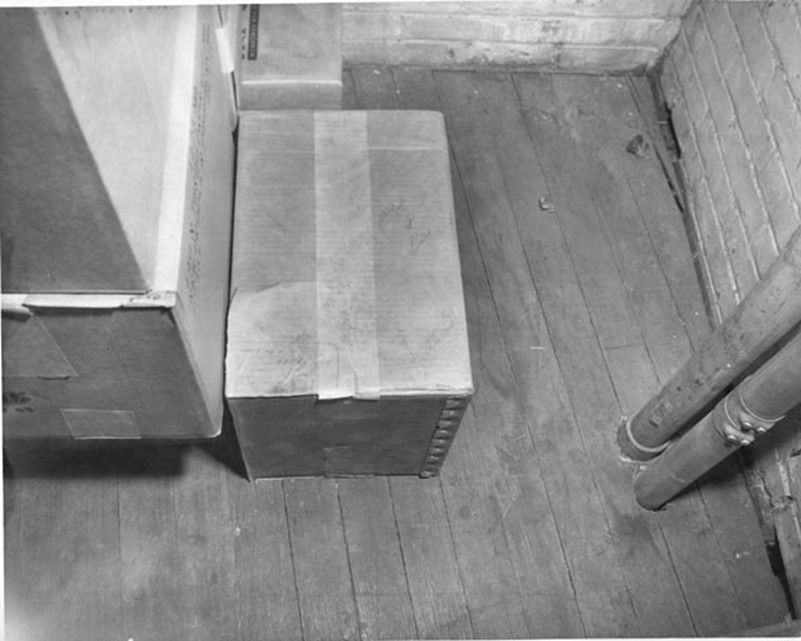
    The Commission’s conclusion that the bag was used as a container for the rifle forms a crucial part of their case against Lee Oswald. However, this assumption is called into question by expert testimony that is present in the record.

    Special Agent James Cadigan, who conducted an examination of the bag for the FBI, presented starkly contrasting findings. According to Cadigan’s testimony,

    Melvin Eisenberg – “Mr. Cadigan, did you notice when you looked at the bag whether there were—that is the bag found on the sixth floor, Exhibit 142–whether it had any bulges or unusual creases?”

    James Cadigan – “I was also requested at that time to examine the bag to determine if there were any significant markings or scratches or abrasions or anything by which it could be associated with the rifle, Commission Exhibit 139 [Mannlicher-Carcano], that is, could I find any markings that I could tie to that rifle?”

    Melvin Eisenberg – “Yes.”

    James Cadigan – “And I couldn’t find any such markings.” (Volume IV; p. 97)

    This testimony from a qualified expert undermines the Commission’s claim that the bag can be linked definitively to the rifle.

    Considering these testimonial inconsistencies, it becomes evident that the Commission’s assertion relies heavily on the mere presence of the bag, without substantiating physical evidence to support its intended use. 5. In a correspondence this researcher had with Buell Wesley Frazier in April of 2021, I asked Mr. Frazier:

    Johnny Cairns. ”On 11/21/63 prior to, during or after you gave Lee Oswald a ride back to Irving, did you observe at any time Lee with a brown paper bag? Or materials to construct a brown paper bag?”

    Buell Wesley Frazier. “No I did not.” (Personal Correspondence)


    6. Inconsistencies in the witness testimony regarding the bag add another layer of uncertainty. When witness accounts vary or contradict one another, it becomes challenging to establish a clear and coherent narrative supporting the bag’s significance as evidence. (No Case To Answer, p.173-214)


    7. Oswald’s partial prints.

    Commission Conclusion. “Oswald’s fingerprint and palmprint found on bag “(WCR; p. 135)

    The inception of CE142 and Oswald’s ‘handling ‘of it raise further troubling questions. It is important to note that the partial prints on the bag, even if genuine, do not provide conclusive evidence that Oswald constructed the bag or carried it on the day of the assassination. These prints alone are insufficient to establish Oswald’s guilt beyond a reasonable doubt.

    Furthermore, the evidence presented in my previous points cast serious aspersions on the CE142 and raises serious doubts about its relevance to the assassination of President Kennedy. This further undermines the significance of the partial prints found on the bag.

    In light of these considerations, it is essential to exercise caution when drawing conclusions solely based on the presence of partial prints on CE142. The partial prints alone do not provide definitive evidence of Oswald’s involvement in the construction or use of the bag on the day of the assassination.


    8. The Greasy-less Prints? “The firing pin and spring of this weapon are well oiled. No oil has been applied to this weapon by the FBI. Numerous shots have been fired with the weapon in its present well-oiled condition as shown by the presence of residues on the interior surfaces of the bolt and on the firing pin.” (Volume XXVI; p. 455.)

    The Warren Commission’s assertion of Oswald’s guilt necessitates the assumption that he engaged in the assembly of the well-oiled Carcano. However, that assumption raises serious doubts with regards to the evidence in this case. For example, the complete lack of any oil or grease residue on Oswald’s hands, the lack of visible oil transfer, from the Carcano, onto the surrounding objects within the ‘snipers nest’, the condition of the wooden floor, devoid of any oil stains and the inexplicable absence of Oswald’s greasy, oily fingerprints make the Commissions assertions highly improbable. What is the likelihood that Oswald in handling the lubricated components of the Carcano, neglected to leave behind any greasy, oily fingerprints at the crime scene?

    The extensive manipulation and shifting through of the rifles various components, within a confined space further intensity’s the scepticism surrounding the absence of any oil transfer from the Carcano to Oswald. Assembling the Carcano in such close quarters would have undoubtedly made it extremely difficult for Oswald to handle it without unintentionally coming into contact with its well-oiled parts.

    Also, the absence of any oil on the wooden floor in the vicinity of Oswald’s alleged assembly and handling of the Carcano is a significant conundrum. With the rifle, well-oiled, it is reasonable to assume that some oil would have dripped or splattered onto the wooden floor during the assembly. Especially, when it is assumed, Oswald emptied the contents of the ‘paper sack’ onto the floor to assemble the Carcano. The absence of visible oil stains or residue on the wooden floor adds another layer of doubt regarding the purported sequence of events. Wooden floors have a porous nature that would likely absorb or retain oil, making it difficult for oil stains to go unnoticed.

    Had Oswald been given the opportunity to stand trial, it would have been a formidable task for Henry Wade, to prove beyond a reasonable doubt that he had assembled the Carcano on November 22, 1963. The rational deductions outlined above cast reasonable doubt on the case against Oswald.


    54. Accessories After The Fact. The Palm Print Evidence.

    “Few people would be ready to convict a man of murder on the basis of such incomplete investigation or such a dishonest presentation of ‘evidence’. Those who would not send a living man to his death on such a basis must ask themselves whether Oswald should be assigned to history stigmatized as an assassin on grounds that would be inadequate if he were still alive.” Sylvia Meagher.

    Commission Conclusion. “Oswald’s palmprint was on the rifle in a position which shows he handled it while it was disassembled.” (WCR; p. 129.) (Accessories After The Fact; p. 120.)

    1. There are no existing photographs taken at the time of the investigation that clearly show the presence of the palm print on the Mannlicher-Carcano rifle, which is a crucial piece of alleged evidence tying Oswald to the weapon.”

    The absence of contemporaneous photographs cannot be understated. These photos would have served as a critical piece of forensic evidence, capturing the initial state of the palm print on the weapon. Their absence raises questions about the authenticity and handling of this key evidence.

    2. “The print on the gun still remained on there… there were traces of ridges still on the gun barrel.” (J.C. Day, Dallas Police)

    Contrary to Day’s account, FBI Fingerprint Expert Sebastian Latona testified that he couldn’t develop any prints on the weapon. “I was not successful in developing any prints at all on the weapon.” (Sebastian Letona, FBI, Volume. IV, p. 23)

    Paul Stombaugh of the FBI observed that the gun had been dusted for latent fingerprints prior to his receiving it, with powder visible all over the gun.

    “I noticed immediately upon receiving the gun that this gun had been dusted for latent fingerprints prior to my receiving it. Latent fingerprints powder was all over the gun.” (Accessories After The Fact; p.121)

    Sylvia Meagher, in her book, questioned the discrepancy between the survival of the dusting powder during the gun’s transit from Dallas to Washington, and the complete disappearance of traces of powder and dry ridges claimed to be present around the palm print on the gun barrel.

    “How could powder survive on the gun from Dallas to Washington, but every single trace of powder and the dry ridges which were present around the palm print on the gun barrel under the stock vanish?” (Accessories After The Fact; p.122)


    3. “Lt. DAY stated he had no assistance when working with the prints on the rifle, and he and he alone did the examination and the lifting of the palm print from the underside of the barrel of the rifle which had been found on the sixth floor of the Texas School Book Depository on November 22, 1963.” (Volume XXV; p. 832.)


    4. Even the Commission harboured significant doubts about the belated discovery of the palm print on the rifle. A memorandum from the FBI, dated August 26, 1964, addressing this uncertainty, states:

    “There was a serious question in the minds of the Commission as to whether or not the palm impression which had been obtained by the Dallas Police Department is a legitimate latent palm impression removed from the rifle barrel or whether it was obtained from some other source and for this reason this matter needs to be resolved.”   Follow this link.


    “Go No Further With The Processing”

    Partial prints discovered on the exterior of the rifle were photographed by Lt Day. However, the FBI determined that these prints held no evidentiary value. According to Day, he captured these photographs at approximately 8 p.m. on November 22, 1963.

    Day testified that he neglected to photograph ‘Oswalds’ latent palm print due to explicit instructions he received from Dallas Police Chief Jesse Curry, who ordered him to cease further processing the Carcano. However, during an interview with the FBI, Day stated that he received these orders from Curry shortly before midnight. Therefore, based on his own admission, Day had nearly four hours between taking the photographs of the external prints and receiving the orders from Curry.

    Given the potential significance of the latent print as critical evidence in Oswald’s trial, it raises the question of why Day chose not to photograph it. It seems likely that he was aware of its importance, making his decision all the more perplexing.

    (Accessories After The Fact; p.122) Follow this link.


    5. On November 22, 1963, Day reportedly informed Chief Curry and Captain Fritz about the discovery of a palm print on the rifle believed to have been used in the assassination of President Kennedy. Day tentatively identified the palm print as belonging to the primary suspect, Lee Oswald. (Meagher, p. 124)

    On November 23rd, when Fritz was asked about the presence of Oswald’s prints on the rifle, he responded with a denial, “No sir”. Similarly, Curry also did not reveal publicly this significant discovery. It was not until November 24th, after Oswald was slain that DA Henry Wade, nonchalantly announced the existence of a palm print found on the rifle.

    Reporter. “What other evidence chief?”

    Henry Wade. “Let’s see, uh. his fingerprints were found on the gun. I said that on the.”

    Reporter. “Which gun?”

    Henry Wade. “The rifle.”

    Reporter. “The rifle fingerprints were his? Oswald’s?”

    Henry Wade. “Yes. A palm print rather than a fingerprint.”

    Reporter. “Wait the palm print… sir the palm print was on the gun?” (the reporter exhibits a completely surprised tone)

    Henry Wade. “Yes”

    Reporter. “Where on the gun? Where on the gun?”

    Henry Wade. “Under the uh… on part of the metal… under the gun.” (Henry Wade, 11/24/63 Press Conference) Follow this link.


    This ‘evidence’ was only disclosed after the Carcano had been returned to Dallas and after Oswald’s death. Considering the gravity of this information, which implicated the main suspect in the assassination, it is perplexing that Fritz, Curry, nor Wade failed to disclose the presence of Oswald’s palm print to the gathered media and television reporters whilst Oswald was alive.


    The State Of The Evidence.

    The palm print evidence cited against Lee Oswald is fraught with significant discrepancies, which seriously undermine its credibility and calls into question the legitimacy of the case against him. Crucially, there are major concerns surrounding the lack of proper chain of custody for this key piece of evidence, thereby casting a shadow over its admissibility and validity in the proceedings.

    A litany of issues plagues this particular evidence. These include the conspicuous absence of crucial photographs, contradictory testimonies that present more questions than answers, and a disturbing lack of corroborative details. Further compounding these problems is the issue of delayed disclosure, which only fuels suspicions and raises more doubts about the way this evidence was handled. In my opinion this evidence reeks of a frame up.


    55. Day’s Admission Of Perjury?

    When requested by the FBI, LT Day specifically declined to sign a sworn affidavit that he had in fact lifted Oswald’s palm print from the barrel of the rifle on the day of the assassination. On that basis alone the print would be inadmissible as evidence in a court of law. (Hear No Evil ; p. 77-78.)


    56. Lt Day Vs FBI Agent Drain.

    Vincent Drain. “I just don’t believe there was ever a print.” Drain noted that there was increasing pressure on the Dallas police to build evidence in the case. Asked to explain what might have happened, Agent Drain said, “All I can figure is that it (Oswald’s print) was some sort of cushion because they were getting a lot of heat by Sunday night. You could take the print off Oswald’s card and put it on the rifle. Something like this happened.” (Reasonable Doubt; p. 109)


    57. Agents Descend On Millers Funeral Home.

    Mortician Paul Groody, who was in charge at Millers Funeral Home, was busy preparing Oswald’s remains for burial when agents arrived in the early hours of 11/25/63 to fingerprint the deceased Oswald.

    Groody stated:” I had gotten to the funeral home with his body something in the neighbourhood of 11 o’clock at night and it is a several hour procedure to prepare the remains and after this time some-place in the early early morning agents came. Now I say agents because I am not familiar at this moment with whether they were Secret Service or FBI or what they were, but agents did come and when they did come, they fingerprinted and the only reason we knew that they did, they were carrying a satchel and the equipment and ask us if they might have the preparation room to themselves. And after it was all over, we found ink on Lee Harvey’s hands showing that they had fingerprinted him, and palm printed him. We had to take that ink back off in order to prepare him for burial and to eliminate that ink” Skip to 3:00:40 Follow this link.


    58. Commission Exhibit 399.

    “The truth has no defense against a fool determined to believe a lie.” Mark Twain.

    Commission Conclusion. “A nearly whole bullet was found on Governor Connolly’s stretcher” (WCR; p. 557.)

    What Is Chain Of Custody? Chain of custody is a crucial concept in legal proceedings that refers to the process of maintaining and documenting the handling of evidence. This starts at the moment the evidence is collected at the crime scene and continues through to its presentation in court. The purpose of this process is to protect the evidence from tampering, contamination, or mishandling, and to provide a documented history of its management and control.

    With this in mind, how would Henry Wade have legitimised CE399 in a court of law? It would have been imperative for Wade to establish a robust chain of custody for CE 399 proving its legitimacy. This would involve providing documented evidence of every individual who handled the bullet, from its alleged discovery at Parkland Hospital to its transportation and subsequent analysis at the FBI crime lab in Washington, and ultimately to its presentation in court.

    In essence, Wade would need to convincingly demonstrate to a jury that CE 399 was the same bullet discovered at Parkland, that it was handled and stored properly at all times, and that it is indeed the bullet that caused the non-fatal wounds to President Kennedy and Governor Connally, as per the single-bullet theory. Establishing a solid chain of custody would be paramount to achieving this. Follow this link.


    Darrell C. Tomlinson. First Link In The Custody Chain.

    Darrell C. Tomlinson, senior engineer, Parkland Hospital: Discovered bullet on a stretcher in a corridor of the hospital emergency area between 1:00 and 1:50 p.m, November 22, 1963. Called O. P. Wright and pointed out bullet. Tomlinson testifies but is asked very little about his finding of the bullet; and nothing about its appearance or his handling and disposition of it. Unlike most other hospital personnel, no written report covering his activities appears in evidence.

    According to CE2011, a document from the FBI located within the Warren Commission Volumes, “Darrell C. Tomlinson was shown Exhibit C1 (CE 399), a rifle slug, by Special Agent Bardwell D. Odum, Federal Bureau of Investigation. Tomlinson stated it appears to be the same one he found on a hospital carriage at Parkland Hospital on November 22, 1963, but he cannot positively identify the bullet as the one he found and showed to O.P. Wright.” (Volume XXIV; p. 412)

    During his Commission testimony Tomlinson is not presented with CE399 and asked to identify it as the bullet he discovered on 11/22/63.


    O.P. Wright. Second Link In The Custody Chain.

    O.P. Wright, Personnel Officer, Parkland Hospital: Received bullet from Tomlinson; or removed it from stretcher after it was pointed out by Tomlinson 1:00-1:50p.m., November 22. Gave it to Richard E. Johnsen shortly thereafter. (Wright not called to testify. No direct statement from him in evidence referring to bullet. He failed to mention it in lengthy report, to hospital administrator, concerning his activities November 22- November 25 (1963), although detailing his handling of President Kennedy’s wristwatch.

    According to CE2011, “O.P. Wright, advised Special Agent Bardwell D. Odum that Exhibit C1 (CE 399), a rifle slug, shown to him at the time of the interview, looks like the slug found at Parkland Hospital on November 22, 1963. He advised he could not positively identify (CE 399) as being the same bullet which was found on November 22, 1963.”

    However, in November of 1966, Josiah Thompson, author of “Six Seconds in Dallas”, undertook a pivotal investigation at Parkland, where he met with Darrell C. Tomlinson and O.P. Wright. These two figures were integral to his objective: to meticulously reconstruct the circumstances surrounding Tomlinson’s discovery of the so-called “stretcher bullet”.

    Guided by Tomlinson and Wright, Thompson endeavoured to re-enact the precise sequence of events that led to the discovery of ‘CE399 at Parkland’. To facilitate this re-enactment, Wright provided Thompson with a prop .30 calibre projectile as a stand-in for ‘399’. During their interaction, Thompson asked Wright to describe the bullet he had obtained from Tomlinson on November 22, 1963. Wright described the projectile as having a “pointed tip” and suggested that it looked similar to “the one you got there in your hand”.

    This characterisation from Wright starkly contrasts the appearance of CE 399. When presented with a photograph of CE 399, along with CE 572 (bullets similar to those from Oswald’s alleged rifle) and CE 606 (bullets similar to those from Oswald’s alleged revolver), Wright rejected them all. None of them resembled the bullet Tomlinson had discovered on a stretcher that day.

    Upon conclusion of their meeting, Thompson recounted a moment that further cast doubt on 399. As he prepared to leave Parkland, Wright approached him with the statement “Say, that single bullet photo you kept showing me… was that the one that was supposed to have been found here?” To which Thompson affirmed, “Yes.” Wright’s response, a simple “Uh…huh,” was delivered with an expressionless face before he turned and returned to his office.

    Thompson interpreted this interaction as a tacit rejection of CE 399 as the bullet Tomlinson handed over to Wright that day.

    Adding to this ambiguity, a declassified document “dated June 20, 1964, from Gordon Shankland, SAC Dallas, to FBI Director J. Edgar Hoover, confirms: “Neither Parkland’s DARRELL C. TOMLINSON nor O. P. WRIGHT can identify this bullet.” which of course contradicts the information in CE2011. (The Bastard Bullet; p.38. Volume XXIV; p 412.Last Seconds In Dallas, Page 24/26).  Follow this link.

    The inability of both Wright and Tomlinson to definitively identify CE 399 as the bullet they handled that day casts serious doubt over its credibility as evidence.


    Richard E Johnsen. Special Agent, U.S Secret Service. Third Link In The Custody Chain.

    The ambiguity surrounding CE 399 continued within the Secret Service’s custody chain. Agent Johnsen received bullet from O.P. Wright at Parkland shortly before 2:00p.m., November 22,1963. Transmitted to James Rowley same day. “On June 24, 1964, Special Agent Richard E. Johnsen, United States Secret Service, Washington, D.C., was shown Exhibit C1 (CE 399), a rifle bullet, by Special Agent Elmer Lee Todd, Federal Bureau of Investigation. Johnson advised he could not identify this bullet as the one he obtained from O. P. Wright, Parkland Hospital, Dallas Texas, and gave to James Rowley, Chief, United States Secret Service, Washington D.C., on November 22, 1963.” Agent Johnsen was not called to testify. (Commission Exhibit 2011, Volume XXIV, p. 412, The Bastard Bullet; p.38)


    James. J. Rowley. Chief, U.S. Secret Service. Fourth Link In The Custody Chain.

    “Received bullet from Johnsen on November 22, 1963. Gave it to FBI Special Agent Todd same day. Rowley testifies July 7th,1964, but is not asked anything about the bullet. No written statement from him concerning his possession of it. On June 24, 1964, James Rowley, Chief, United States Secret Service, Washington, D.C., was shown exhibit C1(CE 399), a rifle bullet, by Special Agent Elmer Lee Todd. Rowley advised he could not identify this bullet as the one he had received from Special Agent Richard E. Johnson and gave to Special Agent Todd on November 22, 1963”. (The Bastard Bullet; p 38. Commission Exhibit 2011, Volume XXIV, p. 412)

    Elmer Lee Todd. Special Agent. FBI. Fifth Link In The Custody Chain.

    Received bullet from Rowley in Washington, D.C., November 221963. Upon receipt, Todd marked bullet with initials at FBI Investigation Laboratory. Gave it to Robert A. Frazier same day. In 1964, Special Agent Elmer Lee Todd, identified C1 (CE 399), a rifle bullet, as the same one he had received from James Rowley, Chief of the United States Secret Service, on November 22, 1963. This identification was based on his own marked initials on the bullet upon its receipt at the FBI Laboratory.”


    Robert Frazier. Firearms Identification Expert, FBI. Sixth Link In Custody Chain.

    “Received bullet from Todd in FBI laboratory, Washington, D.C., November 22, 1963. Frazier put his initials on it.” However according to Robert Frazier’s detailed notes, 399 was transferred into his custody by Special Agent Elmer Lee Todd at 7:30 p.m. on November 22, 1963. However, an examination of the envelope filled out by Agent Todd, documenting the transfer from Rowley, reveals that he did not receive the bullet from Rowley until 8:50 p.m. on 11/22/63. This clear discrepancy of 1:20:00 calls into question the authenticity and validity of the bullet’s chain of custody. The chronology here is of paramount importance.

    If Frazier’s notes are accurate, how could Todd have passed the bullet onto him at 7:30 p.m. when he documented that he only received it from Chief Rowley at 8:50 p.m.? (The Bastard Bullet; p. 38. JFK Lancer)


    John F. Gallagher, spectrographer, Special Agent, FBI.

    “Made spectrographic examination of bullet, (date not given, but apparently prior to March 31, 1966) No written statement from Gallagher appears in evidence. He was not called to testify until September 15, 1964, less than two weeks prior to publication of the Warren Commission Report. His entire seven-page testimony is taken up with a discussion of neutron activation analysis, as it pertains to determination of whether or not an individual has fired a weapon. (Practice has been exposed as junk science) Counsel Norman Redlich failed to ask Gallagher a single question regarding his spectrographic examination of bullet 399.” (The Bastard Bullet;p. 39/39) Follow this linkand  and this link.

    Melvin A. Eisenberg, assistant counsel, Warren Commission: “Received bullet from FBI in Washington, D.C., March 24, 1964. Transmitted to Joseph D. Nichol same day”. (The Bastard Bullet; p. 39)

    Joseph D. Nichol, Superintendent, Bureau Of Criminal Identification, State Of Illinois. Received bullet 399 from Eisenberg in latter’s office, together with other bullets and fragments, Washington, D.C., March 24th, 1964. Made ballistics comparisons with other bullets and fragments. Date not given for return of 399 to FBI custody. Nicol testifies April 1, 1964. Counsel Eisenberg failed to ask his opinion as to whether or not 399 could have caused Governor Connally’s wounds. (The Bastard Bullet; p. 40)

    Bardwell D. Odum, Special Agent, FBI. On June 24, 1964, he is alleged to have shown bullet 399 to Tomlinson and Wright. Odum not called to testify. No direct written statement from him appears in evidence covering his June 12 interviews with Tomlinson and Wright. His written report on unrelated matter, date July 10, 1964, is presented in evidence.

    In 2002 Gary Aguilar and Josiah Thompson approached retired FBI Special Agent Bardwell Odum to review some crucial documents, including CE 2011. Odum expressed surprise and denial over his involvement with CE 399. “I didn’t show it to anybody at Parkland. I didn’t even have any bullet. I don’t know where you got that from, but it is wrong. Mr. Odum remarked that he doubted he would have ever forgotten investigating so important a piece of evidence. But even if he had done the work, and later forgotten about it, he said he would certainly have turned in a “302” report covering something that important. There is no 302 report from Odum in the record. (The Bastard Bullet; p. 40)  Follow this link.

    Elmer Lee Todd. Special Agent, FBI. On June 24, 1964, he showed bullet 399 to Johnsen and Rowley. Todd not called to testify. No direct written statement from him appears in evidence concerning his June 24 interviews with Johnsen and Rowley. (The Bastard Bullet; p. 41)


    Which Stretcher? Connelly or Fuller.

    Commission Conclusion. “Although Tomlinson was not certain whether the bullet came from Connally’s stretcher or the adjacent one, the Commission has concluded that the bullet came from the Governor’s stretcher.” (WCR; p. 81)


    Evidence In The Record Which Refutes Commission Conclusion.

    During his testimony to the Warren Commission, Tomlinson gave a description of the stretcher that he took off the elevator at Parkland.
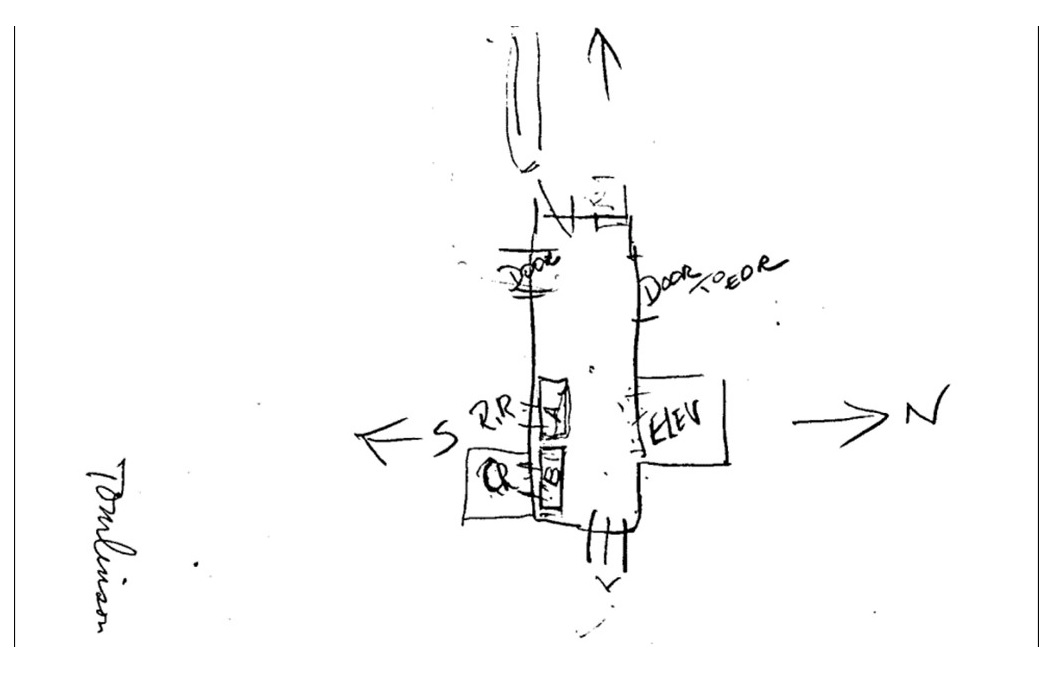
    Arlen Specter. “Was there anything on the elevator at that time?”

    Darrell Tomlinson. “There was one stretcher.” Arlen Specter. “And describe the appearance of that stretcher, if you will, please.” Darrell Tomlinson. “I believe that stretcher had sheets on it and had a white covering on the pad.” (Volume VI; p. 129)


    Tomlinson’s description of the stretcher is collaborated by R. J. Jimison, an orderly at Parkland. Who testified to the Warren Commission that:

    R. J. Jimison. “I came along and pushed it [ Connally’s stretcher] onto the elevator myself and loaded it on and pushed the door closed.

    Arlen Specter. “What was on the stretcher at that time?”

    R. J. Jimison. “I noticed nothing more than a little flat mattress and two sheets as usual.” (Volume VI; p. 126)


    Tomlinson then testifies to his initial discovery of the bullet and which stretcher he believed the bullet was found on.

    Darrell Tomlinson. I pushed it back up against the wall.

    Arlen Specter. What, if anything, happened then?

    Darrell Tomlinson. I bumped the wall and a spent cartridge or bullet rolled out that apparently had been lodged under the edge of the mat.

    Arlen Specter. And that was from which stretcher?

    Darrell Tomlinson. I believe that it was “B”.

    Arlen Specter. And what was on “B”, if you recall; if anything?

    Darrell Tomlinson. Well, at one end they had one or two sheets rolled up; I didn’t examine them. They were bloody. They were rolled up on the east end of it and there were a few surgical instruments on the opposite end and a sterile pack or so. (Volume VI; p. 130/131)

    In the following testimony, Specter appears to engage in a strategy aimed at creating confusion or obfuscating the clarity around which stretcher the bullet was found on. He seemingly contradicts Tomlinson’s assertion that the bullet was discovered on stretcher B, attempting to steer the testimony towards an affirmation that the bullet was instead found on stretcher A.

    This attempt could be interpreted as a deliberate strategy to realign Tomlinson’s account with a predetermined narrative that supports the Commission’s conclusion. Essentially, Specter might be trying to manipulate Tomlinson’s testimony to fit a particular storyline rather than objectively following the evidence presented.

    Arlen Specter. “And at that time, we started our discussion, it was your recollection at that point that the bullet came off of stretcher A, was it not?”

    Darrell Tomlinson. “B.”

    Arlen Specter. “Pardon me, stretcher B, but it was stretcher A that you took off of the elevator.” (Volume VI; p.131)

    Experiencing clear frustration with Specter’s line of questioning, Tomlinson reiterated the sequence of events leading to his discovery of the bullet. What is noteworthy about this portion of his testimony is Tomlinson’s confirmation that both stretchers A and B were left unattended and unprotected at the elevator at the Emergency Department. This lack of security presented a substantial window of opportunity for anyone with access to manipulate the evidence on the stretchers, either by removing or adding items. Consequently, this throws into sharp relief the credibility and integrity of any evidence collected from the stretchers at Parkland Hospital on November 22, 1963.

    Darrell Tomlinson. Here’s the deal– I rolled that thing off, we got a call, and went to second floor, picked the man up and brought him down. He went on over across, to clear out of the emergency area, but across from it, and picked up two pints of, I believe it was, blood. He told me to hold for him, he had to get right back to the operating room, so I held, and the minute he hit there, we took off for the second floor and I came, back to the ground. Now, I don’t know how many people went through that-I don’t know how many people hit them- I don’t know anything about what could have happened to them in between the time I was gone, and I made several trips before I discovered the bullet on the end of it there. (Volume VI; p.132/133)

    Secret Service Agent Johnsen communicates Wright’s account of the characteristics of the stretcher where the bullet was found:

    Richard E. Johnsen, Commission Exhibit 1024. November 22, 1963, 7:30 pm.

    “The attached expended bullet was received by me about 5 min., prior to Mrs. Kennedy’s departure from the hospital. It was found on one of the stretchers located in the emergency ward of the hospital. Also on this stretcher was rubber gloves, a stethoscope and other doctors’ paraphernalia. It could not be determined who used this stretcher or if President Kennedy had occupied it. No further information obtained. Name of person from who I received this bullet: Mr O.P. Wright. Personnel Director of Security. Dallas County Hospital District. By Richard E Johnsen. Special Agent. 7:30pm. Nov 22, 1963.”


    Richard E. Johnsen to Chief James Rowley. “The only information I was able to get from Wright prior to departure of Mrs. Kennedy and the casket was that the bullet had been found on a stretcher which President Kennedy may have been placed on. He also stated that he found rubber gloves, a stethoscope, and other doctors’ paraphernalia on this same stretcher. CE1024. (Volume XVIII; p. 798-800)

    In November 1966, Wright reaffirmed this description of stretcher B to Tink Thompson. Wright also verified “that the stretcher on which the bullet rested was the one in the corner—the one blocking the men’s room door.” (Six Seconds In Dallas; p. 156)

    Ronald Fuller. Ronnie Fuller was received at Parkland Hospital’s Emergency Department around 12:54pm on November 22, 1963. The toddler, aged two and a half years, had sustained an injury to his chin, “which was bleeding profusely. Fuller was placed on a stretcher in the hallway near the nurse’s station before being carried to Major Medicine. Fullers’ stretcher was described as having sheets which were soiled in blood. Rosa Majors told Tink Thompson that she and Era Lumpkin had used gauze pads to clean the child, that either she or Era had been wearing rubber gloves, and that Era had a stethoscope. She cannot remember what happened to this equipment… but it was possible that it was left behind on the stretcher when the two aides carried Ronald Fuller into Major Medicine.” (Six Seconds In Dallas; p. 161/164.)

    Rosa Majors, Nurse Aid Parkland Hospital. Told Tink Thompson that while in trauma room 2 “she removed the Governor’s trousers, shoes, and socks. After removing his trousers, she held them up and went through the pockets for valuables. Had a bullet fallen out of the Governor’s thigh, it would have been trapped in his trousers. When Rosa held them up, any such bullet should have fallen out and been discovered at that time. Rosa told Thompson she never saw any bullet while she was caring for Governor Connally. Much later she heard that a bullet was supposed to have been found on his stretcher. Rosa can’t conceive where such a bullet could have come from.” (Six Seconds In Dallas; p.159)


    The Condition Of CE399.

    Commission Conclusion: “The stretcher bullet weighed 158.6 grains, or several grains less than the average Western Cartridge Co. 6.5mm Mannlicher Carcano bullet. It was slightly flattened, but otherwise unmutilated.” (WCR; p. 557)

    399 is purported to be responsible for inflicting seven non-fatal wounds on both President Kennedy and Governor Connally. According to the Commission

    1. The bullet penetrated President Kennedy’s upper back, traversing through his body. 2. It then emerged from President Kennedy’s throat, just below the Adam’s apple, creating an exit wound. 3. Continuing its trajectory, the bullet entered Governor Connally’s back, near his right armpit, passing through his body. 4. In the process, it shattered several inches of his fifth rib on the right side before exiting his chest. 5. The same bullet is then believed to have passed through Connally’s right wrist, fracturing the distal radius bone. 6. Finally, it lodged itself into Connally’s left thigh, ending its alleged trajectory.

    The following witness testimony is a direct challenge to CE399.

    Dr Robert Shaw. Parkland Hospital. Operated on Gov Connally. “The bullet struck lateral to the shoulder blade. Stripped out approximately 10 cm of the fifth rib, driving fragments of the rib into his chest. Went on and struck his radius bone of his lower arm at this point [pointing to wrist] and a small fragment of bullet, entered the inner aspect of the lower left thigh. I have never seen a bullet that caused as much boney damage as you found in the case of Governor Connally remain as a pristine bullet.  Follow this link.

    <strong” target=”_blank”>Dr Robert Shaw.

    Arlen Specter. What is your opinion as to whether bullet 399 could have inflicted all of the wounds on the Governor, then, without respect at this point to the wound of the President’s neck?

    Dr Robert Shaw. I feel that there would be some difficulty in explaining all of the wounds as being inflicted by bullet Exhibit 399 without causing more in the way of loss of substance to the bullet or deformation of the bullet. (Discussion off the record.)

    Dr Charles Gregory. Parkland Hospital. Operated on Gov Connally.

    Arlen Specter. “I call your attention to Commission Exhibit No. 399, which is a bullet and ask you first if you have had an opportunity to examine that earlier today?”

    Dr Charles Gregory. “I have.”

    Arlen Specter. “What opinion, if any, do you have as to whether that bullet could have produced the wound on the Governor’s right wrist and remained as intact as it is at the present time?”

    Dr Charles Gregory. “In examining this bullet, I find a small flake has been either knocked off or removed from the rounded end of the missile. I was told that this was removed for the purpose of analysis. The only other deformity which I find is at the base of the missile at the point where it Joined the cartridge carrying the powder, I presume, and this is somewhat flattened and deflected, distorted. There is some irregularity of the darker metal within which I presume to represent lead. The only way that this missile could have produced this wound in my view, was to have entered the wrist backward.” (Volume IV; P. 121)


    Commander James Humes, Autopsy Pathologist.

    Arlen Specter. “Now looking at that bullet, Exhibit 399, Doctor Humes…could that missile have made the wound on Governor Connally’s right wrist?”

    Commander James Humes. “I think that that is most unlikely…Also going to Exhibit 392, the report from Parkland Hospital, the following sentence referring to the examination of the wound of the wrist is found: Small bits of metal were encountered at various levels throughout the wound, and these were, wherever they were identified and could be picked up, picked up and submitted to the pathology department for identification and examination. The reason I believe it most unlikely that this missile could have inflicted either of these wounds is that this missile is basically intact; its jacket appears to me to be intact, and I do not understand how it could possibly have left fragments in either of these locations.”

    Arlen Specter. “Dr. Humes, under your opinion which you have just given us, what effect, if any, would that have on whether this bullet, 399, could have been the one to lodge in Governor Connally’s thigh?”

    Commander James Humes. “I think that extremely unlikely. The reports, again Exhibit 392 from Parkland, tell of an entrance wound on the lower midthigh of the Governor, and X-rays taken there are described as showing metallic fragments in the bone, which apparently by this report were not removed and are still present in Governor Connally’s thigh. I can’t conceive of where they came from this missile.” (Volume II; p 375-376)


    Pierre Finck, Autopsy Patholigist.

    Arlen Specter “And could it [CE399] have been the bullet which inflicted the wound on Governor Connally’s right wrist?”

    Pierre Finck. “No; for the reason that there are too many fragments described in that wrist.” (Volume II; p. 382)

    Despite the extensive damage described in the above testimonies, the bullet itself remained remarkably clean, as confirmed by Special Agent Robert Frazier:

    Melvin Eisenberg. “Did you prepare the bullet in any way for examination? that is, did you clean it or in any way alter it?”

    Robert Frazier. “No, sir; it was not necessary. The bullet was clean and it was not necessary to change it in any way.”

    Melvin Eisenberg. “There was no blood or similar material on the bullet when you received it?”

    Robert Frazier. “Not any which would interfere with the examination, no, sir. Now there may have been slight traces which could have been removed just in ordinary handling, but it wasn’t necessary to actually clean blood or tissue off the bullet.” (Volume III; p. 128-129)

    However, blood was retained on two fragments alleged to have been found within the Presidential limousine, CE 567&569.

    Melvin Eisenberg. “Getting back to the two bullet fragments mentioned, Mr. Frazier, did you alter them in any way after they had been received in the laboratory, by way of cleaning or otherwise?”

    Robert Frazier. “No, sir; there was a very slight residue of blood or some other material adhering, but it did not interfere with the examination. It was wiped off to clean up the bullet for examination, but it actually would not have been necessary.” (Volume III; p.437)


    How would Henry Wade have gotten CE399 into evidence? Taking into account all the evidence presented, let’s examine the potential issues Henry Wade might have encountered in attempting to admit CE399 into evidence. Each point will highlight significant inconsistencies and flaws that would seriously challenge the prosecution’s narrative.


    1. Which Stretcher? There is considerable ambiguity regarding which stretcher the bullet was found on. Tomlinson, the person who discovered the bullet, stated that he thought he had found it on stretcher B, whereas the Warren Commission concluded it came from Governor Connally’s stretcher (stretcher A). Wade would need to prove beyond a reasonable doubt that the bullet was indeed discovered on Connally’s stretcher, despite the contradictory testimony.

    2. Unsecured and Unattended Stretcher. Tomlinson’s testimony highlights that both stretchers A and B were left unattended and unsecured at the hospital elevator. This creates an opportunity for tampering, casting serious doubt on the integrity and reliability of any evidence found on these stretchers.

    3. Bullet Identification. Wade would face significant difficulties in establishing a clear chain of custody for the bullet (CE399). Key figures including Tomlinson, Wright, Agent Johnsen, and Chief Rowley, could not definitively identify CE399 as the bullet they handled. In fact, Wright, retired Dallas Police Officer, flat out rejected it as the bullet he had obtained from Tomlinson. The only person who could identify it, prior to its arrival at the FBI Lab was Special Agent Todd, who had conflicting documentation about the timing of the bullet’s retrieval.

    4. Timing Discrepancy. This inconsistency between the times documented by Todd and Frazier further undermines the credibility of CE399 as a key piece of evidence. Todd noted the retrieval time as 8:50pm on 11/22/63, whereas Frazier claimed he received the bullet at 7:30pm the same day.

    5. Lack of Physical Evidence. There’s a lack of physical evidence linking the bullet to Governor Connally. Nurse Aid Rosa Majors, who removed the Governor’s clothing, did not find any bullet when she went through the Governor’s pockets. Had a bullet fallen out of the Governor’s thigh, it would have been trapped in his trousers This brings into question the very presence of the bullet on Connally’s stretcher.

    6. Unnoticed Bullet. It seems implausible that the bullet, if indeed it was on the stretcher from the start, would have gone unnoticed throughout Connally’s medical treatment. Governor Connally was moved from the limousine to the stretcher, brought to Trauma Room 2, had his clothing removed, was transported to the second-floor operating theatre, and then transferred to an operating table. It’s highly unlikely that through all these movements and transitions, a bullet would not only remain undetected but also not fall off the stretcher. Additionally, the noise of a bullet rattling on a metal stretcher as it was moved across different floors of the hospital is something that should have drawn attention.

    7. No Witnesses to Falling Bullet. It’s also worth questioning why there were no eyewitness accounts of the bullet falling from Connally during his movement and treatment. If the bullet had been lodged in his body, the multiple movements and handling would have provided ample opportunity for it to dislodge and fall out in clear view of the medical personnel present. The absence of any such observations raises further doubts about the presence of the bullet on Connally’s stretcher.

    8. The Condition of CE399. Despite causing seven non-fatal wounds on both President Kennedy and Governor Connally, including significant bone damage, 399 was found in relatively pristine condition. As noted in the Commission Conclusion, the “stretcher bullet” weighed only several grains less than a standard 6.5mm Mannlicher Carcano bullet and was slightly flattened, but otherwise unmutilated. This discrepancy was noted by several expert witnesses, including Dr. Robert Shaw, Dr. Charles Gregory, Commander James Humes, and Pierre Finck. Each cast doubt on the ability of CE399 to cause the observed injuries without suffering more substantial deformation or loss of mass. For Henry Wade, the pristine condition of CE399 relative to the extensive physical trauma it allegedly caused would be a significant hurdle in convincing a jury of its role in the sequence of wounds.

    9. Cleanliness of CE399. Another point of contention would be the cleanliness of CE399. Special Agent Robert Frazier confirmed that CE399 was clean upon examination, with no need for removal of blood or tissue. This would be extremely unusual for a bullet that had supposedly passed through two bodies, breaking bone and embedding fragments along its path. This lack of expected biological contamination casts further doubt on the bullet’s history and raises questions about the official narrative.

    Additionally, Commission Exhibits (CE) 567 and 569, which are bullet fragments alleged to have been found within the Presidential limousine, were reported to have a residue of blood or some other material adhering to them. This was confirmed by Robert Frazier’s testimony, stating that there was a slight residue of blood or some other material on 567 and 569. Despite this residue not interfering with the examination, it was wiped off to clean the bullet for examination. The presence of blood on these fragments, yet its notable absence on CE399, which supposedly passed through two bodies, is an additional challenge to the case’s narrative. If the bullet that caused the wounds to President Kennedy and Governor Connally had been as clean as reported, why would fragments found within the limousine retain blood residues? This discrepancy significantly undermines the credibility of CE399 as the bullet that inflicted the seven wounds. For the prosecution, these questions would significantly complicate efforts to validate the evidentiary value of CE399. The bullet’s unexplained cleanliness would stand as a glaring inconsistency in the narrative of its path through two bodies, thereby undermining the case against Oswald.


    59. CE399, A Hard Act To Fellow.

    Dr Joseph Dolce, Chief Consultant of Wound Ballistics for the US Army, supervised the ballistic test conducted by the Warren Commission. Even though he oversaw the Commission’s own ballistics tests, he was not called to give testimony before the Warren Commission. This is what Dr Dolce had to say regarding Commission Exhibit 399: “No it could not have caused all the wounds, because our experiments have showed beyond any doubt that merely shooting the wrist deformed the bullet drastically and yet this bullet [399] came out as almost a perfectly normal pristine bullet… And so, they gave us the original rifle, the Mannlicher Carcano plus 100 bullets, 6.5mm, and we went, and we shot the cadaver wrist as I have just mentioned and in every instance the front or the tip of the bullet was smashed. It’s impossible for bullet to strike a bone, even at low velocity and still come with the perfectly normal tip. The tip of this bullet was absolutely not deformed in no instance whatsoever, in no amount. Under no circumstances do I feel that this bullet [399] could hit the wrist and still not be deformed. We proved that by experiments.”  Skip to 42:17 Skipto 42:17 in video.
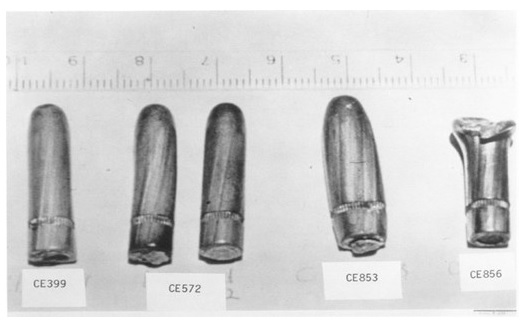
    CE399=Magic Bullet. CE572=Cotton Wadding CE853=Goat CE856=Cadaver Wrist.

    60. CE543, The Dented Lip.

    “There were no shells dented in that manner by the HSCA…I have never seen a case dented like this.” Howard Donahue.  Follow this link.

    The discovery of three spent shells on the sixth-floor post-assassination raised significant questions, and notably, CE 543 stands out as a considerable anomaly in the Commission’s claim that a lone gunman fired three shots at President Kennedy.

    In his compelling and meticulously researched article, “The Dented Bullet Shell: Hard Evidence Of Conspiracy In The JFK Assassination,” Michael T. Griffith sheds light on the dubious authenticity of CE 543 as a piece of evidence from the day of the assassination.

    He cites the insights of fellow researcher Dr. Michael Kurtz, who asserts unequivocally, “CE 543 could not have fired a bullet on the day of the assassination. Moreover, it could not have been discharged from the rifle that Oswald allegedly utilized.”

    In the book I coauthored, ”Case Not Closed”, I sought comment upon CE543 from fellow DPUK member Peter Antill. Peter is a weapons enthusiast who shared with me, his opinion regarding the complexities and irregularities presented by CE543. Antill’s analysis revealed that “One of the more striking characteristics of CE 543 is a significant inward-facing dent in the case lip. This raises the question of how and when this damage could have occurred.

    “Researchers have experimented in throwing an empty Carcano case against a wall or standing on it but failed to do any damage. However, one researcher inflicted exactly the same damage seen on CE 543 on an empty cartridge case while he was loading it into his own rifle.

    “Firing a round results in both the case and its lip expanding slightly and hence there is an increased chance of the case catching on a lip below where the barrel meets the breach if someone tries to subsequently chamber it.

    “If CE 543 had been a live round, such damage would not have been possible as the bullet would have helped to guide the round smoothly into the chamber. This means that either the damage was done before the assassination (and therefore the case could not have been used that day) or if it occurred during it, it raises the question as to why the shooter would waste time trying to manually chamber an empty case.


    Signs of Being Dry Fired

    “According to CE 2968 (a letter from FBI Director J. Edgar Hoover to Commission Counsel J. Lee Rankin, dated 2 June 1964) CE 543 was found with three sets of marks on the base which were not found on the other cases fired through the Carcano, as well as other marks which indicated it had been loaded into, and extracted from a weapon, at least three times. In addition, CE 543 had a deeper, more concave dent in its primer (where it had been struck by the firing pin), a characteristic found with dry fired cartridge cases. The FBI actually reproduced this effect on CE 557, an empty case dry fired in the Carcano for comparison purposes.


    Marks from the Magazine Follower

    “The only marks that link CE 543 to the Carcano were produced by the magazine follower. These marks are caused by the pressure of the magazine follower on the last round in the clip, which pushes the remaining rounds in the clip upwards as their predecessors are chambered and then ejected from the rifle.

    “When the final round is chambered, the clip falls past the magazine follower and drops out of the bottom of the magazine well. While other cases had similar marks, the point is that these marks could not have been caused by the Carcano’s magazine follower on the day of the assassination as the last round in the clip (CE 141) was unfired and still chambered in the rifle when it was found.


    The Chamber Impression

    “CE 543 lacks a characteristic displayed by all the other cartridge cases (CE 544, CE 545 and CE 577) that have been chambered in the Carcano – a distinct impression along one side. Even CE 141 (the live round), showed a similar, if less pronounced, impression.

    “This was probably because it wasn’t fired – firing (where the case expands slightly) would accentuate any marks or impressions caused by the chamber. If CE 543 is supposed to have been fired in the Carcano, how could it be missing this distinct impression?” (Case Not Closed; p. 141-145)


    Final Summation.

    I wish to conclude my article with a poignant reflection on the hope and loss that defined 1960s America. A profound representation of these conflicting emotions can be found in Robert Kennedy’s speech, ‘The Mindless Menace of Violence.’ This speech not only encapsulates the tragic dichotomy of the era but also continues to resonate today, as it stands as a timeless admonition against violence and a plea for compassion and understanding. It inculpates the fear and brutality that marred that period and yet carries a message of hope, encapsulating the complex spirit of a time that will forever leave its mark on the nation’s history.

    The Mindless Menace of Violence

    “Mr. Chairman, ladies and gentlemen, I speak to you under different circumstances than I had intended to just twenty-four hours ago. For this is a time of shame and a time of sorrow. It is not a day for politics.

    I have saved this one opportunity–my only event of today–to speak briefly to you about the mindless menace of violence in America which again stains our land and every one of our lives. It’s not the concern of any one race. The victims of the violence are black and white, rich and poor, young and old, famous and unknown. They are, most important of all, human beings whom other human beings loved and needed. No one–no matter where he lives or what he does–can be certain whom next will suffer from some senseless act of bloodshed.

    And yet it goes on and on and on in this country of ours. Why? What has violence ever accomplished? What has it ever created? No martyr’s cause has ever been stilled by an assassin’s bullet. No wrongs have ever been righted by riots and civil disorders. A sniper is only a coward, not a hero; and an uncontrolled or uncontrollable mob is only the voice of madness, not the voice of the people. Whenever any American’s life is taken by another American unnecessarily–whether it is done in the name of the law or in defiance of the law, by one man or by a gang, in cold blood or in passion, in an attack of violence or in response to violence–whenever we tear at the fabric of our lives which another man has painfully and clumsily woven for himself and his children–whenever we do this, then the whole nation is degraded.

    “Among free men,” said Abraham Lincoln, “there can be no successful appeal from the ballot to the bullet; and those who take such appeal are sure to lose their case and pay the cost.” Yet we seemingly tolerate a rising level of violence that ignores our common humanity and our claims to civilization alike. We calmly accept newspaper reports of civilian slaughter in far off lands. We glorify killing on movie and television screens and we call it entertainment. We make it easier for men of all shades of sanity to acquire weapons and ammunition that they desire. Too often we honor swagger and bluster and the wielders of force. Too often we excuse those who are willing to build their own lives on the shattered dreams of other human beings. Some Americans who preach nonviolence abroad fail to practice it here at home.

    Some who accuse others of rioting, and inciting riots, have by their own conduct invited them. Some look for scapegoats; others look for conspiracies. But this much is clear: violence breeds violence; repression breeds retaliation; and only a cleansing of our whole society can remove this sickness from our souls. For there is another kind of violence, slower but just as deadly, destructive as the shot or the bomb in the night. This is the violence of institutions–indifference, inaction, and decay.

    This is the violence that afflicts the poor, that poisons relations between men because their skin has different colors. This is a slow destruction of a child by hunger, and schools without books, and homes without heat in the winter. This is the breaking of a man’s spirit by denying him the chance to stand as a father and as a man amongst other men. And this too afflicts us all. For when you teach a man to hate and to fear his brother, when you teach that he is a lesser man because of his color or his beliefs or the policies that he pursues, when you teach that those who differ from you threaten your freedom or your job or your home or your family, then you also learn to confront others not as fellow citizens but as enemies–to be met not with cooperation but with conquest, to be subjugated and to be mastered.

    We learn, at the last, to look at our brothers as alien, alien men with whom we share a city, but not a community, men bound to us in common dwelling, but not in a common effort. We learn to share only a common fear–only a common desire to retreat from each other–only a common impulse to meet disagreement with force. For all this there are no final answers for those of us who are American citizens. Yet we know what we must do, and that is to achieve true justice among all of our fellow citizens.

    The question is not what programs we should seek to enact. The question is whether we can find in our own midst and in our own hearts that leadership of humane purpose that will recognize the terrible truths of our existence. We must admit the vanity of our false distinctions, the false distinctions among men, and learn to find our own advancement in search for the advancement of all. We must admit to ourselves that our children’s future cannot be built on the misfortune of another’s. We must recognize that this short life can neither be ennobled or enriched by hatred or by revenge.

    Our lives on this planet are too short, the work to be done is too great to let this spirit flourish any longer in this land of ours.

    Of course we cannot banish it with a program, nor with a resolution. But we can perhaps remember–if only for a time–that those who live with us are our brothers, that they share with us the same short moment of life, that they seek–as do we–nothing but the chance to live out their lives in purpose and in happiness, winning what satisfaction and fulfillment that they can.

    Surely this bond of common fate, surely this bond of common goals can begin to teach us something. Surely we can learn, at the least, to look around at those of us, of our fellow man, and surely we can begin to work a little harder to bind up the wounds among us and to become in our hearts brothers and countrymen once again. Tennyson wrote in Ulysses: that which we are, we are; one equal temper of heroic hearts, made weak by time and fate, but strong in will; to strive, to seek, to find, and not to yield. Thank you very much.” – Robert Francis Kennedy.  Follow this link.


    Go to Part 1 of 6

    Go to Part 2 of 6

    Go to Part 3 of 6

    Go to Part 4 of 6

    Go to Part 5 of 6

  • Part 3 of 6: The Contamination of Evidence, the Inadmissible Lineups and the Autopsy

    Part 3 of 6: The Contamination of Evidence, the Inadmissible Lineups and the Autopsy


    21. Marina’s Credibility.

    The issue of Marina Oswald’s credibility and the evidence suggesting inconsistencies in her testimony is a matter of significant interest. The available evidence, which includes a declassified letter from Freda Scobey and a report from the House Select Committee on Assassinations (HSCA), presents concerns regarding the reliability of Marina’s statements.

    In a declassified letter from attorney Freda Scobey, who worked for Warren Commissioner Richard Russell, there are allegations that Marina, “directly lied on at least two occasions” to the Warren Commission and that Marina’s Testimony “is so full of confusion and contradiction that without the catalystic element of cross-examination it reads like a nightmare. By her own admission Marina is a liar, and it is her voice that tells us how intensely she disliked the FBI and how she lied to that agency almost uniformly. When asked, for example, about the Walker note, she denied knowledge of it, but later admitted her husband wrote it. And when asked on December 3, if she had ever witnessed her husband leaving the house with the rifle, she replied No, but afterwards reversed this by saying she had frequently seen Lee go in and out carrying the rifle, once to “Lopfield” (Love Airfield) for target practice, and, on other occasion, to the park to shoot leaves. How, one asks, can a man go to the park with a rifle either by day or night and shoot leaves off the trees without being reported to the police?” (see this)

    Furthermore, the HSCA report titled: “Marina Oswald-Porter, Statements of a Contradictory Nature,” raises additional doubts about Marina’s credibility. This report, spanning 29 pages, documents inconsistencies in Marina’s statements related to various aspects of the case.

    These reports cast doubt on Marina’s reliability as a source of information in the investigation. The allegations of deception, contradictions, and the questioning of her credibility in these documents are significant factors to consider when evaluating her testimonies before the Warren Commission and their impact on the overall assessment of the case against Oswald.

    Scobey notes that: “Marina is making quite the fortune out of this assassination. It does seem to me that if her testimony lacks credibility there is no reason for sheltering her. The above spots where her veracity was not tested are perfectly obvious to any person reading the report in connection with the transcript, and it might become a policy matter whether this decision to brush her feathers tenderly is well advised.” (see here)

    22. The Contamination Of Evidence.

    Commission Conclusion: “Fibres in paper bag matched fibres in blanket. When Paul M. Stombaugh of the FBI Laboratory examined the paper bag, he found, on the inside, a single brown delustered viscose fibre and several light green cotton fibres. The blanket in which the rifle was stored was composed of brown and green cotton, viscose and woollen fibres.” (WCR; p. 136)

    Evidence In the Record Which Refutes Commission Conclusion:

    The mingling of crucial evidence by the Dallas Police, from the homicide investigations pertaining to President Kennedy and Officer Tippit, in the photographs presented below, raise serious concerns about its scientific credibility. The clear touching of the paper sack (CE142) and the blanket from the Paine garage, poses a considerable risk of cross-contamination. Such contamination not only undermines the integrity of the evidence but also brings into question the ability to reliably connect Oswald to the crimes.

    A thorough and precise approach to handling evidence is crucial to maintaining the investigation’s integrity and building a solid case against an accused individual. Thus, the questionable composition and potential contamination of evidence in these photographs escalate concerns about the overall authenticity of the case against Oswald.

    According to an FBI document dated November 23rd, 1963, from J. Edgar Hoover, the following evidence, was received by Special Agent Orin Bartlett on November 22nd, 1963.

    • Two 6.5 millimeter Mannlicher-Carcano cartridge cases found in the Book Depository Building.
    • Oswald’s right palm print found on a book carton which was part of the ‘snipers perch’ in the Book Depository.
    • A metal fragment from Governor Connally’s arm.
    • A .38 Special bullet taken from Officer Tippit’s body.
    • Textile fibres ‘found’ on the Carcano.
    • The unfired 6.5mm Carcano cartridge alleged to have been found in the rifle.
    • Paper bag- This is probably the same bag which was ‘found’ on the sixth floor by investigators. (CE142, see point 53)
    • Oswald’s shirt, which he was wearing when arrested.
    • ‘Oswald’s’ Revolver.
    • ‘Oswald’s’ green and brown blanket from the Paine garage. (Jesse Curry, JFK Assassination File; pp.88-90)Picture1

    Picture2Lt. Carl Day asserts that he was the photographer of CE738, However, various aspects of Day’s claim cast a shadow of doubt over his involvement and the veracity of his assertion.
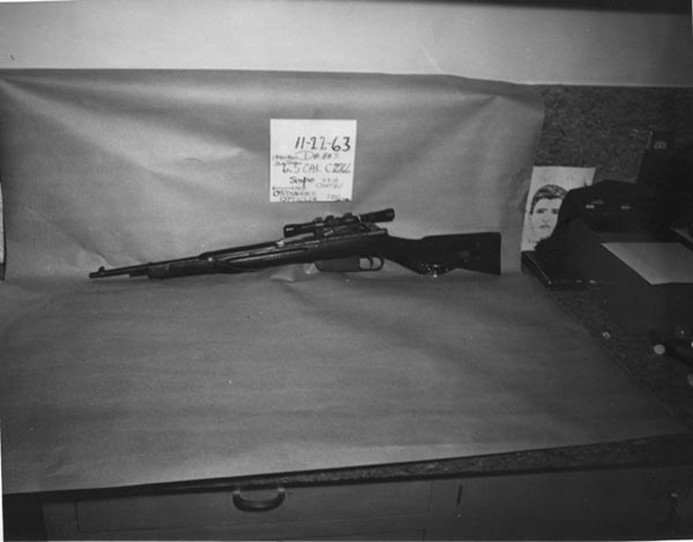
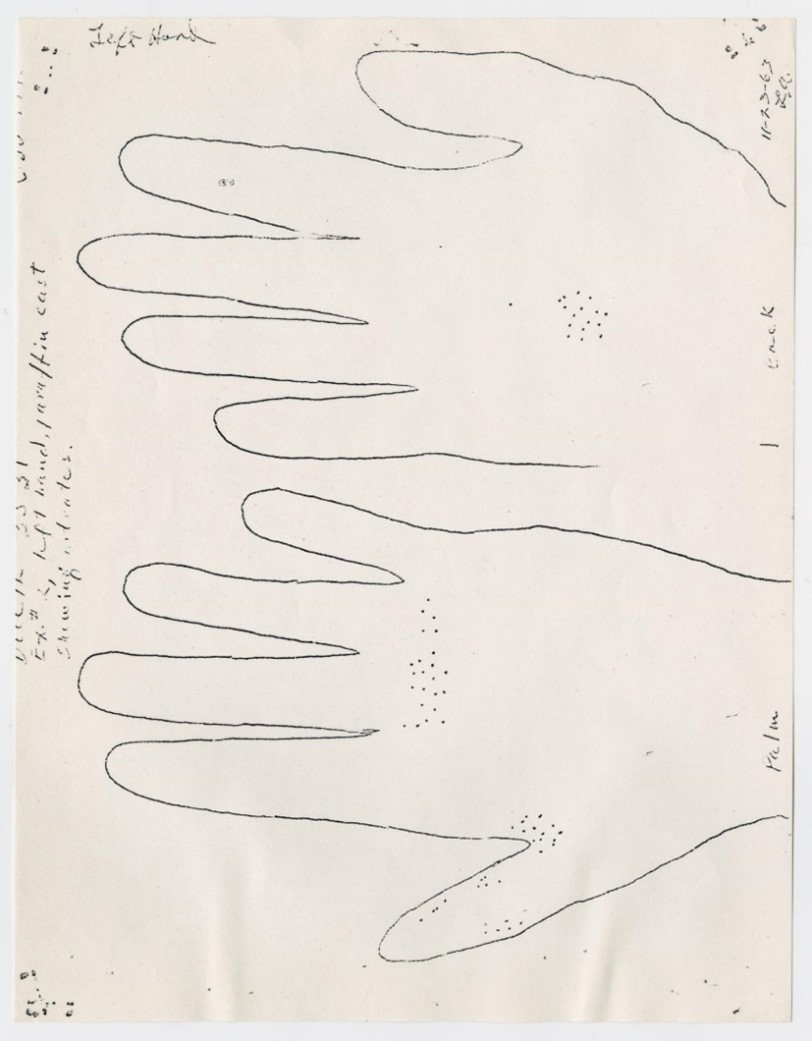
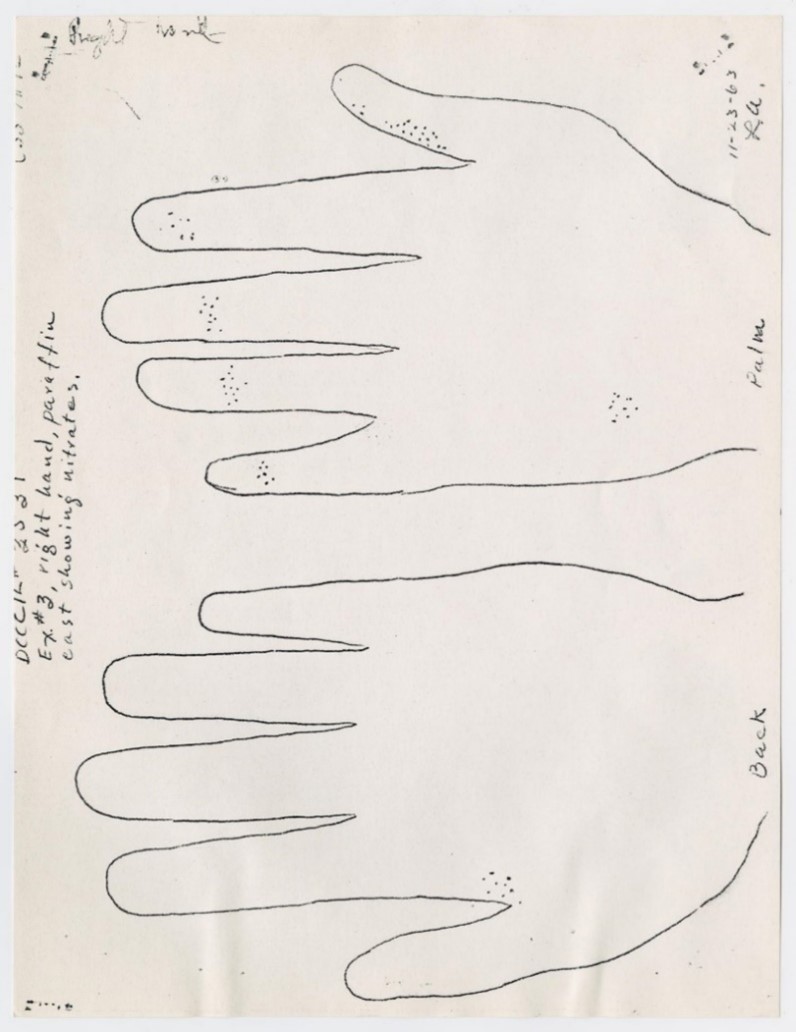
    Remarkably, Day does not include a date in CE738, an omission that stands out since he has included dates in previous evidentiary photographs, e.g., CE737. This inconsistency leads us to question why this particular image would be an exception?

    Day’s assertion that he was the exclusive photographer of CE738 lacks corroboration from any third party, which weakens the credibility of his claim. This ambiguity is amplified by Day’s decision to photograph this evidence upon its second release to the FBI on November 26, instead of at its initial handover to the FBI on November 22. This leads us to wonder whether the Dallas police would not have preferred to maintain a visual record of the evidence being flown to Washington on the 22nd?

    Day’s integrity has been called into question by several sources including Tom Alyea, who accused Day of perjury, [see point 51]. This accusation, along with inconsistencies in his handling of crucial evidence, cast a pall over Day’s credibility. Notably, Day admitted to handling the revolver for the purpose of photographing it but denied marking it.

    David Belin “Did you put any initials on the revolver or not?”
    Lt. Carl Day. “No, sir; I don’t think I did.”

    Belin then continues to question Day regarding CE737 & 738.Picture3

    David Belin. “I am now going to hand you No. 737 and ask you to state if you know what this is.”
    Lt. Carl Day. “Yes, sir. This is the rifle found on the sixth floor of the Texas School Book Depository on November 22, 1963.”
    David Belin. “Who took that picture?”
    Lt. Carl Day. “I took it myself.”
    David Belin. “When?”
    Lt. Carl Day. “About 9 or 9:30 p.m., November 22, on the fourth floor of the City Hall in my office.”
    David Belin. “I am going to now hand you what has been marked as 738 and ask you to state if you know what this is.”
    Lt. Carl Day. “Yes, sir. This is a photograph of most of the evidence that was returned to the FBI the second time on November 26, 1963. It was released to Agent Vince Drain at 2 p.m., November 26.”
    David Belin. “Who took that picture, if you know?”
    Lt. Carl Day. “I took this picture.” (Volume IV; p. 273/274)

    What is striking here is Belin’s detailed questioning about CE737, contrasted with the absence of similar scrutiny for CE738.

    Day’s unconventional decision to combine evidence from two distinct murder investigations into a single image invites additional scrutiny. This method jeopardizes the integrity of both cases, casting a spotlight on Day’s actions and honesty.

    Even if 738 was taken on November 26, after Oswald’s death, the visible cross-contamination within the image questions the reliability of the evidence. Such contamination could render the evidence in this photograph completely useless for future testing. Given the visible cross-contamination, we cannot confidently assert that the evidence was properly handled outside this photograph.

    These factors, including Day’s contested integrity, have substantial implications for the case against Oswald. While Henry Wade might have sought to convince the jury of the state’s evidence’s authenticity, the introduction of this photographic record could cast severe doubt on his case.

    If Oswald had competent legal counsel, this photograph could be pivotal in challenging the state’s case. By emphasizing the potential mishandling and cross-contamination of the evidence, the defense could argue that the evidence’s integrity has been compromised. This photograph serves as a compelling visual aid to underscore these arguments and introduce reasonable doubt about Oswald’s alleged connection to the crimes. Furthermore, the defense could question the rationale behind the Dallas Police’s decision to consolidate evidence from two separate homicide investigations into one photograph – a practice that strays from standard procedure and threatens the reliability of the evidence. Such reasoning could critically undermine the jury’s confidence in the prosecution’s case.”

    23. The Paraffin Test.

    Commission Conclusion.“One would therefore not expect nitrates to be deposited upon a person’s hands or cheeks as a result of his firing a rifle.” (WCR; p. 561)

    “I know that if the case, which has been presented against him, is full of falsehoods and contradictions and I know that right now in the office of the Dallas District Attorney, is a paraffin test which shows that Lee Harvey Oswald did not fire a rifle on November 22 1963. I know that because I have a photostatic copy of that document.” Mark Lane. (see here)

    Just a few hours after the assassination of President Kennedy, Lee Oswald was subjected to a standard forensic procedure applied to individuals suspected of having recently discharged a firearm. This involved a method known as the paraffin test, where a layer of liquid paraffin wax was meticulously applied over the surfaces of Oswald’s hands and onto his right cheek. The principle behind this test was that once the paraffin hardened, it would act as a non-invasive extraction tool, capable of pulling out the most minute residues trapped deep within the pores of his skin, residues that could potentially originate from the firing of a weapon.

    Dr. M. S. Mason, Director of the Dallas City County Criminal Investigative Laboratory, conducted these tests on behalf of the Dallas Police. The items he examined included:

    Exhibit 1. “One manila envelope containing a paraffin cast of the right side of the face of Lee Oswald”.

    Exhibit 2. “One manila envelope containing a paraffin cast of the left hand of Lee Oswald.”

    Exhibit 3. “One manila envelope containing a paraffin cast of the right hand of Lee Oswald.” (see this and this)

    Dr. Mason employed spectrographic analysis, a method regularly used by law enforcement, for the initial test. His findings, reported to the Dallas Police on November 23, 1963, revealed that “No Nitrates were found on exhibit 1. Nitrate patterns consistent with the subject having discharged a firearm were present on exhibits 2 and 3.” The analysis showed evidence of barium and antimony on Oswald’s hands but not on his cheek.

    It is worth noting that these residues, which contain distinct elements like barium and antimony, can also be found in various everyday substances such as “Printing Ink, Paper, Rubber, Plastics, Urine, Tobacco, Cosmetics, and Pharmaceuticals,” etc. Considering Oswald’s job at the Texas School Book Depository, where he frequently handled books, as an order filler, cautious interpretation of these test results is necessary. (WCR; p. 561/562)

    Though spectrographic analysis was deemed reliable enough for most criminal investigations, the lack of positive results on Oswald’s cheek prompted the need for a more incisive examination. This led to the paraffin cast’s being subjected to the process of Neutron Activation Analysis (NAA). This method is capable of detecting the presence of substances in quantities much too small to be identified by spectrographic analysis.Picture4

    Picture5The proposal to subject Oswald’s paraffin casts to Neutron Activation Analysis (NAA) evidently provoked a tangible sense of apprehension within the FBI ranks. This unease seemingly sprang from the potential revelation of exculpatory evidence through the test results. If such evidence was uncovered in Oswald’s favor, it would support the claim that Oswald had not operated a rifle on November 22, 1963, thereby significantly advancing the case for his exoneration.
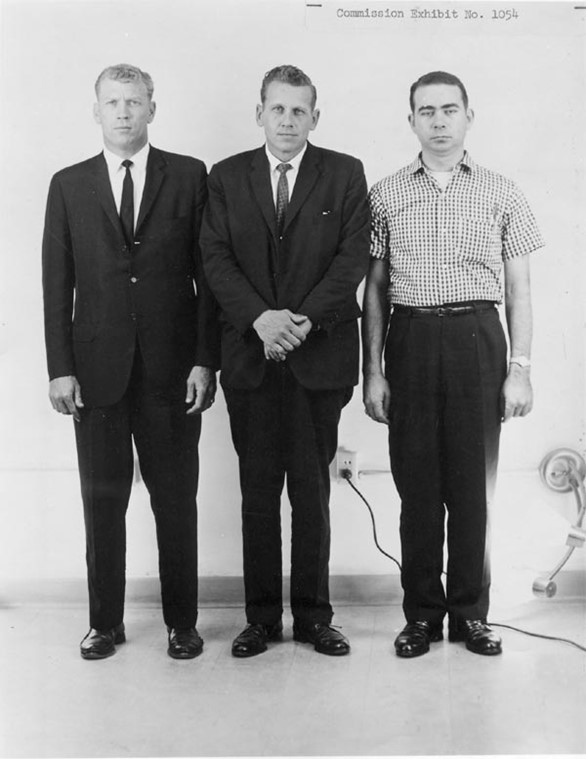
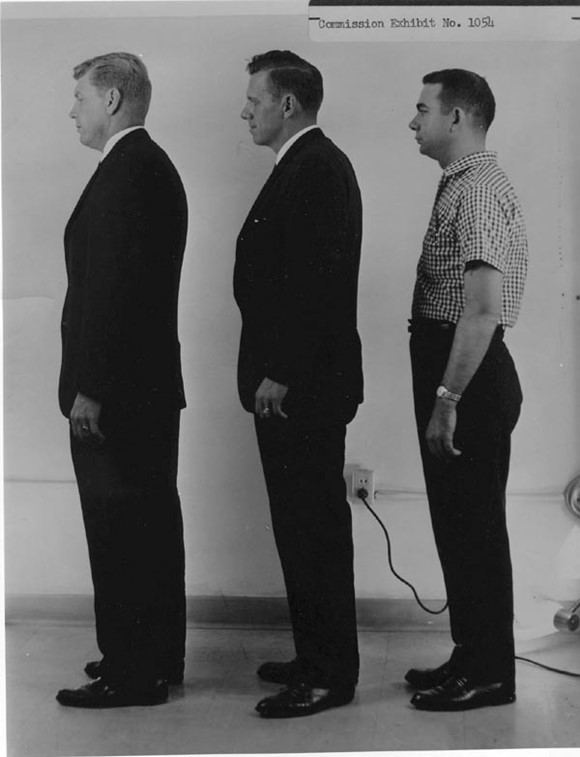
    On November 27, 1963, in an FBI memorandum, Mr. Jevons (FBI) suggests to his superior, Mr Conrad (FBI), that NAA should be used on Oswald’s casts, “To protect the Bureau against any possible future allegations that if Neutron Activation Analysis type of analysis had been conducted [on the paraffin casts], one might have contained extremely significant data.” Jevons also noted that “allegations might originate from relatively highly placed individuals in the Atomic Energy Commission, charged with developing NAA, who will recognise the publicity potential of such allegations.” Aware of the Bureau’s apprehensions, Mr. Jevons gives such reassurances as, “Oswald is now dead and there will be no trial… Any such examinations will, of course, be with the strict understanding that the information and dissemination of the results will be under complete FBI control.” (see this)

    The results of neutron activation analysis corroborated the findings of the spectrographic examination. No gunpowder residue was present on Lee Oswald’s face, indicating innocence. (see this)

    Despite having knowledge of the genuine results of the Spectrographic Analysis on November 23, 1963, the Dallas Police brazenly announced that Oswald’s paraffin test had returned positive results. This false assertion, deliberately disseminated by members of the Dallas Police and prosecutorial officials, stemmed from their distorted interpretation of the paraffin test findings pertaining to Lee Oswald. The dissemination of such groundlessly accusatory information to the media not only undeservedly cast Oswald in a shroud of suspicion, but it also egregiously violated his constitutional rights. Their contentious remarks, thoroughly marred by deception, are reproduced below for closer scrutiny.

    11/23/63. City detective Charles Brown said he believed the hand tests were positive but was not certain about results of a paraffin test on Oswald’s face.

    11/23/63. Brown said he has great faith in paraffin tests. (AP, 9:42 a.m. CST, Raymond Holbrook and Peggy Simpson.)

    11/23/63. Dallas. Oswald, charged last night with murdering the President, insisted he is not the assassin. But an officer said today, I think we got some good results from the paraffin test on both Oswald’s hands.

    11/23/63. Dallas. Curry said … paraffin tests, made to determine from powder residue whether Oswald had fired a gun, were positive. This meant Oswald had fired a weapon within a short time before he was arrested. Apparently, it could have been either a rifle or a pistol – or both. They wouldn’t say. (AP, 1:50 pm CST Peggy Simpson.)

    11/24/63 Dallas. But a Dallas detective, Charles Brown, said a paraffin test of Oswald’s face and hands for gunpowder particles got good results. The paraffin tests, he said, indicated Oswald recently had fired a rifle – the type of weapon used to kill the President. The gunpowder on the face would come from cradling a rifle against the right cheek while the marksman took aim. It was pointed out that Oswald was also accused of killing Dallas patrolman J. D. Tippitt with a pistol while allegedly trying to flee the assassination scene.

    “Wouldn’t this also leave gunpowder traces on the suspect’s hands?” was one question. But Dallas police indicated that their tests were able to distinguish between gunpowder from a pistol and rifle. (San Francisco Examiner, p. 1 col. 8, Bob Considine, Hearst Headline Service)

    11/24/63. Henry Wade.

    Reporter. “What about the Paraffin tests?”
    Henry Wade. “Yes, I haven’t gone into that. The paraffin tests show he recently fired a gun, it was on both hands.”
    Reporter. “Recently fired a rifle?”
    Henry Wade. “A gun.”

    The Director of the F.B.I. in the Dallas-Fort Worth area in charge of the investigation stated: “I have seen the paraffin test. The paraffin test proves that Oswald had nitrates and gunpowder on his hands and face. It proves he fired a rifle on November 22.” (The Minority of One, 9/64, p.11, “16 Questions on the Assassination”, Bertrand Russell)

    Despite being fully aware of the results of the spectrographic analysis, the Dallas Police persisted in asserting publicly that the findings supported Oswald’s guilt. In certain instances, they went so far as to claim that the test had conclusively detected nitrates on his cheeks, which is an entirely false and fraudulent assertion. (see this)

    (Henry Wade, 11/24/63 Press Conference)

    Nestled within the speculative discourse and conjecture section of the Report, one can find the following declaration:

    Speculation: “Gordon Shanklin, who was the Special Agent in charge of the Dallas office of the FBI, posited that the paraffin test conducted on Oswald’s face and hands produced positive results, indicating that Oswald had indeed fired a rifle.”

    Commission Finding: “However, it’s essential to note that the paraffin tests were undertaken by members of the Dallas Police Department, and the subsequent technical examinations were carried out by the Dallas City-County Criminal Investigation Laboratory. The Commission was notified by the FBI that neither Shanklin nor any other FBI representative had ever made such a claim. The Commission found no substantiating evidence that Special Agent Shanklin had publicly voiced this statement.”

    These statements were underpinned by a letter from J. Edgar Hoover to J. Lee Rankin, dated September 14, 1964. In this communication, Hoover addressed the claim that “Special Agent in Charge, J. Gordon Shanklin of our Dallas Office made a public statement about a paraffin test performed on Lee Harvey Oswald.” Shanklin advised Hoover that he had made no such statement, dubbing the allegation as “completely unfounded.”

    Nonetheless, a conflicting report surfaced from The New York Times on November 25, 1963, claiming Shanklin as the source of the information about Oswald’s positive paraffin tests. The report detailed, “Already the authorities have collected evidence of all sorts, Gordon Shanklin, the FBI agent in charge of Dallas, said today…The FBI noted these other pieces of evidence, which have been assembled by the Dallas Police, FBI, and Secret Service… A paraffin test, used to determine if a person has recently fired a weapon, was administered to Oswald shortly after he was apprehended Friday. It showed particles of gunpowder from a weapon, probably a rifle, remained on Oswald’s cheek and hands” (NY Times; Fred Powledge; November 25th, 1963).

    During the Warren Commission hearings, FBI Special Agent Cortland Cunningham testified about the results of paraffin tests conducted on Lee Oswald. The specific tests in question were aimed at determining whether Oswald had recently fired a weapon, specifically the Mannlicher Carcano, C2766.

    Melvin Eisenberg, one of the Commission’s counsels, inquired whether Cunningham’s tests, or his experience with revolvers and rifles, could shed any light on the significance of a negative result being obtained on the right cheek, stating,

    Melvin Eisenberg.”A paraffin test was also run of Oswald’s cheek, and it produced a negative result.”
    Cortland Cunningham
    . “Yes.”
    Melvin Eisenberg. “Do your tests, or do the tests which you ran, or your experience with revolvers and rifles, cast any light on the significance of a negative result being obtained on the right cheek?”
    Cortland Cunningham. “No, sir; I personally wouldn’t expect to find any residues on a person’s right cheek after firing a rifle due to the fact that by the very principles and the manufacture and the action, the cartridge itself is sealed into the chamber by the bolt being closed behind it, and upon firing the case, the cartridge case expands into the chamber filling it up and sealing it off from the gases, so none will come back in your face, and so by its very nature, I would not expect to find residue on the right cheek of a shooter.”

    Cunningham then testified that he, alongside fellow FBI Agent Charles Killion, executed a rapid-fire test with the rifle, yielding negative results for residues on both the cheek and hands.

    Melvin Eisenberg. Also, before firing the rifle?
    Cortland Cunningham. Yes. We fired the rifle. Mr. Killion fired it three times rapidly, using similar ammunition to that used in the assassination. We reran the tests both on the cheek and both hands. This time we got a negative reaction on all casts.
    Melvin Eisenberg. So, to recapitulate, after firing the rifle rapid-fire no residues of any nitrate were picked off Mr. Killion’s cheek?
    Cortland Cunningham. That is correct, and there were none on the hands. (Volume III; p. 492-494)

    However, Cunningham’s statements were refuted by two different pieces of evidence. The first comes from Vincent P. Guinn, head of the Neutron Activation Analysis (NAA) Section of the General Atomic Division, of the General Dynamics Corporation, in February 1964. Guinn and his colleagues had been using NAA to test the powder residues from discharged firearms. When they ran tests using a rifle similar to the one reportedly owned by Lee Harvey Oswald. Guinn found that “the triple firing of the rifle leaves unambiguous positive tests every time on the paraffin casts. Because of the inferior construction of the Carcano the blowback from one or three shots deposited powder residue on both cheeks of the shooter.(Gerald McKnight, Breach Of Trust; p. 211)

    The second piece of evidence comes from Harold Weisberg, a first-generation researcher who successfully sued for the actual test results from the FBI. Within the records he received, it was stated “These paraffin tests were subjected to NAA…there is no similar evidence [Nitrate] on [Oswald’s] cheek. The tests given me show that in seven “control” cases where others fired a rifle this evidence [Nitrate] was left on the cheeks.” This evidence stands as a direct challenge to Cunningham’s claim that residue wouldn’t be found on a shooter’s cheek. (Weisberg, Post Mortem; p. 437)

    Regrettably, the all-encompassing data yielded from Cunningham’s test – including unprocessed results, spectrographic or neutron activation analyses, photographic proof, and procedural documentation – remains unrevealed. Which makes his testimony problematic to present at trial, especially with the countering evidence described above. That evidence appears to be exculpatory.

    Also why weren’t the clothes worn by Oswald at the Texas School Book Depository and subsequently at his arrest at the Texas Theatre subjected to a gunshot residue analysis? Implementing these tests could have furnished critical evidence that either substantiated or refuted his involvement in the President’s assassination.

    The problems with this evidence shine a spotlight on a fascinating facet of the case. It compelled the Commission to cast a skeptical eye on the veracity of these findings, and the test itself; thereby shrouding these potentially vindicating results in a fog of uncertainty.

    Even Commission counsel Norman Redlich, in a memorandum to Commissioner Alan Dulles, noted, “At best, the analysis shows that Oswald may have fired a pistol, although this is by no means certain. … There is no basis for concluding that he also fired a rifle.” (McKnight, p. 207)

    24. The Dallas Police Line-Ups.

    Commission Conclusion. “The Commission is satisfied that the line ups were conducted fairly.” (WCR; p.169)

    The Department Of Justice.“Testimony concerning a line up or showup identification is inadmissible if, considering the totality of the circumstances, the identification procedure was so impermissibly suggestive as to give rise to a very substantial likelihood of misidentification.” (see here)

    Between November 22 and 23, 1963, a series of line-ups were convened involving Lee Oswald, various Dallas Police personnel, and city prisoners held for unrelated offences. In every instance the participants were required to state their name and occupation to the identifying witness. It is important to note that while some participants provided false information during these line-ups, Oswald consistently provided accurate details about himself, more specifically his infamous name and place of employment, the Texas School Book Depository. Highly concerning is the fact that this information was widely publicised through the media, and many witnesses reported to having observed Oswald’s photograph on television prior to attending the actual line-ups.(Volume VII; p. 239.)

    Joesph Ball. “Now, back to the first showup, did the detective ask you any questions? Ask your name and address and occupation?”
    R. L. Clark. “Yes, sir.”
    Joesph Ball.
    “What did he ask you?”
    R. L. Clark.
    “He asked me my name.”
    Joesph Ball. “Did you give him your real name?”
    R. L. Clark.
    “No, sir.”
    Joesph Ball.
    “Fictitious name?”
    R. L. Clark. “Yes, sir.”
    Joesph Ball.
    “Ask you your occupation?”
    R. L. Clark.
    “Asked my occupation.”
    Joesph Ball.
    “What did you tell him?”
    R. L. Clark
    . “I don’t recall. All of them are fictitious.”
    Joesph Ball.
    “Fictitious?”
    R. L. Clark.
    “Yes, sir.” (Volume XII; p.237/238.)
    Joesph Ball.Policeman ask you any questions? Detective ask you any questions?”
    William Perry.
    “Yes, sir; my name and what have you.”
    Joesph Ball.“Well, what do you mean, “what have you.”?
    William Perry.
    Well, occupation.”
    Joesph Ball.“And what answer did you give him?”
    William Perry.
    “I gave him all fictitious answers.” (Volume XII; p. 234.)
    Joesph Ball.“Did the detective ask you name?”
    Daniel Lujan. “Yes, sir.”
    Joesph Ball.“And did you tell him your name?”
    Daniel Lujan. “Yes, sir.”
    Joesph Ball.“Did he ask your occupation?”
    Daniel Lujan. “Yes, sir.”
    Joesph Ball.“What did you tell him?”
    Daniel Lujan. “Working for S. & F. Meat Co.” (Volume XII; p 245/246)

    The judicial system has established rules by which police departments must adhere to in the assembly of line ups for witness identification. These rules, crucial for maintaining fairness and objectivity, are as follows:

    Participant Similarity: ‘Fillers’ should generally resemble the suspect’s description. This includes aspects like height, weight, age, race, and other distinctive features.

    Inadmissible Lineups.When the others are grossly dissimilar in appearance from the suspect.” (see here)

    Cecil McWatters.“No, sir; they were different ages, different sizes and different heights.” (Volume II; p. 270)

    Lineup Size: A lineup should, by standard, include at least five ‘fillers’ in addition to the suspect. This discourages the suspect from being conspicuously distinctive.

    Suspect’s Position: Suspects should have the liberty to choose their position in the lineup, rather than being consistently stationed at a specific number.

    Oswald, Number 2 man: 3 times. Number 3 man:1 time.

    Witness Instructions: The Police Department should make it clear to the witness that the perpetrator may not be part of the line up, relieving them from the pressure to identify someone.

    David Belin. “Did they tell you one of the men was the man you saw or not, or did they tell you “See if you can”–just what did they say? Did they say, “Here is a lineup, see if you-can identify anyone,” or did they say, “One of the men in the lineup”
    William Scoggins. “Yes, I believe those are the words they used.” (Volume III; p.334)

    Clothing Change: In instances where multiple line ups are conducted, suspects should have their clothing changed. This prevents identification based on clothing instead of physical traits. On November 22, 1963, during all three line-ups, Oswald consistently wore the same clothes, except for the Saturday line-up conducted on November 23. During that particular line-up, Oswald’s brown long-sleeved shirt was missing, as it had been sent to Washington.

    Non-Suggestive Environment: The lineup setting must be unbiased and devoid of suggestive elements. Police officers, for instance, should refrain from hinting at the identity of the suspect.

    Inadmissible Lineups. “When the suspect is pointed out before or during the procedure.” (see here)

    Captain Will Fritz or Jim Leavelle, intimated to an audience which included Ted Calloway, Sam Guinyard and Cecil McWatters that: “We want to be sure. We want to try and wrap him up real tight on killing this officer. We think he is the same one that shot the President, and if we can wrap him up tight on killing this officer, we have got him.” (Volume III; p. 355) (watch this) (see here)

    Line up Protocol and its Importance:

    Inadmissible Lineups. “When an identification is made in the presence of other identifying witnesses.” (see here)

    Adhering to a rigorous and standardized protocol for police line ups is crucial in maintaining the reliability and integrity of witness testimony. This includes taking careful measures to ensure witnesses are kept separate from each other to mitigate any potential influence that may arise from shared discussions or collective reactions. Encouraging each witness to independently identify the suspect underscores the importance of their testimony being solely rooted in their own recollections.

    The primary objective of this protocol is to minimize the risk of corrupting the identification process. Allowing witnesses to converse about the event or discuss the suspect’s attributes could lead to the contamination of the process. Such discourse could inadvertently foster groupthink, induce false positives, or in the worst-case scenario, yield tainted identifications.

    The consequences of such errors are severe and far-reaching. They could trigger misidentifications and, subsequently, wrongful convictions.

    What follows is a compilation of witness testimonies presented to the Commission. These statements confirm that the Dallas Police Department failed to adhere to the established protocol, jeopardizing the integrity of the investigation.

    Sam Guinyard.

    Joseph Ball. “Were you with Ted [Calloway] at the time?”
    Sam Guinyard. “Yes, sir.”
    Joseph Ball. “How close was Ted to you?”
    Sam Guinyard. “Oh, sitting about like that.”
    Joseph Ball. “You mean 3 or 4 feet away from you?”
    Sam Guinyard. “Yes, something like that.” (Volume VII; p. 400)

    Ted Calloway.“We first went into the room. There was Jim Leavelle, the detective, Sam Guinyard, and then this bus driver and myself. We waited down there for probably 20 or 30 minutes.” (Volume III; p. 355)
    William Whaley.“Then they took me down in their room where they have their showups, and all, and me and this other taxi driver [William Scoggins] who was with me, sir, we sat in the room awhile and directly they brought in six men, young teenagers, and they all were handcuffed together.” (Volume II p. 260/261)

    William Scoggins.

    David Belin. “Mr. Scoggins, when you identified the man in the line up at the police station on November 23, was there any other person who at the same time was asked to identify a man in that lineup?”
    William Scoggins. “Yes, one other.”
    David Belin. “Do you know-one other person?”
    William Scoggins. “Yes.” (Volume III; p. 337)

    Virginia Davis

    David Belin. “Where was your sister when you identified him?”
    Virginia Davis. “She was sitting right next to me.”
    David Belin. “How did you identify him? Did you yell that this is the man I saw?” Where was the detective? Was he to your right or to your left?”
    Virginia Davis. “Let’s see to my right.”
    David Belin. “Where was your sister, to your right or to your left?”
    Virginia Davis. “Right.”
    David Belin. “As she was to your right, so you leaned over to the detective and told the detective it was No. 2?”
    Virginia Davis. “Yes, sir.” (Volume VI; p. 462)

    The following is a chronological record of the line ups conducted by the Dallas Police Department on 11/22-11/23-1963.

    11/22/63 16:05
    Showup 1.Picture6
    Picture71. William E Perry, Dallas Police Officer. Aged 34. 5’10”1/2”. 170 Pounds. Brown Hair. Blue Eyes. Dark Complexion. Brown Sports Coat. Gave fictitious name and occupation to witness.
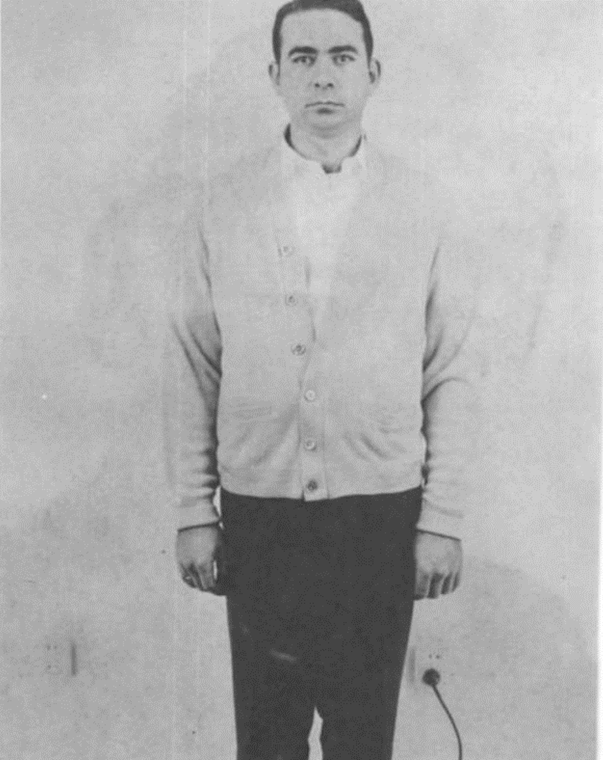
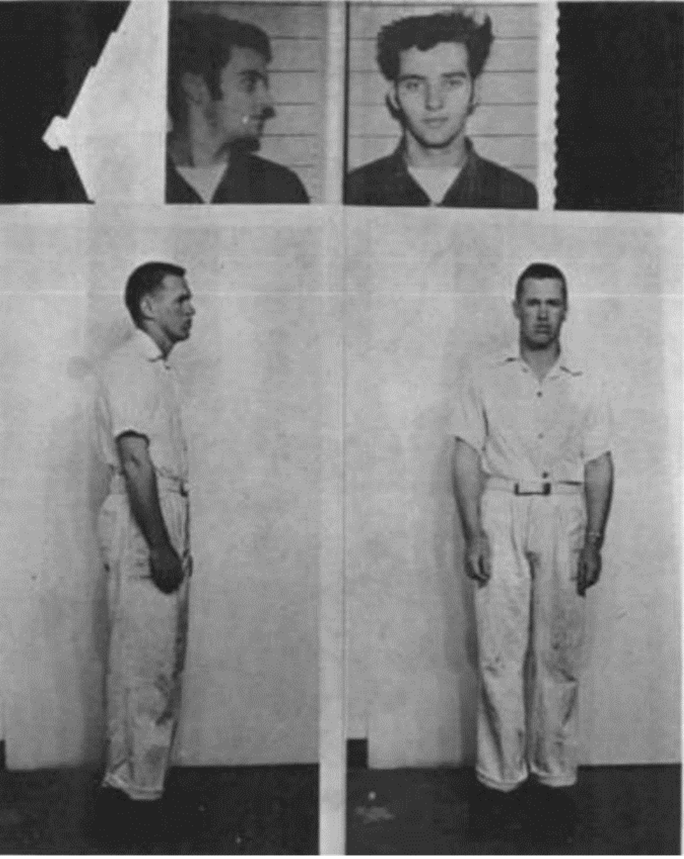
    2. Lee H. Oswald, Texas School Book Depository, Warehouse Employee. Tattered Brown Long Sleeved Shirt. Tattered White T-Shirt. Dark Pants. Aged 24. 5’ 9”.131 Pounds. Medium Build. Brown, Receding Hair. Blue Eyes. Bruise Over His Right Eye. Cut On His Forehead.
    3. R. L. Clark, Dallas Police Officer. Aged 31. 5’9,3/4”. 170 Pounds. Blond Hair. Blue Eyes. Ruddy Complexion. Red Vest, Short Sleeve White Shirt, Brown Pants With Belt. Gave fictitious name and occupation to witness.
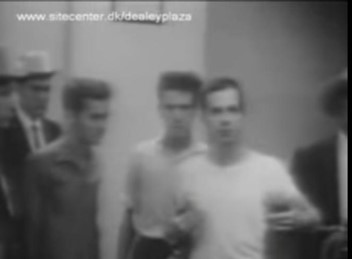
    4. Don Ables, Dallas Police Jail Clerk. Aged 26. 5’9”. 165 Pounds. Brown Hair. Eyes Brown. Ruddy Complexion. White Shirt, Gray-Knit Sweater. Dark Trousers. Gave fictitious name and occupation to witness.
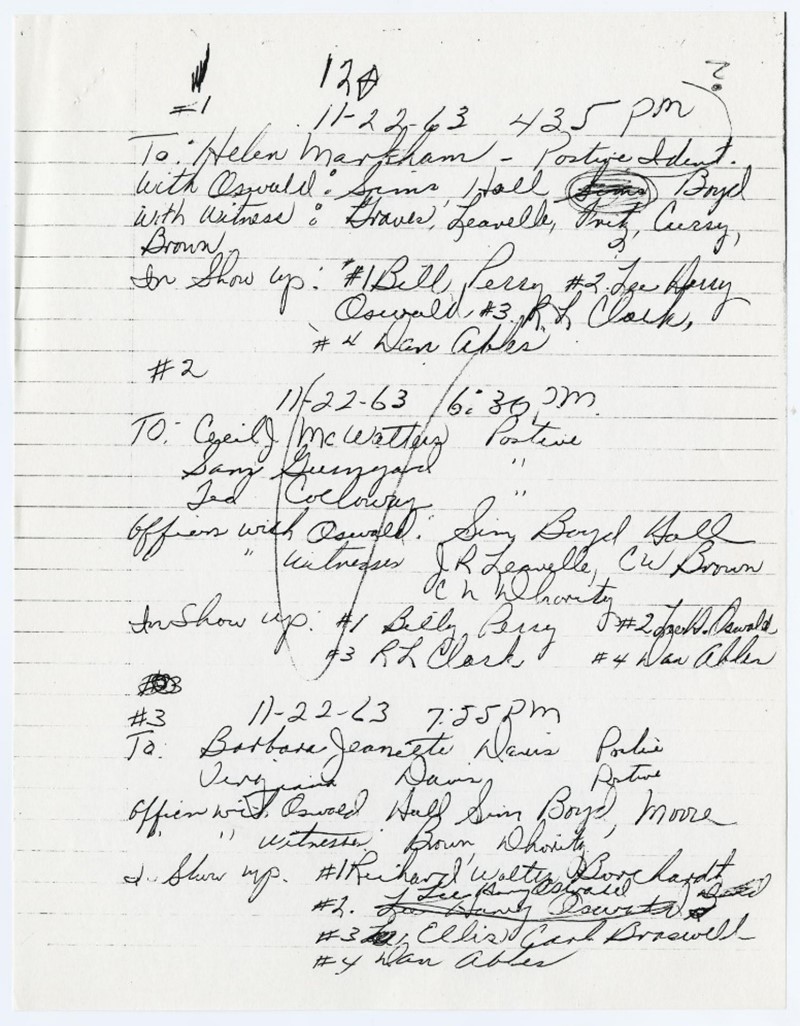
    (Volume VII; p. 125/168,170,233,236, 241/242)
    Joseph Ball. “It’s unusual to use officers to show up prisoners?”
    Elmer Boyd. “Well, I would say so.”
    Joseph Ball.“Is that usual to use Don Ables, the clerk, in a show up?”
    Elmer Boyd.“No, sir.”
    Joseph Ball.“It is unusual?”
    Elmer Boyd.“Yes.” (Volume VII; p. 125)

    11/22/63 18:20.
    Showup 2.
    1. William E Perry, Dallas Police Officer. Aged 34. 5’10”1/2”. 170 Pounds. Brown Hair. Blue Eyes. Dark Complexion. Brown Sports Coat. Gave fictitious name and occupation to witnesses.
    2. Lee H. Oswald, Texas School Book Depository, Warehouse Employee. Tattered Brown Long Sleeved Shirt. Tattered White T-Shirt. Dark Pants. Aged 24. 5’ 9”.131 Pounds. Medium Build. Brown, Receding Hair. Blue Eyes. Bruise Over His Right Eye. Cut On His Forehead.
    3. R. L. Clark, Dallas Police Officer. Aged 31. 5’9,3/4”. 170 Pounds. Blond Hair. Blue Eyes. Ruddy Complexion. Red Vest, Short Sleeve White Shirt, Brown Pants With Belt. Gave fictitious name and occupation to witnesses.
    4. Don Ables, Dallas Police Jail Clerk. Aged 26. 5’9”. 165 Pounds. Brown Hair. Eyes Brown. Ruddy Complexion. White Shirt, Gray-Knit Sweater. Dark Trousers. Gave fictitious name and occupation to witnesses.
    (Volume VII; p. 125,168,169,170,233,236, 241/242)Picture8
    Joseph Ball.“Were they dressed differently than Oswald?”
    Richard Sims. “Yes; I know they didn’t have the color of clothes on or things like that.”
    Joseph Ball.“His clothes were rougher looking than the other men?”
    Richard Sims.“Well, I don’t imagine that he would be dressed as nice as the officers were, as far as their clothes.” (Volume VII; p. 170)
    Joseph Ball.“The other three were better dressed than Oswald, would you say?”
    Elmer Boyd.“Well, yes, sir; I would say they probably were.”(Volume VII; p. 127)

    11/22/63 19:40
    Showup 3.Picture9
    1. Richard Walter Borchgardt. City Prisoner. Aged 23. 161 Pounds. 5’9”. Brown Hair. Blue Eyes. Fair Complexion.
    2. Lee H. Oswald, Texas School Book Depository, Warehouse Employee. Tattered Brown Long Sleeved Shirt. Tattered White T-Shirt. Dark Pants. Aged 24. 5’ 9”.131 Pounds. Medium Build. Brown, Receding Hair. Blue Eyes. Bruise Over His Right Eye. Cut On His Forehead.
    3. Ellis C. Brazel. City Prisoner.. Aged 22. 5’10”. 169 Pounds. Green Eyes. Blond Hair. Ruddy Complexion
    4.Don Ables, Dallas Police Jail Clerk. Aged 26. 5’9”. 165 Pounds. Brown Hair. Eyes Brown. Ruddy Complexion. White Shirt, Gray-Knit Sweater. Dark Trousers. Gave fictitious name and occupation to witnesses.
    (Volume VII; p. 131/132,170, 41/242

    11/23/63.
    Showup 4.Picture10
    David Belin. “Had you seen any pictures of Lee Harvey Oswald in the newspapers prior to the time you went to the police station lineup?”
    William Scoggins. “I think I saw one in the morning paper.”(Volume III; p.334)
    1. John T. Horne. City Prisoner. Aged 17. Dark Shirt. Dark Pants. Dark Thick Hair.
    2. David Knapp. City Prisoner. Aged 18. White Shirt. Dark Pants. Dark Thick Hair.
    3. Lee H. Oswald. Texas School Book Depository, Warehouse Employee. Tattered White T-Shirt. Dark Pants. Aged 24. 5’ 9”.131 Pounds. Medium Build. Brown, Receding Hair. Blue Eyes. Bruise Over His Right Eye. Cut On His Forehead.
    4. Daniel Lujan. City Prisoner. Aged 26. 170 Pounds. 5’8”. Black Hair. Brown Eyes. Complexion Olive. Mexican. Blue Shirt. Brown Jacket.
    (Volume VII; p. 170, 245/246) (watch this

    The Curious Case Of Howard Brennan.

    Determining which line up Howard Brennan attended should, in theory, be straightforward. However, the available records yield no clear answer to this surprisingly complex question. This intriguing issue was first highlighted by Ian Griggs, who found no explicit evidence of Brennan attending any specific line up. As outlined in Commission Exhibit 2003, the list of ‘witnesses’ for the line ups is as follows: Helen Markham, Cecil McWatters, Sam Guinyard, Ted Calloway, Barbara Davis, and Virginia Davis on 11/22/63; and William Scoggins and William Whaley on 11/23/63. It is perplexing that the Dallas Police would allow ‘witnesses’ from two distinct homicide cases to participate in the same line up. Furthermore, the actions McWatters and Whaley supposedly witnessed are ambiguous at best. After all, when did taking a bus home or hailing a taxi qualify as a crime?”(Volume XXIV; p. 347)

    For some perspective on this issue, let us first look at the testimony of Brennan himself on this point.

    David Belin.“Now, taking you down to the Dallas Police Station, I believe you said you talked to Captain Fritz. And then what happened?”
    Howard Brennan. “Well, I was just more or less introduced to him in Mr. Sorrels’ room, and they told me they were going to conduct a line up and wanted me to view it, which I did.”
    David Belin. “Do you remember how many people were in the line up?”
    Howard Brennan. “No, I don’t. A possibility seven more or less one.”
    David Belin. “All right. Did you see anyone in the line up you recognized?”
    Howard Brennan. “Yes.”
    David Belin. “And what did you say?”
    Howard Brennan. “I told Mr. Sorrels and Captain Fritz at that time that Oswald–or the man in the lineup that I identified looking more like a closest resemblance to the man in the window than anyone in the lineup.”
    David Belin. “Were the other people in the lineup, do you remember–were they all white, or were there some Negroes in there, or what?”
    Howard Brennan. “I do not remember.” (Volume III; p. 147)

    Here are some notable observations drawn from this excerpt of Brennan’s testimony:

    1. The line-up consisted of four individuals, three fillers and the suspect. If Brennan did indeed view a line-up, how could he possibly forget such a critical detail?
    2. Brennan identified both SS Agent Sorrels and Captain Fritz as present at this line-up.
    3. Curiously, Brennan could not recall the ethnic backgrounds of those in the line-ups. This strikes me as odd. Could Brennan, in his lifetime, have participated in an event more dramatic and pivotal? And in Texas? During segregation?

    The idea that he could forget such fundamental elements of the procedure, assuming he genuinely attended, is quite puzzling to me.

    Now let us take a look at the testimony of Forrest Sorrells.

    Forrest Sorrells. “I got a hold of Captain Fritz and told him that the witness was there, Mr. Brennan. He said, I wish he would have been here a little sooner, we just got through with a line up. But we will get another fixed up. So I took Mr. Brennan, and we went to the assembly room, which is also where they have the line up, and Mr. Brennan, upon arrival at the police station, said, I don’t know if I can do you any good or not, because I have seen the man that they have under arrest on television, and he said. I just don’t know whether I can identify him positively or not because he said that the man on television was a bit dishevelled and his shirt was open or something like that, and he said the man I saw was not in that condition.

    So when we got to the assembly room, Mr. Brennan said he would like to get quite a ways back, because he would like to get as close to the distance away from where he saw this man at the time that the shooting took place as he could.
    And I said, “Well, we will get you clear on to the back and then we can move up forward.
    They did bring Oswald in in a line up. He looked very carefully, and then we rooted him up closer and so forth, and he said, I cannot positively say.
    Sam Stern. “How many other people were in the line up?”
    Forrest Sorrells. “As I recall it, there were five. In other words, all told there was five or six-I don’t remember. I believe there were five.”
    Sam Stern. “Were the others reasonably similar to Oswald in height and physical appearance, and color?”
    Forrest Sorrells. “I noted that to me I thought it was a very fair line up, because they didn’t have anyone that was a lot taller than he was, or anyone a lot shorter. They didn’t have any big fat ones or anything like that. In other words, to me it was a good lineup.” (Volume XII; p. 354/355)

    1. In an affidavit dated November 22, 1963, Mr. Brennan asserted that “he could identify the man if he ever saw him again”, as noted in point 7.
    2. Sorrells failed to specify which line-up Brennan attended or identify any other attendees of the line-up.
    3. Sorrells estimates that there were either “five or six” individuals present at the line-up. It raises questions about Sorrells’ accuracy, given that only four individuals were supposed to be viewed.
    4. Sorrells described it as a “very fair line-up.” This mysterious line-up, which Mr. Brennan allegedly attended, appears to be more of an anomaly than the norm. Given what we know, it’s impossible for an unbiased observer to conclude that the line-ups conducted by the Dallas Police Department were anything but fundamentally flawed, exhibiting a shocking disregard for established protocols.

    Lastly, let’s examine the testimony of Will Fritz regarding this matter.

    John McCloy.“Were you present at the show up at which Brennan was the witness?”
    Will Fritz. “Brennan?”
    John McCloy. “Brennan was the alleged…”
    Will Fritz. “Is that the man that the Secret Service brought over there, Mr. Sorrels brought over?”
    John McCloy. “I don’t know whether Mr. Sorrels…”
    Will Fritz. “I don’t think I was present but I will tell you what, I helped Mr. Sorrels find the time that that man–we didn’t show that he was shown at all on our records, but Mr. Sorrels called me and said he did show him and he wanted me to give him the time of the showup. I asked him to find out from his officers who were with Mr. Brennan the names of the people that we had there, and he gave me those two Davis sisters, and he said, when he told me that, of course, I could tell what showup it was and then I gave him the time.”
    John McCloy. “But you were not present to the best of your recollection when Brennan was in the showup?”
    Will Fritz. “I don’t believe I was there, I doubt it.” (Volume IV; p. 237)

    Here are some notable observations drawn from this excerpt of Fritz’s testimony:

    1. Strangely, Fritz appears not to recognize the name Brennan, even though Brennan was a pivotal witness in his case.
    2. Fritz seems to distance himself from the assertion that he was present at Brennan’s line-up.
    3. According to Fritz, it was Sorrells who informed him that Brennan had been taken to a line-up. Oddly, however, Sorrells wanted Fritz to specify the time of the line-up.
    4. It raises the question, who are the officers that Fritz is referencing?
    5. As Ian Griggs highlights, Brennan did not attend the Davis sisters’ line-up. Griggs posed this query to Dale Myers, who in turn asked Barbara Davis if Brennan or someone fitting his description had been present at her line-up. Barbara’s response was: “Just me and my sister-in-law and some guys from law enforcement” (No Case To Answer; pp. 92/93).
    6. Lastly, if Brennan did indeed attend a line-up, it’s perplexing as to why his name was not listed in any of the Dallas Police Department records concerning these line-ups.

    As highlighted by Ian Griggs, the undeniable facts remain that:

    1. “Brennan or his description, does not appear in the testimony of any of the other eyewitnesses who attended the line-ups. Markham, Calloway, Guinyard, McWatters, Barbra and Virginia Davis, Scoggins, Whaley, fail to mention Brennan.”
    2. “The name Brennan does not appear in the testimony or affidavits of any of the DPD officers who supervised the line-ups on record. Chief Curry, Sims, Boyd, Graves, Leavelle, Dhority, Moore, Potts, Brown, Hall, Senkel.” (Griggs, pp. 77-100)

    Brennan’s name is not only absent from the DPD’s records relating to line-ups, but also from the testimonies and affidavits of the officers present at the other line-ups. Why is this the case? Despite its seemingly straightforward nature, why is there a sense of obfuscation around this event?Picture11

    Picture12Dr Buckout Evaluates.

    In 1979, the late Larry Harris approached Dr. Robert Buckout to assess the Dallas Police line-ups in which Lee Oswald was subjected to. Dr. Buckout, a renowned expert in eyewitness testimony and identification procedures, reached a clear conclusion. He stated,

    “By any stretch of the imagination, virtually every rule in the book was violated in the conduct of these line-ups. The results of any of the line-ups conducted as poorly and under hysterical circumstances, as they were, should be regarded as utterly worthless.” (watch this)

    Line-up participate Daniel Lujan on Oswald’s objections to the lineup:

    Joesph Ball.“You were handcuffed to Oswald?”
    Daniel Lujan. “Yes, sir.”
    Joesph Ball. “He was complaining, was he?”
    Daniel Lujan. “About having a T-shirt and wanted a jacket or something.”
    Joesph Ball.“Oswald was doing some talking?”
    Daniel Lujan.“Yes.”
    Joesph Ball. “Was he shouting loud?”
    Daniel Lujan. “He was shouting. He, he was shouting, said all of us had a shirt on and he had a T-shirt on. He wanted a shirt or something.” (Volume XII; p. 245/246)

    Dr. Buckout’s assessment illuminates the serious flaws and deficiencies in the line-ups conducted by the Dallas Police Department. As an expert in the field of eyewitness testimony and identification procedures, his conclusion carries substantial weight, suggesting that the line-ups were conducted in a manner that not only violated established protocols but implies that they were conducted in such a manner which would reach a desired conclusion. Additionally, the actions of Fritz/Leavelle exposes a specific agenda and a desire to not only link Oswald to the murder of Officer Tippit, but also to the assassination of President Kennedy. It suggests a deliberate effort to construct a strong case against Oswald by solidifying his involvement in both crimes. This highlights the Dallas Police’s predisposition to connect Oswald to both murders, thereby influencing the direction of the investigation and subsequent legal proceedings. This again raises serious questions regarding Oswald’s treatment at the hands of the Dallas Police.

    “When a line up or showup is conducted in violation of the defendant’s right to due process, an in-court identification of the defendant will not be permitted unless the government can establish an independent source. The factors used to establish an independent source where a line up or showup has been conducted in violation of the defendant’s right to counsel are also applicable here.” (see here)

    25. Oswald Gets No Defense.

    Marguerite Oswald:“My son, Lee Harvey Oswald, was tried and convicted within a few hours time, without benefit of counsel. And so, I am appealing to the Board that my son, Lee Harvey Oswald, be represented by counsel… I implore you, I implore you, in the name of justice, to let my son, Lee Harvey Oswald, who is accused of assassinating the President, and I, the mother of this man, who is the accused’s mother, be represented by counsel. Marguerite Oswald. (Volume I; p. 127/128)

    Mark Lane, a seasoned attorney and vocal critic of the case against Oswald, was enlisted by Marguerite, Oswald’s mother. He put forth a petition to the Warren Commission, articulating his intent to advocate for Oswald’s legal rights during the forthcoming hearings. Prior to this, Lane had addressed a letter to Chief Justice Earl Warren, stating, “It would be appropriate that Mr. Oswald, from whom every legal right was stripped, be accorded counsel who may participate with the single purpose of representing the rights of the accused.” Nonetheless, Lane’s request to represent Oswald was rejected. As substantiation, Lane cited a letter dated January 23, 1964, from J. Lee Rankin, the Commission’s counsel. The correspondence stated, “The Commission does not believe that it would be useful or desirable to permit an attorney representing Lee Harvey Oswald to have access to the investigatory materials within the possession of the commission or to participate in any hearings to be conducted by the commission.” Earl Warren also informed Lane “that Oswald was not on trial, and that counsel would not be permitted to represent him”(NY Times, 26 Feb 1964; p. 17)

    26. President Kennedy’s Clothing.

    Picture13Commission Conclusion. “President Kennedy was first struck by a bullet which entered at the back of his neck and exited through the lower portion of his neck.” (WCR, P19.)Picture14
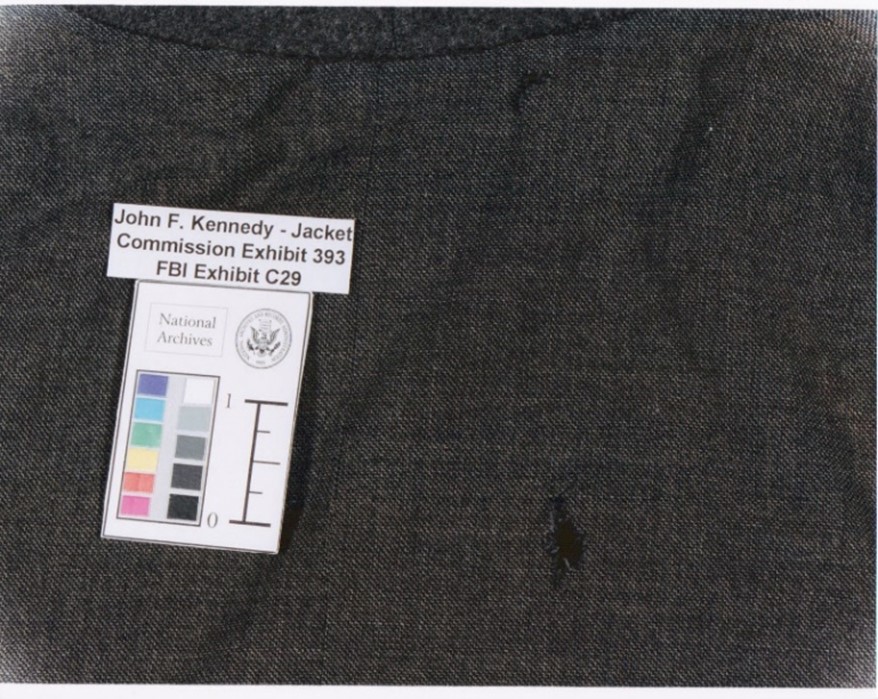
    The clothing worn by President Kennedy serves as compelling evidence in this case. An examination of the garments reveals that President Kennedy sustained a gunshot wound in the upper portion of his back, specifically near the third thoracic vertebra. This fact finds support in numerous eyewitness testimonies and the documented evidence on the record. Had Oswald gone to trial, it would have been imperative for Henry Wade to demonstrate to the jury that despite the President’s shirt and jacket displaying a clear and concise bullet hole in the back, the actual entry point of the sustained injury was at the base of President Kennedys neck.

    Sibert & O’Neill

    FBI agents James Sibert & Francis O’Neill took meticulous notes during the Presidents autopsy. Included in these notes is a detailed description of the wounds sustained by the President.

    “During the latter stages of this autopsy, Dr Humes located an opening which appeared to be a bullet hole which was below the shoulders and two inches to the right of the middle line of the spinal column. This opening was probed by Dr Humes with the finger, at which time it was determined that the trajectory of the missile entering at this point had entered at a downward position of 45 to 60 degrees. Further probing determined that the distance travelled by this missile was a short distance as much as the end of the opening could be felt with the finger.” (Sibert and O’Neil Report on the Autopsy 11/26/63) (see this)

    Admiral George Burkley, Official Whitehouse Death Certificate, 11/23/63. “A second wound occurred in the posterior back at about the level of the third thoracic vertebra.” (see this)Picture15

    Picture16Admiral George Burkley.Signed “verified” to the Autopsy Face sheet which depicts the wound in President Kennedy’s back way below the neckline, around the third thoracic vertebra.
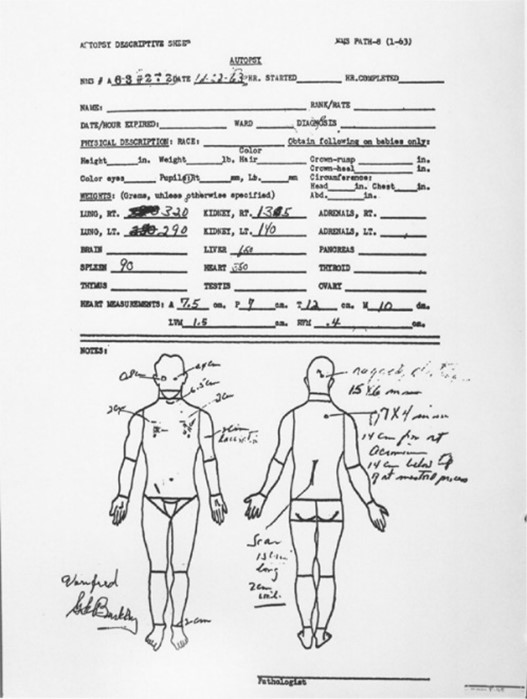
    Clint Hill.“I saw an opening in the back, about six inches below the neckline to the right-hand side of the spinal column.”(Volume II; p.143)

    Roy Kellerman.“While the President is in the morgue, he is lying flat. And with part of the skull removed, and the hole in the throat, nobody was aware until they lifted him up that there was a hole in the shoulder. That was the first concrete evidence that they knew that the man was hit in the back first.” (Volume II; p.103)

    Roy Kellerman.“The other wound I noticed was in his shoulder”.

    Arlen Specter.“Which Shoulder”
    Roy Kellerman. “Right shoulder…the upper neckline, sir, in that large muscle between the shoulder and the neck, just below it.” (Volume II; p. 81)

    Glen Bennett.“At this exact time, I saw a shot that hit the Boss about 4 inches down from the right shoulder; a second shot followed immediately and hit the right rear high of the Boss’s head.” (Volume XXIV, pp. 541/542)

    Willam Greer. “It was, to the best of my recollection it was, back here, just in the soft part of the shoulder.” (Volume II; p.127)

    Paul O’Connor.“Finally, we turned the body over, and there was a bullet wound-an entrance wound-in his back, on the right side of his spinal column. To emphasize where it was in proximity to the rest of his body: if you bend your neck down and feel back, you feel a lump and that’s the seventh cervical vertebra. This bullet wound was about three inches down and an inch or two to the right of the seventh cervical vertebra.” (William Law, In The Eye Of History; p.199)

    Jim Jenkins.“There was a bullet wound around the scapula in the back.”
    William Law. “How far do you say that was. Give me an estimate: T1, T2-?”
    Jim Jenkins. “He thinks, reaching around touching his back…I would say say about T4” [the fourth thoracic vertebra. (Law, p.226)

    Pierre Finck, one of three autopsy pathologists who conducted the President’s autopsy has revealed that: “I was denied the opportunity to examine the clothing of Kennedy. One officer who outranked me told me that my request was only of academic interest. The same officer did not agree to state within the autopsy report that the autopsy was not complete, as I had suggested to indicate. I saw the clothing of Kennedy, for the first time on March 16, 1964, at the Warren Commission, before my testimony, more than 3 months after the autopsy.” see this

    Pathologist Gerald Ford.

    A declassified document released by the ARRB (Assassination Records Review Board), proves that Commissioner Gerald Ford made a critical change to the wording of the Warren Report, which describes the location of the wound on the President’s back. The original version explicitly described that “A bullet had entered at the back at a point slightly above the shoulder to the right of the spine.” This description was consistent with the verified autopsy face sheet, the death certificate, and numerous witness testimonies. However, Ford revised the report to state that the bullet entered at the back of the neck, thereby bolstering the credibility of the Single Bullet Theory (SBT). And, more importantly, keeping the blame for the assassination solely on Lee Oswald. Fords revision stated that “President Kennedy was first struck by a bullet which entered at the back of his neck.” This alteration not only calls into question the integrity of the report, but it appears to be a deliberate manipulation of the facts by an elected official. This was done purely to save the circumstantial case against Oswald. Alongside other fraudulent exhibits such as CE1302, these revisions underscore the practices employed by the Commission (See the film, JFK:Destiny Betrayed, Episode 3; WCR; p.19)

    To summarize, the jacket and shirt of President Kennedy effectively serve as evidence that exonerates Oswald in the case, especially the shirt since these were tailored. Examination of the clothing reveals a gunshot wound in the upper portion of the President’s back, near the third thoracic vertebra. This finding is supported by eyewitness testimonies and documented evidence. However, in the aftermath of the autopsy, Dr. Finck has revealed that he was denied access to the President’s clothing, thus limiting the ability of the pathologists to thoroughly examine the evidence during the procedure. Gerald Ford made a critical change to the wording of the report, regarding the placement of the back wound. The original version accurately described the entry point above the shoulder to the right of the spine, but Ford revised it to support the Single Bullet Theory (SBT). This alteration raises serious concerns about the modus operandi of the Commission. It suggests a deliberate manipulation of facts to maintain a predetermined theory that Oswald was the lone assassin.

    27. Admiral Burkley vs. The Warren Report.

    Picture17“Dulce et decorum est, pro patria mori.” Wilfred Owen.
    Admiral George Burkley, President Kennedy’s personal physician who was present at both Parkland and Bethesda, had firsthand experience witnessing the fatal wounds sustained by the President. Given the significance of his testimony in establishing the facts surrounding the nature and locations of President Kennedy’s injuries, it was crucial for Dr. Burkley’s account to be heard on the record.However, astonishing it may seem, Dr Burkley was not called to testify before the Warren Commission.

    In a 1967 interview with the John F. Kennedy Presidential Library, Burkley declined to comment on the findings of the Commission.

    Interviewer– “Do you agree with the Warren Report on the number of bullets which entered the Presidents body?”Burkley – “I would not care to be quoted on that.” (see this)

    28. Uncovering the Whitewash: Jim Humes and The ARRB.

    James Humes: “In [the] privacy of my own home, early in the morning of Sunday, November 24, I made a draft of this report which I later revised, and of which this [handwritten draft of autopsy report] represents the revision. That draft I personally burned in the fireplace of my recreation room.” Commander J. J. Humes. (Volume II; p. 373)

    Michael Baden: “Where bungled autopsies are concerned, President Kennedy’s is the exemplar.” (James DiEugenio, Reclaiming Parkland; p.37)

    Chief autopsy surgeon Commander J.J. Humes destroyed crucial medical evidence on November 24, 1963, which had significant implications for the case against Oswald. This evidence consisted of the initial draft of President Kennedy’s autopsy report and the accompanying notes it was based upon. It is noteworthy that Humes alleged destruction occurred only after Lee Oswald had been shot to death by Jack Ruby. Humes testified: “The final changes in the notes prior to the typing of the report were made, and I will have to give you the time because whatever time Mr. Oswald was shot, that is about when I finished. I was working in an office, and someone had a television on and came in and told me that Mr. Oswald had been shot, and that was around noon on Sunday, November 24th.” If Oswald had lived to stand trial, these destroyed notes would have played a crucial role as evidence. On February 13, 1996, Jeremy Gunn and Doug Horne from the ARRB conducted a deposition of Commander Humes, during which they addressed the issue of his disposal of the original autopsy material. Gunn ultimately exposed Humes’ explanation for his actions.

    Jim Humes “Also in Greenfield Village, there is an old Illinois courthouse where Lincoln used to preside when he was circuit-riding judge. And in that courthouse was a chair that was alleged to be the chair in which Lincoln sat when he was assassinated in Ford’s Theater. And the docent, in describing this chair, proudly spoke that here on the back of the chair is the stain of the President’s blood. The bullet went through his head. I thought this was the most macabre thing I ever saw in my life. It just made a terrible impression on me. And when I noticed that these bloodstains were on this document that I had prepared, I said nobody’s going to ever get these documents. I’m not going to keep them, and nobody else is ever going to get them. So, I copied them–and you probably have a copy in my longhand of what I wrote. It’s made from the original. And I then burned the original notes in the fireplace of my family room to prevent them from ever falling into the hands of what I consider inappropriate people”

    Gunn then questions Hume’s about a glaring inconsistency in his story regarding the draft and notes:

    Jeremy Gunn. “Did you ever make a copy that–a copy of the notes that contained the same information as was on the original handwritten notes that was in any form other than the form that appears in Exhibit 2?”
    Jim Humes. “No.”
    Jeremy Gunn. “Have you ever observed that the document now marked Exhibit 1 in the original appears to have bloodstains on it as well?”
    Jim Humes. “Yes, I do notice it now. These were J’s. I’m sure I gave these back to J. I presume I did. I don’t know where they came from.” [J refers to Jay Thornton Boswell, who was a partner to Humes on the autopsy.]
    Jeremy Gunn. “Did you ever have any concern about the President’s blood being on the document that’s now marked Exhibit 1?”
    Jim Humes. “I can’t recall, to tell you the truth.”
    Jeremy Gunn. “Do you see any inconsistency at all between destroying some handwritten notes that contained blood on them but preserving other handwritten notes that also had blood on them?”
    Jim Humes. “Well, only that the others were of my own making. I didn’t–wouldn’t have the habit of destroying something someone else prepared. That’s the only difference that I can conceive of. I don’t know where these went. I don’t know if they went back to J or where they went. I have no idea. I certainly didn’t keep them. I kept nothing, as a matter of fact.
    Jeremy Gunn: I’d like to show you the testimony that you offered before the Warren Commission. This is in Exhibit 11 to this deposition. I’d like you to take a look at pages 372 to the top of 373, and then I’ll ask you a question.”
    Jim Humes. “All right.”
    Jeremy Gunn. “I’ll read that into that record while you’re reading it yourself. Mr. Specter asked the question: And what do those consist of? The question is referring to some notes. “Answer: In privacy of my own home, early in the morning of Sunday, November 24, I made a draft of this report, which I later revised and of which this represents the revision. That draft I personally burned in the fireplace of my recreation room. Do you see Mr. Specter’s question and your answer?”
    Jim Humes. “Yes.”
    Jeremy Gunn. “Does that help refresh your recollection of what was burned in your home?”
    Jim Humes. “Whatever I had, as far as I know, that was burned was everything exclusive of the finished draft that you have as Exhibit–whatever it is.”
    Jeremy Gunn. “My question will go to the issue of whether it was a draft of the report that was burned or whether it was—”
    Jim Humes. “I think it was—”
    Jeremy Gunn. “—handwritten notes—”
    Jim Humes. “It was handwritten notes and the first draft that was burned.
    Jeremy Gunn. “Do you mean to use the expression handwritten notes as being the equivalent of draft of the report?”
    Jim Humes. “I don’t know. Again, it’s a hair- splitting affair that I can’t understand. Everything that I personally prepared until I got to the status of the handwritten document that later was transcribed was destroyed. You can call it anything you want, whether it was the notes or what, I don’t know. But whatever I had, I didn’t want anything else to remain, period. This business, I don’t know when J got that back or what.”

    Further in the testimony Gunn asks Humes again about his destruction of the autopsy report and notes:

    Jeremy Gunn. “When I first asked the question, you explained that the reason that you had destroyed it was that it had the blood of the President on it.”
    Jim Humes. “Right”.
    Jeremy Gunn. “The draft report, of course, would not have had the blood of…”
    Jim Humes. “Well, it may have had errors in spelling, or I don’t know what was the matter with it, or whether I even ever did that. I don’t know. I can’t recall. I absolutely can’t recall, and I apologise for that. But that’s the way the cookie crumbles. I didn’t want anything to remain that some squirrel would grab on and make whatever use that they might. Now, whether you felt that was reasonable or not, I don’t know. But it doesn’t make any difference because that was my decision and mine alone. Nobody else’s.” (see this)

    29. Pierre Finck Spills The Beans.

    Harold Weisberg.The President got an autopsy that wouldn’t have been acceptable for a bowery bum. But Oswald got an autopsy fitting of a President.

    The subsequent testimony from the 1969 trial, The People Vs Clay Shaw, strengthens the claim that President John F. Kennedy’s autopsy was significantly faulty, emphasizing the military’s substantial influence over the process. Within this scenario, Alvin Oser, the state prosecutor, cross-examines Pierre Finck, a defense witness who was also one of the pathologists involved in the autopsy that evening. What Oser elicits from Finck is crucial in understanding the autopsy.

    Alvin Oser. “Well, at that particular time, Doctor, why didn’t you call the doctors at Parkland or attempt to ascertain what the doctors at Parkland may have done or may have seen while the President’s body was still exposed to view on the autopsy table?”
    Pierre Finck. “I will remind you that I was not in charge of this autopsy, that I was called –”
    Alvin Oser. “You were a co-author of the report though, weren’t you, Doctor?”
    Pierre Finck. “Wait. I was called as a consultant to look at these wounds; that doesn’t mean I am running the show.”
    Alvin Oser. “Was Dr. Humes running the show?”
    Pierre Finck. “Well, I heard Dr. Humes stating that — he said, “Who is in charge here?” and I heard an Army General, I don’t remember his name, stating, I am.” You must understand that in those circumstances, there were law enforcement officers, military people with various ranks, and you have to co-ordinate the operation according to directions.”
    Alvin Oser. “But you were one of the three qualified pathologists standing at that autopsy table, were you not, Doctor?”
    Pierre Finck. “Yes, I am.”
    Alvin Oser. “Was this Army General a qualified pathologist?”
    Pierre Finck. “No.”
    Alvin Oser. “Was he a doctor?”
    Pierre Finck. “No, not to my knowledge”.
    Alvin Oser. “Can you give me his name, Colonel?”
    Pierre Finck. “No, I can’t. I don’t remember.”

    Testimony continued.

    Alvin Oser. “Colonel, did you feel that you had to take orders from this Army General that was there directing the autopsy?”
    Pierre Finck. “No, because there were others, there were Admirals.”
    Alvin Oser. “There were Admirals?”
    Pierre Finck. “Oh, yes, there were Admirals, and when you are a Lieutenant Colonel in the Army you just follow orders, and at the end of the autopsy we were specifically told — as I recall it, it was by Admiral Kinney, the Surgeon General of the Navy — this is subject to verification — we were specifically told not to discuss the case.”

    Finck’s sworn admission that military personnel were supervising the pathologists during President Kennedy’s autopsy brings to light serious concerns regarding the case against Oswald. In response to Oser’s questions about why Finck had refrained from dissecting the trajectory in President Kennedy’s neck, Finck testified that.

    Alvin Oser. “Did you have an occasion to dissect the track of that particular bullet in the victim as it lay on the autopsy table?”
    Pierre Finck. “I did not dissect the track in the neck.”
    Alvin Oser. “Why?”
    Pierre Finck. “This leads us into the disclosure of medical records.”
    Alvin Oser. “Your Honor, I would like an answer from the Colonel, and I would as the Court so to direct.”
    Judge: “That is correct, you should answer, Doctor.”
    Pierre Finck. “We didn’t remove the organs of the neck.”
    Alvin Oser. “Why not, Doctor?”
    Pierre Finck. “For the reason that we were told to examine the head wounds and that the –”
    Alvin Oser. “Are you saying someone told you not to dissect the track?”
    Judge: “Let him finish his answer”.
    Pierre Finck. “I was told that the family wanted an examination of the head, as I recall, the head and chest, but the prosectors in this autopsy didn’t remove the organs of the neck, to my recollection.”
    Alvin Oser. “You have said they did not, I want to know why didn’t you as an autopsy pathologist attempt to ascertain the track through the body which you had on the autopsy table in trying to ascertain the cause or causes of death? Why?”
    Pierre Finck. “I had the cause of death.”
    Alvin Oser. “Why did you not trace the track of the wound?”
    Pierre Finck. “As I recall I didn’t remove these organs from the neck.”
    Alvin Oser.” I didn’t hear you.”
    Pierre Finck. “I examined the wounds, but I didn’t remove the organs of the neck.”
    Alvin Oser. “You said you didn’t do this; I am asking you why didn’t do this as a pathologist?”
    Pierre Finck. “From what I recall I looked at the trachea, there was a tracheotomy wound the best I can remember, but I didn’t dissect or remove these organs.”
    Alvin Oser. “Your Honor, I would ask Your Honor to direct the witness to answer my question.”
    Alvin Oser. “I will ask you the question one more time: Why did you not dissect the track of the bullet wound that you have described today, and you saw at the time of the autopsy at the time you examined the body? Why? I ask you to answer that question.”
    Pierre Finck. “As I recall I was told not to, but I don’t remember by whom.”
    Alvin Oser. “You were told not to, but you don’t remember by whom?”
    Pierre Finck. “Right.”
    Alvin Oser. “Could it have been one of the Admirals or one of the Generals in the room?”
    Pierre Finck. “I don’t recall.”
    Alvin Oser. “Do you have any particular reason why you cannot recall at this time?”
    Pierre Finck. “Because we were told to examine the head and the chest cavity, and that doesn’t include the removal of the organs of the neck.”
    Alvin Oser. “You are one of the three autopsy specialist and pathologists at the time, and you saw what you described as an entrance wound in the neck area of the President of the United States who had just been assassinated, and you were only interested in the other wound but not interested in the track through his neck, is that what you are telling me?”
    Pierre Finck. “I was interested in the track, and I had observed the conditions of bruising between the point of entry in the back of the neck and the point of exit at the front of the neck, which is entirely compatible with the bullet path.”
    Alvin Oser. “But you were told not to go into the area of the neck, is that your testimony?”
    Pierre Finck. “From what I recall, yes, but I don’t remember by whom.”

    Finck’s testimony introduces serious doubts about the thoroughness of President Kennedy’s autopsy. Finck’s disclosure that military personnel directed the autopsy, including the decision not to dissect the wound in the neck, implies manipulation and restrictions imposed upon the pathologists. These revelations challenge the autopsy’s comprehensiveness and scrutiny of key evidence. This testimony confirms that intentional limitations were imposed upon the autopsy, concealing the fact that President Kennedy was shot from the front. (read this and this.

    30. The Condition Of President Kennedy’s Brain.

    “I’ve a rendezvous with Death. At midnight in some flaming town,
    When Spring trips north again this year, And I to my pledged word am true,
    I shall not fail that rendezvous.”
    Alan Seeger.

    The official record of President Kennedy’s brain post-mortem raises significant questions that further complicate the investigation. The “Supplementary Report of Autopsy Number A63-272 of President John F. Kennedy,” reported the brain weight as 1500 grams after formalin fixation. This is puzzling when compared to the expected average weight of an adult male brain. Typically, brain weight decreases with age, with the average male brain weighing around 1400 grams at the age of 20 and decreasing further to approximately 1300 grams by the age of 65. The recorded weight of President Kennedy’s brain, at 1500 grams presents a perplexing contrast to the evident and disturbing images of a shattered skull and mass eruption of brain matter, which is clearly visible in the Zapruder film. The stark incongruity between the autopsy report and the observable evidence raises significant doubts about the accuracy and trustworthiness of the post-mortem findings. To assess the correlation between witness testimonies and the findings in the supplementary autopsy report, it is crucial to consider the following testimonies from various witnesses who were present during the events surrounding President Kennedy’s death. These witnesses observed the immediate aftermath of the assassination and may have important information regarding the condition of President Kennedy’s brain.Picture18

    Dr Robert McClelland.“The cause of death, I would say, would be massive head injuries with loss of large amounts of cerebral and cerebellar [brain] tissues and massive blood loss.” (Volume VI; p. 34.)

    Dr Malcolm Perry.
    “I noted there was a large wound in the right posterior parietal area in the head exposing lacerated brain. There was blood and brain tissue on the cart.” (Volume VI; p. 9.)

    Dr Marion Jenkins. “Regarding the head wound, Dr Jenkins said that only one segment of bone was blown out—it was a segment of occipital or temporal bone. He noted that a portion of the cerebellum (lower rear brain) was hanging out from a hole in the right—rear of the head. During the emergency medical procedures, Mrs Kennedy came in the room and gave Dr Jenkins a piece of the President’s brain.” (Dr Jenkins HSCA Interview with Andy Purdy; p. 15.) (see this)

    Dr Jim Carrico. “The skull wound had avulsed the calvarium and shredded brain tissue present with profuse oozing. Attempts to control slow oozing from cerebral and cerebellar tissue via packs instituted.” (Volume XVII; p. 4/5.)

    Dr Kemp Clark.There was a large wound in the right occipito-parietal region, from which profuse bleeding was occurring. 1500 cc. Of blood were estimated on the drapes and floor of the Emergency Operating Room. There was considerable loss of scalp and bone tissue. Both cerebral and cerebellar tissue were extruding from the wound.” (Volume XVII; p. 3.)

    Dr Paul Peters.“I could see that he [Kennedy] had a large, about 7cm opening in the right occipital parietal area. A considerable portion of the brain was missing there and uh the occipital cortex the back portion of the brain was lying down near the opening of the wound and blood was trickling out”. (see this)

    Dr Charles Baxter.“Portions of the right temporal and occipital bones were missing and some of the brain was lying on the table. The rest of the brain was extensively macerated and contused” (Volume XVII; p. 8.)

    Dr Adolph Giesecke Jr. “I noticed that he [JFK] had a very large cranial wound, with loss of brain substance and it seemed that most of the bleeding was coming from the cranial wound.” (Volume VI; p. 74.)

    Dr Ronald Jones.
    “There was a large defect in the back side of the head as the President lay on the cart with what appeared to be some brain hanging out of this wound with multiple pieces of skull noted next with the brain and with a tremendous amount of clot and blood”. (Volume VI; pp 53-54)

    Dr Don Curtis. After I completed the cut-down, I went around to the right side of the patient [JFK] and saw the head wound.”
    Arlen Specter. “And what did you observe there”?
    Dr Don Curtis. “Oh –fragments of bone and a gross injury to the cranial contents, with copious amounts of haemorrhage.” (Volume VI; p. 60.)

    Clint Hill. “As I lay over the top of the back seat, I noticed a portion of the President’s head on the right rear side was missing and he was bleeding profusely. Part of the brain was gone. I saw a piece of his skull with hair on it lying in the seat. (11/30/63 Report by Clint Hill on Activities on 11/22/63.)

    Clint Hill.
    “His brain was exposed. There was blood and bits of brain all over the entire rear portion of the car.” (Volume II; p. 141.)
    Dr Robert Karnei JR.Dr. Karnei said that normally a neuropathologist is present for the examination of abnormal brains. He said this brain would be “…considered such because of the extensive damage.” (p. 6/7 of summary HSCA interview with Karnei.)
    Governor Connally. “Immediately I could see on my clothes, my clothing, I could see on the interior of the car which, as I recall, was a pale blue, brain tissue, which I immediately recognized, and I recall very well, on my trousers there was one chunk of brain tissue as big as almost my thumb, thumbnail.
    Arlen Specter. “Did Mrs Kennedy state anything at that time”?
    Governor Connally. “Yes; I have to—i would say it was after the third shot when she said, They have killed my husband.
    Arlen Specter. “Did she say anything more”?
    Governor Connally. “Yes; she said, I heard her say one time I have got his brains in my hand”. (Volume IV; p. 133/134.)

    Mrs Nellie Connally. “Then after the third shot she said [Mrs Kennedy] They have killed my husband. I have his brains in my hand.” (Volume IV; p. 148).

    Bobby Hargis

    Mr Stern.“Did something happen to you, personally in connection with the shot you have just described”?
    Bobby Hargis. “You mean the blood hitting me”?
    Mr Stern. “Yes”
    Bobby Hargis. “Yes; when President Kennedy straightened back up in the car the bullet hit him in the head, the one that killed him and it seemed like his head exploded, and I was splattered with blood and brain and a kind of bloody water. (Volume VI; p. 294.)

    J Thornton Boswell. “Well, probably half of one hemisphere was absent…the upper surface of that side of the brain was missing.” (ARRB Interview pp. 42/43)

    Abraham Zapruder.
    Forrest Sorrels testified that Zapruder had told him “My God, I saw the whole thing. I saw the man’s brains come out of his head.” (Volume VII; p. 352).


    Go to Part 1 of 6

    Go to Part 2 of 6

    Go to Part 4 of 6

    Go to Part 5 of 6

    Go to Part 6 of 6