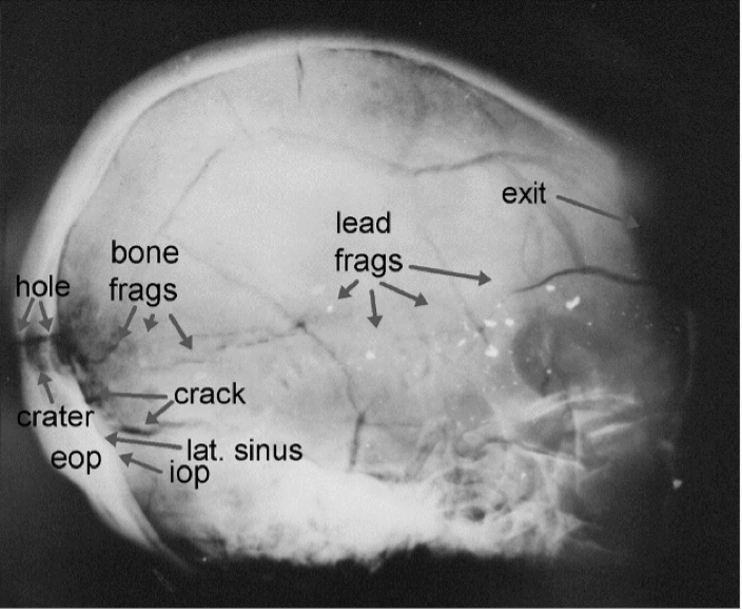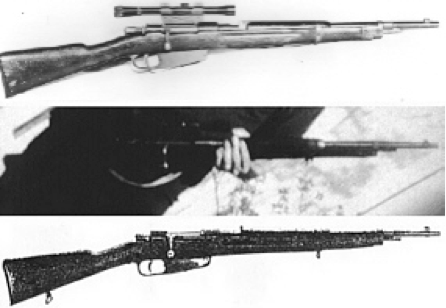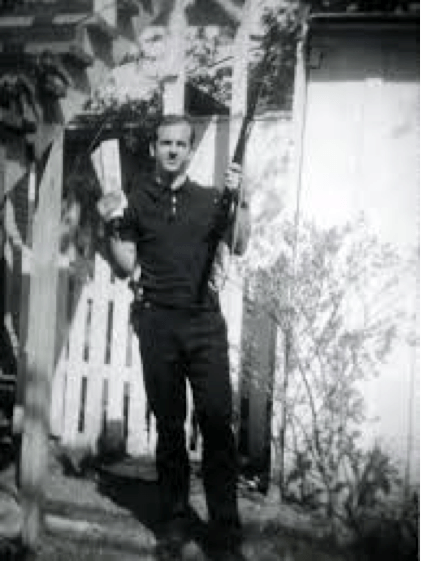
Author: Gary Aguilar

  • Gary Aguilar’s Rebuttal to Robert Wagner

    Gary Aguilar’s Rebuttal to Robert Wagner

    Gary Aguilar Rebuts Robert Wagner

    By Gary L. Aguilar, MD


    Self-described “open-minded” Bob Wagner’s riposte (click here) to my review of his book is a showcase of how closed the minds of Warren Commission loyalists are to evidence that threatens J. Edgar Hoover’s no conspiracy verdict. The imperious and notoriously corrupt Bureau Chief, who instilled fear in all, including the Warren Commissioners and LBJ,[1] pronounced Oswald the sole assassin within hours of the ex-marine’s arrest. [2] He controlled the investigation, pressing his remarkable epiphany on the public[3] as well as on the hapless Warren Commissioners whom he cowed. (“[N]ot one of its seven members had any investigative experience.”[4]) The Commissioners bent the knee, as the Church Committee and the House Select Committee later determined.[5] With good reason.

    Hoover had them file-checked them for “derogatory information.” Commissioner Gerald Ford spied for Hoover and helped him block Earl Warren’s preferred choice for Chief Counsel, Warren Olney.[6] The lawyer Hoover preferred, Chief Counsel J. Lee Rankin, later admitted: “Who could protest against what Mr. Hoover did back in those days?” It’s pretty clear that at the time, no one could, not the U. S. Chief Justice nor Congressmen and Senators. Assistant FBI Director William Sullivan understood how things worked: “Only if one unwritten but iron rule was unfailingly observed: The Director was always right.”[7] Predictably, the Warren Commission proved Sullivan was right.

    Bob Wagner shows that, even in these days, some remain who seem unmoved by the government’s myriad, proven lies and bad faith, and I stand with Hoover’s pre-investigation epiphany. In doing so, Wagner repeatedly violates Occam’s principle that the simplest explanation – in this case, the one that requires the fewest assumptions, the fewest exceptions to the rule, the fewest leaps of faith – is most likely the correct one. Wagner shows his hostility to Lord Occam in his take on “clearly the central theme,” and the “primary point of his analysis”: the location of Kennedy’s skull wound. (Wagner’s emphasis)

    Wagner relentlessly campaigns to discredit Parkland Hospital’s Dr. Robert McClelland’s sworn testimony: “[The] right posterior portion of [JFK’s] skull had been extremely blasted.”[8] His description matched those of other Parkland doctors. Wagner argued, “if Dr. McClelland, having several minutes to observe the wound, could get this wrong, why wouldn’t others do the same?”[9] (He dodged a question I’d put to him: How did the two neurosurgery professors who lifted JFK’s skull and examined the head wound also get it wrong, describing it much as McClelland and the others had?)

    KENNEDY’S HEAD WOUND – WERE THE DALLAS DOCTORS WRONG?

    “The large wound was on the top of the head,” Wagner insists. So, the doctors were wrong. Wagner’s proof? “Alternate substantive evidence.” (Sounds almost Trumpian.) His alternative evidence is threefold.

    One: The autopsy said Kennedy’s head wound was “chiefly the parietal bone but extending somewhat into the temporal and occipital regions.”[10]

    Two: A 4 x 2.5-inch skull fragment was ejected from the top of JFK’s skull and found in the limousine – the so-called “triangular” or “Delta” fragment.

    Three: An autopsy photo shows what Wagner says is a bullet hole in the low, occipital bone, with missing bone above it at the top of JFK’s skull.

    The Texas crew missed the damage to the top of JFK’s head. And I blew it because I never “addressed how head wound witnesses at Parkland (and Bethesda) (sic) failed to note this large area of skull missing from the top of the president’s (sic) head.” He’s wrong.

    First, there’s much more about Kennedy’s head wound than Wagner’s quotes from the autopsy report. Moreover, I have discussed the obvious and common-sensical reason that both Parkland and Bethesda witnesses didn’t notice that a bone was missing from the top of JFK’s skull. He ignored it.

    J. Thornton Boswell’s much-discussed “face sheet” diagram of JFK’s skull, prepared during the autopsy, is primary evidence. It’s superior to the official autopsy report that was written, rewritten, and typed up later, and which says that Kennedy’s skull defect measured “13 cm. in greatest diameter.”[11] The House Select Committee’s (HSCA) Dr. Michael Baden asked Boswell about an important discrepancy in this diagram:

    Baden: “Could you explain the diagram on the back [of Boswell’s face sheet]?”

    Boswell: “Well, this was an attempt to illustrate the magnitude of the [skull] wound again. And as you can see it’s 10 centimeters from right to left, 17 centimeters from posterior to anterior.”[12] (Fig. 1)
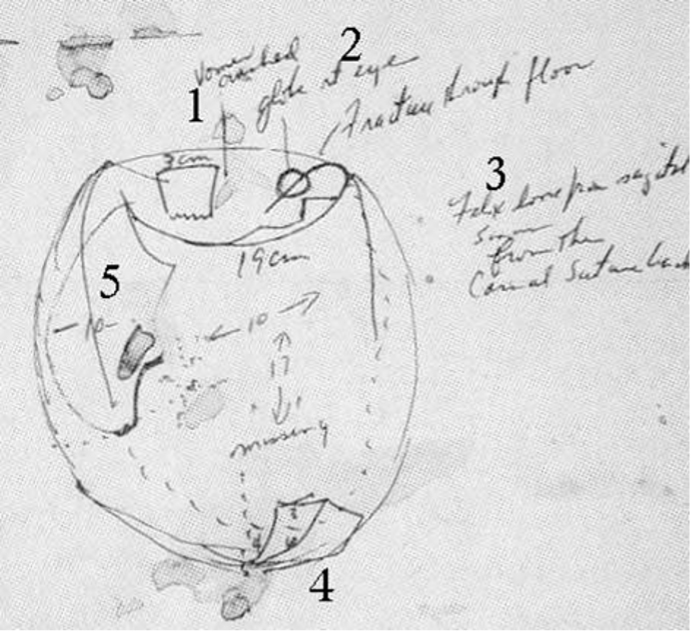
    Figure 1. Dr. Boswell’s “face sheet” diagram of JFK’s skull. In the center of the image, Boswell wrote “17” and “missing,” with an arrow pointing front-to-back. He also wrote “10” next to an arrow pointing right-to-left. The official autopsy report says Kennedy’s skull defect measured “13 cm. in greatest diameter.”

    How did a 17-cm skull defect on the night of the autopsy shrink in the autopsy report? Boswell told the HSCA, the Assassinations Records Review Board (ARRB)and me that JFK’s skull defect measured 17 cm at the outset of the autopsy. But after a late-arriving bone fragment was replaced into the bottom rear of JFK’s skull, into the “occiput,” the remaining gap then measured “only” 13 cm, the dimension specified in the autopsy report.[13]

    Two important things follow. Not only was bone ejected from the top of JFK’s skull, the Delta fragment, but bone was also ejected from the rear, from the low, occipital bone. (Fig. 2)
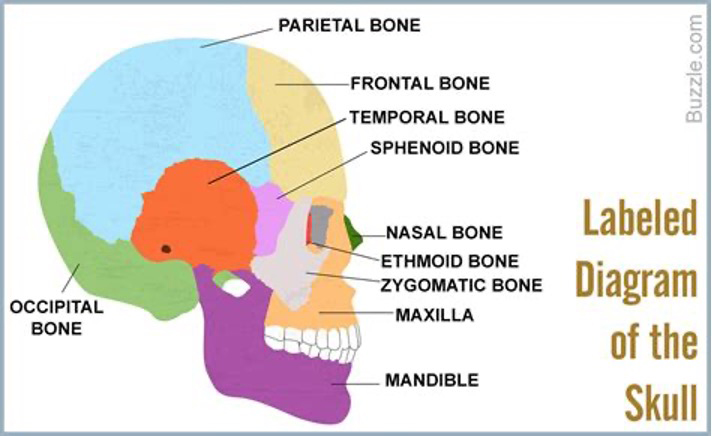
    Figure 2. Diagram of human skull viewed from the right side.

    Secondly, JFK’s skull defect ran per force from the low, occipital bone in the skull’s rear to roughly the parietal-frontal bone region in the front. That’s what Boswell depicted on a human skull that he had marked for the ARRB. Both Boswell’s face sheet and ARRB diagrams are in sharp contrast to what the Warren Commission presented to the public, the Rydberg diagram. It depicts a small (bullet) hole in the rear of JFK’s skull in an otherwise intact plate of bone, and a skull defect that is well above that hole. (Fig. 3)
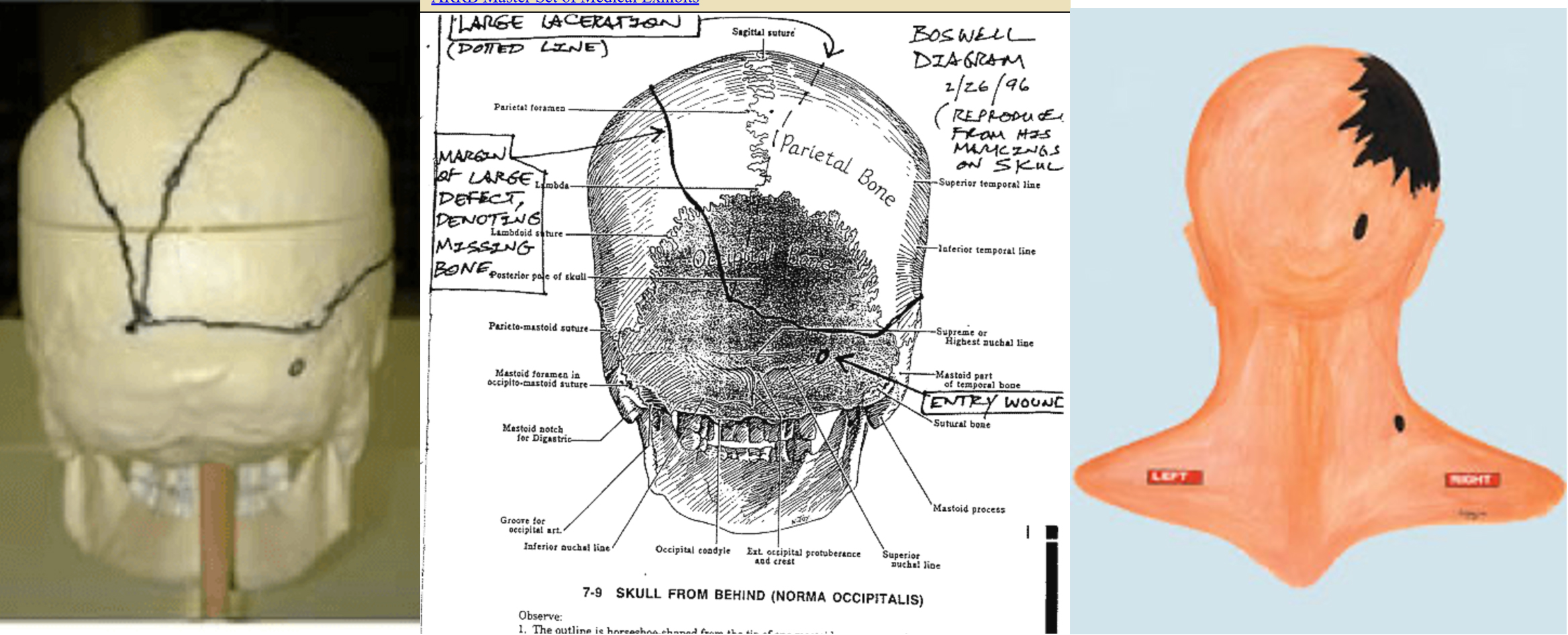
    Figure 3. Left: Photo of a skull marked by Dr. Boswell depicting the size of JFK’s skull defect at autopsy.[14] Notice that the defect extends deeply into the bottom of “JFK’s” low occipital bone. Center: a two-dimensional rendering of the markings Boswell made on the human skull for the ARRB. It shows the shape and dimension of Kennedy’s skull defect at autopsy.[15]

    Right: Warren Commission Exhibit 386 shows a small occipital entrance wound, which is distinct from the large right-sided skull defect. Boswell told the HSCA in 1977 and the ARRB in 1996 that the entrance hole was not in an intact plate of bone. They actually inferred it was a wound of entrance from the beveling present on a late-arriving bone fragment, which fit into a wound that was initially much larger than shown here, and which extended down to the entrance hole. (See CE # 386.[16] Also see Boswell’s HSCA interview,[17] and Dr. Boswell’s ARRB deposition, p. 79 ff.[18])

    The reason Parkland’s trauma surgeons, neurosurgery professors, and autopsy witnesses said JFK’s skull wound was occipital has an obvious, simple explanation. Wagner says I never addressed this. I have, several times, starting decades ago.

    “Wounds picked apart during an autopsy examination,” I wrote 25 years ago, “are often found to be larger than they first appeared to emergency personnel. In Kennedy’s case, moreover, Jackie Kennedy testified that she tried to hold the top of JFK’s head down as they raced from Dealey Plaza to Parkland Hospital. It is not hard to imagine that during the time it took the Presidential limousine to get to Parkland Hospital, a clot had formed, gluing the top portion of JFK’s disrupted scalp down, making JFK’s skull defect appear smaller to treating surgeons than it later would to autopsy surgeons.”[19]

    Jackie has said as much herself. ” ’He had his hand out, I could see a piece of his skull coming off, and I can see this perfectly clean piece detaching itself from his head . . . I kept holding the top of his head down, trying to keep the brains in,’ she said on Nov. 29, 1963.[20]” (my emphasis)

    In his rebuttal, Wagner offers autopsy witness FBI agent James Sibert in support of his claim that the overlooked Delta fragment proves the Dallas error. But in a taped interview, Sibert described what he saw when Kennedy’s head was unwrapped at autopsy: “… there was a sheet unwrapped off the head. There was a big gaping hole in the right rear of the head back here … .”[21] (my emphasis) (Fig. 4) Sibert also diagrammed the wound he saw for the ARRB. Sibert thus confirms that JFK’s head wound at autopsy looked eerily like, if not as large as, the wound Dr. McClelland saw at Parkland.[22] Many other autopsy witnesses described it in similar terms, and so were just as “mistaken” as Dallas neurosurgeons and the FBI Agent were.[23]
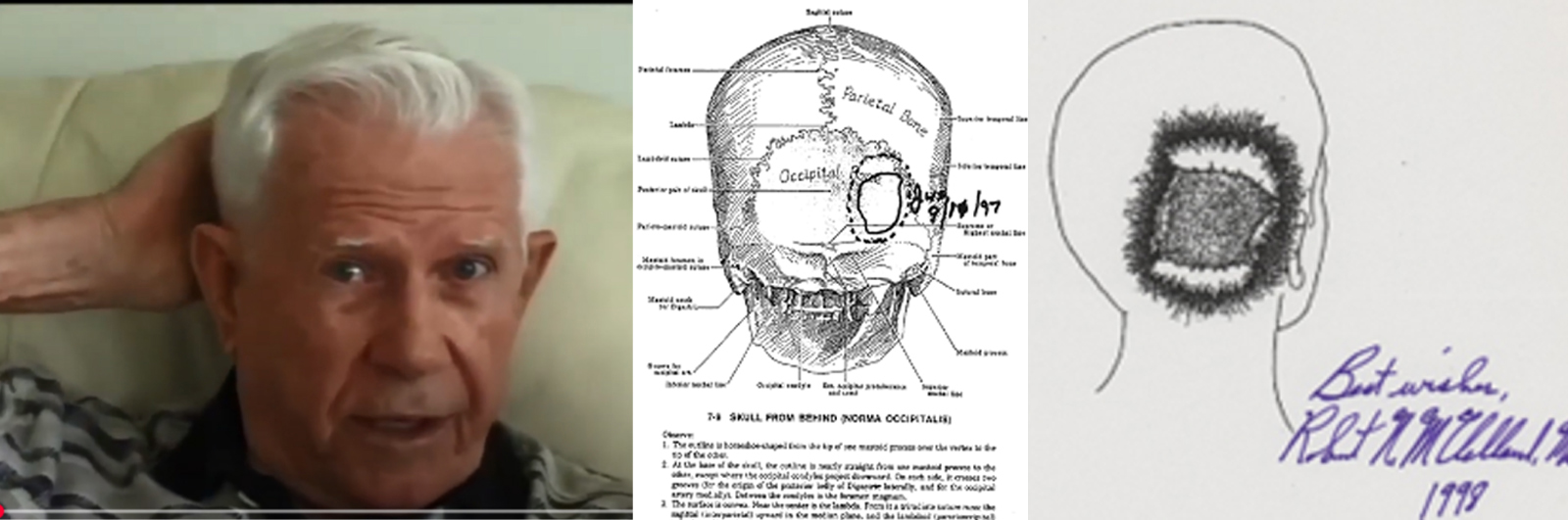
    Figure 4. Left: screenshot of witness James Sibert showing where JFK’s wound was when they unwrapped his head at autopsy. Center: MD 188 – Sketch made by FBI agent James W. Sibert for the ARRB – Anatomical Drawing of Wound in President Kennedy’s Head (Executed on September 11, 1997). Right: “McClelland diagram” attested to by Dr. McClelland in 1998.

    Jackie held the top of JFK’s head down on the way to Parkland; a blood clot kept his scalp down; and the full extent of his skull defect wasn’t apparent until the surgeons at Bethesda lifted his scalp to examine his huge skull defect. My reply to Wagner’s claim of: “The large wound was on the top of the head, not lower on the back of the head” is clear. Kennedy’s wound was so large that it involved both the top of his head as well as the back of his head.

    But what about the autopsy photograph that shows the backside of JFK’s head intact and undamaged? Does this not prove Dr. McClelland, neurosurgeon Dr. Kemp Clark, Agent Sibert, etc., were wrong? (Fig. 5) The ARRB asked Boswell about this very photograph.

    Q. Okay. Could we turn to the sixth view, which is described as “wound of entrance in right posterior occipital region”? That corresponds to black and white photos Nos. 15 and 16, and color photos Nos. 42 and 43. Do these photographs appear to you, Dr. Boswell, to be accurate representations of photographs taken during the autopsy of President Kennedy?

    A. Yes.

    Q. In that photograph, is the scalp of President Kennedy being pulled forward?

    A. Yes.

    Q. For what purpose was it being pulled forward?

    A. In order to take the photograph, because if it wasn’t pulled forward, this would just–the scalp would come down and cover the wound of entrance here. And this was necessary to demonstrate the wound here. [24]

    In other words, the photo of the back of JFK’s head doesn’t show the rearward extent of the head wound because JFK was lying on his left side, not upright, as his scalp was pulled forward over the back of his skull to show a bullet wound in the scalp. (Fig.5)
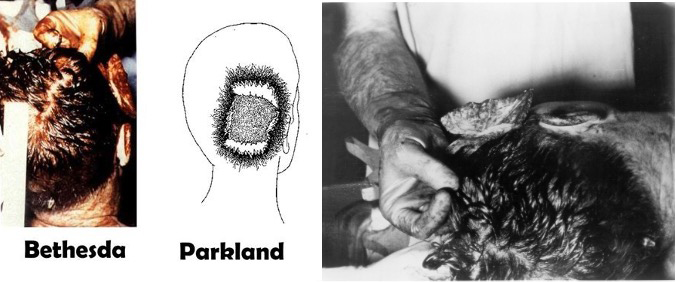
    Figure 5. Left: Autopsy photo as it’s usually displayed. Kennedy is upright; the backside of JFK’s head is intact and undamaged. Center: diagram of the wound that Parkland’s Dr. Robert McClelland said he saw. Right: proper orientation of the photo as it was taken. JFK is lying on his left side, and an autopsist (Boswell?) is holding JFK’s rearward scalp forward over the right-rear portion of Kennedy’s skull wound.

    WAGNER’S CLAIM: AN AUTOPSY PHOTO PROVES OCCIPITAL INSHOOT

    Re Wagner’s last bit of ‘alternate evidence,’ an autopsy photo commonly called the ”mystery photo”. It is so badly shot and composed that many could not understand what it was. I do not accept his “special plea” that he knows what it is and what it means, when even the autopsy surgeons and the HSCA’s Forensic Pathology Panel were uncertain about its proper orientation or meaning. Besides, as I originally wrote, Dr. Pierre Finck, who held JFK’s skull in his hands, as Wagner put it, said that this is not the photo Wagner says it is.

    This “mystery photo” (sic) is of the “occipital wound of entrance,” he says, “How could it be otherwise?” It’s otherwise for at least two good reasons. First, in his 1965 memo to General Blumberg, Finck wrote that “I found a through-and-through wound of the occipital bone, with a crater visible from the inside. This wound showed no crater when viewed from the outside.”[25] (my emphasis)

    The wound in the photo, as I discussed in my original review, and as anyone can see, is beveling. But it’s beveled outside, not inside, and it’s plainly visible, even in this bootleg “mystery photograph.” (Fig. 6) The outside beveling makes this photo more likely one of an outshoot, not Wagner’s occipital inshoot. 
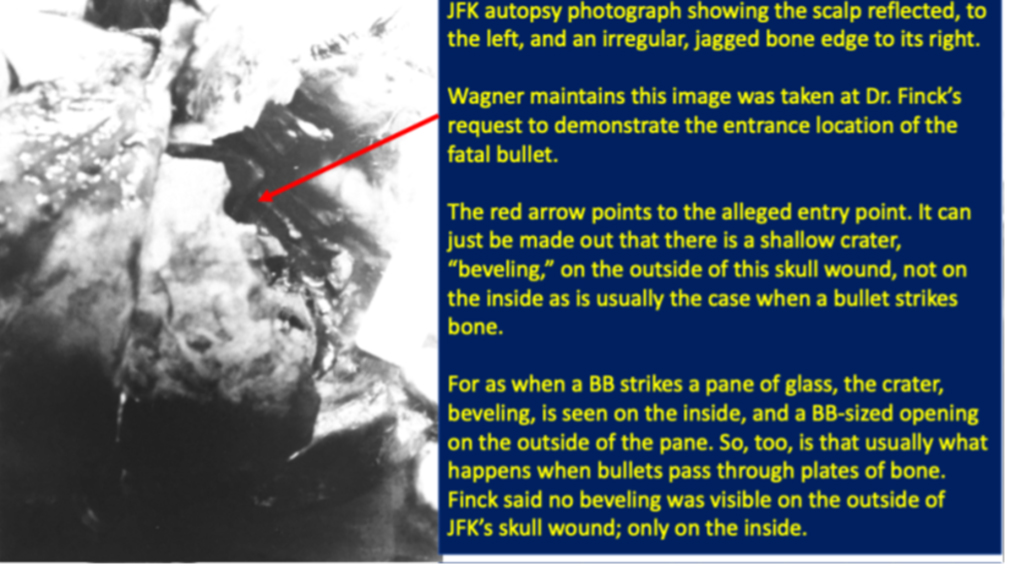
    Figure 6. “Mystery photo” from JFK’s autopsy.

    Wagner says this “mystery photo” (taken from my slide show) shows the entrance point of a bullet low in the back of JFK’s skull, in occipital bone, the area specified in the autopsy report. The red arrow points to a semicircular notch, Wagner’s supposed entrance wound. But the “beveling” is on the outside of the skull, not the inside, where Dr. Finck said it was. This, therefore, is not the photo of the entrance wound that Finck meant.

    The HSCA’s Charles Petty, MD, asked Finck: “If I understand you correctly, Dr. Finck, you wanted particularly to have a photograph made of the external aspect of the skull from the back to show that there was no cratering to the outside of the skull … Did you ever see such a photograph?” (my emphasis)

    Finck: “I don’t think so and I brought with me memorandum referring to the examination of photographs in 1967… and as I can recall I never saw pictures of the outer aspect of the wound of entry in the back of the head and inner aspect in the skull in order to show a crater … I don’t remember seeing those photographs.”[26] Finck examined this photograph, which does show cratering on the outside, and he denied it was the occipital entrance photo. So how can Wagner, not a forensic pathologist, not a physician, and who wasn’t present, say that Finck, a forensic pathologist, who was there, who held JFK’s head in his hands, is wrong, and that he is right.

    WAGNER AND KENNEDY’S PHYSICAL AND X-RAY EVIDENCE

    Perhaps Wagner’s most desperate assaults on Lord Occam have to do with the physical evidence: Kennedy’s response to the shot that killed him, and the autopsy X-rays. By his lights, what we see happen to JFK’s head, what we see in the Zapruder film, and what’s visible in JFK’s X-rays, mesh smoothly with Hoover’s scenario. They don’t.

    Put simply, we know from government duplication experiments done for the Warren Commission that, when human skulls are struck with Mannlicher ammo, they move differently than JFK’s did; the skull injuries are vastly different; and the X-ray findings are worlds apart. I ran through them in detail in my original review.

    Briefly:

    High-speed photos show that when struck with MCC rounds in the government’s tests, 10 out of 10 skulls moved away from the shooter, not back toward the shooter as Wagner argues Kennedy’s did. The photos also show that, like all “closed vessels,” the first reaction to bullet penetration is an explosion back out through the point of entrance.[27] Milliseconds later, there’s a burst through the outshoot on the opposite side of the skull, or “closed vessel.” (JFK’s skull showed no such rearward ejecta in the Z film.) Shot in accordance with the official theory, the test skull’s right forehead, entire right orbit, and right cheek were blown away. JFK suffered no such injuries.

    There’s no small irony that the official experiments intended to “duplicate” what happened when Oswald shot JFK not only failed, they pretty much proved Oswald didn’t do it. (Fig. 7) The pictures below illustrate what I said about ejecta and facial damage.
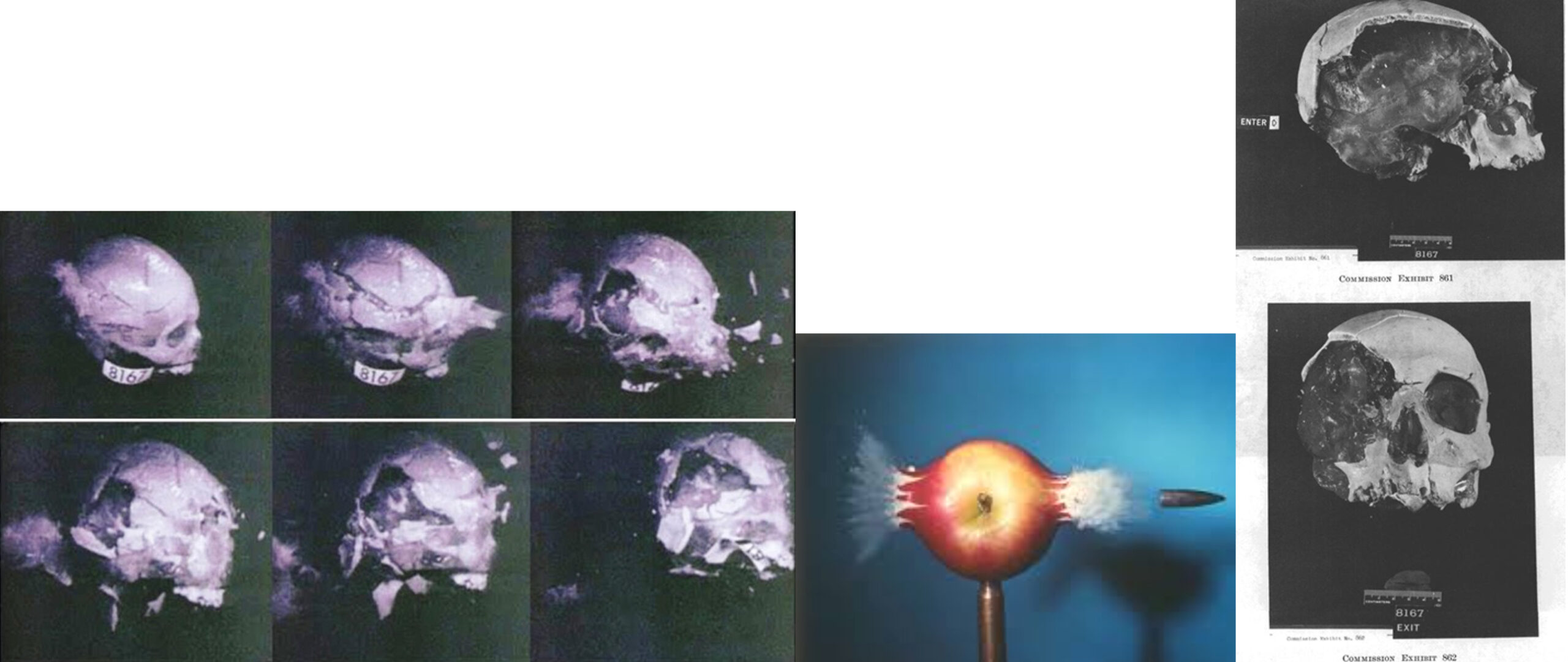
    JFK’s X-rays can’t keep Wagner’s ship afloat. A test skull shot with a Carcano round showed no “dust-like,” no “snowstorm,” of minuscule fragments. Wagner’s own expert, Larry Sturdivan, testified in detail why: jacketed bullets like Oswald’s don’t leave a “snowstorm” of minuscule fragments after blasting through bone.[28]

    But in fact, there is a “snowstorm” of minuscule bullet fragments in the right front quadrant of JFK’s skull X-ray. They are clearly visible in JFK’s original, unenhanced X-rays, and their existence in that location was attested to by expert radiologists.[29] But they’re blotted out and are not visible in the poor quality, “enhanced” films available to the public.

    Moreover, jacketed shells like Oswald’s don’t deviate much from their original flight path. Why? Because, as Larry Sturdivan testified, the jacketed “Mannlicher-Carcano bullet is much more stable, the yaw begins to grow much more slowly (than non-jacketed, military rounds do) … .”[30] (my emphasis)

    Wagner asks us to believe that Oswald shot downward toward JFK’s receding skull, striking it low with a jacketed slug. It was then somehow deflected way upward to the top of JFK’s skull, leaving fragments high in the skull. (Figs.7&8)
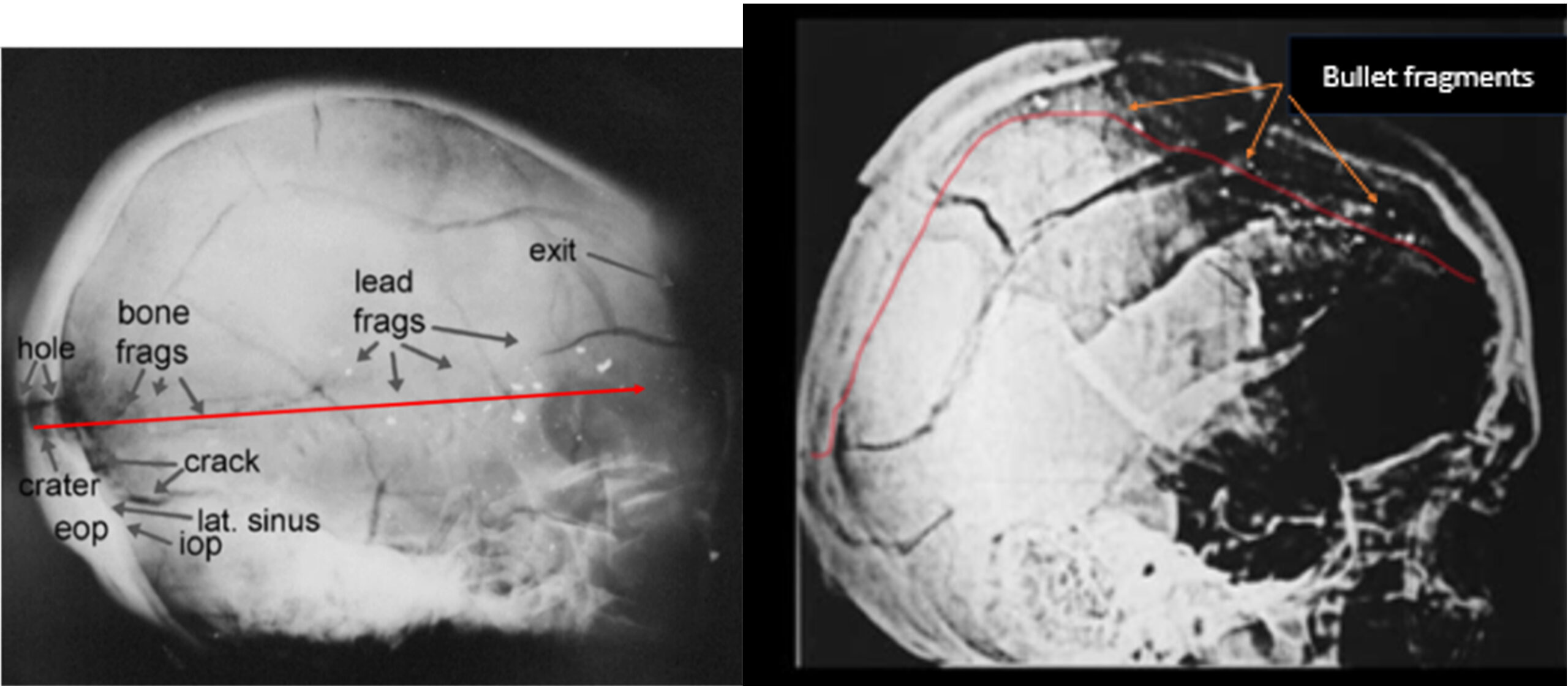
    Figure 8. Left: Sturdivan reproduced an X-ray of a test skull shot with a Mannlicher round at the Biophysics Lab.[31] The fragments are small, but not “dust-like.” Not like the “snowstorm” of fragments visible in the right-front quadrant of Kennedy’s still-secret, original and unenhanced, lateral X-ray. (Which is evidence JFK was killed with a non-jacketed bullet. For “dust-like” fragments are quickly stopped by brain tissue, and so lodge close to the point of entry.) Moreover, the test skull’s fragment trail closely follows a low, little-deviated flight path across the skull, precisely as Larry Sturdivan said happens with MCC rounds.

    * Right: JFK’s “enhanced” lateral X-ray: small fragments are visible only along the top of the skull. Wagner says that, unlike the test skull, Oswald’s bullet was fired downward, struck JFK’s skull low, then popped up to the top of his skull, broke apart, and blew out of the right side of his head.

    MOMENTUM – WHAT DROVE KENNEDY “BACK AND TO THE LEFT”?

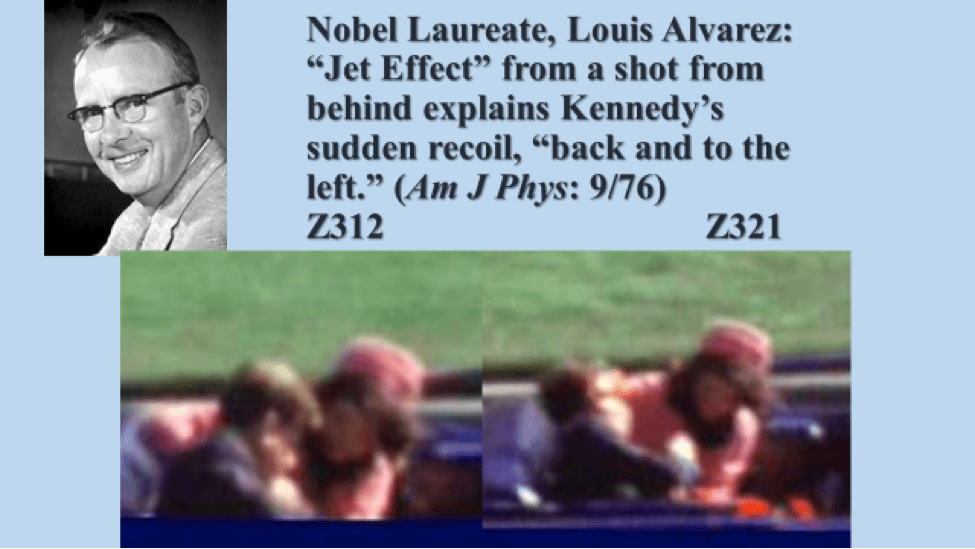
    Wagner offers no explanation for JFK’s rearward lunge. Except a “grassy knoll” shot did not do it. Why? Because JFK’s body is visibly “lifted against gravity” after Z-313. It’s something that Kennedy’s rearward head movement could not have accomplished. (He carefully avoids admitting it, but if not “momentum transfer” from a “grassy knoll” shot, his sole remaining pro-Hoover explanation for the rearward lunge is a “neuromuscular” reaction, one that lacks medical/scientific foundation, and that has been debunked.[32])

    The proof Wagner is wrong is in the Zapruder film. The motion of JFK’s head appears to have been enough to pull his back along with it. For as JFK’s head moves, so does his upper body, and it does so in two different directions. Following Z-327, when an acoustics- and Z-film-corroborated shot hit him from behind, Kennedy’s head lunges frontward and his back moves forward with it. The opposite thing happens after Z-313: his head flies backward, and his back follows. So just as JFK’s back is “lifted against gravity” backward when his head jolts rearward after Z-313, his back is similarly “lifted against gravity” forward as the President’s head ploughs ahead after Z-327. (Fig. 9)
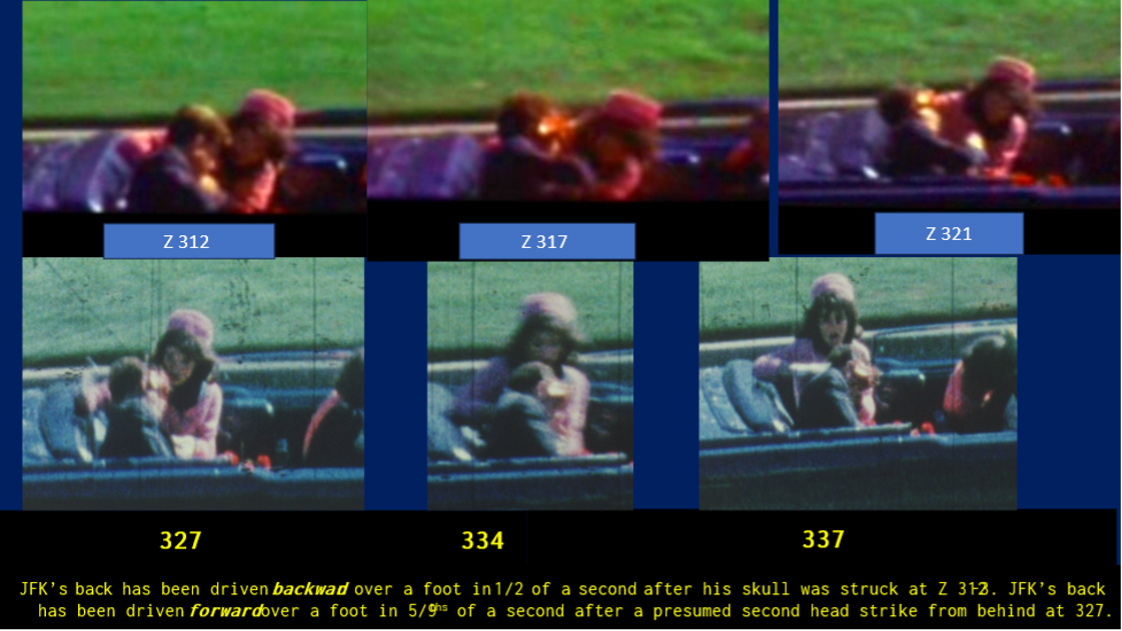
    Figure 9. Kennedy’s “upper body” is “lifted against gravity” backward by the motion of his head after Z-313, just as it is similarly “lifted against gravity” forward after Z-327. (Image taken from a PowerPoint slide.)

    THE “DEBRIS FIELD”

    Josiah Thompson, Dr. Doug Desalles and I have repeatedly pointed out that the “debris field” – the region toward which most of Kennedy’s skull and brain matter flew – was “back and to the left” of Kennedy, consistent with a shot from the grassy knoll. Wagner counters that some “human matter” was also located forward of JFK. He’s right on that.

    The explosion of JFK’s head at Z-313 would likely have sent some debris forward. As previously shown (Fig.7), some debris flies back toward the shooter when any closed vessel is struck. But most of the debris from the Z-312-313 shot clearly flew back to the left. Some of the forward-driven material likely flew due to a bullet strike to JFK’s head from the rear at Z-327-8. That strike drove JFK’s head and upper body rapidly forward after Z-327. It also abruptly changed the anterior-top portion of his skull, driving the “debris” that is seen falling down across his face a half-second later. High-quality Z-frames make this clear. (Fig. 10)

    As final, corroborative points, an acoustics waveform suggested a shot was fired from behind at Z-327-8. And Z-frames 331 and 332 are “jiggled,” which fulfills the Alvarez-proposed, 3-frame delay for the sound of an Oswald shot at Z-327-8 to reach Zapruder and jostle his camera.[33]
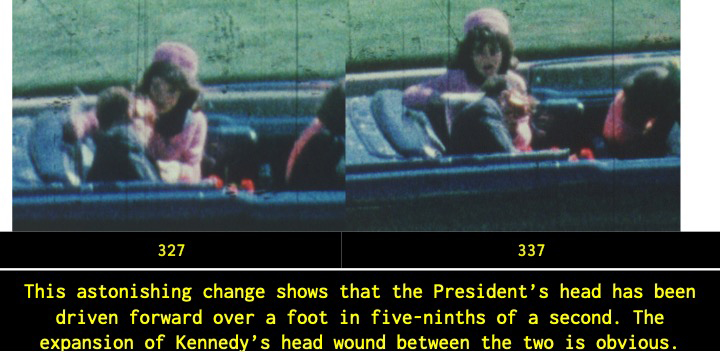
    Figure 10. Between Z-frame 327 and 337, Kennedy’s head is driven swiftly forward and downward; his back follows. The anterior portion of his head changes dramatically, and debris can be seen spilling down across his face. (If he was struck from behind at Z-327, why is there no rearward gush of ejecta seen as occurred in the government’s skull shooting tests, Fig. 7? Simply, by Z-327 the President’s skull was no longer a “closed vessel.”)

    THE MAGIC BULLET – COMMISSION EXHIBIT #399

    Wagner tries to salvage the dubious bona fides of the so-called “magic bullet” by eliding key facts. First, the FBI lied in Commission Exhibit #2011 when it reported that Parkland employees Tomlinson and Wright claimed #399 resembled the bullet they found on 11.22.63.[34] They never said that. The early, and only, report from the Bureau’s Dallas field office in 1964 reported that neither Tomlinson nor Wright could identify #399. Period. And, as Wagner admits, in 1966 O.P. Wright handed Thompson a bullet from his own desk that he said looked like the bullet they’d found. It had a pointed tip, not at all like the round-tipped #399. (As a former Dallas Sheriff, he would have known the difference.)

    The FBI also lied, claiming that it was agent Bardwell Odum who had gotten the Tomlinson-Wright admission that there was a bullet resemblance. In person, in his own living room, Odum emphatically denied to Thompson and me that he’d gotten any such admission. He never talked with Tomlinson and Wright, or had #399 in his possession. The Bureau’s own internal records back up Odum’s unequivocal denials to us. Odum’s name is nowhere to be found in any FBI files regarding #399, according to searches done by skeptics as well as by the government.

    It should not be ignored that #399 is “magical” in other ways as well. It’s supposed to have passed through JFK’s jacket and shirt on the way in, through his neck, his shirt again on the way out. It then nicked his tie, tore through Governor Connally’s jacket and shirt, blew completely through his chest, breaking a rib, and out through his shirt. Then it passed, butt-first, backward through the governor’s wrist, transected his trousers, before finally lodging in his leg, only later to fall out. And yet there are no fabric striations on the unblemished nose of #399. Nor is there any residuum of blood or tissue on this negligibly deformed missile. And it’s skeptics who are fools for not buying this?

    ACOUSTICS

    As I pointed out in my review, Wagner says that one should trust authorities “who are truly expert in the field in which they offer opinions.” He didn’t do that with the acoustics, nor with much else for that matter. The U.S. Justice Department didn’t either. Wagner omits any mention of a well-known, acoustics-related scandal.

    When the HSCA went out of business, two of the committee members appropriately recommended that the pro-conspiracy acoustic evidence needed to be reexamined. They specified that acoustics experts should do the restudy.[35] As I discussed in my review, in typical fashion, the Justice Department ignored the HSCA’s directive. Justice first turned to a Bureau agent, B. E. Koenig, whose credentials consisted of his completing a quickie “Gee Whiz!” course in acoustics. His paper “refuting” the HSCA’s acoustics was promptly debunked and discredited.[36]

    DOJ then turned to Nobel Prize winner, Luis Alvarez. He’d previously put out a false scientific finding that pleased the Carter Administration. His work on the so-called Vela incident proved nothing except that he could be relied upon to uphold a necessary government myth. [37][38]

    U.S. officials needed a fixer for the acoustics. But Alvarez didn’t chair the reexamination. Instead, he arranged the panel. The selectees were all physicists known to Alvarez. None had any acoustics training or expertise. Not even the chair, Harvard’s Norman Ramsey, with whom Alvarez had long collaborated on prior government projects. He also picked Richard Garwin and F. Williams Sarles, both trusted alumni of Alvarez’s Vela fiasco. It was like picking pediatricians to do a hip replacement, except that the pediatricians I have personally known would never do what Alvarez and his appointees did.

    Alvarez sat in and worked closely with his “Ramsey Panel,” and, lo and behold, they disproved the HSCA’s acoustics! Wagner shows no concern about this arrangement: progovernment, anticonspiracist Alvarez hand-picked non-experts who issued a progovernment opinion in a field in which they had no experience or expertise, and which supposedly disproved the findings of government-appointed scientists with proven experience and expertise. And it’s skeptics who are fools for not buying this?

    Conclusion

    A reasonable corollary of Lord Occam’s principle might be to reject a complex theory that requires suspending disbelief and embracing complex improbabilities if there is a simpler, less complex, less improbable theory that requires less suspension of disbelief. The evidence is so against Wagner that he asks us to suspend disbelief and accept complex improbabilities.

    • That numerous percipient trauma surgeons, neurosurgery professors, FBI agent eye witnesses were wrong that Kennedy had a rearward skull wound;
    • That nonphysician Wagner is right that the “mystery photo” in Fig. 6 is Kennedy’s occipital entrance wound from Oswald’s fatal bullet, and that JFK’s examining forensic pathologist Finck, who said it isn’t, is wrong;
    • That JFK’s head flew backward toward Oswald’s rifle when all 10 test skulls that were similarly fired upon in government tests flew away from the shooter;
    • That Oswald’s bullet entered Kennedy’s skull low on a downward trajectory, yet was wildly deflected upward. Which is in defiance of the expressed claims of Wagner’s experienced, government ballistics expert, Larry Sturdivan, whose opinion was confirmed in a government duplication test that showed that a Mannlicher shell was not deflected as it passed through a human skull;
    • That Oswald’s jacketed MCC bullet left a “snowstorm” of minuscule fragments in the right front quadrant of JFK’s head when “snowstorms” in X-rays are not seen with jacketed bullets, but only with non-jacketed rounds. [Nor was a “snowstorm” seen in the X-ray of a test skull shot with an MCC shell in a government test. (Fig.8)]
    • That the “debris field” that flew back to the left of JFK, and the skull fragments that flew leftward, were all driven backward and leftward by Oswald’s bullet that supposedly entered the right rear of Kennedy’s skull and blew out of the right front part of his head;
    • That there is nothing noteworthy about the fact that none of the first four people in the chain of possession of the Parkland stretcher bullet were later able to identify #399 as that same bullet. Nor is it noteworthy that the FBI lied about #399 in official records. Nor that there was neither the marking of the shell’s having passed through fabric nor any tissue residues on the near-pristine bullet that is supposed to have been so destructive of fabric, flesh and bone;
    • That a group of untrained, acoustics-ignorant physicists, appointed by an acoustics-ignorant, proven government toady and anticonspiracist (Luis Alvarez), definitively debunked the findings of three of the most highly regarded acoustics authorities in the country.
    • That the debunked “neuromuscular reaction” and/or “jet effect” explain(s) Kennedy’s rearward lunge, and that the momentum imparted to JFK’s skull from a grassy knoll shot does not.

    For Wagner, it’s always, well, under normal circumstances, a, b, c, … x, y, and z do not happen. But this time it’s different. As improbable as it may seem, folks, in this unique case, all these unlikely things did happen, and they happened just the way the government said they did … . And it’s the skeptics who are fools for not buying this? Well, we don’t buy it. Because we have long had a far less complicated theory than J. Edgar Hoover about what happened in Dealey Plaza. And it’s one that fits the evidence and is not in defiance of it. It explains things like JFK’s rearward lunge, which an Oswald shot does not; it explains things like ejecta backward; why the motorcycle cops were hit with blood and tissue while riding to JFK’s right; why there is a snowstorm of dust-like bullet fragments in the right front of Kennedy’s forehead. I could go on and on with this, but I think the reader gets the point by now.

    If the government had been telling us the truth all along, there’d have been no need for intimidating witnesses, for destroying evidence, and for continuing to withhold evidence to this day.

    So why does Wagner remain faithful to those who have endlessly lied and acted in such extraordinarily bad faith? How many more proven official malefactions would it take to shake his faith? I keep thinking of something Jeff Morley pointed out that’s worth repeating:

    “In civil law, when one party does not disclose evidence in its possession, a jury is allowed to draw an adverse inference that the missing information destroyed or not produced was unfavorable.” Now, 60+ years after Kennedy was assassinated, it’s more than fair to draw the adverse inference that the missing information destroyed or not produced by the FBI, the CIA,[39] and the Secret Service was unfavorable to the government’s claim Oswald acted alone.[40]

    One might have hoped that the government’s proven dishonesty and bad faith in the Kennedy case, which Jim Dieugenio, Jeff Morley, and others have shown have no limit and no end, would force a reckoning among Warren loyalists. There’s little doubt but that it has, among some. But from what he’s written in his books and in his riposte, it seems that there’s nothing that’s likely to ever shake Bob Wagner’s “patriotic” faith. And it’s skeptics who are fools for not buying this?

    Click here to read the article by Robert Wagner that Gary Aguilar is responding to.

    Editor’s note: Robert Wagner and Gary Aguilar have both been given space on this site to present their latest retorts on this ongoing debate. At this point, we have no plans to publish further discussion between the two researchers regarding this debate.

    ————

    1. Curt Gentry. J. Edgar Hoover – the Man and the Secrets. New York. W.W. Norton & Co., 1991, p. 553, and p. 558. (Hoover kept a file on LBJ.)

    2. See Hoover memo from 11.22.63 saying Oswald was the culprit: https://www.maryferrell.org/showDoc.html?docId=62251#relPageId=97

    3. JFK assassination files: Hoover said FBI must “convince the public” Oswald acted alone. CBS News. https://www.cbsnews.com/news/jfk-assassination-files-hoover-said-fbi-must-convince-the-public-oswald-acted-alone/

    4. Curt Gentry. J. Edgar Hoover – the Man and the Secrets. New York. W.W. Norton & Co., 1991, p. 548 and p. 553.

    5. See: Aguilar G. Warren Commission Counsels Burt Griffin and Howard Willens Attempt the Impossible: Shoring up the Tottering Credibility of Earl Warren’s Investigation. https://www.kennedysandking.com/john-f-kennedy-articles/warren-commission-counsels-burt-griffin-and-howard-willens-attempt-the-impossible-shoring-up-the-tottering-credibility-of-earl-warren-s-investigation

    6. Sources at: Aguilar G. Warren Commission Counsels Burt Griffin and Howard Willens Attempt the Impossible: Shoring up the Tottering Credibility of Earl Warren’s Investigation https://www.kennedysandking.com/john-f-kennedy-articles/warren-commission-counsels-burt-griffin-and-howard-willens-attempt-the-impossible-shoring-up-the-tottering-credibility-of-earl-warren-s-investigation

    7. Gerald D. McKnight. Breach of Trust – How the Warren Commission Failed the Nation and Why. Lawrence, Kansas: Kansas University Press, 2005, p. 150.

    8. Warren Commission testimony of Robert McClelland, Hearings Vol. 6, p. 33. Hereafter 6H33.

    9. Wagner, R. JFK Assassisnated – In the Courtroom Debating the Critical Research Community. Mill City Press, 2023, p. 210.

    10. Warren Commission Exhibit #387, Autopsy Report and Supplemental Report, p. 3. https://aarclibrary.org/publib/jfk/wc/wr/pdf/WR_A9_AutopsyReport.pdf

    11. Warren Commission Exhibit #387, Autopsy Report and Supplemental Report, p. 3. https://aarclibrary.org/publib/jfk/wc/wr/pdf/WR_A9_AutopsyReport.pdf

    12. House Select Committee (HSCA) testimony of J. Thornton Boswell, MD. V7:253 https://history-matters.com/archive/jfk/hsca/reportvols/vol7/html/HSCA_Vol7_0132a.htm

    13. HSCA memo of conversation with J. T. Boswell, HSCA record # 180-10093-10430-, agency file number 002071, p. 6. Also reproduced in ARRB Medical Document #26, see p. 6. See also my discussion of this 33 years ago:

      Aguilar G, Cunningham K. HOW FIVE INVESTIGATIONS INTO JFK’S MEDICAL/AUTOPSY EVIDENCE GOT IT WRONG – DISCUSSION. https://history-matters.com/essays/jfkmed/How5Investigations/How5InvestigationsGotItWrong_6.htm

    14. Image available at: Mantik D. The Omissions and Miscalculations of Nicholas Nalli

      https://www.kennedysandking.com/john-f-kennedy-articles/the-omissions-and-miscalculations-of-nicholas-nalli

    15. ARRB Master Set of Medical Exhibits, MD 29. https://history-matters.com/archive/jfk/arrb/master_med_set/md209/html/md209_0001a.htm

    16. https://history-matters.com/archive/jfk/wc/wcvols/wh16/html/WH_Vol16_0501a.htm

    17. HSCA V. 7:246. https://history-matters.com/archive/jfk/hsca/reportvols/vol7/html/HSCA_Vol7_0128b.htm

    18. https://history-matters.com/archive/jfk/arrb/medical_testimony/Boswell_2-26-96/html/Boswell_0045b.htm

    19. Aguilar G. The Converging Medical Case for Conspiracy in the Death of JFK. In: Fetzer J, ed. Murder in Dealey Plaza, Part III. Chicago: Catfeet Press, 2000, p. 187.

    20. Seattle Times, May 27, 1995. Jackie’s Memories Of JFK’s Death — In 1963 Interview, She Talked Of Seeing Husband Shot. https://archive.seattletimes.com/archive/19950527/2123253/jackies-memories-of-jfks-death—-in-1963-interview-she-talked-of-seeing-husband-shot

    21. https://www.youtube.com/watch?v=h7cimeXvqLA

    22. https://aarclibrary.org/publib/jfk/arrb/master_med_set/md188/html/md188_0001a.htm

    23. See my 1994 compilation of witness statements: JOHN F. KENNEDY’S FATAL WOUNDS: THE WITNESSES AND THE INTERPRETATIONS FROM 1963 TO THE PRESENT http://assassinationweb.com/ag6.htm

    24. ARRB testimony of J. Thornton Boswell, p. 160-161. https://www.jfk-assassination.net/russ/testimony/boswella.htm

    25. MD 28 – Reports From Lt. Col Finck to Gen. Blumberg (1/25/65 and 2/1/65). See Summary page: https://aarclibrary.org/publib/jfk/arrb/master_med_set/md28/html/Image19.htm

    26. HSCA testimony of Pierre Finck, MD. https://www.jfk-assassination.net/russ/testimony/finckhsca.htm

    27. Besides the photos from the government’s Biophysics Lab, a posted video of extremely high speed videos of eggs being shot with bullets that repeatedly show that the first egress of debris exits the point of entrance. See “Cory Santos” videos posted online in an “Education Forum” discussion of “jet effect.” https://educationforum.ipbhost.com/topic/27768-video-destroying-the-jet-effect/

    28. See: Aguilar G. Is Robert Wagner the New Paul Hoch? – Part 2, “Snowstorm.” https://www.kennedysandking.com/john-f-kennedy-articles/is-robert-wagner-the-new-paul-hoch-part-2

    29. See: Aguilar G. The X-Ray Evidence: Enhanced vs Unenhanced. In: Is Robert Wagner the New Paul Hoch? – Part 2 https://www.kennedysandking.com/john-f-kennedy-articles/is-robert-wagner-the-new-paul-hoch-part-2

    30. Sturdivan, L. Testimony HSCA Vol. 1:394. https://aarclibrary.org/publib/jfk/hsca/reportvols/vol1/pdf/HSCA_Vol1_0908_3_Sturdivan.pdf

    31. Sturdivan, L S. The JFK Myths. St. Paul. MN. Paragon House, 2005, p. 173.

    32. * See: Aguilar G, Wecht CH. Dr. Nalli and Neuromuscular Reaction. In: Nicholas Nalli and the JFK Case, Part 2. https://www.kennedysandking.com/john-f-kennedy-articles/nicholas-nalli-and-the-jfk-case-part-2

      * See: Aguilar G, Wecht CH. AFTE Journal — Volume 47 Number 3 — Summer 2015, p. 134-135. Available here: https://www.kennedysandking.com/john-f-kennedy-reviews/nova-s-cold-case-jfk-junk-science-pbs

      * See: Aguilar G. Wecht CH. AFTE Journal — Volume 48 Number 2 — Spring 2016, p. 72. Available here: https://www.kennedysandking.com/john-f-kennedy-reviews/nova-s-cold-case-jfk-junk-science-pbs

    33. Alvarez J. A physicist examines the Kennedy assassination film. Am. J. Physics, V.4, # 9. Sept. 1976. https://aarclibrary.org/publib/jfk/hsca/reportvols/vol1/pdf/HSCA_Vol1_0908_4_Alvarez.pdf

    34. See Commission Exhibit #2011: https://www.history-matters.com/essays/frameup/EvenMoreMagical/images/Slide2.GIF

    35. * HSCA Final Report, p. 486. https://www.history-matters.com/archive/jfk/hsca/report/pdf/HSCA_Report_4_Remarks.pdf

      * DISSENTING VIEWS BT HON. ROBERT W. EDGAR TO THE FINAL REPORT, p. 499https://www.history-matters.com/archive/jfk/hsca/report/pdf/HSCA_Report_4_Remarks.pdf

    36. * Koenig, BE. Acoustic Gunshot Analysis – The Kennedy Assassination and Beyond (Conclusion) https://www.ojp.gov/ncjrs/virtual-library/abstracts/acoustic-gunshot-analysis-kennedy-assassination-and-beyond

      * Thompson. J. Last Second in Dallas. Lawrence, Kansas: University Press of Kansas, 2023, p. 275-300.

      * See also memo from HSCA Chief Counsel, Robert Blakey, to the FBI’s William Webster dated 4.2/1981 that included a technical refutation of FBI Agent Koenig’s acoustics analysis written by James Barger and the acoustics authorities at Bold, Beranak and Newman, Inc. Cambridge, Mass: http://jfk.hood.edu/Collection/FBI Records/062-117290/062-117290 Volume 25/62-117290P25b.pdf

    37. Thompson. J. Last Second in Dallas. Lawrence, Kansas: University Press of Kansas, 2023.

    38. * https://scienceandglobalsecurity.org/archive/sgs25wright.pdf

      * Thompson. J. Last Second in Dallas. Lawrence, Kansas: University Press of Kansas, 2023, p. 280-284. 

      *See also” “The Vela Incident Nuclear Test or Meteoroid? Documents Show Significant Disagreement with Presidential Panel Concerning Cause of September 22, 1979 Vela “Double-Flash” Detection.” National Security Archives, 5/5/2006. Available here: https://nsarchive2.gwu.edu/NSAEBB/NSAEBB190/index.htm

      *A good summary of government evidence proving a nuclear blast in the Vela Incident is available in: Report on the 1979 Vela Incident. Available here. [“(Investigative journalist Seymour) Hersh reports interviewing several members of the Nuclear Intelligence Panel (NIP), which had conducted their own investigation of the event. Those interviewed included its leader Donald M. Kerr, Jr. and eminent nuclear weapons program veteran Harold M. Agnew. The NIP members concluded unanimously that it was a definite nuclear test. Another member—Louis H. Roddis, Jr.—concluded that ‘the South African-Israeli test had taken place on a barge, or on one of the islands in the South Indian Ocean archipelago.’” [Hersh 1991; pg. 280-281. Available here. He also cited internal CIA estimates made in 1979 and 1980 which concluded that it had been a nuclear test. “The U.S. Naval Research Laboratory conducted a comprehensive analysis, including the hydroacoustic data, and issued a 300-page report concluding that there had been a nuclear event near Prince Edward Island or Antarctica [Albright 1994b].”

    39. CIA Hid Key Oswald Ties from JFK Investigators, New Docs Confirm

      July 14, 2025 https://rockymountainvoice.com/2025/07/14/cia-hid-key-oswald-ties-from-jfk-investigators-new-docs-confirm/
    40. Jeff Morley. JFK Facts. https://jfkfacts.substack.com/p/a-trail-of-destruction-followed-faucis?utm_source=post-email-title&publication_id=315632&post_id=145391771&utm_campaign=email-post-title&isFreemail=false&r=1e6chw&triedRedirect=true&utm_medium=email

  • Is Robert Wagner the New Paul Hoch? – Part 2

    Is Robert Wagner the New Paul Hoch? – Part 2

    Is Robert Wagner the New Paul Hoch? – Part 2

    Gary L. Aguilar, MD

    Commission Exhibit #399, the “Magic Bullet”

    Decades ago, Josiah “Tink” Thompson and I detailed the reasons we had for suspecting that CE #399, the  Magic Bullet, is not the original bullet that was found on a stretcher at Parkland Hospital on the day of the assassination. We published our findings online in an essay entitled “The Magic Bullet: Even More Magical Than We Knew?” [1]


    The crux of it is that the FBI told the Warren Commission that one of their agents, Bardwell Odum, interviewed the two Parkland Hospital employees who had found the stretcher bullet, Darrell Tomlinson and O.P. Wright. And when Odum showed them CE 399, said the Bureau, they identified it as the stretcher bullet.[2] That was false: Odum never interviewed them.* Furthermore, according to the Bureau’s own, once-secret records, the witnesses told the Agent who did, Gordon Shanklin, that they did not recognize #399. That inconvenient FBI memo never reached the Warren Commission, which was left to believe that Tomlinson and Wright agreed #399 was the stretcher bullet.

    (*Tink and I interviewed Odum in his home in Dallas in the 1990s. He flatly denied he’d ever shown any bullet to any Parkland employees, a claim backed up by the fact no FBI files exist of Odum’s supposed interview.)

    Suspicion about CE 399’s bona fides first arose in 1966 when Tink Thompson interviewed Parkland’s O. P. Wright about it. A former cop and hunter with a trained eye for ‘guns and ammo,’ Wright said that the round-tipped #399 was not the Parkland bullet. Rather, the bullet he and Parkland engineer Darrell Tomlinson had found on 11/22/63 had a pointed tip. To show what he meant, he pulled a pointed-tipped bullet from his desk that he said looked like the 11/22 shell, and handed it to Tink. A photograph of Wright’s bullet is on page 175 of Tink’s 1967 book.[3]

    But wait, Wagner exclaims. There is evidence that at least Tomlinson agreed that #399 looked like the stretcher bullet! It was dug up by Pat Speer,[4] he tells, and it comes from two credible, independent sources, Warren skeptic Ray Marcus and Earl Golz, a Dallas Morning News reporter. They both said that Tomlinson had told them (in 1966 and 1977, respectively) that #399 resembled the stretcher bullet. (p. 117-120) 

    Our counselor admits that Tink and I were right that Agent Odum didn’t interview the two men. The record shows that Dallas Special Agent in Charge (SAC) Gordon Shanklin took the interview. But Wagner evades the most important evidentiary point: what Shanklin actually said in the declassified 6/20/64 FBI AIRTEL memorandum from the FBI office in Dallas. 

    For the benefit of the jury, here’s what Shanklin wrote the DC Bureau, as Tink and I published it decades ago: 

    “SAC, Dallas” (i.e., Special Agent in Charge, Gordon Shanklin) to J. Edgar Hoover, “For information WFO (FBI Washington Field Office), neither DARRELL C. TOMLINSON [sic], who found bullet at Parkland Hospital, Dallas, nor O. P. WRIGHT, Personnel Officer, Parkland Hospital, who obtained bullet from TOMLINSON and gave to Special Service, at Dallas 11/22/63, can identify bullet … .” (emphasis added) 

    This memo is the only record, and an official record, of what Tomlinson and Wright told the FBI about CE 399 in 1964. It proves that the Bureau lied to the Warren Commission in CE # 2011 about their saying it resembled the stretcher bullet. And, as Wagner knows but prefers the jury not to, it predates whatever Tomlinson may have told Ray Marcus and Earl Golz in ’66 and ’77. Wagner credits Tomlinson’s later story even though he himself cites the evidence that Tomlinson may not have told Marcus or Golz the truth.

    Wagner recounts that Tomlinson told Marcus in 1966 that he had met with FBI agent Shanklin and O.P. Wright in 1964 (p. 118), and that he advised Shanklin that #399 looked like the stretcher bullet. That’s not what Shanklin told his bosses in Washington. No doubt Shanklin’s account is the more objective. For, if anything, Shanklin would have been happy to report that Tomlinson and Wright told him that the dubious  CE 399 was the actual bullet they found on a Parkland stretcher. Wagner discounts what Tomlinson and Wright told the high-ranking FBI agent in 1964, when their memories were fresh. And he touts Tomlinson’s questionable, later word, seemingly oblivious to the inconvenient fact that Shanklin’s 1964 memo debunks the convenient tale Tomlinson gave Ray Marcus in 1966 and Earl Golz in 1977.

    It never seems to have occurred to our counselor that when Tomlinson was interviewed by Marcus, 2 years after the FBI interviewed him, and 13 years later by Earl Golz, that by then he might have learned the benefits of aligning with official preferences.  It shouldn’t be ignored that in 1964, Arlen Specter repeatedly leaned on a balky and uncomfortable Tomlinson to say that he found the Magic Bullet on Governor Connally’s stretcher. [5][6] Tomlinson stammered and stalled under oath, but later demonstrated on film to Walter Cronkite that he found the bullet on the stretcher that Tink Thompson had described in Six Seconds in Dallas, Ronnie Fuller’s stretcher–not Connally’s.[7]

    Furthermore, after Tomlinson and Wright, the next two people in the “Magic Bullet’s” alleged chain of possession, Secret Service Agent Richard Johnsen and the Chief of the Secret Service James Rowley, were also unable to identify #399, a fact that the FBI reported accurately in CE # 2011. Wagner tries to discount this by arguing their failure to identify was merely a failure to “positively identify” the bullet because they hadn’t inscribed their initials on it, a claim Tink and I dismantled in our original essay.

    The bottom line? The first four people in the “Magic Bullet’s” chain of possession said they couldn’t identify CE 399. The FBI lied about it, and Tomlinson probably lied about it, too. Wagner does the best he can with what little he has to make this problem go away. He hasn’t succeeded.

    The X-Ray Evidence: Enhanced vs Unenhanced

    JFK’s X-ray evidence is of particular importance to our counselor. For Dr. Wecht, myself, and others have argued that the presence of tiny, “dust-like” fragments in the right front quadrant of JFK’s skull X-ray can best be explained by his having been struck in the right front quadrant of his skull by a soft-nosed, hunting round, not Oswald’s jacketed bullet. This worries Wagner. “The nature of the tiny fragments is the most persuasive argument offered by the CRC (critical research community),” he writes, “at least regarding the head wounds of the president (sic) – to establish the multiple-gunman thesis and thus conspiracy.” (p. 305, emphasis added) Wagner is right to fret about the important implications of this evidence. But why?

    Unjacketed, soft-nosed rounds don’t behave like Oswald’s jacketed bullets do. Jacketed rounds pass through bone and break up once on the other side into small, but not tiny, “dust-like” fragments. (Fig. 12) Soft-nosed ones flatten on impact and burst into a “snowstorm” of minuscule fragments that cluster near the point of impact. And because they flatten on impact, unjacketed bullets impart more directional momentum to targets than jacketed ones do. The X-ray findings of injuries from the two types of missiles are distinctly different and distinctly important in the JFK case. 

    Wagner’s “expert,” again Larry Sturdivan, correctly described those differences to the HSCA. 

    The Select Committee asked, “Mr. Sturdivan, taking a look at JFK exhibit F–53, which is an X-ray of President Kennedy’s skull (Fig. 11), can you give us your opinion as to whether the President may have been hit with an exploding bullet?”

    “Well,” he replied, “this adds considerable amount of evidence to the pictures which were not conclusive. In this enhanced x-ray of the skull, the scattering of the fragments throughout the wound tract are characteristic of a deforming bullet. This bullet could either be a jacketed bullet that had deformed on impact or a soft-nosed or hollow-point bullet that was fully jacketed and therefore not losing all of its mass. It is not characteristic of an exploding bullet or frangible bullet, because in either of those cases the fragments would have been much more numerous and much smaller. A very small fragment has very high drag in tissue and, consequently, none of those would have penetrated very far. In those cases, you would definitely have seen a cloud of metallic fragments very near the entrance wound. So this case is typical of a deforming jacketed bullet leaving fragments along its path as it goes. (emphasis added throughout)[8]

    Elaborating in his 2005 book, Sturdivan reproduced on the same page both Kennedy’s enhanced lateral skull X-ray and the unenhanced lateral X-ray of a skull shot with a Carcano round in the Biophysics Lab’s tests in 1964.[9] The pattern of bullet fragmentation was very similar, he said. He was right, but for reasons he didn’t at all understand. (Figs. 11 and 12.)

    Re JFK’s enhanced X-ray, he wrote: “… Lead fragments are scattered within the skull, reaching the frontal bone, not clustered at the entry pointFrangible bulletswould disintegrate very quickly, producing a dense cloud of fragments at the entry site … the extent of fragmentation of the bullet (in the enhanced X-ray) is characteristic of that of a fully jacketed military bullet that deformed and broke apart upon impact with the skull … It is not that of a frangible, soft-nosed or hollow-point bullet.”[10] (Fig. 11) (emphasis added)

    Sturdivan is simply wrong. Cyril Wecht and I explained why in a piece in the AFTE Journal that Wagner discusses in his book, and which he ignores. (p. 301-303) It’s not complicated. 

    Because he was neither a radiologist nor a physician, Sturdivan didn’t know how to read X-rays. He was reading the wrong X-ray when he compared Kennedy’s enhanced X-ray (Fig. 11) with the unenhanced film of the blasted test skull (Fig. 12). An apples to oranges comparison. The process of “enhancing” an X-ray renders minuscule fragments invisible. In Kennedy’s original, still secret,unenhanced X-ray, there is an obvious cloud of “dust-like” fragments that don’t show up in the enhanced film that Sturdivan discussed. And that “cloud” is located right where critics believe JFK was struck: the right front quadrant of JFK’s skull, just inside the “entry point,” to borrow from Sturdivan.

    Had he done it properly and scientifically, he would have compared Kennedy’s unenhanced post-mortem X-ray with the unenhanced X-ray of the test skull he reproduced in his book. (Why the HSCA hired someone as unqualified as Sturdivan to give an expert interpretation of the X-ray of the Century is a mystery, though perhaps not to those inclined to the view that the HSCA wanted a witness to tell them what they wanted to hear.)

    The unenhanced X-ray of the Biophysics test skull (Fig. 12) shows a pattern that is similar to Kennedy’s disanalogous, enhanced X-ray (Fig. 11) — a scattering of small fragments, but none of the “dust-like” radiolucencies that are present in JFK’s original, unenhanced X-rays. 

    The Snowstorm

    In the Biophysics experiment (Fig. 12), the test skull was shot from behind, and the missile entered where Oswald’s is said to have entered Kennedy’s, low through the occipital bone. The small fragments run across the lower portion of the skull, virtually undeflected. In this enhanced X-ray of JFK, small fragments run along the top. But the “dust-like” fragments, the “snow storm” of fragments, that are easily seen in the original, unenhanced films, aren’t seen because the process of “enhancement” has blotted them out. 

    GAWagner2 Fig11

    Figure 11. Enhanced lateral X-ray taken of JFK during the autopsy. (HSCA Exhibit F 53; 1HSCA240) 

    Red arrows: The autopsy report and Sturdivan and Wagner maintain Oswald’s bullet entered low, through the occipital bone. The Clark Panel and the HSCA’s Forensics Pathology Panel said it entered high, through the parietal bone. When the Biophysics Lab shot test skulls through the occipital bone, the resulting fragment trail was low. (Fig 12) By contrast, the fragment trail in Kennedy’s X-ray runs very close to the top of JFK’s skull, above: orangearrow. Wagner and Sturdivan maintain Oswald’s low-entering bullet left the fragments along the top of JFK’s skull, and that there were no “dust-like” fragments on his X-ray.

    However, JFK’s original, still secret, unenhanced X-rays at the National Archives do show myriad, minuscule fragments that are not visible in this enhanced image. They are clustered in the right front quadrant of JFK’s lateral skull X-ray. 

    GAWagner2 Fig12 

    Figure 12. Unenhanced, lateral x-ray of a test skull shot with a Mannlicher Carcano by the government’s Biophysics Lab.[11] The jacketed bullet entered low, through the occipital bone, as Oswald’s is said to have done. The fragment trail is low, as the undeflected Mannlicher Carcano round traversed the lower portion of the skull. 

    As with JFK’s enhanced X-ray, there is a scattering of small fragments. But no “dust-like” fragments are visible on this X-ray such as those that are visible, and were described in JFK’s original, unenhanced X-rays. JFK’s unenhanced, lateral skull X-ray would look like this X-ray if he’d been shot with a Mannlicher Carcano. But it doesn’t.

    The presence and location of the “snow storm” of dust-like fragments in the right front quadrant of JFK’s original, unenhanced skull X-rays destroys Wagner’s case for a lone gunman. It proves a non-jacketed bullet, a non-Oswald bullet, blew into the right front part of JFK’s skull. Were those X-rays available to the public, I would show them, and the issue would vanish. That those inconvenient “dust-like” fragments exist is not just my and Cyril Wecht’s opinion. 

    In fact, they were reported by Kennedy’s chief pathologist, James Humes, MD, also by a Secret Service agent, by an FBI Agent, as well as other government consulting, expert radiologists. This evidence has largely lain unrecognized and unappreciated in the record since 1964.

    • During his Warren Commission testimony in 1964, Dr. Humes said: “(JFK’s X-rays) had disclosed to us multiple minute fragments of radio opaque material…These tiny fragments that were seen dispersed through the substance of the brain in between were, in fact, just that extremely minute, less than 1 mm in size for the most part.” A few moments later, Dr. Humes was asked, “Approximately how many fragments were observed, Dr. Humes, on the x-ray?” “I would have to refer to them again (the X-rays),” he answered, “but I would say between 30 or 40 tiny dust-like particle fragments of radio opaque material, with the exception of this one I previously mentioned, which was seen to be above and very slightly behind the right orbit.”[12]
    • Secret Service Agent Roy Kellerman, an autopsy witness, testified that the fragments in JFK’s skull X-ray “looked like a little mass of stars; there must have been 30, 40 lights where these pieces were so minute that they couldn’t be reached.”[13]
    • The HSCA interviewed FBI Agent James Sibert and reported, “the X-ray had many ‘… flecks like the Milky Way… .’ Sibert said a lot of the metal fragments were tiny.”[14]
    • Russell Morgan, MD, the chairman of radiology at Johns Hopkins University, was the Clark Panel’s radiologist. “Distributed through the right cerebral hemisphere are numerous, small irregular metallic fragments,” the Panel reported, “most of which are less than 1 mm in maximum dimension. The majority of these fragments lie anteriorly and superiorly. None can be visualized on the left side of the brain and none below a horizontal plane through the floor of the anterior fossa of the skull.”[15]
    • Cook County Hospital Forensic Radiologist John Fitzpatrick, MD, examined JFK’s X-rays in consultation for the ARRB and agreed, writing: “There is a ‘snow trail’ of metallic fragments in the lateral skull X-rays which probably corresponds to a bullet track through the head, but the direction of the bullet (whether back-to-front or front-to-back) [sic] cannot be determined by anything about the snow trail itself.”[16]
    • Practicing neurologist Michael Chesser’s work requires examining skull X-rays. He examined the original, unenhanced JFK X-rays at the National Archives with special permission. He came to the same conclusion. “This location, on the intracranial side of the bony defect, is highly suggestive of an entry wound,” he wrote. “One of the principles of skull ballistics is that the largest fragments travel the furthest from the entry site, with the smallest traveling the least distance, and that is exactly what is seen on this right lateral skull X-ray. Tiny fragments are seen on the inner side of this right frontal skull defect, and the largest fragments were noted in the back of the skull.”[17]

    DiMaio’s Patriotic Folly

    Forensic pathologist Vincent DiMaio, MD, explained the meaning of a “snow trail” or “snowstorm”: “[T]he snowstorm appearance of an X-ray almost always indicates that the individual was shot with a centerfire hunting ammunition…”[18] That is, a soft-nosed, non-jacketed round. And as per Sturdivan, the right-forward location of the tiny fragments is a clear indication of what is visible in Zapruder film: an entrance wound in the right front quadrant of Kennedy’s head from an unjacketed bullet that left a tell-tail snowstorm of “dust-like” fragments in that area. 

    For, although he thought that the shot at Zapruder frame 312-313 went from back to front, Sturdivan admitted what is well understood among “ballistics/forensics” authorities: just as the X-ray “snowstorm” can’t tell you whether the bullet was going back-to-front or front-to-back, Sturdivan said that “[a] similar explosion would have taken place if the bullet had gone through in the opposite direction.”[19]

    Wagner, and his X-ray “expert” Sturdivan disagree. Our counselor clings to the theory Oswald’s bullet could have left the “snowstorm” of fragments in the right front part of JFK’s skull based on comments DiMaio made in a later edition of his book. 

    In it, he suggested that the breach of the shell’s jacket after Oswald’s bullet struck Kennedy’s skull from the rear might have released the “dust-like” fragments seen in Kennedy’s unenhanced X-rays. (p. 323) However, DiMaio never examined Kennedy’s X-rays; he offered no evidence for his theory; and the Biophysics skull-shooting tests offer stout counterevidence: they show that MCC shells don’t release “dust-like” fragments. (Fig. 12) The absence of minuscule fragments in the X-ray of the test skull crushes the DiMaio-Wagner-Sturdivan theory. For as Richard Feynman once put it, “It doesn’t matter how beautiful your theory is, it doesn’t matter how smart you are. If it doesn’t agree with the experiment, it’s wrong.”[20]

    [As an aside, Sturdivan finally did see the original, unenhanced images in 2004 at the National Archives. He was emphatic under oath to the HSCA that the absence of tiny fragments in the enhanced X-ray proved that a jacketed bullet, not a hunting round, had felled JFK. But when he reported on his examination of the originals that dramatically do show a snowstorm of fragments in the right front quadrant of JFK’s skull, he said nothing about them. (Nor did he mention them in his 2005 book, JFK Myths.) He either didn’t notice them, or elected not to say they were there.[21] The HSCA’s, and Wagner’s, X-ray “expert” conveniently didn’t see what he didn’t want to see, but what credentialed experts did see.

    X-ray Evidence of a Second Headshot?

    Besides the “snow trail” of dust-like fragments in the right front quadrant of JFK’s skull, there is also a trail of small, but not minuscule, fragments that runs along the top of JFK’s skull in both the enhanced and the still-secret nonenhanced lateral skull X-rays. It does not align with the supposed low, occipital entrance wound specified in Kennedy’s autopsy report, although the autopsy surgeons said that it did. [22]> Nor does it line up with the higher entrance wound the Clark Panel identified, although that Panel said that it lined up to that higher entrance spot that they chose. [23] In fact, as anyone can see, the fragment trail in JFK’s lateral X-ray is about 5 cm above where both the Clark Panel and the HSCA said it was. (Fig. 11, orange arrow.)

    That high fragment trail offers evidence for a second headshot circa Z-frames 327-328, one striking high from behind with a jacketed round that left small, but not “dust-like” fragments. Such a possibility is also backed up by the “jiggle” evidence in the Zapruder film (Z-frame 331 is blurred, which fulfills the 3-frame delay Luis Alvarez posited for a shot from the distant School Depository.[24]), by Professor James Barger’s acoustics analysis that indicated a shot from the rear at this moment, and by JFK’s rapidly forward-moving skull after Z frame 328, as explored by Thompson in Last Second in Dallas. Both Sturdivan and Wagner do not agree. Improbably, they claim Oswald’s bullet entered Kennedy’s skull low, was deflected upward, and left the high fragment trail at the top of Kennedy’s skull. Sturdivan, however, didn’t always see things that way.

    Sturdivan, Wagner, and the Improbable Bullet Deflection

    In 1978, Sturdivan told the HSCA that the evidence was clear and that the Forensic Pathology Panel got it right: “[T]here is no indication of any (bullet) track in the lower half of the skull. It definitely was in the upper part.” (Wagner, p. 305-6) [25] However, in 2003 he apparently changed his mind. He then endorsed the “low entrance” claim of Parkland neurosurgeon Robert Grossman, MD, with whom he had collaborated in a paper that appeared in the journal Neurosurgery. “There was a laceration approximately 1 inch in diameter located close to the midline of the cranium,” Grossman said, “approximately 1 inch above the external occipital protuberance,” and he produced a sketch of what he saw (Fig. 13).[26]<

     GAWagner2 Fig13

    Figure 13. Left: diagram prepared by Parkland neurosurgeon Robert Grossman, MD, depicting the entry wound he saw on 11/22/63. He said it was ~1 inch in diameter and slightly above the external occipital protuberance (EOP) in occipital bone. Right: Ida Dox’s drawing of the back of Kennedy’s head. It is a reasonably accurate rendition of an original autopsy photograph. [Dr. Grossman has said that JFK’s actual wound looked much different than the Dox image.[27]]

    Against the Clark Panel and the HSCA’s forensic pathologists, Wagner endorses Grossman and Sturdivan that the entry wound was low, just like the autopsy surgeons said it was (Chapter 10). Neither Sturdivan, Wagner, nor Grossman appear cognizant of the fact that X-rays, and Sturdivan’s own sworn testimony, pose virtually insurmountable obstacles for their theory.

    As per the lateral X-ray of the skull shot with Oswald’s type of ammo in the government’s tests (Fig. 12 and 15), the fragment trail is low and horizontal. Virtually undeflected, it follows the striking bullet’s trajectory across the test skull. Of course, upon impact, bullets may be deflected and veer away from the straight-line path. But the test bullet didn’t deflect much, if at all, as jacketed bullets like Carcano shells tend not to. Could Oswald’s bullet have been so severely deflected from its low entry point as to leave its fragments along the top of the President’s head, a full 100mm above the point of entry?

    Sturdivan and Wagner say: Yes, it could, and it did. No, it couldn’t, according to the government’s skull shooting tests and, ironically, Wagner’s trusty expert. Sturdivan has testified about bullet deflection. Speaking from experience, he said,

    “Well, let’s put it this way. With most military bullets, like the M-193, the bullet would curve almost immediately because the yaw begins to grow almost immediately. With the Mannlicher-Carcano bullet, it is much more stable, the yaw begins to grow much more slowly, and it curves much more slowly. So that at a target of 4 or 5 inches of soft tissue, that bullet would not deviate appreciably from its path… .” (emphasis added) [28]

    Recall that he told the HSCA that Oswald’s bullet had entered high:  “[T]here is no indication of any track in the lower half of the skull. It definitely was in the upper part.” [29]> (Wagner, p. 305-6) Sturdivan’s obvious point was that Oswald’s bullet wasn’t much deflected, so the fragment trail at the top of JFK’s skull X-ray was close to the path of the bullet. “I would place the original track as being somewhat lower than that trail of fragments indicated through there,” he testified, “certainly not much lower.” (emphasis added) [30]

    The X-ray of the test skull backs up Sturdivan’s claim: after entering the skull, the fragment trail does not deviate much from the bullet’s low trajectory. (Figs. 12 and 14)

    GAWagner2 Fig14 

    Figure 14. Left: Lateral skull X-ray of Biophysics Lab test skull shot with a Mannlicher Carcano round from the rear. The bullet entered just above the external occipital protuberance. Note the fragment trail is horizontal and low (green line). The higher, red line is the path Sturdivan/Wagner propose Oswald’s bullet took after striking near the bottom of Kennedy’s skull.

    Right: JFK’s enhanced lateral X-ray. Against Sturdivan’s testimony that MCC shells don’t much deflect, Wagner says that Oswald’s bullet entered JFK’s skull low and was dramatically deflected upward. He believes it left the fragment “trail” that we see in JFK’s X-rays at the very top of the skull, the red line. Note that there are no fragments between Wagner’s/Sturdivan’s low entrance wound and the “trail” at the top of Kennedy’s skull. 

    I’ll leave it to the jury to decide whether Wagner and Sturdivan are right about the President’s X-rays.


    Wagner “Debunks” the Acoustics

    To dismiss the HSCA’s acoustics evidence for a shot from the grassy knoll, our counselor ignores credentialed authorities who are agnostic on the question of conspiracy. Instead, he cites non-credentialed, pro-Warren Commission sources. A little context, first.

    Apparently, a Dealey Plaza motorcop’s microphone was stuck open in broadcast mode during the murder. Sounds were picked up, fed to, and recorded by the Dallas police. The HSCA hired two independent groups of acknowledged acoustics experts to analyze the recording. The first was M. R. Weiss and E. Aschkenasy; [31] the second was J. E. Barger, S.P. Robinson, E.G. Schmidt, and J.J. Wolf. [32] Both groups concluded that the recording revealed that gunshots had been fired, and that there was a high probability that one of the shots was fired from the grassy knoll. This finding arrived late in the HSCA’s proceedings, and it raised a ruckus. As the HSCA went out of business, two HSCA members recommended further study.

    “The acoustical evidence of a gunman on the grassy knoll has enormous significance for our Nation,” Congressman Christopher J. Dodd wrote. “This by itself makes real the idea of a conspiracy to kill the President. The data upon which the experts base their conclusion should, therefore, be reviewed by other noted experts in this field.”[33] (emphasis added)

    Similarly, Congressman Robert Edgar suggested, “I recommend that the Congress immediately order a full and detailed restudy of the acoustics work, perhaps through the National Science Foundation. Included in this restudy, a panel of scientific experts with knowledge of acoustics should be employed to monitor the methodology used in the study to ensure accuracy and determine the level of weight which should be given to this evidence.”[34] (emphasis added)

    As Thompson minutely documented in Last Second in Dallas, the government ignored the sensible, specific recommendations of the HSCA. Two “reinvestigations” were done. Neither used credentialed acoustics authorities. Instead, this hot potato was first handed to the FBI, which in 1964 had “proved” there was no conspiracy. A thoroughly inadequately trained Bureau agent, B. E. Koenig, wrote a paper “disproving” the HSCA’s acoustics authorities. [35] His work was promptly debunked and discredited.[36] [37]

    The Sorry Story of Luis Alvarez

    So the government then turned to its trusted deputy: Nobel Prize-winning physicist Luis Alvarez. Though lacking any acoustics expertise, the Nobelist had sterling credentials as a Warren Commission devotee, and had previously set science aside to run cover for the government on another controversy. That story is worth a few words that Wagner denies the jury. It helps contextualize Alvarez’s subsequent work on the acoustics.

    Israel and South Africa detonated a nuclear bomb in the Indian Ocean on 22 September 1979, the so-called “Vela Incident.” [38] It was inconvenient for President Carter’s nonproliferation policy that America’s ally, Israel, was testing nuclear weapons fashioned with American technology. To make the story go away, the government engaged Alvarez. He assembled a team and investigated, reporting that the “double flash” detected by the Vela satellite – invariably betokening a nuclear explosion – was, in this unique case, not a nuclear event. Rather, it was caused by a meteorite striking the satellite. As Thompson pointed out,Alvarez was promptly debunked by both expert government investigators and on-site Israeli sources that Seymour Hersh personally interviewed. [39]

    As had the Vela Incident, the conspiratorial implications of HSCA’s acoustics posed an uncomfortable problem for the government. So again, the government tapped Alvarez. Given his longstanding pro-government position on JFK’s murder, the Nobelist did not chair the Ad Hoc Committee on BallisticAcoustics.[40] But he influenced who would be on it. None of the selectees had any acoustics training or expertise, including its chair, physicist Norman Ramsey–with whom Alvarez had long collaborated on prior government projects. He also picked Richard Garwin and F. Williams Sarles, both physicists who’d served on the disinforming Vela Panel. Alvarez thereupon worked closely with the “Ramsey Panel” to debunk the HSCA’s acoustics. 

    Does Wagner embrace the experts who are truly expert in the field in which they offer opinions, such as the credentialed acoustics authorities? No. He goes instead with the uncredentialed Ramsey Panel, whose pro-government conflicts, prior history, and lack of expertise he omits any mention of–despite knowing of them from Thompson’s book, which he cites frequently. He also cites, in extenso, the conclusions of the untrained, non-acoustician Michael O’Dell (pp. 184-187, 191, 418-9, 423, 425, 428, 433.) Apparently, they told him what he wanted to hear. And with little more than that, he closes the case on the acoustics in favor of the official narrative. 

    Conclusion

    I would have much liked to have written a more favorable review, and would have if Wagner had written a different book. I’ve known him for seven years and bear him no personal animosity. He’s been a welcome guest in my home, attending JFK mini-conferences. He is invariably polite, well-mannered, and polished. Like Hoch, he presents himself as a “fair witness,” as someone who is detached, objectively minded, and willing to follow the evidence wherever it leads. But I’ve long thought that that’s not the real Wagner. Beneath a veneer of cautious, objective detachment, I see a devoted partisan. 

    My first suspicion arose in the wake of Wagner’s presence supporting anti-conspiracy activist Lucien Haag in a debate at a mock trial of Oswald in Houston in 2017. As he had in a paper in the Association of Firearms and Toolmark Examiners Journal (AFTE), Haag argued that Governor Connally’s back wound was so large and oval that it proved Oswald’s bullet (#399) had not hit point forward, undeflected. It instead must have struck the governor sideways, in “yaw,” because it had tumbled through JFK’s back and neck before it hit Connally. 

    Wecht and I had thoroughly debunked that same Haag myth two years before the Houston “trial” in the pages of the AFTE Journal.[41] It was foolish of Haag to gift us the opportunity to debunk him again in Houston. When later I read his first book, I discovered that Wagner had himself already debunked Haag’s fairy tale. Yet he remained mute as Haag tried foolishly to pass off this falsehood before the jury. This episode suggested to me that Wagner’s loyalty is likely less to truth than to the official narrative, and to junk-peddling “experts” like Haag who agitate in support of it. His latest book shows that our counselor’s stripes haven’t changed. 

    He’s still privileging pro-government nonexperts and dubious evidence while sedulously ignoring true experts and hard evidence. Does he really expect his jury of readers to accept the debunked claims of his “authorities” when their most demonstrable virtue is not their expertise in the fields in which they offer opinionson JFK, but their loyalty to the government’s lone gunman wheeze? I don’t think he can. Wagner has thus failed the jury. He has also failed his dwindling band of Warren Commission coreligionists who cleave to the official mythology, defending a government that has lied about the death of JFK since the day he was murdered. 

    But Wagner may yet redeem himself. He made a pledge that I hereby also make: “If I am wrong in certain respects, I will admit error and work to correct it.” (p. 13) I’ll do that no matter what he does, and I invite corrections. Let’s see if he does the same.

    ________________________________________

    Footnotes

    [1] https://www.history-matters.com/essays/frameup/EvenMoreMagical/EvenMoreMagical.htm

    [3] Thompson, J. Six Seconds in Dallas. New York, Bernard Geis Associates for Random House, 1967.

    [4] Speer, P. Chapter 3b: Men at Work. https://www.patspeer.com/chapter3bmenatwork

    [5] Warren Commission Hearings, V.6:130 ff. https://www.maryferrell.org/showDoc.html?docId=35#relPageId=140

    [6] Fonzi, G. The Warren Commission, The Truth, and Arlen Specter. Greater Philadelphia Magazine 1 August 1966 pp. 38-45, 79-88, 91.

    [7]https://www.youtube.com/watch?v=cvqCtaBkyyE  Watch video starting at the 30 minute, 10 second mark for Tomlinson’s explicitly identifying the stretcher he found a bullet on, which wasn’t Connally’s. See also Thompson, J. Six Seconds in Dallas. New York. Bernard Geis Associates for Random House, 1967, p. 161-164. Thompson describes the stretcher Tomlinson identified, on which Tomlinson found hospital gloves and a stethoscope It was pediatric patient Ronnie Fuller’s stretcher, exactly as Tomlinson demonstrated to Cronkite during his on-camera interview. 

    [9] Sturdivan LM. The JFK Myths, St. Paul, MN: Paragon House, 2005, Fig. 38, p. 173.

    [10] Sturdivan LM. The JFK Myths, St. Paul, MN: Paragon House, 2005, p. 177.

    [11]Source: Sturdivan, LM, Review of JFK Photographs and X-Rays at the National Archives, September 23, 2004. Available https://kenrahn.com/Noncons/LarryNARA.html

    [12]Warren Commission testimony of James H. Humes, MD, Vol. 2:353. https://history-matters.com/archive/jfk/wc/wcvols/wh2/pdf/WH2_Humes.pdf

    [13]Warren Commission testimony of Secret Service Agent Roy Kellerman. Vol. 2, p. 100. https://www.history-matters.com/archive/jfk/wc/wcvols/wh2/pdf/WH2_Kellerman.pdf

    [14] MD 85 – HSCA Interview Report of August 25, 1977 Interview of James W. Sibert, p. 3-4. https://aarclibrary.org/publib/jfk/arrb/master_med_set/md85/html/md85_0003a.htm

    [16] “Inside the ARRB: Appendices – Current Section: Appendix 44: ARRB staff report of observations and opinions of forensic radiologist Dr. John J. Fitzpatrick, after viewing the JFK autopsy photos and x-rays,” p. 2. https://www.maryferrell.org/showDoc.html?docId=145280#relPageId=225

    [17] Chesser, M A. Review of the JFK Cranial X-Rays and Photographshttps://assassinationofjfk.net/a-review-of-the-jfk-cranial-x-rays-and-photographs/

    [18] DiMaio, VJM. Gunshot wounds – Practical Aspects of Firearms, Forensics, and Ballistics Techniques, Third Edition, p. 166. https://books.google.com/books?id=8eCYCgAAQBAJ&pg=PA50&lpg=PA50&dq=soft+nosed+bullets,+Xrays,+snowstorm&source=bl&ots=0sNfkZezak&sig=ACfU3U1e6__SLS9tthavEYrGpK1kIi3rcg&hl=en&sa=X&ved=2ahUKEwiqtPCrqtfoAhUBqJ4KHSN8BSEQ6AEwFXoECA0QMQ#v=onepage&q=snow storm&f=false

    [19] Sturdivan, LM, The JFK Myths, St. Paul, MN: Paragon House, 2005, p. 171.

    [21]Sturdivan, L. “Review of JFK Photographs and X-Rays at the National Archives, September 23, 2004.”https://kenrahn.com/Noncons/LarryNARA.html

    [26] Sullivan, D, Faccio, R, Levy ML, Grossman, RG. THE ASSASSINATION OF JOHN F. KENNEDY: A NEUROFORENSIC ANALYSIS—PART 1: A NEUROSURGEON’S PREVIOUSLY UNDOCUMENTED EYEWITNESS ACCOUNT OF THE EVENTS OFNOVEMBER 22, 1963Neurosurgery. VOLUME 53 | NUMBER 5 | NOVEMBER 2003, p. 1023-1024. https://pubmed.ncbi.nlm.nih.gov/14580267/

    [27] Grossman never testified to the Warren Commission or the HSCA. Authors Groden and Livingstone reported that, “He (Grossman) said that he saw two large holes in the head, as he told the (Boston) Globe, and he described a large hole squarely in the occiput, far too large for a bullet entry wound…”. (Groden R. Livingstone. High Treason-I Groden and Livingstone, p. 51. See also “Duffy & Ricci, The Assassination of John F. Kennedy–A Complete Book of Facts, p. 207-208.)

    [31] Weiss MR and Aschkenasy E. An Analysis of Recorded Sounds Relating to the Assassination of President John F. Kennedy…

    https://aarclibrary.org/publib/jfk/hsca/reportvols/vol8/pdf/HSCA_Vol8_AS_1_Weiss.pdf

    [32]  Barger JE, Robinson SP, Schmidt EG, and Wolf JJ. Analysis of Recorded Sounds Relating to the Assassination of President...https://aarclibrary.org/publib/jfk/hsca/reportvols/vol8/pdf/HSCA_Vol8_AS_2_BBN.pdf

    [34] DISSENTING VIEWS BT HON. ROBERT W. EDGAR TO THE FINAL REPORT, p. 499. https://www.history-matters.com/archive/jfk/hsca/report/pdf/HSCA_Report_4_Remarks.pdf

    [35] Koenig, BE. Acoustic Gunshot Analysis – The Kennedy Assassination and Beyond (Conclusion) https://www.ojp.gov/ncjrs/virtual-library/abstracts/acoustic-gunshot-analysis-kennedy-assassination-and-beyond

    [36] Thompson. J. Last Second in Dallas. Lawrence, Kansas: University Press of Kansas, 2023, p. 275-300.

    [37] See also memo from HSCA Chief Counsel, Robert Blakey, to the FBI’s William Webster dated 4.2/1981 that included a technical refutation of FBI Agent Koenig’s acoustics analysis written by James Barger and the acoustics authorities at Bold, Beranak and Newman, Inc. Cambridge, Mass: http://jfk.hood.edu/Collection/FBI Records/062-117290/062-117290 Volume 25/62-117290P25b.pdf

    [39] Thompson. J. Last Second in Dallas. Lawrence, Kansas: University Press of Kansas, 2023, p. 280-284. 

    *See also” “The Vela Incident Nuclear Test or Meteoroid? Documents Show Significant Disagreement with Presidential Panel Concerning Cause of September 22, 1979 Vela “Double-Flash” Detection.” National Security Archives, 5/5/2006. Available here: https://nsarchive2.gwu.edu/NSAEBB/NSAEBB190/index.htm

    *A good summary of government evidence proving a nuclear blast in the Vela Incident is available in: Report on the 1979 Vela Incident. Available here. [“(Investigative journalist Seymour) Hersh reports interviewing several members of the Nuclear Intelligence Panel (NIP), which had conducted their own investigation of the event. Those interviewed included its leader Donald M. Kerr, Jr. and eminent nuclear weapons program veteran Harold M. Agnew. The NIP members concluded unanimously that it was a definite nuclear test. Another member—Louis H. Roddis, Jr.—concluded that ‘the South African-Israeli test had taken place on a barge, or on one of the islands in the South Indian Ocean archipelago.’” [Hersh 1991; pg. 280-281. Available here.] He also cited internal CIA estimates made in 1979 and 1980 which concluded that it had been a nuclear test. “The U.S. Naval Research Laboratory conducted a comprehensive analysis, including the hydroacoustic data, and issued a 300-page report concluding that there had been a nuclear event near Prince Edward Island or Antarctica [Albright 1994b].”

    [41]Aguilar G, Wecht CH. AFTE Journal — Volume 47 Number 3 — Summer 2015, p. 132. On-line at: https://www.kennedysandking.com/john-f-kennedy-reviews/nova-s-cold-case-jfk-junk-science-pbs

  • Is Robert Wagner the New Paul Hoch? – Part 1

    Is Robert Wagner the New Paul Hoch? – Part 1

    Is Robert Wagner the New Paul Hoch? – Part 1

    Gary L. Aguilar, MD

    Introduction

    Paul Hoch is considered by some, and was recently described as the “doyen of serious JFK assassination research.”[1] That was the impression I and several colleagues had of him when we first waded into the mysteries of the President’s murder in the early 1990s. Having immersed himself in the case since the mid-1960s, Hoch struck us then-newbies as objective, knowledgeable, and logical. His essays in the 1976 book The Assassinations were astute, informative, and justly attacked aspects of the official narrative. Particularly the dishonesty of the FBI, and the Warren Commission’s bending its knee to the Bureau despite its members’ private, serious misgivings.[2] But while he skewered the Commission, he also rubbished some of the critics’ wilder notions.[3] But when, decades ago, he boosted Gerald Posner and J. Edgar Hoover’s confidant, John Lattimer, MD,[4] and when Hoch signaled his loyalty to the official narrative, our enthusiasm subsided. As he has faded from the scene in recent years, Hoch continues to wave the Commission’s flag. And now it seems a protégé and apparent heir has stepped forward to take up that éminence grise’s banner.  His name is Robert Wagner.

    The author of two books,[5] Wagner, à la Hoch, purports to navigate the dense thicket of assassination medical, legal, and forensics data with “just one agenda,” he says, “to work toward establishing the most reasonable explanation of the assassination.”[6] To do that, Wagner, who has no credentials in medicine, law, or forensics, applies the knowledge and wisdom he’s acquired from what he says are his “many years of experience” in “providing expert opinions at state and federal trials on business and economic topics.” Those years taught him that “the jury needs to be convinced that the expert is truly expert in the field in which he or she offers opinions” and that an “expert consistently grounds his or her opinions on a reasonable assessment of known facts and overall context.”[7]

    In his latest book, JFK Assassinated, Wagner puts his courtroom experience to work weighing the contrasting claims of Warren loyalists and skeptics. He, like Hoch before him, levels broadsides at both sides. Also, like Hoch, he concludes that the battle is done, the smoke has cleared, and the government’s case, though battered and bruised, still stands.

    Pro Warren jurors will cheer, and they have.[8] Skeptics will jeer, not without good reason. For our counselor observes in the breach the very rules he advocates in real trials. He’ll never convince a fair jury that the experts he cites – Larry Sturdivan on neurophysiology, radiology, etc., Parkland Hospital’s Robert McClelland, MD on Kennedy’s head wound, Michael O’Dell, and indirectly the Ramsey Panel, on acoustics, etc., really are the best ‘experts in the fields in which they offer opinions.’ Nor does he show that they ‘consistently ground their opinions on reasonable assessments of known facts and overall contexts.’  

    In this review, as if presented to a jury, I will argue that a whiff of insincerity wafts from the pages of his book. For it’s difficult to imagine he doesn’t realize how flawed and prejudiced the sources he trusts are.

    Wagner was warned that I might take notice of his book. “Paul Hoch may have been correct,” he writes, “when he told me that I had taken over from him to be Gary’s punching bag.” (p. 343) I take no joy in lacing up the gloves. But with this book, our counselor has willingly stepped into the ring and put his guard down. I wouldn’t be taking a swing if he hadn’t jutted out his glass jaw.

    While much more could be written, in this review I will narrow the focus to areas our consultant most emphasizes: Kennedy’s head wound and evidence from the autopsy photographs; his explanation of JFK’s lurch “back and to the left” after being struck in the head at Zapruder frame 313; the bona fides of Commission Exhibit #399, the so-called “Magic Bullet;” Kennedy’s X-ray findings; and, finally, the acoustics evidence.

    To begin with, Wagner’s handling of the President’s head injuries hints at an agenda. In brief, he sides with the House Select Committee’s (HSCA’s) dubious claim, namely that the Parkland doctors were mistaken about Kennedy’s head wound. It’s a fascinating story, but a little background for the jury is in order.

    Kennedy’s Fatal Head Wound

    After the shots rang out in Dealey Plaza, Kennedy was rushed to an excellent major trauma center, Parkland Hospital. There, he was treated by a seasoned team of trauma surgeons. They said that Kennedy’s fatal wound was on the back, right side of his head. The words right “posterior,” “occipital,” “occipito-parietal,” etc., were repeatedly used. However, Kennedy’s autopsy photographs, which the HSCA said it had authenticated, showed no such rearward damage but only a wound toward the right front area of JFK’s head.[9] This posed a significant problem for the HSCA, which reinvestigated the assassination in the late 1970s.

    It announced that it had resolved the conflict. This is what it wrote in Volume 7, p. 37 of their volumes: 

    Critics of the Warren Commission’s medical evidence findings have found (sic) on the observations recorded by the Parkland Hospital doctors. They believe it is unlikely that trained medical personnel could be so consistently in error regarding the nature of the wound … In disagreement with the observations of the Parkland doctors are the 26 people present at the autopsy. All of those interviewed who attended the autopsy corroborated the general location of the wounds as depicted in the photographs; none had differing accounts … it appears more probable that the observations of the Parkland doctors are incorrect.”[10] (Emphasis added.)

    As we discovered almost 30 years ago from files declassified by the JFK Review Board–files that should never have been suppressed in the first place–the above HSCA claim was false. The autopsy witnesses did not corroborate the wounds depicted in the photographs. To the contrary, by word and diagram, they had overwhelmingly agreed with the Dallas doctors that JFK’s skull wound was rearward, on the right.[11]

    Wagner doesn’t bother with the autopsy witnesses who had more than ample viewing time, nor with most of the Texas trauma surgeons. Instead, he presents to the jury “[P]erhaps the most famous account” of JFK’s rearward wound, that of Dallas’s Robert McClelland, MD, and dissects the doctor over four pages (p. 206-10). Wagner begins by quoting McClelland’s Warren Commission testimony: “As I took the position at the head of the table … I was in such a position that I could very closely examine the head wound, and I noted that the right posterior portion of the skull had been extremely blasted.” (6H33). 

    That was an innocent mistake, Wagner says, because, as the anesthesiologist M. T. “Pepper” Jenkins reported, JFK’s “emergency room cart was elevated at the feet in order to provide a Trendelenberg position.” (Fig. 1.) (This is a common and proper maneuver in such circumstances. It increases blood flow to the brain and heart during the CPR of a trauma patient. I used it myself in emergencies during my stint as a trauma surgeon at UCLA-Harbor General Hospital.) 

    Fig. 1 depicts what Wagner is talking about. Dr. McClelland couldn’t actually have seen the back of JFK’s head, he says, because the head of the gurney had been lowered. Wagner’s conclusion? “[I]t is indeed most reasonable to believe that he observed a blast wound more on the top-right of the president’s (sic) head than on the right rear.” (emphasis added)

    GAWagner1 Fig1

    Figure 1. Dr. McClelland stood at JFK’s head in Trauma Room One. He looked down at the President, who was in a head-downward, Trendelenburg position. The back of Kennedy’s head would not have been visible to the doctor, says Wagner. So, the doctor saw a wound in the top-right of JFK’s head and mistook it for a posterior one.

    Wagner extrapolates from McClelland’s “error” to the rest of the trauma team, and lands in HSCA country. The wound McClelland described “is simply not correctly located. Perhaps this explains why other witnesses located the large wound incorrectly. After all,” Wagner argues, “if Dr. McClelland, having several minutes to observe the wound, could get this wrong, why wouldn’t others do the same?” (p. 210) Put simply, Wagner says the HSCA was right when it concluded that “it appears more probable that the observations of the Parkland doctors are incorrect.” 

    Wagner’s selection and elimination of evidence is as breathtaking as it is unsurprising. He has, rather unreasonably, left out witnesses ‘who are truly experts in the field in which they offer opinions’: the two senior head wound experts who attended Kennedy at Parkland. Neurosurgery professors Kemp Clark, MD, the most senior treating surgeon, the man who pronounced JFK dead, and who spoke at a news conference on the day of the murder, as well as his neurosurgery professor colleague, Robert Grossman, MD.

    He doesn’t black them out completely, but Wagner keeps the lights down low. He tells the jury that Clark located JFK’s wound “mostly in the back-back side of the president’s head” (sic, p. 282). And he doesn’t even mention Grossman. For the benefit of Wagner’s jury, let’s turn the lights up. 

    Kemp Clark, MD – from the record: 

    • In an undated note apparently written contemporaneously at Parkland, Clark described the President’s skull wound as “in the occipital region of the skull… Through the head wound, blood and brain were extruding… There was a large wound in the right occipitoparietal region … Both cerebral and cerebellar tissue were extruding from the wound.” (WC–CE#392)
    • In a handwritten note dated 11-22-63, Dr. Clark wrote, “a large 3 x 3 cm remnant of cerebral tissue present … there was a smaller amount of cerebellar tissue present also …There was a large wound beginning in the right occiput extending into the parietal region … Much of the skull appeared gone at the brief examination….” (Exhibit #392: WC V17:9-10)
    • He told the Warren Commission: “I then examined the wound in the back of the President’s head. This was a large, gaping wound in the right posterior part, with cerebral and cerebellar tissue being damaged and exposed.” (WC–V6:20)[12] 

    To push his theme that the Dallas doctors blew it, Wagner quotes, only to discount, what coauthor Cyril Wecht, MD, JD, and I wrote in Charles Crenshaw, MD’s second book, Trauma Room One: “it seems reasonable to suppose that not only did they have plenty of time to get a good look at Kennedy’s skull injuries, the Dallas doctors took responsible and appropriate steps to examine the skull wound before pronouncing the President dead.”[13] (p. 207) His riposte is that we were merely “inferring” that. We weren’t. 

    Which the jury would know if Wagner hadn’t knowingly cut what else we wrote on that very page: “Because the autopsy photographs show no wound in the rear of JFK’s skull, an explanation has been sought for how it was that so many Parkland physicians, including neurosurgeons, said they saw such a wound. The Boston Globe raised the issue. It reported that “some [Parkland] doctors doubted the extent to which a wound to the rear of the head would have been visible since the President was lying supine with the back of his head on a hospital cart….” The Globe immediately refuted that speculation: “But others, like [Dr. Richard] Dulaney and [neurosurgeon] Dr. Robert] Grossman, said the head at some point was lifted up, thereby exposing the rear wound.”[14]  And make no mistake, that paper is an MSM outlet.

    We also pointed out that the ARRB’s Jeremy Gunn interviewed Grossman on March 21, 1997, reporting, “[Grossman] and Kemp Clark [Chairman of Neurosurgery at Parkland] (sic) together lifted President Kennedy’s head so as to be able to observe the damage to the President’s head.”[15] Grossman has said the same thing over the years, most recently in the peer-reviewed journalNeurosurgery, where he wrote, “The President was lying supine, with his occiput on the stretcher. Kemp (Clark, MD) and I lifted his head to inspect the occiput….”[16] Grossman has repeated this numerous times,[17] which Wagner should know from work I’ve published that he discusses. [18] [19]

    That wasn’t the only credible expert Wagner omitted regarding JFK’s head injuries. Ironically, he also left out the professor of anesthesiology whom our consultant cited about Kennedy’s being positioned in Trendelenburg. In an interview with the HSCA’s Andy Purdy on 11-10-77, “Pepper” Jenkins said that he “was positioned at the head of the table so he had one of the closest views of the head wound (and) believes he was ‘…the only one who knew the extent of the head wound.’ (sic)…Regarding the head wound, Dr. Jenkins said that “a portion of the cerebellum (lower rear brain) (sic) was hanging out from a hole in the right–rear of the head.” (HSCA-V7:286-287) In an interview with the American Medical News published on 11-24-78, Jenkins said, “(Kennedy) had part of his head blown away and part of his cerebellum was hanging out.” (As elsewhere documented, poor Pepper’s inconvenient early memory underwent a sudden patriotic turn 12 years later when queried by pro-Warren loyalist Gerald Posner, who was kind enough not to remind the good doctor, or his readers, of his prior, unhelpful statements.[20])

    Furthermore, Wanger ignores other credible, official witnesses who were not rushed, who had ample opportunity to see what Kennedy’s fatal wound looked like, and whose descriptions of Kennedy’s wounds are part of the official record: the witnesses at Kennedy’s autopsy. As Wecht and I wrote in the Crenshaw book, Bethesda Naval Hospital witnesses were closely aligned with the “mistaken” descriptions of the trauma surgeons in Texas. 

    A full recitation of the Bethesda witnesses is beyond the scope of this discussion. Curious members of the jury are invited to review the official accounts of these witnesses, which have been online, with hot-linked sources, for 30+ years.[21] We summarized the autopsy witnesses’ accounts in the following table that appears on page 286 of Crenshaw’s Trauma Room One. (Fig. 2)

    GAWagner1 Fig2

    Figure 2. Screenshot of page 186 from Charles Crenshaw, MD’s Trauma Room One.

    Put simply, regarding JFK’s head wound, Wagner has ignored the best-positioned and most expert witnesses. Instead, he featured McClelland, who, though “less expert,” somehow managed to describe the wound very much like the experts did. 

    He also didn’t think to mention something else Wecht and I wrote about in Trauma Room One — published research on the reliability of witnesses.

    There we wrote:  

    Though sometimes dismissed as unreliable, the reigning authority on eyewitness testimony, Elizabeth Loftus, claims witnesses are not always unreliable. In fact, there are circumstances in which their reliability is high.[22]In part, her evidence is based upon a 1971 Harvard Law Review study. Marshall, Marquis, and Oskamp found that when test subjects were asked about “salient” details of a complex and novel film clip scene they were shown, their accuracy rate was high: 78% to 98%. Even when a detail was not considered salient, as judged by the witnesses themselves, they were still accurate 60% of the time.[23]

    Factors that would degrade witness recall were not present at either Parkland or Bethesda. Absent those factors, the research of Marquis and Oskamp, and Loftus, shows that witnesses are very reliable.[24] If Wagner is going to argue witness error is the explanation, it’s his burden to explain how so many good witnesses improbably made the same mistake by agreeing JFK had a gaping skull wound involving the back of his head.[25] Wecht and I made this challenge in the very pages Wagner cites; he does not rise to that challenge. We also documented official accounts of numerous percipient government eyewitnesses saying that autopsy photographs they took, or processed, or saw, have vanished. (Available online.[26]) For the reasons stated above, he must know about it and conveniently ignores it.

    However, Wagner doesn’t overlook the autopsy images completely. Rather, he uses one of them to (wrongly) insist that Kennedy was not struck high, in the parietal bone, as the Clark Panel and the HSCA’s Forensic Panel had determined, but low, in the occipital bone.

    Pierre Finck, MD and Kennedy’s occipital entrance Wound

    His evidence is a confusing and controversial photograph that was taken during the autopsy, which he calls the “mystery photograph”(p. 254). Wagner says that this image was taken to “document specific – and not general – wounds.” That is, it’s specific proof that the fatal bullet struck JFK low in the rear of his head, in occipital bone, where the autopsy report put it. His evidence is Finck’s memo to General Blumberg, “I help(ed) the Navy photographer to take photographs of the occipital wound (external and internal aspects) as well as the wound in the back.” (sic, p. 254) “[T]he mystery photograph was taken,” our counselor says, “to document an occipital wound of entry, just as Finck told Blumberg.”  Fig. 3 is the image Wagner refers to. 

    It is clearly not the photo Wagner says it is, which the jury would know if Wagner hadn’t cut the rest of Finck’s memo. Here’s what else he wrote, “I found a through-and-through wound of the occipital bone with a crater visible from the inside of the cranial cavity …This bone wound showed no crater when viewed from outside the skull … .” (emphasis added) [27] In other words, Finck said that no beveling was visible on the outside of the skull at the point of bullet penetration, the inshoot. But as anyone can see, “outside beveling” is plainly visible in this “mystery photograph.” (Fig. 3) (And it’s even more plainly visible in the original photo at the National Archives that I examined.) That makes this photo more likely one of an outshoot, not Wagner’s occipital inshoot. 

    GAWagner1 Fig3

    Figure 3. Bootleg copy of autopsy photograph of JFK’s skull wound. What it shows has been hotly contested for decades. 

    Wagner says it shows the entrance point of a bullet low in the back of JFK’s skull, in occipital bone, the area specified in the autopsy report. The red arrow points to a semicircular notch, the supposed entrance wound. But the “beveling” is on the outside of the skull, not the inside where Dr. Finck said it was. This, therefore, is not the photo of the entrance wound Finck meant.

    Were that not enough, Finck specifically rejected that this image was the occipital entry wound. 

    The HSCA’s Charles Petty, MD, asked Finck: “If I understand you correctly, Dr. Finck, you wanted particularly to have a photograph made of the external aspect of the skull from the back to show that there was no cratering to the outside of the skull … Did you ever see such a photograph?”

    Finck: “I don’t think so and I brought with me memorandum referring to the examination of photographs in 1967… and as I can recall I never saw pictures of the outer aspect of the wound of entry in the back of the head and inner aspect in the skull in order to show a crater although I was there asking [the photographer to take] these photographs. I don’t remember seeing those photographs.”[28]  (Emphasis added. If such images ever existed, they’ve disappeared. I elsewhere explore in detail the possibility that photographs are missing.[29]) 

    Kennedy’s lunge “back and to the left”

    Over several pages, Mr. Wagner discusses Kennedy’s pronounced left-rearward pitch after being struck in the head at Zapruder frames 312-313. He rejects the skeptics’ widely held view that Kennedy was driven backward by the momentum delivered to JFK’s skull from a shot fired from the right front. Instead, he maintains that either a “jet effect” or a “neuromuscular reaction,” or both, best explain(s) Kennedy’s rearward jolt.

    He scolds skeptics, writing, 

    I caution the CRC (critical research community, i.e., government skeptics) to be more circumspect about the back-and-to-the-left movement of the president (sic) after Z313. Frankly, the movement of the entire torso of the president (sic) against gravity because of a transiting bullet strike from the front (even hitting tangentially) (sic) seems to me as a layman, after studying expert views on this topic, at least as problematic as arguing for the jet effect or a neuromuscular reaction as an exclusive explanation of the president’s head and body movements after the fatal shot to the head. (p. 147)

    The theory that a “jet effect” explains Kennedy’s backward lunge was first put forward in 1976 in the American Journal of Physics by Luis Alvarez, a Nobel Laureate in physics.[30] It has been heralded ever since, in recent years, by Nicholas Nalli, Ph.D. Wagner likely knows that Wecht and I dismantled Alvarez’s theory in two pieces published in the AFTE Journal,[31] as well as in two online articles rebutting Nicholas Nalli’s defense of “jet effect.”[32] Even Warren loyalists no longer believe it, including one of our counselor’s most trusted allies, former government employee Larry Sturdivan. He rubbished the Nobelist’s nonsense on the basis of government-funded, skull-shooting experiments that he was a part of in 1964. (See Fig. 5, below.)

    Describing those tests, he told the HSCA that the test skulls:

    …moved in the direction of the bullet … showing that the head of the President would probably go with the bullet … In fact, all 10 of the skulls that we shot did essentially the same thing. They gained a little bit of momentum consistent with one or a little better foot-per-second velocity that would have been imparted by the bullet …  [33]

    He doubled down in his 2005 book, 

    “The question is,” he wrote, “Did the gunshot produce enough force in expelling the material from Kennedy’s head to throw his body backward into the limousine? Based on the high-speed movies of the skull shot simulations at the Biophysics Laboratory, the answer is no.”[34]

     But that isn’t the half of it. 

    Per Sturdivan, had a jet effect rocked Kennedy back and to the left, his blasted cranial contents would have been jettisoned in the opposite direction, toward the right front. It’s the forward-moving ejecta that would have provided the rearward propulsion, had there been any. But they don’t. Instead, like JFK’s head, they, too, flew off to the left and rear, and for the same reason, the government’s skulls did: momentum transfer.

    Zapruder frame 313 shows a mist of debris just in front of JFK’s face, but no real “plume” of brain and bone matter flying forward from him. Exiting bone fragments are seen flying upward, and only very slightly forward. Not discernable in the two-dimensional frame is that those bone segments were also traveling leftward. They landed to JFK’s left, not to his right-front, which they would have if Oswald’s shot from the rear had blown out the right-front side of JFK’s skull. Moreover, the “debris field” from the Z frame 312-313 headshot was principally to the President’s left-rear. (See Fig. 4.)

    GAWagner1 Fig4

    Figure 4. Zapruder frame 313 and sketch of documented debris field from headshot at Z-313. (Courtesy, Doug Desalles, MD)

    Zapruder Frame 313 (left image) shows, in two dimensions, that there is a cloudy mist above and in front of JFK’s face. Exiting bone fragments are going mostly upward and, as discussed, to Kennedy’s left. They would have blown forward to JFK’s right if Oswald’s shot had entered the rear of Kennedy’s skull and exploded out of the right front. The debris field (image right) shows that most of the ejecta moved “back and to the left,” as did the President’s head. 

    The motor police riding to Kennedy’s left rear, and Secret Service agents Clint Hill and Sam Kinney, also to JFK’s left rear, were bespattered, as was the left side of the trunk of JFK’s limousine. The right side of the car’s trunk, and motor cops riding to JFK’s right rear, were not smeared. This suggests that the Z 312-313 shot was fired from Kennedy’s right front, the “grassy knoll,” not from Oswald’s right-rearward location.

    Our counselor might counter that the cloud of debris that is visible in front of JFK’s face in frame 313 proves Kennedy was shot from behind. But his trusted expert, Sturdivan, has pointed out what is known among forensics/ballistics cognoscenti: “A similar explosion would have taken place if the bullet had gone through in the opposite direction.”[35] Noted forensics/ballistics authority, Masaad Ayoob, has elaborated on this very point regarding Kennedy.

    “The explosion of the President’s head as seen in frame 313 of the Zapruder film,” wrote Ayoob, “… is far more consistent with an explosive wound of entry with a small-bore, hyper-velocity rifle bullet … If the cataclysmic cranial injury inflicted on Kennedy was indeed an explosive wound of entry, the source of the shot would have had to be forward of the Presidential limousine, to its right, and slightly above … the area of the grassy knoll.”[36]

    Ayoob’s point was demonstrated in government duplication tests that our counsel’s trusted ally, Sturdivan, ran for the Warren Commission in 1964. These images were taken from a high-speed film of skull-shooting experiments. (Fig. 5)

    GAWagner1 Fig5

    Figure 5. High-speed film images from Biophysics Lab skull shooting tests conducted for the Warren Commission in 1964. 

    Note that while the bullet entered the back of the skull, the initial egress of debris is thrown rearward, exiting through the inshoot in the occiput. The later frames show that as much material flies back out of the entry point as from the area of exit in the front. As the skull ruptures, the skull moves swiftly away from the shooter, just as Kennedy’s did in Dealey Plaza. (Debris is not seen exiting the rear of Kennedy’s skull in the Zapruder film.)

    NEUROMUSCULAR  REACTION

    So, if not “jet effect,” what of “neuromuscular reaction” as an explanation for JFK’s lunge backward? Wagner quotes in extenso what I’ve written about that theory. I won’t repeat all of it here, but some key points bear mention. 

    First, there are two known types of “neuromuscular reactions” that may be seen in brain injuries or following head trauma: decorticate and decerebrate. Their features are well known in the medical/scientific community. It is known that they do not manifest in split seconds, as Kennedy’s reactions did. From the web, below are images depicting and contrasting decerebrate and decorticate positions (Fig. 6), images Wagner also used in his book (p. 135). JFK assumed neither posture in reaction to the headshot. 

    GAWagner1 Fig6

    Figure 6. Decorticate vs. Decerebrate Postures

    Decorticate posture results from damage to one or both corticospinal tracks. The upper arms are adducted, and the forearms flexed, with the wrists and fingers flexed on the chest. The legs are stiffly extended and internally rotated with plantar flexion of the feet.

    Decerebrate posture results from damage to the upper brain stem. The upper arms are adducted, and the forearms arms are extended, with the wrists pronated and the fingers flexed. The legs are stiffly extended, with plantar flexion of the feet.

    The Goat Experiment

    However, there is another, more instantaneous “neurospasm” that has been demonstrated experimentally in animals. Wagner’s go-to neurophysiology authority, Sturdivan, described and demonstrated this reaction – a split-second neurospastic response that he likened to the President’s response to the headshot at Z-312-313.[37] His evidence is a goat’s reaction to being shot through the head with a .30 caliber bullet, as shown in a movie produced by Edgewood Arsenal.

    As the high-speed film rolled, Sturdivan described the action to the HSCA: “…the back legs go out under the influence of the powerful muscles of the back legs, the front legs go upward and outward, that back (sic) arches, as the powerful back muscles overcome the those of the abdomen. That’s it.”[38]

    In his book The JFK Myths, Sturdivan reproduced a series of still photographs from the experiment that he said demonstrated the goat’s evanescent, “JFK-like” reaction to being shot in the head. Sturdivan writes, “His (the goat’s) back arches, his head is thrown up and back, and his legs straighten and stiffen for an instant before he collapses back into his previous flaccid state.”[39] (Fig. 7)

    GAWagner1 Fig7

    Figure 7. Images of a goat being shot in the head, per Larry Sturdivan. At left, image of a goat taken before being shot in the head. At right, the goat’s immediate reaction to being shot. His back arches, his upper and lower limbs splay outward and backward. (Unlike JFK’s, the goat’s head does not explode.)

    Elaborating to the HSCA, Mr. Sturdivan, who has no credentials in medicine, neurology, neurophysiology, etc., drew the Dealey Plaza parallel:

    …since all (of JFK’s) motor nerves were stimulated at the same time, then every muscle in the body would be activated at the same time. Now, in an arm, for instance, this would have activated the biceps muscle, but it would have also activated the triceps muscle, which, being more powerful, would have straightened the arm out (occurs in “decerebrate”). With leg muscles, the large muscles in the back of the leg are more powerful than those in the front, and, therefore, the leg would move backward (occurs both in “decerebrate” and “decorticate” postures). The muscles in the back of the trunk (the “extensor” muscles) are much stronger than the abdominals, and, therefore, the body would arch backward.[40]

    In a broadcast interview, Sturdivan demonstrated how he said Kennedy reacted to the fatal shot. (Fig. 8.)

    GAWagner1 Fig8

    Figure 8. Arching his back and head rearward, and his upper arms upward, in a filmed interview, Sturdivan purports to mimic JFK’s neurophysical reaction to the headshot.[41]

    Not only was Sturdivan’s posture one that JFK never remotely manifested, but his arms weren’t ‘straightened out’ as he testified they should have been, as the goat’s forelegs were. (Fig. 9)

    The jury can easily see that Mr. Sturdivan’s posture resembles neither of the known types of “neuromuscular reactions” depicted in Wagner’s book (Fig. 6), nor that of the goat’s response. (Fig. 7) All are unlike JFK’s actual reaction to his fatal head injury. (Fig. 9)

    GAWagner1 Fig9

    Figure 9. Zapruder frame 230, Kennedy is reacting to the first shot. His elbows are raised and abducted away from his body. His wrists are flexed inward across his mouth and neck. In Z frame 312, 1/18th second before his head explodes, JFK’s head is bent forward and to the left.

    In Z frame 320, less than ½ second later, it’s his head that has jolted backward, not his back, which has not arched backward à la Sturdivan, but instead follows after his driven skull. His right arm neither flexes inward, “decorticate-style,” nor straightens out, “decerebrate-style,” but instead falls limply toward the President’s lap. Kennedy’s reactions bear no resemblance to Mr. Sturdivan’s demonstration (Fig. 8), nor to any known “neuromuscular” reaction. (Fig.8)

    In sum, JFK’s reaction to the headshot at Z 312-313 can’t be explained by a “jet effect,” and it fails the physiological criteria of any kind of “neuromuscular” reaction.[42]

    Our counselor would have done himself and the jury a favor if he had looked at the Z film himself and not taken an anti-conspiracy activist’s word for what is in it.

    More Problems with Sturdivan

    Another counter to inexpert Sturdivan’s theory is that real neuromuscular reactions are not evanescent; they last a while. “Such decerebrate rigidity as Sherrington described,” the HSCA’s Forensic Panel correctly noted, “usually does not commence for several minutes after separation of the upper brain centers from the brainstem and spinal cord.”[43] Not only was Kennedy’s backward jolt immediate, it was not sustained.

    In the frames following Z-327, 7/10ths seconds after the headshot, JFK’s head starts driving forward. His back then follows along after it, but at a slower rate than his skull moves, which advances at as fast a rate, or faster, than his head flew backward after Zapruder frame 313.[44] Kennedy’s back thus “flexed” forward the same way it had “arched” backward: it didn’t itself flex or arch. It instead followed JFK’s head in both directions: backward after Z-313, and forward after Z-327. This is at a time when our counselor’s theory would have it that the President’s back should have been arching backward. (Fig. 10.) 

    In addition, Wagner argues that Kennedy’s backward-moving head could not have moved JFK’s torso backward; that it could not have ‘lifted him against gravity.’ Unfortunately for our counselor, the proof that it did is right in the Zapruder film in the frames following Z-327: Kennedy’s head flies forward, and his torso is visibly ‘lifted against gravity’ in the same, now forward direction. Obviously, it wasn’t the bullet itself that did all that; it was the left rearward lunge of his ~11 lb. head that tugged his upper body backward after Z-313, and then forward after Z-321.

    GAWagner1 Fig10

    Figure 10. Left: frame 320, 7/18th seconds after being struck in the head, Kennedy’s head has flown backward; his back and torso follow. At approximately frame 321, his head starts reversing direction and moving forward. 

    Right: frame 338, 17/18th seconds later, Kennedy’s head has moved far forward, and his back and torso have been “lifted against gravity” in a forward direction.

    Momentum Transfer vs. Neuromuscular Reaction vs. Momentum Transfer

    It’s clear that “jet effect” and/or “neuromuscular reaction” simply can’t explain Kennedy’s rearward lunge. The most reasonable explanation for it is momentum transfer from a bullet striking from the right front. This is consistent with the results of the Biophysics Lab’s experiments in which all the shot skulls moved in the direction of bullet travel; consistent with the fact debris from the headshot was thrown to JFK’s left rear; consistent with the observation of several witnesses who saw smoke floating across Dealey Plaza from the grassy knoll; consistent with the impressions of the 21 cops in Dealey Plaza who suspected a grassy knoll shot;[45]and it perfectly fits the acoustics evidence. 

    Click here to read part 2.

    ________________________________________

    Footnotes

    [1] Sayre, PaulThe Secrets of the JFK Assassination Archive – How a dogged journalist proved that the CIA lied about Oswald and Cuba — and spent decades covering it upNew York Magazine, 11/9/23. https://nymag.com/intelligencer/article/jfk-assassination-documents-national-archives.html

    [2] Hoch, Paul. “Ford, Jaworski, and the National Security Cover-Up.” In Scott P., Hoch, P. Stetler, R. The Assassiations – Dallas and Beyond. New York. Vintage Books, 1976, 136 ff.

    [4] John Lattimer, MD was J. Edgar Hoover’s urologist. In an ARRB interview, Parkland’s Paul Peters, MD revealed that Hoover let Lattimer privately see JFK’s restricted autopsy photographs. See ARRB transcript with Jeremy Gunn, p. 39-43: https://mail.google.com/mail/u/0/#label/Lattimer+and+Hoover+by+P.+Peters/FMfcgzGmtXDbzzLjcFwwJnRlMcnMsWpp?projector=1&messagePartId=0.1

    [5] Wagner, R. The Assassination of JFK: Perspectives Half a Century Later, Dog Ear Publishing2016, and JFK Assassisnated – In the Courtroom Debating the Critical Research Community. Mill City Press, 2023.

    [6] Wagner, R. JFK Assassisnated – In the Courtroom Debating the Critical Research Community. Mill City Press, 2023, p. 13.

    [7] Wagner, R. JFK Assassisnated – In the Courtroom Debating the Critical Research Community. Mill City Press, 2023, p. 6.

    [9] Significant question exists whether the HSCA had actually authenticated Kennedy’s autopsy photographs. As discussed elsewhere, the HSCA determined that extant images were not taken by camera that was allegedly used to take those photographs. See:  Gary L. Aguilar, MD and Kathy Cunningham. HOW FIVE INVESTIGATIONS INTO JFK’S MEDICAL/AUTOPSY EVIDENCE GOT IT WRONG, Part V: https://www.history-matters.com/essays/jfkmed/How5Investigations/How5InvestigationsGotItWrong_5.htm

    [11] Aguilar G, Cunningham K. HOW FIVE INVESTIGATIONS INTO JFK’S MEDICAL/AUTOPSY EVIDENCE GOT IT WRONG, part V:  The ‘Last’ Investigation – The House Select Committee on Assassinations. https://www.history-matters.com/essays/jfkmed/How5Investigations/How5InvestigationsGotItWrong_5.htm#_ednref273

    [12] More of Dr. Clark’s statements are available on line, here: http://assassinationweb.com/ag6.htm

    [13] Crenshaw, C A. Trauma Room One. New York: Paraview Press, 2001, p. 207.

    [14] Bradlee, Ben. “Dispute on JFK assassination evidence persists.” Boston Globe, 6/21/81, p. A-23. https://sites.google.com/site/jfkwords/full-articles/boston-globe

    [15] ARRB MD #185. ARRB interview with Dr. Robert G. Grossman, 3/21/97.

    [16] Sullivan, D, Faccio, R, Levy ML, Grossman, RG. THE ASSASSINATION OF PRESIDENT JOHN F. KENNEDY: A NEUROFORENSIC ANALYSIS—PART 1: A NEUROSURGEON’S PREVIOUSLY UNDOCUMENTED EYEWITNESS ACCOUNT OF THE EVENTS OFNOVEMBER 22, 1963. Neurosurgery. VOLUME 53 | NUMBER 5 | NOVEMBER 2003, p. 1023.

    [17] Dr. Robert Grossman’s Reaction to JFK Autopsy Photo (March 5, 1981). https://www.youtube.com/watch?v=SVTmhWdmuRo#:~:text=Full,%20verbatim,%20taped%20conversation  Listen starting at 4 min, 10 second mark. At and after the 14 minute mark, Grossman said that Clar k would be a better source than he because Clark picked up Kennedy’s head.

    [18] Roylance, Roy. Neurosurgeon recalls examining the dying JFK. Baltimore Sun, 11/22/2003. Republished by “Desert News.”https://www.deseret.com/2003/11/22/19797270/neurosurgeon-recalls-examining-the-dying-jfk/#:~:text=For%20Dr.%20Robert%20G.%20Grossman,%20this%20classic

    [20] See: Aguilar, G. JOHN F. KENNEDY’S FATAL WOUNDS: THE WITNESSES AND THE INTERPRETATIONS FROM 1963 TO THE PRESENT. http://assassinationweb.com/ag6.htm

    [21] Aguilar, G. JOHN F. KENNEDY’S FATAL WOUNDS: THE WITNESSES AND THE INTERPRETATIONS FROM 1963 TO THE PRESENT http://assassinationweb.com/ag6.htm#:~:text=In%20a%20speech%20to%20a%20gathering%20of%20Urologists

    [22] Elizabeth F. Loftus. Eyewitness Testimony. Cambridge: Harvard University Press, 1996, p, 25 – 28.

    [23] Loftus, Elizabeth F. Eyewitness Testimony. Cambridge, Harvard University Press, 1996, p. 25 – 26.  “Items that were highest of all in salience (“salience” being determined by the witnesses themselves) received accuracy and completeness scores of 98. Those that were lowest in salience received scores below 70.” 

    Note that an item judged not to be salient at all, i.e. “Salience category 0.00,” was still accurately recounted 61% of the time. See also the study to which Loftus refers, Marshall, J, Marquis, KH, Oskamp, S. Effects of kind of question and atmosphere of interrogation on accuracy and completeness of testimony.  Harvard Law Review, Vol.84:1620 – 1643, 1971.

    [24] Elizabeth Loftus, James M. Doyle. Eyewitness Testomony: Civil and Criminal, Second Edition. Charlottesville: The Michie Company, 1992.

    [25] Crenshaw, C A. Trauma Room One. New York: Paraview Press, 2001, p. 211-2.

    [27] ARRB MD 28 – Reports From LtCol Finck to Gen. Blumberg (1/25/65 and 2/1/65) file:///Users/gabrielaguilarmd/Downloads/mffpdf_609.pdf

    [28] HSCA testimony of Pierre Finck, MD. https://www.jfk-assassination.net/russ/testimony/finckhsca.htm

    [29] See: Aguilar G, Cunningham K. HOW FIVE INVESTIGATIONS INTO JFK’S MEDICAL/AUOPSY EVIDENCE GOT IT WRONG, part V:  The ‘Last’ Investigation – The House Select Committee on Assassinations. https://www.history-matters.com/essays/jfkmed/How5Investigations/How5InvestigationsGotItWrong_5.htm#_ednref273

    [30] Alvarez L, “A Physicist Examines the Kennedy Assassination Film,” American Journal of Physics Vol. 44, No. 9, p. 817. September, 1976. http://jfk.hood.edu/Collection/Weisberg%20Subject%20Index%20Files/A%20Disk/Alvarez%20Luis%20Dr/Item%2002.pdf

    [31] Both of the articles published by the AFTE Journal have been available on line since 2016. They are posted in an essay: Aguilar, G. NOVA’s Cold Case: JFK – the Junk Science Behind PBS’s Recent Foray into the Crime of the Century.    https://www.kennedysandking.com/john-f-kennedy-reviews/nova-s-cold-case-jfk-junk-science-pbs

    [32] Aguilar, G, Wecht, CH. Peer Reviewed” Medical/Scientific Journalism Has Been Corrupted by Warren Commission Apologists – Part 1.  https://www.kennedysandking.com/john-f-kennedy-articles/peer-reviewed-medical-scientific-journalism-has-been-corrupted-by-warren-commission-apologists

    Aguilar, G. Wecht, CH. Nicholas Nalli and the JFK Case, Part 2 https://www.kennedysandking.com/john-f-kennedy-articles/nicholas-nalli-and-the-jfk-case-part-2

    [33] House Select Committee on Assassinations testimony of Larry Sturdivan, 8 September, 1978. 1H404. On-line at http://history-matters.com/archive/jfk/hsca/reportvols/vol1/html/HSCA_Vol1_0204b.htm

    [34] Sturdivan LM. The JFK Myths. St. Paul, MN: Paragon House, 2005, p. 162.

    [35] Sturdivan, L. JFK Myths. St. Paul, MD: Paragon House, 2005, p. 170.

    [36] Ayoob, M. The JFK Assassination: A Shooter’s Eye View. American Handgunner, March/April, 1993, p 98.

    [37] Sturdivan LM. The JFK Myths. St. Paul, MN: Paragon House, 2005, p. 170.

    [39] Sturdivan, L M., “The JFK Myths: A Scientific Investigation of the Kennedy Assassination,” Paragon House, St. Paul, MD (2005), pp. 164, 166.

    [42] Individual Zapruder frames available on-line at: http://www.assassinationresearch.com/zfilm/ . A good video of Zapruder’s film is available, here: https://www.youtube.com/watch?v=iU83R7rpXQY

    [44] Precise measurements of this forward motion were first tabulated by Josiah Thompson in 1967. See table on page 274, in: Thompson J, Six Seconds in Dallas. New York: Bernard Geis Associates for Random House, 1967.

    [45] Morley, Jeff. “21 JFK cops who suspected a grassy knoll shot.”  https://jfkfacts.org/21-jfk-cops-who-heard-a-grassy-knoll-shot/

  • Warren Commission Counsels Burt Griffin and Howard Willens Attempt the Impossible: Shoring up the Tottering Credibility of Earl Warren’s Investigation

    Warren Commission Counsels Burt Griffin and Howard Willens Attempt the Impossible: Shoring up the Tottering Credibility of Earl Warren’s Investigation


    By Gary L. Aguilar, MD and Cyril Wecht, MD, JD

    Last fall former Warren Commission assistant counsel Burt Griffin put out a brief in defense of the government’s original 1964 findings regarding John F. Kennedy’s assassination. He was the third Commission counsel to do so. Former Warren Commission assistant counsel David Belin wrote one in 1988.[i] In 2013 assistant counsel Howard Willens did the same with his book History Will Prove Us Right.[ii]

    Now Griffin has picked up the baton with a book of his own, JFK, Oswald and Ruby.[iii] What’s striking, though not surprising, is how little the last two authors seem to know (or are willing to admit they know) of what we’ve learned in the millions of once-secret files that have been unsealed during the past 60 years, particularly during the past 25. Were it not for these declassifications, we might not know that much of what Griffin and Willens asks us to accept as true simply is either not true, or not the whole truth.

    For example, it isn’t true, as Griffin writes, that “The Warren Commission had not sealed its documents. Our intent was complete openness for the public.” (p. 306) This is an old untruth. It was first disseminated by the New York Times on the day the Warren Report was released. In the simultaneously released, October, 1964, New York Times’ edition of the Warren Report, Timesman Anthony Lewis reported, undoubtedly from a Commission source, that “The Commission made public all the information had bearing on the events in Dallas, whether agreeing with its findings or not. It withheld only a few names of sources, notably sources evidently within Communist embassies in Mexico, and each of these omissions was indicated.”[iv]

    This was debunked decades ago. Despite the government’s having slowly released Commission documents in the years following the 1964 release of the Report, the Assassinations Records Review Board (ARRB) discovered that, “at the time that Congress passed the JFK Act (1992), only 3,000 pages of Warren Commission material remained for the agencies and the Review Board to release.[v] “Only?” Moreover, in 2014 historian Philip Shenon reported that Willens was releasing never-seen Commission documents on the former commissioner’s personal website.[vi]

    Nor is it true, as Griffin claims (p. 294) that Bobby Kennedy accepted the Commission’s conclusions. This untruth, first put forward in the Warren Report,[vii] was similarly debunked decades ago, a fact established beyond any doubt years ago by best-selling author David Talbot,[viii] whom neither counsel mentions. Also by historian Philip Shenon who long ago wrote that RFK “had never stopped suspecting that there had been a conspiracy to kill his brother,”[ix] and that Bobby “insisted in public that he believed the commission’s report and accepted that Oswald acted alone—but said precisely the opposite to the people closest to him.”[x] This information is readily confirmable with a simple google search of independent sources.[xi]

    However, it is true, as Griffin and Willens report, that Lee Harvey Oswald was a marine radar operator at Atsugi Naval Air Base in Japan.[xii] But it’s far from the whole truth, or even the most important part of the truth. Which is that Atsugi was a CIA-run base from which U-2 spy planes flew high-altitude missions over the Soviet Union.[xiii] “Defector” Oswald would have tracked those flights. Given long-held suspicions the “lone nut” had undisclosed intelligence ties, this is scarcely an inconsequential detail. (See below.)

    It’s also true, as they report, that Oswald visited Mexico City six weeks before the assassination. The whole truth, which they withhold, includes the fact that someone impersonated this “unknown,” “unaffiliated” “lone nut” in CIA-taped calls that Oswald made to the Soviet Embassy while he was there. This part of the story was published by AP 13 years ago,[xiv] and has been frequently discussed by critics ever since. (See below.)

    Both books establish one thing that is as true today as it was in 1964: one should not look to the Warren Report, or its attorneys who defend it, for the truth about November 22nd, 1963. It’s not that one encounters falsehoods, although there’s no shortage of those. It’s more that inconvenient evidence is omitted, or tendentiously spun to lead away from the truth. It’s a feature that defines the lawyers’ briefs Griffin and Willens have produced, as it did Earl Warren’s 1964 lawyer’s brief. Fortunately, not all former Commissioners sing along in the chorus with Griffin and Willens and Warren. In recent years some of them have sung a different tune.

    Dissent among the ranks

    Alan Dershowitz reported that one-time Commission attorney, Stanford law professor John Hart Ely, “has acknowledged that the (C)ommission lacked independent investigative resources and thus was compelled to rely on the government’s investigative agencies, namely the FBI, CIA and military intelligence.”[xv] Both Griffin and Willens touch on this, but deemphasize it, despite the fact it was firmly established decades ago by subsequent government investigators. (See below.)

    Anti-conspiracy author Gus Russo reported that Commissioner Hale Boggs “was known to have had strong disagreements with the Commission’s official conclusion,” and that “he wished he’d never signed on to the report.”[xvi]

    Before he began singing in harmony with Willens, even Griffin admitted to doubts. House Select Committee on Assassinations’ (HSCA) Chief Counsel G. Robert Blakey disclosed that, “When (the HSCA) asked (Judge Burt Griffin) if he was satisfied with the (Commission’s) investigation that led to the (no conspiracy) conclusion, he said he was not.”[xvii]And he may not have been for the ¬historically accurate reason Griffin gave Gus Russo, “We spent virtually no time investigating the possibility of conspiracy. I wish we had.”[xviii] Griffin has apparently forgotten that wish, and now croons with the man who put him in on the Commission in 1964, Howard Willens, [xix] singing, ‘Trust us. We took a good look. History Will Prove Us Right.

    The “Investigators”

    Griffin’s revealing admissions to Robert Blakey and Gus Russo, though nowhere evident in his new book, are borne out by the record. The Commissioners were powerful political appointees who had full time jobs apart from their Commission work. They were in no position to do the requisite, painstaking, time-consuming investigative work. That was principally left to counsels such as Griffin and Willens. These recent law school graduates who were pulled from the Justice Department were the full timers. But they weren’t criminal investigators. and weren’t remotely what a murder investigation called for, particularly one of this magnitude.

    Warren critic Dwight McDonald made an insightful comment in 1965. He described the young and inexperienced staff counsels who actually did the Commission’s legwork as, “ambitious young chaps who were not going to step out of the lines drawn by their chiefs.”[xx] And they didn’t. What investigation got done was mainly conducted by FBI agents. Director J. Edgar Hoover, who had announced on the afternoon of the murder that Oswald alone had done it, watched closely over his underlings. Hoover’s verdict stuck. Just how the Bureau chief got his preinvestigation epiphany to stick can be understood by a particularly telling anecdote historian Gerald McKnight recounted.

    While under oath before the Commission Hoover volunteered an answer to critics. They questioned why Oswald hadn’t taken the easier, clearer shot at JFK as his limo rolled along Houston St. toward his location in the Depository, rather than the tougher shot as he drove away down Elm St. McKnight writes, “Hoover’s explanation was as seductively simple as it was monumentally wrong: ‘There were some trees,’ the director noted, ‘between the window [of the sniper’s nest] on the sixth floor and the cars’ as they moved toward the TSBD on Houston Street.”[xxi] There were no such trees. Nor were they depicted in the 480-square foot mock-up of the assassination scene that the FBI prepared at Hoover’s request. None of the commissioners called Hoover out on this “mistake.” Nor did the senior FBI executive officers who edited Hoover’s Commission testimony before publication correct the Director. The FBI wasn’t yet finished.

    Two years later the Bureau took after critic Harold Weisberg, who’d mentioned Hoover’s howler about the trees during a broadcast radio interview. When the top echelons at the Bureau heard Weisberg’s claim, they reportedly took a hard look at the evidence, and corrected the wacky conspiracist. “The Director’s testimony,” they officially reported, “was accurate.” As McKnight put it, “The director was right even if the photographs and the FBI’s own elaborate mock-up of Dealey Plaza proved otherwise.”[xxii] This sort of thing was pretty common. Assistant FBI Director William Sullivan once remarked that “Life in the circus was possible only if one unwritten but iron rule was unfailingly observed: The Director was always right.”[xxiii] This rule was followed by both the FBI and, as we’ve learned, the Warren Commission as well. It’s no wonder therefore that almost since the day it was released doubts have swirled around the Warren Report.

    Commissioner Willens rejects this mistrust, arguing, “What the critics often forget or ignore is that since 1964, several government agencies have also looked at aspects of our work.”[xxiv] As if officials had reviewed and endorsed the Commission’s work. But it is Willens who has forgotten or ignored what critics have not. Namely, that “agencies” did take a look, particularly at those aspects that are essential in a murder investigation. They did not approve. Instead, they issued stinging critiques, principally for the Commission’s having gullibly relied upon, and been rolled by, J. Edgar Hoover, and to a lesser extent by the CIA and the Secret Service. The authors’ unwillingness to acknowledge these official findings, to say nothing of addressing them, is among the more notable weaknesses of their work.

    Government vs. government

    It’s a given that investigators hired by the government normally are inclined to favor prior government investigators. To do otherwise would be an “admission against interest” – the government admitting against its own interest as a credible investigative source that its prior investigation lacked credibility. Staffed with the sort of seasoned, criminal sleuths the Warren Commission never had, the Church Committee and the House Select Committee on Assassinations (HSCA) looked at the Commission’s investigation, and did just that. In one of the more unexpected and unheralded scandals of the Kennedy saga, they blistered it. To their discredit neither Griffin nor Willens acknowledge these dour assessments.

    They maintain that, despite Hoover’s initial opposition to the Commission’s creation, and the problems they had dealing with the prickly, imperious Director, a credible investigation was undertaken, and it reached a credible conclusion. That’s not precisely how experienced government investigators later saw it.

    “It must be said that the FBI generally exhausted its resources in confirming its case against Oswald as the lone assassin,” the HSCA concluded, “a case that Director J. Edgar Hoover, at least, seemed determined to make within 24 hours of the of the assassination.”[xxv] In essence, the HSCA determined that the domineering Director had divined the solution to the crime before starting the inquiry. Knowing what was good for them, his underlings readily confirmed the boss’s epiphany with a “slow walk,” amusingly described by the head of the FBI’s General Investigative Division, Alex Rosen. Historian McKnight quipped that “privately (Rosen) characterized the whole sorry affair as the FBI ‘standing with pockets open waiting for evidence to drop in.’”[xxvi] The intimidated commissioners also knew ‘what was good for them,’ and so respectfully curtsied for reasons neither Griffin nor Willens tell.

    Willens, in fact, sanitized one of the good reasons they had to go along with the FBI capo. He euphemized that Hoover had “ordered investigations of commission staff members.”[xxvii] No falsehood there. But as with Oswald at the CIA spy base in Japan, he omitted the most damning detail: Hoover had deployed one of his dirtier tricks to deal not only with lowly support staffers such as Griffin and Willens, but also with the Presidentially-appointed congressmen, senators, and Chief Justice of the Supreme Court – everyone on the Commission. “[D]erogatory information pertaining to both Commission members and staff (including Griffin and Willens) was brought to Mr. Hoover’s attention,” the Church Committee discovered (author’s emphasis). [xxviii] This evasion is of a piece with another one central to the question of conspiracy – Oswald’s assassin, Jack Ruby.

    Neither author tells that the FBI had known of Jack Ruby’s ties to the mob since at least early 1964. The HSCA “found that Ruby’s links to various organized crime figures were contained in reports received by the FBI in the weeks following the shooting of Oswald.” They never pursued that information; never informed the Commission about those reports. The Commission then officially denied those links because of the FBI’s malfeasance. Appropriately, the HSCA concluded that, “the FBI was seriously delinquent in investigating the Ruby-underworld connections.”[xxix] Given the considerable ink both authors spilt on Ruby, the HSCA, and the HSCA’s “the-mob-did-it” chief counsel, G. Robert Blakey, Griffin and Willens were themselves also ‘seriously delinquent’ in omitting the Ruby-mafia story. Particularly Griffin, for he had “primary responsibility” in 1964 for investigating Ruby, whose name he put in the title of his book. (See back cover of Griffin’s book.) But how the FBI flubbed the mob connection is a fascinating tale in its own right. It’s one that shines a light on how the FBI kept the Commission in the dark.

    The FBI averts its gaze and puts blinders on the eyes of the willing Commissioners

    The Bureau had Jack Ruby’s phone records in 1964. It failed to spot, or pretended not to spot, Ruby’s suspicious, atypical pattern of calls to known Mafiosi in the weeks leading up to the assassination. The Commission’s investigators didn’t know enough, or have the capacity or courage, to look into Ruby’s possible mob connections. Basing its conclusions on FBI-supplied “character references” from, among others, two known-to-the-FBI mob associates (Lenny Patrick and Dave Yaras),[xxx] the Commission ultimately concluded Ruby was not connected to the underworld.[xxxi] And who was the Commission attorney who worked on the investigation of Jack Ruby and was denied this information? Burt Griffin,[xxxii] who nowhere acknowledges this in his book, nor does he admit Ruby’s clear ties to the underworld. (Commission attorney Leon D. Hubert, Jr. may have worked with Griffin on the Ruby detail. See Griffin, p. 68.)

    Then in 1977 the HSCA exposed Lenny Patrick’s and Dave Yaras’s mob ties. And it performed the obvious, rudimentary task of actually analyzing Ruby’s calls.[xxxiii] Making the obvious connection, one that fit other compelling, previously ignored evidence, it established that Ruby was mobbed up.[xxxiv] Among other tell-tail signs, he had run guns to both pro- and anti-Castro elements in Cuba in the late 1950s. This was a time when the Mafia was hedging its bets to protect its gambling casinos by supporting both Batista and his nemesis, Castro.[xxxv] Ruby had also gone to a Cuban jail to visit the mobster who had predicted JFK would be “hit,” Santos Trafficante. Unsurprisingly, neither Griffin nor Willens give these HSCA findings any play which, at least circumstantially, linked the mob to November 22nd, and were a pillar in Robert Blakey’s construct of the mob’s role.[xxxvi]

    The Bureau “missed” the connection in 1964 because its senior mafia expert Courtney Evans was excluded from the probe. Evans told the HSCA: “They sure didn’t come to me. … We had no part in that that I can recall.”[xxxvii] [xxxviii] Instead, the Bureau turned to FBI supervisor Regis Kennedy, who then hilariously claimed Carlos Marcello, the New Orleans capo to whom Ruby had been linked, was a “tomato salesman and real estate investor.”[xxxix]43 It’s likely that the Commissioners also willingly averted their gaze, lest they agitate the sensitive FBI director.

    Hoover lays down the law

    “The evidence indicates that Hoover viewed the Warren Commission more as an adversary than a partner in a search for the facts of the assassination,” the HSCA concluded in 1978.[xl] Speaking in 1977, Commission chief counsel J. Lee Rankin admitted that in 1964 the Commissioners were naïve about Hoover’s honesty, and were afraid to confront him when he wouldn’t properly fetch for them. “Who,” Rankin sheepishly asked, “could protest against what Mr. Hoover did back in those days?”[xli]

    Apparently not the high-profile nominees the President had appointed. And so, “The Commission did not investigate Hoover or the FBI,” the HSCA determined, “and managed to avoid the appearance of doing so.”[xlii] This had repercussions on possibly the most explosive rumor the Warren Commission had ever dealt with – the “dirty rumor” that Oswald had been on “our side” – that he had been an “undercover agent,”[xliii] perhaps, as Houston Post journalist “Lonnie” Hudgins suggested, an FBI informant.[xliv]

    The Commission realized that it had to do the right thing. But it was in a tough spot. “There was general agreement within the Commission,” the HSCA remarked, “that they had to go beyond the FBI’s word on the informant allegation.”[xlv] The way the Commission ‘went beyond the FBI’s word’ was to send General Counsel Rankin over to ask Hoover about it. In his book Willens relates that on the day he was to meet with the Bureau chief, Rankin got a letter from Hoover “brimming with anger.”[xlvi] When he met with Hoover, Rankin said he was “quite cold and uncommunicative.”[xlvii]

    Hoover fretted that investigative reporter Harold Feldman’s “Agent Oswald” story that had appeared in The Nation [xlviii] might push Warren “around the bend,” because in Hoover’s view, ‘The Nation was Warren’s bible.’”[xlix] The FBI’s capo dropped the hammer. He handed the Commission his signed affidavit declaring Oswald was not an informant, and he had 10 FBI agents also send in signed affidavits of denial. The “independent” commissioners promptly folded their tents. Case closed.

    The HSCA reached the obvious conclusion: “The Commission did not investigate Hoover or the FBI, and managed the to avoid the appearance of doing so. It ended up doing what the members had agreed they could not do: Rely mainly on FBI’s denial of the allegations [that Oswald had been an FBI informant].”[l] Griffin keeps a steely silence on this telling charade. And Willens spins it in a transparent attempt to wipe off the egg the HSCA had splattered on the faces of the commissioners.[li] Historian Gerald McKnight unearthed an aspect of this farce that’s illuminating.

    The “dirty rumor” that Oswald had been a government informant was so threatening that on January 24, 1964 Warren and Rankin flew four Texas officials up to Washington to explore it in secret session. No transcript of the meeting was made. McKnight agrees with the view that Oswald was probably not a Bureau informant because Oswald’s alleged FBI “badge” numbers, “S172” and “S179,” were not designations the FBI ever used. However, from FBI files that seeped out about that secret meeting, McKnight also noted that the secret session was much more about Oswald’s possibly having been a CIA informant than an FBI one. And that Oswald “carried Number 110669,” a number that “was consistent with the CIA’s system of identifying its informers and sources.”[lii]

    Other than Willens reporting that Hoover and his agents signed affidavits denying the “dirty rumor”[liii] that the “lone nut” had informed for them, he withheld from readers the “rest of the story” – that the CIA was implicated, and that the Commission had wilted. In the hundreds of pages in both books one finds Griffin and Willens repeating this pattern of selective reportage or outright omission.

    Withholding the rest of the story

    As noted, Griffin tells that Oswald was a radar operator at Japan’s Atsugi naval base (p. 107), but not that it was a CIA spy base.[liv] Willens makes no reference to this at all. Nor do either detail Oswald’s known association with numerous intelligence-connected individuals.[lv] Nor his surreal “defection” to Russia during which this former CIA spy base radar operator promised to reveal state secrets to the Soviets, after which the U.S. State Department paid for his return to the U.S. and didn’t arrest him. These omissions blind readers to some of the enduring reasons skeptics have for suspecting Oswald had closer ties to intelligence than ever officially acknowledged.[lvi]

    The authors similarly spin Oswald’s trip to Mexico City six weeks before Kennedy’s murder. Griffin devotes all of chapter 31 to it. Both mention that the CIA had an extensive photographic and electronic surveillance system monitoring both the Russian and Cuban embassies. Oswald visited both more than once. Yet neither author says a word about some oft-reported and well-known findings: Despite the fact the CIA routinely and clandestinely photographed visitors’ comings and goings to both embassies, the Agency implausibly asserted it didn’t have a single photograph of Oswald entering or exiting either of them. (Robert Blakey suspected that they actually did have such images, but that someone else was in the photo(s) with Oswald. So the images were suppressed to avoid having to answer inconvenient questions.)

    What’s more, as reported widely, including by the Washington Post in 1993, but not by either Griffin or Willens, someone had impersonated Oswald in calls made to the Russian embassy in Mexico City that were picked up and recorded in CIA wiretaps. Repeating CIA lies, some Commission loyalists have countered that no such recorded calls survived because the tapes had been taped over and recycled.[lvii] Inconveniently, Commission counsels Coleman and Slawson visited Mexico City in 1964 and said they listened to the supposedly destroyed tapes of Oswald. Again, nary a word of this from Griffin or Willens.[lviii] This half-truth is not unlike others.

    For example, they admit that the FBI never informed the Commission of Oswald’s threatening note to FBI Agent Hosty, which it destroyed. But they don’t mention that Agent Hosty reported that his own personnel file, and other FBI files, had been falsified.[lix] Nor that assistant FBI director William Sullivan told author Curt Gentry that the Bureau had destroyed other JFK documents.[lx] They also leave out that the Bureau never told the Commission about the mafia threats against both JFK and RFK that had been picked up in FBI wiretaps before the assassination, information that might have inspired the institution of new inquiries.[lxi] Hoover had the Commission checkmated.

    Hoover sets the table

    Neither author acknowledges that J. Edgar determined who the Chief Justice of the United States could have as his chief counsel. He vetoed Warren’s choice, Warren Olney, the man about whom Warren once said “I could bet my life for integrity.” Olney’s support for civil rights and his willingness to stand up against the FBI prompted The Director to run a successful, covert “stop Olney campaign.”[lxii] Rankin’s docility made him Hoover’s preferred choice. Moreover, Hoover had someone secretly spying on them before the Commission opened for business – then Commissioner, ex-President Gerald Ford.[lxiii] As the Washington Post headlined it, “Ford Told FBI of Skeptics on Warren Commission.”[lxiv] In a declassified FBI memo, Agent Cartha DeLoach advised Hoover that, “Ford indicated he would keep me thoroughly advised as to the activities of the Commission…He stated this would have to be done on a confidential basis, however he thought it should be done.” At the bottom of the memo, an appreciative Hoover scrawled, “Well handled.”[lxv] Again, no hint of these machinations from Griffin or Willens.

    Thus, the Director’s intimidating and manipulating the Commission can’t be dismissed as a wacky conspiracy theory. It’s a well-documented, official government finding that the assistant counsels don’t cop to. They do, however, dilate on HSCA’s chief counsel, Notre Dame Law Professor Robert Blakey. A criminal investigator and prosecutor with vastly better credentials than anyone on the Commission, Griffin and Willens never tell readers that Blakey has made this very point himself:

    “What was significant,” Blakey has written, “was the ability of the FBI to intimidate the Commission in light of the Bureau’s predisposition on the questions of Oswald’s guilt and whether there had been a conspiracy. At a January 27 [1964] Commission meeting, there was another dialogue [among the commissioners]:

    “John McCloy: ‘… the time is almost overdue for us to have a better perspective of the FBI investigation than we now have … We are so dependent on them for our facts … .’

    “Commission counsel J. Lee Rankin: ‘Part of our difficulty in regard to it is that they have no problem. They have decided that no one else is involved … .’

    “Senator Richard Russell: ‘They have tried the case and reached a verdict on every aspect.’

    “Senator Hale Boggs: ‘You have put your finger on it.’ (Closed Warren Commission meeting.)”[lxvi]

    Despite admitting their misgivings about Hoover, neither counsel wants readers to know how the Commission repeatedly bowed to the inflexible, imperious Bureau chief rather than investigating independently. A noteworthy example of the legal and prosecutorial timorousness of the attorneys who ran the Commission makes this especially clear.

    Commission lawyers keep their revolvers holstered

    The Congress-enacted Joint Resolution 137 (Public Law 88-202) established the Commission. Among its provisions, it “authorized the Commission to compel testimony from witnesses claiming the privilege against self-incrimination under the fifth amendment to the U.S. Constitution by providing for the grant of immunity to persons testifying under such compulsion.”[lxvii] In other words, the Commission was empowered, if not encouraged, to use one of the rudimentary investigative tools that are often essential to any serious probe: granting witnesses immunity from prosecution to get at the whole truth.

    The Commission was composed primarily of lawyers like Griffin. After Yale Law School, he had worked as a federal prosecutor for two years before Howard Willens invited him onto the Commission.[lxviii] He would normally have jumped at the chance to use such a tool. But neither he nor any of the more senior lawyers ever did. “The Commission,” the HSCA reported, “failed to utilize the instruments of immunity from prosecution and prosecution for perjury with respect to witnesses whose veracity it doubted.”[lxix] Even the Commission itself admitted it: “Immunity under these provisions was not granted to any witness.”[lxx] This was but one of its many deficiencies.

    Government investigators give the Warren Commission a failing grade

    The list of Commission shortcomings is vast. It runs to some 47 pages in the Bantam Books version of the HSCA’s Report (p. 289-336).[lxxi] It required much of HSCA’s volume XI to cover it.[lxxii] Read as a whole, the latter’s 500 pages deliver a crushing blow to the credibility of the Warren Commission’s investigation that produced the no-conspiracy conclusion which Hoover had announced before he had lifted an investigative finger.

    “The evidence indicates that facts which may have been relevant to, and would have substantially affected, the Warren Commission’s investigation were not provided by the agencies (FBI and the CIA),” the HSCA determined.[lxxiii] “Hence, the Warren Commission’s findings may have been formulated without all of the relevant information.”[lxxiv] Lest this scathing assessment be dismissed as the mewlings of some “disgruntled” government officials, this grim assessment was also held by another group of independent, experienced government investigators.

    Two years before the HSCA issued its critique, the Senate Select Committee (aka “Church Committee”) reported on its own evaluation of Earl Warren’s signature achievement. While it didn’t investigate the assassination per se, it did study the manner in which the Warren Commission’s was conducted. Previewing the HSCA’s later findings, it similarly concluded that the problem was that “… the Commission was perceived as an adversary by both Hoover and senior FBI officials.” “Such a relationship,” the Committee dryly observed, “was not conductive to the cooperation necessary for a thorough and exhaustive investigation.”[lxxv]

    Griffin touches on the Church Committee (p. 305), but doesn’t reveal what it thought of the Warren investigation. “The Committee has developed evidence which impeaches the process by which the intelligence agencies arrived at their own conclusions about the assassination, and by which they provided information to the Warren Commission … This evidence indicates that the investigation of the assassination was deficient and that facts which might have substantially affected the course of the investigation were not provided the Warren Commission or those individuals within the FBI and the CIA, as well as other agencies of Government, who were charged with investigating the assassination… Rather than addressing its investigation to all significant circumstances, including all possibilities of conspiracy, the FBI investigation focused narrowly on Lee Harvey Oswald. The Committee has found that even with this narrow focus, the FBI investigation, as well as the CIA inquiry, was deficient on the specific question of the significance of Oswald’s contacts with pro-Castro and anti-Castro groups for the many months before the assassination.” [lxxvi] Even some from the days of Warren Commission later came to understand the significance of these glaringly obvious deficiencies, chief counsel Rankin among them.

    If we’d only known

    “Speaking of the CIA-Mafia assassination conspiracies against Fidel Castro, and other such information withheld from the Commission,” the HSCA reported, “Rankin stated: ‘Certainly if we had had that it would have bulked larger, the conspiracy area, the examination and the investigation and report, and we would have run out all the various leads and probably it is very possible that we could have come down with a good many signs of a lead down here to the underworld.’”[lxxvii] (Griffin acknowledges Rankin’s lament, p. 76.)

    Similarly, “Former Attorney General Nicholas Katzenbach told the (HSCA) that he believed the CIA’s and FBI’s withholding of information regarding the existence of the CIA-Mafia plots from the Warren Commission constituted a serious failure to provide relevant evidence: ‘I think given that information, you would have pursued some lines of inquiry probably harder than you might have otherwise pursued them.”[lxxviii] Ironically, though it’s nowhere in his new book, in the late 1970s Griffin expressed the same opinion.

    “Judge Griffin thought that the information about the CIA plots would have led the Commission to investigate more the Cuban/Mafia/CIA connections,” the HSCA said, “and, consequently, a possible connection between Ruby, organized crime, anti-Castro groups and Oswald.” “If we had further known that the CIA was involved with organized criminal figures in an assassination attempt in the Caribbean,” Griffin testified, “then we would have had a completely different perspective on this thing. But, because we did not have those links at this point, there was nothing to tie the underworld in with Cuba and thus nothing to tie them in with Oswald, nothing to tie them in with the assassination of the President.”[lxxix]

    Backtrack

    Today we do have those links that Griffin said he wished he’d had, links that would have led him to look at the “Cuban/Mafia/CIA connections.” We’ve had them for a long time. Yet they no longer ‘bulk larger.’ He pays them no heed; pays no honor to the “completely different perspective” he said such disclosures would have given him. Unfortunately, the CIA’s denying the Commission information on its collusion with the mafia in Caribbean murder plots was not its only act of bad faith. It continued into the late 1970s by compromising the HSCA’s investigation, as Jeff Morley has proven,[lxxx] and as HSCA Chief Counsel Robert Blakey has angrily confirmed.[lxxxi] And its bad faith continues: it’s withholding evidence to this very day.

    Jeff Morley pointed out something Rep. Howard Griffith of Virginia said that’s relevant to the present discussion: “In civil law, when one party does not disclose evidence in its possession, a jury is allowed to draw an adverse inference that the missing information destroyed or not produced was unfavorable.”[lxxxii] Now, 60+ years after Kennedy was assassinated, it’s more than fair to draw the adverse inference that the missing information destroyed or not produced by the FBI, the CIA, and the Secret Service was unfavorable to the government’s claim Oswald acted alone. In like vein, one can similarly infer that commissioners Griffin and Willens have withheld evidence because it would have been unfavorable to their claim that History Will Prove Us Right.

    Postscript

    On June 6, 2016 Howard Willens and since-deceased Commission staffer Richard Mosk published an article in The American Scholar, the journal of the Phi Beta Kappa Society. In “The Truth About Dallas” they aggressively defended their work and the conclusions of the Warren Commission.[lxxxiii] As previously mentioned, in buttressing their case they wrote, “What the critics often forget, or ignore, is that since 1964, several government agencies have also looked at aspects of our work,” and they specified the Church Committee and HSCA. What they denied the journal’s readers was that, as discussed above, both panels wrote scathingly of the Commission’s investigation.

    To rectify that ‘oversight’ Cyril Wecht and I wrote a letter to the editor, ticking off several of the official critiques published here. The American Scholar published it in the December 5, 2016 issue.[lxxxiv] I then republished our letter on-line under the original Willens/Mosk article in the journal’s comments section. [lxxxv] I also put it in the comments section Willens then hosted on his website devoted to his article. Willens never replied to our letter as it appeared in the journal, or in the on-line comments section. Two days after I put our letter in the comments section of his website, the entire portion of his site devoted to “The Truth About Dallas,” including our letter, vanished.

    Judge Griffin cites the Willens-Mosk piece in footnote #3 on page 361 of his book, but he says nothing of our still available, published riposte.


    ________________________________________

    Footnotes

    [i] David Belin. Final Disclosure: The Full Truth About the Assassination of President Kennedy.

    [ii] Howard P. Willens. History Will Prove Us Right. New York, Overlook Press, 2013.

    [iii] Burt W. Griffin. JFK, Oswald and Ruby. Jefferson, North Carolina, McFarland & Company Inc., 2023.

    [iv] Anthony Lewis. “On the Release of the Warren Commission Report.”

    In: Report of the Warren Commission. T¬¬¬he New York Times Edition. New York. McGRAW-HILL BOOK COMPANY, p. xxxii.

    [v] Assassinations Records Review Board: President’s Commission to Investigate the Assassination of President John F. Kennedy (Warren Commission) https://sgp.fas.org/advisory/arrb98/part03.htm

    [vi] Philip Shenon. Was RFK a Conspiracy Theorist? Politico Magazine.10/12/2014. https://www.politico.com/magazine/story/2014/10/was-bobby-kennedy-a-jfk-conspiracy-theorist-111729/

    [vii] Report of the Warren Commission. T¬¬¬he New York Times Edition. New York. McGRAW-HILL BOOK COMPANY, p.310.

    [viii] David Talbot, Brothers. https://www.nytimes.com/2007/05/20/books/review/Brinkley-t.html

    [ix] Philip Shenon. A Cruel and Shocking Act. New York: Henry Holt and Co., 2013, p. 431.

    [x] Philip Shenon. Was RFK a Conspiracy Theorist? Politico Magazine, 10/12/2014. https://www.politico.com/magazine/story/2014/10/was-bobby-kennedy-a-jfk-conspiracy-theorist-111729/

    [xi] A quick google search brought up, among others, Donald E. Wilkes, Jr. RFK and the JFK Assassination: Bobby Never Bought the Lone Gunman Theory. https://digitalcommons.law.uga.edu/cgi/viewcontent.cgi?article=1065&context=fac_pm

    [xii] Burt W. Griffin. JFK, Oswald and Ruby. Jefferson, North Carolina, McFarland & Company Inc. 2023, p. 107.

    [xiii] Donald E. Wilkes Jr. “The CIA and the JFK Assassination, Pt. 1.” University of Georgia School of Law. https://digitalcommons.law.uga.edu/cgi/viewcontent.cgi?article=1239&context=fac_pm

    [xiv] Deb Riechmann. “Call to Soviet Embassy after JFK assassination not from Oswald.” https://www.southcoasttoday.com/story/news/nation-world/1999/11/22/call-to-soviet-embassy-after/50503041007/

    [xv] Alan M. Dershowitz. Los Angeles Times, 12/25/91.

    [xvi] Gus Russo. Live by the Sword. Baltimore: Bancroft Press, 1998, p. 374.

    [xvii] R. Blakey and R. Billings. Fatal Hour – The Assassination of President Kennedy by Organized Crime. New York, Berkley Books, 1992, p. 94.

    [xviii] Gus Russo. Live by the Sword. Baltimore: Bancroft Press, 1998, p. 374.

    [xix] Burt W. Griffin. JFK, Oswald and Ruby. Jefferson, North Carolina, McFarland & Company Inc. 2023, p. 6.

    [xx] Dwight Macdonald. A Critique of The Warren Report. Esquire Magazine, March, 1965.

    [xxi] Gerald D. McKnight. Breach of Trust – How the Warren Commission Failed the Nation and Why. Lawrence, Kansas: Kansas University Press, 2005, p. 148-149.

    [xxii] Gerald D. McKnight. Breach of Trust – How the Warren Commission Failed the Nation and Why. Lawrence, Kansas: Kansas University Press, 2005, p. 150.

    [xxiii] Gerald D. McKnight. Breach of Trust – How the Warren Commission Failed the Nation and Why. Lawrence, Kansas: Kansas University Press, 2005, p. 150.

    [xxiv] Willens H, Mosk R., The Truth About Dallas. The American Scholar, summer, 2016, p. 59. on-line at: Onhttp://howardwillens.com/hwil/wp-content/uploads/2016/08/052WillensMosk.pdf

    [xxv] The Final Assassinations Report – Report of the Select Committee on Assassinations, U.S. House of Representatives. New York: Bantam Books edition, 1979, p. 150.

    [xxvi] Gerald D. McKnight. Breach of Trust – How the Warren Commission Failed the Nation and Why. Lawrence, Kansas: Kansas University Press, 2005, p. 148.

    [xxvii] Willens HP, Mosk RM. The Truth About Dallas. The American Scholar, 6.6.2016. https://theamericanscholar.org/the-truth-about-dallas/

    [xxviii] In: Final Report of the Select Committee to Study Governmental Operations, Book V, p. 47, on-line at:https://www.maryferrell.org/showDoc.html?docId=1161#relPageId=53&tab=page.

    Also cited by: Curt Gentry. J. Edgar Hoover–The Man and His Secrets. New York: W. W. Norton & Co., 1991, p. 549.

    [xxix] HSCA Final Assassinations Report, p. 243. https://history-matters.com/archive/jfk/hsca/report/pdf/HSCA_Report_1D_Agencies.pdf

    [xxx] Curt Gentry. J. Edgar Hoover – The Man and His Secrets. New York: W. W. Norton & Co., 1991, p. 552.

    [xxxi] HSCA Findings. “With respect to Jack Ruby, 2 the Warren Commission similarly found no significant associations, either between Ruby and Oswald or between Ruby and others who might have been conspirators with him. (8) In particular, it found no connections between Ruby and organized crime, and it reasoned that absent such associations, there was no conspiracy to kill Oswald or the president.” National Archives: https://www.archives.gov/research/jfk/select-committee-report/part-1c.html

    [xxxii] HSCA Vol. XI:72. https://www.historymatters.com/archive/jfk/hsca/reportvols/vol11/pdf/HSCA_Vol11_WC_2_FBI_CIA.pdf

    [xxxiii] “In 1946 the FBI was told that (Lenny) Patrick and Dave Yaras … were “‘torpedoes’ for syndicate.” In: R. Blakey and R. Billings. Fatal Hour–The Assassination of President Kennedy by Organized Crime. New York, Berkley Books, 1992, p. 306.

    [xxxiv] HSCA Final Assassinations Report, p. 173: https://history-matters.com/archive/jfk/hsca/report/html/HSCA_Report_0102a.htm  

    [xxxv] Based on the work of the Church Committee and the House Select Committee, and his own interviews and research, author William Scott Malone explores Ruby’s mafia ties and the errands he ran for the mob in extenso.

    See: William Scott Malone. “The Secret Life of Jack Ruby.” New Times, 1.23.78, p. 46-61. http://jfk.hood.edu/Collection/Weisberg%20Subject%20Index%20Files/R%20Disk/Ruby%20Jack%20As%20Gangster%20Related/Item%2001.pdf

    [xxxvi] R. Blakey and R. Billings. Fatal Hour–The Assassination of President Kennedy by Organized Crime. New York, Berkley Books, 1992, p. 312-323.

    [xxxvii] HSCA Final Assassinations Report, p. 243. https://history-matters.com/archive/jfk/hsca/report/pdf/HSCA_Report_1D_Agencies.pdf

    [xxxviii] See also: “JFK Assassination Records.” National Archives, p. 243. https://www.archives.gov/research/jfk/select-committee-report/part-1d.html

    [xxxix] “[FBI agent Regis Kennedy told the HSCA that] he believed Marcello was not engaged in any organized crime activities or other illegal actions during the period from 1959 until at least 1963. He also stated that he did not believe Marcello was a significant organized crime figure and did not believe that he was currently involved in criminal enterprises. Kennedy further informed the committee that he believed Marcello would ‘stay away’ from any improper activity and in reality did earn his living as a tomato salesman and real estate investor.” In: HSCA, vol. 9:70-71. https://history-matters.com/archive/jfk/hsca/reportvols/vol9/html/HSCA_Vol9_0039b.htm

    See also Curt Gentry. J. Edgar Hoover – The Man and His Secrets. New York: W. W. Norton & Co., 1991, p. 530.

    [xl] HSCA Vol. 9:53. https://history-matters.com/archive/jfk/hsca/reportvols/vol11/html/HSCA_Vol11_0030a.htm

    [xli] HSCA Vol. 11:49. https://history-matters.com/archive/jfk/hsca/reportvols/vol11/html/HSCA_Vol11_0028a.htm

    [xlii] HSCA Vol. XI:41. https://history-matters.com/archive/jfk/hsca/reportvols/vol11/pdf/HSCA_Vol11_WC_2_FBI_CIA.pdf

    [xliii] Gerald D. McKnight. Breach of Trust – How the Warren Commission Failed the Nation and Why. Lawrence, Kansas: Kansas University Press, 2005, p. 164.

    [xliv] See 2/11/64 letter to Warren Commission General Counsel Rankin, from J. Edgar Hoover. http://jfk.hood.edu/Collection/McKnight%20Working%20Folders/Part%204/FBI%20-WC%20And%20Dirty%20Rumor/FBI-WC%20And%20Dirty%20Rumor%2014.pdf

    See also: McKnight 2005, op. cit., chapter 6 for an excellent, detailed discussion.

    [xlv] HSCA Vol. XI:41. https://history-matters.com/archive/jfk/hsca/reportvols/vol11/pdf/HSCA_Vol11_WC_2_FBI_CIA.pdf

    [xlvi] Willlens, H.P. History Will Prove Us Right. New York: The Overlook Press, 2013, p. 54.

    [xlvii] Willlens, H.P. History Will Prove Us Right. New York: The Overlook Press, 2013, p. 55.

    [xlviii] Harold Feldman. Oswald and the FBI. The Nation, 1/27/64, pp. 86-89. https://ratical.org/ratville/JFK/OswaldAndFBI.html

    [xlix] Gerald D. McKnight. Breach of Trust – How the Warren Commission Failed the Nation and Why. Lawrence, Kansas: Kansas University Press, 2005, p.136

    [l] HSCA, vol. XI, p. 41.

    https://history-matters.com/archive/jfk/hsca/reportvols/vol11/pdf/HSCA_Vol11_WC_2_FBI_CIA.pdf

    [li] Willlens, H.P. History Will Prove Us Right. New York: The Overlook Press, 2013, p. 53-4.

    [lii] Gerald D. McKnight. Breach of Trust – How the Warren Commission Failed the Nation and Why. Lawrence, Kansas: Kansas University Press, 2005, p. 136.

    [liii] Willlens, H.P. History Will Prove Us Right. New York: The Overlook Press, 2013, p. 545..

    [liv] Burt W. Griffin. JFK, Oswald and Ruby. Jefferson, North Carolina, McFarland & Company Inc. 2023, p. 107.

    [lv] Donald E. Wilkes Jr. The CIA and the JFK Assassination, Pt. 1. University of Georgia School of Law.

    https://digitalcommons.law.uga.edu/cgi/viewcontent.cgi?article=1239&context=fac_pm

    [lvi] Philip H. Melanson. Spy Saga: Lee Harvey Oswald and U.S. Intelligence Hardcover. Praeger, January1,1990. https://www.amazon.com/Spy-Saga-Harvey-Oswald-Intelligence/dp/027593571X

    [lvii] “The CIA has always insisted that while a transcript exists, the tape was routinely destroyed before the Kennedy assassination. However, two staff lawyers for the Warren Commission say that CIA personnel in Mexico City played tapes for them of more than one conversation in the spring of 1964 and told them it was Oswald who was speaking.” Pinkus, W, Lardner G. FEEDING PERSISTENT SUSPICIONS – DISPUTES ABOUT WHAT PROBE UNCOVERED STARTED MOVEMENT THAT WON’T STOP. Washington Post, 11/16/1993. https://www.washingtonpost.com/archive/politics/1993/11/16/feeding-persistent-suspicions/c2d3f186-19d0-4a6e-bca2-6e65fb5c1057/

    [lviii] Pinkus, W, Lardner G. FEEDING PERSISTENT SUSPICIONS – DISPUTES ABOUT WHAT PROBE UNCOVERED STARTED MOVEMENT THAT WON’T STOP. Washington Post, 11/16/1993. https://www.washingtonpost.com/archive/politics/1993/11/16/feeding-persistent-suspicions/c2d3f186-19d0-4a6e-bca2-6e65fb5c1057/

    [lix] James P. Hosty, Jr. Assignment: Oswald. New York: Arcade Publishing, 1996, pp. 178–180, 184–185, 243–244.

    [lx] Curt Gentry. J. Edgar Hoover–The Man and His Secrets. New York: W. W. Norton & Co., 1991, p. 546, footnote.

    [lxi] In: R. Blakey and R. Billings. Fatal Hour–The Assassination of President Kennedy by Organized Crime. New York, Berkley Books, 1992, p. xii.

    [lxii] Philip Shenon. A Cruel and Shocking Act. New York: Henry Holt & Co., 2013, p. 69.

    [lxiii] 12/12/63 memorandum from C. D. DeLoach to Mr. Mohr. (“Ford advised that he would keep me thoroughly advised as to the activities of the Commission. He stated this would have to be on a confidential basis.”)

    See also: Lardner, G. Documents Show Ford Promised FBI Data – Secretly – About Warren Probe. Washington Post, 1.20,78. https://www.washingtonpost.com/archive/politics/1978/01/20/documents-show-ford-promised-fbi-data-secretly-about-warren-probe/3953d76f-e616-4813-89ea-d11a91ff9016/

    See also: Curt Gentry. J. Edgar Hoover: The Man and His Secrets. New York: W W Norton & Co., 1991, p. 557.

    [lxiv] Joe Stephens. Ford Told FBI of Skeptics on Warren Commission. Washington Post. Friday, August 8, 2008. https://www.washingtonpost.com/wp-dyn/content/article/2008/08/07/AR2008080702757_pf.html

    [lxv] See copy of original note: https://www.maryferrell.org/showDoc.html?docId=61488#relPageId=101

    [lxvi] In: R. Blakey and R. Billings. Fatal Hour–The Assassination of President Kennedy by Organized Crime. New York, Berkley Books, 1992, p. 29.

    This testimony was also published in: Mark North. Act of Treason. New York, 1991, Carroll and Graf, p. 515–516.

    [lxvii] Warren Report, p. x-xi. https://history-matters.com/archive/jfk/wc/wr/pdf/WR_Foreword.pdf

    [lxviii] Willens, Howard. History Will Prove Us Right. New York. The Overlook Press, 2013, p. 104.

    [lxix] In: The Final Assassinations Report–Report of the Select Committee on Assassinations, U.S. House of Representatives. New York: Bantam Books edition, 1979, p. 334. Also in: HSCA Final Assassination Report, p. 259. https://history-matters.com/archive/jfk/hsca/report/pdf/HSCA_Report_1D_Agencies.pdf

    [lxx] “Immunity under these provisions (testifying under compulsion) was not granted to any witness during the Commission’s investigation.” (In: Report of the President’s Commission on the Assassination of President John F. Kennedy. Washington, D.C.: U.S. Government Printing Office, 1964, p. xi.) https://history-matters.com/archive/jfk/wc/wr/pdf/WR_Foreword.pdf

    [lxxi] The Final Assassinations Report. New York. A Bantam Book. July, 1979.

    [lxxii] https://history-matters.com/archive/contents/hsca/contents_hsca_vol11.htm

    [lxxiii] HSCA Vol. XI:59. https://www.history-matters.com/archive/jfk/hsca/reportvols/vol11/pdf/HSCA_Vol11_WC_2_FBI_CIA.pdf

    [lxxiv] HSCA, Vol. XI, p. 59. On-line at: http://www.history-matters.com/archive/jfk/hsca/reportvols/vol11/pdf/HSCA_Vol11_WC_2_FBI_CIA.pdf

    [lxxv] In: Final Report of the Select Committee to Study Governmental Operations (Church Committee) , Book V, p. 47, on-line at: https://www.maryferrell.org/showDoc.html?docId=1161#relPageId=53&tab=page

    [lxxvi] The Investigation of the Assassination of President John F. Kennedy: Performance of the Intelligence Agencies, Book V, Final Report of the Select Committee to Study Governmental Operations with Respect to Intelligence Activities, United States Senate, p. 6. https://www.intelligence.senate.gov/sites/default/files/94755_V.pdf

    [lxxvii] HSCA Vol. XI:70. https://history-matters.com/archive/jfk/hsca/reportvols/vol11/pdf/HSCA_Vol11_WC_2_FBI_CIA.pdf

    [lxxviii] HSCA vol. XI, p. 71-73 https://www.historymatters.com/archive/jfk/hsca/reportvols/vol11/pdf/HSCA_Vol11_WC_2_FBI_CIA.pdf

    [lxxix] HSCA Vol. XI:72-3. https://history-matters.com/archive/jfk/hsca/reportvols/vol11/pdf/HSCA_Vol11_WC_2_FBI_CIA.pdf

    [lxxx] Scott Sayare. How a dogged journalist proved that the CIA lied about Oswald and Cuba — and spent decades covering it up. New York Magazine. Nov. 9, 2023. https://nymag.com/intelligencer/article/jfk-assassination-documents-national-archives.html

    [lxxxi] Interview: G. Robert Blakey, Frontline, November 19, 2013. https://www.pbs.org/wgbh/frontline/article/interview-g-robert-blakey/

    [lxxxii] Jeff Morley. JFK Facts. https://jfkfacts.substack.com/p/a-trail-of-destruction-followed-faucis?utm_source=post-email-title&publication_id=315632&post_id=145391771&utm_campaign=email-post-title&isFreemail=false&r=1e6chw&triedRedirect=true&utm_medium=email

    [lxxxiii] Howard P. Willens, Richard M. Mosk. The Truth About Dallas. The American Scholar. June 6, 2016. https://theamericanscholar.org/the-truth-about-dallas/

    [lxxxiv] https://theamericanscholar.org/responses-to-our-autumn-2016-issue/#.WEcbWfrYjgA

    [lxxxv] https://theamericanscholar.org/the-truth-about-dallas/

  • JFK: What the Doctors Saw – An Important Addition, and a Missed Opportunity

    JFK: What the Doctors Saw – An Important Addition, and a Missed Opportunity


    Paramount Plus’ new documentary, JFK: What the Doctors Saw, is a valuable contribution to the story of the assassination. It features interviews conducted during the past six years with the trauma surgeons who tried to save President John F. Kennedy’s life after he was shot in Dallas on 11/22/63. It will inevitably expand and enliven the never-ending controversy about whether Lee Harvey Oswald, alone, could have inflicted the wounds these doctors saw. On film, they make a compelling case that the answer is no.

    Whether one agrees with them or not, one can simply not watch them without concluding that these are sincere, highly experienced surgeons with no axe to grind, speaking truthfully about what they witnessed on perhaps the most dramatic day in their long and distinguished careers. Importantly, what they emphasize on film is something they’ve always said, right from the day Kennedy was assassinated: JFK arrived in Parkland Hospital’s Trauma Room One with a large, rearward skull wound.

    The House Select Committee on Assassinations in the late ‘70s, and Warren Commission defenders ever since, maintain that the Dallas doctors were mistaken. JFK’s actual head wound they say was where it appears in the autopsy photographs, on the right side of his skull toward the front, not the rear. It’s a question that is at the very heart of the question of conspiracy.

    Unfortunately, the film’s great value is somewhat diminished by the theory that JFK underwent a secret surgical procedure before the official autopsy began at Bethesda Naval Hospital. Douglas Horne, an Assassinations Records Review Board (ARRB) investigator, said on film that he believed that Commander James Humes, MD, JFK’s chief pathologist, had surreptitiously removed JFK’s brain to extract bullet evidence of a shot from the front. He then, says Horne, put Kennedy’s picked-over brain back into his shattered brain case, only to remove it again later during the official autopsy which Horne described as a “charade.” His extraordinary claim is made without extraordinary evidence, and so will persuade few and be dismissed by this author.

    That aside, there is much to recommend this work, especially the fact that the seven featured Parkland doctors have been consistent in their descriptions of JFK’s wounds for nearly 60 years. They still think Kennedy’s throat wound was probably an entrance wound, but never opined as to where that bullet might have gone. However, they seemed willing to consider the more likely possibility: that it was an exit wound for a shot that struck from behind. For while bullet fragments were found in front of JFK from a likely back-to-front trajectory, there is no evidence a bullet or fragments popped out behind Kennedy, nor any signs – X-ray or otherwise – that a bullet was retained anywhere in JFK’s chest or abdomen from a shot in front. The Parkland crew were less equivocal about JFK’s fatal head wound.

    As documented by the trauma surgeons in hospital notes written on the day of the murder and published by the Warren Commission, the Dallas crew still says there was major damage to right rear portion of JFK’s head. Kennedy’s autopsy photographs show no such wound. On film Doug Horne offered a possible explanation. “Everything changed as soon as JFK’s body left Parkland Hospital,” he said, reprising the claim first made by author David Lifton in his book, Best Evidence. As regards Kennedy’s head injury at least, new information shows that things don’t appear to have changed all that much between Dallas and the autopsy room at Bethesda Naval Hospital.

    In the 1990s, The Assassinations Records Review Board released suppressed interviews with witnesses at JFK’s autopsy that the House Select Committee had conducted in the late 1970s.Their descriptions of Kennedy’s skull injuries are strikingly similar to what the Parkland doctors said on the day of the assassination, as well as in interviews over the past 60 years and again in the documentary.

    By way of background, the following sampling of quotes are taken from notes written by the trauma surgeons who attended Kennedy on 11.22.63 and published in the Warren Report[1]:

    • Kemp Clark, MD, professor of neurosurgery: “There was a large wound in the right occipito-parietal region…There was considerable loss of scalp and bone tissue. Both cerebral and cerebellar tissue was extruding from the wound.” (WR, p. 518) And, “a large 3 x3 cm remnant of cerebral tissue present…there was a smaller amount of cerebellar tissue present also…There was a large wound beginning in the right occiput extending into the parietal region…Much of the skull appeared gone at the brief examination…” (WR p. 524-525)
    • Malcolm Perry, MD: p. 521: “A large wound of the right posterior cranium was noted…” (WR p. 521)
    • Charles Baxter, MD: “…the temporal and occipital bones were missing and the brain was lying on the table.” (WR p. 523)
    • Marion Thomas Jenkins, MD, the professor of anesthesiology who held JFK’s head in his hands during the resuscitation effort: “There was a great laceration on the right side of the head (temporal and occipital), causing a great defect in the skull plate so that there was herniation and laceration of great areas of the brain, even to the extent that the cerebellum had protruded from the wound.” (WR p. 529-530)

    Paramount Plus had the Dallas doctors reaffirming those observations, but it said nothing about what the autopsy witnesses had reported. Given Doug Horne’s remark, viewers were thus left to assume everything had changed. But it hadn’t.

    In formerly suppressed witness interviews that were not available to David Lifton when he wrote Best Evidence, but were to Doug Horne, the HSCA reported the following:

    • Bethesda lab technologist James Jenkins told the HSCA that, “he saw a head wound in the ‘…middle temporal region back to the occipital.’[2]
    • In an affidavit prepared for the HSCA, FBI agent James Sibert wrote that, “The head wound was in the upper back of the head … a large head wound in the upper back of the head…”[3]
    • The HSCA’s Andy Purdy interviewed Tom Robinson, the mortician who prepared John Kennedy’s remains for burial.: “Approximately where was (the skull) wound located?” Purdy asked. “Directly behind the back of his head,” Robinson answered. Purdy: “Approximately between the ears or higher up?” Robinson, “No, I would say pretty much between them.”
    • Jan Gail Rudnicki, Dr. Boswell’s lab assistant on the night of the autopsy, told the HSCA’s Mark Flanagan, the “back-right quadrant of the head was missing.”[4]
    • When first asked, John Ebersole, MD, the attending radiologist who took JFK’s autopsy X-rays, told the HSCA, “The back of the head was missing,” Hethen waffled after being shown the autopsy photographs.[5]
    • Regarding the Commanding officer of the military District of Washington, D. C., Philip C. Wehle, the HSCA reported that, “(Wehle) noted that the wound was in the back of the head so he would not see it because the President was lying face up.”[6] (emphasis added throughout)

    Besides these clear statements, several autopsy witnesses drew diagrams of President Kennedy’s wounds for the HSCA. (Figures 1 and 2)

    aguilar1Fig. 1. Left — Diagrams of JFK’s wounds prepared for the HSCA by autopsy technician, James Curtis Jenkins.[7] Right — Diagrams of JFK’s wounds prepared for the HSCA by autopsy witness, FBI agent James Sibert.[8]

    aguilar2Fig. 2. Left — Diagrams of JFK’s wounds prepared for the HSCA by Tom Robinson, the mortician who prepared Kennedy’s body for burial.[9] Right — Diagrams of JFK’s wounds prepared for the HSCA by autopsy witness, FBI agent Francis O’Neill, Jr.[10]
    [These and other, similar accounts are further elaborated upon in the 2003 on-line essay: “HOW FIVE INVESTIGATIONS INTO JFK’S MEDICAL/AUTOPSY EVIDENCE GOT IT WRONG.[11]]

    In neglecting the autopsy witnesses, the program missed a great opportunity – a long known, underreported HSCA scandal that the producer, Jacque Lueth, knew all about from repeated, personal conversations with me over the past several years. (Ms. Lueth told me she wanted to present this material on film but was blocked by others involved in the documentary.) Only when the ARRB released the accounts of the autopsy witnesses in the late 90s did we discover that the Select Committee had misled the public about what they had said in the 1970s. It had everything to do with the heart of Paramount’s documentary: JFK: What the Doctors Saw.

    Confronting the conflict between autopsy photos that show no damage to the rear of JFK’s skull and the Parkland doctors who said damage was in the rear, theHSCA reported it had resolved the problem. “Critics of the Warren Commission’s medical evidence findings have found (sic) on the observations recorded by the Parkland Hospital doctors,” they wrote. “They believe it is unlikely that trained medical personnel could be so consistently in error regarding the nature of the wound, even though their recollections were not based on careful examinations of the wounds…In disagreement with the observations of the Parkland doctors are the 26 people present at the autopsy.All of those interviewed who attended the autopsy corroborated the general location of the wounds as depicted in the photographs;none had differing accounts … Further, if the Parkland doctors are correct, then the autopsy personnel are either lying or mistaken. It did not seem plausible to theCommittee that 26 persons would by lying or, if they were, that they could provide such a consistent account of the wounds almost 15 years later. Second, it is less likely that the autopsy personnel would be mistaken in their general observations, given their detailed and thorough examination of the body…it appears more probable that the observations of the Parkland doctors are incorrect.” (7HSCA37-9. Emphasis added.[12])

    aguilar3

    This was clearly false. The autopsy witnesses had described a rearward skull defect to the HSCA verbally, in writing, and by sketch diagram. The HSCA, however, reported that the autopsy witnesses had refuted the Dallas witnesses whom, in fact, they had actually corroborated. There is an additional aspect of this that might have also been worth a few moments of film.

    At the one hour, 18-minute mark, the program showed a clip of the HSCA’s Andy Purdy declaring that the ‘Dallas doctors are wrong; these recollections afterward are faulty.’ As noted above, it was Purdy who was wrong, as the doctors’ ‘recollections afterward’ closely aligned with what Parkland’s experts documented on the day of the murder as per the Warren Report. They also snugly fit with the suppressed claims of the autopsy witnesses whom Purdy had himself interviewed, and whose diagrams he had signed (See Figs. 1 & 2). Though arguing that the public has been misled, Paramount Plus missed a perfect opportunity to both expose the government’s false claim, while debunking one of the government officials whom they had on film pushing that claim, Andy Purdy.

    There is another, evidence-based problem for those who argue that Parkland got it all wrong. Research has shown that experienced, credible witnesses working in their usual environment, simply do not make mistakes of this nature. Furthermore, how could a different group of credible witnesses at a multi-hour autopsy at a different location have made the same error as the Texans? Though witness claims are often disparaged as unreliable, the reigning authority on eyewitness testimony, Elizabeth Loftus, has reported that there are circumstances in which their reliability tends to be high.[13] She based her conclusions on evidence from a 1971 study. In a Harvard Law Review paper[14] Marshall, Marquis and Oskamp reported that, when test subjects were asked about “salient” details of a complex and novel film clip scene they were shown, their accuracy rate was high: 78% to 98%. Even when a detail was not considered salient, as judged by the witnesses themselves, they were still accurate 60% of the time.

    Loftus has identified the factors that tend to degrade witness accuracy, most of which are relevant to the Kennedy case. Principal among them are poor lighting, short duration of an event, or a long duration between the event and when a witness is asked questions about it, the unimportance of the event to the witness, the perceived threat of violence during the event, witness stress or drug/alcohol influence, and the absence of specialized training on the witness’s part. Absent these factors, Loftus’s work shows that witnesses are very reliable.[15]

    JFK’s skull damage would certainly have been considered a “salient detail” to the senior trauma surgeons in Trauma Room I, as well as the witnesses in the morgue. Negligible adverse circumstances were present in either location that would explain how both groups of witnesses might have erred. They were working as highly trained experts in their usual capacity, in their usual circumstances, and in their usual setting. Moreover, both groups had no reason to dissemble, and more than ample time and opportunity to make accurate observations, many of which were recorded immediately. Though the overwhelming odds are that they were right, Warren Commission loyalists are constrained to insist they were nearly 100% wrong, and somehow wrong in the same way. Their case hinges on the official autopsy photographs, which are regarded as unimpeachable proof the Parkland doctors were wrong. Presumably, they also prove that the autopsy witnesses were unimpeachably wrong, too: they show no damage to the right rear portion of JFK’s head.

    For Warren Commission skeptics, however,this documentary, combined with evidence declassified by the ARRB, offer reasons to believe the Dallas doctors and the autopsy witnesses were probably right.

    First, the extant autopsy photos may not tell the whole story. We learned from ARRB releases and other evidence that all three of JFK’s pathologists, both autopsy photographers, and the two government employees who developed Kennedy’s autopsy photographs have claimed, sometimes under oath, that photos they either took, or later saw after development, are missing.[16] Assuming they had no reason to lie, it’s likely the photographic record is incomplete. Among the pictures that may well be missing is an image (or images) of the full extent of Kennedy’s skull wound taken from his injured, right side. (Interestingly, in the official collection there is one of uninjured, left side of JFK’s head.)

    Autopsist J. Thornton Boswell’s face sheet diagram, prepared on the night of the post mortem, specifies that 17-cm of JFK’s skull was missing. No autopsy photograph captures such a huge defect. It strains credulity to think that the surgical team tasked with documenting JFK’s cause of death would have neglected to take such an image. In fact, as documented elsewhere, autopsy witnesses say such an image, or images, were taken.[17]

    Second, in the documentary Dr. McClelland said that the image of the back of Kennedy’s head does not show the wound he saw. He pointed out that a hand is holding JFK’s torn scalp over the rearward wound that he saw. (Figure 3)

    aguilar4Fig, 3: Bootleg copy of an autopsy photo from JFK’s autopsy in the correct orientation, with JFK lying on his left side. A hand appears to be holding the scalp forward over the back of the President’s head, over what Dr. McClelland said was a large rearward skull defect.

    In a similar vein, Kenneth Salyer, MD said he thought that the autopsy photos appeared to have been tampered with, and that they had replaced the scalp over an area that was wide open (1 hr., 20 min. mark).

    Near the end of the film Dr. Salyer made a suggestion that some of us skeptics have long believed plausibly explains why the Parkland doctors and autopsy witnesses said JFK’s wound was right-rearward. A flap of JFK’s scalp had fallen backward, Salyer said, and it “bunched up” at the base of Kennedy’s occiput.

    Since the autopsy report documented that there were large scalp tears, and since JFK was lying face-up on the Parkland gurney, as well as on the autopsy table, it only makes sense that gravity would have drawn a torn flap downward to reveal what was present, a rearward skull defect described by both Parkland and Bethesda witnesses. It would jibe with Dr. Boswell’s 11/22/63 “face sheet” diagram specifying that 17-cm of President Kennedy’s skull was missing. (Figure 4) It would also fit with the anatomical ARRB sketch of Dr. Boswell’s depiction showing a massive skull defect. (Figure 5)

    aguilar5Figure 4. J. Thornton Boswell, MD’s “face sheet” diagram prepared during the autopsy on the night of JFK’s assassination at Bethesda Naval Hospital. Note the number “17” with arrows pointing fore and aft. Under oath, Dr. Boswell later explained that when examined, the President’s skull defect measured 17-cm.

    aguilar6Fig, 5. These diagrams are two-dimensional drawings prepared by the ARRB to depict JFK’s skull damage. They are based on markings made on a three-dimensional human skull model by J. Thornton Boswell, MD. Note that these diagrams reasonably match the face sheet diagram prepared on the night of the autopsy that documented 17-cm of Kennedy’s skull was missing . The images show what most skeptics believe: that Kennedy’s skull damage extended from the so-called “frontal bone” anteriorly well into the occipital bone posteriorly. A truly massive, fatal wound.

    Despite its imperfections, including the omission of evidence such as the above that would have reinforced its case against the Warren Commission’s trustworthiness, JFK: What the Doctors Saw is a valuable, first-hand account by credible witnesses, a real contribution to the medical evidence in the Kennedy case.

    At a minimum it confirms the widely held view that the government has not told the public the whole truth about the Kennedy case. It also adds to existing evidence from JFK’s X-rays, from the Zapruder film, from Dealey Plaza witnesses, etc. that have chipped away at the official version of Kennedy’s murder. It’s inescapable that the President’s mortal head wound was far larger than the 13-cm defect specified in the official autopsy report,[18] and much different than what can be gleaned from the extant file of autopsy photographs. Simply, by the most credible accounts imaginable, it’s too large and too different to be explained by a single shot fired from Lee Harvey Oswald’s alleged perch, “above and behind.”


    [1] Warren Report. >https://history-matters.com/archive/jfk/wc/wr/contents.htm

    [2] HSCA interview with Curtis Jenkins, Jim Kelly and Andy Purdy, 8-29-77. JFK Collection, RG 233, Document #002193, p.4. Also reproduced inARRB Medical Document #65, see p.4 and diagram on p. 16.

    [3] HSCA rec # 002191. Also reproduced in ARRB Medical Document #85, see p. 3 anddiagram on p. 9.

    [4] HSCA rec. # 180-10105-10397, agency file number # 014461, p. 2.)

    [5] https://history-matters.com/archive/jfk/arrb/master_med_set/md60/html/Image04.htm

    [6] HSCA record # 10010042, agency file # 002086, p. 2.

    [7] https://www.history-matters.com/archive/jfk/arrb/master_med_set/md65/html/md65_0016a.htm

    [8] https://www.history-matters.com/archive/jfk/arrb/master_med_set/md85/html/md85_0009a.htm

    [9] https://www.history-matters.com/archive/jfk/arrb/master_med_set/md63/html/Image13.htm

    [10] https://www.history-matters.com/archive/jfk/arrb/master_med_set/md86/html/md86_0011a.htm

    [11] https://history-matters.com/essays/jfkmed/How5Investigations/How5InvestigationsGotItWrong_5.htm#_edn287

    [12] 7HSCA37-39 https://www.history-matters.com/archive/jfk/hsca/reportvols/vol7/html/HSCA_Vol7_0024a.htm

    [13] Loftus, Elizabeth F.Eyewitness Testimony. Cambridge, Harvard University Press, 1996, p. 25 – 26.

    [14] Marshall, Marquis and Oskamp, Vol.84:1620 – 1643, 1971.

    [15] E Loftus, JM Doyle.Eyewitness Testimony: Civil and Criminal, Second Edition. Charlottesville:The Michie Company, 1992

    [16] See HOW FIVE INVESTIGATIONS INTO JFK’S MEDICAL/AUTOPSY EVIDENCE GOT IT WRONG, Part V. https://history-matters.com/essays/jfkmed/How5Investigations/How5InvestigationsGotItWrong_5.htm#_edn287

    [17] See “Questions Arise about JFK’s Autopsy Photographs.” https://www.history-matters.com/essays/jfkmed/How5Investigations/How5InvestigationsGotItWrong_5.htm

    [18] https://www.archives.gov/files/research/jfk/warren-commission-report/appendix-09.pdf

  • Howard Willens and The American Scholar

    Howard Willens and The American Scholar


    How far the Warren Report has fallen in public estimation is an almost humorous subject. When it was first issued in the fall of 1964, the report was met with almost universal acclaim as an historically unquestionable document. All branches of the media – the press, television, periodicals and radio – accepted it with almost no reservations. Perhaps because none of the commentators had read the nearly 15,000 pages of accompanying evidence, which was not published until a month later. To show just how strange this reception was, and how lacking in rigor the media examination was, CBS prepared a two-hour documentary on the Warren Report the day it was published! Clearly, this show was being prepared in advance of the release of the report. In other words, CBS had accepted the Warren Report without reading it. Or, someone in the government passed them a copy before anyone else had it.

    Yet, this mass propaganda deployment did not hold. Within three years, the majority of Americans now doubted the main tenets of the Warren Report. And that figure has never dipped below a majority in the nearly fifty years since. Which is a tribute to both the work of the critical community and the good sense of the American people. Because the members of the Warren Commission have never let up in their attempts to reinculcate the public with their fallacious verdict based upon, at best, incomplete evidence.

    For instance, when Oliver Stone’s film JFK was released, David Belin appeard at the National Press Club to criticize the film. (Click here for that appearance https://www.c-span.org/video/?25215-1/kennedy-assassination-controversy). When the late Dr. Charles Crenshaw, who was in residence at Parkland Hospital in 1963, published his book Conspiracy of Silence suggesting something was awry with the autopsy of President Kennedy, Belin appeared in the pages of the Dallas Morning News to denounce his book. Years earlier, Commission attorneys David Slawson and Wesley Liebeler communicated with the Justice Department to construct a limited medical examination that would hinder Jim Garrison’s investigation in New Orleans. And as Pat Speer has shown, in all probability, before Arlen Specter passed away, he got in contact with New York TImes journalist Phil Shenon to coax him into writing his limited hangout book, A Cruel and Shocking Act. (Click here for our review)

    Wesley Liebeler, Arlen Specter and David Belin have all since passed away. So today, Commission counsel Howard Willens is the most active participant in sustaining the verdict of the Warren Commission into the new millennium. In 2013, he wrote an ill-titled volume called History Will Prove Us Right. The review at this site by Martin Hay was so scathing, Willens actually replied to it on his personal web site. (Click here for Hay’s review http://www.ctka.net/reviews/willens.html, and here for Willens’ reply http://howardwillens.com/jfk_history/conspiracy-communitys-response-book/) Willens’ reply was so weak and unfounded that Martin had little trouble demolishing it also. (Click here http://themysteriesofdealeyplaza.blogspot.com/2014/06/the-watchman-waketh-but-in-vain-howard.html) Apparently, Willens did not learn his lesson. Or he is a glutton for punishment. He has sallied forward again. This time he has joined forces with survivng member Richard Mosk.

    Attorneys Willens’ and Richard Mosk’s latest defense appears in, of all places, The American Scholar. This essay on their work for the Warren Commission they served on is more notable for what they omit from the official record than what they include. “What the critics often forget or ignore,” they write, “is that since 1964, several government agencies have also looked at aspects of our work” (American Scholar, Summer, 2016, p. 59). As if the Church Committee and the House Select Committee on Assassinations (HSCA) had reviewed and applauded the commission’s work. Indeed, they did look at it. But rather than plaudits, they issued stinging rebukes, principally for the commission’s having been rolled by J. Edgar Hoover, and to a lesser extent, by the CIA and the Secret Service.

    “It must be said that the FBI generally exhausted its resources in confirming its case against Oswald as the lone assassin,” the HSCA concluded, “a case that Director J. Edgar Hoover, at least, seemed determined to make within 24 hours of the of the assassination.”1 In essence, the experienced investigators concluded that Hoover had divined the solution to the crime before the investigation began, and then his agents confirmed the boss’s epiphany. The intimidated commission went right along. And with good reason, only part of which Mr. Willens tells.

    He admits that the “FBI had originally opposed the creation of the Warren Commission,” and that Hoover “ordered investigations of commission staff members.” But he doesn’t reveal that Hoover deployed one of his favorite dirty tricks to deal not only with lowly support staffers, such as Mr. Willens, but also with the heralded commissioners themselves. “[D]erogatory information pertaining to both Commission members and staff was brought to Mr. Hoover’s attention,” the Church Committee reported.2 (emphasis added)

    Willens and Mosk also forgot to mention that Hoover had a personal spy on the Warren Commission, then Rep. Gerald Ford, who tattled on Commissioners who were (justifiably) skeptical of the Bureau’s work. “Ford indicated he would keep me thoroughly advised as to the activities of the Commission,” FBI executive Cartha DeLoach wrote in a once secret memo. “He stated this would have to be done on a confidential basis, however he thought it should be done.”3 At the bottom of the memo, Hoover scrawled, “Well handled.”4 The success of Hoover’s machinations was obvious to subsequent government investigators.

    The HSCA’s chief counsel, Notre Dame Law Professor Robert Blakey, an experienced criminal investigator and prosecutor, was impressed with neither the Commission’s vigor nor its independence. “What was significant,” Blakey wrote, “was the ability of the FBI to intimidate the Commission, in light of the Bureau’s predisposition on the questions of Oswald’s guilt and whether there had been a conspiracy. At a January 27 [1964] Commission meeting, there was another dialogue [among Warren Commissioners]:

    “John McCloy: ‘… the time is almost overdue for us to have a better perspective of the FBI investigation than we now have … We are so dependent on them for our facts … .’

    “Commission counsel J. Lee Rankin: ‘Part of our difficulty in regard to it is that they have no problem. They have decided that no one else is involved … .’

    “Senator Richard Russell: ‘They have tried the case and reached a verdict on every aspect.’

    “Senator Hale Boggs: ‘You have put your finger on it.’ (Closed Warren Commission meeting transcipt.)”5

    Testifying before the HSCA, the Commission’s chief counsel J. Lee Rankin shamefully admitted, “Who could protest against what Mr. Hoover did back in those days?”6 Apparently not the President’s commissioners. The HSCA’s Blakey also reported that, “When asked if he was satisfied with the (Commission’s) investigation that led to the (no conspiracy) conclusion, Judge Burt Griffin said he was not.”7 Moreover, author Gus Russo reported that Griffin also admitted that, “We spent virtually no time investigating the possibility of conspiracy. I wish we had.”8

    Thus, despite their clear misgivings, rather than truly investigate, the Commissioners bowed to the notoriously corrupt and imperious Bureau chief. This policy had serious repercussions when the Commission confronted two key issues: published claims that Lee Harvey Oswald had been an FBI informant, and the possibility Jack Ruby had a relationship with organized crime.

    “The Commission did not investigate Hoover or the FBI, and managed to avoid the appearance of doing so,” HSCA investigators determined. “It ended up doing what the members had agreed they could not do: Rely mainly on the FBI’s denial of the allegations (that Oswald had been a Bureau informant).”9 Hoover merely sent the Commission his signed affidavit declaring that Oswald was not an informant, and he also “sent over 10 additional affidavits from each FBI agent who had had contact with Oswald.”10 And with those self-exonerating denials, the case was closed.

    About Jack Ruby: in 1964 the FBI had his phone records, yet failed to spot Ruby’s obvious, and atypical, pattern of calls to known Mafiosi in the weeks leading up to the assassination. After performing the rudimentary task of actually analyzing those calls, the HSCA determined that, if not a sworn member of La Cosa Nostra, Ruby had close links to numerous Mafiosi.11 Thus the HSCA found that the Commission was wrong in concluding that, “the evidence does not establish a significant link between Ruby and organized crime.”12

    The list of Commission shortcomings the HSCA assembled is not short. A brief summary of them runs some 47 pages in the Bantam Books version of the report (pp. 289-336), which outlines what required much of the 500 pages of HSCA volume XI to cover (available on-line).13 “The evidence indicates that facts which may have been relevant to, and would have substantially affected, the Warren Commission’s investigation were not provided by the agencies (FBI and the CIA). Hence, the Warren Commission’s findings may have been formulated without all of the relevant information.”14 The Church Committee said that the problem was that “… the Commission was perceived as an adversary by both Hoover and senior FBI officials.” “Such a relationship,” Committee observed, “was not conducive to the cooperation necessary for a thorough and exhaustive investigation.”15

    But the FBI did more than just withhold evidence from the Commission. Although he mentions that the FBI destroyed a note Oswald wrote to Agent Hosty and withheld that information from the Commission, Mr. Willens doesn’t mention that Agent Hosty reported that his own personnel file, and other FBI files, had been falsified.16 Nor that author Curt Gentry learned from assistant FBI director William Sullivan that there were other JFK documents at the Bureau that had been destroyed.17

    Although too numerous to explore here, American Scholar readers should understand that legitimate questions persist about issues Messrs. Willens and Mosk consider settled. These include the notorious Single Bullet Theory and JFK’s hapless autopsy,18 to name but two. But if the authors cannot even be completely honest with what the HSCA and Church Committee wrote about them, then should one trust them with those two radioactive issues?


    Notes

    1 House Select Committee on Assassinations Final Report, p. 128. On-line at: https://www.maryferrell.org/showDoc.html?docId=800#relPageId=158&tab=page.

    2 In: Final Report of the Select Committee to Study Governmental Operations, Book V, p. 47, on-line at: https://www.maryferrell.org/showDoc.html?docId=1161#relPageId=53&tab=page. Also cited by: Curt Gentry. J. Edgar Hoover – The Man and His Secrets. New York: W. W. Norton & Co., 1991, p. 549.

    3 “Ford Told FBI of Skeptics on Warren Commission”, By Joe Stephens, Washington Post Staff Writer, Friday, August 8, 2008. On-line at: http://www.washingtonpost.com/wp-dyn/content/article/2008/08/07/AR2008080702757_pf.html.

    4 See copy of actual memo at Mary Ferrell: http://www.maryferrell.org/showDoc.html?docId=61488#relPageId=100.

    5 In: R. Blakey and R. Billings. Fatal Hour – The Assassination of President Kennedy by Organized Crime. New York: Berkley Books, 1992, p. 29. This testimony was also published in: Mark North. Act of Treason. New York: Carroll and Graf, 1991, p. 515-516.

    6 House Select Committee on Assassinations, Vol. XI, p. 49, on-line at: http://www.maryferrell.org/showDoc.html?docId=83#relPageId=55&tab=page.

    7 Blakey and R. Billings. Fatal Hour – The Assassination of President Kennedy by Organized Crime. New York: Berkley Books, 1992, p. 94.

    8 Gus Russo. Live by the Sword. Baltimore: Bancroft Press, 1998, p. 374.

    9 HSCA, Vol IX, p. 41. On-line at: http://www.history-matters.com/archive/jfk/hsca/reportvols/vol11/pdf/HSCA_Vol11_WC_2_FBI_CIA.pdf.

    10 HSCA, Vol IX, p. 41. On-line at: http://www.history-matters.com/archive/jfk/hsca/reportvols/vol11/pdf/HSCA_Vol11_WC_2_FBI_CIA.pdf.

    11 See excellent discussion in: House Select Committee on Assassinations Final Report, p. 148-156, on-line at: http://www.maryferrell.org/showDoc.html?docId=800#relPageId=178&tab=page.

    12 Warren Report, p. 801. On-line at: http://www.archives.gov/research/jfk/warren-commission-report/appendix-16.html.

    13 http://www.history-matters.com/archive/contents/hsca/contents_hsca_vol11.htm.

    14 HSCA, Vol. XI, p. 59. On-line at: http://www.history-matters.com/archive/jfk/hsca/reportvols/vol11/pdf/HSCA_Vol11_WC_2_FBI_CIA.pdf.

    15 In: Final Report of the Select Committee to Study Governmental Operations (Church Committee), Book V, p. 47, on-line at: https://www.maryferrell.org/showDoc.html?docId=1161#relPageId=53&tab=page.

    16 James P. Hosty, Jr. Assignment: Oswald. New York: Arcade Publishing, 1996, pp. 178-180, 184-185, 243-244.

    17 Curt Gentry. J. Edgar Hoover – The Man and His Secrets. New York: W. W. Norton & Co., 1991, p. 546, footnote.

    18 The Chairman of the Forensics Panel of the HSCA, former New York Coroner Michael Baden, MD, has written, “Where bungled autopsies are concerned, President Kennedy’s is the exemplar.” See Baden, Michael M., Unnatural Death: Confessions of a Medical Examiner. New York: Ivy Books, published by Ballantine Books, 1989, p. 5. See also, Larry Sturdivan, The JFK Myths, chapter 10, “Bungled Autopsy,” St. Paul, MN: Paragon House, pp. 185-220.

  • NOVA’s Cold Case: JFK – the Junk Science Behind PBS’s Recent Foray into the Crime of the Century

    NOVA’s Cold Case: JFK – the Junk Science Behind PBS’s Recent Foray into the Crime of the Century


    By Gary Aguilar and Cyril Wecht


    On August 7, 2013 The Los Angeles Times offered a preview of an upcoming, PBS NOVA program on the Kennedy assassination for which the David Koch Fund for Science provided major financial support.[i][ii] “Sorry, conspiracy theorists, modern forensic science shows that John F. Kennedy was likely killed by ‘one guy with a grudge and a gun,’” it reported, quoting one of the participants, John McAdams, during a panel discussion by those featured in Nova’s “Cold Case: JFK.”[iii] Sure enough, the broadcast offered seemingly impressive scientific support for the Warren Commission’s conclusion that Lee Harvey Oswald, alone, had done it. NOVA’s ballyhooed evidence came principally from three ballistics experts – the father and son team Messrs. Lucien and Michael Haag, and from Mr. Larry Sturdivan, all longstanding, ardent anti-conspiracists. CBS was so impressed that it featured Lucien and Michael Haag in on-air interviews.[iv] But because it was presented solely in video format (still available on-line[v]) students of the case were hard pressed to assess the quality of the scholarship. Things have changed.

    Apparently seeking to disseminate his findings among his professional colleagues (and to take pot shots at a fellow anti-conspiracist, Max Holland[vi]), Luke Haag got his material published in the “peer reviewed” AFTE Journal, the official outlet of The Association of Firearm and Toolmark Examiners, an organization he was once president of. If Luke Haag had expected his AFTE articles would be a kind of post NOVA victory lap, thanks to the courage and integrity of the journal’s editor, Mr. Cole Goater, his hopes have been rudely dashed.

    The editor gamely published two lengthy rebuttals Cyril Wecht, MD, JD and I wrote, 26 pages in all. In their wake, it’s likely Luke Haag rues the day he ever let his junk science see the light of day. For in answer to my request to republish his AFTE material verbatim, he emailed me, “I do not grant permission for you or Cyril Wecht to reproduce or republish any of my articles from the AFTE Journal … .”[vii] Haag clearly grasps he has a lot to hide. (Although he may have succeeded in preventing us from posting his material on-line, readers can access all of them behind a paywall at the AFTE Journal, and can download for free the first one that is as of this writing available on-line.[viii])

    We first heard of Haag’s material when a friend sent me (Aguilar) a copy of one of Haag’s articles in early 2015. A longstanding Warren skeptic, I could barely restrain my amusement and glee as I read it. My colleague and coauthor, Cyril Wecht, MD, JD had a similar reaction. The rest of the articles and letters proved to be no less entertaining, not least because most of the claims the Haags and Sturdivan made had long since been widely debunked and discredited. But perhaps what struck us most about this bounty of balderdash is not only how junk science continues to snooker the mainstream media, a phenomenon that’s been oft repeated since the release of the Warren Report,[ix] but also how this cornucopia of codswollop will warm the hearts of both Warren Commission loyalists and skeptics alike.

    Encomiums for the articles from the pro-Warren side came quickly. Dale Myers, a Haag fan and an indefatigable defender of the lone gunman scenario, crowed, “The AFTE Journal published … outstanding articles detailing Luke and Michael Haag’s investigation into the forensic aspects of the JFK murder … (that) are sobering, instructive, and a must read for anyone interested in the science behind bullet ballistics and in particular, the JFK case.”[x] (Lucien Haag and Myers are mutual admirers; in his first (of five) articles, Haag touts Myers’ pro-Warren animation work.[xi]) Not only will Warren loyalists appreciate having much of what was shown on TV available in on-line and print format, they’re certain also to welcome some riveting new fairytales that weren’t on TV.

    Especially striking among them is the fable that author Wecht, a celebrated forensic pathologist and a perennial Warren skeptic, had actually endorsed the official autopsy report in no less than the “peer-reviewed” Journal of Forensic Sciences. Another is Mr. Haag’s claim that Dr. Wecht had dismissed the Commission’s controversial “Single Bullet Theory” (SBT: the idea that one bullet caused all seven nonfatal wounds in both the President and Governor Connally) because, fabricated Haag, the forensic expert had publicly declared that “one bullet cannot go through two people.” But there’s so much more.

    To buck up the controversial SBT, Lucien Haag “proved” that the bullet that struck Governor Connally had passed through JFK first. His evidence? Haag said that the missile didn’t leave a small, puncture-type wound in the Governor’s back, like a typical entrance wound. Instead, it left an oval, 3-cm long, “yawed” entry wound, the full length of Commission Exhibit, #399, the so-called “magic bullet.” The ovality of that back wound was forensic proof, Haag asserted, that the bullet had been destabilized by passing through JFK and was traveling sideways, not point forward, when it hit Connally’s back. As we pointed out, this particular myth has long been debunked.[xii] Connally’s back wound was no more oval than JFK’s skull wound, and no one has ever argued JFK’s fatal missile had been destabilized and was yawing when it took the President’s life.

    Further, Mr. Haag and Mr. Sturdivan dredged up Dr. Vincent P. Guinn’s sunken Neutron Activation Analysis (NAA) ship, work that was once said to prove that all the recovered bullets and fragments came from Oswald’s rifle.[xiii] To the editor’s great credit, he allowed Dr. Wecht and I to point out in the letters pages the well-known fact that Guinn’s NAA metallurgy work had been repeatedly discredited in the “peer reviewed” scientific literature by authorities vastly better credentialed than those Haag cited. Among others, they include two Berkeley Lawrence Livermore Lab NAA metallurgy experts. In an emotional, splenetic riposte, the uncredentialed Sturdivan dismissed the credentialed scientists as mere “purported metallurgists” not real metallurgists, and that their anti-NAA work was nothing but an attempt “to trash the late Dr. Guinn’s reputation.”[xiv] In our response we pointed out what Sturdivan conveniently omitted: one of the metallurgists who he smeared, Pat Grant, Ph.D, studied under Vincent Guinn and is a credentialed NAA examiner who worked on NAA under Guinn at UC Irvine during graduate school.[xv]

    Haag offered additional baloney to buttress the lone gunman scenario, including claims that:

    • Duplication experiments in which human skulls were shot from above and behind with Oswald’s ammunition damaged the blasted skulls in a manner very like the damage JFK sustained. As has long been known,[xvi] and as we point out, they did no such thing. If anything, the test skulls prove that JFK was not shot in the manner the Warren Commission had alleged.
    • Haag said that JFK’s “back to the left” lunge after being struck in the head from behind had been validated scientifically as due to either, or both, a “jet effect,” as Nobel Laureate Luis Alvarez had demonstrated in test firings published in in 1976 in the American Journal of Physics (AJP), or to JFK’s neuromuscular reaction to the head injuries, as explicated by the inexpert and uncredentialed Mr. Larry Sturdivan. Neither explanation holds water.
    • Josiah Thompson, Ph.D. recently got the photo file of Alvarez’s shooting tests from a former Berkeley grad student who had participated in the tests, Paul Hoch, Ph.D. When he reviewed the images, Thompson discovered, as we describe, that the Nobel Laureate had misrepresented his own results: virtually all the objects he fired at flew away from the shooter, not toward him, except for the ones he reported in the AJP. Alvarez not only neglected to mention his inconvenient results, in the AJP he clearly implied there were none. (Paul Hoch never told anyone about his former professor’s contradictory results, despite having been asked about the tests for decades.)
    • Sturdivan’s claim JFK was rocked backward due to what Sturdivan has variously called a “decerebrate” or a “decorticate” neuromuscular” reaction is nonsense. As we lay out, from our own professional experiences as physicians and as described in the medical literature, JFK’s motions are neither; they’re best explained (as are the skull X-ray findings) as consequence of the impact of a shot from the right front.

    This is but a small sampling of the silliness that will send the spirits of both sides of the debate soaring. Neither Dr. Wecht nor I can think of a greater, single repository of nonsense, outright fabrications and junk science than what the Haags and Sturdivan have published in the AFTE journal. And but for the honesty and integrity of the editor, myriad JFK myths and falsehoods would embarrassingly have stood uncontested and uncorrected in the journal. To his everlasting credit, and AFTE’s benefit, Mr. Goater not only published an 8-page riposte Dr. Wecht and I wrote in the Summer 2015 issue in response to Haag’s first three articles, available here on-line, in the Spring 2016 issue he also published our 18-page rejoinder to the fact-challenged, choleric letters Haag and Sturdivan had put in the Journal. Included in our second riposte is the essay, “The Science Behind the Persistence of Skepticism in the Kennedy Case,” supported with over 100 citations to official and professional sources, most available on-line by clicking the provided links.[xvii]

    In Haag’s defense, it must be admitted that his forensic-ballistics work was not entirely useless. He demonstrated what had previously been demonstrated and not disputed:[xviii] that one bullet can go through two men and that penetrating bullets can cause heads to explode.[xix] If he had limited his remarks to these obvious, previously established conclusions Warren skeptics and serious students of the murder would have no quarrel. But instead, no doubt through an honest ignorance of the data, and a misguided loyalty to his collaborator, Larry Sturdivan, who’s book he cites, Haag elected to repeat long-debunked, pro-Warren Commission fairy tales. One suspects his work won’t disturb the principals of the David H. Koch Fund for Science, but Haag must hold his fellow AFTE members in low regard to believe he’d get away with publishing such rubbish in their journal.

    Haag’s cowardly refusal to permit our republishing his JFK material says it all. It can best be explained by his justified fear that a wider, informed public might see the shoddiness of his research and how poorly he grasps long established, fundamental facts in the Kennedy case. Although he demands his words be kept hidden behind AFTE’s paywall, his confections, falsehoods and severe limitations are clearly visible here on-line, in the two letters Dr. Wecht and I published in the AFTE Journal. For we did what mountebanks most fear: we quoted him accurately and in context.


    Aguilar & Wecht — Letter to the Editor: AFTE Volume 47 Number 3 — Summer 2015

    (Click here if your browser is having trouble loading the above.)


    Aguilar & Wecht — Letter to the Editor: AFTE Volume 48 Number 2 — Spring 2016

    (Click here if your browser is having trouble loading the above.)


    Footnotes:

    [i] “Major funding for NOVA is provided by the David H. Koch Fund for Science … .” http://www.pbs.org/wgbh/nova/tech/cold-case-jfk.html

    [ii] http://mediamatters.org/research/2014/08/27/myths-and-facts-about-the-koch-brothers/200570

    [iii] Gelt, Jessica, Television Critics Association Press Tour: PBS’ ‘Cold Case: JFK’ opposes conspiracy theories. Los Angeles Times, August 07, 2013 http://articles.latimes.com/print/2013/aug/07/entertainment/la-et-st-pbs-cold-case-jfk-conspiracy-theorists-20130807

    [iv] http://www.cbsnews.com/news/jfk-single-bullet-theory-probed-using-latest-forensics-tech/

    [v] https://www.youtube.com/watch?v=NzPCca1Deto

    [vi] See: Haag, L C. The Missing Bullet in the JFK Assassination. AFTE Journal, vol.47(2), Spring 2015, p. 70-74. See also, Dale Myers, “The Shot that Missed JFK: a New Forensic Study.” http://jfkfiles.blogspot.com/2015/05/the-shot-that-missed-jfk-new-forensic.html

    [vii] Personal email from Lucien Haag, June 10, 2016.

    [viii] N.E.D.I.A.I Journal, Vol.3 of 3, p. 6 ff. http://www.nediai.org/pdf_files/3of3-2014.pdf

    See also “Response from Lucien C. Haag. AFTE Journal — Volume 48 Number 2 — Spring 2016, p. 86-91.

    [ix] See Robert Hennelly and Jerry Policoff, “JFK: HOW THE MEDIA ASSASSINATED THE REAL STORY,” on-line at: http://www.assassinationresearch.com/v1n2/mediaassassination.html

    See also Russ Baker, Milicent Cranor, THE MYSTERY OF THE CONSTANT FLOW OF JFK DISINFORMATION, on-line at: http://whowhatwhy.org/2015/11/24/the-mystery-of-the-constant-flow-of-jfk-disinformation/

    [x] Dale Myers, “The Shot That Missed JFK: A New Forensic Study.”, 5.5.15, online at:

    http://jfkfiles.blogspot.com/2015/05/the-shot-that-missed-jfk-new-forensic.html

    In 2004 Myers received an Emmy Award[1] from the National Academy of Television Arts and Sciences for his computer animated recreation of the Kennedy assassination featured in ABC News’ 40th anniversary television special, Peter Jennings Reporting: The Kennedy Assassination — Beyond Conspiracy (2003). https://en.wikipedia.org/wiki/Dale_K._Myers

    [xi] Haag, Lucien C., Tracking the ‘Magic’ Bullet in the JFK Assassination. AFTE Journal, Vol. 46(2), Spring 2014, p. 110. Available on-line at: http://www.nediai.org/pdf_files/3of3-2014.pdf (see p. 15)

    [xii] See Milicent Cranor, “Trajectory of a Lie,” on-line at: http://www.history-matters.com/essays/jfkmed/BigLieSmallWound/BigLieSmallWound.htm

    [xiii] Haag, Lucien C., Tracking the ‘Magic’ Bullet in the JFK Assassination. AFTE Journal, Vol. 46(2), Spring 2014, p. 110. Available on-line at: http://www.nediai.org/pdf_files/3of3-2014.pdf (see p. 8-9)

    [xiv] Sturdivan, L. “Response from Larry Sturdivan” AFTE Journal — Volume 47 Number 3 — Summer 2015 143

    [xv] See essay by Lawrence Livermore Lab‘s Pat Grant, Ph.D., on-line at http://www.maryferrell.org/pages/Essay_-_Commentary_on_Dr_Ken_Rahns_Work_on_the_JFK_Assassination_Investigation.html

    [xvi] See Aguilar G, Cunningham K, HOW FIVE INVESTIGATIONS INTO JFK’S MEDICAL/AUTOPSY EVIDENCE GOT IT WRONG. On-line at: http://www.history-matters.com/essays/jfkmed/How5Investigations/How5InvestigationsGotItWrong_1b.htm

    [xvii] Aguilar G, Wecht, CH. AFTE Journal. Volume 48(2) Spring 2016, p. 68-85.

    [xviii] See Review of “Cold Case JFK” by David Mantik, MD, Ph.D.: http://www.ctka.net/2013/nova.html

    [xix] See testimony of Larry Sturdivan to the HSCA, Vol.1, p. 401-403, on-line at: http://www.history-matters.com/archive/jfk/hsca/reportvols/vol1/pdf/HSCA_Vol1_0908_3_Sturdivan.pdf

  • Flip de Mey, Cold Case Kennedy: A New Investigation Into the Assassination of JFK (2013)

    Flip de Mey, Cold Case Kennedy: A New Investigation Into the Assassination of JFK (2013)


    Landing on the 50th anniversary of JFK’s murder alongside scores of other new or reprinted volumes, author Flip de Mey attempts to set his new book, Cold Case Kennedy, apart from the rest. “If so much ink has already flowed on the assassination of Kennedy,” he writes, “what is the point of yet another book? Cold Case Kennedy places the emphasis on what the whole thing is supposed to be: a murder investigation. The emphasis is on what the evidence says, not on what believers or conspiracists claim.” (p. 9) (emphasis in original) True to that pledge, de Mey emphasizes evidence, while skewering the distortions that have come from both Warren loyalists and skeptics alike. Ultimately concluding that Lee Harvey Oswald was a patsy, de Mey argues for a conspiracy that involved oil men, the mafia and the CIA. (p. 386)

    Although novices will doubtless find the detail in the book daunting, de Mey writes entertainingly and well, and he does a credible job of making his work accessible even to those with only limited background. His sweep is wide, but throughout he keeps his focus on hard evidence, possible suspects, and the flaws in the original investigation.

    Borrowing from the work of Walt Brown, his analyses and insights are particularly astute regarding the weaknesses of what might have been the legal case against Lee Harvey Oswald, had he survived his encounter with Jack Ruby while in police custody (pp. 376-380). Echoing the official conclusions of the Church Committee and the House Select Committee, de Mey answers Earl Warren’s oft heard remark, “Truth was our only client,” with, “The necessary cooperation between the FBI, the CIA, the Secret Service and similar institutions was therefore established in circumstances in which uncovering the truth was not a priority – to put it gently.” (p. 46) Or, as the Senate Select Committee (“Church Committee”) put it, “[T]he Commission was dependent upon the intelligence agencies for the facts and preliminary analysis … The Commission and its staff did analyze the material and frequently requested follow-up agency investigations; but if evidence on a particular point was not supplied to the Commission, this second step would obviously not be reached, and the Commission’s findings would be formulated without the benefit of any information on the omitted point.”1 And, “although the (Warren) Commission had to rely on the FBI to conduct the primary investigation of the President’s death … the Commission was perceived as an adversary by both Hoover and senior FBI officials … such a relationship was not conductive to the cooperation necessary for a thorough and exhaustive investigation.”2 This poisonous atmosphere proved disastrous to the believability of Earl Warren’s work.

    “Reading the volumes and the many underlying, unpublished documents does not bring clarification,” de Mey writes, “Quite the opposite. Gaps, distortions, contradictions, nonsensical window-dressing, legal trickery, deception of witnesses, ambiguous wording … there is no end to it.” (p. 54) de Mey concludes that, “Many of the most ardent critics, in fact, became relentless critics after they had thoroughly read and re-read the (Warren) report, after they had studied and re-studied thousands of documents, after they had searched for years on end for the answer to a specific question … (only then) they became more convinced that the official truth is teeming with errors, manifest lies and omissions … .” (p. 54) The House Select Committee agreed, concluding, “It is a reality to be regretted that the Commission failed to live up to its promise.”3

    de Mey’s analysis will both delight and annoy both skeptics and loyalists alike. Skeptics will delight in his excellent, succinct summary of the “improbabilities” that are the sine qua non of the Warren Commission’s case for a lone gunman (pp. 364, 371-372). Many skeptics will also warm to his conclusion, “The conspirators could be found amongst the higher echelons of the oil industry and the mafia, and certain elements within the CIA,” groups who had “a powerful motive to eliminate Kennedy (p. 386).” Warren Commission loyalists will cheer his embrace of the controversial Single Bullet Theory, the theory that a single bullet fired from behind (Commission Exhibit #399), struck both JFK and Governor John Connally, inflicting seven non-fatal wounds in both men. (p. 300-303).

    Photo of Governor John Connally’s jacket showing location of bullet hole.10

    But loyalists will cringe at his claim that the first shot at Z-160 missed, and that the second, “magic bullet,” shot, must have hit circa Z-211. This latter conclusion rests on his rigid vertical and horizontal trajectory constraints, which he says only permit such a “Magic Bullet” to have hit between Z-207 and Z-211 (p. 300 – 303). So much, then, for Connally’s “lapel flip” at Z-224, held by many loyalists as proof #399 exited the Governor’s chest at that moment, and therefore that Z 223-224 was the moment of impact.4 5 6 And so much for the House Select Committee’s conclusion that the nonfatal shot hit at Z-190.7

    Besides the problems de Mey’s proposed trajectory has with a hit at Z-224, Governor Connally’s hand, he says, “was not even in the correct position (at Z-224). How could the bullet that exited Connally’s chest ten centimeters below the nipple enter his right wrist when it was not there?” (p. 274) However, de Mey does not explain how he knows exactly where Connally wrist was in Z-224, since it is not visible in frame 224, nor any of the frames before or after 224.8 But he does point out that, “Connally was still moving his uninjured hand and his snow-white cuff and Stetson above the edge of the limousine in Z-230 and Z-272.” (p.330) He might also have asked, as Cyril Wecht, MD, JD and Wallace Milam asked, how it was that Connally’s lapel flipped when the presumed exit wound in the Governor’s jacket was decidedly below the lapel of his jacket; or why no flying blood and bone debris is visible in Z-224-225 from the exiting bullet that supposedly flapped the lapel.9 (The expected spray of debris would not have been visible when de Mey says both men were hit, at Z-211, as the Stemmons freeway sign blocked the view.)

    de Mey further insists that #399 did not inflict all of the non-fatal wounds in both men – JFK’s back and throat wound, as well as Connally’s back, chest, wrist and thigh wounds – as per the Warren Commission’s Single Bullet Theory. Rather, de Mey argues that #399 caused JFK’s back and throat injuries as well as Connally’s chest and thigh wounds. But it was a fragment from another “magic bullet,” one fired from the “sniper’s nest,” striking JFK’s head at Z-312-313, that caused Connally’s wrist injuries. I say “magic” because de Mey claims the Z-312 bullet did a lot more than just break bones in JKF’s skull and Connally’s wrist.

    In all, he claims to have identified eight fragments from that amazing shell: One damaged the chrome above the limo’s windshield. A second hit the front windshield. A third fragment scratched a sewer cover and then left a hole in the grass at the edge of Elm St. A fourth fragment struck Connally’s wrist, leaving fragments in the wound after fracturing his heavy radius bone. A fifth fragment flew across the front windshield and struck a curb 80 meters down range, kicking up a concrete fragment that injured bystander James Tague. (Tague himself has said that he was not hit by the last shot; he heard a shot after the one that hit him.11) And three smaller fragments eventually ended up underneath Mrs. Connally’s jump seat. (p. 383)

    de Mey is strapped to this peculiar conclusion because he says only three bullets were fired toward the limousine and one of them missed entirely. And that no shots were fired from any other direction, including a frontal shot many claim came from the “grassy knoll.” That left but two shells to explain all the wreckage. One of them, #399, passed through JFK and the Governor’s chest, ending up in his thigh, de Mey argues, without striking the latter’s wrist. A paucity of ammo means that the bullet that struck JFK’s skull is all that’s left to explain Connally’s wrist injuries, James Tague’s injuries, the scratched sewer cover, the dented chrome strip in the limo, as well as the three fragments found in the limo. In all, he says, “eight fragments from the (bullet that hit JFK’s) head … were projected forward.” (p. 331) de Mey needn’t have embraced this improbable scenario. For, as he acknowledges (p. 148-9), the long-heralded neutron activation analysis “proof” that all the recovered bullet evidence traced to but two bullets, both firearms-matched to Oswald’s rifle, has been debunked. As Lawrence Livermore Lab scientists Eric Randich, Ph.D. and Pat Grant, Ph.D. have shown in the peer-reviewed literature, the recovered fragments may have come from as many as 5 bullets, including non-Mannlicher Carcano ammunition.12

    The Bottom Sling Mount
    Oswald “backyard photo” holding a Mannlicher Carcano13

    Perhaps one of de Mey’s more imaginative speculations is that the murder may have been “executed by an experienced sniper using a sound weapon with bullets that had been prepared in advance with the above-mentioned Carcano” (that is, shot through Oswald’s ’museum piece’ so as to lay a trail to the patsy, then later fitted with a sabot to allow the incriminating rounds to be fired through a more reliable weapon on 11.22.63) (p. 365) This “scapegoat hypothesis,” he says, explains the absence of fingerprints on the weapon, since it was planted. It explains why Oswald never bought or possessed bullets (three shell casings and a live round in the rifle’s chamber were the only rounds that ever surfaced in evidence). It also explains why Oswald, who was right-handed hadn’t adjusted the gun sight, which was set for a left-hander.

    More importantly, it also supposedly explains one of de Mey’s more ambitious claims: why the Carcano seen in Oswald’s hand in the “backyard photographs” is not the same Carcano found in the Book Depository, presumably Commission Exhibit #139. The only difference he specifies is what ambiguously appears to be an object of some sort on the bottom of the weapon’s barrel in the backyard images, which he says is the “fixing ring for the strap.” (p. 171) This object is absent in the photos of the Carcano in evidence. But it’s possible that the “fixing ring” on the barrel’s underside is actually a shadow from an object in the background, as there are other nearby shadows in the images. Moreover, the backyard photos appear to show that the strap is attached, fore and aft, to the side of Oswald’s rifle. If indeed the fixing ring was on the underside of the barrel of Oswald’s rifle and not the side, as he claims, there would have been a matching rearward fixing ring on the rearward underside of the stock of the weapon. No such object is visible in the backyard photos; nor is one evident in Commission Exhibit #139. Rather, the strap in the backyard photos seems to attach to the side of the stock, not the bottom, as it does in #139.


    de Mey makes much of Kennedy’s botched autopsy, placing much of the blame on the Kennedys, particularly Robert. “The Bethesda autopsy was poorly conducted by physicians without any pathological experience, was poorly documented and some of the autopsy findings that were contrary to the desired scenario were adjusted accordingly, even after Kennedy had already been buried.” (p. 247) “The incomplete and inaccurate autopsy was arranged by Admiral Burkley at the request of the Kennedys … [t]he errors in the autopsy were largely due to the lack of experience of the pathologists who carried out the autopsy. This, again, was a consequence of the Kennedys’ interference in the procedure.” (p.39) While de Mey is on solid footing arguing Kennedy’s autopsy was botched, he’s unconvincing on why. A case can be made he aims fire in the wrong direction.

    First, it’s false that JFK’s surgeons had no pathological experience. All three were board-certified pathologists with lots of experience, but in “natural death,” death due to heart attacks, strokes, cancer and so on. What they were shy of was experience in forensic pathology, deaths from “unnatural” causes, such as gun shots, stabbings, etc. But one of them, Commander Pierre Finck, did have proper forensic credentials; he was board certified in forensic pathology. de Mey’s point should have been that JFK’s autopsy was error-ridden because none of the surgeons, not even Finck, was up to the task at hand on 11/22.

    The famed New York City coroner Milton Helpern, MD, laid out the problem particularly well: “Colonel Finck’s position throughout the entire proceeding was extremely uncomfortable. If it had not been for him, the autopsy would not have been handled as well as it was; but he was in the role of the poor bastard Army child foisted into the Navy family reunion. He was the only one of the three doctors with any experience with bullet wounds; but you have to remember that his experience was limited primarily to ’reviewing’ files, pictures, and records of finished cases. (Finck had not done an autopsy himself in ~2 years before 11.22.63) There’s a world of difference between standing at the autopsy table and trying to decide whether a hole in the body is a wound of entrance or a wound of exit, and in reviewing another man’s work at some later date in the relaxed, academic atmosphere of a private office … .” 14

    JFK’s postmortem wasn’t helped by the fact the pathologists probably felt under the gun to finish quickly. On the 17th floor of the hospital sat the mortified and exhausted Kennedy family entourage. More than once there were calls down to the morgue to inquire about the progress of the examination and how much more time would be required. Might the military have buckled to Kennedy family pressure?

    There was at least one good reason to suppose it had. Although the Armed Forces Institute of Pathology was by far the best place for a murder autopsy, and although the Institute was recommended to the Kennedy family, Jackie picked the less expert Naval hospital at Bethesda instead. Her reason? Not because she could control the Navy, but merely because Jack had been a lieutenant in the Navy. This is not to say Bethesda was a bad hospital; it wasn’t. It was an active teaching hospital with an active autopsy service in 1963. But its cases came overwhelmingly from deaths due to natural causes, not murder. So the pathology staff had little experience with the types of injuries JFK sustained, and there was no “on-campus” forensic pathologist handy when they needed one.

    Historian William Manchester,15 author Gus Russo,16 and John Lattimer, MD, a urologist who has published articles and a book about the Kennedy case,17 have all argued that Kennedy family interference goes a long way towards explaining the failings of JFK’s autopsy. However, the weight of the evidence, including some new evidence, suggests that the Kennedy family cannot be faulted for the most important failings of JFK’s post mortem. (Not even the discredited18 19 20 21 22 23 24 25 26 Warren Commission loyalist Gerald Posner believes they can.27) It is more likely that the military deserves that distinction.

    For example, one cannot rule out the possibility that the Kennedy family tried to prevent an examination of JFK’s Addison’s disease-ravaged adrenal glands, then a dark family secret. But in 1993 in JAMA, Finck recalled that, “The Kennedy family did not want us to examine the abdominal cavity, but the abdominal cavity was examined.”28 29 And indeed it was. Kennedy was completely disemboweled.30 So while there’s no indisputable proof, perhaps the family did request that JFK’s abdominal cavity, which houses the adrenals, be left alone, especially since JFK suffered no abdominal injuries. If Finck was right, so much for the military’s cutting corners to kowtow to the Kennedys’ need for speed. (The doctors were not entirely insensitive to family wishes, however. They kept mum about JFK’s atrophied adrenal glands, even 30 years later, in JAMA. But by then Kennedy’s Addison’s disease was an open secret, having already been discussed by John Lattimer in his 1980 book.31)

    Though they might have been unsuccessful in keeping the military out of JFK’s belly, it is not unreasonable to wonder if the family might have otherwise interfered. The likely ` answer is that they probably didn’t, at least not in any way that influenced the outcome. Under oath to the ARRB, Humes admitted that JFK’s personal physician, Burkley, seemed keen to move things along, but “as far as telling me what to do or how to do it, absolutely, irrevocably, no.” By way of explanation, Humes made the obvious point that, since Burkley was not a pathologist, “he wouldn’t presume to do such a thing.”32 Boswell told the ARRB that they were “not at all” in any rush or under any compulsion to hurry.33 “It was always an extension of the autopsy,” that was encouraged, “rather than further restrictions.”34 Similarly, after an interview with the Commanding officer of the Naval Medical Center, the HSCA reported that, “[Admiral Calvin B.] Galloway said that he was present throughout the autopsy,” and that, “no orders were being sent in from outside the autopsy room either by phone or by person.”35 (emphasis added) In a sworn affidavit executed for the HSCA on November 28, 1978, JFK’s personal physician, Admiral George Burkley, claimed, “I directed the autopsy surgeon to do a complete autopsy and take the time necessary for completion.”36

    The family didn’t, for example, select the sub-par autopsists; military authorities did. Realizing how over their heads they were, JFK’s pathologists told Lattimer that they (wisely) requested to have nonmilitary forensic consultants called in. Permission was denied.37 The Autopsy of the Century was thus left in the hands of backbenchers. Given the “can do” mentality so prevalent in the military, this shortcut isn’t surprising. But it is one the family didn’t take. Had the government but asked, it is impossible to imagine that any expert forensic pathologist in the entire country would have refused his duty during this time of national tragedy, or that the family would have objected.

    The HSCA explored the question of the family’s role in considerable detail in 1978, concluding that, other than (reasonably) requesting the exam be done as expeditiously as possible, the Kennedys did not interfere in the autopsy.38 Moreover, in an important legal matter, RFK left blank the space marked “restrictions” in the permit he signed for his brother’s autopsy.

    While a compelling case for family interference is difficult to sustain, a case can be made that there was at least some interference in JFK’s autopsy. The most glaring errors – the selection of inexperienced pathologists and the exclusion of available, experienced ones, the failure to dissect JFK’s back wound, and the failure to obtain his clothing – had nothing to do with camouflaging JFK’s secret disease, or even with significantly speeding the examination. (Dissecting the back wound would have taken not much more than one hour. JFK was in the morgue more than eight.) Nor is it at all likely the Kennedys would have imposed those specific restrictions, in the off chance they had even thought of them. Instead, these peculiar decisions are more likely to have come from the military.39


    Without so much as even acknowledging, to say nothing of refuting, the extensive acoustics work of Don Thomas, including that which was published in the British peer-reviewed forensics journal, Science and Justice,40 de Mey entirely discounts all evidence, including the HSCA’s acoustics-based conclusion, that there was a shot from the right front. He thus has to explain how a shot from behind fits with JFK’s rearward head snap following Z-312. To do that, DeMey embraces the twin theories favored by loyalists: a “jet effect” of forward-exiting brain and skull matter, as well as a “neuromuscular reaction,” are responsible for driving Kennedy’s head back and to the left. On page 325 he writes, “The kinetic energy is transferred into the impact on the skull, the fragmentation of the bullet and the projection of the fragments. There is also a massive blast out (sic) of brain tissue and blood. (In the case of Kennedy, 35 percent of the content of the right cerebral hemisphere and large sections of the skull were projected and sprayed out at high velocity.) (sic). Such an explosion not only absorbs kinetic energy, it also causes a backwards momentum … The contraction of Kennedy’s back muscles explains the further backwards movement. Professor Kenneth A. Rahn calculated scientifically and in detail how this happened on the Academic JFK Assassination Site.” (emphasis and italics in the original) (p. 325)

    There are so many problems with those sentences that a proper discussion much longer than this entire review could easily be devoted to exploring them. But in short, de Mey admits that kinetic energy may be imparted to a skull on bullet impact. But in the JFK case any forward energy was more than compensated for by rearward momentum resulting from the “massive blast out” of debris exiting from the front – a classic restatement of Nobel Laureate-physicist, Luis Alvarez’s, famous theory.


    Although he couldn’t have known it when he wrote “Cold Case,” Alvarez’s ’proof of concept’ – his melon-shooting experiments demonstrating a “jet effect” that throws blasted melons backward, toward the rifle – have been largely debunked. In his “peer-reviewed” American Journal of Physics article (9/76) Alvarez asserted, “It is important to stress the fact that a taped melon was our a priori best mock-up of a head, and it showed retrograde recoil in the first test … If we had used the ’Edison Test,’ and shot at a large collection of objects, and finally found one which gave retrograde recoil, then our firing experiments could reasonably be criticized. But as the tests were actually conducted, I believe they show it is most probable that the shot in 313 came from behind the car.”41

    Recently, author Josiah (“Tink”) Thompson made an amazing discovery. He gained first-time access through Alvarez’s former graduate student, Paul Hoch, to the actual photos taken during the shooting tests Alvarez had conducted in the 1970s. They showed that Alvarez had, in fact, pretty much used the “Edison Test,” meaning that he had shot at numerous objects, including coconuts, pineapples, plastic jugs filled with water, rubber balls filled with gelatin, etc. All his targets, except the melons, were driven downrange, something he never mentioned.

    Thompson pointed out another problem with Alvarez’s jet effect: “Whether taped or not, a bullet will cut through the outside of a melon like butter. A human skull is completely different. The thick skull bone requires considerable force to be penetrated and that force is deposited in the skull as momentum … A much closer ’reasonable facsimile of a human head’ is the coconut.” When Alvarez used it in his tests, it did not show recoil motion, but was instead blasted down range.”42

    Ida Dox Drawing of an actual photograph of JFK’s brain taken at autopsy. House Select Committee on Assassinations Exhibit, #302.50
     

    Even if we were to grant de Mey that forward-moving ejecta explains JFK’s rearward jolt, another problem immediately pops up: If de Mey is right that that 35% of JFK’s right cerebral hemisphere was blasted out, a claim that is consistent with what witnesses at the autopsy have said,43 what missing ejecta explains the “jet effect?” The University of Washington puts the weight of a complete, undamaged brain at 1300 to 1400 grams.44 At Kennedy’s brain autopsy, after fixation with formaldehyde, his brain weight was measured at 1500 grams.45 Even if we were to assume JFK’s brain weighed more than average, and/or that formaldehyde had somehow increased the weight of JFK’s brain, it’s hard to imagine that a brain missing “35% of its right cerebral hemisphere” would weigh 100 grams more than an average, complete brain. Autopsy witnesses gave telling accounts.

    FBI Agent O’Neill told the ARRB in 1997 that when JFK’s brain was removed, “more than half of the brain was missing.”46 (The assistant autopsy photographer, Floyd Riebe, recalled things much the same way. When asked by ARRB counsel, “Did you see the brain removed from President Kennedy?” Riebe answered, “What little bit there was left, yes … Well, it was less than half of a brain there.”47) Moreover, in JAMA, Dr. James Humes reported that, “Two thirds of the right cerebrum had been blown away.”48 Dr. Boswell recalled that one half of the right cerebrum was missing.49 The Zapruder film shows a massive explosion of Kennedy’s head, with such a shower of brain matter being ejected from the right side of the skull that no one would dispute these autopsy witnesses. And yet the photos of what is supposed to be JFK’s brain show considerable disruption, but very little in the way of actual tissue loss.

    One possible explanation for the discrepancy between the witnesses and the brain in the official autopsy report was one that was proposed by Assassinations Records Review Board analyst, Douglas Horne. Namely, that there were two different JFK “brains,” and that the one that measured 1500 grams and is pictured in the autopsy photographs was not actually Kennedy’s.51


    Flip de Mey’s well written and entertaining book makes valuable contributions. But in the end it must be said it is far from completely satisfactory. However, there is great material in the book and students are encouraged to read it, and then decide for themselves about his timing of the shots, his neo-Single Bullet Theory and his hypothesis a bullet fired through Oswald’s rifle was then fitted with a sabot to allow the incriminating rounds to be fired through a more reliable weapon on 11/22/63.


    1  Final Report of the Select Committee to Study Governmental Operations, 1976, Book V, p 46. http://www.history-matters.com/archive/church/reports/book5/html/ChurchVol5_0026b.htm

    2  Final Report of the Select Committee to Study Governmental Operations, 1976, Book V, p 47. http://www.history-matters.com/archive/church/reports/book5/html/ChurchVol5_0027a.htm

    3  House Select Committee on Assassinations, Final Assassinations Report, p. 261. http://www.history-matters.com/archive/jfk/hsca/report/html/HSCA_Report_0146a.htm

    5  “Experimental Duplication of the Important Physical Evidence of the Lapel Bulge of the Jacket Worn by Governor Connally When Bullet 399 Went Through Him”, Journal of the American College of Surgeons, Vol. 178(5):517-521 (May 1994).

    6  Dale K. Myers, “Secrets of a Homicide.” http://www.jfkfiles.com/jfk/html/concl1.htm

    7  Report of the Select Committee on Assassinations of the U.S. House of Representatives, p. 47: http://www.archives.gov/research/jfk/select-committee-report/part-1a.html

    8  Costella Combined Edit Frames (updated 2006) http://assassinationresearch.com/zfilm/z224.jpg

    9  C.H. Wecht and W. Milam, “THE GREAT LAPEL FLAP: A Rebuttal of Dr. John K. Lattimer’s Interpretation of the Kennedy and Connally Wounds”: “In the actual assassination, a transiting bullet would have produced debris not only from dried ribs (as in Lattimer’s test), but from blood and other chest tissues as well, so that the resulting spray should have been far more conspicuous than is seen in Lattimer’s test. The absence of any such spray at frame 224 is persuasive evidence that no such chest shot occurred at that point.” http://22november1963.org.uk/governor-john-connally-lapel-flap, http://jfk.hood.edu/Collection/Weisberg%20Subject%20Index%20Files/L%20Disk/Lattimer%20John%20Dr/Item%2003.pdf

    12  E. Randich and P.M. Grant, “Proper Assessment of the JFK Assassination Bullet Lead Evidence from Metallurgical and Statistical Perspectives,” Journal of Forensic Sciences, Vol. 51(4):717-728 (July 2006). http://www.dufourlaw.com/JFK/JFKpaperJFO_165.PDF

    14  Quote cited in: Josiah Thompson, Six Seconds in Dallas (New York: Bernard Geis Associates for Random House, 1967), p. 198.

    15  William Manchester, The Death of a President (New York: Harper & Row, 1967), p. 419. Note: Manchester makes the flat statement (quoted by Russo’s in his book on p. 324): “The Kennedy who was really in charge in the tower suite was the Attorney General.” But the decisions Manchester attributes to RFK had nothing whatsoever to do with autopsy limitations.

    16  Gus Russo, Live by the Sword (Baltimore. Bancroft Press, 1998), pp. 324-328. (Russo cites Livingstone’s assertion, in High Treason [1992, p. 182], that Robert Karnei, MD – a Bethesda pathologist who was in the morgue but not part of the surgical team – claimed the Kennedys were limiting the autopsy. However, the ARRB released an 8/29/77 memo from the HSCA’s Andy Purdy, JD [ARRB MD # 61], in which, on p. 3, Purdy writes: “Dr. Karnei doesn’t ‘ … know if any limitations were placed on how the autopsy was to be done.’ He said he didn’t know who was running things.”)

    17  John Lattimer, Kennedy and Lincoln (New York: Harcourt Brace Jovanovich, 1980), p. 195. (“He [Dr. Humes] was severely limited in what he was permitted to do by constraints imposed by the family.”)

    18  While Posner’s book, not unexpectedly, won praise in the New York Times (J. Ward, NY Times Book Review, 11/21/93), University of Wisconsin historian David Wrone, a legitimate JFK authority who Posner approvingly cited repeatedly in Case Closed, described Posner’s book as “so theory driven, so rife with speculation, and so frequently unable to conform his text with the factual content in his sources that it stands as one of the stellar instances of irresponsible publishing on this subject.” See Journal of Southern History, V.61(1):186 (2/95).
    However, another historian, Thomas C. Reeves – whose credentials on the JFK case are so meager that he is nowhere cited in any book on the JFK subject (including Case Closed) – did write a favorable review in the Journal of American History, Vol. 81:1379-1380 (12/94). Michael Parenti described Reeves’ review as “more like a promotional piece than an evaluation of a historical [sic] investigation.” (M. Parenti, History as Mystery [San Francisco: City Lights Books, 1999], p. 195; Parenti provides an extensive review of the peculiar media flattery of Posner in this book.)

    19  Notre Dame Law professor, and former HSCA chief counsel, Robert Blakey, another legitimate authority Posner repeatedly cited in Case Closed, wrote: “Posner often distorts the evidence by selective citation and by striking omissions … (he) picks and chooses his witnesses on the basis of their consistency with the thesis he wants to prove.” (In: G. Robert Blakey’s article “The Mafia and JFK’s Murder – Thirty years later, the question remains: Did Oswald act alone?”, The Washington Post National Weekly Edition, November 15-21, 1993, p. 23).

    20  Case Closed cited in extenso, but selectively, the work of Failure Analysis Associates, Inc. (FaAA) of Menlo Park, California, which prepared evidence for both sides of an American Bar Association mock trial of Lee Harvey Oswald in 1992. On December 6, 1993, FaAA’s CEO, Roger McCarthy, swore out an affidavit in which he declared that Posner had requested FaAA’s prosecution material, but not the defense material; that Posner failed to disclose that FaAA had also prepared a defense, and that the jury that heard both sides “could not reach a verdict.” McCarthy’s affidavit is available on the web at: http://www.assassinationscience.com/mccarthy.html

    21  In testimony before the Congress, Posner reported that both Humes and Boswell had told him they’d changed their minds, and that the autopsy report was wrong about JFK’s skull wound being low. Posner claimed they had admitted to him that they’d come around to the view the wound was high, and so consistent with a shot from Oswald’s position. But as author Aguilar first reported in the Federal Bar News and Journal, Vol. 41(5):388 (June, 1994), both Humes and Boswell, in recorded conversations (now available at the National Archives), denied having ever changed their minds that JFK’s skull wound was low. (They repeated their assertion that they had never changed their minds JFK’s skull wound was low under oath to the ARRB.) Boswell also told Aguilar, twice, that he’d never spoken with Posner. Aguilar gave the recordings, which suggested Posner had perjured himself, to the ARRB. Aguilar also sent the ARRB a copy of a letter calling Posner’s testimony into question, a letter that had been published by a committee chaired by Rep. John Conyers. (See letter in: Hearing before the Legislation and National Security Subcommittee of the Committee on Government Operations House of Representatives, One Hundred Third Congress, First Session, November 17, 1993. Washington, D. C.: U.S. Government Printing Office, 1994. It appears on the final 5 pages of the report.) Subesquently, the ARRB asked Posner for his notes and records substantiating his claims regarding Humes and Boswell. As the ARRB reported on page 134 of the Final Report of the ARRB, Posner declined to cooperate.

    22  Peter Dale Scott, “Case Closed? Or Oswald Framed?” The San Francisco Review of Books, Nov./Dec., 1993, p.6. (This review is perhaps the most eloquent, concise, authoritative and damning of all the reviews of Case Closed.)

    23  Jonathan Kwitny, “Bad News: Your Mother Killed JFK”, Los Angeles Times Book Review, 11/7/93.

    24  Mary Perot Nichols, “R.I.P., conspiracy theories?” Book review in: Philadelphia Inquirer, 8/29/93, pp. K1 and K4.

    25  George Costello, “The Kennedy Assassination: Case Still Open”, Federal Bar News & Journal V.41(3):233 (March/April, 1994).

    26  Jeffrey A Frank, “Who Shot JFK? The 30-Year Mystery”, Washington Post – Book World, 10/31/93.

    27  Summarizing what appears to be his own view, Posner writes, “The House Select Committee concluded that Humes had the authority for a full autopsy but only performed a partial one.” G. Posner, Case Closed (New York: Anchor Books/Doubleday edition, 1993), p. 303n.

    28  Dennis Breo, “JFK’s death, part III – Dr. Finck speaks out: ‘two bullets, from the rear.’” JAMA Vol. 268(13):1752 (October 7, 1992).

    29  Without citation, this episode was also cited by Gus Russo in Live by the Sword, p. 325.

    30  Dennis Breo, “JFK’s death – the plain truth from the MDs who did the autopsy”, JAMA, Vol. 267(12):2794 ff. (May 27, 1992).

    31  John Lattimer, Kennedy and Lincoln, pp. 223-224.

    32  ARRB testimony James H. Humes, College Park, Maryland, pp. 32-33.

    33  ARRB testimony J. Thornton Boswell, College Park Maryland, 2/26/96, p. 29.

    34  ARRB testimony J. Thornton Boswell, College Park Maryland, 2/26/96, p. 30.

    35  Interview of Admiral Calvin B. Galloway by HSCA counsel Mark Flanagan, 5/17/78. HSCA Record Number 180-10078-10460, Agency File # 009409.

    36  Sworn affidavit of Vice Admiral George G. Burkley. HSCA record # 180-10104-10271, Agency File # 013416, p. 3.

    37  Lattimer writes, “Commanders Humes and Boswell inquired as to whether or not any of their consultants from the medical examiner’s office in Washington or Baltimore should be summoned, but this action was discouraged.” In: John Lattimer, Kennedy and Lincoln, p. 155.

    38  HSCA. Vol. 7:14: “(79) The Committee also investigated the possibility that the Kennedy family may have unduly influenced the pathologists once the autopsy began, possibly by transmitting messages by telephone into the autopsy room. Brig. Gen. Godfrey McHugh, then an Air Force military aide to the President, informed the committee that Attorney General Robert F. Kennedy and Kenneth O’Donnell, a presidential aide, frequently telephoned him during the autopsy from the 17th floor suite. McHugh said that on all occasions, Kennedy and O’Donnell asked only to speak with him. They inquired about the results, why the autopsy was consuming so much time, and the need for speed and efficiency, while still performing the required examinations. McHugh said he forwarded this information to the pathologists, never stating or implying that the doctors should limit the autopsy in any manner, but merely reminding them to work as efficiently and quickly as possible.” (emphasis added)

    39  For a more extensive discussion, see “The Medical Case for Conspiracy,” Chapter 8 in: C. Crenshaw, Trauma Room One (New York: Paraview Press, 2001).

    41  Alvarez, Luis, “A Physicist Examines the Kennedy Assassination Film”, American Journal of Physics, Vol. 9:813-827 (1976). Available on line at: http://jfk.hood.edu/Collection/Weisberg%20Subject%20Index%20Files/A%20Disk/Alvarez%20Luis%20Dr/Item%2002.pdf.

    42  Personal communication, 3/2014.

    43  See “The Medical Case for Conspiracy,” op. cit. Crenshaw.

    46  Washington Post, 11/10/98, p. A-3.

    47  Deposition of Floyd Albert Riebe, 5/7/97, pp. 43-44.

    48  JAMA, Vol. 267(12):2798 (May 27, 1992).

    49  ARRB testimony J. Thornton Boswell, College Park Maryland, 2/26/96.

    51  George Lardner, “Archive Photos Not of JFK’s Brain, Concludes Aide to Review Board”, Washington Post, 11/10/98, p. A-3.

  • John McAdams, JFK Assassination Logic: How to Think about Claims of Conspiracy – Three Reviews (2)

    John McAdams, JFK Assassination Logic: How to Think about Claims of Conspiracy – Three Reviews (2)


    Comes now yet another book to chastise Warren Commission skeptics for muddled thinking about John Kennedy’s assassination, JFK Assassination Logic. This time the author is a quirky, staunchly anti-conspiracy, political science professor who teaches at the Jesuit college, Marquette. The author declares his intent on the first page of the preface. “This is not a book telling you what to think about conspiracy theories,” he writes, “Instead, it provides advice on how to think about conspiracy theories … In this book, I will show the reader how to evaluate conspiracy theories.” (emphasis in the original) (p. ix).”

    Right off the bat, John McAdams displays a trait that skeptics find both common and infuriating among Warren Commission loyalists – blatant dishonesty. Those prefatory sentences couldn’t be more misleading. No one could read the book, or be familiar with McAdams’ writings, and not realize what the professor really intends. Namely, to show that, once readers have learned from him how to think about Kennedy evidence, they’ll ineluctably know what to think: there was no conspiracy.

    This book is not for the uninitiated. To readers with scant knowledge of the JFK case, the book will come off as hopelessly obscure, painfully pedantic and punctilious, and woefully mired in factual minutiae that mostly clouds a clear and simple understanding of the myriad controversies. But to those who need no explanation when things like “399,” the “Stemmons Freeway Sign,” “Z-frame 313,” and the like pop up, McAdams’book should be a great hit, regardless of whether they swear by, or at, the Warren Commission.

    Warren Commission fans will embrace it because it endorses what they’ve always wished to believe: their fundamental faith in imperfect national authorities and investigative institutions has not been misplaced, and that disbelievers are overly suspicious, paranoid, gullible fools who are only too willing to believe almost anything about the “evil guvmint.” Skeptics, on the other hand, will delight in it for its abundant, unintended irony: in page after page, chapter after chapter, McAdams systematically and continuously flouts the very rules of fact and logic that he, clearly no logician (as David Mantik has shown), endlessly condemns skeptics for breaching.

    Among the transgressions McAdams finds most disturbing are the twin sins of selective presentation of evidence, and the “embrace of” what McAdams calls, “evidence that’s not too reliable.” (p. x) “Everybody knows that writers, newscasters, and producers of documentaries can mislead their audiences by leaving out certain information,” he writes, adding, “The reader of this book may be dismayed to discover how often these omissions happen.” (p. x)

    Though knowledgeable skeptics may be dismayed by the common practice of selective presentation of, and omission of, evidence, they will scarcely be surprised by it. Of course some skeptics are guilty. But such practices are at least as common among Warren Commission defenders, including McAdams, as they are the authors of Warren Report itself and other officials who’ve defended the original verdict. This fact is so firmly established by informed skeptics, as well as other government investigators, that it easily qualifies as what McAdams calls “hard data.”(p. x)

    The clear pattern of evidence manipulation by government officials and government-favored witnesses (to say nothing of the Warren loyalists who defend them, the professor from Marquette among them) largely explains both the widespread disbelief in the Warren Commission’s conclusions, as well as the mountain of critical literature that has been published during the past nearly five decades. This book is a graduate-level course on how to reach pre drawn conclusions by none-too-deftly cherry-picking witnesses and evidence that support a “patriotic,” pro-Warren Commission verdict, while sedulously ignoring, when not misrepresenting, witnesses or evidence that challenges it.

    The constraints of even an overly long review such as this allow but a small sampling of the myriad tortures to which McAdams subjects JFK fact and logic. Given the limitations, this review will focus on how the professor treats witnesses who support the Warren Commission as opposed to those who challenge it. More than one-third of his book is devoted to discrediting pro-conspiracy witnesses, which he does by either citing inconsistencies in their accounts, or by proffering confounding evidence. By contrast, he gives pro-government witnesses virtually a complete pass.

    But in no case does McAdams acknowledge that minor inconsistencies are common, even among good witnesses whose credibility is confirmed by their accurate recall of important, salient events.[i] Nor does he show the slightest skepticism about the trustworthiness of conspiracy-refuting official accounts, whether from the FBI, the CIA, dubious police reports or questionable witnesses, especially those of paid, pro-government experts.

    His selective faith in anti-conspiracy accounts is so consistent, and so defies the sordid history of the CIA, the FBI and many police actions, both in that era and even now, that it seems that McAdams’s real ambition is a “patriotic” one: he isn’t just defending the Warren Commission in particular, but instead the government and its investigative agencies, generally. After reading even the first few pages, one can’t help but think that McAdams’ real message is, “Don’t trust witnesses; trust instead government officials, their official statements, and their official reports.” This is particularly true regarding Kennedy’s controversial autopsy evidence.

    Preferred Witnesses: Government Experts and JFK’s Autopsy Evidence

    For example, regarding Kennedy’s all-important medical autopsy evidence, on page 147 the professor drops what he likely regards as the coup de grace on skeptics: “Two blue-ribbon panels of scientists – one appointed by Attorney General Ramsey Clark in 1968 and another working for the Rockefeller Commission in the mid-1970s – concluded that two and only two bullets hit Kennedy, both from behind, and inflicted wounds entirely consistent with a lone shooter in the Texas School Book Depository.” In other words, two different panels of government-paid/appointed experts confirmed the government’s original medical/autopsy findings. That’s it. Case closed. Who but a fool could doubt them?

    While McAdams is indeed right that two separate groups of nationally recognized authorities essentially rubber-stamped the Warren Commission’s medical/autopsy conclusions, as did the Forensic Panel of the House Select Committee in the 1970s, nowhere does he admit that both official investigations were established in a way that all but guaranteed a pro-government verdict. Nor does he admit that the officials themselves had glaring conflicts of interest and that both groups of experts made so many serious mistakes – uniformly with an anti-conspiracy slant – that one can’t help but cast an obelisk eye at their conclusions.

    The Clark Panel

    As I’ve elsewhere shown, the Clark Panel made a number of obvious, serious errors, many of which the House Select Committee later corrected.[ii] A explanation for why the Clark Panelists had stumbled so badly may have emerged in an article in the 1977 issue of the Maryland State Medical Journal. Baltimore Medical Examiner and Clark panelist, Russell Fisher, MD, explained partly what had motivated the Attorney General to convene the panel in the first place: he said that Clark “became concerned about some statements he’d seen in the proofs of the not yet published book by Josiah Thompson, Six Seconds in Dallas … [Clark] decided to get a panel of people together to look at [the autopsy evidence], independently of all other investigations … The result of this panel review was that we found some minor errors in [JFK’s autopsy] protocol, such as the site of the entrance wound as being just above the external occipital protuberance … .” The Clark Panel Report was released, Dr. Fisher said, “partly to refute some of the junk that was in [Thompson’s] book.”[iii]

    Sensitive to the Attorney General’s desire to refute Thompson’s theory of a shot from the right front, the Clark Panelists delivered: two shots from the rear. The report was initially suppressed. It was subsequently released just prior to Jim Garrison’s trial of Clay Shaw. Only years later, after the House Committee’s forensic panel had had another look, could it be publicly seen how sloppy the Clark Panel had been. The following is a partial list of the errors these ‘blue-ribbon scientists’ made. [Additional information on the Clark Panel can be found in my multi-part, on-line essay, “How Five Investigations Into JFK’s Medical/Autopsy Evidence Got It Wrong.”[iv]]:

    1. The Clark Panel judged that both lateral X-rays were “left lateral,” meaning that both were shot with the X-ray beam shooting from the right side toward the left side of JFK’s head, which was placed downward, flat against the X-ray film. Wrong. As was immediately apparent to me, a non-radiologist who looks at skull X-rays with some regularity, as well as to the HSCA’s radiologists, one of JFK’s X-rays is left-lateral, the other is right-lateral.

    2. The Clark Panel said that, among the “minor errors” JFK’s pathologists had made was claiming that the fatal bullet struck JFK low in the rear of the skull, near the external occipital protuberance (EOP). In fact, they said, the fatal bullet had actually struck JFK fully 10-cm higher. They also said that the X-ray trail of bullet fragments that the original autopsists said had gone from low in the rear, near the EOP, toward the front of JFK’s skull, was wrong too. The actual trail, the Clark Panel said, aligned with the 10-cm higher, entrance wound they picked. Wrong. As this author discovered for himself, and as the HSCA later determined, and as anyone looking even at the lateral skull X-ray as published by the HSCA can see, the actual fragment trail did not align with the higher entrance wound they picked; it was at least 5-cm higher than that.[v]

    3. The Clark Panel said there were no bullet fragments visible on the left side, or the lower portion, of JFK’s skull X-rays. This was evidence, they said, of a sole shot to JFK’s head, arriving from above and behind to the right, and striking the top, right portion of Kennedy’s skull. Wrong. As the HSCA later determined, and as confirmed by me and David Mantik, apparent bullet fragments are visible both on the left side of JFK’s skull and on its “lower portion.” ( No surprise, McAdams repeats this error on page 180.)

    4. The Clark Panel said X-rays showed retained bullet fragments in Kennedy’s neck. Wrong. As the HSCA, David Mantik and this author determined, the X-rays at the National Archives show no bullet fragments in JFK’s neck, only X-ray artifacts that look like fragments. (A simple comparison between two different X-ray projections, which radiologists routinely do, makes this abundantly clear, except to Clark’s ‘blue-ribbon’ expert.)

    5. The Clark Panel said that autopsy photos revealed that there was a “a well defined zone of discoloration of the edge of the back wound, most pronounced on its upper and outer margin, (which) identifies it as having the characteristics of the entrance wound of a bullet.” The site of this so-called “abrasion collar” – toward the upper edge of the back wound signified that the bullet was traveling downward when it struck the President, as if from Oswald’s perch. Misleading. As the HSCA later found, and this author confirmed, the abrasion collar is more visible toward the lower edge of the wound than the upper, suggesting, as the HSCA later concluded, that the bullet was traveling upward when it struck.

    The Rockefeller Commission

    Regarding the ‘blue-ribbon-ers’ of the Rockefeller Commission, one scarcely knows where to begin. One can start by pointing out that Vice-President Nelson Rockefeller appointed as executive director of the Commission, David Belin, a former Warren Commission counsel, and an anti-conspiracy bulldog. Because of his clear conflicts of interest, Belin pledged to absent himself from the JFK aspects of the wide-ranging probe into CIA lawlessness and abuses. But, as I’ve elsewhere shown from the record, he did not keep his promise; he immersed himself substantially in JFK matters.[vi]

    Another holdover was Warren Commission ballistics expert, Dr. Alfred Olivier. As I’ve previously pointed out, it was regarding his “duplication tests” that the Warren Commission said that “an extensive series of tests were conducted by the Wound Ballistics Branch of the U.S. Army.” These experiments, the Commission said, “blew out the right side of the (test) skull in a manner very similar to the head wounds of the President.”[vii]

    oliver skull

    Using Oswald’s rifle, appropriate ammunition and human skulls, Olivier undertook to duplicate JFK’s wounds. Describing Commission Exhibit # 862 – a photograph of a blasted skull from his tests – Olivier testified, “This particular skull blew out the right side in a manner very similar to the wounds of the President  … We found that this bullet could do exactly – could make the type of wound that the President received.”[viii] As anyone (but Warren loyalists, perhaps) can see, Olivier’s blasted test skull looked nothing at all like JFK. Whereas JFK’s forehead and right eye socket were fully intact, the right forehead and eye socket of Olivier’s skull were completely blasted away. This performance apparently earned him a coveted spot on Rockefeller’s team.

    The other members of the team fell under a cloud when Pittsburgh coroner, Cyril Wecht, MD, JD, charged that, “the Commission has set up a panel of governmental sycophants to defend the Warren Report.” In a May 5, 1975 press release, Wecht charged that “all the members of the panel appointed by the Rockefeller Commission have strong ties to the federal government and close professional relationships with individuals who have formerly participated in studies defending the Warren Report.”

    Wecht emphasized Belin’s Warren Commission roots. Wecht also charged that, “The (medical) panel itself is made up of people who have been associated with the Baltimore Medical Examiner’s Office, the Johns Hopkins School of Medicine, Department of Radiology, and the Armed Forces Institute of Pathology, three facilities which either supplied the members of the original autopsy team or from which selected members of a previous panel had been appointed by the Justice Department in 1968 (the Clark Panel) to defend the Warren Report.”[ix] Their subsequent performance more than justified Wecht’s concerns.

    As I explored in my multi-part essay, “How Five Investigations into JFK’s Medical/Autopsy Evidence Got It Wrong,” Rockefeller’s “experts” made myriad, obvious errors, errors obvious even to non-physicians,, including some of the same mistakes the Clark panelists had made. Though beyond the scope of this review, interested parties are encouraged to read it. It almost goes without saying that, despite the fact that error tends to be random, going one way one time, and another the next time around, amazingly, all of the errors of David Belin’s patriotic underlings favored the government’s lone gunman scenario.

    The bias of the panel was perhaps best exemplified by the remarks of panelist Robert R. McMeekin, MD, the Chief of the Division of Aerospace Pathology at the Armed Forces Institute of Pathology: “The motion of the President’s head is inconsistent with the shot striking him from any direction other than the rear.” [x]In other words, against known evidence, common sense, and even his fellow panelists, McMeekin said that JFK’s rearward jolt is proof the shot came from behind. No authority but McMeekin has ever taken this position. Fellow panelist Werner Spitz, MD, for example, rightly concluded that, “It is impossible to conclude from the motion of the President’s head and body following the head shot, from which direction the shots came.”[xi] Similarly, Panelist Fred Hodges, MD said that, “The motion of the President’s head as shown in the Zapruder film does not indicate the direction of the shot in my opinion … .”[xii]

    Although we later learned from the House Select Committee about the many errors of the professor’s “blue-ribbon” experts, even the HSCA was far from faultless. [In my on-line essay, I similarly take a hatchet to the medical/autopsy findings of the House Select Committee.[xiii]]

    The point to be emphasized is not that the men who worked on the Clark Panel, the Rockefeller Commission and the House Select Committee were not recognized authorities. They were. Nor is it that they were less than perfect. No one is. It is rather that, in interpreting clues to the murder – the trail of bullet fragments on the X-rays, the location of the bruising on the abrasion collar in JFK’s back wound or the snapping of JFK’s skull – the government’s experts invariably found that the evidence supported the government’s original conclusion: Oswald did it. Or at least that the shots emanated from Oswald’s alleged position, above and behind. Their errors are plain as day. No advanced degree or university appointment is required to see them. Thus, expert opinion from government-appointed “blue-ribbon” experts is not always as hard, or as reliable, as the John McAdamses of the world would have you think. Who, after all, paid these fiddlers? Perhaps more importantly, who choose them, and why?

    Just as McAdams sedulously ignores the peccadillos of witnesses who say what he wants to hear, he just as sedulously goes hammer and tong after witnesses who say what he doesn’t want to hear.

    Debunking Pro-Conspiracy Witnesses

    A case in point is the publicized account of the deaf mute, pro-conspiracy witness Ed Hoffman. He described seeing two men behind the fence atop the grassy knoll, including one who he believed had fired at JFK. McAdams refutes Hoffman by proffering a very selective version of events. McAdams claims that it wasn’t until June 28, 1967, almost four years after the fact, that Hoffman finally “contacts the Dallas office of the FBI, and tells of two men whose actions he thinks suspicious” (p. 260). He then gives the FBI’s unflattering report of an agent’s 1967 interview with Hoffman.[xiv] To discredit him further, he cites unflattering remarks by other witnesses, including some from Hoffman’s father. But McAdams doesn’t tell the whole story, not even close.

    McAdams never lets on that Hoffman had great difficulty conveying what he’d seen to others because his writing ability was poor and because almost no one in those days could translate sign language. Nor does McAdams admit that Hoffman did not wait until 1967 to describe what he’d seen on the day of the assassination. Right after the shots rang out, Hoffman said he went to the Dallas Police Department and to the Dallas FBI office to try to describe what he’d seen, only to be rebuffed because no one could understand the deaf mute.[xv]

    Hoffman said he also told his father on the day of the assassination. But his father didn’t want him going public for fear of what might happen. Nor does McAdams mention that Hoffman tried to tell his pro-conspiracy story again a few days later, on Thanksgiving. This time to his uncle Robert Hoffman, a Dallas Police Detective who vouched for his nephew’s “character and truthfulness.” To back up the Bureau, McAdams similarly cheats the reader by not telling that Hoffman believed that the FBI agent who interviewed him in 1967 was hostile, tried to bribe him, and that what the FBI reported officially was false.

    While it’s unknowable whether the FBI agent did correctly understand Hoffman, or treat him shabbily, the professor shows the sort of “academic” he is by taking the Bureau’s account at face value and withholding substantial contrary evidence, including the witness’ side of the story. This, though it’s pretty clear that FBI agents knew what their boss, J. Edgar Hoover, wanted. As the House Select Committee put it (though you’ll look in vain for it in McAdams’ book) , “It must be said that the FBI generally exhausted its resources in confirming its case against Oswald as the lone assassin, a case that Director J. Edgar Hoover, at least, seemed determined to make within 24 hours of the of the assassination.”[xvi] Other witnesses described the same sort of pressure Hoffman described.

    Witness Wilbyrn Litchfield swore that the FBI had pressured him to retract his claim he’d seen LHO at Ruby’s Carousel Club.[xvii] Robert Oswald said the FBI threatened to deport Marina Oswald if she didn’t cooperate. [xviii] (Given Hoover’s fixation, one would have to be a real Warren loyalist to be confused about what the Bureau meant by “cooperate.”) Since these witnesses are not government officials or recognized authorities, Warren loyalists’ general response is to either ignore them or smear them, a la McAdams, and, a la McAdams again, to just take FBI evidence as gospel. But it is not so easy to dismiss credible government officials’ casting doubt on the Bureau:

    • Congressman Tip O’Neill recounted in his book Man of the House, that JFK special assistant Ken O’Donnell was riding in the car behind JFK’s and “told the FBI what I (O’Donnell) had heard [two shots from behind the grassy knoll fence], but they said it couldn’t have happened that way and that I must have been imagining things. So I testified the way they wanted me to. I just didn’t want to stir up any more pain and trouble for the family.” Dave Powers, another JFK aide who rode in the limo with O’Donnell, said he too heard shots coming from the area of the grassy knoll,[xix] not that you’d know it by anything the FBI or the professor ever reported.
    • The HSCA’s chief counsel, Robert Blakey, was an experienced criminal investigator and prosecutor. “What was significant,” Blakey has written, “was the ability of the FBI to intimidate the Commission, in light of the bureau’s predisposition on the questions of Oswald’s guilt and whether there had been a conspiracy. At a January 27 [1964] Commission meeting, there was another dialogue [among Warren Commissioners]:

      John McCloy: … the time is almost overdue for us to have a better perspective of the FBI investigation than we now have … We are so dependent on them for our facts … .

      Commission counsel J. Lee Rankin: Part of our difficulty in regard to it is that they have no problem. They have decided that no one else is involved … .

      Senator Richard Russell: They have tried the case and reached a verdict on every aspect.

      Senator Hale Boggs: You have put your finger on it.[xx]

    • The HSCA laid the Bureau’s testiness about alternatives to Oswald squarely at the Cappo’s feet. “It must be said that the FBI generally exhausted its resources in confirming its case against Oswald as the lone assassin, a case that Director J. Edgar Hoover, at least, seemed determined to make within 24 hours of the of the assassination.”[xxi] (The Bureau’s ability to prove is legendary. It proved that Nixon was innocent of Watergate after what then-Attorney General Richard Kleindienst, with unintended irony, described as the greatest (FBI) effort since the assassination of President Kennedy.[xxii])
    • Retired FBI agent Don Adams recently claimed that he was assigned to Dallas shortly after the assassination and that he was pressured by his superiors to not follow leads that would lead away from Oswald, to keep mum about his suspicions it might not have been Oswald, and that some FBI files had been destroyed and tampered with.[xxiii]
    • Finally, apparently not even the Warren Commissioners themselves were free from Hoover’s abuse. The Senate Select Committee discovered that Hoover had deployed one of his favorite dirty tricks to deal with the Warren Commission. “[D]erogatory information pertaining to both Commission members and staff was brought to Mr. Hoover’s attention.”[xxiv]

    These are just established, inconvenient facts. The Bureau successfully leaned on numerous witnesses to confirm Hoover’s conviction of Oswald. Predictably, McAdams does not deign to include “unpatriotic” nuggets such as these, including those sworn to under oath, admitted by government officials, or written as official conclusions, against the interests of the government itself, by government investigators – nuggets that show that the official investigative agency entrusted with solving the Crime of the Century could abuse truth as aggressively as any of the wacky conspiracists McAdams condemns.

    Similarly, the professor also spares his readers other, contextually useful tales from the Bureau in the 1960s. For example, on July 28, 2002, AP reported revelations concerning long-suppressed horrors from the mid-1960s, “For more than 20 years, FBI headquarters in Washington (e.g. J. Edgar Hoover) knew that its Boston agents were using hit men and mob leaders as informants and shielding them from prosecution for serious crimes including murder.” It also reported that a known murderer was allowed by the FBI to go free, “as four innocent men were sent to prison in his place.”[xxv] Etc.

    Setting aside for the moment the Bureau’s scabrous history under Hoover, and whether it’s sensible to credit the disputed account of as biased a source as the FBI on what Hoffman and other pro-conspiracy witnesses may have said, it’s worth noting something else McAdams withholds about the deaf mute: at least some of what he said was independently corroborated.

    Echoing Hoffman’s early account that he’d seen two men behaving suspiciously behind the fence overlooking the grassy knoll was a railway worker, Lee Bowers. The man had a commanding view from his perch atop the signal box of the area behind the grassy knoll from which he observed two men.[xxvi]

    Both the FBI and others reported that Hoffman claimed that, at the time of the shooting, he’d seen “a puff of smoke in the vicinity of where the two men” were standing behind the fence.[xxvii] Though McAdams uses a well-positioned Dealey Plaza witness, Sam Holland, to discredit part of Hoffman’s story (p. 15), he omits the fact that Holland, like Hoffman, had also said he saw smoke issue from atop the grassy knoll. (Moreover, like Hoffman, Holland also said that the FBI had falsified his own testimony.[xxviii] As usual, McAdams doesn’t mention this.)

    Smoke coming from the grassy knoll atop Dealey Plaza is an obstacle to those who assume the absence of a grassy knoll gunman. (On his website, McAdams dismisses this by falsely, if hilariously, claiming that “modern firearms don’t let off big puffs of smoke when they are fired,”[xxix] as if either Hoffman or Holland, or any of the other witnesses, had said they’d seen “big puffs of smoke.” “Big puffs” or no, many modern firearms do in fact emit smoke, including, although it’s likely irrelevant, Mannlicher Carcanos, as Douglas DeSalles, MD and Stanford Linear Accelerator physicist, Art Snyder, Ph.D., proved when they fired Mannlicher Carcanos in shooting tests.[xxx])

    If Hoffman and Holland had been the only witnesses claiming they’d seen smoke, it’d be worth the attention McAdams gives it in his book: none. But in 1967 Josiah Thompson reported, “In all, at least seven people standing on the overpass saw smoke in the area of the parking lot and the stockade fence.”[xxxi] Thompson further noted that two Dallas Deputy Sheriffs had “independently reported being told by a witness or witnesses that smoke had been seen near the corner of the stockade fence.”[xxxii] That would seemingly take the number up to at least nine. “Then,” as author Anthony Summers pointed out, “there were the witnesses who actually claimed to have smelled gunpowder in the air. There were six of them, all either distinguished public figures or qualified to know what they were talking about.”[xxxiii] Among them were the mayor’s wife, Senator Ralph Yarborough, Congressman Ray Roberts.

    Fifteen credible witnesses saying they’d either seen or smelled firearms-associated smoke at ground level in Dealey Plaza at the moment JFK was felled is an inconvenient obstacle for Warren loyalists, one that McAdams surmounts by entirely omitting it from his book. Instead, he goes after a deaf mute who was almost certainly misunderstood, a witness he crafts of straw by selecting and eliminating evidence that makes it easy to take him out at point blank range. Only Warren loyalists can fail to see the irony in how the punctilious professor has squarely placed himself among “advocates (who) selectively present information that serves their purposes.” (p. 77)

    I highlight Hoffman because McAdams does. He is one of six witnesses discussed in a section entitled, “Witness Testimony of a Grassy Knoll Shooter?” (p. 13) Given that Hoffman was the very first witness McAdams presented, one might expect that Hoffman’s account was a core portion of the conspiracy canon. It isn’t. While authors Jim Marrs,[xxxiv] Bill Sloan[xxxv] and James Douglas give Hoffman a sympathetic ear, which this author encourages readers to examine for themselves, one will find Hoffman’s story in virtually none of the respected works of skeptics. It’s in none of the pro-conspiracy books published (unlike McAdams’s book) by university publishing houses. (All university-published books about the JFK case are pro-conspiracy.)

    When not slashing deaf mutes, McAdams goes after witnesses who described Kennedy’s injuries in a way that challenged the government’s conclusions, particularly those I’ve cited. Since official evidence – autopsy photos and the autopsy report – show that Kennedy had a gaping wound to the antero-lateral portion of his skull (the right-front side of his skull, in front of his ear), McAdams takes pains to refute witness statements that this author compiled that suggest otherwise.

    JFK’s Fatal Wound – Selecting and Eliminating Evidence

    The professor writes,

    “The tour de force of selectively using testimony to reach a particular conclusion can be found in an essay by Gary Aguilar, who claims to have examined the testimony of forty-six witnesses to Kennedy’s wounds at Parkland Hospital and Bethesda Naval Hospital. Aguilar claims that forty-four of them saw a wound to the ‘back of the head,’ contradicting the autopsy photos and X-rays and suggesting a shot from the grassy knoll … To reach this number, however, Aguilar has to be massively selective in the testimony he uses and quite tendentious in how he interprets it.” (p. 28)

    McAdams showcases the statements of Clint Hill as his first example of my tendentiously abusing evidence. He writes, “Clint Hill was the Secret Service agent who ran to the presidential limo after the shooting started and huddled over John and Jackie Kennedy on the wild ride to Parkland. Aguilar quotes him (correctly) as telling the Warren Commission that he saw a “large gaping wound in the right rear portion of the [president’s] (sic) head.” Aguilar interprets this statement as supporting his position (that JFK had a rearward skull wound) despite its vagueness. But Hill told National Geographic, in a TV special titled Inside the U.S. Secret Service, that there was a ‘gaping hole above the right ear about the size of my palm.’ (p. 29) ‘Above his right ear’ implies parietal bone and is consistent with the autopsy photos and X-rays.”

    McAdams never mentions that I prefaced my witness compilation with, “It was not the author’s intent to list every comment ever made by every witness, but rather to gather the earliest, presumably most reliable, accounts for consideration and comparison.” That aside, apparently McAdams considers me massively selective and quite tendentious because I failed to include in my 1994 essay statements that Hill (may have) made to National Geographic in 2004. (I’ve not been able to get a copy of the video to verify McAdams’ assertions. For what it’s worth, in his new book, Mrs. Kennedy and Me, Hill has again described JFK’s skull damage as involving the upper right rear of the head.[xxxvi])

    But McAdams is correct that I offered Hill as a witness who said JFK’s skull damage was rearward. I did so because Hill’s meaning seemed clear enough in the full quote I cited, from which the professor took only a snippet. Here’s what I originally wrote, a longer Hill quote:

    “The right rear portion of his head was missing. It was lying in the rear seat of the car. His brain was exposed …There was so much blood you could not tell if there had been any other wound or not, except for the one large gaping wound in the right rear portion of the head.” (WC–V2:141)

    Though McAdams doesn’t tell, I quoted more than just that. In the same essay, I also quoted Hill’s own 11/30/63 statement, in which he said that he “observed another wound (in addition to the throat wound) on the right rear portion of the skull. (WC–CE#1024, V18:744)” Perhaps there are readers who could read all that I wrote and yet agree with McAdams that I was wrong to believe that by “right rear,” Hill actually meant right rear. Nevertheless, by omitting much of what I wrote, McAdams has placed himself squarely among “advocates (who) selectively present information that serves their purposes.”

    McAdams also takes aim at Bethesda autopsy technician, Jerrol Custer, who author David Lifton reported had said that, “the rear of the President’s head was blown off.” As David Mantik perfectly put it, McAdams “cites Jerrol Custer’s much later recall of the skull wound as being more accurate than his earlier description (which violates the rule that earlier reports are to be privileged over later ones). In any case, Custer’s wandering recollections for the Assassination Records Review Board (ARRB) raise deep doubts about his (later) memory. McAdams has again employed special pleading, i.e., selecting evidence favorable to his side and ignoring the rest. (For a photo showing Custer demonstrating the occipital wound, see The Killing of a President by Robert Groden (p. 88).”[xxxvii]

    Next, McAdams writes, “Aguilar quotes Doris Nelson, a Parkland nurse, as having been asked by conspiracy authors Robert Groden and Harry Livingstone whether the autopsy photo showing the back of the president’s head as being intact was accurate.” (p. 29) A quick check shows that’s not what I wrote. Rather, I said that the Boston Globe’s Ben Bradlee, Jr. had asked her, according to Groden and Livingstone.

    Citing p. 454 of High Treason, I wrote, “As Groden and Livingstone reported, however, journalist Ben Bradlee, Jr. asked her , ‘Did you get a good look at his head injuries?’ Nelson: ‘A very good look …When we wrapped him up and put him in the coffin. I saw his whole head.’ Asked about the accuracy of the HSCA autopsy photographs she reacted: ‘No. It’s not true. Because there was no hair back there. There wasn’t even hair back there. It was blown away. Some of his head was blown away and his brains were fallen down on the stretcher.’”[xxxviii]

    This amusingly tendentious distortion aside, the professor “refutes” Nelson by sending readers to a photo apparently taken by an interviewer for Life Magazine. In it, Nelson seems to be holding her hand over the right side of her own head, apparently demonstrating JFK’s wound. But McAdams doesn’t explain, either in his book or in his on-line writings, why Nelson specifically rejected the wounds in an official autopsy photograph that Ben Bradlee, Jr. had showed her. Nor does he even mention other evidence we have from Nelson.

    In his marvelously comprehensive, on-line compilation, Vince Palmara quotes the following from authors Groden and Livingstone, “Nurse Nelson drew a picture of the head wound, mostly in the parietal area, but well towards the rear of the head. Her drawing conflicts strongly with the official autopsy photograph. When she saw that picture she said immediately, “It’s not true…There wasn’t even hair back there. It was blown away. All that area (on the back of the head) was blown out.”[xxxix]

    Though Nelson is indeed holding her hand over the right side of her head in the photo, she also apparently drew a diagram McAdams doesn’t mention that showed a large defect involving both the right side and the rear of JFK’s head, consistent with the vast majority of other witnesses. The professor brandishes Nelson’s photo as the definitive proof of where she really believed the skull wound was – solely on the right side of JFK’s head. Thus a witness demonstrating JFK’s head wound in a photo settles it. Unless it goes the wrong way. Then, you never hear about it.

    The professor pocket vetoes 18 photos on pages 86, 87 and 88 of Robert Groden’s The Killing of a President:18 separate witnesses, including seven physicians, demonstrate JFK’s skull damage by placing their hands on the right rear of their own skulls. While most include the right side, above the ear, they all show that the area behind JFK’s right ear was also damaged. None point to damage in front of the ear. The photo of Charles Carrico, MD, for example, has him placing his own hand exactly where he described the wound to the Warren Commission and the HSCA, the top right rear portion of his head. The caption reads, “There was a large – quite a large – defect about here (pointing) on his head.”

    McAdams feels strongly about Carrico. He takes after me for including him among my witnesses to a rearward head wound, and also for my not mentioning that Dr. Carrico had drawn a diagram for the Boston Globe that depicted a wound on the right side of Kennedy’s head. I confess I was unaware of that diagram when I wrote my compilation in 1994, but the doctor’s early descriptions seem clear enough. And Carrico’s later vacillations seem clear enough, too.

    In my compilation, I wrote that Carrico had said, “(the skull) wound had avulsed the calvarium and shredded brain tissue present with profuse oozing…..attempts to control slow oozing from cerebral and cerebellartissue via packs instituted… .” (CE 392–WC V17:4-5)

    Arlen Specter asked him, “Will you describe as specifically as you can the head wound which you have already mentioned briefly?”

    Dr. Carrico: “Sure. This was a 5- by 71-cm (sic–the author feels certain that Dr. Carrico must have said ‘5 by 7-cm’) defect in the posterior skull, the occipital region.”

    In an interview with Andy Purdy for the HSCA on 1-11-78, Dr. Carrico said, “The skull wound “…was a fairly large wound in the right side of the head, in the parietal, occipital area. One could see blood and brains, both cerebellum and cerebrum fragments in that wound.” (emphasis added). [xl]

    I added: “Despite a fifteen-year consistent recollection, like several other Parkland physicians, Carrico’s memory seemed to undergo a dramatic transformation when confronted by author (Gerald) Posner. On March 8, 1992 Posner reported Carrico said, ‘We saw a large hole on the right side of his head. I don’t believe we saw any occipital bone. It was not there. It (the location of the skull defect) was parietal bone…’.[xli] Both Posner and Carrico would have done well to have reviewed Carrico’s prior testimonies and affidavits before conducting interviews.”

    Of course the professor shields his readers from this inconvenient information.

    Thus, McAdams doesn’t lay a glove on, nor does he even address, the very essence of my inquiry. Namely, that, as I wrote, “despite over 40 witnesses’ having given opinions on the subject, not a single witness’ earliest account acceptably described the anterolateral skull/scalp defect in JFK’s autopsy photographs. Why not? Second, while 45 of 46 witnesses were correct, JFK’s skull wound was on the right side, how could 44 wrongly agree the wound involved the skull’s rear, yet no one recall that it was where it should be – based on photographs – toward the front? In other words, if error is random, and if these authentic images prove the witnesses to have been in error, how could so many experienced witnesses, viewing the body in two very different locations, have been able to accurately identify on which side of JFK’s skull the wound was, yet be universally wrong the wound was more rearward than toward the front?”

    This puzzle is particularly pesky given the fact that, as established authorities such as Elizabeth Loftus[xlii] and others[xliii][xliv] have shown, with the professor blithely ignoring them, studies prove that witnesses tend to be very good at accurately recalling “salient” details of witnessed events, the simple location of wounds certainly qualifying as “salient” to the treating doctors in Dallas and other credible witnesses.

    Though McAdams ignores or dismisses most of early accounts of the doctors about where JFK’s skull damage was, he positively gushes over the anti-conspiracy implications of their early remarks about his throat wound. Referring to the low location in the neck given for that wound by resident physician Malcolm Perry, MD, and by Kennedy’s senior treating physician, neurosurgery professor Kemp Clark, McAdams writes, “these assessments come from admission notes of November 22, 1963 … long before any of the doctors could have learned of any controversy over the issue and ‘regularized’ their testimony.”

    By now, readers will scarcely be surprised to learn that McAdams doesn’t apply the same standard regarding what these same witnesses said about JFK’s head injuries. In the same, ‘unregularized,’ admission notes,[xlv] brain surgeon Kemp Clark said that, “There was a large wound in the right occipitoparietal region … Both cerebral and cerebellar tissue were extruding from the wound.” (WC–CE#392) By hand, Dr. Clark also wrote, “… There was a large wound beginning in the right occiput extending into the parietal region … .” (Exhibit #392: WC V17:9-10) In his 11-22-63 note, Dr., Perry described the head wound as, “A large wound of the right posterior cranium…” (WC–V17:6–CE#392)

    And so it goes. Line after line, paragraph after paragraph, page after page, McAdams trudges tirelessly onward, selectively using testimony to reach a particular conclusion. Though readers may find that it’s perhaps a bit short on fact, and a tad thin on logic, JFK Assassination Logic more than compensates by being wonderfully long on misguided patriotism.


    NOTES

    [i] Witness evidence: “Minor inconsistencies between witnesses regarding things such as time, speed and distance, all of which are affected by subjective assessments, will usually have a limited affect on reliability unless glaringly different. Minor differences on details can in fact enhance, rather than detract, from the credibility of the witness as too much similarity will suggest collusion.” http://en.wikibooks.org/wiki/Canadian_Criminal_Evidence/Credibility_and_Reliability Canadian Criminal Evidence

    http://www.history-matters.com/essays/jfkmed/How5Investigations/How5InvestigationsGotItWrong_4.htm

    [ii] http://www.history-matters.com/essays/jfkmed/How5Investigations/How5InvestigationsGotItWrong_3.htm
    [iii] Blaine Taylor, The Case of the Outspoken Medical Examiner. Maryland State Med. J., March, 1977, p. 65-66.
    [iv] http://www.history-matters.com/essays/jfkmed/How5Investigations/How5InvestigationsGotItWrong_3.htm
    [v] See: http://www.history-matters.com/essays/jfkmed/How5Investigations/How5InvestigationsGotItWrong_3.htm
    [vi] http://www.history-matters.com/essays/jfkmed/How5Investigations/How5InvestigationsGotItWrong_4.htm
    [vii] http://www.history-matters.com/essays/jfkmed/How5Investigations/How5InvestigationsGotItWrong_1b.htm
    [viii] http://www.history-matters.com/essays/jfkmed/How5Investigations/How5InvestigationsGotItWrong_1b.htm
    [ix] http://www.history-matters.com/essays/jfkmed/How5Investigations/How5InvestigationsGotItWrong_4.htm
    [x] IBID.
    [xi] IBID.
    [xii] IBID
    [xiii] http://www.history-matters.com/essays/jfkmed/How5Investigations/How5InvestigationsGotItWrong_5.htm
    [xv] Bill Sloan. JFK – Breaking the Silence. Dallas Texas: Taylor Publishing Company, 1993, p. 22-31.
    [xvi] The Final Assassinations Report–Report of the Select Committee on Assassinations, U.S. House of Representatives. New York: Bantam Books edition, 1979, p. 150.
    [xviii] http://www.history-matters.com/archive/jfk/wc/wcvols/wh1/html/WC_Vol1_0211b.htm
    [xix]Man of the House, by Thomas P. “Tip” O’Neill Jr., p. 178. O’Donnell was riding in the Secret Service follow-up car with Dave Powers, who was present and told O’Neill he had the same recollection. http://www.maryferrell.org/wiki/index.php/JFK_Assassination_Quotes_by_Government_Officials
    [xx] [xx] In: R. Blakey and R. Billings. Fatal Hour–The Assassination of President Kennedy by Organized Crime. New York, Berkley Books, 1992, p. 29. This testimony was also published in: Mark North in: Act of Treason. New York, 1991, Carroll and Graf, p. 515–516.
    [xxi] The Final Assassinations Report–Report of the Select Committee on Assassinations, U.S. House of Representatives. New York: Bantam Books edition, 1979, p. 150.
    [xxii] Fred Emery. Watergate–The Corruption of American Politics and the Fall of Richard Nixon. New York: A Touchstone Book for Simon & Shuster, 1995, p. 217.
    [xxiii] http://www.fox8.com/news/wjw-news-don-adams-president-kennedy-assassination-story,0,6504699.story
    [xxiv] In: Final Report of the Select Committee to Study Governmental Operations, Book V, p. 47. Also cited by: Curt Gentry. J. Edgar Hoover–The Man and His Secrets. New York: W. W. Norton & Co., 1991, p. 549.
    [xxv] http://truthinjustice.org/blood-bargain.htm
    [xxvi] 6H287-288
    [xxvii] http://www.spartacus.schoolnet.co.uk/JFKhoffman.htm Federal Bureau of Investigation report on the testimony of Ed Hoffman (25th March, 1977)
     
    On March 25, 1977, Richard H. Freeman, Texas Instruments, Semi-Conductor Building, Richardson, Texas, telephone number 238-4965, home address 2573 Sheli, Frisco, Texas, telephone 377-9456, telephonically advised Special Agent (name deleted) that he knew sign language and has communicated with Virgil E. Hoffman, a deaf mute who is employed at his building at Texas Instruments. Mr. Hoffman communicated with him by the use of sign language and Hoffman was concerned that the FBI perhaps did not fully understand what he was trying to communicate. Hoffman communicated the following information to Mr. Freeman:

    Hoffman was watching the motorcade of President John F. Kennedy on November 22, 1963, at Dallas, Texas. Hoffman was standing on Stemmons Freeway watching the presidential motorcade, looking in an easterly direction when the motorcade sped away and headed north on Stemmons Freeway. Hoffman communicated that this must have been right after President Kennedy was shot. Hoffman saw two men, one with a rifle and one with a handgun, behind a wooden fence, approximately six feet in height, at this moment. This fence is located on the same side of Elm Street as the Texas School Book Depository building but closer to Stemmons Freeway. Since he is deaf, he naturally could not hear any shots but thought he saw a puff of smoke in the vicinity of where the two men were standing. As soon as he saw the motorcade speed away and saw the puff of smoke in the vicinity of the two men, the man with the rifle looked like he was breaking the rifle down by removing the barrel from the stock and placing it in some dark type of suitcase that the other man was holding. The two men then ran north on the railroad tracks by actually running on the tracks. Hoffman was standing approximately 75 yards from this fence. This fence was at approximately the same height or level as the ground floor of the Texas School Book Depository building.

    On March 28, 1977, Virgil E. Hoffman accompanied Special Agent (name deleted) to Stemmons Freeway, also known as Interstate Highway 35 North, Dallas, Texas.

    Hoffman communicated that he was driving a 1962 Ford Falcon on November 22, 1963. He parked his car on the west shoulder of Stemmons Freeway at the northbound lane near the Texas and Pacific Railroad overpass that crosses Stemmons Freeway. He could not see the presidential motorcade as it was proceeding west on Elm Street toward the Triple Underpass. He saw the motorcade speed up as it emerged on Stemmons Freeway heading north. His line of vision was due east looking from Stemmons Freeway toward the Texas School Book Depository building. The two men he saw were behind the wooden fence above the grassy knoll north of Elm Street and just before the Triple Underpass. He indicated he saw smoke in that vicinity and saw the man with the rifle disassembling the rifle near some type of railroad track control box located close to the railroad tracks. Both men ran north on the railroad tracks.

    He tried to get the attention of a Dallas policeman who was standing on the railroad overpass that crosses Stemmons Freeway, but since he could not yell, he could not communicate with the policeman. He drove his car north on Stemmons Freeway after the motorcade passed him in an effort to find the two men, but he lost sight of them.

     
    [xxviii] Josiah Thompson. Six Seconds in Dallas. New York: Bernard Geis Associates for Random House, 1967, p112.
    [xxix] http://mcadams.posc.mu.edu/hoffman.htm
    [xxx] Personal communication.
    [xxxi] Josiah Thompson. Six Seconds in Dallas. New York: Bernard Geis Associates for Random House, 1967, p. 121.
    [xxxii] IBID, p. 119.
    [xxxiii] Anthony Summers. Not in Your Lifetime. New York: Marlowe and Co., 1998, p. 27.
    [xxxiv] Jim Marrs, Crossfire.
    [xxxv] Bill Sloan. JFK – Breaking the Silence. Dallas: Taylor Publishing Company, 1993, p. 10ff.
    [xxxvi] Clint Hill, Mrs. Kennedy and Me. New York: Gallery Books, 2012, pp. 290-291, 305-306.
    [xxxvii] http://kennedysandking.com/john-f-kennedy-reviews/mcadams-john-jfk-assassination-logic-how-to-think-about-claims-of-conspiracy
    [xxxviii] http://www.assassinationweb.com/ag6.htm
    [xxxix] http://www.assassinationresearch.com/v4n2/v4n2part1.pdf
    [xl] http://www.assassinationweb.com/ag6.htm
    [xli] Gerald Posner, Case Closed. New York. Random House, p.311.
    [xlii] Elizabeth F. Loftus. Eyewitness Testimony. Cambridge: Harvard University Press, 1996, p, 25 – 28.
    [xliii] Loftus, Elizabeth F. Eyewitness Testimony. Cambridge, Harvard University Press, 1996, p. 25 – 26. “Items that were highest of all in salience (“salience” being determined by the witnesses themselves) received accuracy and completeness scores of 98. Those that were lowest in salience received scores below 70.” Please note that an item judged not to be salient at all, i.e. “Salience category 0.00,” was still accurately recounted 61% of the time. See also the study to which Loftus refers, Marshall, J, Marquis, KH, Oskamp, S. Effects of kind of question and atmosphere of interrogation on accuracy and completeness of testimony. Harvard Law Review, Vol.84:1620 – 1643, 1971.
    [xliv] Elizabeth Loftus, James M. Doyle. Eyewitness Testomony: Civil and Criminal, Second Edition. Charlottesville: The Michie Company, 1992.
    [xlv] http://www.assassinationweb.com/ag6.htm


    Reviews of John McAdams’ book JFK Assassination Logic by
    Pat Speer
    David Mantik
    Frank Cassano

  • Malcolm Perry, MD Falls into the Kennedy Vortex


    The recent death of Malcolm Oliver Perry, MD, [1] a key Parkland Hospital witness to President Kennedy’s wounds, provides an instructive opportunity to revisit not only some of the mysteries of JFK’s injuries, but also why, ironically, anti-conspiracy witnesses such as Dr. Perry make the case for conspiracy so compelling.

    As so often happens with a witness showcased by the government, Dr. Perry’s downright odd, flip-flopping behavior strongly hinted that authorities were exerting themselves behind the scenes to push the anti-conspiracy line. His saga also suggests that not only did a respected independent physician bow to those authorities, but so also did the press.

    Dr. Perry, an assistant professor of surgery at the University of Texas Southwestern Medical center, was one of the first physicians to attend to the president. And when he answered questions at a news conference shortly after JFK died, he was the first treating physician to speak publicly about Kennedy’s injuries.

    It was Dr. Perry’s unrehearsed, seemingly pro-conspiracy remarks about JFK’s injuries given right after his death, and how they were given a vigorous anti-conspiracy spin by the government, a servile press and the cooperative physician-witness himself, that convinces skeptics to this day that their doubts are well founded.

    Dr. Perry at Parkland Hospital on 11.22.63

    Little more than one hour after JFK was pronounced dead at Parkland Hospital, Dr. Perry appeared alongside neurosurgery professor Kemp Clark, MD to answer questions at a press conference.

    A newsman asked Dr. Perry: “Where was the entrance wound?”

    Dr. Perry: “There was an entrance wound in the neck …”

    Question: “Which way was the bullet coming on the neck wound? At him?”

    Dr. Perry: “It appeared to be coming at him …”

    Question: “Doctor, describe the entrance wound. You think from the front in the throat?”

    Dr. Perry: “The wound appeared to be an entrance wound in the front of the throat; yes, that is correct. The exit wound, I don’t know. It could have been the head or there could have been a second wound of the head. There was not time to determine this at the particular instant …” [2]

    Dr. Perry’s initial impression isn’t proof the wound in JFK’s throat was an entrance wound. But at no time before the press did he allow that the wound might have been anything but an entrance wound. With but one exception, that of the New York Herald Tribune, to which we will later return, early press accounts accurately reflected Dr. Perry’s words.

    On 11.22.63 UPI reported that Dr. Perry had said, “There was an entrance wound below the Adam’s apple.” The New York Times reported that Dr. Perry had said, “Mr. Kennedy was hit by a bullet in the throat, just below the Adam’s apple … This wound had the appearance of a bullet entry.” [3] The Dallas Morning News reported, “The front neck hole was described as an entrance wound,” and it quoted Dr. Perry to say, “It did however appear to be the entrance wound at the front of the throat.”

    The problem with this account arose with Oswald’s arrest. For if he had indeed pulled the trigger, he’d have pulled it from the sixth floor of the Texas School Book Depository, above and behind JFK. Informed of the contradiction, Dr. Perry held fast to his initial impression. The Boston Globe‘s medical reporter, Herbert Black, asked Dr. Perry the next day how the throat wound could have been of entry if the gunman was behind the President. Perry answered, “It may have been that the President was looking sideways with his head thrown back when the bullet or bullets struck him.” [4]

    The Trauma Surgeon vs. the Press

    Arlen Specter and the Warren Commissioners saw these press accounts as a problem for the lone nut case they were building. So much so that Mr. Specter took the unusual step of contacting Dr. Perry and others Parkland physicians in Dallas the week before Dr. Perry testified formally to establish, as he put it, “for the record what was true and what was false on the statements (sic) attributed to them.” [5] Specter added that he had tried to obtain recordings of Perry’s public comments for Perry to review “prior to his appearance, before deposition or before the Commission,” but was unable to do so. [6]

    The Commissioners were also concerned. Allen Dulles requested that Mr. Specter send Dr. Perry “the accounts of his press conference or conferences” for Dr. Perry to point out “the various points in these press conferences where you are inaccurately quoted, so we can have that as a matter of record.” [7]

    There is no evidence that this was ever done. Perhaps the reason it wasn’t had something to do with the fact Dr. Perry proved to be a malleable and helpful a witness. Besides, considerable unpleasantness might well have ensued if Dr. Perry and The Commission had been forced to confront the doctor’s actual, pro-conspiracy statements.

    For example, in contrast to his telling reporters on 11.22.63 that the bullet “appeared to be coming at” JFK, when Mr. Specter asked Dr. Perry, “What responses did you give to [reporters’] questions relating to the source (entrance or exit) of the bullets, if such questions were asked?”, he answered, “I could not. I pointed out that both Dr. Clark and I had no way of knowing from whence the bullets came.” [8]

    Warren Commissioner Allen Dulles followed-up with: “Was there any reasonably good account in any of the press of this interview?” Perry: “No sir.” Rep. Gerald Ford then asked: “Were those reportings by the news media accurate as to what you and others said?” Perry: “In general, they were inaccurate.” [9]

    The Warren Report summarized the bad reporting on Dr. Perry’s remarks, writing, “Dr. Perry stated to the press that a variety of possibilities could account for the President’s wounds.” And it quoted Dr. Perry to say, “I expressed it [his answers] (sic) as a matter of speculation that this was conceivable. But, again, Dr. (Kemp) Clark [who also answered questions at the conference] (sic) and I emphasized that we had no way of knowing.” [10]

    To buttress that position, the Report added, “Dr. Perry’s recollection of his comments is corroborated by some of the news stories after the press conference. The New York Herald Tribune on November 23, 1963, reported as follows:

    ‘Dr. Malcolm Perry, 34, attendant surgeon at Parkland Hospital who attended the President, said he saw two wounds – one below the Adam’s apple, the other at the back of the head. He said he did not know if two bullets were involved. It is possible, he said, that the neck wound was the entrance and the other the exit of the missile.’” [11]

    Of course The New York Herald Tribune did not corroborate Dr. Perry’s actual words. And there were no other news stories besides that of The Tribune that supported Perry’s fickle memory, at least none that I could find after a lengthy search. Like The New York Times and Dallas Morning News, they faithfully reflected what Perry had actually said. He had not offered the press a variety of possibilities about the throat wound; rightly or wrongly, he offered them only one – the throat wound was an entrance wound. There is less irony than one might imagine in the fact that the very press accounts that Dr. Perry denounced as false were true, while the one the Warren Commission touted as true was false. But by this time The Commission had what it wanted. So, rather than checking Dr. Perry’s account against the verbatim transcript, which should not have been difficult to obtain, the Warren Commission accepted the professor’s inaccurate testimony at face value, letting stand in the record a helpful, if false, slur against the press. The press, which could have checked Dr. Perry’s testimony against the original footage, obligingly never did; or at least it never complained about Dr. Perry’s false slur. Debunking accurate media reports wasn’t the only service Dr. Perry provided the Warren Commission.

    Dr. Perry vs. Dr. Perry

    Under oath before The Commission, Dr. Perry described the wound, saying, “In the lower part of the neck below the Adam’s apple was a small, roughly circular wound of perhaps 5 mm in diameter from which blood was exuding slowly. [12] A few minutes later, he elaborated, “this was situated in the lower anterior one third of the neck, approximately 5 mm in diameter. It was exuding blood slowly which partially obscured it. Its edges were neither ragged nor were they punched out, but rather clean.” [13]

    This account more aptly described a wound of entrance, a fact not lost on his interrogator.

    Mr. Specter again pressed Dr. Perry on the point, appearing to ask the same thing, only this time he said, “…was it ragged or pushed out in any manner?”

    (Pushed out? This refers to the position of the edges: a wound’s edges are pushed out by an exiting bullet. Whereas punched out is an informal term used to indicate the condition of the edges. “Punched out” edges are clean and round, as if made by a hole punch.)

    Dr. Perry’s answer was not very different this time: “…the edges were neither cleancut, that is punched out, nor were they very ragged … I did not examine it very closely.” [14]

    Even though Mr. Specter had gotten Dr. Perry to perform satisfactorily, he wanted even more; he wanted Dr. Perry to say that he believed the throat wound was an exit wound. And Dr. Perry did say it, after Mr. Specter ran through an elaborate “begging the question” scenario.

    Midway through his testimony, Arlen Specter asked Dr. Perry a series of questions he would ask most of the Parkland doctor-witnesses: “Based on the appearance of the neck wound alone, could it have been either an entrance or an exit wound?”

    Dr. Perry: “It could have been either.”

    Mr. Specter: “Permit me to supply some additional facts, Dr. Perry, which I shall ask you to assume as being true for purposes of having you express an opinion.

    “Assume first of all that the President was struck by a 6.5-mm. copper-jacketed bullet fired from a gun having a muzzle velocity of approximately 2,000 feet per second, with the weapon being approximately 160 to 250 feet from the President, with the bullet striking him at an angle of declination of approximately 45 degrees, striking the President on the upper right posterior thorax just above the border of the scapula, being 14 cm. From the tip of the right acromion process and 14 cm. below the tip of the right mastoid process, passing through the President’s body striking no bones, traversing the neck and sliding between the large muscles in the posterior portion of the President’s body through a fascia channel without violating the pleural cavity but bruising the apex of the right pleural cavity, and bruising the most apical portion of the right lung inflicting a hematoma to the right side of the larynx, which you have just described, and then exiting from the hole that you have described in the midline of the neck.

    “Now, assuming those facts to be true, would the hole which you observed in the neck of the President be consistent with an exit wound under those circumstances?”

    Dr. Perry: “Certainly wound be consistent with an exit wound.”

    Mr. Specter: “Now, assuming one additional fact that there was no bullet found in the body of the President, and assuming the facts which I have just set forth to be true, do you have an opinion as to whether the wound which you observed in the President’s neck was an entrance or an exit wound?”

    Dr. Perry: “A full jacketed bullet without deformation passing through skin would leave a similar wound for an exit and entrance wound and with the facts which you have made available and with these assumptions, I believe that it was an exit wound.” [15]

    Apart from the fact that the angle of declination Mr. Specter described – downward at 45-degrees – is much too steep to fit with the supposed bullet path from JFK’s back to his throat, his line of questioning is preposterous. It is a classic example of a well known logical fallacy, “begging the question,” in which the initial assumption of a statement is treated as already proven when, in fact, no evidence or logic is provided to show why that assumption is true in the first place. [16]

    None of the Ivy-educated Warren Commission attorneys and staff, and none of the physicians subjected to this flawed and tendentious line of questioning, commented on the obvious logical defect in Mr. Specter’s line of inquiry. But Mr. Specter may have felt he achieved his goal.

    A Very Private Conversation

    Even though Dr. Perry swore that he believed the throat wound was an exit wound, he may not have actually believed what he said. On 2-14-92 an emergency room physician in Baltimore, Robert Artwohl, M.D. told an interesting tale in a “Prodigy” on-line post: Dr. Artwohl said that he had had a private conversation with Dr. Perry in 1986, and that Dr. Perry had said, “one of the biggest regrets in his life was having to make the incision for the emergency tracheotomy through the bullet wound, because he was certain that it was an entrance wound. He remembered making a very good mental note of the wound since he was cutting through it … speaking with Dr. Perry that night, one physician to another in (sic) Dr Perry stated he firmly believed the wound to be an entrance wound.” [17]

    Dr. Perry and the Posterior Cranium

    When doubts about the Warren Commission in the late 1970s led to a reexamination of the case by the House Select Committee on Assassinations, Dr. Perry was interviewed by the HSCA’s Andrew Purdy, JD.

    Perhaps the most telling aspect of that interview was Dr. Perry’s reaffirming his original description of JFK’s skull injuries. In a note written at Parkland Hospital and dated 11-22-63, Perry described the head wound saying, “A large wound of the right posterior cranium was noted.” [18] Dr. Perry testified to the Warren Commission that, “there was blood noticed on the carriage and a large avulsive wound on the right posterior cranium…” [199 and “I noted a large avulsive wound of the right parietal occipital area, in which both scalp and portions of skull were absent, and there was severe laceration of underlying brain tissue ….” [20] He told the HSCA much the same thing.

    In an interview on 1-11-78 the HSCA’s Andy Purdy, JD reported that Dr. Perry had said he, “… believed the head wound was located on the ‘occipital parietal’ (sic) region of the skull and that the right posterior aspect of the skull was missing …” [21] and “I looked at the head wound briefly by leaning over the table and noticed that the parietal occipital head wound was largely avulsive and there was visible brain tissue in the macard (sic) and some cerebellum seen ….” [22]

    Thus, on the day of the assassination, under oath before the Warren Commission a few months later, and again fourteen years after that, Dr. Perry gave a consistent description of JFK’s skull wound, saying that it involved the posterior skull, the “parietal occipital” area. And he added that he’d seen cerebellum, which is a small lobe of the brain located at the very rear and bottom of the skull. Similarly, author David Lifton reported that Parkland emergency nurse Audrey Bell, who couldn’t see JFK’s head wound though she was standing along JFK’s right side, asked Dr. Perry, “‘Where was the wound?’ Perry pointed to the back of the President’s head and moved the head slightly in order to show her the wound.” [23] These accounts would later prove problematic.

    Dr. Perry vs. Oliver Stone and Charles Crenshaw, MD

    Nothing more was heard from Dr. Perry about the Kennedy case until the Journal American Medical Association brought him back into the fray when it strode into the JFK case in a series of articles published in 1992. JAMA’s work was a spirited defense of the Warren Report that came in response to Oliver Stone’s film, JFK, and the publication of a pro-conspiracy book by Parkland witness Charles Crenshaw, MD, entitled JFK – Conspiracy of Silence. [24]

    Dr. Perry was one of four Parkland Hospital physician-witnesses that JAMA had enlisted to both reaffirm the Warren Report and to discredit the dissident Dallas doctor. [25] JAMA wrote: “Since it is hard to prove a negative, no one can say with certainty what some suspect – that Crenshaw was not even in the trauma room; none of the four [Drs. Jenkins, Baxter, Carrico and Perry] recalls ever seeing him at the scene,” [26] and, “…Most of those who know the facts … question if he was involved in the care of the President at all…” [27] (emphasis in original) Ironically, in 1964 when one of JAMA’s sources, Charles Baxter, MD, was asked under oath by the Warren Commission, “Can you identify any other doctors who were there at that time?”, the first name Dr. Baxter gave was Dr. Crenshaw’s. [28]

    Had JAMA, with its legendary research capabilities, merely glanced at the index published by Warren Commission, [29] it would have found that Dr. Crenshaw’s name appears in volume VI of the Warren Commission’s “Hearings and Exhibits,” on pages 31 – 32, 40, 60, 80 – 81, and 141, pages that more than confirm his presence in JFK’s trauma room. [This bit of irresponsible journalism ended up costing JAMA nearly a quarter of a million dollars, plus court costs, when Dr. Crenshaw successfully sued the Journal for defamation after JAMA refused to publish a correction. [30]

    Among the claims Dr. Crenshaw had made was that JFK’s wounds were inconsistent with shots fired from behind. For example, the skull damage Dr. Crenshaw said he saw was not a blowout wound toward the right front of JFK’s skull, as the autopsy photographs seemed to show. Instead, Dr. Crenshaw said it involved the whole right side of the skull, including the back of JFK’s skull and the cerebellum – the parietal occipital region, in other words. [31] Well, that’s not far from how Dr. Perry had repeatedly described the wound over a span of fourteen years. But in the furious reaction to Mr. Stone’s movie and Dr. Crenshaw’s book, Dr. Perry suddenly remembered things differently.

    Dr. Perry vs. Robert McClelland, M.D.

    Pro-Warren Commission author Gerald Posner reported that Dr. Perry had told him, “I did not see any cerebellum.” [32] When told that Robert McClelland, MD, a close Parkland colleague and fellow witness, had said “I saw cerebellum fall out on the stretcher,” Mr. Posner claimed that Dr. Perry responded, “I am astonished that Bob [McClelland] would say that … It shows such poor judgment, and usually he has such good judgment.” [33] Mr. Posner did not point out to Dr. Perry that he had himself told the HSCA that he’d seen cerebellum. [34]

    Mr. Posner also proved that, when dealing with a helpful anti-conspiracy witness, he wasn’t a stickler about following the advice he gave others: “Testimony closer to the event must be given greater weight than changes or additions made years later, when the witness’s own memory is often muddied or influenced by television programs, films, books, and discussions with others.” [35]

    However, not everyone was so polite to Dr. Perry. In 1998, after JFK Review Board counsel T. Jeremy Gunn, JD, Ph.D. quoted Perry’s own Warren Commission description of JFK’s “right posterior cranium” injury, [35] Perry quickly retreated, lamely lamenting that, “I made only a cursory examination of the head … I didn’t look at it. I was in some kind of a hurry.” [37]

    The lessons we learn from Dr. Perry about how investigator bias can influence how evidence is handled and how witnesses can be manipulated by investigators are scarcely new. The Warren Commission, the Journal of the American Medical Association and author Gerald Posner are staunch Warren Commission supporters. They therefore were naturally disinclined to check the record of a witness like Dr. Perry who told them what they wanted to hear.

    One is left wondering why someone as accomplished, experienced and independent as Dr. Perry would seem to be so willing to make a fool of himself by contradicting himself and by not only turning on the press, but also on a colleague and friend, Dr. McClelland. While it’s unlikely we will ever know for sure what was behind all this, a seemingly credible witness has come forward with an intriguing tale that just might help us understand Dr. Perry.

    A Knock on Dr. Perry’s Door

    In a memo written to House Select Committee counsel, Robert Tanenbaum on 6.1.77, investigator Howard Gilbert described an interview with a man named James Gochenaur who had quite a story to tell about conversations he had had with a Secret Service agent named Elmer Moore. Agent Moore apparently told Mr. Gochenaur in 1970 that the Secret Service had sent him to Parkland Hospital to speak with the doctors about the wounds. Agent Moore told Mr. Gochenaur that he felt guilty about what he had done to Dr. Perry a few days after the assassination.

    Gilbert: “All right. What did he (Secret Service Agent Elmer Moore) have to say about Kennedy? Or anything that indicates to you that he may have knowledge – ah, or may have done something wrong in the investigation.”

    Gochenaur: “Ok, what he told me was this, he said that he had badgered Doctor Perry into changing his testimony, he did not feel good about that.”

    Gilbert: “He – being Moore?”

    Gochenaur: “Yes, Moore talked to Perry and, I guess, really laid it on to the poor guy.”

    Gilbert: “In what respect, what areas did he badger Perry with respect (sic)”

    Gochenaur: “Ah, what Perry had seen, as he was doing his emergency operation, apparently.”

    Gilbert: “Well, in what way’s did he indicate to you that he had Perry distort the truth?”

    Gochenaur: “In – I think that what he was trying to say was him [sic] to making a flat statement that there was no entry wound in the neck, or that where the position of the wound in the back [sic], what Moore was telling me after he talked about that was the fact that his study, and the study that went into talking with the Doctors [sic], is that there was no conclusive evidence where any of the shots had come from, at that point. Ok? If the report that he had written up …” [38]

    Mr. Gochenaur said that Agent Moore offered him an explanation why he’d done the things he did in investigating the Kennedy case: ” [W]e had to do what we were told, in regards to, you know, the way the way they were investigating the assassination, or we get our heads cut off.” [39]

    Conclusion

    It’s clear that the story Dr. Perry told about the JFK assassination on the day of the murder is different than the story he later gave. It’s not clear, however, why he changed it. Mr. Moore might well have been the agent of change. Or it could have been the influence of Mr. Specter, both in open Warren Commission session or before that in the off-the-record interviews he conducted with the Parkland doctors. Perhaps the influence of both Agent Moore and Mr. Specter explains Dr. Perry’s turnabout.

    I have written elsewhere that the government has made myriad errors in its various investigations of JFK’s medical and autopsy evidence. [40] And rather than the errors being typical human, random mistakes – some favoring conspiracy, some against it – they instead tended uniformly to distort evidence along anti-conspiracy lines. The same pattern seems evident in the behavior of Dr. Perry, who appears to have allowed himself to be used to further the anti-conspiracy agenda by publicly denouncing accurate, pro-conspiracy press reports, which the government irresponsibly never cross checked; by contradicting his own, earliest (and therefore most likely reliable) statements; and even by ridiculing the account of a highly esteemed, close medical colleague, Robert McClelland, MD. Unfortunately, as I’ve also elsewhere written, [41] a scenario such as we’ve seen with Dr. Perry could be written about a number of the other Dallas doctors, with Dr. McClelland, MD being a notable exception. (William Kemp Clark, M.D. was another notable exception, and his story is should be the subject of a separate article.)

    Although it’s scarcely a surprise to many who are familiar with their work, celebrated Warren Commission defenders Gerald Posner and Vincent Bugliosi were silent on Dr. Perry’s peculiar flip-flopping when they selectively quoted his comments to make their anti-conspiracy case. Not only did neither address Dr. Perry’s inconsistencies, neither ever mentioned the official HSCA memo to counsel Robert Tanenbaum concerning the plausible explanation Mr. Gochenaur gave for the doctor’s flip-flopping.

    Following his brush with history in the early sixties, Malcolm Perry quietly carried on a long and distinguished career as a professor of surgery at several respected universities, including the University of Washington, Cornell, Vanderbilt, and the University of Texas Southwestern. He died at age 80. During those years he apparently spoke almost nothing of the assassination, even when among fellow physicians. [42]

    ~Gary L. Aguilar, MD


    End Notes

    1.     David Stout, “M.O. Perry, Kennedy Surgeon, Dies at 80.” New York Times, 12.8.09 http://www.nytimes.com/2009/12/08/us/08perry.html?_r=1&scp=1&sq=Malcolm%20Perry,%20obituary&st=cse
    2.     http://mcadams.posc.mu.edu/press.htm
    3.     New York Times, 11.23.63.
    4.     Boston Globe, 11.24.63. p. 9
    5.     3H378 http://www.history-matters.com/archive/jfk/wc/wcvols/wh3/html/WC_Vol3_0193b.htm
    6.     3H378 http://www.history-matters.com/archive/jfk/wc/wcvols/wh3/html/WC_Vol3_0193b.htm
    7.     3H377 http://www.history-matters.com/archive/jfk/wc/wcvols/wh3/html/WC_Vol3_0193a.htm
    8.     3H375-376 http://www.history-matters.com/archive/jfk/wc/wcvols/wh3/html/WC_Vol3_0192a.htm
    9.     3H376 http://www.history-matters.com/archive/jfk/wc/wcvols/wh3/html/WC_Vol3_0192b.htm
    10.  Warren Report, p. 90 http://www.history-matters.com/archive/jfk/wc/wr/html/WCReport_0057b.htm
    11.  Warren Report, p. 90-91. http://www.history-matters.com/archive/jfk/wc/wr/html/WCReport_0058a.htm
    12.  3H368 http://www.history-matters.com/archive/jfk/wc/wcvols/wh3/html/WC_Vol3_0188b.htm
    13.  3H372 http://www.history-matters.com/archive/jfk/wc/wcvols/wh3/html/WC_Vol3_0190b.htm
    14.  3H388 http://www.history-matters.com/archive/jfk/wc/wcvols/wh3/html/WC_Vol3_0198b.htm
    15.  3H373 http://www.history-matters.com/archive/jfk/wc/wcvols/wh3/html/WC_Vol3_0191a.htm
    16.  http://begthequestion.info/
    17.  Prodigy interactive personal service, 2-14-92, 7:45 AM, in:” Arts Club” bulletin board, books-nonfiction. In a posting to John Hensley (NXVX71A) from Robert Artwohl (BSMK63A)-copies available by request with SASE to author.)
    18.  17H6, Warren Commission Exhibit #392. http://www.history-matters.com/archive/jfk/wc/wcvols/wh17/html/WH_Vol17_0016b.htm
    19.  3H368 http://www.history-matters.com/archive/jfk/wc/wcvols/wh3/html/WC_Vol3_0188b.htm
    20.  3H372 http://www.history-matters.com/archive/jfk/wc/wcvols/wh3/html/WC_Vol3_0190b.htm
    21.  7HSCA295. http://www.history-matters.com/archive/jfk/hsca/reportvols/vol7/html/HSCA_Vol7_0153a.htm
    22.  7HSCA302. http://www.history-matters.com/archive/jfk/hsca/reportvols/vol7/html/HSCA_Vol7_0156b.htm
    23.  Lifton, David. Best Evidence. New York: Carroll & Graf, 1988, p.704.
    24.  Charles Crenshaw, MD, JFK – Conspiracy of Silence. New York: Signet Book, 1992.
    25.  Breo, D. “JFK’s death, part II – Dallas MDs recall their memories.” JAMA, May 27, 1992; v. 267(20):2805. http://jama.ama-assn.org/cgi/reprint/267/20/2804
    26.  Breo. JAMA. Vol. 267:2804. http://jama.ama-assn.org/cgi/reprint/267/20/2804
    27.  Breo. JAMA. Vol. 267:2805. http://jama.ama-assn.org/cgi/reprint/267/20/2804
    28.  6H40. http://www.history-matters.com/archive/jfk/wc/wcvols/wh6/html/WC_Vol6_0025b.htm
    29.  15H761 http://www.history-matters.com/archive/jfk/wc/wcvols/wh15/html/WC_Vol15_0386a.htm
    30.  http://74.125.155.132/search?q=cache:yjWxy-jARHcJ:findarticles.com/p/articles/mi_m1374/is_n4_v58/ai_20979803/+Charles+Crenshaw,+JAMA,+lawsuit&cd=5&hl=en&ct=clnk&gl=us
    31.  Crenshaw, p. 79.
    32.  Gerald Posner. Case Closed. New York: Random House, p. 312.
    33.  Ibid.
    34.  7HSCA302. http://www.history-matters.com/archive/jfk/hsca/reportvols/vol7/html/HSCA_Vol7_0156b.htm
    35.  Posner, p. 235.
    36.  ARRB depositions of Parkland witnesses, p. 19.
    37.  ARRB depositions of Parkland witnesses, p. 23.
    38.  HSCA Memo from Howard Gilbert to Robert Tanenbaum, dated June 1, 1977, HSCA Record Number: 180-10109-10310, Agency File Number: 014182, p. 22. http://spot.acorn.net/JFKplace/03/g2t.txt
    39.  HSCA Memo from Howard Gilbert to Robert Tanenbaum, dated June 1, 1977, HSCA Record Number: 180-10109-10310, Agency File Number: 014182, p. 21. http://spot.acorn.net/JFKplace/03/g2t.txthttp://spot.acorn.net/JFKplace/03/g2t.txt
    40.  Gary Aguilar, Kathy Cunningham, “How Five Investigations into JFK’s Medical/Autopsy Evidence Got It Wrong.” http://www.history-matters.com/essays/jfkmed/How5Investigations/How5InvestigationsGotItWrong.htm
    41.  GL Aguilar, CH Wecht. The Medical Case for Conspiracy. In: Crenshaw, CA, Trauma Room One. New York: Paraview Press, 1992, p. 170-286.
    42.  Obituary, Dallas Morning News, 12.08.09. http://www.dallasnews.com/sharedcontent/dws/dn/latestnews/stories/120909dnmetperryob.3fc0b99.html