Author: Frank Cassano

  • Plaza Man: Robert Groden vs. the City of Dallas

    Plaza Man: Robert Groden vs. the City of Dallas


    When a scribe sets out to write a review he hopes to be inspired by the topic under discussion. Inspiration makes the effort fun, even poetic. The people who end up reading the review will pick up on the good vibes and we all have a swell day. I was inspired by the documentary film Plaza Man. But not by the topic. The topic of the film is really the power and influence of the Sixth Floor Museum; and, by extension, the pernicious influence of the Power Elite in the JFK case. Pretty difficult to be inspired about that kind of subject matter. Even more difficult to be inspired by the Sixth Floor’s official hit man, the late Gary Mack.

    But odd as it may seem, I was inspired by Plaza Man, a film released in 2014 by Dutch director/ writer Kasper Verkaik. And I was inspired by the continuing fight and struggle of Robert Groden. Groden is the lonely protagonist of the film, opposed to the titanic forces that make up the awesome power of the Sixth Floor Museum. That awesome force is, of course, the Power Elite of Dallas. They are the ones who always tried to deny that Dealey Plaza, the site of JFK’s assassination, was the number one tourist attraction in the Dallas/Fort Worth area. When they could deny it no longer, they then talked of razing the Texas School Book Depository building—where from, as the Warren Report told us—Lee Oswald fired at President Kennedy. When that provoked a loud public outcry, they then pooled county funds with private and corporate money in order to buy the building. In 1989, when something called the Dallas County Historical Foundation opened the renovated site as the Sixth Floor Museum, it became a monument to the—oxymoron here—efficacy of the Warren Commission. And there has been no let-up in that message since. In fact, it was after visiting this spurious museum that the late actor Bill Paxton, and author Stephen King decided to launch film and literary projects on the JFK case. (For a review of the latter, see “Stephen King and J. J. Abrams Lay an Egg”; Paxton’s brainstorm turned into the movie bomb Parkland.)

    It’s a funny thing, this JFK case. We’re almost sixty (!) years along since the disturbing event of the President’s removal; one which literally changed the world. For the worse.

    It’s almost like watching a movie. You witness some diabolical villains concocting a murder plot. You watch as a man gets murdered. You see the politicians and the media scurry about to ram home the cover-up. You watch as their paid lackeys twist the facts and rewrite documented history. You see official investigations being hijacked by men in dark suits. Everybody can smell a rat, yet they just stand by and let it happen. Then the movie ends. Whew, you think. Thank goodness that could never happen in real life!

    But it has happened. And in just that way. What makes the whole thing even more unsettling is that it’s not just some fictional saga you could turn off as you rush to get back to your happy-go-lucky “all is right with the world” philosophy.

    This is an old story, one we’ve been over countless times; a broken record. Regardless of all our efforts, we’ve essentially been relegated to being helpless spectators; at the mercy of a diabolical evil. All we can do now is watch, in muted disgust, as they continue to make a mockery of principles we once held dear. We still believe in those principles, but they’ve become an anomaly before our very eyes. They no longer apply to real life. As much as we do not like to admit it: We’ve lost. They’ve won. As Groden notes in this film, prior to 1963, he believed in the old Western movie paradigm: the guys in white hats vanquished the guys in black hats. But that did not happen in the JFK case.

    Why was that the result? Well, they have the money. They have the power. But most of all, they control the media. As Jim DiEugenio showed with the work of CBS employee Roger Feinman, the MSM wants to preserve the cover up. Even when some of their employees wanted to do otherwise, those employees were either intimidated into knuckling under, or bought off. And management then lied about it. In the face of that level of secrecy, lies and power, there’s very little the rest of us can do about it.

    For the last twenty odd years there’s been the equivalent of a Gunfight at the O.K. Corral in the JFK case. Very few people are aware of it outside the city of Dallas. In 1995, Bob Groden left his home, wife and family in Pennsylvania. Alone, he moved to Dallas from the small town of Boothwyn. His objective was to give the Warren Commission critics a voice against the Sixth Floor Museum’s unalterable promotion of the Warren Report. By that time, the Museum was well on its way to its current status of treating hundreds of thousands of people per year, at sixteen bucks a crack, to what Michael Morrissey once called the Biggest Lie of the second half of the twentieth century: namely, that Oswald killed Kennedy. When Groden arrived is when the battle was joined. This gunfight has taken place at the intersection of Houston and Elm Street. Gary Mack was firing a bazooka, tossing out grenades, scorching the earth, using psychological warfare, setting boobytraps and snares from his walled fortress with its drawbridge and moat at the museum.

    On the other hand, Robert Groden was sitting out across the street on the legendary Grassy Knoll. He was exposed, out in the open, armed only with his books, magazines and DVDs. Talk about bringing a pea shooter to a gunfight. Bob Groden showed up armed with nothing but a deck chair, a folding card table and his research, which showed that just about everything that Mack and The Sixth Floor stood for was wrong.

    I doubt that’s where Bob thought this would all lead: a David (Groden) vs. Goliath/(Mack) mismatch. After all, as depicted in this film, he and Gary used to be friends. In fact, at one time, he considered Gary his best friend. They went on vacations together and he stayed at Gary’s home. But something happened. That something was two offers of employment. Both by the Sixth Floor. One was to Groden. He was offered the directorship from a man named Robert Hayes. The salary was $235,000 per year to start. There was one qualification. Bob had to stop saying anything about that conspiracy that killed Kennedy. Bob said, well, I can’t do that. So he did not get the job. Gary Mack was offered the opportunity to replace Conover Hunt as curator. That job did not pay as much as the one offered to Groden. But it didn’t matter to Mack. He had no reservations about reversing field on just about everything he had previously said about the JFK case. So now, the former friends became enemies. As the film shows, this went as far as the Sixth Floor having the police arrest and ticket Groden many, many times. It was a Battle Royale.

    A Battle Royale? Why should it be a battle to want to know why President Kennedy was removed, or to find out why the truth continues to be so aggressively suppressed at all costs?

    Why should it be a battle to want official documents released?

    Why should it be a battle to want to allow free, open, and wide distribution of books, articles, and documentaries? Isn’t that what democracy is all about, the free flow of information? For as Groden tells us, this is something that the Sixth Floor will not do. You will not find any of his books for sale there, or for that matter, any pro-conspiracy book.

    And this phenomenon extends outward from Dallas to New York. With very few exceptions, major publishers won’t touch the topic with a ten-foot pole. Yet they will readily green-light books written by the likes of Vincent Bugliosi, Gerald Posner, and Bill O’Reilly. An outright ban of critical books would be far too obvious. So “they” have done the next best thing—they’ve herded us outward to the farthest margins of the desolate wilderness. Way out there—where you’re free to wail away to your heart’s content—but where nobody will ever hear you.

    Do you feel you want to get the good word out? Go ahead! With very few exceptions (e.g., Robert Kennedy Jr.), here are the choices available to you: vanity presses, self-publishing, or signing with a teeny-tiny, microscopic publisher. This means no marketing, little distribution, no strong shelf presence, no inclusion on best-seller lists, no major reviews, and no major TV appearances to plug the book. But, hey, at least you can brag that you have a book out!

    Unfortunately, few will ever read it. And it’s pretty much the equivalent in other media. Same with movies. Same with documentaries. Same with articles. All pretty much blocked from public scrutiny. And without even breaking a single law. It was not always like this. As Groden notes in this film, back in 1989—the year the Sixth Floor opened—he and Harry Livingstone wrote a book called High Treason. That volume sold quite well. It was on the New York Times bestseller list for weeks, rising officially to number two. But as time has gone on, the Power Elite has pulled out all the stops to make sure something like that does not happen again.

    “Look,” they yell from their fortified garret: “How many times do we have to tell you people before you get it through your democracy-loving, thick heads. YOU MUST NOT PUT THIS STUFF OUT! PERIOD!!!!!!”

    We’ve lost. They’ve won. Everywhere except in the court of public opinion. It’s sort of like watching a heavyweight prize-fight and having the guy who was knocked out declared the winner. The Power Elite says, “The public be damned! Who cares what they think?” Well, we do. And so does Bob Groden.

    Robert Groden surely did his part. As mentioned, he replied with an emphatic “NO!” when offered the top job at the museum (it would have required that he lie through his teeth). Instead, he wrote books. He spoke out whenever and wherever he could. He got ticketed 82 times. As he relates in this film: He got handcuffed; he got thrown in jail. His commitment to the cause resulted in irreparable damage to his marriage. He wasn’t around to see his small children grow up—little kids who were too terrified to pick up the phone because of constant, anonymous threats. He lost his wife to cancer in the process.

    But, as the film shows, the most frightening display of power and intimidation broke out in Dallas in 2013, on the occasion of the fiftieth anniversary of the murder of President Kennedy. The Sixth Floor got in contact with city hall. And through Mayor Mike Rawlings—a former Pizza Hut executive—they decided to take pre-emptive action to cordon off Dealey Plaza so people like Groden could not get in. Actually, Groden and like-minded persons could not even get close to the place. In one of the most egregious deprivations of first amendment freedoms in recent history, all of Dealey Plaza was blocked off, along with every street leading into it from at least two blocks away. Gary Mack and the Sixth Floor knew that, at the fiftieth, the media would descend upon Dealey Plaza in droves from all over the world. This would offer a prime opportunity for the actual facts about Kennedy’s life and death to be disseminated by all kinds of people, who they considered heretics, to the furthest reaches of the planet.

    Gary Mack and the Sixth Floor were not going to let that happen. No way, no how. They had too much invested, in time and money, in their consecration of Allen Dulles’ fairy tale that Oswald did it. Therefore, any person who wanted to be in attendance that day in the Plaza had to submit his application in advance. His or her identity would then be passed through the Department of Homeland Security for clearance; sort of like being suspected of being a member of Al Qaeda. Only then could one enter the plaza and, at that, only a certain number of people would be allowed in. Mayor Rawlings then set up carpenter’s horses that blocked every thoroughfare going into Dealey Plaza. At every point, those obstacles were backed up by literally dozens of armed policemen. The city paid 200 of them overtime to come in that day. The police were deployed in a variety of ways: on foot, in cruiser cars, and some on horseback to guard if anyone broke through. As the film shows, the effect of watching the speeches that day was that somehow John Kennedy was not killed in Dallas on that dark day in November. All that mattered was his presidency. As if the two were not connected. That is how deep the denial extends in that city. And this is how much the MSM wants a controlled and unified message on this case. Every major broadcast media outlet reported this fabricated façade with no explanation as to how it was created: by the denial of freedom of assembly and speech. When Rawlings was asked if Robert Kennedy Jr. could speak that day, he replied, “as long as he stays on message.”

    Throughout all this, Groden never threw in the towel. On the contrary. He would have been throwing in the towel had he accepted the lucrative job which he ultimately refused. Instead, that dubious honor went to Gary Mack, who gladly accepted.

    He’s the guy who won.

    Groden lost. He’s now on the sidelines with the rest of us who don’t buy the Warren Report. That is, about 70% of the public.

    Had this been a real war, being fought to the death on some blood-spattered battlefield, and Groden and I were on the side that was being decimated, soon to be defeated, I would have preferred to go down fighting to the end—with him alongside me. Had someone said to me, “Hey, do you want to come over to the side of the winners? After all, Gary Mack is on that side. He knows people. He is GUARANTEED to win! They’ve fixed it that way!” If that would have happened, I would have spit in his face and prepared for my imminent death—with a wounded Groden beside me in the trenches. That’s what this quiet, understated film is about. But remember, it is only a coincidence that the year Mel Gibson’s Braveheart was released, 1995, was the year Groden moved to Dallas.

    Imagine for a moment that all modern-day humans were gone. The humans of a far off, future era are now in charge. Their scientists and archaeologists are looking back at the people of our generation, the same way we look back upon prehistoric cavemen. They’re trying to figure us out, striving to make sense of how we lived, how we thought. They analyze our cities, our food, our clothes, our politics, our economies, our wars, our art. Then they stumble upon the JFK murder, complete with its endless cover-up, and why it was allowed to continue on and on the way it has. What would their best and brightest make of it all?

    “Seems pretty cut and dried to me. Those ancient primitives were cowards.”

    “They did not possess bravery.”

    “Their leaders, organizers, and intellectuals should have stepped forward and protested more vehemently.”

    “Shocking that something so contrived, so blatant, could be allowed to occur without anybody intervening.”

    And they would have been absolutely correct in their assessments.

    But they would not have been referring to the losers—us.

    They would have been describing the winners.

    Plaza Man would have been a great title for a movie about a super hero; a mighty masked avenger who swoops in and rights the wrongs of society; while everybody cheers him on.

    Sadly, what Plaza Man tells us, is that real life has no time—and no place—for heroes. And anybody who dares try and thwart the arch villains will get his wings clipped. In a hurry.

    Maybe that’s why Hollywood has gone bonkers with endless movies based on comic books? Maybe we’re at the point where we’re that desperate for a super hero of our very own; one who fights for us, right here in our precious little world.

    We’ve witnessed years’ worth of covert political shenanigans, and corporate-sponsored crap of every sort on a daily basis. And while we politely discuss the unfairness of it all amongst ourselves—because, hell, even a two-year old could figure that much out!—we’re helpless to do anything about it. That’s when the fearless Plaza Man would appear out of nowhere and start bopping the bad guys on the head, administering justice, and restoring our hope for humanity along the way. “Yay! Get him, Plaza Man!”

    I suppose seeing a fictional comic book hero on a movie screen is better than nothing. And I’m afraid it’s the best we’re ever going to get.

    Don’t take my word for it—just take a look at your nearest wall calendar. My, but those pages sure keep flying off, don’t they? Just like in a scene from an old movie. Plaza Man is a filmed tribute to a guy who tried to stop those pages in mid air. And it shows the price he paid for it. It’s a film that could not be made in America. We owe thanks to Dutchman Kasper Verkaik for it being made at all. We don’t agree with everything in the film (for example, the authenticity of the McCone/Rowley memo about Oswald). But that is not what this film is about. This picture is about the maddening hypocrisy of America, its denial of first amendment rights, its refusal to acknowledge high crimes and misdemeanours in the JFK case, and how that brought on the weakening and alteration of democracy. It’s the subject Jim Garrison talked about at the end of his famous Playboy interview way back in 1967. There, he was addressing the complete sell-out by the MSM on the JFK case. And the concomitant muffling of dissent in America. He referred to “the clever manipulation of the mass media” and how it was creating a “concentration camp of the mind” that promised to be very “effective in keeping the populace in line.” The New Orleans DA warned back then that America was developing into what he called a proto-fascist state; in 1980, author Bertram Gross coined the phrase “friendly fascism” and wrote a book on the subject.

    For Garrison, the alteration of our democracy would not result in the unfurling of swastikas or the organized spectacle of massive, frenzied rallies glorifying the central government. For him the test was smaller and quite simple: “What happens to the individual who dissents?” He is not physically destroyed, because that would be too obvious, too “unfriendly”. Instead, he is marginalized, harassed, intimidated, caricatured, smeared. Which, as the DA stated, has the same effect as liquidating him.

    Plaza Man illustrates just how prescient that 1967 warning was.


    View the full-length documentary


    Addendum:  several years ago, the Washington Post ran this obituary concerning CIA officer Charles A. Briggs, Sr., which states: “A notable contribution was serving as liaison for the creation of the Sixth Floor Museum in Dallas”.

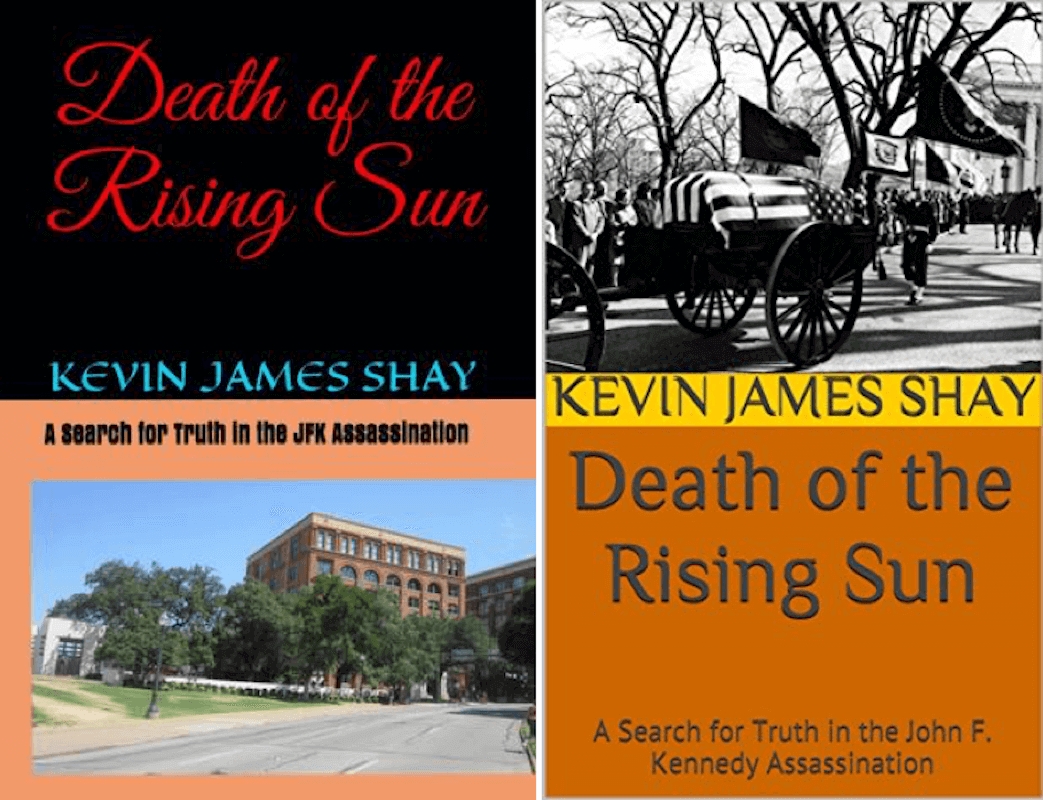
  • Kevin James Shay, Death of the Rising Sun: A Search for Truth in the JFK Assassination

    Kevin James Shay, Death of the Rising Sun: A Search for Truth in the JFK Assassination


    “In 1989 I covered the opening of The Sixth Floor Museum in the former Texas Schoolbook Depository building, from where Oswald supposedly shot at the motorcade. I asked then-project director Conover Hunt why there was so little emphasis on conspiracy theories. ‘We are not here to solve this crime,’ said Hunt … That statement struck me as odd. Shouldn’t a museum that promotes this crime of the century be at least mildly interested in all aspects of the case?”

    ~Kevin James Shay, from Death of the Rising Sun (2017)


    I had been looking into the various attempts on JFK’s life when I came across an incident that was news to me. In May of 1963 JFK landed in Nashville. During a stop-over at a local high school he was approached by a man carrying a gun obscured by a paper sack. The man (whose identity was never released) was apprehended by Secret Service agents, and then (inconceivably) released. No further mention was made by the authorities of either the man, or the incident. The incident was supposedly suppressed in order to prevent any future copycat attempts. I could only find two brief mentions of this episode on the internet. One of them was in this book.

    So I went to the Amazon page where the book is listed and clicked on the link that says “Look Inside”. I read the introduction. I was impressed.

    Whenever I encounter a book about the JFK case I quickly scan it to determine if it has been packaged by a shill. If it has, then I don’t read it. Because there’s nothing more painful than having to suffer through a book about the murder of John Fitzgerald Kennedy which has the Good Housekeeping Shill of Approval on it.

    The first thing I did was consult Shay’s index—but mostly the footnotes—to view the author’s citations (there are many, many sources listed in the footnotes which you won’t find in the index). The sources he mentions are as qualified as they come: Garrison, Lane, Talbot, Douglass, Mellen, Newman, Marrs, Crenshaw, Morley, Brussell, DiEugenio, Russell, etc. He’s familiar with The Education Forum, John Simkin, Martin Hay, Gil Jesus. He’s familiar with the Fletcher Prouty Reference site.

    But mainly I was looking for certain names in particular: Gerald Posner, John McAdams, the late Gary Mack and Vincent Bugliosi, and others who make up the Wall of Shame. I was pleasantly surprised. Only one mention of Mack. Posner and Bugliosi mentioned only a scant few times. Same with McAdams.

    I felt the coast was clear—no murky water, no swamp monsters present—so I dove in.

    Why did the introduction impress me?

    Mr. Shay does not proclaim to be an “expert,” or a “researcher”. He is just a regular citizen who sensed that all was not kosher with the Official Government Explanation. He expressed natural human concern—the type most of us are born with—but which some heartless, corrupted souls are incapable of ever possessing. So he decided to look into the matter. The title of the book reflects this. It was his own personal search for the truth. The death of President Kennedy—and all the promise he represented—signified the death of a rising sun. He wanted to be able to answer his children’s questions honestly.

    As anyone who has ever looked into the Kennedy murder will tell you, it can be a complex and often daunting maze to navigate through. There are hundreds of books out there, and just as many websites and You Tube videos. It’s not unusual for one to develop myopia by focusing on one particular aspect of the crime over another. But those of us who were born with that natural human sense of right and wrong I mentioned earlier, which is what led us to this case in the first place, were simply responding to a basic, primal instinct: something smelled. And it’s equally important that we never lose sight of the outrage and disgust we first felt, and of how that disgust kept growing once we realized just how far the case has devolved into an outright mockery.

    Having said all that, here’s the catch.

    Mr. Shay decided to look at this case “from both sides”.

    Writes Shay:

    … I am some 75% certain that there was a conspiracy to kill JFK. In that vein, Oswald could have been an actual conspirator, patsy or government-hired asset who attempted to monitor and even stop the plots. I leave the door at least one-quarter open that the lone-assassin theory is correct. That’s not much, relatively speaking. But I have lived long enough to know that nothing is certain, not even death (life could continue after physical death), and taxes (see Donald Trump’s decades-long nonpayment of income taxes) … Whether he was a patsy or actually fired his rifle at Kennedy is more up in the air. If he was a shooter, he had help, and if he was trying to infiltrate and stop the plot as a government informant, he obviously didn’t do enough. But then, no one did enough.

    How anyone who has read the definitive body of material Shay has and still arrive at a figure of there being a 25% possibility that Oswald was the shooter is, frankly, baffling. My own likelihood of Oswald being the shooter would be closer to 0%. It might be higher had I never read a shred of critical information and based my opinion solely on the Warren Commission findings. And to base my opinion on the Warren Report would be silly. It’s because of our refusal to swallow such silliness that we’re all still talking about this case today. To his first point, that Oswald was somehow involved, I would venture that all of us would concur. It’s quite plain based merely on Oswald’s associations with a myriad of key players that he was up to something.

    As per Shay’s claim that he’s committed to looking at and considering the case from both sides … I, respectfully, don’t buy a word of it. I think he knows better. There are indeed two sides to this case. One side is facts. The other is deception. For him to include anything ever offered by Posner is a waste of everyone’s time. So why would he include it at all? Same with Bugliosi and the others. Similarly, for him to offer anything ever offered by Hugh Aynesworth is a compounded waste of everyone’s time. Especially when Shay later illuminates Aynesworth’s many intelligence ties, and the unscrupulous, deceitful manner by which he participated in the destruction of Jim Garrison’s case against Clay Shaw. Again—why? If I were writing a book called The Search for Truth about Who Raided My Chicken Coop at Night, I certainly wouldn’t consult the family of nocturnal weasels who lived under the shed.

    There’s an important fact about Kevin James Shay that you need to be aware of.

    He lives and works and writes in Dallas.

    Before he wrote the above passage he provided the following:

    While I haven’t been as dogged in pursuing the truth behind the JFK assassination as Penn Jones Jr., Jim Marrs, Earl Golz, Jim Garrison, David Talbot, and some others, it remains the most important and defining story I have chased in my almost four-decade journalism career. It haunts me today as much as it did in 1978. It’s more than a detective story with high-level political stakes. To truly study the Kennedy assassination and pursue the truth, you have to suspend the truth about everything you have been taught about this country, international politics, and who the good guys and bad guys are.

    You have to risk your career, reputation, and sometimes even life. You have to shuck off the laughter and ‘tin-foil hat’ comments, ignore the threats. You have to walk down a slippery slope. You have to take up a missionary’s cause without thought of monetary reward, fame, or even redemption. You have to trust no one, not even yourself. You have to reach deep within yourself to find reasons to hold onto the hope that the sun, will indeed, rise in the morning.

    One of the newspapers Shay has written for is the Dallas Morning News. I visited the Twitter page of another man who also writes for this newspaper. Not only does this man receive messages and updates from the Sixth Floor Museum, but he also provides readers the link to John McAdams’ web page.

    Then again, If I were forced to function in a mysterious and shady atmosphere, like that which continues to fester in Dallas to this very day, I might be tempted to leave the door open 25%, too. Especially if I ever hoped to work again.

    Shay lays out most of his book in a point-counterpoint fashion. He’ll describe the “official” version of a particular event … then bash it to pieces with facts. Well, sometimes. But not always.

    I do understand that he set out to write this book from the perspective of both sides. But I found this style to be a head-scratcher, and often frustrating. Simply because, and I reiterate, when someone has accumulated the knowledge that Shay has, why even bother mentioning Marina’s testimony in the first place? Or Brennan’s? We know beyond any and all doubt that so many Warren Commission testimonies were either altered, contrived, fabricated, or arrived at through coercion, witness-leading, coaching, or outright threats, to the point that almost none can be relied on as a documentation of anything that ever really happened. The same applies to the medical evidence. The same applies to the x-rays. On and on.

    The recent Houston mock trial proved what a colossal, well-crafted diversion the WC was and is. The prosecutors prefaced so many of their questions with, “Now, according to the Warren Commission,” that it literally gobbled up hours of precious time. By the time the witnesses were able to move past how their evidence or testimony compared to the Warren Report to please the prosecutors there was hardly time for anything else. If the Warren Commission report is anything at all, it’s the perfect tool for any zealous prosecutor intent on sidetracking an evidentiary proceeding, onto an off-ramp filled with red herrings, based on dubious facts that are based on a false premise, and straight into a drainage ditch.

    And yet the book still works. The farther you read, and the more he bashes the official versions to bits, the more you get a distinct whiff of just how ridiculous the official version is. He doesn’t have to hit you over the head with it. He allows you to hit yourself over the head.

    Factually, the book is pretty sound. He sprinkles in an extraordinary amount of information gleaned from a multitude of the many different go-to books that we all have in our personal libraries, as well as magazine and newspaper articles. Sometimes it’s overwhelming. It is here where the author is at his finest. The breadth and scope of what he’s compiled is quite riveting and expansive. Although he does admit that he’s not an expert and may have left a few things out. Where the book stumbles is when he offers descriptions of what the “other side” considers facts. Simply stated, those “facts” are not facts. They come from the Warren Report, Commission lawyers, or shills—many of whom have intelligence ties. Had he not included this “other side” nonsense he might have had a huge, important bestseller on his hands. But, more likely, the book would never have been published.

    There is one error that I felt was particularly egregious. It’s in the chapter about Cuba. He outlines how the CIA continually misled John and Robert Kennedy. He says both Kennedys were on board with the Cuba shenanigans, if to a lesser extent. Then JFK dies. Shay then quotes Johnson as saying that “those Kennedy boys” were running a goddamn murder incorporated in the Caribbean.

    Um, excuse me, but not only was Johnson not referring to the Kennedys when he made that comment, he never mentioned their names. Shay also gives the impression that Johnson made the comment directly after JFK was killed, implying that JFK’s alleged militancy against Cuba rebounded back to cause his own death. When in fact, Johnson didn’t make his comment until years after JFK’s death. (See, for instance, this article)

    The main reason why I am recommending this book is … because it’s out there. It’s on the shelves. It is not just researchers who buy books about the JFK assassination. Regular, everyday people buy way more copies of the same books—most of whom have no idea whatsoever about the ground-breaking progress that’s been achieved over the last fifty-four years. Zip. Zero. All they know is the false cover story they’ve been fed on TV, films or newspapers. Dutifully served up by the shills—like slop from a soup kitchen—and gift-wrapped by the morally indigent corporate media. They’re unaware of official records being destroyed, or corpses being hijacked, or autopsies being rigged, or brains going missing, or intelligence agencies blocking investigations, or bullets being switched, or Black Ops, or hit-pieces against researchers, or witnesses mysteriously dying. All they know is that a disgruntled misfit named Lee Harvey Oswald assassinated President Kennedy with a high-powered rifle, thereafter killing a police officer.

    It is for those reasons that I would much rather they bought a book like this one, than, say, one by Bill O’Reilly—or whoever the “other side’s” designated shill happens to be this week. This is why I began my article speaking about shills. Because that’s the real hurdle. We’ve laboured for over fifty years like a horde of diligent worker ants. We’ve uncovered a warehouse full of facts and information. But a gag order has been carefully and masterfully applied on a largely unsuspecting public. And they can’t even tell they’re gagging on it.

    And speaking of gags, Shay talks about how John McAdams was caught at a conference using a phoney name. Shay writes, “McAdams claimed the debunking was a ‘hobby’ for him that should be ‘fun’. Many noted that was an odd thing for a political science professor to say, since you’d think he would be interested in setting the historical record straight in such a pursuit, not having ‘fun’. McAdams also once responded to charges that he was paid by the CIA with this: ‘Those people think the CIA cares about them. It does not!’ … That led to another question: If McAdams was not associated with the CIA in some way, how did he know for sure the CIA did not care about Warren Commission critics?”

    In the Appendix he commends the people that influenced and inspired him the most. They include (among others) Jim Marrs, whose course about the JFK assassination the author attended at the University of Texas at Arlington in 1988; Mary Ferrell; Gary Shaw and the late Larry Howard (who kept the JFK Assassination Information Center going for years as a counter to the Sixth Floor Museum), and Abraham Bolden. And finally …

    There should be a special place in heaven for Jim Garrison, who went through Hell attempting to prosecute the only criminal case brought against an alleged member of a plot. Garrison’s investigation wasn’t perfect and he took some excesses, but it was amazing what he was able to uncover about a plot in the late 60s with the bulk of the government and media against him. If he had just a smidgen of help from those in powerful places, he and the staff may have broken the case wide open.

    Would it have been preferable if Kevin James Shay boldly hopped off of the fence and stopped pretending that he was just a little bit pregnant? In a perfect world it would.

    Then again, that’s easy for me to say. I’m not the one who has to live and work in Dallas.

    This baby must largely be read between the lines. Don’t throw it out with the bath water.

  • Jesse Ventura, They Killed our President

    Jesse Ventura, They Killed our President


    Jesse Ventura has arguably been the chief message bearer in the JFK assassination case for almost a decade now.

    There, I’ve said it. Whether or not the “JFK community” cares to admit it, Jesse has been the go-to guy for the average Joe. He’s not a researcher, per se, but he is a reader and a student and someone who has a great passion for finding out the truth. As a matter of fact, the reason I accepted this assignment is because I have a deep admiration for the man. And I’m not shy about admitting it. Will that affect my objectivity? No way. If the book sucks, I’ll tell you all about it. No man is an island. Well, except for Cuba Gooding, Jr. Cuba is an island.

    jesse ventura
    Gov. Jesse Ventura in Dealey Plaza, Nov. 22, 2003
    Photo Copyright © by John Kelin

    Jesse’s enormous and lasting celebrity has afforded him the type of platform that very few people ever realize in their lifetime. It is because of Ventura that literally tens of millions of people who were new to the case ended up knowing just a little bit more regarding the true facts of Kennedy’s murder; information they would not have received otherwise. And with this latest effort, They Killed Our President: 63 Reasons To Believe There Was A Conspiracy To Assassinate JFK, his legions of followers will go away knowing almost as much as the most ardent “expert”.

    First, a word about the title. This is the second book Ventura has penned which has the number 63 in it. If one recalls, Ventura did a book in 2012 called 63 Documents the Government Doesn’t Want you to Read. It’s fairly obvious that Jesse is singlehandedly trying to keep 1963 in our subconscious minds. And he is doing a good job of that. We can also add, this list of 63 reasons serves as a nice counterpoint to Vince Bugliosi’s 53 items of evidence showing Oswald was guilty in his Reclaiming History.

    The JFK case is staggering in its breadth. Up until now, most books have specialized in one or another particular aspect of the case and zeroed in with a macro lens. There is the physical evidence, ballistics evidence, acoustical evidence, medical evidence, film evidence, photographic evidence, witness testimony, and the events in Dealey Plaza itself. There is Oswald, Ruby, Dulles, LeMay, LBJ, Ferrie, Banister, Hoover, the FBI, the Dallas Police, the Warren Commission, the Russians, the Mafia, the anti-Castro Cubans, and the CIA. One would need an entire library of books and much free time on their hands to be able to traverse the spectrum adequately. With this book, Jesse has succeeded in providing a comprehensive list of the more intriguing and important aspects of the case, each with sufficient detail to educate and enlighten … all contained within the covers of one single book. The reader is then free to investigate each point in further detail if they choose.

    The book was co-written with Dick Russell and David Wayne. And although I felt I could sense which passages were probably not handled entirely by Ventura himself, this is a forgivable blip in the overall picture. Because as a whole, the book works. To say the least, the book is not delivered in a stuffy, clinical, or dry manner. It’s not an exercise in self-aggrandizement, nor is it a manual designed purely for scholars, academics, or PhD’s to analyze and comment on in scientific journals or obscure blogs. Instead, it’s pure Jesse Ventura; a primer for the everyman.

    The book is written in the same manner in which Jesse speaks. You get the impression that he is right there beside you telling you about it himself. “Come on!” “Are you kidding me?” “Get this!” “Bullshit!”: these are pure, in-your-face Jesse-isms. And you know what? It’s high time the message was delivered with a little bit of elbow grease. We’re all sick to death of the deception, we’re tired of the lies, we’re on to the elephant in the room, and we all react with the same incredulity and outrage when presented with another phony book, documentary, or example of censorship in this case. So why shouldn’t Jesse be allowed to express his disgust the way he sees fit?

    The book draws on a wealth of material culled from many notable books, articles, and files written on the topic. To wit, it contains footnotes from some of the finest researchers – such as James Douglass, David Talbot, Walt Brown, Robert Groden, Jim Marrs, John Armstrong, Jim DiEugenio, Peter Dale Scott, Harold Weisberg, Mark Lane, and others. One thing that quickly caught my attention was the inclusion, not just of footnotes, but the addresses of relevant videos found on Youtube. Those of us who have been following the case for some time are well aware of the plethora of good videos available on the internet; and being that we are living in the internet age, Jesse decided to capitalize on those resources to help illustrate a particular point. Good call.

    Do I agree with all of his points? No. I would have preferred he did not include the ridiculous theory of the three tramps as championed by Jim Fetzer and Wim Dankbaar. Ugh! We’ve been over this before. I like both of these men and respect their efforts; but Lois Gibson can put on all the slide presentations she wants, but that will never turn the three tramps into Holt, Rogers, and Harrelson. Ever. They are simply not the same people. The slide presentation in question is so biased and self-serving that it appears Gibson was hired to provide a pre-ordained conclusion. Pardon me, I mean allegedly hired.

    On November 22, 1963, Chauncey Holt would have been 40 years old and was sporting a prominent pile of very dark hair. Ditto with E. Howard Hunt – yet another candidate for being the old tramp – who would have been 45 years old in 1963. Both werehttp://kennedysandking.com/administrator/index.php?option=com_modules&view=modules&layout=modal&tmpl=component&editor=text&12b2b33c79752d6e2db5a2e53f40da76=1 tight-skinned and physically fit. The old tramp in the photos is very clearly and significantly older than that. And Charles Rogers looks nothing whatsoever like either of the tramps! Not unless he was a shape-shifting reptilian from Jesse’s TV show. Only Harrelson comes remotely close to resembling one of the tramps – but again, he would have been a mere 25 years old at the time the photos were taken. The tramps in the photos are clearly Harold Doyle, Gus Abrams, and John Gedney. It frustrates me that people would continue to place suspicion on these men. It is pointless. It is futile. Might Holt, Rogers, and Harrelson have been involved in the plot in some way? Sure, it’s possible. But they’re not the men in the photos.

    About the only thing more frustrating than Lois Gibson’s slide presentation is a Michael Shermer slide presentation. And I’ve had the misfortune of reviewing a couple of those, too.

    The only other obvious point I think Jesse might have missed was during his analysis of the presidential limousine in Chapter 30. He left out the part about how a Secret Service agent was seen sponging down the limousine as it sat waiting at Parkland. Oh, and the phone call Dr. Crenshaw received from LBJ while tending to a mortally wounded Oswald. All minor things when considering the big picture, however. Each of these 63 points is almost deserving of a book of its own, and there simply isn’t the time or the space to include everything in a single book. But all in all, Jesse deserves full credit for addressing an enormous amount of issues here. Everything from the Umbrella Man to the missing brain (a “no brainer” says Jesse.)

    That said, this book may well represent the high point of Jesse’s legacy. It is astounding to think of the dozens and dozens of occasions Jesse has appeared on TV or radio interviews, only to be snickered at, mocked, derided, patronized, interrupted, hurried, been called “insane,” “mad,” “lunatic,” or given the rolled eyes treatment. Yet time after time, year after year, Jesse puts himself out there just so he can get his (our) message across. Can you name one other person who has had to endure so much personal insults and abuse for so long by the scared-of-their-own-shadows media hair-dos? I sure can’t.

    We can all be thankful of the fact that he felt compelled to commit his power and influence toward noble causes, rather than sell his soul to the highest bidder, like so many others have. We all know who they are. In fact, Jesse was kind enough to name three of them in his dedication page! Three out of many. I wish he would have named the rest. People need to know their names. Courage, integrity, honesty: Jesse was instilled with these virtues at a very early age. And unlike those pitiful cretins, hunchbacks, vermin, and frauds who sold their souls, he believes those virtues are worth holding on to. That makes his message worth listening to, and his books worth reading.

    I heartily recommend this book. None of us will ever know the answers to all of the questions buzzing around in this case. But after reading this book, readers will know that Garrison’s investigation was destroyed by the CIA, the autopsy photos were forged, eye witnesses had their testimonies changed or were ignored outright, other witnesses were murdered, Hoover lied, LBJ profited, the CIA controls the media, the military was hell-bent on war, the Secret Service was negligent, the evidence was tampered with, the Mafia worked with the CIA, the big oil connection … and Oswald was framed.

    Thank-you, Mr. Ventura. Now, maybe I won’t have to spend three hours with every person I meet trying to get them to see the truth. I can just tell them to buy your book. Before, I would have had to refer them to about fifteen books. But now, I need only refer them to one. Much cheaper. After all, its a bad economy.

  • John McAdams, JFK Assassination Logic: How to Think about Claims of Conspiracy – Three Reviews (3)


    I must admit that I was flattered when Jim DiEugenio asked me if I would provide a review of John McAdams’ latest published piece of horse …oops, I mean his book. But once I finally made my way through it, I felt drained, empty, discouraged about the human condition in general, and of the hopeless plight of shameless propagandists in particular. I felt like I’d just been robbed of precious hours of my life. Hours that I will never get back again.

    That’s why I believe that everybody who reads this mess should band together and enter into a class-action suit against John McAdams. The charge? Theft.

    We demand those hours back, John.


    Once I began reading, I emailed Jim that one can’t review something this bad. How can one review disinformation, omissions, half-truths, and innuendoes? It can’t be done. And since McAdams likes to base most of his arguments on a false premise, you end up having to review something that begins and ends with distortions. This is not a book. It’s a campaign.

    Take the liner notes, for example: “This book gets in the thick of all the contradictory evidence and presents an intriguing puzzle to be solved.” Yep, McAdams sure piles it on thick, alright. “The solution, in each case, involves using intellectual tools [my emphasis].” Now, if you flip to the back cover, you’ll see endorsements from Dave Reitzes and Gary Mack. I have to admit that, for once, McAdams finally comes clean and hits a bull’s-eye here; because between himself, Reitzes, and Mack…we do indeed have three of the biggest tools ever involved in the JFK assassination case.

    McAdams even cites Mack as a source of “sanity.” It’s interesting how he keeps referring to Gary Mack as a “conspiracist researcher”. Come on, John…Gary Mack – a conspiracist? Since when? Certainly not since he took on his six-figure position as Head Ringmaster at the Sixth Floor Big Top Circus. What with their belief in the “Single Bullet Theory” and their bookstore featuring tomes like Case Closed.

    Or how about this passage from the Preface: “While I can’t deal with the vast array of minor issues surrounding the assassination, there is one big issue that I won’t cover: Lee Harvey Oswald’s character or personality. It’s certainly possible to paint a compelling picture of Oswald “the striver” who wanted to be somebody important; of Oswald “the violent fellow” who beat his wife and shot at another person, Gen. Edwin Walker; of Oswald “the actor” who liked to play spy games; of Oswald “the deceiver” who lied quite readily when it served his purposes; and of Oswald “the callow Marxist” who became enamored of the Soviet Union and later, when he was disillusioned with Russia, of Fidel Castro’s Cuba.

    And, most importantly, I won’t deal with Oswald the loner and malcontent.”

    Thanks for not talking about those things, John.

    Lowlights

    Allow me to highlight some of the lowlights of this “book”.

    Chapter 1: The Frailty of Witness Testimony

    Just check out some of the headings in this chapter. “WACKY WITNESSES”; “FALSE RECOLLECTIONS”; “BEWARE OF AD HOC ASSUMPTIONS”; “ABSURD THEORIES”; “INTERPRETING WITNESS TESTIMONY: JUST WHAT DID THE WITNESS SAY”. In his plan to show how inaccurate people’s recollections are, McAdams presents a litany of important-sounding words like “science,” “data,” “outlier,” “model,” “noise,” and “signal”. Let me put this into plain English for you. Basically, it comes down to this: John McAdams and his co-propagandists are correct about the JFK assassination. Everybody else is unreliable and/or nutty. Simple enough for you?

    As an example of an “Ad Hoc Assumption,” McAdams cites the Chicago plot. Well, sort of. You see, if you can believe it, he never actually mentions Abraham Bolden – the man who just happened to be the central character in the whole event. Does McAdams not know who Abraham Bolden is? Maybe McAdams should put down his copy of Posner and start paying attention to facts for a change. For how one can deal with the Chicago Plot and never mention Bolden is a trick even Posner would have difficulty with. For without the heroic Bolden we likely would have never heard of the Chicago Plot. And this is the guy who titles his book how to think logically about claims of conspiracy. Talk about chutzpah.

    Realistically, I think the reason McAdams brought the whole thing up was so that he could take advantage of a cheap opportunity to slam author James Douglas, who discussed that topic in his laudable book, JFK and the Unspeakable. (McAdams’ book, on the other hand, is more like JFK and the Unconscionable.)

    Chapter 2: Problems of Memory

    Hey, wait a minute — am I reading John McAdams’ book here, or watching a Michael Shermer slide presentation? In his “Preface” McAdams even slips in mention of Bigfoot and UFO’s — two of Shermer’s favorite diversions. McAdams uses this chapter to further lay the groundwork on his theory about how people commonly “misremember” events, or “connect the dots incorrectly”.

    McAdams’ strategy is not a new one — it involves attacking all of the witnesses; they are either weird, shady, unreliable, unqualified, possess bad memories…or are crazy. Or liars. Everyone else must have “misremembered”. Thank goodness we have the likes of McAdams, Mack, Reitzes, and Dave Perry to set us straight on the facts. After all, you would never, ever, ever see someone of Gary Mack’s unimpeachable integrity put out a TV re-creation of the assassination which places Jackie in the wrong position in the limousine, would you? Oops, I guess for Inside the Target Car Mack must have “misremembered” where Jackie was sitting.

    Speaking of “misremembering”…I suppose McAdams misremembered his real name when he was seen carousing around the 1995 COPA Conference using the assumed name of “Paul Nolan: Jet Propulsion Expert”?

    McAdams is a master of omissions. For example, he might well mention the name of autopsy technician Paul O’Connor. O’Connor was the autopsy technician whose task it was to remove the president’s brain. But what he’ll neglect to mention is that O’Connor found there was no brain present.

    Likewise, he might well mention the name of Jean Hill. Jean Hill and Mary Moorman were snapping Polaroids in Dealey Plaza — photos that were aggressively snatched from Hill’s coat pocket by an “agent” (who instinctively picked the correct pocket).. The photos were eventually returned to her. Well, sort of. One of the photos taken by Hill and Moorman was a shot aimed at the TSBD. When this photo was returned, all of the background had been scratched out obliterating any and all details which might have been revealed in the building.

    On page 31, paragraph 1, McAdams quotes the Warren Commission thusly: “Meanwhile, Oswald had received his Mannlicher-Carcano rifle from Klein’s Sporting Goods with the scope already mounted.” Thus the author tells us two things. First, even though the Warren Report has been thoroughly and completely discredited in every aspect, he still uses it as if it is credible. Second, that he will ignore all the holes punched in that sorry report in order to not tell the whole story to the reader. This is a perfect example. The problem with the quote is a rather serious one: according to the HSCA testimony of Mitchell Westra (2/20/78), a Klein’s gunsmith, Klein’s did not mount scopes on that model of rifle. (McAdams must have misremembered…or connected the dots incorrectly…or relied on the dubious information provided by unreliable witnesses.

    Further down the page, McAdams comments on the veracity of one “Mrs. Gertrude Hunter”. McAdams says of Hunter: “Finally, since her family members were aware of her tall tales, ‘they normally pay no attention to her’.” Hmm…he said practically the same thing about witness, Ed Hoffman. Sounds like Mrs. Gertrude Hunter and Ed Hoffman must come from the same family! The “reliable source” that McAdams references here? Are you sitting down: Ruth Paine. (Actually, citing Ruth Paine as a reliable source is much better than who he usually relies on throughout the course of this book: the Warren Commission.)

    To go through this book and count all of its individual inconsistencies would be akin to swimming through the Atlantic and keeping tabs on all the spineless jellyfish floating around. It’s no secret that the JFK case is rife with disinformation, red herrings, or false witnesses (“plants”). McAdams himself just happens to be a prime source of the disinformation. In other words, this book is more of the same old, same old. Did anybody really expect anything different? I sure didn’t.

    What this book actually is is an admission on McAdams’ part that he has grown weary of debating people like Jim DiEugenio and Tom Rossley. Why bother with such hard work when you can simply write down your smoke screen and cart it out unchallenged by such nuisances as a moderator…or fact-checking. It actually is nothing more than a published version of the alt.conspiracy.jfk website. In other words, the good professor couldn’t muster the energy or resources to really do some new work to sustain his old arguments.

    Chapter 4: Witnesses Who Are Just Too Good.

    Sounds like a pretty fair-minded and even-handed chapter title to me. Don’t forget — McAdams assures us at the beginning of the book that he is simply here to provide a public service by acting as an arbiter of truth and justice. And who does he go after in this chapter? Only what many consider to be some of the most important players in the entire case: Jean Hill, Roger Craig, Dr. Charles Crenshaw, and Madeleine Brown. (He also goes after Judy Baker, but Ms. Baker, whatever her story, was not a key player, and I therefore won’t waste any time on her for the purposes of this review.)

    After an almost two-page long assassination of Jean Hill’s character, integrity, and memory, he then goes on to add insult to injury by claiming that Hill says she saw a “little dog” in the presidential limousine. McAdams volunteers that there was a bouquet of flowers present between the President and Mrs. Kennedy that Hill might easily have mistaken for a dog: “a small poodle perhaps”. In fact, when John and Jackie arrived at Love Field, an adoring admirer gave Jackie a doll which was a replica of “Lambchop” – of “Shari Lewis and Lambchop” fame. This doll rode beside Mrs. Kennedy during the entire motorcade.

    This was the “doll” that Hill saw. But surely McAdams must have known this, right? If not, he must have misremembered. Is it conceivable that Gary Mack — McAdams’ “voice of sanity” — wouldn’t have known this either? Perhaps Mack misremembered too. And so did Reitzes? No they did not. McAdams is just exercising his noted propaganda technique of keeping crucial facts from the reader in order to bamboozle him about a certain issue or witness.

    Maybe Mack misremembered the presence of the doll at the precise time he also forgot Jackie’s location in the limousine for his “JFK and the Target Car”? A curious deja vu strikes me about McAdams’ mention of this “little dog”. In fact, this is the second time I’ve seen that “little dog” reference thrown at me.

    To show you how old this canard about Hill is, consider this. I first began trolling the dreaded IMDb website a few years back in order to compile research on the astounding level of disinformation that exists in the JFK case – and particularly at the site for the movie “JFK”. One of the first of the many disinfo artists I would eventually encounter posed to me the following question in his campaign of (attempted) deception. He wrote something to the effect of: “Did you know that Jean Hill said she saw a little dog in the limousine? A dog! That’s ridiculous! Everybody knows that there was no dog in the limousine! Surely Hill is a nut.”

    Hmmm…now, you wouldn’t know anything about that, would you, Mr. McAdams?

    Most new books on the assassination strive to offer something new. This book simply attacks each and every important witness, or piece of evidence that points to a conspiracy. To sharks like John McAdams, these people are an easy meal. Many are women, most are average citizens without much money or legal recourse. And even though many have since passed on, they are still a staple menu item for scavengers like John McAdams and his crew.

    McAdams begins his section on Roger Craig with the sentence: “Roger Craig was everywhere in the wake of the assassination.” Is this supposed to be sarcasm, John? Craig had two important pieces of evidence to testify to: 1.) Seeing a man who looked like Oswald escape the Depository and jump in to a Rambler, and 2.) Being on the sixth floor when the alleged murder rifle was found. So according to the author, being outside and inside the Texas School Book Depository is being “everywhere”. McAdams then goes on to make reference to “anal-retentive conspirators”. What McAdams neglects to point out is that Roger Craig was elected the Dallas Sheriff’s Department “Officer of the Year” in 1960. Seymour Weitzman — the deputy who recognized that the rifle was a Mauser — just happened to have operated a sporting goods store, and was very familiar with weapons (a fact which McAdams omits).

    How does McAdams explain Roger Craig’s testimony? “Given previous discussions regarding witness testimony, Craig’s claim to have seen Oswald run down the grassy slope and get into the Rambler could easily be an honest misperception…Thus Craig may have put two and two together but come up with the mistaken conclusion.” There’s McAdams dazzling us with his how-the-brain-makes-mistakes wizardry again. Shades of Michael Shermer all over again. Like Shermer, what the author leaves out is that 1.) This testimony is partly corroborated, and 2.) There are photos now that seem to bear this out. (See the CD to John Armstrong’s Harvey and Lee.)

    The author on Charles Crenshaw: “Charles Crenshaw was one of the many doctors in Emergency Room (ER) One at Parkland Hospital who worked to save President Kennedy’s life. Although a junior and bit player, he was indeed there. Thus, especially if one believes that physicians are particularly sober and reliable people, he should have been a good witness.” (Italics added)

    Well, thank goodness the doctor was indeed there. The part about Crenshaw being “only a junior and bit player” is another McAdams attempt at cheap discreditation.

    I’m having a hard time keeping up the façade of providing an honest review of an honest book for the simple reason that this is not an honest book. And I’m only on page 69! So why does McAdams attack Crenshaw? Because Crenshaw noted a couple of disturbing things.

    When treating Kennedy he noticed a small bullet hole of entrance to the front of Kennedy’s throat; when treating Oswald, he said that none other than newly sworn in President Lyndon Johnson phoned him in the operating room. Johnson demanded from Crenshaw that he obtain a “death-bed” confession from the mortally wounded Oswald. Of course, Oswald would never again regain consciousness and such a confession would never be obtained. Crenshaw’s story is corroborated by the switchboard operator, Phyllis Bartlett, who received LBJ’s call and directed it into the room where Crenshaw was administering to Oswald. McAdams doesn’t mention this.

    McAdams then again practices his “misremembering” when he fails to tell readers that Madeleine Brown’s story of a big party at the home of Clint Murchison the night before the assassination was in fact corroborated by cook and seamstress, May Newman. Newman even conversed about the event with one of the chauffeurs. McAdams’ summation of Madeleine Brown (and others like her): “To a degree, they may have been manipulated by conspiracy researchers who asked leading questions and gave subtle clues as to what sort of testimony worked in gaining credibility and further interest. To maintain that interest, of course, it’s desirable to give better and better testimony.”

    Question for the author: What “conspiracy researcher” existed on the 22nd when Craig came into police HQ and said he saw the arrested man, namely Oswald, jumping into a car in Dealey Plaza?

    Further on in this chapter, on page 75, under the innocuously-titled heading: “WHY DOES ANYBODY BELIEVE THESE PEOPLE?”, the author says: “But the majority of people who watch movies like JFK, read conspiracy books available at chain bookstores, or view purported documentaries such as The Men Who Killed Kennedy on television are not seasoned and knowledgeable researchers. Thus they are exposed to these bogus accounts but not to their debunking. And increasingly, sober and knowledgeable conspiracy-oriented researchers find themselves allied with lone assassin theorists in unmasking such witnesses to both the hard-core believers, who will accept them, and the innocent neophytes.”

    There’s McAdams using that word “sober” again. Leave it to McAdams and Mack to “debunk” things honestly for the rest of us; McAdams with his bogus website…and Mack with his bogus museum and TV shows. Combined, the awesome forces of these two beacons of truth, justice, and the American way is not unlike the raw, unleashed powers of a dynamic super-hero…“Mack-Adams!”

    Oh, and how does McAdams end this chapter? With mention of the Holocaust. Subtle touch, there, John. The apt comparison today though would be this: With the releases of the ARRB, to deny a conspiracy in the JFK case should group one with those who deny the Holocaust.

    And this guy is a college teacher?

    Chapter 5: Bogus Quoting, Stripping Context, Misleading Readers.

    Nice title John, but shouldn’t you have reserved it for your autobiography? In his preface, McAdams says the following: “Everybody knows that writers, newscasters, and producers of documentaries can mislead their audiences by leaving out certain information…” (John, I especially like the lat four words there.) In the second paragraph of Chapter 5, he elaborates. “Everybody knows and pretty much accepts that advocates selectively present information that serves their purposes, but it’s all too easy to forget that book authors and video producers are advocates too. And it is sometimes hard to grasp how radically selective advocates are prone to be. An author would not present the testimony of a witness and willfully omit parts that show the witness to be insane, would he? A director of a documentary would not produce something that puffs witness accounts she knows to be contradicted by reliable evidence, would she?

    Yes, he or she would”

    Hear, hear, John! Right off the bat I can think of two “authors” and “producers of television documentaries” who come to mind.

    McAdams’ next target is Jack Ruby — specifically about how Ruby tried and tried in vain to be taken out of Dallas so that he could give a full accounting of his inclusion in the plot to kill President Kennedy…and Oswald. How does McAdams describe Ruby? “Ruby’s addled brain seemed to go from obsession to obsession…We have to remember that many thoughts were going through Jack Ruby’s addled brain.” McAdams goes on to add that Ruby was a “huge sycophant,” a “wannabe,” and a “hapless schlub.” Again, this indicates just how much McAdams is caught in a time warp. These are the kinds of words that were used to discount Ruby by pro Warren Report authors in the sixties and seventies e.g. Ovid Demaris. This was all later dispelled by the work of Seth Kantor and the House Select Committee on Assassinations. Today we know that Ruby had telling and important links to the Mafia, the Dallas Police, and the CIA. And that an Oswald double was looking for Ruby the night before the assassination! (Armstrong, p. 789) In the face of all this new information, the above is McAdams’ scientific way of painting an unbiased, accurate picture of a person so that others can judge his/her testimony fairly and objectively.

    Chapter 6: Probability: Things That Defy The Odds.

    It is well known that Guy Banister’s office was located at 544 Camp Street in New Orleans. David Ferrie also happened to be a frequent visitor. Leaflets handed out by Oswald were stamped with that 544 Camp Street address. The building was located on the corner of Camp and Lafayette Streets.

    How does McAdams try and wiggle his way out of this one? He says that Banister’s office was only accessible if you entered from the Lafayette Street entrance, number 531. According to McAdams, the fact that they were the same, exact, identical building is merely a complete coincidence and not in any way related. Oswald must have simply picked that building at random when searching for an address to stamp on his leaflets! No joke. We are supposed to forget about all the people who saw him inside Banister’s office.

    At the time, Oswald worked at the Reilly Coffee Company, not far from the Camp Street building. Or, rather, according to McAdams, he was “employed” there, since he “reportedly did little work”. (But John, I thought you made it clear that you weren’t going to pick on Oswald!)

    On Bannister and Ferrie: “No doubt, the men seem extremely sinister to people steeped in the conspiracy literature and to people who have seen the move JFK or documentaries like The Men Who Killed Kennedy. But how the men have been portrayed stems from their (rather slight) connection with Oswald and his use of their address.”

    Rather slight? That reminds me of filmmaker Robert Stone referring to the “magic bullet” as being “not quite so pristine”. McAdams then begins to bail out the pair by doing nothing less than the equivalent of breaking out a string quartet. “Banister and Ferrie were not, in fact, terribly sinister people.” (Can you hear those violins?) But what about all of the sightings of Ferrie and Oswald together? “They all lacked credibility.” But here’s my favorite. There is a photo of Oswald and Ferrie standing mere feet away from each other when both were members of the Civil Air Patrol. McAdams’ explanation? “The photo doesn’t prove that they ever met or talked to each other, but only that they were in the organization at the same time.”

    Sure John.

    This points out a recurrent technique that McAdams uses: he steals without accreditation. That above silly rejoinder is taken straight from Pat Lambert’s book, False Witness. Some other examples of this pattern: McAdams using the Chris Mills essay “Flight of Fancy” to explain Oswald’s flight from London to Helsinki—without telling the reader that Mills’ essay was labeled as fanciful. Or his use of the word “factoids”. This is stolen from a debate at the time that JFK came out with Fletcher Prouty and Dan Moldea among others. The moderator used the word to label facts that he felt were tangential to the actual murder case. McAdams stole the term, and then expanded it to include all evidence exculpatory of Oswald—period. That is even the mismatching of shells and bullets in the Tippit murder!

    Jim Garrison doesn’t fare much better. According to McAdams, the fact that Clay Shaw was gay was a “big factor in Garrison’s belief that Clay Shaw was a conspirator.” McAdams must know something the rest of the world doesn’t. If so, I wish he’d ante it up. The way that Garrison got onto Shaw is clear. He wanted to know who called Dean Andrews the night of the assassination and asked him to go to Dallas to defend Oswald. Most people would consider that rather relevant and important information. Andrews knew that ‘Clay Bertrand’ was a pseudonym. But he would not tell anyone who asked him—and this included Garrison, Tony Summers, and Mark Lane—what the man’s real name was. He told all of them that he feared bodily harm if he did divulge that information. So Garrison sent his investigators into the French Quarter to try and find whom Bertrand actually was. If you go through his files—something McAdams has not done—you will see that they found about eleven sources that pegged Shaw as Bertrand. It later turned out that even the FBI knew this, and that Shaw’s name popped up in their own inquiry in December of 1963! (William Davy, Let Justice Be Done, pgs. 191-94)

    Garrison’s investigation also succeeded in uncovering a phone call that was placed by the attorney of Carlos Marcello to a female acquaintance of Jack Ruby’s, Jean Aase (Jean West). West accompanied another associate of Ruby’s, Lawrence Meyers, to Dallas on November 20, where they all met at Ruby’s Carousel Club. However, according to one of McAdams’ staunchest and most reliable “researchers,” the origin of this call is “far from clear.” The “researcher” in question? Dave Reitzes. Par for the course for this book.

    Chapter 7: More On Defying The Odds: The Mysterious Deaths.

    What McAdams does here is to base an entire chapter on what was one researcher’s own personal figure of 103 so-called “suspicious” deaths surrounding the JFK case. According to McAdams’ rationale, why would the conspirators have stopped at 103? Why not go for a thousand? Or a million? Nobody can ever know for sure the number of people who were sacrificed in order to maintain the cover-up.

    But even if it were only one person that died, that would have been one too many. Of course, it wasn’t just one. Many, many people met untimely deaths as the direct result of what happened on November 22, 1963. Naturally, he doesn’t mention each and every person who is on the list…he doesn’t have the time to get into all of them.

    McAdams then provides his own list of other people who were in some way involved in the case, and poses the question: Why weren’t these people killed? Why wasn’t this person killed? Or that person? Or, how about that other person? Surely, the conspirators wouldn’t have left all of them alive if the information they possessed was considered somehow “dangerous,” would they?

    Consider what the author is suggesting: That somehow it is supposed to be odd that some people were left alive with valuable counter-information about the JFK case! In other words, if those nutty conspiracy theorists are right, well heck, the CIA or FBI should have killed every single one of those contrary witnesses.

    Uh professor, wouldn’t that be kind of giving the game away? Kind of high risk as they say.

    But anyone who does not find the circumstances of the deaths of say David Ferrie, George DeMohrenschildt, William Sullivan, Sam Giancana, John Roselli, and Dorothy Kilgallen rather odd and curious, well, then I would say they don’t know how to think about conspiracies. (Click here for an interesting piece on the Kilgallen case http://www.midtod.com/new/articles/7_14_07_Dorothy.html)

    Chapter 8: Did People Know It Was Going To Happen?

    There are numerous instances of people who claimed foreknowledge of the JFK assassination. If a person can predict an event which involves other people, and which turns out to be true, days before it happens, that person is either clairvoyant…or they have inside information of a conspiracy. At least that has been my experience. Of course, I could have connected the dots incorrectly…or misremembered.

    Joseph Milteer is one such person. Milteer was taped telling a police informant, William Somersett, that JFK would be assassinated in Miami during his visit to the city in the upcoming weeks. He gave information which so closely mirrored the actual killing that it was chilling in its similarity. He said the President would be shot from an office building overlooking the motorcade; that a high-powered rifle would be used; that the rifle would be disassembled and taken up in pieces; that a patsy would be picked up soon afterwards to throw off the public; and that the plot was currently in the works.

    Pretty good description of what ultimately unfolded in Dealey Plaza, right?

    Enter McAdams.

    On Milteer: “Where Milteer is concerned, he described the most generic assassination scenario possible: ‘From an office building with a high-powered rifle.’ He later added that what Milteer had provided was an “unspecific scenario”.

    Unspecific scenario? Generic assassination? Can the man be serious? When other time in American history has such a murder scene been promulgated?

    What does McAdams say of the police informant, William Somersett? According to McAdams, federal authorities had decided that Somersett was “’unreliable,’” having “’been described as overenthusiastic, prone to exaggeration, and mentally unstable.’” Further, according to McAdams: “They also determined he had ‘furnished information bordering on the fantastic, which investigation failed to corroborate.’”

    Uh John, this info was in FBI hands prior to the assassination. Yet they did nothing to act on it. Therefore, don’t you think they are trying to smear the messenger for making them look bad and allowing the president to be killed? I mean did not J. Edgar Hoover do that kind of thing many times? Yet, John, it wasn’t Somersett who painted the assassination scenario on tape for all to hear. It was Milteer. McAdams leaves both those pertinent facts out.

    Then there’s Rose Cheramie. Cheramie claimed to have heard two men scheming about a plot to kill President Kennedy. She was thrown out of a car, and later recalled her account to both a state trooper and to hospital personnel. Here’s how the ever objective, non-advocate McAdams introduces her. “Rose Cheramie was a prostitute with a long arrest record.” Again, McAdams is hard at work killing the messenger.

    Further, her credibility problems are “massive”; she made “a series of ridiculous statements”; she had a history of providing “information” to various law enforcement agencies. McAdams then goes on an incredible and lengthy character attack on Cheramie. She was arrested many times on differing charges, used myriad aliases, and tried to take her own life.

    Who does McAdams defer to on this issue? You guessed it, his so-called New Orleans/Garrison expert, Dave Reitzes. If a witness’ value in this case can be measured by the ferocity of the attack upon him or her by Warren Commission diehards, then McAdams and Reitzes understand just how important Cheramie is to the JFK case. The character and credibility assault goes on for about two pages. Some of it is just silly. For instance, McAdams repeats the John Davis tenet that Cheramie told someone the two men she was with were “Italians or resembled Italians.” He then mentions that the HSCA found out that a Garrison investigator located the bar she attended with them and the bartender identified one of the men as a Hispanic. If you can believe it, McAdams then uses this to attack Cheramie. As if a person of Italian heritage has never been confused with being Hispanic! (And one should note here, for a professor, McAdams is really poor at checking original sources. The newly declassified files on the Cheramie case reveal that she was not thrown out of a car. She got into an argument at the saloon she was in with the two men and they forcibly abandoned her there. See the HSCA deposition of Officer Francis Fruge of 4/18/78))

    He then tries another technique. He says that there were dozens of threats against Kennedy at the time. So the essence of her story really does not matter much since, again, it’s not detailed enough. (Note here the inconsistency with his attack on Milteer.) He can say this because he does not mention the second man with Cheramie—Emilio Santana—and does not describe the first man with her, Sergio Arcacha Smith. They were not just “Hispanic”. They were anti Castro Cuban exiles living in New Orleans in 1961 and 1962. Smith and Santana were closely involved with the CIA and Smith worked on the Bay of Pigs operation. Smith had reportedly moved to Dallas at the time of the assassination. Further, they were both suspects in the Garrison investigation. And Smith was a suspect in the investigation of Richard Case Nagell. (Which we will soon discuss.) So by not informing the reader of this, McAdams leaves out the fact that the Cheramie’s testimony provides a link between the setting up of Oswald in New Orleans in the summer of 1963 and the denouement of that plot in Dallas in November. Further, the unadulterated record, as uncovered by the House Select Committee on Assassinations, does not support the charge of her just handing out “information”. The information she gave out on her last case, when she heard the two men discussing the death of Kennedy, all this checked out as accurate. (The Assassinations, edited by James DiEugenio and Lisa Pease, p. 227) Further, more than one person vouched for the so-called “ridiculous statements” she made about the impending murder of President Kennedy. The list of corroborators included doctors, nurses and interns. (ibid, pgs. 226-27)

    So in other words, as pertains to the facts of this case, what McAdams and Reitzes do here is in the worst tradition of advocacy journalism. They raise a chorus of sound and fury that is, at best, tangential, at worst, superfluous. In other words, none of it alters the fact that she heard that Kennedy would be killed in advance of the murder and that there were multiple sources for that. The two then eliminate the part of the declassified record that actually is important in forensic terms and gives her testimony a valuable context. Namely that the anti Castro Cubans hated Kennedy, and these two were in league with the CIA, which is a (the?) prime suspect in the conspiracy.

    And let us end this discussion with what most people would consider a rather important piece of testimony. State Trooper Fruge, who first encountered Cheramie and then was recalled by Jim Garrison, posed a rather pertinent query to the HSCA. He asked them if they had discovered the maps of the Dealey Plaza sewer system that Smith had in his apartment in Dallas in 1963. (ibid, p. 237) Does it get any more corroborative or suspicious than that?

    And finally, there’s the case of Richard Case Nagell. Nagell was a former military man who ended up being a double agent, working for both the KGB and the CIA. While working for both agencies, he uncovered a plot to assassinate the president. He went to numerous locales in his quest: including Los Angeles, Miami and finally New Orleans. The plot he eventually discovered was, well, kind of similar to Garrison’s concept. It involved Guy Bannister, Sergio Arcacha Smith, David Ferrie, and Clay Shaw. And it featured an Oswald double named Leon Oswald. He said he had a tape of Smith and Carlos Quiroga manipulating Oswald in New Orleans in the summer of 1963. (ibid) Nagell was told by the KGB to warn Lee Harvey Oswald of this. Why? Because they had heard of such a plot brewing in Mexico City and they strongly suspected that the conspirators would try and pin the blame on the Russians. Which of course ended up being a correct assumption. Eventually, fearing for his safety as a result of being involved with such a plot, he managed to get himself arrested by entering a bank and shooting bullets into the ceiling. He then patiently waited until the police came to take him away, thereby removing himself to the safety of a jail cell.

    Enter McAdams.

    Says McAdams of Nagell: “A secret internal CIA document describes him as ‘a crank’ because he is mentally deranged’ and noted he never worked for the agency.”

    Are you all starting to get the picture now? As I noted in my review of Chapter 2, according to John McAdams, everybody who ever figured in the JFK assassination who had evidence that pointed to a conspiracy is either insane, crazy, unqualified, shady, bogus, criminal, a prostitute, a drug addict, or a liar. This includes doctors, surgeons, nurses, decorated policemen and military personnel, and even average mothers and fathers who just happened to take their small children to see a presidential motorcade.

    Yawn. Sure John.

    Chapter 9: Signal And Noise: Seeing Things in Photos

    McAdams says he saw the guys on the TV show Mythbusters shoot a bullet into a dummy. The dummy moved back only a couple of inches and then fell to the ground.

    McAdams’ conclusion? “Thus it seems that any movement ‘back and to the left’ actually proves nothing.”

    John, dummies are not people. And what you just did here is not exactly inscrutable detective work worthy of getting an audition for Scotland Yard. Why did you not look for pictures of actual people being shot? Gil Jesus found some. Guess what? They all went backward from the origin of the shots. Uh, even your friend Gary Mack’s simulation experiment Inside the Target Car showed this. But somehow, McAdams can’t bring himself to admit this or do actual legwork. Which is one reason why hardly anyone in the research community takes him seriously outside his own forum.

    McAdams ends this chapter by saying that unless one possesses a “disciplined approach” when evaluating photos, or even the sightings and perceptions of ear witnesses in Dealey Plaza, that “intellectual havoc can ensue.”

    Too bad he didn’t take his own advice.

    Chapter 12: Too much Evidence of Conspiracy

    Several people noticed a bullet hole in the presidential limousine from the time it sat parked at Parkland Hospital. The bullet passed cleanly through the windshield from the front. This list includes a reporter, a student nurse, two motorcycle cops, and others.

    Enter McAdams.

    On page 193 in a section titled “CAN WE GET BEYOND THE NOISE,” McAdams refers us to an article by Barb Junkkarinen, Jerry Logan, and Josiah Thompson. He says this article “destroys the notion that there was a through-and-through bullet hole in the windshield of the presidential limo. Such a hole would, as noted, clearly imply a conspiracy, but the evidence is against it.”

    What McAdams fails to tell the reader is that the article in question (“Eternal Return: A Hole Through the Windshield”) doesn’t even mention the name of George Whittaker Sr.! Whittaker was the glass expert and technician at Ford Motors in Detroit who worked on the presidential limousine. Whittaker possessed 30 years of experience working with glass, including how glass reacts when hit by bullets. Whittaker noticed a clear through-and-through bullet hole which went from front to back. He and his colleagues were ordered to use the windshield as a template for a replacement windshield. They were then ordered to destroy the original windshield.

    After Whittaker’s death, a signed letter was found among his possessions where he again made mention of the bullet hole he found that day. What he, the nurse, and the others saw was a clean bullet hole which penetrated fully from front to back. It wasn’t a crack. It wasn’t a fragment. It wasn’t a spider-web splinter.

    Again, McAdams goes on to thank, among others, Dave Perry, and Gary Mack, who McAdams says has “been a voice of sanity in too many ways to list here.”

    Again, this shows the author’s over-reliance on the work of others, his penchant for cherry picking and his failure to deal with contrary evidence that counters his ordained agenda.

    Chapter 15: Putting Theory into Practice: The Single Bullet Theory

    This from the section titled “KENNEDY’S THROAT WOUND” on page 223:

    “If the location of Kennedy’s back wound is controversial, both the location and the nature of the throat wound are subject to controversy. Conspiracists frequently insist that the throat wound was actually one of entrance. And they do indeed have some evidence for this. In the first place, the Parkland doctors seemed to believe that it was an entrance wound…” (Italics in original.)

    Wait a minute John. I have to stop you, just like I would a thief in the night.

    In 1963, Dallas, Texas led the nation in gun-related crimes. The doctors at Parkland were extremely experienced with, and knowledgeable about, the nature of bullet wounds. So if any of them originally said it was an entry wound, it was an entry wound. And Malcolm Perry, among others, said that in a press conference the day of the assassination.

    What does the author leave out? That this evidence was so devastating to the official story that 1.) the Secret Service lied to the Warren Commission about having a transcript of this press conference, and 2.) Secret Service agent Elmer Moore admitted later that he had badgered Perry into making his story more equivocal for the Warren Commission. Most people would think this important information.

    On page 225 in the section titled “Unqualified Autopsy Doctors” McAdams says that “Bethesda was chosen as the site of the autopsy by Jackie Kennedy on the plane returning from Dallas to Washington. The president’s aide, Admiral Burkley, told her that the autopsy needed to be at a military hospital for ‘security reasons,’ and added, ‘Of course, the President was in the Navy.’ Jackie responded with ‘Of course’ and ‘Bethesda.’’

    That hardly sounds like Jackie Kennedy chose the autopsy site. It sounds like she was simply agreeing with a decision which had already been made.

    On the issue of why Kennedy’s body was whisked out of Dallas for an autopsy at Bethesda: “But what about the Parkland doctors? Surely they had seen a lot of gunshot wounds, and their opinions should carry some weight. But actually no, they carry virtually no weight.”

    McAdams then relies on a tried-and-true favorite tactic of his: to paint the Parkland doctors as a bunch of stumbling, bumbling, incompetent nincompoops and know-nothings; a veritable staff comprised of Abbott and Costello, The Three Stooges, Charlie Callas, Jonathan Winters, and Mr. Bean — all running around the hospital to the theme song from The Benny Hill Show.

    Bethesda it is. We know those “qualified” pathologists are going to do nothing less than a rip-roaring job on the President in what was to be the autopsy of the century, right? Well John, it didn’t turn out exactly like that. McAdams conveniently neglects to inform the reader about just how badly botched that autopsy was…of how it was performed by inexperienced pathologists…of how it was directed and controlled, not by medical protocol, but by admirals and generals shouting out directions of what to do and what not to do.

    How bad was it? Michael Baden, a man McAdams bows down to, once wrote that Kennedy’s autopsy was the exemplar for botched autopsies.

    Chapter 16: Thinking about Conspiracy: Putting It All Together

    Just listen to McAdams’ opening line. “It’s doubtlessly clear to the reader by now that I believe Oswald killed Kennedy, and most likely did it by himself.”

    Did I read McAdams correctly there? I mean, he was doing such a grand job of being unbiased, thorough, and impartial that I really hadn’t yet made up my mind on where he stood.

    In the section titled “A LARGE CONSPIRACY ISN’T PLAUSIBLE” (Pg, 248), McAdams says: “The first and most obvious principle is that a very large conspiracy simply isn’t plausible. It’s simply a matter of probabilities. ..There are plenty of reasons why a plotter might defect. He might have an attack of conscience (although if he had much of that he would not have been part of the plot)….”

    Again, this points our just how hackneyed this book is. This is an argument that Warren Commission defenders have used ad nauseum since the beginning. It ignores two things that defeat it: 1.) People in this case did talk. To list just a few: Mafia consort John Martino, CIA advisor Gary Underhill, CIA agent Richard Case Nagell. Although he does not name them, the HSCA later found out that the two men who talked in the presence of Cheramie were Emilio Santana and Sergio Arcacha Smith.

    Please note: this indicates a plot between the CIA, the Cuban exiles and the Mob. In other words, its very similar to what Tony Summers proposed in his book Conspiracy. You know, that kind of unwieldy plot that is not plausible.

    But secondly, there have been conspiracies and cover-ups that did remain secret, at least for a time. To name just a few: the plot to assassinate Hitler, the secret radiation experiments on Americans, the giant conspiracy to run guns to the Contras while bringing back cocaine to America. This last may have remained forever secret to Americans if a young Contra volunteer had not knocked CIA pilot Eugene Hasenfus out of the sky with a shoulder launched missile launcher. When Hasenfus was captured he had a notebook on him. It was traced back to the secret Central American CIA Ilopango air base run by officer Felix Rodriguez. This unraveled a truly colossal conspiracy and cover up which eventually included the CIA, the Pentagon, President Reagan, Vice-President Bush, the Secretary of Defense, the Secretary of State, several wealthy American families, and the Mossad.

    Are we to believe that a college professor of political science forgot about all this? Maybe he misremembered?

    Let me add one more thing on this stale and trite “Unwieldy plot” issue in addition to the two points made above. What people like McAdams and Reitzes like to do is to take the JFK case and consider it in isolation. Therefore, they leave out say a man like Craig Watkins. Watkins is the first African American DA in Dallas. Because he was not a member of the country club set there, he decided to look back at, among others, the prosecutorial techniques used by the regime run by DA Henry Wade and Will Fritz. The two men responsible for the JFK case in Dallas in 1963. Testing these so-called “cold cases” with modern DNA technology, what were the results? Well, it turns out that ramrodding suspects into convictions with questionable evidence and testimony was rather par for the course with these two men. So far the Watkins inquiry has released 29 falsely accused convicts from prison on trumped up charges. And the review is not over yet. So far from being an “unwieldy plot” germane only to the JFK case, the questionable techniques used to pin the murder on Oswald was more like Standard Operating Procedure for Fritz and Wade. Laid in this context, the world view of America is reversed from McAdams Land: America is not all Mom, Apple Pie and Baseball with Oswald as the Black Hatted Villain. In fact, it may be just the reverse. For what kind of law enforcement agency puts that many innocent people behind bars?

    But, of course, it’s worse than that. Because the other investigative body on the JFK case was the FBI. And I think we all know today just how bad J. Edgar Hoover was in his prosecutorial zeal. All of us except John McAdams. There have literally been reams of pages in scholarly books that expose how Hoover framed suspects in high profile cases. And we all know of course that Hoover detested the Kennedys, especially RFK. And most us know that Oswald very likely was an FBI informant. Something that Hoover would never ever ant to reveal since it would permanently mar the image of the Bureau, something he propagandized the public into thinking was flawless. When we all know today, it was far from that. All of us except John McAdams.

    Therefore, when looked at as the compromised and corrupt bureaucracies they provenly were, the idea of some “unwieldy plot” disappears. In framing Oswald the people who investigated the case for the Warren Commission were doing what was considered by them to be standard in a murder case. And they had been doing it for years. In fact, to NOT do it would likely get them in trouble with their superiors. It is incredible that in this day and age Professor McAdams does not understand this. Yet this is the Ozzie and Harriet world that he exists in. He seems unaware that as writers like Jim Hougan and Don DeLillo have pointed out, that ersatz American veneer was shattered on November 22, 1963.

    In his final page (thank God!), titled “ANY ROOM FOR CONSPIRACY?” guess what position McAdams takes? Good guess. According to McAdams, choosing the “sensible” theory (that which sides with Oswald being the lone assassin) “doesn’t allow you to demonize your political enemies.” (Yep, he forgot about all the character smears he just used.)

    So who wants to demonize anybody? It wasn’t me who wrote a book that tries to tell mature, intelligent readers that they are incapable of “connecting the dots” properly, or that they’ve “misremembered” an event, or that they are all victims of “noise,” or “false memories”.

    McAdams likes to warn us about how “noise” clouds our perceptions. He should know, he’s directly responsible for a great deal of it.

    Well, after this debacle who is up for the next whitewash…Gary Mack? Dave Reitzes? Dave Perry? By the way, what happened to Dave Von Pein? I didn’t see any mention of him in your book. One thing is for sure — you needn’t ask Vincent Bugliosi for his participation in this charade any longer. I have a hunch that he now realizes what a monumental blunder he committed (both personally and professionally) by whipping up that doorstop book of his. Bugliosi asking Jesse Ventura to turn off the camera during his interview on Jesse’s Conspiracy Theory spoke volumes.

    And now … I’m off to take my “little pink dog” for a walk.


    Reviews of John McAdams’ book JFK Assassination Logic by
    Pat Speer
    David Mantik
    Gary Aguilar
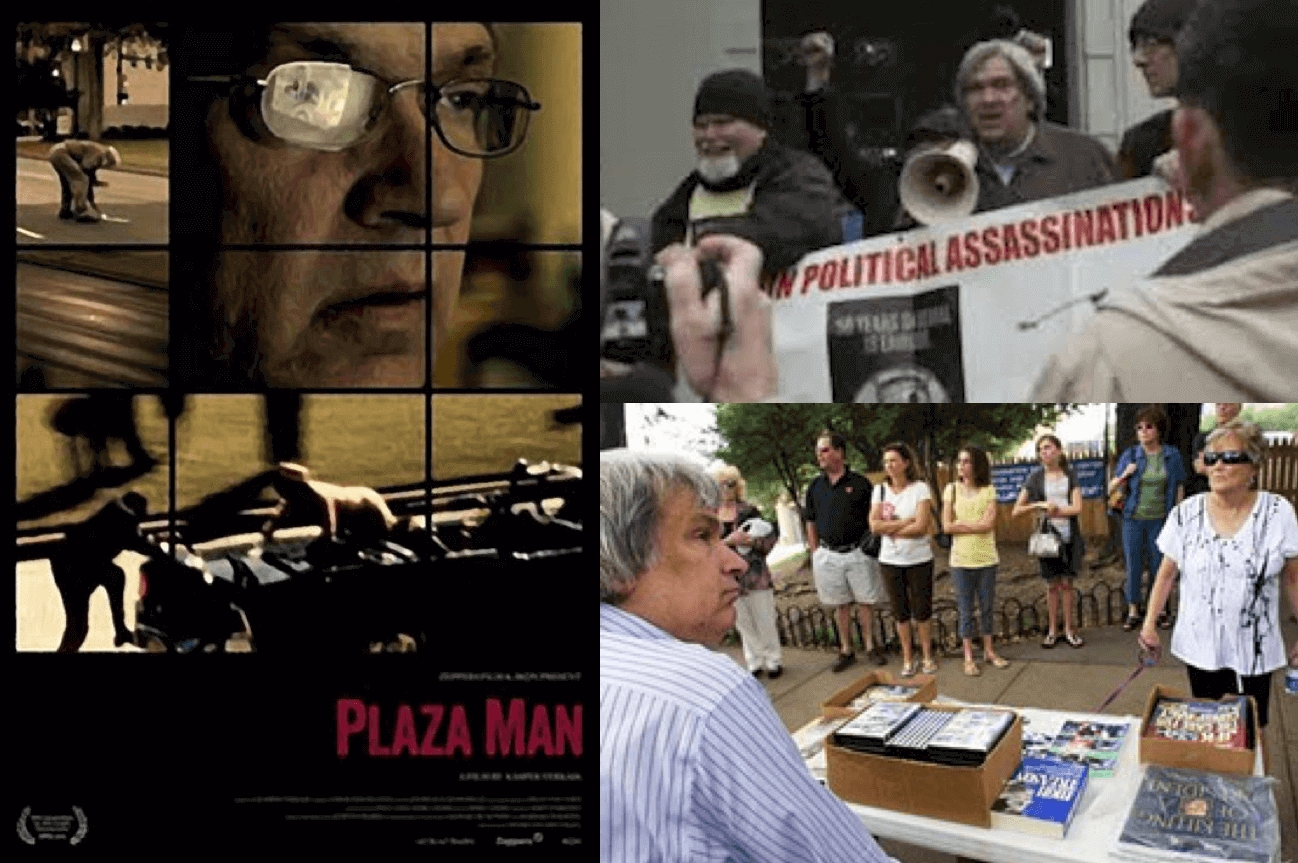
  • Michael Shermer Strikes (Out) Again: Review of Michael Shermer’s CBC documentary, Conspiracy Rising


    “In every case, the chance for complete information is very small, and the hope that in time researchers, students, and historians will be able to ferret out truth from untruth, real from unreal, and story from cover story is at best a very slim one. Certainly, history teaches us that one truth will add to and enhance another; but let us not forget that one lie added to another lie will demolish everything. This is the important point…Consider the past half century. How many major events – really major events – have there been that simply do not ring true? How many times has the entire world been shaken by alarms of major significance, only to find that the events either did not happen at all, or if they did, that they had happened in a manner quite unlike the original story? The mystery behind all of this lies in the area we know as ‘clandestine activity’, ‘intelligence operations’, ‘secrecy’, and ‘cover stories’ used on a national and international scale. It is the object of this book to bring reality and understanding into this vast unknown area.”

    – Colonel L. Fletcher Prouty, Colonel, U.S. Air Force, The Secret Team


    It has been several decades since those words were written by the late-great Mr. Prouty. This goes way back when to before there existed cell phones, Twitter, Facebook, 24-hour news cycles, and most of all, the internet. What Prouty originally described as being a “vast unknown area” has become infinitely vaster, infinitely more secretive…yet infinitely more widely known about and exposed for all the masses to question in their minds. It’s a dichotomy of wooly mammoth proportions. It has become the 10,000 lb. elephant in the room; everybody knows it’s there, but nobody dares point it out. Especially not our media organizations.

    But wait how does that make sense? How can something become more widely known yet remain a secret at the same time? It’s largely a matter of being able to see the forest for the trees. (And what with so much clear-cutting going on in the world, the big picture has never been clearer.) In previous decades, we didn’t know that any such huge covert element even existed. At least now we know. That, in my opinion, is great progress. Not only is the Emperor not wearing any clothes, the fig leaf he uses appears to be embarrassingly tiny! But in this case, the Emperor is not any one single person. It’s a group effort; a movement.

    How do we know the elephant exists in the room? Well, that’s pretty simple: because never before have we experienced such a full-force onslaught of disinformation, propaganda, and censorship as we have is recent years. Yes, I said censorship. When media organizations and individuals alike are expressly ordered to not publish or report on certain stories, and they respond, instead, by carting out the typical smoke screen cover story…that is censorship.

    When other parties are called in to disseminate false or inaccurate information, distorted evidence, or unfactual information over top of it, this amounts to a clever game of mop-up. Censorship sets you up with the jab, and the disinformation campaigns knock you out with the big right hand uppercut. It’s that uppercut that keeps you down on the canvas and in la-la land. These mop up efforts come in the form of books, blogs, newspaper articles, TV documentaries, film documentaries, and of course, bogus museums.

    If you ever doubted for a second that the American rightwing was in complete charge, you can now put that question to rest. There are so many things that point to this all-out take-over that it’s downright chilling. The military and all of its various secret government agencies are bigger, stronger, richer, and more powerful than ever before. They are now the caboose that runs the locomotive.

    I don’t know of many left-wing military “hawks” or if such an animal even exists; the Kennedys have been vilified, while Reagan has been resurrected and glorified; corporations, CEOs, and billionaires have never had it better. Again, I don’t know of too many Wall Street executives who would be caught dead supporting a Democrat, or even an independent. Simply put, it goes against their own best interests. Why pay a tax rate of 35%, 25%, or even 1%…when you can get away with paying no taxes at all! Why be forced by pesky unions to pay your workers $20/hr, including job security, overtime, and pension provisions…when you can close down your plant, send those jobs to China, and pay someone $20 a week!

    I found the following statement in Michael Shermer’s CBC documentary Conspiracy Rising, quite telling. The statement was: “conspiracy theorists threaten democracy”. And, in fact, this is one of the strongest, most explicit themes in the show. In fact, I don’t think I have ever seen this message made so clearly. Namely that the rise of conspiracy thinking can and will lead inevitably to the rise of Nazi terrorism as with the Klan or as in Germany itself. Not kidding at all, this is what the show depicts. See, I’d say the rise of this kind of thinking and digging for facts threatens fascism – which explains the heavy handed efforts at disinformation and propaganda we’ve been witnessing of late. Of which this show, and Shermer himself, are prime examples.

    This is no accident; no mere blip. This is the way that power brokers and money men have restructured the system, and they like it this way. But they can’t do it on their own. They need help, in the way of relief pitchers. A mop-up crew.

    The Canadian Broadcasting Corporation (CBC) began in 1936 as CBC radio. One of its main objectives was to provide important news and information to people who lived on the outskirts of this massive country of Canada. People who lived out on the far coasts, or up north in the Yukon, were more-or-less cut off from the rest of society, unlike those who lived in the bigger cities to the south e.g. Toronto and Montréal. It was the CBC who would keep these people in touch, first with radio, and later in the early 1960’s, with television. It was a way of unifying the country by keeping all citizens in touch.

    As a Canadian, I continue to seek out the CBC when I’m after accurate, in-depth journalistic pieces. Or even the BBC. But I sure as hell don’t seek out any of the American outlets. What’s the difference? Well, on the CBC, you might hear the journalists asking: “Have Bush and Cheney started two phony wars for profit and power?” By contrast, on a typical American news channel, you would hear: “And President Bush was seen wearing a handsome grey suit today as he was exiting Air Force One. It was a beautiful suit. I think I’ll go out today and buy myself one just like it. And now…let’s have a weather update!”

    It can be argued that the American media only see things in black or white…but at least Bush’s suit contained some shades of gray. Better than nothing.

    Now, let us fast forward to a headline in the Huffington Post, dated December 14, 2010: “My Day in Dealey Plaza: Why JFK Was Killed by a Lone Assassin” by Michael Shermer.

    Now also on that day appeared in this blog in bold headlines: “Michael Shermer making documentary about ‘conspiracy theories’ for CBC”.

    Oh, and just for the hell of it, here’s yet another article of Shermer’s which appeared in the Huffington Post: “9/11 ‘Truthers’ a Pack of Liars”.

    Now, this is the same Huffington Post which told Jesse Ventura in no uncertain terms: “We don’t do 9/11.” Yet they let Michael Shemer get away with a title like that? The almost humorous irony here is that in his documentary under discussion, Shermer actually complains that the new media, the Internet, can lead to the fatal Fascist disease of conspiracy thinking. Well, that sure won’ t happen at Huffington Post, not with Michael Shermer and Arianna Huffington around.

    Well, gee willies, Shermer sure gets a lot of exposure on the Huffington Post, doesn’t he? I mean, it’s almost like they’re seeking him out! I wouldn’t be surprised to see the following notice on their website.

    “This is an open standing offer to Michael Shermer. We will print whatever you want, whenever you want! Our loyalty is not to our readers, or to journalism, or to our share holders our main concern is to make sure your message gets out to the world! We won’t edit your stuff…hell, we don’t even have to read it. We’ll just print it as is. Will you please call us, Michael? Pretty please? Pretty please with sugar on top?

    Sincerely,

    Your friends at the Huffington Post

    Now, in that spirit, here are some upcoming articles we might expect.

    “Michael Shermer eats an apple!”
    “Michael Shermer ties his shoelaces!”
    “Michael Shermer goes out grocery shopping!”
    “Michael Shermer gets a tan!”

    Let’s get back to the pitching analogy. The “team” needed a mop-up crew, and who could they get? Well, Dave Reitzes was away being McAdams’ New Orleans expert; Von Pein was being benched for using growth hormone. Not on himself but on his fried chickens; John McAdams? we can’t get him because he’s working on a book so who’s left? Gary Mack? Nope, we can’t get Mack – he’s just plain exhausted from trying to cut down that large tree on Elm Street which blocks the view from the 6th floor window. So who’s left? The coach now escorts Michael Shermer to the mound.

    “Steeee-riiiikkke!”

    Shermer knows how to throw strikes. Well, if truth be told, we’ll never know if any of these guys can or not. Because if they ever balked, or had their pitches belted out of the park, the New Media, that is the Daily Beast or Huffpo would not note it. They’d just turn around and let Michael write an article in the Huffington Post, or come out with a book, blog, or television documentary to tell you that the ball never actually exited the park for a home run, that it was all a misunderstanding; an optical illusion; that the sun was in peoples’ eyes; that they actually struck the guy out. “You see, everybody only thought they saw a home run.” Obviously, those 35,000 fans in attendance, not to mention all of the dozens of news cameras strategically located around the park, were mistaken. They misremembered. It was a “flashbulb” memory completely unreliable. You know just like the Zapruder film! And by the way, Shermer uses that analogy of Flashbulb Memories in this documentary, just like Posner did to criticize that good documentary The Lost JFK Tapes. And Posner did that where? In The Daily Beast. Before they canned him for being a plagiarist. When in fact, he was much worse. He was a liar.

    Lie goes to the runner. Oops, I mean tie.

    Shermer’s “Flashbulb Memories” theory got me wondering. My father died in 1983 of a brain aneurysm. I have many great memories of my father. Or at least I think I do. Because according to Michael Shermer, I can’t really be sure that my father ever existed. Michael tells me that my memories are unreliable. Was that my father…or some neighbour who just kind of sort of resembled my father? Michael, can you help me with this? Was that really my father I remember, or was my brain playing tricks on me? Have I misremembered? Can you help me to connect the dots?

    The CBC “documentary,” titled Conspiracy Rising is just another orchestrated disinformation campaign much like McAdams’ recent book. No difference. Well, there is one difference. The show was hosted, presented and narrated by Ann-Marie MacDonald. Unlike the vast majority of pieces put out by the CBC, where the reporting is done in a straight-up, well-researched and impartial manner, Ms. MacDonald does a surprising thing very unbecoming of a “serious journalist”. She puts inflections in her voice so as to impugn the object at hand that is to be ridiculed.

    And the ridicule is non-stop, in every direction. From the choice of talking heads—Jim Angleton’s pal Chip Berlet no less—to the swirling of topics in a blender—Marilyn Monroe meets Roswell meets 9-11 meets JFK meets faked moon landing meets death of Diana meets world trade agreements meets Obama’s birth certificate meets David Icke’s reptile people, etc. As if they are all equal in importance and standard of proof adduced.

    Now whom does Shermer trot out to be the representative of the conspiracy side? Well remember who Shermer is. Would he use say John Newman on the JFK case? Or Mike Ruppert on 9-11? Nope. That would be fair. He wants to be unfair and ridiculous. So he brings in the overbearing, non-discriminating demagogue Alex Jones. And then to top if off, Shermer inserts the “Oh it’s all psychological, people need conspiracies to support themselves from facts they cannot accept stuff.” Its all been said before by Shermer. And this is just a cheap rehash. Except the danger of fascism angle has never been more virulent as it is here.

    The show couldn’t resist but to levy the same old tried-and-true “tin foil hats” remark when referring to people who suspect a conspiracy. Shermer even says he’s challenged people who believe in UFO’s to produce evidence and how they can’t respond. Fricking UFO’s and aliens, Michael? Michael, why don’t you challenge people in the JFK community? Michael? Are you there? Where’d he go?

    But is this a wholesale sell-out by the CBC? I doubt it. More likely, it’s a reflection of how the CIA itself operates; where the left hand doesn’t know what the right hand is doing; where individual agents go about their assignments in a bubble, not knowing what other agents are doing or even if there are other agents.

    But clearly, somebody at the CBC was receptive to Shermer’s advances; someone at the CBC had either already been aware of, or had been made aware of Shermer’s ongoing mission; otherwise he wouldn’t have gotten the gig…and the CBC wouldn’t have forked out the necessary budget allotment. Right? Clearly, someone at the CBC decided that this was bigger than any one individual; that it was the continuation of a team effort.

    Now, if you ask me who first phoned who to get the process rolling, I can’t say. But it is striking how Shermer continues to get the red carpet treatment from various news organizations. Isn’t it?

    “Michael Shermer making documentary about ‘conspiracy theories’ for CBC”. Very interesting announcement from the Huffington Post, no less. This is the same Huffington Post who refused to carry Jesse Ventura’s articles about 9/11. Then there’s Mark Lane, who can’t find a publisher for his book. Jesse Ventura sees episodes of his “Conspiracy Theories” pulled. “The Men Who Killed Kennedy” gets banned for all time by A&E. L. Fletcher Prouty’s “The Secret Team” gets mysteriously “unpublished” overnight by the CIA. Oliver Stone gets personally maligned, and his film JFK gets mercilessly slammed by the media…before it’s even released!

    No problems here. Or as Leslie Nielson would say with the building burning behind him, “Nothing to see here.”

    (Ever smiling)Michael Shermer begins by saying that people just can’t accept the fact that a great man like the president of the United States could be killed by a nobody such as Oswald.

    Not so, Michael; your premise is incorrect. Oswald was a somebody. In fact…he was super-human! Because according to Shermer’s logic (but more importantly, according to the president’s wounds) Oswald shot at JFK from behind him on the 6th floor, then he ran out and shot him in the throat from the front, then he ran over and shot him from the grassy knoll, then he ran back into the TSBD and had a Coke all within a few short seconds! With that type of speed Oswald could have made mince meat out of unworthy pretenders like Usain Bolt or Jesse Owens. Or The Flash. Or The Roadrunner.

    (Ever Smiling) Michael Shermer is always fond of theorizing about how people are prone to “misremembering” events, and how they are incapable of “connecting the dots properly”. Well, this just exposes how Shermer must obviously have done precious little research into the assassination. Because if he had, he’d know that Oswald was a radar operator for the U2 spy flight missions. Radar operators often use Morse code which is made up of a series of dots and dashes. So in other words…it was Oswald’s job to literally connect the dots properly! Take that, Michael!

    For shame, Michael! At least Mack, McAdams, Reitzes, and Von Pein are up to speed on the facts of the case. Of course, the fact that their life’s mission appears to be to subvert, mangle, misrepresent, and conceal those facts is altogether a separate issue. Come on, Michael…get in the game! A team only wins if every player puts out 110%! No team wants a teammate out there that the rest of the team has to carry.

    Just take a look at who Shermer consults in any of his puppet show/slide presentations available on the internet, or even on this documentary. Does he speak with Jim DiEugenio? Mark Lane? the Dallas doctors? Jim Douglas? David Mantik? Abraham Bolden? No, no, no, no, no, and no. The list goes on. Instead, Shermer invariably seeks out the expertise of a freelance “tour guide” in Dealey Plaza and tourists! Is this where you go to get your facts, Michael? But of course, (Ever Smiling) Michael Shermer prefers it that way. It allows him to make a mockery out of the whole thing, without having to answer tough questions. Or any questions at all, for that matter.

    He slips in, makes a mockery, and slips out again but seldom without his trusty cameraman nearby filming the whole thing. If Shermer could ever dispel even one of the dozens of proven facts that blow the Warren Commission fairy tale out of the water it would be so refreshing. Perhaps then he might be taken seriously. But as you’ll notice…he never once does this. Not once. Not a single time. Never. It is not in his mission statement. Ka-ching! Your check is in the mail, Michael.

    In my original review of Michael Shermer, I suggested the title of his magazine should be changed from Skeptic to Denier But now I think it should be changed to “Septic”. That’s because every time one of these disinfo artists has a bowel movement (inevitably disguised as a book, article, blog, slide show, museum, or documentary)…the rest of us are reduced to having to review, well, a bowel movement! It’s not unlike sorting through your dog’s stool with a stick when you think he may have swallowed a foreign object. And I don’t mean a “pink poodle” either, Mr. McAdams: this excrement leaves a pile of Brontosaurus proportions.

    But back to the documentary for a second. If you’ve noticed, I’ve spent very little time talking about it. That’s because it’s not worth talking about! There’s one thing that did give me great laughs. And that is when Shermer tells us that what conspiracy theories do is give us a dopamine hit! Aw, come on, now, Michael! Like it’s not enough that our brains don’t work and we can’t remember things properly – are you now telling us that we’re dope addicts too! Sheesh! The show even ends with “quiz”. Just answer the questions to see if you, too, are well, a conspiracy theorist!

    You won’t be surprised to know that Gary Mack offers up his opinion in this show. Mack says: “I’ve long believed, personally, that there was more to it than Lee Harvey Oswald. I just can’t prove it. And I don’t know anyone who can.”

    WRONG!

    Gary, allow me to present a list of FACTS that ARE proveable.

    • JFK was shot in the throat from the front
    • The “stretcher bullet” arrived at FBI HQ before the FBI agent delivered it
    • The most botched autopsy in history was conducted by inexperienced pathologists and was directed and controlled, not by medical protocol, but by military personnel who were yelling out orders of what to do and what not to do
    • The president’s brain was and is missing
    • The man who took the photos of Kennedy’s brain says he did not take them
    • Oswald was seen on lower floors during the time of the shooting
    • The condition of CE 399
    • Most of the Dallas doctors could not recognize the head wounds that they were later shown as having been the same as they had originally witnessed and treated
    • Several people expressed foreknowledge of the assassination
    • There were fake “agents” in Dealey Plaza
    • The Zapruder film

    And that’s only a partial list. I’m sure Gary would have little difficulty fleshing it out…to about ten times it’s current size. Just one of the items on that list would be sufficient to prove that Oswald was set up. But to have literally dozens and dozens? That sort of stuff just doesn’t happen in the real world. But this ain’t the real world we’re talking about here. Remember what I said earlier? It’s a review of the latest in a series of bowel movements. Hey, somebody’s got to do it. And Jim DiEugenio asked me to. Maybe he’s anti-Canadian? Whoops, another conspiracy theory.

    By Mack saying, “I’ve long believed, personally, that there was more to it than Lee Harvey Oswald. I just can’t prove it. And I don’t know anyone who can.” is just Mack taking the chump’s way out. Mack assures us that the case can’t be proved. Even though he surely know better. So what does Mack do instead? He uses this as justification to go ahead to put out KNOWN FALSITIES about the case! That’s like an paleontologist saying: “Well, all we have here are dinosaur bones … but we have no actual living dinosaurs. So, therefore, dinosaurs don’t exist.”

    I must give full credit to Gary, however. In Jesse Ventura’s Conspiracy Theory television show, Jesse asked Mack if he could imagine himself prognosticating about the JFK assassination over a beer a proposition that Mack enthusiastically accepted. This surely must have been gut-wrenchingly difficult for Mack. He was probably thinking to himself: “Beer? What’s with the beer? Everybody knows I prefer three shots.”

    From 1964 until 1968 there was a television show called “The Man from U.N.C.L.E.” It was all about spies, counterspies, secret agencies, disinformation, mercenaries for hire, double-agents, people in high places mounting wide-spread propaganda campaigns, and intelligence gathering. Contrary to popular belief, the original working title was not “The Man from D.U.N.K.L.E.” And I got that straight from Wikipedia – John McAdams’ own personal fiefdom!

    As you all know, McAdams cites Mack as being his “voice of sanity,” so  I don’t think McAdams would have steered Mack wrong about this. However, Gary very nearly did figure in another popular show from the 60’s – “McAdams’ Family”. Who could ever forget that memorable theme song with the snapping fingers?

    “They have a 6th Floor muse-um

    But nobody does believe ‘em

    It’s Reitzes, Mack, and Von Pe-in

    McAdams’ Family!”

    To see this one, click below.

    http://www.disclose.tv/action/viewvideo/91169/Conspiracy_Rising___Full_Documentary_/

    The most uplifting part of this whole exercise was certainly not the documentary itself, but the comments log beneath the show as seen above, and the CBC trailer here:

    http://www.cbc.ca/doczone/episode/conspiracy-rising-1.html

    There are dozens of pretty fantastic and excellent posts down there. What it proves, beyond a reasonable doubt, is that nobody not Michael Shermer, not Gary Mack, and not even the CBC is fooling anybody with this type of shameless propaganda.

  • Update: Shermer Takes the Message Wide


    I hope you didn’t blink … or you would have missed it.

    On December 14, 2010, an article appeared in the Huffington Post, titled “My Day in Dealey Plaza: Why JFK Was Killed by a Lone Assassin.” It was supplied by Michael Shermer. I say “supplied” because I hesitate to use the word “written.” “Written” would imply that it was a creative and original endeavor.

    But there is nothing about this article by Shermer that is different from anything you ever saw Max Holland provide for the New York Times, and other publications, pertaining to the violent death of John Fitzgerald Kennedy on November 22, 1963, in Dallas.

    It pretty much begins and ends with “Lee Harvey Oswald was the lone assassin of President Kennedy.” (There, I just saved you some time. You don’t need to read the article anymore.) Shermer does do Holland one take better in that he doesn’t even make it out of the first paragraph before he’s already smeared those who give tours down in Dealey Plaza as being interested only in procuring your money. (As if the people who give tours at the Sixth Floor Museum are not? You can be sure that any information you get from the people in Dealey Plaza is bound to be infinitely closer to reality than anything you could ever receive on the Sixth Floor.)

    And make no mistake, Shermer wants no alternative thinking about anything. In this same article, he uses the date he was in Dealey Plaza–December 7th–to take a swipe at anyone who thinks the USA deliberately let its guard down to allow the Japanese attack at Pearl Harbor. He then extends that into this: “There is no more to the Pearl Harbor conspiracy theory than there is that President Bush helped orchestrate 9/11 or knew about the pending attack and allowed it to happen in order to unite the American public into supporting his wars of aggression in the Middle East.”

    But it is paragraph four that is my overall favorite. Second sentence in particular:

    This was certainly the case for me when I interviewed several conspiracy theorists hanging around Dealey Plaza that day. Their eye light up and they grow ever more animated (and even agitated) as their story grows in complexity about all the different people, elements, and events that almost miraculously (it would be a miracle in most re-tellings) came together to assassinate JFK. One fellow had so many people involved in the assassination that they would have needed a small sports arena to meet to plan out the day. This improbability seems to bother conspiracy theorists not one tiny bit, as they spin out their narratives, drawing you down their causal pathway that resulted in the end of Camelot.

    “Their eye light up…”?

    Was Mr. Shermer speaking with a Cyclops that day in Dealey Plaza?

    I’m surprised Shermer didn’t seize the opportunity to build up that angle. It would have added immensely to the ridiculous picture he always strives to paint about the JFK assassination, Dealey Plaza, and conspiracy theorists. (Plus, a Cyclops roaming around Dealey Plaza would have fit perfectly into Shermer’s cute little puppet show/slide presentations.)

    But of course, this is another canard. Shermer never delineates between what the actual conspiracy consisted of and what the cover up consisted of. Since the cover up was ratified by J. Edgar Hoover of the FBI, President Johnson, and Supreme Court Chief Justice Earl Warren, then yes, many people were involved with it. Since it was clear there was no downside or consequences to cooperating with a lie.

    Shermer then follows with another hackneyed canard: that Dealey Plaza is much smaller than he thought therefore, it would have been easy for Oswald to pull off his “three shots, with two direct hits in six seconds.” Shermer fails to bring up the fact the Warren Commission could not duplicate this feat using marksmen who were worlds above Oswald in shooting skill.

    I’d say that the most interesting part of the article was not Shermer’s parroting of the Warren Commission hocus-pocus–that’s par for the course in everything Shermer does. Rather, it was the posts which were included in the “comments” section underneath the story.

    The posts demonstrate beyond any doubt that there are enough people present out there who remain skeptical about the “official story.” So much so that “they” would need to go out and hire another 20 Michael Shermers if they hoped to ever change that. True, plenty are still woefully misinformed … but the vast majority can see past all the blatant bull crap, voodoo, snake oil, and smoke.

    One last word on the sorcery of Shermer. Prior to his cover up of the JFK case for Huffington Post, he did a review for them of the excellent film Inside Job. This is clearly the finest documentary on the Wall Street crash of 2007. In the entire review, Shermer could not bring himself to type the word “derivative.” Which, of course, was the main cause of the crash.

    That fact tells you all you need to know about who Shermer is and what he is about.

  • A Letter to James Corbett


    Dear James Corbett:

    This letter is in regard to your interview with John Hankey which was broadcast on December 4, 2010.

    I am a student of the JFK assassination and an interested and impartial observer.

    I just finished re-listening to the interview this morning when it became obvious that the end portion of the interview has since been edited out. Removed.

    It cuts out just as you can be heard redirecting Mr. Hankey to “the CTKA hit piece” put out by Jim DiEugenio.

    Fortunately, I held on to the original-length version!

    I don’t know which was more hilarious – Hankey saying that by 1972 he had “made himself an expert” in the JFK case, or the part where Hankey says that he “dropped out of college to get an education.” I’m going to have to remember that one in case I’m ever asked to deliver a speech to aspiring students – it’ll undoubtedly save them large on pesky tuition fees.

    Hankey’s harangue of Jim DiEugenio kicks in around the 27 minute mark. By the way, it’s pronounced “Dee U Geenio”… not “Dee U Haynio.” The name is Italian, not Spanish. How do I know this? Well, it’s because I’m familiar with the work of both DiEugenio and Hankey.

    Here is the fair and balanced way in which Hankey introduces DiEugenio:

    He’s a guy of great repute, and you hear intelligent people, who I believe are honest, and so on, referring to him with great deference, and…I think that he’s an operative. He’s certainly attacking the conclusions that I’ve drawn in a wildly unprofessional and unintelligent fashion. I mean, the guy has written extensively. He’s very, very well-versed. He’s very knowledgeable, and nothing I’ve ever seen that he’s written has been incredibly stupid…

    An operative? Wildly unprofessional? Unintelligent? Are we talking about the same Jim DiEugenio here?

    Since Hankey brought it up, kindly allow me to point out the many times Hankey strayed during this interview. Talk about being unprofessional? Wrong names. Wrong dates. Wrong numbers. Wrong memos. Wrong automobiles. And personal smears galore.

    By the way, throughout most of the interview I couldn’t help but notice the sound of a baby crying. Who was that – Hankey’s fact checker?

    Errors made by Hankey:

    • Jim DiEugenio’s book is called The Assassinations, not The Assassins.
    • Hankey mistakenly says that Hoover supervised the Cubans. Host Corbett had to correct him that he (Hankey) actually meant George H.W. Bush – not Hoover.
    • When Hankey talks about Fletcher Prouty reading the famous newspaper article in Australia, Host Corbett points out that the article in question appeared in the Christchurch Star in New Zealand – not Australia. To which Hankey reacts: “Um, OK, very good. Thank you very much. I’m sure that you’re correct.” [LOL!]
    • Hankey then says that Prouty wrote NSAM 273 (which Hankey refers to as “273”), which Hankey says outlined Kennedy’s intentions of withdrawing 1,000 troops out of Vietnam by Christmas. In fact, it was NSAM 263 which detailed Kennedy’s intentions of withdrawing 1,000 troops out of Vietnam by Christmas 1963 – and all troops by the end of 1965. NSAM 273 was a REVERSAL of NSAM 263, which ultimately resulted in the deployment of 185,000 troops into Vietnam by the end of 1965.
    • Hankey says that Oswald was seen leaving the TSBD in a green Studebaker by Roger Craig. In reality, the car was a light green Rambler.
    • On the topic of the E. Howard Hunt “deathbed” confession, he says that Hunt points the finger at, “…a guy named McCord? No, that’s Cord.” (Hunt was clearly referring to Cord Meyer.) When Host Corbett asks Hankey if he means “Frank McCord,” Hankey then says: “No…um…if you’re very, very familiar – since you asked the question, I’d be counting on you to be very familiar with the Hunt confession…” [LOL! Um, exactly who is the host here and who is the expert? It seems that in this interview the roles are reversed.]
    • During his next exchange, Hankey rambles on (I’m not sure if it was a ramble…could have been a Studebaker, I suppose) about some Republican woman (whom Hankey gladly volunteers was “a little bit drunk”), and the CFR, when he says after a long silence: “Um…I forget what question I’m answering.” Host Corbett then reminds Hankey that they were still on the topic of the Hunt confession. “Right!” exclaims Hankey – the sound of the penny finally dropping must have been loud enough to be heard clear across the next county over.
    • Hankey then quickly switches the topic to Madeleine Brown. In attempting to describe her to the host, he says, “…I wanted to call her a prostitute…she’s on the History Channel…” When Host Corbett points out that Madeleine was LBJ’s mistress, Hankey says, “so-called, yes…I don’t mean to say that she’s a liar, um, but if you listen to her story, she talks about how she got invited to all these Texas millionaires’ parties. Well, you know, why do you think they keep inviting her? (Chuckles.) Because she’s such a brilliant conversationalist?”
    • Still on the topic of Madeleine, he says: “She says she’s there with Johnson, and that Johnson comes walking out of a meeting with these guys, and… I can never remember this… the name of this individual… but she comes… she comes walking out of a meeting… at least one of whom is CFR. He’s the CFR guy who was on the Warren Commission. He’s a Rockefeller thug who was on the Warren Commission. Um, and I can nev–… I… you know, I’ve looked his name up twenty times but I can never make it stick to the tip of my tongue. Anyhow!” [LOL!]
    • Towards the end of the interview, Hankey talks about a supposed death photo of author Gary Webb. Hankey goes on to say how he showed the photo to a “bed buddy” of Webb’s, someone who was, in Hankey’s opinion, “way too close” of a friend.

    And there you have it, Mr. Corbett.

    Not only is John Hankey notorious for getting his facts wrong, and being completely unprepared (not to mention misinformed), but he also seems to take great pleasure in smearing everybody he mentions along the way.

    Perhaps you’ll keep this in mind the next time you consider asking him to appear on your show.

    Sincerely,

    Frank Cassano

  • The Illusion of Michael Shermer


    See also: Update: Shermer Takes the Message Wide


    Before you read this article, I would ask that you first watch this short video. In it, magicians Penn and Teller demonstrate their “7 Principles of Sleight of Hand.” These techniques will help you better understand how disinformation campaigns work.

      1. Palm (To conceal an object in an apparently otherwise empty hand)
      2. Ditch (To discard an object)
      3. Steal (To secretly acquire a needed item)
      4. Load (To move an object into place)
      5. Simulation (To give the impress that something has happened when nothing has)
      6. Misdirection (To lead attention away from a secret move)
      7. Switch (To secretly exchange one object for another)


    I: Avuncular Affection

    A couple of years ago I came across a YouTube video whose mandate was ostensibly to demonstrate why people believe the things they do—particularly when the things they believe in may sound a bit wacky to the majority of us. Aptly enough, it was titled, “Why People Believe Strange Things”.

    Actually, there was more than just one of these video presentations to choose from. Some are longer, some are shorter, and there are minor differences throughout. But the message contained therein remains essentially the same. They are all done in slide-presentation format and usually conducted in college auditoriums, up on the stage, with the lights down.

    And they were hosted by one Michael Shermer.

    By all appearances, Shermer is a skilled and gifted spokesperson. He’s intelligent, charming, appears friendly enough, and almost always has a smile on his face—the kind that says “you can trust me.” His speeches are interspersed with cute little jokes—many about politicians (those inept bumblers!)—which succeed in showing us what an “everyman” he is. Surely, the only reason he’s gone to all the trouble of hosting these presentations is to tell us something that’s designed to help us … by showing us the error of our ways. We’re all indebted to you for that, Michael. We’re lost without you. Thanks for looking out for us.

    In an alternate universe, Shermer could easily have functioned as the ideal pitchman for any company with a product to sell. It is not a stretch to say that he appears to be the personification of everybody’s favorite uncle. And, sure enough, by the time I finished watching his presentation … he sure had me crying “Uncle!!!” alright.

    Shermer usually starts off his presentations right at the bottom of the barrel—with a supermarket tabloid newspaper (complete with wacky headline about aliens and space invasions). He then proceeds to guide the audience—most of whom appear sincerely suspicious of various “official stories” they’ve been fed by governments (and the media) over the years—through a demonstration which is designed to show how easy it is for the brain to pick up the wrong signals when processing information. (You thought you were looking at a picture of someone’s butt crack? Wrong! It’s actually a picture of female breasts! Fooled ya! See how easily we can be tricked? See how unreliable our perceptions are? Oh, and don’t eat that potato chip … it has Jesus Christ’s face on it!)

    Those were my own examples … but you get the picture.

    Shermer goes on to mention the Beatles’ famous “Paul Is Dead” rumors and how the phrase, “turn me on dead man” can seemingly be heard if you play the song “Revolution #9” backwards. He then plays the Led Zeppelin song, “Stairway To Heaven,” backwards, which seemingly reveals a long satanic message. (It’s really getting hilarious now, eh, Michael? ) Well, this is getting so incredibly ridiculous and over the top that anybody with a half a brain and an ounce of common sense would be reduced to derisive laughter. And that’s exactly what unfolds—almost as if on cue. Audience members have been practically peeing on themselves ever since Shermer brought up those silly alien stories earlier on. But that Led Zeppelin example really takes that cake! To think that some people actually believe that stuff? Sheesh…are people ever gullible, or what!

    And then somewhere along the way—between stories about aliens, UFO abductions, brain functions, satanic message in songs, and the like (and interspersed between all the derisive laughter)—Shermer quietly, without fanfare, slips in the JFK assassination and 9/11. (See Rule #6 in the Principles of Sleight of Hand: Misdirection. Followed by Rule #7: Switch.) He even tells the audience of the time when somebody in Dealey Plaza told him how President Kennedy was likely shot from a manhole cover. Can you believe these kooks—I mean, how ridiculous is that? (More laughter.) But Shermer, the pitchman, is not selling a product. He is selling a message. (Not exactly “ShamWow!” … well, maybe just the “Sham” part.)

    It was just recently reported on an internet site that Shermer will be producing a documentary about conspiracy theories for the CBC (Canadian Broadcasting Corporation). So, this is a good time to ask: Who is Michael Shermer?

    II: A Skeptic Skeptic

    Shermer publishes Skeptic magazine. He is frequently called upon by major television networks and shows (such as Larry King Live) whenever they are in need of someone to “debunk” a popular “myth” or “conspiracy”—much the same way that Gary Mack is called upon by the cable networks whenever they are in need of an “expert” opinion about the JFK case.

    There is yet another video which Shermer appears in where he admits during the Q&A session that he has done work with the History Channel. And can you guess which other noteworthy person also happens to share an intimate, working connection with Skeptic magazine?

    James “The Amazing” Randi.

    Throughout the 50s, 60s, and 70s, Randi was a magician/illusionist of some fame. He could be seen escaping from a straightjacket while being dangled upside down over Niagara Falls. He even oversaw the special effects wizardry for one of Alice Cooper’s early tours. Most notably, he went on to found the James Randi Educational Foundation. This foundation has been active in debunking various claims of mind power, or ESP—even going so far as to offer a prize of $1,000,000 to anyone who can prove that they have psychic powers.

    Even though many have tried, that million dollar prize has yet to be claimed. Randi’s most famous exposé was unquestionably Uri Geller—the man who claimed to be able to bend spoons using the power of his mind. (As it turns out, the spoons bend because they have been manipulated and softened to the consistency of near-putty well before the illusion is to be performed. At that point, all the “conjurer” needs to do is touch the spoon ever so slightly … and it will eventually appear to bend.)

    Randi should be applauded for his efforts and achievements at exposing such fakery and fraudulence in the paranormal world. But unfortunately for Randi, the JFK assassination case is not about spoon-bending, or ESP, or clairvoyance. Here, the prestidigitation is being perpetrated not by some charlatan wearing a swami hat, or some fortune teller rubbing her crystal ball while reciting mysterious incantations in an indiscernible tongue. Far from it. The flim-flammery emanates from those who destroy or subvert the evidence, those who alter or conceal the facts, those who intimidate witnesses into either changing their testimony or keeping their mouth shut altogether, and those who would prefer that the rest of us stopped asking so many pesky questions just because a sitting President of the United States happened to get his head blown off in 1963.

    Randi was a talented escape artist and entertainer. He conquered handcuffs and straightjackets. It was often done with mirrors. Abraham Bolden was not so lucky. Bolden, the first African-American Secret Service Agent, exposed what became known as “The Chicago Plot” out of a sense of duty to his country. It was often done with mirrors. The Chicago Plot mirrored almost precisely what was to unfold in Dallas only a short time later. But Bolden would not be hailed or applauded for his astounding feats. Instead, Bolden was framed. He was jailed. He was confined to a mental institution.

    Why—because he was some deranged serial killer? Or a spy who sold sensitive information to the Soviet Union? Or a child molestor? Or a tax cheat? Worse. Bolden apparently did something so heinous, low-down, underhanded, and disgusting that the powers-that-be deemed it unforgivable: he came forward to volunteer information about a plot to kill the President of the United States. Handcuffs and straightjackets indeed. Only for Bolden, this was no illusion. It was all too real.

    I Googled “James ‘The Amazing’ Randi CIA” to see if he ever shared any connection with the dubious agency. There are indications that he has acted as a CIA consultant in the areas of mind control, magic, debunking, and disinformation. You decide.

    I once emailed him my profound disappointment that he would ever stoop to aligning himself alongside any organization that promoted the Warren Commission fairy tale. I provided several examples which indicated how the official story is bogus, and how Oswald was framed. His response? He replied, simply: “Enjoy your convictions.”

    What fueled that profound disappointment? Well, because I, too, am a skeptic, that’s why … and I expected much better from Randi. I don’t believe in UFOs. I don’t believe in alien abductions. I don’t believe in ESP or clairvoyance. I don’t believe in the Moon Landing Hoax. I don’t believe that the Bermuda Triangle is supernatural or evil. I don’t believe in the power of prayer. I don’t believe that the world was created in seven days by an omniscient being.

    I don’t believe in the 9/11 Commission.

    I don’t believe in the Warren Commission.

    For Shermer and Randi to mention the John F. Kennedy assassination in the same breath as aliens and UFOs is a massive insult to the memory of the man—and the office. It is an insult, as well, to those of us who have smelled a rat for 47 years now and would like to see the true culprits brought to justice and an open and equitable democratic system of government restored to the people.

    Perhaps they should change the title of the magazine from Skeptic to Denier? One thing is for sure … I’ve become a skeptic about Skeptic.

    Because for these men—who like to preach how “science” and “reason” are everything— to not show skepticism towards what happened in Dallas, reveals in brutal starkness just what we’re up against here. Are we supposed to believe that a magazine devoted to analyzing factual data and separating it from “make believe” could not find a single shred of evidence pointing to a conspiracy? Not one shred? And that not only is there no such evidence reflective of a conspiracy … but that the case belongs in the realm of alien abductions and UFOs, no less?

    III: Into the Pig Pen

    One of the most glaring outlets of disinformation in the JFK case has been the International Movie Data Base (IMDb) website. If you check out the listing of any movie ever made about the Kennedy case, you’ll run smack dab into a hovering horde of disinfo agents with colorful user names. But these wasps don’t just sting … they also deceive. They are fully armed with a copy-and-paste campaign of deception, disinformation, and personal attacks—all designed to throw off any well-intentioned person who is simply looking to find out accurate, honest, and truthful information about the assassination of John F. Kennedy, and other principle players involved in the case.

    I’ve visited the site many times. And I must say that it’s akin to standing waist-deep in a rank, overflowing sewer in the searing heat of a hot summer’s day. It is never long before I inevitably get the irresistible urge to take a long, hot shower. None other than Dave Reitzes and David Von Pein can be found posting freely on the messageboards. But there is yet another poster who can be found haunting the site virtually 24/7. If you dare post anything that implies that JFK was killed as the direct result of a conspiracy, she will attack you—facts be damned.

    Her username? … “randimazing”

    Hmm… that name sure sounds familiar, doesn’t it? What are the odds, you ask?

    Let’s take a look at the score so far:

    • Shermer publishes Skeptic magazine.
    • Skeptic magazine is a very active participant in attempting to discredit JFK research.
    • James “The Amazing Randi” is also closely associated with Skeptic magazine.
    • One of the posters of out-and-out disinformation at the IMDb website possesses the username, “randimazing”.
    • Randi is a regular contributor to the Penn and Teller TV show, Bullshit. Both are shamelessly pro-WC.
    • Shermer has admitted to having had a working relationship with the History Channel.
    • Dave Reitzes emails articles by Shermer to people who believe in a JFK conspiracy.

    In the following YouTube video, Shermer is shown being challenged and confronted by two different audience members during one of his slanted, biased, and agenda-laden presentations at the University of Lethbridge, Alberta. Shermer was in the process of denying the possibility that 9/11 was an orchestrated, inside job. However, when challenged by several people in the audience … well, see for yourself how Shermer reacted.


    A few days later, Shermer attempted to defend himself in the Scientific American magazine. But instead of showing us how his “attackers” were wrong, by laying out the reasons why their arguments were faulty, or in any way inaccurate, Shermer simply goes on to re-hash the same old schmaltz he feeds us in his cute little old slide presentations—about how the human mind has the inherent need to “connect the dots” in order to make sense of something that probably otherwise wouldn’t make sense.

    It wasn’t a defense at all. He didn’t address a single point which Hall (the professor who challenges Shermer) brought up about 9/11. Maybe … it’s because Shermer doesn’t know enough about the facts surrounding 9/11 to be able to provide a defense in the first place?

    Ditto with the JFK assassination.

    Ask yourself a few simple questions: Why was Shermer’s slide presentation originally produced? Why did it seem necessary? Who paid for it? Why did someone go to all of that expense, time, and effort? Are there really so many poor, misguided people out there who believe in alien abductions that it’s developed into that big of a problem in our society where it needs to be specifically addressed by a man who travels around the world equipped with an all-purpose slide presentation under his arm? I would hardly think so. Well, then, what is it?

    Remember rules #6 and #7 in the 7 Principles of Sleight of Hand. Misdirection: To lead attention away from a secret move…and Switch: To secretly exchange one object for another.

    (As discussed earlier, the irony here is that James “The Amazing” Randi is a well known contributor to Penn and Teller’s TV show called Bullshit. Both Randi, as well as Penn and Teller, reflect a decidedly pro-WC position. If you’ve never seen the P & T segment on the JFK assassination, you’d be stunned at what a shallow, dismissive, and predictable mishmash it is. The fact that P & T and Randi share a close association should no longer come as any surprise now that this article has proved how so many of those who live in the disinfo camp are clearly connected, tied, or whose efforts overlap in one way or another. But, hey, it’s not like P & T invented these deceptive magicians’ techniques— the techniques have been used for hundreds of years. They merely present them here in an entertaining— but, more importantly, short—fashion.)

    IV: Conclusion

    So why, Messers Shermer and Randi?

    These little puppet shows you conduct are out there for one reason and one reason only. OK, two reasons.

    1. To discredit any and all research done in the JFK and 9/11 cases.
    2. And, further, to discredit the very notion that all may not be what it seems when it comes to “official government stories,” and that we should sheepishly and obediently accept everything we’re told.

    Is that about right, Mr. Shermer?

    Michael Shermer and his group are currently involved in producing a documentary about conspiracy theories. For Canadian television. But here’s the point I despair about: Who will make the documentary about the documentary makers? That’s the one I’d pay big money to see.

    For whether it’s Shermer, or Randi, or Penn and Teller, or Dale Myers, or Vincent Bugliosi, or Gary Mack (and the list goes on …), they seem to do a pretty good disappearing act whenever cornered on the subject. Heck, Dave von Pein and Dave Reitzes have made it abundantly clear that they remain unwilling (or unable) to ever show their faces in public to defend their positions. And John McAdams is perfectly content to fabricate facts during debates.

    Yes, my friends … it appears, that among the LN camp, that there is no “I” in “Team”.

    (The hand is quicker than the “I”?)