Author: David Mantik

  • Anti-Conspiracy theories: Why the media (and Shermer) believe the implausible


    A reply to Michael Shermer and the Los Angeles Times


    In the JFK assassination, why do the media refuse to accept the overwhelmingly obvious conclusion that Oswald was framed?

    Michael Shermer is the publisher of Skeptic magazine, to which I once subscribed. [1] Skeptic has printed at least two pieces that favor a JFK conspiracy, but now Shermer paradoxically promotes the lone gunman theory. Ironically, for that case in particular, he has dropped his pretense of skepticism.

    In a November 26, 2013 Op-Ed, Shermer purports to explain away a JFK conspiracy via psychology. However, if this notion is logically extrapolated, no one (not even the judicial system – nor even string theorists) would ever need to consult any facts, i.e., merely identifying an author’s motives would suffice to discern the truth. But what is good for the conspiracist is good for the anti-conspiracist – perhaps some day Shermer will reveal what deep psychology motivates his own persistent obfuscation of the JFK case.

    Shermer believes that conspiracy theories offer tidy and simple-minded explanations. But what could be more simple-minded than Oswald as a lone gunman?

    Shermer claims that we have had a surfeit of documentaries favoring conspiracy. On the contrary, in my three decades of observing this event, we have never had such a deluge of mainstream support for Oswald. (See my critique of just one of these – on NOVA.)

    He claims that evidence points toward Oswald. For once, he is correct. Unfortunately, nearly all of it is suspect. An itemized demolition of these fraudulent claims has come from a fellow Wisconsin Badger (see Into the Nightmare, pp. 195-205, by Joseph McBride). Is Shermer truly ignorant of all this soiled laundry? Moreover, this is hardly the first case in history of misleading evidence. The French had their own Dreyfuss Affair, where virtually all the “official evidence” pointed toward an innocent man. And the Lincoln assassination was a lone gunman case before additional evidence emerged. Even in Watergate, the evidence of conspiracy only evolved across time.

    A conspiracy, by definition, requires only two persons. Given the pervasive tendency of humans to socialize, that is the natural state of human affairs. Most curiously, the original meaning of conspiracy theory was neutral. Only since the mid-1960s (suspiciously right after the JFK assassination) did it become a term of ridicule. It is now a term of derision, whose sole purpose is promptly to strangle any serious examination of the evidence. Oddly enough, The Paranoid Style in American Politics (by Richard Hofstadter), was first published in Harper’s Magazine on the first anniversary of the JFK assassination – in November 1964.[2]

    Michael Parenti has observed that even the CIA is, by definition – via its covert actions and secret plans – a conspiracy. Ambassador David K. E. Bruce, in his formal report on the CIA to President Eisenhower, disclosed the devastating impact these conspiracies had on US foreign policy.[3] Even the Mafia (by its very nature) believes in conspiracies.

    Justin Fox of Time magazine describes most Wall Street traders as conspiracy-minded; he adds that most good investigative reporters are also conspiracy theorists. For conspiracy theorists in this JFK case, see my long list (with supporting documentation – see Addendum 5). Here are several: Lyndon Johnson, Richard Nixon, John Connally, J. Edgar Hoover, John McCone, David Atlee Phillips, Robert Tanenbaum, James Rowley, George Burkley, Jesse Curry, Roy Kellerman, Evelyn Lincoln, Richard Russell, Bertrand Russell, G. Robert Blakey, and Robert Kennedy, Jr.

    Cass Sunstein, in a 2008 paper, offered his own remedies for conspiracy theories; he proposed infiltrating them to cause internal disruption. In other words, his response to conspiracy theories was to propose a conspiracy of his own. Several years ago, I sent him a rebuttal. I am still waiting for his reply.

    My own view of the JFK assassination has evolved from mere belief into actual knowledge. Based on my seeing (on nine different occasions) the JFK artifacts at the National Archives, I now know that the JFK skull X-rays are copies, not originals, and that the mysterious 6.5 mm bullet-like fragment (supposedly at the back of the skull) was added to the X-ray in the darkroom, merely to incriminate the supposed weapon – a 6.5 mm Mannlicher-Carcano.

    On November 22, 2013, I met with James Jenkins, who had been Dr. Boswell’s technician at the JFK autopsy. He confirmed my conclusion (based on hundreds of data points via optical densitometry on the extant JFK skull X-rays) – that the images of the brain in the National Archives are fraudulent. But this was no surprise; after all, the official autopsy photographer, John Stringer, had long ago disavowed these photographs as those he took.

    David W. Mantik earned his Ph.D. in physics at Wisconsin and his M.D. at Michigan. He is Board Certified in radiation oncology by the American Board of Radiology. A former fellow of the American Cancer Society and director of residency training in radiation oncology at Loma Linda University, he has also used proton beams to cure cancer.


    “A reliable way to make people believe in falsehoods is frequent repetition, because familiarity is not easily distinguished from truth.”

    “It is the consistency of the information that matters for a good story, not its completeness. Indeed, you will often find that knowing little makes it easier to fit everything you know into a coherent pattern.”

    “The confidence that individuals have in their beliefs depends mostly on the quality of the story they can tell about what they see, even if they see very little. We often fail to allow for the possibility that evidence that should be critical to our judgment is missing – what [you] see is all there is (WYSIATI).”

    “They didn’t want more information that might spoil their story.”

    – Thinking Fast and Slow (2011) by Daniel Kahneman
    (Winner of the Nobel Prize in Economic Sciences for his seminal work in psychology)

    Postscript: A Rebuttal from Shermer (and the Los Angeles Times)


    Before my critique had even been submitted to the Los Angeles Times, Shermer had already struck back. Here is what the Times printed on Saturday, November 30, 2013 (p. A15).

    Facts or Conspiracies?

    Almost all of the readers who responded to Michael Shermer’s November 26, 2013 Op-Ed didn’t buy his idea that psychology helps to explain why JFK assassination theories persist. Reader Stephany Yablow of North Hollywood wrote:

    “J. Edgar Hoover came up with the lone-gunman scenario within 24 hours of the assassination as a cover-up. Lyndon Johnson backed it, demanding that the case be closed quickly.

    “The Warren Commission was political window dressing. It failed to thoroughly investigate, interview witnesses and experts and conduct forensic studies. It produced a shallow report.

    “Maybe people would believe the lone-gunman theory if Jack Ruby didn’t waltz into the jail and kill Lee Harvey Oswald; hence, the theory that someone directed Ruby to do so. There must have been at least two people (the requisite number of actors to define a ‘conspiracy’). If the lone-gunman proponents had a better answer, they haven’t convinced us yet.”

    Michael Shermer responds:

    [Note by Mantik: Misleading statements so densely infest this manifesto that each opinion is itemized, followed by my comments. Shermer’s words are in italics.]

    1. The Warren Commission report was shallow? At 880 pages, I wonder what would be considered deep.

      Reply (based on the work of Walt Brown): Of the 488 witnesses who testified, only 93 did so in the presence of any of the seven members of the Commission. Here is the scorecard: Earl Warren – 93, Allen Dulles – 70, Gerald Ford – 60, John Sherman Cooper – 50, John McCloy – 35, Hale Boggs – 20, and Richard Russell – 6. What value would be placed on a judicial proceeding in an American courtroom in which the prosecutors, the defense attorneys, or certain jurors just came and went as they pleased? Furthermore, anyone who has even glanced at these volumes quickly recognizes that trivia and irrelevancies populate the pages, but critical witnesses are often studiously avoided. Insofar as a “deep” analysis, one example is Douglas Horne’s five volume set: Inside the Assassination Records Review Board. Horne’s book is 1880 pages. (The Warren Report is actually 888 pages.) Another would be Walt Brown’s Chronology of the JFK Assassination.

    2. In any case, five different government investigations – along with countless private inquiries – have concluded that the evidence overwhelmingly points toward Oswald as the lone assassin.<

      Reply: Shermer apparently has not read that brilliant piece by Dr. Gary Aguilar and Kathy Cunningham: “How Five Investigations into JFK’s Medical Autopsy Evidence Got It Wrong.” Insofar as private investigations, Shermer likewise seems hopelessly lost – the vast majority favor conspiracy. (See his last statement here, which implies that he does know this.)

    3. Oswald’s Carcano rifle with his fingerprints on it was found on the sixth floor of the Texas School Book Depository.

      Reply: The weapon (actually a carbine, not a rifle) in evidence is not the one ordered by LHO. The Commission states that he used a coupon from the February 1963 issue of The American Rifleman (but this ad does not appear in the Commission). The ad is for a 36″ Carcano weighing 5.5#. The weapon in evidence is supposedly 42″ and weighs 8# (with sling and sight). The first weapon reported in the Texas School Book Depository was a 7.65 German Mauser; Eugene Boone filed two separate reports to this effect, and Seymour Weitzman filed a confirming affidavit. Boone later testified that Captain Fritz and Lt. Day also identified it as a Mauser. The weapon in evidence, however, clearly reads “Made Italy” and “Cal, 6.5″.” Furthermore, no one has explained why a wannabe assassin would purchase a weapon by money order through the mail – instead of paying cash locally (with no trace of ownership). In addition, on the supposed purchase date (March 12), Oswald was at work from 8 AM to 12:15 PM (see Harvey and Lee by John Armstrong for company employee records). If the post office records can be believed, LHO walked 11 blocks to the General Post Office, purchased a money order, but then did not mail it from there. Instead, he walked many bocks out of his way (eventually using a mailbox) before returning to work, where his absence was not noted. This order then arrived the very next day at Klein’s (in Chicago) – and was already deposited at the bank that same day! Unfortunately, the bank deposit actually reads February 15, 1963 – not March 13, 1963. Of course, if the date really had been February, then the serial number C2766 could not apply to the weapon in the backyard photographs. For even more anomalies on the MC see Reclaiming Parkland by James DiEugenio.

      Insofar as fingerprints go, none were initially found on the weapon. Only after a visit by federal agents to the morgue, where Oswald was fingerprinted – according to the mortician, did a palm print appear on the weapon. Moreover, during the last several decades much doubt has been cast on fingerprint evidence in general; see my review of John McAdams’s book.

    4. Three bullet casings there match what 80% of eyewitnesses in Dealey Plaza reported hearing: three shots.

      Reply: The initial report described only two casings. The so-called Magic Bullet (which should have matched the casings) could not be identified at Parkland Hospital by the man who handled the actual bullet. Josiah Thompson (a private detective) and Dr. Gary Aguilar have demolished the chain of possession for this bastard bullet. Regarding witnesses, a long list of them reported that the final two shots were very close together, much too close for the Mannlicher-Carcano. [4]

    5. It was the same rifle Oswald purchased in March 1963, which he then used the following month in an attempt to assassinate the rabidly anti-communist Army Maj. Gen. Edwin Walker.

      Reply: Walker denied that Oswald had shot at him. The bullet was not matched to any weapon owned by Oswald. At the time of the event, the Dallas Morning News reported a 30.06 bullet. (Of course, the Warren Report omitted this.) A witness, Kirk Coleman, saw two men, but neither was Oswald. A photograph of a car behind Walker’s house turned up at Ruth Paine’s house and was ascribed to Oswald. While the police had that photograph, the license plate disappeared from the back of the car. However, Chief Curry’s book (1969) contains a photograph of Oswald’s possessions, including that Walker photograph. In that version, the license plate is intact – which strongly implies that the police had cut it out of the other one.

    6. Co-workers saw Oswald on the sixth floor of the depository shortly before JFK’s motorcade arrived, and saw him exit soon after the assassination.

      Reply: Oswald worked in the building and might well have been seen there. But Shermer fails to tell us when he was seen there. The only witness the Commission could round up was Howard Brennan, who had poor eyesight; he could not identify Oswald in a line-up later that same day. Furthermore, the window in the sniper’s nest was partly closed, making it virtually impossible for Brennan to get a good look at the man’s face. Arnold Rowland and Carolyn Walther saw a man with a rifle, but neither identified Oswald. Furthermore, both said they saw two men! Within 90 seconds of the shooting, Roy Truly spotted Oswald drinking a coke in the second floor lunch room. Victoria Adams walked down the same stairs (from the fifth floor) right after the shooting and did not see Oswald.

    7. Oswald went home and picked up his pistol and left again, shortly after which he was stopped by Dallas Police Officer J. D. Tippit, whom Oswald shot dead with four bullets.

      Reply: “The official story of the Tippit killing is full of holes.” [5] McBride has devoted most of his book (and much of his life) to the Tippit case. If Shermer truly likes long books (as he claimed about the Warren Report), then he will love this book (662 pages). It is mostly devoted to the Tippit case. The author firmly denies that Oswald shot Tippit. Another author, John Armstrong, has investigated this murder for two decades and has now developed a detailed scenario of the event. Has Shermer done as much research on this as Armstrong or McBride?

    8. He then ducked into a nearby theater without paying, which resulted in a police confrontation.

      Reply: Theater employee Warren Burroughs said that Oswald went to the balcony. A police dispatcher (at 1:46 PM) stated that Oswald was in the balcony. However, Oswald was arrested on the main floor. Bernard Haire saw a second man (who was flushed, as though he had been in a struggle) leave the rear of the theater and then be placed into a police car. Until Haire saw Oliver Stone’s film, he had always thought that he had seen Oswald’s arrest. Can Shermer explain any of this?

    9. Two days later, Oswald was himself assassinated by a pro-Kennedy nightclub owner named Jack Ruby, who said his motive was “saving Mrs. Kennedy the discomfiture of coming back to trial.” Thousands more pieces of evidence all converge to the unmistakable conclusion that Oswald acted alone.

      Reply: Does Shermer truly know more than these legal minds, which were deeply immersed in the case? (None of them believed in a lone gunman.)

      Senator Richard Russell, member of the Warren Commission
      John McCloy, member of the Warren Commission
      Rep. Hale Boggs, member of the Warren Commission
      Senator John Sherman Cooper, member of the Warren Commission
      Rep. Henry Gonzalez, chair of the HSCA
      Rep. Don Edwards, chair of the HSCA
      Robert Blakey, Chief Counsel for the HSCA
      Robert Tanenbaum, Chief Counsel for the HSCA
      Richard A. Sprague, Chief Counsel for the HSCA
      Gary Cornwell, Deputy Chief Counsel for the HSCA

    10. In the 50 years since, conspiracy fabulists have concocted more than 300 different people and organizations allegedly involved in the assassination, and yet not one line of evidence conclusively supports any of these suspects. It’s time to move on and let JFK R.I.P.

      Reply: If Shermer had paid any attention to JFK books or meetings during the past year, he would know that the evidence of a cover-up by federal agencies is now overwhelming. Instead, he has responded like an automaton, programmed to recite the Commission’s dogmas. He even evades the last official government investigation (the HSCA), which declared a probable JFK conspiracy. We might well ask: What about history? For example, what if the Dreyfuss affair had simply been left to lie dormant? Or what if the Lincoln assassination had never been pursued – or if no investigation had been done into Watergate, or into Iran-Contra, or into BCCI? What then Mr. Shermer?


    Notes

    1. I let my subscription lapse after I became skeptical of some of these alleged skeptics.

    2. According to Wikipedia, on November 21, 1963 (sic) Hofstadter delivered the Herbert Spencer Lecture at Oxford University (on this same subject)

    3. Timothy Weiner, Legacy of Ashes (2007), pp. 133-135. The complete report is still unavailable!

    4. Assassination Science (1998), edited by James Fetzer, p. 296.

    5. Joseph McBride, Into the Nightmare (2013), p. 201.

  • Cold Case JFK vs. Cold Hard JFK Facts


    G. Robert Blakey (as quoted on “Cold Case JFK”):
    “…the need that led to the Warren Commission was not to find out what happened but to assure the American people what didn’t happen.”

    John McCloy (Warren Commission):
    [It was of paramount importance to] “show the world that America is not a banana republic, where a government can be changed by conspiracy.”

    Jim Marrs (Crossfire 2013, p. 441):
    “Allen Dulles told author Edward Jay Epstein that since an atmosphere of rumors and suspicion interferes with the functioning of the government, especially abroad, one of the Commission’s main tasks was to dispel rumors.”


    This was a remarkably disingenuous program, with many erroneous assumptions, misleading statements, and crucial omissions. I label these accordingly below. I also list several correct statements and provide additional comments.

    Assumption: Lee Harvey Oswald (LHO) owned the Mannlicher-Carcano (MC)

    Comment: The weapon in evidence is not the one ordered by LHO. The Warren Commission (WC) states that he used a coupon from the February 1963 issue of The American Rifleman (but this ad does not appear in the WC). The ad is for a 36″ Carcano carbine weighing 5.5#. The weapon in evidence is supposedly a 40″ short rifle and weighs 8# (with sling and gunsight). Further, when the HSCA interviewed the gunsmith at Klein’s, he said he placed scopes on the 36-inch model but not the 40-inch model. Yet this rifle had a scope on it. How did it get there?

    No one addressed these problems on this program. Or even acknowledged they existed.

    The first weapon reported in the Texas School Book Depository (TSBD) was actually a 7.65 German Mauser; Eugene Boone filed two separate reports to this effect, and Seymour Weitzman filed a confirming affidavit. Boone later testified that Captain Fritz and Lt. Day also identified it as a Mauser. The weapon in evidence, however, clearly reads “Made in Italy” and “Cal, 6.5″.” Therefore, how could those affidavits be filed if the police could read properly?

    Furthermore, no one has explained why a wannabe assassin would purchase a weapon by money order through the mail – instead of paying cash locally (with no trace of ownership). In addition, on the supposed purchase date (March 12), LHO was at work from 8 AM to 12:15 PM (see Harvey and Lee by John Armstrong for company employee records). If the post office records can be believed, LHO walked 11 blocks to the General Post Office, purchased a money order, but then did not mail it from there. Instead, he walked many bocks out of his way (eventually using a mailbox) before returning to work, where his absence was not noted. This order then arrived the very next day at Klein’s (in Chicago) – and was already deposited at the bank that same day! Unfortunately, the bank deposit actually reads February 15, 1963 – not March 13, 1963. Of course, if the date really had been February, then the serial number C2766 could not apply to the weapon in the backyard photographs. For even more anomalies on the MC see Reclaiming Parkland by Jim DiEugenio. (Especially Chapter 4, pages 56-63)

    Omission: The witnesses pointed to the TSBD.

    Comment: The narrator fails to say that most witnesses ran to the overpass and to the Grassy Knoll.

    Misleading: John McAdams claims that the ballistics evidence would have been admissible in court.

    Comment: The palm print on the weapon was not initially discovered by the Dallas Police Department, but only turned up later, after the FBI apparently fingerprinted LHO at the morgue (according to the mortician). In addition, fingerprint evidence can be surprisingly subjective (see my CTKA review of McAdams’ book). Although CE-399 (the Magic Bullet) was supposedly matched to the MC (see Jerry McLeer’s website for this controversy), that does not prove that LHO fired the gun on 11/22/1963, or even that LHO handled it that day. After all, the paraffin test on his cheeks was negative. And then there is the fundamental question of whether LHO actually owned the MC – as well as where the bullets were obtained.

    Correct: The FBI did not stock MC bullets.

    Comment: Nor did most gun shops in Dallas. Nor were any extra bullets found anywhere in LHO’s possessions. In fact, the only MC shells in the case were in the sniper’s nest. But the FBI did find a Mauser shell in Dealey Plaza, which they kept secret for 30 years.

    Therefore, if LHO had actually purchased these bullets, he bought only a few, which is quite remarkable – or perhaps he did not buy any at all. Although the FBI did not have MC samples, the CIA likely did. In the 1950s, the Marine Corps purchased four million rounds – even though these bullets do not fit into any Corps weapons. This leads one to wonder if the purchase was for the CIA, since they often prefer weapons (and bullets) that cannot be traced.

    Assumption: LHO was a communist.

    Comment: This statement is made without any introduction or any context, almost as if it were a fundamental theory of physics. This is the most overt clue to NOVA’s inexorable bias. James Jesus Angleton, who was CIA Chief of Counterintelligence, would have been amused to hear this. After all, according to John Newman, Angleton controlled the Oswald files at Langley. (2013 edition of John Newman’s Oswald and the CIA.) Further, there is evidence from two FBI employees, Carver Gayton and William Walter, that Oswald was an FBI informant. It is even conceivable that LHO ordered a MC at the request of the Alcohol, Tobacco, and Firearms agency, in order to assist with federal efforts to trace gun purchases.

    Misleading: John McAdams speaks of an “entrance” for a bullet hole in JFK’s back.

    Comment: The pathologists clearly stated that this site could be probed only superficially. No bullet was ever discovered at that site (or at an exit site). The abrasion collar surrounding the wound suggested that the projectile (whatever it was) was traveling upward (not downward, as would be required for a shot from the TSBD). That this projectile penetrated to any real depth is nothing but sheer speculation. Furthermore, an entry into the back would have caused a lung puncture, but this was not reported at the autopsy.

    Misleading: The pathologists did not know about the throat wound while at the autopsy.

    Comment: My good friend, Dr. Robert Livingston (now deceased), had advised Dr. James Humes, the lead pathologist, about this apparent entry wound during a telephone call before the autopsy began. He repeated this recollection during the depositions for Charles Crenshaw’s suit against the Journal of the American Medical Association. Many other witnesses attest to Humes’s knowledge of this wound while the autopsy proceeded. These include the autopsy radiologist, Dr. John Ebersole, with whom I had two separate telephone calls. It also includes pathologist Dr. J. Thornton Boswell, who confirmed this directly to the Baltimore Sun (Richard H. Levine, 25 November 1966, front page article). He later repeated this to the Assassination Records Review Board (ARRB). Finally, tissue samples were taken of the tracheotomy site – and several autopsy witnesses saw probes passing through the tracheotomy. Neither of these items makes any sense unless the tracheotomy site harbored a forensically meaningful wound; it also implies that the pathologists understood that very fact during the autopsy.

    Misleading: The shirt collar and tie show evidence of an exit.

    Comment: Although both were damaged, such damage is mostly silent about the direction of a projectile. The nurses claimed that scalpels (used to remove JFK’s clothing) caused this damage. Neither the front of the shirt nor the tie showed any scientific evidence (low energy X-ray scattering) of metal from a bullet passage, although the bullet holes in the back of JFK’s jacket and shirt did show such evidence. Furthermore, the relevant witnesses described the throat wound as lying above the collar and tie. While before the WC, Dr. Charles Carrico clearly implied that the wound was above the necktie and above the shirt collar (3H361-362). To leave no doubt about what Carrico had seen, Harold Weisberg reports his own confirmatory interview with Carrico (Post-Mortem 1969, pp. 357-358 and 375-376). And then there is nurse Diana Bowron, who saw the throat wound while JFK was still in the limousine – before the shirt and tie had been removed. But here is the problem: the lacerations in the shirt lie well inferior to the top of the collar – and therefore well inferior to the throat wound. Moreover, I have seen the clothing at the National Archives and Records Administration (NARA). The shirt does not exhibit any missing material, but such missing material would be expected for a real bullet. And the lacerations in the shirt do look like the work of a scalpel.

    Misleading: The final shot (a headshot) occurred just an instant before Z-313 (where the bloody spray is seen).

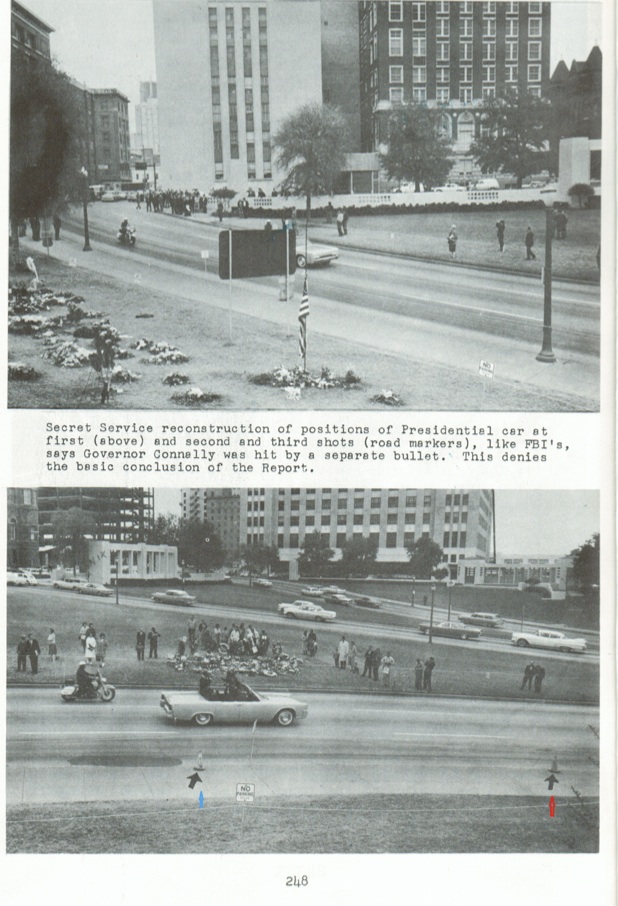
    Comment: The skull X-rays show a trail of metallic debris across the top of the skull. Using JFK’s orientation in Z-312 (at the instant of impact), this trail lies at an angle of 34° from horizontal (proceeding downward from the rear). But the angle from the “sniper’s nest” in the TSBD to JFK’s head at this moment is only 16°, according to Thomas Canning, the rocket scientist for the House Select Committee on Assassinations (HSCA). Therefore, in order for LHO to reproduce this particle trail in the X-rays (at Z-312) he must have been hovering above Dealey Plaza in a hot air balloon. Furthermore, there is much evidence (including WC documents) for a shot well after Z-313. See this writer’s review of Sherry Fiester’s book at this website. There is also evidence for this in overviews of Dealey Plaza (published in Newsweek, November 22, 1993) and in Secret Service photographs (right after the event). In the latter, a traffic cone clearly marks a final shot well after Z-313. Curiously, NOVA’s own interviewee, the famous author Josiah Thompson, at the recent Pittsburgh conference (October 17-19, 2013), announced his own new conviction that the final shot came well after Z-313.

    Omission: NOVA failed to ask Thompson (their own interviewee!) for his opinion on this critical issue of when the final shot occurred.

    Comment: While in Pittsburgh, Thompson shared with me the steps that led to his conclusion, which I found extremely interesting – since I had independently arrived at the same endpoint.

    Misleading: CE-399 was quite deformed.

    Comment: Not at all the case. For a truly deformed bullet, see Commission Exhibit 856, a bullet fired through a cadaver’s wrist (See Cover-Up by Stewart Galanor, Document 23).

    Misleading: Luke Haag, NOVA’s ballistics expert, claims to see “bullet wipe” around the hole in the back of JFK’s jacket. (This is superficial debris transferred from the bullet surface to the jacket.)

    Comment: This critical observation was not demonstrated visually at this point in the show (although the bullet wipe from the experiment was clearly shown). Oddly, the hole in the jacket had been shown earlier, so it could easily have been shown again. When I rewound the recorded show to examine the jacket hole, I saw no bullet wipe. I also carefully inspected close-up and high resolution images of this hole from other sources (e.g., Galanor, Document 6) and still could see no bullet wipe. Finally, I have personally inspected the jacket at NARA. I recall no bullet wipe from that visit either. Curiously, Haag describes the jacket hole as showing a “small, round hole.” Although Galanor’s image agrees with Haag’s description, the hole shown by NOVA is very elongated and quite irregular (obviously different from Galanor’s image). In fact, about ½ of the circumference had been removed by the FBI, but Haag seems unaware of this. If samples had been taken, then whatever evidence initially existed for “bullet wipe” has been severely compromised.

    Correct: The MC bullet traversed 36″ of pine board in a straight trajectory and emerged undeformed.

    Comment: This is very old news, as John Lattimer and John Nichols performed similar experiments many decades ago. They found that the bullet penetrated two feet of tough elm or through four feet of Ponderosa pine.

    Correct, but misleading omission: The exit hole (in soap) was larger than the entrance wound.

    Comment: In fact, the images show that Haag’s thumb would likely have fit into the exit hole. All of this, of course, is grossly inconsistent with JFK’s throat wound, which was often described as the size of a pencil. And JFK’s throat wound, of course, was also smaller than the purported entry wound in the back. Of course, NOVA avoids any discussion of these gross paradoxes.

    Misleading: The bullet yaws (its axis of rotation varies) after leaving JFK and then strikes Connally’s (JBC) back sideways, leaving an elliptical hole in his jacket and an elongated wound on his back.

    Comment: Dr. Cyril Wecht testified to the HSCA that an elongated wound might well result if the bullet had struck at an oblique angle. In fact, since no one really knows where the bullet (that struck Connally’s back) originated, such an oblique strike must logically remain on the list of possibilities. (NOVA merely assumes that the SBT is true, thus creating a circular argument.) Even worse though, the size of the JBC’s back wound has often been misrepresented. In particular, Milicent Cranor stated that “Connally’s back wound was only as long as the wound in the back of Kennedy’s head: 1.5 centimeters. No one has suggested Kennedy was hit in the head with a tumbling bullet.” She adds that “The head wound was 1.5 x 0.6 centimeters, and the back wound, 1.5 x 0.8 centimeters, as documented on at least four occasions by the governor’s thoracic surgeon, Dr. Robert Shaw (4WCH104, 107; 6WCH85, 86). The holes in the back of Connally’s shirt and jacket were as small as his back wound (5WCH64).” JBC’s back wound became 3 cm (exactly the length of the MC bullet) when it was surgically enlarged, as Shaw explained. Dr. Charles Gregory, who operated on JBC’s wrist, also doubted that the bullet (that hit JBC’s chest) had struck anything before JBC. He even speculated that a fragment from JFK’s head wound had caused JBC’s wrist wounds. Finally, John Hunt has argued that Connally was likely turned to the right when struck; that would, of course, produce a tangential strike and therefore an elongated wound. In particular, Hunt states that if JBC had been rotated by 43°, and the bullet was approaching at 10.2° (right to left), then a yaw of merely 6° is enough to yield the 1.5 cm wound.

    Misleading: Luke Haag states that there is no reason not to believe in the single bullet theory (SBT).

    Comment: This is a breathtaking, almost staggering statement. Because it fails to take into account – in any way – the entry and exit points in either man, nor does it require any knowledge of cross sectional anatomy! A CT scan, with a cross section through the area of interest (that I presented long ago – see Galanor, Document 45) still remains an effective demolition of the SBT. The trajectory for the SBT would either have shattered a vertebra body or it would have punctured the apex of the lung – but neither was seen at the autopsy. NOVA did not address this profound conundrum. With simplistic conclusions such as this one by Haag, forensic pathologists could be spared much serious work.

    Correct: Jefferson Morley points out that the acoustics evidence is not decisive.

    Comment: It is not even relevant. See my review of Don Thomas’s book at the CTKA website.

    Correct: Based on a meticulous reconstruction of Dealey Plaza, using detailed laser data, a shot from the top of the stockade fence to JFK’s head is possible; the distance is 105 feet, with a downward trajectory of 4°.

    Comment: Hmm, I cannot add anything to that.

    Correct: Connally and his wife both strongly disagreed with the SBT – for their entire lives.

    Comment: Furthermore, while in the hospital, JBC referred to shooters (in the plural). He later told a reporter that he never for one second believed the conclusions of the Warren Commission. (Joseph McBride, Into the Nightmare, p. 418)

    Misleading omission: The skull X-rays show no shot from the front, but they do show a posterior entry.

    Comment: This contradicts the experts for the ARRB, none of whom could identify an entry. Nor could I, via detailed optical density (OD) measurements at NARA. To rule out a frontal entry requires a good measure of hubris: e.g., it assumes that Humes and Boswell did not tamper with the skull before the official autopsy began. There is now serious evidence that this did occur. One line of evidence for such tampering is the major absence of brain in the anterior skull (on both sides) on the skull X-rays, as the OD data clearly demonstrate. Why is this evidence of tampering? The answer is that multiple witnesses at Parkland described a major loss of posterior brain tissue. This was recently confirmed by Dr. Robert McClelland during his videotaped presentation at the Cyril Wecht Duquesne conference. This is a major paradox, because the brain is not likely to have fallen backward while en route to Bethesda. However, if the major moorings of the brain (the falx) had been severed shortly before the official autopsy (e.g., illicitly by Humes), then the brain would indeed have fallen backwards. (On the other hand, if the falx had been severed before Parkland, the brain should already have fallen to the rear, thus leaving little significant brain tissue loss for McClelland to see.) Moreover, NOVA assumes only one headshot. NOVA’s participants, of course, fail to point out this fundamental assumption. After all, following a second shot, the evidence of the first shot may no longer have existed.

    Misleading: No shot came from the (right) side.

    Comment: My recent detailed discussion of the Harper fragment (presented at Duquesne, and soon to be posted at the CTKA website) clearly demonstrates, from multiple lines of evidence (especially including intrinsic information from the skull X-rays), that it arose largely from the occipital bone. In that case, the trigger for such an ejection most likely was a frontal shot (e.g., entering near to the right ear). Furthermore, there is strong eyewitness testimony (from the closest witnesses) that JFK was struck near the right ear. Even Kemp Clark, the neurosurgeon, described just such a tangential shot. As further corroboration for a tangential shot, at the recent JFK Lancer Conference (November 22, 2013), the autopsy technician James Jenkins recalled an apparent entry hole near Kennedy’s right ear that was surrounded by a gray border; even the pathologist Finck commented on this (off the record) during the autopsy. (Also see my review of Sherry Fiester’s book at the CTKA website). And G. Paul Chambers (a Ph.D. physicist, who worked for NASA), in Headshot (p. 136) agrees that a shot “…striking Kennedy’s head from the right front side was possible, even probable.”

    Misleading: Fracture lines on the JFK skull X-rays begin at the rear and go forward. (In general, these typically begin at the point of entry and very quickly extend outward from that point.)

    Comment: In Enemy of the Truth, (p. 212) Sherry Fiester, a forensic specialist, reaches the opposite conclusion: she concludes that the fractures radiate from the front of the head, which would imply a frontal shot. More importantly, though, if two headshots occurred (especially one from the rear and one from the front, as is quite likely – based on witnesses, the X-rays, and pathologic evidence), then this entire argument becomes moot.

    Assumption: The JFK autopsy photographs of the brain are authentic.

    Comment: Again, this is breathtaking. The experts seem oblivious to the serious doubt cast about this issue by the ARRB. Because, under oath before that body, official photographer John Stringer did not recognize the film or the process by which they were taken. Because he did not use either. They also seem unaware of Douglas Horne’s essays on the two brain examinations , which was well publicized in the media. My own OD data on the skull X-rays show virtually no brain (on either side) in a fist-sized area at the front of the skull. This is radically inconsistent with the autopsy photographs, which show a completely intact left side and a nearly intact right side. In principle, one can accept as authentic either the skull X-rays or the brain photographs, but not both.

    Misleading: Larry Sturdivan interjects his now-hoary explanation for the posterior head snap – the neuromuscular reaction.

    Comment: This has been refuted so many times that I leave this for the reader to pursue.

    Misleading: Josiah Thompson states that Humes was not very competent.

    Comment: Humes conducted the weekly brain cutting seminars at the Bethesda Naval Medical Center. All his life he had the respect of his peers. Although more experienced forensic pathologists would have done better, Humes’s chief problem was that he was boxed into a corner, where he often had no choice but to lie. The best example of this is his barefaced misplacement of the metallic trail of particles on the skull X-rays. (He became greatly embarrassed about this during his ARRB deposition.) Even my son at age six would not have done that. This was not a mistake by Humes. After all, consider the consequences: if he had reported the truth about the superior location of this particle trail it would have directly implied a second gunman, which he knew was not (politically) allowed.

    Misleading: NOVA’s illustrations for the SBT demonstrate the trajectory going through JFK’s collar.

    Comment: This is incredible, inasmuch as the hole in the jacket (shown earlier in the program) is about six inches inferior to the collar. So is the hole in the shirt. No one in NOVA even comments about this bizarre discrepancy.

    Misleading: Jim Lehrer and John McAdams both believe that LHO did it – and that he fired three shots.

    Comment: Among other things, Lehrer is a prolific novelist, and may say whatever he likes. Regarding McAdams, I have critiqued the SBT thoroughly (and with detailed anatomic models) in my review of his book at the CTKA website (this also includes the aforementioned CT scan). I have never seen any response from him about this. Until one is forthcoming, he really should cease to pontificate. Furthermore, the media have no cause to listen to someone (especially on human anatomy) who is solely a professor of “American politics, public opinion, and voter behavior.” In fact, NOVA should be mortified to quote such slender sources. Surely the American public deserves better.

    Correct, but misleading omission: Most witnesses heard three shots.

    Comment: Many, many witnesses heard two final shots in very quick succession (much too close for the MC), which could well imply two, near-simultaneous headshots. Further, there was never any systematic interviewing of witnesses either on the grassy knoll or in the Texas School Book Depository. Therefore, this database is sorely incomplete.

    Misleading omission: NOVA seems to refer to the Edgewood Arsenal skull shooting experiments, and then implies that these support the Commission’s theory.

    Comment: Dr. Gary Aguilar and Kathleen Cunningham have discussed these in detail. In particular, they point out that these experiments (supposedly using the official entry site) actually destroyed the faces of the skulls. Furthermore, the actual movies shown on NOVA (of exploding skulls) also show destruction of the anterior skull. Of course, since JFK’s face was intact, we (not surprisingly) have another paradox.

    Misleading: CE-399 entered JBC’s thigh and then fell out, but not before depositing a small metal fragment. (On the X-ray, the fragment is 3.5 mm x 1.3 mm.)

    Comment: The wound was no more than 1 cm deep, while the bullet was 3 cm long. The only site from the bullet for lead to extrude into the wound is from the tail. (NOVA shows the bullet entering the thigh nose first.) So how does the lead get under the skin, when the tail of the bullet is at least 2 cm outside of the skin? Dr. Tom Shires, who worked on the thigh wound, claimed that it looked like a tangential hit – or else a large fragment had stopped in the skin and then had subsequently fallen out. Dr. Malcolm Perry told Harold Weisberg that the hole in Connally’s skin was too small to be caused by a bullet. Arlen Specter shrewdly avoided this entire issue.

    Misleading omission: NOVA assumes, without any proof – or even any discussion – that CE-399 actually flew over Dealey Plaza that day.

    Comment: Their own interviewee, Josiah Thompson, is the reigning expert on this question, but NOVA did not discuss the chain of possession of CE-399 with him. (Thompson confirmed to me, via e-mail, that he was not asked.) If CE-399 is the wrong bullet, then the entire program immediately becomes hapless and hopeless. In fact, Thompson’s original pursuit of this issue (in Six Seconds in Dallas) was more recently renewed with the assistance of Dr. Gary Aguilar. The critical witness at Parkland Hospital (who actually handled the bullet) clearly did not recognize CE-399. On the contrary, the bullet he saw had a pointed nose, like the four bullets from World Wars I and II that NOVA displayed. John Hunt has also incisively highlighted serious problems with the timeline for receipt of this bullet (or perhaps even two different bullets) in Washington, DC. If the producers knew that Thompson had shattered the provenance of CE-399, and they nonetheless deliberately avoided this issue, then they are hypocrites. On the other hand, if they did not know this fundamental fact, then they are amazingly ignorant.

    In the lead up to this program, both McAdams and the director Rush DeNooyer proclaimed that their program would prove with modern forensic science that Lee Oswald alone shot John Kennedy. (See Los Angeles Times, August 7, 2013.) If that was their intent from the outset, then they were being unprofessional. But even with that inherent bias, they have failed ignominiously.

  • Sherry P. Fiester, Enemy of the Truth: Myths, Forensics and the Kennedy Assassination

    Sherry P. Fiester, Enemy of the Truth: Myths, Forensics and the Kennedy Assassination


    JFK X-rays, Headshots, and the Zapruder Film: A Demythologizing Book Review


    We must continually re-examine what we perceive to be true and hold it accountable to new information, research, and technological advances.”

    – Fiester (p. xv)

    “Thousands of young men are willing to die for the truth. But few are willing to study for five years [to learn] what the truth is.”

    – Fyodor Dostoyevsky [1]

    “One thing that happens to theories that hang around past their time is that they’re nibbled to death by ‘routine findings.’”

    –Jerry Fodor and Massimo Piattelli-Palmarini [2]


    Abstract: This is a valiant book that sometimes stumbles and falls short of its proclaimed goal, especially as expressed in the first quotation above. On the other hand, the author does a skillful job on several core topics: the incompetence of the Dallas police, the unreliability of ear witnesses, the unreliability of skull beveling, the futility of neutron activation analysis (for the JFK case), and the single bullet theory.

    I especially applaud the author for the renewed focus on the south side of the triple overpass (opposite the Grassy Knoll) for a possible headshot – the same site often nominated for the throat shot. She may even be right about seeing back spatter in Z-313. Since we are largely in agreement on these issues, I say little about them in this review.

    However, I disagree strongly on some other fundamental matters, as detailed below. For impatient readers, I list these disagreements more concisely in the Conclusions. In the following discussion I use subtitles as they appear in the book (underlined here). Statements from the book are in italics and enclosed by quotation marks. I also use italics for my own emphases.


    [Introduction:] The Magic of Myth

    Enemy of the Truth (EoT) defines myth (p. xv) as “… lacking historical or scientific sustenance.” A rather different definition is traditionally used in folklore:

    …a traditional [usually pre-scientific and pre-literate] story of ostensibly historical events that illustrates the world view of a people or explains a practice, belief, or natural phenomenon. [3]

    EoT clearly avoids this folkloric definition: instead the author uses “myth” as a pejorative – meaning a misconception, false belief, or mistake. To avoid this semantic bog she might instead have used one of these latter words.

    EoT claims that “myths” and “facts” are irreconcilable (p. xvi), i.e., in the author’s (black and white) view myths are false and facts are true. While the author does not distinguish between facts and theories, that distinction is also nonetheless critical to this discussion: “facts” can be defined as claims that are both true and verifiable (this restricts them to finite portions of space-time). On the other hand, scientific theories (which are not restricted to local portions of space-time) can in principle be false (e.g., the geocentric model).

    Furthermore, theories can be superseded – without necessarily re-labeling them as “myths.” For example, even though Newtonian physics is now a special case of Einstein’s theory of relativity, no historian or scientist would therefore describe Newton’s Laws as “myths.” It is curious though, that in making her case, the author actually assumes the unqualified applicability of Newton’s laws, even though these laws (since they have been replaced by relativity) might well meet her definition of a myth. [4]

    Even more troubling though is this: myths can be inspired by facts. As examples, Troy (Heinrich Schliemann), Ur (Sir Leonard Wooley), and Minos (Sir Arthur Evans) were once regarded as myths, but today these sites are widely accepted as archaeological reality (although the stories are another matter). Therefore, if facts can become myths and myths can be recognized as fact-based, perhaps EoT should not so quickly conclude that myth cannot become truth.

    This semantic confusion burrows even deeper, however. One of EoT’s alleged “myths” is that the Zapruder film does not represent reality. [5] At the very least, EoT should regard this as an hypothesis rather than as a myth; in particular, it is an hypothesis that can be subjected to experiment – and therefore to possible disproof. For example, just recently I viewed yet more objective evidence that strongly suggests alteration in several frames. (This quantitative data will likely be reported later this year.) Many readers, like me, will therefore be disconcerted by EoT’s unwarranted and unnecessary verdict on the extant Z-film. On the contrary, will we again see “myth” turn into reality?

    Another EoT claim tends to trivialize the difference between truth and reality – the author implies that assertions or characterizations about reality may not actually correspond to the way things are: “Consequently, truth is often a matter of perspective – not irrefutable fact” (p. xv). If the author truly believes this (as the subsequent discussion seems to imply), then she has joined the post-modernists, who doubt the existence of objective physical reality. [6]

    This is a serious issue, for if truth need not reflect reality, then the entire basis for EoT begins to evaporate. And such discussion about “truth” and “reality” – in opposition to myths and misconceptions – then assumes a different level of meaning, i.e., it seems that one myth is simply replaced by another (in such a post-modernist scheme).

    Chapter 1. Dallas PD followed Protocol

    “The Dallas Police Department in the 1960s was comprised of men who were doing the best job they possibly could” (p. 4). Almost the same statement appears again (p. 50).

    “… the Dallas Police Department’s crime scene work is decisively inadequate; discounting forever the myth, they followed contemporaneous protocol and standards …” (p. 57).

    In view of the severe criticism of the DPD throughout this chapter, what can EoT possibly mean by the high praise in the first quotation here, especially since it is repeated near the end of the chapter? And if the author truly believes that the DPD was a first-rate organization in the 1960s, what evidence is cited? The answer is – none at all.

    EoT claims that fingerprints are unique to each individual (p. 33). Even if that is theoretically true, however, a critical revolution in matching prints has occurred over the past decade. These new findings view fingerprints in a totally new light. See my book review of John McAdams. [7]

    The author states that latent fingerprints can be developed with silver nitrate (p. 35) via a reaction with silver chloride deposited by the body in any print. (If that were true, instead of killing Aztecs in his search for silver, Hernan Cortes could instead merely have fingerprinted them!) Of course, “silver chloride” should read “sodium chloride.”

    Chapter 2. Ear Witnesses

    This chapter cites the acoustic experiments of the House Select Committee on Assassinations (HSCA) and concludes that subsequent studies have been conflicting. On the contrary, if the reductio ad absurdum argument produced by Linsker and Garwin [8] is accepted (which seems inescapable), then this issue has been settled – the acoustics data are irrelevant. (It is only a matter of understanding the argument, which does require a little effort.) Believers in the acoustic data cite the 5% (i.e., low) probability that (in effect) a lone gunman did it. As a comparison, however, for the opening coin flip in five consecutive Super Bowls (2009-2013), heads came up each time. [9] The chances of this are 1 in 32 (3%), which is even less than the 5% chance cited for a lone gunman – yet these coin tosses supposedly happened by pure chance and for no other reason.

    Furthermore, in nine consecutive Super Bowls (1998 – 2006), tails came up eight times; the probability of getting eight tails in nine tries (in any order) is less than 2%. [10] Moreover, as John Ioannidis explains, via a convincing mathematical argument, many scientific (especially medical) claims are false. [11] I strongly suspect that the acoustic data fall into this category, i.e., 5% claims most certainly can be wrong (by chance alone). That is why physicists demand much higher levels of certainty – witness the announcement of the Higgs boson on July 4, 2012. [12] I can only fantasize that medicine will also some day require higher levels of certainty. Many patients have already paid a price for not requiring it. These wrong medical results have typically come from randomized, controlled clinical trials – often claimed to be the best that medicine can offer.

    In this same chapter on ear witnesses we read:

    “This means that witnesses in Dealey Plaza close to the path of the bullet were very likely incorrect in their judgment on the source of the sound and the placement of the shooter” (p. 82).

    What is striking (and paradoxical) here is that EoT later cites (pp. 219-221) ear witnesses who support the author’s proposal of a gunman on the south side of the triple overpass (opposite the Grassy Knoll). [13] But if ear witnesses are so unreliable (as seems likely) how then can the author justify using them to support her case?

    Chapter 3. Blood in Zapruder is Faked

    “… the assertion that the blood in the Zapruder film is faked is absolutely identified as a myth” (p. 120).

    EoT concludes that the bloody mist in Z-313 is back spatter (which may be true), while leaving unexamined the curious bright reflection (e.g., in Z-335 and Z-337) on JFK’s pre-auricular/temple area. [14] At chapter’s end, the reader is left uncertain about the author’s opinion of this bright spot. Is it also blood? Was this faked? If it is real, why is its movement in the film so erratic? And why did no one see anything unusual in this area at Parkland? [15]

    EoT seems uninterested in this puzzling issue; despite this, however, the author proclaims that faked blood (presumably including this bright site) in the Z-film is a myth – with “absolute” certainty. (This degree of certainty goes well beyond even the enthusiasm of most physicists for their favorite physical theories. [16]) One observer who clearly disagreed with EoT (regarding this area), is Dr. Roderick T. Ryan, an Eastman Kodak Gold Medal Award Winner, who told Noel Twyman that this object looked as though it had been painted in. [17]

    Insofar as the mist in front of JFK, EoT cites Bill Newman, who described this as about two feet in diameter (p. 340). Oddly enough, in his video interview with Douglas Horne (July 9, 2011), Dino Brugioni viewed the mist in the extant film and recalled (with great certainty) that the mist was larger in the (original) film that he had seen during the weekend of the assassination (November 23-24, 1963).

    In this video, I watched him outline on a projected image of Z-313 how much larger this mist had been in 1963. [18] Unfortunately, EoT was too incurious to ask Newman if the size of the mist in the extant film agreed with his own recollections. [19] Furthermore, Brugioni recalled that the mist he had seen in the (original) Z-film in 1963 had been white, not red. If Brugioni’s recollection is correct, then the red mist in Z-313 is artwork – not authentic back spatter – that was painted on an animation cell during the film’s alteration (possibly using an optical printer modified to perform aerial imaging visual effects). This image might even have been copied from a later portion of the Z-film. In that case, this image would bypass EoT’s argument that no one knew how to create backspatter in 1963. (However, even if Z-313 supposedly depicts the sole headshot, a profound paradox emerges when the particle trail on the lateral X-ray film is scrutinized; this is discussed below.)

    Remarkable evidence, including (altered) surveyor’s data sheets, [20] exists for a headshot distinctly farther down Elm Street, i.e., closer to the stairs that ascend the Grassy Knoll. As another example, Newsweek displayed a map (from the Warren Commission (WC)) showing just such a shot (Figures 1A and 1B). [21]

    Figures 1A and 1B. Newsweek (November 22, 1993), p. 74. The final head shot is shown at 30-40 feet beyond Z-313, based on early reenactments, data tables and documents; all were ignored by the Warren Commission.

    Figures 2A and 2B. This Secret Service photograph was taken shortly after the assassination. Traffic cones mark the supposed three shots on Elm Street.But the final cone (red arrow) is well beyond Z-313, as can be seen by the large floral memorial that alignswith the blue arrow closer to Z-313 (Harold Weisberg, Whitewash II (1966), p. 248). [22]

    So the question naturally arises: Were two headshots conflated? We shall return to this question. But an even more profound question is this: What really happened at Z-313 ? [23]

    But here is my chief criticism of this chapter: If back spatter is so obvious in the film (as may be true), why then is forward spatter so hard to see? According to Figure 5 in EoT (the MFRC video), forward and back spatter are visible in the same frame. [24] So where is the forward spatter in the Z-film? To further highlight this paradox, note that EoT quotes Hargis as easily seeing (during the actual event) such forward spatter (p. 341):

    “He described to me how the blood left the back of the President’s head in copious amounts. He stated that as the expelled blood hung in the air, he drove into it, thereby getting blood and bits of bone and brain on his motorcycle, clothing, and person. … he said, ‘It was as if a bucket of blood was thrown from the back of his head; it spread out and hung in the air for a minute.’ “

    EoT even reports that Hargis’s wife, too, noticed solid matter on Hargis when he returned home (p. 341). But about the absence of such forward spatter in the Z-film, EoT remains oddly silent. [25]

    Costella’s analysis of the streaking fragments (in successive frames) suggests that the bullet impact likely occurred “… just after the end of the exposure of Frame 312, which is about half a frame before the start of the exposure of Frame 313.” [26] If so, then it is even more likely (since both spatter events occur promptly with the bullet strike, according to EoT) that both events should be visible in Z-313. In fact, EoT states that back spatter dissipates faster than forward spatter (p. 102, item 5). If so, then where is the forward spatter in Z-313? After all, it should appear at about the same time as back spatter and it should last longer.

    Another issue that entirely escapes the author’s attention is the distance that the back spatter supposedly traveled: according to Frazier (pp. 114, 342-344), both sides of the windshield, the entire exterior, and the hood ornament (at the front of the limousine) were all coated with tissue debris. On the other hand, according to EoT, back spatter only travels four feet (p. 101) or perhaps just three feet (p. 118). [27] But the distance from JFK to the hood ornament is way over four feet – and the wind was blowing (strongly) toward the rear of the limousine (see the coats of Moorman and Jean Hill in the Muchmore film [28]).

    So the problem is obvious: How did back spatter reach the hood ornament? [29] (Recall that EoT insists on only one headshot.) But perhaps we should change focus here: Do exploding bullets behave differently from the (apparently) metal-tipped bullet shown in EoT’s figures? In particular, do such exploding bullets fail to produce forward and back spatter? Could they produce enough debris to cover the limousine and its occupants? Regrettably, this question is not addressed anywhere in EoT.

    The cited witnesses (Frazier at pp. 110, 114, [30] 342-344 and Clint Hill at pp. 109, 114) also recall that the trunk was well covered with tissue debris (and perhaps blood), none of which is seen in the Z-film. Hill, in particular, describes it as “all over the rear portion of the car.” So where did it go? Was it selectively erased during (illicit) film editing, so as not to suggest a shot from the front? EoT does not address this issue, although the author does admit that no extant photographs show blood on the exterior of the vehicle – even though blood on the interior was obvious in photographs (p. 343).

    EoT argues (p. 114) that tissue debris is not seen on the limousine trunk because dried blood is difficult to spot on a dark surface (although JFK’s blood would still have been fresh). But Thompson displays a photograph of obvious debris on the trunk, as seen in the Nix film. [31] So the question is obvious: Why don’t we see this debris in the Z-film?

    A different question might also be asked: If forgers were at work, why did they not also erase the incriminating mist in Z-313? The answer may well lie in the state of knowledge in 1963 (as EoT notes – pp. 235 and 243): in their innocence, the forgers may have interpreted the mist in Z-313 as forward spatter and therefore as evidence of a shot from the rear. Such a shot, of course, was acceptable to them because Oswald was behind the limousine. It would be interesting today to ask them how they interpreted the mist.

    Chapter 4. The Limo Stop

    In this chapter, EoT introduces an hypothesis (subjective time deceleration for witnesses under stress) but then this hypothesis, without further ado, is promptly promoted into a conclusion. [32] The subjective slowing of time and the simultaneous remarkable awareness of detail are certainly real (as they have been for me personally), but how do we know that this happened to nearly every eye witness in Dealey Plaza? The fact is that we don’t know this. What is worse, there is no way that we can ever know this. Just because something might have happened is no proof that it did happen.

    Consider this: as an historical parallel, during the shooting of Archduke Ferdinand, the motorcade stopped. Does EoT also wish to imply that this stop was an illusion? After all, this event closely parallels the Dealey Plaza event. [33] If so, what else in history might be false, merely based on the notion of subjective time deceleration? Such a revision of history might go on endlessly. To my knowledge (after reviewing many books on historiography) no historian has ever made such a suggestion.

    All four of the closest motorcyclists recalled the limousine stop. An actual stop would surely have caused some instability in their bikes – most likely they had to work to keep their bikes balanced while the limousine paused. Does EoT truly suppose that these men were mistaken in recalling how they managed their bikes during such a stop? Why would the psychological slowing of time have contemporaneously produced inaccurate memories in these men – about stabilizing their own bikes?

    Here is another question not asked (or answered) by EoT: Why do first-time viewers of the Z-film fail to comment on the limousine stop (or at least report a dramatic slowing)? Why are they not likewise affected by the psychological slowing of time? Is seeing such an event on film different from a live event? [34] EoT offers no comments on these perplexing issues.

    The author does admit (p. 132) that most Dealey Plaza observers agreed that the limousine slowed, but is this what first-time viewers of the extant Z-film report? (After showing the Z-film many times to students, that has not been my impression.) Readers might also ask this: Were they themselves personally impressed by a remarkable slowing of the limousine the first time they saw the Z-film? Or better yet: Did they recall an actual stop after first viewing the extant Z-film? After all, that is what so many Plaza witnesses did recall.

    Although EoT claims that few witnesses recall a limousine stop, this is clearly misleading. I have previously listed the ten closest witnesses [35] to the limousine (including motorcyclist Hargis). They all recalled a stop (their most common response) or they said that it “hesitated.” The reader is strongly encouraged to review their direct words, as EoT’s conclusion surely does not agree with these witnesses. Furthermore, Vince Palamara has compiled over 50 witnesses who also reported an event different from the extant Z-film. [36] Many Dealey Plaza witnesses also recall the abrupt acceleration after the stop. That, also, is not typically reported by viewers of the extant film.

    To her credit the author does agree that the Muchmore film shows the brake lights on for about nine frames. [37, 38] But then EoT cites the Nix and Muchmore films as evidence against a limousine stop. Unfortunately, that evidence is heavily tainted, as I have previously noted. [39] Gayle Nix told Inside Edition that her grandfather believed that the government had altered his film, though she did not know the truth. [40]

    In a conversation (May 1993) with Millicent Cranor, Gayle stated that her grandfather believed that frames had been removed. [41] Insofar as the Muchmore film is concerned, Robert Groden notes that, while UPI had the original, it “was cut or mutilated at the frame that showed the moment of the headshot.” [42] The original cannot be located. In a technical report (21 December 1995) Charles Mayn states that the copy in the Archives is not the camera original.

    Z-film alteration is not merely suggested by eyewitnesses [43] but, on the contrary, is based on a great deal of objective data. I cite only one example here, as described by John Costella. He cites Z-232 and shows that the image is physically impossible: either the entire limousine or the entire background should be blurred by an obvious amount (which he displays in his Figure 20). [44] On the contrary, such blurring is not seen. Thus, this frame represents an actual image from the original Z-film only if the limousine had come to a stop. Believers in Z-film authenticity have been reluctant to address this paradox.

    Multiple witnesses have seen a Zapruder-like film that is different from the extant Z-film. Brugioni is a recent addition to this list. [45] Just two others are Rich Della Rosa [46] and Scott Myers. There are more. [47] Does EoT truly believe that each one of these individuals is lying – or unbelievably mistaken (often in the same way)?

    In order for EoT’s explanation of the limousine stop to work, virtually all of these (limousine stop) witnesses must have experienced the same psychological sense of time deceleration, but this cannot be true – after all, many did not even know it was an assassination. For example, some thought that firecrackers were going off, while others described the backfire of a motorcycle. [48] And then we have the remarkable recollection of Abraham Zapruder himself: [49]

    … and I was walking back toward my office and screaming … and the people that I met on the way didn’t even know what happened and they kept yelling, “What happened, what happened, what happened?” It seemed that they had heard a shot but they didn’t know exactly what had happened as the car sped away, and, I kept on just yelling …

    We can only wonder: Did these witnesses – who did not know that an assassination had occurred – also experience a dramatic subjective slowing of time? If so, why?

    EoT also cites Alvarez as not supporting a limousine stop – merely because he calculated that the limousine slowed from 12 to 8 mph in the extant film. But that quite misses the point – what the Dealey Plaza witnesses reported was a stop (or a near stop), not a decrease by 1/3 in speed. To assess for an authentic stop, Alvarez’s calculations (and the physicists who agreed with him) are quite irrelevant. After all, Alvarez never addressed (and probably never even imagined addressing) the question we face today: Was the Z-film altered?

    Chapter 5. Ballistics Prove One Shooter

    Of course, despite the chapter title here, EoT does not support the lone gunman scenario. On the contrary, the author focuses here primarily on the neutron activation analysis data, which no longer support the lone gunman scenario, even though Robert Blakey once described it as the “linch-pin” of the case. I agree with the author’s conclusions.

    EoT notes that traces of copper were found on JFK’s shirt (p. 148). Although the author later (p. 282) reminds us that minute traces of copper were found on JFK’s jacket, she omits (in this later discussion) to remind us that it had also been found on the shirt.

    Chapter 6. The Grassy Knoll Headshot

    “However, there is no credible evidence to support identification of a specific, definitive point of entry or exit wound to the head” (p. 169).

    On the contrary, the trail of metallic debris across the top of JFK’s skull (on the X-rays) strongly suggests a bullet trajectory. (To add grist to the mill, EoT always assumes a single straight line trajectory. [50]) For the general case, EoT states (p. 206):

    “The fragment distribution pattern identifies the projectile’s direction of travel. The fragment pattern begins near the point of entry … “

    If this is true in general, why is JFK’s trail not a candidate for just such a trajectory? [51] Furthermore, many eyewitnesses recall a frontal entry wound (near the hairline above the right eye) that matches the X-ray trail astonishingly well: Malcolm Kilduff, Charles Crenshaw, Ronald Jones, David Stewart, Robert McClelland, Tom Robinson, Dennis David, Joe O’Donnell (a friend of Robert Knudsen), and others. [52]

    Of course, the autopsy photographs show an incision (not an entry wound) at exactly this site. This is most peculiar because the Parkland witnesses saw no such incision. In other words, precisely where we would expect to see an entry wound, the autopsy photographs now show an incision (likely produced by the pathologists). Is this mere chance, or was it deliberate? [53]

    We now come to a moment of truth: Is this trail of metallic debris on the X-rays consistent with a frontal shot at Z-313? Note that agreement between these two items is the fundamental – and never-questioned – assumption throughout EoT. But the answer is truly disturbing: No, this X-ray trail cannot derive from a frontal shot (from the overpass) at Z-313! [54] Here is why. First note JFK’s head orientation in Z-312 (p. 178 in Fiester – but also displayed here in Figure 3); then compare this image to the trail of metallic debris on the X-rays (Figures 4 and 6). [55]

    Figure 3. Z-312 (left) and Warren Commission Exhibit CE-388. An entry site shown here (in CE-388) is probably correct.
    Figure 4. JFK lateral skull X-ray. The trail of debris here is far above the entry site in CE-388, which suggests a second headshot, most likely frontal.

    An immediate paradox arises: for a shot from the triple overpass (specifically for EoT, the South Knoll) after Z-312, the orientation of the expected trail of debris is radically different from what the X-rays show. To be more precise, since EoT claims (p. 218) that the top of the limousine and the top of the overpass (the handrail) are at nearly the same elevation, then the trajectory for this proposed frontal shot should appear on Z-312 as a nearly horizontal line. In Z-312 such a trajectory would pass through JFK’s upper orbit and also through his ear canal (Figure 5).

    Placing that horizontal trajectory on CE-388 (Figure 5) shows that this trajectory is almost parallel to the WC’s trajectory, but inferior to it. (The directions are opposite, of course. [56]) But here is the point: the author’s expected trajectory is a gross mismatch to the metallic trail on the lateral X-rays. [57] So the unavoidable conclusion faces us: Although Z-313 may show a headshot, the particle trail on the X-rays definitely cannot result from this headshot!

    If the author cannot resolve this paradox, then at least two headshots (total) are required. Just one headshot is quite inadequate to the task. This conclusion delivers a severe blow to EoT, which concludes that just one headshot explains everything. That simply cannot be true.

    Figure 5. The solid red arrow (in both images here) shows the approximate path of a bullet in Z-312 (a nearly horizontal trajectory) for a shot from the South Knoll, as proposed by the author. The yellow arrow represents the trail of metallic debris on the JFK lateral X-rays. This is a gross paradox. The solid red arrow must be wrong. But the yellow trajectory (which is real) could not have resulted from a shot at Z-312; instead it must have occurred when JFK was more nearly erect, well after Z-312.
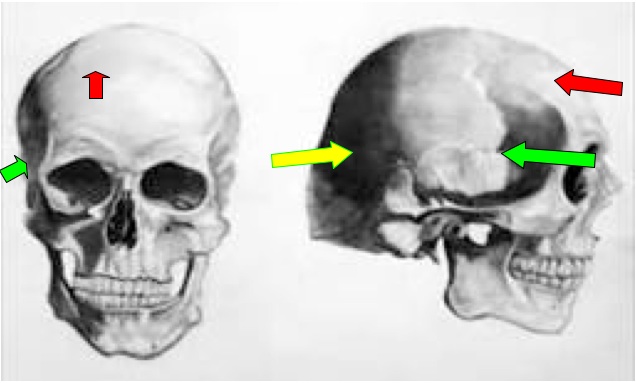
    Figure 6. The yellow arrow represents the trail of metallic debris on this JFK lateral skull X-ray. The cyan arrow identifies the 7 x 2 mm metal fragment – removed by Humes at the autopsy. The dark blue arrow identifies the small fragment at the rear, which is seen as a phantom image through the 6.5 mm object on the AP skull X-ray. The beige arrow locates the orbit, while the green arrow identifies the EOP (external occipital protuberance). The violet arrow locates the ear canal, and the orange arrow approximately locates the orange-sized hole reported by most witnesses. I have explained elsewhere why such a hole would likely not be visible on a lateral skull film. [58]

    But we are still not done with this issue. Let us agree that this trail of debris (Figure 6) does represent a bullet trajectory. (No one has seriously challenged the authenticity of these metallic particles – nor can I.) This trail is inconsistent with several other fundamental pieces of data in this JFK case, as follows: [59]

    • It is inconsistent with the orange-sized hole in JFK’s right rear skull (Figure 6) that was so widely reported, both at Parkland and at Bethesda. The debris trail is far too superior.
    • It is truly inconsistent with the location of the 7×2 mm fragment above JFK’s right eye (the same fragment that Humes likely removed). This 7×2 mm fragme
    • It disagrees utterly with the beveled skull site near the EOP (Figures 5 and 6) that the pathologists took for the entry of a posterior bullet. The debris trail is simply far too superior. [60]

    A third headshot could solve this impasse (see Figure 7):

    • (Yellow in Figure 7). That someone shot from the rear is nearly universally accepted – after all, James Tague was struck by something. A shot from the rear (e.g., from a lower story of the Dal-Tex building) may have entered at the pathologists’ beveled site just right of the external occipital protuberance (EOP). My reconstruction of the Harper fragment, with the lead deposit precisely at the pathologists’ site, may be considered objective proof of their honesty and accuracy on this issue. [61] If additional metal fragments were deposited with this shot, they were removed before the official autopsy began. [62]

    The autopsy report describes a fragment trail from the EOP to the right parietal bone. This trail is not present in the extant X-rays, but perhaps such a trail did exist before these fragments were removed, i.e., perhaps Humes told the truth in his autopsy report! It is even possible, if not likely, that the 7×2 mm metal fragment above the right orbit was part of that trail. [63] There is also eye witness evidence for a successful posterior headshot: early viewers of the film described a brief and abrupt leftward “jerk” of JFK’s head (no longer seen in the film). Such a rotation could have been induced by a shot striking the right rear of the skull (the torque would have been appropriately counterclockwise). [64]

    It is even possible, if not likely, that early viewers of the film took this jerking motion as evidence for a successful shot. [65] On the other hand, a frontal shot from the South Knoll, i.e., the south end of the triple overpass, could not have caused such a rotation unless it struck the left skull, e.g., behind the left ear, but no evidence suggests such a shot.

    Another posterior shot (different from the one that hit near the EOP), one that first struck the street, is also strongly implied – by four clues: (a) a metallic fragment in the left scalp (visible on most public images of the skull X-rays), (b) the metallic fragment in the posterior scalp (Figure 6 – dark blue arrow) that appears as a phantom image inside the 6.5 mm object on the AP X-ray, [66] (c) an unknown projectile that caused the superficial back wound, and (d) five witnesses (including three cited in the WC) who recalled a shot that struck the street (an event that may have produced these ricochet fragments that hit JFK) [67]. The final argument for a successful posterior shot is the presence of debris on the inside of the windshield and on the hood ornament. Forward spatter from a posterior shot might explain this debris, but a frontal shot almost certainly cannot. [68]

    • (Red in Figure 7). A frontal shot most likely produced the particle trail on the X-rays. This entered high on the right forehead, near the hairline (where the incision is seen in the autopsy photographs). For a shot from (anywhere on) the overpass, the observed particle trail is really only possible when JFK’s head is nearly erect, i.e., it cannot occur with the forward head orientation in Z-312 (or in Z-313). [69] If JFK’s head had been rotated to the left (as in EoT’s scenario), then this particle trail might derive from a South Knoll shot, although not immediately after Z-312. On the other hand, since the moment of this shot is not precisely known, so is JFK’s head orientation also unknown at this moment. That leaves open the possibility that the shot might have come from elsewhere, e.g., the north side of the overpass. However – and this is critical – this shot cannot explain the orange-sized hole at JFK’s right rear (the one that so many witnesses recalled)-after all, the particle trail is much too superior.
    • (Green in Figure 7.) Another frontal bullet may have struck tangentially [70] (e.g., either (1) from the north end of the triple overpass – perhaps from the storm drain, or (2) from somewhere behind the fence on the Grassy Knoll) [71], entered anterior to the right ear, and then exited to yield the orange-sized hole at the right rear. It is quite unlikely that such a tangential headshot could have deposited the 7×2 mm fragment, however. Such a tangential shot would have entered too far posterior (as well as too far inferior) to leave that fragment behind. This shot (#3) could well have produced the forward spatter that Hargis encountered. On the other hand, shot #2 is an unlikely candidate for that spatter. If shot #2 (from the South Knoll) had produced forward spatter, that spatter should have gone to the right rear, which does not match the witness reports. Clint Hill’s recollection [72] implies that this shot (#3) was the last shot. Finally, most witnesses quite specifically recall that JFK’s final movement was to “slump” forward. [73]


    Figure 7. Schematic illustration of three possible headshots. Entry sites are only approximate. Each color defines a different shot. [74]

    It is far beyond the scope of a book review to address these complex matters in much more detail. [75] Yet I would make several observations: Tom Robinson watched as the pathologists removed about ten small metal fragments from the brain (these are not in the official record) [76] and put them into a test tube or vial; the largest was about one quarter of an inch. [77] And Dennis David typed a memo that described enough bullet fragments to constitute more than one bullet [78] (perhaps the 7×2 mm fragment was accidentally overlooked by these nefarious collectors).

    Consistent with shot #3 above, Dr. Kemp Clark (neurosurgeon) described a tangential strike, and several close witnesses (e.g., Bill and Gayle Newman, and also Abraham Zapruder) saw trauma in front of JFK’s right ear, perhaps caused by this bullet’s entry. Gayle Newman also recalled that JFK grabbed his right ear (p. 339). [79] Also note Clint Hill’s comment about the “upper right rear of the right ear” (footnote 72).

    Then there is the memo of A. H. Belmont (at FBI headquarters), dated November 22, 1963, with a handwritten annotation of the time as 9:18 PM:

    I told SAC Shanklin that Secret Service had one of the bullets that struck President Kennedy and that the other is lodged behind the President’s ear [emphasis added] and we are arranging to get both of these. [80]

    In retrospect, a Belmont bullet (behind the ear) may have caused the tangential strike (shot #3 above); if so, then that bullet [81] was removed (or its fragments were removed) by the pathologists. In fact, the disappearance of 2-3 skull X-rays (p. 330) may well be further evidence for this conclusion – i.e., these missing X-rays (taken shortly after the body arrived) showed the pathologists precisely what fragments needed to be collected before the official autopsy began; if so, it was then critical (for a successful cover-up) for these early X-rays to disappear. [82] Although others may wish to pursue this issue, it is well beyond my purposes here to propose specific sequences for multiple headshots. [83]

    Oddly, EoT does not actually pinpoint the site of origin (on JFK’s skull) for either forward spatter from JFK (which is cited on page 102) or for back spatter. [84] The autopsy photographs in particular show no obvious site of origin for either back spatter or for forward spatter, but EoT skips over both of these issues. We might ask the film forgers a similar question: If they believed, as seems likely, that the mist (in Z-313) represented forward spatter, then exactly where on JFK’s head did that spatter exit, based on the autopsy photographs?

    EoT then goes on to recall that, for the HSCA, Humes raised his posterior skull entry site by 10 centimeters; the author implies that this was his final verdict (p. 175). That of course is false, because Humes later shamelessly reverted to his original site, near the EOP. [85]

    EoT also states that the HSCA concluded that no evidence suggested a second shooter (p. 187). On the contrary, the main HSCA conclusion was just the opposite – the acoustic evidence strongly implied (to them) a second (but inaccurate) shooter behind the fence on the Grassy Knoll.

    On another issue, EoT brings us current on skull beveling: once considered the “gold standard,” it is now considered less reliable (pp. 198, 211-212, and 248-249). [86] For example, a [bone] fragment can break off and leave behind (at that site) apparent beveling, quite unrelated to entry or exit. In further support of this, I have previously cited the experiments conducted for Roger McCarthy, in which he noticed random beveling that was unrelated to entry or exit. [87] The beveled skull site identified as an exit by the HSCA was likely an example of such irrelevance. After all, in their autopsy report, none of the pathologists had identified it as an exit. [88] To further confound us, the HSCA has identified this beveled site as lying within frontal bone [89] (pp. 184-185; 1HSCA253), which is actually absent (on the skull X-rays)! [90]

    In support of the South Knoll headshot, EoT then focuses on JFK’s head orientation at Z-312 (pp. 213-218). For this, the author adopts the work of Dale Myers: JFK was rotated away from Zapruder at 25.7° past profile (left), tilted left 18.1°, and nodding forward (pitch) 27.1°. EoT states the margin of error as 2°, but notes (p. 213) that the HSCA disagreed with Myers regarding the pitch. In particular, Myers’s angle is 16° steeper than Canning’s (for the HSCA)! [91] That is not a small amount.

    Chapter 7. Two Headshots

    EoT claims that the presence of back spatter in Z-313 proves that this frame (at least) is authentic. However, this assertion overlooks the possibility that the mist was merely borrowed from a later frame and superimposed onto an original image. (The mist might also merely have been copied, e.g., by hand, based on a later image.)

    The author concludes this chapter with a presumptuous claim (p. 265):

    “Current forensic research supports a single gunshot originating in front of the President, and front is not the Grassy Knoll. All other explanations are myths and are to be discounted as such.”

    I agree that a successful Grassy Knoll shot is not supported by the medical evidence. However, so long as EoT is unwilling to discount the acoustics data (which implied a gunman on the Knoll), how then can the author conclude that no shooter (even one who missed) stood on the Grassy Knoll? For that matter, any gunman who missed (from whatever site) cannot easily be excluded, no matter how often the author uses the word “myth.” (I am not close-minded about an inaccurate shooter on the Knoll, even though the acoustics data cannot be used as evidence for one. As usual, we must turn to the witnesses for such evidence.)

    EoT claims (p. 225) that some projectiles can remain within the target. Does this describe the particle trail in the X-rays? Is forward spatter absent because nothing exited from the back of JFK’s head with this particular shot? (Maybe so.) Based on the fuzzy borders of these particles (I have observed these many times at the National Archives, with quite myopic eyes), I have asked if they derived from an exploding mercury bullet. I also wonder: Would exit debris usually be absent with a mercury bullet? (I don’t know.) If two frontal headshots occurred, then perhaps the tangential one did cause forward spatter (as encountered by Hargis) – but then this spatter was subsequently excised from the film by felons who (illegally) altered it; after all, their goal was to erase any evidence of a frontal shot.

    EoT places great emphasis on the retrograde (toward the shooter) movement of ballistic gelatin (pp. 250-253), and offers this as an explanation for the initial forward movement of JFK’s head in the Z-film. The chief problem with this, of course, is that JFK’s head was not gelatin – after all, the brain was surrounded by a bony skeleton, which is quite another matter. [92] To be fair, though, EoT does cite (p. 203) Robin Coupland, who apparently used “model” skulls filled with gelatin. A “bulge” was observed in the skull where the bullet entered. In my opinion, however, this is quite different from the entire skull moving toward the bullet.

    Chapter 8. The Single Bullet Theory

    EoT claims (p. 294) that vertebral body T1 was fractured. But that was not the conclusion of the Clark Panel radiologist. (I agree with him.) The Panel concluded that only artifacts were seen at that site. [93]

    EoT carefully presents (p. 294) the trajectory through JFK. For additional (corroborating) anatomic information, see my essay on this subject. [94]

    The Witnesses (this final chapter is unnumbered)

    I have already cited several of the witnesses from this chapter. I would in addition, however, refer the reader to the many witness statements that suggest two (or more) headshots. [95]

    A Potpourri of Curiosities in EoT (my comments)

    1. Despite the frequent references to back spatter in the Z-film, only two tiny figures (pp. 178 and 228) show any Z-frames – and these are in black and white, with low resolution.
    2. EoT contains no index. This was a major handicap during my review.
    3. “When scientific methods prove a theory true, it becomes a fact. When scientific methods prove a theory false, it becomes a myth” (p. 331). Here again we see the conflation of “truth” with “fact.” This is careless use of language. More puzzling though is this: the current attitude in science is quite different from EoT’s. Most scientists would agree that even widely accepted theories (e.g., Maxwell’s classical electrodynamics of the 1800s) were not considered immutable, but were rather always open to falsification – and never finally proved. Furthermore, older theories are not always considered myths. For example, although Newton’s Laws have been superseded by Einstein’s relativity, these Laws are still useful for launching satellites into the solar system – and Maxwell’s Equations still find wide application today. Surely these accomplishments of Newton and Maxwell should not be called myths.
    4. “Physics is a complicated subject” (p. 259). On the contrary, physicists would say that sociology, economics, and psychology are complicated subjects. Models in physics can be reduced to bare essentials, thereby simplifying the problems and allowing testable predictions. Such an approach rarely works in these other disciplines, just because of their inherent complexity.
    5. “Newton’s Second Law of Motion [96] states that when a force acts on an object, it causes the object to move” (p. 205). Of course, “move” should read “accelerate” [force = mass x acceleration]. “Move” is better reserved for “velocity.” The statement itself reflects the (incorrect) thinking of Aristotle, i.e., in his opinion even a constant velocity was impossible without a continuous force.
    6. EoT persistently cites Oliver (p. 180) as a participant in shooting experiments at the Edgewood Army Arsenal. In fact, Oliver was a professor of classical philology at the University of Illinois, who had written an article about Oswald, titled “Marxmanship in Dallas.” [97] The man who participated in the shooting experiments was Alfred Olivier. [98, 99]

    Copy Editing in EoT

    1. These pages have misspellings: pp. 98, 116, 132, 153, 154, 184, 251, 264, 265, 271, 281, 310, 314, 330, and 335.
    2. These pages contain mangled syntax (or missing words, or incorrect words, or repeated words): pp. 35, 89, 91, 99, 102, 118, 119, 146, 177, 198, 199, 214, 253, 273, 291, 301, 303, 315, and 331.
    3. Nearly the same MFRC image is shown on too many pages: 100, 103, 117, 231, 253, and 291.
    4. Radiating fracture lines are repeatedly discussed, in almost identical phrases: pp. 97-99, 199, and 226-227. [100]
    5. An almost identical discussion of cavity formation occurs on pp. 98, 227, and 254-255.
    6. Radiating fracture lines in the skull are repeatedly shown (with nearly the same image): pp. 99, 200, 250, and 255.
    7. Differences and similarities between back spatter and forward spatter are discussed over and over, in virtually the same language (which gives the reader a curious case of deja vu): pp. 101, 209-210, and 232-233.
    8. Thicknesses of skull bones are (unnecessarily) cited twice: pp. 197 and 249.
    9. In the Bibliography, beginning with the second appearance of AFTE (p. 362), eighteen references are repeated (i.e., it is their second coming).
    10. Figure 31 is discussed (p. 291), but the displayed image is clearly the wrong one. The correct one does not appear anywhere.
    11. Z-312 supposedly shows spatter (p. 91), but then, paradoxically, Z-312 is said (p. 186) to have been exposed before the headshot! This twisted my mind for a while – after all, how could spatter appear before the headshot? – but I suspect that the first appearance here of Z-312 is a typo and that it should read Z-313. If not, some serious conceptual challenges await us. [101]

    My Conclusions (just the unpleasant ones)

    [Note: I have listed my agreements with EoT in the opening abstract.]

    1. The title would be better served by using “fallacies” instead of “myths.”
    2. The author should clearly state her own view of the external world: Does she indeed side with the post-modernists?
    3. The acoustical data are red herrings.
    4. The extant Z-film misleads us about tissue debris – on the contrary, much other evidence places it in the air (especially to the left rear) and all over the outside of the limousine. In addition, the mist in the extant Z-313 may not agree with the original Z-313. Perhaps the mist was copied (by hand) imprecisely, i.e., from a later Z-frame. If so, that could explain why it looks like back spatter. (The forgers may have regarded it as forward spatter from a shot from the rear.)
    5. Even if Z-313 shows back spatter, that alone cannot prove that the entire Z-film is authentic. It may not even prove that Z-313 is wholly authentic.
    6. A shot from (anywhere on) the overpass immediately after Z-312 is grossly inconsistent with the trail of metallic particles on the X-rays. If Z-313 displays a headshot, then that shot cannot cause the particle trail in the X-rays. That trail must have arisen from a different headshot, more likely later when JFK’s head was more erect.
    7. Multiple headshots occurred (Figure 7) – in radical disagreement with EoT. However, at least two of these shots were likely separated by well over one or two Z-frames; unfortunately, EoT only considers a very short time interval. Multiple headshots are also strongly suggested by many witnesses – likewise separated by well over one or two Z-frames.
    8. The skull X-rays (not considered by EoT), when correlated with all of the evidence, provide very powerful, perhaps even irrefutable, evidence of multiple headshots. The set of three headshots (Figure 7) is the only one to date that correlates all of the X-ray evidence with the Z-film and the eyewitnesses.
    9. The absence of forward spatter (from a frontal shot) in the Z-film is an enigma – curiously nowhere even discussed by EoT. If the bullet that produced the particle trail on the X-rays did not exit (which may be true) then that could explain the absence of forward spatter (for that shot). Or if government-employed felons deliberately erased evidence of forward spatter (i.e., from shot #3 above – the tangential shot) then that forgery could account for its absence (from that shot). EoT does not discuss any of these issues.
    10. Most likely the limousine actually did stop, although only briefly. Subjective time deceleration cannot explain away all of these witnesses. (There is also photographic evidence – not discussed in this review [102] – of at least a dramatic slowing of the limousine.)
    11. Only artifacts are seen near the T1 vertebra on the neck X-rays. They contribute nothing to this case.
    12. If another printing of this book is planned, then a copy editor with a critical eye should be hired. Finally, an index would be priceless.

    Acknowledgments

    Because this essay metamorphosed well beyond a standard book review, I must thank the following individuals. Jim DiEugenio initially persuaded me to read (and to review) the book. Greg Burnham offered his historical knowledge of the Zapruder film, was a careful listener to my theses, and made specific suggestions for increased clarity. Tim Nicholson provided precise quantitative analyses that provoked further thoughts; he also commented on the retrograde movement of gelatin targets. Jim Fetzer’s editorial skills led to a more readable format; Jim also proposed some of the illustrations. Gary Aguilar inspired some new ideas about the movement of JFK’s head at a critical moment (based on Thompson’s graph). Douglas Horne once again displayed his profound knowledge of this case via frequent invaluable and critical insights. As a result, this review is more lucid, more nuanced, and richer in detail than it would otherwise have been. Unfortunately, all of the left over mistakes are mine. I only wish I knew where they were.

    25 August 2013
    Coronado, California


    Notes

    1. Although I have been unable to locate the original source, Doug Fabian attributes this to Dostoyevsky. If Fyodor did not say this, then he should have: http://www.humanevents.com/2013/07/03/the-liquidation-cycle-and-wall-street-fireworks/.
    2. Jerry Fodor and Massimo Piattelli-Palmarini, What Darwin Got Wrong (2010), p. 55. I was thinking here not just about the lone gunman theory, but also about Zapruder film authenticity.
    3. Adapted from Wikipedia.
    4. “When scientific methods prove a theory true, it becomes a fact. When scientific methods prove a theory false, it becomes a myth” (Fiester, p. 331).
    5. Paradoxically, Jim Marrs (Foreword) states: “There are even legitimate arguments that the famous film of Abraham Zapruder has been altered from the original.” EoT definitely does not say that.
    6. See the breathtaking hoax by physicist Alan Sokal, cited in my review of Vincent Bugliosi’s Reclaiming History (2007) (http://www.assassinationscience.com/v5n1mantik.pdf). Sokal has stated: “And I’m a stodgy old scientist who believes, naively, that there exists an external world, that there exist objective truths about that world…” (http://en.wikipedia.org/wiki/Alan_Sokal). Post-modernists take exception to this, in surprising agreement with EoT.
    7. “How to Think Like John McAdams” (http://www.ctka.net/reviews/McAdams_Mantik.html).
    8. See my review of Don Thomas’s book: http://www.ctka.net/reviews/mantik_thomas_review_pt1.html. Enrico Fermi once called Richard Garwin the only true genius he had ever met (William J. Broad, “Physicist and Rebel is Bruised, Not Beaten,” New York Times, November 16, 1999. http://www.nytimes.com/1999/11/16/science/scientist-at-work-richard-l-garwin-physicist-and-rebel-is-bruised-not-beaten.html?pagewanted=all&src=pm). In 1952, Garwin designed the plan for the first hydrogen bomb.
    9. http://www.docsports.com/super-bowl-coin-toss-history.html.
    10. Click here.
    11. “Why Most Published Research Findings are False,” PLoS Med 2, No. 8 (2005): e124. Also see The Half-Life of Facts (2008), Samuel Arbesman, chapter 8 and “Sifting the evidence – what’s wrong with significance tests?” by Jonathon A. C. Sterne, British Medical Journal 2001; 322 (7280): 226-231.
    12. “Each experiment quotes a likelihood of very close to ‘5 sigma,’ meaning the likelihood that the events were produced by chance is less than one in 3.5 million. Yet in spite of this, the only claim that has been made so far is that the new particle is real and ‘Higgs-like.’ The existing data set is still too small to statistically determine with precise accuracy that the data is consistent with the standard model.” (Click here for more.)
    13. If their recollections were actually useful, most of these witnesses could also be cited to suggest a shot from the north side of the overpass – i.e., their statements are usually not specific for the south side. (In this review, this south side is sometimes called the South Knoll.)
    14. In High Treason II (1992), p. 363, Harry Livingstone describes a “blob,” which is “half a foot wide.” The object in question here though is the very bright area just anterior to the ear, only several inches across.
    15. In June 1970, Lifton viewed the frames after Z-334 (the last one published by the Warren Commission) and discovered that the supposed right facial wound of JFK (not seen by anyone at Parkland) was enormous – and that it appeared merely to be artwork. Provoked by this, Lifton then studied “Insert Matte Photography” and suggested that the “blacking out” effect [e.g., in Z-317] might also be artwork (“Pig on a Leash,” David S. Lifton, The Great Zapruder Film Hoax (2003), edited by James Fetzer).
    16. “We now understand that all physical theories are merely effective theories that describe nature on a certain range of scales. There is no such thing as absolute scientific truth…” (Quantum Man: Richard Feynman’s Life in Science (2011), Lawrence Krauss, chapter 17).
    17. Noel Twyman, Bloody Treason (1997), p. 160.
    18. Also see Brugioni’s comments in Mary’s Mosaic (2012) by Peter Janney, pp. 287-293, 477.
    19. Readers can, however, do their own investigations: just draw a two foot circle on an enlarged (or projected) image of Z-313 and then determine whether that matches the size of the visible mist.
    20. “The JFK Assassination Re-enactment” by Chuck Marler, in Assassination Science (1998), edited by James Fetzer, pp. 249-261. This astounding summary is essential reading.
    21. Clint Hill also recalls seeing the results of a head shot a discernible time interval after Z-313: http://www.veteranstoday.com/2011/07/25/jfk-whos-telling-the-truth-clint-hill-or-the-zapruder-film/.
    22. Also see Weisberg 1966, p. 243 for the official surveyor’s map.
    23. The December 6, 1963 survey (CE-585) places three “X” marks on Elm Street (to represent three shots) at Z-208, Z-276, and Z-358. Note that Z-313 is missing! (Fetzer 1998, p. 252 – this is from Marler’s paper, cited in footnote 20.) Now look again at the Newsweek image: Z-313 is also missing there.
    24. This appears to be the video cited by EoT:

      https://www.mfrc.ameslab.gov/files/index.php?folder=Qmxvb2RsZXR0aW5nIE1lY2hhbmlzbSBWaWRlb3M=7Ab1 .44 cal bullet impacting bloodied sponge from 182 cm.avi.

      Note (a) the near simultaneous appearance of back spatter and forward spatter, (b) the persistence of the mist (in both directions) until the video stops at 0.023 seconds (one Z-film exposure is 0.025 seconds), and (c) the very similar size of the mist in both directions. Then ask yourself this question: Why is forward spatter not seen in the Z-film? Viewing this MFRC video, especially with these questions in mind, is strongly encouraged.

    25. There may be one enigmatic exception (p. 102): “Blood spatter analysts observed forward and back spatter in the Zapruder film. Forward spatter had a greater velocity than back spatter and moved away from the immediate area of the President much faster than back spatter. One easily identified portion of the forward spatter in the Zapruder film is the whitish object projected from the head, forward [sic] of the President.”

      I find this most perplexing because EoT has previously defined forward spatter as traveling in the direction of the exiting bullet (i.e., away from the back of JFK’s head) – not forward of JFK, as is stated here. For my part, I do not see obvious forward spatter in the Z-film, i.e., any mist traveling toward the rear of the limousine (from the back of JFK’s head), even though that should be visible based on (a) the MFRC video, (b) Hargis’s statement, (c) surveyors of Dealey Plaza, shortly after the assassination, who saw such debris in multiple frames, (d) witnesses who saw (a great deal of) debris on the limousine trunk, and (e) those who saw debris fly to the left rear (both in Dealey Plaza and on Zapruder-like films).

    26. “A Scientist’s Verdict: the Film is a Fabrication,” by John P. Costella, in The Great Zapruder Film Hoax (2003), edited by James Fetzer, p. 186.
    27. In this same paragraph, the author strangely confuses “momentum” with “distance.”
    28. Josiah Thompson, Six Seconds in Dallas (1967), p. 187.
    29. Kellerman (in the right front seat of the limousine) also recalled that he had “stuff” all over his coat (p. 113). He sat well over 3-4 feet from JFK. Nellie Connally also saw debris falling on herself and all over the limousine (p. 109).
    30. Strangely, the end of Frazier’s quotation (p. 114) cites Finck, not Frazier!
    31. Thompson 1967, p. 99.
    32. Somewhat paradoxically, on this same page, we find this statement: “A belief is trustworthy information we evaluate as accurate because it originates in a reliable cognitive process: primarily that process is vision.” If the author truly believes that “vision” is so reliable, then why does she not want to believe the limousine stop witnesses?
    33. “Paradoxes of the JFK Assassination: The Zapruder Film Controversy” by David W. Mantik, in Murder in Dealey Plaza (2000), edited by James Fetzer, p. 326.
    34. EoT cites a reference (top of page 360) to “Emotion and time perception: effects of film-induced mood.” If merely watching a film can indeed induce a sense of time deceleration (as this paper concludes), then first-time observers of the extant Z-film should be just as likely to report a limousine stop as did the Dealey Plaza witnesses. On the contrary, it is my strong impression that first-time viewers do not report a stop (or even a dramatic slowing) – nor do they report the dramatic acceleration after the stop (that the Dealey Plaza witnesses recall). I have read this paper closely and it does indeed conclude that time slows (modestly) when subjects are first primed by viewing a film designed to induce a fearful mood.
    35. Fetzer 2000, pp. 341-342.
    36. “59 Witnesses: Delay on Elm Street,” by Vincent Palamara, ibid., p. 119.
    37. I first described this in Fetzer 1998, p. 301.
    38. http://www.youtube.com/watch?v=hrX8lsb2WTk.
    39. Fetzer 1998, pp. 302-304. Although EoT places great confidence in the accuracy of films (p. 132), the author seems unaware of the widespread use of film alteration for propaganda purposes – ever since 1894! See my discussion (with references) of this unholy marriage of film and half-truths in Fetzer 2003, pp. 291-307.
    40. Richard B. Trask, Pictures of the Pain (1994), p. 197. His source is Inside Edition [Television Program] 12/27/1991.
    41. Cranor told me this in a personal conversation.
    42. Robert Groden, The Killing of a President (1993), p. 37.
    43. Even Zapruder is one of these witnesses. He reported filming the limousine as it turned from Houston onto Elm Street (Fiester, pp. 86-87), a turn that is absent from the extant film. (Some viewers of a Zapruder-like film have seen this turn.) Furthermore, when testifying before the WC, Zapruder seemed confused about the images he was shown – from his own film – which he recalled watching so often that weekend that he had nightmares about it. He even described several events not seen in the extant film (http://www.jfk-info.com/wc-zapr.htm), e.g., “That’s correct. I started shooting – when the motorcade started coming in, I believe I started and wanted to get it coming in from Houston Street.”
    44. Fetzer 2003, pp. 180-181.
    45. In the same video cited above, Brugioni is certain that the mist was visible for longer (in the original film) than in the extant film, both of which he examined frame by frame. About the extant film (while watching it as a movie) he says, “That just doesn’t look right” and “It doesn’t shock me like it did when I first saw it; I just gasped – so did everyone else” and “Something has been cut out of this” and “I saw more matter in the air than that” and “I thought there were missing frames” and (regarding the black patch over JFK’s head in Z-317) “That’s an anomaly.” He also stated (regarding the mist), “It was white, not red,” a color difference that EoT does not discuss (although the author may not have been aware of it).
    46. http://www.youtube.com/watch?v=XrRbkY9gEnQ.
    47. Fetzer 1998, pp. 299-300 and Fetzer 2003, pp. 463-465. Millicent Cranor has described her 1992 experience in Fetzer 1998, p. 299. Just this week I have spoken to two others; both recalled the final shot being farther down Elm Street than Z-313. My impression is that these multiple viewers do not contradict one another on any point, although they do not all recall exactly the same details.
    48. Fifty (50) witnesses described firecrackers, while nineteen (19) described backfire in Murder from Within (1974) by Newcomb and Adams, p. 86.
    49. http://www.jfk-info.com/wc-zapr.htm.
    50. This assumption may not be universally true, however. DiMaio states: “Thus [for headshots], internal ricochet is fairly common, occurring in anywhere from 10 to 25% of the cases, depending on the caliber of the weapons and the diligency [sic] with which the evidence of internal ricochet is sought. As a general rule, internal ricochet is more commonly associated with lead bullets and bullets of small caliber” (Vincent J. M. DiMaio, Gunshot Wounds (1985), p. 219).
    51. EoT notes that most of these particles lie in the anterior half of the skull (p. 212) – which implies that they arose from a frontal shot. I agree. I would also note that two of the largest particles lie in the posterior half of the skull. Since heavier particles travel farther, this is yet one more argument that the trail represents a frontal shot. That these particles most likely represent a bullet trail was also supported by Dr. John J. Fitzpatrick, the forensic radiologist for the Assassination Records Review Board (ARRB): http://www.maryferrell.org/mffweb/archive/viewer/showDoc.do?docId=145280&relPageId=225.
    52. Fetzer 2000, pp. 249-252.
    53. Douglas Horne, Inside the ARRB, Volume III, pp. 732-733, 764-765.
    54. Since JFK’s head is tilted so far forward in Z-312, this statement covers both ends of the overpass.
    55. Z-312 here is a surrogate for Z-313. An image of Z-313 appears on page 228 (Fiester).
    56. The WC’s trajectory is also outrageously misaligned with the metallic trail, but no one noticed that because the X-rays were not available.
    57. I first publicly presented this observation a long while ago (probably decades ago), but its profound significance is still often overlooked today, as here in EoT. One source is “How the Film of the Century was Edited,” Fetzer 1998, p. 286.
    58. http://www.ctka.net/reviews/mantik_speer.html. In particular, the defect left by the Harper fragment would not be expected to be visible on this lateral X-ray.
    59. None of these paradoxes is confronted in EoT.
    60. Someone could conceivably argue that the pathologists’ beveled site represents the exit of the (single) head shot espoused by EoT, rather than the entrance site proposed by Humes. However, such an exit site (along with a forehead entry) would still require a trajectory that was radically inconsistent with the trail of metallic particles – so the paradox would persist. There is no escape by that scenario.
    61. Fetzer 2000, p. 227. My updated essay on the Harper fragment is pending.
    62. Horne, Volume IV, pp. 1000-1013.
    63. On the overhead view of the skull (7HSCA230), note that this 7×2 mm metal fragment must lie very close to (if not actually on) the (extrapolated) trail from the EOP to Angel’s exit site (adjacent to the coronal suture). Angel’s images are also here: http://www.history-matters.com/essays/jfkmed/ADemonstrableImpossibility/ADemonstrableImpossibility.htm.
    64. Fetzer 1998, pp. 298-299.
    65. See “Interviews with Former NPIC Employees: the Zapruder Film in 1963,” by Douglas P. Horne, Fetzer 2000, pp. 311-324.
    66. http://www.ctka.net/reviews/mantik_speer.html, Figure 3.
    67. Bonar Menninger, Mortal Error (1992), pp. 67-78.
    68. Dr. Robert Grossman executed a wound diagram for the ARRB in 1997 (Horne, Volume I, Figure 23) that depicted a “trap door” (that could open and close) due to a right parietal bone flap. Although no one at Parkland except Grossman recalled this, it would explain the (1) vertical head explosion described by Brugioni and (2) the debris on both sides of the windshield and all over the occupants of the limousine. Such an explosion through the top of the skull might well be expected due to cavitation from any headshot.
    69. Fetzer 1998, p. 286.
    70. Even EoT seems to consider a tangential strike (p. 198).
    71. Recall that ear witnesses to an overpass shot did not discriminate well between the north and south ends (if they are to be believed at all).
    72. Clint Hill: “As I approached the vehicle there was a third shot. It hit the President in the head, upper right rear of the right ear, caused a gaping hole in his head ….”
      (http://www.veteranstoday.com/2011/07/25/jfk-whos-telling-the-truth-clint-hill-or-the-zapruder-film/).
    73. Fetzer 1998, pp. 285-295.
    74. A curious, but now increasingly credible story from Clarence Israel was related by Janie Taylor, a biologist at NIH, across the street from the Bethesda Hospital. Israel’s brother (now deceased), one of two orderlies in the morgue that night, reported that one doctor was waiting in the autopsy room for some time before the body (or any other physicians) arrived. “When the body arrived, many people were forced out of the room and the doctor performed some type of mutilation of three bullet punctures to the head area. The doctor was working at a very ‘hurried’ pace and was done within a few minutes, at which point he left the autopsy room.” (Horne, Volume IV, pp. 1063-64).
    75. Gary Aguilar, MD, has recently advised me, based on Josiah Thompson’s position graphs of JFK’s head (Thompson 1997, p. 91 – or see Harrison Livingstone, Killing Kennedy and the Hoax of the Century (1995), p. 139), that the head moved most rapidly near Z-328. (Livingston had made this observation long ago; see his p. 138). At these frames, JFK is nearly vertical (i.e., not tilted forward or backward, although he is tilted toward Jackie).

      In this review, I have (again) stated that the particle trail in the X-rays could only occur for a frontal shot while JFK was nearly erect (meaning not tilted forward, in particular). And here is another coincidence (or maybe not): Clint Hill reached the limousine at about this same moment (Z-328) – and only then did he hear his “third” (and final) shot – long after Z-313. So we can now ask: Is this when the final shot (#3 above) struck? I discussed this possibility 15 years ago in Fetzer 1998, pp. 285-295.

    76. http://www.maryferrell.org/mffweb/archive/viewer/showDoc.do?docId=711&relPageId=3.
    77. http://www.maryferrell.org/mffweb/archive/viewer/showDoc.do?docId=327&relPageId=9.
    78. In the Eye of History (2005), William Law, pp. 12-13. Curiously, Harrison Livingstone, High Treason (1998), pp. 562-563, even displays a photograph of a bullet fragment said to have been removed from JFK.
    79. Note that this movement by JFK’s hand is not seen in the extant Z-film, but Gayle was not alone: based on 75 viewings of the Z-film, William Manchester reported that JFK lifted his hand to his head in The Death of a President (1967), p. 158. Even Jackie said, “And then he sort of did this [indicating], put his hand to his forehead and fell in my lap” (5H180).
    80. http://www.jfklancer.com/hunt/mystery.html, Figure 6.
    81. Douglas Horne adds this comment (e-mail of August 22, 2013): “On Nov 29th Hoover and LBJ had a long phone call, which (the part I refer to) is reproduced verbatim on page 54 of Michael Beschloss’s book Taking Charge. In that conversation Hoover tells LBJ that ‘A complete bullet rolled out of the President’s head.’ That has bothered me for many years, since no one else ever said that, to my knowledge, and here was the nation’s top law enforcement officer saying it. For years I have thought that this was proof of his complete senility and incompetence. In this conversation with LBJ, Hoover says that the complete bullet fell out of JFK’s head during cardiac massage at the hospital, and was found on his stretcher. So what we know from this conversation is that, IN HOOVER’S MIND, this was the source of the ‘stretcher bullet,’ even though it is NOT the explanation offered up by his own agents Sibert and O’Neill, who quoted Humes’s speculation (in their FD-302) that it fell out of JFK’s BACK during cardiac massage. For years I thought Hoover was a senile idiot who didn’t even know the basic facts in this case. BUT WHAT IF HE KNEW ALL ABOUT THE BELMONT BULLET DESCRIBED IN THE MEMO, and for that reason (forgetting that it was not ‘in the official record’), got it confused with the stretcher bullet that Humes announced (to S & O) had obviously fallen out of JFK’s back? This must be the case, because I am not aware of anyone the day of the assassination speculating that the stretcher bullet came from JFK’s head. In other words, Hoover is still an idiot, but the nature of his slip here when speaking to LBJ may very well indicate that he was privy to evidence removed during clandestine surgery at Bethesda, and got confused (because he was getting senile) and simply said the wrong thing about the stretcher bullet when speaking to LBJ…indicating only to us, years later, that he must have been thinking of the bullet Belmont wrote about.”
    82. Note that, although Belmont is FBI, his source is not the two FBI agents (Sibert and O’Neill), who were assigned to the morgue that night. Most likely the FBI was not permitted in the morgue when the pathologists collected these initial fragments – and illegally failed to report them. (Also see Dr. Humes’s comments, about the absence of the FBI in the morgue, in the CBS memo of January 10, 1967 (http://www.maryferrell.org/mffweb/archive/viewer/showDoc.do?docId=145280&relPageId=184). If Sibert and O’Neill had actually been there, it would mean that they also illegally failed to report these fragments.

      In an e-mail of August 24, 2013 from Douglas Horne, he states his sense of the characters of S & O: Based on observing them during several hours of questioning during their ARRB depositions they were innocents – honest men sent to the autopsy simply to obtain bullet fragments – and they were not concealing any autopsy evidence collected after 8 PM, when they were belatedly admitted to the morgue. In particular, Horne believes that they told the truth – under oath – that they saw only two minuscule metal fragments removed from JFK’s cranium.

      In support of this scenario, the FBI report makes no mention of these many earlier fragments (i.e., those of Robinson, David and Belmont). Douglas Horne has discussed this scenario (the Belmont memo and the exclusion of S & O) in great detail (Horne, Volume III, pp. 705-708, 713-726). Another possible origin for the bullet behind the ear is the EOP shot (#1 above). Of course, Dennis David’s report (of fragments constituting more than one bullet) suggests that Humes collected fragments from both the EOP shot (#1) and the tangential shot (#3), which may be true.

    83. Inquisitive souls might begin with Clint Hill’s report of the “third shot” as he reached the limousine – while also noting that he reached the limousine well after Z-313. See the Clint Hill footnote above (#72).
    84. Tim Nicholson has performed a detailed analysis of the physics of the Z-313 streaks, although the following comments are my own. Extrapolating the two largest streaks backward on Z-313 strongly suggests that they converge – at the same point – on JFK’s forehead (Commission Exhibit 390, WC Volume XVI, p. 986). Oddly, however, the forehead was actually intact (according to both the witnesses and the autopsy photographs) so the forehead therefore is not a likely source for these bone fragments (to say nothing of two fragments from the same point – at the same moment).

      To further perplex us, the physical anthropologist (Angel) for the HSCA (likely correctly) identified the largest, late arriving bone fragment (found in the limousine, according to Humes and Kellerman – but see Horne, Volume III, pp. 710-711) as frontal bone, where these two streaking fragments also supposedly originated! So the question becomes: How could all three of these bone fragments originate from the same site in the skull? But there is yet one more puzzle: Why would one of these bone fragments merely fall into the limousine while the other two zoomed off at high speeds (p. 257)? Possible answers include (1) two different headshots were at play, or (2) the streaks are not authentic, or (3) as Horne suggests, perhaps the large bone fragment was removed by Humes during his illicit surgery.

      Witnesses in Dealey Plaza and early viewers of the Z-film offered a different scenario, e.g., ” …and one fragment, larger than the rest, rises over Kennedy’s falling shoulders and seems to hang there and then drift toward the rear (William Manchester, The Death of a President (1967), p. 160.) This fragment may actually be visible in Mary Moorman’s famous photograph, on top of JFK’s right shoulder. Jackie also saw a piece of the skull (5H180) – an unlikely event if it traveled at the high speeds of the streaks in Z-313. Charles Brehm is another who saw a skull fragment flying to the left rear (Thompson 1967, p. 99.) There are more such witnesses.

    85. Breo DL. JAMA, 267:2794. Reproduced in ARRB Medical Document #22, see p. 2794.
    86. Ibid. Humes pompously proclaimed that his beveling rule was valid forever: “It happens 100 times out of 100, and I will defend it until I die. This is the essence of our autopsy, and it is supreme ignorance to argue any other scenario. This is a law of physics and it is foolproof – absolutely, unequivocally, and without question.” Humes is now dead, and so is his so-called law.

      For more on the utility (or futility) of beveling, see footnote 352 in “How Five Investigations into JFK’s Medical Autopsy Evidence Got It Wrong” by Gary L. Aguilar, MD, and Kathy Cunningham (May 2003): http://history-matters.com/essays/jfkmed/How5Investigations/How5InvestigationsGotItWrong_6.htm#_edn351.

    87. Livingstone 1995, p. 313.
    88. In the Military Review of January 1967 they were, however, persuaded to change their minds; they signed the document that had been prepared for them by the Justice Department. In this document a beveled exit wound was reported at the junction of the frontal and parietal bone, at the periphery of the large skull defect. Before the ARRB, when pressed by Jeremy Gunn (at Horne’s suggestion) about this change, Humes put his head in his hands, stared down at the document, and said, “I don’t know who wrote this” (Horne e-mail of July 9, 2013).
    89. See Figure H-4 by John Hunt, which is a copy of HSCA Exhibit F-66. This figure shows the frontal bone intact all the way back to the coronal suture (http://www.history-matters.com/essays/jfkmed/ADemonstrableImpossibility/ADemonstrableImpossibility.htm).
    90. I have often discussed this misinterpretation by the HSCA. John Hunt has listed those who report absent frontal bone: Boswell, Finck, Canning, and McDonnel (ibid.). See my sketch here: Fetzer 2000, p. 251. Dr. John J. Fitzpatrick, the forensic radiologist for the ARRB, also agreed with me that the frontal bone was present only up to the hairline. Although Angel would have agreed with him, the HSCA would not have welcomed Fitzpatrick’s conclusion (http://www.maryferrell.org/mffweb/archive/viewer/showDoc.do?docId=145280&relPageId=225).
    91. Tim Nicholson notes (e-mails of August 12 and 22, 2013) that he has “JFK’s head orientation as 27-33° nodded forward [pitch], turned left 10°, tilted left 15-30° (see Moorman photo). Sherry [Fiester] says the head is turned 25° to the left. She apparently does not specify the other angles. In the attached images [of Z -312] the forward tilt of the skull is 27° and 33°.” Nicholson’s major disagreement with Fiester appears to be JFK’s leftward rotation: 10° (Nicholson) vs. 25° (Fiester). That is significant, particularly as this angle determines whether the particle trail could have originated from the South Knoll. On reviewing Nicholson’s images I was struck by how subjective these conclusions are – and how imprecise these angles must be (for any observer).
    92. Tim Nicholson has offered this assessment (e-mail of August 11, 2013): “The gelatin does deform when the bullet hits it, showing this retrograde effect. This happens because of internal pressure and because there is nothing constraining the gelatin from such deformation. If it were inside a closed inflexible container you would not see this effect.”
    93. Aguilar and Cunningham (May 2003); see Section III (The Clark Panel), paragraph 1: “Metal Fragments Present in JFK’s Neck X-rays.”
    94. Fetzer 2000, pp. 252-260.
    95. Fetzer 1998, pp. 285-295.
    96. EoT cites this Law as if it were currently used in physics. That assumption, however, contains an unintentional irony, i.e., according to EoT, because this Law has been replaced by relativity, it should be considered a “myth.”
    97. http://www.revilo-oliver.com/rpo/Warren_Commission_Testimony.html.
    98. http://www.jfk-info.com/fragment.htm. Bizarrely enough, however, this website states: “Dr. Oliver [sic] shot the wrists of cadavers for the Commission. Olivier [sic] was a supervisory research veterinarian …” One can only wonder who was shooting whom for the WC. With typos flying almost as thick as bullets, perhaps we should ask whether “veterinarian” was supposed to be “vegetarian.”
    99. Aguilar and Cunningham (May 2003). This is a wonderful review of the government’s relentless incompetence at investigating JFK’s murder. Olivier (but not Oliver) is cited here. (To add further unneeded confusion, Cunningham has married Evans, and now uses that name, even when searching for silver ingots.)
    100. Although EoT renounces any specific entry site for its sole frontal head shot (p.169), each one of these images places an entry exactly where the metallic trail of debris on the X-rays fits best. This is also the same site where the forehead incision is seen in the autopsy photographs.

      Is the author subconsciously aware that this is indeed a very specific (and likely correct) entry site – and may even fit with a shot from her favored site, i.e., the South Knoll? If so, she does not tell us. (Of course, this trail could not have resulted from a shot at Z-312 – or at Z-313 – but might have occurred later, when JFK’s head was nearly erect.)

    101. I eventually discovered one final comment on this matter (p. 206): “Frame 312 [sic] also reveals blood spatter leaving the head because of a gunshot wound to the head” [sic]. I am now hopelessly confused. May I even ask: Just which head shot caused spatter in Z-312?
    102. Fetzer 1998, pp. 301-302.

  • Douglas Horne, Inside the ARRB (Part IV)


    Inside the ARRB, Vol. IV, by Doug Horne

    A Nearly-Entirely-Positive Review


    This is a Review of Volume IV, which includes

    Part II: Fraud in the Evidence: A Pattern of Deception (continued)
    Chapter 13: What Really Happened at the Bethesda Morgue? (and in Dealey Plaza)
    Chapter 14: The Zapruder Film Mystery.


    The death of a democracy is not likely to be an assassination from ambush. It will be a
    slow extinction from apathy, indifference, and undernourishment.

     ~ Robert Maynard Hutchins, Great Books (1954)


    My title here is a parody of my review1 of Reclaiming History (2007) by Vincent Bugliosi. Since that review was (in my opinion) rather devastating for Bugliosi, my title was intended to be sardonic. Despite this, Vince lifted a few quotes from it (out of context and without my permission) and included them with his abbreviated paperback version, Four Days in November (2008). The total page count (CD included) of his massive doorstopper was about 2786, almost exactly three times as long as the 888-page Warren Report. Horne’s book, by contrast, is shorter: 1880 pages, including the front matter (pages i-lxxiii). I had stated that Bugliosi’s book was likely to stand forever as the magnum opus of this case, though not without serious flaws. As a magnum opus, however, Horne’s five-volume set is a serious challenge to Bugliosi, but with virtually none of Bugliosi’s flaws. The current review, however, focuses (almost) solely on Volume IV, which I regard as Horne’s set piece (as that phrase is used in literature and film, but not in soccer).

    Although some men believe that women age like fine wine, in this case it is Horne himself who has aged well – he waited the better part of a decade after his experiences with the Assassination Records Review Board (ARRB) before beginning the serious work on his book. He does hint, though, that Bugliosi drop-kicked him (he is an Ohio State Buckeye fan) onto the playing field. Volume IV focuses on the two chief themes of the entire five-volume set: (1) the illicit surgery, before the official autopsy began, by pathologists James J. Humes and J. Thornton Boswell2 at the Bethesda morgue and (2) the Zapruder film riddles. It is likely that the success or failure of Horne’s work will rise or fall with this single volume. In this review, I shall address these two topics in sequence, critique a few puzzles, then draw some conclusions and finish with several suggestions. By way of a caveat emptor, I should confess that I initially encountered Horne at his first COPA (Committee on Political Assassinations) conference (when he interviewed with the ARRB), have intermittently met him since, and consider him a very good friend. He is also a very bright and strong-willed investigator.

    Illicit Surgery at the Bethesda Morgue

    In order to paint Humes and Boswell (H&B hereafter) as the morbid co-conspirators, Horne needs first to clarify the timeline – which he does brilliantly (see the Appendix at the end of this review). The ARRB learned, for the first time, that JFK’s body initially arrived at the Bethesda morgue at 6:35 PM local time (in a black hearse). That information derives from an after-action report (written on November 26, 1963) by Marine Sergeant Roger Boyajian.3 Quite astonishingly, Boyajian had retained a copy of his report, which he presented to the ARRB. His report corroborates the recollections of Dennis David4 who saw the light gray navy ambulance (with the bronze casket from Dallas) arrive at the front of the hospital, where he saw Jackie exit; its arrival time was either 6:53 PM or 6:55 PM (the sources vary).5 But just about 20 minutes earlier, David had directed his on-duty sailors as they delivered the body in a cheap casket, i.e., the entry described by Boyajian. David estimated (from memory) the delivery time as 6:40 PM, or perhaps 6:45 PM. His estimate is strikingly close to Boyajian’s recorded time of 6:35 PM. Horne concludes that this arrival time of 6:35 PM must now be accepted as a foundation stone in this case. As further corroboration for this time, he emphasizes that even Humes agreed with it: before the ARRB, Humes cited the initial arrival as possibly as early as 6:45 PM.6 In my opinion, therefore, it is very difficult to disagree with this early arrival time. If this is accepted, though, the repercussions are colossal – it means that the bronze casket (the one that traveled with Jackie) was empty. Horne next compiles a long table7 of witnesses to the cheap casket and the body bag, both of which were seen at this initial entry. He is also very persuasive here, although he rightfully credits Lifton with much of this groundbreaking work.

    Now if the body arrived at 6:35 PM in a cheap shipping casket, when did it exit the bronze casket (the one that left Parkland)? Horne suggests that this transfer occurred right after the bronze casket boarded Air Force One. (Lifton again blazed this trail.) As corroboration for this, Horne8 describes JFK’s Air Force Aide, Godfrey McHugh, as perturbed about a delay caused by a ‘luggage transfer’ between the two official planes. After this transfer to a body bag, tampering became feasible. Horne suggests that an initial foray into the body took place in the forward baggage compartment prior to the flight to DC; the goal was to extract metal debris or a bullet from the throat wound. (It is not known whether anything was found.) Horne infers that a similar attempt was made on the brain, but that attempt likely foundered because the requisite tool (e.g., a bone saw) was missing.

    The second casket entry (via a light gray navy ambulance) occurred at about 7:17 PM. James W. Sibert and Francis X. O’Neill, Jr. (the two-member FBI team) and Roy H. Kellerman and William Greer (both Secret Service) together delivered the (empty) bronze casket to the morgue.9 This time is consistent with the arrival time of the bronze casket (shortly before 7 PM) at the front of the hospital. The third casket entry (with the body inside) has traditionally been accepted as the official one – at 8 PM (in a light gray navy ambulance). It was delivered by the Joint Service Casket Team.10 The transfer of the body must have occurred (in the morgue) after the second entry at 7:17 PM. But it must also have transpired after the initial X-rays (for reasons to be discussed below).11 Finally, this transfer must have occurred well in advance of 8 PM so that the bronze casket could leave the morgue (Tom Robinson recalled this temporary departure12), be ‘found’ by the official casket team, and then delivered again at 8 PM. This sequence of three casket entries looks like a classic French farce, i.e., an affair concocted by a half-mad scriptwriter. Unfortunately, all of the evidence points strongly in the direction of three casket entries. Perhaps this would have been unnecessary, as Horne points out, if only Jackie had not insisted on staying with the bronze casket en route to the morgue. (She had declined a helicopter ride to the White House, which would have separated her from the Dallas casket.) Most likely the plan had been to surreptitiously transfer the body between caskets at the Walter Reed Army Medical Center. But Jackie’s unexpected decision to remain with the bronze Dallas casket waylaid those plans, which meant that Kellerman (who Horne nominates as the morgue manager) had to improvise on the spot. It was a highly risky business, during which this escapade was nearly uncovered, according to Horne.

    Lifton had argued that body alteration had occurred somewhere before Bethesda. He believed that altering the geometry of the shooting through “trajectory reversal” – i.e., turning entrance wounds into exit wounds, and planting false entrance wounds on the body – was the primary reason for the illicit post mortem surgery, and that removing bullet fragments was only a co-equal, or even secondary, goal of the clandestine surgery.13 Horne takes a different tack: he believes that the reason for assaulting the body (before Bethesda) was merely to extract bullet debris, not primarily to alter wounds.

    My own views come into play at this point. Before Horne’s work, I had become convinced that someone had messed with the throat wound, most likely to extract bullet fragments. The evidence for this was that the two sets of witnesses – those at Parkland vs. those at Bethesda – had disagreed so profoundly. Also, Malcolm Perry, the surgeon who performed the tracheotomy, claimed that he had left the throat wound ‘inviolate,’ meaning that it was easily visible after the tube was pulled. In addition, Charles Crenshaw insisted that the tracheotomy at Parkland was nothing like the one in the autopsy photographs. I also had my own (telephone) encounter with the autopsy radiologist, John Ebersole.14 I still sense the horror in his voice as he recalled the tracheotomy and declared that he would never do one like that. Horne’s witnesses (there are more) only validate my prior conclusion about throat tampering.

    Before Horne’s work, I was uncertain about head tampering before Bethesda (although Lifton had made a strong case for it). Nonetheless, I had to agree that if the throat had been explored, then of course the head might also have been invaded. Although Horne is still open-minded about illegal tampering of the skull before Bethesda, he believes that such an event can be inferred from (1) Finck’s statement (to the defense team at the Clay Shaw trial in 1969) that the autopsy report (presumably an earlier one, as the extant one does not say this) described the spinal cord as severed when the body arrived at Bethesda and (2) Tom Robinson’s comment to the ARRB that the top of the skull was ‘badly broken’ when the body was received at Bethesda, but that the large defect (in the superior skull) in the autopsy photographs was ‘what the [autopsy] doctors did’ – i.e., that the missing skull was due to the pathologists, not due an assassin’s bullet(s).15 These reports therefore provide more evidence that the head was explored somewhere before Bethesda; the goal was to retrieve bullet debris, but it failed – because the brain could not be extracted from the skull. In summary then, the body arrived at Bethesda as follows: (1) with a radically enlarged tracheotomy16 and no bullet debris in the neck (perhaps there never was any, as I have suggested elsewhere17) and (2) with the same (right occipital) exit wound that was seen at Parkland and with a brain that had not been removed from the skull and that therefore closely, or possibly even exactly, resembled the Parkland brain. Most likely the brain still contained most, or even all, of the bullet fragments from Dealey Plaza. (These metal fragments are, of course, absent from the official record today.) Those are Horne’s conclusions about H&B, but let’s look at the evidence.

    So why does Horne conclude that H&B illicitly removed (and altered) the brain shortly after 6:35 PM, before any X-rays were taken, and before the official autopsy began? He here introduces two intriguing witnesses – the two R’s, namely Reed and Robinson. Edward Reed was assistant to Jerrol Custer (the radiology tech), while Tom Robinson was a mortician. Rather consistently with one another, but quite independently, both describe critical steps taken by H&B that no one else reports. (Horne documents why no one else reported these events – almost everyone else had been evicted from the morgue before this clandestine interlude.) After the body was placed on the morgue table (and before X-rays were taken), Reed briefly sat in the gallery.18 Reed states19 that Humes first used a scalpel across the top of the forehead to pull the scalp back. Then he used a saw to cut the forehead bone, after which he (and Custer, too) were asked to leave the morgue. (Reed was not aware that this intervention by Humes was unofficial.) This activity by Humes is highly significant because multiple witnesses saw the intact entry hole high in the right forehead at the hairline. On the other hand, the autopsy photographs show only a thin incision at this site, an incision that no Parkland witness ever saw. The implication is obvious: this specific autopsy photograph was taken after Humes altered the forehead – thereby likely obliterating the entry hole.

    Reed’s report suggests that Humes deliberately obliterated the right forehead entry; in fact, the autopsy photograph does not show this entry site. Paradoxically, however, Robinson (the mortician) recalls20 seeing, during restoration, a wound about º inch across at this very location. He even recalls having to place wax at this site. So the question is obvious: If Humes had obliterated the wound (as seems the case based on the extant autopsy photograph), how then could Robinson still see the wound during restoration? This question cannot be answered with certainty, but two options arise: (1) perhaps the wound was indeed obliterated (or mostly obliterated) and Robinson merely suffered some memory merge – i.e., even though he added wax to the incision (the one still visible in the extant photograph), he was actually recalling the way it looked before Humes got to it, or (2) the photograph itself has been altered – to disguise the wound that was visible in an original photograph. The latter option was seemingly endorsed by Joe O’Donnell, the USIA photographer,21 who said that Knudsen actually showed him such a photograph.

    Regarding Robinson, Horne concludes that he arrived with the hearse that brought the body (i.e., the first entry). After that, Robinson simply observed events from the morgue gallery; contrary to Reed’s experience, he was not asked to leave. Just before 7 PM, Robinson22 saw H&B remove large portions of the rear and top of the skull with a saw, in order to access the brain. (Robinson was not aware that this activity was off the record.) He also observed ten or more bullet fragments extracted from the brain. Although these do not appear in the official record, Dennis David recalls23 preparing a receipt for at least four fragments.24

    Contrary to Reed and Robinson, Humes25 declared that a saw was not important:

    We had to do virtually no work with a saw to remove these portions of the skull, they came apart in our hands very easily, and we attempted to further examine the brain.

    Although James Jenkins (an autopsy technician) does not explicitly describe the use of a saw, he does recall that damage to the brain (as seen inside the skull) was less than the corresponding size of the cranial defect; this indirectly implies prior removal of some of the skull.26

    Horne adds an independent argument for multiple casket entries.27 Pierre Finck told the Journal of the American Medical Association28 that he was at home when Humes telephoned him at 7:30 PM. (In his 2/1/65 report to General Blumberg he cites 8 PM.29) Finck, as a forensic pathologist, had been asked to assist with the autopsy. As further confirmation for Finck’s overall timeline, he arrived (see his Blumberg report) at the morgue at 8:30 PM. But here is the clincher: during this phone call, Humes told Finck that X-rays had already been taken – and had already been viewed. On the other hand, the official entry time (with the Joint Service Casket Team) was at 8 PM! If that indeed was the one and only entry time, how then could X-rays have been taken – let alone developed and viewed (a process of 30 minutes minimum) – even before the official entry time? The only possible answer is that the body did not first arrive at 8 PM. Furthermore, Custer and Reed, the radiology techs, provide timelines consistent with much earlier X-rays; in particular, they recall seeing Jackie enter the hospital lobby,30 well after the 6:35 PM casket entry – an entry they had personally witnessed. In summary, eyewitnesses convincingly support a much earlier timeline than the official entry of 8 PM. Therefore, multiple casket entries are logically required. And that more relaxed timeline gave H&B time both to perform their illicit surgery and also for skull X-rays to be taken and read, most likely all before 7:30-8:00 PM.

    The reader might well ask why Reed and Robinson (and Custer, too) were permitted to observe (at least briefly) this illegal surgery by H&B. Horne proposes that the morgue manager that night (Kellerman) was not present for the first casket entry – that’s because he was riding with Jackie and the bronze casket. Therefore, before he arrived (most likely that was shortly after 7 PM), there was no hands-on stage manager in the morgue. It is even possible that Kellerman himself ejected Reed and Custer as soon as he arrived. Robinson, on the other hand, dressed in civilian clothing, may have seemed to Kellerman a lesser threat, so Robinson stayed.

    Several conclusions follow from the above analysis. First, the official skull X-rays31 do not show the condition of the skull or the brain as seen at Parkland. Instead, they were taken after tampering by H&B, perhaps even after significant tampering, especially if Robinson and Reed are correct. Furthermore, the massive damage seen in the photographs and X-rays was not caused just by a bullet or even by multiple bullets, but instead by pathological hands. In particular, for a single, full metal-jacketed bullet (the Warren Commission’s inevitable scenario) to generate such an enormous defect has always defied credibility.32 Likewise, Boswell’s sketch (for the ARRB) on a skull33 of this enormous defect only shows the condition of the skull after tampering by H&B – and does not reflect the skull as seen at Parkland. (The Parkland witnesses fully concur with this.) On the other hand, many witnesses at Bethesda saw the condition of the skull before such tampering began. These witnesses, both physicians and paraprofessionals, uniformly describe a right occipital blowout,34 consistent with a shot from the front. Leaving aside the pathologists, as many as eight Bethesda physicians may be on this list.35 In photographs,36 both Parkland and Bethesda witnesses demonstrate with remarkable unanimity, on their own heads, the location of this obvious exit wound on the right rear skull.

    The X-rays do, however, show many small fragments distributed across the top of the skull.37 So why didn’t Humes extract more of these? I have previously proposed (based on their actual appearance – as viewed in detail on multiple occasions at the Archives) that they look more like mercury than like lead. If so, then Humes would not have been able to palpate them (mercury is liquid) and would therefore have been unable to remove them during his illicit surgery phase.

    We could go on to ask: What other evidence exists for such illicit surgery? Lifton initially introduced this issue by citing the FBI report (by Sibert and O’Neill), which quoted Humes as describing surgery to the head.38 Sibert, in the 2000s, still insisted that they had quoted Humes correctly about such surgery.39 (I also heard Sibert say this in Fort Myers, Florida, during one of Law’s taping sessions.) Furthermore, the FBI had no reason to fabricate such a statement. On Lifton’s tape (which I have heard), he queries Humes about this; to me, Humes does sound remarkably suspicious and evasive. But the FBI men are not the only witnesses to his statement. Another is James Jenkins, who quotes Humes40 as asking: ‘Did they do surgery at Parkland?’ Furthermore, Humes was later told, when some skull fragments arrived at the morgue,41 that these had been ‘removed’ during surgery at Parkland. We all know that did not happen, so where did they come from? Horne implies that Humes himself had removed them during the illicit phase. Another supporting argument is the remarkable ease of removing the brain from the skull (during the official autopsy phase), but this is not so surprising if it had previously been removed during the unofficial phase. James Jenkins42 observed that the brainstem had been cut, as if by a scalpel (not severed by a bullet), which also suggests its earlier removal that evening (while Jenkins was absent). In any case, such an early removal was likely essential to successfully search for (and extract) bullet debris. Even Finck43 bears witness to a transected spinal cord: to the defense team at the Shaw trial in 1969, Finck stated that the autopsy report (presumably an earlier one, as the extant one does not say this) described the spinal cord as severed when the body arrived at Bethesda. Finck was still absent when the brain was removed, so someone must have told him this, most likely Humes.

    Horne comments further on the throat wound. He concludes that H&B were well aware of this wound that night and he provides considerable evidence for this conclusion.44 However, given the absence of the throat wound from the FBI report, H&B probably learned of it only after the FBI left, i.e., after 11 PM.45 That information then led to the pathologists’ interim discussion of an exit through the throat, as later reported by Richard Lipsey.46 Horne even speculates that an early version of the autopsy report included exactly this scenario, which later had to be discarded because of timing data from the Zapruder film.

    Regarding the throat wound I would add the following. Warren Commission loyalists like to cite medical articles that ER personnel cannot reliably distinguish entry from exit wounds. Even if true, though, that comment obfuscates the situation. To the contrary, in this particular case several facts trump those medical reports: (1) such a tiny exit wound could not be duplicated in experiments47 and (2) Milton Helpern (who had done 60,000 autopsies) said that he had never seen an exit wound that was so small (under similar conditions).48 Then there is the question of the magic bullet. As Horne summarizes, its provenance has been extensively investigated by Josiah Thompson49 (with recent assistance from Gary Aguilar). In the face of the persistent refusal of the pertinent witnesses to identify this bullet, most likely it would never have been admitted at trial – and that alone would thoroughly devastate any Warren Commission case.50 A final telling blow derives from the National Photographic Interpretation Center (NPIC): before political leverage was exerted, their scenario actually included a frontal throat shot!51

    The Zapruder Film Mystery

    Based on his relentless defense of the extant film, Josiah Thompson can justifiably claim the title, ‘High Priest of Z Film.’ His initial claim derives from his work for LIFE magazine in the 1960s, which led to Six Seconds in Dallas (1967).He claimed (p. 7): ‘Quite obviously, the Zapruder film contained the nearest thing to absolute truth about the sequence of events in Dealey Plaza.’ His most recent public paper (2007)52 finalized his claim to the above title. Unfortunately for Thompson, Horne’s work has created deep fractures in his purported bedrock, and has pulverized some rockheads into finely ground sand.53 When Thompson wrote his ‘Bedrock’ article he ignored two witnesses54 who had been extensively interviewed by the ARRB (actually by Horne himself) and whose interviews were surely already known to Thompson, who is nothing if not a very bright detective. These witnesses were Ben Hunter and Homer McMahon, employees of the NPIC (a subsidiary of the CIA), who received the original (in their view) film from a Secret Service agent. The latter, in turn, had just couriered it from Rochester, New York, headquarters of Eastman Kodak. Moreover, this agent (‘Bill Smith’) specifically said that the film had been developed (sic) in Rochester. If that was true, then there must have been a second film, one not shot by Zapruder (his film, after all, had been developed in Dallas), but rather one filmed from a nearly identical site in Dealey Plaza.55

    But Horne’s next stroke is the mortal blow to the Zapruder film, one beyond even the skills of a contemporary Parsifal. Horne details Peter Janney’s encounters (including seven interviews) with Dino Brugioni,56 a founder of the NPIC. John McCone, Director of the CIA, had telephoned the NPIC director, Arthur Lundahl (Brugioni’s superior), asking him to assist the Secret Service in analyzing the original (Zapruder) film.57 Beginning late on Saturday night (November 23), Brugioni viewed an original, 8 mm film and prepared briefing boards, which were presented to McCone the next morning. Amazingly, Brugioni stated that neither Ben Hunter nor Captain Sands were at his event.

    (Brugioni did not recall ever meeting Homer McMahon; he could therefore not personally report whether or not McMahon was present at Event I on Saturday night. Of course, since Brugioni was positive that Ben Hunter was absent, and because Hunter and McMahon were linked by their recall of one another, then McMahon should not have been present at Brugioni’s event.) In a detailed analysis Horne shows convincingly that two separate events, both highly compartmentalized, occurred on successive nights. During these recent interviews, when Brugioni finally learned – after 46 years – of two unrelated events, both at NPIC, he was stunned!

    Horne assembles a magnificent table58 that contrasts these two events: the Saturday night (November 23) event with Brugioni and the Sunday night event (November 24) with Hunter and McMahon. Horne demonstrates how compartmentalized these two events were: they differed in attendees, film format, and briefing boards. Brugioni knew Ben Hunter, but did not see him at his event. Brugioni had handled an 8 mm film (Hunter and McMahon had a 16 mm film) that he considered an original; that it was 8 mm is certain because NPIC had to purchase a projector (near midnight on Saturday) from a private local store. (The NPIC did not own its own 8 mm projector.) Brugioni also viewed photographs of the briefing boards currently in the Archives, which had been authenticated by Hunter and McMahon. However, Brugioni was certain that these were not his. He was even able to recall how his differed from these. Although Hunter and McMahon’s film reportedly came from Rochester, Brugioni was not told where his had originated (most likely it was Zapruder’s original – diverted from Chicago to DC that Saturday).

    Based on these interviews, Horne draws several conclusions: (1) the CIA had an immediate and high level interest in the film; (2) the original film had been split from 16 mm to 8 mm in Dallas, just as the Dallas witnesses had agreed;59 (3) the extreme compartmentalization implies that the two films were different; (4) Brugioni viewed Zapruder’s original (8mm), whereas Hunter and McMahon viewed an altered film (in 16 mm, unslit format); (5) the alterations were done during the day on Sunday, November 24, in Rochester, New York; (6) most likely aerial imaging was used for these alterations; and (7) the three copies of the original (already in circulation60) then had to be replaced by copies of the newly altered film. The reason that Horne chooses Sunday is straightforward: LIFE‘s next issue reached the marketplace on Tuesday (November 26) and it contained images from the extant film (the one currently in the Archives). Some of these low resolution, black and white LIFE images (in Horne’s opinion – and mine, too) show signs of alteration, particularly the bizarre debris (sometimes called the ‘blob’) on JFK’s face and the disappearance of the white object in the background grass. Horne suspects that the alterations had all been completed by Sunday night, although he seems not finally wedded to this concept. In any case, Loudon Wainwright61 said that 31 frames were employed for that issue of LIFE. Although other frames might have been open to alteration after Sunday, it seems likely that these 31 frames would have restricted later changes. (There are fewer than 500 in the entire film.)

    Horne next reviews the momentous technical issues that bedevil the extant film – anomalies that really should not be present. In fact, none of these would have been predicted for an original film. Even a single one casts doubts on authenticity, but when a complete list is compiled the evidence becomes overwhelming. Aside from image content issues (which are very serious) this technical list includes the following items: (1) the location of the punched number 183 is inconsistent on both the extant film and (in photographic images) on the extant copies, (2) the punched numbers unique to each of the three copies are quite strangely located, (3) the absence of intersprocket images on the three copies was not predicted by the Jamieson lab, which had exposed them, (4) Zavada could not reproduce the septum line, (5) the double registration of the Dallas processing edge print is odd, (6) no one in Dallas recalled the bracketing (by exposure differences) that is present in the three extant copies, (7) Zavada has shown remarkable indecisiveness about when Zapruder’s film was slit from 16 mm format to 8 mm, (8) the ‘full flush left’ issue62 was not resolved, and (9) claw flare is still a puzzle. That so many purely technical issues persist would, by itself, be a wonder if the extant film indeed were authentic.63

    Horne also reviews the curious stories of Dan Rather64 and Cartha DeLoach.65 Both had been early viewers of the film and both had reported that JFK’s head had gone violently forward. To put this into perspective, the reader might ask himself this question: How many individuals have you met who, after once viewing the film, agreed with the reports of these two men? I have never met any.An actual Dealey Plaza witness, James Altgens, a photographer, also described JFK’s head as going forward.66 Horne also reminds us that early viewers of the film easily saw debris (possibly brain tissue) flying to the rear. One of these witnesses was Erwin Schwartz (Zapruder’s partner), who saw the film multiple times the very day that it was developed.67 Such backward-flying debris is nowhere seen in the extant film. Horne also notes the unrecorded turn from Houston to Elm (which both Zapruder and his secretary recalled filming) as well as the now-ancient problem of the limousine stop (first emphasized by Lifton many years ago). The discrepancies between the autopsy photographs, on the one hand, and the Zapruder film, on the other, are also reviewed. Horne offers likely explanations (of incompetent tampering) for these inconsistencies.

    In an Addendum, ‘The Zapruder Film Goes to Hollywood,’ Horne recounts his viewing of HD scans based on a 35 mm ‘dupe negative.’ His Hollywood contact got her copy of the extant film (for $795) from a private laboratory, to which she had been referred by the Archives’ personnel themselves. (There is no other means to obtain such a copy, as the Archives do not directly reproduce copies.) Horne describes his viewing experiences with several Hollywood professionals (I have seen these, too). Quite striking were (1) the black patch over JFK’s head,68 (2) the oddly truncated corner of the Stemmons Freeway sign,69 and (3) the ‘blob’ on JFK’s face.70 The black patch, in particular, had sharp and geometric borders and was astonishingly black, especially when compared to earlier frames (before Z-313) of JFK’s head and also when compared to the natural shadow on the back and side of Connally’s head. I have since viewed the MPI transparencies (copied directly from the extant film at the Archives) at the Sixth Floor Museum in Dallas. These images, too, are quite striking. Since they are accessible by the public, anyone should be able see them, merely by arranging an appointment with the Museum. Horne concludes this section by printing his FOIA letter to the CIA and associated letters on this subject to President Obama, Senator Webb, and DCI Panetta (the CIA response is still pending). Among other items, he requested information on (1) the highly secret CIA facility in Rochester, New York (Hawkeyeworks), (2) the optical printer(s) available there in 1963, (3) the briefing boards prepared by Brugioni (which might still exist), and (4) Brugioni’s personal history of the NPIC. Brugioni told Janney that he himself had written this history, which included a brief mention of his Zapruder film event.

    Aside from David Wrone (not discussed here, but worth reading about), the individual who fares worst as Horne’s mark is Roland Zavada, author of the now-infamous Zavada Report. Although this was purportedly a study to confirm the authenticity of the Zapruder film, no such claim is actually made in that report. After many tÍte-ý-tÍtes with Zavada, Horne concludes that Zavada has ruined his own credibility in matters of the Zapruder film.71 Horne especially, and appropriately, critiques him for his public dithering on multiple serious issues, all of which are well documented. I myself have accused him of frequently employing ex post facto logic.72 That may be appropriate in the courtroom but is wholly out of place in a scientific investigation. Horne specifically faults him for these items: (1) the printing aperture issue, (2) the bracketing issue, (3) the edge printing light issue, and (4) the inconsistent locations of the punched numbers on the copy films. I concur with all of these – and have previously so stated in print.

    Critiques

    It is impossible to write any comprehensive treatise about the JFK case and expect to go unscathed (as I well know). The data are simply too complex and, as Horne repeatedly emphasizes, they are too often corrupted. The sole recourse then for the investigator is simply to speculate, based on those data he considers most reliable. Horne clearly recognizes his vulnerability here. Horne and I differ, as he knows, on several issues, the most obvious being the role of Robert Knudsen in the autopsy.73

    Horne concludes that none (or at least very few) of the autopsy photographs derive from the official photographer, John Stringer. Instead he nominates Knudsen as the source of the extant autopsy photographs. Knudsen was the social photographer for the White House and he told his family that he had been busy that night filming the autopsy (he was not home for three nights in a row). The embarrassing fact, of course, is that no one saw him there. Not even the Secret Service agents mention him, though they surely recognized one another from their White House duties.74 Horne regards the autopsy photographs as authentic (i.e., not photographically altered), chiefly based on his viewing of high resolution images at Eastman Kodak, in Rochester, while he served on the ARRB. (Nonetheless, he maintains that they are highly misleading.) On the other hand, I regard several images (certainly not all of them) as photographically altered, especially the posterior head images.75 An entire essay could be spent developing these divergent arguments (of photo-alteration vs. no alteration), but I shall not do so here. My viewing of the posterior scalp, with a large format stereo viewer (on multiple occasions and while sampling all imaginable photographic variations of the two pertinent images), repeatedly showed that the back of the head, precisely at the occipital blowout, did not yield a 3D image. This could only occur if the occipital area was precisely identical on the two photographs in the stereo viewer; such a resulting 2D image is exactly what would be expected if the same photographic patch (a soft matte insertion) had been used for each member of the pair. (Ordinarily the two images should have derived from slightly different perspectives.) Otherwise, the expected 3D images were readily obtained, both on other portions of these same suspect photographs and also on all other photographs that I examined. This impression of an anomalous area, precisely where the witnesses disagreed with the photographs – and only there – was inescapably striking to me. Unfortunately, Horne did not perform such stereo viewing, as he acknowledges with some regret.

    In addition, other serious problems plague Knudsen’s role as assigned to him by Horne. Foremost is his statement to his own son: he rode in the limousine with the bronze casket.76 Now we know that the bronze casket arrived at the front of the hospital by 6:55 PM and that it arrived at the morgue by 7:17 PM. That is a very tight timeline for Knudsen, if he was at the morgue at all. In view of that, it does seem unlikely that he took very early photographs of the right upper forehead. By then (according the timeline offered by Tom Robinson, and also probably by Ed Reed), H&B had already committed at least some of their nefarious manipulations. Some skull X-rays may even have been taken by 7:17 PM. If that is true, how then could Knudsen have photographed the head before these alterations – as Horne claims he did? Perhaps he got there much earlier (and did not ride with the bronze casket), but no evidence exists for this. And Stringer himself clearly implies that photography began only after 8 PM. If both Stringer and Riebe are correct about this timeline, then what equipment did Knudsen use? And who set it up for him? That task would typically fall to an assistant, such as Riebe, but Ed Reed tells us that he saw no photographic equipment when he took the initial X-rays.77 And, since Knudsen was a total novice at an autopsy, how did he know to take two photographs from a similar perspective, in order to create stereo pairs?

    Here is another major challenge to Horne’s scenario: he proposes that Knudsen took photographs after reconstruction by the morticians, when both Riebe and Stringer were absent from the morgue. Horne bases this on Riebe’s recollection78 that they had both left by then. Unfortunately, that is not what Stringer recalled. In fact, he clearly stated that he remained until reconstruction had been completed and that he did not get home until about 4 AM.79 Who would best remember Stringer’s presence during that time: Riebe or Stringer? Therefore, if Stringer stayed around, Knudsen gets left out. There is simply no need for two photographers. Furthermore, Stringer never saw Knudsen.80

    The record shows Knudsen making many trips to develop the autopsy photographs. And, of all places, they went to the highly secret Anacostia facility. (Ordinarily, Stringer would have developed his own photographs; furthermore, he would never have used Anacostia.) That so many trips were required, over the next several weeks,81 is suspicious in itself. After all, there are only nine autopsy views and only 52 catalogued photographs.82 So why were so many trips necessary?

    My conclusions about Knudsen, only briefly supported here, disagree with Horne’s. I instead conclude that Knudsen indeed worked with the autopsy photographs (in the darkroom, but not in the morgue), perhaps by improving them cosmetically for the Kennedy family – or by supervising someone else who did this. I suspect he was an unwitting conspirator, being played by his superiors. Furthermore, if the Oswald evidence photographs were doctored, if Dealey Plaza photographs were touched up, if the skull X-rays were altered (in the darkroom), if the Zapruder film was revised, then why would the autopsy photographs remain pristine? After all, it is much, much easier to alter a photograph than to correctly improvise a misleading autopsy scene in the morgue (especially a scene that was often described by attendees as a madhouse). Furthermore, time limits do not apply in the darkroom, where one can leisurely keep improving the image until success is achieved.

    I also disagree with Horne about the semicircular defect (with apparent beveling), as seen in F8.83 This mysterious photo, which I consider to be the back of the head, was described as precisely that during the initial ‘military review’ by the autopsy personnel on November 1, 1966. In addition, Paul O’Connor (autopsy technician) clearly confirmed this.84 Horne concludes that this beveled defect represents an important exit site. Because it looks like an exit, I agree with Horne that the pathologists should have discussed it. In fact, they do not – and that is suspicious. However, Roger McCarthy,85 after his own experiments, concluded that such beveled defects can occur independently of exiting bullets or bullet fragments. Furthermore, this site does not fit with any other metal debris in the skull X-rays – certainly not the fragment trail across the top of the skull nor the two fragments removed by H&B – nor does it match the right occipital blowout. To finally bury this proposal, no witness at either Parkland or Bethesda observed a scalp wound that corresponded to this semicircular beveled defect, so it may simply be a red herring.

    How many shots struck JFK’s head? Horne argues for three,86 which will perplex many a reader. Even critics of the Warren Commission typically argue for only two head shots at most. (The Warren Commission’s scenario was simple: a single shot entered at the rear, near the external occipital protuberance (EOP).)87 Although I agree with that shot, a second shot likely entered high on the right forehead, very near the hairline.) I confess that Horne has forced me to think again about a third shot. Although I had previously been inclined to ascribe the supposed left temple entry to observer error (confusing left for right – or perhaps just seeing a blood clot88), I am now more inclined to believe in such an entry. Horne cites the Parkland physicians – Marion Jenkins, Robert McClelland, Ronald Jones, and Lito Puerto (aka Porto)89 – who clearly reported a small wound in the left temple. Others include Dr. Adolph Giesecke,90 Dr. David Stewart,91 Father Oscar Huber,92 photographers Altgens93 and Similas94 and, more recently, Hugh Huggins (aka Hugh Howell),95 who was RFK’s emissary to the autopsy.

    Although I was reluctant to visualize Greer with a pistol during the shooting, Secret Service agents did pull their pistols during the tussle over JFK’s body in the ER. It is even possible that Greer fired, though I can’t imagine what his target was. But it is most unlikely that he deliberately fired at JFK. That would have been far too risky – multiple witnesses would have fingered him, yet no one has done so. Furthermore, no photograph shows him doing this (although it is theoretically possible that such photographs have been culled or altered). Besides, although he may have disliked JFK, we have no evidence that he was involved in the plot to kill JFK.

    In the end, though, I must admit that evidence of a third shot to the head persists. Perhaps the major clue is the right occipital blowout. The right forehead shot96 likely produced the debris across the top of the skull X-rays (neither the Warren Commission’s scenario nor the HSCA’s scenario match that trail), but that fragment trail does not fit (at all) with a right occipital blowout. Furthermore, if the bullet that caused the visible fragment trail had been mercury filled (as I suggested), then perhaps much of the mercury remained inside the skull. So what produced the occipital blowout? The Warren Commission shot (from the rear) surely could not do that. But a shot from the left front could be just right. What is odd, though, is that no witness at Bethesda, absolutely no one, ever reported such an entrance hole.97

    Then there is the Clarence Israel story, related by Janie Taylor, a biologist at NIH, across the street from the Bethesda Hospital.98 Israel (now deceased), an orderly in the morgue that night, saw a doctor working at a ‘hurried’ pace to mutilate three bullet punctures to the head area. Like Jeremy Gunn, I don’t know what to do with this tale, although it is striking that three head wounds are cited.

    Diana Bowron, a Parkland nurse,99 told Livingstone that less than 50% of the right brain remained (the right rear quadrant was most effected) and about a quarter of the left hemisphere was also missing. I am not aware of any other Parkland comments about the left hemisphere, and there is very little clear-cut information from Bethesda either. But if Bowron is correct, then her report constitutes powerful evidence for a left frontal shot. Of course, her report also flatly contradicts the official brain photographs, which show no missing left brain.100 The optical density data also support Bowron; they show that only 60-65% of the left brain was present, as measured on the AP skull at the National Archives.101 Of course, in view of Horne’s conclusions, some of this missing brain might have been due to H&B. But, even if H&B had removed this, that alone would be suspicious – i.e., they would have had no reason to excise left brain tissue at all unless trauma had occurred there.

    To all of this, Horne adds the support of Dr. Charles Wilbur, who carefully reviewed the microscopic pathology report of the left brain sample.102 This showed ‘extensive disruption associated with hemorrhage.’ Wilbur concluded: ‘These observations rekindle my interest in the observations made in Dallas on the ER table (by several medical personnel) Ö that there was an entry hole in the left temporal region, in front of the ear and at the hairline.’ In conclusion, I would say that the left temple wound seems more likely than ever, especially with support from the optical density data.

    It might have been expected the brain photographs would have resolved this mystery; unfortunately, they are not of JFK’s brain. Horne was the first to deduce, from multiple lines of disparate data (see his detailed table),103 that a surrogate brain had been introduced at a second brain examination. Even the (sole) autopsy photographer of the brain, John Stringer, stated in no uncertain terms that these were not his photographs. One reason was that they were on the wrong brand of film.104 My own optical density data (taken directly from the extant skull X-rays at the National Archives)105 are totally inconsistent with the brain photographs (which I have observed at the National Archives with Cyril Wecht). Insofar as the amount of residual brain goes, one can accept either the X-ray data as authentic or the brain photographs as authentic, but not both. They are inconsistent with one another – in fact, wildly inconsistent. To date, no Warren Commission supporter has come to terms with this intractable paradox. It should also be emphasized that the optical density data actually preceded Horne’s proposal, but these data are entirely consistent with his two-brain proposal.

    I also object to Horne’s proposal that puncture wounds106 were deliberately created in the scalp that night.107 Oddly, he does not identify the perpetrator, or even who issued the order. Of course, none of that is in the official record. Horne proposes that the high posterior ‘red spot’ (selected by the HSCA as the official entry site – albeit persistently denied by the pathologists) was deliberately created that night. How the red color was achieved he does not say. And why that particular site was selected is also mysterious – did it fit better with the ‘sniper’s nest’ than did the EOP site? If so, who in the morgue would have known that so early in the game? But what madness it would be to create another wound! After all, H&B had already identified a lower (EOP) entry site; therefore this higher one would immediately imply two shots to the head – exactly what no one wanted that night. But Horne does not stop there; he also believes that the lower ‘white spot’ (very near the posterior hairline) was deliberately man-made.108 We might well ask why he takes these risks. But that question has a simple answer: because he refuses to consider photographic alteration, he has no choice. Think about this: that red spot nearly correlates spatially with the 6.5 mm object on the skull X-ray – as it should since both were fakes. However, what breathtaking serendipity such a match was for subsequent government panels – they had their entry site!109 But because Horne has boxed himself in (no photo-alteration allowed) his only option is to say that the red spot really was present that night. Unless photographic doctoring is permitted, that red spot could not abruptly appear later. But no one at the autopsy saw this red spot (let alone its creation) – and the pathologists forever adamantly refused to recognize it (despite Horne’s insinuation that they themselves had created it). All of this, taken together, is quite damning evidence in favor of (at least some) photographic alteration.110

    Horne suggests that the original Zapruder film may have been shot at 48 frames per second, an option that was available on that camera:

    Removing the Car Stop and the Exit Debris From the Film Would Have Been Simple if Zapruder Had Actually Filmed the Motorcade at ëSlow Motion,’ or at 48 Frames Per Second, Instead of at the Normal ëRun’ Setting of 16 Frames Per Second.111

    Horne suggests that simple frame excision could then have eliminated much of the evidence of conspiracy. But this cannot work, as Costella has explained: the ghost images (in the intersprocket area) make this impossible.112 When Zapruder’s camera exposed one frame (call it number 10), the gate (the metal frame that actually admits light to the film) simultaneously exposed (in the intersprocket area) a modest portion of each neighboring frame (call these 9 and 11).113 When Costella examined the film he learned that these ghost images are, in fact, consistent with the central frame in each case – i.e., 10 is always adjacent to 9 and 11 (and this works for any three adjacent frames). In a sense then, each adjacent ghost image ‘belongs’ to its primary frame – and not to any other frame. On the other hand, if frame excision had occurred, each ghost image would become separated from its simultaneously exposed primary frame; i.e., such excision would have led to an adjacent ghost image exposed at a different time from the primary frame. For example, for excision of every other frame, 10 would end up next to 8 and 12; for excision of two of every three frames, 10 would end up next to 7 and 13. In either case, these ghost images would not match the frames next to them. And Costella emphasizes that enough information (e.g., motion blur) exists in these ghost images to permit such a deduction. The bottom line is that such inconsistencies are not found in the extant film. Furthermore, there is no escape from this problem, i.e., it is not possible simply to erase a ghost image from the intersprocket area – once there, it is always there. Partly based on this very powerful argument, Costella has argued that the extant film must be a fabrication, i.e., a re-creation using parts of multiple films (and probably only a rather modest portion of Zapruder’s film at most). At least one of these films must have been shot during the motorcade, but others could have been shot before or after, even some days before or after. These then had to be stitched together to compose the extant film. Even differences of perspective (as would be expected for films shot from slightly different sites) could be overcome by selecting only pertinent parts of frames.

    Costella concludes that the Stemmons freeway sign is one example of such a cut and paste job. By analyzing the effects of pincushion distortion114 he concludes that the sign was placed into the film after the fact, i.e., it looks constant in all frames. On the other hand, if it had been shot from Zapruder’s camera, it should have experienced pincushion distortion: i.e., the sign would successively change its appearance from one frame to the next. Furthermore, after several frames, these changes would accumulate to become even more obvious. But the bottom line is that the Stemmons sign does not show such pincushion effects, which means that it was placed after the fact by the film forgers. This situation is closely analogous to the fake hairpiece on the back of JFK’s head, where the image looks 2D rather than 3D via the stereo viewer. In both cases, the same fake image was placed (into multiple photographs – or into multiple frames) in a manner that violates the basic rules of optics.

    Based on these arguments, Costella concludes that it would have been impossible to alter the film without discarding essentially all of the intersprocket areas and starting all over. In that case, he argues, the total time for (final) fabrication would have taken much longer than several days. Although Horne does not require completion of a final film (i.e., the extant film) by Sunday night (November 24) he does suggest that the Jamieson copies were switched quite promptly, likely within several days. Such a prompt (yet final) switch implies a timeline that sharply contrasts with Costella’s more leisurely pace. Even David Healy (a professional video producer with decades of experience) emphasized in his 2003 Duluth lecture that even if an altered film had been viewed on Sunday night, November 24, it need not have been the final product (i.e., the extant film), but merely an interim film.115 Horne ultimately agrees that alterations might have continued for ‘several weeks’ afterwards, especially if a traveling matte had been employed.116

    Costella also refers to the possibility that the proposed second film of the motorcade (by an unknown photographer – or photographers) might have been shot in 16 mm format. If so, that would have made forgery ever so much easier, particularly since the contemporaneous optical printers were not designed for 8 mm. It might also have made the subsequent first generation copies (the extant ones, which are probably not the Jamieson copies) appear more authentic after fabrication.

    Costella goes on to wonder whether the splices in the film (e.g., between Z-208 and Z-212) were unavoidable during forgery for a simple reason: they may have contained telltale ghost images of bystanders who appeared under the left edge of the Stemmons sign.117 A splice is also present at Z-155 to Z-157. Curiously, this is close to frames where Michael Stroscio, a physicist, identified a possible shot at Z-152 to Z-153.118

    There is a final, simple argument against a 48 fps scenario for Zapruder. If 48 fps had been used, then when the film was shown that weekend, all of the action would have appeared in slow motion – as if the actors were subject to the lesser gravity of the moon. However, no one reported such an odd effect, even though someone surely should have.

    My final paragraph in this section is not really a criticism of Horne at all. It merely reflects an unblinking reality: no one (not even Bugliosi119) can address everything important in this case. I refer here to the police dictabelt and the acoustics data.120 Horne implies that the acoustics data support conspiracy – based on the number of audible shots and also on timing problems, i.e., two shots are only 1.66 seconds apart, an interval much too short for the Mannlicher-Carcano. However, he does not cite the work of Don Thomas,121 which reinvigorated this subject, nor does he mention the fallout from that work. The discussion continues; the interested reader may begin with Wikipedia for current references.122

    Conclusions

    I stand in awe of the scope, detail, and profound insights that Horne has achieved, especially in the medical evidence – to say nothing of his Olympian effort. Given the circumstances of its creation (mostly on weekends, within a cumulative time span of perhaps two years) it is nothing short of phenomenal. Contrast Horne’s effort with Bugliosi’s, which extended over several decades, and which may have included writing assistants and editors. Bugliosi also did not have to self-publish. The bottom line is that I feel a deep debt of gratitude to Horne for further disentangling this nearly half-century old Gordian knot. By contrast, I should emphasize that I never experienced that sensation with Bugliosi.

    If H&B indeed played alterationists with the skull and brain (as I now accept), then Horne has initiated a paradigm shift in our understanding of the cover-up. But, as Horne acknowledges, this does not necessarily convert H&B into villains. After all, they may well have considered themselves to be heroic patriots, who single-handedly aborted World War III,123 depending on exactly what their military superiors124 had told them.

    Josiah Thompson has proclaimed that the Zapruder debate has been a gigantic waste of time, because it is ‘junk science’ that has produced nothing.125 Like Einstein’s opinion of quantum mechanics,126 Thompson’s mind is stuck in the past. In fact, Horne has presented revolutionary new data about the chain of possession. In view of Thompson’s now-shaky bedrock, many will find this new information very convincing indeed – especially younger researchers new to the case, whose minds are still open. I have previously summarized traditional historical (and scientific) views that were later overturned,127 so no one should be surprised at this dÈnouement. Without nascent heretics, our world would soon become more impoverished. In retrospect, it was best not to offer obeisance to Roland Zavada (as the inerrant pope of the film), as Thompson implied we should do.128 The two-event sequence at NPIC has all the hallmarks of a covert operation – but for 46 years not even Brugioni knew what had transpired – and he wrote the history of the NPIC!Some of us did not need more evidence, but others did. These fence-sitters may now take their own time to decide. Some may even wish to make a pilgrimage to view the MPI transparencies in Dallas. The real point, though, as Horne states, is that the alteration of the film is, in itself, major evidence of a government cover-up. I could not agree more.

    What remains controversial for many though is the timeline for alteration. Horne favors a very short timeline, while Costella prefers a distinctly longer one. The early appearance in LIFE of altered frames (e.g., the ‘blob’ on JFK’s face and the disappearance of the white object in the background grass) indicate that some frames had been altered before Sunday night, November 24. In addition, the Hunter/McMahon briefing boards show the extremely black patch over JFK’s occiput, as well as the blob. It is possible, though not certain, that incriminating flying debris was also removed by Sunday night. The Stemmons sign and the lamppost (both added after the fact, according to Costella) also appear in LIFE‘s first JFK issue, in low-resolution black and white photographs. Now consider this: McMahon concluded that JFK was hit by 6-8 shots, fired from at least three directions. Evidence for these shots is absent from the extant film, so he must have seen a different film (though probably not the original). If McMahon’s observations were correct, then he must have seen a partly altered film. That would leave time for Costella’s more leisurely scenario.

    The chief argument for a short timeline is the need to dispose promptly of the Jamieson (first-day) copies; the problem, of course, is that the longer these persisted the longer the original images might be copied – or recalled – by others. Horne notes that the FBI returned its Jamieson copy to the Secret Service by Tuesday, November 26.129 However, we do not know the disposition of any other FBI copies, i.e., later generation copies made from the Jamieson copies (that the FBI might have already made by then).130 So perhaps this cover-up was a two-step process: (1) retrieve quickly all possible copies (including Jamieson copies and all those made from Jamieson’s)131 and (2) sometime later (e.g., within one or two months) replace those earlier ones by copies subsequently made from the extant film. Perhaps the FBI was even given some credible excuse for the delay in replacement (e.g., an improved quality copy was pending); in any case, it is likely that J. Edgar Hoover would have cooperated with any reasonable suggestion to abet the cover-up. But LIFE, too, had a copy. However, after their early assassination coverage, they had no need for the film, as a movie film. Given the role of C. D. Jackson (LIFE‘s publisher), first in the very expensive purchase of the film, and then in his sequestering of the film (with no profit accruing to LIFE), it is likely (especially in view of his longtime intelligence connections)132 that he also would have agreed to such a delayed replacement.

    But there is still the matter of the three black and white copies of the extant film, discovered in the year 2000 by the Sixth Floor Museum among materials sold to Zapruder in 1975 by Time, Inc.133 Their format is 16 mm, unslit, with the motorcade on one side and Zapruder home scenes on the other (adjacent) side. These include markings on the film that identify specific frames actually printed in LIFE.134 An irresistible deduction from these markings, of course, is that the extant film had already been completed by that early date. In fact, however, all that is certain is that specific frames (those made public) must have been finalized by that date. On the other hand, if Costella’s more leisurely timeframe is adopted, that would imply that these black and white copies were only later placed into the LIFE collection – marked up appropriately after the fact – so as to give the impression that the markings (and the extant film, too) dated to November. Although this scenario may be true, no eyewitness to date has corroborated it.

    Suggestions

    The HD scans (cited above) of selected Zapruder frames should be scanned with an optical densitometer. If possible, multiple wavelengths (colors) should be employed. These scans should then be compared to controls, e.g., JFK’s head before Z-313 and Connally’s head (at most any time). This might quantify the magnitude of photo-alteration, thus making the conclusions more scientific. Further studies may be forthcoming from the Hollywood nexus. New films shot via a camera like Zapruder’s might yet provide further insights. Of course, if extant films (i.e., original ones, not altered ones) from Zapruder’s actual camera can still be located that would be even better. As Horne suggests, at the National Archives two autopsy photographs of the posterior scalp (from a matched pair) should be overlaid on a view box. If the images of the suspect area perfectly align, that would constitute powerful evidence of photo-alteration. Control areas should also be extensively compared, just to see what non-identical (but stereo-matched) pairs look like. Surprisingly, no one has done this.

    There are three X-ray films of the bone fragments,135 which seems a bit excessive. Is it possible that these extra films were taken to replace those X-rays that had been discarded – in order that the total number of X-ray films remained fixed at 14? Is it even possible that these three films are identical to one another? If so, that would be even more suspicious. To check on this (for the first time – no one has done this), Horne suggests that the films simply be overlaid to see if they match precisely.

    I have never looked for the head brace on the X-rays nor, apparently, has anyone else. Since the autopsy personnel did not recognize this, it would be useful to look for this on the X-ray films. (Custer told the ARRB that he had used a blanket behind the head, but Custer’s memory has not always been reliable.) In view of Horne’s proposal that Knudsen took autopsy photographs with the head brace (apparently while no autopsy personnel were present – because no one recalls this), the presence or absence of such a brace on the X-rays might shed further light on Horne’s proposed timeline for Knudsen (if he was involved at all).

    The optical density data from the X-rays should be confirmed. The National Archives have their own densitometer(s); perhaps they would even assist with this. Actually the data need not be too extensive – even a few select data points inside the 6.5 mm object and inside the ‘white patches’136 could be highly confirmatory.

    My observation at the National Archives of intact emulsion (where there should be none) over the T-shaped inscription on a lateral skull X-ray137 provided prima facie evidence that this X-ray must be a copy. That clearly means that (1) the original is missing and (2) the door lies open to alteration (during copying). Surprisingly, no one has yet attempted to confirm my observation (of the paradoxically missing emulsion), despite the fact that Chad Zimmerman and Larry Sturdivan had that opportunity after my observation became public.138 Furthermore, Bugliosi should be a bit red-faced that he did not accompany them at that critical moment. Even he could have made that observation.

    Perhaps some other creative minds can think further about three head shots. My fear, though, is that this impasse may never be resolved due to insufficient data. Given the destruction inflicted on the skull by H&B (and perhaps by their predecessors), I am not even certain that a second autopsy would help to resolve that question.

    Addendum: The 6.5 mm Mystery on the AP Skull X-ray

    Although Horne’s discussion of the suspicious 6.5 mm object on the AP X-ray is in Volume II, I could not resist a few comments about it here.139 To date no one else has explained this object, not even the three experts interviewed by the ARRB.140 Furthermore, each one of the three autopsy pathologists (interviewed separately and under oath) denied either seeing or removing this thing at the autopsy.141 Even Larry Sturdivan142 admits that it cannot be a bullet fragment (this admission, almost by itself, destroys the case against the lone gunman), but then after his visit to the National Archives he had to confess that it remained as mysterious as ever. He did, however, offer one half-hearted proposal that he did not really endorse, namely that the fragment had been present on the AP X-ray, but had fallen off before the lateral was taken. (He necessarily assumed that the AP had been taken first.) But this does not explain an awkward fact: the lateral X-ray143 still shows a small metal fragment at precisely the expected site! Furthermore, this proposal disagrees with Reed’s sequence of X-rays: Reed said he took the lateral film first.144 In fact, the only viable explanation for this bizarre 6.5 mm object is photographic addition in the dark room.145 Horne recounts my own adventures with this fantastic forgery in some detail. Given that he began his odyssey as a layman in medicine and radiology, Horne offers a splendid summary of this entire subject.146


    Appendix: Three Casket Entries

    Time (PM) Casket Type Witnesses Remarks
        Paul O’Connor  
    6:35 Shipping Roger Boyajian Black hearse
      casket Dennis David Body bag
        Donald Rebentisch  
        Floyd Riebe  

    Note: this first entry was documented by Boyajian and corroborated by the above witnesses.147

    7:17 Bronze viewing Jim Sibert Light gray navy
      casket Frank O’Neill ambulance 
      (from Parkland) Roy Kellerman Empty casket
        William Greer  

    Note: this second entry was documented in the report of Sibert and O’Neill.148

    8:00 Bronze viewing Joint Service Casket Team Light gray navy
      casket Godfrey McHugh ambulance 
          Body inside, wrapped
    in sheets – no body bag

    Note: this third entry was supervised by Lt. Samuel Bird from Fort Myer.149


    NOTES

    1 Google: ‘A Not-Entirely-Positive Review.’ Also see Jim DiEugenio’s very extensive review of Bugliosi’s book, Reclaiming Parkland.

    2 Visit their photographs at Douglas Horne, Inside the ARRB (2009), Volume I at Figures 77-80.

    3 Ibid. at Figure 68 and at xxxiii. A more detailed account is in Horne’s Appendix 38; see http://www.maryferrell.org/mffweb/archive/docset/getList.do?docSetId=1932.

    4 David Lifton, Best Evidence (1988), at 569-588.

    5 For example, see Clint Hill’s statement at http://www.jfk-online.com/clhill.html:
    ‘The motorcade arrived Bethesda Naval Hospital at 6:55 p.m.’
    Hill also describes landing with Air Force One at Andrews Air Force Base at 5:58 PM.

    6 Horne, supra, Volume IV at 1002.

    7 Ibid. at 989-992.

    8 Horne cites William Manchester, Death of a President (1967).

    9 Horne, supra, Volume IV at 1006.

    10 Horne, supra, Volume I at Figure 70.

    11 The entire X-ray collection is listed in Ibid. at Figure 58.

    12 Horne, supra, Volume IV at 1007.

    13 In retrospect, Lifton had been grievously misled by the HSCA’s false statements, namely that the autopsy photographs were authentic and that all the witnesses agreed with them. This falsehood was only discovered after the movie, JFK, triggered the release of multiple, sequestered witness statements that disagreed with the photographs.

    14 James Fetzer, editor, Murder in Dealey Plaza (2000), at 433 and 436.

    15 Horne, supra, Volume IV at 1164.

    16 Horne, supra, Volume I at Figure 60.

    17 Fetzer (2000), supra, at 258-259.

    18 Horne, supra, Volume I at Figure 40, shows a sketch of the morgue floor plan, including the gallery.

    19 Horne, supra, Volume IV at 1035, 1163-1171 and Volume II at 426 and 437.

    20 Fetzer (2000), supra, at 250.

    21 Ibid. at 242.

    22 Horne, supra, Volume IV at 1005.

    23 Lifton (1988), supra, at 492 and 579.

    24 Harry Livingstone actually prints a photograph of four fragments in High Treason (1998), at 562. Their provenance, however, seems uncertain.

    25 Warren Commission Hearings, Volume II at 354.

    26 Horne, supra, Volume IV at 1042-1043.

    27 Ibid. at 1000.

    28 Breo, D.L., ‘JFK’s death, Part II – Dr. Finck speaks out, ëtwo bullets, from the rear,’ ‘ JAMA 268:1749 (1992).

    29 http://www.jfk-assassination.net/weberman/finck1.htm. Or see Horne’s Appendix 29 or 7 HSCA 101, 122, 135, 191. The list of appendices is in Horne, supra, Volume I at xix-lii. The appendices themselves are at the Mary Ferrell website. See my footnote 3 for a link.

    30 Horne, supra, Volume IV at 1005.

    31 Horne, supra, Volume I at Figures 37-38.

    32 See Boswell’s sketch from the autopsy: Horne, supra, Volume I at Figure 11.

    33 Ibid. at Figures 12-15.

    34 For two eyewitness sketches see Ibid. at Figures 21 & 30. Also see the sketch approved by Parkland physician, Robert McClelland: Ibid. at Figure 81.

    35 Michael Kurtz includes George Burkley, Robert Canada, John Ebersole, Calvin Galloway, Robert Karnei, Edward Kenney, David Osborne, and John Stover; see The Assassination Debates (2006), at 39 and 126.

    36 Robert Groden, The Killing of a President (1993), at 86-88.

    37 Horne, supra, Volume I at Figures 37-38.

    38 Lifton, supra, at 295-307.

    39 William Law, In the Eye of History (2005), at 143-288.

    40 Horne, supra, Volume IV at 1036 and 1038.

    41 See their X-rays in Horne, supra, Volume I at Figure 39.

    42 Horne, supra, Volume IV at 1037.

    43 Horne, supra, Volume IV at 1036-1037.

    44 Ebersole also confirmed a call to Dallas during our telephone conversations (see my footnote 14). He estimated the time as about 10:30 PM (Ibid. at 999). What struck me, though, is the reason why he recalled this event so clearly: he said that after they learned about the throat wound, they stopped searching for bullet debris on the X-rays (Fetzer (2000), supra, at 437). Quite interestingly, Stringer also seemed to recall such a telephone call (Horne, supra, Volume IV at 1011; Volume I at 166; or HSCA interview with John Stringer, Document 013617, at 4). Moreover, Stringer’s estimate of the time agreed with Ebersole’s estimate. Dr. Robert Karnei (resident pathologist) also recalled a telephone call to Parkland on that Friday night; see Harry Livingstone, High Treason II (1992), at 186.

    45 Horne, supra, Volume IV at 999. Oddly enough, Malcolm Perry, before the Warren Commission, initially recalled his conversation with Humes as Friday night; see Warren Commission Hearings, Volume III at 380 or http://jfkassassination.net/russ/testimony/perry_m1.htm:
    Mr. SPECTER – Dr. Perry, did you have occasion to discuss your observations with Comdr. James J. Humes of the Bethesda Naval Hospital?
    Dr. PERRY – Yes, sir; I did.
    Mr. SPECTER – When did that conversation occur?
    Dr. PERRY – My knowledge as to the exact accuracy of it is obviously in doubt. I was under the initial impression that I talked to him on Friday, but I understand it was on Saturday. I didn’t recall exactly when.

    46 Horne, supra, Volume I at Figure 83.

    47 Olivier, A.G., Dziemian, A.J., ‘Wound Ballistics of the 6.5 mm Mannlicher-Carcano Ammunition. US Army Edgewood Arsenal Technical Report CRDLR 3264.’ March 1965. Also see Horne, supra, Volume IV at 1083 and Kurtz, supra, at 35.

    48 Kurtz, supra, at 35. Also see Marshall Houts, Where Death Delights; the Story of Dr. Milton Helpern and Forensic Medicine (1967).

    49 Horne, supra, Volume IV at 1089-1095. Also see Josiah Thompson, Six Seconds in Dallas (1967), at 176. Thompson here actually wonders if the bullet had been switched by government agents sometime after its initial appearance. Also see http://www.historymatters.com/essays/frameup/EvenMoreMagical/EvenMoreMagical.htm.

    50 David Wrone has made a similar argument for the chain of possession of the Zapruder film; see Fetzer (1998), supra, at 265. Wrone claims that a good lawyer could have kept the film out of the courtroom (although it did surface for the Clay Shaw trial). Given the recent interviews with Dino Brugioni (see below), that argument today is stronger than ever.

    51 Horne, supra, Volume IV at 1208-1212; the NPIC proposed such a frontal shot at frame Z-190. Of course, there is also the article by Paul Mandel (Ibid. at 1202 and LIFE, December 6, 1963) about the Zapruder film: “Öthe 8 mm film shows the President turning his body far around to the right as he waves to someone in the crowd. His throat is exposed—towards the sniper’s nest—just before he clutches it.”

    53 Ironically, a Captain (Pierre) Sands attended the Hunter-McMahon event (see below). The layman should understand that ‘rockhead’ is neither an epithet nor a pejorative for certain types of music lovers. It is merely a geological formation.

    54 Horne, supra, Volume IV at 1226-1227.

    55 John Costella, an Australian Ph.D. physicist with expertise in optics, has offered very compelling physical arguments as to why more than just an original Zapruder film was absolutely necessary to fabricate the extant film. See James Fetzer, editor, The Great Zapruder Film Hoax (2003), at 145-238. One researcher has advised me that he has made some progress, but identifying the pertinent photographer(s) remains an open question.

    56 Dino Brugioni, Photofakery: the History and Techniques of Photographic Deception and Manipulation (1999). His recollections of the Cuban missile crisis are documented at 109-110.

    57 Horne, supra, Volume IV at 1220-1243.

    58 Ibid. at 1236.

    59 This contradicts Roland Zavada’s final verdict on this question, although his initial conclusion had been precisely the opposite; see below for more on Zavada.

    60 It is possible that some copies of these copies (sic) escaped the dragnet. Dan Rather, for example (The Camera Never Blinks (1977), at 127), claims that security for the film was extremely poor while he was at CBS. Multiple individuals have reported viewing a very different Zapruder film, actually one more consistent with the eyewitnesses (Fetzer (2000), supra, at 354). Millicent Cranor described to me a film that she saw in 1992 at NBC; she added that John Lattimer must have seen a similar film (Resident and Staff Physician, May 1972, at 60). The LIFE issue of October 2, 1964, had six different versions according to Paul Hoch and Vincent Salandria (Fred Newcomb and Perry Adams, Murder from Within (1974), at 143). In one version Z-323 had a caption that described JFK’s head as ‘snapping to one side’ (also see my footnote 67); another version replaced this frame with Z-313 and a caption describing JFK’s head as going forward.

    61 Horne, supra, Volume IVat 1346. Wainwright was a LIFE employee who published The Great American Magazine – An Inside Story of LIFE (1986).This includes a (second-hand) account of these images in LIFE (November 29, 1963). He states that 31 enlargements were used in creating a sequential layout for that issue.

    62 I recently viewed an original Zavada report; there is indeed one image of the red truck (Zavada Report (1998) at 1285) that does extend very near the left edge, just as Horne states. However, Horne’s point is that the images in the extant Zapruder film nearly always extend fully left, whereas Zavada’s test images only rarely show this phenomenon. Horne also cites the Janowitz/Myers film (Horne, supra, Volume IVat 1290), shot in Dealey Plaza with a camera like Zapruder’s. As he viewed it on a DVD it seemed to show ‘full flush left,’ but Horne noted that he personally could not authenticate this film and would really prefer to see a film actually shot through Zapruder’s camera. For more on this J/M film see http://educationforum.ipbhost.com/index.php?showtopic=15326.

    63 Many of these points had previously been made, as Horne acknowledges, both by Harry Livingstone and by me, although our work was admittedly based on Horne’s initial efforts. Horne emphasizes that he only read Livingstone’s book after he had done his own research. That the two of them reached so many common conclusions (they did indeed do so) is taken by Horne as (at least partial) verification of his own work. See Fetzer (1998), supra, and Fetzer (2000), supra, and also Harry Livingstone, The Hoax of the Century: Decoding the Forgery of the Zapruder Film (2004).

    64 Rather, supra, at 127.

    65 Noel Twyman and I independently discovered DeLoach’s report in his autobiography, Hoover’s FBI: The Inside Story by Hoover’s Trusted Lieutenant (1995), at 139. DeLoach does not comment on his obvious disagreement with the extant Zapruder film.

    66 Fetzer (2003), supra, at 200.

    67 Also see a review by Richard J. DellaRosa at http://www.jfkresearch.com/book_review.html: ‘When interviewed in the 1990s, Zapruder’s business partner, Erwin Schwartz, said that he vividly recalled watching the film and remembered seeing JFK’s head suddenly ëwhip around to the left’ and saw an explosion of blood and brains from his head and that it had been blown out ëto the left rear.’ ‘ Also see my footnote 60.

    68 Horne, supra, Volume I at Figures 87-88.

    69 Ibid. at Figures 85-86.

    70 Ibid. atFigures 89-90.

    71 Horne, supra, Volume IV at 1281.

    72 See the Preface (by me – but amputated by Harry) to Harry Livingstone, The Hoax of the Century: Decoding the Forgery of the Zapruder Film (2004).

    74 Ibid. at 251.

    75 Ibid. at Figure 65 (autopsy photographs 43 & 44).

    76 Horne, supra, Volume IV at 1003 (footnote 3).

    77Horne, supra, Volume II at 435. Gunn: Did you, at any point, see photographers in the morgue?
    Reed: Yes, I did. But they didn’t have their equipment. There was no equipment at that time with them.

    78Horne, supra, Volume I at 237.

    79 Ibid. at 165 and 167. Of course, both men could be right. Stringer might have been only temporarily absent – shortly after Riebe left. Stringer also added a major observation: no photographs were taken either during or after the embalming. Although Godfrey McHugh reported the opposite, I would be inclined in this case to believe the photographer.

    80 Ibid. at 250. Also recall that Knudsen claimed to be the sole autopsy photographer; by implication, therefore, he did not see Stringer.

    81 Fetzer (2000), supra, at 275.

    82 Horne, supra, Volume I at Figure 57.

    83 Horne, supra, Volume IV at 1027. Also seeHorne, supra, Volume I at Figure 66 (autopsy photographs 17&18, 44&45). Larry Sturdivan precisely identifies this site with a pointer; see JFK Myths (2005), at 195 (Figure 44). These sites are also identified in PowerPoint slides from my November 2009 lecture in Dallas; see the Mary Ferrell website at http://www.maryferrell.org/wiki/index.php/Main_Page. Alternate websites, with slightly updated slides, are at http://www.assassinationscience.com and http://www.assassinationresearch.com.

    84 Horne, supra, Volume IV at 1027. Stringer also disagreed with Michael Baden’s orientation (Horne, supra, Volume I at 165).

    85 Fetzer (2000), supra, at 282.

    86 Horne, supra, Volume IV at 1147-1155.

    87 Horne, supra, Volume I at Figure 47.

    88 Horne, supra, Volume II at 642.

    89 Horne, supra, Volume IV at 1150. Also see Horne, supra, Volume III at 757, 765-769.

    90 Warren Commission Hearings, Volume VI at 74. However, Giesecke also thought the occipital wound was on the left side. He later admitted that he had described the wrong side: http://www.assassinationresearch.com/v4n2/v4n2part1.pdf.

    91 Harold Weisberg, Post-Mortem (1969), at 60-61.

    93 Fetzer (2003), supra, at 200.

    94 New York Times, November 23, 1963; Edgar F. Tatro, The Quincy Sun, November 21, 1984, at 1-17.

    95 Bill Sloan, JFK: Breaking the Silence (1993), at 183.

    96 See the incision in the high right forehead, near the hairline, in Horne, supra, Volume I at Figure 62.

    97 The autopsy photo of the left lateral head also does not show such an entry hole: Ibid. at Figure 59.

    98 Horne, supra, Volume IV at 1063-64.

    99 Ibid. at 1045 (footnote). Also see Harry Livingstone, Killing the Truth (1993), at 195.

    100 Horne, supra, Volume I at Figure 35.

    101 David W. Mantik and Cyril H. Wecht, ‘Paradoxes of the JFK Assassination: The Brain Enigma,’ in James DiEugenio and Lisa Pease, editors, The Assassinations (2002), at 264.

    102 Horne, supra, Volume IV at 1151. Also compare Wilbur’s description of the wound location to that of Dr. Marion Jenkins before the Warren Commission: http://mcadams.posc.mu.edu/russ/testimony/jenkins.htm.

    103 Horne, supra, Volume III at 777-844: ‘Two Brain Examinations – Cover-up Confirmed.’ The relevant table is at 791. Horne’s ARRB memo was dated June 2, 1998. Only while writing this review did I recall that I had asked this same question some years earlier. See Harry Livingstone, Killing Kennedy (1995), at 268 (footnote): ‘Is Boswell describing different brains on these two occasions?’ Horne, however, was the one who pursued the question fully.

    104 Horne, supra, Volume I at 42-43.

    105 Mantik and Wecht (2002), supra, at 250-271.

    106 These sites are precisely identified in PowerPoint slides from my November 2009 lecture in Dallas; see the Mary Ferrell website at http://www.maryferrell.org/wiki/index.php/Main_Page. Alternate websites, with slightly updated slides, are at http://www.assassinationscience.com and http://www.assassinationresearch.com.

    107 Horne, supra, Volume IV at 999.

    108 In his defense, Horne notes that Lipsey recalled seeing the white spot – and also recalled the pathologists’ discussion of it – during his HSCA interview. He even recalled it well enough that he identified this site on a sketch. See http://www.history-matters.com/archive/jfk/hsca/med_testimony/Lipsey_1-18-78/HSCA-Lipsey.htm. As further corroboration, Horne adds that Robinson also recalled a probe entering low on the back of the head.

    109 For an unbiased perspective, however, see the summary reports of the three medical experts for the ARRB (Horne, supra, Volume II at 583-587). None of them could identify such an entry site on the skull X-rays – and there was great uncertainty about the red spot, as well. For full summaries see Horne’s Appendices at the Mary Ferrell website or visit my November 2009 lecture (about these experts) at the same website: http://www.maryferrell.org/wiki/index.php/Main_Page.

    110 Most likely the red spot was simply added in the darkroom; after all, that site fit much better with the ‘sniper’s nest’ than did the EOP site. The white spot was merely an oversight. When the darkroom magicians covered up the large skull defect they simply neglected to extend their new (photographic) hairpiece inferiorly enough.

    111 Horne, supra, Volume IV at 1335.

    112 See these ghost images in Fetzer (2003), supra, at 210.

    113 Each intersprocket area therefore contains two ghost images: one from the frame before and one from the frame after the primary frame that was exposed.

    114 Fetzer (2003), supra, at xi, 23, 35, 164-169, 209.

    115 Horne, supra, Volume IVat 1309. Healy has suggested two weeks for the complete job (Ibid. at 1339).

    116 Ibid. at 1341 (footnote).

    117 Ibid. at 220.

    118 Fetzer (1998), supra, at 343-344.

    119 See my footnote 1.

    120 Horne, supra, Volume IV at 1127-1131 and 1213.

    121 Thomas, Donald B., ‘Echo correlation analysis and the acoustic evidence in the Kennedy assassination revisited.’ Science & Justice (The Forensic Science Society) 41: 21ñ32 (2002).

    123 LBJ later gave Humes a personal set of presidential cufflinks, which Humes wore during his ARRB visit.

    124 Horne, supra, Volume IV at 1188. Horne cites these superiors as Edward C. Kenney (Surgeon General of the Navy), Calvin Galloway (Commanding Officer of the Bethesda National Naval Medical Center), and George Burkley (White House Physician). All were admirals. Also see Vincent Palamara’s summary at http://www.assassinationresearch.com/v4n2/v4n2part3.pdf.

    125 Josiah Thompson: ‘One way of looking at this continuing argument is to see it as a gigantic waste of time, as a prime example of junk science from educated people who ought to know better. It may have amusement value in some chronicle of ësilly science,’ but, in terms of knowledge about the Kennedy assassination, it has produced literally nothing.’ See his entire essay at
    http://www.maryferrell.org/wiki/index.php/Essay_-_Bedrock_Evidence_in_the_Kennedy_Assassination.

    126 Rebecca Goldstein (a MacArthur Genius Fellow), The Mind-Body Problem: A Novel (1983), at 140-141.

    127 Fetzer (2000), supra, at 371-411.

    128 Horne, supra, Volume IV at 1290. At the 2003 Pittsburgh conference, Cyril Wecht set his sails in precisely the opposite direction – he advised his audience not to trust the experts but instead to do their own analysis; see www.cyrilwecht.com/journal/archives/jfk/index.php. I very much side with Wecht.

    129 Horne, supra, Volume IV at 1199.

    130 The National Archives does possess later generation copies of the extant film, labeled as being from the FBI.

    131 Costella implies that this collection process was not entirely successful, i.e., that there were ‘multiple films’ in circulation, ‘not one.’

    132 Ibid. at 1202.

    133 Ibid. at 1199.

    134 That issue was dated November 29, 1963, but most likely it first appeared on newsstands on Tuesday, November 26.

    135 Horne, supra, Volume II at 389.

    136 For an image of the white patch, see Horne, supra, Volume I at Figure 67.

    137 See my November 2009 lecture at http://www.maryferrell.org/wiki/index.php/Main_Page. Alternate websites, with slightly updated slides, are at http://www.assassinationscience.com and http://www.assassinationresearch.com.

    138 Sturdivan, supra, at 193.

    139 Horne, supra, Volume I at Figure 38; look inside JFK’s right orbit for this white object. Also see Fetzer (1998), supra, at 120-137.

    140 Horne, supra, Volume II at 583-587. Detailed summaries of the experts’ opinions are in Horne’s Appendices; see the list of appendices in Horne, supra, Volume I at xix-lii. The appendices themselves are posted at the Mary Ferrell website (see my footnote 3 for a link).

    141 Horne, supra, Volume II at 564 (Humes), at 573 (Boswell), and at 580 (Finck).

    142 Sturdivan, supra, at 193.

    143 Horne, supra, Volume I at Figure 37.

    144 Horne, supra, Volume II at 426, 430-431.

    145 Fetzer (1998), supra, at 120-137. Also see my lecture (November 2009) at the Mary Ferrell website (see my footnote 137). Alternate websites, with slightly updated slides, are at http://www.assassinationscience.com and http://www.assassinationresearch.com.

    146 Horne, supra, Volume II at 546-554.

    147 Horne, supra, Volume IV at 1002-1013.

    148 http://www.jfklancer.com/Sibert-ONeill.html. Or see Thompson, supra, Appendix G. The time of 7:17 PM appeared in their interview with Arlen Specter (March 12, 1964): FBI 62-109060-2637 at 2. Also see Lifton, supra, at 484-485.

    149 Horne, supra, Volume IV at 1008 and Volume I at Figure 70. Also see Military District of Washington, Bird Report and Lifton, supra, at 399, 406-407.

  • JFK Autopsy X-rays: David Mantik vs. Pat Speer

    JFK Autopsy X-rays: David Mantik vs. Pat Speer


    A Critique of http://www.patspeer.com/
    Chapters 18a, 18b, and 19b


    It ain’t what you don’t know that gets you into trouble. It’s what you know for sure that just ain’t so.

    ~Mark Twain


    Note 1: When I printed Speer’s essays, page numbers appeared; I use those numbers here.
    Note 2: For my Dallas lecture (2009), see The JFK Skull X-rays: Evidence for Forgery
    Note 3: ARRB summaries (Horne’s Appendices 43-46) of the three forensic experts

    Introduction to this Critique

    Jim DiEugenio brought the extraordinary work of Pat Speer to my attention. Since Jim wanted my feedback, and because Speer’s interests overlapped mine, I devoted several slides in my Dallas talk to Pat’s two chief proposals: explanations for the 6.5 mm object on JFK’s AP skull X-ray, and for the White Patch on the lateral skull X-rays. I first met Pat in the hallway after my talk, where I identified him by his name tag and we had a brief and courteous chat. I recall being surprised that he had not attended my lecture, although I later learned (from his website) that he had caught the last few minutes. It is the only time we have exchanged any dialogue. About a year later I visited his website again; that visit has prompted this review. At the above website, Speer has established a new record by nominating over 30 individuals for a rogue’s gallery, i.e., individuals who have made (meaningful) mistakes in this JFK case:

    Speer’s Gallery of Rogues

    Aguilar Horne Myers (aka Meyers)
    Baden Kurtz Morgan
    Bell Lattimer Peters
    Bugliosi Lifton Piziali
    Crenshaw Lindenberg Robertson
    Davis Mantik Spitz
    Durnavitch McAdams Sturdivan
    Fackler McCarthy Wecht
    Fetzer McClelland White
    Groden McDonnel  
    All the doctors who testified in the ABA mock trial (1992)


    After Speer’s self-assured omniscience at ferreting out these blunders (and their guilty sponsors), I was not too daunted at seeing my own name among such an illustrious throng. However, it quickly got worse: Speer had nominated me for a special citation. Not only had I made (many) mistakes, but I had lied:

    I’d never considered that, in order to convince his audience they should ignore my ramblings, that he would lie. That’s right, I wrote “lie” (Speer, 19b, p. 25).

    So, after seven decades, I finally qualified as a liar. Curiously, my problem has always been the reverse – that of being too honest. (Speer cites me as lying about the location of the (presumed) lead smudge on the Harper fragment and about the explanation for the White Patch.) My devout Pentecostal mother, who had persistently drummed one lesson into my childhood head – never to lie – would have risen from her grave had she heard that charge. I have never been able to shake those shackles (of never lying), and my children are afflicted as well. But Speer still wasn’t done – he gamely went on to proffer some other attention-grabbing remarks:

    Before I began this project I knew virtually nothing about x-rays.

    Durnavitch, and just about everybody else who’s written about the x-rays, was wrong.

    And yet it seems I’ve uncovered many issues not addressed by the so-called experts.

    I offer one important clarification in this critique. After my Dallas lecture I recognized, with some regret, that I had left the audience with a confused picture of the (apparent) site of lead debris on the Harper fragment. Speer gets credit for also noticing this, and the audience has my apologies. The confusion arose from new evidence on the Harper X-ray, discovered by John Hunt. The X-ray showed the metal debris to lie at the opposite pole of the Harper fragment from where I had originally placed it (a placement that had been based solely on the photographs). For my Dallas lecture I showed only a close-up image (slide 19) of the Harper X-ray (courtesy of John Hunt), but I should have shown the entire X-ray. I correct that oversight here. However, if this new site for metal is accepted, Speer’s placement of the Harper fragment (like Riley’s and Angel’s) suffers grievous trauma.

    Chapter 18: X-ray Specs

    Note 4: This is actually Chapter 18a (18b follows), but Speer labels it simply as 18.
    Note 5: These twenty questions were prompted by Speer’s comments, although the wording here is (mostly) my own.
    1. Why were the JFK X-rays taken with a portable unit – and does it matter? (p. 1)

    No, it does not matter. The autopsy suite had no installed unit, so the only option was a portable unit. But Speer quotes (p. 7) Dr. John Ebersole (the autopsy radiologist, who practiced as a radiation oncologist): for the evening’s chief purpose (locating metallic debris), this unit was quite satisfactory. I agree that a permanently installed unit would have added very little to this quest. The available images, which Speer describes as “poor,” are actually quite adequate to the task. Furthermore, to call the portable equipment “not first-rate,” as he does, is a gratuitous attack on GE, which was a major manufacturer of such portable equipment (and was also located in my childhood home of Wisconsin).

    2. Was the club-shaped (metallic) object in the forehead “basically invisible to the naked eye” on the original X-rays? (pp. 2 and 22)

    No, that’s wrong. Speer is correct to say that this object is hard to see on the unenhanced prints, but that is quite irrelevant – it is very easy to see on the extant X-rays. No one has ever said otherwise. See this fragment in my Figures 1 and 2 here. So far as I know, Speer has never actually viewed the extant X-rays at NARA (National Archives and Records Administration), so his conclusions derive solely from the published prints. (He has never asked me about my own viewing of the X-rays at NARA.) This fact (of his viewing only prints) becomes even more significant later in this critique (when he introduces his “slice”). Instead of the label “club-shaped” I have used “7 x 2 mm”; this describes its size (uncorrected for magnification) on the X-ray film. I have no intrinsic objection, however, to Speer’s label. My Figures 1 and 2 are the enhanced X-ray prints prepared by the HSCA. Given a choice of viewing the extant X-rays or the enhanced prints, most experts would prefer to see the X-rays. The enhanced prints were produced primarily because they more accurately reflect the X-ray images (than do the unenhanced prints). Jim DiEugenio has asked whether the chiaroscuro effect (dark-light contrast) is as apparent on the actual X-rays as in the prints. Based on my recollection, that answer is “No.” The act of printing is what increases the contrast; as anyone can see, that effect is especially evident in the unenhanced prints of the X-rays.

    Figure1

     
    Figure 1. The AP skull X-ray. Note the 6.5 “metal” object within the upper right orbit (vertical yellow arrow). The elongated fragment (7 x 2 mm), lying above and to the viewer’s left of the 6.5 mm object (horizontal red arrow), was authentic and was removed by Humes. The trail of debris (oblique rose arrow), in turn, lies above this, at the very top of the skull. The single, tiny piece of shrapnel in the left scalp is indicated by the horizontal green arrow. Speer’s “wing” is identified by the oblique orange arrow (right side of skull). The residual right lateral skull is identified by a vertical blue arrow. Metallic debris (claimed by Speer not to exist) just inferior to the 6.5 mm object, is identified by a horizontal lavender arrow. Some of these (lavender) fragments may have correlates on the lateral X-ray, which would then mark them as authentic metal debris.


    Figure2


    Figure 2. The right lateral skull X-ray. Note the faintly visible, tiny metal fragment (OTF, i.e., outer table fragment) at the far rear (oblique yellow arrow), just inferior to the discontinuity (fracture). This fragment correlates with (part of) the 6.5 mm object seen on the AP X-ray. The 7×2 mm fragment, removed by Humes, is at the very front (horizontal red arrow). The single, tiny piece of shrapnel high in the left scalp is indicated by the horizontal green arrow. The external auditory canal (large dark dot) is identified by a vertical pink arrow. The oblique orange arrow in the center identifies Speer’s “wing.” The vertical blue arrow (near the top) identifies Speer’s “large disintegrated fragment” (LDF). Two tiny metallic-like fragments (invisible here – lavender arrow) can be seen on the X-rays at NARA, near the inferior pole of OTF. None, however, lie inside of OTF. Furthermore, some of them may have correlates on the AP X-ray, near the 6.5 mm object, which would then mark them as authentic, tiny metallic debris.


    3. Is it reasonable to conclude that the failure of Humes and friends to mention the apparent metal fragment seen within JFK’s right orbit (which I have described as the 6.5 mm object) was “some kind of mistake”? (p. 2)

    This is a clear mistake all right, but one by Speer, not by Humes. The pathologists were hardly the only ones to view the X-rays that night. While in the morgue, these images were on public display, where many attendees saw them and commented on them. But no one ever described the 6.5 mm object that night. And that was the whole point of the exercise – surely someone would have pointed it out. Even my son (at age 6) and daughter (at age 4) both easily identified it as the dominant feature of the AP X-ray (neither one was then board certified). When I asked Ebersole about it, he abruptly – and forever – stopped talking about the autopsy (listen to my taped interview at NARA). The explanation is simple – it was not there that night. Larry Sturdivan has his own idea: he does not regard this thing as metal (I agree). Instead, he describes it as an artifact (it is), although he seems a bit lost about how that happened (he is not alone). Furthermore, even if Sturdivan were right about this – and it was present that night – how in the world did everyone overlook it? Sturdivan does not comment on this. Even the ARRB experts (see my note 3 above for a reference) all emphasized the gross inconsistency (in optical density) of this thing as viewed on the AP X-ray vs. its partner image on the lateral X-ray. Furthermore, they all agreed on how to correlate its image on the AP with its image on the lateral X-rays, i.e., the 3D coordinates of the 6.5 mm object correlated with the fragment at the rear of the skull. (In my Figure 2, I have labeled this latter object as OTF – for “outer table fragment” – a phrase that derives from the Clark Panel.)

    Such a gross inconsistency in optical density had never before occurred in forensic radiology. But the ultimate proof of this gross violation of basic radiology principles lies in the optical density (OD) data. Subjective opinions of the X-rays come cheap, but the OD measurements thoroughly validate these conclusions of gross inconsistency – and they do so in a quantitative (and potentially reproducible) fashion. These results were published in Assassination Science (James Fetzer 1998, pp. 120-137). Regrettably, except for incorrectly using one graph below, Speer does not address these OD data, nor does he offer even an opinion on why they might not be reliable. These data show that the 6.5 mm object (as seen on the AP X-ray) must be longer (from front to back) than all of JFK’s dental amalgams stacked side by side – which is an obvious paradox. Aside from photographic superposition (in the darkroom) of this 6.5 mm object onto the AP X-ray, no one has even begun to explain that curious fact. Speer has now joined a large congregation of onlookers who have remained literally dumbstruck by the paradox of this 6.5 mm object. As just one example, John Fitzpatrick, the ARRB’s forensic radiologist, who reviewed the 6.5 mm object on two different days, “…continued to be disturbed and puzzled by the fact that the large radio-opaque object in the AP skull X-ray could not be located on the lateral skull X-rays.” See my Appendix 1 here for a summary of his findings. Even David Davis of the HSCA (p. 10) had trouble with these X-rays; he said, “It is impossible to work this out entirely.”

    4. Is the second largest fragment on the X-rays (on the “path of disintegrated fragments,” according to Speer) the same as the one that Sibert and O’Neill described as lying at the rear of the skull? (p. 2)

    Probably not. Speer identifies the “next largest fragment” as lying on the main trail (see his figure on his p. 1). See my Figures 1 and 2, where I have labeled this fragment as LDF (for “large disintegrated fragment”). In my opinion, Sibert and O’Neill’s description is too vague to interpret with certainty, but the outer table fragment (OTF) would, in common parlance at least, be described as lying at the rear, whereas LDF would be described as near the top of the skull (or near the crown, as Speer says). Fortunately, we don’t really need to rely too much on Sibert and O’Neill in this matter, so let’s move on.

    5. Was JFK struck by a ricochet fragment? (pp. 3-4)

    Yes, most likely he was, perhaps by even more than one. Howard Donahue (whose home I once visited) lists the evidence for these events (Mortal Error 1992, Bonar Menninger). OTF is a good candidate for this. Another is a small fragment near the top of the scalp – on the left side (see Figures 1 and 2). This latter one is visible on both the AP and lateral skull X-rays, even in poor quality prints, and it does lie way off the main trail of debris. Its appearance on the extant X-rays (as viewed at NARA) is totally consistent on the two views and also strongly suggests a metallic fragment. Furthermore, there are even other candidates for ricochet fragments (they are well off the main trail of debris), which I have observed at NARA. Also see my comments under Figures 1 and 2 about very tiny metal fragments near OTF (on the lateral X-ray) and also near the 6.5 mm object (on the AP X-ray). (For data on ricochet angles, see “FBI: Bouncing Bullets.” FBI Law Enforcement Bulletin. S. 2-6 u. 20-23. Washington, Sept/Oct 1969. A more recent article is by L. C. Haag, “Bullet ricochet: an empirical study and a device for measuring ricochet angle.” AFTE Journal 7 (3): 44-51, December 1975.) Whether such bullets must have struck James Chaney (as Speer insists, albeit without any analysis) would depend critically on the origin of the shot (Speer only mentions the sniper’s nest) as well as its timing. Chaney was a motorcycle man located to JFK’s rear; his Wikipedia entry describes him as the closest witness to the assassination – except for the limousine occupants. However, Speer is correct to cite Vincent DiMaio and to conclude that ricochet bullets do not break into narrow cross-sections or slices (even though Speer promptly introduces his own slice). He is also correct to confirm that the nose and tail of the bullet (which supposedly deposited the 6.5 mm object) were both reportedly found in the limousine. Unfortunately, since he has just quoted DiMaio, Speer sows confusion when he apparently states the opposite:

    When one considers that the fragment is, according to both the Clark Panel and the HSCA Pathology Panel, 6.5 mm in diameter, the same as a cross-section of the bullet, moreover, the conclusion that the fragment was a “slice” seems obvious.

    Even more puzzling, he seems to reverse himself once more on the next page (p. 4): “…it makes little sense to believe that the middle of a bullet…would get sliced off upon entrance to the skull…”. I think that what Speer means is that a slice can arise after entering the skull, but not at the point of entry. But he does insist that the 6.5 mm object represents an authentic piece of metal, one that came from the “middle of the bullet.” That is, of course, an extraordinary denouement – unsupported by any forensic data, and surely not approved by DiMaio. Here is what the HSCA’s ballistics expert (Larry Sturdivan) thinks of this proposal:

    In the Biophysics Lab tests, most of the bullets’ jackets ruptured about midway through the skulls. The projectile would only break into disks if a person were shot by something like a roll of coins. When they break up in the target, real bullets break into irregular pieces of jacket, sometimes complete enough to contain pieces of lead core. It cannot break into circular slices, especially one with a circular bite out of the edge. As radiologist David Mantik points out in the book edited by Fetzer, there is no corresponding density on the lateral x-ray. The slightly lighter area indicated by the FPP [Forensic Pathology Panel] as the lateral view of this object is not nearly light enough to be a metal disk seen edge-on. As bright as it is seen flat in the frontal x-ray, it should be even brighter when seen edge-on in the lateral. If an object is present in only one x-ray view, it could not have been embedded in the president’s skull or scalp. (The JFK Myths 2005, pp. 192-193)

    To make matters even worse, since Speer claims that the JFK X-rays are authentic, he must also believe that this 6.5 mm object was indeed present on the AP X-ray that night – but that no one noticed it. Speer totally evades this profound conundrum, as if he were blissfully unaware of it.

    Speer also quotes from DiMaio (Gunshot Wounds: Practical Aspects 1985, p. 90), who reports no ricochet from a 6.5 mm full metal-jacketed bullet for impact angles of 20º and 30º. The following data (from the same table), however, are omitted by Speer. For this same bullet, a ricochet angle of 1.6º results from an impact angle of 10º. In addition, for impact angles of 30º, various other bullets yield ricochet angles of 1.19º – 2.48º. DiMaio also adds that partial metal-jacketed bullets usually break up on impact and then pepper the body with fragments from the jacket or from the core. He notes that these projectiles typically lodge in or just beneath the skin (that reminds me of JFK’s back wound). The multiple, tiny metallic fragments I saw in the skull X-rays (and the shallow projectile that caused the back wound, too) might thus be explained via such ricochet, but Speer carefully avoids following DiMaio down that path. Several pages later (p. 12), Speer notes that the nose of the bullet (CE-567) was covered with skin [for laboratory analyses of evidence released by the National Archives and Records Administration (NARA) click here], so the question naturally arises: Was this the projectile that caused JFK’s back wound? The problem, of course, is that this nose fragment was officially discovered in the front seat of the limousine so, unless some mix-up later occurred, that explanation won’t work.

    6. Was the right half of JFK’s brain “turned to mush” by gunfire? (p. 5)

    Since Speer regards the brain photos as truly JFK’s, he needs to square this comment with the nearly intact right brain seen in the autopsy photos. Unfortunately, he totally evades this issue. In fact, the OD data demonstrate that a good deal of the right brain was actually missing (which is consistent with the Parkland observations). Ultimately, however, this question cannot be answered – because authentic photographs of the brain no longer exist (Inside the Assassination Records Review Board 2009, Douglas Horne, Chapter 10).

    7. Is it common for the brain to settle at the rear after gunshot wounds? (p. 6)

    Perhaps it does. Speer cites a peer reviewed article (Radiology 240; No. 2, pp. 522-528, August 2006), in which this occurred in 8 of 10 cases, but he omits the following details. This study included 78 wound tracks in 13 cases, i.e., about six per person (which is clearly different from JFK). All subjects were injured by high-velocity 7.62 mm bullets from an AK-47 (probably also different from JFK). The authors admit that decompositional changes (especially in the brain) could have affected their interpretation. In particular, a distinct linear track within the brain could not be identified in any case. In addition, they emphasize that their small sample size limited their conclusions and they reported that their results would still need to be confirmed in a larger study. I would add that Doug DeSalles and I do not recall a similar outcome (of such brain settling) in any of the nineteen (19, not 9) cases we reviewed (of fatal gunshot wounds to the skull). Also, as best I can now recall, our cases typically had suffered only a single head shot. If such a CT scan study had been available for JFK, many of today’s mysteries about his skull trauma would have vanished; in particular, a 3D reconstruction of a skull (in this Radiology article) shows a remarkably detailed image of the comminuted skull fragments and skull fractures.

    8. Does it make any sense that the cowlick bullet (I think Speer has in mind the HSCA scenario) did not leave any fragments around the entry hole? (pp. 6 and 14)

    But it did leave small fragments! See my slide 33 from the Dallas lecture or my Figure 3 here. My sketch shows tiny metallic debris lying immediately inferior to the 6.5 mm object and at least one piece (paradoxically) inside the 6.5 mm object! (There may be more inside.) These (exterior) pieces can actually be seen in my Figure 1 (horizontal lavender arrow). These observations were made before my Lasik surgery, when I was extremely myopic (-9 diopters) and I could see such small objects in amazing detail without eyeglasses. That these things are metal is strongly suggested by the lateral X-ray, where two tiny fragments lie near the inferior pole of OTF (but outside of it). These two may well have correlating images on the AP X-ray; such a correlation would virtually guarantee their authenticity as metallic debris (presumably from a ricochet). If OTF is authentic, no other fragments should be seen superimposed over the inside of it; in fact, none are (which is different from the 6.5 mm object seen on the AP X-ray).

    figure3

     
    Figure 3. This is a magnified view of the 6.5 mm object, as I sketched it in my NARA notebook; I was still very myopic at that time so I could see nearby objects in remarkable detail. Notice the three fragments immediately outside of it and at least one inside its borders (all identified by red arrows). In addition, note the original, authentic fragment (cross-hatched – oblique blue arrow), which was probably described by the FBI. This one correlates with OTF (outer table fragment) seen on the right lateral skull X-ray; both the size and location (of the cross-hatched fragment) match to OTF. With my naked and myopic eyes I could actually see this cross-hatched, authentic fragment as an optical superposition. Speer fails to locate OTF anywhere on the AP X-ray, but he is apparently unaware of this gaffe. (This figure is similar to slide 33 in my Dallas lecture.)


    Here is Speer’s actual comment, which is clearly wrong (about no small fragments located near the 6.5 mm object):

    …defying expectation, there were no small fragments surrounding the [HSCA’s] supposed in-shoot in the cowlick, then one should rightly conclude that the lateral x-ray demonstrates convincingly that a bullet broke up near the site of the supposed out-shoot, above the right ear. I’d bet everything I have on it. And have.

    So Speer seems to say that the 6.5 mm object arose near the exit site, after which it presumably (in his scenario) traveled to its final resting site, where his “slice” is now seen in my Figure 4. (A bit more clarity from Speer would help here.) More importantly, however, he offers no evidence whatsoever from forensics that such an event is even possible.

    Figure4

    Figure 4. Seeing is Believing. This figure is copied from Speer’s p. 21. The oblique blue arrow (Speer’s arrow, not mine) identifies his “slice,” which (he claims) correlates with the 6.5 mm object on the AP X-ray. Of course, by reaching this conclusion, Speer has only created another paradox – he leaves OTF (outer table fragment) without a correlating image on the AP X-ray, but he seems unconscious of this.


    9. Do radiologist Randy Robertson and neuroanatomist Joseph Riley agree that the JFK X-rays are authentic, and that there are no radiologists who share the opposite opinion and thereby agree with me? (p. 6)

    It is true that Robertson and Riley disagree with me. (I don’t know who Burnett is, but Speer cites him as a radiology colleague of Randy Robertson.) However, neither of them has attempted to explain any of the paradoxical OD data. For that matter, no professional has even tried to explain the obvious paradox of the 6.5 mm object as viewed on the AP vs. its corresponding image on the lateral – the ARRB experts are excellent examples of this (failure to explain). In the history of forensic radiology, this is a unique event. It is true that there is no published list of radiologists who support my view. However, my best friend (a superb diagnostic radiologist), who played a critical role in illuminating how X-rays were copied in the 1960s, is a strong supporter of my views. Dr. Siple (whom I met), a friend of Harry Livingstone (see Siple’s comments in Harry’s books), had long suspected that the X-rays were composites (Assassination Science 1998, p. 156), which matches my own view. My Dallas lecture also cites Arthur G. Haus, the chief medical physicist at Kodak (whom I have met), as not offering any critique of my original OD paper; on the contrary, he found it very interesting. (Of course, as a then-Kodak employee, he could not make comments that might affect his own company.) But the chief problem, as Speer himself notes (based on his own online efforts), is a lack of interest by diagnostic radiologists; by his own report, he apparently got feedback from only one, and that discussion did not relate to the OD paradoxes. Finally, I did eventually receive a letter from the ARRB’s forensic radiologist, John Fitzpatrick, in which he made no substantive comments and firmly declined to discuss the JFK X-rays (Appendix 2). So the matter rests.

    10. Were JFK’s X-rays overexposed? (pp. 7-8)

    This is a common allegation, but it is misleading. Speer also buys into this myth – he even castigates Custer and Reed for screwing up so badly (even though, paradoxically, he later prefers their opinions – on other matters – over that of true experts). Think about this: no one claims that the other X-rays (of JFK’s extra-cranial sites) were likewise overexposed. They weren’t. So why would the skull X-rays alone be overexposed? Actually, they are not. It is common practice for X-rays to contain optical densities in the range of 0.5 to 2.0, so that the human eye can make rather easy distinctions among different densities. In fact, except for the Dark Area, most of the ODs on the JFK skull X-rays do lie within that typical range, as I have verified via hundreds of measurements. Even the densest bone (the petrous) falls within that range. Back when I first viewed them, the skull X-rays did not strike me as overexposed. Furthermore, such a response has not characterized other viewing experts either, e.g., none of the ARRB experts said that. One exception to this is Russell Morgan, who called them “severely overexposed” (p. 17). [Morgan was the forensic radiologist on the Clark Panel (named for US Attorney General Ramsey Clark), which published its report (of no conspiracy) on January 16, 1969, just days before the Garrison trial began. This panel was led by Russell Fisher, a forensic pathologist. Curiously (some would say suspiciously) both Russells had offices at Johns Hopkins University; in addition, the report had been long delayed, perhaps to counteract the Garrison trial. The Clark report can be found here.] However, with less exposure, the White Patch would be even whiter – and its OD would fall below the normal range for viewing X-rays! Interestingly, Morgan chose to ignore this absurdity. The HSCA, of course, enhanced the X-rays, but I suspect that was mostly to obtain useful prints for publication. (Printing changes the contrast.)

    Speer claims that I failed to discuss issues of contrast in the JFK X-rays, thereby imputing this supposed failure to my specialty as a radiation oncologist. By contrast, Speer favorably quotes another radiation oncologist (John Ebersole) but then generously overlooks his specialty (which was the same as mine). More to the point, though, Speer ignores my history as a physicist, which is actually far more germane to this matter than is my specialty. (Just ask a random diagnostic radiologist some detailed OD questions, especially about characteristic curves, if you seek proof of this.) I had, in fact, addressed these issues in some detail in a rather long, but unpublished manuscript (privately circulated in 1994). Many pages were devoted to technical issues regarding OD, including characteristic curves of X-ray films. Although Speer is probably ignorant of this history, he failed even to be curious about it, and instead falsely accused me of being superficial.

    Now one final point should seal the deal. I measured the ODs in the background of these X-rays, where only air surrounds the body. These background ODs provide a very useful check on the relative exposure of one X-ray film compared to another. The ODs quoted here are based on several measurements (up to ten) for each X-ray, but the range of ODs on each one was narrow. Here are the mean ODs: AP skull = 3.99; right lateral = 4.01; left lateral = 4.18; abdomen = 3.75; pelvis = 3.73. This represents only a modest range of exposures among the different anatomic sites. The one outlier is the chest, with a mean background OD of 3.42. This implies a lower exposure, but since lung tissue does not need as much exposure, that would be expected. In fact, to use the same exposure for the chest as for the pelvis or abdomen would lead to an overexposure. In short, all of these numbers fit together very well and are not at all surprising. Further support for this conclusion comes from John B. Cahoon (Formulating X-ray Techniques 1966, pp. 167-168). Suggested exposures for the abdomen, pelvis, and skull are almost identical: for the same current (100 milliampere-seconds), they differ only modestly in voltage (respectively 62, 64, and 70 kV). By contrast, the suggested PA chest exposure is only 10 milliampere-seconds (at 62 kV), a much lower exposure. These exposures are completely compatible with the background ODs on the JFK X-rays. Therefore, to claim that the skull X-rays were incorrectly exposed (and also to accept that the extra-cranial X-rays were correctly exposed – which they were) makes no sense. This discussion should just be put to bed – and Morgan was wrong to say that overexposure had occurred. The OD data convincingly close this case.

    11. Did I employ contrast enhanced X-rays for the OD measurements? (p. 8)

    No – definitely not. This is an eccentric charge by Speer, and it reflects badly on his approach to this subject. At NARA, I used only the extant X-ray films, not prints and not enhanced X-rays. In fact, while at NARA I never even viewed prints of X-rays or any enhanced X-rays. It is true, though, that the published prints of the JFK skull X-rays have been enhanced, but that is because the prints of the unenhanced X-rays do not accurately portray the extant X-rays. In print format, the enhanced X-rays are closer in image content to the extant X-rays. Since Speer had been exchanging e-mails with Fetzer (he quotes Fetzer), he could easily have asked Fetzer (about whether I had used the extant X-rays), but he forgot to ask. Of course, Steve Tilley (and Gary Aguilar, too) can also verify exactly what I used. Speer concludes with this statement:

    I must admit that I …find Mantik’s conclusion the x-rays have been altered premature, and unconvincing (p. 8).

    How Speer reaches this remarkable conclusion, without once addressing any actual OD data, he does not explain. Even if Speer were ultimately to prevail here, such opinions, reached without serious underpinnings, cannot become candidates for serious conversation. He could, at the very least, offer an opinion on why the ODs of the White Patch are similar to those of the petrous bone (in the right lateral X-ray) – after all, three layers of bone will not explain this. Another troubling paradox for Speer is that the White Patch and the petrous bone are not nearly so similar to one another (in OD) on the left lateral skull X-ray. Of course, this might well have occurred if the double exposure – of the fake White Patch – had been somewhat different on the two lateral X-rays.

    12. Why is there no consensus on what is shown in the x-rays? (p. 17)

    This is the easiest question of all; just think – if forgery had occurred, then that is precisely the expected (and almost certain) outcome! On the contrary, with honest X-rays no such persisting confusion should ever have arisen. Notice, in particular, how the 6.5 mm object greatly troubled John Fitzpatrick (the ARRB’s forensic radiologist) – so concerned was he that he even returned to it for a second day, yet he never could explain it. Speer does not address issues of authenticity in any detail, which – in view of Fitzpatrick’s failure to solve the puzzle – should scarcely surprise us. Speer then cites his reluctance to

    …go through every wrong or misguided statement made by a conspiracy theorist [as if wearing blinders, Speer fails to recognize that my OD data are actually experimental, not theoretical], David Mantik and Doug Horne’s status within the so-called research community are of such a proportion that I find it necessary to note the numerous mistakes in their collected works. Here is one such mistake by Horne…

    Speer then quotes at length from Horne (who was citing me): in short, I stated that the HSCA site shows no entry (as confirmed by the OD data, a basis that Speer ignores), but Speer claims that this conclusion is evidence of my belief in an exit high on the rear of the head. He finishes by suggesting that the HSCA entry site may be real, but merely be located somewhere else! (No evidence is offered for this.) Here is my response to this semantic bog.

    Via detailed OD measurements, I was not able to locate a hole at the rear of the skull anywhere near the HSCA entry site. And where the main trail of debris projects to the rear of the skull, the AP X-rays suggest no skull bone, so it is natural to assume that some debris did exit there. However, in the absence of skull bone, one surely cannot expect to see a “hole” in that vicinity. That some debris did, in fact, exit to the rear, where it struck the follow-up limousine and at least one motorcyclist, seems quite certain. The other option for such an exit, of course, is the hole in the right occiput, as reported at Parkland. This is, of course, much lower than the main trail of debris. As expected, Speer does not mention this latter site as a possible exit.

    13. Is there a “distortion” problem on the skull X-rays? (p. 19)

    No – definitely not. The dictionary definition of “distortion” is a “change in shape.” What Speer actually means is magnification, which is quite another matter. Magnification alone does not change the shape of an object. Although magnification does affect these X-rays, that effect is easily manageable.

    14. “Believing is Seeing” – did Speer find the right object on the lateral X-ray film to correlate with the 6.5 mm object on the AP? (p. 21)

    Surely not. The so-called “slice” that Speer identifies on the lateral X-ray (my Figure 4) is the ultimate “boner” (Speer himself introduced this pun – see p. 18). No expert has ever identified that site as a piece of metal. Even Speer, if he had viewed the extant X-rays, would not have made such a blooper. The discussion that follows from his misidentification should just be ignored – totally. The reader should simply ask himself a simple question: Who is more likely to be correct – an amateur who has viewed only prints or zillions of experts, who have seen the X-rays? It is true that phrases (some by Humes, but others have contributed, too – see pp. 24-26) have imprecisely located the 7×2 mm fragment (Speer’s club), but the bottom line is simple: despite the semantic fog, there is really only one large metallic fragment under discussion – and it’s not the “slice” cited by Speer. His “slice” is just a bone spicule, certainly not metal. It has nothing to do with the case, except that it might have resulted from trauma. The only authentic large metal fragment involved in the autopsy is the 7×2 mm one (identified in my Figures 1 and 2), which Humes removed. Speer might also want to read again his own quotes from Humes (p. 25), about the 6.5 mm object: “I can’t be sure I see it in the lateral at all, do you?” And this one too: “I don’t remember retrieving anything of that size.

    15. Does the metal fragment at the rear of the skull (OTF) correlate with the 6.5 mm object seen on the AP? (pp. 23-28)

    Yes – definitely! If you disagree, then try this question: Given the metal fragment at the rear (OTF) of the right lateral X-ray, where is its correlate on the AP? I have never found anyone who can answer this question – unless it lies (paradoxically) inside the 6.5 mm object. And that is precisely what my myopic eyes saw at NARA – an optical superposition of the faked 6.5 mm object over the underlying authentic fragment at the rear of the skull (OTF).

    16. Has Speer explained the discrepancy between the 7×2 mm fragment (seen on the X-rays) and the quite different fragment in evidence at NARA? (p. 30)

    No, he has not. John Hunt has summarized sample-size requirements (private communication):

    According to Heiberger [of the FBI], the optimal mass of the spectroscopy sample was a milligram or less. Heiberger explained that ‘it would be about the size of a period at the end of a sentence.’ So small was the preferred sample size, according to Heiberger, Gallagher, and Corbie, that it was necessary to remove and prepare it under a 20X microscope. Heiberger also stated that they would be judicious with the blade when the samples were meager. ‘No more of a sample than was necessary would be removed,’ recalled Heiberger.

    Hunt discovered that only 2 mg was actually taken for spectroscopy. This is only a tiny fraction of the original mass (106.92 mg) of the larger fragment.

    Speer claims that I insist the 6.5 mm object is not visible on the back of the head. This is scarcely an accurate portrayal of my work. On the contrary, I have repeatedly stated that the location of OTF (on the lateral X-ray) correlates extremely well with the 6.5 mm object on the AP X-ray. So do virtually all experts who have viewed these films. The real issue is slightly, but seriously, different: Are the ODs of this thing consistent from one view to another? That answer is clearly, “No,” as even the ARRB experts readily emphasized. But Speer is relentless – he then also takes Horne to task for misrepresenting the situation. Somehow, though, Speer has still missed the point – it’s all about the inconsistent ODs, not the 3D coordinates (which do match). But then, strangely enough, Speer notes my “…near religious belief the fragment in the AP X-ray [the 6.5 mm object] has been added atop a much-smaller pre-existing fragment…”. So it seems (at least semantically) that he can state my proposal, despite his earlier misrepresentations. Unfortunately, as before, Speer does not even begin to address the actual OD data that support my conclusion (of superposition). That the OD data (presumably hard science) provide the basis for my “religious” belief, according to Speer, is especially ironic. Oddly enough, if he had known of my remarkable religious pilgrimage, he might even have winked at me while making such a statement. But let’s put the chief question directly to Speer: If OTF (on the lateral X-ray) does not match (in 3D) to the 6.5 mm object (on the AP X-ray), then where we do see the correlate of OTF on the AP? If I could choose one question for Speer to address, this is it. To date, no one has dared to answer this question. Speer, of course, has chosen to match his “slice” (on the lateral X-ray) with the 6.5 mm object (seen on the AP). But that leaves OTF without a partner on the AP X-ray, which is surely a unique event in the history of radiology.

    17. Was the 6.5 mm object actually that size on the AP X-ray? (p. 33)

    Yes, of course it was. This size was cited by both the HSCA and the Clark Panel. That size is merely based on a physical measurement (no magnification correction) on the AP X-ray, which is a trivial matter. Since this thing correlates with the metal at the rear of the right lateral skull X-ray (OTF), then magnification should be not an issue (because OTF lay adjacent to the film). Of course, if my proposal of photographic superposition is accepted, then magnification is quite irrelevant. Speer cites my OD graphs (and displays one of them), from which he extracts a width of 7.4 mm. His measurement technique, however, is highly unorthodox. Most scientists would measure from the halfway point (between minimum and maximum ODs) at either end of the curve: that yields a width of 6.5 mm, which agrees with measurement directly on the extant X-ray film. This is hardly news – I had made that determination from the graph immediately after recording the data.

    Chapter 18b: More Fun with X-rays

    18. Does the overlapping bone (on the lateral X-ray) explain the “White Patch”? (pp. 6-10)

    No, it does not – nor could it even do so in principle. First, these are two distinctly different areas, as should be obvious from the right lateral X-ray – the White Patch is much more posterior than the overlap area. See my image of the White Patch in Assassination Science 1998, p. 160, or slide 5 in my Dallas lecture, or my Figure 5 just below. Speer does not display my image, but he should have. For comparison, Speer displays his “wing” on his p. 7; that image is copied here in Figure 6.

    Figure5

    Figure 5. Right lateral X-ray showing the White Patch and the Dark (Frontal) Area. For the image on the right, I have circled (black dotted line) the White Patch, but it is readily apparent, even to the naked eye, on the left image. Also note the absurdly identical whiteness (on the left image) in the petrous bone and in the White Patch. On the right image, the petrous bone (which surrounds the external auditory canal – pink arrow) is faintly circled, while the Dark Area is circled in white. The external auditory canal locates the approximate center of the external ear (see my Figure 2).


    Figure6

    Figure 6. Where is the “Wing”? This image is copied from Speer’s p. 4. He locates the “wing” between the two red lines. Presumably (although Speer does not state this clearly) the “wing” is identified by red shading. Notice that the “wing” lies directly superior to the external auditory canal (the latter is identified in my Figure 2), which is the approximate center of the external ear.

    In his image (my Figure 6 here), Speer locates the “Actual tip of ‘wing’,” presumably meaning its most posterior tip (although his syntax is fuzzy). Even if that unreasonably far posterior location is accepted, it is still far too anterior to match the posterior border of the White Patch. The location of the White Patch, especially its posterior border, has repeatedly been confirmed by the OD data – it does not depend on the human eye (although it does match what the eye sees); in fact, the whitest area lies immediately anterior to the inner table of the occipital skull, well posterior to anyone’s location for the “wing.” Furthermore, it is visibly obvious (see Speer’s images) that the “wing” lies superior to the external ear and cannot extend far posteriorly. In my Figure 2, I have identified the external auditory canal, which Speer ignores; that structural feature clearly locates the external ear – without any ambiguity. Speer also ignores the evidence of the AP X-ray (my Figure 1). Notice there how the wing lies far out in space, quite detached from the skull. On the other hand, if the wing had extended far posteriorly (as Speer wants to believe), then some part of it would be seen much more medially in the AP X-ray, but it is not there. This argument is so powerful that little else need be said. But there is more.

    Second, the ODs of these two areas are quite different: on the right lateral X-ray, the mean OD of the white patch (0.625 ±.055) is almost the same as the petrous bone (0.55), whereas a typical OD (1.33) for the overlap site is noticeably higher (than the White Patch), and it does not appear nearly so white to the eye. That visible difference is dramatically obvious in Figure 5 (especially on the right sided image). Speer claims that the White Patch was caused by three overlapping layers of bone. Despite his unrelenting caricature to the contrary, I have always accepted three layers of bone at the overlap site, although I have never emphasized this because no one (before Speer) had offered such a novel explanation for the White Patch. Incidentally, the three layers of overlapping bone should be obvious to anyone after viewing the AP X-ray (an image that Speer overlooks). He also argues that, because the ARRB experts (p. 10 and also Chapter 19b, pp. 26-27) noticed such bone overlap, they therefore support his conclusion that the overlap explains the White Patch. But that is simply absurd. We all (even me) understand that bone overlap (of three layers) is present. On the contrary, the question is this: Does the overlap explain the White Patch?

    Third, the White Patch is so dense that whatever physical object it represents must appear somewhere on the AP X-ray film. I made this argument from the very beginning, even at our first press conference in New York City (1993). That transcript is reproduced in Assassination Science 1998 (p. 155) and warrants a quote here:

    On the frontal [AP] X-ray, such an extremely dense [physical] object should have been as visible as a tyrannosaurus rex in downtown Manhattan at noon. However, when I looked at the frontal X-ray, there was no such beast to be seen.

    No one has even tried to explain this paradox. Even worse, Speer seems oblivious to it.

    Let’s next focus on the OD issues for overlapping bone, a quantitative exercise that Speer totally neglects. For these JFK skull X-rays, here are the pertinent OD changes (∆ODs) across various layers of bone: one layer = 0.45; two layers = 0.90; three layers = 1.35. The difference for one layer is easily measured at fracture lines; amazingly enough, Speer believes that I ignore these fracture lines (p. 9). If an extra bone layer truly explained the White Patch, then sites just outside the White Patch should yield ODs that are higher by about 0.45 (one layer). But that is not the case – on the contrary, the ODs suggest a difference of more than just one layer of bone. Of special interest is the OD over the occiput, at the very back of the skull (very close to the White Patch), where the bone is viewed tangentially: the data there suggest a ∆OD (compared to the White Patch) of not just more than one layer, but actually about two bone layers (i.e., it is much less white). In other words, the White Patch is truly an anomaly (much too white and with ODs that are far too low). It cannot possibly arise simply from overlapping bone. On the other hand, of course, a deliberate superposition of this area in the dark room could easily explain this paradox. That the ODs of the White Patch and the petrous bone are not nearly so identical (to one another) on the left lateral X-ray should also raise some doubt that not all is well in OD land.

    Now recall that three layers of bone yield a ∆OD of 1.35. Since the measured OD (cited above) in the overlap area is already 1.33, the OD without the three layers of bone would be 1.35 + 1.33 = 2.68. The ODs in the maxillary sinuses (mostly air) are 2.89, so this value of 2.68 clearly suggests substantial missing brain in the overlap area. But the site in question (medial to the overlapping bone on the lateral X-ray) lies near the middle of the brain, where the autopsy photographs show no missing brain tissue! Also recall that the pathologists described the brain laceration as only 4.5 cm deep, which would lie just above the “wing.” (This level is demonstrated on the right lateral skull X-ray in the DiEugenio reference at the end of my Appendix 1 – see Figure 5A in that article.) Since Speer believes the autopsy photographs of the brain are JFK’s, this missing brain poses yet another paradox for him, which, of course, he does not address. The bottom line is that, given his state of knowledge, Speer has offered a zealous, honest and original proposal, but edicts are not evidence and proclamations are not proof. A thorough analysis of all of the data is always required. Moreover, he had seemed to agree with me (p. 5) that large dark areas (not merely fracture lines) represent missing brain, because the brain typically contributes much more to the overall OD than does bone, but in this specific discussion he has forgotten that lesson (or perhaps he changed his mind without telling us).

    Speer also claims that the Dark Area contains only one layer of bone. Even a brief look at the AP X-ray, though, shows that this is most likely wrong. In my Figure 1, residual bone along the right lateral skull is indeed present (vertical blue arrow), and so is the symmetric bone on the left side; therefore two layers are present. Furthermore, Boswell’s autopsy diagram (cited by Speer, or see slide 23 in my Dallas lecture) clearly shows bone present on both sides of the skull in this region. Boswell’s skull drawings for the ARRB also confirm this (see my Figures 7 and 8 here). By simple logic therefore, the large Dark Area did not result from having only one layer of bone; it actually has two layers. On the contrary, the darkness must represent a large volume of missing brain. Moreover, Speer’s quoted Radiology article (if he accepts its conclusions) offers compelling evidence for just such missing brain at this anterior site (in those cases), but he seems to have forgotten what he read there.

    figure7
    Figure 7. Boswell’s drawing on a skull – lateral view. Doug Horne copied (onto a piece of paper) Boswell’s drawing on a 3D skull for the ARRB. Notice, in particular here, how much bone is present on the right lateral skull, in the region of the Dark (Frontal) Area (arrow). The latter phrase is my description of this dark region as seen on the lateral skull X-rays (both right and left).


    Chapter 19b: Stuck in the Middle with You


    Figure8

    Figure 8. Boswell’s drawing on a skull – AP view. This is the AP view of the same skull drawing by Boswell. Notice the presence of bone on both sides of the skull, where the Dark Area (arrow) would appear on the lateral skull X-rays.


    19. Was the Oswald evidence tainted? (p. 14)

    Yes, we agree! But if it was, why is Speer so certain that the medical evidence is so pristine?

    20. What does the Harper fragment tell us? (pp. 21-25)

    I have already offered my apology for confusing the audience with the site of the metallic debris on the Harper bone. Even though it is decisive, Speer does not cite the Harper X-ray at all, even though I did show the close-up view in Dallas. Using the Harper photographs, I had placed this (presumably) lead debris at one corner of the fragment. See Speer’s reproduction of the “Mystery Photo F8” (p. 21), or see slide 22 in my Dallas lecture. In retrospect, I don’t actually know which site the Dallas pathologists had picked, nor have I ever met anyone who knew. I only knew that they had picked some site. Just based on the photograph, though, the site I originally selected had looked suspicious to me, and, without the X-ray, I might still pick it today. The reader may wish to try this exercise himself, or even try it on friends. Quite amusingly, Speer (p. 24) also places the lead debris where I originally did! The Harper X-ray, however, shows the lead debris at the opposite pole of the fragment. See my Figures 9 and 10 here; the X-ray images are courtesy of John Hunt.

    Figure9


    Figure 9. Harper fragment photos from the Dallas pathologists. The outer surface is on the left: note the faint lead smudge (red arrow) at the upper left, at the very edge. The inner surface is on the right. No evidence for metal of any kind is seen on this inside surface.


    Figure10


    Figure 10. X-ray of the Harper fragment. Note the metallic debris, circled on the left, and shown enlarged on the right. This is the same site as the lead-like smudge that is identified on the photograph in my Figure 9 – just rotate either photo by 180º for easier comparison. John Hunt is acknowledged (and thanked) as the source for this X-ray, which he discovered at NARA.

    Whether any metal is present at my originally selected site may not even be finally answered by the X-ray, but, in principle, it might have been decided by other physical and/or chemical tests performed on the actual bone (which is now long gone). For the present, therefore, we are stuck with the X-ray evidence. In his essay, Speer displays my placement of this fragment (p. 23) in the “Overhead View of Human Skull” from my Dallas lecture (slide 20). Notice where I have labeled “Metal debris – confirmed.” This is the metallic site identified in the Harper X-ray (Figure 10). On the exterior surface in the photographs (Figure 9) there is a suggestion of lead at the same site as the X-ray. If that evidence is accepted, then Angel’s (and Riley’s) placement of the Harper fragment (my Figure 11 here) does not make any sense. I had deliberately placed the Harper fragment (slide 20 of my Dallas lecture) deliberately too far to the right (for Angel’s placement), just because I did not want to obscure the sagittal suture. On the contrary, to correctly mimic Angel’s conclusion, the “Suture line, according to Lawrence Angel” should exactly overlap the sagittal suture (as it does in Angel’s sketch in my Figure 11 here). Of course, I do not accept Angel’s interpretation. Instead, the Harper fragment most likely came from the high occipital area, as I have argued elsewhere.

    Figure11

    Figure 11. Angel’s placement of the Harper fragment (in blue). The delta fragment here (in red) lies anterior to the coronal suture (probably in its correct location). Note the suture line on the Harper fragment, a structure that Angel did accept. I borrowed this colored sketch from John Hunt; the uncolored version was published by the HSCA. The red arrow points at the metal debris (on the outside of the Harper fragment), based on the Harper X-ray.


    According to Angel, the sagittal (i.e., midline, top of the head) suture is visible on the Harper fragment. That suture line helped Angel to locate the Harper fragment near the skull vertex, as shown in my Figure 11. However, based on the Harper X-ray, the lead site then lies just to the left of the skull vertex – and the lead is on the outside of the skull! That is truly bizarre. No one has ever proposed that a bullet entered at this site, yet that is precisely where Angel’s (and Riley’s) placement of the Harper fragment has led them. There is even more evidence (in a forthcoming essay) that my placement of the Harper fragment (mostly from the upper occipital area – see my essay in Murder in Dealey Plaza) is correct, after all. However the bottom line here is this: if one accepts the Harper X-ray evidence, then the Angel location – with lead lying to the left of midline on the outside – cannot possibly be correct. Angel, however, can be forgiven. He was told, as a fait accompli, that the occipital bone was intact, so he had little choice about where to put this bone. Also, even more importantly, he knew nothing about the Harper X-ray, but now everything has changed.

    On Closed Minds

    Speer adamantly claims that most characters (on both sides of these JFK debates) have totally closed minds, which they won’t change for anything (p. 27), a category into which he presumably dumps me. He had earlier (p. 9) also cited The Structure of Scientific Revolutions (Kuhn 1962) to the same effect. But I plead not guilty to his charge – Speer should think hard about the following facts. First, at a rather early stage in my OD work, after I had (wrongly) decided that the OD data were inconsistent with composite X-rays (in a widely, but privately, circulated paper, titled “2 + 2 = 4”), I had followed the data where (I thought) they led and stated that the X-rays must be authentic. Speer apparently does not know this history. The correction of my mistake came from Arthur G. Haus and colleagues at Kodak, who advised me about image crossovers (from one side of the film to the other) in these 1960s X-rays, a technical problem that was later solved. (Initially, I had only known about modern X-ray films, where the image cannot effectively cross over from one side to the other.) The presence of such crossover in these JFK X-rays, though, re-opened the door to photographic alteration in the darkroom. Haus later read my paper, which discussed these image crossovers in the JFK X-rays. In view of this, Speer is demonstrably wrong to say that my mind has been forever closed. (Regarding the role of irrationality and bias in human decision making, see two excellent references – Irrationality: The Enemy Within 1991, Stuart Sutherland and Persuasion: Theory and Research 1990, Daniel J. O’Keefe.)

    Second, as further evidence for my open-mindedness, Speer should review my rejection of the acoustic evidence (a 72-page essay for the CTKA website). A senior JFK researcher (who does not espouse a JFK conspiracy and who I greatly respect) remarked that I am the only conspiracy believer (so far as he knows) who has clearly disavowed the acoustic evidence. (I do not know where Speer stands – or sits – on the fence atop the grassy knoll.)

    Third, another event might also give Speer pause: when Fetzer (my own editor and still a dear friend) overstepped the accepted bounds of public civility, I publicly chastised him, an event that Speer also seems to have missed. That sad event displays a lifelong curse: my primary loyalty is to my ideals, even at the expense of close friends (but I would not wish that handicap on anyone else, not even on Pat). In any event, here is the challenge for Speer: if he can truly show me to be wrong, then I shall recant again (of my JFK beliefs, but probably not of my religious views). On the other hand, if Speer were to recognize his imperfections, he would be welcomed back as warmly as the Prodigal Son.

    A Few Final Thoughts

    Lest there be any doubt, let me be very clear: I admire Pat’s passion. We need more Americans like him. And I really think I would like him if I got to know him. I would be remiss, however, if I did not admonish his readers to probe deeply into the foundations of his arguments before accepting his conclusions. In addition, Pat himself might consider becoming a bit more disciplined before careening into verdicts. I would also encourage him to lay aside his ad hominem attacks. David Hackett Fischer (Historians’ Fallacies: Toward a Logic of Historical Thought 1970, p. 293) has critiqued such ad hominem attacks: “But an ad hominem debate is unlike tennis in one respect – it is a match which everybody loses: players, referees, spectators and all. ” These attacks do not lead to any new knowledge and they surely won’t win Pat many new friends. In this tent (of researchers) we have acres of space for divergent views – but tolerance is always welcome. Finally, and more specifically, the implications of the Harper X-ray need to be integrated into our understanding of JFK’s skull trauma. My kudos to John Hunt for this wonderful discovery.


    Acknowledgments. I am deeply grateful to Douglas Horne and James DiEugenio for their careful reading and valuable comments. I have already noted the essential contributions of John Hunt. It is a luxury to have accomplices such as these.


    Appendix 1. My letter to John Fitzpatrick (with attachment)

    November 3, 2009

    John J. Fitzpatrick, MD
    Diagnostic Radiology
    John H. Stroger, Jr., Hospital of Cook County
    1901 W. Harrison St.
    Chicago, IL 60612

    Re: JFK Autopsy Skull X-rays

    Dear Dr. Fitzpatrick:

    I recently read a staff summary of your medical presentation to the ARRB. In the attachment here I have listed 12 points of agreement. The only possible point of disagreement is not even certain; it is possible that there are no points of disagreement at all.

    Nonetheless, the ARRB staff summary quotes you as saying that you disagree with my work. I wonder if I could persuade you to be more specific. In fact, there is a specific purpose: I am scheduled for a talk in several weeks on this very subject.

    The chief medical physicist at Kodak (my own PhD is in physics) read my original paper (regarding the OD data on the skull X-rays), said he found it very interesting, and offered no specific critiques of it. You will also note that Cyril H. Wecht co-authored an article with me (see footnote on the attached page).

    You may find my latest presentation on this subject online at http://www.assassinationresearch.com/v2n2/pittsburgh.pdf

    Also see: Mantik, D. W. (2000), “Paradoxes of the JFK Assassination: The Medical Evidence Decoded,” in J. Fetzer, ed., Murder in Dealey Plaza (Chicago, IL: Open Court/Catfeet Press, 2000), pp. 219–297.

    Sincerely yours,

    David W. Mantik

    The JFK Skull X-rays [also sent to Fitzpatrick]

    Fitzpatrick (JF) vs. Mantik (DM): Points of Agreement

    by David W. Mantik
    October 30, 2009

    1. The left brain silhouette can be seen in the AP film.
    2. The extremely dark area on the upper right in the AP film represents missing brain (replaced by air) in an open wound.
    3. The orbit of the right eye is fractured and displaced.
    4. No entry wound is seen on the AP film.
    5. The 6.5 mm object (on the AP) looks metallic.
    6. The two burn marks (on the AP film) are unique.
    7. No entry wound is visible on the lateral films.
    8. No definite object is seen on the laterals to correspond to the 6.5 mm object on the AP film.
    9. A small object is seen on one lateral film that was spatially consistent with the 6.5 mm object (on the AP), but it was not of the appropriate optical density.
    10. The small metallic fragment posterior to the right eye on the lateral does not correspond to the 6.5 mm object (on the AP).
    11. Most missing skull bone is parietal.
    12. The direction of the bullet cannot be ascertained from the “snow trail” on the lateral film.
    13. Most of the frontal bone is present, at least up to the hairline.
    14. From the three bone fragments, it is impossible to determine the nature and direction of beveling.
    15. Metallic fragments are seen on the largest of these bone fragments.
    16. A suture, as well as an adjacent break in bone, is seen on the largest fragment, but the specific suture cannot be identified.

    Fitzpatrick & Mantik: A Possible Disagreement

    JF concludes that the left frontal brain is present. DM reports this: OD measurements on the lateral, through the maxillary sinuses, were compared to ODs in the dark frontal area. These two different sites show ODs that are very similar, which strongly suggests very little soft tissue in either area, i.e., very little brain on either side. One possible resolution of this apparent disagreement is as follows: if the left frontal brain has been displaced posteriorly, both parties could be correct. In fact, DM agrees that this might well be the case. DM only states that the area where the left frontal brain should lie is empty on the lateral films. However, OD measurements on the left side of the AP film add new information: these data suggest that 60-65% of the brain is present along an AP line through the left hemisphere.

    Reference. The Assassinations, edited by James DiEugenio and Lisa Pease; “Paradoxes of the JFK Assassination: the Brain Enigma,” by David W. Mantik and Cyril H. Wecht.

    Appendix 2. Letter from Fitzpatrick to me

    (Postmarked March 10, 2010)

    Fitzpatrick Letter to Me

  • Cass R. Sunstein & Adrian Vermeule, Conspiracy Theories: A Decidedly Negative Review


    [The article under review was originally dated January 15, 2008, then updated to January 18, 2010. The electronic copy is at http://ssrn.com/abstracts=1084585.]                            


    [The author is certified by the American Board of Radiology, completed a postdoctoral fellowship in physics at Stanford, and served on the tenure-track physics faculty at the University of Michigan. He is now a practicing radiation oncologist (in the treatment of cancer). He is not politically active, nor does he wish to be. He prefers to read (widely) and occasionally just to think.] 


    Many millions of people hold conspiracy theories; they believe that powerful people have worked together in order to withhold the truth about some important practice or terrible event.

    – Sunstein and Vermeule     

    A lawyer without books would be like a workman without tools.

    – Thomas Jefferson


    To the astonishment of many, Cass R. Sunstein and Adrian Vermeule, both on the faculty of the Harvard Law School, have recently proposed that we substantially subvert the First Amendment (freedom of speech), purportedly to advance national security. Even more worrisome is that Sunstein has joined the Obama administration in a regulatory role: Sunstein is the Administrator of the White House Office of Information and Regulatory Affairs. [His appointment was greeted with controversy among progressive legal scholars and environmentalists. Sunstein’s confirmation had been blocked for some time because of allegations about his political and academic views. See, for example, his Wikipedia entry at http://en.wikipedia.org/wiki/Cass_Sunstein.] His name has even been bandied about as a candidate for the Supreme Court [http://www.wnd.com/index.php?fa=PAGE.view&pageId=96775; this online article cites the Atlantic Monthly as a source for the Supreme Court proposition.] Even his role in the White House concerns legal scholars insofar as he favors the US president (and his staff, presumably including Sunstein himself) over judges as interpreters of federal laws.

    But let us turn to the article itself. Most curiously, the apparent definition (quoted above) by Sunstein and Vermeule (S&V) irresponsibly evades the primary issue of whether a given conspiracy theory is true or false. That profound lapse is not faced until page 4, but even then that focus lasts only for the blink of an eye. This distinction – between truth and falsehood – is so elemental that the title of their article would more informatively be entitled, “False Conspiracy Theories.”

    To compound this unnecessary ambiguity, S&V nowhere offer any epistemic standards for identifying false conspiracy theories that might lie hidden in a mixed bag of conspiracy theories. The reader is unavoidably, and helplessly, left with nothing save the authors’ list – and even these (presumed exemplars) are not well-defined. Worse than that, some of their items are wrongly identified, i.e., conspiracies labeled by them as false actually appear to be true conspiracies – or at least, well-confirmed, as we shall soon see.

    S&V cite a Zogby poll showing that 49% of New York City residents believe that US government officials knew in advance of the 9/11 attacks. They presume this data demonstrates that action must be taken (to correct the views of these miscreants). But Steven Pinker reminds us of polls showing that 25% of Americans believe in witches, 50% in ghosts, 50% in the devil; 50% believe that the book of Genesis is literally true, 69% believe in angels, 87% believe in the resurrection of Jesus, and 96% believe in a god or universal spirit [http://www.assassinationresearch.com/v5n1/v5n1mantik.pdf, footnote 26]. These polls suggest that US adults are generally prone to false beliefs. So should we take corrective action on these other myths, too? And, if that is the case, where does this corrective action end? Must we likewise correct all rumor, speculation, and gossip, too?

    Quite tellingly, S&V do not state the obvious: 9/11 was officially declared by the Bush administration – the American government – to be a conspiracy: it was claimed to be a true conspiracy. Insofar as S&V do not clearly distinguish between true and false conspiracies, the reader may immediately wonder if their chief recommendations, which we shall soon consider, are also intended to apply to conspiracy theories that are true.

    Eventually (p. 4), S&V advance their official definition of a conspiracy theory:it is an effort to explain some event or practice by reference to the machinations of powerful people, who have also managed to conceal their role. Astonishingly, this definition still does not address the matter of truth vs. falsehood. In other words, by their literal definition, a real event manipulated by powerful individuals (whose role remained hidden) would also qualify for conspiracy mongeringeven though it was a bona fide conspiracy. [An excellent example of a true conspiracy that meets their definition may be found in False Profits: The Inside Story of BCCI, the World’s Most Corrupt Financial Empire (1992), by Peter Truell and Larry Gurwin.] The reader’s only option, it appears, is to trust S&V as the final arbiters regarding which conspiracy theories are acceptable. But they seem to require no facts, nor do they list any authoritative maps for use when the road bifurcates into truth, on the right, and into falsehood, on the left.

    Furthermore, to make matters as hopeless as possible, as their very first example of a conspiracy theory, they cite the belief that the CIA was responsible for the assassination of JFK. Due to the untimely (for S&V) publication of Inside the Assassination Records Review Board (2009), by Douglas Horne, their favorite example appears to have suffered a mortal blow. [Also see Murder in Dealey Plaza (2000), edited by James Fetzer, which includes the results of my own nine visits to the National Archives.] In fact, Horne was a government insider, who served on the ARRB. In view of S&V’s extremely high regard for government intervention (see below) by “well-intentioned” individuals (of whom Horne is surely one), Horne’s role as a government insider is their ultimate bête noire.

    Their second example of a purportedly false conspiracy is TWA Flight 800. This, too, is presented as a done deed – no evidence is offered. But the reader – and S&V, too – might wish to consult Kristina Borjesson’s account of this event. [See Into the Buzzsaw: Leading Journalists Expose the Myth of the Free Press (2002), edited by Kristina Borjesson, pp. 103-149. Borjesson’s media credits are many: WBAI, CNN, CBS, PBS, and National Geographic Explorer]. Unfortunately for them, S&V’s conclusion about TWA Flight 800 is far from clear-cut.

    S&V (p. 4), surprisingly, cite the Martin Luther King. Jr., assassination as another example (of a false conspiracy), thereby ignoring the jury verdict that it was, in fact, the opposite – it was a true conspiracy [New York Times, December 10, 1999, p. 25]. That two lawyers would so unabashedly ignore the official result of a jury trial is so extraordinary that diligent readers may well wonder if their oversight was not deliberate.

    S&V next cite the Paul Wellstone plane crash (as supposedly engineered by Republican politicians) as another conspiracy theory. I have no special insight into Republicans, but there are astonishingly many paradoxes about this crash, of which these are merely a small sample: (1) persistently misleading reports about the weather at the time of the crash; (2) the absence of a distress call; (3) the miraculously early responses of the FBI; (4) the FBI’s refusal to permit photography by fire or ambulance teams; (5) odd meteorological phenomena consistent with the use of a directed-energy weapon; and (6) a statement by one signatory of the official report that the NTSB actually “had no idea” what had caused the crash. Three scholars (with four doctorates among them) also reached a conclusion opposite to that of the NTSB. [See American Assassination (2004) by Four Arrows, Ph.D., Ed.D., and James Fetzer, Ph.D.; and “The NTSB Failed Wellstone,” From the Wilderness (2005), by James Fetzer, Ph.D. and John Costella, Ph.D., which may be accessed at http://www.fromthewilderness.com/free/ww3/070605_wellstone.shtml.]

    S&V cite the “Operation Northwoods” escapade as a potential true conspiracy (p. 4). To their citations, I would add the more comprehensive Body of Secrets by James Bradford (2001), which includes 613 pages and 612 footnotes. Incidentally, Douglas Horne, the author of Inside the ARRB (2009), turns out to be the individual who was responsible for the release of the Northwoods documents.

    S&V state clearly (pp. 4-5) that true accounts – i.e., true conspiracy theories – should not be undermined. In view of the above examples – which are their own examples – the reader is entitled to wonder why the authors do not take their own advice: i.e., why are they themselves undermining belief in true (or at least well-confirmed) conspiracy theories? This dilemma only emphasizes their crucial epistemic omission: How are true conspiracy theories to be winnowed from those that are false?

    S&V suppose that conspiracy theories are a subset of false beliefs, thereby promptly negating their concession that some may be true (p. 5). Their examples of false beliefs include: (1) prolonged exposure to sunlight is healthy and (2) climate change is false. But again, as usual with S&V, there is another side to the story: in view of the national plague of vitamin D deficiency (which includes me and my own son, who had clinical rickets) some sunlight exposure is now promoted by medical experts as commendable, especially in winter and in northern latitudes. Prolonged exposure under those specific conditions is likely to be quite safe and beneficial.

    Moreover, although global climate change does seem likely, Steven Levitt and Stephen J. Dubner [Super Freakonomics (2009), pp. 165-203] emphasize (1) that methane is 25 times more potent than CO2 as a green house gas and also (2) that water vapor is actually the major greenhouse gas, but it is not taken into account in current models – and it may not be possible to do so until 2020. So, even if Earth is heating up, it may be unwise to focus exclusively on CO2 and the associated carbon credits. More research is clearly needed.

    S&V then ask whether conspiracy theories are “justified” (p. 5). Here they stumble into a semantic bog. Perhaps they meant – and should have said – “self-justified.” Instead they talk as if a belief in Santa Claus might be “justified.” (I would instead have used “acceptable.”) They then use “warranted” as a synonym for “justified,” which hardly clarifies the matter. My dictionary defines “justify” as showing or proving something to be right. That is clearly not how S&V use the word. For interested readers, Alan Sokal has provided an excellent discussion of “justification.” [See Beyond the Hoax (2008), p. 200. Also see Against Method (1993) by Paul Feyerabend, pp. 147-149.] In this same paragraph, S&V describe Earth as having “fires” at its core; in my four decades of reading Scientific American, I have never encountered such exciting geological news.

    S&V claim that a conspiracy theory typically overlooks the role of random events (p. 6). For example, I would claim that a T-shaped inscription (with uniquely peculiar radiographic properties) on the JFK autopsy X-rays proves – prima facie – that this X-ray must be a copy. [See http://www.assassinationresearch.com/v5n1/v5n1mantik.pdf. Also see PowerPoint slides from my November 2009 lecture in Dallas at http://www.assassinationscience.com and http://www.assassinationresearch.com.] This, in turn, proves a conspiracy, both to produce such a copy and also to lose the original (it has in fact disappeared). That the process of copying also permitted a critical alteration to the X-ray is yet another concern.

    So, was this strange property (of the T-shaped inscription) produced randomly, as S&V may want suggest? I would claim that no competent radiologist, after viewing this, would accept a random event as an explanation – that would require a total suspension of rationality. Therefore, not all conspiracies require consideration of randomness as a cause – that would be the grossest sophistry.

    To explain the common acceptance of conspiracy theories, S&V claim that most folks prefer them because they are simpler causal stories. That is a peculiar perspective for them to adopt. For example, would it not be simpler to claim that Oswald did it than to invoke a host of other players in a JFK assassination conspiracy and cover up? And it certainly does not turn out to be emotionally more reassuring to conclude that 9/11 was perpetrated by the government than by 19 Islamic fundamentalists. Their position verges on incoherence.

    They assert that secrets cannot be kept in open societies (p. 6), but that notion is highly suspect. I have discussed this issue at some length [see Murder in Dealey Plaza (2000), edited by James Fetzer, pp. 336-338; also see many other citations there]. Examples include the Manhattan Project, My Lai, the Pentagon Papers, radiation experiments of the 1940s (at blue ribbon institutions), Tic-Tac-Dough, and Twenty One. Also see the many examples cited by Borjesson [Into the Buzzsaw: Leading Journalists Expose the Myth of the Free Press (2002), edited by Kristina Borjesson]. The reader is also referred to A Culture of Secrecy (1998), edited by Athan G. Theoharis; The Secret War Against the Jews (1994), by John Loftus and Mark Aarons; and Legacy of Ashes: the History of the CIA (2007), by Tim Weiner.

    That major secrets are typically kept by bureaucracies is actually exceedingly common [see Voltaire’s Bastards (1992), by John Ralston Saul]. In the year 2005, for example, 125 secrets were classified every minute by federal departments, while during the year of 2004, a total of 15.6 million documents were classified, at a cost of 7.2 billion dollars. [See The New York Times (July 3, 2005) and http://www.nytimes.com/2005/07/03/politics/03secrecy.html?_r=1&pagewanted=print.] As a particularly illuminating example, the CIA was then still fighting (in the courts) to keep secret its budgets from the 1950s and 1960s. In the 1970s it appears that the CIA allocated 29% of its budget to “media and propaganda.” The CIA expenses per annum for propaganda in the 1970s were likely above $285,000,000 – which is more than the combined budgets of Reuters, United Press International, and the Associated Press [http://www.informationclearinghouse.info/article3700.html].

    As yet another highly illuminating example, in January 1995 the Secret Service destroyed presidential survey reports of some JFK trips for the fall of 1963. This destruction occurred only after the ARRB had already warned the Secret Service not to destroy pertinent documents, and while the ARRB was drafting further requests to the Secret Service for moreinformation about these very trips. The Secret Service also destroyed files from the Fair Play for Cuba Committee, as well as Dallas-related files (for JFK’s Dallas trip). What are the odds that this miraculous timing (of file destruction) was pure coincidence? If we are to believe S&V, the destruction (of precisely those documents wanted – from 32 years earlier) might well have been random chance. Furthermore, when the Secret Service submitted its “Final Declaration of Compliance” (September 18, 1998), it was not executed under oath, as had been expected of them [Final Report of the ARRB (September 30, 1998), p.149]. In the end, one can only wonder where S&V got their information – i.e., the notion that “secrets” cannot be kept. [Katherine Graham, who was the owner of the Washington Post for many decades, reminded a top CIA official of a fundamental fact when the Berlin Wall began to crack: “There are some things the general public does not need to know and shouldn’t. I believe democracy flourishes when the government can take legitimate steps to keep its secrets and when the press can decide whether to print what it knows.” http://www.informationclearinghouse.info/article3700.html.]

    S&V then offer another remarkable declaration: our press is free (p. 7). Borjesson’s readers would surely develop some nagging doubts about that. In addition, though, serious doubts have been raised by Ben H. Bagdikian [The Media Monopoly (1992)] and by Noam Chomsky [Necessary Illusions: Thought Control in Democratic Societies (1989)], among others. One quote seems particularly germane:           

    The media are less a window on reality than a stage on which officials and journalists perform self-scripted, self-serving fictions [The New York Times (July 29, 1994), p. A13].           

    S&V want to encourage trust in government; in particular, they argue that widespread belief in conspiracy theories would undercut grounds for many other beliefs (p. 7), thus implying that this would be a great loss. The issue of “second-hand knowledge” (which seems to be their focus here) is indeed a serious one [although ignored by S&V, I would suggest Second-Hand Knowledge: An Inquiry into Cognitive Authority (1983), by Patrick Wilson], but sometimes a thorough evaluation of one’s beliefs can effectively cleanse the Augean stables of the mind. Insofar as public trust in government goes, that has dismally and dramatically decreased since the JFK assassination – and for good reason. [See http://www.roaddrivers.org/whywedonttrustgov.htm and http://unpan1.un.org/intradoc/groups/public/documents/UN/UNPAN025062.pdf.] It is a mystery why the authors have donned blinders for that rather plain fact.

    They state that no famine has ever occurred in a nation with a free press and democratic elections, which may even be true, but they also argue that it would be excessive to infer that famines in authoritarian nations are a “conspiracy” brought about by authoritarians. Those – I suspect this includes some of my own relatives – who experienced the Ukraine famine of 1932-33 would almost certainly disagree with S&V on this historical fact. [See http://www.guardian.co.uk/commentisfree/2009/nov/18/ukraine-famine-russia-holodomor and http://www.youtube.com/watch?v=VXkgGdZC6uQ.]

    They go on to ask how conspiracy theories begin (p. 9). Stunningly, the possibility that they arise because they actually occurred in the real world is not an option for S&V. The reader might well wonder again about 9/11 – how did that (official) conspiracy theory begin?

    Some persons, according to S&V, cannot accept conspiracy theories because that would capsize too many of their other articles of faith (p. 10). But perhaps that is precisely why S&V lump true conspiracies with false conspiracies – i.e., because S&V themselves fear a loss of their own fundamentals of the faith. Although this country nominally believes in separation of church and state, there is, de facto, a kind of national secular religion, which is accepted by the vast majority of Americans. This is a belief in the Founding Fathers, the Declaration of Independence (and especially the Bill of Rights as a kind of divinely inspired document), the Constitution, the righteousness of American foreign policy, that the US actually looks out for the general welfare of other nations, that our markets (at least until recently) are free, and that the US is superior to other nations in moral values.

    When a new president takes the oath of office, Americans perceive this almost as a religious rite, and the president feels that he must say, “So help me God!” As another ritual, campaign speeches, and even some State of the Union addresses – which has actually occurred precisely as I write this – often recite, “God bless America.” [See http://seattletimes.nwsource.com/html/opinion/2004364209_domke22.html.] To omit such phrases today can be politically dangerous. Although nominally a Presbyterian, Ronald Reagan was a prophet of this national religion:

    Can we doubt that only a Divine Providence placed this land, this island of freedom, here as a refuge for all those people in the world who yearn to breathe freely: Jews and Christians enduring persecution behind the Iron Curtain, the boat people of Southeast Asia, of Cuba and Haiti, the victims of drought and famine in Africa, the freedom fighters of Afghanistan and our own countrymen held in savage captivity [http://hnn.us/articles/45469.html].

    S&V suggest that acceptance of conspiracy theories can be countered by showing “that some, many, or most (trusted) people accept or reject the theory” (p. 11). [S&V immediately inspired in me a nonsensical vision of a meeting of the American Physical Society, at which physicists voted on the validity of the latest string theory. Of course, that would be sheer madness; physicists would never vote on this – they would merely appeal to the data. Science, after all, is not democratic (or Republican). Nonetheless, S&V would like the majority to rule on questions that should instead be decided on the basis of logic and evidence]. The whole notion of popular opinion (no matter what group) deciding a question that should rest on its merits (or perhaps even a modicum of data) is madly preposterous. Even more importantly, though, the majority of the best minds can be outrageously wrong.

    For example, Robert McNamara has repeatedly described the counsel of LBJ’s “Wise Men” on Vietnam [In Retrospect: The Tragedy and Lessons of Vietnam (1995), pp. 196-198, 229, 309-311]. In the end, though, their advice was an utter disaster. The rioters in the streets were closer to the truth than were these “Wise Men.” Barbara W. Tuchman has also chronicled the pervasive lunacy of government [The March of Folly: from Troy to Vietnam (1984)].

    S&V wonder why conspiracy theories come to be accepted, so they discuss the role of information (p. 11), the role of famous believers (p. 12), group polarization (p. 13), selection effects (p. 13), and the “… shared sense of identity and … bonds of solidarity” (p. 13). These too, though, have all the hallmarks of our national (secular) religion, though S&V seem not to notice. Moreover, at this juncture, they should at least have offered slight obeisance to the classic study of groupthink by Irving Janis [Victims of Groupthink: a psychological study of foreign-policy decisions and fiascoes (1972)], which was a pioneering venture into these matters and is still highly relevant.

    S&V conclude that the government should use “counter-speech” to discredit conspiracy theories (p. 14). In view of S&V’s crippled definition and their agnostic position on truth versus falsehood, the reader might well ask if this applies to true theories as well. They propose that the government hire credible parties to engage in counter-speech. Of course, that has already been tried – nearly since the beginning of the CIA. Carl Bernstein has reported in detail on these collaborations between the media and the CIA. [See “The CIA and the Media,” Rolling Stone (October 20, 1977), by Carl Bernstein, or visit http://tmh.floonet.net/articles/cia_press.html.]

    Bernstein discovered that 400 journalists had worked for the CIA over a 25-year interval. This included distinguished reporters and even Pulitzer Prize winners. Media executives who collaborated included William Paley of CBS, Henry Luce of Time, Inc., Arthur Hays Sulzberger of the New York Times, and James Copley of the Copley News Service. Other cooperating companies included ABC, NBC, Associated Press, United Press International, Hearst Newspapers, Scripps-Howard, Newsweek, Reuters, the old Saturday Evening Post, and the New York Herald Tribune.

    James Jesus (sic) Angleton – who, as the chief Oswald stage-manager, is a suspect in the JFK assassination [see Oswald and the CIA: The Documented Truth about the Unknown Relationship between the U.S. Government and the Alleged Killer of JFK (2008), by John Newman; especially read “Epilogue, 2008”] – ran his own covey of journalist-operatives “who performed sensitive and frequently dangerous assignments. Little is known about this group for the simple reason that Angleton deliberately kept only the vaguest of files” [from “The CIA and the Media,” Rolling Stone (October 20, 1977), by Carl Bernstein]. This was a classic Angleton ploy. The CIA even ran its own training school for would-be journalists.

    S&V hope for a cadre of government agents (or their allies) to undermine the “crippled epistemology” of conspiracy believers (p. 15). But what if these very agents themselves have caused these “bad events”? [That federal agents have indeed acted illegally is well documented by Gerry Spence in From Freedom to Slavery (1995), pp. 27 and 50; also visit http://www.ruby-ridge.com/gspence3.htm.] Here is the central question: who will govern those who govern? Or is that not necessary in the world of S&V? But they do not dodge this question – in fact, they seem pleased to “assume” that the government is “well-motivated” (sic). Incidentally, an absence of oversight has already been attempted (and found sorely lacking) in the case of the CIA. [Both Harry Truman, who signed off on the CIA in 1947, as well as George Kennan, who initially sent up this trial balloon, later offered their most profound regrets.] The sequelae of this approach are spelled out in alarming detail in Legacy of Ashes by Tim Weiner.

    S&V insinuate (their syntax is a bit fuzzy here) that Bush spread a false conspiracy theory (p. 16). But we don’t need to guess about lying in the White House. Eric Alterman has extensively discussed lying in the White House – When Presidents Lie: A History of Official Deception and Its Consequences (2004). If presidents lie (they actually do), then what is it that guarantees that other government employees (or agencies) will tell the truth? Are they to be trusted more than the president? And, if not, who will supervise them? [S&V might also consult Official Lies: How Washington Misleads Us (1992), by James T. Bennett & Thomas DiLorenzo. Also see http://findarticles.com/p/articles/mi_qa5421/is_n4_v59/ai_n28628633/.]

    S&V bemoan the “crippled epistemology” of conspiracy believers. Ironically, they themselves suffer from a profound, even mortal, wound in their own epistemology – i.e., they persistently ignore the difference between lies and truth, as we have repeatedly seen here. How could an epistemology be more “crippled” than that? Until S&V provide reliable guidelines for extricating truth from lies they can offer absolutely zero assistance in our ongoing conflict with terrorism. [The scientific method has been around for a few centuries and is generally considered reliable for finding truth, unless, of course, one is a postmodernist of a certain type. S&V seem virtually oblivious to its existence. On the contrary, those of us who have researched the JFK assassination (see Fetzer’s books and Horne’s five volumes) have been striving to expurgate rumor and speculation and instead substitute an objective and scientific foundation.] And, until S&V can learn from our prior experiences with “counter-speech” – as has been demonstrated by the CIA-media collaboration – they can scarcely expect an enthusiastic reception for their views. As Geog Wilhelm Friedrich Hegel sagely stated, “What experience and history teach is this – that people and governments never have learned anything from history, or acted on principles deduced from it”[http://www.marxists.org/reference/archive/hegel/works/hi/history2.htm]. Or as Shakespeare succinctly put it, “The past is prologue.” [This is a paraphrase from The Tempest, Act 2, scene I, 245-254; the paraphrase is inscribed above an entrance to the National Archives I, an entrance that I first took to view the JFK autopsy materials.]

    Rancho Mirage, CA January 27, 2009


    Addendum

    Immediately after writing the above review I discovered a current article by Glenn Greenwald [“Obama confidant’s spine-chilling proposal,” by Glenn Greenwald (January 15, 2010) at http://www.salon.com/news/opinion/glenn_greenwald/index.html?story=/opinion/greenwald/2010/01/15/sunstein]. He claims that Sunstein’s proposal is ” … itself illegal [underlining in the original] under long-standing statutes prohibiting government ‘propaganda’ within the U.S., aimed at American citizens.” I quote further from Greenwald:

    As explained in a March 21, 2005 report by the Congressional Research Service, “publicity or propaganda” is defined by the U.S. Government Accountability Office (GAO) to mean either (1) self-aggrandizement by public officials, (2) purely partisan activity, or (3) “covert propaganda.”  By covert propaganda, GAO meansinformation which originates from the government but is unattributed and made to appear as though it came from a third party.

    Greenwald notes that Sunstein acknowledges that some “conspiracy theories” previously dismissed as false have turned out to be true. Sunstein’s examples were (1) CIA mind control experiments with LSD [as is typical of them, S&V do not cite an excellent reference (quickly plucked from my bookshelf) – Journey into Madness: The True Story of Secret CIA Mind Control and Medical Abuse (1989), by Gordon Thomas], (2) DOD plots to commit terrorism within the US with intention to blame Castro [see Body of Secrets (2001), by James Bradford], and (3) the White House bugging of the Democratic National Committee.Sunstein claims that the extraordinary powers in his proposal would only be ” … wielded by truly well-intentioned government officials who want to spread The Truth and Do Good – i.e., when used by people like Cass Sunstein and Barack Obama.” [The quote itself is actually from Greenwald.] Greenwald next quotes directly from S&V’s article (p. 15):

    Throughout, we assume a well-motivated government that aims to eliminate conspiracy theories, or draw their poison, if and only if social welfare is improved by doing so.

    We can now discern a pattern in S&V: they are glib at offering proposals, but absolutely abysmal at offering concrete guidelines for implementation. As we have observed, their chief oversight is a conspicuous hiatus in their definition of “conspiracy theory” – it did not even recognize the difference between truth and falsehood. And here is a similar faux pas – they offer no principles or procedures for identifying exactly who is “well-motivated.” But there is a further problem. Even if trustworthy guidelines could be established, and such an individual (or group) identified, those conditions would only have been met at that singular point in time. In particular, what happens if this individual (or group) later becomes corrupted? (Recall Lord Acton.) In that case, who will notice the corruption – and will also have the courage to wave a red flag? This recalls my prior question: Who will govern those who govern? But we are still not done with the above quote from S&V. The following question inevitably arises as well: Should the government truly attempt to quell conspiracy theories that are true, if in doing so they improve social welfare? This begins to sound like George Orwell (Nineteen Eighty Four (1949), p. 32).

    But there is yet one more question that S&V do not answer: Who decides whether or not “social welfare” is truly enhanced? What yardstick is to be used? Or is this merely subjective, based on someone’s opinion? If so, who will decide: Will it be a Democrat – or a Republican? Or a joint Congressional Committee? Or perhaps the National Security Council? Perhaps even the CIA? Without a clear-cut yardstick, S&V’s entire whimsy could quickly degenerate into politics as usual.

    After all of this discussion, though, the bottom line is this: S&V’s proposal is both undemocratic and retrogressive; it lacks oversight, is clearly subject to mind-boggling subjectivity, is easily at risk for abuse and exploitation – and may actually be illegal. I would suggest that S&V wipe the slate clean and run home. They may well be qualified for projects of many kinds, but this one is not among them.

  • JFK: Inside the Target Car (Discovery Channel)


    See Additional Reviews of Inside the Target Car


    Subject: Another attempted reenactment of the JFK murder

    Protagonists: Gary Mack, Adelaide T & E Systems, two JFK witnesses, two forensic experts, and a marksman (Michael Yardley)

    Evidence analyzed: blood spatter patterns

    Intrinsic assumptions:

    1. a single shot hit JFK in the head
    2. this shot struck at Zapruder frame 313
    3. the limousine traveled at 7-8.5 mph at this instant
    4. this shot entered at the posterior head site selected by the HSCA (not the Warren Commission site)
    5. the Zapruder film has not been altered
    6. the only examined shooting sites were:
    7. a. the sixth floor window

      b. the grassy knoll

    Outside the domain of this experiment:

    1. a head shot from anywhere else
    2. any shots to JFK’s body or to John Connally
    3. any shots that missed
    4. a second head shot
    5. other evidence in the case

    Implicit and Explicit Conclusions (of the Discovery Channel):

    1. JFK was hit only once in the head (from the rear)
    2. this shot came from the sixth floor window
    3. Oswald fired this shot
    4. the Warren Commission got it right

    A Brief Summary of What They Did

    The narrator begins by implying that the program will prove that the Warren Commission (WC) was correct, i.e., that a lone gunman did it, with the clear insinuation that Oswald was the man. (Of course, that’s logically impossible: Oswald was not firing at the test site. No shooting at a range could ever determine who fired at JFK.)

    In my view, the most that this experiment can claim is a truly simple conclusion: the blood spatter pattern matched a posterior head shot. Also in my view, hardly any serious critic of the WC would disagree with this conclusion, especially not anyone who has examined JFK’s skull X-rays. (I have long agreed that no grassy knoll shot hit JFK.) Once this simple statement is accepted, the program can only follow a downhill trajectory, which it promptly proceeds to do.

    Mack and Michael Yardley, the designated marksman, first inspected three candidate sites in Dealey Plaza for frontal gunmen. The grassy knoll on the south side was ruled out because only two to three inches of JFK’s head were visible above the windshield. (They had positioned a similar vehicle with riders at the supposed kill site on Elm St.) The south side of the overpass was next eliminated because the shot would have pierced the windshield. (But no one mentioned the multiple eyewitnesses who reported that the windshield had been completely pierced or the Ford Motor Company employee who said he received the windshield at the Ford plant with just such a hole.)

    The north side of the overpass (the same side as the traditional grassy knoll) was greeted with genuine interest by the marksman: “Not a difficult shot. I would keep an open mind on this position.” Mack’s sole objection to this site was that eyewitnesses would have seen such a shooter. (See my comments below on that.) Not surprisingly, that is the last we hear of this site.

    With guidance from that man for all seasons (Gary Mack), Adelaide T ∓ E Systems constructed a JFK crash test dummy, including head and torso, with a connecting neck. By their report, this yielded an accurate anatomic replica of the biological tissues of the head.

    Under Mack’s guidance, a stationary limousine mock-up was positioned on a shooting range in Sylmar, California, to match the conditions of Elm St. Even a huge fan was employed to simulate a 25 mph breeze. This was intended to take into account a head wind of 15-20 mph, superimposed on a limousine speed of 7-8.5 mph. The dummy was inserted to mimic JFK’s position and orientation.

    For the traditional grassy knoll shot (while in Dealey Plaza), Yardley had noted that it was a possible shot, i.e., there was just enough time to track the limousine. At the Sylmar range, Yardley fired two shots, the first with a soft point round (a Winchester). This bullet exploded the entire skull. On the other hand, a Mannlicher-Carcano bullet (full metal jacket) created a large exit hole on the left side of the skull, leaving the rest of the skull largely intact. The program notes that Jackie would have been struck by such a bullet. They conclude, therefore, that no grassy knoll shot was fired. (That it might merely have missed was not entertained at this point, though Mack finally mentions that option near the end of the program.)

    For the posterior head shot, Mack marked the target site on the skull. Oddly enough, despite all of the incessant homage paid to the WC throughout the show, Mack did not choose the WC site. Instead he chose the site selected by the House Select Committee on Assassinations (HSCA), which is much higher. This higher site was quite adamantly denounced by the pathologists. (Of course, no one on the program commented on either of these paradoxes.) The simulated posterior shot blows off the top right of the skull and widely scatters debris. Some even falls on the front of the windshield and a large chunk falls on the trunk. Simulated brain seems to scatter widely around the limousine interior, though I actually saw little on the inside of the right rear door or on the back of the right front seat—the two sites that the show emphasizes as prominent blood scatter sites in the real limousine. (Of course, no one notices that the head snap is absent at the shooting range—on what was supposedly the best model used to date.)

    Two JFK witnesses (who had observed the actual limousine) viewed this test evidence (in photographs) and agreed that the spatter pattern matched what they had seen on November 22, 1963. (It would have been truly admirable if they had first been shown a wrong blood spatter pattern, just to see how flexible they were. Curiously, the experiment shows debris going in nearly all directions; it is therefore not at all clear just how a wrong pattern would look.) Photos of the limousine in the garage in Washington, DC, just after midnight, are then shown. Blood stains are chiefly seen on the seat; the narrator admits that blood spatter evidence is hard to see in these images. (Of course, that means that the two eye witnesses now become the sine qua non in the key argument of the entire program. If their recollections are mistaken, the total show collapses.)

    Two forensic experts are then invited to view the simulated blood spatter evidence in the mock-up. During the time interval that they agree that the spatter pattern indicates a shot from the rear, the graphics extend a trajectory to an image of the sixth floor window—even though the experts say nothing about this. The experts then identify a hole in the dashboard, in front of the driver’s seat. (That bullet would have passed through the body of the driver, but no one comments on this. Likewise, no one asks about the appearance of the bullet after the shooting.) The forensic experts then suggest that the bullet’s path could, in principle, be traced backward in a straight line through this dashboard hole and the entry in JFK’s head. (I would note that the trajectory would have been different for the actual WC entry site, i.e., the one that Mack did not choose. Of course, that was all left unsaid.) And no one questions whether the bullet might have been diverted from a straight line by its impact with the skull. Mack then asks if they could reach this same conclusion without the hole in the dashboard. The experts merely reply that the forward scattering of debris is consistent with a shot from the rear. Neither of them ever mentions the sixth floor window, or Oswald for that matter, despite the overlying graphics.

    The narrator concludes that the WC was right all along—it was Oswald from the sixth floor window. In fact this implication recurs with clocklike regularity throughout the program—amazingly, even before the experiment is shown. Gary Mack’s final comment, though, was a surprising hedge: “äthe shot that killed President Kennedyädid come from behind and apparently [emphasis added] from the sixth floor window…” Mack also adds a totally gratuitous comment that does not follow from this specific experiment: “I haven’t seen anything that counters the official story—that Kennedy was shot from behind from above.”


    A Brief Summary of What They Did Not Do

    Their chief oversight was not to think. Such incompetence must be laid at the feet of the producer/director, Robert Erickson, and perhaps Gary Mack, since he appears to have served as expert consultant. After all, Mack seems to direct the project while on film and he feels free to offer unwarranted comments, which were not excised.

    Though the casual viewer might be tempted to think otherwise after viewing this program, none of these statements were proven in this program:

    1. A shot came from the sixth floor window.
    2. Oswald fired this shot.
    3. There was only one head shot.
    4. There was no shot from the grassy knoll (i.e., a missed shot).
    5. No other shots missed.
    6. The windshield remained intact (i.e., no piercing shot).
    7. The Zapruder film is reliable.
    8. The limousine did not halt at the fatal moment.
    9. A shot from the north overpass (the storm drain site) was excluded.
    10. Only one shot hit JFK in the body (below the head).

    As we have noted above, despite the apparent care to achieve an accurate simulation, the targeted site on the posterior head (chosen by Mack) was not the WC’s site. If the WC site is ignored, how then can anything be concluded about the WC? The narrators served their own purposes well to avoid that entire quagmire.

    The radical disagreement (between the WC and the HSCA) about the entry site of the posterior head shot—as well as the pathologists’ vehement disagreement with the HSCA (whose entry site Mack chose)—is totally ignored in the program. Furthermore, no one cites any of the numerous Parkland physicians who actually viewed JFK’s head; none of these specialists reported the entry site that Mack chose. (Their often-handwritten reports are still easily accessible in the Warren Report). In fact, and this is truly beyond belief, no one who saw JFK’s actual head (not merely photos of it) ever reported seeing the site that Mack chose. Even the pathologists agreed with that conclusion. Finally, there is Lattimer’s shooting experiment with an authentic human skull, which yielded quite a different result from this program—but he targeted the WC site (see Gary Aguilar’s discussion and figure in Murder in Dealey Plaza, p. 185).

    The program cites Hargis, a motorcycle man, as struck by debris. What is not noted, however, is that he was struck so hard that he thought it was a bullet. Moreover, the follow-up car (the Secret Service car) also collected a great deal of debris; that is also ignored. Both of these facts are, of course, arguments for a second head shot—but from the front.

    The matter of the second head shot is really the chief issue in this entire discussion. That issue has been extensively discussed elsewhere (see my prior essays in Fetzer’s books) but, of course, was never addressed in this program. The reader should sift through the astonishing compendium of evidence that supports such a second shot, even including eyewitnesses, maps, tables, and documents in the WC itself. Newsweek (22 November 1993, pp. 74-75) even published a photograph of Dealey Plaza (from WC data) that showed quite a different site on Elm St for the fatal head shot. In my view, that location is likely where the second head shot hit JFK—much closer to the storm drain.

    The best location for the origin of this second head shot is the storm drain on the north side of the overpass. It was possible for a shooter to stand well inside this drain, even to park a vehicle over the drain, and for the gunman to fire between the slats in the wooden fence. Because of the way the fence was (and still is) angled at this point, it would have been difficult for anyone actually on the grassy knoll, or on the overpass, to see any activity in the storm drain, which is quite contrary to Mack’s statement. In fact, that was my biggest surprise when I first visited this site: I felt quite alone, totally invisible to persons on the knoll or on the overpass. It was even possible then to crawl for a long distance through the drain and emerge far away in a river bed. Quite extraordinarily, photographs taken immediately after the assassination show a large crowd at precisely this site, including Robert MacNeil. My own observations of the skull X-rays had suggested to me a shot from about this direction—and that was before I discovered this photograph with MacNeil.

    The final irony of this Discovery program is the reliance placed on eyewitnesses—there are just two, and it is, after all, 45 years later. Of course, the program had no choice: because the Secret Service bucket brigade had done its job so well at Parkland Hospital, the program could present no objective evidence of blood spatter from the actual crime scene. On the other hand, WC critics (even including some who are not conspiracy theorists) often rely on the statements of eyewitnesses made immediately after the event—especially when virtually all agree. The limousine stop at about frame 313 is the best example of this. However, lone gunman theorists repeatedly remind us that eyewitnesses cannot be trusted and that their comments should simply be ignored. Now that the shoe has shifted, will anyone notice?