Author: David Mantik

  • A Tribute to Cyril Wecht, MD, JD

    A Tribute to Cyril Wecht, MD, JD


    In Chicago during April 1-4, 1993, the Second Annual Midwest Symposium on Assassination Politics featured one of the most impressive groups of experts ever assembled. It was my first conference. Here I met Cyril for the first time and watched his impassioned 20-minute speech on the Single Bullet Theory.

    Dr. Cyril Wecht’s impassioned speech at the 1993 Chicago JFK assassination conference remastered (youtube.com)

    grab_1.jpg

    Chicago Assassination Politics Conference Videos: JFK, RFK and MLK (assassinationweb.com)

    Little did I know that 30 years later I would introduce this same (recorded) speech at a dinner honoring Cyril during his final conference:

    The JFK Assassination at 60.

    The Cyril H. Wecht Institute of Forensic Science and Law.

    22nd Annual Symposium, November 15-17, 2023.

    Here is a snapshot from that 2023 Pittsburgh conference. The arrows identify the following individuals: my cinematographer daughter Meredith (just 6 years old in 1993), the back of Mrs. Cyril Wecht, Mike Nurko (board member), and Glenda Devaney (conference coordinator). On the screen in the background, Dr. Wecht gesticulates dramatically during his 1993 Shakespearean oration on the Single Bullet Theory. That night, Gary Aguilar and myself gave speeches honoring Cyril, who was in a wheelchair. He even suggested that this might be his last JFK conference. But even in his weakened condition, he was determined to be part of it. He passed away a few months later on May 13, 2024 at age 93.

    My son, Christopher Mantik, graduated from the University of Pittsburgh Medical School in 2019 and then completed his one-year internship there. Cyril graduated from the same medical school in 1956, while I was still in high school. During my son’s five years in Pittsburgh, I frequently worked as a locum tenens physician for UPMC, so Cyril and I often met for lunch or dinner. After staying with him overnight in the Squirrel Hill area (his longtime residence), he offered parting advice on negotiating the Pittsburgh freeway system. As I successfully arrived at my temporary residence, I turned on my television set. The voice that promptly came booming out was—believe it or not—Cyril Wecht on a live documentary!

    We had lunch on another occasion (I think it was Yesterday’s Bar and Grill) where we discussed the JonBenet Ramsey case. Cyril had been rather vocal about his views. His summary follows here:

    Forensic pathologist Dr. Cyril Wecht believed the blow to the head occurred when she was already dead or dying. “We can scientifically eliminate this theory,” Dr. Wecht said, “that Patsy Ramsey killed her daughter because she lost her mind ind a split second and struck the girl with tremendous force on the top of the head. That is absurd.”

    Dr. Cyril Wecht on JonBenet Ramsey Murder Case (youtube.com)

    What had happened is that because of his notoriety on the John Kennedy case, he had now become the forensic pathologist that the media went to for opinions on other high profile murder cases. For example, he also rendered an opinion and appeared on television to talk about the Epstein case.

    When my son first arrived in Pittsburgh, Cyril took his family and me, with Chris and his wife, to one of his favorite Italian restaurants near the river. No one ordered anything. But we were soon blessed with nearly all the offerings of the restaurant—from beginning to end. I have never quite recovered from that totally unspoken, but perfectly-orchestrated journey through the menu. This was the almost too kind generosity of Cyril Wecht.

    On another occasion, Cyril made a reservation at the Casbah restaurant for just the three of us. Ironically, although Cyril did not know this, Chris and I had previously been there to celebrate Chris’s purchase of a condo in the Shadyside area. Later, with my wife and daughter, and Chris’s wife, we would celebrate his medical school graduation there. But that night it was just the three of us. We were seated 40-50 feet from the front entrance. Cyril was facing the door. I swear that nearly every other party that entered that night promptly acknowledged Cyril’s presence! This was the popularity that the man had. I was flabbergasted.

    Another time Cyril and I had Sunday brunch at a local home-style restaurant. On cue, the waiter promptly brought Cyril his favorite item, while I took time to wander through the menu.

    At another lunch I had the pleasure of sharing with Cyril, several images from a PowerPoint presentation, which is now at my website: The Mantik View – Articles and Research on the JFK Assassination by David W. Mantik M.D., Ph.D. I shall always be grateful for his kind Amazon review of my hardcover book. I shall also treasure his gifts of several of his own books, which included his generous accolades.

    On another occasion, while in my home desert, we had a delightful dinner at the Marriott Desert Springs Resort with my ingenious surgical colleague, Phillip Bretz. Bretz had crossed paths (perhaps I should instead more accurately say “crossed swords”) with another Pittsburgh medical graduate (possibly its most famous)—Bernie Fisher, who pioneered conservative treatments for women with breast cancer, thus leaving radical mastectomies mostly in the dustbin of history. Bretz, too, had been a pioneer, as his research led to the contemporary widespread use of tamoxifen. His trailblazing work was adopted in many subsequent clinical trials on breast cancer, trials that were of course led by Bernie Fisher. Curiously, Cyril advised me that Bernie and he shared the same barber. (What—Cyril needed a barber?) Cyril sometimes left notes for Bernie with their shared barber!

    Cyril’s mother, Fannie Rubenstein, was a Ukrainian-born homemaker. My maternal grandmother, Emily Dobberstein, was also born in Ukraine; she was an illiterate and often barefooted peasant—at least until she arrived in the USA and bought shoes for the frosty northern Wisconsin winters. But she never did learn to read.

    Cyril was a man of many talents. I suspect that he could have rivaled Sir Kenneth Branagh as a Shakespearean actor. And we all know that, as an undergraduate, he was the concertmaster for the University of Pittsburgh orchestra. Of course, he also earned a law degree—despite working essentially full time (while supporting a young family) while doing so. But many do not recall that he had also served as a captain in the medical corps while at the Maxwell Air Force Base in Alabama.

    Most of all, though, he was an authentic gentleman, in keeping with the older meaning of the term. On several occasions, he called me just to connect, including on a recent Thanksgiving Day. For a recent Hanukkah, we received a wonderful gift in the mail from a Pittsburgh pastry shop. He never failed to inquire about my family and their health. Of course, he had met Chris and Meredith; they had had dinner together in Pittsburgh, when Meredith interviewed him for her documentary on the JFK researchers. See the photograph just below—which also appears on the back of my hardcover book. (This very week, as I write, Meredith is working with her former film professor on this JFK project; Cyril will likely be featured.)

    grab_2.JPG

    There will never be another Cyril Wecht—that would be inconceivable. He was the one foresic patholgoist who refused to accept the offiical story on the JFK case, he thought it was too absured to contemplate. And in his speeches, he assailed the entire establishment for accepting the Warren Commission. He will always be remembered, not merely for his many talents, but also for his courage, his audacity, and his spell-binding oratory. It has been one of life’s greatest honors to know him. We offer our best wishes to his wife and family. What a photographic album of memories they all surely have.

    ___

    Jim DiEugenio has also paid tribute to Dr. Wecht at his substack site, which is still free. Here are links to Part One and to Part Two.

  • Gagné Desperately Dispenses CPR for the Lone Gunman (Part 2)

    Gagné Desperately Dispenses CPR for the Lone Gunman (Part 2)


    see Part 1

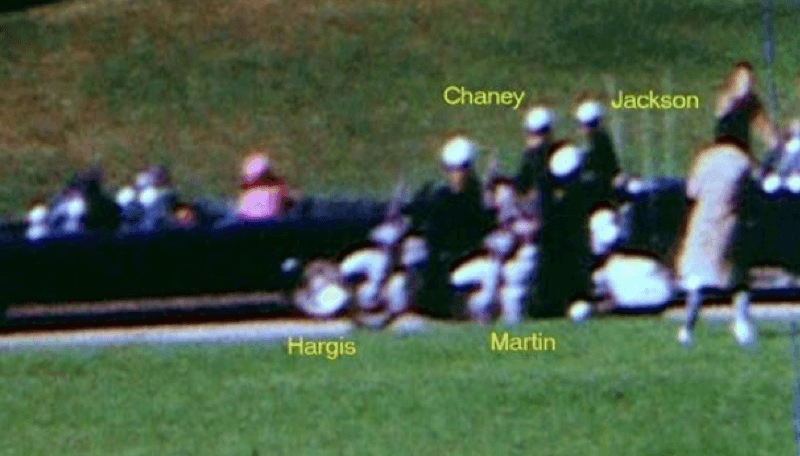
    G: “No one riding behind the president’s car, including JFK’s special assistants and close friends Kenneth O’Donnell and David Powers, reported a blowout to the back of his head, nor did motorcycle patrolmen B. J. Martin and Bobby Hargis…In fact, there exist no contemporaneous Dealey Plaza eyewitness reports of a blowout to the back of Kennedy’s head.” (313)

    DM: In that case then, try this report from Clint Hill: “…the President’s head on the right rear was missing…” This interview occurred on November 30, 1963.[1] Does G not consider this contemporaneous?

    Or try this one, which is based on an interview with Roy Kellerman on November 27, 1963: He noticed a wound in the back of his [JFK’s] head.[2] When later questioned by Arlen Specter, he described this wound as 5 inches [sic] in diameter and located at the right rear of the head. Does G not regard this as a contemporaneous report? (Roy later acknowledged in private that there had been a conspiracy.)

    Or consider this one from Tim McIntyre: “…horrified to witness…the back of the president’s head exploding.” This conversation originally occurred in December 1963.[3]

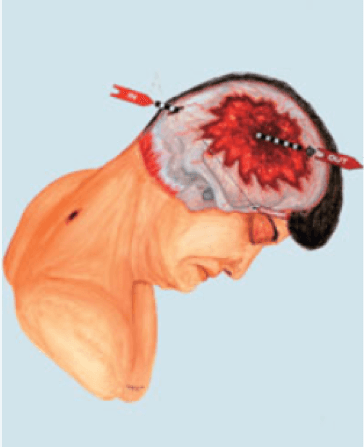
    Palamara’s extensive list (in Honest Answers) mostly focuses on the direction of the shots (with many reporting a shot from the right front), but the following individuals later all reported a large hole at the right rear: Sam Kinney, Linda Willis, Phillip Willis, Harry Holmes, Beverly Oliver, Ed Hoffman, Winston Lawson, Aubrey Rike, George Burkley, Bill Greer, Jesse Curry, and Dave Powers.[4] A fair number of witnesses also saw tissue flying to the left rear from JFK’s head and many saw a wound near the right ear, which they interpreted as an entrance wound. Of course, the Parkland physicians almost universally recalled a hole in the right rear, quite consistent with the similar report of eight Bethesda physicians.[5] And John Ebersole, the autopsy radiologist, described the head wound in the same way to me.

    G’s statement (about no contemporaneous Dealey Plaza witnesses) is either deliberately deceptive—or else it is unforgivably careless research. Either one is damning—and such an uncritical approach instantly discredits him as a serious scholar or thinker, especially after his duplicity about the throat wound. A thick smog has now settled over his entire disinformation campaign—and his confirmation bias has plainly been exposed. I now only wish that I were reviewing a more candid researcher, but the benefit of the doubt has totally vaporized. G’s effort is just the opposite of critical thinking. Furthermore, for me, reviewing such drivel from one so agenda driven gives me rather little pleasure—and it provides only pea-sized intellectual challenge.

    G: “But nothing suggests the car came to a stop for any length of time.” (336)

    DM: G has obviously not read Chapter 10 in Honest Answers (2021), where Vince Palamara lists 74 [sic] witnesses who recalled a limousine stop, or at least a near stop. So, how many does G think we need? And since when does “nothing” = 74?

    G: “According to Cyril Wecht, another JFK buff…” (346)

    DM: According to G, “Kennedy buffs” are amateur JFK conspiracy researchers (2). Then I would only ask G this question: How can someone who has done over 20,000 autopsies (and served on official government panels on the JFK assassination) possibly be called an “amateur?” Only G can answer that question.

    G: “…new disclosures should have led Mantik, Aguilar, and like-minded others to reconsider their assumptions. Sadly, this has not been the case.” (353)

    DM: Unless G has had access to my brain for the past 30+ years, there is no way he could know this. On the contrary, I have been re-evaluating evidence all my life. In fact, that is my trademark. Now nearing age 82, I no longer believe many ostensibly important lessons I learned during the first 50 years of my life. More to the point, I refused to see the movie, JFK, until I had spent several months reviewing the medical evidence. And, during much of this time (while mostly stuck in neutral), I sat on the fence, especially while I focused on the work of Luis Alvarez. (After all, Luis had won a Nobel Prize in physics—and was therefore automatically one of my heroes.) I also had listened to Luis’s lecture about the JFK case in 1975 at the Los Alamos National Laboratory and I had saved his preprint from that lecture. Even after I had unavoidably decided on conspiracy, every subsequent government disclosure led me to re-evaluate the evidence. (The foremost example of a changed conclusion is the Grassy Knoll shot, which I did not at first accept—but I do now.) I also do this routinely for patient treatment plans, often awakening at night to re-consider a critical aspect of a complex medical case. That is precisely why G should reference only my current opinions—not just those of 20+ years ago.

    The clarity of my vision has improved with time—because increasingly more evidence has emerged. I even discuss this evolution of JFK assassination evidence in my forthcoming hardcover book. So, in the end, this charge by G is only demeaning to him—but not at all to me. For me, life has always been about learning and renovating one’s knowledge. I only wish that G would agree to do this—but much of what we now know about this case is oddly absent from his book. Perhaps he should study this case for another 10 years, become up to date, and draft another book? In addition, an advanced scientific or medical degree would surely help. After all, truth can afford to wait—but can G wait that long?

    G: “When the ARRB showed the pictures from the National Archives to autopsy photographer John Stringer…he confirmed that these were his original work.”

    DM: This is just one more deception. After Stringer reviewed the brain photographs, he declared to the ARRB that he had not taken them. He knew this because they were the wrong film type and also because he had photographed serial sections of the brain—which no longer exist.[6] I have also demonstrated the radical inconsistency between the brain in the photographs versus the brain in the X-rays. At least one of these images must have been faked.[7]

    G: “Identical images do not create such an [stereo] effect…” (356)

    DM: G is here discussing stereo viewing of the autopsy photographs, which I have performed on virtually all of the photographic pairs at the National Archives. G does not say whether he has done any of this—which is a serious omission for a “critical thinker.” After all, it is not necessary to visit the National Archives to do this—as I have discussed in my online lectures. The images are available in Robert Groden’s Absolute Proof. G does not explain why he has not performed such an elementary exercise. But he is certainly correct about this: When identical images are viewed via a stereo viewer, no 3D effect is achieved. That bizarre result is precisely what is seen at the critical site at the back of JFK’s head—exactly where the Parkland physicians (and virtually everyone else) saw a large hole. Stereo viewing at that site shows only a 2D effect. And quite to the point, this absence of a 3D effect is not seen elsewhere in the autopsy collection, as I ascertained via a painstaking review of these many pairs of images. Who else has done this? So, what are the odds that—only at JFK’s occiput—a 3D effect is absent? (Robert Groden has confirmed the same observation to me.) G does not comment on this—but he has no excuse for omitting this simple exercise, which he could still do today or tomorrow, but I shall not hold my breath.

    G: “Although Mantik and others have continued to claim that Kennedy’s throat wound was a wound of entry, this theory has by now been discounted by numerous trained forensic pathologists.” (358)

    DM: If this is true, I have never seen those reports—and as usual, G does not cite even one of them. Did he simply invent this scenario out of whole cloth? This papal-like edict can scarcely represent in-depth research. Not a single Parkland physician (before encountering political pressure) described the throat wound as anything but an entry. Only a WC lawyer (Arlen Specter) was deemed qualified enough to identify it as an exit wound. On the contrary, all of the evidence goes the other way:

    1. Such a tiny exit wound could not be duplicated in experiments by the WC;

    2. Milton Helpern, who had done 60,000 autopsies, had never seen an exit wound that small;

    3. Before political leverage was exerted, the first scenario by NPIC included a throat shot at Z–190;

    4. During a WC Executive Session (December 18, 1963), John McCloy, Hale Boggs, and Gerald Ford discussed a possible frontal shot from the overpass.

    Furthermore, how many of these supposed “forensic pathologists” were told that the autopsy photographs had no chain of possession? Although the correct camera (and lens) had been located by the HSCA, it did not match the technical features of the autopsy photographs![8] Why would G hide this from his readers?

    G: “…an irregular-shaped white spot near the subject’s hairline…has led these authors to suspect this was the real entrance point…Aguilar and Mantik therefore conclude that the head in the photograph is not Kennedy’s…According to Mantik, this is as close as it gets to finding a ‘smoking gun.’” (358–359)

    DM: This is false—triply false. I have never believed that the white spot represented an entry wound; it is far too inferior to fit with the missing Harper fragment, which is discussed, and illustrated, in painstaking detail in my e-book, JFK’s Head Wounds. Furthermore, I have never stated that the head was not JFK’s. On the contrary, it is his head—but with the hole covered by a photographic matte insertion so as to disguise the hole. G seems unable to make such fine distinctions, which only confuses things for him, as he admits, “Confused? It seems everyone is.”

    Regarding smoking guns, I would now regard my subsequent discovery of the T-shaped inscription (see the end of this review for images) as a more blatant example of a smoking gun. But G seems not to know about this, even though the T discovery was made in 2001, and I have reported it on innumerable occasions.[9]

    G: “The X-rays and pictures both located the wound of entry high on the back of the head (at the cowlick), consistent with the trail of bullet fragments inside Kennedy’s skull, and of the exit wound.” (359)

    DM: This is (again) triply false:

    1. The radiologists could not locate a wound of entry (or of exit) on the X-rays. I agree. That was explicitly stated in their reports. Did G fail to read them?

    2. All three pathologists disavowed the “red spot” as a bullet entry. Humes said, “I don’t know what that [red spot] is…. I don’t, I just don’t know what it is, but it certainly was not a wound of entrance.” (7HSCA 254) In fact, no one at Parkland had reported such a red spot.

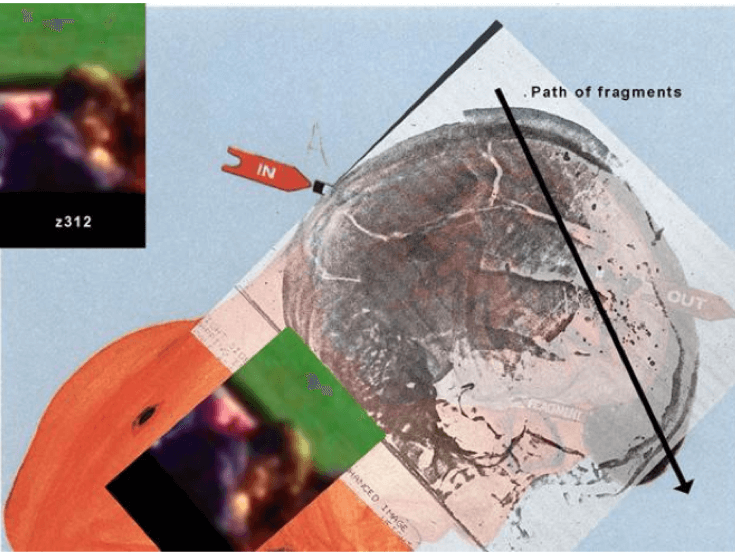
    3. The trail of bullet fragments does not even transect G’s selected cowlick entry site!

    4. And G’s statement totally ignores the many tiny metallic fragments at JFK’s forehead. This is thoroughly discussed in Chesser’s online lecture, which is not cited by G.

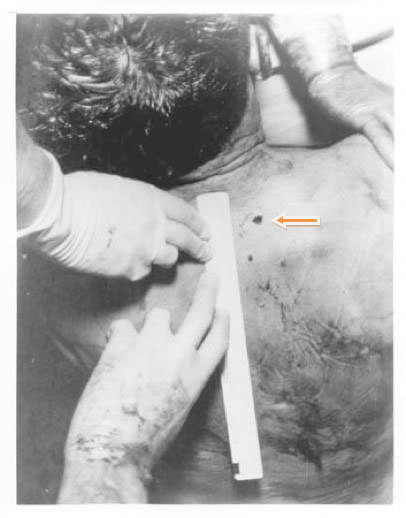
    G: “Mantik argues that the back wound, which he wrongly locates at the third thoracic vertebra, was too low to jibe with the single bullet theory. But the pathologists’ report never made any mention of the third thoracic vertebra.” (362)

    DM: G does not explain why my T3 location was wrong—this was merely another papal-like edict. But Dr. Burkley did sign the autopsy descriptive sheet, and he did cite the back wound at T3. He also signed JFK’s death certificate.

    In my conversation with Dr. John Ebersole, he cited T4. Moreover, Ebersole (like me) practiced the only specialty in which knowledge of external anatomic landmarks must correlate with internal anatomy. If this is not done accurately, cancers will be missed by the radiation beam and, because Humes was under severe political pressure, he could never identify the vertebra as T3. After all, that admission would instantly have impugned the SBT, so he deliberately omitted it (just as he deliberately misplaced the metal fragment trail by an impossible 4 inches on the X-rays). So, by what authority does G challenge the recollections of the on-site radiologist—or those of Dr. Burkley? Of course, G will never answer those questions.

    G: “Mantik also fails to tell his readers that most Parkland physicians would later endorse the autopsy’s findings.” (363)

    DM: In Murder in Dealey Plaza (p. 240), I cite 16 Parkland physicians who clearly did not recognize the photographs of the back of JFK’s head.

    Should that not be enough, G should view the documentary, The Parkland Doctors,[10] which was screened in Houston during the 2017 mock trial of Oswald.[11] Has G viewed this powerful display of agreement among these physicians? If so, he remains silent.

    G: “…Aguilar [and] Mantik…are reading the evidence incorrectly because they are bent on confirming existing beliefs…[They] fail to take note of the angle at which certain X-rays were taken.” (364)

    DM: This is an outlandish claim—I had no “existing beliefs.” And the comment about the angle is prima facie preposterous; how could I possibly target cancers without understanding perspective? Furthermore, I have carefully (on multiple occasions) documented the angle at which JFK’s AP skull X-ray was taken.[12] Has G read my 2019 critique of Randy Robertson (at my website—and repeated in my hardcover book), in which I describe—and illustrate—not only the angle, but also the divergence, of these X-rays? No one else has done this. This is one of the daftest claims in the entire book.

    G: “…no evidence has been produced to suggest that these men were coerced.” (363)

    DM: This is preposterous on its face. In fact, this is so egregious that we might easily conclude that G is uninterested in facts. On the contrary, Elmer Moore severely badgered Dr. Perry.[13] And from Rob Couteau, we now know that Humes also badgered Perry.

    Furthermore, during the trial of Clay Shaw, Pierre Finck made the following points:

    1. Senior military officers took an active part in proceedings and he implied that they were in charge of the autopsy.
    2. He admitted, after trying hard to avoid the question, that the pathologists were forbidden to dissect the president’s back and throat wounds and the connecting tissue.[14]

    G: “…F8 is certainly not depicting the lower back of the President’s head.” (365)

    DM: In my e-book, I offered 15 clues that F8 showed the back of JFK’s head. How many of these does G address: the answer is zero. He does not even cite my e-book! How can we have an adult conversation with such an approach?

    G: “While we could surmise that Mantik, Aguilar, and Fetzer have simply been short-sighted, a final example suggests that they were purposefully duplicitous.” (367)

    DM: I was indeed short-sighted. My myopia in one eye reached -9 diopters, which is what allowed me to identify the double exposure inside the 6.5 mm fragment while viewing the extant AP skull X-ray at the National Archives. This was only further proof that the 6.5 mm object had been (illegally) forged via a double exposure in the dark room.[15]

    G: “Misinterpretations are all the more likely when amateurs with little experience reading X-rays… (368)

    DM: So, after 40+ years of reading X-rays, I am still an amateur? In that case, how many years would qualify me as a professional?

    G: “…an expert radiologist, Dr. Gerald McDonnel…examined the autopsy X-rays for evidence of alteration and found none.” (370)

    DM: I have discussed McDonnel[16] and his proposed clues to X-ray alteration at length in my e-book, which G has obviously not read. Quite oddly, McDonnel did not even raise the possibility of using optical density as a tool! Furthermore, I have cited—quite specifically—how my observations do in fact meet McDonnel’s requirements. I even discovered one possibility that he had overlooked. Unfortunately, Mac passed away (not far from me on December 13, 1992) just as I was entering this case, or we would have had some fascinating conversations. I did, however, have enlightening (face-to-face and via telephone calls) conversations with Kodak’s top scientist, Arthur G. Haus, PhD, about my article on the X-ray alterations—which he read and about which he made no criticisms.[17] Also see my detailed technical references to the inspired work of Haus, which are cited in my online review of McAdams (at my website).

    G: “The…6.5 mm object…seemed to have troubled none of the autopsy doctors. In fact, it was not mentioned in their report.” (371)

    DM: Douglas Horne, who witnessed their ARRB testimony, observed quite the opposite effect. He reported that Humes was so frustrated that Horne expected him to walk out of his testimony at any minute. All three pathologists denied seeing this 6.5 mm object on the X-rays. Even worse, none of the dozens of participants at the autopsy (who observed these films on the view box that night) mentioned this object—which was precisely the point of taking any X-rays at all. This bogus object only surfaced with the Clark Panel Report some years later.

    Of course, when I asked John Ebersole about this object, he instantly terminated any further discussion of the JFK autopsy—and never spoke of it again to anyone. What G cannot dare to address, of course, is the unanimous opinion—of all the experts—that there is no image that correlates with this unphysical object on the lateral X-ray. Such a situation transports us directly out of our known physical world.

    Furthermore, on the AP skull X-ray, the front to back length of this bogus 6.5 mm object is many centimeters long (as shown by the optical density data), which is longer than all of JFK’s mercury-silver amalgams (which overlap one another on this view). Of course, G cannot afford to comment on such central conundrums, so he does not.

    Moreover, how does G explain this nearly circular 6.5 mm object—one that could not be explained by John Fitzpatrick (the ARRB forensic radiologist), or by the Clark Panel, or by Larry Sturdivan (the HSCA expert)?[18] Quite astonishingly, G (per his account) is able to succeed where everyone else has failed: “…it is little more than a distraction caused by circular logic.” (371)

    So, according to G, we now know that a circular object—visible on an X-ray film—was caused by circular logic! With this approach, one can easily escape into any conceivable fantasy. But this is not grounded in physical reality, and despite some exposure to critical thinking during my radiation oncology residency, I never learned any of this.

    G: Regarding the Z-film, he states: “Unless multiple witnesses can independently corroborate the same information, which they rarely do, the hunt for all of this hidden evidence can easily turn into a wild goose chase.” (372)

    DM: G has thereby belittled the recollections of many independent observers: Greg Burnham, Milicent Cranor, Scott Myers, Dan Rather, Cartha DeLoach, William Reymond, William Manchester, Homer McMahon, Dino Brugioni, Erwin Schwartz, Rich Dellarosa,[19] and others. Each one of these, without conferring with anyone else, has seen a version of the Zapruder film that contradicts the extant film—but the individual recollections surprisingly agree with one another! Surely, we should not hear this riposte again: “They all just made the same mistake.”[20] It is far too late for that reply.

    G also states: “…several eyewitnesses can produce clear and consistent memories of the alleged evidence” (372). To which I reply: Since this constraint is met by these many Z-film witnesses, by what right does G abandon his self-proclaimed decree for accepting evidence?

    And the comment, “and they rarely do” is not only false, but it is unsubstantiated. This is really becoming too much.

    Early viewers of the Z-film (e.g., Erwin Schwartz, Dan Rather, Deke DeLoach (at the FBI), and possibly even Pierre Finck, reported that JFK’s head moved forward—quite contrary to the Z-film! Furthermore, none of these early viewers reported a head snap.[21]

    On the other hand, G reports this:

    “We should take note that the head snap—real or faked—is barely perceptible when projected at the film’s normal speed of 18.3 frames per second.” (404)

    So, here is my reply to that: Then how did this so-called almost invisible head snap (per G) trigger the formation of the HSCA?

    G: “His [Mantik’s] main witness [to Z-film tampering] is Homer McMahon.” (406)

    DM: I have never said this—or even implied this. If I had to choose one primary witness, it would be Dino Brugioni. However, the existence of two totally compartmentalized viewing events (on two successive nights by two totally distinct groups) during November 23–24, 1963, provides overwhelming evidence of a cover-up. See Douglas Horne’s summary of this cacophony: Assassination of JFK – The Two NPIC Zapruder Film Events: Signposts Pointing to the Film’s Alteration. Especially watch the Z-film interview with Dino Brugioni, who was the Duty Officer at NPIC that weekend.

    In 1962, Dino helped to trigger the Cuban missile crisis by assisting in the discovery of Russian missiles in Cuba, and he is the author of one of my favorite photographic books: Photo Fakery: The History and Techniques of Photographic Deception and Manipulation (1999). The first chapter is titled “Photo Fakery is Everywhere.” In Chapter 3, he amusingly recalls (and illustrates) the work of Oscar Gustav Rejlander via his allegorical composite (and partly topless) photograph, The Two Ways of Life (1857), which was assembled from thirty negatives.

    G: Conspiracy theories are fed by “…an obsessive scrutiny of small inconsistencies and irrelevant details.” (430)

    DM: So, G would have us grieve that Max Planck obsessed over unexplained deviations in black body radiation—or perhaps he could have warned Einstein not to fret over the anomalous precession of the perihelion of Mercury (by 43.1 arc seconds—over 100 years).[22] Unfortunately for G, he has arrived too late for either of those observations.

    G: “…the suffering Christ remains, at best, one of thousands of peace-loving gurus tragically killed in their prime.” (434)

    DM: As expected, G does not cite even one of these slain thousands; in any case, Jesus of Nazareth is rarely regarded as a “guru,” especially not by billions of Christians.[23] Furthermore, from my days as an amateur (but devoted) New Testament scholar, I still recall Jesus’ statement, “Do not suppose that I have come to bring peace to the earth. I did not come to bring peace, but a sword.”—Matthew 10:24, the New International Version.

    G: “Conspiracy theories are an affront to responsible historical research and rational discourse.” (435)

    DM: Were they still alive, we would expect G to so inform each one of those 50–60 luminaries I listed in Addendum 5, “Believers in a JFK Assassination Conspiracy.”[24] G obviously thinks he knows more about this case than the combined expertise of LBJ, Nixon, Hoover, Tolson, Phillips, the Kennedy family, Burkley, Rowley, Curry, Kellerman, Greer, Kinney, Blakey, Tanenbaum, Sprague, Cornwell, and the Parkland doctors.

    Even worse though, G has impugned virtually every historical conspiracy. Does he honestly believe that all of these events are mere Conspiracy Theories?

    1. The murder of Julius Caesar (44 BC)

    2. The assassination of Abraham Lincoln (1865)

    3. 694 pogroms in 660 Russian towns (1905)[25]

    4. The Japanese sneak attack on Port Arthur (1905)

    5. The assassination of Archduke Ferdinand (1914)

    6. The Black Sox World Series Scandal (1919)

    7. The Tuskegee Experiment (1932–72)

    8. The Cambridge Five (1934–50s)

    9. The murder of Ernst Röhm (1934)

    10. Operation Himmler (1939)

    11. The murder of Leon Trotsky (1940)

    12. Spying on the Manhattan project (1941–45)[26]

    13. The Holocaust (1941–45)

    14. The Valkyrie Plot against Hitler (1944)

    15. The assassination of Mahatma Gandhi (1948)

    16. Operation Mockingbird (1950s)

    17. The Secret War in Laos (1953)

    18. Project MK-Ultra (1953–73)

    19. CIA-Mafia plots to kill Castro (1960–63)

    20. Assassination attempts (33) on de Gaulle (1961ff)

    21. Watergate (1972)

    22. Joannides’ role for the HSCA (1978–79)

    23. The Rajneeshee Bioterror Attack (1984)

    24. The Iran-Contra Affair (1985)

    25. 9/11 (2001)

    26. The Houston Astros World Series Title (2017)

    CONCLUSION

    But it is now past time to conclude this review. We have seen more than enough of G’s “critical thinking.” I prefer reality—for the past, in the present, and for the future. There are already enough zebras lurking out there.

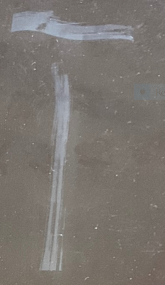
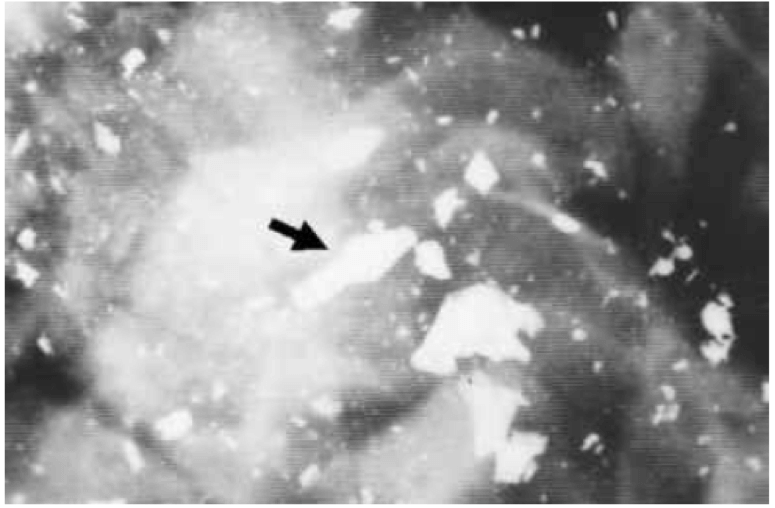
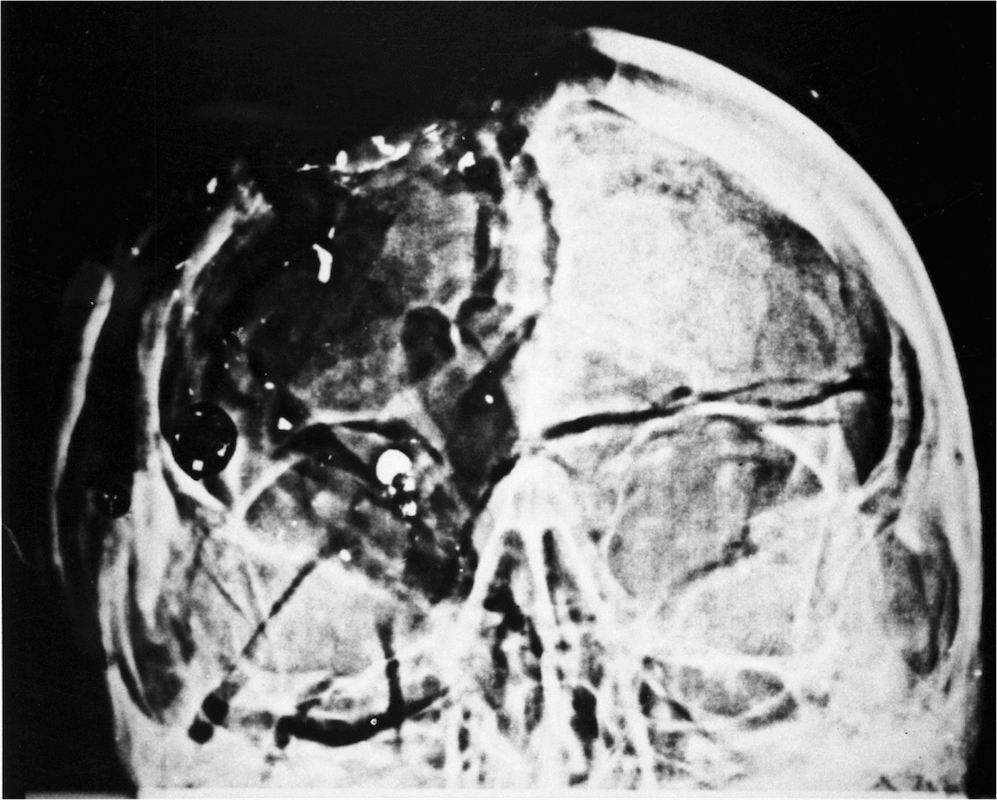
    One final observation may be useful. Here are two images of an emulsion-based X-ray film that I own; I created the T-shaped inscription on this film. The film is similar to those used for the 1963 autopsy X-rays and the T-shape is similar to what I saw on one lateral JFK skull film. The T-shape was obviously produced by scraping emulsion off the JFK X-ray film. (The image of this lateral JFK X-ray is not in the public domain.) Recall that, at the National Archives, no emulsion is missing—on either side—of that lateral JFK skull X-ray film.


    The left image above shows the missing emulsion side, while the right image displays the intact emulsion side (my film has emulsion on both sides, just as the JFK autopsy films do). The 3D visual impact (on my film) of physically missing emulsion (actually gouged into the film) can only be fully appreciated via binocular vision. This is especially dramatic when viewed at a glancing angle to the light source. I repeatedly did this while at the National Archives (for both sides of the JFK film), but no emulsion was missing anywhere.[27]

    Therefore, we now know that the Archives houses only a copy of this lateral X-ray. After all, only a copy film could preserve both the T image and the emulsion. But if this a copy film, then the door stands wide open to X-ray alteration—because a double exposure could easily have intervened. Of course, we already knew that this same lateral JFK X-ray was a copy—due to the presence of the White Patch, so the T-shaped inscription is merely a second confirmation that this is not the original lateral skull X-ray of JFK.


    [1] 18H740–745.

    [2] FBI Report (Sibert and O’Neill).

    [3] Honest Answers: About the Murder of President John F. Kennedy (2021), pp. 302ff, by Vince Palamara, who gifted this book to me. The quote is from an interview with Tim McIntyre. Vince has compiled a wonderful—and indispensable—collection of witnesses here. Of course, G does not cite this amazing reference.

    [4] JFK: Absolute Proof (2013), by Robert Groden includes a magnificent set of images in which the witnesses place their hands on the back of their heads to locate JFK’s right rear head wound. As now expected, G does not cite this book either. We can only begin to wonder: What exactly has G been reading?

    [5] JFK’s Head Wounds (2015), by David W. Mantik. Of course, G does not cite my book.

    [6] “Two Different Brain Specimens in President Kennedy’s Autopsy,” by Douglas Horne in Murder in Dealey Plaza (2000), edited by James Fetzer, p. 299.

    [7] https://www.fff.org/freedom-in-motion/video/jfks-head-wounds/

    [8] How Five Investigations into JFK’s Medical/Autopsy Evidence Got it Wrong – Introduction (history-matters.com)

    [9] Pittsburgh Text2.PDF (assassinationresearch.com)

    [10] The Parkland Doctors (2018) – IMDb

    [11] The 2017 Houston Mock Trial of Oswald (kennedysandking.com)

    [12] The Assassinations: Probe Magazine on JFK, RFK, and Malcolm X (2003), edited by James DiEugenio and Lisa Pease, p. 265.

    [13] dr perry jfk badgered – Search (bing.com)

    [14] Dr Pierre Finck: Dissecting JFK’s Back and Throat Wounds : The JFK Assassination (22november1963.org.uk)

    [15] The JFK Skull X-rays: Evidence for Forgery David W. Mantik DALLAS, TEXAS November 21, 2009 – [PPT Powerpoint] (vdocuments.net)

    [16] Dr Gerald Matthew “Mac” McDonnel (1919-1992) – Find a Grave Memorial

    [17] Assassination Science (1998), p. 134, edited by James Fetzer.

    [18] JFK Myths (2005), p. 193, by Larry Sturdivan. This expert, who testified for the HSCA, claimed that this 6.5 mm object could not possibly represent a real piece of metal. There is no physical correlate on the lateral X-ray—which is physically impossible. I agree with Sturdivan: this is not the world that he and I know. On the other hand, it is difficult to know what world G inhabits.

    [19] Dellarosa offers his personal descriptions of the action here: https://www.youtube.com/watch?v=XrRbkY9gEnQ.

    [20] David Lifton supposedly will suggest (in his forthcoming book—if it ever arrives) that Robert S. McNamara approved the Z-film alteration: https://www.youtube.com/watch?v=wMblToYoWzA. Also see Lifton’s recent comment: https://educationforum.ipbhost.com/topic/15099-inside-the-arrb-vol-4/page/4/.

    [21] Oddly enough, every new viewer of the extant Z-film, above all else, is stunned by the backward head snap. And today no one ever sees JFK moving forward (like Ike Altgens and Dan Rather and Deke DeLoach did). Why is G not aware of this ridiculous discrepancy?

    [22] Einstein Relatively Easy – Advance of the perihelion of Mercury

    [23] On the contrary, most Christians would be insulted with that description of him.

    [24] Fetzer 2000, p. 404.

    [25] Sleeper Agent: The Atomic Spy in America Who Got Away (2021), by Ann Hagedorn, Kindle, p. 13. This is the story of George Koval, born on Christmas Day, 1913, in Sioux City, Iowa, who delivered the secrets of Oak Ridge, Tennessee’s 75,000 workers to the Soviets. This included the polonium details, used to ignite the atomic bomb, i.e., polonium generated the neutrons that triggered the bomb. (On 1 November 2006, Alexander Litvinenko was poisoned and later died on 23 November, becoming the first confirmed victim of polonium-induced acute radiation syndrome.) After George’s death, Vladimir Putin (in 2007) named George a “Hero of the Russian Federation.” As George began his work, he appeared to be the average clean-cut American, only two years out of the US Army. He could recite the history and stats of every big-league pitcher in 1948—and he had skills as a shortstop. Of course, the Soviet spying had begun much earlier (in August 1941), with the work of Klaus Fuchs (who, ironically, loaned his car to Richard Feynman). Already in spring 1942, Lavrentiy Beria had sent a memo to Stalin about using uranium for bombs, even describing two hemispheres whose sum would exceed the critical mass. In other words, Stalin was not surprised at the allusion to the atomic bomb at Yalta.

    [26] Ibid., p. 78.

    [27] The right image is slightly colored, because we are looking through the film base, which has a blue tinge.

  • Gagné Desperately Dispenses CPR for the Lone Gunman (Part 1)

    Gagné Desperately Dispenses CPR for the Lone Gunman (Part 1)


    Hi David, I just looked at the survey questions. These are WAY [sic] beyond my competency…Feel free to use the above and my earlier comments.

    —Michael Shermer[1]

    Another falsehood of this title [Gagné’s title] is thinking critically. As a criminology graduate with a first-class degree who applied critical criminological thinking to all his work, I can safely say no critical thinking has been applied to this one-sided rubbish.

    —Anonymous Amazon Review (this constituted one-half of G’s reviews)

    His volume is a cogent and incisive treatment of the whole assassination landscape, with a particular attention to recent conspiracy arguments…

    —John McAdams, Ph.D.[2]

    I concede that I am not an expert in any of these disciplines… [military history, ballistics, health sciences, photography and film and the like]

    —Michel Jacques Gagné

    It would take more than one book to respond to all of Aguilar’s and Mantik’s theories. Doing so would also force us to discuss complex medical procedures that might confuse the nonexpert and which this author does not have the medical training to debate in depth and detail. But this does not prevent us from identifying the many errors in logic and research that make Aguilar and Mantik’s theories refutable…

    —Michel Jacques Gagné [3]

    A reliable way to make people believe in falsehoods is frequent repetition, because familiarity is not easily distinguished from truth.

    —Daniel Kahneman[4]

    Facts do not cease to exist because they are ignored. That men do not learn very much from the lessons of history is the most important of all the lessons that history has to teach.

    —Aldous Huxley (who, like C.S. Lewis, also died on November 22, 1963)

    —————————————————

    Michel Jacques Gagné. He teaches courses in critical thinking, political philosophy, philosophy of religion, and ethics at a junior college near Montreal, Canada. He has an M.A. in history with a thesis on civil rights. He enjoys discussing conspiracy theories, but has no specific training in science or medicine or forensics. He does not even cite any personal interviews with witnesses. By his own admission, his research has consisted solely of reviewing official sources and “thinking critically.” He has not been banned from the National Archives, nor has he ever visited there.

    David Wayne Mantik. He completed his physics Ph.D. thesis on X-ray scattering from proteins while at the University of Wisconsin-Madison and then concluded his training with an NIH post-doctoral fellowship in biophysics at Stanford University (Grant FO2 GM37600). After several years on the tenure-track physics faculty at Michigan, he changed professions and graduated from the University of Michigan Medical School. He became Board Certified in Radiology after a residency at USC, where he was also awarded an American Cancer Society Junior Faculty Clinical Fellowship (#568). He next directed the residency training program at Loma Linda University, where he treated cancers with the proton beam. After 40 years now, he still treats cancer patients in radiation oncology—the only specialty in which knowledge of external anatomy is critical for precise targeting of cancers via modern imaging techniques. In this specialty, he is often required to read many X-rays every day. However, he is not board certified in the detection of forged X-rays—because no such specialty exists. He has visited the National Archives (specifically to view the JFK artifacts) on nine separate days. Like Michael Chesser, MD, he has now been banned from the National Archives (although not for misbehavior).

    —————————————————

    NOTE: G identifies Gagné in the following discussion. My replies are identified by DM. The page numbers (in parentheses) refer to the Kindle edition (but these numbers may not be stable over time and usage).

    G: “The logical principle of Ockhams’ razor” will serve as G’s guide. (xvii)

    DM: On the contrary, it is not always possible to know which one of several conflicting theories is correct—or even which one is the simplest. For example, at the turn of the twentieth century, the ether was the simplest explanation. Does G therefore now believe in the ether?

    Furthermore, there is no empirical evidence that the world is simple. For example, who would describe quantum theory as simpler than classical mechanics? So, does G truly not accept quantum mechanics (which I have studied over many semesters)?

    The fundamental mistake that G makes is to assume that we can transpose a philosophico-scientific principle to the complex JFK case. In fact, he uses this pretext to gloss over (a la Michael Shermer) multifaceted, but crucial medical and scientific data, thus falling prey to confirmation bias. Also, recall that G has forthrightly admitted that he has no special expertise in the required areas for this case. Inevitably then, he alights on an improbable knife edge, where, like Humpty Dumpty, he often falls off and crashes. Moreover, he has not even read my peer-reviewed articles; even worse though, he—quite paradoxically—touts peer-reviewed articles as reliable treasure troves, but he never explains why he has excluded mine from his reading list.

    Occam’s (or Ockhams’) razor can be useful in specific settings. For example, doctors use a version of it—“when you hear hoofbeats, think horses, not zebras”—to ensure they go for the simplest diagnosis to explain their patient’s symptoms.[5]

    G: “…my acceptance of certain conspiracy theories had less to do with the strength of the evidence and more to do with my emotional and existential needs for an inspiring story that gave my life meaning.” (xvii)

    DM: My career, my family, and my hobbies provided complete fulfillment before I encountered the JFK case. I did not need this case for any self-realization. Besides, I was then already over 50 years of age.

    G: We should “be ready to follow sound logic and clear evidence wherever these lead…and engage in meaningful and respectful exchanges.” (xviii)

    DM: Contrary to his claim, G never cites the most powerful scientific evidence in this case—the optical density data[6] taken directly from the extant autopsy X-rays at the National Archives. And he has never tried to exchange any ideas with me—even though my e-mail address appears in my online (peer-reviewed) articles.

    G: “We must be ready to tolerate uncertainty…” (xviii)

    DM: On the other hand, G is never uncertain about the lone gunman! He implies that every single piece of evidence supports it.

    G: “I have made every effort to avoid resorting to personal attacks.” (xxii)

    DM: Here are quotes from G—do these seem like personal attacks?

    “While we could surmise that Mantik, Aguilar, and Fetzer have simply been short-sighted, a final example suggests that they were purposefully duplicitous.” (367)

    And then try this one:

    “…Mantik is seeing monsters in his bedroom closet.” (372)

    Or this one:

    “…Mantik indulges in a five-page flight of fancy of photographic ‘what-ifs’…” (383)

    G: “…conspiracists rarely submit their convictions to the scrutiny of formal logical analysis…careful critical thinking threatens to undermine the fragility of their untested theories, which can, in turn, trigger a personal crisis of faith…” (6)

    DM: Just so, but G has not submitted his own convictions to the three alarming signs of X-ray alteration.[7] In fact, he totally avoids all three, even though the meaning of the T-shaped inscription (see the images at the end of this review) is purely a matter of common sense—the argument was instantly anticipated by my 15-year-old son (a non-radiologist) when I began to describe the evidence. And insofar as the lone gunman is concerned, if that baseless theory were proven to be true, my world view would be radically improved—and I would certainly not have a crisis of faith.

    G: He cites “Richard Hofstadter’s influential 1964 essay, ‘The Paranoid Style in American Politics’…In Hofstadter’s view, conspiracism [that is G’s word—Richard did not use it] is essentially the fruit of economic and political angst, a fear of being dispossessed by suspicious minority groups…” (8)

    DM: Richard Hofstadter’s article[8] was first published in Harper’s Magazine on the first anniversary of the JFK assassination—in November 1964.[9] What are the odds of that?

    Furthermore, and quite contrary to G, no pertinent economic or political angst led me into this JFK case.

    G: “JFK conspiracists are largely left-leaning liberals in their political views.” (8)

    DM: That is not me—at all. I am more accurately described as a classical liberal (a la Adam Smith and John Locke).[10]

    G: “Americans are most likely to believe in CTs when they feel themselves locked out of power…” (10)

    DM: Although I believe in CT scanners, G’s description does not remotely apply to me. I have no interest in power, particularly not in political power. My career bears clear witness to that, although I know colleagues who fit that description quite well.

    G: “British psychologist Patrick Leman similarly argues that conspiracism arises out of a condition called anomie: feelings of general disaffection, rejection, or disempowerment from society” (11).

             DM: I do not recognize myself here—at all.

    G: “Kay identifies seven personality types that are easily seduced…those muddling through a mid-life crisis [I am 81 years old]; failed historians [not me]; mothers with autistic children [probably not me]; cosmic voyagers; cranks; evangelical doomsayers; and radical firebrands.” (12)

    DM: None of my friends would recognize any of my new personas here. Furthermore, I wonder which members of the 9/11 Commission would fit G’s descriptors—after all, they proposed a conspiracy that included 15 Saudis!

    G: “CTs are an example of what happens when people base their convictions on fears, unjustified suppositions, and wishful thinking instead of sound reason and investigation.” (15)

    DM: So, that is what happened to me because I took hundreds of data points (from the extant autopsy X-rays and photographs) during my nine visits to the National Archives?

    G: “Most conspiracists are notorious for insufficiently referencing their sources…I have selected expert academic or journalistic sources whose authors are subject to a rigid editorial process.” (16)

    DM: My forthcoming hardcover book will include over 900 footnotes. Several of my articles have been published in peer-reviewed journals, but G cites none of them. In that case, how did he know that they were not subjected to a “rigid editorial process?”

    G: “Kennedy crumpled sideways onto his wife.” (26)

    DM: On the contrary, the Z-film shows that JFK was initially thrown violently backward. Did G miss the head snap? (As we shall see below— he barely noticed it!)

    G: “[Oswald]…was a former US Marine trained to shoot rifles at long-range targets.” (27)

    DM: Between May 8, 1959, and November 22, 1963, despite diligent efforts by the FBI, no evidence was ever unearthed to show that Oswald fired a weapon during those 1,600+ days (which is even longer than US involvement in WW II).[11] Moreover, Marine Colonel Allison Folsom,[12] testifying before the Warren Commission (WC), characterized Oswald (while he was in the Marines and using a Marine-issued M-1) as “a rather poor shot.”

    Charles de Gaulle survived over 30 assassination attempts,[13] but (according to G) JFK could not survive even one attempt by Lee Harvey Oswald. If you genuinely believe this, you have a lot to explain, especially since JFK was hit by multiple bullets (as everyone agrees) from more difficult shots. Moreover, if G is correct, why did the OAS not hire Oswald to kill de Gaulle instead of squandering its resources over so many failed attempts?[14]

    G: “Some witnesses described a man similar to Oswald standing in the sixth-floor window.” (27)

    DM: Only one witness made such a claim, which he later retracted. Besides, the window was partially closed and only a small portion of the body would have been visible. But G’s approach here is oxymoronic—after all, he claims not to trust eyewitness testimony, so why does he cite a witness at all? The same bizarre paradox soon occurs when he cites witnesses who claimed to see Oswald at the Tippit murder scene. (28) Since when, given his penchant for “critical thinking,” is being inconsistent (about the reliability of witnesses) truly required for critical thinking?

    G: “A 6.5 mm Mannlicher-Carcano rifle was also found stashed between stacks of boxes.” (28) “No evidence of 7.65-millimeter bullets, casings, or fragments [sic] was ever found anywhere in the TSBD or Dealey Plaza.” (283)

    DM: G cites the several policemen who initially described a different weapon. Weitzman described the weapon that he and Boone discovered as “a 7.65 Mauser bolt action, equipped with a 4/18 scope, a thick leather brownish-black sling on it.” (Click here for details) But, of course, G fails to cite the report of my friend, Noel Twyman, who during the Assassination Records Review Board (ARRB), discovered a receipt for a 7.65 mm Mauser shell recovered from Dealey Plaza. The shell was found between November 22 and December 2, 1963.[15]

    G: “A handmade paper bag [was] recovered on the sixth floor of the TSBD…” (29)

    DM: Two different paper bags may have existed; furthermore, no photograph was taken at the time of discovery. To salvage his story, G omits most of the relevant evidence. (Click here for details) The FBI had two reports on the paper used for the bag—one stated that the paper was “not identical” with the book depository paper, while the other stated that the paper had the same “observable characteristics.” The astute reader can likely guess which one was prepared last.[16] Of course, we learn none of this from G.

    G: “[The Carcano]…had been purchased the previous spring from a Chicago sports store…” (29)

    DM:

    1. The WC was never able to prove that Oswald received the weapon through the post office.

    2. The bank deposit slip read February 15, 1963, even though Oswald did not order the weapon until March 1963!

    3. In the book depository, the police found a 40.2-inch carbine with a 4-power scope.

    4. Oswald ordered a 36-inch carbine in March 1963; the 40-inch weapon was not advertised for sale until April 1963.

    5. Klein’s employee, Mitchell Westra stated, “Klein’s would not have mounted scopes on 40-inch Mannlicher-Carcanos.”

    6. Klein’s microfilm records disappeared.

    7. The FBI did not find Oswald’s fingerprints on the money order.

    8. The clip was still inside the weapon when it was found even though it is nearly impossible for an empty clip to remain there.

    9. The serial number was not unique—John Lattimer owned the same weapon with the same serial number. (C 2766)[17]

    G: “The same weapon was used linked to the ammunition used to kill Tippit.” (29)

    DM: This is a remarkably childlike approach to the complexities of the Tippit murder. For a much fuller explication read the 675-page Into the Nightmare (2013) by my fellow Badger, Joe McBride. Sergeant Gerald Hill had told Officer James Poe to mark two shells with his initials, but when Poe examined the shells for the WC, his initials had disappeared! Even G’s bald-faced claim that the shells matched the gun is far from certain,[18] but we can no longer expect G to express even a sliver of doubt when evidence favors his biases. For example, nowhere does he mention the conundrums posed by the multiple wallets in the Tippit scenario. This is critical thinking?

    G: “The evidence against Oswald was strong.” (29)

    DM: The evidence against Oswald was contaminated. Even Dallas Police Chief Jesse Curry became a vocal doubter of the lone gunman theory: “We don’t have any proof that Oswald fired the rifle, and never did. Nobody’s yet been able to put him in that building with a gun in his hand.”

    G: “The entrance wound in the president’s back, for instance, could finally be linked to the wound in his throat (as an exit wound).” (30)

    DM: Three members of the WC—Hale Boggs, Richard Russell, and John Cooper—thought that the single bullet theory (SBT) was improbable.[19] Russell even insisted that his opposition be printed in the report; of course, this was not done. In any case, the SBT is anatomically impossible—see my many discussions of this issue as well as my demonstration of this faux pas on a CT scan.[20]

    In late 1966, Jim Garrison was on a flight with Louisiana Senator Russell Long, who convinced him that the Warren Commission Report was fiction.

    More importantly, the Magic Bullet (of SBT fame) is irrelevant—its provenance has long since been trashed by Tink Thompson and by Dr. Gary Aguilar.[21] Even worse though, two bullets arrived at the FBI lab that night (see my online FFF lecture[22]). Which one of these bullets does G accept? He does not say—so we do not know. Perhaps G does not know either?

    If Oswald had acted alone, why then are his tax returns still being withheld for “national security reasons?” And why did Gerald R. Ford, my fellow Michigan alumnus and near neighbor in Rancho Mirage, tell the former French president (Valery Giscard D’Estaing) in 1976 that “It wasn’t a lone assassin.[23] It was a plot. We knew for sure that it was a plot. But we didn’t find who was behind it.”[24]

    G: “The Dallas DA reached the conclusion that Oswald did murder Kennedy, that he probably did so alone [sic].”

    DM: Dallas District Attorney Henry Wade (6 PM, November 22, 1963): “Preliminary reports indicated more than one person was involved in the shooting.” The legendary Dallas DA ran a conviction machine that was results-oriented (i.e., not truth oriented).[25] Wade obtained 19 convictions that were later overturned. Oswald might well have been #20. So, should we accept Wade as a “critical thinker?”

    G: “The suspect, it turned out, had expressed hatred for the United States on several occasions…” (30)

    DM: Did G fail to read Oswald’s speech (in July 1963) at the Jesuit House of Studies at Spring Hill College near Mobile, Alabama? He does not cite it. In this rather private setting, where he presumably shared his real opinions, Oswald has little good to say about communism or communists, whom he describes as “a pitiful bunch.”[26]> This is more critical thinking by G?

    G: “[The Warren Commission] would paint him as a disgruntled and unstable loner.” (30)

    DM: If so, why then was Paul Bleau able to show that Oswald had either plausible, probable, or definite intelligence links to at least 64 individuals?[27] Does that seem like more than average? And Senator Richard Schweiker (The Village Voice, 1975) stated: “We do know Oswald had intelligence connections. Everywhere you look with him, there are fingerprints of intelligence.”

    G: “…the rifle’s ammunition closely resembled pieces of lead recovered from Connally’s body and bullet fragments found inside the limousine.”

    DM: This is disgraceful. Even I have no idea what G means by “resembled.” If he means that it was visibly similar, then that is meaningless. If he means that it was matched by neutron activation analysis, then he is hopelessly out of date. And he surely cannot mean that lands and grooves matched—because lead fragments would be useless for this. Is this truly the best we can expect from “critical thinking?”

    G: “The Commission also discovered that the ammunition fired at Kennedy…shared a resemblance with a slug found at the site of an unsolved cold case…photographs of Walker’s house were found among Oswald’s possessions…” (36)

    DM: This is the logical fallacy of the a priori argument, which our critical thinker should immediately recognize. Furthermore, “resemblance” is meaningless—unless G ties it to some specific scientific evidence, which he forgets to do. This is merely more of G’s “critical thinking.” In fact, the Walker ballistics evidence is very much in doubt. Walker himself claimed repeatedly that CE-573, the bullet fragment supposedly retrieved from the scene of the shooting, was not the fragment he had held in his hand and examined.[28] Furthermore, how could Oswald miss such an easy stationary target, but then be so precise with much more difficult (and multiple) shots on November 22?[29] (G also does not inform us that the rear license plate on the vehicle in that photograph had been suspiciously cut out!)

    G: The JFK autopsy “was performed by a team of pathologists with insufficient experience with forensic investigations.” (38)

    DM: In a book already jam-packed with myths, this is merely one more. Humes conducted the weekly brain cutting sessions at Bethesda, so he surely knew how to examine a brain. To appreciate the respect in which Humes was held by his pathology colleagues during the HSCA investigation, just read Real Answers (1998) by Gary Cornwell.

    But that point is merely the tip of the iceberg. Humes was not a victim of inexperience. On the contrary, he was an active participant in the cover-up. We recently learned this from Rob Couteau: Perry claimed that one or more of the autopsy doctors warned him (during a telephone call that night) that he would appear before a medical board if he continued to insist on his story (about a throat entry wound). Perry said they threatened to take away his medical license.[30]

    G: “Precedence should be given to physical evidence…” (41)

    DM: If so, why does G totally ignore the optical density data—which may be the most important physical evidence of all? Moreover, this data was confirmed some years ago at the National Archives by Michael Chesser, M.D.[31] But G does not even cite Chesser!

    G: “…the single bullet theory was not accepted unanimously by its [the WC] staffers…” (41)

    DM: (Final Report of the ARRB, 1998, p. 11): “Doubts about the Warren Commission’s findings were not restricted to ordinary Americans. Well before 1978, President Johnson, Robert Kennedy, and four of the seven members of the Warren Commission all articulated, if sometimes off the record, some level of skepticism about the Commission’s findings.”

    G: “As we shall see, the WC’s findings have been scrutinized, verified, and largely accepted by a wide range of historians, forensics, and ballistics experts…” (42)

    DM: I wonder how many of these purported experts have made nine visits to the National Archives to examine the JFK artifacts. And how many of these experts actually examined JFK’s body and brain? After all, this is the only traditional means of ascertaining the cause of death. In particular, photographs are never a satisfactory substitute for the body or for the brain. Finally, how many were trained to detect (illegitimate) photographic or X-ray alterations? I can assure you that there is no such specialty. Even forensic pathologists are typically unaware that, of Rembrandt’s supposed original 600 paintings, only 300 are now considered authentic. Ironically, X-rays have been used to decide this issue. Does G know anything about any of this? If so, he does not say.

    G: “…the CIA later explained that its Mexico City station had simply photographed the wrong man.” (Chapter 2, footnote 43)

    DM: G disingenuously regards this merely as proof of their disorganization, but not as proof of their role as accessories in a coverup

    Even J. Edgar Hoover knew that an imposter had played a role: “We have up here the tape and the photograph of the man who was at the Soviet Embassy using Oswald’s name. That picture and the tape [sent by the CIA] do not correspond to this man’s voice, nor to his appearance.”

    Even Robert G. Blakey concluded that the CIA had lied. (Click here for details) Does G not know this?

    G: “…the name Hidell was that of a former acquaintance in the US Marines.” (Chapter 2, footnote 44)

    DM: Richard Case Nagell had been a US counterintelligence officer from 1955 to 1959. Oswald’s path converged with Nagell’s in Tokyo, where both worked in an operation code namedHidell.” In 1963, Nagell worked with Soviet intelligence in Mexico City. (See chapter 4 in the book by Jim Douglass.) On October 31, 1995, the ARRB mailed Nagell a letter from Washington, DC, seeking access to documents about the JFK conspiracy. The very next day (November 1, 1995) Nagell was found dead in the bathroom of his Los Angeles house. For more about Nagell (and his remarkable parallels with Oswald), see The Man Who Knew Too Much (1992), by Dick Russell (i.e., not Richard Russell, Jr., the WC member). Of course, you will look in vain for a reference to Dick’s book in G’s book.

    G: “However, it remains possible that Tague’s injury had another unexplained cause.” (Chapter 2, footnote 65)

    DM: After G warns us against the speculations of conspiracists, this is an example of critical thinking? Why else would Tague’s cheek have been struck in Dealey Plaza? Just what is our “critical thinker” pondering here to explain a cheek injury?[32]

    G: “A myth is a story made up…that serves to unfold part of the world view of a people.” (50)

    DM: This is a perfect description of the lone gunman potion that has been served up to the public by the power elite, which now includes the media. G has finally hit the nail on the head. The lone gunman has perfect explanatory power for them. And it truly is all about power, just as G has claimed all along.

    G: “Chomsky’s volume responds to claims that Kennedy, had he survived, would have pulled American troops out of Vietnam…” And then G claims, “Kennedy thus completely misunderstood…the plight of the people of South Vietnam…” (59)

    DM: G seems too timid to clarify his own views on this subject so he hides behind Chomsky. However, Harvard historian Fredrik Logevall (of course, he is not cited in G’s book) does not agree with Chomsky’s conclusion—at all. He is the Laurence D. Belfer Professor of International Affairs at the John F. Kennedy School of Government. Read his book, Embers of War: The Fall of an Empire and the Making of America’s Vietnam (1999). On the contrary he believes that Johnson immediately changed course. Has G read this book, or the books by John Newman or David Kaiser or Gordon Goldstein or Jim Blight or Richard Mahoney? Perhaps G really prefers to limit what he reads. After all, he seems irresponsibly ignorant in medicine, in science, and now in history.

    G: “President Johnson and his entourage quietly wondered whether the Russians or Cubans had something to do with all this.” (60)

    DM: LBJ apparently stated: “I never believed that Oswald acted alone…” LBJ added that the government “…had been operating a damned Murder Inc. in the Caribbean.” (Click here for details)

    G: “Two days later, during a memorial service held at Capitol Hill, the Supreme Court judge [oddly not named, but clearly Earl Warren] would again intone that Kennedy had been a ‘believer in the dignity and equality of all human beings…’” (63)

    DM: Since Oswald had not yet been killed, Warren had unethically prejudged the accused assassin.[33] In the American justice system, the accused must be presumed innocent when the trial starts. Judges especially must not proclaim the guilt of the accused in the court of public opinion. So, how did Warren forget this—and then get away with this serious breach of ethics? Did he merely toss his ethical standards into the trash bin? Instead, he publicly seized upon the lone assassin myth while he asserted, “…an apostle of peace has been snatched from our midst by the bullet of an assassin. What moved some misguided wretch to do this horrible deed may never be known to us…”[34] Does this suggest that Warren was open-minded to conspiracy?

    G: “…the vast majority of conspiracist works have undiscriminatingly accepted the ‘saintly’ view of President Kennedy as a great humanist.” (72)

    DM: I did not even vote for him.

    G: “…there is a strong left-liberal or libertarian bias running through much of this literature…” (72)

    DM: None of my friends or family would recognize me as a left liberal.

    G: “Garrison was right to say that Clay Shaw worked for the CIA.” (98)

    DM: Kudos to G for acknowledging that Shaw was a paid CIA informant. In fact, Shaw had worked for the CIA since 1949, first starting as a contract agent—and he had filed 30 reports for the CIA during 1949–1956.[35] In order to facilitate his private life as a gay person, he had used the name Clay Bertrand. However, G does not inform us that, by the end of Shaw’s trial, the jury (perhaps all of them) had come to believe in a JFK conspiracy.[36]

    G: “…Dan Rather produced an ambitious four-part investigation…that vindicated the Warren Report.” (84)

    DM: This was on CBS during June 25–28, 1967. Nonetheless, Rather had also reported that, in the original Z-film (as he viewed it that initial weekend) JFK had gone forward—just the opposite of what we now see in the extant film. Robert Tanenbaum (Deputy Chief Counsel for the HSCA) directly confirmed to me a remarkable 1993 confession by Dan Rather (Jim DiEugenio, Probe, January-February 1999, p.3): “We really blew it on the Kennedy assassination.” Does G know this?

    G: “However, it is rarely acknowledged by most conspiracists that the HSCA’s acoustic evidence …was impeached almost immediately…” (94, 113)

    DM: Then I am indeed a rare bird, since I have never accepted the acoustics case of the HSCA. In fact, over ten years ago, I wrote a 100+ page, extremely critical review of Don Thomas’s book (an update is now at my website). And my new hardcover book will include further devastation of this issue, along with lethal comments from the reigning acoustics expert, Michael O’Dell. My update should bring closure to this hopelessly conjured case. So, in view of this, will G then stop calling me a conspiracist? I shall not hold my breath for his great awakening.

    G: The ARRB “…found no cover-up.” (100)

    DM: However, the ARRB final summary did emphasize that the Secret Service had quite deliberately destroyed pertinent records of JFK’s trips—even after the ARRB had warned them not to do so.

    More importantly though, the board members had no clue about the medical evidence. I wrote a letter to the chairman, John Tunheim, and included about 20 questions to be distributed to each board member. The purpose was to ascertain their level of knowledge about (and interest in) the medical evidence. Although John promised to forward this questionnaire to his colleagues, I never received a reply from anyone. That told me all I needed to know. Douglas Horne (a nonmedical person), who served on the ARRB staff for several years, was also appalled at the medical ignorance (both of the board and its staff—except for lawyer Jeremy Gunn), so we should not be surprised at their misleading summary.

    As Horne tellingly wrote, “I know from personal observation that not one Board member attended one medical witness deposition and I was reliably informed by Jeremy Gunn that not one Board Member read the transcript of any medical deposition during the active lifespan of the ARRB.”[37]

    G: He cites John Costella once. (101)

    DM: Yet John, with his physics PhD and his vast technical knowledge of optics, is the world’s expert on the Z-film. He has clearly demonstrated, via clever mathematical transformations, exactly where (inside the film) and how this film was altered. G is technically unable to address these issues, so he wisely chose to bypass Costella’s stunning work.[38]

    G: He cites “Interview with Former NIPC [sic] Employees: The Zapruder Film in November 1963” in Fetzer (2000). Horne is also the focus of several low-budget online interviews and lectures such as ‘Altered History: Exposing Deceit and Deception in the JFK Assassination Medical Evidence…’” (115)

    DM: G’s typo escaped him—the reference should be to NPIC, the National Photographic and Interpretation Center. And G needlessly tries to impugn Horne’s effort by calling it a “low-budget” offering. This is a strike below the waist. In fact, Horne produced an excellent documentary—which still remains unrefuted. Of course, G says little about it.

    G: “All those who knew him agree that Oswald was a tight-lipped and enigmatic figure who rarely shared his own thoughts, even with those close to him.” (210)

    DM: Prof. Ernst Titovets, MD, PhD, is the author and the only English-speaking friend of Oswald in Minsk. So his book (Oswald: Russian Episode) offers a unique insight into the authentic Oswald. Exceptional in assassination-related literature, Oswald emerges here as a fully human character without the burdens of post-assassination history and conjecture, which often either distort his character or his motivations.[39] I have read this book, but Titovets is not cited in G’s book. Surely G should read this entire book before concluding anything about Oswald, but here again we are assailed by G’s ever-present “critical thinking,” in which in-depth research is quite unnecessary.

    G: “One of the most succinct and comprehensive conspiracist descriptions of what happened…is found in Oliver Stone’s 1991 JFK.” (243)

    DM: I disagree. It would be wiser to consult a real expert—an actual sniper. For example, read Fry The Brain: The Art of Urban Sniping and its Role in Modern Guerrilla Warfare (2008) by John West. Has G read this book? I doubt it—as he does not cite it.

    G: “Shortly after the assassination Lt. J.C. Day…did lift…a palm print belonging to Oswald from the rifle barrel…” (278–279)

    DM: In my acerbic, online critique of John McAdams, I have summarized the (dishonest) use of fingerprints in the courtroom, with special emphasis on its abuse in the Oswald matter.[40] Very recently we have learned even more about junk science in the courtroom: forensic scientists have often overstated the strength of evidence from tire tracks, fingerprints, bullet marks, and bite marks.[41] And John McAdams committed the same fallacy in his book.

    G’s forensic knowledge of fingerprints is gravely delinquent. He has not read my summary here. And he has ignored the statements of experts: “When somebody tells you, ‘I think this is a match or not a match,’ they ought to tell you an estimate of the statistical uncertainty about it”—Constantine Gatsonis, Brown University statistician.

    He has also misinterpreted Carl Day, who took Oswald’s palm print. In 1964, Day refused to sign a written statement confirming his fingerprint findings. (See WC Exhibit 3145, which is the FBI interview of September 9, 1964) When FBI expert, Sebastian Latona, got the weapon from Day, he found no prints of value, no evidence of fingerprint traces, and no evidence of a lift. Furthermore, Day took no photographs of this palm print—either before or after he supposedly lifted it. (Click here for details)

    In 2009, a committee at the National Academy of Sciences (NAS) concluded: “No forensic method has been rigorously shown to have the capacity to consistently, and with a high degree of certainty, demonstrate a connection between evidence and a specific individual or source.” In other words, judges and juries have sent (many) people to prison (and some to their deaths) based on bogus science.[42]

    Also see Pat Speer’s comments here.

    G: “…Kennedy’s throat wound was not visible to the pathologists at Bethesda…” (306)

    DM: This is utterly false, as discussed in detail in my forthcoming book.

    First, Boswell has repeatedly claimed (from early on) that they did know about it.

    Second, we do not even require Boswell’s recollection. The bruising at the right lung apex immediately told Humes that the apex had been struck by a projectile on Elm St—and the only possible cause was a throat shot. He already knew that the back wound was superficial and that it was far too inferior to explain the throat wound (just look closely at the face sheet—it is obvious there). Furthermore, while at the National Archives, I had a model wear JFK’s jacket—the bullet hole was preposterously low. (And yes, I have seen the photograph of the bunched-up collar on Elm St.) Besides, the jacket tells us nothing about the bullet hole in the shirt, which is also ridiculously low (as I observed at the National Archives). Many eyewitnesses have also confirmed this.

    Third—and even worse—we have just learned that Malcolm Perry (who performed the tracheostomy) had immediately (and in private), confirmed his initial conclusion: the throat wound was an entry.[43]

    Fourth, Malcom Perry originally recalled (for the WC) phone calls on November 22. Parkland nurse, Audrey Bell,[44] reported that Perry had told her that he had been kept awake by such calls during the night.

    Fifth, Dr. John Ebersole, the autopsy radiologist, told me (now on a recorded interview at the National Archives) that the first phone call had occurred at 10:30 PM and that a second one followed, still during the autopsy.[45]

    Sixth, Pathologist Dr. Robert Karnei (who would have performed the autopsy on anyone but JFK—and who retired in July 1991 as director of the Armed Forces Institute of Pathology) recalled hearing of such calls before the body left the morgue.

    Seventh, William Manchester, in his 1967 book wrote this: “Commander James J. Humes, Bethesda’s chief of pathology, telephoned Perry in Dallas shortly after midnight…”[46]

    Eighth, the commanding officer of the Bethesda Naval Hospital (Capt. Robert Canada, MD) told Michael Kurtz that “…we were aware from telephone calls to Dallas and from news reports that the president had an entrance wound in the throat…”[47]

    see Part 2


    [1] Shermer is one of Gagné’s (positive) reviewers. The quotation is excerpted from his e-mails to me. The pertinent JFK assassination survey (with Shermer’s quote) is at my website: The Mantik View – Articles and Research on the JFK Assassination by David W. Mantik M.D.,Ph. D.. My website also includes a review of Shermer’s naïve view of the JFK assassination.

    [2] Gagné’s book was published in 2022, but McAdams died on April 15, 2021. John was an associate professor of political science at Marquette University, where he taught courses on American politics, public policy, and voter behavior, but he had no training in science or medicine or in forensics. “How to Think Like John McAdams” is my critique of his book; this critique is at my website. Like McAdams, Gagné offers not a single reference to standard works on logical fallacies. During the ten years after I wrote this devastating critique of his book, McAdams mumbled not a single word in self-defense. And McAdams is surely wrong about Gagné being up to date. For, example, Gagné never cites my e-book, JFK’s Head Wounds (2015), which is far more current than my earlier work (which was mostly based in the 20th century). My current hardcover book (of 600+ pages), Paradoxes of the JFK Assassination (2022), will soon be released on Amazon. It should also be emphasized that none of Gagné’s reviewers are (or were) forensic science experts—nor does he quote any forensic pathologists, although he enjoys alluding to them. On the other hand, Cyril Wecht, MD, JD, who cheers my work (and who accompanied me on my first visit the National Archives), is the past president of both the American Academy of Forensic Sciences and the American College of Legal Medicine.

    [3] My research is most notable for its experimental data, taken directly from the extant JFK autopsy X-rays at the National Archives—it is not especially notable for any theories. In fact, if I were asked what my theories were, I would be momentarily mystified. G seems haplessly disoriented and incapable of distinguishing between experiment and theory—and so he never cites my optical density data. For him it is sufficient merely to pronounce a conclusion, as in a papal-like edict, i.e., if he makes a claim then that is adequate—no proof need be forthcoming. We are plainly off to an unfortunate start, especially for a supposed “critical thinker.”

    [4] Kahneman was the recipient of the Nobel Prize in Economic Sciences for his seminal work in psychology. The quotation appears in Thinking Fast and Slow (2011).

    [5] Exactly so. When my son had anomalous symptoms, his primary care doctor recited the zebra rule. Instead, after my diagnosis of an exceedingly rare, growth hormone secreting pituitary adenoma proved to be correct, I told this excellent physician, “Don’t let a zebra bit you in the rear.” If I had taken Gagné’s advice, my son might have become incurable—instead of being cured by surgery. But now he will soon complete his medical residency and take his board certification examinations.

    [6] Greg Henkelmann, M.D. (physics major and radiation oncologist): “Dr. Mantik’s optical density analysis is the single most important piece of scientific evidence in the JFK assassination. To reject alteration of the JFK skull X-rays is to reject basic physics and radiology.” Unbelievably, the phrase “optical density” appears nowhere in G’s book. Exactly how does a “critical thinker” justify ignoring such hard scientific data? Meanwhile, G accuses me of being selective in citing evidence! (My original optical density article appeared in Assassination Science (1998), edited by James Fetzer, pp. 120ff.)

    [7] https://www.fff.org/freedom-in-motion/video/jfks-head-wounds/

    [8] See A Conspiracy So Dense: Richard Hofstadter’s “Paranoid Style” – Brewminate: A Bold Blend of News and Ideas and also Richard Hofstadter’s Brilliant Essay Misled Us About the Paranoid Style of American Politics | History News Network. Unfortunately, Richard had overlooked the chronic conspiracy theories found in the mainstream, e.g., the recent Russia Collusion Hoax, the Iraqi Weapons of Mass Destruction, as well as those persistently devised by the CIA (such as the so-called Missile Gap during the Kennedy era).

    [9] According to Wikipedia, on November 21, 1964 (sic) Hofstadter delivered the Herbert Spencer Lecture at Oxford University (on this same subject).

    [10] What Is Classical Liberalism? Definition and Examples (thoughtco.com). I am also sympathetic with “the constrained vision,” as described in A Conflict of Visions (2002), by Thomas Sowell; but I also empathize with Miguel de Unamuno y Jugo’s Tragic Sense of Life (1921). But none of this should matter in assessing the JFK assassination evidence.

    [11] As a more current example, Tiger Woods had recently gone 1700+ days without a major tournament win.

    [12] Frazier RA: Testimony of Robert A. Frazier before the Warren Commission: http://mcadams.posc.mu.edu/russ/testimony/frazr1.htm).

    [13] How Charles de Gaulle Survived Over Thirty Assassination Attempts (theculturetrip.com)

    [14] By late 1963, there was an international pool of 2,000 to 3,000 highly trained and motivated assassins, ready and willing to make a buck: JFK: The French Connection (2012) by Peter Kross, Kindle, 4820. If G is correct, however, none of them could match the success rate of Lee Harvey Oswald, who worked for free.

    [15] Max Holland Says Enough! (kennedysandking.com)

    [16] Bugliosi supposedly solved this conflict—by claiming that the reports were from different days, thus implying that further work had clarified the situation. Unfortunately for Bugliosi, both reports were created on the same day (November 30, 1963). Pat Speer has even argued (with surprising support) that the bag currently in evidence is not the original one. This issue is further confounded by the fact that the police did not photograph the bag where they say it was found; in fact, it was not photographed at all until November 26, 1963!

    [17] Kennedy and Lincoln (1980), John Lattimer, p. 250: “In 1974 and 1975, my sons and I had conducted a series of experiments with a 6.5 mm Mannlicher-Carcano carbine, model 91-38, serial number C2766…exactly like Oswald’s.”

    [18] FBI agent Cortland Cunningham (not in G’s book) could not match the bullets (taken from Tippit) to Oswald’s supposed handgun (WC Volume 3, p. 465). Did G actually read Cortland’s report here: Cortlandt Cunningham (whokilledjfk.net)?

    [19] Even the initial FBI investigation did not accept the SBT! And JFK’s personal physician did not accept the SBT either: Admiral George Burkley, MD, refused to agree that there had been only one shooter: JFK Revisited Misleads on Dr. Burkley’s Suspicions of a Conspiracy (onthetrailofdelusion.com). Of note, Burkley had been the only physician at both Parkland and at Bethesda, so if he did not inform the pathologists about the throat wound, then he promptly became a culprit in the cover-up. On the other hand, my good friend Dr. Robert Livingston had telephoned Dr. Humes before the autopsy and told him about the throat wound. Surely Dr. Humes was not so senile as to forget this within the next few minutes: Robert B. Livingston (spartacus-educational.com). Dr. Livingston repeated this claim under oath in the lawsuit against JAMA, in which JAMA had defamed Dr. Charles Crenshaw. My professional society (the AMA) rightfully lost that suit: Item 33.pdf (hood.edu).

    [20] Murder in Dealey Plaza (2000), pp. 252ff, edited by James Fetzer. The dispositive CT scan is illustrated in Document 45 of Cover-Up (1998) by Stewart Galanor.

    [21] The Magic Bullet: Even More Magical than We Knew (history-matters.com)

    [22] https://www.fff.org/freedom-in-motion/video/jfks-head-wounds/

    [23] http://jfkfacts.org/president-ford-spoke-jfk-plot-says-former-french-president/.

    I asked Ford to autograph his Oswald book for me, which he promptly did, reminding me (while he signed with his left hand) that he was the last surviving member of the WC. Perhaps I got lucky—he did not seem to recognize me.

    [24] https://www.facebook.com/killjfk/posts/586489194733140

    [25] Wade had obviously forgotten (or more likely had never learned) the Canons of Professional Ethics, Canon 5 (1908): “The primary duty of the lawyer engaged in public prosecution is not to convict, but to see that justice is done.”

    [26] http://22november1963.org.uk/lee-oswald-speech-in-alabama

    [27] https://kennedysandking.com/john-f-kennedy-articles/oswald-s-intelligence-connections-how-richard-schweiker-clashes-with-fake-history.

    [28] For his correspondence, see Justice Department Criminal Division File 62–117290–1473.

    [29] http://22november1963.org.uk/lee-oswald-speech-in-alabama

    [30] Kennedys And King – The Ordeal of Malcolm Perry

    [31] Assassination of JFK – A Review of the JFK Cranial x-Rays and Photographs. Chesser discovered the presence of many tiny metallic particles near JFK’s forehead on the two lateral X-rays—as well as a small hole in the skull at that site, consistent with the passage of a bullet through the forehead. These observations can only lead to one conclusion: JFK was hit in the forehead by a bullet. (Actually, there is much more evidence for this, as I have outlined.) Although Chesser’s online lecture occurred in 2015, G is blissfully unaware of it. Of course, he cannot be allowed to know this, or else his entire case would collapse—and his book would be totally useless, except for lighting a fireplace.

    [32] JFK’s cheek had several (highly suggestive) puncture wounds, which I have discussed, but G seems unaware of these.

    [33] Oswald had been killed only a few hours before Warren’s eulogy, but Earl had likely prepared his address while Lee was still alive.

    [34] Eulogies for President Kennedy | JFK Library

    [35] The French Connection (2012), Kindle p. 239, by Peter Kross.

    [36] Max Holland Says Enough! (kennedysandking.com)

    [37] Inside the Assassination Records Review Board (2009), by Douglas P. Horne, Volume 1, p. 17.

    [38] A Scientist’s Verdict: The Film is a Fabrication – John P. Costella, Ph.D. (assassinationscience.com)

    [39] I have adapted this comment from the Amazon website.

    [40] https://kennedysandking.com/john-f-kennedy-reviews/mcadams-john-jfk-assassination-logic-how-to-think-about-claims-of-conspiracy-1. Regarding fingerprints, for Frontline in 1993, Vincent Scalese (the HSCA fingerprint expert) offered the perfect example of misleading testimony, when he used the word, “definitely”: “…we’re able for the first time to actually say that these are definitely [sic] the fingerprints of Lee Harvey Oswald and that they are on the rifle. There is no doubt about it.” To make matters even worse, John McAdams’s oxymoronically titled book endorses this view even though, given the state of the literature in 2011, he should have known better: JFK Assassination Logic: How to Think about Claims of Conspiracy, p. 161, note 27.

    [41] “Reversing the legacy of junk science in the courtroom,” by Kelly Servick, March 7, 2016:

    http://www.sciencemag.org/news/2016/03/reversing-legacy-junk-science-courtroom.

    Michael Chesser, MD, has just notified me of another human tragedy—due to reliance on junk science: https://www.theguardian.com/us-news/2022/apr/28/forensics-bite-mark-junk-science-charles-mccrory-chris-fabricant?CMP=Share_iOSApp_Other.

    [42] We have seen this scenario before; for the HSCA, Robert Blakey once declared that neutron activation analysis was the “linchpin” of the ballistic evidence against Oswald. Unfortunately for Blakey, that linchpin is totally fractured, and such evidence is no longer even permitted in the courtroom.

    [43] According to Jim DiEugenio, the pathologists’ knowledge of the throat entry wound (from contemporaneous records) while at the autopsy has just been confirmed by author Rob Couteau: Kennedys And King – The Ordeal of Malcolm Perry

    [44] https://history-matters.com/archive/jfk/arrb/medical_interviews/audio/ARRB_Bell.htm

    [45] My transcript of our conversation is in Murder in Dealey Plaza (2000), edited by James Fetzer, p. 433.

    [46] The Death of a President, Penguin Books (1977), pp. 432 – 433, by William Manchester.

    [47] The Assassination Debates (2006), p. 87, by Michael Kurtz.

  • I was NOT a Teenage JFK Conspiracy Freak

    I was NOT a Teenage JFK Conspiracy Freak


    This is a (mostly serious) review of Fred Litwin’s book:

    I was a Teenage JFK Conspiracy Freak (2018)[1]

    Fred Litwin: He is a former left-wing activist, who is now a politically conservative, gay Jewish man, who became interested in the JFK case in 1975. At age 20, he was accused of being a CIA agent. He is a marketing and sales professional, who managed the Pentium III launch in Asia. As a founder of a music company, he has released 70 CDs and collected numerous awards. He has never visited the National Archives to examine the JFK artifacts. His Garrison website is here.

    David Mantik, MD, PhD: He is a socially liberal, but fiscally conservative heterosexual male, who has no interest in marketing or sales, nor has he ever collected any awards for CDs. After 80 years, no one has ever accused him of being a CIA agent. His son is an MD, while his daughter is a Hollywood film editor. As an internist, his wife still sees octogenarians and nonagenarians. He has examined the JFK artifacts at the National Archives on nine different days and has performed hundreds of optical density (OD) measurements on the extant X-rays. His JFK website is here.

    He who has no inclination to learn more will be very apt to think that he knows enough.
    —John Powell

    The best evidence that Oswald could fire as fast as he did and hit the target is the fact that he did so.
    —Commission Counsel Wesley Liebeler

    Facts are indifferent to your beliefs, religion, ethnicity, identity group, political party, gender, family, friends, or enemies. And they don’t cease to exist just because you ignore them. Like cockroaches, they are simply there. But it is wise that you not be too indifferent to them.
    —Tyler Durden (paraphrased)

    NOTE: I used the Kindle version of Litwin’s book so page numbers are not cited. This review is mostly free of citations. However, these may be found in countless numbers at my website—scattered throughout multiple articles—or in my Amazon e-book, JFK’s Head Wounds.

    MY DIALOGUE WITH LITWIN’S BOOK

    1. LITWIN (L): “A few seconds later, a bullet hit Kennedy in the head and he moved back and to the left.

    MANTIK (M): This action is seen in the extant Zapruder film. Oddly, however, no one in Dealey Plaza recalled this event. Early viewers of the Z-film (e.g., Erwin Schwartz, Dan Rather, Deke DeLoach (at the FBI), and, possibly, even Pierre Finck) reported an opposite movement—JFK’s head moved forward! None of these early viewers reported a head snap.[2] Instead, most eyewitnesses recalled that JFK had “slouched” forward. For a dose of reality, review the recollections of James “Ike” Altgens,[3] who saw JFK struck while he (JFK) was sitting erect. Most eyewitnesses agree quite closely with Altgens, but not with the Z-film. Litwin tells his readers none of this. His carefully selective approach infests the entire book as he consistently reports items that favor his biases, while persistently ignoring contrary items.

    1. L: “Duranty even denied that there was a famine in Ukraine.” Litwin notes that Walter Duranty even won a Pulitzer Prize for his 13 essays.

    M. We agree on this one issue—the Holodomor (1932–1933) was real; it also likely killed many of my (German Lutheran) relatives in Ukraine.

    1. L: “There are quite a few factoids in the JFK assassination.” Litwin’s examples include that a Mauser was found on the Sixth Floor and that Ruby knew Oswald.

    M: Litwin is surely wrong to implicitly hint that he knows all the answers (I don’t). Well-informed researchers would surely take issue with his brazen—and all-embracing—certainty about this case. As a remarkable counterexample, during the Assassination Records Review Board (ARRB), Noel Twyman discovered a receipt for a 7.65 Mauser shell recovered from Dealey Plaza. (The shell was found between November 22 and December 2, 1963.) Several witnesses report seeing Ruby with Oswald; you can doubt them or call them liars, but it is dishonest to pretend that they don’t exist. Unfortunately, similar examples of this arrogance permeate the entire book. This does not bode well. In fact, because of this, suspicions immediately arise about all of his future claims.

    1. L: “No topic is too crazy for [Lew] Rockwell—the strange deaths of witnesses; Zapruder film alteration; JFK’s phonied-up autopsy; JFK murder was an inside job.

    M: To respond to this litany would require innumerable paragraphs (many occur below), but Litwin has merely divulged his impetuous mindset, i.e., he has lurched across the finish line without even knowing where to begin.

    1. L: Here is an ironical statement by Litwin: “And, of course, the Robert Kennedy assassination was a conspiracy as well.” Then shortly later: “And the left could never face the fact that an Israel-hating Palestinian [Sirhan] killed Robert Kennedy.

    M: Nowhere does Litwin disclose the central forensic fact (not factoid) of this case—RFK was shot at very close range, according to the forensic pathologist of record, Thomas Noguchi (not in Litwin’s book), to whom I have spoken.[4] This fatal bullet struck RFK near his mastoid—an impossible shot for Sirhan given his frontal position. Litwin’s failure to report this most fundamental forensic fact is, prima facie, an immediate and serious indictment of his overall credibility. Furthermore, Litwin does not bother to cite Lisa Pease’s masterpiece on the RFK case: A Lie Too Big to Fail (2018).[5]

    1. L: “The authors of the Warren Report were honorable men who conducted an honest investigation and reached the right answer.

    M: Contrast that statement with Litwin’s subsequent comment: “In late 1966, Jim Garrison was on a flight with Louisiana Senator Russell Long who convinced him that the Warren Commission Report was fiction.

    And here is what Earl Warren proclaimed in his Capitol rotunda eulogy that Sunday: “…an apostle of peace has been snatched from our midst by the bullet of an assassin. What moved some misguided wretch to do this horrible deed may never be known to us….Does this suggest that Warren was open to conspiracy?

    Furthermore, three members of the Warren Commission (WC)—Hale Boggs, Richard Russell, and John Cooper—thought that the single bullet theory (SBT) was improbable.[6] Russell even asked that his opposition be stated in the report, which of course was not done. Consistent with his now-predictable pronouncements, Litwin tells us none of this.

    1. L: “The rifle found on the Sixth Floor was bought by Oswald.[7]

    M: Almost certainly, Oswald did not fire a weapon that day. It is most unlikely that he owned the Mannlicher-Carcano carbine. The truly diverse arguments for this conclusion are dazzling and overpowering. The reader is referred to the exhaustive work (Harvey and Lee) by John Armstrong. An easier way to begin, though, is with Reclaiming Parkland (2013) by James DiEugenio—or with Jim’s The JFK Assassination (on Kindle). Here are only some of the bewildering conflicts in the evidence (none of them cited by Litwin).

    1. The WC was never able to prove that Oswald received the weapon through the post office.
    2. The bank deposit slip reads February 15, 1963, even though Oswald did not order the weapon until March.
    3. In the book depository, the police found a 40.2 inch carbine with a 4-power scope.
    4. Oswald ordered a 36 inch carbine in March 1963; the 40 inch weapon was not advertised for sale until April 1963.
    5. Klein’s employee, Mitchell Westra stated, “Klein’s would not have mounted scopes on 40-inch Mannlicher-Carcanos.
    6. Klein’s microfilm records disappeared.
    7. The FBI did not find Oswald’s fingerprints on the money order.
    8. The clip was still inside the weapon when it was found even though it is nearly impossible for an empty clip to remain there.
    9. The serial number was not unique—John Lattimer owned the same weapon with the same serial number (C 2766).
    10. Marina never saw Oswald with a scoped weapon.
    11. No one, other than his wife, ever saw the weapon in Oswald’s hands.
    12. The source of Oswald’s ammunition was never determined.
    13. From John Armstrong: “If Oswald mailed the letter, and if the postmarks on the mailing envelope are genuine, it means that he left JCS around 9 AM, walked 11 blocks to postal zone 12 where he dropped the letter into a mailbox, and then walked several miles back to JCS without anyone noticing he was gone.” Even more puzzling, he could instead have mailed the letter from the GPO where he supposedly purchased the money order!
    1. L: “Oswald’s right palm print was found on the rifle barrel; and his fingerprints were found on the bag used to carry the rifle to work.

    M: Litwin’s forensic knowledge of fingerprints is gravely delinquent. He has not read my summary here. He has ignored the statements of experts: “When somebody tells you, ‘I think this is a match or not a match,’ they ought to tell you an estimate of the statistical uncertainty about it”—Constantine Gatsonis, Brown University statistician. He has also ignored Carl Day, who took Oswald’s palm print; in 1964, Day refused to sign a written statement confirming his fingerprint findings. (See WC Exhibit 3145, which is the FBI interview of September 9, 1964.) When FBI expert, Sebastian Latona, got the weapon from Day, he found no prints of value, no evidence of fingerprint traces, and no evidence of a lift. Furthermore, Day took no photographs of this palm print—either before or after he supposedly lifted it. By now we are no longer surprised by Litwin’s selective editing of critical facts. (Comments on the bag follow below.)

    1. L: Regarding the Tippit murder, “…two witnesses, Virginia and Barbara Davis, saw Oswald run across their lawn and unload the shells from his gun (which of course matched the revolver found in his possession).

    M: This is a remarkably naive approach to the complexities of the Tippit murder. For a much fuller explication, read the 675-page Into the Nightmare by my fellow Badger, Joe McBride. Sergeant Gerald Hill had told Officer James Poe to mark two shells with his initials, but when Poe examined the shells for the WC, his initials had disappeared! Even Litwin’s bald-faced claim that the shells matched the gun is far from certain,[8] but we no longer expect Litwin to express even a sliver of doubt when evidence favors his biases. For example, nowhere does he mention the conundrums posed by the multiple wallets in the Tippit scenario.

    1. L. “Merriman Smith, the UPI reporter who first reported that JFK had been shot…

    M: Merriman Smith, like many, many others in Dealey Plaza, reported that the limousine had stopped. The Z-film does not show this abrupt halt, which Litwin naturally ignores.

    1. L. “After just 54 minutes of deliberation, the jury found Clay Shaw not guilty.

    M: While I have no horse in this race, it should be noted that many (perhaps all) jurors felt that Garrison had proved conspiracy. In the interest of full disclosure, Litwin should have mentioned this.

    1. L. “The second movement [JFK’s head snap] was probably caused by a neuromuscular spasm…

    M: We may now legitimately suspect deliberate obfuscation, as Litwin fails to confess this: no expert in neuroscience has ever supported this hypothesis. In fact, it has been thoroughly debunked on many prior occasions, none of which is cited by Litwin.[9] The same is true for the jet effect. Milicent Cranor, in particular, has destroyed that argument.

    1. L: “They didn’t mention that the autopsy materials—clearly the best medical evidence available—totally refuted a shot from the front.

    M: It is surely hopeful that Litwin admits that the autopsy materials are the best medical evidence—which is why I visited the Archives on nine occasions. But this does not explain why he has not visited even once—even though some materials are open to non-specialists.

    Of course, his conclusion has been overwhelmingly refuted on many occasions; see my e-book (JFK’s Head Woundsnot cited by Litwin) for a thorough demolition of this overweening claim. More discussion occurs below.

    1. L: “He [Dick Gregory] blamed pollution as the source of criminal violence in the black community.

    M: Litwin here wants to smear Dick Gregory for his supposed fringe theories. However, lead in paint (and its banning in 1978)[10] remains a viable explanation for the decline in crime in the 1990s.

    1. L: “He [Gregory] believed that World Trade Center Towers One and Two were the victims of controlled demolition.

    M: This is just another attempt to smear Gregory. This is not my area of expertise, but long lists of building experts still favor a controlled demolition. It is a bit overwrought for Litwin to trash Gregory for beliefs held by so many professionals. Nonetheless, Litwin’s great Wurlitzer of denigration will not stop.

    1. L: “I tried to counter the conspiracy factoid that he was shot from the front.

    M: This is presumptuous—after all, labeling a fact as a factoid is a step too far. On the contrary, several Parkland doctors saw an entrance wound in the high forehead. Even Thorton Boswell, one of the pathologists, clearly described this forehead site as “…an incised wound.” (Note that scalpels cause incisions, but they do not cause “wounds.”) Of course, Litwin knows none of this.

    1. 17. L: “…it [Livingstone’s book] focused on the medical evidence, which was a favorite topic of mine.

    M: Since my e-book is so intensely focused on the medical evidence (perhaps more than any other book), I would expect Litwin to be quite familiar with it. But he shows no sign of this.

    1. L: “But the autopsy X-rays and photographs only showed a small wound in the back of Kennedy’s head—evidence of an entry wound.

    M: This is a truly stunning denouement. After all, on the X-rays the radiologists could not spot an entry hole (nor could I), and James Humes, the chief pathologist, declared, “I don’t know what that [red spot] is. It could be to me clotted blood. I don’t, I just don’t know what it is, but it certainly was not a wound of entrance” (7HSCA254). So desperate was Pierre Finck that he inquired whether this was in fact a photograph of JFK! Under oath, none of the three autopsy pathologists agreed with Litwin’s conclusion. Litwin has clearly let his unshakeable preconceptions determine his diktats, but this no longer surprises us.

    1. L: “…the Zapruder film shows the back of Kennedy’s head intact after the fatal shot…

    M: The Sixth Floor Museum in Dallas houses the first-generation transparencies created by MPI in 1997 (of each frame of the extant film). While viewing these together in November 2009, Sydney Wilkinson and I promptly identified the geometric patch on the back of JFK’s head; in fact, it was so flagrant that I had to stifle a laugh. It was so childishly done that my visually gifted daughter (a current film editor, who is now at work on a JFK documentary)—at age 10—would have been embarrassed at such a crude effort. That black patch is also obvious on the images that Wilkinson obtained from the National Archives. This was a US government authorized and certified, third generation, 35 mm, dupe negative of the “forensic version” of the Z-film.

    Here is Sydney’s summary after viewing the MPI images:

    We used a loupe and a light box to look at each transparency—I was stunned at how sharp they were. When I viewed the head shot frame (Z–313), and the frames following the head shot, I felt the hair stand up on the back of my neck. In the frames that weren’t blurry—i.e., Z–313, 317, 321, 323, 335, 337 (and more), the solid, black “patch” that is clearly seen on our 6k scans (covering the lower, right back of JFK’s head) was even more obvious/egregious on the MPI transparencies—I felt as if the “patch” jumped out at me. There was no doubt in my mind that the MPI transparencies corroborated what we (including numerous film experts) saw on our scans. Most importantly, they clearly depicted what should be on the “original” Zapruder film housed at NARA.

    Has Litwin seen any of these images? If so, why is he mute? In the interest of fairness and honesty, surely he must have done this before reporting such potent (contrary) conclusions. Invoking second-hand knowledge for this issue is simply absurd.

    Alec Baldwin has reported (at a public meeting that I attended) that the Kennedy family believes that the Z-film has been altered. As a participant, is it possible that Jackie knew what really happened? In my work, I discuss one of her chief recollections—which is totally inconsistent with the extant film—but which agrees with another witness (William Manchester) who had seen the original film 75 times.

    1. L: “And his [Harrison Livingstone’s] witnesses all disagreed with each other.

    M: This is surely false. At least sixteen (16) Parkland physicians[11] viewed the back of the head photographs, and all declared that they were manifestly inconsistent with Dallas. See the images in Groden’s books for the remarkable agreement among nearly all witnesses—physicians and non-physicians.

    1. L: “…hard physical evidence like the autopsy X-rays and photographs.

    M: Since that is precisely the entire focus of my e-book, it is simply stunning that Litwin has ignored it. After all, who else has seen this “hard physical evidence” on nine different visits to the Archives, compiled three long and meticulous notebooks, taken hundreds of OD measurements, and reported on it in scrupulous detail? Surely not Litwin.

    1. L: “But Hoch was not your run-of-the-mill conspiracy freak—he actually wanted to follow the facts, no matter where they led.

    M: Of course, Paul would not now be regarded as a conspiracy freak. I am nonetheless indebted to Paul for his collegial assistance with the acoustic evidence (discussed in over 100 pages on my website). Paul has described me as the only conspiracy believer who regards the Dictabelt as irrelevant. If so, I surely am not your “run-of-the-mill conspiracy freak.” (I became aware only today (October 20, 2020) that Pat Speer has now also discounted the acoustic evidence; see his website for this discussion. Kudos to Pat!)

    1. L: “…the radiologist [John Ebersole] who took the X-rays at the autopsy verified that the X-rays at the National Archives are the same X-rays he took that night. He said that ‘none are missing, none have been added, and none have been altered.’

    M: Did Litwin speak to Ebersole?[12] I did—twice. Litwin does not describe his interview. My conversation was recorded and is now located at the National Archives. Ebersole told me that he took more than three skull X-rays (three is the official number). Independently, Jerrol Custer, the radiology technician, in a personal encounter with me (and in several subsequent telephone conversations) also reported more than three skull X-rays, including at least one oblique view. Did Litwin interview Custer? He is silent about this.

    1. L: “There were several stereo pairs and there was no indication of alteration.

    M: This is transparently false. Groden reported precisely the opposite result, and he also offered (to me) his candid opinion of Robert Blakey’s pitiable skill at this simple task. (Blakey, the Chief Counsel of the HSCA, is absent from Litwin’s book.) To correct the record (based on my multiple visits—which included extensive stereo viewing), there are not merely several stereo pairs, but every view is doubled. This means that the number of control pairs is rather large—and these pairs all show the expected stereo effect (as I observed), with one quintessential exception. Precisely where the witnesses—both at Parkland and at Bethesda—saw a large occipital hole, the stereo effect does not occur!

    1. L: “…neutron activation analysis…‘strongly indicates that a single bullet injured both men.’

    M: Later in his book, Litwin admits that this is now known to be false—so kudos to him for that somewhat delayed confession. Unfortunately, he does not likewise admit that fingerprint evidence has now fallen under a dark cloud—it is now no longer viewed as highly reliable (as the previous JFK investigations had assumed).

    1. L: “The [Forensic Pathology] panel concluded that Kennedy and Connally’s alignment in the limousine was consistent with the SBT.

    M: This is now known to be irrelevant—because the so-called Magic Bullet can no longer be regarded as authentic. This is due to the detailed detective work of Josiah Thompson and Gary Aguilar (the latter is not cited by Litwin). He also ignored the stunning work of John Hunt, who demonstrated (via detailed documents at the Archives) that two different bullets arrived at the FBI laboratory that night! Which was the Magic Bullet? Litwin does not say!

    Even Dallas Police Chief Jesse Curry became a vocal doubter of the single gunman theory: “We don’t have any proof that Oswald fired the rifle and never did. Nobody’s yet been able to put him in that building with a gun in his hand.

    And LBJ was quoted: “I never believed that Oswald acted alone ….” He added that the government “had been operating a damned Murder Inc. in the Caribbean.

    1. L: “It is highly likely that the bullet used in the attempted assassination of General Walker was a Mannlicher-Carcano bullet.

    M: Walker repeatedly claimed that CE–573, the bullet fragment supposedly retrieved from the shooting scene, was not the fragment he had held in his hand. This is just one more explicit demonstration of how Litwin—surely deliberately—restricts critical data.

    1. L: “…every forensic pathologist who had viewed the autopsy evidence had concluded that Kennedy was shot [only] from behind.

    M: None of these subsequent forensic pathologists had examined the body. This is, after all, how real autopsies are done. Pathologists almost never make post-mortem decisions based solely on second-hand evidence (i.e., photographs and X-rays). And none of them had ever taken a course on forgery in forensic evidence—because no such courses exist (to this very day).[13]

    Their conclusion, of course, was based on autopsy photographs that had no legal provenance. Even worse, the panel members did not know this. We now also know that the HSCA lied about what the Bethesda witnesses had seen, i.e., these witnesses had reported a large posterior hole in the skull, similar to the Parkland defect. In addition, these “experts” implicitly believed that X-ray films were as immutable as God himself, but now we know better (from my work). As expected, Litwin never tells his readers about the nonexistent provenance of the autopsy photographs—or about my X-ray work.

    Since Litwin has now confessed his reverence for authority (a cultural bias that supposedly died after the 17th century), he might wish to ponder these words by legendary physicist and Nobel Laureate Richard Feynman:

    Science is the belief in the ignorance of experts.[14]

    Feynman (when discussing one of his own mistakes) is also remembered for his celebrated letter to a William and Mary student (who had mistakenly relied on Feynman’s mistake):

    You should, in science, believe logic and arguments, carefully drawn, and not authorities.[15]

    If Litwin is truly such a devotee of authority, he might consider converting to Catholicism (shall we remind him that the first Pope was a Jew?), which specializes in this approach. That James Humes, the chief JFK autopsy pathologist was a Catholic, and had joined the military (considered by many to be an authoritarian institution) is not at all irrelevant to this case. Litwin might also wish to read Obedience to Authority (1974) by Stanley Milgram, which details the highly pertinent experiments he did at Yale University during 1960–1963—on the in-born propensity of the human race to obey malevolent authority figures.

    1. L: “Oswald qualified as a sharpshooter in the U. S. Marines.

    M: If so, how could Oswald miss an easy shot at Walker, but then be so precise with much more difficult shots on November 22? In fact, between May 8, 1959, and November 22, 1963, despite diligent efforts by the FBI, no evidence was ever unearthed to show that Oswald had fired a weapon during those 1,600+ days (which is even longer than US involvement in WW II). Moreover, Marine Colonel Allison Folsom, testifying before the WC, characterized Oswald (while he was in the Marines and using a Marine-issued M-1) as not a very good shot.

    1. L: “Wounds created after the heart stops pumping blood have a lighter colour and would be easily recognizable by autopsy surgeons.

    M: This statement will soon haunt Litwin. Further discussion follows below.

    1. L: “In Reclaiming History, Vincent Bugliosi’s exhaustively-researched[16] 2007 account of the assassination, Judge John Tunheim, Chairman of the ARRB, said he had examined all of the redacted material and found “nothing in any of the documents that was central to the assassination.

    M: As the ARRB was concluding, I sent Tunheim a two-page questionnaire (of 25 questions) on the medical evidence, with a request that he forward it to all board members. I had hoped thereby to assess the board members interest in—and knowledge of—the medical evidence. Tunheim agreed to do so, but I never got any response, not even from Tunheim. Douglas Horne assured me that the board members had no interest in—or knowledge of—any of the pertinent (and often new) medical evidence. In view of this, Tunheim’s above comment is nearly irrelevant. Furthermore, he has never confessed to his near total ignorance of the medical evidence.

    1. L: “Yup, [Brian] McKenna thinks the Zapruder film was faked and that this has been confirmed by ‘Hollywood special effects experts.’

    M: Attendees at the November 2019 CAPA Conference in Dallas previewed a documentary, in which highly experienced Hollywood special effects experts[17] offered their resolute opinions that the film had been altered. Also review the work of optical physicist John Costella, PhD, at his website or in our book, The Great Zapruder Film Hoax. Furthermore, multiple individuals (initially unknown to one another)[18] have seen a clearly different Z-film. More importantly, they independently agree on many of the features they saw, i.e., action not seen in the extant film. Does Litwin truly believe that these observers were all merely spinning yarns? If so, why?

    1. L: “But there’s been a sea change in the past 20 years—the percentage of people who [believe conspiracy] has been steadily declining. In 2000, only 13% believed [in the lone gunman]; by 2013 that had risen to 30%.

    M: This is an important sociological change. But who is more likely to be correct: someone closer to the event—or someone further removed? Furthermore, who is more likely to be correct: someone who has been relentlessly—November 22 after November 22—subjected to the media onslaught of lone gunman programs (as well as forced classroom teaching that it was Oswald)? I encountered this myself when I visited my daughter’s elementary school classroom. My daughter’s classmate gave a presentation on the lone gunman—with no disagreement from the teacher! On the other hand, in my peripatetic journeys around the USA while treating cancer patients (typically elderly), I routinely find no one who accepts the lone gunman theory. But US demographics have changed fundamentally in the past few decades—and they continue to change. See Appendix 2 for my further meditations on this issue—and how they even relate to the current political scene.

    1. L: “For example, the chain of possession of CE–399 [the Magic Bullet] can be traced from the time it was found to the time it ended up in the FBI laboratory.

    M: This is so riddled with falsehoods that I can only wonder if Litwin has merely feigned his anti-conspiracy arguments. Possibly he merely enjoys sowing discord and smirking at the resulting chaos. (I do not pretend to know.) In any case, the work of Josiah Thompson, Gary Aguilar, and John Hunt is devastating for Litwin’s case. Of course, Litwin seems not even to know the names of the latter two.[19]

    1. L: “His [Roland Zavada’s] 150-page report, published in 1998, was quite clear—the Zapruder film at the National archives is the original film and has not been modified.

    M: I own one of the (very few) originals of this full-color report, and I still have Zavada’s e-mail address, which was recently active. Zavada is a chemical engineer, but he is not an expert on special effects. His report offers specific and serious challenges to film alteration, including in-camera issues as well as Kodak II chemical data (e.g., characteristic curves). I have addressed some of these issues; so has David Lifton. But a lengthy, and very detailed, response has come from Douglas Horne, who worked with Zavada on this project during the ARRB. Moreover, it should be recalled that Zavada was deeply beholden to the relevant power structures—both to the ardently held anti-conspiracy biases of the ARRB (characteristic of both board members and staff), as well as his expected fealty to his former employer—the Kodak Corporation (not to mention his retirement stipend). But this is not the time or place for further discussion of these technical matters. In any case, Litwin has demonstrated no useful knowledge of these issues.

    Douglas Horne reports the following, where he recalls that Zavada was referring to Z-317:

    In a side-venue at the Adolphus hotel [Dallas, Texas] at the JFK Lancer conference in 2013, Rollie Zavada stated: “It certainly looks like a black patch…but I don’t know how it would have been done.” This indicates he had no knowledge of visual special effects, such as aerial imaging, which was certainly the technique used. Present with me [during Zavada’s statement] was Leo Zahn,[20] a Hollywood film guy who has produced countless commercials on film, including a documentary about Frank Sinatra in Palm Springs. It was Leo Zahn who asked, “What about frame 317?” That was what Rollie was forced to respond to when he made his statement, after someone put frame 317 on the screen.

    I wrote [Horne here refers to his set of five JFK books] about aerial imaging extensively in my Z-film chapter, but he [Rollie] didn’t respond to any of that in his long critique.

    Horne adds the following comments:

    The observations of Dino Brugioni during my 2011 interview of him also “outweigh” Rollie’s technical report. Dino saw the original Z film on Saturday, Nov 23, 1963 at NPIC. For two reasons, he believed it was a different film than is in the Archives today:

    (1) There is only one head shot frame in the film now (Z–313), and Dino said there were at least three more of them in the version of the film he saw; he said that there were frames missing from the film (“cut out of the film”) on 3 occasions when viewing it as a motion picture with me, and this is what he was referring to: the head shot sequence.

    (2) The head explosion Dino saw was much BIGGER than the explosion in frame 313, much higher in the air; AND it was WHITE, not red or pink or orange.

    1. L: “…John McAdams who runs the best conspiracy debunking website.

    M: It is curious, and a bit amusing, that (according to Litwin) this website is not described as the “best” overall JFK website! My own review of McAdams’s book (including critical anatomic demonstrations—and the history of optical density) is at my website. As expected, McAdams has never uttered one word in self-defense after my demoralizing (for McAdams) review.

    1. L: “But if you are looking for the ultimate debunking tome, this is it. Bugliosi demolishes every conspiracy theory systematically.

    M: Bugliosi has done no original research, interviewed no new witnesses, and has never visited the National Archives. In other words, his book is jam-packed with second-hand information. The same frailties plague Litwin’s book. Furthermore, Bugliosi seemed not to understand the nature of scientific argument or what constitutes proof; he even admitted that his knowledge of physics was minimal.

    He also admitted (pp. xxx–xxxi) that the WC should have considered conspiracy more than it did. For example, one long, but omitted document (June 1964) was titled: “Oswald’s Foreign Activities: Summary of Evidence Which Might Be Said to Show That There Was Foreign Involvement in the Assassination of President Kennedy.” So, even if one read the Warren Report, this would be missed.

    On a lovely Sunday morning, I visited Bugliosi at his house near the Rose Bowl, where I presented him with my conclusions. As expected, he never really addressed any of them. Although he described our books (edited by James Fetzer) as the only exclusively scientific books on the case, he preferred instead to address his many straw men,[21] even though he promised his readers that he would never duck serious issues.

    In short, Bugliosi’s doorstopper book is a ponderous, tendentious prosecutor’s brief. Where contrary data were fundamentally irrefutable (e.g., my optical density data from the extant JFK skull X-rays or the presence of small metallic debris near JFK’s forehead) he ignored it—or trivialized it. After all, in the face of such hard data, his task was beyond hopeless. In fact, Litwin should have been aware of Bugliosi’s feeble efforts—after all, my Bugliosi review had been published (publicly) long before Litwin’s book.

    1. L: “[Oliver] Stone repeats many other factoids [Litwin’s favorite word] in his book. He believes…that Johnson changed Kennedy’s Vietnam policies…

    M: Harvard historian Fredrik Logevall (not in Litwin’s book) does not agree with Litwin’s conclusion—at all. He is the Laurence D. Belfer Professor of International Affairs at the John F. Kennedy School of Government. Read his book, Embers of the War: The Fall of an Empire and the Making of America’s Vietnam (1999). On the contrary, he believes that Johnson immediately changed course. Has Litwin read this book, or the books by John Newman or David Kaiser or Gordon Goldstein or Jim Blight? These are all absent from his list of references (which are mostly anti-conspiracy books and articles). Perhaps Litwin really prefers to limit what he reads. After all, he seems irresponsibly ignorant in medicine, in science, and now in history.

    1. L: “We will never know exactly why Oswald killed Kennedy.

    M: We will never know why I did it either. (Oswald was born one year before me.) Looking for motives in a man who fired no shots[22] is like the 19th century search for the ether. Did Litwin fail to read Oswald’s speech (July 1963) at the Jesuit House of Studies at Spring Hill College near Mobile, Alabama? In this rather private setting, where he presumably shared his real opinions, Oswald has little good to say about communism or communists, whom he describes as “a pitiful bunch.” Despite Oswald’s absence from the Sixth Floor, it is likely that Henry Wade[23] would have gotten a conviction.[24]

    1. L: “…as well as the forward dispersal of brain matter indicating a shot from behind.

    M: Litwin is clearly out of date: both forward and backward spatter typically occur. See my review of Nick Nalli (at my website) for images of this nearly universal phenomenon. Seeing such a forward dispersal proves nothing. Furthermore, multiple Hollywood special effects experts have now publicly stated their firm views that this display was faked. See endnote 17.

    1. L: “A new wave of books continues the trend of rejecting evidence…

    M: Talk about rejecting evidence—this is the perfect description of Litwin’s own book! Although his CDs are likely quite marvelous, he has yet to demonstrate any real scientific or medical knowledge relevant to this case. Perhaps he should at least attend medical school before he makes any more mistakes.[25]

    1. L: “…two bullet fragments found in the limousine and the cartridge cases found in the sniper’s nest matched his rifle “to the exclusion of all other weapons…

    M: Although he chooses not to inform us, his conclusion is presumably based on the rifling grooves. But here again, Litwin is quite out of date. To illustrate the issue about bullet grooves, in 2000 Richard Green was shot and wounded in his neighborhood south of Boston. About a year later, police found a loaded pistol in the yard of a nearby house. A detective with the Boston Police Department fired the gun multiple times in a lab and compared the minute grooves and scratches with the casings at the crime scene. They matched, he said at a pretrial hearing, “…to the exclusion of every other firearm in the world.” So how could the detective be so certain that the shots hadn’t been fired from another gun?

    The short answer, if you ask any statistician, is that he couldn’t. There was an unknown chance that a different gun could cause a similar pattern. (Furthermore, when the HSCA tested the weapon they found differences in the land and groove impressions as originally fired by the FBI.) But for decades, forensic examiners have claimed in court that close, but not identical, ballistic markings conclusively link evidence to a suspect—and judges and juries have (gullibly) trusted their so-called expertise. Examiners have made similar statements for other pattern-type evidence, e.g., fingerprints, shoeprints, tire tracks, and bite marks.

    In 2009, a committee at the National Academy of Sciences (NAS) concluded that such claims were ill-founded. “No forensic method has been rigorously shown to have the capacity to consistently, and with a high degree of certainty, demonstrate a connection between evidence and a specific individual or source.” In other words, judges and juries have sent many people to prison (and some to their deaths) based on bogus science. This is the kind of evidence that Litwin wants us to accept.

    1. L: “…his fingerprints were found on the bag used to carry the rifle to work.

    M: This assumes that the event occurred; there are, after all, serious questions about this. The FBI had two reports on the paper used for the bag—one stated that the paper was “not identical” with the book depository paper, while the other stated that the paper had the same “observable characteristics.” The astute reader can likely guess which one was prepared last.[26] Of course, we learn none of this from Litwin. Regarding the fingerprints, we now know we should not promptly trust such evidence—even if the prints are authentic. Also see Pat Speer’s comments here.

    1. L: “A radiologist looked for differences in density, discontinuities of bone structure, and any abnormal patterns and found no evidence of alteration.

    M: Dr. Gerald McDonnel (radiologist at Good Samaritan Hospital in Los Angeles—where RFK died)…advised the HSCA that an alteration of the [X-ray] images…should be readily…discernible in a number of ways:

    1. An inexplicable difference in [optical] density (of the same object)
    2. A discontinuity in anatomical structures.
    3. Altered continuity in a pattern that is clearly abnormal.
    4. An image that is not anatomical, or that displays an impossible pathological process.

    In online PowerPoint talks, in articles, and in oral presentations I have demonstrated that most of these criteria have been met by the extant JFK autopsy skull X-rays. The three critical anomalies are the White Patch, the 6.5 mm object (inside JFK’s right orbit), and the T-shaped inscription (on one lateral X-ray). McDonnel apparently did not spot any of these incongruities. He should have included one more item: the absence of emulsion (under the T-shaped inscription) on a copy film, but he did not envision this one, as it was totally novel. But McDonnel—because he was only a physician—may play that card as an excuse. After all, he was not a medical physicist. Nonetheless he never proposed optical density measurements as an analytical technique to probe these issues. Unfortunately, he passed away (only a few miles from my Los Angeles home) just before I entered this case, or we would have had an invigorating discussion.

    THE MEDICAL EVIDENCE: MORE CONCLUSIONS

    The back wound.

    This wound was most likely caused by metallic shrapnel from a bullet that struck Elm Street. Here are at least 3 arguments in favor of this. (1) At least five witnesses (including several in the WC volumes) reported such a bullet (or even bullets) glancing off Elm Street. (2) On the autopsy X-rays, tiny metal fragments are widely scattered on both sides of JFK’s skull (as I have observed at the Archives); the fragment at the back of the head, over which the 6.5 mm fake was superimposed, is likely just one of these. (3) Low energy X-ray scattering showed metal at the holes on the rear of the shirt and coat; spectroscopic data showed that this metal was copper, consistent with a (partially) copper-jacketed fragment. On the other hand, no metal was found on the front of the shirt, so that suggests either (1) a non-metallic projectile or (2) an entry superior to the shirt. Furthermore, the pathologists reported that the back wound was very shallow (as expected for shrapnel).

    Bruising seen at the autopsy.

    It is nearly certain that the damage to JFK’s shirt collar and tie were caused by a nurse’s scalpel, not by a projectile—as the nurses agreed. That is also my impression after viewing these items at the Archives. And, for the throat wound, I have proposed a glass shard—from the windshield. These shards are limited to a very narrow scattering cone (therefore striking no other limousine occupants); and we know that three more tiny wounds (on JFK‘s cheek) had to be closed by the mortician, because they oozed embalming fluid. These were very likely caused by additional (but very tiny) glass shards. But we know more than that.

    1. We know that something struck JFK in the throat while he was on Elm St. This conclusion derives from (an oft-overlooked part of) the autopsy report. At the autopsy, bruises (bruise: injury in which small blood vessels are broken but the overlying skin remains intact) were seen in the strap muscles of the anterior neck (and in the fascia around the trachea)—and a contusion was seen at the right lung apex. (Lung contusion: bruise of the lung as a result of vascular injury.) Such bruising can only occur while the victim is alive. After death, the heart stops pumping, and the circulatory system is under no pressure—so no bruising can then occur. Therefore, both the strap muscles and the lung contusion prove that JFK’s heart was still beating when these injuries occurred—so these wounds must have occurred on Elm St. As further confirmation, notice that the incisions for the chest tubes (on the anterior chest) were specifically described (in the autopsy report) as showing no bruising. So, we have a built-in control—right on JFK’s own body—for this deduction.

    2. We can therefore also reach one more conclusion—one of momentous import: Humes and Boswell understood, while at the autopsy, that something had struck JFK in the throat, while he was on Elm Street. Surely, they recognized that bruising of the lung apex and the neck muscles could only have occurred while JFK was still alive. (At the very least, they recognized that the tracheotomy could not have caused a contusion of the lung apex.) They merely disguised their knowledge (of these pre-mortem wounds) with their bland comments about bruising—and no one was ever shrewd enough to ask them about this. Of course, they also blamed the tracheotomy incision (for obscuring the throat entry wound), but they knew better. In other words, as I have always insisted, the pathologists disclosed as much truth as their predicament could bear. But they did not want history to regard them as buffoons (which they were not), so they left these clues for us. Because they were under strict military orders, with their pensions and promotions at stake, they had to be cagey. So, their detailed descriptions of bruising (versus no bruising) were their secret cryptograms to posterity that they were not fools. We should not say otherwise.

    3. The glass shard probably caused the contusion at the right lung apex, but due to its small size, its momentum quickly dissipated, so that no exit wound should have been expected. Furthermore, a glass shard would not readily be seen on an X-ray, so the pathologists had no credible chance of identifying it.

    4. Bruising (“ecchymosis”: the passage of blood from ruptured blood vessels into subcutaneous tissue, marked by a purple discoloration of the intact skin) was also seen at the back wound. Therefore, we have yet one more argument (besides the three cited just above) for a posterior projectile that struck JFK on Elm St.—most likely shrapnel.

    5. In view of the foregoing, we can now also conclude this: No one produced fake wounds after JFK died—after all, such wounds would not have caused bruising.[27]

    More about the throat wound.

    Gary Aguilar reports: “On February 14, 1992, an emergency room physician in Baltimore, Robert Artwohl, M.D., told an interesting tale in a Prodigy online post. He stated that he had had a private conversation with Dr. Perry in 1986 … speaking with Dr. Perry that night, one physician to another in [sic], Dr. Perry stated he firmly believed the wound to be an entrance wound.”

    At the Mock Trial of Oswald in Houston, Texas, Dr. Michael Chesser reported on his own conversations with a surgical colleague of JFK’s tracheotomy surgeon, Dr. Malcolm Perry. Perry had privately advised this colleague that the throat wound had indeed been an entrance wound.

    There is yet one more witness who proves that Malcolm Perry lied to the WC. In fact, Perry had seen an entrance wound, as recently reported by his colleague, Donald W. Miller, Jr., MD, of the University of Washington. We also know that nurse Audrey Bell, a close colleague of Dr. Perry, reported her conversations with him to the ARRB. Perry had complained to Bell on Saturday morning, November 23, that he had had phone calls all night to persuade him to change his statement about the throat entry wound. Perry even initially recalled that he had spoken to Bethesda on Friday, November 22 (presumably during the autopsy). Threats had actually been made to Perry to persuade him to change his story.

    Here is an excerpt from a transcript taken during an Executive Session of the Warren Commission (27 January 1964), quoting Chief Counsel J. Lee Rankin (also not in Litwin’s book):

    We have an explanation there in the autopsy that probably a fragment came out the front of the neck, but with the elevation the shot must have come from, and the angle, it seems quite apparent now, since we have the picture of where the bullet entered in the back, that the bullet entered below the shoulder blade to the right of the backbone, which is below the place where the picture shows the bullet came out in the neckband of the shirt in front, and the bullet, according to the autopsy didn’t strike any bone at all… (Post-Mortem, Harold Weisberg 1975, p. 307.)

    Since no known version of an autopsy report—not CE–387, nor the Sibert and O’Neill report, nor any subsequent FBI report—describes a bullet emerging from the throat, this is a completely inexplicable mystery, still unresolved to this very day.

    WC loyalists’ persistent claim that ER doctors often misinterpret wounds (e.g., confusing exit for entrance) tries to evade the facts, but…

    A. Such a tiny exit wound could not be duplicated in experiments by the WC;

    B. Milton Helpern, who had done 60,000 autopsies, had never seen an exit wound that small;

    C. Before political leverage was exerted, the first scenario by the National Photographic interpretations Center (NPIC) included a throat shot at Z–190.

    Forgeries in the autopsy X-rays.

    See my PowerPoint presentation here.

    An earlier (and rather detailed) November 2009 lecture is here.

    Alteration of the autopsy photographs: JFK’s back.

    While at the Archives, I spotted what everyone else had missed (after all, nine visits do present certain advantages). On JFK’s back (of the torso) two supposedly partner photographs of JFK’s back are distinctly different; see slide 64 ff. A left-sided dark spot, near the ruler, at the level of the scapular spine is distinctly not a dark spot in its partner photograph. For discussion of these contradictory images, see my 2009 online lecture for JFK Lancer. In the real world, such contradictions can never occur. After all, these paired photographs were taken within seconds of one another—with no time for any nefarious activity. Although the Archives still claims that all autopsy photographs are authentic—and unaltered—that cannot possibly be true. (Of course, they make the same claim for the X-rays.) If one such photographic counterexample exists, then the door is wide open to alteration of any of the other autopsy photographs—most especially the one of the back of the head.

    Extra bullets and fragments.

    In 2017, we learned that a hitherto unknown bullet had been found by Dr. James Young in the JFK limousine, but Litwin’s 2018 book does not report this. What about the Belmont (FBI) memo (also missing from Litwin’s book) of a bullet found behind the ear? What about Tom Robinson’s report (to the ARRB) of about 10 bullet fragments removed from JFK’s head? What about Dennis David’s typed memo about four bullet fragments? What about that transparent plastic bag of bone and bullet fragments that James Jenkins saw lying next to JFK’s head during the autopsy? (I have interviewed both David and Jenkins.) You will not learn any of this from Litwin. And neither Dennis David nor James Jenkins appears in Litwin’s book. Of course, Tom Robinson’s account (of bullet fragments) is also missing.

    CONCLUSIONS

    For those new to my work, an excellent starting point is at my website here.

    During the heated last two months of the 1976 presidential campaign (Carter vs. Ford), 500 voters—all with strong party allegiances (this was not a random poll!)—were monitored.[28] By the end, only 16 of these characters (just 3%) had changed their minds. So, we have learned this: voters do not use reason to decide these issues—instead they use reason to preserve their biases. And when they successfully preserve their biases, they experience a rush of pleasure (as confirmed via fMRI). In other words, self-delusion feels really great! Once you identify with a political party (or, in this case, with a JFK position), you edit the world to fit your preconceptions. You do not fit your beliefs to the facts. Human beings habitually silence inner cognitive dissonance via self-imposed, self-generated ignorance, i.e., their pre-frontal cortex (the reasoning part of the brain) rules the roost. The ego-driven goal of a human brain is to protect its sacred beliefs—its goal is not to uncover truth. Litwin’s book is an awe-inspiring paradigm of just how superbly this works. Psychologists should take note. After writing his book, Litwin must have felt exceptionally delirious—and he probably still does, even should he read this review (if he does). In all probability, though, he will remain calcified—just like the (above) 97% who never changed their minds.

    The lodestone. The 6.5 mm bogus object within JFK’s right orbit (see the figure below) remains the lodestone (i.e., the focus of attraction) for this entire case, but Litwin was evidently too frightened even to introduce it. This object materialized, quite stunningly (like a magician’s rabbit), without any warning in the Clark Panel report (1969).[29] No one at the autopsy, of at least dozens of participants, knew anything about this most central “forensic” object—presumably a major bullet fragment. All three autopsy pathologists, under oath before the ARRB, denied seeing it at the autopsy. And when I asked the radiologist (John Ebersole) about it, he never again commented on the autopsy. Instead he told me that he liked to write detective stories.

    JFK’s AP autopsy skull X-ray. The vertical arrow identifies the 6.5 mm object, which was not seen at the autopsy. The horizontal arrow identifies the 7 x 2 mm metal fragment, which was removed at the autopsy.

    While at the Archives, I took optical density (OD) measurements, at 0.1 mm (sic) intervals over this object (on both the AP and the lateral X-rays). Then after I returned home, I performed similar measurements with an authentic human skull and a genuine 6.5 mm (sawed off) Mannlicher-Carcano bullet. These two data sets were dramatically different and clearly suggested that this bizarre object on JFK’s skull X-ray had been inserted into the extant X-ray via a double exposure in the darkroom—during post-autopsy shenanigans (most likely by my radiation oncology colleague, John Ebersole). I subsequently proved how easy (during that era) it would have been to alter X-rays—by producing amusing X-ray films like this “birdbrain.”[30]

    To be taken seriously today, it is incumbent on any respectable author to enlighten us about the magical 6.5 mm object. If he/she fails to do so, it is immediately obvious that he/she is not sincere about this case. Larry Sturdivan, who is surely sincere and who is one of Litwin’s references, has tried but has failed (as I have previously discussed). Litwin does not even try. This is the (lode)stone about Litwin’s neck—not Oliver Stone. CASE CLOSED.

    APPENDIX 1: Over one hundred persons and/or items missing from Litwin’s book

    1. Gary Aguilar, MD
    2. M. L. Baker
    3. Russ Baker
    4. Guy Bannister
    5. Belmont memo
    6. Jim Blight
    7. Richard Bissell
    8. Robert Blakey
    9. Malcolm Blunt
    10. Hale Boggs
    11. Abraham Bolden
    12. Floyd Boring
    13. Camp Street
    14. Charles Brehm
    15. Chester Breneman
    16. Walt Brown, PhD
    17. Adm (Dr) George Burkley
    18. Michael Chesser, MD
    19. Chicago plot
    20. Kemp Clark, MD
    21. Clinton-Jackson sightings
    22. John Cooper
    23. John Costella, PhD
    24. Roger Craig
    25. Milicent Cranor
    26. Charles Crenshaw, MD
    27. Cortlandt Cunningham
    28. Jesse Curry
    29. Jerrol Custer
    30. Dennis David
    31. Carl Day
    32. Cartha “Deke” DeLoach
    33. dented shell
    34. Howard Donahue
    35. Death Certificate (JFK)
    36. John Ebersole, MD
    37. Enfield rifle
    38. Fabian Escalante
    39. double exposure
    40. James Fetzer, PhD
    41. Pierre Finck, MD
    42. Gaeton Fonzi
    43. Robert Frazier
    44. Wesley Frazier
    45. Will Fritz
    46. Gordon Goldstein
    47. Michael Griffith
    48. Jeremy Gunn
    49. Larry Hancock
    50. Harper fragment
    51. Drs. Harper, Cairns, and Noteboom (Harper fragment)
    52. William King Harvey (i.e., not the medical scientist)
    53. Gerald Hill
    54. Harry Holmes
    55. John Hunt
    56. James Jenkins
    57. M. T. Jenkins, MD
    58. George Joannides
    59. JM/WAVE
    60. David Kaiser
    61. Nicholas Katzenbach
    62. Malcolm Kilduff
    63. Robert Knudsen
    64. Edward Lansdale
    65. Meyer Lansky
    66. William Law
    67. Robert Livingston, MD
    68. Fredrik Logevall
    69. Sylvia Lopez
    70. Joe McBride
    71. Robert McClelland, MD
    72. Richard Mahoney
    73. David W. Mantik, MD, PhD
    74. Joan Mellen
    75. Minox camera
    76. Elmer Moore (Dr. Perry’s badger)
    77. David Sanchez Morales
    78. Errol Morris
    79. Marie Muchmore
    80. Richard Case Nagell
    81. Nicholas Nalli
    82. National Photographic and Interpretation Center
    83. Fred Newcomb
    84. Bill Newman
    85. John Newman
    86. Thomas Noguchi, MD
    87. Yuri Nosenko
    88. Gordon Novel
    89. NPIC
    90. Sylvia Odio
    91. Joe O’Donnell
    92. Kenny O’Donnell
    93. Bardwell Odum
    94. Optical Density (OD)
    95. Michael Paine (Ruth was located)
    96. Vincent Palamara
    97. White Patch
    98. Lisa Pease
    99. Malcolm Perry, MD
    100. David Phillips
    101. James Poe
    102. Dave Powers (Thomas was located)
    103. Gary Powers
    104. J. Lee Rankin
    105. Dan Rather
    106. red spot
    107. Randy Robertson, MD
    108. Tom Robinson
    109. Johnny Roselli
    110. Dick Russell (the author)
    111. Quentin Schwinn
    112. Peter Dale Scott
    113. Theodore Shackley
    114. Bill Simpich
    115. Wayne Smith
    116. Pat Speer
    117. John Stringer
    118. James Tague
    119. Tampa plot
    120. Don Thomas
    121. Elmer Lee Todd
    122. Darrell Tomlinson
    123. Noel Twyman
    124. Thomas Arthur Vallee
    125. Oswald’s wallets
    126. Jack White
    127. George Whittaker
    128. O. P. Wright
    129. David Wrone
    130. James Young, MD
    131. 6.5 mm

    APPENDIX 2: The looming American demographic shift—a dystopic phantasm

    In the next 20 years the groups (born after c. 1975) inside the blue brackets (see the colored graph below) will slowly disappear as they march off the page to the right, thus leaving only those folks to the left of the blue brackets (born before c. 1975). Not only will my pre-WW II generation vanish, but even many of the postwar boomers will disappear.

    Therefore, the demographic composition of the USA will change dramatically. This will become a very different country. In particular, there will be far fewer non-Hispanic whites (like me—and like Litwin). For example, note the number of individuals at age 5—whites are not even double that of Hispanics. By contrast, at age 60 that ratio is now over 6.

    We should also expect national policies and priorities to change radically. In particular, citizens will expect more and more government aid—and voters will increasingly favor politicians who promise ever more handouts. Expect progressivism to flourish, e.g., watch for distinct movements toward national healthcare (to include illegal aliens), free public college, guaranteed jobs, universal childcare, cancellation of student debt, very high minimum wages, and perhaps even universal wearing of masks in case of more epidemics. Social media will censor all online opinions, which will become more and more acceptable. We may even abandon academic testing in schools, so that no racial (or identity) preferences can possibly occur. Likewise, employee evaluations may become obsolete, for the same reason. Productivity and efficiency will no longer be valued, but racial and cultural sensitivity will be prized—and probably rewarded.

    With this loss of productivity, American international trade advantages will be lost and these new programs will become exceedingly costly. They will require enormous tax hikes, and many new taxes, e.g., a wealth tax, steeply graduated income taxes (getting steeper year by year), much higher estate taxes, higher Social Security taxes, and whatever else our legislatures can invent. Along with this we should expect inescapable inflation—the cost of living will rise dramatically, while our standard of living plummets. Special interest groups will clash over the last free government scraps, as politically weaker groups are ignored. We may even see persistent outbreaks of violence, as civil unrest accelerates. Meanwhile, gold and silver and collectables will skyrocket, but very few individuals will be able to own them.

    The JFK assassination will increasingly be forgotten, except for the occasional lone gunman programs in November. In 20 years (by 2040), individuals who were 10 years old in 1963 (i.e., born in 1953) will celebrate their 87th birthdays; in other words, almost no one then alive will recall the actual assassination. Instead American beliefs will have been shaped by the mainstream media and by their (lone gunman) school history books. By then I will be long gone, and my website and e-book will have vanished. Quite probably John McAdams’s website and even Fred Litwin himself will also have disappeared.

    Believers in conspiracies (of any stripe) will increasingly become marginalized and will be seen as too eccentric to notice. They may even become viewed as enemies of the state. Republicans will be seen as dodos, and libertarians will be viewed as deluded dreamers. Only progressives will be welcomed to dinner parties. All others will be outcasts—like the former untouchables of Mother India. Akin to the former Soviet Union, we will have become a one party state, like California already is today. But everyone will have a job—if they want one. The question will be whether they really want it. It might just be easier to apply for (rather generous) disability benefits—or maybe everyone will have a guaranteed income, so that no one will have to work at all. All citizens can then depend on the ever-whirling government printing presses—unless China calls in our government debts. In that case, we can all get jobs in China (to work their assembly lines), although Chinese wives may be hard to find. But perhaps our newly-liberated American women will cheer this mass emigration while male toxicity—especially white masculine toxicity— disappears from the land, and perfect peace arrives at last.

    APPENDIX 3: The Z-film/X-ray Paradox

    After reading my argument (which I first publicly expressed in the 1990s), David Josephs developed the overlay figure below, which luminously illustrates the most fundamental paradox in all of the medical evidence.

    JFK’s lateral skull X-ray superimposed on Z–312, as composed by David Josephs.

    JFK’s head cannot possibly be in the correct orientation) at Z–312 to match the metallic trail across the top of the skull X-rays (the head is tilted way too far forward in the Z-film). The trajectory of this metallic trail matches neither a frontal shot at Z–312 nor a posterior shot (unless it derived from a hot air balloon far above Dealey Plaza). No one has even attempted to explain this paradox, and Litwin does not read my work, so he would know nothing about this impossible conundrum. In any case, the logical conclusion is truly terrifying for Litwin’s case: Z–312 profoundly disagrees with the X-rays. Therefore, at least either the X-ray or the Z-film must be inauthentic. I favor the X-rays (after all, the trail is authentic), which then points a lustrous accusatory finger at Z–312. Of course, this paradox was well nigh inevitable; after all, the felons who altered the Z-film had no access to the X-rays—and vice versa. CASE CLOSED.

    APPENDIX 4: The range of various-sized particles

    Dr. Michael Chesser located this enlightening research in the literature. It is well known that large particles travel farther (in mass media) than smaller particles do, but this experiment provides final confirmation (Figure 139).

    The multiple tiny metallic particles near the forehead (on JFK’s lateral skull X-rays) provide irrefutable proof of a frontal headshot. See the online lectures of Dr. Michael Chesser. I have also observed these particles during my comprehensive mapping of all metallic particles in the skull X-rays (performed while at the National Archives). There is no way that these forehead particles could derive from a posterior headshot. A forehead entry wound was reported by several Parkland physicians—and their identified site was spatially consistent with these X-ray particles. Several Bethesda witnesses also confirmed such a wound—either by direct observation (Tom Robinson at the autopsy) or via (now missing) autopsy photographs, e.g., Quentin Schwinn, Robert Knudsen and Joe O’Donnell. I have personally spoken to Schwinn and have included his simulated autopsy image in my e-book. Even Boswell, somewhat guilelessly, described an “incised wound” at this same site. Scalpels cause incisions, but they most assuredly do not cause “wounds.” CASE CLOSED.

    APPENDIX 5: Believers in a JFK conspiracy

    Does Litwin truly know more about this case than all of these individuals?

    • Lyndon Baines Johnson, President of the United States • Richard M. Nixon, President of the United States • John B. Connally, Governor of Texas • J. Edgar Hoover, Director of the FBI • Clyde Tolson, Associate Director of the FBI • Cartha DeLoach, Assistant Director of the FBI • William Sullivan, FBI Domestic Intelligence Chief • John McCone, Director of the CIA • David Atlee Phillips, CIA disinformation specialist (Chief of Covert Actions, Mexico City, 1963) • Stanley Watson, CIA, Chief of Station • The Kennedy family • Admiral (Dr.) George Burkley, White House physician • James J. Rowley, Chief of the Secret Service • Robert Knudsen, White House photographer (who saw autopsy photos) • Jesse Curry, Chief of Police, Dallas Police Department • Roy Kellerman (heard JFK speak after supposed magic bullet) • William Greer (the driver of the Lincoln limousine) • Abraham Bolden, Secret Service, White House detail & Chicago office • John Norris, Secret Service (worked for LBJ; researched case for decades) • Evelyn Lincoln, JFK’s secretary • Abraham Zapruder, most famous home movie photographer in history. • James Tague, struck by a bullet fragment in Dealey Plaza • Hugh Huggins, CIA operative, conducted private investigation for RFK • Sen. Richard Russell, member of the Warren Commission • John J. McCloy, member of the Warren Commission. • Bertrand Russell, British mathematician and philosopher • Hugh Trevor-Roper, Regius Professor of Modern History at Oxford University • Michael Foot, British MP • Senator Richard Schweiker, assassinations subcommittee (Church Committee) • Tip O’Neill, Speaker of the House (he assumed JFK’s congressional seat) • Rep. Henry Gonzalez (introduced bill to establish HSCA) • Rep. Don Edwards, chaired HSCA hearings (former FBI agent) • Frank Ragano, attorney for Trafficante, Marcello, Hoffa. • Marty Underwood, advance man for Dallas trip • Riders in follow-up car: JFK aides; • Kenny O’Donnell and Dave Powers Sam Kinney. • Secret Service driver of follow-up car Paul Landis, passenger in Secret Service follow-up car. John Marshall, Secret Service • John Norris, Secret Service • H. L. Hunt, right-wing oil baron • John Curington, H.L. Hunt’s top aide • Bill Alexander, Assistant Dallas District Attorney • Robert Blakey, Chief Counsel for the HSCA • Robert Tanenbaum, Chief Counsel for the HSCA • Richard A. Sprague, Chief Counsel for the HSCA • Gary Cornwell, Deputy Chief Counsel for the HSCA • Parkland doctors: McClelland, Crenshaw, Stewart, Seldin, Goldstrich, Zedlitz, Jones, Akin, and others • Bethesda witnesses: virtually all of the paramedical personnel All of the jurors in Garrison’s trial of Clay Shaw • Bobby Hargis, Dealey Plaza motorcycle man • Mary Woodward, Dallas Morning News (and eyewitness in Dealey Plaza) Maurice G. Marineau, Secret Service, Chicago office • Most of the American Public  •  Most of the world’s citizens.

    APPENDIX 6: Jim DiEugenio vs. Fred Litwin

    Jim Garrison vs. Fred Litwin: The Beat Goes On (part 2)

    FINAL NOTE: Perhaps the chief benefit of a review of an impoverished book (such as this) is the inclusion of resources for personal learning. John Powell (see my opening quotation) would surely have endorsed this.


    [1] I was 23 years old when JFK was killed. I was then focused on my career in physics, while later I concentrated on my medical career. During the latter period, I was also busy raising my two children—because my wife had usually absconded to the Eisenhower Hospital ER, where she served as medical director. My first significant encounter with these JFK issues was at the Los Alamos National Laboratory in the fall of 1975—via a lecture by Luis Alvarez, Nobel Laureate in Physics. But my serious JFK research did not begin until I was about 50 years old, after Oliver Stone’s movie appeared. (I did watch it once.) So, unlike Litwin, I made no contributions to this case as a teenager. As I write this (at age 80), my brain has now marinated in these medical issues for three decades.

    [2] Oddly enough, every new viewer of the extant Z-film is, above all else, stunned by the head snap. Yet today no one ever sees JFK moving forward (like Ike Altgens did).

    [3] When CBS television interviewed him in 1967, Altgens said it was obvious to him that the head shot came from behind the limousine “because it caused him to bolt forward [emphasis added], dislodging him from this depression in the seat cushion.” He added that the commotion across the street after the shooting struck him as odd, since he believed the assassin would have needed to move very quickly to get there. [He presumably meant that the (sole) assassin had to move from behind the limousine to the spot across the street—within an impossibly short time interval.]

    [4] Also see the explicit comments about the RFK case by Cyril Wecht, MD, JD, in The Life and Deaths of CYRIL WECHT (2020) by Cyril H. Wecht and Jeff M. Sewald, pp. 110–111. Wecht has just gifted this book to me.

    [5] It is possible that Litwin did not have access to this 2018 book before his own book was published in 2018. I would expect that his website has since corrected this grievous oversight, but I have not confirmed this. Someone should. I have written a complimentary online review of Pease’s book.

    [6] Even the initial FBI investigation did not accept the SBT! It should also be noted that JFK’s personal physician did not accept the SBT—Admiral George Burkley, MD, refused to agree that there had been only one shooter. Of note, Burkley had been the only physician at both Parkland and at Bethesda.

    [7] Litwin does not discuss the dented shell found on the Sixth Floor, but Howard Donahue (a firearms expert, whom I had visited in Maryland) stated that it could not have been fired that day. Josiah Thompson stated that it had three identifying marks, which showed that it had been loaded and extracted at least three previous times. Such marks were not found on the other two shells. When Donahue was queried (by Michael Griffith—also not in Litwin’s book), Donahue replied, “there were no shells dented in that manner by the HSCA…I have never seen a case dented like this.” Did Litwin interview Donahue (as I did)?

    [8] FBI agent Cortlandt Cunningham (not in the book) could not match the bullets (taken from Tippit) to Oswald’s supposed handgun (WC Volume 3, p. 465). Did Litwin actually read this?

    [9] To begin this literature tour, see my Nick Nalli review (at my website).

    [10] Leaded gasoline was banned in the US for road vehicle use in 1995.

    11] During the Mock Trial of Oswald (November 16–17, 2017) at the South Texas College of Law—Houston, Texas, the new documentary, “The Parkland Doctors,” was screened. It was palpably obvious that these seven Parkland doctors, sitting in a semicircle, totally agreed that the autopsy photographs did not agree (at all) with their Parkland recollections. Has Litwin viewed this? He does not say.

    [12] Given Litwin’s self-proclaimed infatuation with the medical evidence, it is truly astonishing that Ebersole’s name does not appear in his book.

    [13] Of the 600+ officially listed Rembrandt paintings, about half may be forgeries. Ironically, X-rays have played a major role in this detective work, but this fact seems unknown to forensic pathologists.

    [14] From his speech “What is science?” given at the 15th annual meeting of the National Science Teachers Association in 1966 (one year before I earned my PhD in physics).

    [15] Preface to the Millennium Edition of Feynman’s famous Lectures on Physics (2010), Volume I, p. vii.

    [16] See my highly negative Bugliosi review at my website. Although he praises our book (Murder in Dealey Plaza) as the most scientific on the market, he never replied to my many devastating critiques—although he did protest to me in a long telephone call. During that call, he admitted that I was the only reviewer he had ever contacted. (Naturally, the others all praised his book!) So, instead of tackling my serious medical and scientific challenges, Bugliosi instead chose to spend 16 pages in a desultory discussion of Oswald’s motive—to no real purpose.

    [17] At the time of their interviews (2013), Paul Rutan had worked for 27 years at Paramount and Garrett Smith had worked in the film industry for 37 years, with almost 25 years at Paramount. They knew visual effects when they saw them. Both said that the blood in the “head explosion” in Z-313 did not look real, but that it looked like “a cartoon” or animation. Their comments can be heard in the documentary. Smith called Z–317 “an overlay” with the blood placed on top of the original image. In 2013, Rutan advised the documentarians (Thom Whitehead and Sydney Wilkinson) on video that Z–317 was produced by “an aerial optical printer.” He added that it would have been “an overnight job.” Most researchers are now aware of the two NPIC events (i.e., the viewing of two different Z-films on two successive days by two totally different teams) but Litwit does not even cite NPIC in his book.

    [18] I have interviewed many of them. Has Litwin bothered to do this? As usual, he is mute.

    [19] On June 16, 1995, I viewed the physical CE 399 (not merely the photographs!) at the National Archives—and noted the critical missing initials (of Elmer Todd). Has Litwin done this? He does not say, even though he could have. Does he even understand why the missing initials are important? He does not say and Todd does not appear in Litwin’s book.

    [20] Leo is a fellow resident of my home town of Rancho Mirage, and he has gifted his Sinatra documentary to me.

    [21] Although some of Bugliosi’s books were outstanding, his Divinity of Doubt, despite being highly acclaimed, was woefully uninformed. Shortly before his death I sent him my review of this book. That review is also here. In turn, Bugliosi mailed me a CD of Italian music! As a purveyor of CDs, did Litwin get one from Bugliosi, too? If so, that remains secret.   

    [22] Read the nonfiction book, The Innocent Man by John Grisham, for which I wrote a lengthy review. Furthermore, the JFK case is hardly the first one with misleading evidence. The French had their own Dreyfuss Affair, where virtually all the “official evidence” pointed toward an innocent man. Litwin seems unaware that such a travesty is possible in the modern world.

    [23] He is the infamous Wade in “Roe vs. Wade.”

    [24] See my review of Wagner’s book for a discussion of Wade’s deplorable record (1951–1986) of false convictions. Many of these have now been overturned, while others still await justice. The award-winning documentary, The Thin Blue Line (1988), by another fellow (and contemporaneous) Badger, Errol Morris, exposes one of these cases. In that film, the hidden motto of Wade’s office was described as, “Any prosecutor can convict a guilty man. It takes a great prosecutor to convict an innocent man.”

    [25] Litwin, who frequently touts his passion for the medical evidence, might ponder this online Amazon review of my e-book from Gregory Henkelmann, MD (a physics major and practicing radiation oncologist for 30 years): “Dr. Mantik’s optical density analysis is the single most important piece of scientific evidence in the JFK assassination. Unlike other evidence, optical density data are as ‘theory free’ as possible, as this data deals only with physical measurements. To reject alteration of the JFK skull X-rays is to reject basic physics and radiology.”

    [26] Bugliosi supposedly solved this conflict—by claiming that the reports were from different days, thus implying that further work had clarified the situation. Unfortunately for Bugliosi (and for Litwin), both reports were created on the same day (November 30, 1963). Pat Speer has even argued (with surprising support) that the bag currently in evidence is not the original one. This issue is further confounded by the fact that the police did not photograph the bag where they say it was found; in fact, it was not photographed at all until November 26, 1963!

    [27] Ebersole told me (on a recorded call, now housed at the Archives) that phone calls occurred with Dallas during the autopsy. Parkland ENT surgeon, Malcolm Perry (who performed the tracheotomy), initially also recalled these autopsy conversations, but he later changed his story, probably under duress. Therefore, during the autopsy, despite their later denials, the pathologists knew about the throat wound.  Kathleen Cunningham (now Evans) long ago compiled a long list of supporting evidence for this conclusion.

    [28] In retrospect, with 2020 vision (a pun), this is quite astonishing, but Republican Ford won three states that are now permanent Democratic fixtures–California, Oregon, and Washington! This transformation, of course, was predictable, based on Appendix 2.

    [29] These four physicians met in Washington, DC, on February 26–27, 1968 and drafted their report on February 27, 1968. However, the Clark Panel report was not made public until January 16, 1969. Besides introducing this most fantastic 6.5 mm object, the Panel is famous for moving the posterior skull entry site superiorly by 10 cm. Although most authors do, Litwin does not mention this major repositioning. Mistakes of 4 inches do not trouble him.

    [30] Today you can merely type “jfk birdbrain image” into a browser and my faked X-ray image instantly appears.

  • Robert A. Wagner, The Assassination of JFK: Perspectives Half A Century Later

    Robert A. Wagner, The Assassination of JFK: Perspectives Half A Century Later


    In the Courtroom with Robert Wagner

    by David W. Mantik, MD, PhD

    February 18, 2018
    Revised August 27, 2018


    NOTE: This is my second review of Wagner’s 2016 book; the first was dated December 4, 2017.1

    My first review, and Wagner’s response to it, can be found at my website: http://themantikview.com/pdf/Wagner_Response_1.pdf2


    “German judges, very respectable people, who rolled the dice before sentencing, issued sentences 50% longer when the dice showed a high number, without being conscious of it.”

    ~ The Black Swan: The Impact of the Highly Improbable (2010), Nassim Nicholas Taleb

    “If logic and reason, the hard, cold products of the mind, can be relied upon to deliver justice or produce the truth, how is it that these brain-heavy judges rarely agree? Five-to-four decisions are the rule, not the exception. Nearly half of the court must be unjust and wrong nearly half of the time. Each decision, whether the majority or minority, exudes logic and reason like the obfuscating ink from a jellyfish, and in language as opaque. The minority could have as easily become the decision of the court. At once we realize that logic, no matter how pretty and neat, that reason, no matter how seemingly profound and deep, does not necessarily produce truth, much less justice. Logic and reason often become but tools used by those in power to deliver their load of injustice to the people. And ultimate truth, if, indeed, it exists, is rarely recognizable in the endless rows of long words that crowd page after page of most judicial regurgitations.” 

    ~ How to Argue and Win Every Time (1995), Gerry Spence

    “There is no such thing as justice—in or out of court.”

    ~ Clarence Darrow3

    “Initially, Admiral Burkley said that they had caught Oswald and that they needed the bullet to complete the case and we were told initially that’s what we should do, is to find the bullet.”

    ~ J. Thornton Boswell, Testimony before the HSCA Medical Panel (9/16/1977)4


    In my first review, twenty specific Wagner statements were taken to task. This second review raises more fundamental questions about Wagner’s overall approach, discusses a host of specific JFK issues, cites Wagner’s many logical fallacies, and (again) lists many corrupted evidence items. Wagner’s response to my first review is addressed in the text below. The plan is to also post his response to this second review at my website.

    I shall first describe fundamental flaws in Wagner’s model (the legal system), and then explicitly address Henry Wade’s personal travesties in the Texas justice system. Wade was the District Attorney who would have prosecuted Oswald. I then summarize my personal encounters with the legal system—they are consistent with Darrow’s opening quote (above). We begin with a real case.


    Incompetent prosecutors and judges in the courtroom

    The Innocent Man (2006) by John Grisham relates a case in which Pontotoc County District Attorney Bill Peterson was woefully ignorant of science and was eventually voted (by the Bennett Law Firm) one of “The 10 Worst US Prosecutors of 2007.”I have written a detailed critique of this egregious miscarriage of justice.5 Grisham describes the hostile and foolish mission of the Ada (city), Oklahoma Police Department and Attorney Peterson to solve a murder case at all costs. Peterson and the police used forced “dream” confessions, untrustworthy witnesses, and hair evidence to convict Ron Williamson and Dennis Fritz. The Innocence Project aided Williamson’s attorney, Mark Barrett, in exposing the prosecution’s far-fetched case. Frank H. Seay, a US District Court judge, ordered a retrial. After eleven years on death row, Williamson and Fritz were exonerated by DNA evidence and released on April 15, 1999. According to Wikipedia, Williamson was the 78th inmate released from death row since 1973.


    Science in the courtroom

    Based on DNA evidence, the work of the Innocence Project has led to freedom for 351 wrongfully convicted persons and the discovery of 150 real perpetrators. The Innocence Project was established after a landmark study, which found that incorrect identification by eyewitnesses was a factor in over 70% of wrongful convictions. The original Innocence Project was founded in 1992 by Barry Scheck and Peter Neufeld (of O. J. Simpson fame), as part of the Cardozo School of Law of Yeshiva University in New York City.


    Reversals on appeal

    How can we decide whether the courts serve justice and truth? Well, we can ask a simple question: What happens during appeals? Here is a startling statistic: The Supreme Court reversed about 70 percent of the cases it took during 2010-15. Among cases it reviewed from the 9th Circuit Court of Appeals, it reversed about 79 percent. The reversal rate for defendant appellants (typically the so-called guilty party) was 40 percent, compared to 20 percent for plaintiff appellants. So, given this shocking rate of reversal, we can immediately question the legitimacy of Wagner’s model for discovering Truth.

    Since Wagner is concerned about Texas courts, we shall ask this: How well is Texas doing now? According to a new study, appeals court judges in Texas have become increasingly hostile to jury verdicts in civil cases, especially when the jurors rule in favor of plaintiffs.6 The report, which examined a full year of decisions during 2010-11 by the state’s 14 courts of appeals, found that these judges reversed more than one-third of all civil jury verdicts, and that they are more likely to overturn jury verdicts that favor plaintiffs than verdicts that favor defendants.

    The Texas courts of appeals also reversed 50 percent of the jury verdicts that favor plaintiffs in consumer fraud and general tort cases, but the judges overturned only 11 percent of the jury verdicts that favored defendants. This study was titled “Reasons for Reversal in the Texas Courts of Appeal.”


    Death sentences in Texas

    In the past year, the Texas Supreme Court heard three appeals from inmates on death row, and in each case the prosecutors and the lower courts suffered stinging reversals.7

    But what about Henry Wade, the man who would have prosecuted Oswald? We also know this answer, thanks to Mary Mapes:8 “When Henry Wade Executed an Innocent Man,” in D Magazine (May 2016).9 The legendary Dallas DA ran a conviction machine that was results-oriented (i.e., not truth oriented).10 In 1954, he persuaded a jury to send Tommy Lee Walker to the electric chair just three months after his arrest. But a new look at the case uncovered one of the worst injustices in Dallas history.

    Then there are the 19 convictions obtained by Wade that were later overturned. Oswald might well have been #20.11 Here is a quotation from the Associated Press.12

    DALLAS — As district attorney of Dallas for an unprecedented 36 years, Henry Wade was the embodiment of Texas justice. A strapping 6-footer with a square jaw and a half-chewed cigar clamped between his teeth, The Chief, as he was known, prosecuted Jack Ruby. He was the Wade in Roe v. Wade. And he compiled a conviction rate so impressive that defense attorneys ruefully called themselves the 7 Percent Club.13

    But now, seven years after Wade’s death, The Chief’s legacy is taking a beating.

    Nineteen convictions — three for murder and the rest involving rape or burglary — won by Wade and two successors who trained under him have been overturned after DNA evidence exonerated the defendants. About 250 more cases [in Texas] are under review [emphasis added].

    No other county in America — and almost no state, for that matter — has freed more innocent people from prison in recent years than Dallas County, where Wade was DA from 1951 through 1986.

    Current District Attorney Craig Watkins, who in 2006 became the first black elected chief prosecutor in any Texas county, said that more wrongly convicted people will go free.

    “There was a cowboy kind of mentality and the reality is that kind of approach is archaic, racist, elitist and arrogant,” said Watkins, who is 40 and never worked for Wade or met him ….

    The new DA and other Wade detractors say the cases won under Wade were riddled with shoddy investigations, evidence was ignored, and defense lawyers were kept in the dark. They note that the promotion system under Wade rewarded prosecutors for high conviction rates [emphasis added].

    “Now in hindsight, we’re finding lots of places where detectives in those cases, they kind of trimmed the corners to just get the case done,” said Michelle Moore, a Dallas County public defender and president of the Innocence Project of Texas. “Whether that’s the fault of the detectives or the DA’s, I don’t know.”
    John Stickels, a University of Texas at Arlington criminology professor and a director of the Innocence Project of Texas, blames a culture of “win at all costs.”

    “When someone was arrested, it was assumed they were guilty,” he said. “I think prosecutors and investigators basically ignored all evidence to the contrary [emphasis added]14 and decided they were going to convict these guys.”15

    And this same Henry Wade, in Wagner’s model for Truth, would have prosecuted Oswald.16


    About majority decisions

    Wagner routinely decides an issue via majority vote.17 But as a scientist I am dumbfounded—and horrified—at the fantasy of the American Physical Society voting on whether the 2012 Higgs particle was the real thing—or merely a masquerade. In this nightmare, whatever happens to objective data?

    But can we trust the majority to be right? In Indonesia the majority would vote for Islam, but in America, Christianity would win hands down. So, who is right? How does a majority vote help us here?

    Of course, the most notorious case of science on trial occurred on April 12, 1633. For espousing “heresy,” physicist Galileo Galilei was found guilty by a majority vote under the reign of Pope Urban VIII. The Catholic hierarchy finally cleared Galileo on October 30, 1992. (This date is not a joke.) The red-hot issue now though is whether his chief inquisitor, Father Vincenzo Maculano da Firenzuola, should be tried (in absentia) for “heresy.” The Church has yet to address this issue.


    Papal infallibility

    Ironically enough, this was another majority decision! Infallibility was formally defined in 1870, but bishops Aloisio Riccio and Edward Fitzgerald dissented. Before 1870, belief in papal infallibility was not a requirement for Catholic faith. Here is a painting to commemorate papal infallibility, following the definition of 1870 (Voorschoten, 1870).

    papal-infallibility
    Right to left: Pope Pius IX, Christ, and Thomas Aquinas

    Following the First Vatican Council (1869–1870) a few Catholic dissenters arose among some Germans, Austrians and Swiss. This resulted in the formation of communities in schism with Rome, so they became known as the Old Catholic Churches. The dogma of papal infallibility is rejected by Eastern Orthodoxy. The Church of England and its sister churches also reject papal infallibility—so unanimity is surely lacking. Even a few contemporary Catholics, such as Hans Küng (author of Infallible? An Inquiry) and historian Garry Wills (author of Papal Sin) deny papal infallibility. Küng has been sanctioned by the Church, but Wills has escaped (so far).


    American history

    During reconstruction, and for decades afterwards, southern juries excluded persons of color, yet these jury verdicts of murder (typically against black men) stood unchallenged—and unappealed. This was also rule by majority, just as Wagner prefers.18

    During the Vietnam War, LBJ’s “Wise Men” persistently voted (essentially unanimously) to continue the war. Meanwhile, even the protestors on the streets knew better.19 This illustrates the logical fallacy of deferring to so-called authorities, a trait often displayed by Wagner.


    Can we trust the courtroom? Some personal experiences

    Wagner overtly admits that his model for discovering Truth is the courtroom.20 So, Wagner and I are immediately at loggerheads. My model is distinctly not the courtroom. Rather, it is science—which is very different indeed. In this review I examine where such a courtroom approach might take us, especially in Texas, but first some personal comments.

    I have served several times as an expert witness—both in physics and in medicine. I have seen my mother win a modest sum in a malpractice case (against her radiation oncologist), in which expert witnesses testified on both sides. I have been a plaintiff in a civil lawsuit against a subcontractor—in which my general contractor sided with me—but I still lost the case. I have protested two traffic tickets. In the first one, I presented my phone bill, which proved that I had not used my cell phone. Such hard evidence did not matter to the judge; I still had to pay the fine. I eventually won the second case (with a generous refund from the state of California), but only after the Appellate Court recognized the lower court’s frivolous decision. That appeal should never have been necessary, and I am still trying to get my well-deserved DMV refund. With the legal aid of Bill Simpich, I have assisted my son in a suit against his landlord, which ended in a draw.21 Based on personal experience, I can say—without a moment’s thought—that justice is oddly rare in the halls of justice. Too often, basic common sense—and even truth—are deliberately excluded. Just ask any attorney what they learned about truth and justice from their philosophy courses while in law school. They will respond with blank gazes. Instead, they are primed to advocate for the views of individuals and diverse interest groups within the context of the legal system.


    Junk science in the courtroom

    In my acerbic, online critique of John McAdams, I have summarized the (dishonest) use of fingerprints in the courtroom, with special emphasis on its abuse in the Oswald matter.22 Very recently we have learned even more about junk science in the courtroom: forensic scientists have often overstated the strength of evidence from tire tracks, fingerprints, bullet marks, and bite marks.23 This is the very same evidence that Wagner so desperately wants us to accept. It is indeed noteworthy that some of this information became known while he was writing his book, but some was even known well before that. Why did he fail to inform his readers of these remarkable new developments? And John McAdams committed the same fallacy in his book.

    To illustrate the issue about bullet grooves (which Wagner heavily relies upon in the Oswald case), consider this. In 2000, Richard Green was shot and wounded in his neighborhood south of Boston. About a year later, police found a loaded pistol in the yard of a nearby house. A detective with the Boston Police Department fired the gun multiple times in a lab and compared the minute grooves and scratches with the casings at the crime scene. They matched, he said at a pretrial hearing, “ … to the exclusion of every other firearm in the world.” So how could the detective be so certain that the shots hadn’t been fired from another gun? 

    The short answer, if you ask any statistician, is that he couldn’t. There was an unknown chance that a different gun could cause a similar pattern. But for decades, forensic examiners have claimed in court that close, but not identical, ballistic markings conclusively link evidence to a suspect—and judges and juries have (gullibly) trusted their so-called expertise. Examiners have made similar statements for other pattern-type evidence, e.g., fingerprints, shoeprints, tire tracks, and bite marks.24

    In 2009 a committee at the National Academy of Sciences (NAS) concluded that such claims were ill-founded. “No forensic method has been rigorously shown to have the capacity to consistently, and with a high degree of certainty, demonstrate a connection between evidence and a specific individual or source.” In other words, judges and juries have sent (many) people to prison (and some to their deaths) based on bogus science.25 And this is the kind of evidence that Wagner wants us to accept.

    My conclusions, on the other hand, rarely rely on majority votes. Rather, actual data are preferred, such as optical density data. And if I say that an issue has been (essentially) decided, as I do in my first review of Wagner, then that conclusion is not based upon a majority vote, but rather on fundamental scientific data. (Wagner seems unaware of this distinction, or perhaps is unable or unwilling to grasp it.) A good example, of course, is the 6.5 mm (fake) object on JFK’s frontal X-ray. It matters not a whit what so-called experts say—especially since they routinely evade the actual data. But I do care about genuine experts, such as Kodak physicists.26 For example, the phrase “optical density” does not even appear in Wagner’s book. Despite this, Wagner quickly disposes of this OD data, which was taken directly from the extant X-rays at the Archives.27 Furthermore, in Wagner’s comments about my work, this distinction (i.e., majority vote vs. scientific data) persistently eludes him. Now, because neurologist Michael Chesser, MD, has validated so many of my OD data,28 we should soon be able to separate believers in science from the post-modernists. So far, Wagner has been very careful not to comment on Chesser’s observations.


    What about Wagner’s scenario for his own Marvelous Bullet?

    He is jubilant about rejecting the Magic Bullet of the Warren Commission (WC), but then instead proposes an even more marvelous (and hitherto unknown) trajectory of his own.29 (Ironically, by doing so he leaves the notion of a majority vote in the closet—his is, after all, a highly iconoclastic speculation.) He suggests that a bullet struck JFK’s back, then somehow (no cause is stated) was deflected upward, exited the throat, flew over the windshield, struck the curb, after which some particle found its way to Tague’s face, but then that bullet got lost. There are some problems with this:

    1. The pathologists, via probing, found only a superficial wound in the back. James Jenkins watched this probe as it indented the pleura—but did not penetrate the pleura.30
    2. The pathologists found no pneumothorax, i.e., the lung was not deflated by external air due to penetrating trauma of the lung.
    3. X-rays showed no pertinent damage to vertebrae or ribs.
    4. The WC printed photographs31 that showed the remarkable penetrating power of Western bullets fired from the Mannlicher-Carcano. These bullets were fired through 72.5 cm (29 inches) of gelatin blocks. The bullets passed through 1.5 blocks (22 inches) in a straight line, before the trajectory curved. So, in view of this remarkable stability, especially without striking either lung or bone, how exactly was Wagner’s Marvelous Bullet deflected to the throat? Did the thymus gland deflect it?
    5. No copper was discovered on the curb. So, where did the copper jacket go? The only reasonable possibility is that the copper was left inside of JFK’s chest or throat. Unfortunately for Wagner, the X-rays show no copper (or any other metal).

    But perhaps, in view of Wagner’s (likely limited) science background we should not be surprised by his indifference to these issues.

    Then there is Josiah Thompson’s alternate proposal (made in 1967 in Six Seconds in Dallas, and possibly no longer supported by him): the curb was struck by a fragment from the headshot. Wagner initially considers this option, but then ultimately rejects it (or maybe not—as Wagner seems ambivalent32), but without ever offering a detailed analysis. There are good reasons to reject it:

    1. This is the same bullet that (purportedly) deposited the 6.5 mm cross section on the back of JFK’s head.
    2. The nose and tail of this same bullet were found inside the limousine—meaning that these two (large) fragments did not fly far.33
    3. On the other hand, if a (separate) metal fragment struck the curb, it first had to fly through JFK’s head, zoom over the windshield, and alight on the curb. But we know that smaller fragments (which this must have been) do not travel very far through tissue, so why would that 6.5 mm “fragment” stop abruptly (at the back of JFK’s head), while this smaller Tague “fragment” flew through JFK’s brain—and well beyond?
    4. This same bullet (in this madcap scenario) must have produced the metal fragment trail across the top of the head. If that bullet entered at the cowlick site—as selected by the HSCA34—then it likely exited through the forehead! (After all, that trail intersects JFK’s forehead on the lateral X-ray.) But any rational WC loyalist would give up at this point—these loyalists see no forehead wound.
    5. Since no copper was found on the curb, the entire copper jacket must have been left inside of JFK’s head—or inside the limousine. But none was found in the limousine, and none is visible on the X-rays.

    Wagner’s basic premise.35

    As he argues for Oswald’s guilt, he is indeed a clone of Vincent Bugliosi.36 After “proving” Oswald’s guilt, Wagner (like Bugliosi) then uses this conclusion to insist on many other items:

    1. Oswald carried a package into the book depository.
    2. The wrapping paper fit the disassembled weapon.
    3. Handwriting analysis (more junk science) proved that Oswald ordered the weapon.
    4. Marina confirmed that Oswald owned a rifle (even though she never saw a scope).
    5. Oswald killed Tippit.
    6. Oswald shot at General Walker.
    7. The palm print (more junk science) belonged to Oswald.

    By taking this approach, Wagner’s house rests on very thin reeds indeed. Should only a few of his initial premises (of Oswald’s guilt) be refuted, his house would promptly collapse. Moreover, we know that much of the Oswald evidence is corrupted (although this is mostly overlooked by Wagner). So, if the reader can first accept Oswald’s guilt, then the remainder of Wagner’s book may appear conceivable. On the other hand, many readers will promptly be derailed by this approach—of overt circular reasoning.


    Wagner’s Grand Pronouncements

    The initial statements (at each number) are direct quotations from Wagner’s book. For each, my response follows.

    1. It is clear, however, that this record can be properly arranged in such a way that reconciliation occurs, so certain truths can be stipulated to by reasonable minds.

      RESPONSE: This is the lawyers’ approach. For this JFK case, on the other hand, I am only concerned with the truth, but never with reconciliation. Reconciliation is strongly recommended for social and political causes, e.g., racial injustice in South Africa. But it is grossly inappropriate for science.

    2. Oswald had visited the Cuban and Russian embassies in Mexico City.

      RESPONSE: It is quite unclear how Wagner decided so effortlessly that these Mexican appearances were the genuine article. Even J. Edgar Hoover knew that an imposter had played a role: “We have up here the tape and the photograph of the man who was at the Soviet Embassy using Oswald’s name. That picture and the tape [sent by the CIA] do not correspond to this man’s voice, nor to his appearance. In other words, it appears that there is a second person who was at the Soviet embassy down there.”37 According to Mark Lane (who had interviewed Marina), she was incredulous when FBI agents told her that Lee had been in Mexico from September 26 until October 3, 1963. She added that she had been in contact with Lee during that entire period.38 Moreover, a recent record release (too recent for Wagner’s book) states that the CIA had two informants inside the Cuban embassy. Each one told the CIA that neither had seen Oswald there during any of his supposed visits.39 Even if some of these appearances were by an authentic Oswald, most likely not all were—and that alone reveals fingerprints of an intelligence operation. It implies that Oswald was being framed as a patsy.

    3. It [Bugliosi’s book] is a well-done and impressive work, and I think for the most part, it’s right on the mark ….

      RESPONSE: It is merely a lawyer’s brief, with science mostly omitted. Many critical reviews besides mine40 concur with this conclusion. Bugliosi’s knowledge base (outside of politics and the law) was unmasked in my critical review41 of his Divinity of Doubt. His mistakes there are legion.

    4. Pure chance placed Oswald at the Texas School Book Depository (TSBD) in perfect position to kill the president …. Mrs. Paine made a phone call on Oswald’s behalf.

      RESPONSE: Marina said the reason she was advised by the Secret Service to stay away from Ruth Paine was that “she was sympathizing with the CIA.” Ruth Paine was asked more questions by the WC than anyone else. She failed to advise Oswald that he could have had a better job than the TSBD. Allen Dulles was a close friend of Michael Paine’s mother, Ruth Forbes Paine. Michael Paine worked for Bell Helicopter, where his stepfather had designed the first commercial helicopter. The Minox camera (a spy camera not available to the public) found in the Paine garage belonged to either Lee Oswald or to Michael Paine, so one of them must have had ties to American spies. On October 23, 1964, Hoover wrote the WC: “Making … such documents [about the Paines] available to the public could cause serious repercussions to the Commission.” Another potential scapegoat (see below), Thomas Arthur Vallee (most patsies have three names), also had a job that placed him directly above a presidential motorcade. What is the probability that two potential scapegoats were both positioned randomly above such a route?42

    5. Oswald hid the rifle because he knew it was easily traceable to him.

      RESPONSE: See my first review—most likely he knew nothing about the weapon. Imputing motive here demonstrates the logical fallacy of the argument from motives.

    6. If innocent, why would he immediately flee the depository to his room, collect a pistol, “go to the movies,” and then at the theater draw the pistol on arresting officers?

      RESPONSE: Possibly because he quickly realized that he had been set up? By this time, Oswald was likely merely trying to survive the day. He got his weapon from his room, but started walking five blocks south, probably to ascertain that he was not walking into a trap.

    7. WC members took the position on the fifth floor and could easily hear shell casings drop to the floor directly above them. This fact alone confirms that shots were fired from the sixth-floor window and that no planting … occurred.

      RESPONSE: Here we see another logical fallacy. Without a visual sighting, Wagner cannot possibly know whether the shells were dropped by conspirators or by Oswald. And hearing such shells surely can tell us nothing about planting of evidence.

    8. There is little question that Oswald killed Tippit.

      RESPONSE: So, in a few short sentences, Wagner dispenses with Joe McBride’s entire 674-page tome, Into the Nightmare (2013), which focuses on the Tippit murder. As expected, this book is not listed in Wagner’s “Selected Bibliography.” (If only McBride had known he could have saved himself years of hard labor.) On the other hand, WC counsel David Belin wrote: “The Rosetta Stone to the solution of President Kennedy’s murder is the murder of Officer J. D. Tippit.”43 If so, perhaps McBride was right, after all, to focus so intently on this case. After 674 pages, McBride does not accept Oswald as Tippit’s murderer. On the other hand, after a few sentences, Wagner finds Oswald guilty.

    9. … strong circumstantial evidence supports HSCA medical panel report findings that the Kennedy assassination research community has largely ignored.44

      RESPONSE: On the contrary—I have focused squarely on their findings; so also has my colleague, Gary Aguilar, MD. The panel’s conclusions, of course, were critically based on a single autopsy photograph, in which the panel placed the wound at the “red spot,” the same one that none of the pathologists saw! Furthermore, the camera/lens combination (which was located by the HSCA) did not match the photographs.45 Even worse, the panel was not told about this lack of provenance! The HSCA also claimed that all the Bethesda witnesses confirmed an intact back of the head. Only via the Assassination Records Review Board (in the 1990s) did we learn that this was a complete fabrication. On the contrary, these witnesses, via their words and their diagrams, reported a large posterior hole in the skull. Of course, based on my observations at the Archives (of JFK’s back), we also now know that at least one autopsy photograph must be a copy. But if one is a copy, the door is opened wide to more copies, especially that astounding photograph of the intact back of JFK’s head.

    10. … there is absolutely no corresponding explanation of what happened to that bullet upon its entering President Kennedy’s throat if it was fired from the front.

      RESPONSE: This is clearly false, as Wagner should have known from my work. Long ago, I proposed a glass shard from the windshield as the cause of the throat wound, and I offered several lines of evidence for this, including the perforations of JFK’s right cheek. The recently reported (additional) bullet in the limousine (i.e., described in the Dr. John Young document) may represent the windshield bullet. Furthermore, other bullet holes were seen in the presidential limousine (my roommate’s father is one source for these reports).

    11. … the bullet fragments later recovered from the presidential limousine were indisputably tied to Oswald’s rifle ….

      RESPONSE: This conclusion was based on the junk science of bullet grooves (discussed above). And now there is Dr. John Young’s bullet, found in the back of the limousine, whose grooves are unknown. (This Young document became public after Wagner’s book was published.) I have already cited Floyd Boring, who could not even initially recall finding these very same bullet fragments!

    12. The theory that a bullet was planted at Parkland Hospital is thus a highly interesting bit of intrigue but falls apart rather quickly ….

      RESPONSE: Of course, that bullet could have entered the scene well after Parkland, so this is another logical fallacy. See the brilliant analysis by John Hunt46 (of two bullets at the FBI that night), and also note the distinguished detective work of Thompson and Aguilar on the (sharp-tipped) bullet that Darrell Tomlinson found at Parkland.47 Wagner does not even cite Hunt’s work, and he simply refuses to accept the research results of Thompson and Aguilar. As expected, Hunt’s and Tomlinson’s names appear nowhere in Wagner’s book.

    13. There is no reasonable doubt that Oswald [alone] fired a rifle from the depository’s sixth-floor window.

      RESPONSE: If so, then why do American polls still strongly suspect a conspiracy? If Oswald acted alone, why then are his tax returns still being withheld for “national security reasons”? And, why did Gerald R. Ford, my fellow Michigan alumnus and fellow resident of Rancho Mirage,48 tell the former French president (Valery Giscard D’Estaing) in 1976 that “It wasn’t a lone assassin. It was a plot. We knew for sure that it was a plot. But we didn’t find who was behind it.”49 Even Dallas Police Chief Jesse Curry became a vocal doubter of the single-gunman theory: “We don’t have any proof that Oswald fired the rifle, and never did. Nobody’s yet been able to put him in that building with a gun in his hand.”50

      “We’ve never, we’ve never been able to prove that, but just in my mind and by the direction of his blood and brain from the president from one of the shots, it would just seem that it would have to [have] been fired from the front rather than behind,”51

    14. There is simply no reasonable evidence of Dealey Plaza assassins other than Oswald.52

      RESPONSE: So why did Admiral George Burkley, MD, refuse to admit that there had been only one shooter?53 Furthermore, Wagner initially admitted that he had overlooked my e-book, JFK’s Head Wounds, which contains a rather long discussion of frontal head shots. And what about that second arrest (of an Oswald doppelgänger) at the Texas Theatre? (See more discussion below.) During the Assassination Records Review Board (ARRB), Noel Twyman discovered a receipt for a 7.65 Mauser shell recovered from Dealey Plaza. And, of course, the first reported weapon in the depository was a 7.65 Mauser.54 Or was Oswald so skilled that he fired two weapons that day? Then, in 1975, a maintenance worker found a spent (and rather old) 30.06 shell casing on the roof of the Dallas County Records Building, facing Dealey Plaza. It appeared to have been used as a sabot slug, which can be used to fit smaller bullets into larger shells (e.g., a 6.5 mm bullet inside a 30.06 shell). Of course, we now also have Dr. Chesser’s recent observations of tiny metal fragments just inside the forehead bone (on the extant JFK X-rays)—surely Oswald did not fire that bullet. In corroboration of this forehead wound, Tom Robinson saw a tiny wound at precisely this site, as did Quentin Schwinn in a possible missing autopsy photograph.55 Immediately after the assassination, Robert Knudsen and Joe O’Donnell also saw such a hole in photographs. In view of these many extant clues, we would expect Wagner to be more circumspect about claiming “no reasonable evidence” of assassins other than Oswald.

    15. … most [doctors] have differing recollections and opinions on the critically important question of Kennedy’s head wounds.

      RESPONSE: This is surely false. Gary Aguilar, MD, and Robert Groden have convincingly shown the remarkable agreement among Parkland witnesses about the large posterior hole. And many Bethesda witnesses concur with these Parkland witnesses. My e-book lists up to eight Bethesda physicians who recalled a large posterior defect. And the recent documentary “The Parkland Doctors” (which Wagner viewed at the same time I did), provides overwhelming evidence that these doctors are still bewildered by that autopsy photograph (of the intact back of JFK’s head). For Wagner to claim that doctors had differing recollections about the wounds is disinformation, at the very least.

    16. … there can be no definitive account such that common ground can be found for all reasonable people.

      RESPONSE: Hmm, isn’t this the opposite of #1?

    17. Oswald had attempted to kill Major General Edwin Walker.

      RESPONSE: This is the logical fallacy of the a priori argument. In fact, the Walker ballistics evidence is very much in doubt. Walker himself claimed repeatedly that CE-573, the bullet fragment supposedly retrieved from the scene of the shooting, was not the fragment he had held in his hand and examined.56 Furthermore, how could Oswald miss such an easy shot, but then be so precise with much more difficult shots on November 22?57 Was he trying to miss on purpose, so as to create his own legend? Or had he practiced in the interim (between these two events)? Most likely, he had not. Between May 8, 1959, and November 22, 1963, despite diligent efforts by the FBI, no evidence was ever unearthed to show that Oswald fired a weapon during those 1,600+ days (which is even longer than US involvement in WW II).58 Moreover, Marine Colonel Allison Folsom,59 testifying before the WC, characterized Oswald (while he was in the Marines and using a Marine-issued M-1) as “a rather poor shot.”

    18. Oswald meticulously planned his act as much as he could in the few days available …. Oswald also planned his escape.

      RESPONSE: Here Wagner displays his ESP (as he often does). Since I have no ESP, it is difficult to critique this. Perhaps someone who has such ESP talents can do so.

    19. As of early November 1963, Oswald did not intend to kill the president.

      RESPONSE: How does Wagner know something that no one else knows? Did he conduct a séance—or is this just more supernatural ESP? Or does Wagner mean to suggest that Oswald killed JFK by accident? In any case, did Oswald misguidedly divulge to a fair number of individuals, well in advance, that he was planning this escapade?60 This eccentric throng includes John Martino, Silvia Odio, Joseph Milteer, Richard Case Nagell, Rose Cherami (prostitute), Adele Edisen (PhD in physiology from the University of Chicago61), and others.

    20. … Oswald hid in a theater until he was apprehended ….

      RESPONSE: Wagner fails to tell us about the second person (an Oswald doppelgänger), who was also captured by the police, and led out the rear door of the Texas Theatre—in handcuffs!62 This is the logical fallacy of availability, i.e., the use of easily available information, while ignoring other critical evidence. Furthermore, Oswald migrated from person to person while in the theatre, as if trying to reach his contact. Many would say that, rather than hiding, he made himself painfully obvious. James Douglass reports the following details, based on his personal interviews. Butch Burroughs saw Oswald’s arrest, but then saw a second arrest of an Oswald lookalike “three or four minutes later.” The latter was taken out the rear door, while Oswald was taken out the front door. Bernard Haire stood outside the rear door, and saw the double come out. In 1987, he was finally shocked to learn that Oswald had gone out the front door; before that, he had always thought that he had seen Oswald at the rear door. According to the Dallas Police Department’s official report (on J. D. Tippit), “Suspect was later arrested in the balcony of the Texas Theater at 231 W. Jefferson.”63 Furthermore, police detective L. D. Stringfellow also reported to Captain W. P. Gannaway: “Lee Harvey Oswald was arrested in the balcony of the Texas Theater.”64 Of course, the official version is that Oswald was arrested in the orchestra, not in the balcony.

    21. A fatal flaw overlooked by assassination researchers who promote the patsy theory is that framing a patsy requires that the patsy have no plausible or solid alibi.

      RESPONSE: Surely Wagner knows about the Chicago (patsy) plot against JFK.65 But a search of Wagner’s book fails to find “Chicago.” If other patsy plots existed against JFK, why is it so difficult to believe in yet one more?66 Furthermore, given the lies often told by many witnesses while under government duress (e.g., Kenny O’Donnell, Malcolm Perry, Sam Kinney67), and the FBI’s pastime of materially altering witness statements, why would Oswald even need an alibi?

    22. I have nothing to add to the question of Oswald’s motivation.

      RESPONSE: Did Wagner fail to read Oswald’s speech (July 1963) at the Jesuit House of Studies at Spring Hill College near Mobile, Alabama? In this rather private setting, where he presumably shared his real opinions, Oswald has little good to say about communism or communists, whom he describes as “a pitiful bunch.”68

    23. The Walker incident obviously revealed a murderous mindset (further on display with the Tippit slaying) ….

      RESPONSE: This is more ESP; see prior comments about Walker and Tippit, which come close to exonerating Oswald of both murders. This is the logical fallacy of the a priori argument.

    24. … there is no evidence of this third bullet.

      RESPONSE: My (University of Michigan) medical school roommate recently visited us. He reminded me that his father had worked at the Ford plant, where JFK’s limousine had been delivered shortly after the event. His father reported that several bullet holes were found in the limousine. Furthermore, we now have the newly discovered report of navy Dr. John Young: another bullet was found in the back of the limousine.69 In Wagner’s response to my first review, he admits that this could be the missing bullet. And what about the recollections of Sheriff Roger Craig: “One .45 mm slug was found on the south side of Elm Street, outside on the grass. It was lying amongst … part of the hair, and blood, and bone matter.”70 As expected, “Craig” does not appear in Wagner’s book.

    25. If the entire case against Oswald boils down to proving each and every facet of the case beyond a reasonable doubt, I have to acquit.

      RESPONSE: So be it.

    26. No evidence of any bullets not fired from Oswald’s rifle was located in the body of Kennedy or Connally, or in the limousine.

      RESPONSE: Well, what about Dr. Chesser’s recent observation of a hole in JFK’s forehead (on the X-ray at the Archives)? And what about Dr. Young’s bullet? What about the Belmont (FBI) memo (also missing from Wagner’s book) of a bullet found behind the ear?71 What about Tom Robinson’s report (to the ARRB) of about 10 bullet fragments removed from JFK’s head?72 What about Dennis David’s typed memo about four bullet fragments? What about that transparent plastic bag of bone and bullet fragments that James Jenkins saw lying next to JFK’s head during the autopsy? You will not learn any of this from Wagner. Neither Dennis David nor James Jenkins appears in the book,73 and Robinson’s account (of bullet fragments) is also missing. Wagner tried to use an argument from silence (i.e., absent evidence) but instead fell victim to the logical fallacy of the argument from silence (the fallacy that if sources are silent then that offers good proof of absent evidence).

    27. The question of an assassination conspiracy can be conclusively settled by determining whether three shots or more than three shots were fired, assuming that Oswald himself fired three shots.

      RESPONSE: What? —the first step is to assume that Oswald fired three shots? Some might suspect circular reasoning here.

    28. Wagner quotes Clint Hill: “I jumped from the follow-up car and ran toward the Presidential automobile. I heard a second firecracker type noise but it had a different sound … I saw the President slump more toward his left.”

      RESPONSE: Although Wagner seems oblivious to this paradox, it is a real zinger for him. Hill speaks loudly and clearly: he hears (and sees) JFK hit by a bullet well after Z-313.74 Unfortunately for Wagner, by this time Oswald has long since shot his wad (of three bullets). Yet Wagner (and Hill, too) overlooks this major paradox. My e-book includes an extensive review of the arguments for a shot well after Z-313. This includes documents, sketches and data tables—contained in the WC files! Many eyewitnesses also corroborate such a scenario. Wagner ignores all these ancient data sources.

    29. Wagner quotes David Powers: “ … there was a third shot which took off the top of the President’s head.”

      RESPONSE: Like virtually all the Dealey Plaza witnesses, Powers saw no head snap! Tip O’Neill added his own striking comments, which strongly suggest conspiracy.75 For what actually occurred, listen to James Altgens,76 who saw JFK struck while he was sitting erect! This is clearly not JFK’s orientation at Z-313. This issue is extensively discussed in my e-book. Furthermore, many witnesses saw JFK struck well after Z-313. (See footnote 75 in my e-book.)

    30. The president was struck in the head at frame 312.

      RESPONSE: No shot at Z-312—from the front or from the back—is consistent with the bullet trail on the X-rays. I have explored this issue, with detailed images in my Nalli critique. So far Wagner seems not to have grasped the spatial concepts in this argument.77

    31. Josiah Thompson refers to Milton Helpern, a prominent New York City pathologist, who said that if he were permitted to see the X-rays, he “would look for traces of metal indicating the presence of another head wound.” Wagner adds this: There is simply no evidence of a bullet entry wound to the front portion of the president’s head.

      RESPONSE: Of course, there was another head wound—an entry at the hairline, above JFK’s right orbit. This is discussed in detail in my e-book (which Wagner initially had not read). More importantly though, Mike Chesser, MD, has recently discovered precisely what Helpern had suggested: many tiny metal fragments just inside JFK’s forehead bone. Wagner was in the audience at Oswald’s Mock Trial in Houston in November 2017, when Chesser presented his findings. What Wagner thought about this amazing discovery (made directly on the extant X-rays at the Archives) remains a mystery.

    32. Wagner quotes the HSCA: “It is the firm conclusion of the panel members … there is no bullet perforation of entrance any place on the skull other than the single one in the cowlick area.”

      RESPONSE: This conclusion, of course, was based on autopsy photographs that had no legal provenance. Even worse, the panel members did not know this.78 Of course, we now also know that the HSCA lied about what the Bethesda witnesses saw, i.e., in fact they reported a large posterior hole in the skull, like the Parkland wound.79 Wagner never tells his readers about the abysmal provenance of the autopsy photographs. This is the logical fallacy of deliberate ignorance. Furthermore, Chesser has noted a hole in the forehead bone, consistent with the tiny metal fragments that he saw.

    33. Thus, by all appearances, Agent Frazier had possession of the pristine bullet before there was an opportunity for the FBI to fire Oswald’s rifle to recover a bullet to illicitly substitute for the alleged pointed-tip bullet.

      RESPONSE: This is merely a straw man argument—and it is unintentionally hilarious. Wagner has committed another logical fallacy—he merely assumes that the cover-up had no planning (because he is overly focused on Oswald). On the contrary, perhaps this bullet substitution was an original back-up plan, i.e., the bullet had already been prepared, so that no last-minute antics were required.

    34. There is no reasonable conclusion other than that Kennedy’s back wound—and the throat wound were the result of the same bullet.

      RESPONSE: First, many professional observers recalled that the back wound was far too low to exit the throat. Second, this is true poverty of imagination and illustrates the logical fallacy of the either-or argument (the false dilemma). As I have already suggested, the throat wound may have been caused by a glass shard from the windshield. The evidence of a penetrating hole in the windshield derives not only from four reliable Parkland witnesses (and one Secret Service witness), but also from the Ford Motor Company supervisor, George Whittaker, who received the windshield.80 Of course, neither “Whitaker” nor “Whittaker” appears in Wagner’s book. The back wound, of course, was likely caused by shrapnel from the street. Several WC witnesses reported that something had struck the street.81 Furthermore, clothing on JFK’s back—but not his front—tested positive (via low energy X-rays) for metal.

    35. If the X-rays were faked, how could they have been faked?

      RESPONSE: Wagner obviously failed to review my online JFK Lancer lecture (2009).82 These are indeed JFK’s X-rays, but they have been critically altered at precisely known sites. This omission by Wagner (again) demonstrates the logical fallacy of deliberate ignorance.

    36. As Dr. McDonnel explained to the HSCA, this almost inconceivable feat could not have occurred; the president’s head X-rays are authentic.

      RESPONSE: That is mostly true; the JFK X-rays are, after all, only altered at specific sites—but it is far from an inconceivable process, as I have shown. Unfortunately, McDonnel (who worked in downtown Los Angeles, only miles from me) died shortly before I entered the case, or we would have had a most interesting discussion about optical densitometry, which he never mentioned (and likely never considered). He was, after all, not a medical physicist. The argument invoked here by Wagner is the logical fallacy of the argument from incredulity (rejecting an argument merely because it initially appears incredible).

    37. There is no reasonable basis to claim that Zapruder was demonstrating the location of an entry wound.

      RESPONSE: Elsewhere Wagner seems to side with the HSCA, which concluded that the posterior bullet exited through the top of the skull. But here, paradoxically, Wagner seems to imply that a bullet exited through JFK’s temple. He can’t have it both ways. More importantly though, many, many witnesses reported an entry wound in the right temple. (See Headshot #3 in my e-book.) As expected, Wagner ignores these witnesses.

    38. The doctors [up to nine altogether] said they saw cerebellum tissue, which the autopsy photographs and X-rays indicate would have been impossible.

      RESPONSE: Wagner should view Figure 34A in my e-book. Even John Ebersole, the official autopsy radiologist (who does not appear in Wagner’s book), disagrees here with Wagner. Ebersole told me83 that he saw the posterior hole in the skull; he would also have agreed about seeing cerebellum, but Wagner ignores him. Wagner does not even disclose that Ebersole saw the posterior defect. This is the logical fallacy of the a priori argument (beginning with a false premise to reach a wrong conclusion).

    39. We know that the president’s body was not altered prior to the autopsy.

      RESPONSE: In that case, it is incumbent on Wagner to explain the astounding evidence for three different casket entries.84 Of course, he fails to do this. This is the logical fallacy of the a priori argument again (assuming a false premise to reach a conclusion). Wagner would have had a very interesting discussion about wound alteration with Robert Knudsen. According to Popular Photography (August 1977), Knudsen photographed the autopsy. He was deposed by the HSCA in 1978, and the ARRB later interviewed his family. His son Bob reported that his father told him that “hair had been drawn in” on one photograph to conceal a missing portion of the top-back of JFK’s head. Knudsen’s wife added that her husband saw wounds [in photographs] that did not represent what he had seen. Knudsen’s name does not appear in Wagner’s book.

    40. The autopsy doctors never wavered in confirming the authenticity of that photograph.

      RESPONSE: Well, not exactly. None of them recognized the “red spot” near the cowlick area.85 And they all placed the posterior entry wound far inferior to the red spot (where the photograph showed no wound) so how exactly does that authenticate the photograph? Furthermore, Humes (for the ARRB) oriented the mystery F8 photograph so that the large skull defect was located posteriorly. Consistent with that, even if the photograph (of the back of the head) shows intact scalp, that does not mean that the bone was intact. In fact, it is far more likely that both scalp and bone were absent. Wagner persistently evades this issue as well.86

    41. Boswell testified [a better word would be “speculated,” since he made this claim to the ARRB on February 26, 1996—about 32 years after the event] that the scalp was pulled forward to demonstrate the entry wound.

      RESPONSE: What entry wound is he citing? Surely not the “red spot.” But there is no other wound in the photograph! And why would anyone manipulate the scalp so that it obscured the critical missing tissue? Furthermore, it is absurd to believe that Boswell could have done that so seamlessly as to leave absolutely no trace of the large defect. Finally, we know that Boswell later elevated the back wound to please his interrogators—so how do we know that this odd statement (about pulling the scalp) is not just another sycophantic obeisance—made 32 years later? When asked if there was any scalp remaining in the right rear of the head behind the ear, Jan Gail Rudnicki (Boswell’s assistant) said, “That was gone.”87 He had previously told Mark Flanagan (05/02/1978) of the HSCA that the “back-right quadrant of the head was missing.”88

    42. Indeed, reliance on whatever Humes and Boswell said or represented through the years—after the night of the autopsy … is nothing short of perilous. [This statement appears in Wagner’s response to my first review.]

      RESPONSE: This is a stunning reversal for Wagner (who otherwise accepts their statements). It is totally inconsistent with Boswell’s speculation about pulling the scalp over the wound! It also negates Bowell’s subsequent elevation of the back wound. In Wagner’s reply to my initial review, he also admits that Humes and Boswell succumbed to political pressure. So why should we believe that Boswell was not again under political pressure—when he speculated about pulling the scalp over the large defect?

    43. … for many the HSCA’s expert panel was wrong.

      RESPONSE: No, they were merely misled. That is quite another matter. Wagner has just committed another logical fallacy (the false dilemma). The photographs, whose provenance was never established, had been altered to cover the posterior hole—as shown by stereo viewing at the Archives. Robert Groden (the photographic consultant for the HSCA) and I have both observed this in the photographs of the back of JFK’s head—at the Archives. Given Groden’s magnificent collection of photographs it is stunning that his name is also absent from Wagner’s book.

    44. … the three pathologists … were unaware of … a gunshot wound in Kennedy’s throat.

      RESPONSE: That is surely false. My good (now deceased) friend, Robert Livingston spoke to Humes on the telephone well before the autopsy—and specifically emphasized this fact. (Livingston testified to this—under oath—for the JAMA lawsuit brought by Dr. Charles Crenshaw.) In a telephone call with me, John Ebersole (the autopsy radiologist) stated that they knew about the throat wound during the autopsy—based on a telephone call with Dallas. In addition, a rather long list of evidence contradicts this disgraceful misstatement. (See footnote 101 in my e-book.) This can only be feigned ignorance by Wagner. Furthermore, Boswell himself admitted that they knew about a bullet-related wound to the throat (i.e., not just the tracheostomy).89 But it is even worse than that for Wagner. Richard Lipsey recalled that, during the autopsy, the pathologists speculated that a fragment had exited from the throat. This makes absolutely no sense unless they were aware of a throat wound. Furthermore, in a WC Executive Session,90 J. Lee Rankin (General Counsel for the WC) stated: “We have an explanation there in the autopsy [report] that probably a fragment came out the front of the neck …. ” What more needs to be said?

    45. Pathologists … were the only medically trained witnesses to examine the president’s body ….

      RESPONSE: This is clearly false. Wagner, as usual, has forgotten the official radiologist, John Ebersole, who told me, despite being the only physician responsible for reading the X-rays, that he saw a large hole at the back of JFK’s head. This can only be more deliberate ignorance by Wagner.

    46. Down in the morgue, the president’s casket was opened, and the autopsy began around eight p.m.

      RESPONSE: This is an astounding statement, which overlooks much contrary evidence that the casket first arrived at about 6:35 PM. Does Wagner not believe Custer and Reed that they were en route to the radiology suite on the fourth floor (to develop X-rays) when they saw Jackie Kennedy enter the lobby around 7 PM? (I interviewed Custer in person and on the telephone multiple times.) Does Wagner not believe Pierre Finck, who recalled that he arrived after X-rays had already been taken—or that Humes had called Finck at 8 PM and told him that they already had skull X-rays (and had viewed them)?91 And if Wagner accepts only one casket entry, which one is it? And then, how does he explain away the other two? Finally, he must account for Humes’s admission to the ARRB that the body arrived at about 6:45 PM.

    47. In total, O’Neill and Sibert’s 302 report lists twenty-six people in the autopsy room at some point during the night.

      RESPONSE: And none of them saw the 6.5 mm object on the X-rays? In his response to my first review, Wagner admits that Larry Sturdivan and I have been correct—that the 6.5 mm object was not a bullet fragment. However, he still argues that it was on the X-ray that night (as an artifact), but that none of these 26 witnesses saw it. This is sheer nonsense. Even my 5 and 7-year old children promptly identified it. I have already noted that John Ebersole, the official radiologist, abruptly curtailed our conversation as soon I asked him about this forgery.

    48. After he found the fragment, Harper took it to his uncle, who happened to be a medical doctor ….

      RESPONSE: Dr. Harper was not merely a doctor—he was a pathologist. Furthermore, he—and two other professional pathologists—confirmed that this Harper bone derived from the occiput, exactly where the large posterior hole existed. Of course, Wagner is reluctant to tell us what these pathologists concluded. I have spoken to one of them (Noteboom), who confirmed his initial findings. My e-book is focused mostly on this critical Harper fragment. For Wagner to minimize Dr. Harper’s role (and then also to omit the other two pathologists), in such a central issue, can only have been deliberate. None of these three pathologists (Harper, Cairns, and Noteboom) is cited in Wagner’s book.

    49. They made paper cutouts and fit four pieces together … such that one of the three fragments … was shown to have adjoined the Harper fragment.

      RESPONSE: Only three pieces (officially) arrived late in the autopsy. The Harper fragment was not present, but the large triangular piece (sometimes called “delta”) was present. However, it is pure inspired nonsense that these pieces fit together. Read my e-book (with images) about what an incredible misfit this proved to be.92

    50. Like so many aspects of this case, that four-inch error is more than a minor matter.

      RESPONSE: Of course, it was not a mere error—it was a deliberate obfuscation. Even my 5 and 7-year-old children would not have missed this. It is simply not conceivable that three trained pathologists would—simultaneously—make such a shameful error on an issue that is manifestly obvious on immediate inspection. At this point, Wagner has left the universe I know.

    51. The autopsy doctors simply never entertained the notion that an exit wound had been obscured by a tracheostomy.

      RESPONSE: So, why did Boswell tell the HSCA that they did know about the throat wound at the autopsy?93 And was my friend Robert Livingston lying when he recalled (under oath during the JAMA lawsuit) that he had told Humes about the throat wound? Was Ebersole senile when he told me about phone calls with Dallas during the autopsy? And was J. Lee Rankin fantasizing during the WC Executive Session when he noted a throat wound in the autopsy report? Furthermore, we now know that Malcolm Perry lied to the WC—he had seen an entrance wound, as recently reported by his colleague, Donald W. Miller, Jr., MD, of the University of Washington.94 In fact, Perry had previously told Robert Artwohl, MD, the same story.95 We also know that nurse Audrey Bell, a close colleague of Dr. Perry, reported her conversations with him to the ARRB.96 He had complained on Saturday morning, November 23, that he had had phone calls all night to persuade him to change his statement about the throat entry wound. Perry even initially recalled that he had spoken to Bethesda on Friday, November 22!97 Also see my first Wagner review for threats made to Perry.

    52. … the burning of the notes was nothing nefarious.

      RESPONSE: This is more mind reading by Wagner—how would he know what Humes was thinking? On the other hand, Douglas Horne has shown that three different versions of the autopsy report once existed, likely done on different dates. This is not nefarious? And, if not, why was this information deliberately kept hidden?98

    53. The FBI Director, Hoover, was interested in solving the crime.

      RESPONSE: Nothing, but nothing, could be more preposterous than this statement. Many agents afterward confessed that Hoover had only one goal—which was to indict Oswald. Furthermore, Nicholas Katzenbach issued a prompt statement (within hours of the murder) to Bill Moyers: “The public must be satisfied that Oswald was the assassin; that he did not have confederates who are still at large; and that evidence was such that he would have been convicted at trial.” Did Hoover fail to notice this?

    54. … the facts indicate that the Humes autopsy report was not fabricated after the fact.

      RESPONSE: So, why the three different (and secret) versions—with at least one written well after that weekend? Of course, Wagner does not tell us any of this.

    55. The brain was not properly examined and sectioned.

      RESPONSE: That is not what John Stringer said about the brain autopsy he attended; he recalled sections!99 And what about that report of a section of JFK’s brain at the Armed Forces Institute of Pathology?100

    56. … most of the seven members of the commission had full-time jobs.

      RESPONSE: This is all too reminiscent of the government’s investigation of the Challenger disaster. Perhaps solely due to the fearless and private efforts of physicist Richard Feynman, the culprit O-ring was exposed—on national television, no less. Feynman’s account of his detective adventures while in government land goes far to explain what happens when lawyers lead the charge. Feymann’s behavior was many standard deviations outside the usual government pattern—and that explains why the WC and the HSCA both failed so disastrously. It should always have been science, not consensus, but with layers of lawyers perpetually hovering about, the only target they could see was consensus.101 To really nail this to the church door though, think about this: Feynman—often proclaimed as the successor to Einstein—literally had to rewrite his own addendum (for the Challenger report) zillions of times before government officials found it acceptable.102 (And we know that Feynman can write just fine.) That is all you really need to know about government investigations. Naturally, the 9/11 Commission displayed the same mind-numbing mischief many times over. One thing is certain: the next government investigation (independent of political party) will surely repeat this process, which is happening even as I write. It will always be consensus—and so Wagner will always get his wish.

    57. … how could any conspirator assume that the crime could be made to look like it was the responsibility of just one shooter … ?

      RESPONSE: Here we have another logical fallacy: how does Wagner know what the goals of the conspirators were? What if they wanted the world to know that it was a conspiracy (as some have claimed)—in order to serve as a lesson to future American leaders? Their goals may well have been very different from those imagined for them—by the WC, or by researchers, or even by the media. This is simply more mind reading by Wagner. Imputing motives in this case demonstrates the logical fallacy of the argument from motives.

    58. … the medical evidence is not subject to error …

      RESPONSE: This is a truly bizarre statement, especially since Wagner admits that Boswell “corrected” his placement of the back wound (he elevated it—years afterwards, as if his memory had improved). If Wagner here refers to the photographs and X-rays (he doesn’t say), then that would be false—because both were subject to alteration in that era, which is another matter entirely. But Wagner evades the evidence for alteration, in which case his job becomes rather trivial. Here we see (again) the logical fallacy of the a priori argument, along with echoes of the false dilemma fallacy.

    59. No, a government-wide conspiracy was not responsible for President Kennedy’s assassination.

      RESPONSE: “Hoover knew that Nagell knew the CIA was planning to kill Kennedy in Washington around the end of the month. Nagell said he had secretly taped a meeting he attended in late August 1963 with three other low-level participants in the plot to kill Kennedy. He identified the three voices on the tape beside his own as those of Oswald, Angel, and ‘Arcacha’—very likely Sergio Arcacha Smith.”103

      “We have no evidence as to who in the military-industrial complex may have given the order to assassinate President Kennedy. That the order was carried out by the Central Intelligence Agency is obvious. The CIA’s fingerprints are all over the crime and the events leading up to it.”104

      “We know the CIA was involved, and the Mafia. We all know that.” ~ Richard Goodwin, former Deputy Assistant Secretary of State for Inter-American Affairs.105

    60. We should remember that even after half a century, there is still no hard evidence of a conspiracy.106

      RESPONSE: Well, if we take that tack, then there is still no hard evidence of Oswald’s guilt either. More to the point though, here is how Gregory Henkelmann, MD (a physics major and practicing radiation oncologist for 30 years) reviewed my e-book: “Dr. Mantik’s optical density analysis is the single most important piece of scientific evidence in the JFK assassination. Unlike other evidence, optical density data are as ‘theory free’ as possible, as this data deals only with physical measurements. To reject alteration of the JFK skull X-rays is to reject basic physics and radiology” [emphasis added]. Since Wagner had not read my e-book he also missed this crisp summation. Moreover, if optical density (obtained directly from the extant JFK X-rays at the Archives) is not “hard evidence” then what is?107


    Conclusions

    Although Wagner relies heavily on many of the following evidence items, they should never be admitted into the courtroom.108 Their provenance is highly questionable—or else they manifest outright corruption:

    1. Autopsy photographs
    2. Autopsy X-rays
    3. Oswald items (including the weapon and the Magic Bullet)
    4. Palm prints on the Mannlicher-Carcano109
    5. The Zapruder film110

    For many critics of the lone gunman theory (it is, after all, only a theory), the question of Oswald’s guilt is not primary. Most of us suspect instead that US intelligence was involved (with or without Oswald), so that is why we care about this case. That also explains why Wagner’s book is anathema to many knowledgeable researchers, i.e., they loathe his (probably naive) role as the currently fashionable Exculpator-in-Chief for the wayward American intelligence services of the 1960s.111


    ADDENDUM 1: Eighty persons and/or items missing from Wagner’s book112


    1. James Jesus Angleton
    2. John Armstrong
    3. Guy Bannister
    4. Belmont memo
    5. Russ Baker (M. L. was located)
    6. Richard Bissell
    7. Malcolm Blunt
    8. Abraham Bolden
    9. Floyd Boring
    10. Walt Brown, PhD
    11. Michael Chesser, MD
    12. Chicago (plot)
    13. John Costella, PhD
    14. Roger Craig
    15. Milicent Cranor
    16. Charles Crenshaw, MD
    17. Dennis David
    18. James DiEugenio
    19. James Douglass
    20. John Ebersole, MD
    21. Fabian Escalante
    22. Sam Giancana
    23. Robert Groden
    24. Larry Hancock
    25. Drs. Harper, Cairns, and Noteboom
    26. William King Harvey (i.e., not the medical scientist)
    27. Richard Helms
    28. Gerry Patrick Hemming
    29. E. Howard Hunt
    30. John Hunt
    31. James Jenkins (Dr. M. T. Jenkins was located)
    32. George Joannides
    33. Robert Knudsen
    34. Edward Lansdale
    35. Meyer Lansky
    36. William Law
    37. Robert Livingston, MD
    38. JM/WAVE
    39. Joe McBride
    40. Joan Mellen
    41. Minox camera
    42. Mary Moorman
    43. David Sanchez Morales
    44. Jefferson Morley
    45. Marie Muchmore
    46. Richard Case Nagell
    47. Fred Newcomb
    48. Bill Newman (John was located)
    49. Orville Nix
    50. Yuri Nosenko
    51. Paul O’Connor
    52. Joe O’Donnell (Kenny was located)
    53. Bardwell Odum
    54. Optical Density (OD)
    55. Michael Paine (Ruth was located)
    56. Vincent Palamara
    57. Lisa Pease
    58. Gary Powers (Dave was located)
    59. Fletcher Prouty
    60. Johnny Roselli
    61. Dick Russell (Richard Russell, Jr., is also absent)
    62. Quentin Schwinn
    63. Peter Dale Scott
    64. Theodore Shockley
    65. Bill Simpich
    66. Wayne Smith
    67. Larry Sneed
    68. Pat Speer
    69. John Stringer
    70. Larry Sturdivan
    71. David Talbot
    72. Tampa (plot)
    73. Don Thomas
    74. Darrell Tomlinson
    75. Noel Twyman
    76. Thomas Arthur Vallee
    77. Jack White
    78. George Whittaker
    79. O. P. Wright
    80. David Wrone

    ADDENDUM 2: More about that hole in the windshield …


    On August 3, 2018 at 7:44 PM, Vince Palamara said:

    JFK Secret Service Agent Joe Paolella, who passed away in 2017, admits that he saw a bullet hole in the windshield of President Kennedy’s bloody limousine the night of the assassination AND that Gerald Blaine [Secret Service agent] omitted this from his book, The Kennedy Detail!!! Author William Law is coming out with the book they were working on—Paolella thought there was a conspiracy, questioned Oswald’s abilities, and was no fan of Blaine’s book.

    Paolella’s video interview is here:

    http://educationforum.ipbhost.com/topic/25116-jfk-secret-service-agent-hole-in-windshield-of-limo/?page=2

    And here are the Altgens photographs:

    Altgens #6
    Altgens #7

    NOTES

    1 Also see Martin Hay’s brilliant and caustic review at the “Kennedys and King” website: https://kennedysandking.com/john-f-kennedy-reviews/robert-a-wagner-the-assassination-of-jfk-perspectives-half-a-century-later. It is unique for me to write a second review, but too much remained unsaid after the first review. Wagner’s book clearly required more attention, especially since his profound mistakes are so often duplicated by the unenlightened mainstream media.

    2 With deepest appreciation to Bernard Wilds, who maintains the website from the UK.

    3 Associated Press, “Law is ‘Horrible,’ says Darrow, 79,” New York Times, April 19, 1936.

    4 7HSCA263; this is volume 7, page 263 of the report of the House Select Committee on Assassinations.

    5 Now in my personal files.

    6 https://www.dallasnews.com/business/business/2012/04/30/texas-appellate-courts-often-reverse-civil-jury-verdicts-study-finds.

    7 “Death Sentences in Texas Cases Try Supreme Court’s Patience,”

    8 Mapes broke the Abu Ghraib prison story (which won a Peabody Award) and the story of Strom Thurmond’s unacknowledged biracial daughter. In 2005, she was fired from CBS (Dan Rather was later fired, too) for her role in essentially proving the misadventures of the junior George Bush while he was (occasionally) in the National Guard.

    9 https://www.dmagazine.com/publications/d-magazine/2016/may/henry-wade-executed-innocent-man/. “There is no way to know the exact wrongful conviction error rate. But several studies put the lower estimate in the 2%-5% range. In Texas, that could mean hundreds of wrongful convictions each year” (https://www.innocencetexas.org/the-problem/). We can only imagine the rate under Henry Wade.

    10 Wade had obviously forgotten (or more likely had never learned) the Canons of Professional Ethics, Canon 5 (1908): “The primary duty of the lawyer engaged in public prosecution is not to convict, but to see that justice is done.”

    11 Or maybe not! “Preliminary reports indicated more than one person was involved in the shooting.” ~ Dallas District Attorney Henry Wade (6 PM, November 22, 1963).

    12 http://www.nbcnews.com/id/25917791/ns/us_news-crime_and_courts/t/after-dallas-das-death-convictions-undone/.

    13 In Arthur Conan Doyle’s “The Sign of the Four, Sherlock Holmes describes his cocaine injection as “a seven-per-cent solution.” So, are these (frequently losing) defense attorneys hinting at cocaine use here? Or: defense lawyers in combat against Wade achieved one of the lowest acquittal rates in the country—was this about 7%?

    14 Government commissions on the JFK case often used this same tactic—of ignoring contrary evidence. Wagner makes a great spectacle of claiming to correct this error, but inevitably he falls victim as well.

    15 From the movie, The Thin Blue Line (1988, Errol Morris): “Prosecutors in Dallas have said for years—any prosecutor can convict a guilty man. It takes a great prosecutor to convict an innocent man.” Henry Wade was District Attorney when Randall Dale Adams, the subject of this documentary film, was (wrongfully) convicted in the murder of Robert Wood, a Dallas police officer. Adams, who received no compensation (as often happens in these cases), died of a brain tumor on October 30, 2010, nine years after the death of Wade. Due to the taxpayer-supported efforts of Wade, Adams had spent twelve (unnecessary) years in prison. Despite this (and other atrocities), the Henry Wade Juvenile Justice Center was named in Wade’s honor; wronged victims were not consulted about this. Mother Nature ruled differently, however; in 2000, she gave Parkinson’s disease to Wade. Incidentally, one of Wade’s convictions was Jack Ruby; as expected though, the appeals court also threw this one out, but Ruby died before a new trial could be held.

    16 Including his three years as assistant district attorney, he asked for death sentences 30 times, and got them in 29.

    17 “The father of liberalism: Against the tyranny of the majority. John Stuart Mill’s warning still resonates today,” The Economist, August 4, 2018 (https://www.economist.com/schools-brief/2018/08/04/against-the-tyranny-of-the-majority). Mill favored wide exposure to ideas (contrary to today’s extremes on the right and on the left), supported the vote for women, and espoused free trade, but worried that individual freedom could become more restricted under mass democracy than under the ancient despotic regimes. Mill famously referred to this as “the tyranny of the majority.”

    18 For a more recent example, read Just Mercy: A Story of Justice and Redemption (2014) by Bryan Stevenson. In 1983, a 23-year-old Harvard Law School student encounters a black man (who is innocent) on death row in Georgia.

    19 I have written a long critique of In Retrospect (1995) by Robert McNamara. In this astonishing confessional, he essentially admits that JFK would not have gone to war in Vietnam.

    20 For the Warren Commission (WC), J. Lee Rankin (the general counsel) chose twelve lawyers to lead the investigation—but no MDs, no PhDs, no engineers, and no scientists were considered worthy.

    21 Despite persistent appeals to his landlord, orally and in print, about the nightlong ruckuses of his overhead neighbors (often just before long and critical trips for medical school interviews), the revelry persisted. Ultimately, sleeping became impossible—especially after physical threats from these neighbors—so my son moved out before his lease had expired. As a result, his landlord sued him. That is called justice in America.

    22 https://kennedysandking.com/john-f-kennedy-reviews/mcadams-john-jfk-assassination-logic-how-to-think-about-claims-of-conspiracy-1. Regarding fingerprints, for Frontline in 1993, Vincent Scalese (the HSCA fingerprint expert) offered the perfect example of misleading testimony, when he used the word, “definitely”: “ … we’re able for the first time to actually say that these are definitely [sic] the fingerprints of Lee Harvey Oswald and that they are on the rifle. There is no doubt about it.” To make matters even worse, John McAdams’s oxymoronically titled book endorses this view even though, given the state of the literature in 2011, he should have known better: JFK Assassination Logic: How to Think about Claims of Conspiracy, p. 161, note 27.

    23 “Reversing the legacy of junk science in the courtroom,” by Kelly Servick, March 7, 2016: http://www.sciencemag.org/news/2016/03/reversing-legacy-junk-science-courtroom.

    24 Just this week (August 23, 2018) I observed a supposed expert on a forensic television program touting his ability to identify a criminal based on his shoeprints. In fact, he had no idea of the total universe of possible footprints. Worse yet, he was oblivious to this critical fact.

    25 “When somebody tells you, ‘I think this is a match or not a match,’ they ought to tell you an estimate of the statistical uncertainty about it.” ~ Constantine Gatsonis, Brown University statistician. We have seen this scenario before; for the HSCA, Robert Blakey once declared that neutron activation analysis was the “linchpin” of the ballistic evidence against Oswald. Unfortunately for Blakey, that evidence is no longer even permitted in the courtroom.

    26 Wagner seems to cite Randy Robertson, MD, as an expert on optical density (OD). Robertson has, however, never published anything (for the lay public—or for the peer reviewed literature) about optical density, so Wagner has thereby committed a logical fallacy (citing an opinion as authoritative). The expert opinion he should seek is from physicists at Kodak. I have discussed my (fruitful) encounters with them in Assassination Science (1998), edited by James Fetzer. Another authority he could consult (but has not cited) is Michael Chesser, MD, who spoke at the 2015 JFK Lancer Conference, well before the 2016 publication of Wagner’s book. He has corroborated my OD data on the extant JFK X-rays (while at the Archives), but Robertson has never taken even one OD measurement—despite many opportunities to do so. Furthermore, one would not expect a diagnostic radiologist to be an expert in optical density analysis; such expertise would more likely characterize a medical physicist. As obvious proof of this, none of the very many diagnostic radiologists for the government ever raised the possibility of optical density measurements (or even considered it)—and no medical physicist was ever consulted. Robertson clearly wants no part of optical density data either.

    27 Wagner, chapter 9.

    28 http://assassinationofjfk.net/category/by-dr-michael-chesser/.

    29 Wagner, chapter 5.

    30 John Stringer, the autopsy photographer, watched as Humes jabbed his finger into the back wound, but could not advance it very far (ARRB Testimony of July 16, 1996, pp. 191-192). James Sibert (FBI) also specifically recalled that pathologist Pierre Finck palpated the deep end of this wound and likewise could find no exit.

    31 Warren Report (2004) p. 421. See Commission Exhibit 844 (https://www.history-matters.com/archive/jfk/wc/wcvols/wh17/pdf/WH17_CE_844.pdf).

    32 This is the logical fallacy of “Equivocation.” Here is another curiosity from Wagner: “I wish there was [sic] more to sink our teeth into to definitively answer this important question.” Nonetheless, Wagner concludes that, one way or another, only Oswald could have caused Tague’s injury.

    33 Oddly enough, the man who found these critical fragments in the limousine (Secret Service Agent Floyd Boring) could not recall doing so! See Douglas Horne’s personal interview with Boring (Inside the ARRB, Volume IV, p. 1097). Horne also recounts that Boring found a skull fragment in the follow-up car, but then the next day, Boring’s memory had improved—he then recalled that he had instead found the fragment in the presidential limousine! Since Wagner relies heavily on these two limousine fragments, it is striking that Boring’s name does not appear in his book. According to my Kindle, “boring” occurs in the phrase “ … that Oswald was surely no boring nine-to-fiver.” Likewise, Vincent Palamara, renowned Secret Service historian, is absent from Wagner’s book. And, regarding Oswald’s less than boring career, Paul Bleau shows that Oswald had either plausible, probable, or definite intelligence links to at least 64 individuals. Does that seem like more than average? See https://kennedysandking.com/john-f-kennedy-articles/oswald-s-intelligence-connections-how-richard-schweiker-clashes-with-fake-history. Senator Richard Schweiker (The Village Voice, 1975) had stated: “We do know Oswald had intelligence connections. Everywhere you look with him, there are fingerprints of intelligence.”

    34 This was the House Select Committee on Assassinations (1976-1979).

    35 Wagner repeats his mantra so often that he might well be accused of the logical fallacy of confirmation bias.

    36 Bugliosi adores the a priori logical fallacy, i.e., beginning with a false premise to reach a wrong conclusion. Here is an example: “Because we know that Oswald was the sole gunman, we know that that there were no frontal shots.” Wagner often follows his example. Bugliosi and Wagner both present ponderous, tendentious prosecutor’s briefs. Where data is fundamentally irrefutable (e.g., OD data and Chesser’s observations) they typically ignore or trivialize it. After all, in the face of such data, no honest approach would suffice. Bugliosi is the example par excellence: he evaded nearly all my critical observations, even though he promised his readers that he would never duck serious issues. Wagner does the same with the 6.5 mm object on the AP X-ray; he is simply unable to face the issue head on.

    37 https://whowhatwhy.org/2017/11/13/jfk-files-new-light-oswald-mexico-city/. Rex Bradford notes that this portion of the tape has been erased, although LBJ’s conversations before and after this are still intact. Also see JFK and the Unspeakable: Why He Died and Why It Matters (2008) by James W. Douglass, chapter 2. Many students of the case regard this book as foundational for understanding the historical origins of the assassination—just as The Federalist Papers provide the backdrop for the founding of the US republic. Oddly enough, considering its central role, the book does not appear in Wagner’s “Selective Biography.” As I wrote this, Douglass’s book had 730 reviews while Wagner’s had 4 (counting mine). Douglass’s book was endorsed by Robert F. Kennedy, Jr.; Wagner’s was not.

    38 See footnote 686 in the book by James W. Douglass, who did not begin his twelve-year journey (of writing his book) as a believer in conspiracy. According to Wikipedia, he is a theologian and Catholic worker; he was formerly a professor of religion at the University of Hawaii.

    39 https://kennedysandking.com/john-f-kennedy-articles/max-holland-says-enough.

    40 https://www.assassinationscience.com/v5n1mantik.pdf.

    41 http://jamesfetzer.blogspot.com/2011/07/doubts-about-bugliosis-divinity-of.html and http://www.assassinationscience.com/DoubtReview.pdf.

    42 For more on (multiple) patsies in this case, see “The Three Plots to Kill JFK,” by Paul Bleau: https://kennedysandking.com/john-f-kennedy-articles/the-three-failed-plots-to-kill-jfk-the-historians-guide-on-how-to-research-his-assassination. His detailed table of patsy comparisons is particularly impressive.

    43 November 22, 1963: You Are the Jury (1973), David W. Belin, p. 466.

    44 Preface, Wagner’s book. He repeats this argument so often that it might be called the logical fallacy of “The Big Lie Technique.”

    45 https://history-matters.com/essays/jfkmed/How5Investigations/How5InvestigationsGotItWrong_1a.htm.

    46 http://www.jfklancer.com/hunt/mystery.html.

    47 https://www.history-matters.com/essays/frameup/EvenMoreMagical/EvenMoreMagical.htm and https://www.youtube.com/watch?v=aJ1ecDXbkRs. WC Exhibit 2011 (a memo) asserts that both Darrell Tomlinson and O. P. Wright told Agent Bardwell Odum that the bullet “appears to be the same one” they found on the day of the assassination, but that neither could “positively identify” it. On the other hand, Odum told Aguilar, “I didn’t show it to anybody at Parkland. I didn’t have a bullet …. I don’t think I ever saw it even.” Nonetheless, the WC relied on Exhibit 2011, so … case closed.

    48 http://jfkfacts.org/president-ford-spoke-jfk-plot-says-former-french-president/. I asked Ford to autograph his Oswald book for me, which he promptly did, reminding me (while he signed with his left hand) that he was the last surviving member of the WC. Perhaps I got lucky—he did not seem to recognize me.

    49 https://www.facebook.com/killjfk/posts/586489194733140.

    50 Dallas Morning News, November 6, 1969, Tom Johnson. Curry’s interview is on YouTube: https://www.youtube.com/watch?v=ImNhmLcrXi0.

    51 https://www.dallasobserver.com/news/declassified-jfk-documents-show-show-feud-between-fbi-and-dallas-police-10015830.

    52 Even LBJ was quoted: “I never believed that Oswald acted alone …. ” He added that the government “had been operating a damned Murder Inc. in the Caribbean”: https://www.theatlantic.com/magazine/archive/2013/08/lbj-oswald-wasnt-alone/309486/. Despite Wagner’s protests, my essay (“The Medical Evidence Decoded”) in Murder in Dealey Plaza (2000, edited by James Fetzer) includes a long list of well-informed individuals who have believed in conspiracy. Does Wagner truly know more than each one of these individuals?

    53 George Burkley’s attorney, William F. Illig, told Richard A. Sprague (1977) “ … that he has information in the Kennedy assassination indicating that others besides Oswald must have participated”: https://www.history-matters.com/archive/jfk/hsca/numbered_files/box_23/180-10086-10295/html/180-10086-10295_0002a.htm.

    54 Reclaiming Parkland (2013), James DiEugenio, p. 92.

    55 This image (a reconstruction) appears in my e-book.

    56 For his correspondence, see Justice Department Criminal Division File 62–117290–1473.

    57 http://22november1963.org.uk/lee-oswald-speech-in-alabama.

    58 As a more current example, Tiger Woods has now gone 1700+ days without a major tournament win.

    59 Frazier, R.A.: Testimony of Robert A. Frazier before the Warren Commission (http://mcadams.posc.mu.edu/russ/testimony/frazr1.htm).

    60 https://www.maryferrell.org/pages/Foreknowledge_of_the_Assassination.html.

    61 Dr. Edisen’s strange encounter occurred in April 1963, seven months before November. See A Secret Order: Investigating the High Strangeness and Synchronicity in the JFK Assassination (2013), H. P. Albarelli, chapter 3.

    62 https://ratical.org/ratville/JFK/Unspeakable/TwoLHOs.html#fn444; especially see footnote 444.

    63 Dallas Police Department Homicide Report on J. D. Tippit, November 22, 1963. See With Malice: Lee Harvey Oswald and the Murder of Officer J. D. Tippit (2013), Dale K. Myers, p. 447.

    64 Letter from Detective L. D. Stringfellow to Captain W. P. Gannaway, November 23, 1963, Dallas City Archives. See Harvey and Lee (2003), John Armstrong, p. 871.

    65 http://22november1963.org.uk/jfk-assassination-plot-chicago.

    66 The patsy was to be Thomas Arthur Vallee: http://22november1963.org.uk/jfk-assassination-plot-chicago. “Vallee” does not appear in Wagner’s book, but Vallee (like Oswald) had served at U-2 bases in Japan as well as in other covert operations in Asia. Both of their U-2 bases were prime recruitment stations for the CIA. Both men had recent intelligence connections with anti-Castro Cuban exiles. Both had relocated in the late summer and fall, and each potential scapegoat found a new job in a building overlooking an upcoming presidential motorcade route—near a dogleg turn. The registration for the New York license plate on Vallee’s car (a 1962 Ford Falcon) at the time of his arrest was classified—restricted to U.S. intelligence agencies. In January 1995, the Secret Service promptly and deliberately destroyed all records of the Chicago plot to kill JFK—even though the ARRB had previously requested access. (See chapter 5 in the book by Jim Douglass.) This was not a random act of record destruction—as duly noted by the ARRB in their final report.

    67 Gary Loucks, a former marine, first met Sam A. Kinney [Secret Service agent and driver of the follow-up limousine], in October of 1980 when he moved next door to him in Palm Springs, FL. Sam stated that he had “no doubt that a shot came from the grassy knoll and it did happen just as many witnesses described.” He said, “I saw it (the smoke) and heard it (the sound of the shot).” See https://www.intellihub.com/jfk-ss-agents-deathbed-confession/.

    68 http://22november1963.org.uk/lee-oswald-speech-in-alabama.

    69 https://whowhatwhy.org/2017/10/06/navy-doctor-bullet-found-jfks-limousine-never-reported/.

    70 Inside the ARRB, Douglas Horne (2009), Volume IV, p. 1107.

    71 http://hollywood-elsewhere.com/2013/08/out-of-the-past-the-belmont-memo/.

    72 https://www.aarclibrary.org/publib/jfk/arrb/master_med_set/pdf/md180.pdf.

    73 James Jenkins will publish his own book in October 2018: https://www.amazon.co.uk/Shoulder-History-James-Curtis-Jenkins/dp/1634242114/ref=sr_1_fkmr1_1?s=books&ie=UTF8&qid=1534799047&sr=1-1-fkmr1&keywords=Standing+at+the+cold+shoulder+of+History.

    74 http://jamesfetzer.blogspot.com/2011/01/whos-telling-truth-clint-hill-or.html and http://www.youtube.com/watch?v=lYpY8zI_wwA. In this video, Hill clearly describes such a late shot. Z-343 is when the FBI said that Clint Hill first placed his hand on the limousine—30 frames (nearly two seconds) after Z-313. According to the FBI, his foot did not reach the bumper until Z-368; both feet reached at Z-381.

    75 From Man of the House, Tip O’Neill (1987), p. 178: “I was never one of those people who had doubts or suspicions about the Warren Commission’s report on the president’s death. But five years after Jack died, I was having dinner with Kenny O’Donnell and a few other people at Jimmy’s Harborside Restaurant in Boston, and we got to talking about the assassination. I was surprised to hear O’Donnell say that he was sure he had heard two shots that came from behind the fence.”

    “That’s not what you told the Warren Commission,” I said.

    “You’re right,” he replied. “I told the FBI what I had heard, but they said it couldn’t have happened that way and that I must have been imagining things. So, I testified the way they wanted me to. I just didn’t want to stir up any more pain and trouble for the family.”

    76 https://www.youtube.com/watch?v=wNQeEClGSDc. (Begin viewing Altgens at about 4:22 minutes.) Of course, neither witnesses in Dealey Plaza, nor early viewers of the Zapruder film, reported a head snap. Altgens was hardly alone in not seeing this dramatic event. Moreover, many, many witnesses reported that JFK was erect when hit. (See Assassination Science, p. 285, for my 1998 compilation.) The head snap only appears in later versions of the film.

    77 Before completing this second review, my critique of Nicholas Nalli appeared here: https://kennedysandking.com/john-f-kennedy-articles/the-omissions-and-miscalculations-of-nicholas-nalli. Figure 10 (composed by David Josephs) contains a composite image that emasculates the WC verdict of one shot to the skull. Perhaps Wagner will grasp the overt paradox when he views this. My Nalli review was a chief cause for the delay of this second review, although during that time interval I also saw way too many cancer patients.

    78 Even worse, the HSCA panel employed no experts on forged X-rays and only rather few experts on forged photographs. Unfortunately, in 1963 (the pre-digital era) there were no experts on X-ray forgery (and few experts on photographic forgery)—especially in human forensic cases. On the other hand, if Rembrandt paintings had been in doubt (or forensic documents, for that matter), the HSCA could have located many forgery experts. For example, of Rembrandt’s supposed original 600 paintings, only 300 are now considered authentic. Even today as I write, my online search fails to identify forensic classes on detection of X-ray forgery, e.g., search on “forgery of X-rays.” So, when my critics complain that I have no forensic experience in identifying forged X-rays, who exactly do they cite instead? Surely not diagnostic radiologists, who have no training (or experience) with such forgeries. In fact, some years ago, when a patient X-ray in a trauma case was questioned as a possible forgery, Cyril Wecht asked me to visit Nebraska to view it. Surely, he would have asked someone well known in the field of X-ray forgery detection, but clearly no such experts exist. (That X-ray turned out to be authentic.)

    79 http://www.assassinationweb.com/ag6.htm.

    80 https://www.youtube.com/watch?v=ShWMSkNwNug. Evalea Glanges, MD (once the Chairperson of the Department of Surgery at John Peter Smith Hospital in Fort Worth, Texas) can be seen in the DVD, The Men Who Killed Kennedy (2003). In this live interview, she describes a through-and-through bullet hole in the windshield. In this same DVD, my friend, Bob Livingston, MD, also describes his telephone conversation (about the throat wound) with James Humes. The actual hole in the windshield can be seen in this same DVD: go to “The Smoking Guns” episode, between times 14:02 and 14:04. This consists of 84 video frames. The hole is best seen with a high definition screen, via frame by frame advance. This cannot be appreciated via YouTube. Douglas Horne comments here: https://www.lewrockwell.com/2012/06/douglas-p-horne/photographic-evidence-of-bullet-hole-in-jfk-limousine-windshield-hiding-in-plain-sight/.

    For those who still doubt, I have cited the recollections of the father of my University of Michigan Medical School roommate, i.e., JFK’s limousine indeed did go to the Ford plant (where George Whittaker worked, and where he might well have seen it). For an introduction to the windshield issue, see “The Kennedy Limousine: Dallas 1963,” by Douglas Weldon, JD, in Murder in Dealey Plaza (2000), p. 129ff. Finally, if glass shards did not cause the tiny holes in JFK’s right cheek, then some other explanation must be forthcoming. What will it be?

    81 Warren Report, p. 116 and 7H508. The latter is Volume 7, p. 508 of the accompanying WC volumes. Altogether about five witnesses recalled that something struck the street. One final comment about the windshield: my friend Robert Livingston, MD, while director of two NIH agencies (in Bethesda, MD) heard stories about multiple windshields being ordered—when only one replacement windshield was actually needed.

    82 https://www.assassinationscience.com/JFK_Skull_X-rays.htm. For a correction, see http://assassinationofjfk.net/wp-content/uploads/2014/03/Correction-David-Mantik.pdf. My presentation for the Mock Trial is here: https://statick2k-5f2f.kxcdn.com/images/pdf/david-mantik-houston-2017.pdf. I discuss the three major clues to alteration of the JFK skull X-rays (typically overlooked by government investigators): The White Patch, the 6.5 mm object, and the T-shaped inscription.

    83 Wagner admits to speaking to no witnesses.

    84 There were three mutually exclusive casket entries—with different actors at different times. Furthermore, a Coast Guard corpsman made contemporaneous notes about a wild goose chase (several times around the hospital).

    85 James Humes said, “I don’t know what that [red spot] is. It could be to me clotted blood. I don’t, I just don’t know what it is, but it certainly was not a wound of entrance” (7HSCA254).

    86 Of course, according to J. Thornton Boswell, the occipital bone was not intact under this scalp. See Boswell’s diagrams for the HSCA. John Hunt’s high-resolution photographs (of Boswell’s drawings on a skull) appear in my e-book (Figure 8B). So, the issue then reduces to a simple question: Which is more important for assessing damage from a bullet—the scalp or the bone? Supporters of the lone gunman, such as Wagner, persistently evade this question. In fact, of course, scalp was also missing—photographic alteration merely covered this defect, but it could not erase Boswell’s recollection of missing bone—nor the absence of right occipital bone on the X-rays.

    87 High Treason II (1989), Harrison Livingstone, p. 207.

    88 HSCA rec # 180-10105-10397, agency file number # 014461, p.2.

    89 Inside the ARRB, Douglas Horne, Volume III, Chapter 11.

    90 Whitewash IV: The Top Secret Warren Commission Transcript of the JFK Assassination (reissued 2013), Harold Weisberg. Also see Inside the ARRB, Douglas Horne, Volume III, p. 865. This is also available at the Mary Farrell website (search on Inside the ARRB: Appendices).

    91 See my e-book, JFK’s Head Wounds.

    92 Ibid.

    93 https://www.maryferrell.org/showDoc.html?docId=601#relPageId=1&tab=page. Also see Horne’s (confirmatory) comments in the next footnote. Boswell also confirmed their suspicion of a bullet exit via the throat wound in his ARRB testimony. Richard Lipsey, who was at the autopsy, recalled a three-shot scenario (discussed by the pathologists during the autopsy), with a bullet exiting through the throat. So, almost certainly, the pathologists were aware of the throat wound at the autopsy, although they were embarrassed to admit this.

    94 https://www.lewrockwell.com/2013/11/donald-w-miller-jr-md/jfk-thought-control-and-thought-crimes/.

    95 Gary Aguilar reports: “On 2-14-92 an emergency room physician in Baltimore, Robert Artwohl, M.D., told an interesting tale in a ‘Prodigy’ on-line post: Dr. Artwohl said that he had had a private conversation with Dr. Perry in 1986 …. speaking with Dr. Perry that night, one physician to another in [sic] Dr Perry stated he firmly believed the wound to be an entrance wound.” See https://kennedysandking.com/obituaries/malcolm-perry-md-falls-into-the-kennedy-vortex.

    96 For a wonderful summary of the medical evidence, with sources, as compiled by Rex Bradford, see https://www.history-matters.com/medcoverup.htm.

    97 https://history-matters.com/archive/jfk/wc/wcvols/wh3/html/WC_Vol3_0194b.htm

    98 Inside the Assassinations Review Board (2009), Douglas Horne, Volume III, Chapter 11, “Three Autopsy Reports—a Botched Coverup.”

    99 http://mcadams.posc.mu.edu/russ/testimony/stringer.htm, p. 150. Finck, on the other hand, recalled no sections, which is consistent with two different brain examinations (on two different dates). In his report to General Blumberg, he specifically stated that no sections had been taken. In yet one more bizarre event, Finck complained privately that his autopsy notes had disappeared (forever) immediately afterwards. In a private conversation with Cyril Wecht, he clearly suggested that events that night were a bit surreal—the implication was that all was not quite standard operating procedure. He was, however, not forthcoming about precisely what he meant. Stringer also noted that the (extant) brain autopsy film was not the brand he had used; this is also consistent with two different brain examinations.

    100 http://www.aarclibrary.org/publib/jfk/arrb/master_med_set/pdf/md260.pdf.

    101 Recall those silicone breast implants and the Dow Corning bankruptcy—which was facilitated by our “justice” system. Dow Corning ended up in bankruptcy for nine years, ending in June 2004. Eventually, several independent reviews (fortunately not managed by lawyers) showed that silicone breast implants do not cause breast cancers—or any identifiable systemic diseases. This scientific result led to a great loss of income for these lawyers.

    102 https://motherboard.vice.com/en_us/article/nz7byb/the-challenger-disasters-minority-report. See What Do You Care What Other People Think? (1988) by Richard Feynman, who wrote from the perspective of science and engineering, while the Rogers Commission wanted a (much more favorable) political conclusion. William P. Rogers, the chairman, concluded that Feynman, for telling the truth, had become “a real pain in the ass.”

    103 Richard Case Nagell had been a US counterintelligence officer from 1955 to 1959. Oswald’s path converged with Nagell’s in Tokyo, where both worked in an operation code named “Hidell.” In 1963, Nagell worked with Soviet intelligence in Mexico City. (See chapter 4 in the book by Jim Douglass.) On October 31, 1995, the ARRB mailed Nagell a letter from Washington, DC, seeking access to documents about the JFK conspiracy. The very next day (November 1, 1995) Nagell was found dead in the bathroom of his Los Angeles house. For more about Nagell (and his remarkable parallels with Oswald), see The Man Who Knew Too Much (1992), by Dick Russell (i.e., not Richard Russell, Jr., the WC member).

    104 Douglass (2008), Chapter 4.

    105 Brothers (2007) by David Talbot, p. 303.

    106 Major Ralph P. Ganis has just published The Skorzeny Papers: Evidence for the Plot to Kill JFK (2018), in which he identifies Otto Skorzeny as the long-mysterious CIA operative QJ/WIN. The latter was identified by the top-secret CIA Inspector General’s Report as the “principle asset” in the CIA’s assassination program ZR/RIFLE. Skorzeny was Hitler’s Chief of Special Forces; in that role, he often consulted directly with Hitler. At Hitler’s request, he led the famous rescue of Mussolini after “Il Duce” was deposed. After the war, he offered his services to the US. President Eisenhower was so impressed that he kept Skorzeny’s photograph on his White House desk. Ganis reports: “William Harvey and James Angleton [both counterintelligence experts] wove Otto Skorzeny into their tangled web …. ” Allen Dulles and John J. McCloy (both WC members) helped Skorzeny establish his secret network. Ganis also shows that the OAS assassin, Jean Rene Souetre (most likely the leader of the nearly successful assassination of DeGaulle), worked as one of Skorzeny’s trainers. (Since his earliest days in the Senate, JFK was publicly and passionately in favor of Algerian independence, which made him a natural enemy of the OAS.) In March-April 1963, Souetre met with E. Howard Hunt in Madrid, which was Skorzeny’s home base. In April-May 1963, Souetre probably met with Gen. Edwin Walker in Dallas. According to a May 1963 memo from CIA Deputy Director for Plans (Richard Helms), Souetre approached the CIA as the OAS “coordinator of external affairs.” It has been reported that Souetre met with William King Harvey at Plantation Key, Florida some months before JFK was killed. Credible sources suggest that Souetre trained that summer with Alpha 66, in which Antonio Veciana and David Phillips were both active. Finally, Souetre was apparently in Dallas during the main event and (per a dentist, Dr. Lawrence Alderson) was promptly deported by the FBI via private plane to Canada or Mexico. Ganis also demonstrates that the person who met with Thomas Eli Davis (who often used the alias “Oswald”) a few weeks before November 22 was Skorzeny’s business partner. And the man who assisted Davis’s escape from a North African prison was QJ/WIN (i.e., quite possibly Skorzeny himself). For a brief biography of Davis (and his gun-running connection to Jack Ruby) see http://spartacus-educational.com/JFKdavis.htm. For a judge’s recent refusal to release CIA records on Souetre, see https://www.courthousenews.com/cia-need-not-release-files-on-kennedy-assassinations/.

    107 For the history of optical density as a science, see Appendix 10 in my review of John McAdams: https://kennedysandking.com/john-f-kennedy-reviews/mcadams-john-jfk-assassination-logic-how-to-think-about-claims-of-conspiracy-1

    108 “Most JFK Medical Evidence Would Not Be Admissible at Trial,” by Douglas P. Horne: http://assassinationofjfk.net/most-jfk-medical-evidence-would-not-be-admissible-at-trial-doug-horne/.

    109 When the FBI asked Dallas Police Lt. J. C. Day to sign a statement about finding this palm print (on the Mannlicher-Carcano), he refused to do so (26H289). Day would not even claim that this palm print dated to November 22, 1963. In fact, he labeled it an “old dry print” that “had been on the gun several weeks or months” (26H831 and Conspiracy (1980), Anthony Summers, p. 54). No matter, Wagner relies heavily on this print. So did Vincent Scalese.

    110 Among the throng of suspicions about an altered Zapruder film, audio interviews from 1971 by Fred Newcomb (with four motorcycle men near JFK during the motorcade) report specific events no longer seen in the extant film: http://jamesfetzer.blogspot.com/2015/09/jfk-escort-officers-speak-fred-newcomb.html. Also see Murder from Within: Lyndon Johnson’s Plot Against President Kennedy (originally 1974), by Fred Newcomb.

    111 That the CIA was indeed ill-disciplined, reckless, and habitually ineffective is documented extensively in Legacy of Ashes (2008) by Timothy Weiner. Also see Secrecy and Democracy (1985) by Stansfield Turner, former CIA director (under Jimmy Carter). The case of Oswald’s would-be acquitter, Yuri Nosenko, as well as Nosenko’s amoral and enigmatic accuser, James Jesus Angleton, are highlighted by Turner. Despite Angleton’s unrelenting and ruthless punishment of Nosenko (three years of solitary confinement), in the end Nosenko was formally acknowledged to be a genuine defector, and was released (with financial compensation) from the CIA. Despite Angleton’s suspicions, Nosenko always claimed that the Soviets never tried to recruit Oswald.

    112 This is based on my Kindle searches. Wagner’s book contains a reading list and footnotes, but no index.

  • The Omissions and Miscalculations of Nicholas Nalli

    The Omissions and Miscalculations of Nicholas Nalli


    “If there are enough parameters, it is possible to fit anything.”

    –G. Paul Chambers, Ph.D. (physics)1


    The source material for this review is as follows:


    Nicholas R. Nalli*. “Gunshot-wound dynamics model for John F. Kennedy assassination.” Mechanics, Engineering, Physics. 30 Apr 2018, Volume 4, Issue 4.

    *Corresponding author. I.M. Systems Group, Inc., 5825 University Research Court, College Park, MD 20740, USA. nallin@imsg.com.

    https://www.heliyon.com/article/e00603

    • From the news release: “The new findings do not necessarily rule out a broader conspiracy, but they do pour water on the theory that the fatal shot was fired from the grassy knoll.”2
    • From Nalli’s abstract: “It is therefore found that the observed motions of President Kennedy in the film are physically consistent with a high-speed projectile impact from the rear of the motorcade, these resulting from an instantaneous forward impulse force, followed by delayed rearward recoil and neuromuscular forces.”
    • From the closing paragraph: But themodeling study (and underlying dynamics and conservation laws) presented in this paper, in corroboration of the autopsy findings, do imply that President Kennedy was not hit by a hypothesized gunshot from the front.”

    First: A Logical Issue3

    Nalli claims that his work is “consistent with” a (rearward) recoil of JFK’s head after a posterior shot. He then concludes that because his work is “consistent with” such a scenario, this means that any other scenario (e.g., a frontal shot) cannot be correct. On the other hand, G. Paul Chambers has shown that JFK’s head snap is fully consistent with a frontal shot.4 Can Chambers therefore justify reaching precisely the opposite conclusion, i.e., namely that recoil from a posterior shot cannot be correct?

    These mutually exclusive models remind us of the Ptolemaic model, which described the earth as the stationary center of the universe. The planetary motions were modeled on clever epicycles. The model worked (well enough), and it was “consistent with” the data. But that does not mean that other models were excluded—as Copernicus (1473-1543) discovered. Nalli does not seem to recognize this logical issue. Moreover, he does not recognize that a shot from the rear might even be compatible with a second head shot (from the front).

    David Lifton was an early pioneer in this controversy about the movement of JFK’s head, first meeting with a Nobel Laureate, the physicist Richard Feynman, and next with a British physicist, Dr. James Riddle at UCLA, who (like Chambers) concluded:

    The motion of Kennedy’s body in frames 312-313 is totally inconsistent with the impact of a bullet from above and behind. Thus, the only reasonable conclusion consistent with the laws of physics is that the bullet was fired from a position forward and to the right of the President.5


    The Nalli Assumptions

    Nalli employs numerous key assumptions. If any one of these is seriously wrong, his model might well collapse. Here are 21 assumptions, many of which inevitably lead to miscalculations.

    1. NALLI: In his scenario, ejected debris only goes forward; none travels backward.

      MANTIK: Nalli acknowledges that the autopsy skull defect measured 13 cm (5 inches), but he never explains why ejecta could not escape in other directions. The autopsy report (if it is accepted) described a defect that encompassed the frontal, parietal, and occipital skull. The Parkland doctors, almost uniformly, described a baseball-sized hole in the right occiput; so also did autopsy assistants, FBI observers, and the individual6 who developed autopsy photographs. (See Addendum 1 below.) If some ejecta went backwards, Nalli’s thesis is in serious trouble—after all, less momentum would then be available to drive the head backwards. Furthermore, many witnesses—in Dealey Plaza, as well as early observers of the Z-film—recalled such rearward-flying debris. One of these was Charles Brehm: “That which was a portion of the President’s skull went flying slightly to the rear of the President’s car and directly to its left.”7 Clint Hill noticed that there “…was blood and bits of brain all over the entire rear portion of the car.” Hill added that he himself had been covered with blood and brain tissue. Moreover, the evidence is not all from eyewitnesses; Josiah Thompson was the first to point out debris visible on the limousine trunk, as seen in the Nix film.8 Nalli (perhaps innocently) ignores all this rearward going momentum.

    2. NALLI: He estimates that the projected area (A) of the bullet (as it struck the skull) was merely its cross-sectional area.

      MANTIK: Milicent Cranor9 points out, however, that no such estimation is required—after all, the autopsy report plainly states the actual size of the entry hole as 6 x 15 mm,10 which is obviously much larger (by more than a factor of two) than the bullet’s cross-sectional area. She further quotes Nalli, who states that all the pertinent drag forces (on the bullet)—are directly proportional to the projected area of the bullet. Therefore, Nalli’s calculations for the drag force (Fd) are wrong by at least a factor of two. In addition, such a tangential strike would deliver a greater impulse to the head, making it more difficult for Nalli’s forward ejecta to reverse the resulting (additional) forward momentum of JFK’s head. Cranor concludes:

      The elliptical shape of the long entrance wound indicates a sideways or tangential hit (the two are different but have much in common). This would mean the bullet was in contact with the bone in front of it longer than it would have been in a nose-on hit.

      And the longer bullet and bone are in contact, the more energy is imparted to the bone—and, in some circumstances, the more the head moves, until the bone in front of it detaches completely. According to Capt. Philip Dodge, tangential strikes can actually knock a person down.11

    3. NALLI: In his Figure 3, he plots the drag force (Fd) as a function of tissue depth (δx). Four curves are shown, each with a different value of the exit wound diameter (de).

      MANTIK: Unfortunately, he never shows similar curves for different values of the entrance diameter, which he incorrectly estimates to be the cross-sectional area (A) of the bullet.

    4. NALLI: In his Figure 4, he plots the impulse (Jx) as a function of tissue depth, for four different values of the exit wound diameter (de).

      MANTIK: However, the impulse force is directly proportional to the projected area (A) of the incident bullet, which means that the entrance wound diameter (A) is also critical. Unfortunately, he merely estimates that A is the cross-sectional area of the bullet—even though the pathologists described it as 6 x 15 mm. His Figure 4 therefore examines only a small fraction of the universe of possibilities; he should have used either the correct value of A, or some reasonable range, instead of estimating that A was merely the cross-sectional area of the bullet.

    5. NALLI: In his Figure 4, he plots the velocity of the bullet at depth (vx) for four different values of the exit wound diameter (de).

      MANTIK: Unfortunately for Nalli, according to his equation 23, the velocity also depends on the projected area (A) of the bullet, but he again merely estimates that A is the cross-sectional area of the bullet, rather than the 6 x 15 mm stated in the autopsy report.

      So, this graph also needs some serious amendments.

    6. NALLI: He sees only a single head shot (said to be due to a Mannlicher-Carcano bullet).

      MANTIK: The only intact bullet (the Magic Bullet) in the Warren Commission (WC) case was purportedly found on a Parkland Hospital stretcher. Its provenance has been thoroughly debunked by Josiah Thompson and Gary Aguilar, M.D.12 John Hunt has also noted the paradoxes evoked by its so-called arrival at the FBI laboratory in Washington, DC.13 Most likely, the Mannlicher-Carcano bullet is irrelevant to the JFK case, but it is the only bullet that Nalli considers.

      There is even more: Dr. Randy Robertson, my radiology colleague, recently discovered the papers of James M. Young, M.D., at a Navy website. Young, a White House physician at the time, reports that one more bullet was found in the limousine.14 The WC did not report this, nor does Nalli recognize this bullet, although he may not have known about it.

    7. NALLI: “…the impulse force [sic] is modeled in the current paper by assuming a perfectly inelastic collision.”

      MANTIK: During such an inelastic collision, by definition, the entire bullet must remain inside the target. Inconveniently for Nalli, the nose and tail of this same bullet were purportedly15 found inside the limousine—not inside of JFK’s head. Nalli is aware of these fragments, but he does not really address the conundrums that they pose. No one knows how much momentum was carried away by these miscreant limousine fragments—or by the middle portion of this bullet—because this middle section was never recovered.16 Since Nalli never considers the momentum of these three fragments in his calculations, a dark cloud is cast over his results.

    8. NALLI: His “…theoretical model calculations were performed for an idealized high-energy spherical projectile with the mass and speed of a Carcano bullet.”

      MANTIK: Of course, the actual bullet (or bullets) remains unknown,17 and its spherical shape is only an approximation. In particular, if the 6.5 mm object on the AP skull X-ray represents a real metal fragment (that mysteriously sheared off and remained behind at the rear of the skull), then that bullet fractured at entry (which Nalli concedes) and was never round at any point inside the skull.

    9. NALLI: The cratering process identifies the exit wound—and therefore the direction of the exiting projectile.

      MANTIK: The purported exit site is shown on the left below (Figure 1), from WC Exhibit 388, as produced by H.A. Rydberg18 under the direction of JFK autopsy pathologist Dr. James Humes. Frame 313 of the Zapruder film (Z-313) is on the right. Nalli displays neither of these images. Nalli’s streaking debris can be faintly seen here in Z-313, going upward and forward. (He describes four particles.)

      Figures 1A and 1B. On the left is the WC sketch. On the right is Z-313.

      The usefulness of beveling (to pinpoint entrance or exit sites) has now been roundly criticized. It is no longer considered definitive. Nowhere does Nalli acknowledge this.19 It is not certain that he was aware of this rather new state of knowledge.

    10. NALLI: Perfect inelasticity is assumed, i.e., the bullet does not exit from the skull: “As a final note, all these calculations have treated the head as a ballistic pendulum.”

      MANTIK: Unfortunately for Nalli, if the nose and tail of the bullet were found inside the limousine (as the WC reported), and the middle portion has disappeared, then his ballistic model is broken. For the classical ballistic pendulum (where nothing exits), such a broken rule might well destroy his case.20

    11. NALLI: The parameter a, used to calculate the bullet speed at depth (Equation 18),is a projectile nose-shape parameter that ranges between ≈1.2 and 1.9.

      MANTIK: This value contains an alarmingly large range. In Nalli’s Figure 3, he presents the drag force for several values of de (the effective exit diameter of the deformed bullet—see Nalli’s Table 2). Nalli’s Figure 4 displays the bullet speed at tissue depth (vx), but no variation of a is demonstrated, thus concealing a great deal of uncertainty. MATLAB could easily have plotted this for him (for different values of a).

    12. NALLI: The bullet was broken into at least three fragments.

      MANTIK: This presumably (Nalli never clarifies this) includes the 6.5 mm “fragment,” located inside JFK’s right orbit as seen on the AP X-ray—but never explicitly cited by Nalli21—as well as the nose and tail of this same bullet. Nalli also overlooks the 40-odd fragments still visible on the skull X-rays. Figure 2 is my meticulous 3D localization of these fragments, with a schematic attempt at relative sizes. This work was performed at the National Archives, using the extant JFK X-rays. The blue ellipse (not its actual shape) represents a fuzzy cloud of ill-defined metallic debris, quite unlike that typically seen from a full metal-jacketed bullet. (See Addendum 2 below for images of typical fragments from a metal-jacketed bullet.) The thin orange arrow (in Figure 2) represents the approximate trail of particles. I shall return to this trail later, as it is grossly inconsistent with Nalli’s bullet trajectory.

      Figure 2. My localization (in yellow) of tiny metal fragments on JFK’s lateral X-ray. The blue ellipse represents a fuzzy cloud of metallic debris. The red ellipses represent mysterious objectsthat appear on the reproductions by the House Select Committee on Assassinations.
    13. NALLI: The bullet exited at the right coronal suture [somewhat anterior to the exit site shown in WC Exhibit 388)].

      MANTIK: Nalli thereby ignores the multiple bullet fragments seen on the X-rays (Figure 2) that lie far anterior—and far inferior—to his chosen exit site. He also ignores the single metal fragment in the left hemisphere, easily visible on most extant images of the AP skull X-ray (but not identified here).22 Most of these fragments lie in the anterior portion of the skull, which suggests a frontal bullet. For so many tiny fragments to fly so far forward from a posterior entry would be odd indeed. Furthermore, the largest fragment in the trail is near the back of the head, whereas it would be expected to fly the farthest from the entry, and therefore lie nearer the front of the head.

    14. NALLI: JFK’s hat size was average (7 3/8), but then (paradoxically) he assumes that JFK’s intact brain weighed 2100 grams [sic].

      MANTIK: Wikipedia reports that male brain sizes lie between 1250 and 1500 cubic centimeters.23 There is, however, substantial variation between individuals; one study of 46 adults, aged 22-49 years and of mainly European descent, found an average brain volume of 1273.6 cubic centimeters for men, with a range of 1052.9 to 1498.5 cubic centimeters.24 Based on Nalli’s estimate of 2100 grams, JFK’s brain size lies extraordinarily far outside the normal range.25 As an extreme example, Oliver Cromwell’s brain was well over 2000 grams, possibly the largest ever recorded.26 Cyril Wecht tells me that he has performed over 50,000 autopsies, but has never encountered a brain anywhere near that large. Nalli here faces a classic choice between Scylla and Charybdis: either he must admit that the brain weight in the autopsy is wrong27 or he is stuck with too little dispensable brain to achieve his jet effect.

    15. NALLI: He claims that JFK had only a single large wound—which was on the right front.

      MANTIK: The autopsy report disagrees with a single right frontal defect; on the contrary, it describes a 13 cm defect (a number quoted by Nalli) that included the frontal, parietal, and occipital regions. The autopsy notes of pathologist J. Thornton Boswell suggest that the defect was even larger, i.e., 17 cm (Figure 3). Furthermore, numerous Parkland physicians reported a large right occipital defect. See the recent documentary film, “The Parkland Doctors,”28 for their essentially unanimous—and very troubling recollections.29 Nalli might find the doctors’ comments exceptionally disconcerting, but he never mentions these professional eyewitnesses. Figure 3 is Boswell’s depiction of the huge skull defect at the autopsy. The line at the vertex (#2) represents a scalp laceration. In other words, bone was missing over most of the upper skull, which raises profound questions about why the debris should only go forward (as Nalli claims). Furthermore, Dino Brugioni, who saw an early version of the Z-film, reported that debris surrounded JFK’s head, and did not merely travel forward. (See further discussion of Brugioni below.) The autopsy X-rays also confirm large areas of missing skull, even over the occiput, as I have extensively discussed in Reference 8.

      Figure 3. Boswell’s marks on a skull as photographed at the National Archives. He prepared this for the ARRB to depict JFK’s skull at the autopsy. Line #2 represents a scalp laceration. Most of the upper skull is missing, which Nalli never tells us.
    16. NALLI: He admits that the mass of the forward “exhaust jet” (i.e., the ejected debris) is not known, but he estimates it as 20 ±10% of the total brain mass.

      MANTIK: The problem here is that the photographs of the brain show rather little missing brain tissue. I have viewed these at the National Archives. Nalli never refers to these photographs—or even to the public sketch from the House Select Committee on Assassinations (HSCA). Figure 4 is a reasonable portrayal of the photographs (which I have seen at the Archives). This image is grossly inconsistent with Humes’s statement: “Two thirds of the right cerebrum had been blown away.”30 Furthermore, the exact masses of the ejecta are manifestly critical to Nalli’s calculations. Therefore, his explicit confession of ignorance on this point is quite disturbing.

      Figure 4. JFK’s (purported) brain shows little missing tissue. This is the sketch by Ida Dox for the HSCA. This brain was likely present at the second examination, i.e., not JFK’s brain.
    17. NALLI: His pièce de résistance is his Figure 7, which is based on his Equation 27. In this figure he demonstrates that JFK’s head displacement is always backward (as shown by the negative signs in his figure), no matter the angle of the ejecta, and no matter their masses.

      MANTIK: But, of course, if the presumed scenario can only yield a leftward (backwards) displacement of the head, one should not be too surprised to obtain a backward displacement of the head. Nalli should clearly note (but fails to do so unambiguously) that these measurements only apply to the Center of Mass (CM) system, i.e., the perspective of the moving limousine. He notes (again unclearly) that “… this calculated recoil displacement can be translated to the observed changes of position in the Zapruder Film by re-adding the initial velocity.” Unfortunately, he never does this simple addition for the edification of his reader, nor does he take time to explain exactly what this means.

    18. NALLI: He argues that a “real” [sic] force caused JFK’s head snap, and that without it JFK would simply have “…succumbed to gravity” and fallen forward or sideways. He claims that the “anomalous forward impulse” at Z-313 is not observed on any other limousine occupant.

      MANTIK: We might ask Nalli about Kellerman’s dramatic backward head snap (and subsequent prompt forward snap)—as seen in multiple Dealey Plaza films—immediately prior to JFK’s head snap. If JFK’s movement requires a “real force,” why is Kellerman exempt? (Kellerman sat in the right front seat.) Kellerman’s movement in the Nix film can be seen here:31

      http://assassinationofjfk.net/wp-content/uploads/2018/05/Nix.gif

      The corresponding animation from the Z-film is here:

      http://assassinationofjfk.net/wp-content/uploads/2018/05/Zapruder.gif

      And here is the Muchmore film:

      http://assassinationofjfk.net/wp-content/uploads/2018/05/Muchmore.gif

      In each of these films, Kellerman clearly moves rather dramatically, yet Nalli insists that JFK is the only person who moves.

    19. NALLI: JFK was hit in the head at Z-312.

      MANTIK: Nalli thereby ignores a legion of witnesses to a head shot well after Z-313.32 He also ignores WC survey data,33 corroborating WC documents, WC sketches of shot locations on Elm St., and the prompt WC re-enactments on Elm St., all of which are consistent with a shot well after Z-313.34 Figure 5 is taken from the WC files, and clearly shows a shot well after Z-313.35 In Reference 8 (p. 56) I display corroborating Secret Service photographs that show the limousine positions for each of these three shots.36 Such a late shot, of course, raises the specter of another shooter.

      Figure 5. WC exhibit, prepared by the FBI, showing a shot (first limousine on the left)well after Z-313 but ignored by Nalli. The next nearest shot(second limousine from the left) here is at Z-313.
    20. NALLI: He tacitly assumes that the Z-film is authentic.37 Likewise, he assumes that the streaking debris in Z-313 is authentic.

      MANTIK: These streaks are central to Nalli’s calculations of recoil momentum. See References 3 and 6 below for detailed analyses of Z-film authenticity.38 The bizarre issues raised by this streaking debris are discussed below.

    21. NALLI: The Mannlicher-Carcano was the assassination weapon.

      MANTIK: Nalli does not recognize the evidence-based arguments that the Mannlicher-Carcano is likely irrelevant to the case. Almost certainly Oswald did not fire a weapon that day, and it is dubious that he owned the Mannlicher-Carcano. The truly diverse arguments for this conclusion are dazzling and overpowering.39

      Robert Frazier, the FBI ballistics expert, admitted they did not swab the barrel of the weapon to determine if it had been fired that day. Lyndal Shaneyfelt of the FBI added that he could not identify the weapon from the photograph in which Oswald held it. Even Howard Brennan, who supposedly saw Oswald in the sixth-floor window, admitted that he never saw a rifle discharge or flash—and that he never saw a scope (the weapon in the Archives has a scope40). Furthermore, no one ever identified it as the weapon supposedly stored in the Paine garage. Finally, between May 8, 1959, and November 22, 1963, despite diligent efforts by the FBI, no evidence was ever unearthed to show that Oswald fired a weapon during those 1,600+ days.41 Moreover, Marine Colonel Allison Folsom,42 testifying before the WC, characterized Oswald (while he was in the Marines and using a Marine-issued M-1) as “a rather poor shot.” Yet on November 22, 1963, using a far inferior weapon, he was supposedly perfect.


    Nine Nalli Omissions

    1. Dr. Luis Alvarez, who Nalli frequently refers to, persisted in his experiments until he got the result he wanted.43 Even worse, he failed to disclose what he had done. This embarrassing gaffe was finally revealed by Josiah Thompson during Cyril Wecht’s “Passing the Torch” conference in Pittsburgh during October 2013.44 45 It should also be emphasized that Alvarez only got his result (of a jet effect) by using a soft-nosed bullet. A Mannlicher-Carcano bullet never produced a consistent jet effect.46 Nalli fails to disclose this critical evidence. In fact, Nalli’s next step should be to demonstrate the jet effect with an intact Mannlicher-Carcano bullet (or to hire someone for the job).
    2. No Dealey Plaza witness—or any early viewer of the Z-film—reported a JFK head snap. Instead, these witnesses repeatedly recalled JFK slouching forward.
    3. Nalli does not cite the rearward going debris seen by surveyors (in individual magnified Z-film frames) during their prompt re-enactment on Elm Street.47
    4. Nalli does not cite the Dealey Plaza witnesses who saw debris slowly rising 6-8 feet in theair above and around JFK.48 Jackie Kennedy and William Manchester also saw slow-moving fragments. Manchester should know—after all, he had watched the Z-film seventy-five times.
    5. Nalli seems unaware (which may be excusable) of the recollections of Dino Brugioni, who saw an early, and quite different, Z-film.50 Brugioni observed debris surrounding JFK’s head—not just going forward, as Nalli assumes. This is of course consistent with Nalli’s statement that the kinetic energy is “…propagated radially outward [emphasis added] in the form of an expanding pressure wave, resulting in a rupture and explosion of the skull.”51 Furthermore, Nalli may not be aware that Brugioni was quite certain that the extant Z-film is different from the one he saw.52 In particular, Nalli only sees these forward flying particles in 2-3 frames at most, whereas Brugioni recalled seeing them in many frames. So also did the Dealey Plaza surveyors. The same is true for the debris in Alvarez’s experiment.53
    6. Nalli omits the observations of Hargis (a motorcyclist at the left rear), who was struck so hard by debris that he thought he had been hit:

      Then I felt something hit me. It could have been concrete or something, but I thought at first I might have been hit.54

      A second motorcyclist was also hit—Billy Joe Martin, who also rode at the left rear.55 Their positions in the motorcade are shown in Figure 6. It is surely quite odd that the two motorcyclists at the right rear (Chaney and Jackson) did not report being hit. Nalli tells us none of this, but perhaps he did not know.

      Figure 6. Positions of the motorcycle men, as seen in the Nix film; this image was supplied by David Josephs. Chaney and Jackson were apparently not struck by debris, but Hargis and Martin were.

      This (rearward-flying) debris might well have carried away a significant fraction of ejected momentum, so its omission by Nalli is critical. Also recall that Hargis and Martin were riding at the left rear, while Nalli’s ejecta derive from the right front—exiting at veryhigh speeds (he claims)—so it is unlikely that Hargis simply encountered these same ejecta as he rode forward—even though the wind was blowing toward the limousine. Moreover, if the wind was blowing debris (ejected from the right front) backwards toward the limousine, why then were the motorcyclists at the right rear not struck by debris, while both of those at the left rear had such vivid recollections of being hit?

    7. Although Nalli cites his business address as College Park, MD, and he acknowledges the assistance of the staff at National Archives II, he does not report a personal examination of the JFK artifacts at Archives II—which is in College Park, MD. On the other hand, I have viewed these artifacts on nine different days, initially with Cyril Wecht, M.D., J.D.56
    8. Nalli fails to tell his readers what happened when a posterior shot struck a skull in the WC scenario: the face of the skull was blown out. This shocking image was printed by the WC (Exhibits 861 and 862).57 That is clearly not what happened to JFK. So, how does Nalli explain this astonishing result?
    9. Nalli ignores the eyewitnesses—from Dealey Plaza, from Parkland, and from Bethesda. He does not display the JFK skull X-rays, which he mostly avoids. He even overlooks the WC data tables, re-enactments, and their sketches of shots on Elm St. The Z-film is his sole source for truth. The WC three-shot scenario (Figure 5 above) clearly shows a shot well after Z-313.58 The final shot appears at the bottom of the stairs, but Nalli seems unaware of this.

    A Nalli Admission

    • NALLI: Missed shots cannot be ruled out.

      MANTIK: Nalli missed the bullet reported by James Young, M.D. Likewise, he does not mention the Belmont memo; written the evening of the assassination by assistant FBI director Alan Belmont, it states that a bullet was lodged behind Kennedy’s ear (Joseph McBride, Into the Nightmare, p. 556).


    Eight Questionable Statements by Nalli

    1. NALLI: The WC considered the question of conspiracy.

      MANTIK: Hale Boggs, Majority Leader and former Warren Commissioner:

      Hoover lied his eyes out to the Commission—on Oswald, on Ruby, on their friends, the bullets, the guns, you name it …59

      Judge Burt W. Griffin, former assistant counsel for the WC and judge of the Court of Common Pleas, Cuyahoga County, Ohio:

      “I think the CIA and all the other investigative agencies, including the FBI, were totally dedicated to trying to find out if there was a conspiracy,” he said. “But they were also totally dedicated to concealing how they operated, and the CIA did not want us to know that they were trying to assassinate [Fidel] Castro.”60

      W. David Slawson has been even more outspoken:

      Slawson’s silence has ended once and for all. Half a century after the commission issued an 888-page final report that was supposed to convince the American people that the investigation had uncovered the truth about the president’s murder, Slawson has come to believe that the full truth is still not known. Now 83, he says he has been shocked by the recent, belated discovery of how much evidence was withheld from the commission—from him, specifically—by the CIA and other government agencies, and how that rewrites the history of the Kennedy assassination.61

      William Walton, a friend of the Kennedys, speaking on behalf of RFK and Jacqueline Kennedy:

      Perhaps there was only one assassin, but he did not act alone …. Dallas was the ideal location for such a crime.62

      Richard Goodwin, former Deputy Assistant Secretary of State for Inter-American Affairs:

      We know the CIA was involved, and the Mafia. We all know that.63

    2. NALLI: The recoil effect “… has been backed up by subsequent independent experimental studies.”

      MANTIK: For the WC, Larry Sturdivan (one of Nalli’s consultants) shot ten skulls with the Mannlicher-Carcano at the Aberdeen Proving Grounds.64 All ten skulls moved in the direction of the bullet. (Did Sturdivan, as consultant to Nalli, fail to tell him about these skulls?) Oddly enough, Sturdivan thereby confirmed the (long-concealed) results of Alvarez, i.e., the jet effect is a unique event, which does not occur with the Mannlicher-Carcano bullet. Furthermore, the jet effect as an explanation for the head snap has been fully discredited in at least three other independent experiments performed by John Nichols, M.D., Ph.D., Arthur Snyder, Ph.D. and Doug DeSalles, M.D.65 In summary, if we were to count Sturdivan’s (10) disobedient skulls and Alvarez’s (singular) failure, this would total five independent confirmations (of no jet effect). Moreover, based on Lucien Haag’s more recent report, we now have six. He shot at fiberglass wrapped melons with 6.5 mm Carcano bullets and seemed to show a dramatic jet effect in sequences of colorful frames. But Haag was careful to parse his words—a jet effect was only obtained when he first exposed the soft lead cores of these bullets! On the contrary, when he used intact Carcano bullets, “…the melons…remained in place, and the entry and exit holes were small.”66 In summary, he obtained the same results as everyone else—intact Carcano bullets do not cause a jet effect.

    3. NALLI: John Connally (JBC) reacted at the same time as JFK. (JFK was apparently shot while behind the sign, i.e., before Z-224.)

      MANTIK: This is misleading. JBC believed he had been hit shortly after JFK, between Z-231 and Z-234. (His wife chose Z-229 through Z-233.) Connally’s surgeons, Robert Shaw and Charles Gregory, believed it might have been as late as Z-236.67 JBC insisted that he heard the first shot, and only after that felt himself hit by the second one. Furthermore, he was certain that only JFK was hit by the first shot.

    4. NALLI: The development of high speed cameras has assisted our understanding of wound ballistics.

      MANTIK: Indeed, it has. Such films routinely show both forward spatter and backspatter, but Nalli totally ignores the inevitable backspatter, as seen in Figure 7.68 For Nalli, there is only forward spatter—he never mentions backspatter—at all, let alone in the JFK case.

      Further support for this conclusion derives from experiments on live pigs destined for slaughter. Bone particles were a feature of backspatter from close-range shots to their heads: “Contamination of nearby surfaces by bone fragments and bone-plus-bullet fragments, as well as other organic debris appears to be quite heavy.”69 Many Dealey Plaza witnesses saw debris flying backwards. If this had been due to backspatter, much of Nalli’s assumed forward momentum would have been cancelled out. These Dealey Plaza witnesses though were not seeing backspatter—they saw forward spatter, from a frontal bullet.

      Figure 7. Backspatter is obvious here; it occurs in most similar shots.
    5. NALLI: Three [sic] additional government investigations affirmed the WC’s basic findings.

      MANTIK: On the contrary, the HSCA favored a “probable conspiracy.” The Assassination Records Review Board (ARRB) was neutral, as stated in their final report, which published no official conclusions or findings of fact. The ARRB merely cited the Congressional prohibition against reinvestigating the assassination. Nalli has merely misled us about this fundamental issue. Worse than that (for Nalli), the ARRB staff strongly suggested that two separate brain examinations had been conducted of two different brains on two different dates.70 That report was approved by Chief Counsel Jeremy Gunn and reported in the Washington Post. This conclusion likely explains the odd reported brain weight of 1500 grams. Furthermore, the ARRB learned that the autopsy photographs could not be matched to the pertinent camera/lens combination,71 and that Saundra Kay Spencer, the photographic technician who developed and printed JFK autopsy images at the Naval Photographic Center (NPC) in November 1963, testified to the ARRB that she saw a photograph with a hole of one to two inches on the back of JFK’s skull.72 Altogether, even though they were officially neutral, the ARRB reached four different sets of autopsy conclusions.73 Despite Nalli’s pleading for the WC, the commissioners would not have been pleased with these ARRB autopsy conclusions.

    6. NALLI: The WC offered “definitive evidence.”

      MANTIK: Nalli conveniently overlooks the rather long list of criticisms that the HSCA levelled against the WC investigation. Also recall the comments above by Boggs, Griffin, Slawson, Walton, and Goodwin. Then there is Walt Brown’s The Warren Omission (1996), written by a Ph.D. in history, Harold Weisberg’s Never Again (1996), and the detailed review article by Aguilar and Cunningham.74 Moreover, historian Gerald McKnight provides an exhaustive guide to the antics of the WC.75 The army’s top ballistics expert in that era was Colonel Joseph R. Dolce; the army specifically sent him to the WC, but the agenda-driven Specter shrewdly ignored his answers. For example, Dolce insisted that two bullets had struck Connally.76 Dolce’s experience in government had led him to say that in “… conferences you cannot disagree too often … especially when you’re discussing bullets before three-and-four-star generals.” For their sympathy with the WC conclusions, Drs. Alfred G. Olivier and A. J. Dziemian of the Edgewood Army Arsenal were well received by the WC; on the other hand, when Dolce was eager to correct the wrong impression they had made, the WC ignored him.

    7. NALLI: He claims that no bullet fragments were recovered (except for two tiny ones by Humes).

      MANTIK: He thereby ignores the independent recollections of James Jenkins, Dennis David, and Tom Robinson, all of whom saw bullet fragments (distinctly more than two tiny ones) while in the morgue that night. Others with similar recollections include Paul O’Connor, Floyd Riebe, Jerrol Custer, Edward Reed, John Stringer, and Captain John Stover77.

    8. NALLI: He posits a neuromuscular reaction as a further source for JFK’s rearward head snap.

      MANTIK: This claim rests upon slim evidence, i.e., the movement of JFK’s head at about Z-318. If one is permitted to interpolate, then this latter event (according to Nalli) is more precisely located at Z-318.2. But Z-318 itself does not even contain an original data point (due to excessive image blurring). Furthermore, the graph of displacement (Nalli’s Figure 8a) shows a nearly uniform displacement between Z-316 and Z-319 (and includes only three data points); it is inexplicable how a force can be invoked during this interval of essentially uniform motion. Finally, after Nalli’s supposed neuromuscular reaction at Z-318, JFK’s head slows down (while going backward), whereas the neuromuscular reaction (according to Nalli) should accelerate the head (backward). Here are the pertinent Nalli Figures 8a, 8b, and 8c.78

      Figure 8. Nalli’s graphs of position, “speed,” and “acceleration.”

      Gary Aguilar, M.D., and Cyril Wecht, M.D., J.D., have responded in detail to the neuromuscular speculation. Here is a quotation from their work.

      There are numerous problems with this “neuromuscular” theory. With respect to the example of the alleged human victim in 1936, Robert Capa’s famous “Fallen Soldier,” it’s now widely believed that the photograph [to which Nalli apparently alludes] was likely not taken of a head shot victim in a war zone, where Mr. Capa claimed he’d taken it. Instead, it’s likely the photograph was staged, far from any battle action. But even if “Fallen Soldier” is valid, the image, like those of the goat, depicts reactions distinctly different than what we see when JFK is fatally struck.79

      Aguilar also notes (in the same article) that neither the decorticate nor the decerebrate posture explains JFK’s head snap; if so, the neuromuscular reaction simply does not apply. Oddly enough, Larry Sturdivan invokes both of these postures—at different places in his work. It should be quite sufficient to emphasize that no expert in neuroscience has ever supported this bizarre neuromuscular theory.


    Two Stubborn Paradoxes for Nalli

    1. Now what about those forward-streaking ejecta in the Z-film—the very ones that critically underlie Nalli’s momentum calculations?
      1. The two most obvious trajectories extrapolate back to the same point on JFK’s forehead/frontal bone.
      2. This same site is also the origin of the large bone fragment seen (and X-rayed) at the autopsy; according to Lawrence Angel this was frontal bone.
      3. This large bone fragment simply fell into the limousine—while the streaking fragments (supposedly) zoomed off at very high speeds.80 How can such wildly different behavior occur for bone fragments ejected from the same forehead site? And how exactly can all these fragments fit into this same limited forehead site—where no one at Parkland saw any defect? Nalli addresses none of these issues, even though he claims to see four solid flying fragments, which he explicitly interprets as skull fragments.
      4. Dealey Plaza witnesses—and early viewers of the Z-film—saw only fragments slowly moving in the air immediately around JFK.
      5. Witnesses saw fragments flying to the left rear—but not to the right front.
      6. Calculations show that the Z-313 ejecta could have flown 117 feet, whereas John Lattimer’s (experimental) fragments flew only 20-40 feet. The latter distance, of course, is more consistent with slower ejecta speeds. Furthermore, the documentary, “Inside the Target Car,” did not report such far flung fragments.81 On the contrary they only report nearby fragments.
      7. The relative absence of spatter behind JFK’s head is itself suspicious, as such spatter would be expected for either a shot from the front or from the rear.
    2. This final paradox is one of the most fundamental in the entire case, although it is seldom noted. The left image below is Z-312, essentially the moment of impact—per Nalli. Note JFK’s forward head tilt. For dramatic comparison, WC Exhibit 388 is shown again on the right.
      Figures 9A and 9B. Z-312 is on the left, while the WC trajectory is on the right. The yellow arrow represents the metallic trail on the X-rays (assuming a posterior bullet), while the red arrow (on the left) identifies Nalli’s headshot, as prescribed by the WC.

      On the left, the red arrow identifies Nalli’s proposed single head shot, with the appropriate downward angle of 16° (taking into account the downward 3° slope of Elm St.). The entry site does not seem to matter to Nalli, so I have chosen the WC site, which is also shown in the image on the right. (The HSCA entry site lay 10 cm superior.) The yellow arrow represents the trail of metallic debris on the lateral skull X-rays—presumably deposited by this same bullet. The WC trajectory in Figure 9B—presumably championed by Nalli—stands in stark contrast to the red arrow in Figure 9A, i.e., the exit sites are quite different. In fact, Nalli’s trajectory might well blow out JFK’s forehead, which would have been obvious at Parkland (but such damage was not seen).

      But the second (and even more profound) paradox is apparent in Figure 9A. Nalli’s bullet trajectory cannot reasonably deposit the metallic trail seen on the X-rays: the entry site is both too low and the angle is quite wrong. The HSCA entry site might be nearly superior enough, but then the bullet would exit through the top of the skull—well before depositing the anterior portion of the trail. However, the red arrow in 9A could work if JFK were sitting erect. Oddly enough, many witnesses recalled that JFK was sitting erect when hit.82 If that is true, though, then the Z-film does not reflect reality. To more clearly illustrate this confounding paradox, Figure 10 is a composite image.83 If any single image emasculates the WC verdict of one shot to the skull (as well as Nalli’s conclusions), then this is the one.

      Figure 10. The lateral X-ray superimposed on Z-312, as composed by David Josephs.

    Conclusions

    Nalli runs into surprisingly many buzz-saws. If even one critical assumption is seriously wrong, his conclusion cannot stand. This review has demonstrated several such assumptions that clearly must be wrong. At the very least, the uncertainty in many of his parameters casts a strong shadow over the entire work. Nalli clearly favors the Zapruder film over the X-rays, but he never explains why. Furthermore, eyewitnesses—even the Parkland M.D.s—are persistently ignored. Although he cites Larry Sturdivan as a consultant, he does not cite Sturdivan’s shooting experiment, where 10 of 10 skulls flew forward—not backward. Nor does he recognize Sturdivan’s conclusion that the 6.5 mm object (on JFK’s AP X-ray) cannot represent a metal fragment. Without any comment, he accepts the Mannlicher-Carcano as the guilty weapon, and Z-312 as the critical moment. He resorts to inflating the mass of JFK’s brain—to nearly match Oliver Cromwell’s outsized brain (whose size appears unmatched in history—at least for home sapiens). He assumes that ejecta only flew forward—despite current knowledge that backspatter is typical, and despite visible evidence on the limousine trunk of rearward-going debris. Based on rather fragile reasoning, he merely assumes the masses of these ejecta. He mistakenly estimates the projected cross-sectional area of the bullet as it initially struck the skull, whereas the autopsy report states a much larger area. And these items are all fundamental to his calculations. For example, if some ejecta flew backward, his calculations cannot possibly be correct—and his model might well fail. (Since some brain likely flew backward, even less brain mass would then be available to fly forward and provide backward propulsion.)

    Moreover, he commits a logical fallacy—just because his model works, he concludes that no other model can possibly be correct. Logically, however, just because one model is initially preferred, its challenger is not thereby finally proven wrong. After all, the history of science often illustrates battles between opposing models, where both (temporarily) explain the same data set. Most critically though, he assumes a scenario in which debris only flies forward which means that, in his calculations, the head can only lurch backwards. Well, in that case, it surely will go backwards.


    Addendum 1: The Witnesses

    Figure 11. What the witnesses saw at the right rear of JFK’s head.

    For higher resolution images of Figure 11, see Robert Groden, The Killing of a President (1993), pp. 86ff.


    Addendum 2: Bullet Fragments

    Figure 12. X-ray of someone shot in the head with a Bronze-Point® bullet. The arrow-like “Bronze-Point,” a hunting bullet, is identified by the arrow.

    Notice the very large fragments in Figure 12, quite unlike the JFK X-rays. Also note how numerous these fragments are—quite unlike the next image (of a metal-jacked bullet). Furthermore, none of these fragments have the remarkably fuzzy borders that most of the JFK fragments show.84

    Figure 13. This test skull was shot with a Mannlicher-Carcano (full metal-jacketed bullet) by the Biophysics Division at Edgewood Arsenal.

    In Figure 13, the bullet entered occipital bone superior to the site where Mr. Larry Sturdivan believes that JFK was struck (note the “hole”). But the fragment trail is relatively low on the skull (compared to JFK’s trail) and the fragments are larger than most of the JFK fragments. There are fewer fragments than in Figure 12 (a hunting bullet), but also notice how large most of these fragments are (compared to the JFK X-rays). Notice another striking feature: the bullet in Figure 13 breaks up some distance from its entrance site (as is typical of full metal-jacketed bullets), whereas the fragments in the JFK X-rays cluster toward the front, especially the smaller ones (which suggests a frontal entry). Furthermore, there is nothing in Figure 13 remotely like the fuzzy cloud in JFK’s X-rays. Such a fuzzy cloud (i.e., the blue ellipse in Figure 2), as well as fuzzy borders for many (but not all) JFK fragments, hint at a possible mercury bullet.

    Figure 14. These fragments were produced by a full metal-jacketed bullet.

    None of these examples in Figure 14 come close to matching the fragments in JFK’s X-rays.85


    Addendum 3: Brain Weights

    Figure 15 displays brain weight versus body weight for various species. The red line represents the brain size gifted to JFK by Nalli.86 David Josephs alerted me to this graph, although I first became aware of this concept in 1963 as a graduate student in biophysics. Note that this is a log-log graph. If a linear-linear graph had been used, the inexplicable size (2100 grams) cited by Nalli for JFK’s brain would have looked even more preposterous.

    Figure 15. Brain weights vs. body weight in various species. The red line identifies Nalli’s brain weight for JFK, which is far outside the normal range for homo sapiens.

    Acknowledgments

    Fortunately, this essay was not orchestrated by a one-man band. Although I am not quite sure whether to thank him or to curse him, Jim DiEugenio incited me to undertake this review. Jeffrey Sundberg offered his usual astute clarifications, often weeding out ambiguous statements. Michael Chesser, M.D. has confirmed so many of my observations at the Archives that I hardly know how to express my gratitude. Gary Aguilar, M.D. and Cyril Wecht, M.D., J.D. contributed singular insights. Douglas DeSalles, M.D. reminded me of the many shooting experiments that failed to show a jet effect. Gregory Burnham contributed the movie clips about Kellerman. Walt Brown reminded me of Marine Colonel Allison Folsom. Paul Hoch, Ph.D., generously shared his unique historical perspective on the shooting experiments of Luis Alvarez. John Hunt supplied the skull photographs from the National Archives. Douglas Horne, the éminence grise of assassination researchers, as always, offered critical input. And David Josephs offered so many suggestions that he should be a co-author. Finally, I must thank Nicholas Nalli for reminding me of so many concepts that I once appreciated intuitively while on the physics faculty at the University of Michigan—and for thereby also resurrecting many happy memories of those long-gone days.


    Notes

    1 Head Shot: The Science Behind the JFK Assassination (2010), p. 128. Nalli lists twenty parameters in his Table 2. He also reports that the strength of cortical bone (σu) can be three times higher during high-speed trauma. This necessarily introduces a great deal of uncertainty into any calculations based upon this parameter. And, according to Nalli, the drag force (Fd) is directly proportional to σu, so any calculations of drag force are subject to this uncertainty—and Nalli has many of these calculations in his paper. According to Nalli, “…while uncertainties in parameters were accounted for as much as possible, this could not be done for a handful of them, especially bio-mechanical parameters (e.g., σu, U6, ρt, ρs and E).”

    2 http://www.newsweek.com/jfk-assassination-conspiracy-theory-debunked-new-gunshot-study-902292.

    3 Although the first draft of this review was completed soon after Nalli’s article appeared, I then got hopelessly sidetracked for many weeks while working in an underserved clinic in northern California—trying to help zillions of cancer patients with poor lifestyle choices. My apologies for this delay; it was due to a commitment I had made well before Nalli’s article appeared. NOTE: To avoid tedium, many sources are not cited here. Reference 8 includes most of these. June 18, 2018. DWM.

    4 Chambers, Chapter 9. Nalli references Chambers’s book, but he does not comment on his conclusions. Chambers, also a physicist, supports a frontal head shot, and does not accept a jet effect.

    5 David Lifton, Best Evidence (1980), p. 53.

    6 I have personally interviewed several of these individuals, who tell a mutually consistent story.

    7 Mark Lane, Rush to Judgment (1966), p. 56.

    8 Josiah Thompson, Six Seconds in Dallas (1967), p. 99. Inspect the trunk in this image.

    9 https://whowhatwhy.org/2018/05/31/scientist-neutralizes-jfks-back-and-to-the-left-or-does-he/.

    10 This reported entrance wound diameter of 6 x 15 mm introduces yet one more paradox into the case: How can this bullet scape off a nearly round 6.5 mm fragment onto the back of the skull (as seen on the JFK AP X-ray) if it struck tangentially?

    11 Journal of Neurosurgery 9 (1952), 472-483—as cited by Cranor.

    12 https://history-matters.com/essays/frameup/EvenMoreMagical/EvenMoreMagical.htm.

    13 http://www.jfklancer.com/hunt/mystery.html.

    14 https://whowhatwhy.org/2017/10/06/navy-doctor-bullet-found-jfks-limousine-never-reported/.

    15 Although this seems an unlikely scenario, the WC bequeathed it to us.

    16 Nalli seems to accept the 6.5 mm fragment (on JFK’s AP skull X-ray) as authentic—even though his consultant (Larry Sturdivan) does not. Even if it is authentic, it cannot represent much of the middle portion, as it is extremely thin. See my peer-reviewed paper about this object at Reference 9.

    17 These limousine fragments could not definitively be matched by neutron activation analysis to any other metal fragments in the case—nor to the Magic Bullet.

    18 Rydberg has since expressed his misgivings about his sketch: http://assassinationofjfk.net/for-the-sake-of-historical-accuracy/.

    19 From that memorable essay (Reference 5) by Gary Aguilar, M.D. and Kathy Cunningham, here is their footnote 352: “As observed by David Mantik, M.D., Ph.D. (personal communication), there are numerous cases from the scientific literature in which the documented beveling characteristics were the reverse of what might be expected from the known direction of wounding. While beveling may be a useful clue, it is far from Humes’ ‘100 times out of 100.’ [Dixon DS.”Keyhole lesions in gunshot wounds of the skull and direction of fire.”J Forensic Sci,1982; 27:555-66. Coe JI.”External beveling of entrance wounds by handguns.” Am J Forensic Med Pathol,1982; 3:215-9. Baik S, Uku JM, Sikirica M.”A case of external beveling with an entrance wound to the skull made by a small caliber rifle bullet.”Am J Forensic Med Pathol,1991; 12:334-6. Donohue ER, Kalelkar MB, Richmond JM, Teas SS.”Atypical gunshot wounds of entrance; an empirical study.”J Forensic Sci,1984; 29:379-88. Lantz PE.”An atypical, indeterminate-range, cranial gunshot wound of entrance resembling an exit wound.”Am J Forensic Med Pathol, 1994; 15 (1):5-9.]”

    20 For an illustration of a ballistic pendulum, see Chambers’ useful sketch at p. 203.

    21 Despite Nalli’s reliance on Sturdivan (he is, after all, one of Nalli’s consultants), Nalli never cites Sturdivan on the critical matter of the 6.5 mm object. Instead Nalli appears to accept it as an authentic metal fragment. But Sturdivan has stated the opposite in The JFK Myths (2005), p. 193: “No, I think it’s an artifact of some kind … [bullet] fragments could have been found anywhere but, wherever they were found, NONE (sic) would be disks 6.5-mm in diameter … Some have said it was a piece of the jacket, sheared off by the bone and left on the outside of the skull. I’ve never seen a perfectly round piece of bullet jacket in any wound….”

    22 Michael Chesser, M.D. (neurologist), while recently at the National Archives, noted many tiny metallic fragments just inside the forehead bone (on JFK’s extant lateral skull X-rays). This location is grossly inconsistent with Nalli’s exit site. Chesser’s observations were made public well in advance of Nalli’s review, but Nalli was likely unaware of them. Chesser’s tiny fragments partially overlap the more inferior of the two red ellipses in Figure 2. Chesser also noted a hole in the forehead bone, possibly created by the same bullet that deposited these tiny fragments. Now if Chesser is correct—and it would be difficult for an impartial observer to avoid the conclusion—not only would this overt evidence for a frontal shot “pour water” on Nalli’s conclusions, but it would render his work quite irrelevant. Like me, Chesser was an expert witness at the November 2017 Mock Trial of Lee Harvey Oswald. See Reference 12 (slides 9-31) for Chesser’s own presentation.

    23 https://en.wikipedia.org/wiki/Brain_size.

    24 Allen, JS; Damasio H; Grabowski TJ (2002). “Normal neuroanatomical variation in the human brain: An MRI-volumetric study”. Am J Phys Anthropol. 118(4): 341-58. doi:10.1002/ajpa.10092.PMID12124914.

    25 If true, JFK’s brain weighed 4.6 pounds, compared to the average brain of 3.0 pounds. The average head weight is 10-11 pounds: https://www.brainstuffshow.com/blogs/how-much-does-the-human-head-actually-weigh.htm. Nalli estimates JFK’s head as 10.3 pounds. See https://www.brainstuffshow.com/blogs/how-much-does-the-human-head-actually-weigh.htm. So, the average ratio of brain to head size is about 29%. Since JFK’s hat size was average (and his head size therefore was probably average, as Nalli agrees), his brain to head size in Nalli’s scenario (using Nalli’s numbers) becomes a fantastic 45% (2100 grams ÷ 4500 grams).

    My cousin Steve agreed to submerge his head in a bucket of water; using Archimedes Principle, his head weight was 4250 grams.

    26 https://www.scientificamerican.com/article/the-littlest-human-2006-06/. Was Cromwell blessed with especially potent NOTCH2NLS genes? Ironically, this article (about these genes) was posted online during the Mock Trial of Lee Harvey Oswald: https://www.biorxiv.org/content/biorxiv/early/2017/11/17/221226.full.pdf.

    27 The listed brain weight (1500 grams) most likely describes the one at the second brain autopsy, i.e., the one shown in Figure 4 below (not JFK’s brain).

    28 https://www.youtube.com/watch?v=AN6WXERsEKE.

    29 This film was screened during the November 2017 Mock Trial of Oswald, where I appeared as an expert witness.

    30 In JAMA, May 27, 1992—Vol 267, No. 20, p. 2798.

    Humes here almost certainly described JFK’s actual brain, i.e., not the one shown in Figure 4. Humes, of course, was not the only one to report rather little residual brain. FBI agent Frank O’Neill, several autopsy assistants, and professional personnel at Parkland agreed: https://www.maryferrell.org/pages/ARRB_Medical_Testimony.html.

    But we don’t need witnesses—we have optical density measurements that yield similar results for the large amount of missing brain: see David W. Mantik and Cyril H. Wecht, “Paradoxes of the JFK Assassination: The Brain Enigma”. Cf. https://archive.org/details/assassinationspr00jame.

    31 Greg Burnham supplied these online images.

    32 See Milicent Cranor’s brilliant summary of these witnesses to a shot after Z-313: https://web.archive.org/web/20110606195259/http:/spot.acorn.net/jfkplace/09/fp.back_issues/31st_Issue/jiggle.html. Also see my argument for such a late shot in Reference 1, p. 285. Then there is Clint Hill, who also recognized a shot well after Z-313: https://www.dailystar.co.uk/news/latest-news/604980/jfk-assassination-kennedy-clint-hill-witness-account-president-dallas. Clint Hill first placed his hand on the limousine 30 frames after Z-313. According to the FBI, his foot did not reach the bumper until Z-368; both feet reached at Z-381. Mary Moorman has often recalled hearing a shot well after her famous photograph, which supposedly captured the headshot. Finally, even Josiah Thompson, in his forthcoming book, Last Second in Dallas, now favors a late shot near Z-327.

    33 The first survey plat of Dealey Plaza was by Robert H. West, Dallas County Surveyor, on November 26, 1963, just four days after the assassination. That data was obviously altered later to fit the single bullet theory. At the bottom of the next survey (December 5th, CE-585) is a note, “Revised 2-7-64,” which means that in February 1964 the last shot was still fixed near the concrete steps, well after Z-313. See Chuck Marler, “The JFK Assassination Re-enactment: Questioning the Warren Commission’s Evidence,” in Assassination Science (1998), ed. James Fetzer.

    34 See reference 8 for a WC reconstruction (with photographs) that clearly display a shot well after Z-313.

    35 https://kennedysandking.com/content/warren-commission-document-wcd-298-how-the-bureau-made-a-fourth-shot-beyond-z-313-disappear. This is an enlightening essay by David Josephs, which illuminates the nature of the earliest FBI conclusions. These still stand in stark contrast to those of the WC.

    36 These SS photographs were initially published by Harold Weisberg in Whitewash II (1966), p. 248. David Josephs reminds us that CE875 is an album of SS photographs with the limousine at every station point on Elm St. at intervals of 0+25. No photograph was taken at 5+00 because the last shot was within 4 feet of this. But this site is well beyond Z-313, i.e., well past Zapruder’s pedestal, as is readily seen here: https://www.history-matters.com/archive/jfk/wc/wcvols/wh17/pdf/WH17_CE_875.pdf.

    37 Nalli cites Vincent Bugliosi, who claimed that the Z-film was not necessary to reach the WC conclusions. I concur that the Z-film is not required to reach a conclusion—unfortunately for Nalli, though, that conclusion is rather one of conspiracy. My review of Bugliosi’s enormous book can be found online: https://www.assassinationscience.com/v5n1mantik.pdf. (So also is my review of his Divinity of Doubt.)While he once regaled me with his frustration over my review (for well over an hour), Bugliosi stated that I was the only reviewer who he had telephoned.

    38 Here are some arguments for film alteration: (1) John Costella (Ph.D. in theoretical physics) has shown via mathematical algorithms that unrealistic distortions appear in the film, (2) some frames (e.g., Z-232) show physically impossible images, (3) odd inconsistencies exist among the Dealey Plaza films, (4) the debris hangs in the air for only about three frames, (5) the black geometric patch over the back of JFK’s head (flagrant on early generations of the film—as I have observed in two separate formats), (6) the two, totally compartmentalized Z-film events at the CIA on consecutive days that weekend, (7) witnesses uniformly reported that the limousine stopped, and (8) witnesses reported actions no longer seen in the Z-film (e.g., see the Preface in Reference 8).

    See http://educationforum.ipbhost.com/topic/19952-new-proof-of-jfk-film-fakery-conclusive-evidence-experts-claim/ and http://assassinationofjfk.net/the-two-npic-zapruder-film-events-signposts-pointing-to-the-films-alteration/.

    At the recent Mock Trial of Oswald, Alec Baldwin reported that even the Kennedy family accepts alteration of the Z-film. After all, Jackie was there.

    39 The reader is referred to the exhaustive work by John Armstrong, Harvey and Lee. An easier approach is via James DiEugenio, Reclaiming Parkland (2013). Then there is David Josephs, who has also done heroic work on these issues: https://kennedysandking.com/john-f-kennedy-articles/oswald-on-november-22-1963.

    40 https://en.wikipedia.org/wiki/John_F._Kennedy_assassination_rifle. Brennan failed to identify Oswald in a police lineup that day; for further discussion of Brennan’s erratic statements, see Gerald McKnight, Breach of Trust: How the Warren Commission Failed the Nation and Why (2005), pp. 109ff.

    41 This is longer than US involvement in WW II—and even longer than Tiger Woods’s major tournament drought.

    42 Warren Commission Hearings, Volume XIX, p. 17ff: https://www.maryferrell.org/showDoc.html?docId=1136#relPageId=35&tab=page.

    43 Alvarez shot at coconuts, pineapples, and even at water-filled jugs—and he tried quite different bullets, until he happened upon a combination that finally yielded his long-desired jet effect. But that did not happen with the Mannlicher-Carcano bullet.

    44 This was based on original documentation generously supplied by Paul Hoch, Ph.D., who was then Alvarez’s graduate student in physics.

    45 http://www.patspeer.com/chapter16:newviewsonthesamescene.

    46 I was in the audience (as a medical student) when Alvarez gave his lecture at Los Alamos, NM in 1975, where I received (and preserved) a pre-print of his paper.

    47 Charles Breneman, who assisted surveyor Robert H. West, stated that he “…saw three frames of the Zapruder film which showed large blobs of blood and brain matter [emphasis added] flying from Kennedy’s head to the rear of the car” (Fort Worth Star Telegram, April 14, 1978).

    48 Larry Sneed, No More Silence (1998), pp. 351-371.

    49John Corry, The Manchester Affair (1967), p. 45.

    50 Dino A. Brugioni (1921-2015) served as the Chief Information Officer at the National Photographic Interpretation Center (NPIC) for about two-and-a-half decades. He was the world’s foremost living expert on the U-2 and SR-71 aerial reconnaissance imagery, and on the Corona and early Keyhole satellite reconnaissance imagery.

    51 In his excellent book, Hear No Evil (2010), pp. 351ff, Donald Thomas describes this as a Krönleinschuss effect, as it is called in forensic pathology. Nalli references Thomas, but does not quote his conclusion: “… we are compelled to conclude that the jet recoil theory is dubious at best.”

    52 https://www.lewrockwell.com/2012/05/douglas-p-horne/the-two-npic-zapruder-film-events-signposts-pointing-to-the-filmsalteration/.

    53 The American Journal of Physics, Volume 44, No. 9, September 1976; I have carefully examined the images in the original article.

    54 http://mcadams.posc.mu.edu/hargis.htm.

    55

    Mr. BALL. You had a white helmet on?
    Mr. MARTIN. Yes.
    Mr. BALL. Did you notice any stains on your helmet?
    Mr. MARTIN. Yes, sir; during the process of working traffic there, I noticed that there were blood stains on the windshield on my motor and then I pulled off my helmet and I noticed there were blood stains on the left side of my helmet.
    Mr. BALL. To give a more accurate description of the left side, could you tell us about where it started with reference to the forehead?
    Mr. MARTIN. It was just to the left—of what would be the center of my forehead—approximately halfway, about a quarter of the helmet had spots of blood on it.
    Mr. BALL. And were there any other spots of any other material on the helmet there besides blood?
    Mr. MARTIN.Yes, sir; there was other matter that looked like pieces of flesh.
    Mr. BALL. What about your uniform?
    Mr. MARTIN. There was blood and matter on my left shoulder of my uniform.
    Mr. BALL. You pointed to a place in front of your shoulder, about the clavicle region?
    Mr. MARTIN. Yes, sir.
    Mr. BALL. Is that about where it was?
    Mr. MARTIN. Yes.
    Mr. BALL. On the front of your uniform and not on the side?
    Mr. MARTIN. No, sir.
    Mr. BALL. That would be left, was it?
    Mr. MARTIN. Yes; on the left side.
    Mr. BALL. And just below the level of the shoulder?
    Mr. MARTIN. Yes, sir.

    Mr. BALL. And what spots were there?
    Mr. MARTIN. They were blood spots and other matter.
    Mr. BALL. And what did you notice on your windshield?
    Mr. MARTIN. There was blood and other matter on my windshield and also on the motor.
    Mr. BALL. Was the blood noticeable—were there large splotches?
    Mr. MARTIN. No; they weren’t large splotches, they were small—It was not very noticeable unless you looked at it.

    Mr. BALL. Was the discoloration on your helmet noticeable?
    Mr. MARTIN. Not too much—no—as a matter of fact, there were other people around there and two more officers there and they never noticed it.
    Mr. BALL. At that time were you with Mr. Hargis?
    Mr. MARTIN. No, sir; I don’t believe that he went to the hospital with us. I believe he stopped there at the scene of the shooting.
    Mr. BALL. And did you ever see his helmet or his uniform or the windshield of his motorcycle?
    Mr. MARTIN. No, sir—I never recall seeing him again until the next day.
    Mr. BALL. Now, was this blood on the outside or the inside of your windshield?
    Mr. MARTIN. It was on the outside of my windshield.
    Mr. BALL. Was it on the right or left side?
    Mr. MARTIN. It was on the outside of my windshield.

    56 Reference 4.

    57 https://www.history-matters.com/archive/jfk/wc/wcvols/wh17/html/WH_Vol17_0440b.htm.

    58 This exhibit was supplied by David Josephs.

    59 Bernard Fensterwald, Jr. and Michael Ewing, Coincidence or Conspiracy?, p. 96. The quote comes from an unnamed aide to Congressman Boggs. The book also quotes Bogg’s wife Lindy, through a colleague, as saying “He wished he had never been on it [the Commission] and wished he’d never signed it [the Report].”

    60 http://www.toledoblade.com/MarilouJohanek/2013/11/17/Retired-Ohio-judge-investigated-Ruby-s-slaying-of-Oswald.html.

    61 https://www.politico.com/magazine/story/2015/02/warren-commission-jfk-investigators-114812.

    62 https://www.maryferrell.org/pages/JFK_Assassination_Quotes_by_Government_Officials.html.

    63 David Talbot, Brothers, p. 303. Author interview.

    64 http://mcadams.posc.mu.edu/russ/jfkinfo/hscastur.htm. Also see Larry M. Sturdivan, JFK Myths (2005), p. 163, which displays the 10 (of 10) skulls that failed to show the jet effect. Although the resolution in these images is low, backspatter might be faintly visible.

    65 http://www.jfklancer.com/galanor/jet_effect_text.html. See Arthur and Margaret Snyder, “Case Still Open: Skepticism and the Assassination of JFK” in Skeptic Magazine, Volume 6, Number 4. (Arthur is a SLAC physicist.) DeSalles (e-mail to me) notes that his multiple attempts, with full metal-jacketed bullets through melons wrapped with either duct tape or casting plaster, failed to show convincing evidence of a jet effect. He has offered $100 to anyone who can demonstrate a jet effect (with the proper bullet). DeSalles has gifted me with videotapes of his experiments, which I have viewed closely. John Nichol’s experiments are reported here: https://www.baylor.edu/content/services/document.php/185131.pdf.

    66 “President Kennedy’s Fatal Head Wound and his Rearward Head ‘Snap,’” AFTE Journal, Volume 46, Number 4, Fall 2014, pp. 279-289; see Figure 8.

    67 Thompson, Six Seconds in Dallas (1967), pp. 70ff.

    68 https://www.google.com/search?q=exploding+bullets&rls=com.microsoft:en-us:IE-SearchBox&tbm=isch&tbo=u&source=univ&sa=X&ei=o-YoUrqzOYWSiAKtjYDoAQ&ved=0CEMQsAQ&biw=1920&bih=1048#facrc=_&imgrc=w_ukJR22ViotQM.

    Nalli never acknowledges backspatter, although it might well offset much of his proposed forward momenta. An authentic human skull would be a superior example for Figure 7, but my internet trolling failed to discover such an example, although this image is memorable: https://www.nytimes.com/2018/02/01/world/asia/vietnam-execution-photo.html.

    69 “These materials were examined by scanning electron microscopy/energy-dispersive X-ray analysis. Calcium-phosphorous (bone) particles were detected on the 9-mm Smith & Wesson pistol, on two casings found at the scene, and on one of the revolvers. Two of the calcium-phosphorous particles on the casings had associated bullet fragments.” J Forensic Sci. 1991 Nov; 36 (6):1745-52. https://www.ncbi.nlm.nih.gov/pubmed/1770342?dopt=Abstract.

    70 Reference 2. Douglas P. Horne , “Evidence of a Government Cover-Up: Two Different Brain Specimens in President Kennedy’s Autopsy”.

    71 Reference 5, Section V.

    72 Reference 5, Section V.

    73 Reference 6, Chapter 11.

    74 Reference 5.

    75 The most infamous quote from the WC was uttered by attorney Wesley Liebeler: “The best evidence that Oswald could fire his weapon as fast as he did and hit the target is the fact that he did so.”

    76 Breach of Trust, pp. 186ff. This book was published by the University Press of Kansas.

    77 http://aarclibrary.org/publib/jfk/wc/wcvols/wh17/pdf/WH17_CE_397.pdf. Stover was the Commanding Officer of the National Naval Medical School at Bethesda that night.

    78 Paul Hoch, Ph.D. (e-mail to me) raises several issues about these graphs: (1) Did Nalli repeat the measurements? (2) Nalli states that he “re-plotted” the data, whereas re-measurement would have been expected. (3) When Nalli refers to “digitization of the original image,” does he mean the Z-film—or rather the graph in Six Seconds in Dallas, p. 91? (4) Nalli’s Figure 8 has error bars; they all appear the same size; “I wonder where he got them.” Thompson has since disavowed the initial forward motion (due to blur artifact), although Nalli does not tell us that: http://jfkcountercoup.blogspot.com/2013/10/wecht-center-symposium-on-jfk.html.

    Here is my response to Hoch. Comparison of Nalli’s graphs with Thompson’s graphs suggests that Nalli performed his own measurements even though he ambiguously states, “The data have been re-plotted [emphasis added] by the current author….” To further confuse us, Nalli’s legend for Figure 8 states that the position measurements are those of Thompson, so the answer is still in some doubt. Given the sequential steps involved in Nalli’s three successive graphs, I would expect the uncertainty to increase successively from graph to graph. Close inspection suggests that is likely true, but the error bars remain oddly uniform within each graph. And certainly, the blurring in some frames (e.g., Z-318) must increase the calculated uncertainty at that point, yet that is not seen in the third graph at Z-318—just where the neuromuscular reaction supposedly begins.

    79 https://statick2k-5f2f.kxcdn.com/images/pdf/AguilarWechtAFTA2015.pdf. For more details from Aguilar and Wecht, see AFTE Journal, Volume 47, Number 3—Summer 2015, and AFTE Journal, Volume 48, Number 2—Spring 2016.

    80 While investigating these streaks decades ago, I had also measured their speeds, and calculated their ranges.

    81 https://www.youtube.com/watch?v=8dMzdvYyXNA.

    82 See my discussion of these many witnesses in Reference 1. James Altgens is a corroborating witness, discussed in Reference 8.

    83 This image presents even more challenges to a frontal headshot at Z-313, which means that the traditional believer in conspiracy might become even more bewildered than a WC supporter. See Reference 8 for further discussion of this paradox.

    84 https://www.bevfitchett.us/gunshot-wounds/centerfire-rifle-bullets.html. Incidentally, ingested game that contains lead is distinctly unhealthy. It should be left to the elderly.

    85 The images in Figure 14 were supplied by David Josephs.

    86 http://serendip.brynmawr.edu/exchange/brains/compare/size6.


    Principal References

    1. Fetzer, J. H., ed. (1998). Assassination Science: Experts Speak Out on the Death of JFK. Chicago, Catfeet Press.
    2. Fetzer, J. H., ed. (2000). Murder in Dealey Plaza: What We Know Now that We Didn’t Know Then about the Death of JFK. Chicago, Catfeet Press.
    3. Fetzer, J. H., ed. (2003). The Great Zapruder Film Hoax: Deceit and Deception in the Death of JFK. Chicago, Catfeet Press.
    4. David W. Mantik (2003). “Twenty Conclusions after Nine Visits”, an online lecture. https://assassinationresearch.com/v2n2/pittsburgh.pdf.
    5. Gary L. Aguilar, M.D. and Kathy Cunningham (2003). “How Five Investigations into JFK’s Medical Evidence Got It Wrong.”
    6. Horne, D. P. (2009). Inside the Assassination Records Review Board: The U.S. Government’s Final Attempt to Reconcile the Conflicting Medical Evidence in the Assassination of JFK. Self-published.
    7. David W. Mantik (2009). “The JFK Skull X-rays: Evidence for Forgery,” A Lecture for JFK Lancer. http://www.assassinationscience.com/JFK_Skull_X-rays.htm.
    8. David W. Mantik (2015). JFK’s Head Wounds: A Final Synthesis—and a New Analysis of the Harper Fragment. e-book.
    9. David W. Mantik (2015). “The John F. Kennedy Autopsy X-rays: The Saga of the Largest ‘Metallic Fragment’” (peer-viewed article). http://www.journals.ke-i.org/index.php/mra/article/view/177/78.
    10. David W. Mantik (2017). The State of Texas vs. Lee Harvey Oswald: “The JFK Autopsy Skull X-rays”, an online lecture prepared for the Mock Trial of Oswald. https://kennedysandking.com/john-f-kennedy-articles/the-state-of-texas-vs-lee-harvey-oswald-the-jfk-autopsy-skull-x-rays.
    11. David W. Mantik (2018). “JFK Paradoxes: A Primer for Beginners” (peer-reviewed article). http://escires.com/articles/Health-1-126.pdf.
    12. Michael Z. Chesser, M.D. (2017). “The Application of Forensic Principles for the Analysis of the Autopsy Skull X-rays of President Kennedy and a Review of the Brain Photographs.” This is a visual essay prepared by a neurologist and expert witness for the Mock Trial of Lee Harvey Oswald, held at the South Texas College of Law in Houston, Texas, November 16-17, 2017. https://statick2k-5f2f.kxcdn.com/images/pdf/michael-chesser-houston-2017.pdf.

    The Mantik Website: http://themantikview.dealeyplazauk.org.uk/


  • The State of Texas vs Lee Harvey Oswald: The JFK Autopsy Skull X-rays

    The State of Texas vs Lee Harvey Oswald: The JFK Autopsy Skull X-rays


    We are pleased to be able to feature here in its entirety a PowerPoint presentation on the JFK X-rays which for reasons of time was not fully reviewed by the jury during the mock trial.

    Dr. David W. Mantik has been studying these materials since the early 1990s.  He is a radiation oncologist and also holds a Ph.D. in physics.  He has visited NARA on nine separate occasions and is one of the few outside the government to have been granted access to the autopsy X-rays and photographs.  He also has published extensively on these issues, perhaps most notably in the peer-reviewed Medical Research Archives.


    SlideShow


    Version in .pdf


  • The Harper Fragment – Dramatis Personae


    NOTE:  Dr. Mantik’s four-part essay on the Harper Fragment, orginally posted at CTKA on November 11, 2014, has been superseded by his e-book:

    With his permission, we have republished this useful tabular summary of the researchers and doctors who have contributed to the discussion of the Harper Fragment.

       
    Aguilar, Gary, M.D. Ophthalmologist and major contributor to the anti-Warren Commission (WC) literature; he compiled a long list of Dallas witnesses who saw an occipital defect. He also viewed the JFK autopsy materials with me at the Archives.
    Angel, Lawrence, Ph.D. Physical anthropologist and consultant to the Forensic Pathology Panel of the HSCA (1977-1979); in his opinion, HF is right parietal bone.
    Baden, Michael, M.D. Chairman of HSCA Forensic Pathology Panel; he concluded (incorrectly) that frontal bone was entirely intact. Robertson has (mostly) agreed with him about this.
    Bolleter, M. Wayne Chief Medical Photographer at Methodist Hospital in Dallas; photographed HF before it was turned over to the FBI.
    Boswell, J. Thornton, M.D. Navy pathologist at the JFK autopsy; his sketches clearly show (significant) missing occipital bone. He also verbally recalled missing occipital bone.
    Brown, Walt, Ph.D. Author of many books critical of the WC, including the essential resource: Master Chronology of JFK Assassination (over 32,000 pages), available for Kindle.
    Burkley, George, M.D. Admiral and JFK’s personal physician, who was present at Parkland and at Bethesda; last known possessor of HF. He later refused to comment on the number of headshots. Not interviewed by the WC.
    Cairns, A.B., M.D. Chief Pathologist at Methodist Hospital in Dallas; with Drs. Harper and Noteboom, he examined HF before transferring it to the FBI. All three concluded that HF was occipital bone.
    Costella, John, Ph.D. Expert in optics and electromagnetism; he has extensively studied the Zapruder film and concludes that it is a reconstruction. His stabilized version of the film is an invaluable resource for researchers. So also is his essay, “What Happened on Elm Street? The Eyewitnesses Speak”, which is a compilation of eyewitness statements from the WC’s 18 volumes — about what they saw on Elm Street.
    Cranor, Milicent Story Editor at WhoWhatWhy.org; author of many incisive, and cleverly titled, anti-WC articles.
    Ebersole, John, M.D. The (sole) navy radiologist at JFK’s autopsy in Bethesda; he spoke to Mantik about his recollections of the autopsy. In particular, he recalled (to Mantik) a “big” occipital defect. He later practiced Mantik’s own specialty of radiation oncology.
    Evans, Kathy Former nurse, now in eager pursuit of silver ingots from sunken ships. With Dr. Aguilar, she co-authored the classic paper on (inept) governmental investigations into the JFK murder.
    Fetzer, James H. Ph.D. Chair or co-chair of five national conferences (1999-2013); organizer of the first Zapruder Film Symposium at JFK Lancer (1996); editor of Assassination Science (1998), Murder in Dealey Plaza (2000) and The Great Zapruder Film Hoax (2003). His M/W/F radio show, “The Real Deal” (with over 880 episodes), featuring “The New JFK Show“, has gone video at “The Real Deal on MBC TV”. His latest articles are at http://veteranstoday.com/author/fetzer, while he co-edits assassinationresearch.com with John P. Costella.
    Fiester, Sherry Certified Senior Crime Scene Investigator and author of Enemy of the Truth: Myths, Forensics and the Kennedy Assassination. Mantik’s review of her book is here.
    Finck, Pierre, M.D. Army pathologist summoned to participate in the navy JFK autopsy at Bethesda. In his written summary, he recalled missing occipital bone. Contrary to the extant Zapruder film, but like Dan Rather and CarthaDeke” DeLoach, Finck (after watching the film) also recalled that JFK fell forward after being shot. (James Altgens also agreed with this forward motion — see footnote 222 below.)
    Fitzpatrick, John, M.D. Forensic radiologist and consultant to the ARRB. He observed that significant frontal bone was missing, but he was particularly puzzled by the 6.5 mm object, which he could not explain. No one saw this object on the X-rays during the autopsy.
    Harper, Jack, M.D. Uncle of Billy Harper; together with Drs. Cairns and Noteboom, these three pathologists examined HF before turning it over to the FBI.
    Harper, Billy Discovered HF on the infield grass in Dealey Plaza on Saturday, November 23, 1963.
    Horne, Douglas Chief Analyst for Military Records for the ARRB and author of Inside the ARRB: The U.S. Government’s Final Attempt to Reconcile the Conflicting Medical Evidence in the Assassination of JFK. He is the only former member of the ARRB to publish his insights and recollections.
    Humes, James J., M.D. JFK’s chief pathologist at Bethesda; while before the ARRB, he identified his EOP entry site in such a way that autopsy photograph F8 must be a posterior view. His official autopsy report describes the skull wound as extending into the occiput.
    Hunt, John Independent researcher who has made many visits to the National Archives; he supplied the images in this essay of the HF X-ray and also the FBI photographs of HF.
    Jenkins, James C. Autopsy technician at Bethesda Naval Hospital. He stood next to JFK’s body during the autopsy and recalled a large occipital defect. He also saw a bullet entry near the right ear and a plastic bag with bullet fragments and bone fragments (which he had not seen being removed) lying next to JFK’s head during the autopsy.
    Kirschner, Robert, M.D. Forensic pathologist and consultant to the ARRB. Like me, he saw fatty tissue in the corner of autopsy photograph F8, which he interpreted as abdominal fat. This is consistent with F8 as a view of the posterior skull.
    Law, William Matson Author of In the Eye of History: Bethesda Hospital Medical Evidence in the JFK Assassination (2005). This book contains Law’s interviews with Dennis David, Paul O’Connor, James Jenkins, Jerrol Custer, James Sibert, Francis O’Neill, Harold Rydberg, and Saundra Spencer. Mantik wrote the Foreword.
    Lifton, David S. Author of Best Evidence, a best seller and also a Book of the Month selection. He also produced extensive videotapes of the key JFK medical witnesses. The latter can now be viewed for free on YouTube. Lifton is chiefly remembered for raising the issue of body alteration between Parkland and Bethesda.
    Mantik, David W. Ph.D. in physics (Wisconsin); post-doctoral fellowship in biophysics (Stanford); tenure-track physics faculty (Michigan); M.D. (Michigan); radiation oncology residency (USC); certified by the American Board of Radiology; director of residency training at Loma Linda University, where he treated cancer with proton beams. He has viewed the JFK autopsy materials at the Archives on nine separate visits and has made hundreds of optical density measurements directly from the extant JFK skull X-rays. His lecture on altering X-rays is here.
    McAdams, John C., Ph.D. Polemicist and acerbic supporter of the WC, he attended Kennedy High School in Kennedy, Alabama. He taught courses on American politics and public policy at Marquette University in Milwaukee, but he is now suspended (with pay) and may be dismissed from the faculty. Mantik’s review of McAdams’s JFK book is here.
    Nicholson, Tim Stanford-trained engineer and bicycle enthusiast; he has developed detailed mathematical models of the shooting in Dealey Plaza.
    Noteboom, Gerard, M.D. Pathologist at Methodist Hospital in Dallas; he examined HF together with Drs. Cairns and Harper; all three concluded that it was occipital bone.
    Purdy, J. Andrew, J.D. Staff lawyer for the HSCA; he interviewed many medical personnel, including Drs. Cairns and Harper.
    Riley, Joseph, Ph.D. Neuroanatomist who placed HF into the right parietal area. His (mistaken) view was based on his claim that occipital bone does not contain vascular grooves or foramina.
    Robertson, Randy, M.D. Diagnostic radiologist who accepts the JFK autopsy photographs and X-rays as authentic. He does not accept any medical witness (at Parkland or Bethesda) who saw a large occipital defect. He also (1) accepts a variant of the single bullet theory and (2) believes that JFK’s cerebellum was intact.
    Seaton, Paul Single-minded WC supporter, who has posted his online discussion of HF.
    Speer, Pat Independent researcher, usually critical of the WC. He cites at least three posterior shots (but no frontal shots), and he places HF into the parietal area. He also apparently believes that the autopsy photographs and X-rays have not been altered.[2] My critique of Speer’s whimsical scenarios is here.
    Schwinn, Quentin Imaging specialist who, while a student at the Rochester Institute of Technology (several years after the sunset of the HSCA), saw an apparent authentic autopsy photo with a frontal entry wound in the right high forehead, near the scalp.
    Stringer, John Navy employee and chief photographer at the JFK autopsy. He initially recalled a large occipital defect, but then later changed his mind (without seeing any new evidence).
    Thomas, Donald, Ph.D. U.S. government entomologist and expert on the acoustic evidence from the police Dictabelt. He places HF into the parietal area. He also accepts a variant of the single bullet theory. Mantik’s review of Thomas’s book is here.
    Thompson, Josiah, Ph.D. Former professor of philosophy, who later became a private detective. One of the first generation of WC critics, he wrote Six Seconds in Dallas, but more recently has written Last Second in Dallas.
    Tobias, Richard Independent researcher who has posted his opinions of HF online.
    Wecht, Cyril H., M.D., J.D. Member of the HSCA Forensic Pathology Panel and archnemesis of the WC, but especially of the single bullet theory. He was coroner of Allegheny County and is past president of both the American Academy of Forensic Science and the American College of Legal Medicine. He has authored many books and articles, especially of high-profile forensic cases. He co-authored an article on JFK’s brain with Mantik and also visited the Archives with Mantik.
  • Harrison E. Livingstone, Panjandrum: Secrets of the JFK X-rays


    The implied claim on these pages that both bone and brain are missing is fallacious, or that the brain is proven gone by so much darkness and the bone is still there is a non sequetor [sic] and quite wrong.
    ~Harrison E. Livingstone [henceforth, HEL], Panjandrum (p. 138)

    So she went into the garden to cut a cabbage-leaf to make an apple-pie; and at the same time a great she-bear, coming up the street, pops its head into the shop. “What! No soap?” So he died, and she very imprudently married the barber; and there were present the Picninnies, and the Joblillies, and the Garyulies, and the grand Panjandrum himself, with the little round button at top, and they all fell to playing the game of catch-as-catch-can till the gunpowder ran out at the heels of their boots.
    ~Samuel Foote

    This [DM: i.e., the above gibberish by Foote – not the initial babble from Livingstone] introduced the nonsense term “The Grand Panjandrum” into the English language and the name was adopted for the Panjandrum or Great Panjandrum, an experimental World War II-era explosive device.
    ~Wikipedia on Samuel Foote


    NOTE: Quotations from Panjandrum in this review are in italics; page references are to Panjandrum.


    The Main Issue

    In essence, Panjandrum is merely about two questions, both related to the anterior portion of JFK’s skull X-rays:

    1. Where was brain missing?
    2. Where was bone missing?

    The answers (my answers) are also simple:

    1. Frontal brain was absent in a fist-sized area, best seen on the lateral X-ray (p. 89-of Panjandrum). I have previously labeled this as the “Dark Area”-see slide 5 at http://jamesfetzer.blogspot.com/2010/04/david-w-mantik-md-phd-on-jfk-skull-x.html (the Dark Area is circled in white) or The Assassinations (2003), edited by James DiEugenio and Lisa Pease, p. 265, Figure 5A. The latter is the Mantik/Cyril Wecht essay cited by HEL.
    2. Bone was missing over the skull vertex, including anterior to the coronal suture, particularly on the right side; see my sketch in Panjandrum (p. 10). It was also missing from the right forehead/temple area.

    Although HEL seems to hint otherwise, I would emphasize that neither of my two answers is due to (or in any way related to) altered X-rays. HEL claims (p. 50) that I “jump around,” and also states (p. 36) that I have changed my mind. He even cites the “corrupt turn-about” of Mantik and Wecht (p. 46) and goes on to claim (pp. 134-135) that I have “walked away from [my] densitometer findings…” Of course, none of this is true – my opinions on these issues have not changed.

    Neither of my two above answers, however, directly addresses a slightly different issue: What was the condition of JFK’s right “face”? Livingstone struggles valiantly to state his question clearly, but the following is as clear as he ever gets (although not until p. 139): “It seems to me quite clear that both brain and bone are missing on the front right of the at least partly false [sic] double-imaged [sic] skull X-rays.” So after many pages, we finally learn that, by “face,” he does not mean the periorbital area or the maxillary bone, which most laymen would consider to be the face. Although his syntax fails to make his distinction clearly, his image of JFK’s lateral X-ray (p. 93) decisively clarifies this issue: his white arrow points to the forehead/temple, not to the maxillary area. (The latter includes the area around the nose and above the jaw.)

    The issue of missing “facial bone” totally possesses HEL. But here is what is most curious: my image of the forehead/temple area (p. 10) and JFK autopsy pathologist Thornton Boswell’s sketch (p. 11) are in remarkable agreement with each other-i.e., this area is indeed absent. That should have satisfied HEL, since that is his point! Although Livingstone rants endlessly about this, stating that the right temple/forehead is absent (assuming that his syntax can be deciphered), he does not seem to recognize that my image shows precisely that bone to be absent. In other words, since we agree about this, he did not need to write this book. Even Boswell’s sketch agrees with me (and HEL) that the right temple/forehead was absent. If, on the other hand, HEL’s clamor is about the sphenoid bone (which is near the front of the skull behind the eyes) then we (Boswell and I) may actually disagree with HEL: Boswell and I agree that the sphenoid bone is present. Curiously enough, though, HEL never actually discusses the sphenoid bone, nor does he ever use that word. This means that his entire book is a tempest in a teapot. There is literally nothing more to say about his repeated and frenzied fears about Mantik and Wecht (pp. 1, 3, 7, 27, 32, 33, 34, 36, 46, 50, 51, 55, 75, etc.).

    More Eccentricities from HEL

    On p. 2. HEL quotes Boswell, who stated that one of the late arriving fragments formed part of the EOP entry hole. But Boswell is the only pathologist to state this-none of the others ever endorsed that interpretation. In fact, the OD data for these fragments renders such a conclusion quite unlikely. The average OD of the large triangular fragment (likely frontal bone) is 0.92. But both of the other two fragments have average densities consistent with thinner bones: 1.24 and 1.31. Occipital bone, however, should be thicker (i.e., have a lower OD) than frontal bone. Most likely therefore, Boswell was wrong about this, i.e., neither of these two smaller fragments likely formed part of the entrance hole. p. 6. HEL states that Humes and Boswell recalled removing the brain before taking X-rays. In fact, taking X-rays after the brain was gone would serve little purpose; the point was to visualize metallic particles within the brain. HEL also recalls that I estimated the amount of brain present via OD data-which is mostly what the Mantik/Wecht (M/W) essay is about. Later (p. 52) HEL strongly implies that no brain was present in the skull X-rays. And this statement is made despite all of the OD data presented (to the opposite conclusion) in the M/W essay, i.e., that essay estimated the fraction of residual brain at multiple measured sites. HEL repeats his claim that the skull X-rays contain no brain (pp. 81 and 140), but he does not even hint at why the OD data might be incorrect (in showing the presence of some brain); in fact he totally ignores the OD data. p. 8. “…but he [Mantik] failed to tell us that the two images [i.e., the lateral and AP skull X-rays] were in conflict.” This is absurd, inasmuch as this was precisely the point of my presentation in NYC (pp. 106-107, 133) at HEL’s own press conference (Assassination Science, 1998, edited by James Fetzer, pp. 153-160). This same issue recurs later (p. 29). Paradoxically, after that (p. 39), HEL recalls that I told him that the two X-rays were “incompatible.” He has thereby stated two directly opposite opinions about this matter.

    pp. 8-9. HEL claims that I describe the back of the head as intact, but then on the very next page, he quotes me as saying that the Harper fragment derived from the back of the head. He cannot have it both ways-only one of these statements can be true. For more detail see my upcoming essay, “The Harper Fragment Revisited,” at the CTKA website. There can now be little doubt that the Harper fragment was occipital.

    pp. 19-20. HEL claims that “David Lifton never subscribed to the idea that the X-rays and photographs of the body were forged…” But on the next page (p. 20), we read “Yet a few investigators bought into Lifton’s whole ball of wax: Horne and Mantik among them.” HEL here is not even consistent. After all, Horne and I do have an opposite opinion (from HEL’s depiction of Lifton)-we believe that some critical X-rays and photographs indeed have been altered.

    pp. 20-21. “The large head wound did not change at all before the autopsy, contrary to the claims of David Lifton. Dr. Mantik agrees with my findings that the wound did not change before Bethesda.” But the head wound did change (purely as a side effect) of the illicit efforts of James Humes at Bethesda to remove bullet fragments from the brain before the official autopsy began. In retrospect, this was the most important deception in the entire medical cover-up. Absent this step, a conspiracy would have been obvious to all.

    p. 21. “This led to Lifton’s biggest lie of all: that the body had been stolen and altered, which was bought hook, line, and sinker by …Horne and Mantik…” Also note this (p. 54): “Mantik buys into Lifton’s body theft and alteration theories lock, stock, and barrel, and shows you that Horne accepts most of it.” This is, of course, nonsense; neither Horne nor I believe in body alteration as described by Lifton. More to the point, Horne and I strongly suspect that Humes illicitly removed the brain before the official autopsy began. This was done, not to alter the appearance of the body, but solely in order to remove bullet fragments from the brain (to eliminate evidence for multiple head shots).

    p. 22. HEL believes that the Parkland MDs cut the cerebellum loose and that they also probed the throat wound. This is pure drivel; there is absolutely no evidence for either of these statements-and HEL cites none.

    p. 24. HEL quotes from his own book Killing the Truth (where he had stated his personal opinion): “The lateral X-rays show no significant loss of bone whatsoever on the rear of the head…” Of course, if HEL truly believes that the occiput was intact, then he disagrees with virtually all of the Parkland and Bethesda witnesses, who saw a large hole there.

    p. 30. “So the term that needed to be better defined was ‘frontal.’ I was correct in saying that the frontal area down to the floor of the right orbit seemed to be missing in at least the AP X-ray.” HEL astonishingly claims (p. 138) that I once said the right orbit was missing. Even worse, he claims that “all other doctors” believed that the right orbit was missing (p. 141)! This is more rubbish-the AP X-ray clearly shows the entire right orbit. After all of this, it is only appropriate that we read HEL’s final comment on the right orbit (p. 139): “…because we know that it was impossible that any of the frontal or even forehead and orbital area bone or the vertex of the head was in fact lost, which it was not.” [DM: I did not make this up.]

    p. 33. HEL wonders if the X-rays have been enhanced too much [DM: for the original X-rays this would be an oxymoron], or possibly whether there was too much light [DM: another oxymoron-light is not used to expose original X-ray films] or whether the exposure of the X-ray beam was wrong. Regarding the latter, see a detailed analysis in my critique of Pat Speer, who raised the same question. (See item 10: “Were JFK’s X-rays overexposed?” at JFK Autopsy X-rays: David Mantik vs. Pat Speer.) In fact, the X-rays were properly exposed. None of this makes any sense.

    p. 45. HEL believes that the 6.5 mm fragment represents the base of a bullet. This is more than astonishing. Based on my extensive OD data (Assassination Science, pp. 120-137), HEL once seemed convinced that this 6.5 mm object was merely an artifact. This was, after all, the chief result of my OD data. But now HEL seems to have forgotten his prior agreement with me. In any case, the official story is that the nose and base of this bullet were found inside the limousine-so how can the base be visible on the X-ray? Larry Sturdivan, the HSCA ballistics expert has also stated that the 6.5 mm object must be an artifact. HEL disagrees with both of us.

    p. 49. “No right lateral X-ray survives-just two left ones…” This is more drivel -one of each side exists in the Archives. If they were both from the same side I would have been able to visualize a 3D image (of metallic particles) via my stereo viewer, which I did try to see. That did not happen. Furthermore, radiology assistant Jerrol Custer unavoidably omitted the back of one of the laterals because of space constraints in the morgue; that alone demonstrates asymmetry between the two lateral X-rays. But numerous radiologists have likewise attested to both a left and right lateral. I agree with them.

    p. 54. “A primary reason for altering the skull X-rays was that the large defect or hole in the back of the head created by an exiting bullet (seen by nearly all witnesses) had to be obliterated…” He repeats this again (page 75). The need for such a cover-up is totally false, as I discuss in detail in upcoming Harper fragment essay at the CTKA website; the defect caused by the Harper fragment lies at the very rear of the skull. Missing bone due to the Harper fragment is not (and never was) obvious on the X-rays, so it did not need to be covered up. I have never held (or stated) any other position, although others have misinterpreted my position on this matter.

    p. 59. HEL implies that the M/W essay was suppressed, which is why he (HEL) could not obtain a copy. Our editor, Jim DiEugenio, however reports that this is false. Rather, the book is out of print and can only be purchased via e-book format.

    p. 74. HEL asks how JFK’s brain got out of the skull. For this, he should read Horne’s discussion (Volume IV, e.g., p. 1005). Although HEL later (pp. 152-153) takes severe umbrage at my generally favorable review of Horne’s Volume IV (http://assassinationscience.com/HorneReview.pdf), HEL missed the fundamental point: Humes had to remove the brain (illicitly, before the official autopsy began) in order to extract bullet fragments-or a conspiracy would have been obvious.

    pp. 75-154. The discussion over these many pages is often repetitious; rather little new is introduced. However, some of these pages have already been cited above.

    p. 155. HEL states that the Boyajian casket entry is a fantasy that ends with a bronze casket. He recalls Dallas doctor Kemp Clark’s description (in the Warren Report) of a “bronze colored plastic casket.” Horne has discussed these issues in great detail (Volume IV, pp. 988-1013). HEL does not wish to address this evidence.

    p. 159. HEL accepts some witnesses for a tangential shot from the (right) front. See my Fiester review and my Harper fragment essay (previously cited) for more about the (almost certain) tangential headshot from the right front, which is consistent with Kemp Clark’s description (and much other evidence).

    p. 160. “…it was not necessarily Kennedy’s head, but someone else’s who they killed to manufacture this evidence.” [DM: I did not make this up-also see p. 165.] HEL does not tell us here that the HSCA experts confirmed that the skull X-rays were, in fact, JFK’s (p. 117). I, too, confirmed this, which HEL also fails to say. In addition, he does not tell us who “they” were, nor does he offer any details about when or who was substituted for JFK. And if it really was someone else, what are the odds that the substitute body also had no adrenal glands-and also had myelogram contrast dye in the lumbar area? And where did JFK’s actual body (or head) go? Although HEL accuses me of ignoring “many complexities” (p. 159), perhaps HEL is merely describing himself.

    p. 163. “The X-rays are what is called ‘subtraction,’ which is a composite made from several different pictures.” HEL once seemed to understand (from me) that they were actually prepared via a double exposure (i.e., addition-not subtraction) in the dark room, but his memory has now faded.

    p. 166. “All I know is, we do not need optical densitometry to prove any issue…” If HEL is correct about this, then all of the following conclusions go into the trash can: (1) the artifactual character of the 6.5 mm object, (2) the White Patch, (3) the near total absence of frontal brain, (4) the surprising amount of missing brain on both left and right sides of the skull, (5) the optical densities of the background air (which prove that the X-ray exposures were indeed reasonable), (6) the absence of a bullet entry or exit on the back of the skull, (7) the absence of soft tissue (brain, in particular) lying on the outside the skull, and (8) objective evidence for the location of the Harper fragment. HEL seems blissfully ignorant of how full his trash can would become.

    Conclusions

    HEL was once a heroic pioneer in the medical evidence. His books (and Lifton’s contributions, too) were invaluable introductions for me. For that I am still grateful to both. Unfortunately, I see little of value in this book, but rather lots of pointless confusion. The book should not have been written-and it should not be read.

  • John McAdams, JFK Assassination Logic: How to Think about Claims of Conspiracy – Three Reviews (1)

    John McAdams, JFK Assassination Logic: How to Think about Claims of Conspiracy – Three Reviews (1)


    How to Think Like John McAdams

    A Book Review by David W. Mantik

    Every man has a right to his opinion, but no man has a right to be wrong in his facts.

    —Bernard Baruch—

    Note: Italics identify quotes from the book; for my own emphases, I use underlining here.


    Overview

    Despite his pompous claim to teach all of us how to think critically, McAdams offers not a single reference to standard works on logical fallacies. Nor does he ever present his unique credentials for this task. After all, why would a professor of “American politics, public opinion, and voter behavior” automatically possess such superior skills in critical thinking? On the contrary, in this rather narrow-minded book, he demonstrates all three of these political disciplines. In order to persuade the reader to vote for his dubious conclusions, he uses the standard tools of manipulation and commits a variety of crimes against logic—the straw man, the invalid analogy, begging the question, special pleading, the false dichotomy, and the moving goalpost. Numerous examples of these fallacies are presented below. Fortunately, although his online persona is sometimes less than admirable, here he does not often resort to ad hominem attacks.

    Given the subject matter, this is a remarkably brief book (254 pages). McAdams therefore frequently dispenses with critical issues in a sentence or two, often based on feeble (anti-conspiracy) sources. An example is Zapruder film tampering (p. 193). Even if McAdams is technically unable to address the luminous work on the Zapruder film by optical physicist John Costella, why not at least cite a more detailed and current source, possibly even from his own turf—such as Vincent Bugliosi’s Reclaiming History? (My decidedly negative reviews of Bugliosi’s two recent books are here and here.)

    My chief objections to the book, though, are its numerous sins of omission. Paradoxically, although McAdams claims to loathe these transgressions in others, he often forgets to adjust his own mirror. For example, in his Preface, he states:

    Everybody knows that writers, newscasters, and producers of documentaries can mislead their audiences by leaving out certain information. The reader of this book may be dismayed to discover how often these omissions happen.

    But McAdams frankly tells us why he himself omits data (p. 250):

    To actually solve a crime, you have to throw away most of your pieces of “evidence.” You have to conclude that this sighting of the suspect where he could not have been is bogus, that the crackpot witness is not to be believed, and that a juicy-looking “connection” actually leads nowhere. When you do that, you are left with reasonably hard and reliable evidence, and with some luck, you can break the case. If you refuse to cull your evidence, you end up with suspicions out the ears, and no solution to the crime.

    McAdams cites no textbook on evidence for this method—nor does he provide a general framework for such culling.  In fact, he violates a fundamental principle of scientific reasoning: the requirement of total evidence, which insists that conclusions must be based upon all the relevant evidence. On the contrary, McAdams’s goal seems extraordinary: he strives for a conclusion at all costs, even if it is the wrong one.

    Curiously enough, McAdams had earlier (p. 12) stated that evidence should not be discarded:

    Scientists will sometimes throw away observations that are considered outliers. When the data points will fit a neat pattern and one observation sticks out far from the rest, scientists often discard it. Scientists throw such observations away on the ground that they reflect a measurement error of some sort…. One should not be too cavalier about deleting this information, since an outlier can be valid information and may in fact be the tip-off to something interesting.[The 6.5 mm object, discussed below, plays precisely such a role.] When scientists throw away an outlier because it doesn’t fit the model and because they can’t explain it, they are making an ad hoc assumption. [The measurement of electron charge is an excellent historical example.]

    This is a sensible statement, but McAdams prefers outliers that do not threaten his case. Unfortunately, as occurs too often, he makes these selections behind the scenes. This means that his reader is actively blind folded, i.e., he is stripped of the opportunity to decide for himself what evidence is authentic.

    In her essay, “Trajectory of a Lie,” Milicent Cranor cites a guideline that could apply to any evidence. The author was a forensic pathologist, Alan R. Moritz, M.D., in “Classical Mistakes in Forensic Pathology,” American Journal of Clinical Pathology 1956; volume 26, p. 1383: 

    . . . it is better to describe 10 findings that might prove to be of no significance than to omit one that might be critical. The purpose of a protocol is twofold. One is to record a sufficiently detailed, factual, and noninterpretive [emphasis added] description of the observed conditions, in order that a competent reader may form his own [emphasis added] opinions in regard to the significance of the changes described. Thus, a region of dark blue discoloration in the… may or may not be a bruise. To refer to it as a contusion in the descriptive part of the protocol is to substitute an interpretation for a description, and this is as unwarranted as it may be misleading….

    Dr. Moritz was a member of the Clark Panel (1968), which reviewed the JFK evidence. As Cranor observed, Moritz and his panel violated this principle when, based on their examination of poor quality photographs taken from a distance, they pronounced JFK’s throat wound as “characteristic of that of the exit wound of a bullet” (Clark Panel Report, p. 9). On the contrary, because it was a small, round wound, it was in fact typical of an entrance wound. As Cranor notes, they gave no description of its appearance, and gave instead “an interpretation for a description.” For decades now, defenders of the lone assassin theory have fine tuned such skills of misdirection, and John McAdams here similarly proves to be an apt student of this technique.

    Eyewitness Testimony

    If one theme can be extracted from this book it is this: Do not trust eyewitnesses—except for those approved by McAdams. It is widely understood that eyewitnesses are not very reliable in recalling complex matters, including recognition of faces, especially if these are only briefly glimpsed. In addition, intricate sequences of events (especially with multiple actors) are challenging for eyewitnesses. Nowhere, however, does McAdams cite one of his own authorities (Elizabeth Loftus) for those contrary occasions when eyewitness testimony has been shown to be highly reliable. In fact, when recall is prompt, and items are salient and simple, eyewitnesses do remarkably well. See Appendix 2 for further details.

    Despite his passionate and nearly uniform condemnation of eyewitness testimony throughout the book, McAdams does not take any serious pains to distinguish prompt recall from later recall, nor does he ever recognize the critical role of salience (or simplicity). Until he pays attention to these crucial parameters, his incessant nagging about eyewitness failures is quite pointless. Ideally, his principle should instead read: “Do not trust eyewitnesses—except in those specific cases when experience shows you should.

    McAdams accuses conspiracy partisans of carefully selecting eyewitnesses to make their case. Paradoxically, however, although McAdams (p. 2) emphasizes that the Dealey Plaza witnesses are central, he does not have the courage to discuss the ten Plaza witnesses who were closest to the limousine that day, many of whom were ignored by the Warren Commission (WC). These witnesses are clearly not randomly selected (p. 28), yet they uniformly (and promptly) recalled a simple and salient event that day: they said that the limousine stopped (or nearly stopped). This is relevant to understanding the assassination and cover-up because the Zapruder film does not show such a stop. (Historically, this was the initial reason for suspecting that the film itself had been altered.) For a compilation of these witnesses, with citations for their comments, see Murder in Dealey Plaza (MIDP, pp. 341-342). Since these witnesses disagree with the Zapruder film, which McAdams takes to be “hard” evidence, perhaps he has merely chosen to cull them—but then he has done so without telling us. On the other hand, when multiple witnesses describe Tippit’s murderer as manually ejecting spent cartridges from his weapon (p. 177), McAdams has no trouble believing these witnesses (who of course support his case). As expected, after reviewing the ballistic evidence in this murder he concludes that Oswald did it. However, Don Thomas reviews this same evidence (Hear No Evil, Chapter 14) and reminds us that three separate sets of experts have arrived at “three irreconcilably different opinions….” McAdams, of course, reports none of this, so he is guilty here of a methodological inconsistency (often called “a double standard”), which of course merely impugns his credibility.

    But what about the witnesses to the back of JFK’s head? McAdams argues, as expected, that the autopsy photos take precedence over eyewitness testimony (even though it has been customary in court for eyewitnesses to first validate photos before these are admitted as evidence). As we might now expect, though, McAdams does not acknowledge the profound disagreement with the reports of the Dallas physicians (see Appendix 3). And to rebut Gary Aguilar’s long list of witnesses who saw a posterior blow-out, McAdams resorts to a halfhearted bout of nit-picking (pp. 28-30)—no doubt because he has no other options. For example, he cites Jerrol Custer’s much later recall of the skull wound as being more accurate than his earlier description (which violates the rule that earlier reports are to be privileged over later ones). In any case, Custer’s wandering recollections for the Assassination Records Review Board (ARRB) raise deep doubts about his (later) memory. McAdams has again employed special pleading, i.e., selecting evidence favorable to his side and ignoring the rest. (For a photo showing Custer demonstrating the occipital wound, see The Killing of a President by Robert Groden (p. 88). For Custer’s report that the rear of the head had been blown off, see Best Evidence 1980 by Lifton (pp. 619-620). Also review the fine essay by Gary Aguilar and Kathy Cunningham (now Evans.)

    Furthermore, although McAdams claims that the Zapruder film shows no occipital wound, this issue is at least controversial. Recent work by Hollywood professionals has shown a distinct black, geometric-shaped mask lying precisely over the occipital area in question (on multiple frames in a film approved by the National Archives). This apparent artifact is highly suggestive of photo tampering. I have observed this geometric mask myself in Hollywood, and have confirmed the same feature on the MPI images at the Sixth Floor Museum in Dallas (while accompanied by one of the Hollywood personnel). Surely, at the very least, McAdams must view these MPI images before he draws conclusions—after all, these images are accessible to the public.

    Two Oswalds (pp. 41-43)

    Even if history is replete with false sightings of individuals, especially famous miscreants (e.g., Malcolm Naden and John Wilkes Booth), as McAdams maintains, then that information can tell us very little about the two-Oswald hypothesis—instead, each case must be decided on its own merits. After all, some sightings are not false (e.g., John Wilkes Booth was probably photographed at Lincoln’s second inauguration—see here). Determining the accuracy of such sightings is analogous to deciding what past events have been authentic conspiracies. As McAdams himself admits, for such a decision a case-by case approach is essential (p. ix). Ironically, McAdams himself—a self-anointed instructor in logic—falls prey here to another logical fallacy: the appeal to probability, i.e., just because something could have happened (mistaken sightings in this case), it is inevitable that it did happen.

    Although McAdams accepts 9/11 as a real conspiracy (pp. ix and 201), he still maintains that “conspiracy theories” see the government as “very evil but very competent.” Paradoxically, though, sometimes the government itself reports a conspiracy (e.g., 9/11 and the Lincoln assassination), so we can ask: Does that imply to McAdams that conspiracists also view these (government) reports as evil, but nonetheless competent? (Surely, doubters of The 9/11 Commission Report would not agree with this.) This is the kind of logical absurdity that follows from (possibly subconsciously) considering all conspiracy theories to be false.

    Another point should be made. Because false sightings do occur, and because humans are quite poor at recalling briefly encountered faces, we ought therefore to conclude that, rather than discrediting the two-Oswald hypothesis, this human flaw lends some support (unintentionally and indirectly) to the two-Oswald scenario. Why should that be true? Consider this: If two Oswalds existed, then eyewitnesses could not reliably distinguish between them. For example (since we cannot trust eyewitnesses) even if the same witness had seen two different Oswalds on two different occasions, that would not be sufficient proof of two Oswalds. Therefore, since we cannot fully trust eyewitnesses on this matter, the question of two Oswalds is actually left open by the eyewitnesses—it must instead be decided by objective evidence, such as documents and photos.

    When McAdams discusses the two-Oswald scenario, he dodges the more recent 983-page opus by John Armstrong (Harvey and Lee–$325 on Amazon) and instead cites (p. 42) the 1966 book by Richard Popkin (The Second Oswald). Armstrong does not even appear in McAdams’s index. On the contrary, readers might, for example, like to view the strange newspaper photo of “Oswald” at the time of his defection. (See: note image 13 of 50, second row, third photo.) And surely the man photographed in Mexico City as “Oswald” was not Oswald. Even J. Edgar Hoover conceded that the “Oswald” voice on the tape was not Oswald.

    This omission of Harvey and Lee exemplifies the logical fallacy of special pleading, i.e., citing only evidence favorable to one’s case, while suppressing the rest.

    Fact Checking

    The Acknowledgments cite no fact checker, a singular omission, especially in view of the high risk for errors that any JFK author inevitably faces. As we shall soon see (items 1-6 below), this is a grievous mistake. Although three editors at Potomac are listed, a copy editor would also have been wise, e.g., McAdams lists Zapruder, Nix, and Muchmore as shooters in Dealey Plaza (p. 180)! Another blooper occurs when he comments (p. 27) on David Lifton’s theory: “But if you ignore the weight of the evidence, it’s likely to be an absurd theory.” Of course, he meant “accept,” not “ignore.” An amusing mistake occurs in the timeline (p. 259): “Oswald arrested…after attempting to shoot…McDonald…and scuffing with police.” (Scuffing is defined as walking without lifting the feet.) The long list of those thanked (second paragraph in this section) invites skepticism—almost all would be described as anti-conspiracy; in other words, McAdams has plainly, and without apparent embarrassment, skewed his case from the outset.

    1. McAdams claims that, because individuals cannot keep a secret, a large conspiracy is impossible (p. 248) and for this he offers an unintentionally comical statistical “proof.” One of his scenarios assumes 20 conspirators, ironically just one more than that cited by the official 9/11 report. From this he predicts a 95.5% probability that the secret (of the conspirators) would get out. However, we all know that, in the case of 9/11, the secret (of flying into structures) did not get out. In a similar vein, I have previously cited multiple powerful examples in which many individuals actually did keep deep and important secrets (see Appendix 4). McAdams then heroically wades into a statistical morass—by introducing his supposed analogy of false positives in medicine (p. 192). He conjures up a test for leukemia (for 61 subjects) in which 11 or 12 false positives are to be expected. (Although he states that leukemia is rare, my own father died from it.) He claims, without any statistical analysis, that if 15 subjects actually test positive then we can conclude that no one has leukemia and that everyone should relax. Of course, he has omitted the critical piece of information—the standard deviation for this test, which means that we cannot assess his conclusion. (Readers interested in a serious discussion of these issues should consult a superb book by H. Gilbert Welch: Should I be Tested for Cancer? Even worse, though, his analogy to the 15 matches in the acoustic data is a false analogy (see discussion below).
    2. McAdams claims (pp. 26-27) that the vast majority of witnesses saw JFK’s body arrive at the Bethesda morgue in the same casket that had left Dallas, and that nobody else (other than Paul O’Connor) reported a body bag. Although he is not cited by McAdams, Douglas Horne demonstrates that these statements cannot be justified—after all, at least six witnesses reported a wrapping like a body bag: Paul O’Connor, Floyd Riebe, Jerrol Custer (initially), Ed Reed, John VanHoesen, and Capt. John Stover, MD. (Horne’s table lists the witnesses and the sources of their statements; see Inside the ARRB, Volume IV, pp. 989-992.) Witnesses to a shipping type casket were Dennis David, Paul O’Connor, Floyd Riebe, Ed Reed, James Jenkins, and Capt. John Stover, MD. (Custer saw two caskets, one of which was bronze.) Although these recollections were not uniformly identical (and Custer later recanted about a body bag), rather remarkable similarity does exist among these statements. Furthermore, most of these individuals were consistent over time and also with different interviewers. Horne’s summary therefore seriously discredits McAdams (for only citing O’Connor)—but McAdams’s comment also implies that he failed to read Horne’s work. Even if McAdams dislikes these conclusions, he has nonetheless ignored relevant evidence and has thereby committed the logical fallacy of begging the question (by assuming conclusions that may be false). This approach has also sometimes been called “cherry picking.”
    3. He implies that Jim Sibert and Francis O’Neill were the only witnesses who heard Humes describe prior surgery to the head. This is false, however, as I have previously emphasized, because James Jenkins is another (High Treason 2 by Harrison Livingstone, p. 234; also see In the Eye of History by William Law, p. 80). Jenkins repeated this statement to a small group (which included me) in Fort Myers, Florida in September 2002. Furthermore, Doug Horne summarizes how Tom Robinson and Ed Reed recalled how James Humes, the pathologist, may have performed cranial surgery before the official autopsy began (Inside the ARRB, Volume IV, pp. 1005 and 1167-1169).
    4. Regarding Robert McClelland and the back of head (p. 30, footnote 60), McAdams claims that McClelland could not see the occipital defect because JFK was lying face up and his head was not lifted up (this is more begging of the question). Yet here are words directly from McClelland (6H33 or see http://www.assassinationresearch.com/v4n2/v4n2part1.pdf):

      As I took the position at the head of the table…I was in such a position that I could very closely examine the head wound, and I noted that the right posterior portion of the skull had been blasted. It had been shattered, apparently, by the force of the shot so that the parietal bone was protruded up through the scalp and seemed to be fractured almost along its posterior half, as well as some of the occipital bone being fractured in its lateral half, and this sprung open the bones that I mentioned in such a way that you could actually look down into the skull cavity itself, and see that probably a third or so, at least, of the brain tissue, posterior cerebral tissue and some of the cerebellar tissue had been blasted out.

    5. McAdams promotes the idea (p. 229) that the oval shape of Connally’s back wound proves that it was caused by a yawing bullet–the result of first striking another object (which he supposes was JFK’s neck.) McAdams cites 7HSCA144 (Volume 7, page 144 of the House Select Committee on Assassinations), but that page raises an alternate explanation for an elongated wound: a tangential strike. (McAdams wonders whether a “sharp” angle might explain the wound, but it is not clear whether McAdams means tangential.)Michael Baden, one of McAdams’s favorite sources, has gone to great lengths to “prove” that Connally’s back was not only struck by a yawing bullet, but by one that struck sideways (with the full length of the bullet), thus creating a 3 cm long wound.  However, Milicent Cranor buried this myth in her decisive essay: “The Trajectory of a Lie” (http://www.history-matters.com/essays/jfkmed/BigLieSmallWound/BigLieSmallWound.htm). Baden’s mistaken belief had originated with John Lattimer, M.D. In an article published in 1974, Lattimer used the operative report as evidence: it described the size of the wound during surgery, after it had been cleaned and enlarged (as by a scalpel) to 3 cm.  But the pre-operative back wound, i.e., the size created by the bullet, was only 1.5 x 0.8 cm. Cranor notes that the actual size of Connally’s back wound was almost the very same size as the entrance wound in JFK’s head: 1.5 x 0.6 cm. She delights in observing that no one has ever said that JFK’s head was hit by a yawing bullet. McAdams seems oblivious to the facts in Cranor’s analysis, which includes thorough documentation for these measurements. Even Bugliosi refrained from promoting this myth of a 3 cm back wound, reportedly because of Cranor’s article, although he does not cite it.
    6. McAdams claims that no bullet fragments are seen on the left side of JFK’s AP X-ray. (That is JFK’s left—the side of lesser trauma—which would be the reader’s right side.) But this is manifestly false, as I have repeatedly emphasized over many years (see Appendix 5, Figure 1). How do I know that this object is metallic? First, it is also visible on both lateral X-rays; that an artifact would be so spatially consistent—on three X-rays—is quite unlikely. Second, at the National Archives, it does look like metal: its borders are sharp while its optical density and shape are also consistent with metal (compared to the other metallic fragments). Third, the relative densities on the three X-ray views are all consistent with one another. Perhaps McAdams should just take a look (at the Archives). Why is this important? McAdams implies that the absence of such a left-sided fragment suggests that no bullet struck JFK from the front—and that, we all would agree, is indeed a central issue. I would emphasize however that, even though McAdams is clearly wrong about the existence of this fragment, its presence is indeed perplexing and that, by itself, raises some prickly and unorthodox questions.

    The Throat Wound           

    McAdams claims (p. 70) that Malcolm Perry, who performed the tracheotomy, and Charles Carrico were the only two physicians who saw the throat wound. Surely, however, McAdams is well aware of Perry’s own statement that he had left the wound “inviolate,” i.e., untouched and therefore still readily visible. In that case, Charles Crenshaw and Robert McClelland, as well as other physicians, could easily have witnessed this wound. Even Milton Helpern, the éminence grise of forensic pathologists, agreed that Perry’s incision should not have affected the visibility of the wound. In fact, physicians Baxter (6H42), McClelland (6H32), and Jones (6H54) offered specific descriptions of this wound, and so also did Drs. Akins and Jenkins. (The reference 6H54 is to WC ancillary volume 6, page 54.) However, the most interesting witness to the throat wound was pathologist J. Thornton Boswell himself. Although the pathologists had originally denied seeing a throat wound during the autopsy, Boswell later told Andy Purdy of the HSCA (August 17, 1977, p. 8) that he had in fact seen “part of the perimeter of a bullet wound in the anterior neck.” In fact, only three years after the assassination, Boswell had told The Baltimore Sun (Richard H. Levine, 25 November 1966, front page article) that, before the autopsy began, the pathologists had been apprised of JFK’s wounds and what had been done to him at Parkland. (Actually, multiple witnesses were aware of the throat wound at Bethesda; Kathy Cunningham, in particular, has summarized this data.) Is McAdams truly ignorant of these statements? In any case, he reveals none of this to his readers, thereby giving us another example of begging the question, i.e., he takes for granted a conclusion that first requires independent verification. Of course, his approach here serves his purpose well: after all, if only two Parkland physicians saw the wound (as McAdams wants to believe), these two could more easily be overruled by the official autopsy report (than if many Parkland doctors had seen and reported an apparent entrance wound—which is actually what they did report).

    McAdams cites a Bowman-Gray study (p. 226), which concluded that ER doctors misinterpreted single bullet wounds (i.e., confusing entrance with exit) 37% of the time. Even if ER personnel cannot reliably distinguish entry from exit wounds, though, that comment obfuscates the situation. To the contrary, in this particular case several facts trump those medical reports: (1) such a tiny exit wound could not be duplicated in WC experiments and (2) Milton Helpern (who had done 60,000 autopsies) said that he had never seen an exit wound that was so small (under similar conditions). Of course these (negative) WC experiments made specific assumptions: a certain (low) entry site on JFK’s head, an explicit distance and elevation for the shooter, a Carcano bullet, etc., which means that the relevance of their experiments could be debated.

    Rather suspiciously, during a WC Executive Session (December 18, 1963), John McCloy, Hale Boggs, and Gerald Ford actually discussed a possible frontal shot from the overpass. Of course, Paul Mandel in LIFE magazine, with his contortionist view of JFK, had also raised the possibility of a frontal throat shot (that strangely enough came from the rear): see here. A final, telling blow derives from the National Photographic Interpretation Center (NPIC): before political leverage was exerted, their first scenario actually included a throat shot at Z-190, many frames before Connally was struck, which was grossly inconsistent with the single bullet theory (SBT). See this data here. This NPIC study likely occurred after the LIFE article—after all, it quotes Mandel verbatim. These NPIC records were transferred from the CIA to the National Archives in 1993. They are located in flat #90A in the JFK Records Collection, along with the 4-panel briefing boards of the Zapruder film made by McMahon and Hunter.

    Although McAdams credits Josiah Thompson (Six Seconds in Dallas 1967) with the best pro-conspiracy book (p. vii), this may be a calculated selection by him, since that book ends on an equivocal note. Meanwhile, he ignores other books (e.g., Best Evidence, Murder in Dealey Plaza, Inside the ARRB) that present a far more powerful (and far more contemporary) case for conspiracy. But there is also the question of the magic bullet: its provenance has been extensively investigated by Josiah Thompson. In the face of the persistent refusal of the pertinent witnesses to identify this bullet, most likely it would never have been admitted at trial—and that alone would devastate any WC case. Thompson (with Gary Aguilar’s more recent assistance) has now so thoroughly destroyed the credibility of the alleged “magic bullet” that it (the bullet) should now simply be tossed into the outgoing trash. But, despite his reverence for Thompson, we learn none of this from McAdams. Here, however, is a direct quote from him about hiding evidence (p. 87):

    But sometimes withholding facts can be used to make a situation appear to be quite different from what it really is. That’s way too common in books about the Kennedy assassination. [By ignoring his own advice here, McAdams again commits the logical fallacy of inconsistency.]

    Here is yet one more problem (of many) with the SBT: so that the throat wound can remain (very) small, McAdams requires that the shirt and collar buttress the skin (p. 225). However, the eyewitness evidence is clear: the wound was above the shirt and tie. While before the WC, Charles Carrico (a surgeon, who saw the wound at Parkland) clearly implied that the wound was above the necktie and above the shirt collar (3H361-362). To leave no doubt about what Carrico had seen, Harold Weisberg reports his own confirmatory interview with Carrico (Post-Mortem 1969, pp. 357-358 and 375-376). Nurse Diana Bowron also reported seeing this wound while JFK was still in the limousine—before JFK was undressed (Killing the Truth by Harry Livingstone, p. 188)—but she could not have seen it unless it had been above the tie. Now think about this: if the wound indeed lay above the necktie, no buttressing would have been possible and McAdams’s case would then be at least suspect, if not lost. So McAdams has again hidden evidence from his reader and, as usual, this is evidence that seriously threatens his case. For more on the throat wound, see Milicent Cranor’s “Trajectory of a Lie” (as cited above). Ms. Cranor, after a thorough review of the ballistics literature, has offered an enlightening summary of relevant conclusions (see Appendix 6).

    The Back Wound

    In the autopsy photograph (Appendix 5, Figure 2), the back wound appears to lie at about T1 (i.e., the first thoracic vertebra), just above the level of the scapular spine. This seriously disagrees with the T3 on the death certificate, which was prepared by Admiral Burkley (p. 221). Two individuals even placed it at T4: James Jenkins and, in a conversation with me, John Ebersole (who practiced my specialty of radiation oncology). For normal anatomy see Appendix 5, Figures 3A and 3B. As is well known, the back wound in the autopsy photo is noticeably higher than the holes in the shirt or jacket. Furthermore, the wound on the Autopsy Descriptive Sheet (prepared by Boswell at the autopsy; see Appendix 5, Figure 4) appears to lie well below T1—at least as low as T2, if not even lower. An online source assigns a typical level to the scapular spine as T3 (manualmed.blogspot.com/2008/09/thoracicspine-landmarks.html). In fact, any level for this back wound below T1 would destroy the SBT (because the back wound would then be lower than the throat wound). However, Boswell later elevated this wound, thus abandoning his earlier, on-site observation. Somewhat amusingly, on this second occasion Boswell elevated this back wound far too high (compared to the autopsy photo), actually into the neck, which only raises questions about either his memory or his honesty. (See these two incompatible placements by Boswell at Inside the ARRB by Douglas Horne, Volume I, Figure 56.) A likely explanation for the discrepancy between the photo and the Descriptive Sheet is post-autopsy (illicit) photo alteration in the dark room. Curiously, this is the precise autopsy photo that displays an anomalous object on the back (not noted by prior investigations), which might be a leftover image from photographic tampering. Further discussion of this follows below.

    Another point is worth emphasizing: physical tests showed no copper deposits on the shirt or on the collar (in the front), even though they were present on the back of JFK’s jacket. This is consistent with a metal projectile as the source for the back wound, but it is inconsistent with a metal projectile through the front of the shirt. On the contrary, the slits had probably been created by the nurses’ scalpels. In an interview in 1971, Carrico actually confirmed this to Harold Weisberg—see Weisberg’s Subject Index File, under “Carrico,” items 02 and 03. (Jerry McKnight reports this.) In addition, based on my personal observations at the Archives, some cloth is missing from both the back of the shirt and the back of the jacket, but none appears missing from the slits at the collar. Furthermore, although McAdams claims that a throat wound at C7/T1 is feasible, he totally ignores the anatomic conundrums in the horizontal plane. (For pertinent, and rather devastating, anatomy and radiology images see Appendix 5, Figures 5-7.) For a more precise vertical level for the throat wound see MIDP (p. 228). James H. Fetzer has also offered a concise analysis of this evidence in “Reasoning about Assassinations,” which he presented at Cambridge and then published in an international, peer-reviewed journal (The International Journal of the Humanities (2005-2006), Volume 3, Issue 10, pp. 31-40).

    McAdams asks a pertinent question about the SBT: If a bullet struck the back, then where did this bullet go? He disregards a possible deflected fragment (from the street) that might have caused this wound. Such a bullet ricochet (possibly more than one) was reported by multiple eyewitnesses (6H238, 7H291, 7H507-515, MIDP, p. 36, and No More Silence by Larry Sneed, p. 145). Because this option—of a deflected projectile (not necessarily an entire bullet)—even appears in the WC ancillary volumes, McAdams has no excuse for omitting it.

    Of course, the same question might be asked about a frontal bullet to the throat: Where did it go? Again, McAdams has restricted the options, although he need not have done so. In MIDP (p. 258) I asked whether a glass fragment might have caused this wound. Such a fragment from the windshield (expelled by a frontal bullet) might fit this scenario. Moreover, its very narrow scattering cone (well documented in the ballistics literature) likely would have missed everyone else. Furthermore, the three tiny puncture wounds in JFK’s right cheek (reported by Tom Robinson during embalming) are also consistent with several additional, tiny scattered fragments from the front. (Given the typically short range of small particles, it is unlikely that they could have originated from the rear, as bone fragments for example, and then exited the cheek.) Of course, I don’t claim to know that a glass fragment is the explanation, but at least it should remain in this discussion. I know of no reason a priori to rule it out. To make matters even worse for McAdams, he himself quotes McClelland (p. 227): the president had “a fragment [emphasis added] wound of the trachea.” (This is actually McClelland’s handwritten note, as reproduced in the Warren Report (October 1964, p. 490).Therefore, by limiting the options for the throat wound, and for the back wound, McAdams has committed another logical fallacy—the false dichotomy.

    The Hole in the Windshield

    If the windshield had a perforated hole (from either direction), then the SBT would be seriously discredited, but McAdams insists (p. 193) that such a through-and-through hole did not exist. Assume for the moment that the hole existed: How then could that have occurred? A shot from the front, of course, might explain both such a hole as well as the throat wound (the latter possibly via a glass fragment), but the final destination of such a bullet would still be unexplained. (Perhaps it missed the limousine occupants, but then struck the street; multiple witnesses recalled such events on the street surface.) Here is another option: a shot from the rear (such as the WC bullet that missed) might be deployed for double duty, e.g., perhaps it was the source of James Tague’s wound after it traversed the windshield. Or perhaps a fragment of the headshot bullet (in the WC scenario) might have gone entirely through the windshield. Of course, the WC (and the HSCA, too) did not review these options—because their windshield had no hole. However, as is too often the case with McAdams, there is more to the story. Readers may wish to read the latest chapter on this matter, as reported by Doug Weldon. Unlike some contributors to this windshield discussion, Weldon has personally communicated with several of the witnesses. He notes that Richard Dudman, a reporter for the St. Louis Post-Dispatch, was flown to Washington, shown a windshield without a hole and only after that did he retract his prior statement. (See Dudman’s original article of December 21, 1963: “Commentary of an Eyewitness.” This can be viewed here.) Notably, after this he also severed his long-standing friendship with Robert Livingston, M.D., who had originally heard about the hole from Dudman. (Livingston, who directed a National Institute of Health at the time, also advised me that he had heard about replacement windshields while in Washington, which is surely a bizarre event if it had no substance.) Besides Dudman, witnesses who discussed a hole include Stavis Ellis (12HSCA23), Harry Freeman, Evangelea Glanges, Nick Principe, and Charles Taylor, Jr. Weldon reminds us that Taylor had written “…in 1963 that he saw a hole, confirmed it in 1975, and then was approached by the government and suddenly an affidavit is signed that he was mistaken and that the windshield he saw then was the same one he saw in 1963 without a hole.” Weldon credits Martin Hinrichs with a detailed comparison of windshield photos taken at different times, after which Hinrichs seriously questioned whether they were the same. Weldon also emphasizes his conversation with the Ford Motor Company witness, George Whitaker, who stated that the original windshield had been scrapped on November 25, 1963 in Dearborn, Michigan. This witness, who had much experience with gunshots through windshields, also recalled that the bullet had come from the front. (See Appendix 7 for a quotation from Weldon.)

    The Shirt and Jacket Holes (p. 223)

    McAdams assumes that the location of these holes supports the SBT. While at the Archives I had a tall male wear the jacket (while standing). He was an inch or two taller than JFK. What was surprising was how low these holes lay. The bullet holes in the shirt and jacket were nearly at the same level (as one another); the center of the hole in the shirt lay 7 ½ centimeters inferior to the horizontal shoulder seam. It also lay about 3 centimeters inferior to the top of the scapula. The clothing images may be seen at here and here. McAdams cites a photographic study that shows the jacket elevated during the motorcade here. Although it is likely that the jacket was elevated at the critical moment, this study surprisingly does not estimate how much it was elevated. This study concludes: “As a direct result, the ‘low’ bullet holes in John Kennedy’s shirt and jacket are not accurate indicators of the entry location, which must have been higher.” But this conclusion about the shirt cannot be certain—there is no photographic evidence of the shirt bunching up. In fact, Charles Carrico reported (3H359) that the back brace (“with stays and corset, in a corset-type arrangement and buckles”) extended upward nearly to the navel. This brace may therefore have kept the shirt from rising very much.

    The Head Wound(s)

    The most important JFK wounds are those of the head, but McAdams discusses these only tangentially. This is a truly astonishing lack of emphasis. Despite a stunning disagreement with McAdams by most of the professional witnesses, he insists (p. 180) that the back of the head was intact. He also insists that the autopsy photographs and X-rays are authentic, but we now know otherwise (see further discussion below). Images of the back of the head (on the AP skull X-ray) show a bone flap, which probably could swing in and out, remarkably consistent with McClelland’s verbal description of it. I have identified this structure on images (MIDP, p. 227); when this flap was closed, the occipital hole was probably less obvious. I have also identified the skull defect left behind by the Harper fragment—an observation I initially noted with my (then-myopic) naked eyes, but then also confirmed via optical density data. But the real riddles of these wounds (and the X-rays, too) are totally ignored by McAdams. For example, among other inconsistencies, the three pathologists and one radiologist all placed the posterior skull entry wound about 10 centimeters inferior to the trail of metallic debris. (I refer here to the obvious collection of metallic like particles located high in the skull; many of these particles have fuzzy borders, an observation that raises the possibility of a mercury bullet—from the front.) Additional paradoxes are cited in my unanswered letter (see Appendix 8) to Max Holland, another writer who is cited approvingly by McAdams (p. vii).

    Although not discussed by McAdams, the evidence for a right temple/forehead entry is particularly suggestive. Robert Karnei, a pathology resident at Bethesda (and later chief at the Armed Forces Institute of Pathology), would have performed the autopsy had it been a routine one. He recalled that the embalmers were putting some wax into a tear or a laceration near the eye. At the news conference at Parkland Hospital immediately after the assassination, Malcolm Kilduff, the assistant press secretary (Pierre Salinger was flying over the Pacific with several cabinet members), was asked about the cause of death. He stated: “Dr. Burkley told me, it is a simple matter … of a bullet right through the head.” The striking feature of his response, however, was the non-verbal portion: as he made this statement, he pointed toward his right forehead, indicating the entry site. A photograph (The Killing of a President by Robert Groden, p. 59) captured this gesture at the critical moment. A follow-up question asked: “Can you say where the bullet entered his head, Mac?” To this Kilduff replied: “It is my understanding that it entered in the temple, the right temple.” Later that day, Chet Huntley repeated this: “President Kennedy, we are now informed, was shot in the right temple. ‘It was a simple matter of a bullet right through the head,’ said Dr. George Burkley, the White House medical officer.” (See JFK: The Medical Evidence Reference, by Vincent Palamara, p. 44.)

    Others corroborate this location, such as Seth Kantor (20H353), a Scripps-Howard reporter whose notes stated: “intered (sic) right temple.” Charles Crenshaw, M.D., one of the treating physicians in Trauma Room One, demonstrated this on live television for Geraldo Rivera (“Now It Can Be Told,” 2 April 1992). I still have this video in my personal library; Crenshaw shows just where this shot entered—near the hairline, just above the lateral border of the right eye socket.

    Tom Robinson, the embalmer who restored JFK’s head, described a wound, about 1/4 inch across, above the right eye near the hairline, where he had to place wax to disguise it (HSCA interview of January 12, 1977). He added that this wound was so close to the hairline that the hair could easily cover it, which may explain why more witnesses did not see it.

    Joe O’Donnell (photographer for the US Information Agency), afriend and occasional colleague of Robert Knudsen, was deposed by the ARRB. Within a short time after the assassination—in fact on two different occasions—Knudsen had shown him autopsy photographs. On the first of these, he saw a hole (about the size of a grapefruit) in the back of JFK’s head, about two inches above the hairline. This hole penetrated the skull and was very deep. Another photograph showed a hole in the forehead, above the right eye; this wound was round and about 3/8 inch in diameter. O’Donnell interpreted this as the frontal entry for a bullet that caused the large hole at the right rear. (The trail of metallic like debris across the top of the skull, however, is not consistent with a blowout of the right occiput—which is much lower—but that is a discussion for another day.)

    Dennis David also saw photographs with a bullet entry high in the right forehead. These were shown to him by William Pitzer (In the Eye of History by William Law, p. 23).

    Despite the right forehead laceration seen in the autopsy photo, the Parkland witnesses denied seeing any damage to JFK’s face. However, at Bethesda, Ed Reed (for the ARRB) recalled that Humes had made an incision in the forehead. Reed even recalls Humes sawing into the forehead bone and Robinson likewise recalls some sawing; furthermore, these events occurred quite early that evening.

    The skull X-rays themselves are quite consistent with such a right temple entry. The small metallic particles in these X-rays appear to align with just such an entry site. Even more intriguing, this extrapolated line seems to pass through a notch in the skull (the right forehead) that I noticed on the X-rays (for my sketch, see Killing Kennedy by Harrison Livingstone, p. 102). Furthermore, Boswell also sketched missing bone at precisely this site (when he drew on a skull model for the ARRB). There is one last tantalizing clue: the largest metal fragment should have the greatest range—and so it does. The lateral skull X-ray clearly shows that the largest authentic metal fragment (not the small one correlated with the 6.5 mm object within JFK’s right orbit on the AP X-ray) lies near the back of the head—which is consistent with a frontal shot.

    The Police Dictabelt

    McAdams devotes less than one page (!) to this data (p. 181). He baldly states that the HSCA study was “torn to pieces” by the National Academy of Sciences (NAS). This would be a non-fallacious appeal to authority if the NAS scientists had been appropriately qualified (but none were actually acoustic experts—see Hear No Evil, p. 619). However, he ignores all of the work done since 1982, including a peer reviewed article by Donald Thomas as well as Don’s rather large book. But much other signally important work, including follow-up by some of the same NAS physicists, is also ignored. Interested readers can reference my three-part review of these issues here. Even the minimal data that McAdams does report is misleading: he implies that fifteen matches were found. In fact, 13 impulses were found on the test tape and 15 impulses on the dictabelt. Comparison of these echo peaks yielded eleven coincident impulses, with an impressive binary correlation coefficient of 0.79. This result led to their conclusion: a gunman was 95% present on the grassy knoll. When discussing false positives (pp. 182 and 192), McAdams reports: “…the scientific match–identified fifteen matches [sic]. There were, in short, way too many false positives.”

    But McAdams misleads us here—the evidence did not mean fifteen possible shots. (For further details, see Appendix 9.) After all, duplicate test shots had been fired from the Texas School Book Depository (TSBD), meaning both inside and outside the window. Furthermore, matches sometimes occurred at adjacent microphones—from the same shot—as might well be expected if the motorcycle had been between two adjacent microphones. In fact, only four actual shots were proposed. One can only wonder if McAdams has even a novice’s grasp of this subject. As the wise man said, “Where ignorance reigns, silence is golden.”

    Moreover, with these acoustics data we begin to unmask the profound biases of Professor McAdams. Although he acknowledges the debunking contributions of some pro-conspiracy researchers (p. 193), he curiously ignores another one—my own highly itemized (and definitely negative) review of the acoustics data. One of the blurb writers for McAdams’s book has noted that I am the only pro-conspiracy researcher who has publicly distanced himself from these acoustics data. Given the admiration of McAdams for his coterie of “debunking conspiracists,” my acoustics review might well have caught his (favorable) eye. Curiously, my favorable review of Dale Myers on this matter also escaped McAdams’s notice. McAdams should have enjoyed my negative conclusion about the acoustic data; for this he might at least have awarded me “honorable mention” in his coterie’s hall of fame. (Myers, of course, was given first class honors by McAdams for his computer reconstruction, despite the fact that Cranor, Jim DiEugenio, and I, among others, have skewered that entire project.) That the Mantik name does not even appear in the book’s index only provokes some probing questions about the mindset of our ersatz instructor in logic. Paradoxically, some of his cited articles do recognize me.

    “The Most Reliable Evidence”: the X-rays and Photos

    “Focusing on the most reliable evidence violates the collector’s instinct of conspiracy theorists. They collect evidence assiduously, and whoever has the biggest collection is the best researcher—just as the best stamp collector is one who has the largest number and the rarest stamps” (p. 157).

    As stamp collector I strongly object, on multiple levels, to this characterization. First, I have done precisely what McAdams has advised (p. x), i.e., “focus on the hard data.” I have repeatedly examined the autopsy materials at the National Archives (online: “20 conclusions after 9 visits”), yet McAdams has unfailingly ignored this data. Even more damning though, these data from the Archives are not theoretical (no conspiracy theorist here); rather, they are observational and experimental (perhaps I am a “conspiracy experimentalist”), replete with hundreds of measurements. Furthermore, these data can in principle be reproduced by anyone with access to the autopsy X-rays. (I have seen an optical densitometer at the Archives, which they might loan to McAdams; even a nonscientist can quickly learn to use it—with minimal instruction.) The use of optical density measurements in radiology is an old science (for this history see Appendix 10) and data acquisition itself is rather trivial. After calibrating the device (a simple matter—which I often did during my work), the X-ray is positioned and a reading is taken. For the 6.5 mm object within JFK’s right orbit (on the AP X-ray) I have done this many, many times, typically in the presence of multiple witnesses: an ophthalmologist, an astronomer (who employs optical density measurements in his specialty), and multiple staff members from the Archives. These simple data are astounding: the apparent metallic length of this 6.5 mm object (from front to back), implied by even a single measurement, is radically inconsistent with reality (it is far too long). At this juncture, Sherlock Holmes, from my favorite childhood tale (The Sign of the Four)is precisely on target: “Eliminate all other factors, and the one which remains must be the truth.” In this case the conclusion is unambiguous: this 6.5 mm object must have been superimposed in the darkroom and must therefore be a forgery (Assassination Science, edited by James Fetzer, pp. 120-137). Even Larry Sturdivan, the ballistics expert who testified before the WC (and who is even cited by McAdams, p. 130) could not explain this object.

    I’m not sure just what that 6.5 mm fragment is. One thing I’m sure it is NOT is a cross-section from the interior of a bullet. I have seen literally thousands of bullets, deformed and undeformed, after penetrating tissue and tissue simulants. Some were bent, some torn in two or more pieces, but to have a cross-section sheared out is physically impossible. That fragment has a lot of mystery associated with it. Some have said it was a piece of the jacket, sheared off by the bone and left on the outside of the skull. I’ve never seen a perfectly round piece of bullet jacket in any wound. Furthermore, the fragment seems to have greater optical density thin-face on [the frontal X-ray] than it does edgewise [the lateral X-ray]…. The only thing I can think is that it is an artifact (MIDP, p. 266).

    Of course, Sturdivan’s conclusion is just more vital evidence that McAdams has decided to cull; even worse, though, he does not so inform his readers. To date, no one (unless forgery is invoked) has been able to explain this bizarre 6.5 mm object on JFK’s AP X-ray. Even the experts for the ARRB (including the forensic radiologist, John J. Fitzpatrick, who was visibly troubled by this strange feature) could not explain this fantastic object). So we are left with this conclusion about this hardest of “hard” evidence: an odd event occurred in JFK’s X-rays that has never, before or since, been seen in the history of radiology. Furthermore, even the best experts in forensic radiology still cannot explain it. And this is what McAdams—who has never claimed to be an expert on X-rays—takes for “hard” evidence of no conspiracy. (Since Speer’s essays overlap with these issues, readers might also review my response to Pat’s protests at here.) Also recall that Helpern, in over 60,000 cases, had never seen an exit bullet produce a wound like that in JFK’s throat. That might raise an acutely troubling question about the lone gunman scenario: How likely is it that two such unprecedented events would spontaneously appear in just one case?

    McAdams asks whether the photos and X-rays had changed in the interval between the autopsy and the Clark Panel (1968). He has an excellent reason for asking this question: the perplexing 6.5 mm object within JFK’s right orbit had not been reported at the autopsy, even though the chief goal of the X-rays had been to identify precisely such objects. Moreover, McAdams never asks the most embarrassing question: Of the many individuals who saw the X-rays that night, why did no one discuss, report, or recall this bizarre object?

    To make matters even worse for this “hard” evidence, I made one more critical observation on a lateral JFK skull X-ray at the Archives, an observation that any amateur could easily reproduce (including several anti-conspiracists who have since visited, yet apparently failed to look): this left lateral is obviously a copy, not an original. Why does that matter? First, the Archives claim that it is an original, so something is clearly amiss. Secondly, though, if it is a copy, the door would be left wide open to manipulation in the dark room. And how do I know it is a copy? Because a T-shaped inscription was made on the original film by someone (for an unknown reason, but it doesn’t matter); this could only have been done by scraping the emulsion off the film, a fact that would be trivial to see on an original. But here is the problem: the film at the Archives has no missing emulsion! In fact all surfaces (near this inscription) show entirely intact emulsion—which, of course, perfectly describes a duplicate X-ray film. Of course, McAdams has also culled this observation from his data set. He could easily have tested this observation himself—even now, why doesn’t he just book a trip to the Archives?

    The autopsy photographs constitute more “hard” evidence that McAdams likes to cite, but all is not kosher here either. Despite what the HSCA reported, stereo viewing in one particular photographic pair (of the back of the head) does not yield a 3D image. As the HSCA concluded, however, all other such pairs do indeed yield a 3D image (as I also observed via the stereo viewer). I would emphasize though that the HSCA never actually viewed a control photo in which such a hairpiece had actually been photographically inserted. Therefore, when they finally saw such a photo in the autopsy collection, it was not surprising that they failed to recognize it as fraudulent. In fact, precisely where the hair is suspect, the image is 2D, just what would be expected if an identical replacement hairpiece had been inserted (in the darkroom) into both members of a matched pair of photos. I made this observation (consistently) on multiple pairs: the transparencies, the colored prints, and the black and white pair. This paradox remained unchanged no matter how I positioned or rotated each member of the pair.

    But there is yet more trouble: a matched stereo pair of 5×7 transparencies (of JFK’s back) displays a different object (on the left back) for each transparency. On one, a small dark spot is visible (possibly clotted blood, although the actual cause is irrelevant for this discussion), but on the second transparency (at the same site on the back), this dark spot has been transformed into a much lighter spot, with a horizontal dark line through it! Furthermore, each of the two matched color prints (of this same perspective) shows only the dark spot. (I know that these prints are a matched pair because they yield a 3D image of the back via the stereo viewer.) So now the questions become obvious: How can two transparencies, supposedly taken just seconds apart at the autopsy, be that different? And how can these two color prints (each showing a dark spot) derive, as they must, from two different transparencies (i.e., only one of these transparencies shows the dark spot)? This is impossible, and that by itself raises troubling questions about the authenticity of at least one transparency (especially the one with the lighter spot and horizontal line). We can put this paradox in another way: one of the color prints must be an orphan, i.e., both color prints display the dark spot, but only one transparency displays this spot, so where is the transparency that gave rise to the second color print? (The transparencies are claimed to be the actual photos exposed by the autopsy photographer, while the prints, on the other hand, were supposedly copied from the transparencies.) These anomalous observations are profoundly troubling: they inescapably open the door to alteration in the darkroom. Even more suspiciously, this photo (of the back) just happens also to include the bizarre hairpiece. McAdams has never viewed these autopsy materials himself—as usual, he just quotes the impressions of others. Why doesn’t he finally take a look himself (and remember to bring along a stereo viewer)? After all, personal observation beats trading on the reports of others, but it does take a little effort.

    Quite strikingly, the photo experts agreed with Robert Groden that an area at the back of JFK’s head looked abnormally dark, but they said that the hair (curiously in just this limited area) must have been washed before the photos were taken (presumably in order to make the wound more visible). Although they said this area looked wet, no one at the autopsy recalled such washing; in fact, everyone who was asked denied such cleaning. (See The Boston Globe, June 21, 1981.) Finally, this “wet” area is precisely the same site that looked suspicious to me during my stereo viewing. What is the likelihood of that occurring by chance alone?

    Fingerprint Evidence (pp. 160-161)

    Identifying criminals by their fingerprints had been introduced in the 1860s by Sir William James Herschel in India. Francis Galton (with an IQ of 200 and a half-cousin to Charles Darwin) identified specific types of fingerprint patterns. He described and classified them into eight broad categories and his work led to their use in the courtroom. Galton also invented a pocket counting device used to record attractive women in Great Britain, which allowed him to create the first “beauty map” of the land. Although he also invented the term “eugenics,” he appears not to have suggested selecting for gorgeous offspring.

    McAdams enthuses over the fingerprint (and palm print) evidence, which he claims implicates Oswald. Although Carl Day was the criminalist in question (pp. 66 and 160), quite amazingly, in 1964 he refused to sign a written statement confirming his fingerprint findings! (See WC Exhibit 3145, which is the FBI interview of September 9, 1964.)

    Both McAdams and Bugliosi totally ignore a recent insurrection in the use of fingerprint evidence, as currently practiced. In fact, it has come under increasing skepticism—as unscientific (see further discussion below). Not so long ago, a similar revolt occurred in the mainstream scientific community against neutron activation analysis, which HSCA Chief Counsel Robert Blakey had once called the “linch pin” of the case against Oswald. Now, however, because it was not scientific, the FBI has abandoned its use in the courtroom. Even Blakey has since described it as “junk science.” Although I suspect that fingerprint evidence can eventually be resuscitated for courtroom use, this practice still has a long way to go—and that recognition has come surprisingly late. For far too long, these practitioners have hoodwinked the judges (and McAdams and Bugliosi, too) into believing that they are as infallible as the pope, as we see in this quotation:

    It would seem that a majority of our FP experts agree that fingerprint identification properly carried out & verified is an absolute fact, not an opinion. (“FP Identification—Opinion or Fact,” circulated by Euan Innes, Head of the Scottish Fingerprint Service.

    In fact, these practitioners can offer only opinions, which have often been proved wrong. Two examples include the Cowansand Mayfield cases (for the latter, see Hear No Evil by Donald Thomas, p. 71). In an article published on March 15, 2005, Sandy L. Zabell, Ph.D., Professor of Mathematics and Statistics at Northwestern University, tells us about subjectivity in “Fingerprint Evidence”:

    Another important reason for the increased scrutiny of fingerprint evidence is the increasing number of documented misidentifications based on fingerprint analysis. Such misidentifications are of interest for several reasons: they illustrate the subjective nature of fingerprint evidence; they directly contradict a number of claims advanced by the fingerprint profession; and they provide concrete illustrations of just what can go wrong.

    Latent print examination necessarily contains a large subjective component, something that automatically rules out certainty. The ability of the human mind to see what it hopes or expects is truly remarkable, and this ability flourishes in the absence of stringent safeguards. (article here)

    We humans are remarkably skilled at seeing what we want to see. For example, see “The Daubert/Kumho Implications of Observer Effects in Forensic Science: Hidden Problems of Expectation and Suggestion,” by Michel D. Risinger, et al., California Law Review, Volume 90, p. 1 (2002). For a classic discussion of human misperception, see Water Witching by Evon Z. Vogt and Ray Hyman. More to the point, David E. Bernstein, Professor, George Mason University School of Law, tells it like it is:

    Much “forensic science” testimony is actually connoisseur testimony disguised as science. If one asks (as this author has) fingerprint experts, forensic anthropologists, polygraph examiners, and many other forensic “scientists” what basis the jury ultimately has to trust their testimony, the answer is that the jury must rely on their training and years of experience. (“Expert Witnesses, Adversarial Bias, and the (Partial) Failure of the Daubert Revolution”)

    Although the reliability of the individual examiner naturally varies, the underlying problem is the estimate of rarity, i.e., how many individuals have quite similar fingerprint patterns? Although the FBI now uses a computer data bank (Integrated Automated Fingerprint Identification System) for comparisons, that has not historically been the case. (Dana Priest and William Arkin, in Top Secret America 2011, report that 96 million sets of prints are currently stored at the FBI’s facility at Clarksburg, West Virginia.) On the contrary, it has been more typical for a single expert merely to offer his opinion on the probability of a match—based on his own necessarily limited experience, as we see here:

    In the absence of data for calculating rarity estimates, it has been left to individual examiners themselves to purportedly make subjective estimates of the rarity of the consistent detail in each latent print within the population…. This is, of course, yet another way in which a latent finger examiner’s conclusion…is an opinion, not a ‘fact”…. (“The Opinionization of Fingerprint Evidence,” by Simon Cole, BioSocieties (2008), 3, 105-113.)

    This also means that the opinion rendered does not (and intrinsically cannot) estimate the probability of error. Because an error estimate is often seen as the hallmark of real science, fingerprint evidence in general is inevitably left in a kind of forensic limbo. The following quotation illustrates just how large a chasm exists between judges and science today:

    Courts have ruled uniformly in more than 40 Daubert hearings since 1999 that fingerprint  evidence rests on a valid method, referred to as the Analysis-Comparison-Evaluation-Verification (ACE-V) method.… We analyze evidence for the validity of the standards underlying the conclusions made by fingerprint examiners. We conclude that the kinds of experiments that would establish the validity of ACE-V and the standards on which conclusions are based have not been performed. These experiments require a number of prerequisites, which also have yet to be met, so that the ACE-V method currently is both untested and untestable. (“Scientific Validation of Fingerprint Evidence Under Daubert,” by Lyn Haber and Ralph Norman Haber, Law Probability and Risk (2008) 7 (2): 87-109.)

    The Hyde Park Bombing is a specific example of how opinions can differ, sometimes by a lot:

    Another case which clearly exemplifies this ‘different opinions’ position is the appeal case against Gilbert McNamee (The Hyde Park Bombing). In brief, FP marks were found on a Duracell battery which was removed from an explosive device. McNamee was convicted and appealed but was turned down. After serving 12 years in prison McNamee’s case was raised and heard by the Criminal Review Commission. At the end of November 1998, 13 different experts including Heads and Deputy heads of bureaux in England, Senior fingerprint experts and Independent experts gave opinions at the Royal Court of Justice in London as to their findings. Opinions ranged from “not identical”, “identical” and “insufficient.” Opinions also ranged as to whether the mark had any movement in it. McNamee’s appeal was successful.

    How does all of this impact the case against Oswald? First, as Don Thomas reminds us in scrupulous detail (Hear No Evil, chapter 2), there are major problems with the provenance of Oswald’s fingerprints. But secondly, only one expert (Vincent Scalese for Frontline, in the 1993 PBS documentary) has fingered Oswald based on the fingerprints from the trigger guard (aka the magazine housing). In view of the history of opinions on this specific print (e.g., Scalese had earlier claimed that it had no value and Carl Day had declined to make a positive identification), is it likely that a single opinion has now finally arrived at the truth? According to Bugliosi, this probability is 100% (Reclaiming History 2007, p. 804), but when Bugliosi reached this conclusion, why did he ignore Zabell’s comment (made in 2005—two years before Bugliosi’s publication date) that 100% certainty is undeniably excessive? (See further discussion below.)

    Perhaps Oswald had handled the Mannlicher gun barrel (when disassembled) at some earlier date—based on Carl Day’s observation of the print under the wooden stock, and his statement that this print was dry (and therefore old). But the fingerprint evidence (from the trigger guard) that Oswald had handled the rifle on or about November 22 is not conclusive.

    McAdams lists his “killer evidence” (p. 2) as fingerprints, handwriting, ballistics, and photographs (notice that he omits neutron activation analysis). With fingerprint evidence now under the gun, an independent look at the ballistics evidence might also be wise. For example, Howard Donahue (a court-certified firearms expert and a world-class marksman), after viewing one of the limousine fragments (at the Archives), was quite puzzled by how severely its jacket had been peeled back, which was hardly consistent with its striking JFK’s head. On the contrary, he thought it much more likely that concrete (i.e., a ricochet from the street) caused this near-magical bending (Mortal Error by Bonar Menninger, p. 75). We can only wonder: With the “linch pin” permanently missing in action and now fingerprint evidence also severely threatened, can we expect any WC loyalists to reconsider their positions—or does “hard” evidence not matter after all?

    I conclude this section with another quotation from Sandy L. Zabell (see citation above). Especially note the lack of correlation between a courtroom conviction and the scientific truth:

    In the past, the fingerprint community has defended its lack of scientific grounding, in part, by appealing to its track record in the courts. The importance of Cowansand Mayfield, among other things, is that they underscore the shakiness of such an argument. Obtaining a conviction does not validate the identification [emphasis added].

    A rigorous system of mandatory, frequent, external blind proficiency testing needs to be implemented. Second, a mechanism for routine, random, blind audits of latent identifications should be established. Third, the government needs to fund research into the validity and reliability of fingerprint identification, the development of pattern recognition software, and the quantification of the uncertainty inherent in latent print identifications.

    Finally, the courts have a role to play as well. Limits should be placed on the testimony of fingerprint examiners (“100 percent positive identification”), so that their testimony reflects the true limits of their expertise. “Whereof one cannot speak, thereof one must remain silent.” (The quote is from the concluding sentence of Tractatus LogicoPhilosophicus by Ludwig Wittgenstein (1921).)

    In 1993, for Frontline, Vincent Scalese set himself up as the perfect target for Zabell’s quotation (about “100 percent positive identification”):

    …we’re able for the first time to actually say that these are definitely the fingerprints of Lee Harvey Oswald and that they are on the rifle. There is no doubt about it (McAdams, p. 161, note 27).

    This is what McAdams calls “killer evidence” (pp. 2 and 161). Unfortunately, though, Scalese’s report came about a decade (or more) before the many strictly opposite quotations above. Despite his obeisance to fingerprints, McAdams seems blissfully unaware of the recent revolution in the scientific use of this evidence.                                         

    Conclusions

    I was seriously disappointed by this book, not merely because I disagreed with it on so many fundamental issues, but even more so because it fell so far short of its announced goals (of explaining and promoting critical thinking). I was also disenchanted that it so often merely regurgitated second hand data; McAdams appears to have done little research of his own—and none at all at the National Archives and apparently none at the Sixth Floor Museum. Chiefly, however, I was astonished by the central issues that he frequently overlooked. Moreover, not every one of his oversights is easily explained by random chance, and that inevitably raises the ugly specter of evidence suppression. After all, if some of these omissions were deliberate, that is radically different from merely overlooking critical problems. Of course, the book is rather short, and space was limited, but many of these neglected issues (such as those I cite here, even in this limited review) could have been incorporated, had McAdams merely been willing to dispense with his incessant and peripatetic comments, e.g., 9/11, UFOs, moon landings, unrelated conspiracies, bureaucrats, Obama’s birth certificate, and especially his interminable thrashing of inconsequential witnesses. (After all, the book’s title is JFK Assassination Logic.) He might also have called off his attacks on feeble-minded conspiracy believers in favor of a few more fundamental issues, but that would, of course, have necessitated more critical thinking.

    Although McAdams persistently rants about the critical role of hard evidence, we might ask a simple question: Does he follow his own advice? Obviously not. In fact, aside from Chapter 15 (the SBT), only about one in every nine pages qualifies for that mark of respect. McAdams even agrees with me that the “best” evidence includes the medical evidence (p. 179). So how many pages does McAdams devote to this?—aside from Chapter 15, only about 10 pages (in a book of 254 pages).

    Although it was a ground-breaking book for its time, citing Six Seconds in Dallas as still “the best conspiracy book” seems self-serving. Does McAdams somberly believe that no significant books have been published in the 44 years since 1967? If so, that would totally account for—without comment or discussion—most of the points that had to be raised in this review. Of course, such an attitude by McAdams just creates another straw man, i.e., he suggests that a far older (and therefore necessarily more incomplete) conspiracy book presents a stronger case than that presented by more recent conspiracy-oriented books. In summary, we don’t need more books like this. We have recently been gifted with two books packed full of sundry details—by Bugliosi and by Horne—but both strangely ignored by McAdams. We don’t need any more short survey books either (Stewart Galanor has already bestowed on us his brilliant Cover-Up). What we do need now are researchers dedicated to specific issues (McAdams does cite several examples), but above all we need authors with open minds. That would indeed be novel, but these two traits do not feature strongly in this book. McAdams might instead go back to doing whatever he does best—with elections on the horizon, perhaps voter behavior might give him pleasure. He might also benefit from a course in logic—after all, as we have repeatedly seen, critical thinking about JFK is clearly not his strong suit (see Appendix 11).


    Appendix 1: Abbreviations

    ARRB = Assassination Records Review Board
    FP = fingerprint
    HSCA = House Select Committee on Assassinations
    JAMA = Journal of the American Medical Association
    MIDP = Murder in Dealey Plaza
    NAS = National Academy of Sciences
    SBT = single bullet theory
    TSBD= Texas School Book Depository
    WC = Warren Commission

    Appendix 2: Eyewitness Recall

    In her book (Eyewitness Testimony 1996, p. 25), Elizabeth Loftus summarized a highly pertinent Michigan paper. Ironically, the dust jacket of her book questions the reliability of eyewitnesses. Contrary to the dust jacket, however, the original University of Michigan paper by Marshall, Marquis, and Oskamp (Harvard Law Review 84: 1620 (1971)) makes a startlingly powerful case for eyewitness reliability. [Coincidentally, I was on the tenure-track Michigan physics faculty that same year.]

    Marshall et al. showed a two-minute, homemade, color movie film with sound to 151 “witnesses.” Within minutes of their viewing they gave a “free report,” during which the interrogator said almost nothing. In individual interviews held in private rooms they were asked to be as accurate and complete as possible, with the understanding that the interviewer had not seen the movie. After this, they were examined using one of four types of questions: (1) open-ended with moderate guidance, (2) open-ended with high guidance, (3) structured, multiple choice questions, and (4) structured leading questions. In addition, half of the witnesses encountered a supportive atmosphere whereas the other half met a hostile atmosphere. To assess salience of specific items, a second group (high school students and members of the survey staff) were asked to recall as many as possible of the 900 items in the movie; if more than 50% of these viewers reported a particular item it was labeled highly salient. The conclusions of this study are as follows.
    The first surprise was that the experimental atmosphere, whether hostile or supportive, had no important effect on either the accuracy or completeness of the testimony. In the free report format, the accuracy of the witnesses was never less than 95% for any degree of salience, and it was 99% for highly salient items. And for these items, it made little difference how the questions were asked: the accuracy ranged from 96 to 99%.

    The free report format yielded the lowest completeness—70% for highly salient items. For these items, higher levels of completeness were found for moderate guidance (84%), high guidance (88%), multiple choice (98%), and leading (98%) questions. The greater the salience, the less was the effect of different types of interrogation on accuracy. Also, as salience increased there was only a small increase in completeness. The authors note that the trade-off between accuracy and completeness was much less than expected; in fact, coverage could increase a great deal while accuracy declined only slightly.

    Accuracy and completeness were also assessed by type of item: person, action, sound, and object. In the free report, accuracy for sounds was 92%, while the other formats ranged from 78% to 90%. For actions—the most pertinent item for the JFK motorcade—accuracy remained high with moderate guidance (97%) or even with high guidance (94%). For actions, completeness was as follows: free report (28%), moderate guidance (38%), high guidance (42%), multiple choice (86%), and leading (87%). These researchers concluded: “Our witnesses were able to testify with impressive ability. For instance, those confronted with leading interrogation in a challenging atmosphere testified with approximately 83% accuracy and 84% coverage.”

    The astonishing reliability of these witnesses is quite remarkable: it is totally contrary to the traditional view of eyewitness unreliability. What made these witnesses so reliable? The authors note that an immediate interview is different from the usual courtroom situation, which often occurs months or even years after the event. This promptness, no doubt, improved the performances of the witnesses. The authors also add, however, that salience is a major factor and they emphasize that prior studies had often investigated nonsalient items. [The above has been adapted from my article in MIDP, pp. 339-340.]

    The effect of violence on memory is yet another issue. It seems likely that violence, by itself, need not necessarily reduce one’s memory for an event. See “Effects of Television Violence on Memory for Violent and Nonviolent Advertising,” by Barrie Gunter, Adrian Furnham, and Eleni Pappa at http://public.wsu.edu/~mija_shin/alex.pdf:

    The nonviolent version of the target advertisement was less well remembered when placed in the violent film than in the nonviolent film, supporting Bushman and Bonacci (2002). In contrast, the violent version of the target advertisement was remembered much better than the nonviolent version when placed in the violent film sequence. Participants’ hostility scores were higher only after watching the violent film, and associated with an impairment in the memory of the nonviolent advertisements, while enhancing the memory of the violent advertisement, thus providing some support for Bushman’s (1998a) hostile-thought hypothesis.

     Appendix 3: Recollections of the Parkland Physicians

    Here is a list of Dallas physicians who, at some time, stated that the photograph of the back of the head was (at least) distinctly different from what they had seen at Parkland:          

    Kemp Clark Marion Jenkins Jackie Hunt Malcolm Perry
    Joe Goldstrich Jim Carrico Ronald Jones Robert McClelland
    Gene Akin Paul Peters Charles Baxter Charles Crenshaw
    Richard Dulaney Fouad Bashour Kenneth Salyer Adolph Giesecke

    In case the reader is waiting for a companion list—those who saw this photograph and immediately recognized it as authentic—there is none. No Parkland physician, on first seeing the posterior photograph of the skull, recognized that image as authentic! [This has been adapted from my article in MIDP, p. 240.]

    Appendix 4: Major Secrets Can be Kept

    Many lines of evidence suggest that major secrets can be kept for long intervals of time. This is not only possible, but for bureaucracies, is surprisingly common (Voltaire’s Bastards by John Ralston Paul; see Chapter 12, “The Art of the Secret,” especially p. 289). Gary L. Aguilar, M.D., has reminded us that Daniel Ellsberg, who released the Pentagon Papers, recalls that in 1964 at least 100 people knew the same information that he disclosed in 1971, yet no one said anything about it before he did. See this article of May 27, 1997: “Ellsberg Remembers,” The Nation (p. 7).

    On the morning that the first nuclear bomb was exploded in the New Mexico desert in 1945, Mrs. Leslie Groves received a telephone call. The caller suggested that she listen to the radio during the day since one of her family members would be in the news. Not knowing what to expect, and not even knowing which family member was meant, she was shocked to learn that her husband, General Leslie Groves, had been the military director of the Manhattan Project. Many others at Los Alamos, to say nothing of family and friends, honored this same state of secrecy. Neither the public nor the media knew any significant details of this project during the several years that it continued, or if they did know, they also kept the secret.

    Secretary of Energy Hazel O’Leary tried (irresponsibly) to take credit for exposing the (unethical, by today’s standards) radiation experiments that began in the 1940s. However, it was only through the persistent and courageous work of Eileen Welsome (The Plutonium Files 1999) that the public finally learned about these escapades. My files contain numerous examples of medical misbehavior over several decades—about which no one ever said anything for many years. Without Welsome we may never have learned about the radiation experiments either. Furthermore, these experiments were performed at blue ribbon universities and institutions. In each of these cases the secret was kept for many years, and often kept by many.

    Walter Goodman (“Mass Media: The Generation of the Lie,” All Honorable Men 1963, Chapter 4) recalls the TV quiz shows of that era. Congressional hearings were conducted and participants (at all levels) were questioned under oath. New York County District Attorney Frank Hogan (interim HSCA Chief Counsel Robert Tanenbaum later worked in the same office) reported that of 150 contestants on Tic-Tac-Dough and Twenty-One, no fewer than 100 had lied about getting answers. Would we have known any of this without Herbert Stempel? Could we even—especially during that era—have believed it? Nor can it be said that disclosure was inevitable, since the shows were losing popularity and their long-term survival was becoming less certain. [The above has been adapted from my article in MIDP, pp. 337-338.]

    Another remarkable example is MyLai. It parallels the JFK case by also being a military cover-up. Psychiatrist M. Scott Peck (People of the Lie, p. 214) informs us that 500 personnel probably knew that war crimes had been committed, but no one had said anything. Only because Ron Ridenhour, a nonparticipant, sent a letter in March 1969 to several congressmen did this affair come to light. (Also see my Foreword to In the Eye of History by William Law.)

    Appendix 5: Anatomy and Radiology
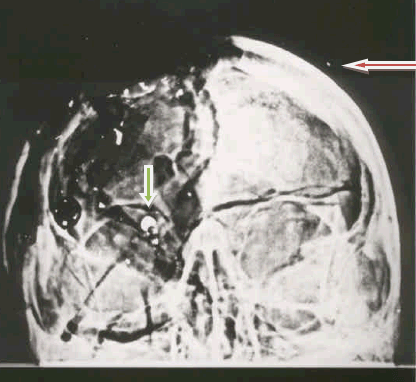
    image Figure 1. AP Autopsy X-ray of JFK’s skull. Note the semi-lunar (6.5 mm) object inside JFK’s right orbit (vertical green arrow). The metal fragment overlying the left skull is identified by the horizontal red arrow. When questioned by the WC, James Humes (the pathologist) stated (2H100) that the largest metal fragment removed from JFK’s skull was “Flat, irregular, two or three millimeters.” Surely this does not describe the 6.5 mm object seen here. Before the ARRB, Humes was again asked whether the metal fragments he had removed were larger or smaller than this 6.5 mm object. He replied (MIDP, p. 449), “Smaller. Smaller; considerably smaller….I don’t recall retrieving anything of this size.” The other two pathologists also did not recall this object.

    http://i217.photobucket.com/albums/cc151/David_Von_Pein/MISCELLANEOUS%20JFK-RELATED%20PHOTOS/JFK_Autopsy_Photo_3.jpg?t=1278230684 http://jfk-archives.blogspot.com/2010/07/jfk-back-wound-location.html
    Figure 2. Autopsy photograph of JFK’s back. The wound (arrow) appears to be at about T1. The scapular spine is faintly visible.

    posterior view Figure 3A. The horizontal scapular spine can be faintly seen (red arrow), inferior to the level of T1. The scapular spine appears to lie at about the level of T2 or T3, close to Boswell’s level for the back wound on his Autopsy Descriptive Sheet. In other words, the autopsy photo and Boswell’s Sheet are inconsistent. Far worse, though, Boswell later elevated this wound into the neck, much higher than shown in the autopsy photograph. Any level inferior to T1 for the back wound makes the SBT impossible.

    http://i.cdn.turner.com/dr/teg/tsg/release/sites/default/files/imagecache/750x970/documents/descriptive1.gif Figure 3B. Another view of the back. Here the scapular spine appears to lie at the level of T3 or T4. An online source assigns a typical level to the scapular spine as T3 (manualmed.blogspot.com/2008/09/thoracicspine-landmarks.html). The C-designations here are for the cervical nerves, not for the vertebrae. (Nerves C2-C8 exit inferior to the vertebrae C1-C7, respectively.)

    http://www.herniatedlumbardisk.com/images/Spine-Anatomy.jpg http://www.thesmokinggun.com/file/autopsy-descriptive-sheet?page=0
    Figure 4. The Autopsy Descriptive Sheet, prepared by Boswell. Note the level of the back wound (indicated by the horizontal line from “7 x 4 mm”). It appears to lie at least as low as T2, possibly even lower. If accurate, that would immediately invalidate the SBT.

    http://ts1.mm.bing.net/images/thumbnail.aspx?q=1339753571660&id=269f742be9d2ee98ca6377cafcccf958&url=http%3a%2f%2fwww.waterburyhospital.org%2fservices%2fortho%2fimages%2fcspine3.jpg Figure 5. Skeleton as viewed from the front. McAdams claims (p. 223) that the bullet (of the SBT) traversed JFK at C7/T1 (between the levels of the seventh cervical and the first thoracic vertebrae)—at about the tip of the vertical cyan arrow. The horizontal red arrow identifies the C7 vertebra. As seen here, it is impossible for a bullet to pass between the transverse process of C7 and the medial portion of the first rib (cyan arrow), without damaging bone. Also note how close together (actually overlapping) these transverse processes are for all of the cervical vertebrae. Therefore, no bullet could have traversed JFK at any cervical level and still be consistent with the autopsy photograph (without causing obvious bone destruction). On the other hand, a bullet inferior to T1 would likely have perforated the right lung apex, which was not seen at the autopsy. Only a contusion was seen there.
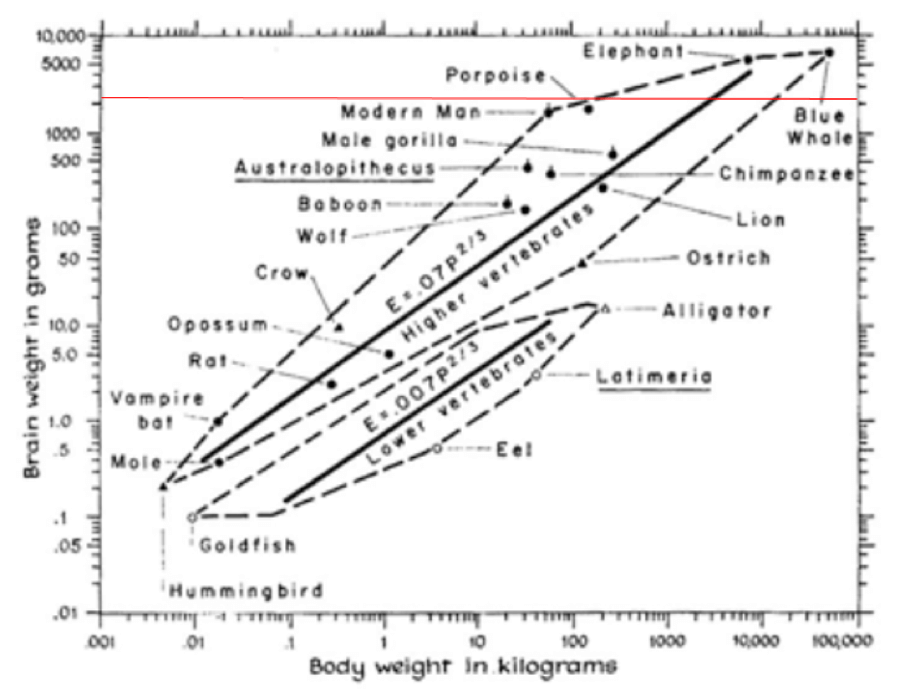
    http://www.bing.com/images/search?q=Anatomy+Of+Spine&FORM=IQFRDR#x0y1427

    Cervical Spine X-Ray: Image 1 http://www.info-radiologie.ch/cervical_spine_radiograph.php
    Figure 6. Cervical Spine X-ray: AP view. 1, Clavicle. 2, 1st rib (from T1). 3, Trachea. 4, Spinous process of C7. 5, Vertebral Body of C5. 6, Uncinate process. A bullet could not pass at the site implied by McAdams (tip of the vertical cyan arrow), which lies between the level of the C7 vertebral body (horizontal red arrow) and the level of T1, without causing obvious bone destruction. That was not seen in JFK.


    911_Card24.jpg Figure 7. CT scan of a patient. This cross section is very close to C7-T1, the level chosen by McAdams for the SBT. I used JFK’s wound measurements to place the hypothetical trajectory (in red). Such a trajectory is impossible here because bone from the spine (the transverse process) intervenes. Based on his X-rays, JFK experienced no such bone trauma. In 1963, CT scans were still in the distant future. This visual disproof of the single bullet theory was first anticipated several years after the assassination (but still well before CT scanners) by a pathologist, John Nichols, MD, PhD.

    Appendix 6: Exit and Entrance Wounds in the Literature (per Milicent Cranor)

    1. Entrance wounds can be jagged. A few JFK witnesses said that the throat wound was somewhat jagged; these comments have been used by WC loyalists to conclude that the throat wound was an exit.

    1. Entrance wounds need not have abrasion collars. Some of the Parkland doctors indicated that JFK’s throat wound had an abrasion collar, which would suggest an entrance wound. However, its absence would prove nothing.

    1. Shored (buttressed) exit wounds do have abrasion collars; in fact, these are typically large (not the case for JFK). The abrasion collar is formed when the bullet crushes the skin against a rigid object that “shores” the skin, i.e., the skin is fixed in place as the bullet exits. And, because the skin is kept in place and is not stretched outward while the bullet advances, the wound size matches the bullet size (like a cookie cutter). Most entrance wounds are shored by muscle or bone and are therefore small. JFK’s small throat wound is sometimes attributed (by WC loyalists) to shoring by the collar and necktie. But in every case of a shored wound, there is a pronounced abrasion collar, with bits of skin pulled outward as the neck and shirt eventually separate. Therefore, skin is left behind on the material (in this case, the shirt). The FBI examined the inside of JFK’s shirt, but they found not even a scrap of skin.

    1. Exit wounds can be small, as proved by well-controlled experiments and wartime experience. A typical (unshored) exit wound is large. In this case, the bullet stretches the skin outward, causing tenting and then tearing of the skin as it exits, and it leaves behind a star-shaped wound. Loose clothing can permit enough stretching that the bullet can exit before it encounters cloth. In specific cases though unshored exit wounds can be even smaller than the entrance wounds from the same bullet. This is more likely when the exit speed is low. In particular, a bullet fired from a great distance may lose much of its energy, and thereby create a small exit wound.

    1. When police cannot decide between an entrance versus an exit wound (e.g., when the context is controversial), pathologists are asked to analyze the wound under the microscope. For instance, just as the beveling of the skull can often determine entrance versus exit, so also can the beveling of bullet wounds in skin, i.e., dermis and epidermis are affected similarly to the skull tables.

    Appendix 7: The Hole in the Windshield

    The following is a quotation from Doug Weldon at (http://educationforum.ipbhost.com/index.php?showtopic=15484).

    The windshield Taylor was shown in 1975 had to be the one you [presumably meaning “Barb and Jerry”] showed in your comparison study in your article by John Hunt. Martin Hinrichs did a detailed study and demonstrated that the cracks were not the same. Jerry himself now questions whether the two windshields in the article are the same. Jerry wrote on this forum “Yes, that’s correct. Right now, I don’t think any windshield comparison can be conclusive including Hunt’s. If we can gather better data at the Archives it might be possible, but right now I’m certain that we really don’t know exactly what it is we’re trying to compare.” Martin Hinrichs also pointed out a very pertinent fact: “A comparison of this (sic) two windshield cracks is nevertheless dominated by the following undeniable principal: The windshield was kicked out at 11/26/63 by the feet of the Arlington Glass men. And that dominant cross crack should be visible in every photo post to 11/26/63.” There is also evidence that the Secret Service ordered twelve windshields after the assassination for “target practice.” Did they need these windshields to attempt to duplicate the damage to the original windshield but without a crack,” (sic) George Whitaker stated that the original windshield was “scrapped” (destroyed) on November 25, 1963 in Dearborn, Michigan. [The “sic” entries are mine—DM.]

    Appendix 8: My (Still Unanswered) Letter to Max Holland

    From the new medical depositions taken by the Assassination Records Review Board (ARRB), we now know that the only recognized autopsy photographer, John Stringer, did not take the autopsy photographs of the brain. A memorandum issued by the ARRB strongly suggests that two different brains were autopsied and that the brain photographs in the National Archives most likely are not those of JFK. My personal, detailed studies of the autopsy skull X-rays, including an original use of optical densitometry, show virtually no brain tissue in a fist-sized area at the front of the skull, just where the photographs (paradoxically) show nearly intact brain. My measurements are not only consistent with the conclusions of the ARRB, but actually anticipated them by several years.

    The shot (or shots) to the head pose even worse conundrums for Holland. If he agrees with the pathologists that JFK was struck low on the right rear of the skull, he then has no explanation for the obvious trail of metallic debris that lies more than 4 inches higher. Alternately, if he concludes that a bullet entered much higher, he must then believe that all three qualified pathologists were wrong by 4 inches, and that an absurdly unique event occurred in the history of ballistics—namely that an internal 6.5 mm cross section of a bullet was sliced out and then migrated 1 cm lower and stayed there. In addition, and after all this, he must also believe that the trail of metallic debris still lies well above his proposed entry site. No ballistics expert has ever testified to seeing so much nonsense from one bullet.

    Even worse for Holland, just within the past year, Larry Sturdivan, the ballistics expert for the 1977–78 Congressional investigation, has insisted that this 6.5 mm cross section cannot represent a metallic fragment at all—thus crippling the central basis for the conclusions reached in prior official inquiries. My own research on the X-rays over the past 5 years (performed at the National Archives and now published in Assassination Science, edited by James Fetzer) agrees with Sturdivan that this object cannot represent a real piece of metal. [Only a tiny metal fragment is visible at the corresponding site on the lateral X-ray.] I have, in addition, shown how simple it was in that era deliberately to manufacture (in the darkroom) an altered X-ray with a 6.5 mm metallic image added to it (so that Oswald’s rifle would be incriminated). Finally, at my request the ARRB specifically asked each of the autopsy pathologists under oath if they recalled seeing this flagrantly obvious, 6.5 mm object on the X-rays during the autopsy. Just as I had predicted, none of them could recall this artifact—one that my 7-year-old (nonradiologist) son instantly spotted on the extant anterior skull X-ray. [This has been slightly adapted from my article in MIDP, p. 400].

    Appendix 9: the Police Dictabelt

    The following is extracted from my review of Hear No Evil by Donald Thomas at here.

    1. The task now was to find matches, if any, between the 432 test shot patterns and the six evidence patterns. Such matches would presumably determine both the shooter locations and the target sites. For this exercise, the reader must imagine a very large matrix, consisting of 432 entries vertically and six entries horizontally. For each element of this matrix there is an evidence pattern and a test pattern, which are to be compared to one another. So a total of 432 x 6 = 2592 comparisons must be made.

    2. Matches for a specific shot were decided based solely on the time between spikes, i.e., amplitude was ignored (except, of course, for the already completed, initial selection of suspect gunshots).

    3. A deviation of eight milliseconds (msec) was permitted, since the microphones might not precisely match the motorcycle position. Even air movement might change the matches.

    4. The statistical formula for detecting a match was this:

    Binary Correlation Coefficient = r =   i  / √ (N x n)
    where i = number of coincident events
              N = number of spikes in the evidence pattern and
              n = number of spikes in the test pattern.

    1. For a perfect match, r = 1, while r = 0 means no match. But, partly because of so much noise, a perfect match could not be expected. Results of interest were for r > 0.6; however, it should be emphasized that this is an arbitrary value. Some other value could have been chosen, with a likely different final outcome, possibly even wildly different.
    2. Values for r < 0.5 were ignored; that left only 15 possible matches (see Table 13 by Thomas). These 15 had the generic pattern of gunshot echoes in Dealey Plaza. The reader must understand that this does not mean 15 shots! After all, duplicate test shots had been fired from the TSBD (inside and outside the window). Furthermore, matches sometimes occurred at adjacent microphones—from the same shot—as might well be expected if the motorcycle had been between two adjacent microphones. Only four actual shots were proposed.

    Appendix 10. Optical Density and Characteristic Curves for X-ray Films

    Because no one recalls the history of this science (of optical density), a short review is appropriate. This history was summarized in a November 1989 article from the Eastman Kodak Laboratory, co-authored by Arthur Haus and John Cullinan—“Screen Film Processing Systems for Medical Radiography: A Historical Review,” Radiographics, Volume 9, p. 1203. The article can also be found online at http://radiographics.rsna.org/content/9/6/1203.full.pdf. After I had completed my original article on the JFK X-rays, I sent a copy to Arthur Haus (the above author). After reviewing it he offered no criticisms of it. I had had a prior conference telephone call with him and his colleague about X-ray films of the 1960s. This information had played a major role in my detective work on the JFK autopsy X-rays and was included in my paper. I later met Haus in person at my specialty meetings in Los Angeles.

    The characteristic curve is central to this discussion. It is a graph of optical density versus X-ray intensity (actually the logarithm of intensity). It shows how the optical density of the film varies with the intensity of the X-rays that strike the film. Haus recalls (pp. 1217-1218 of his article) that this data was first explored for photographic films in 1890; the classical paper was by Hurter and Driffield. In 1917, M. B. Hodgson showed that this earlier work could be applied to X-ray films as well. In other words, this science is now nearly a century old. To put this into the context of 1917, JFK and my mother were both born that year; the US entered World War I; and Lenin, although a bit tardy, arrived on Russian soil (from Switzerland, via Sweden and Finland). But the FBI would not begin its fingerprint files for another seven years (in 1924) and John McAdams’s own mother was still very young (or possibly not even conceived) in 1917. (Ironically, McAdams was born in Kennedy, Alabama.)

    In the late 1960s, Haus (the same one) and Rossman developed an automated inverse square sensitometer for collecting this data, a device that was still in widespread use in 1989. After I graduated in 1976 from the University of Michigan Medical School, I entered the specialty of radiation oncology. While at USC during residency, I worked with compensating filters for radiation therapy of cancer patients. These devices were built from small metal blocks that were placed in the X-ray beam during radiation treatments, in order to compensate for missing (patient) tissue in the path of the therapeutic X-rays. They helped to prevent hot spots in the dose distribution (inside the patient). Picture a checkerboard pattern in which small metal blocks are piled to a specific height on each square, with greater heights corresponding to more missing tissue. More recently, computer planning systems have used CT-derived compensators to correct for missing (or excess) tissue, such as air cavities (or intervening bone). But the principle is similar: the CT numbers play a role like that played by optical density. (See Radiotherapy for Head and Neck Cancer: Indications and Techniques, 3rd edition, by K. Kian Ang and Adam S. Garden, p. 36.)

    When I measured the optical density of the 6.5 mm artifact within JFK’s right orbit (at the Archives), I had invoked the same principles—the optical density was related to the amount of tissue traversed by the X-rays (that had struck a specific point on the film). Of course, if JFK’s X-rays had been double exposed in the darkroom precisely over this 6.5 mm object (as I have proposed—and whose feasibility I have even demonstrated), then this data would make no sense. Such nonsense, of course, is exactly what the data showed. And, consistent with this, no professional has ever been able to make sense of this 6.5 mm object either. It remains unique in the history of radiology. In any case, my major point here is simple and straightforward: no one should claim that optical density measurements are too novel to be used in analyzing X-ray films. The only parameter that is new here is its application to a president of the United States—the principles are the same.

    Appendix 11: Odd output from John McAdams’s Filter Factory for Facts

    A. Most pieces of evidence must be discarded. (Or, if a different page by McAdams is cited, then such evidence should not be discarded.)

    B. Eyewitnesses, even physicians doing what they usually do, cannot be trusted. Furthermore, no distinction need be made between earlier and later recollections of eyewitnesses.

    C. Photos are to be trusted over eyewitnesses, even when no one recognizes the photos.

    D. The size of Connally’s back wound after surgery is more relevant than its original size.

    E Only two physicians at Parkland saw JFK’s throat wound.

    F. Because false sightings in general are unreliable, two Oswalds are not possible.

    G. Major secrets cannot be kept.

    H. The acoustic evidence contained 15 matches.

    I. There is nothing noteworthy about the 6.5 mm object within JFK’s right orbit on the AP X-ray.

    J.  On JFK’s skull X-rays, no metal fragment is seen on JFK’s left side.

    K.  Fingerprint evidence is “killer” evidence.


    Reviews of John McAdams’ book JFK Assassination Logic by
    Pat Speer
    Gary Aguilar
    Frank Cassano