From the November-December, 1996 issue (Vol. 4 No. 1) of Probe
Almost every JFK assassination researcher is aware that the Dallas police found and inventoried a tiny hi-tech Minox camera amongst Oswald’s personal effects during the search of Ruth and Michael Paine’s home after the assassination.This camera was later omitted from an inventory list once the FBI took over the investigation. What is not generally known is the Paines’ role in the “appearance-disappearance”charade.
There were 3 separate inventory lists itemizing the evidence from the Paine household. This is typical of the routine procedures used by law enforcement in establishing chain of custody of physical evidence. First, there was the Dallas police list identifying a “small German camera and black case on chain and film”. A pedometer and camera timer were also itemized; there was no mention of a light meter but there was mention of a “brown case (camera) with long chain”.1 Then there was the joint DPD and FBI list which was prepared in response to the FBI’s assertion of jurisdiction over the crime. The camera is described in aggregate Item #375 as a “Minox camera” together with a pedometer and a camera timer; there is no mention of a light meter. Rolls of undeveloped Minox film and two rolls of exposed Minox film were also inventoried as Item #377. An unidentified electronic device in a brown case was listed as an unsubmitted and unnumbered item as having come from the Beckley Street rooming house.2 When the evidence was taken to Washington, D.C., the FBI Lab prepared its very own inventory by way of a third list; any reference to the Minox camera would disappear from this third list.3
There were four separate sets of photographs of the items removed from the Paine household and Beckley Street residence. First, there were the photos made by the Dallas Police Crime Lab before the evidence was turned over to the FBI which shows the evidence grouped together on the floor of the police station and which depicts the Minox camera.4 At the joint police and FBI inventory of November 26th, a second set of photographs were taken depicting each individual item or selectively grouped items with the numbered photos corresponding to the numbered items. The items ranged from #1 through #455 and required 5 rolls of film. It was understood that the FBI Lab would develop these 5 rolls of film and furnish a set to Police Chief Curry. This intact set of photos from the original 5 rolls have disappeared from the National Archives – assuming that the FBI even turned them over to the Warren Commission or the Archives in the first place.5
The third set of photos consist of 2 rolls of microfilmed photos which the FBI Lab made after developing the photos jointly taken in Dallas; this microfilmed series was furnished to the Dallas Police which in turn furnished copies to other agencies, including the Secret Service.6 In a letter dated December 3, 1963, Police Chief Curry advises the FBI that items #164 through #360 were missing and apparently did not record; he requests the FBI to re-photograph the items.7 The fourth set of photos consist of the FBI’s “re-photographed” items which were sent to the Dallas police to supplement the missing photos.8
Not only were there missing frames but some of those that existed had been altered. The Minox camera itemized in #375 of the joint inventory list ceased to exist in the set of microfilmed photos first returned to the Dallas Police by the FBI. Photo #375 which was supposed to be a group photo of the Minox – along with several other camera items – is now just a Minox light meter.9
It is generally unknown in the research community that much, if not all, of the evidence seized from the Paine household and Beckley Street residence was “loaned” to the FBI on the weekend of the assassination even before the FBI took charge of the crime. The FBI assigned number #Q-5 to the Minox camera and/or Minox film at that time. The evidence was returned to the Dallas police after the FBI’s inspection. It was then turned over once again to the FBI on November 26th when the FBI assumed jurisdiction.10 We know that the Minox film recovered from the Paine household was in possession of the FBI as of November 25th because on that date the FBI requested a comparison of the Minox film as recovered from the possessions of Oswald with Minox film designated as Specimen Q5. The laboratory results were that Minox film Q5 was not taken with the same camera as the other Minox film.11 Was the FBI comparing the Minox film later designated as Item #377 with the cassette still remaining in the Minox camera recovered by the Dallas police?
The FBI’s early efforts to conceal the existence of the Minox camera did not stay secret for long. According to author Gary Savage, a controversy ensued within the first two months following the assassination when news reporters received information that the FBI had altered the inventory list. Furthermore, the FBI had pressured Dallas police detective Gus Rose to change his recollection of what he had found from a Minox camera to a Minox light meter. Detective Rose steadfastly refused to alter his findings and insisted that he found the camera in Oswald’s seabag the weekend after the assassination.12
The FBI was now squarely in the middle of an evidence tampering dilemma before the Warren Commission investigation was barely underway. One solution would be to produce the original camera, or any Minox camera for that matter, in order to resolve the discrepancy. This is precisely what the FBI did.
We now know that the controversy over the Minox camera reached the highest levels of the FBI because on January 27, 1964, Mr. William A. Branigan, Chief of the FBI’s espionage section, telephoned SAC Gordon Shanklin in Dallas to point out the inconsistency in the inventory lists. Branigan also advised Shanklin that the FBI Lab in Washington did not have the Minox camera in its possession.13 On January 28, 1964 Shanklin responded by advising FBI Inspector Moore of the FBI Lab that no such Minox camera had been found – only a Minox light meter.14 This, of course was an outright lie on Shanklin’s part. FBI Director J. Edgar Hoover apparently found this reply unacceptable because on January 30, 1964, Hoover sent a teletype to Shanklin advising once again that the FBI Lab had all Minox related items except for the Minox camera. Hoover then instructed SAC Shanklin to immediately investigate this matter and to contact the Dallas Police, Mrs. Oswald and Mrs. Paine, if necessary.15
In an effort to “locate” the camera, Dallas FBI Agent Bardwell Odum on January 30, 1964, contacted Ruth Paine to inquire into whether the Paines owned a Minox camera.16 Ruth recollected that her husband had a Minox which he had dropped into salt water several years ago; she was sure that he had thrown it away but she would ask him about it and get back to him. She also stated that the police took a Minox camera case along with a light meter belonging to Michael which may or may not have been a Minox light meter.17 The next day on January 31, 1964, Ruth Paine called Odum to tell him that her husband still had the camera and that it was in a coffee can in the garage.18 If this was true, one would have to conclude that the local police not only did a poor job of searching the garage the weekend of the assassination but also fabricated the Minox camera on both its original inventory list and joint DPD/FBI list. Since this was not the case, the collusion of the Paines is readily apparent.
…
The rest of this article can also be found in The Assassinations, edited by Jim DiEugenio and Lisa Pease.
Notes
1The first DPD inventory list, undated, was obtained from the Dallas Police Archives. It is attached to an undated joint statement of the officers which in turn is followed by a supplementary report dated 11/23. The inventory list does not seem to distinguished between those items recovered on the 22nd, and those items recovered on the 23rd pursuant to a search warrant. With respect to felonies, police officers have the power to search and seize what is in plain view. Closed containers, such as Lee Oswald’s boxes, envelopes, suitcases, and seabags, etc. would require a search warrant. While the weekend reports are somewhat sloppy in this regard, the undisputable fact remains that the Minox camera was recovered at that time regardless of whether it was the 22nd or the 23rd. This author has entertained the possibility that the police officers’ search on the 22nd went beyond proper legal limits and this was “rectified” by obtaining a search warrant the next morning.
2 See Commission Exhibit #2003 at Vol. 24, p. 340. The evidence was delivered to the Dallas FBI office on 11/26. On forms supplied by the Dallas police, a detailed inventory list was prepared by police property clerk H.W. Hill and witnessed by FBI Agent Warren De Brueys and police captain J. M. English. The Minox camera is identified on Receipt No. 11192-G as one of the items voluntarily given to the police by Ruth Paine and Marina Oswald on the 22nd suggesting that the first police search went beyond its permissible scope as is often the case in criminal proceedings. The listing of the electronic device in the brown case from the Beckley Street address (set forth in the joint list at Receipt No. 11199-G) further clouds the issue of what items came from where and when – at least insofar as the weekend police search is concerned. The police department version in the Dallas Police Archives differs from the FBI’s list of the 26th in only one respect: the Dallas list contains the signatures of the FBI agents receiving the property. The accompanying affidavit of Dallas officer H. H. Hill describes the process by which a joint inventory was made wherein FBI Agent De Brueys called out the items, one by one.
3 See evidence list set out in CD 735. Item 375 has been altered to omit the Minox camera and turn it into a Minox light meter. For some reason this list contains the Dallas field office file number instead of the Headquarters file number suggesting that the FBI’s own property list was prepared in Dallas before departure to Washington, D.C. We do know from an FBI document that Agent DeBrueys delivered the evidence to the FBI Lab on November 27th. Another document suggests that a 4th list was prepared by the FBI Lab which superseded all prior lists.
4 JFK First Day Evidence by Gary Savage, pp.208, 210.
5 See 11/26/63 report of FBI Agent Ronald E. Brinkley describing how the photos were made with the DPD photo-record camera. 5 rolls of photos were taken using 35mm Kodak High Contrast Copy microfilm. FBI agent James P. Hosty states in his recent book, Assignment: Oswald, p.77 that the photos were taken with a Minox camera. This is a mistake or falsehood on his part as Minox cameras use only Minox film. The documents setting forth the joint photo session with the Kodak film were supplied by Researcher John Armstrong and were obtained from the Dallas Police files. At Mr. Armstrong’s request, the National Archives searched for these 5 rolls of photos and could not locate them.
6 See FBI agent Robert Barrett’s report of statement from Assistant Chief of Police, Charles Batchelor, dated 7/6/64, and available from the microfilmed collection of Dallas Police Archives. See also FBI memo dated 11/29/63 from Branigan to Sullivan.
7 Curry’s 12/3/63 letter from the Dallas Police Archives furnished by Mr. Armstrong.
8 Author’s conversation with John Armstrong whose opinion is based in part upon an undated FBI document bearing Agent Wallace Heitman’s name, referencing dates of 1/23/64 and 2/4/64 and referring to 85 photographs of Oswald’s belongings.
9 Indeed there are two separate photos of #375, one still in the possession of the Dallas Police Archives showing the surrounding items covered up by scraps of paper and the one in the National Archives showing a blow up of the Minox light meter all by itself; copies furnished to author by John Armstrong. The National Archives also has a copy of the same DPD group photos that Gary Savage depicts in his book. However, these photos were enlarged, then cropped to omit the Minox camera featured in the top 1/3 of the original photograph. A copy of the NARA cropped photo was furnished to the author by Anna Marie Kuhns-Walko.
10 See deposition of FBI Lab expert, James C. Cadigan, NARA: HSCA Record No. 124-10086-10013.
11 The author’s copy of this document was furnished to her by John Armstrong without the benefit of a RIF cover sheet from the NARA. It appears to be part of report prepared by Dallas FBI agent, Robert Gemberling. Note that the Minox film analysis was filed away in a New York City FBI field office file #65-22483 of the Espionage-Russia division. According to John Armstrong, a FOIA request failed to turn up this file.
12 See Savage pp. 212-215,and transcript of Gus Rose’s statement to the HSCA made on 4/13/78.
15 FBI #105-82555-1580, teletype dated 1/30/64, RIF citation omitted. This teletype also clarifies the fact that there were two Minox cassettes, one of which contained film.
16 Dallas FBI field office file, #100-10461, Odum report of 1/30/64 interview with Ruth dictated on 1/31/64 and typed on 2/3/64
31 See Warren Commission Vol. 10, p.313 and p.325. It is not clear if Shasteen’s relationship with Odum originated with the FBI investigation into the assassination or if it was pre-existing.
From the November-December, 1995 issue (Vol. 3 No. 1) of Probe
“It’s curious that no one seems to have mentioned this characteristic in connection with the John F. Kennedy assassination, in which both the number and direction of shots fired are still debated. If a silencer was used in combination with another, unsilenced rifle, witnesses located in different parts of the caravan and Dealey Plaza would have heard the shots coming from different directions. Unanimity would have been impossible on the subject of the gunfire’s origin.”
– Jim Hougan, Spooks (New York: William Morrow and Company, 1978.)
There has been no consideration given by the research community over the past 30 years regarding the possible use of silencers in the JFK assassination. This article hopes to remedy that intriguing possibility. Both conspiracy theorists and lone gun proponents at least agree on one point: that there are differing opinions amongst Dealey Plaza witnesses as to just how many shots were fired on November 22, 1963. All witnesses presumed that having “heard” a given number of shots, then there must have been an equal number of actual shots so as to coincide with what they heard, whether it be 2, 3 or 4 sounds or even more than 4 as some witnesses have claimed.
If there were 4 or more shots, then it follows that there was more than one gun for even the lone assassin proponents agree that Oswald could not have fired off 4 shots within the given time frame generally accepted. Consequently, a great deal of effort has been expended pinpointing the location of the witnesses in order to determine which ones may have had a better vantage point for discerning the “real” number of shots. For a brief time it was hoped that the dictabelt evidence would settle the matter once and for all. The HSCA spent a significant amount of time and money grappling with this acoustical evidence but to no avail.
Considering Possibilities
Three gunshots, of course, is in keeping with a lone assassin theory – or is it? If there exists the possibility that silencers could have been utilized by one or two additional gunmen, then the earwitness testimony may very well become irrelevant no matter how many shots were “heard.” Acting on the assumption that a multi-gunmen crossfire, if one existed, would have to be carefully planned and executed, this researcher considered the means by which ballistic evidence could be manipulated. I tried to imagine how a triangulated gunfire could succeed while implicating one lone shooter in the Texas School Book Depository. My research led to the consideration of silencers and the characteristics of typical sniper weapons available in the year 1963. The results of this research should give pause for thought and cause us to re-examine the ballistics evidence and the medical evidence from a different perspective.
Manipulating Reality
It is possible for a shooter to manipulate or eradicate reliable ballistic evidence through a variety of techniques. These include, but are not limited to, the use of barrel inserts, sabots, undersized ammunition, expanding or exploding ammunition, and cartridge conversions. These techniques will impact upon the science of ballistic markings and render matchmaking to a particular weapon impossible. Manipulating the sound of a gun shot can be accomplished in varying degrees through the use of sub-sonic ammunition, suppressors, muzzle flash protectors and silencers. These techniques manipulate the perception of any earwitnesses to a shooting. This article will focus solely on silencers as a manipulative technique.
Firing a gun results in several distinct and separate noises of various intensity. First there is the detonation itself, followed by the muzzle blast of expanding gases, which is then followed by the shock wave-or sonic boom-created by the bullet’s velocity. Add to this the echo effect created by natural or man-made canyons, i.e Dealey Plaza, and it is hardly surprising that there would be disagreement amongst ear witnesses as to the precise number of shots, as well as the disagreement over the perceived direction of shots. Since one’s position in relationship to the direction of the shot also serves to complicate perceptions, earwitness testimony, especially that coming from Dealey Plaza, is inherently problematic.
Rifle Silencers?
Generally, people associate silencers with handguns rather than rifles. This is because the sonic boom of a high velocity weapon such as a rifle, is very difficult to silence and thus handgun silencers have been more prevalent in the past. Even if the muzzle blast sounds from the rifle itself were silenced, that still leaves the sound of the shock wave created by the high velocity bullet as it passes through the air. Silencers are nothing more than bafflers that muffle the sound, much like a muffler on a car. The greater the report or noise generated by a weapon, the larger the silencer needs to be. Silencers can thus be large bulky devices and difficult to conceal. Silencers have been and continue to be illegal for civilian use, although legal for military use. Despite the engineering difficulties in devising silencers for rifles, the utility of silenced weapons was not lost on the U.S. military; a silenced rifle would serve as a most useful instrument for shooting a sentry or guard from a distance.
Patented Silencer
designs for rifles appear as early as 1901. But it was not until WWII that our military devoted serious attention to engineering silencers for rifles after observing the Germans making effective use of them. Two silenced sniper rifles emerged from these war efforts: 1) a modified version of the M-1 .30 caliber carbine, standard issue for the U.S. military, and a modified version of the .30 caliber 1903 30.06 Springfield rifle, also standard issue.
Figure 1: Silenced M-1 .30 Caliber Carbine (top) compared to the regular G. I. issue (bottom)
The silenced M-1 .30 caliber carbine was developed in England for the United States in 1945. It came equipped with an integral non-detachable silencer which had been developed by Bell Laboratory. Its barrel had a 6 groove, right-hand twist rifling pattern. This weapon is pictured in figure 1.
The modified Springfield rifle was a variation of the standard bolt action which was originally developed in 1903. The silenced sniper version is designated as a Springfield M1903A4 and was developed in the United States in 1947 under a special contract with the Remington Arms Company arsenal in Ilion, New York. This .30 caliber rifle came equipped with a detachable Maxim silencer and had a 4 groove, right-hand twist rifling pattern. See figure 2 (below).
Figure 2: Silenced Springfield M1903A4
The M-1 .30 caliber carbine had an effective range of 100 yards while the Springfield M19103A4 rifle had an effective range of 300 yards. Thus both weapons would have readily found their prey in the kill zone of Dealey Plaza. Our Army was nevertheless disappointed in these weapons because neither weapon succeeded in producing a completely silenced shot. The firing of the M-1 carbine, for instance, sounded like a sharp handclap followed by a distinctive hissing sound. Accordingly, the weapons were not manufactured on a large scale basis and it is believed that only 1000 trial weapons were ever manufactured.
CIA Acquires Silenced Rifles
Because of their acoustical shortcomings, these silenced weapons were turned over to the CIA. The precise date is unknown, and some gun authorities believe that the English produced M-1 carbine had been developed in the first place for the CIA’s predecessor, the OSS. Whatever the origin, it is clear that by 1963 the CIA possessed these silenced sniper weapons. The rifles added to the CIA’s existing arsenal of silenced handguns. Still highly reliable in 1963 was the High Standard .22 caliber silenced pistol which was standard issue for the OSS during WWII. This silenced handgun was amongst the personal items recovered by the Russians when Gary Powers, a CIA contract agent, was shot down over Russia in 1960 while flying the CIA’s secret U-2 spy plane. (See page 15, figure 3.)
Figure 3: High Standard .22 Caliber Silenced Pistol
As of 1963, the best available silenced rifles were still the modified vintage WWII weapons described above. Silencer technology remained at a virtual standstill throughout the Korean War and into the 1960’s. We know this from the results of a 1968 Army study which concluded that the best silenced rifles continued to be the M-1 .30 caliber carbine and especially the Springfield M1903A4. It was after this report that the quest for better silencers developed in earnest. During the late 1960’s and 1970’s, Mitchell Livingston Werbell III, a gun dealer whose name surfaces frequently in assassination research, would become the preeminent designer of the modern day silencer for military weapons and is credited with enabling widespread and effective use of silenced sniper rifles in the Vietnam War.
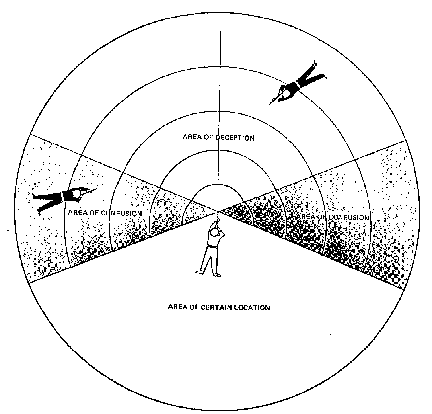
The inherent limitations to completely silencing a high velocity weapon means that some measure of sound will remain depending upon where the earwitness is positioned in relationship to the direction of the shot. This is best illustrated by figure 4 (see page 15) which is borrowed from schematics used by Werbell’s arms company, the Military Armaments Corporation.
Figure 4: Chart from Military Armament Corporation. The muzzle blast spread from a suppressed weapon shows deception and confusion resulting from attempts to locate sound origina from weak fixed source at various angles from the source.
Other Evidence of Multiple Guns
Silencers may explain why different witnesses reported hearing differing numbers of gun shots. But what other evidence is there for more than one gunman? At least four pieces of tangible firearm evidence have surfaced since the Warren Commission’s Report which suggest the presence of gunshots in Dealey Plaza on November 22nd from a weapon other than Oswald’s Mannlicher-Carcano. This evidence consists of two bullets, one bullet fragment and one shellcasing. Each of these items of evidence are consistent with one or the other general characteristics of the two CIA sniper weapons discussed above.
The Barbee Specimen: This intact bullet was found imbedded in the roof of a building located at 1615 Stemmons Free-way by William Barbee in the summer of 1966. The building, which was located about a 1/4 mile from the TSBD, happened to be in the line of fire from where Oswald allegedly shot. Mr. Barbee turned the bullet over to the FBI for analysis in December, 1967, when current publicity about the assassination caused him to wonder if this bullet might be relevant evidence. The FBI lab determined the bullet to be a .30 caliber full metal jacketed military bullet. Its rifling pattern of 4 grooves, right hand twist was the same as that produced by the U.S. government .30 carbine. The FBI took little interest in this bullet once having determined that it came from a weapon other than Oswald’s rifle. Apparently, the thought of a second gunmen was never entertained. Yet this bullet is consistent with that which could be shot from the CIA’s silenced M-1 .30 caliber carbine. One can speculate that this bullet was shot out in the suburbs by a hunter engaged in target practice. Consider, however, that M-1 .30 caliber carbines were not prevalent amongst the civilian population as they had only been released by the government for civilian use in mid-1963. Furthermore, it was and continues to be illegal to use full metal jacketed military ammunition for hunting purposes.
The Haythorne Specimen: The second piece of evidence was a bullet found in 1967 on top of the Massey building by Rich Haythorne, a roofer doing work on the building. The Massey Building was located about 8 blocks away from the TSBD in the 1200 block of Elm Street. It has since been torn down. The bullet remained in the possession of Haythorne’s attorney, until it was delivered to the HSCA for examination. The HSCA utilized the services of the Washington, D.C. police department, where it was determined that the bullet was a jacketed, soft-point .30 caliber bullet, weighing 149 grains which was consistent with the .30 caliber ammunition produced by Remington-Peters. Such ammunition was a popular hunting load and many gun manufacturers chambered their rifles to accommodate this ammunition. The 6 groove, right hand twist rifling marks on the bullet indicated that the bullet was not shot from Oswald’s Mannlicher-Cacano.
The Lester Specimen: The third specimen was a bullet fragment found in Dealey Plaza by Richard Lester in 1974. Its precise location was reported to be 500 yards from the TSBD and 61 paces east of the triple overpass abutment. Mr. Lester turned the fragment over to the FBI for analysis in December, 1976. The FBI reported its findings in July, 1977, and concluded that the fragment, which consisted of the base portion of a bullet and weighed 52.7 grains, was consistent with the diameter of a 6.5 mm bullet. It was also determined that the fragment came from a metal jacketed soft point or hollow point sporting bullet. The rifling characteristics did not match those of a Mannlicher-Carcano. Even though the bullet exhibited the same 4 grooves, right hand twist pattern as Oswald’s Mannlicher-Cacano, the lands between the grooves were spaced further apart than his Carcano. Once again, no one ventured to suggest that the fragment might represent the work of a second gunman.
The Dal-Tex Specimen: The fourth piece of firearm evidence consists of a rusted shell casing found on the rooftop of the Dal-Tex Building in 1977 by an air-conditioning repair man. The Dal-Tex Building is just east of the TSBD, across Houston Street. Assassination researchers have long speculated that a second gunman was positioned at that building. Judging by the rusted condition of the shell case, it had been there for quite some time. What was unique about this case was the crimped edges along the neck suggesting that either the shell had been handloaded or had been used in conjunction with a sabot. Specimens 1), 2) and 3) could conceivably have been shot from locations other than Dealey Plaza by some careless hunter. However, this shell casing meant that the rifle was shot where the shell was expended and it is unlikely that deer hunters ever had occasion to position themselves on a rooftop in downtown Dallas.
One cannot rule out the possibility of a hoax or freakish accident to explain the presence of these specimens. Yet the unresolved questions surrounding the nature of the wounds, trajectory disputes and debate over the number of gunshots require that any evidence of other missiles be taken seriously.
The ballistic evidence, thus far, falls short of proving beyond a reasonable doubt that Oswald’s Mannlicher-Carcano fired bullets on November 22nd that wounded Governor Connally and killed President Kennedy. The limousine fragments and magic bullet #399 appear to have come from Oswald’s Mannlicher-Carcano. Yet they had no residue of blood or tissue and thus cannot be linked to human wounds. The HSCA’s neutron activation analysis links the wound fragments only to the limousine fragments and to bullet #399 – not to the weapon. The major gap in the chain of evidence, then, is the inability to link the wound fragments to the weapon. Moreover, when one considers the testimony of the HSCA firearms expert Vincent P. Guinn that at least four other types of ammunition shared the same composition of trace elements as the 6.5 Mannlicher-Carcano ammunition, the neutron activation analysis leaves the door open to other realistic possibilities.
One such possibility is that an expanding bullet with the same composition of trace elements as the 6.5 Mannlicher-Carcano ammunition was shot from a different weapon, perhaps a silenced weapon. Another possibility is that the 6.5 ammunition was fired and recovered from Oswald’s Mannlicher-Cacano and then shot out of another larger bore weapon with the aid of sabots, barrel inserts or cartridge conversions. Yet another possibility is that bullets or fragments from other weapons were in fact recovered from Kennedy’s body but were suppressed following the autopsy. Consider, for instance, the report from a top FBI administrator, Alan Belmont, to Clyde Tolson, Hoover’s second in command, in which Belmont on the night of November 22nd advises that a bullet has been found lodged behind the President’s ear.
The existence of silenced rifles and the belated discovery of other ballistic evidence in and around Dealey Plaza still does not prove conclusively that more than one gunman was involved in the Kennedy assassination. The point of this article, however, is to encourage researchers to think about other possibilities that are not only realistic and but fall within the capability of the military and intelligence apparatus in the fall of 1963.
Sources:
Truby, Silencers, Snipers and Assassins: An Overview of Whispering Death (1972)
Minnery, Firearm Silencers, Vol II (1981)
U. S. Department of Army, “Silencers: Principles and Evaluations, Report #R-1896” (August 1968)
War Department Technical Manual, Ordnance Maintenance, U.S. Rifles, Caliber .30, M1. M1C (Sniper’s), and M1D (Sniper’s)
War Department Technical Manual, Ordnance Maintenance, The Springfield Rifle, M1903, M1903A1, M1903A3, M1903A4
Nonte, Firearms Encyclopedia (1973)
Hearings before the U.S. House Select Committee on Assassinations, (1978): a) Volume 1, p. 495 et seq re: neutron activation analysis (incredibly the HSCA never asked the firearms expert Vincent P. Guinn to identify the four other types of ammunition that matched Oswald’s 6.5 Western Cartridge bullets.) b) Volume 7, p. 357 et seq re: the Lester and Haythorne specimens (The HSCA makes passing reference to the “Walder” bullet that was also submitted for testing; the author could find no other mention of this particular item of evidence. Is it possible that the HSCA was referring to the bullet which Deputy Walthers was rumored to have found in Dealey Plaza?)
The Dal-Tex specimen: The author has never seen a document substantiating this claim and has also heard that the shell casing was discovered on the rooftop of the book depository, not the Dal-Tex building; she would welcome information from other researchers concerning this evidence
FBI Document #62-109060-5898 (12/13/67) re: the Barbee specimen
FBI Document #62-109060-1431 (11/22/63) re: the statement “I told Shanklin FBI has one of the bullets, the other is stuck behind his ear” is consistent with the writing on the Sibert/O’Neill evidence envelope enclosing a “missile” that had been removed from JFK’s body. It is inconceivable that these FBI agents would mistakenly use the word missile or bullet if what in fact was recovered was merely a small fragment.
Mary La Fontaine’s charges of plagiarism may be worth filing a lawsuit over for defamation of character. But this would only be worthwhile if her book was a blockbuster seller reaping loads of royalties. Mary is so egocentric that it never occurred to her that another human being on the face of the earth might coincidentally be researching the same topic.
My research into John Thomas Masen began with Dick Russell’s 1992 book The Man Who Knew Too Much. I became intrigued with the identification of a real Oswald look-alike and thought Masen deserved a lot more scrutiny. At the 1993 ASK Women’s Luncheon I met numerous women whose research topics were out of the mainstream and rather provocative. I thought it would be a great idea to organize these women. I don’t recall Mary La Fontaine being at that conference. Consequently I organized a women’s workshop which was hosted by Mary Ferrell and which took place in Dallas in March 1994.
At this conference the topic of John Thomas Masen and John Elrod came up. Mary Ferrell shared her files on Elrod with me. She had no files on Masen but told me all she knew about him. Anna-Marie Kuhns-Walko was not able to attend the conference but gave us women her index to the newly released documents pouring out of the National Archives. This index contained page after page of references to John Thomas Masen. It was understood that Anna’s index was not available for public consumption and was a monumental work product that she shared with only a few select persons – I was fortunate to be one of them.
I then asked Anna for all of the files on Masen and Captain George Nonte – which she readily shared. She also provided me with the Frank Ellsworth transcript. Anna also gave some of these same documents to Bill Adams who was working with the La Fontaines. Anna’s philosophy is that public records belong to anyone who requests them. Anna has since told me that Bill Adams never got the complete files because he never asked for them; his request was limited to specifically numbered documents and her involvement with Adams was marginal. Her involvement with the La Fontaines was non-existent. I on the other hand communicate with Anna frequently.
My appetite whetted, I sent my college aged son to the National Archives for a few weeks in the summer of 1994 to do further research. This trip cost me $2000.00 incidently; David still uses this research assignment on his resume! David Hewett researched Ruby, Masen, Whitter, Miller, Nonte, Bertha Cheek, Nancy Perrin Rich, gunrunning, etc., etc. In addition I had David go to the Library of Congress to obtain a listing of every book that Captain George Nonte ever wrote – a list which I will happily share with the La Fontaines if they like.
By now, I was hot on the Masen/Nonte story and decided to submit an abstract to the upcoming first annual COPA conference scheduled for October 1994. I had no idea that the La Fontaines were writing a book on the same topic. I was feeling the pressure and was working with Steve Tilly to obtain release of the 14 page classified Whitter document. Tilly would tell me in writing that it was being withheld on grounds of national security. Wow – I really thought I was on to something. Later I learned that Tilly was in error and privacy was the category under which it had remained classified until the La Fontaines’ Washington Post article (dated 8/7/94) triggered its release. Alas, it was only Whitter’s rap sheet. Bill Adams would later slam me anonymously in a journal for claiming that the Whitter document was classified on national security grounds – had he bothered to call me, he would have learned that the error belonged to the Archives, not me.
I realized I still had lots of work to do regarding the COPA presentation. Of primary importance was the criminal court files on Miller, Whitter and Masen. I made a special trip to Dallas to obtain these files. All I got was the file numbers; the files themselves were in storage at the federal depository in Fort Worth and had to be ordered ahead of time. So I returned to Florida and asked a lawyer friend of mine in Texas to obtain the files for me which she did, including the actual trial transcript of the Miller/Whitter Terrell Armory theft.
In the meantime Gary Shaw provided me with Masen’s November 22 fingerprint card. Now if the issue happened to be JFK’s ingrown toenails I would defer to a podiatrist’s comments about JFK’s toenail records. And so I would expect a similar sort of acknowledgment on the part of other researchers about my skills as a lawyer who has practiced both civil and criminal law in various jurisdictions. I am in my 21st year of practice in state and federal courts with landmark, headline cases to my credit. I have won every criminal jury trial that I have tried. And so I think I speak from experience when I comment on police or court procedures. And I also know how advocates hide facts that are detrimental to their position. This is just what the La Fontaines did in not revealing the full contents of Elrod’s August FBI reports. And if they knew about the November 22nd fingerprint card, they sure didn’t tell their readers. The card says on it in black and white: DATE PRINTS TAKEN. Moreover, police departments are not in the habit of arresting a person one day then calling him back in the next day after he has bonded out because they forgot to take the suspect’s prints!
They would also have you believe that jailers keep track of cell assignments by Roman numerals such that Douglas is in Cell No. F-II (i.e. Roman numeral 2) next to Oswald in cell block F when Douglas was really in A-11 next to Elrod who described his cell as No. 10. (See my upcoming article in Probe on the cell assignment dispute.) In the last analysis, the La Fontaines failed to present any credible evidence that Elrod was with Oswald.
Back to my research methodology: By August 1, 1994 (the designated deadline) I had submitted my COPA abstract on Masen and Nonte. The La Fontaines’ article was still unpublished in the Washington Post. I was notified on August 9th that the committee reviewing the abstracts had accepted mine. As of that date I still did not know of the La Fontaines’ pending book. It was at the October 1994 COPA conference that I first learned of the Washington Post article on Elrod, Masen, Miller and Whitter. It was Paul Hoch, in fact, who gave it to me for I do not subscribe to the Washington Post. I even got to meet Jeff Morley at COPA, the Post reporter who sponsored the article. I was so excited that the La Fontaines were writing a book on this subject. I even mentioned to Hoch that I had done alot of research on this topic and he should tell the La Fontaines about me so we could share information. But the La Fontaines were not at COPA and I had no way of knowing if Hoch ever told them about me.
I still had lots of work to do. I was having trouble getting some of Nonte’s books through the inter-library loan program. I even went to a gun show at the Tampa Fairgrounds in March 1995 to peruse their book stalls for Nonte books and I struck gold. In addition to Masen and Nonte, I was researching military weapons and assassination weapons and was delighted to discover a convergence with Masen, Nonte, the CIA, silencers, Werbell, the Mendoza brothers, assassination weapons, 6.5 ammo, etc. all of which were overlooked by the La Fontaines. The gun show put me in contact with the book lists of para-military organizations and those were really an eye opener. I now knew that the La Fontaines’ book was imminent and wondered if they had progressed as far as I had with my Delta Force and Soldier of Fortune publications.
Before Oswald Talked was even published, I promised Probe in the spring of 1995 that I would do a series of articles on Masen and Nonte as well as on weapons in general. My kick-off article was published in July 1995 where I introduced myself to the research community and mentioned my work on gunrunning. I was chagrined that Oswald Talked came out before my particular article on Masen but thought I would just simply combine my research with a book review.
Needless to say, Oswald Talked was a disappointment as it related to this area of inquiry. I thought there would be more about the whole gunrunning scene and about Elrod, Masen and Nonte in particular. I had no idea that the authors would be digressing on sex-capades with Catholic priests. If only they had called me, for I have Father Machann’s address and that of Daniel Douglas, too! It was evident from their book that they did not bother to get the criminal files on Masen, Miller or Whitter. And they knew precious little about Nonte. Their knowledge of weapons and big time arms dealers was non-existent.
Researcher Robert Dorf put together a workshop in San Francisco over the last July 4th holiday to discuss Oswald Talked (and the Mexico City aspects of the assassination). He invited me to attend to counterbalance Bill Adams who was also invited to represent the position of the La Fontaines. Actually I felt outnumbered when I learned that attendee Paul Hoch had helped the La Fontaines enormously. The presence of Mary and Ray would have slanted the discussion too much; I would have been all alone in making my case. Also, I was told that Mary had a most obnoxious personality that would put a damper on the workshop. The diatribe against me seems to bear this out. There was nothing secret about this meeting – it was simply restricted to a small group that our host chose to invite. I did the very same thing when I sponsored a Paine workshop in June 1995 and purposely avoided inviting one particular gentleman because I did not want the offensive man in my home. Simple as that. Mary seems proud that she prevented Mr. Jeremy Gunn of the Review Board from attending the meeting. But she shot herself in the foot because the consensus of the attendees was that both sides to the Masen/Elrod debate had valid points which would justify further investigation by the Review Board.
Sorry folks, but the La Fontaines are full of sour grapes when it comes to the Masen/Elrod/Nonte material. They took a weak story line and inflated it beyond credibility to make a book sell which comes perilously close to tabloid journalism. Now I’m wondering if the rest of their book can hold up to scrutiny.