Author: Benjamin Cole

  • Walker, Oswald, and the Dog That Didn’t Bark

    Walker, Oswald, and the Dog That Didn’t Bark


    Part of the official JFK assassination lore is that, on the night of April 10, 1963, accused assassin Lee Harvey Oswald took a bus close to the Dallas Turtle Creek neighborhood of General Edwin A. Walker, then a nationally prominent right-wing political activist and armed himself with his Mannlicher-Carano rifle. Oswald then walked to behind the Walker residence, on a service road, a type of back-alley. Walker was seated motionless behind a desk inside his home and facing a large first-floor window. Resting his rifle on a latticed fence about 30 yards away, Oswald took a potshot at his target at 9 pm.

    And missed. Entirely. The shot went over and wide of Walker’s head and into a wall. Walker, on surveying the latticed fence afterwards that evening with a lieutenant from the Dallas Police Department (DPD), remarked that the unknown would-be assassin was a “lousy shot.”

    A police officer reviewing the layout and shooting that night replied, “He couldn’t have missed you.”

    Official Version

    The above official version then posits that Oswald, after shooting and missing Walker, then “buried” his rifle somewhere and rode a bus back home, where he nervously related to his wife Marina details of his expedition.

    Importantly, also entered into the lore was that Oswald would have struck Walker, save for a windowpane that deflected his shot.

    This legend reached something of a zenith in the federally-funded Smithsonian magazine article on 2013. That article not only casually assumed Oswald’s guilt in the assassination of President Kennedy, but then described the shot that missed Walker thusly:

    Drawing a tight bead on Walker’s head, he (Oswald) pulls the trigger. An explosion hurtles through the night, a thunder that echoes to the alley, to the creek, to the church and the surrounding houses. Walker flinches instinctively at the loud blast and the sound of a wicked crack over his scalp—right inside his hair.[1]

    Thus, in the recounted mythology, the shot that missed Walker actually passed through the hair on the general’s head.

    The Dallas Morning News chimed-in in 2013 with a similar story—it was the 50th anniversary year of the JFK murder—that also blithely assumes Oswald’s guilt in both the Kennedy and Walker shootings and adds, “The bullet (fired at Walker) first hit the screen and then the wood frame between the upper and lower windowpanes. Its original path deflected, it passed just above Walker’s scalp.”[2]

    In other words, only a windowpane deflected the Oswald bullet and saved Walker’s life.

    In most regards, the popular-media version of the Walker shooting is actually the opposite of what really happened that night and is, perhaps unsurprisingly, another mythology regarding the JFK murder.

    The Real Story

    There are many reasons not to convict Oswald of either the Kennedy or Walker shootings in 1963. But first, let’s dispose of the dramatic media treatment of that night at General Walker’s and his close brush with death.

    First, Walker, a military veteran who had commanded special forces in combat in World War II, far from feeling a bullet through his scalp, actually initially told investigating officers from the Dallas Police Department that he thought neighborhood kids had tossed a firecracker into to his den through an open window.

    If that! For in a supplementary report filed on April 10, it was written that Walker “stated that when he heard the noise, he thought it was some sort of fireworks.” [3] Fireworks? Hearing fireworks is a far cry from the sensation of a bullet passing through one’s scalp. In truth, only after discovering and examining a bullet hole in the wall behind him, did Walker conclude he actually had been shot at—and so he related to the DPD.

    Secondly, a review of Dallas Police Department documents from the night of April 10 reveals whoever shot at Walker that night would have missed even more widely, save for the deflection downwards of the windowpane.


    Here is a photo of the Walker windowpane and the damage caused by the passing bullet. Obviously, the damage is on the lower edge of the crossbar of the wind plane and likely would have deflected the bullet lower.

    And that is how the Dallas Police Department (DPD) saw it.

    “Officers observed a bullet of unknown caliber, steel jacket, had been shot through the window, piercing the frame of the window and going into the wall above comp’s (Walker’s) head,” according to DPD report filed on April 10 (italics added).

    The report continues, “The bullet struck the window frame near center locking device. From the point where the bullet hit the window frame to the point where it struck the wall is a downward trajectory.”

    It is hard to escape the conclusion that whoever shot at Walker would have missed by even more, except for the deflection. The shooter missed Walker from a distance of about 30 yards, likely armed with a rifle resting on a fence for support.

    In addition, careful readers will also note that that the DPD found a “steel jacket” slug at the scene of the Walker shooting. Assassination researchers know, of course, that Oswald’s Mannlicher-Carcano used copper-jacketed ammo, from the Western Cartridge Company.

    One thing about police officers is that they tend to know guns and ammo and one might assume that the DPD assigned some of its better detectives to the Walker shooting, given his national prominence in 1963.

    But after the Kennedy murder, the DPD sent the steel-jacketed bullet—stated in police reports to be a 30.06 calibre—to the FBI. The federal agents said the mangled Walker slug was actually a 6.5 projectile from the Western Cartridge Company and copper-jacketed. In other words, a Mannlicher-Carcano bullet.

    In a more-innocent era, one might assume the DPD made a mistake—after all, mistakes happen. And the Walker bullet, in fact, was badly distorted after striking the windowpane and passing through a wall in the Walker residence.

    But since the 1960s, the profoundly dismaying history of CE 399, the “Magic Bullet,” has been revealed: the famed nearly pristine dome-headed slug was almost certainly introduced into the evidentiary record within the FBI facilities in Washington. The curious “pointy head” slug found on the Parkland hospital hallway floor Nov. 22 has disappeared and almost certainly had nothing to do with the JFK murder anyway.[4]

    So, with the true story of the Magic Bullet revealed, one reasonable concern is that the FBI also fabricated evidence in the Walker shooting, replacing a steel-jacketed projectile from Dallas with a copper-jacketed Winchester Cartridge 6.5 slug.

    Unfortunately, the records do not reveal why the DPD detective had concluded the Walker slug was steel-jacketed. If the detective had placed the slug on his desk next to a magnet, perhaps he would have noticed the Walker bullet wiggle. (Worth noting, steel-jacketed bullets can be copper coated, the softer metal copper applied to decrease wear-and-tear on gun barrels). In any event, the Walker projectile was originally logged as a steel-jacketed 30.06 slug.

    There is much more to that evening in April 1963; for example, outside Walker’s home at least two vehicles sped from the scene in the wake of the gunfire, as seen by multiple witnesses.

    Two Cars Leave the Scene

    Though hardly dispositive, an additional curiosity is that two automobiles were seen swiftly leaving the scene of the Walker shooting on April 10, in the immediate aftermath of gunfire.

    Hearing the Walker gunshot, a youth named Kirk Coleman immediately thereafter peered over a fence and “saw a man getting into a 1949 or 1950 Ford, light green or light blue and take off,” according to DPD report filed on April 11.

    “This was in the parking lot of the Church next to General Walker’s home. Also, on further down the parking lot was another car, unknown make or model and a man was in it. He had the dome light on and Kirk could see him bend over the front seat as if he was putting something in the back floorboard,” continued the report.

    General Walker also told the Warren Commission he saw a car suddenly leave the area, in the immediate aftermath of the shooting.

    Of course, Oswald is thought not to have had driving skills and certainly did not own a car. To be sure, the two cars could have left the Walker shooting scene suddenly as the sound of gunfire is disconcerting. But one might expect ordinary citizens hearing gunfire to report as much to police, yet the men in the vehicles have simply disappeared into that night, and evidently forever. No one has ever come forward and said they were innocent bystanders who drove away quickly on the night of the Walker shooting.

    So, perhaps the departing vehicles held Oswald and compatriots.

    The Dog That Did Not Bark

    A Walker neighbor’s dog, known as an active barker, was conveniently ill and silenced that evening.

    “The neighbor’s dog to the east of the Walker property is a fanatical barker, but on this incidence did not make a sound,” according to an April 12 DPD report.

    Concerning the dog, a neighbor told the DPD that, “Dr. Ruth Jackson, who lives next door to the General, has a dog that barks at everybody and everything. The night that this offense occurred Dr. Jackson’s dog did not bark at suspects. Investigating officers received further information…that Dr. Jackson’s dog was very sick yesterday [the date of shooting] and is also sick today. Reason for this illness is unknown at this time.” (emphasis added)

    Again, the report of conveniently sick dog is hardly dispositive. But if the dog was intentionally poisoned, it suggests an operation involving more than a lone nut who did not own a car.[5]

    The Walker Backyard Photo and Other Evidence

    And of course, one of the curiosities of the JFKA is the backyard black-and-white photo of Walker’s house, purportedly found in Oswald’s possessions after the JFK murder, featuring the infamous two-tone 1957 Chevrolet with its license plate mysteriously cut out.

    If the photo was truly in Oswald’s possession, it is certainly suggestive.

    In addition, Oswald’s wife, Marina, recounted discussions with her husband regarding the Walker shooting, although her testimony in the wake of the JFK assassination was regarded as unreliable, even by Warren Commission staff. In fact, Marina’s statements and testimony on nearly every topic, made under great duress, vacillated wildly on a daily basis.

    Finally, there is also the “Walker letter,” an unsigned page written in pencil and in the Russian language. The undated letter gives instructions to Marina concerning paying bills, a post office box, disposition of Oswald’s personal belongings, and where Oswald could be located in the event of his arrest. The letter is said to have been written shortly before the Walker shooting, though its origins are disputed.

    None of the above evidence is enough to convict Oswald, even if it is “real” and not fabricated. But assuming the evidence in Oswald’s possession is not planted, there is a strong suggestion that Oswald participated in the Walker shooting.

    An Explanation of the Walker Shooting

    The Warren Commission presented the Walker shooting as another version of Oswald as the leftie-loser-loner nut acting out a demented fantasy. Even the House Select Committee on Assassinations did little with the topic.[6]

    But for the purpose of this article, the Warren Commission treatment of Walker shooting is the interesting part.

    In truth, whoever shot at Walker either—

    1. Was a lousy shot, to put it mildly
    2. Intended to miss
    3. Had faulty firearms
    4. Possibly had compatriots

    None of above surfaces in the Warren Commission treatment of the Walker shooting.

    Indeed, the version that the “windowpane deflection likely saved Walker” is allowed to survive unchallenged in the Warren Commission version of events and grew in mass media literature over the years, as seen in the above quotes from the Smithsonian and Dallas Morning News.

    A Better Explanation

    My own interpretation is that Oswald was possibly the gunman who fired in the direction of Walker in April 1963, but that he had accomplices (hence the cars racing from the scene), he did not use a Mannlicher-Carcano rifle (hence the steel-jacketed bullet), and missed intentionally.

    But why such an exercise?

    Based on the research of scholar John Newman and HSCA investigator Dan Hardway, Oswald was an asset of sorts for US intelligence agencies, not exactly rare in the early 1960s, when the CIA literally had thousands of such individuals in the US or nearby as part of expansive anti-Fidel Castro efforts.

    Oswald, contend Hardway and Newman, was being primed for something, possibly for the JFK assassination or another event that could be blamed on Castro or pro-Castro types.

    It is my speculation that the Walker escapade was part of an Oswald biography-building exercise and to practice and test Oswald’s nerve for an intentionally unsuccessful assassination attempt of a prominent figure—such as President Kennedy—an attempt that could then be blamed on Castro.

    If Oswald could be made the patsy in such an event, such as the JFKA, the fallout could justify a major operation against the Cuban leader.

    If the Walker shooting was a test of Oswald, then evidently he passed.


    [1] Shultz, Colin “Before JFK, Lee Harvey Oswald Tried to Kill an Army Major General,” Smithsonian Magazine, October 4, 2013.

    [2] Peppard, Alan, “Before gunning for JFK, Oswald targeted ex-Gen. Edwin A. Walker — and missed,” The Dallas Morning News, November 19, 2018.

    [3]CE 2001 – Dallas Police Department file on the attempted killing of Gen. Edwin A. Walker,” Warren Commission, Volume XIV, (CD 81.1b).

    [4] Aguilar, Gary and Thompson, Josiah, “The Magic Bullet: Even More Magical Than We Knew?,” History Matters.

    [5] All police reports are found in Warren Commission Exhibit 2001.

    [6]The Attempt on the Life of Maj. Gen. Edwin A. Walker,” Warren Report, p. 284.

  • The Strange, Strange Story of Governor Connally’s Shirt & Coat and Congressman Henry B. Gonzalez

    The Strange, Strange Story of Governor Connally’s Shirt & Coat and Congressman Henry B. Gonzalez


    Not only does the assassination of John F. Kennedy in 1963 remain a riddle in terms of the actual perpetrators, but innumerable aspects of the case defy explanation or are simply inexplicable. As JFK researchers know, there is seemingly not a single straight line in the entire saga and that includes the confounding topic of the Arrow-brand dress shirt and the suit-jacket worn on November 22 by Governor John B. Connally.

    As reported here, it was 50 years after the assassination that Connally’s shirt and suit were put on display by the Texas State Library & Archives Commission on mannequins inside a large glass enclosure.

    Fortunately for researchers, the physical display in Austin in 2013 was supplemented by an extensive online photograph collection of the clothing, including a picture of the rear bullet-hole in the fabric of Connally’s shirt. The hole was helpfully measured by commission staff and labelled at “3/8th by 3/8th inches.”[1]

    Longtime JFK researcher and Connally-wounding specialist Gary Murr has provided an even better photo, one that he personally authorized the shooting of, which illustrates similar measurements for the bullet-hole. It even more clearly reveals the mysterious straight lines of cloth above and below the hole.

    The straight lines alongside the bullet hole in the rear of Connally’s Arrow shirt may have been caused by technicians removing cloth for testing. Note the one-inch scale.

    In any event, the Archive and Murr photographs alone are a near death-blow to the “tumbling” or single bullet theory (SBT) theory of the JFK assassination.

    Why? The large slug from a Mannlicher Carcano rifle, of Western ammo manufacture, measured a little more than a ¼ inch in diameter and 1¼ inches in length.

    The Warren Commission Single Bullet Theory (SBT) posits that the slug, after first passing through JFK’s neck, then tumbled and plunked Gov. Connally sideways, on its long side.

    But the bullet hole in Connally’s shirt, as measured by the Archives or in the Murr photograph, is scarcely larger than the diameter of the Western ammo slug, and moreover, is no larger, and in some respects smaller, than the bullet hole in the rear of JFK’s shirt.

    No one has ever suggested a bullet tumbled as it struck JFK in the back.

    Setting that aside, let’s review the strange tale of Governor Connally’s post-JFK assassination traveling shirt and coat.

    The Journey of the Governor’s Shirt

    Long before Connally’s Arrow shirt and suit jacket ended up on display in Texas, they first, of course, visited the Parkland Memorial Hospital in Dallas on Nov. 22 1963.

    The timeline thereafter appears to be:

    1. Connally’s suit jacket and shirt, but evidently not the trousers, were then mysteriously hand-carried in bloody paper bags to Washington, D.C. by Congressman Henry B. Gonzalez, who stored them in his office closet for an estimated two weeks.

    2. Two Secret Service agents then took the garments, but not to the FBI. Evidently on orders from the White House, the clothes were sent back to Texas and Mrs. Connally. The Governor’s wife might have washed the shirt in a tub of cold water, but more likely sent the clothes to professional cleaning service.

    3. Then, possibly, the shirt and coat and other garments, were sent to the Texas Archives in Austin, Texas, although this is not verified.

    4. The Governor’s clothes were then sent back to Washington and to the Warren Commission offices on April Fool’s Day 1964, where they were examined.

    5. The Connally assassination-day clothes were then finally sent on eight days later to the FBI lab, also in Washington.

    Yes, the above journey is what happened to primary evidence—Connally’s shirt and suit jacket—in the assassination of a US President and serious wounding of a Texas Governor.

    Researcher Murr has put his gimlet eye for decades on the inexplicable journey of Connally’s clothing, and yet even he has concluded there are still unexplained holes in the story. Much of the following account rests upon the work of Gary Murr.

    Parkland Memorial Hospital

    After being shot, Connally was rushed to Parkland Memorial Hospital where the Governor’s shirt and coat were removed in preparation for surgery. A Parkland Hospital nurse testified before the Warren Commission in 1964 that she had exited the room in which Connally awaited surgery, visited an impromptu waiting room, handed two paper bags containing Connally’s coat, tie, and shirt, but not his trousers, to one Cliff Carter, and made out a receipt thereof.[2]

    Parkland Hospital Receipt

    Indefatigable researcher Murr has uncovered the probable receipt, although a description of the clothes is not on the receipt. The receipt does indicate $163.59 in cash (about $1,467 in 2021 dollars) was taken from Connally’s clothes and given to the hospital cashier. Murr points out there was yet a third paper bag, likely containing Connally’s pants, but they are not part of this story.

    Here is where the first oddity surfaces: Cliff Carter was not related to Connally, nor did he work for him. He was not even an employee of the State of Texas. He was a close aide and money-bagger for soon-to-be President Lyndon Baines Johnson. For whatever reason, Carter then had freshman U.S. Congressman Gonzalez of the 20th district in San Antonio—yes, San Antonio and not Dallas—accept the coat and shirt in the paper bags, described in many accounts as “blood soaked.” Gonzalez had been in the fateful Dallas motorcade with Connally and Kennedy, but several vehicles back.

    Now, one might think Carter and Gonzalez would make dead certain that Connally’s garments, which were valuable primary evidence in the crime of the century, would immediately find their way to either the Dallas Police Department or the FBI. As Gonzalez recounted matters later for several JFK researchers, he tried to give the clothes to someone in authority while in Dallas, but was rebuffed, and thereafter ended up on the Air Force Two jet headed back to Washington, “nearly unconscious” that he still held the two blood-soaked paper bags in his hands.[3]

    The Air Force Two jet until that very day had been LBJ’s jet and ferried the remainder of Johnson’s entourage back to Washington, excepting those already ensconced on Air Force One.

    Worth noting is that in 1961 then-Vice President LBJ, who was also perhaps still the most powerful politician in Texas, appeared at shopping centers and supermarkets in San Antonio to support Congressman Gonzalez in his first and successful bid for national office. Gonzalez was his own man, but also a Congressional freshman and an LBJ protege.

    Congressional Closet?

    As Gonzalez relates matters, upon departing Air Force Two, he returned to his office and placed the blood-soaked paper bags into his closet, untouched and unopened, where they sat for two or more weeks. Of course, FBI HQ is also in Washington DC, but Gonzalez did not send the clothes there. He also did not drive by himself one day on his way to work and deliver the clothes, but said he did try to contact authorities about the paper sacks.

    Back to Texas

    The timelines are fuzzy, but as related by the late publisher Penn Jones of the Midlothian Mirror, author Fred Newcomb, and in Murr’s research, Gonzalez said that eventually LBJ’er Cliff Carter sent two “Secret Service men” for the blood-soaked paper bags at his Washington office, but while Gonzalez was back in Texas among his constituents. An assistant in his office gave the paper bags to the Secret Service pair, but did not receive a receipt.[4]

    Researcher Murr has unearthed documents that reveal the governor’s wife had contacted the FBI on Nov. 28. Working through the authority of the governor’s office, she had asked about the location of her husband’s shirt, jacket, and other items.

    Mrs. Connally recounted one version regarding Connally’s clothes to Life magazine in 1966, “We finally located John’s shirt and suit coat, which we were concerned about because the wallet and personal papers in his breast pocket, in Congressman Henry Gonzalez’ clothes closet in Washington.” In Mrs. Connally’s 1966 account, persons unknown then delivered the Governor’s blood-soaked garments to Mrs. Connally, then residing in the Texas Governor’s Mansion.[5]

    In any event, as Mrs. Connally related to Life magazine, she had the shirt and suit jacket in her possession for “seven weeks.” Then she decided to dip the shirt into cold water several times, remove flesh and blood, and to “preserve it.”

    Investigators were not concerned about Connally’s clothes, as she recalled, in her interview with Life magazine. “I told the Secret Service, and I guess the FBI, that I had the clothes, but nobody seemed interested.” After that, she related, “someone finally came to pick up his clothes.”

    By Mrs. Connally’s 1966 account, she did not have the clothes or jacket laundered or dry-cleaned.

    And so, for decades, there was something of a mystery of who had professionally cleaned and pressed Connally’s shirt and jacket before their arrival at the Commission in Washington. Maybe there still is.

    But four decades later, and further confusing matters, Mrs. Connally also provided a second version of what happened to Connally’s assassination-day clothes. This was on the 40th anniversary of her husband’s shooting, in her book, From Love Field, published in 2003:

    Much later (after November 22), I received his clothes in the mail, unpressed and uncleaned, in exactly the same condition as when they had been cut from him at Parkland. I couldn’t bear to look at the blood, nor did I feel right about destroying them, so I told the cleaner to remove the stains as best he could but do nothing to alter the holes or other damage, which is exactly what he did.[6]

    Oddly, in her 2003 rendition of events, Mrs. Connally does not say why she wanted her husband’s clothes back.

    What Really Happened?

    Of course, at this late date there is no way to verify which account of Mrs. Connally’s is the true version; or if there is another, even truer version to be told. For the record, Connally’s clothes were not cut from his body, but merely removed, and were not sent to her in the mail.

    In addition, researcher Murr is dubious that valuables were in the Connally suit breast pocket, post-assassination. The hospital’s records that are extant indicate valuables were removed from Connally’s clothing with the cash being sent on to the hospital cashier.

    There is another puzzler: Photos commissioned by researcher Murr show the inside breast pocket of John Connally’s Oxxford Clothes-brand jacket as having been pierced by the same bullet that passed through him.

    If there had been a billfold or wallet in that breast pocket it likely would have been pierced by a bullet—and thus would also be important evidence.

    The bullet hole in the interior right side of Connally’s jacket, showing a hole through the breast pocket.

    After Mrs. Connally had the clothes professionally cleaned and pressed, it appears the shirt and suit and other items were then sent to the Texas State Archives, although Murr says this bit of the garment’s itinerary has not been verified.

    In any event, on March 30, 1964, the Warren Commission (WC) asked the Secret Service to bring Connally’s jacket and shirt to Washington for examination. By March 1964, nearly five months had passed since the assassination and no investigative body had examined Connally’s clothing. The shirt and jacket arrived at the WC on the suitable date of April 1st.

    When the WC asked Governor Connally about the condition of the clothes on April 21, 1964, he responded, “They, the Archives of the State of Texas, asked for the clothing, and I have given the clothing to them. That is where they were sent from, I believe, here, to this Commission.” Researcher Murr is dubious about Connally’s answer, noting the Governor’s lawyerly use of the qualifying word “believe.” However, there are no hard records from what location the garments were sent to the WC.

    There is an internal memo that reveals the WC examined the Connally clothes before sending the garments to the FBI. WC staffer Norman Redlich wrote on April 10th to Lee Rankin, “We have examined Governor Connally’s clothing and sent it to the FBI Lab for tests on the question of exit and entry holes.” The WC wanted some evidence to work into its single-bullet theory.

    In any event, Robert Frazier, the FBI’s lead firearms and ballistics examiner at the time, told the WC that Connally’s shirt and jacket had been subjected to “cleaning and pressing.” Thus, no trajectories could be divined from the bullet holes in the items. More importantly, the cleaning and pressing of Connally’s shirt and coat were remarkably effective and evidently removed metallic traces from the bullet holes, effectively enough that the technology of the day, spectrographic analysis, could find nothing.[7]

    Later the House Select Committee on Assassinations (HSCA) would also subject Connally’s assassination-day clothes—including his shirt—to testing and would find traces of copper, iron, and lead.

    HSCA Tests

    Nearly 15 years after the JFK murder, and after who knows how much handling by Secret Service men, spouses, dry-cleaners, WC staff, Texas Archive staff, and FBI investigators, Connally’s garments would be subjected to even more exacting tests, conducted by the Institute of Forensic Sciences in Dallas at the behest of the HSCA.[8]

    The tests were so sensitive that iron was detected near the bullet holes in Connally’s clothes, from blood that had been deposited in 1963, despite the passage of time and the professional cleaning of years earlier. Yes, evidently Connally did not have “iron poor blood,” and that iron had been detected around the bullet holes in Connally’s clothing, claimed the institute.

    Lead was found near the rear bullet hole in Connally’s shirt along with amounts of copper, but considered “trace” or too small be meaningful. However, a curiosity of the 1978 testing is that less copper but more lead was found at the rear bullet hole in Connally’s shirt than from a “back control” sample.

    Given that the WC and HSCA storyline is that a copper-jacketed bullet passed through Connally, the finding of trace amounts of lead in the rear hole in the Governor’s clothing is interesting. Copper, in amounts considered meaningful, was found “in the region of the defect in the right front,” of Connally’s suit coat. “The results would indicate that the apparent borderline copper analysis is due to the lining containing some copper. Iron, apparently from blood, was still detectable near the right front defect in the coat, despite dry cleaning,” reported the Institute of Forensic Sciences.

    The results of the 1978 testing, as usual in all matters JFK, raise more questions than answers.

    The only hole that exhibited copper in more than trace amounts was the “defect” or very small hole in the front of Connally’s jacket, where a bullet exited. But here, a control sample—that is cloth not associated with a bullet strike—first yielded an even larger amount of copper than cloth near a bullet hole. But the Southwestern Institute of Forensic Sciences said the high copper count in the control cloth was “aberrant,” as proved by repeat analyses of other control samples.

    You can’t make this stuff up. Test until you get the right results. It should be noted that the HSCA investigation, like the WC investigation, did not have a “defense counsel” who asked probing questions about evidence in question.

    Cliff Carter

    Cliff Carter, the LBJ aide who put the two bloody sacks of clothing into Congressman’s Gonzalez’s hands on November 22, is also worth pondering. Carter was regarded as a “bagman,” who would collect cash for LBJ’s campaigns, or for other expenses, and handled other dark areas for LBJ.

    According to Billy Sol Estes, Carter was also aware of the planning for the murder of Henry Marshall, a U.S. Department of Agriculture investigator who learned of Estes’ illegal scheme to illegally buy certain cotton allotments from smaller farmers. Agriculture agent Marshall was found dead in 1961 of five gunshots from a single-shot bolt-action rifle, and carbon monoxide poisoning to boot, but Texas authorities deemed the death to be a suicide. That ruling stood for decades, until a Grand Jury in 1985 reviewed the case and almost certainly corrected the ruling to murder.

    In later years, Estes, who graced the cover of Time magazine 1962, would tell unverifiable tales regarding a clutch of murders of people in LBJ’s orbit.

    But for the purposes of this story, the inquiry would be: Did Carter, even within two hours of the JFK hit, and in Parkland hospital, have presence of mind to recognize that controlling evidence could be important to the outcome of the JFK investigation?

    Did Carter actually advise Gonzalez to take the two bloody paper sacks containing Connally’s clothes and then to sit tight until further instructions were received? Thus, Gonzalez became an unwitting “cut out” man in the sequestering of primary evidence.

    Indeed, was “controlling the evidence” second nature for Carter, after having been involved in various and serious LBJ scrapes with the law, up to and including murder? In other words, gain control over evidence first and always in every untoward event, then later determine if there are advantages to withholding or releasing evidence?

    Moreover, Mrs. Connally’s tale about wanting the assassination-day shirt and suit-jacket back to retrieve a wallet also does not hold water. First, hospital records indicate Connally’s money and valuables were removed from his clothing. Secondly, if the hospital staff had missed a wallet, and left it in a suit jacket breast pocket, why did not Mrs. Connally ask for the wallet back and not bloodied clothes?

    At this late date, mind-reading Carter and divining who may have given instructions to Mrs. Connally or Gonzalez is a parlor game. Back in 1964 no one at the WC grilled Mrs. Connally, Carter, or Gonzalez about the inexplicable treatment of the bloodied sacks of clothing. Carter died in 1971, taking whatever secrets he had with him.

    Back to Gonzalez

    Of course, the JFK saga contains an unlimited amount of coincidences and many, many unusual turns of events.

    In 1976, the U.S House voted 280–65, to establish the Select Committee on Assassinations (HSCA) in order to investigate the assassinations of JFK and Martin Luther King Jr. A vote that followed the national screening of the Zapruder film on the TV show Good Night America in 1975. The chairman of the HSCA was outgoing Congressman Thomas Downing of Virginia, who harbored deep suspicions about the JFK case. And he hired a tough, well-regarded Philadelphia District Attorney, one Richard Sprague, as HSCA Chief Counsel.

    But Downing would soon retire, and he turned over the reins to Gonzalez—yes, the very same Gonzalez who 13 years prior had hand-carried Connally’s assassination-day clothes to his closet in Washington, where they mysteriously sat for two weeks.

    At first, the ascendance of Gonzalez was comforting to JFK researchers, as he also seemed dubious about the WC conclusions and the nature of the JFK case. The irony of what was to follow is almost cosmic.

    Veteran JFK researcher Jim DiEugenio interviewed Downing in his office in Newport News back in the 1990s. The former congressman showed DiEugenio the ballot that Gonzalez submitted for Chief Counsel in September of 1976 and that Sprague’s nomination had been made by Gonzalez himself.

    So, it appeared in late 1976 that the HSCA has a no-nonsense and smart chief counsel, backed by a solid chairman (the question of Connally’s clothes having been long forgotten).

    Yet as JFK researchers know, as soon as Sprague began to probe connections between Lee Harvey Oswald and the CIA, and connections between the Miami office of the CIA and anti-Castro Cuban exiles, stories began appearing in influential print publications questioning Sprague’s ethics and work history back in Philadelphia.

    Based on some rather picayune bureaucratic and procedural tensions, HSCA Chairman Gonzalez began attacking Sprague publicly, called him a “rattlesnake,” and loudly roasted him for misconduct and mismanagement. Sprague’s rather small and iffy budget was scrutinized and challenged and the Philly DA was accused of not following the Committee’s directions.

    Gonzales ultimately tried to fire Sprague, but on such flimsy grounds that the full committee overruled the firing. Nevertheless, the well was poisoned, and the erstwhile Philly DA did leave his post when he was told his departure was a condition of the HSCA obtaining future funding.

    Even Gaeton Fonzi, the superb JFK researcher who was a staffer on the HSCA under Sprague, and who authored the book, The Last Investigation, strained to explain Gonzalez’ behavior, offering little more insight than Gonzalez was “flying off the handle.”

    To this day, a good explanation of Chairman Gonzalez’ behavior at HSCA—on the surface, inexplicable—has not been rendered. The veteran researcher DiEugenio does offer up one possible explanation in his book The Assassinations: That there were moles planted on the HSCA to exacerbate the antagonism between Sprague and Gonzalez and one issue was Gonzalez and his curious role in the post-JFKA sojourns of Connally’s clothes.

    For those familiar with the history of New Orleans District Attorney Jim Garrison and his 1969 investigation of the JFKA, the possibility of moles or CIA-plants on the HSCA staff is not hard to believe—Garrison’s staff was infested with national security state operatives, some of whom actually leaked information to defense counsel for Clay Shaw, the CIA operative who Garrison suspected played a role in handling Lee Harvey Oswald.

    After both Sprague and Gonzalez left the HSCA, the new chairman was the diffident Congressman Louis Stokes of Ohio, who brought in Robert Blakey, a US Justice Department mafia prosecutor, as HSCA chief counsel.

    Blakey was entirely the wrong man for the job: an earnest civil servant and mob-hunter who, at that time, believed in, and vowed cooperation with, the CIA—the very agency, due to its extensive ties to anti-Castro Cubans and hostile relations with JFK, that was and is most suspect in regards to the JFKA.

    As I said, you can’t make this stuff up.

    Thus Gonzalez, who inexplicably kept assassination-day evidence—Connally’s clothes—in his office closet in 1963 without informing authorities, then also inexplicably helped torpedo the HSCA investigation of the JFK case 15 years later.

    Conclusion

    The WC, as it did so often when convenient, exhibited oceanic apathy regarding the strange post-JFK murder treatment of Connally’s assassination-day shirt and coat. As noted by researcher Murr, “There likewise was no effort undertaken by anyone associated with the Warren Commission to establish just who was responsible for the cleaning and pressing of components of the Governor’s clothing.” Neither the WC or HCSA asked Gonzalez how it was he chose to secretly stash Connally’s crime-day clothes, with bullet holes, in his Washington D.C. for two weeks after the JFK murder. Or why the Secret Service sent the garments to Mrs. Connally, instead of the FBI, when they retrieved the clothes from Gonzalez’ office.

    Like so many aspects of the JFK case, the tale of Connally’s shirt and coat is unfathomable and more than deeply suspicious, yet simple bungling cannot be ruled out. But when the tale of Connally’s garments is added up with too many similarly suspicious explanations of events and evidence surrounding the JFK assassination, the weight of the whole JFK murder story shifts. There are simply too many stories akin to the Connally shirt and coat tale for comfort.


    [1] Details of Governor Connally’s Damaged Clothing.

    [2] Warren Commission, Volume VI: Ruth Jeanette Standridge.

    [3] Forgive My Grief, Volume II.

    [4] Ibid.

    [5] November 25, 1966, Life, “A Matter of Reasonable Doubt.”.

    [6] “From Love Field: our final hours with President John F. Kennedy,” 2003, Nellie Connally.

    [7] Warren Commission, Volume III: Robert A Frazier.

    [8] See “Soft X-ray and Energy-Dispersive X-ray Analyses of Clothing,” Southwestern Institute of Forensic Sciences, 2/1/78, Vol. 7, HSCA.

  • The Death of the Tumbling Magic-Bullet Theory: the Governor’s Shirt, the President’s Shirt, and the Overlooked Dr. Robert Shaw

    The Death of the Tumbling Magic-Bullet Theory: the Governor’s Shirt, the President’s Shirt, and the Overlooked Dr. Robert Shaw


    In the vast collection of JFKA literature and research, some of the simple truths have been buried, including veracities that refute that a lone gunman armed with single-shot rifle could have inflicted all the wounds, or fired as quickly, as seen Nov. 22 in Dallas.

    So, let us ponder anew the shirts worn that fateful day in Texas by President John F. Kennedy and Governor John B. Connally and then observations of Connally’s attending surgeon, Dr. Robert Shaw.

    And as we review, the tumbling single magic-bullet theory will die.

    First, consider the Texas State Libraries and Archives Commission. Though little noticed even in the JFKA community, back in 2013, the commission featured a display of John Connally’s suit and clothes worn on Nov. 22, and prepared an online photo exhibit.

    And here is the photo of Connally’s shirt with a bullet hole in the back, described as 3/8ths by 3/8ths of an inch, and possibly torn along the thread lines adjacent to the spot where the bullet entered. More on the thread lines later.

    The Connally Shirt

    Of course, right away there is a problem—the Mannlicher-Carcano 6.5 rifle fires a large slug, actually 6.77 millimeters in diameter, or a little more than 1/4 inch in diameter and 1 and 1/4 inch in length.

    That size of the Mannlicher-Carcano slug, manufactured by Western ammo, means that the resulting hole in Connally’s shirt was but 1/8th of an inch larger than the diameter of the slug, or a mere 1/16th of an inch on all four sides, assuming the slug was centered in the hole.

    If the magic bullet that struck Connally was tumbling, that is, hit Connally sideways rather than nose-on, how did it make such a small hole, as in 3/8ths of an inch square?  And not a hole 1 and 1/4 inch long?

    Yet here is a depiction by researcher John Lattimer, positing the path and yaw of the “tumbling” bullet:

    Lattimer’s Tumbling Bullet

    But with the re-introduced evidence of Connally’s long-forgotten shirt, it is plainly impossible that the tumbling magic-bullet struck Connally sideways.

    (There are additional complications with Connally’s shirt, but all of which point to an even smaller original hole. The straight edges on the top and bottom of the bullet hole in Connally’s shirt may be the result of fabric removed for testing. Unbelievably, Connally’s shirt and other clothes were sent to a cleaning service directly from Parkland. The FBI indicated it was not able to find metallic traces around the bullet hole, due to the cleaning. It is not clear whether the FBI removed cloth from near the bullet hole, as they did with a hole in JFK’s shirt. In any event, the FBI lab work would have only enlarged the final hole in Connally’s shirt.

    Oddly, the House Select Committee on Assassinations (HSCA) chose to describe the Connally shirt rear bullet hole as “1.3 centimeters (1/2 inch) in transverse diameter.”  Transverse diameter meaning diagonally—and those who remember Pythagoras Theorem can compute that 1/2 inch is a diagonal of a square about 3/8ths by 3/8ths inch. It appears the HSCA was trying to make the Connally shirt hole, already possibly artificially enlarged by the FBI lab, as large as possible, in its report.)

    Also, in the evidence of the shirt President John F. Kennedy wore in the motorcade, the single-magic-bullet theorists posit JFK was actually leaning a bit forward when struck from behind, meaning that the shot from sixth-floor of the Texas School Book Depository struck him cleanly and nearly at a right angle to his body.

    But here is JFK’s shirt from that day:

    Kennedy’s Shirt (1964)
    Kennedy’s Shirt (1993)

    We quickly see a puzzle. The bullet hole in JFK’s shirt is about the same size as the hole in Connally’s shirt. Yet, there is also some uncertainty about this hole in JFK’s shirt. As stated, the squarish cuts on the top end of the hole also may have been made by FBI lab technicians removing cloth to be examined for metallic traces.

    There is a second image of JFK’s shirt, curiously showing an even larger, seemingly double hole.

    There are additional fudge-factors in the Connally shirt, such as possible wrinkles or bunches in material at moment of impact, but all of which would have made the resulting hole larger, rather than smaller.

    In any event, the rear hole in Connally’s does not indicate a sideways hit by a 1 and 1/4-inch long tumbling bullet and is similarly sized as the hole in JFK’s shirt.

    But there is more.

    Dr. Robert Shaw

    Dr. Robert Shaw was the surgeon who attended to the injured Connally on Nov. 22 at Parkland Hospital, and the Governor was immensely lucky in that regard.

    Not only did Shaw have superb credentials—a veteran practicing physician, a professor at the University of Texas—but during Shaw’s WWII service he had personally worked as a surgeon on more than 900 wartime patients who had suffered bullet and shrapnel wounds.

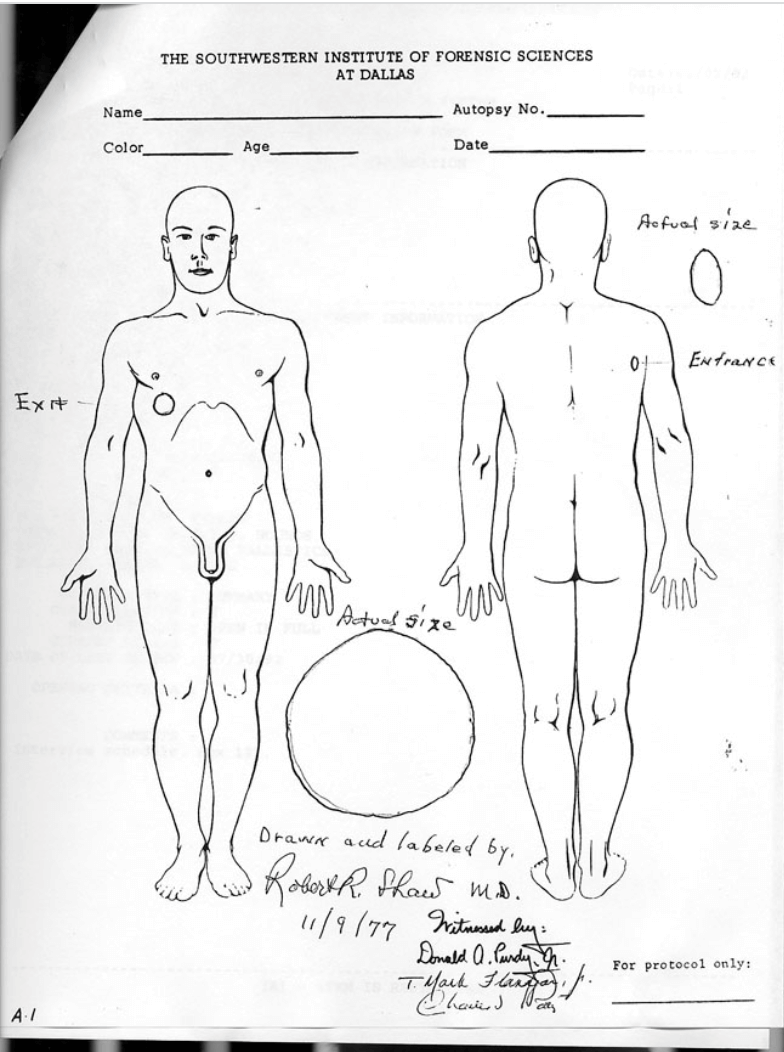
    Dr. Shaw, upon viewing Connally, “found that there was a small wound of entrance (in Connally’s back), roughly elliptical in shape, and approximately a centimeter and a half (5/8th of an inch) in its longest diameter.”

    Connally’s elliptical or oval wound, below his right shoulder, was 5/8ths of an inch along its vertical axis, that is, aligned with Connally’s body or pointing “north-south,” so to speak.

    The vertical elliptical or oval shape of the original wound is a tell, close to conclusive.

    From PathoilogyOutlines.com, in an article entirely unrelated to the JFKA: “Oval shape: suggests an acute angle of fire with respect to the skin.”

    A clean non-tumbling shot, entering Connally’s back from behind and above, such as from the Texas School Book Depository or the Dal-Tex building roof, would leave a vertical elliptical shape, which is precisely the original wound that Connally had.

    The length of ellipse would vary, depending on whether Connally was leaning forward or back at the moment of impact. Connally was almost certainly leaning back, as will be explained later, which would tend to lengthen the resulting elliptical wound.

    In contrast, a tumbling slug might make a ragged hole, as when the bullet’s butt-end struck the body sideways. Such a hole could be largely sideways to the body, or at a three-quarter angle, or oddly shaped in 100 different ways.

    In his testimony to the Warren Commission (WC), and to the House Select Committee on Assassinations (HSCA), Shaw said he thought the rear entrance wound on Connally likely resulted from an unobstructed shot from above, a conclusion bolstered upon his review of the Zapruder film and discussion with the Governor.

    Here is Dr. Shaw’s sketch indicating the vertical, elliptical shape of Connally’s wound—that is, up and down, not horizontal.

    Connally’s Back Wound

    There are other indications that Connally was struck by a non-tumbling bullet. For example, Shaw told the HSCA in 1977 that “there was a tunnel made by the missile in passing through (Connally’s) chest wall.”

    A “tunnel?” Do tumbling bullets make “tunnels”? Yes they do, but according to Dr. Shaw that is not what happened in this case.

    Connally’s Coat

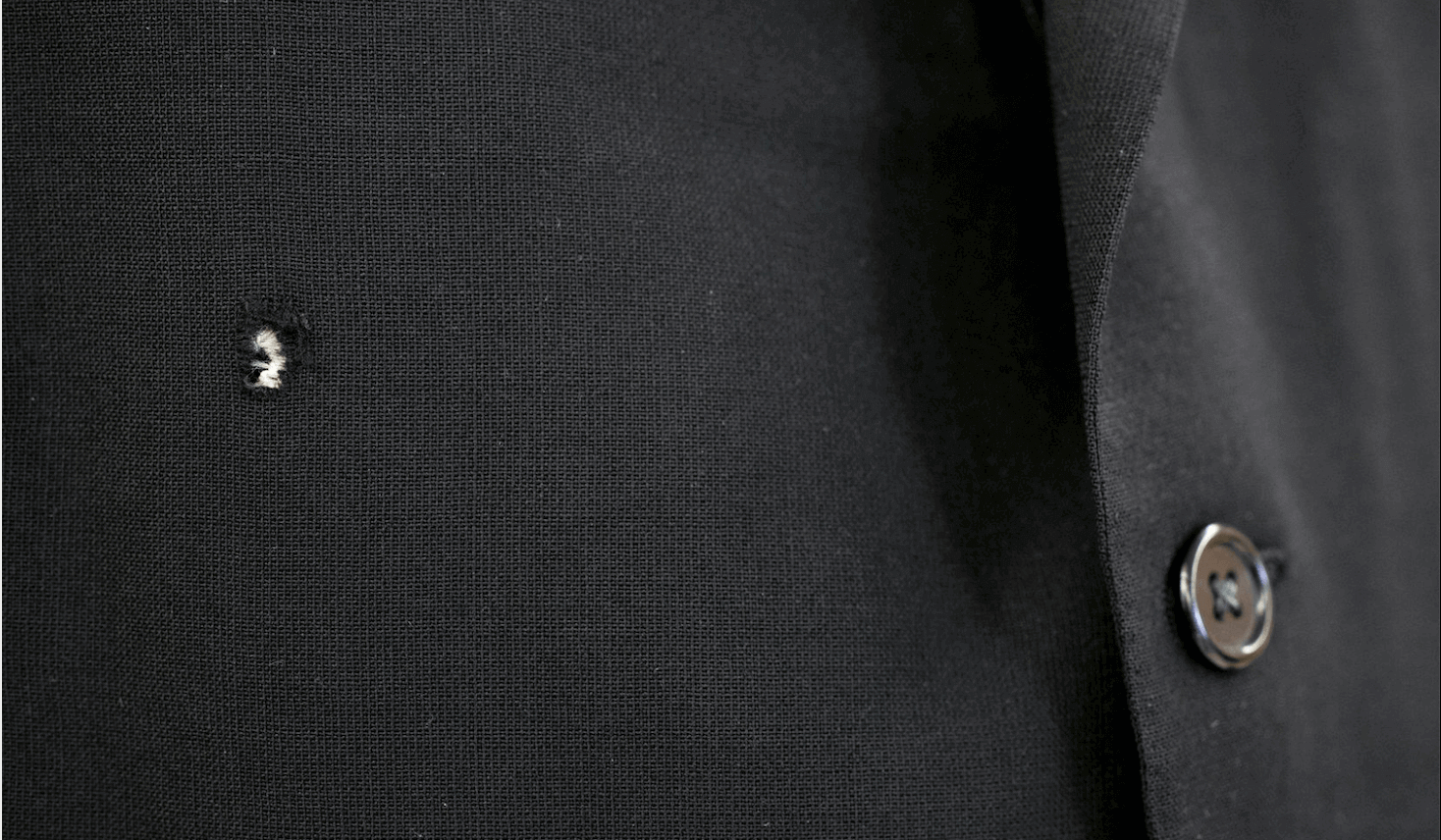
    But there is even more and Shaw was almost certainly correct in his assessment of the wound, for we have a photo Connally’s jacket from Nov. 22 featuring the exit hole the bullet made.

    Connally’s Coat Exit Hole

    And we see a small hole in the front of Connally’s jacket, exactly as if the bullet had cleanly exited. Note the size of the button, for reference.

    Thus, the tumbling single-bullet theory just gets deader and deader.

    To sum up: the tumbling-magic-bullet theorists posit the bullet struck JFK in the upper back, then exited Kennedy’s neck so straight and cleanly that it left a small hole below Kennedy’s Adam’s apple—a hole so small that attending doctors in Parkland Hospital thought it an entrance wound.

    Then (the magic-bullet theorists posit) the bullet tumbled after exiting Kennedy, although it somehow made a small hole in Connally’s shirt, and a small elliptical wound, and then stopped tumbling to tunnel through the Governor. And then the bullet exited exactly nose first, leaving a small hole in Connally’s coat.

    At the risk of piling on, there is even more evidence the shot Connally received that day in Dallas was not tumbling.

    Blundering Pathologists and Lawyers

    Proponents of the single-magic-bullet theory posit the bullet must have tumbled upon leaving President John Kennedy’s neck and then entering Connally. Why?

    That tumbling, proof that the magic bullet passed through JFK’s neck, is why the single magic bullet left a large wound on Connally’s back, the reasoning goes.

    However, the original wound on Connally’s back was not a large one, as is sometimes erroneously asserted, including, embarrassingly, by not only the HSCA’s top lawyer, but also by its top pathologist!

    As stated, Dr. Shaw clearly informed the WC and the HSCA that Connally’s original wound was a small vertical elliptical (or oval shape) injury 5/8ths of an inch long.

    Some of this ground has been covered previously in an excellent article by Millicent Cranor, “Trajectory of a Lie,” at History Matters.

    As noted by Cranor and in the record, Shaw explained to the WC and the HSCA that in order to clean and debride (cut away devitalized tissue) the wound, he enlarged the injury to twice its original size, to a final 3.0 centimeters long (1 1/4 quarter inch long).

    OK, so the final surgically enlarged wound is a one-a-one-quarter inch long, on Connally’s back.

    Here is how Michael Baden, who was chairman of the HSCA Forensic Pathology Panel, described Connally’s back wound in a book he authored: “He (Connally) removed his shirt. There it was—a two-inch long sideways entrance scar in his back. He had not been shot by a second shooter, but by the same flattened bullet that went through Kennedy.”

    Huh?

    So, the original wound, as described by the surgeon Shaw, was a vertical elliptical injury 5/8ths of an inch long.

    But the final scar is a “two-inch long sideways entrance scar,” according to the triumphant Baden, and that means the bullet that struck Connally in Dallas had been tumbling?

    How can Baden, a medical professional, bungle truth and common sense so badly? Had he never considered the small entrance hole in Connally’s shirt? Did he never read the reports by Dr. Shaw?

    And how did a one-and one-quarter-inch final, surgically enlarged wound, as explained by the surgeon Dr. Shaw, become “two-inch long sideways entrance scar” in Baden’s version?

    Even worse, Robert Blakey, chief counsel for the HSCA, fell into the same inexcusable misdiagnosis, also asking Connally to remove his shirt, and also describing the size of scar he had witnessed on the Governor’s back as proof of a tumbling bullet, and thus verifying the single-magic-bullet theory.

    Were the topic not so grave, Team Inspectors Clouseau comes to mind.

    But there is more.

    Dr. Shaw also believed the bullet that coursed through Connally could not have struck a body beforehand, or “it would not have had sufficient force to cause the remainder of the Governor’s wounds.” After tunneling through five inches of Connally’s rib, the bullet then struck and shattered Connally’s wrist before burrowing onto Connally’s left leg.

    But then, what did Shaw know? He had only worked on 900 bullet- and shrapnel-victims during WWII, and then another couple hundred such victims in Dallas.

    Nevertheless, Baden and Blakey would have the final wording of the HSCA report, a type of indelible excrement on the committee’s escutcheon.

    What the Connallys Said

    But there is even more.

    Governor Connally testified resolutely before the WC, and in many other forums (and has been recorded) that there were three shots that day in Dallas: The first shot struck JFK; the second shot struck the Governor in the back and immediately incapacitated him, and the third shot also struck JFK, with awful and fatal result. In other words, three shots, three hits, no tumbling.

    (There may have been and likely were more shots that day in Dallas, but the gunfire may not have been audible in the Presidential limousine, variously due to simultaneous fire, silencers, or use of a pneumatic weapon. In addition, non-simultaneous shots can be heard simultaneously if shooters are at different distances from ear witnesses.)

    Connally’s wife, at his side in the presidential limo, confirmed her husband’s account of the shot pattern many times. Secret Service agents Clint Hill and Sam Kinney, and presidential aide David Powers, all close at the scene on Nov. 22, also all say there were three separate shots that struck JFK and Connally that day, among many other witnesses.

    As Connally stated: “Beyond any question, and I’ll never change my opinion, the first bullet did not hit me. The second bullet did hit me. The third bullet did not hit me.”

    But Governor Connally, like Dr. Shaw—what does he know?

    Zapruder Film

    The Zapruder film almost certainly confirms the Connally’s version.

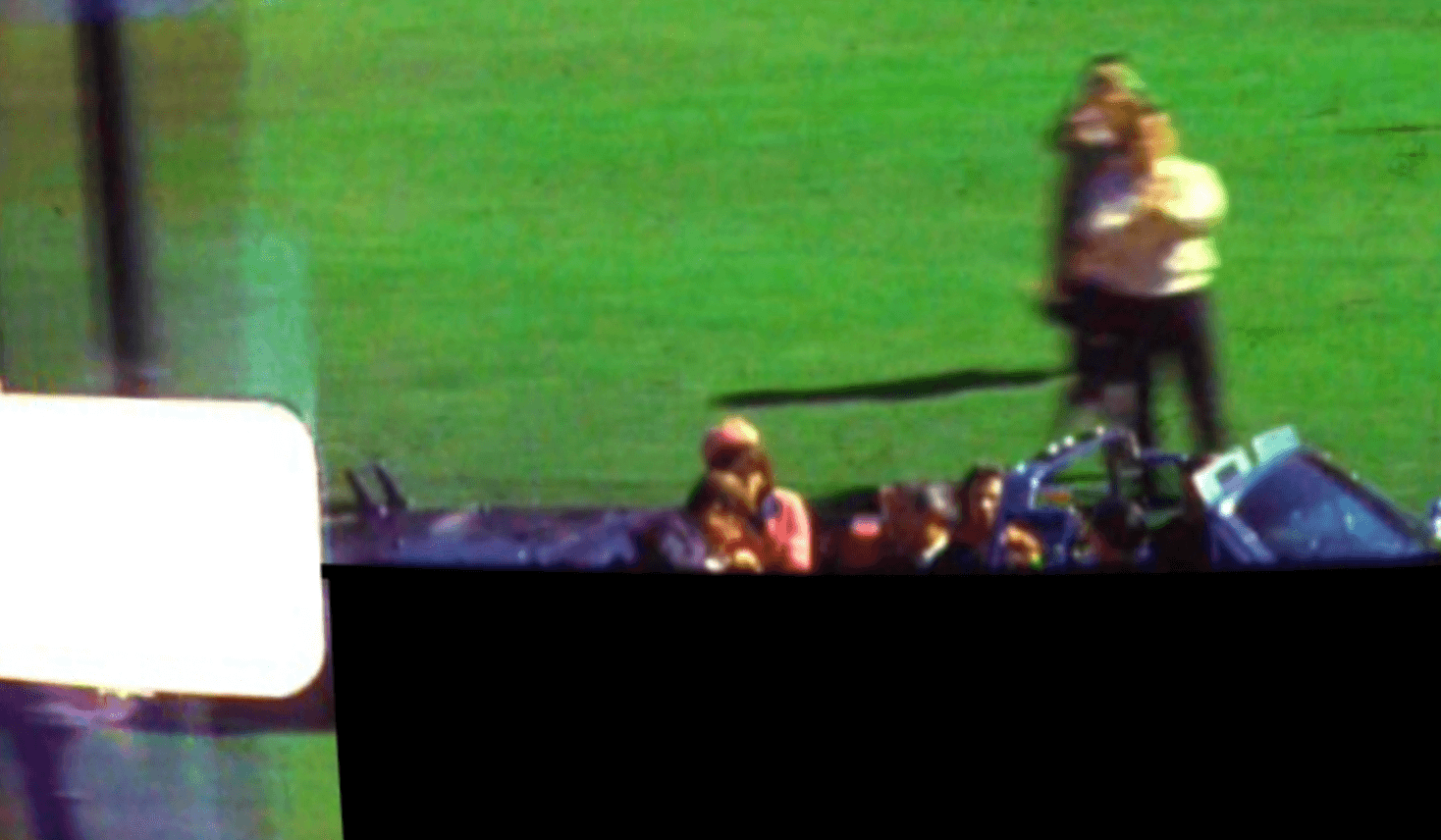
    Here is Zapruder film frame 226, as JFK emerges from behind the Stemmons Freeway sign. JFK appears to have been struck, perhaps just before or while he was behind the sign. Jackie Kennedy looks concerned. Connally is blurry, but sitting upright.

    Z-Film Frame 226. Kennedy is struck; Connally is upright.

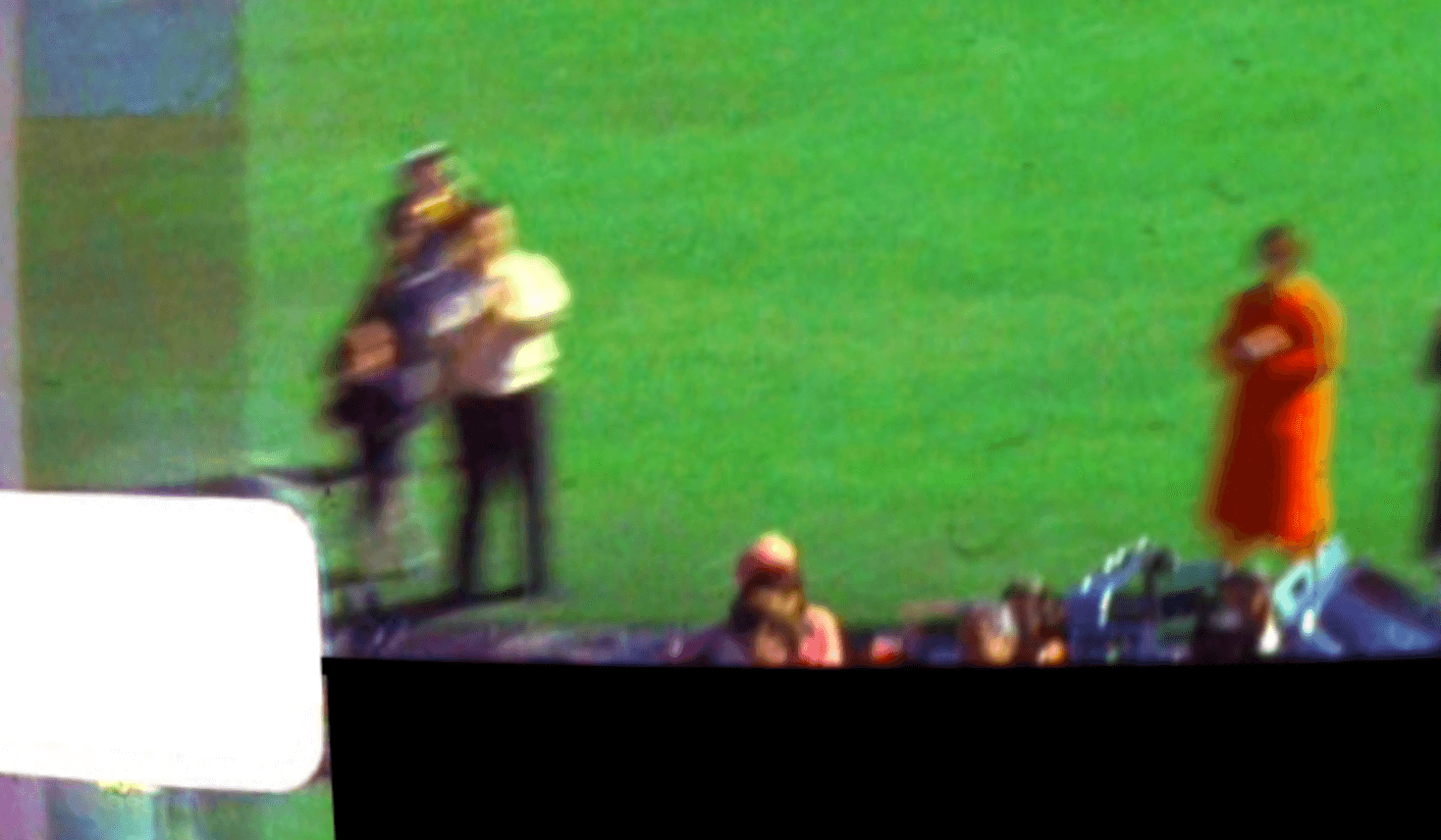
    Here is Z-film frame 245. Connally is halfway through a turn over his own right shoulder, just as he has recounted to the WC. Note, in order to turn around, Connally is leaning back. (Note: Try this yourself. Try to look over your own right shoulder at someone sitting behind you. Try leaning forward, and then leaning back, to look over your right shoulder.)

    Z-Film Frame 245. Connally is turning around.

    In the process of leaning back, Connally exposed his back at a more-acute angle to an elevated gunman, resulting in the original small elliptical wound described by Dr. Shaw.

    This is Z-film frame 280. Note Connally has made a near-180-degree turn in his chair. The WC and HSCA and magic-bullet theorists posit this about-face by Connally happened after he has been shot through the chest and suffered a fractured wrist.

    Connally and his wife said the Governor was trying to catch a glimpse of JFK, given commotion and gunfire, and this is before Connally has been shot. The Connally version appears to be true, beyond reasonable doubt.

    Z-Film Frame 280. Connally has made an 180-degree turn in his seat.

    This is Z-film frame 290. Unable to catch a view of JFK, who has slumped out of view, Connally is now returning to face forward.

    Z-Film Frame 290. Connally turns to face forward.

    And then Z-film frame 296. This appears to be when Connally was struck. Unfortunately, we cannot see Connally’s torso, but his face begins to grimace.

    Z-Film Frame 296. Connally is struck.

    And this is Z file frame 300. Connally appears to be in agony.

    Z-Film Frame 300. Connally is in pain.

    Z-film frame 313 follows, and shows a head shot to JFK.

    The elapsed time between frame 296 and frame 313 is less than eight-tenths of one second, and by all accounts, a single-shot bolt action rifle requires a bare minimum of two seconds to even operate between shots, let alone aim and fire.

    Conclusion

    The reasonable, indeed nearly inevitable and all but certain conclusion is that a bullet did not tumble before striking Connally, and that the timing between shots cannot be explained by a lone gunman operating a single-shot bolt-action rifle.

    The tumbling bullet theory was a desperate fiction invented to give support to the idea that single bullet caused all of Governor’s and the President’s neck wounds on Nov. 22. Otherwise there are too many shots to have been accomplished by a lone gunman with a single-shot bolt-action rifle.

    But from the too-small hole in the rear of Connally’s shirt, to the small elliptical wound in Connally’s back, to the Connally’s testimony, to the observations of Dr. Shaw, and from a review of the Z-film, it is abundantly clear that the Governor was struck by a clean and separate shot.

    Addendum

    Recently, in the oft-excellent pages of the Education Forum, the WC testimony of Dallas Sheriff Seymour Weitzman was reprised in an interesting post by John Butler.

    The relevant passage, in this context, regarding Nov. 22:

    (WC Attorney) Joe Ball: How many shots did you hear?

    Seymour Weitzman: Three distinct shots.

    Joe Ball: How were they spaced?

    Seymour Weitzman: First one, then the second two seemed to be simultaneously.

    But like Connally and Dr. Shaw, what did Weitzman Know?

    Second Addendum

    Interestingly, Dr. Shaw even suggested more than one bullet might have struck Connally. Why?

    The entrance wound on Connally’s wrist was on the side that most people wear the wristwatch, that is the non-palm side, also called the dorsal side. The bullet then exited through the palm side of the wrist.

    Dr. Shaw wondered how Connally could hold his arm so the bullet would pass through his chest and then through the wristwatch-side (or dorsal side) of his wrist. And indeed, try sitting down, and then try to touch the face of your wristwatch (worn on the right wrist) to your chest. You can’t do it. You can place the palm side of your wrist against your chest easily.

    One deduction is another bullet struck Connally’s wrist directly.

    And indeed, Connally testified before the WC that bullets were entering the Presidential limousine as if from “automatic” weapon fire.

    Yet the WC and HSCA posit the magic bullet passed through Connally’s chest, and then through dorsal, non-palm side of his wrist, a nearly impossible scenario, anatomically speaking.

  • Biden, Trump, the CIA: Reflections in a Dark Mirror, Nixon vs. Helms, 1971

    Biden, Trump, the CIA: Reflections in a Dark Mirror, Nixon vs. Helms, 1971


    Come October, President Joe Biden will make a decision on whether to release the remaining 15,834 still-repressed files that were supposed to have been released under the JFK Records Act of 1992.

    The JFK Act required that all the JFK files be made public in their entirety within 25 years, which of course, was 2017.

    But back in October 2017, President Donald Trump caved to the warnings of then-CIA director Mike Pompeo, FBI director Christopher Wray, and the National Security State, and left the remaining 15,834 files either redacted or totally under wraps.

    However, the mercurial Trump then also ordered the withheld files to be reviewed again within four years, perhaps seeking leverage over his adversaries in the intelligence communities.

    Fast forward to present, Trump has been booted from office and the betting is that Biden will also cave before the National Security State, despite the JFK assassination having happened 58 years ago.

    History is full of confounding realities. For all of his weaknesses, Trump was probably the better hope for full disclosure of the JFK records than Biden.

    For Trump was often, perhaps usually, at odds with the National Security State, variously called the “invisible government” or the “shadow government,” and, of late, “The Deep State.”

    In one of his seemingly ubiquitous running battles, Trump in 2019 detailed then-US Attorney General Robert Barr to investigate the nation’s investigative agencies, to ascertain whether elements of the Deep State illegally colluded to first try to prevent his ascendance to the White House, and then to undermine his presidency.

    At present, the criminal investigation into what is called “Russiagate” is led John Durham, now special counsel to the Justice Department and the former US Attorney for the District of Connecticut (2018–2021).

    Durham, originally tasked by Barr in May 2019 to investigate whether the invisible government had it in for Trump, has left the US Attorney’s Office with the advent of the Biden Administration, but has stayed on and is leading the criminal Russiagate investigation, as special counsel.

    Like so many modern-day Washington look-sees, the Durham inquiry promises to be interminable yet inconclusive and spun thereafter by party-based PR machines and media mouthpieces.

    Even a synopsis of the National Security State vs. Trump could consume a book. The famed Mueller investigation ended in a muddle, followed by a December 2019 report by the Department of Justice Inspector General that concluded that the FBI copiously lied to the Foreign Intelligence Surveillance Court, aka the FISA court, to gain permission to spy the former Trump campaign staffer Carter Page during the 2016 election.[1]

    To critics, Trump’s directives to Barr and Durham were the actions of a paranoid, or rank political theater. That could be. To put it mildly, Trump was and is a man of manifest flaws.

    But then, what other aspiring presidential candidate had contemporaneously written about him in the op-ed section of The New York Times, by a one-time director of the CIA: “Donald J. Trump is not only unqualified for the job, but he may well pose a threat to our national security.”[2]

    That line was penned by Michel J. Morell, professional lifer in the CIA, a onetime deputy director, and occasional acting director until his retirement in late 2013. 

    The Morell missive was run in The New York Times even before Trump became President.

    Yet Trump was hardly alone among presidents in his friction with the CIA; Presidents Harry Truman, John F. Kennedy, and Richard Nixon all had conflicts and reservations about the intelligence agency. Most famously, Kennedy has been quoted to the effect that he “wanted to splinter the CIA in a thousand pieces and scatter it to the winds,” due to the agency entangling his White House into the debacle known as the Bay of Pigs.

    Did someone say “Bay of Pigs?” That expression “Bay of Pigs” brings up Richard Nixon.

    Nixon’s Unsuccessful Struggle With the CIA

    Set the stage in 1971, with President Nixon requesting files from then-CIA Director Richard Helms. Paper files—this was largely the pre-computer days, and totally pre-internet.

    So, 50 years ago, what CIA files did Nixon want?

    “The ‘Who Shot John?’ angle,” Nixon explained to Helms, who was seated for a tête-à-tête in the Oval Office.  Nixon had circuitously outlined to Helms why he wanted to see certain files held by the intelligence agency, evidently to further illuminate the background of the assassination of President Kennedy in 1963.[3]

    All but forgotten in the voluminous White House tapes recorded by President Nixon is one of the strangest conversations ever to take place at 1600 Pennsylvania Avenue, a verbal tussle between Nixon and Helms on the morning of October 8, 1971.

    In that meeting, Nixon told Helms that he, the President—the Commander in Chief, the Chief Executive—wanted to see the CIA files on the “Bay of Pigs.”

    The end result: President Nixon never got to see those files.

    Helms sandbagged Nixon, confirming a separation of powers not pondered by the Founding Fathers nor by any sensible understanding of democratic institutions. 

    History rhymes, as they say, and Trump had wanted his AG Barr to review and then possibly make public files held by national security agencies, including the CIA.

    One could ponder if Trump, like Nixon, was effectively thwarted, meaning that the intelligence agencies remain essentially immune from Oval Office directives and oversight. 

    The Nixon-Helms Backdrop

    On that October morning 50 years ago, the cagey CIA Director Helms was mute in response to Nixon’s “The ‘Who shot John?’ angle” gambit.

    Nixon then badgered Helms with a bewildering string of questions regarding responsibility or indirect culpability for Kennedy’s death.

    “Is Eisenhower to blame? Is Kennedy to blame? Is Johnson to blame? Is Nixon to blame? Etc., etc.” asked Nixon. “It may become, not by me, a very vigorous issue but if it does, I need to know what is necessary to protect frankly the intelligence gathering and the dirty tricks department and I will protect it.”

    Nixon finished with the flourish, “I have done more than my share of lying to protect you and I believe it’s totally right to do it.”[4]

    Evidently, Helms was not moved by this Nixon soliloquy.

    The ever-scheming Nixon would later ask Helms for CIA help in derailing the Watergate investigation, by having the agency posit to the FBI that the famous Watergate break-in had actually been a CIA operation.

    Nixon advised his right-hand man and White House Chief of Staff H. R. Haldeman this way on June 23, 1973, as recorded on tape:

    Nixon: When you get in these (CIA) people when you…get these people in, say: “Look, the problem is that this [Watergate investigation] will open the whole, the whole Bay of Pigs thing…”[5]

    In other words, Nixon was implying, if the Watergate story blew open, so would the JFK assassination story.

    One interpretation of the Helms-Nixon stalemate is that Nixon wanted to know if CIA files had details on the Mafia-Cuban-CIA hit squads that had targeted Cuba-leader Fidel Castro in the late 1950s and early 1960s—efforts which Nixon had helped set up as President Dwight Eisenhower’s Vice President, along with CIA officer E. Howard Hunt, later known as the Nixon White House Watergate burglar-meister.

    Many JFK assassination researchers have concluded the anti-Castro death squads, possibly in cooperation with elements in US intelligence agencies, then turned on Kennedy after the failed CIA-sponsored 1961 Bay of Pigs invasion by Cuban exiles, in retribution for Kennedy’s decision to not provide air support for the beleaguered invaders. 

    Interestingly enough, arrested at the Watergate, on the fateful night of June 17, 1972, were five Cuban-exile operatives, including Eugenio R. Martinez, who it was revealed later was still on the receiving end of disbursements from CIA paymasters.

    H. R. Haldeman would later author a book and posit that the expression “Bay of Pigs” were Nixon code words for the JFK assassination. Certainly, if Nixon wanted to see the “Bay of Pigs” files to provide background information on “Who shot John,” then Haldeman’s intuition seems likely. To put it bluntly, Nixon was fishing for CIA files pertaining to the JFK assassination.[6]

    That October, 1971 morning, Nixon and Helms engaged in a polite, lengthy discussion about the President’s organizational and operational needs and prerogatives, to which Helms readily assented.

    But talk is cheap.

    Fast forward a year-and-a-half: Helms never coughed up vital Bay of Pigs files and White House tapes from May 18, 1973, reveal Haldeman informing Nixon that there was key memo missing “that the CIA or somebody has caused to disappear that impeded the effort to find out what really did happen on the Bay of Pigs.”

    So, in the case of Nixon vs. Helms, the CIA foiled a Presidential order to turn over files. The director of the CIA, Helms, was not answerable to the duly-elected US President.

    Of course, Nixon and Haldeman would have no way to know if many other “Bay of Pigs” files had also disappeared—national security agencies inherently have a monopoly not only on security information, but also on information about the information. 

    Ehrlichman

    The October 1971 Nixon-Helms conversation followed on the heels of an Oval Office chat between Nixon and John Ehrlichman, then Chief Domestic Adviser and previously White House Counsel.

    Ehrlichman, like Haldeman, explained to Nixon how he had been roadblocked by the CIA in his request for files and “the internal stuff.”

    Both wondered aloud how they could bring the CIA to heel and they discussed firing CIA Director Helms and replacing him with a loyalist. Then the pair discussed E. Howard Hunt, the ex-CIA officer they recently brought on-staff to the White House ostensibly to lead a “Plumbers’ Unit,” and who later organized burglaries, including the infamous Watergate break-in.

    “Helms is scared to death of this guy [E. Howard] Hunt we got working for us, because he knows where a lot of the bodies are buried,” opined Ehrlichman, in suggesting that the White House could intimidate Helms into cooperation by hinting Hunt had switched from the CIA to Team Nixon.[7]

    In the taped conversation, Ehrlichman and Nixon agreed that the CIA was pursuing “self-perpetuation” in keeping files secret—it would protect its image and could threaten that of others, with secret files.  “Helms is a bureaucrat first and he is protecting that bureau,” said Ehrlichman. Nixon retorted, “Well I am the President and the CIA is not, it [the CIA] is a self-perpetuating bureaucracy.”

    President or not, Nixon never got the files he wanted.

    The final irony is that Hunt, of whom Nixon and Ehrlichman chortled was their ace-in-the-hole against the CIA, in truth probably never stopped being a friend of the agency.

    Rob Roy Ratliff, the CIA’s liaison on the National Security Council, in 1974 provided an affidavit to the House Judiciary Committee, when it was weighing articles of impeachment against President Nixon.[8]

    Ratliff swore that Hunt, while ensconced in the White House, had used secure agency couriers to send sealed pouches to CIA Director Helms on a regular basis.

    Rather than being Nixon’s lever against the CIA, more likely Hunt was a mole for the agency, working in the White House. Like the old joke, Nixon’s paranoia did not mean no one was out to get him.

    Trump

    Of course, Trump’s relationship with the intelligence agencies and CIA was much different from Nixon’s, with no shared history in Cuba, Latin America or Iran, no alignment of fervently held ideologies, and no mutually buried bodies.

    Unlike Nixon who reveled in foreign affairs, Trump was no scholar of international relations and instinctually regarded  offshore incursions as entanglements.

    Yet Trump, like Nixon, was deeply concerned with what might be in intelligence agency files and whether the agencies answer to him, or have their own agendas, or even worse, have plans for a presidential demise.

    By many accounts, the US intelligence community and the CIA and their allies in the media strongly resist anyone from outside their sphere rendering judgment on what is secret and what is not.

    And indeed, the mass media in general sang the CIA tune during the Trump Presidency, fretting, as did The New Yorker magazine, that AG Barr would “unilaterally” declassify documents.[9] In other words, the presumption was that a President should only declassify documents if given approval by the National Security State.

    Of course, the intelligence agencies cited the well-worn and sometimes true clichés that they need to protect “sources and methods.”

    Conclusion

    Still, as in the long-ago Nixon White House, the highly politicized circumstances of the Trump Presidency muddied some underlying principles.

    Trump, like Nixon, was embattled and deeply unpopular in some circles and even considered a menace to the nation by some. Both Nixon and Trump hardly had the charm of a President Kennedy or Ronald Reagan, or even the affability of a Bill Clinton or George W. Bush.

    Yet Trump, like Nixon, was institutionally justified in his struggles with the intelligence agencies. As the elected President and Commander-in-Chief, Nixon had every right to view any file in the entire federal government. And Attorney General Barr, as deputized by Trump, had every right to look at and declassify any document at will, at Presidential direction.

    The real question remains: Will the intelligence agencies release all the relevant files to Special Counsel Durham or, like the CIA in the Nixon days, will they unilaterally withhold information?

    More speculative, but worth knowing—did  the CIA or other intelligence agencies have plants in the Trump campaign or in the Trump White House?

    And Biden?

    And looking forward: Will President Biden show the resolve necessary to release all the remaining 15,834 files that were supposed to have been released under the JFK Records Act of 1992?

    The record of Kennedy, and then Nixon, and then Trump, suggests that Biden will be unable to prevail against the National Security State, even if he tries.


    [1] Glenn Greenwald, The Inspector General’s Report on 2016 FBI Spying Reveals a Scandal of Historic Magnitude: Not Only for the FBI but Also the U.S. Media, The Intercept, 12/2/2019.

    [2] Michael J. Morell, I Ran the CIA, Now I Am Endorsing Hillary Clinton, The New York Times, 8/5/2016, see also https://www.nytimes.com/2016/08/05/opinion/campaign-stops/i-ran-the-cia-now-im-endorsing-hillary-clinton.html

    [3] Nixontapes.org. See http://nixontapeaudio.org/rmh/587-007a.mp3. See also Jefferson Morley, JFK Facts, 6/17/2014.

    [4] Ibid. 3

    [5]Smoking Gun”: Richard Nixon and Bob Haldeman discuss the Watergate break-in, June 23, 1972, Richard Nixon Presidential Library. See also Andrew Coan, Prosecuting the President: How Special Prosecutors Hold Presidents Accountable and Protect the Rule of Law, Oxford University Press, 165–166

    [6] Don Fulsom, Nixon’s Bay of Pigs Secrets, The History Reader, St. Martin’s Press.

    [7] Ibid 3

    [8] Chris Collins, Nixon’s Wars: Secrecy, Watergate, and the CIA, Eastern Kentucky University Encompass, 74.

    [9] David Rohde, “William Barr, Trump’s Sword and Shield,” The New Yorker, 1/13/2020.