Author: Gary L. Aguilar, MD and Cyril Wecht MD, JD

  • Nicholas Nalli and the JFK Case, Part 2

    Nicholas Nalli and the JFK Case, Part 2


    When Cyril Wecht, MD, JD and I put out a critique of Nicholas Nalli Ph.D.’s “peer reviewed” attempt to resuscitate Luis Alvarez’s moribund “jet effect” theory[1] – that Lee Oswald’s shot from behind “jetted” JFK’s head backward – we expected he’d respond. He did. Yet, he didn’t refute our scientific claims. Instead, he bristled that our commentary was, as the title of his rejoinder put it, “The Anti-Science Attack on Scientific Peer-Review.” Our major “sin” was impugning the questionable “peer review” processes that his journal, Heliyon, used to green-light his paper.

    We stated that Heliyon was not a proper, peer-reviewed scientific journal, for it required authors to pay to publish, and it asked them to suggest whom they’d like reviewing their submission and, worse, who’d they like not to “referee” it. Given the obvious flaws in his work, we argued what seemed sensible: that Heliyon was an unrigorous, pay-to-publish, more or less “vanity journal,” and that his “peer reviewers” were likely neither true experts nor anonymous, but probably folks he chose, including long time Warren loyalist, Mr. Larry Sturdivan. Dr. Nalli responded angrily, demanding a retraction and an apology for our blasphemies that were “an anti-science slander against scientists and contemporary peer-reviewed science publishing.”[2]

    Dr. Nalli is partly right: we are against “contemporary peer-review science publishing.” But not all of it. Dr. Nalli is apparently correct that nowadays some journals like Heliyon want authors to pay and to recommend reviewers. It didn’t used to be that way. Does anyone really believe science is better when a writer can select whom he or she does and does not want reviewing her submission?

    Dr. Nalli admitted that he’d paid Heliyon. But that he neither picked, nor knew, his “referees.” He said Heliyon found them and assured him that they had the requisite expertise – in forensic science, ballistics, projectiles, trauma research, gunshot injury, head injury, and impact, etc. Finally, Dr. Nalli fumed that Mr. “Larry Sturdivan was not one of the anonymous reviewers,” although he did say that Sturdivan had “consulted with him during the writing period.”

    If the above is true, in view of the errors in the work itself, one can have faith in the fact that Heliyon dropped the ball. Dr. Nalli’s reviewers plainly did not have the desired expertise. Nor did his consultant, Sturdivan.

    For example, Heliyon’s “experts” in ‘forensic science and gunshot and head injuries’ didn’t know that Dr. Nalli was wildly proposing that JFK’s premortem brain weighed 2,100 grams, ~700+ grams more than an unblasted, adult male brain.[3] Obviously, neither Dr. Nalli, nor Sturdivan, nor Heliyon’s “peer reviewers” took the 20 seconds it’d take to fact check human brain weights. It’s something an expert in forensic science and/or head injury should have known without googling, and would certainly have spent the 20 seconds if he didn’t.

    After his howler was brought to Dr. Nalli’s attention,[4] he published a correction, claiming his 2,100-gram figure wasn’t an error, but merely an “oversight.” It was indisputably an error; the oversight was his, Sturdivan’s, and his peer reviewers not bothering to check brain weights. Backpedaling to salvage his threadbare theory, he then proposed, with Heliyon’s “peer” approval, that Kennedy’s brain may have weighed “only” 1800 grams or 1650 grams,[5] both weights still well above the normal range of a compete brain – 1,250 to 1,400 grams.

    Worse, Dr. Nalli also offered a third possibility: that JFK’s premortem brain might have weighed 1500 grams, precisely what it weighed when measured at autopsy![6]

    If by pre mortem, Nalli means before he was shot, then Kennedy’s brain was quite above average. If Nalli means after he was shot but before the autopsy, then that would of course have been after bits of it had been blown all over Dealey Plaza, the limo, its occupants, the motor cops riding to the left rear of the limo (though not the right rear), etc. And after Jackie Kennedy had handed a “big chunk of the President’s brain” to Parkland Hospital’s chief of anesthesia, professor Marion “Pepper” Jenkins, MD, during the failed resuscitation effort.[7] Moreover, as per his “jet effect” theory, that would also have been after substantial brain ejecta had shot forward, providing the propulsion that Dr. Nalli argues jerked Kennedy’s skull rearward. Not very likely.

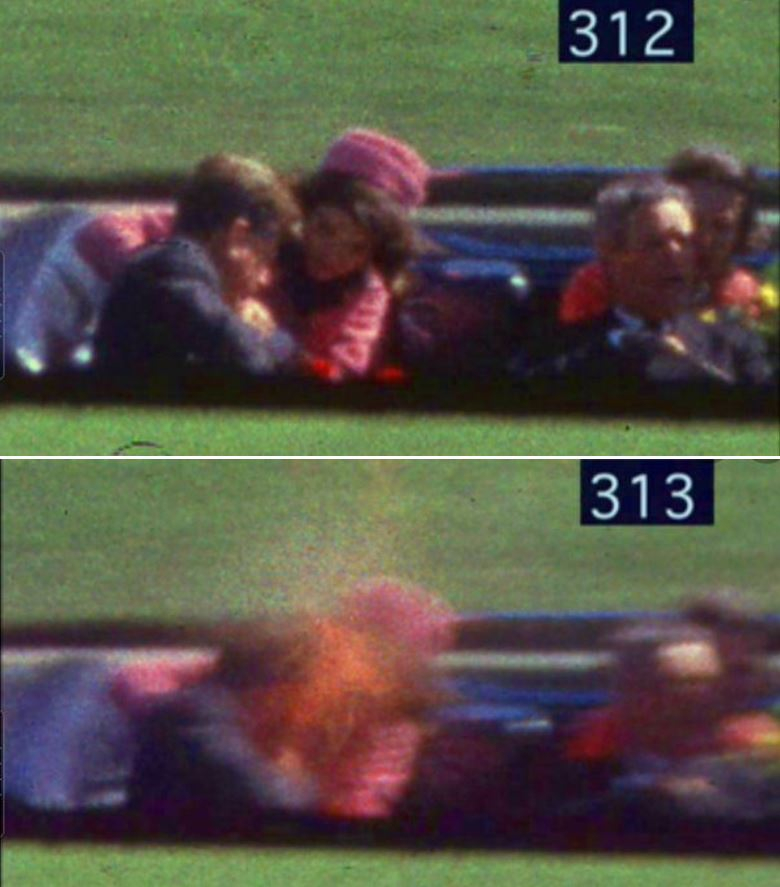
    Zapruder frame 313 shows a mist of debris just in front of JFK’s face, but no real “plume” of brain and bone matter flying forward of him. The exiting bone fragments are flying more upward, not forward. Not discernable in the two-dimensional frame is that those bits were also traveling leftward, and were found to JFK’s left. Similarly, the “debris field” from the frame 313 head shot was principally to the President’s left-rear. (See Figure 1.)

    Picture1Figure 1. Zapruder frame 313 and sketch of documented debris field from head shot at Z-313.

    Zapruder Frame 313 (left image) shows, in two dimensions, that there is a cloudy mist in front of JFK’s face. (See Fig. 2 for comparison with a similar mist seen in a skull-shooting test.) Exiting bone fragments are going mostly upward and, as discussed, to the left. They were not actually going forward which they would have been if, as claimed, Oswald’s shot had entered through the rear of Kennedy’s skull and exited the right front. The debris field (image right) shows that most of the ejecta moved “back and to the left,” as the President’s head also did. This is evidence the shot was fired from Kennedy’s right front, the “grassy knoll,” not his right rear.

    It was thus not accurate for Dr. Nalli to accuse Dr. Wecht and I of “anti-science slander against scientists.” Our brief wasn’t remotely against science or scientists. Quite the contrary. In our two articles we defended good science as against science that was not soundly based but was put out to primarily defend the government’s case for Oswald’s sole guilt.[8] Among these examples are several individuals Dr. Nalli heralds: Nobel Laureate Luis Alvarez, John Lattimer, MD, Messrs. Larry Sturdivan and Lucien Haag, Ken Rahn, Ph.D., Vincent Guinn, Ph.D.,[9] the so-called Ramsey Panel,[10] and, last but not least, the members of the House Select Committee’s forensics panel.[11] It would appear that, Dr. Nalli’s loyalty to these luminaries seems based less on their evidence than on their eminence and loyalty to the government. Let us exemplify our disagreement.

    Luis Alvarez

    Duplication Tests

    Dr. Nalli dilates on Alvarez’s “duplication” shooting tests that he contends confirmed the “jet effect.” He reports that the Nobelist felt stung by a critique he’d received from then-philosophy professor, Josiah Thompson, Ph.D. So, he worked with Paul Hoch, one of his Berkeley graduate students, to find experimental evidence to support his creative theory. Hoch recommended that “Alvarez perform some sort of experimental test that ‘could demonstrate the retrograde recoil on a rifle range, using a reasonable facsimile of a human head.’ They experimented firing upon different targets, ultimately deciding a taped melon as the best facsimile.” Hoch noted that the melons consistently exhibited a ‘retrograde motion’ toward the shooter. Alvarez thus demonstrated that a recoil effect is indeed possible.[12] Dr. Nalli’s account is both selective and incomplete–in a word, unscientific.

    Why did Dr. Nalli never address Josiah Thompson’s discovery that, in his “peer reviewed” Am. J. Physics “jet effect” paper, Alvarez never disclosed that he fired on multiple objects, and all but the melons flew away from the rifle, not towards it? (We had to wait for Thompson to learn of it.) While Dr. Nalli admits that Alvarez got different results from shooting at different objects, he doesn’t tell readers what they were. Is selective reporting that tells the test results that support one’s theory while omitting those that contradict it scientific? Apparently yes, according to Nalli. No, according to Thompson, me, and Wecht. And then there are questions about the specifics of Alvarez’s tests.

    Neither Dr. Nalli nor Alvarez acknowledged that the light-weight target melons only recoiled after being struck with super-charged, deforming, soft-nosed bullets, not after being pierced by the slower, nondeforming jacketed bullets Oswald supposedly used. Furthermore, is a soft-skinned, light-weight melon a “reasonable facsimile” of a much heavier, bony human head, scientifically? Yes, it is, according to Drs. Nalli, Hoch, and Alvarez. No, it isn’t, according to Thompson, Wecht and me. We’ll leave that for readers as a thought experiment. It shouldn’t take too much thinking.

    We challenged Dr. Nalli that this was shoddy scientific reportage. He gave no reply.

    The “Jiggle Effect”

    Alvarez had noted that some Zapruder frames are blurred, and concluded that the blurred images resulted from Zapruder’s delayed startle reaction to the sound of gunshots. “Delayed” because the sound of gunshots traveled more slowly than light, thus more slowly than the visible action in his film. In our review of Dr. Nalli’s tribute to Alvarez, we pointed out that the Nobel winner gave a preposterous, progovernment explanation for the most dramatic of the blurred frames: Zapruder frame 313.[13]

    He wrote: “[I]n the light of this background material we see that the obvious shot in frame 313 is accompanied immediately by an angular acceleration of the camera, in the proper sense of rotation to have been caused directly by shock-wave pressure on the camera body.”[14] Although he mentioned “shock waves,” Dr. Nalli (wisely) kept a deafening silence on Alvarez’s ridiculous claim about frame 313.

    As is well known, and which we pointed out, “shock waves” from bullet blasts travel at the speed of sound, about 1,100 ft/sec. They expand as a cone behind the nose of the bullet as it slices through air.[15][16] Oswald’s supposed bullet flew almost twice as fast as the shock wave, about 2,100 ft/sec. Thus, the expanding shock wave from that missile would not have reached Zapruder in time to blur 313 if Oswald had fired it, from 270 feet away. (Only a shock wave from a “grassy knoll” shot—~60 feet from Zapruder—would have been close enough to nudge the camera and blur frame 313. This fact provides additional corroboration that the frame 313 shot came from the “grassy knoll.” If Oswald had fired that shot, frames 315, 316, and/or 317 would be blurred, and they are not.)

    It’s difficult to understand how Alvarez either didn’t know that, or didn’t check to see if he was right about it. It’s less difficult to imagine why Mr. Science Dr. Nalli never addressed this in either his peevish reply to Wecht and I, or even in his review of Thompson’s book.[17] Similarly, Dr. Nalli refused to glance through another window Thompson opened that offers a useful insight into Alvarez’s loyalties.

    The Vela Incident and Alvarez’s Politics

    Thompson reported that Alvarez had produced a government-friendly, but flat-out wrong, report denying Israel and South Africa had exploded a nuclear device in the so-called “Vela Incident.” Alvarez was promptly debunked by both expert government investigators and on-sight witnesses that Seymour Hersh personally interviewed.[18] Nalli says nothing about this incident, whether in his response to our criticizing him for ignoring it, or in his review of Thompson’s book where it is explored in extenso. It’s an episode that speaks to Alvarez’s trustworthiness when he is called upon to weigh in on issues dear to the government’s heart. This history should not be ignored when judging Nobelist’s credibility on the government’s controversial version of Dallas’s darkest day. Dr. Nalli ignored it, as he did the problems with other Warren defenders he plugs.[19][20]

    John Lattimer, MD

    John Lattimer, MD, a confidant of J. Edgar Hoover[21] and a “jet effect” aficionado, is another of Dr. Nalli’s models.

    Conducting more analogous trials than Alvarez had, Dr. Lattimer fired at human skulls using a Mannlicher Carcano. But he fired downward at them from close range, striking the rear of filled human skulls that were perched atop ladders.[22] The target skulls recoiled, but apparently not due to any “jet effect.” As we pointed out, in his book, Hear No Evil, Donald Thomas, Ph.D. explained the obvious:

    “Lattimer’s diagrams reveal that the incoming angle of the bullet trajectory sloped downwards relative to the top of the ladder, with the justification that the assassin was shooting from an elevated position…But the downward angle would have had the effect of driving the skulls against the top of the ladder with a predictable result—a rebound.”[23] (A video clip of Dr. Lattimer’s shooting tests shows the bullet’s momentum rocking the ladder forward as the skull is driven against the top of the ladder and bounces backward.[24])

    Lattimer’s downward-shooting technique was precisely what longtime Warren defender, and another of Dr. Nalli’s consultants, Paul Hoch, Ph.D. (physics) had sensibly warned against. The target should be fired upon along a horizontal trajectory, Hoch said, not at a downward angle. And the target should either be dangling from a wire or laying on a flat surface.

    Lattimer’s botched technique gave predictably botched results, yet were published by a “peer reviewed” journal. Unlike Dr. Lattimer’s skulls, the base of JFK’s skull and jaw bone were not resting on a hard, flat surface. (It is also worth mentioning that the “wounds” sustained by the blasted skulls were not, as Dr. Lattimer reported, “very similar to those of the President.”[25]) While Dr. Nalli cites our paper debunking Lattimer’s tests, and while he also cites Don Thomas’s book, Hear No Evil, he champions science by maintaining a protective silence about Lattimer’s flawed technique.

    Lattimer’s tendentious skull shooting results were of a piece with his other “peer reviewed” results: He also shot melons. “No melon or skull or combination,” he reported, “ever fell away from the shooter in these multiple experiments,”[26] a finding that deserves an honorable place in the Journal of Irreproducible Results.[27] By contrast, Warren loyalist Mr. Lucien Haag reported what happened when he fired Carcano bullets at melons: “the melons (which were free to move) remained in place, and the entry and exits holes were small.”[28]

    Douglas Desalles, MD and Stanford Linear Accelerator physicist, Arthur Snyder, Ph.D. shot melons with MCC ammo and found the same thing: the targets barely budged, though some did roll slowly away. (Lucien Haag, however, did finally get melons to recoil. But only when he fired after clipping the tips off Carcano rounds to expose the soft lead cores, justifying doing so by arguing that the tip of Oswald’s jacketed bullet would have been breached when it struck JFK’s skull.[29])

    Unscientific Practice Among Pro-Government Authors

    A glaring omission mars all the scientific “peer reviewed” JFK papers by Haag, Alvarez, Lattimer and, given our mention of it in our critique, Dr. Nalli. It is requisite, standard practice in medical/scientific journalism to acknowledge and integrate prior published research findings that bear on an author’s thesis. Writers elaborating on newly discovered aspects of the Theory of Gravity, for example, might well tip their hats to Issac Newton and Albert Einstein. Earlier, published findings that are in conflict with a submitter’s research would typically be discussed and footnoted in referenced work. This is just standard, time-honored practice in peer-reviewed scientific, as well as nonscientific journalism.

    Judging by his copious footnotes, Dr. Nalli appears to grasp this. But when it comes to the “jet effect” and duplicating shooting experiments, Dr. Nalli and jet effect promoters Alvarez, Lattimer, and Lucien Haag, observe this fundamental practice in the breach. They all avert their gaze from what is perhaps the most truly analogous, and credible, test for jet effect ever performed.

    Undertaken by the government for the Warren Commission in 1964, the Biophysics Lab at Aberdeen Proving Grounds ran duplication tests that are virtually never acknowledged by government defenders.

    Using the kind of rifle and ammunition Oswald owned, dried human skulls filled with gelatin were fired upon from the rear. Mr. Larry Sturdivan, a government employee and lifelong Warren defender, participated in those experiments. Using a film shot at 2200 frames/second, he described what happened while testifying to the House Select Committee on Assassinations.

    “As you can see,” Sturdivan swore, “each of the two skulls that we have observed so far have moved in the direction of the bullet. In other words, both of them have been given some momentum in the direction that the bullet was going … In fact, all 10 of the skulls that we shot did essentially the same thing.”[30] (Figure 2)
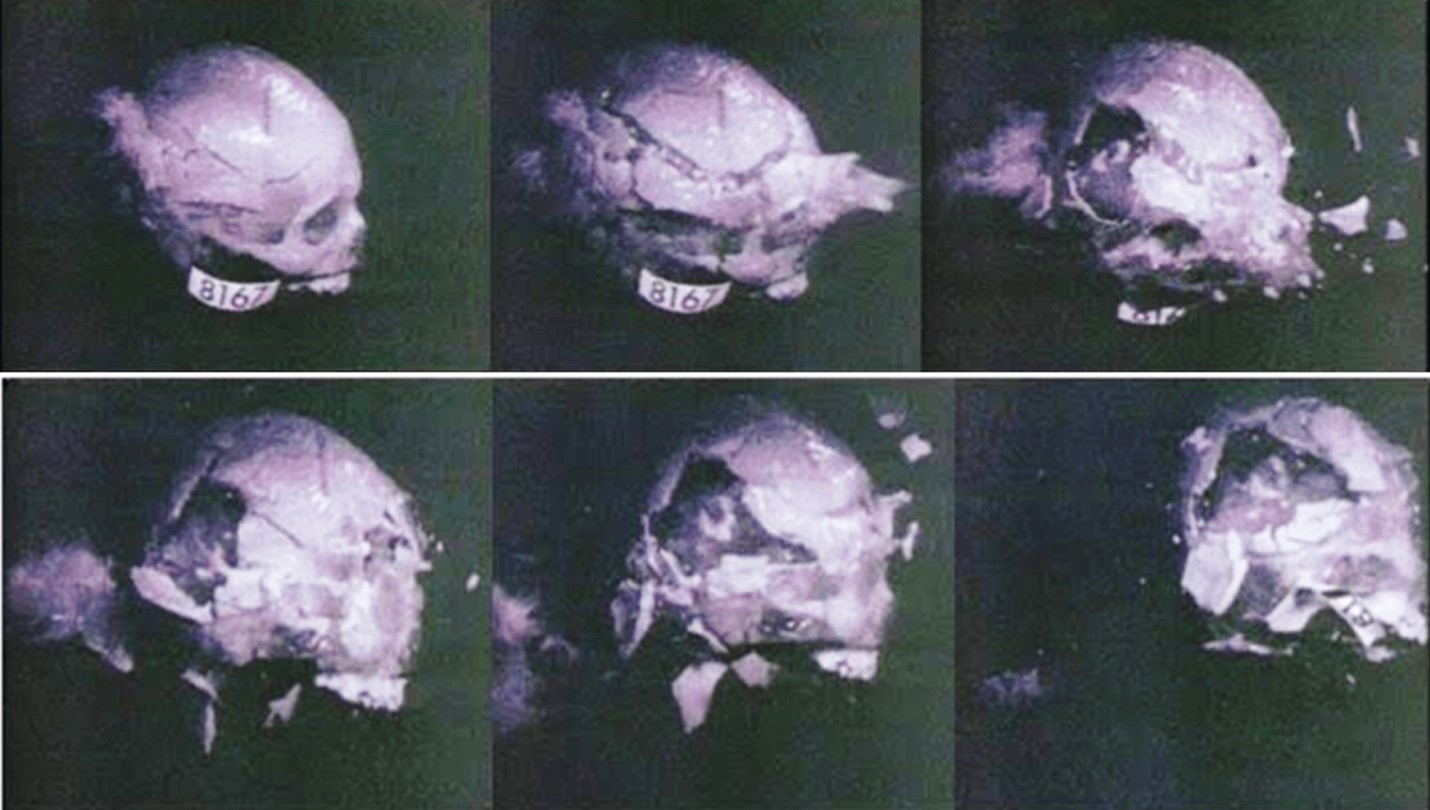
    Picture3Figure 2. High speed film images from Biophysics Lab skull shooting tests conducted for the Warren Commission in 1964. Note that while the bullet entered the back of the skull, the initial egress of misty material is thrown rearward from the point of entrance in the occiput, and that as much material appears to fly backward from the entry point as from the area of exit in the front. As the skull ruptures, the skull moves swiftly away from the shooter.

    Like the rearward egress of debris in first frame of this series, a mist appears overlying the right anterolateral aspect of JFK’s head in Zapruder frame 313 (Fig. 1), which offers experimental corroboration of a bullet entrance in this location. Bony fragments in the third frame of this series are blowing forward. By contrast, those from Kennedy’s skull flew upward and to the left.

    In our review, Dr. Wecht and I challenged Dr. Nalli on these government experiments. Like his heroes, Alvarez, Lattimer, Haag, et al, Dr. Nalli says not a word. This is science?

    Dr. Nalli and Neuromuscular Reaction

    In his original paper, Dr. Nalli argued that a “neuromuscular reaction” followed the initial “jet effect” at Zapruder 313-14, and it propelled Kennedy’s head and upper torso further rearward after Zapruder frame 315. Citing progovernment, nonexperts such as Gerald Posner, John Lattimer, and especially Larry Sturdivan, Dr. Nalli said that “a neuromuscular spasm is the only physically plausible mechanism known to this author.”[31]

    In our review we assaulted Dr. Nalli on this point. “If ‘neuromuscular spasm’ is the only physically plausible mechanism that Nalli knows of,” we wrote, “it’s likely because he’s ‘cherry picked’ the “expertise” of untrained, inexpert. anti-conspiracy crusaders … Were Nalli the least bit serious, or curious, he’d have scoured and cited the work of proper authorities (e.g. neurophysiologists, neurologists, perhaps even trauma surgeons). But he doesn’t; he sources nonexperts.” Among them are the pathologists of the HSCA’s forensic pathology panel, who are authorities on the victims of “unnatural deaths.” (With apologies to coauthor Wecht, pathologists are no more expert on neurophysiological phenomena of living humans than orthopedists are on pediatric asthma.)

    As we previously documented, JFK’s rearward lunge bears no resemblance to the two scientifically recognized types of “neuromuscular spasms” that have been repeatedly specified by Dr. Nalli’s consultant, Mr. Larry Sturdivan: “decorticate” and “decerebrate” neuromuscular reactions. In a filmed interview, Sturdivan demonstrated JFK’s “neuromuscular reaction.” (Figure 3.)

    Picture4Figure 3. Mr. Larry Sturdivan demonstrating JFK’s “neuromuscular reaction” to the fatal head shot.

    Mr. Sturdivan’s posture mimics neither JFK’s reaction to his fatal head injury nor an actual neuromuscular reaction.

    Picture5Figure 4.

    And here is how JFK actually reacted following the head shot at Zapruder 312-13, (Figure 5)
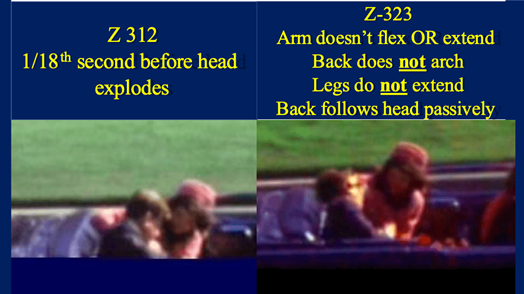
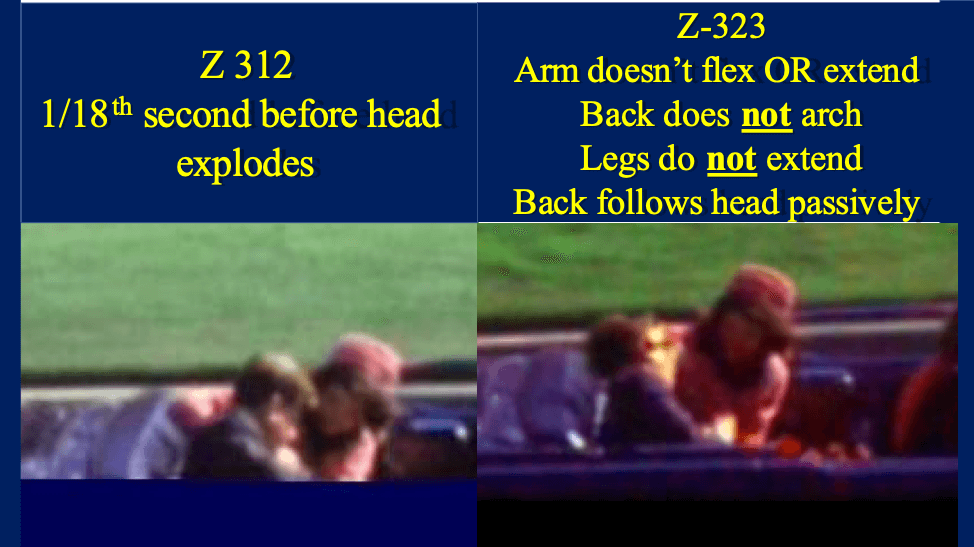
    Picture6Figure 5. Image left, 1/18th second before his head explodes: JFK’s head is chin-downward, tilted forward and slightly to the left. Image right, ½ second after he’s hit, it is JFK’s head that has moved backward. His back does not arch. His right arm neither flexes inward in “decorticate” posture, nor extends in “decerebrate” posture, as it would were it a “neuromuscular reaction.” Instead, it falls limply to Kennedy’s side.

    Note that JFK’s back does not arch; his legs do not extend, which would be detectable by an upward jerking of his body. His forearms do not adduct or extend as they would if his reaction was either decorticate or decerebrate; they simply drop. Unlike in “neuromuscular reactions,” Kennedy’s back passively follows his head, with no visible backward arching, or jerking.

    All this medically/scientifically-based evidence, and more, was laid out in our critique. Dr Nalli offered no counterevidence to it.

    He was similarly silent on our evisceration of his take on “neutron activation analysis” (NAA), another thoroughly debunked bit of junk science that supposedly buttressed Oswald’s sole guilt.

    Dr. Nalli and Neutron Activation Analysis

    NAA was first proffered as evidence in the Kennedy case by UC Irvine professor Vincent P. Guinn during his House Select Committee testimony. NAA is a sophisticated technique that supposedly allowed scientists to match bullet fragments from a crime scene to the bullet they came from. Guinn testified that NAA proved that all bullets and fragments from the assassination traced to but two bullets, which had been firearms-matched by the FBI to Oswald’s rifle. NAA was debunked years before Dr. Nalli ever put pen to paper on JFK. But because NAA is still touted by some anti-conspiracy evangelists, Dr. Nalli inexplicably tries to maintain it.

    For example, in his review of Last Second in Dallas, Dr. Nalli touts Guinn. He writes:

    …that it was ‘highly probable’ that the fragments in Gov. Connally’s wrist were from the ‘stretcher bullet’ (CE399) found at Parkland Hospital and that the fragments from President Kennedy’s head were from the same bullet as the fragments found in the limousine, thereby providing strong evidence that only two bullets caused all the wounds.[32] Dr. Nalli added a qualifier: “There has apparently been some degree of legitimate dispute about the NAA findings of Guinn. However, counterarguments have since been advanced from forensic experts such as Larry Sturdivan (cf. The JFK Myths) (sic) and Luke Haag. Lacking personal expertise, I shall remain, for the time being, agnostic on Guinn’s findings. Sturdivan and Haag are not to be easily dismissed…”[33]

    Dr. Nalli neither mentions nor alludes to what the “legitimate dispute” is all about, nor even who has disputed Guinn, Sturdivan, and Haag. He has a good, though not a scientific, reason not to. It would be difficult to justify why untrained, uncredentialed, crusading anti-conspiracy “forensic experts,” Sturdivan and Haag, would also happen to have expertise on NAA that’s on par with their detractors who have, contra Dr. Nalli, quite “easily dismissed” Sturdivan and Haag (as well as Guinn, and Kenneth Rahn, Ph.D., Sturdivan’s NAA coauthor).

    The ‘legitimate disputants’ Nalli didn’t think worth naming include the FBI’s National Laboratory, which abandoned the use of NAA to match bullets and fragments in 2005 because of its serious deficiencies;[34] two “conspiracy agnostic,” nationally recognized NAA authorities from Lawrence Livermore National Lab, Eric Randich, Ph.D. and Pat Grant, Ph.D., who specifically debunked Guinn’s JFK claims in the prestigious Journal of Forensic Sciences[35] (Guinn was one of Pat Grant’s professors at UC Irvine, and bore him no malice. See Grant’s “Commentary on Dr. Ken Rahn’s Work on the JFK Assassination Investigation.”[36]); a distinguished professor of statistics at Texas A&M University, Clifford Spiegelman, Ph.D., and his coauthor, FBI chief lab examiner William Tobin, who, among other things, eviscerated the flawed statistical analysis that Sturdivan, had published supporting NAA;[37] as well as others.[38]

    Furthermore, Nalli had every good reason to know of these inconvenient “alternative” facts, and not only from the “literature review” he should have done as a science writer during manuscript preparation. They’ve attracted considerable interest among assassination students. They are easily found by doing a simple google search.[39] Moreover, they were explored in extenso in a piece I wrote with coauthor Wecht that Nalli cites himself. That article included a detailed discussion of the collapse of NAA in bullet matching studies, both in the Kennedy case and elsewhere. It also provided the citations found here, with hotlinks to the peer reviewed papers and the source documents themselves.[40] Dr. Nalli averted his gaze from all this.

    Tellingly, Nalli also fails to mention that neither Sturdivan nor Haag have any primary expertise in NAA. They have no applicable training or background, and no credible NAA research, apart from Sturdivan’s debunked statistical analysis that was demolished, without refutation, by the statistics professor at Texas A&M; by the NAA authorities at Lawrence Livermore Lab,[41] and by Stanford Linear Accelerator physicist, Arthur Snyder, Ph.D.[42]

    Dr. Nalli thus puts lightweights Sturdivan and Haag on one side of the NAA scale, and these heavy-weight ‘legitimate disputants’ on the other, and says he must remain agnostic because they look balanced to him. This is exactly the kind of pro-government, anti-science, cherry-picking that skeptics have learned to expect from pro-Warren “scientific experts.” But the irony doesn’t end there.

    Referring to Thompson’s showcasing the work of the internationally recognized acoustics authority, James Barger, Nalli sniffed that “Thompson has no problem ‘appealing to authority’ when it suits him.’” Without delving into the complexities of the acoustics evidence, James Barger, is, actually, an internationally renowned authority to whom one may perfectly appropriately “appeal.” For Barger’s acoustics credentials, and those of the other acousticians who reported to the House Select Committee, easily surpass those of the so-called Ramsey Panel, the Alvaraz-selected physicists who were not acoustics trained, but who Warrenistas like to believe have debunked credentialed acoustics authorities.

    As he did with the government’s skull shooting tests at Aberdeen Proving Grounds, as well as with “neuromuscular reaction” and NAA, Dr. Nalli eschews credentialed, legitimate, published authorities, but has had ‘no problem appealing to the authority,’ and arguing from the authority, of inexpert, anti-conspiracy activists. For example, Eric Randich and Pat Grant versus Larry Sturdivan.

    Should Dr. Nalli ever want to publicly address our science-based challenges to Alvarez’s selectively reported shooting tests that “proved” his “jet effect theory;” or his “jiggle effect” explanation for why Zapruder frame 313 is blurred; or how Alvarez handled the “Vela Incident;” or John Lattimer’s “duplication” shooting tests; or the U.S. Government’s skull shooting experiments; or Kennedy’s supposed “neuromuscular reaction;” or Neutron Activation Analysis, we would be only too happy to engage and respond in the true spirit of scientific inquiry.

    We won’t be holding our breath. Interested readers shouldn’t either. For Dr. Nalli was invited to an on-line “frank exchange of views” with author Aguilar, a debate. He refused. He was then offered to debate physicist Paul Chambers, Ph.D., author of Head Shot: The Science Behind the JFK Assassination.[43] The host of the debate reassured Dr. Nalli that they would review the nature of the questions beforehand with both Dr Nalli and Dr. Chambers so Dr. Nalli would know it was not going to be an ambush.

    He refused that, too.


    Go to Part 1.


    [1] Nalli, Nicholas. Gunshot-wound dynamics model for John F. Kennedy assassination

    [2] http://jfkfiles.blogspot.com/search?q=nicholas+nalli

    [3] Nalli, Nicholas. Gunshot-wound dynamics model for John F. Kennedy assassination

    [4] Milicent Cranor. Scientist’s Trick ‘Explains’ JFK Backward Movement When Shot

    [5] Nalli, Nicholas. [Heliyon 4 (2018) e00603] Corrigendum to “Gunshot-wound dynamics model for John F. Kennedy assassination”

    [6] https://www.history-matters.com/archive/jfk/wc/wcvols/wh16/pdf/WH16_CE_391.pdf

    [7]JFK in Trauma Room One: The Missing Piece: Last Moments Before Death.” A YouTube video of Parkland Professor Marion T. Jenkins, MD discussing the assassination. This quote can be heard at and after the 5 minute, 25 second mark. Available here.

    [8] Gary Aguilar, Cyril Wecht. “Peer Reviewed” Medical/Scientific Journalism Has Been Corrupted by Warren Commission Apologists – Part 2

    [9] V P Guinn. JFK (John F Kennedy) Assassination – Bullet Analyses

    . Analytical Chemistry Volume: 51 Issue: 4 Dated: (April 1979) Pages: 484A-486A,488A,492A-493A

    [10] Josiah Thompson. Last Second in Dallas. University Press of Kansas, 2021.

    [11] HOW FIVE INVESTIGATIONS INTO JFK’S MEDICAL/AUTOPSY EVIDENCE GOT IT WRONG. Gary L. Aguilar, MD and Kathy Cunningham

    [12]https://www.academia.edu/50355206/The_Ghost_of_the_Grassy_Knoll_Gunman_and_the_Futile_Search_for_Signal_in_Noise. P. 7.

    [13] https://www.kennedysandking.com/john-f-kennedy-articles/1279#_edn78

    [14] Alvarez L, “A Physicist Examines the Kennedy Assassination Film”, American Journal of Physics Vol. 44, No. 9, p. 817. September, 1976. Available here.

    [15] “The speed of sound, known as Mach 1, varies depending on the medium through which a sound wave propagates. In dry, sea level air that is around 25 degrees Celsius, Mach 1 is equal to 340.29 meters per second, or 1,122.96 feet per second.” Available here.

    [16] Robert C. Maher. “Summary of Gun Shot Acoustics,” Montana State University 4 April 2006. “A supersonic bullet causes a characteristic shock wave pattern as it moves through the air. The shock wave expands as a cone behind the bullet, with the wave front propagating outward at the speed of sound.” Available here.

    [17] Nalli, Nicholas. The Ghost of the Grassy Knoll Gunman and the Futile Search for Signal in Noise

    [18] A brief discussion with source notes is available on-line in ref. #18, here.

    [19] See comment #3 following Nalli’s article, The Anti-Science Attack on Scientific Peer-Review. Comment posted here.

    [20] See also ref. #18, here.

    [21] See ARRB Testimony of Charles Baxter, Ronald Coy Jones, Robert M. Mclelland, Malcom Perry, Paul C. Peters, 27 Aug 1998, p. 39-42, here.

    [22] Lattimer JK, Lattimer J, Lattimer G. “An Experimental Study of the Backward Movement of President Kennedy’s Head,” Surgery, Gynecology & Obstetrics. February, 1976, Vol. 142, pp. 246–254.

    [23] Thomas, Don. Hear No Evil. Ipswich, MA. Mary Ferrell Foundation Press, 2010, pp. 362–363.

    [24] Clip from a Walter Cronkite CBS special on the assassination, with voice over by Cronkite. Note that the test skull sits flat, atop the ladder. When it is struck from above, the ladder swings forward as momentum imparted to the skull is transferred to the ladder: watch here.

    [25] Image available at: Milicent Cranor. Scientist’s Trick ‘Explains’ JFK Backward Movement When Shot.

    [26] Lattimer JK, Lattimer J, Lattimer G. “An Experimental Study of the Backward Movement of President Kennedy’s Head,” Surgery, Gynecology & Obstetrics. February, 1976, Vol. 142, pp. 246–254. Available here.

    [27] The Journal of Irreproducible Results 1980-2003. Available here.

    [28] Haag, L. “President Kennedy’s Fatal Head Wound and his Rearward Head ‘Snap,’” AFTE Journal, Vol. 46, No. 4, Fall 2014, p. 283; see Figure 8. (Copy available by request.)

    [29] Haag, L. President Kennedy’s Fatal Gunshot Wound and the Seemingly Anomalous Behavior of the Fatal Bullet. AFTE Journal, Vol. 46, No. 3, Summer 2014, p. 218ff.

    [30] Sturdivan LM. HSCA testimony, Vol.1:404. Available here.

    [31] Nalli N R. Gunshot-wound dynamics model for John F. Kennedy assassination.

    [32] Nalli, N R. “The Ghost of the Grassy Knoll Gunman,” a review of J. Thompson’s book “Last Second in Dallas” published on-line, 6/3/21.

    [33] Nalli, N. The Ghost of the Grassy Knoll Gunman and the Futile Search for Signal in Noise

    [34]FBI Laboratory Announces Discontinuation of Bullet Lead Examinations,” September 1, 2005. FBI National Press Office.

    [35] Erik Randich Ph.D., Patrick M. Grant Ph.D., Proper Assessment of the JFK Assassination Bullet Lead Evidence from Metallurgical and Statistical Perspectives. Journal of Forensic Sciences, V.51(4)717 ff. July 2006.

    [36] Pat Grant, Ph.D. “Commentary on Dr. Ken Rahn’s Work on the JFK Assassination Investigation.” Available on the Mary Ferrell website, here.

    [37] Cliff Spiegelman, William A. Tobin, William D. James, Simon J. Sheather, Stuart Wexler and D. Max Roundhill. CHEMICAL AND FORENSIC ANALYSIS OF JFK ASSASSINATION BULLET LOTS: IS A SECOND SHOOTER POSSIBLE?, The Annals of Applied Statistics 2007, Vol. 1, No. 2, pp. 287–301. Check here.

    [38] * Giannelli, Paul, “Comparative Bullet Lead Analysis: A Retrospective,” Case Western Reserve, Sept., 2001.
         * William Tobin. “Comparative Bullet Lead Analysis: A Case Study in Flawed Forensics”, www.nacdl.org The Champion.
         * Charles Pillar. “Report Finds Flaws in FBI Bullet AnalysisLos Angeles Times, 2/4/2004. Charles Pillar.

    [39] *Cliff Spiegelman, Ph.D. “What new forensic science reveals about JFK assassinationSalon.com, 12/12/2017.
          * See also: Pat Grant, Ph.D. (Lawrence Livermore Laboratory). Commentary on Dr. Ken Rahn’s (NAA) Work on the JFK Assassination Investigation.

    [40] https://www.kennedysandking.com/https://host626.com/wp-content/uploads/2016/07/AguilarWechtAFTA2015-f07.pdf

    [41] See Pat Grant’s evisceration of NAA defender, Ken Rahn. “Commentary on Dr. Ken Rahn’s Work on the JFK Assassination Investigation

    [42] Arthur Snyder, Ph.D. Comments on the Statistical Analysis in Ken Rahn’s Essay: “Neutron-Activation Analysis and the John F. Kennedy Assassination”

    [43] Head Shot: The Science Behind the JFK Assassination

  • “Peer Reviewed” Medical/Scientific Journalism Has Been Corrupted by Warren Commission Apologists – Part 2

    “Peer Reviewed” Medical/Scientific Journalism Has Been Corrupted by Warren Commission Apologists – Part 2


    see Part 1

    Larry Sturdivan Bamboozled Neurosurgery, a Legitimate Peer-Reviewed Journal

    In November 2003, the journal Neurosurgery published the first of what it promised would be three papers. It was entitled “The Assassination of President John F. Kennedy: A Neuroforensic Analysis—Part 1: A Neurosurgeon’s Previously Undocumented Eyewitness Account of the Events of November 22, 1963.’’ Except for the fourth of the four coauthors, Parkland witness Robert Grossman, MD, none were known to have particular knowledge of the JFK case. The paper’s stated purpose was to showcase Dr. Grossman’s “previously undocumented neurosurgeon’s eyewitness account of what occurred in Trauma Room 1 of Parkland Memorial Hospital on November 22, 1963, in an attempt to shed light on the nature of President Kennedy’s wounds.”[1]

    That claim fell wide of the mark. Grossman’s recollections in Neurosurgery were not “previously undocumented.” In 1981, The Boston Globe published Grossman’s account of what he saw in Trauma Room One.[2] He had also “documented” JFK’s wounds to the Assassinations Records Review Board in 1997. In fact, in 2003 Neurosurgery published virtually the same “JFK” skull diagram that Grossman had prepared for the Assassinations Records Review Board (ARRB) six years before.[3] (Fig. 8)

    By word and sketch, Grossman recounted that JFK had two skull wounds. The first was a round, 1 inch defect—to the right and ~1 inch above the external occipital protuberance, entirely within the occipital bone. (Fig. 6) The second was on the side of “JFK’s” skull, no larger than about 3 inches, or ~7 & 1/2 cm, and confined solely to parietal bone. Grossman saw no contiguity between the occipital defect and the defect in the right parietal bone that he depicted.

    Figure 8. Sketch diagrams of JFK’s skull injuries prepared by Robert Grossman, MD that were published the peer-reviewed journal, Neurosurgery, in the November 2003 issue (left).[4] Grossman’s labeled skull diagram published in the Assassinations Records Review Board in 1997 (right).[5]

    Neither Grossman’s description nor his images square with what are said to be the authentic photographs taken of the back of JFK’s head at autopsy. Nor are they consistent with the findings in the official autopsy report, or even the sketch diagram of Kennedy’s skull wound that was prepared on the night of the autopsy by one of the autopists. The photographs show no defect low in the back of Kennedy’s head (Fig. 9), and an image prepared on the night of JFK’s autopsy documented a much larger skull defect than 3 inches. (Fig. 10)

    Figure 9. Artist Ida Dox’s close rendition of an actual photograph of the back of Kennedy’s head taken during the autopsy. It was prepared for and published by, the House Select Committee on Assassinations. It shows no “1-inch” defect the occiput where Dr. Grossman said there was one.

    The official autopsy report specified that JFK’s skull defect measured 13 cm, fore to aft.[6] That was later corrected by autopsist, J. Thornton Boswell. He twice testified that when first examined, it actually measured 17 cm, which was the size that he documented on the “face sheet” diagram he prepared by hand during Kennedy’s autopsy. (Fig. 10)[7] After they replaced loose skull fragments into JFK’s skull wound, Boswell explained, the defect then measured 13 cm, and that was the dimension they put in the autopsy report.

    Figure 10. Dr. Boswell’s autopsy “face sheet” with the notation “17 missing”—arrows pointing fore to aft. Dr. Boswell testified that, when first examined, Kennedy’s skull defect measured 17 cm.

    Besides his claims about JFK’s skull wounds, Part 1 was also noteworthy for Grossman’s reporting that Parkland’s chief of neurosurgery, Kemp Clark, MD, “and I lifted (JFK’s) head to inspect the occiput,” where he saw “a laceration approximately 1 inch in diameter located close to the midline of the cranium, approximately 1 inch above the external occipital protuberance. Brain tissue, some of which I thought had the appearance of cerebellar folia, was lying in the laceration.”

    The importance of those remarks is not the nature of JFK’s injuries, which are demonstrably inaccurate, but that two neurosurgeons quite appropriately lifted JFK’s head and took a good look at Kennedy’s skull injuries. Like 7 other Parkland doctors, including Dr. Clark, Grossman said he saw a rearward wound—in the occiput. And he saw cerebellum, the small lobe of the brain at the rear-bottom of the brain case, under the occipital bone and beneath the large cerebral lobes of the brain. (That so many credible Parkland witnesses were in agreement on this is old news, but still important as the autopsy photos show there was no rearward skull wound and no cerebellar damage.[8]) Things got much more interesting in Part 2.

    In June 2004 Neurosurgery published Part II, entitled, “A Neuroforensic Analysis of the wounds of President John F. Kennedy: Part 2 – A Study of the Available Evidence, Eyewitness Correlations, Analysis and Conclusions.” The lead author was University of California Professor of Neurosurgery, Michael Levy, MD, Ph.D. As in Part I, the fourth coauthor was Robert Grossman, MD.[9]

    We were stunned by the long-discredited nonsense that was in it. As the Assassinations Archives and Research Center (AARC) was hosting a JFK conference in Washington, D.C. that fall, one of the current authors (GA) proposed inviting Professor Levy to give a presentation. He agreed and delivered a well-prepared Powerpoint talk. Author Aguilar then stood up and gave a point-by-point rebuttal. Professor Levy was dumbfounded. That evening, Levy joined authors Wecht and Aguilar, and Roger Feinman JD, for dinner. He expressed an honest shame and embarrassment that he knew nothing of the counterfactual evidence Aguilar had presented.

    As professor Levy was unknown in the JFK universe, we asked him where he got his information. He said that he based his paper and presentation on material that Dr. Grossman suggested he read. He encouraged us to submit a rejoinder to Neurosurgery to correct the factual record. We did and, apparently over the objections of Dr. Grossman, they published our 10,000 word rebuttal on September 2005.[10]

    As we worked on our reply, we noticed that the last page of Levy’s paper included a short congratulatory letter from Larry Sturdivan. “Part 2 of this article,” he wrote, “does not present important new evidence regarding the President’s wounds, as Part 1 did. [Which was false, as we’ve shown from the Boston Globe and the ARRB documents re Part 1, above.] Nevertheless, it is an important summary of the material previously reported. The report, especially the full version on the web site, not only saves the reader the time of acquiring these myriad sources, but also puts them into perspective in a way that a simple collection of documents cannot.”[11]

    Intrigued, one of us (GA) phoned the editors at Neurosurgery who were working with us on our reply. He asked them how they found the “peer” who’d reviewed Levy’s paper. They said they didn’t know who to ask. So they turned to Levy’s coauthor, Robert Grossman, the man who had driven the series of articles from the outset. He suggested they invite Larry Sturdivan to do the review.

    “Did you know that Grossman and Sturdivan have collaborated on JFK?” Aguilar asked. A quick on-line search confirmed that fact. “It’s highly irregular,” Aguilar said, “to have an author’s collaborator review his submission.” “Yes,” he replied, “it is highly irregular.”

    Following up via email, Aguilar wrote both the editors and Larry Sturdivan, and still has the emails. They openly admitted Sturdivan had “refereed” both Part I and Part II. Regarding Part II, Sturdivan emailed Aguilar and the editors of Neurosurgery the following:

    Dear Dr. Sullivan,

    As you suggested in your letter, the article was a quick read. I could find no substantive errors or typos. The following minor details should be examined before publication … . (emphasis added; copy available by request)

    No substantive errors?

    Given our rejoinder ran to roughly 10,000 words, with 94 footnotes, a comprehensive accounting of the “substantive errors” Sturdivan missed in Part II alone is well beyond the scope of this discussion. But it can be viewed on-line at Neurosurgery’s website.[12] However, a few of the errors we identified are worth touching upon.

    • Levy recycled debunked claims that the fibers in the back of JFK’s coat were bent inward and the fibers in his shirt front were bent outward, thus proving the back-to-front direction of the bullet. As we documented, it was FBI director J. Edgar Hoover who fabricated those claims and it was the FBI Lab itself that disavowed them.
    • Levy repeated one of the Warren Commission’s most discredited myths, namely, that a Warren Commission ballistics expert had successfully duplicated JFK’s injuries in simulation shooting tests with cadaver skulls. “That (test) bullet,” Levy wrote, “blew out the right side of the reconstructed cranium in a manner very similar to the head wounds of the President.” Except for the word “cranium” rather than “skull,” as was originally written, this sentence is torn verbatim from page 585 of the Warren Report, given without the appropriate quotation marks or attribution.[13] As we’ve shown here, we noted in our reply that the blasted test skull was not at all “very similar” to JFK’s. It sustained severe damage to the right forehead, the loss of the right orbit, and much of the cheek bone, injuries JFK did not sustain.
    • Dr. Levy accepted the legitimacy of Kennedy’s autopsy photos as well as Grossman’s claim that there was a one-inch hole in the occiput of JFK’s skull. He ignored the fact that the supposedly authentic autopsy photos show no occipital wound, one that was described not only by Grossman, but also by numerous Parkland physicians including the chief of neurosurgery, Kemp Clark MD. He also ignored that JFK’s autopsy surgeons all testified that photos they took on the night of the autopsy are missing.
    • Ironically, Levy never mentioned, and likely didn’t know, that the ARRB’s chief Analyst for Military Records, Douglas Horne, showed Grossman the Ida Dox sketch of the back of JFK’s head taken from the autopsy photographs (Fig. 8).[14] Grossman rejected it. Horne reported that, “Grossman immediately opined, ‘that’s completely incorrect.’ He insisted there had been a hole devoid of bone and scalp about 2 cm in diameter near the center of the occipital bone.”[15]
    • Dr. Levy cited the HSCA’s claim it had authenticated Kennedy’s autopsy photos. But he failed to notice a telling footnote in the very HSCA pages he cited in support of authentication. The HSCA wrote that, “Because the Department of Defense was unable to locate the camera and lens that were used to take these [autopsy] photographs, the [photographic] panel was unable to engage in an analysis similar to the one undertaken with the Oswald backyard pictures that was designed to determine whether a particular camera in issue had been used to take the photographs that were the subject of inquiry.”

      But that’s not what the Navy had said. Since Kennedy’s autopsy was performed at the Navy’s Bethesda Hospital, the Secretary of the Navy responded to the HSCA’s claim they hadn’t been given the camera that had taken JFK’s autopsy images . The Secretary huffily insisted that the Navy had definitely sent the HSCA the actual camera, the very one the HSCA’s experts had determined had not taken them.[17]

      Whereas the HSCA reported it could not completely close the loop because the camera was missing, the suppressed record suggests that 1) the loop was closed, 2) the camera was located, and 3) that the HSCA’s own authorities determined that the camera “could not have been used to take [JFK’s] autopsy pictures.” The HSCA staff elected to withhold this inconvenient information from the public. They also kept it from their own experts on the Forensic Pathology Panel, including the chairman, Dr. Michael Baden (personal communication), and one of the authors of this essay [CHW]. And so, as per Dr. Levy, the HSCA experts, and Neurosurgery readers were left to labor under the illusion that the images had passed authentication with flying colors.

    Thereafter, the editors worked with us and published our lengthy reply. Our evisceration of Dr. Grossman’s JFK project scuttled the rest of the planned operation. Neurosurgery never published the promised Part III of “A Neuroforensic Analysis of the Wounds of President John F. Kennedy.”

    The point of this extended discussion is to note that long-debunked anticonspiracy claims of “jet effect,” “neuromuscular reaction,” Neutron Activation Analysis, the government’s skull shooting tests, JFK’s authenticated autopsy photographs, the magic bullet, etc., continue to be recycled by fact-averse, anticonspiracy evangelists. Nicholas Nalli is the new crusader. He laughably tried to rehabilitate “jet effect” and “neuromuscular reaction.” He gave Sturdivan and Haag the benefit of the doubt on their repeatedly debunked NAA fantasies. And he did it in a “peer reviewed,” “scientific” article which was clearly reviewed not by anonymous, informed scientists, as Nalli claimed, but instead by ill-informed Warren loyalists, including in all likelihood, Larry Sturdivan.

    Suspicion falls to Sturdivan because Nalli gushingly acknowledges him (“first and foremost”) for reviewing drafts of his paper and for “providing expert feedback.” Just as Sturdivan had thrown eggs on the faces of Professor Levy and the editors of Neurosurgery by “peer-approving” so much nonsense, he did so again to Nicholas Nally by likely contributing to, and possibly “peer-reviewing,” some rubbish that should embarrass Nalli, and expose Heliyon as an outlet for authors who are unwilling to run their work through a proper, expert, anonymous “peer review” gauntlet.

    Lost in the fog of his attempt to give mouth-to-mouth to the government’s gasping scenario are the multiple lines of evidence Nalli ignores that converge on the conclusion anyone seeing the Zapruder film immediately draws: the mortal head shot at frame 313 came from the right front. For that reason, that’s a good place to start.

    What Can Science Tell Us About What Happened in Dealey Plaza?

    The Zapruder film, jiggle analysis, and the death of JFK

    As mentioned, in 1976 Alvarez theorized that some of the Zapruder frames are blurred at points that appear to correspond to Mr. Zapruder jerking his camera in startle-reaction to the sound of gunfire.[18],[19] His theory was later validated by CBS after it ran its own, independent experiment.[20] The HSCA also undertook its own “jiggle analysis.” On page 20 and 24 of the HSCA’s report, two independent consultants produced graphs depicting the frames in which there was blurring.[21] For the shot that allegedly flipped Governor Connally’s lapel at Zapruder frame 224, the HSCA graphs show a corresponding “jiggling” three frames later, at 227.[22] The delay is due to the fact the sound wave reached Zapruder after the speedier bullet hit its target. There are other frames that are much more “jiggled” than frame 227 is.

    One is Zapruder 313, the head shot. As discussed, if Oswald had fired that shot, frames 316–17 would be blurred.[23] They’re not; they’re sharp. There is only one mathematical possibility for a bullet shock wave distorting the camera’s gaze at frame 313: the bullet had to have been fired much closer to Zapruder than from Oswald’s alleged perch, 270 feet away. The best scenario is that it came from where Mr. Zapruder had told a Secret Service Agent on 11/22/63 it had come from, behind him, from the grassy knoll, approximately 60 feet behind the cameraman.[24],[25]

    Let’s assume the shot was fired between frame 312 and 313. Since the shock waves from rifle muzzle blasts travel at the speed of sound, ~1125 ft/sec, the sound and shock wave from a grassy knoll shot would have hit Zapruder in less than 1/20th second, that is, within a single frame of Zapruder’s camera. A good correlation. The sound and shock wave from Oswald’s position, however, would have hit Zapruder 3 to 4 frames later, at, say, 316 or 317.

    There is also considerable blurring of frames 331 and 332.[26] This appears to match a putative shot from behind that struck JFK’s head in frames 327–328 as per Last Second in Dallas, one which drove him forward more rapidly than he moved rearward after frame 313, as we’ve discussed.

    But what about Kennedy’s rearward lunge after frame 313? If not “jet effect” or “neuromuscular reaction,” what caused it?

    Did Momentum Transfer from a Grassy Knoll Shot Drive JFK “Back and to the Left?”

    To answer this question, we return to the most analogous, and credible, experimental evidence: the government’s 1964, Biophysics Lab, skull shooting experiments. As Larry Sturdivan testified, while demonstrating with film during his HSCA testimony, “All 10 of the skulls that we shot did essentially the same thing. They gained a little bit of momentum consistent with one or a little better foot-per-second velocity that would have been imparted by the bullet…”[27] (As discussed, in his book Sturdivan reported a higher, and more likely valid, velocity: “the skull…moves forward at approximately 3 feet/sec, just as it must from the momentum deposited by the bullet.”[28])

    Sturdivan thus argued, as he testified, that a shot from behind would have caused “slight movement toward the front, which would very rapidly be damped by the connection of the neck with the body.”[29] In other words, an MCC shell would have moved the skull in the direction of bullet travel. New information informs two key issues here.

    Mr. Sturdivan’s conclusion that momentum transfer could not explain JFK’s skull motion was based on experiments using modestly powered Mannlicher Carcano rounds weighing 162 grains (0.023 lbs) that struck their targets from a distance of 90 yards.[30] And he assumed the fatal bullet was jacketed, and so deposited only half of its momentum when it struck Kennedy’s 15-pound skull.[31] These assumptions are unjustifiable and unfairly bias his conclusions toward the lone gunman. (For example, there is no reason to assume a grassy knoll gunman would have used a Mannlicher Carcano and, in fact, the x-ray evidence suggests it wasn’t a Mannlicher Carcano. See below.)

    In his book, Hear No Evil, Don Thomas, Ph.D. scrutinized Mr. Sturdivan’s analysis in considerable detail. With permission, we quote Dr. Thomas.

    Sturdivan’s calculation, Thomas writes, was:

    derived indirectly from his tests shooting human skulls with a Mannlicher-Carcano. The bullet’s velocity at a distance of 90 yards was 1600 feet-per-second according to Sturdivan (in fact, the Army’s data indicated a value closer to 1800 fps) [sic]. Sturdivan then divided this number in half on the supposition (unstated) [sic] that the bullet would deposit only half of its momentum. This supposition was apparently based on his observation that a velocity of something like ‘one-foot-per-second’ was imparted to test skulls when shot with the Carcano.[32] Somehow, Mr. Sturdivan managed to miss the point that the rearward movement might have involved a shot origination from the grassy knoll only 30 yards in front of the target, with consequently less loss of velocity from air resistance, than from a position 90 yards behind the President. It also seemed not to have occurred to Sturdivan that the President might have been shot from the grassy knoll with a different rifle than the modestly powered Mannlicher-Carcano…[33]

    “For the purposes of this discussion,” Thomas continues,

    let us suppose that the hypothetical killer on the grassy knoll was armed with a .30-.30 rifle…(which) happens to have a muzzle velocity (2200ft/sec) very close to that of the Carcano and fires a 170-grain bullet, slightly larger than the Carcano bullet. At 30 yards, the projectile would have struck at a velocity of approximately 2100 fps…the momentum on impact with the head would be 50 ft-lb/sec. If one postulates a hunting bullet (in accordance with the x-ray evidence) [sic] which is designed to mushroom and deposit its energy at the wound instead of a fully jacketed bullet, we will allow a deposit of 80% of the momentum, leaving a residual velocity for the exiting bullet. This results in a momentum applied to the target of 40 ft-lb/sec; considerably more than Sturdivan’s stingy allowance of 18.4 ft-lb/sec. It is important to realize that, at the time Kennedy was struck with the fatal shot at Z-312-3, he had most likely been paralyzed by the shot through the base of the neck (as Sturdivan admits[34]). Consequently, his head was lolling forward, not supported by the muscles of the neck. This fact tends to minimize the damping effect (that so troubled Mr. Sturdivan) from the absorption of shock by the neck until after the head has snapped back. Assuming a head weight of 12 lbs, the velocity imparted to the head would be approximately 3.3 feet per second…[35] [The same speed of the test skulls that Mr. Sturdivan reported in his book, though in JFK’s case it might have even been faster as most estimates put the weight of a human head at 10-11 lbs.[36]]

    From the study of the Zapruder film by Josiah Thompson, the observed rearward velocity for the head was roughly 1.6 feet per second after frame 313.

    Thomas concludes, “Even given the uncertainty about the exact weight of the President’s head and the residual velocity of the bullet, the observed movement of the President’s head is well within the range, if anything less, than expected from the momentum imparted by the impact of a rifle bullet.”[37]

    In sum, if one corrects for Sturdivan’s faulty assumptions, yet uses his sound logic, the case for momentum transfer becomes compelling. Thus, if Sturdivan is right, as per Aberdeen Proving Grounds, that jacketed, Western Cartridge Company (WCC) shells moved blasted skulls forward at 3 ft/sec, or even 1.2ft/sec, imagine how swiftly one would move if struck with heavier, higher velocity, soft-nosed bullet fired from a much closer location; perhaps enough not only to move JFK’s skull “back and to the left,” but also enough to even nudge his probably paralyzed upper body in the direction of his head.

    As Thomas hinted, Kennedy’s x-rays suggest just such a scenario.

    X-Ray Evidence for a Shot from the Grassy Knoll

    While it is evident that a soft-nosed bullet fired from the right front could have delivered sufficient momentum to drive his head back and to the left, during HSCA testimony it was claimed that JFK’s x-rays prove that he was not hit by a soft-nosed round; that the fatal bullet was jacketed, like Oswald’s. This conclusion is false. It rests on a misreading and misunderstanding of the x-rays. Properly read and understood, Kennedy’s x-rays give evidence for a non-jacketed bullet. The confusion began during late 1970s. That is when the HSCA put an altered version of JFK’s lateral x-ray into evidence and had a non-radiologist, non-physician interpret the altered x-ray—the omnipresent “neuromuscular reaction” “authority,” the Neutron Activation Analysis “expert,” and now the radiology specialist, Larry Sturdivan.

    The untrained Sturdivan displayed an “enhanced” version of JFK’s lateral x-ray to the HSCA members (Fig. 10). It was not the original film. The process of enhancement greatly increases the contrast of the x-ray, making the skull bones look much brighter and denser than they appear in the originals. But the process also blots out some of the clinically significant, fine details, including the presence of any miniscule, “dust-like” bullet fragments. Sturdivan testified that the enhanced x-ray ruled out the possibility of a non-jacketed round because, he said, if it had been a non-jacketed shell there would have been many tiny bullet fragments visible on the x-ray.

    But, in fact, there are many, tiny fragments on JFK’s skull x-ray. They’re not visible because they’ve been blotted out from view on the enhanced film he presented to the HSCA. The following exchange under oath captured his error.

    The Select Committee asked, “Mr. Sturdivan, taking a look at JFK exhibit F–53, which is an x-ray of President Kennedy’s skull,[38] can you give us your opinion as to whether the President may have been hit with an exploding bullet?”

    “Well,” he replied, “this adds considerable amount of evidence to the pictures which were not conclusive. In this enhanced x-ray of the skull, the scattering of the fragments throughout the wound tract are characteristic of a deforming bullet. This bullet could either be a jacketed bullet that had deformed on impact or a soft-nosed or hollow-point bullet that was fully jacketed and therefore not losing all of its mass. It is not characteristic of an exploding bullet or frangible bullet, because in either of those cases the fragments would have been much more numerous and much smaller. A very small fragment has very high drag in tissue and, consequently, none of those would have penetrated very far. In those cases, you would definitely have seen a cloud of metallic fragments very near the entrance wound. So this case is typical of a deforming jacketed bullet leaving fragments along its path as it goes.” (emphasis added throughout)[39]

    To demonstrate his point in his 2005 book, Sturdivan reproduced on the same page both Kennedy’s enhanced lateral skull x-ray and the unenhanced lateral x-ray of a skull shot with a Carcano round in the Biophysics Lab’s tests in 1964.[40] The pattern of bullet fragmentation was very similar, he said, and he was right. (Figs. 9 and 10)

    Re JFK’s enhanced x-ray, he wrote: “…Lead fragments are scattered within the skull, reaching the frontal bone, not clustered at the entry point. Frangible bullets would disintegrate very quickly, producing a dense cloud of fragments at the entry site…the extent of fragmentation of the bullet is characteristic of that of a fully jacketed military bullet that deformed and broke apart upon impact with the skull…It is not that of a frangible, soft-nosed or hollow-point bullet.”[41] (emphasis added)

    The unenhanced x-ray of the Biophysics test skull (Fig. 12) shows much the same thing as Kennedy’s enhanced x-ray (Fig. 11), a scattering of small, but not “dust like,” radiolucencies—bullet fragments—across the lower portion of the skull. Neither JFK’s enhanced x-ray nor the unenhanced film of the test skull shot with a Carcano round show the miniscule, more numerous fragments that Sturdivan correctly said would have been present had either been struck with a non-jacketed round.

    But Kennedy’s original, unenhanced skull x-rays at the National Archives actually do show a cloud of myriad, tiny radiolucencies. Those tiny fragments, and their location, collapse the case for a lone gunman for the good reasons Sturdivan gave: a non-jacketed bullet leaves numerous, tiny fragments near their point of striking—just like those that are clearly visible in Kennedy’s original, unenhanced x-rays. Jacketed bullets like Oswald’s don’t do that.

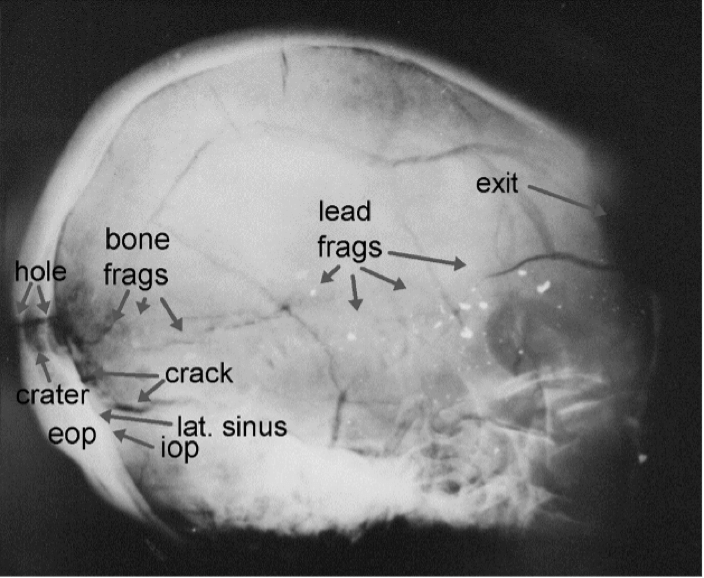
    Figure 11. Enhanced lateral x-ray taken of JFK during the autopsy. (HSCA Exhibit F 53; 1HSCA240) Note that there is a trail of fragments that runs very close to the top of JFK’s skull, and that no “dust like” fragments are visible. Instead, most of the fragments are small, similar to the Carcano fragments in the Biophysics’ unenhanced x-ray of a test skull shot with a MCC round. (Fig. 12) JFK’s original, unenhanced x-rays do show myriad, miniscule fragments that are not visible in this enhanced image. The run along the top of the x-ray, decidedly above the low entrance wound specified in the original autopsy report, and even above the higher entrance wound later accepted by the Clark Panel and the HSCA.
    Figure 12. Unenhanced, lateral x-ray of a test skull shot with a Mannlicher Carcano by the Biophysics Lab.[42] The bullet entered low, through the occipital bone, and so the fragment trail is low, as the bullet traversed the lower portion of the skull. As with JFK’s enhanced x-ray, there is a scattering of small fragments. Note the absence of the myriad, tiny fragments that were described as present in JFK’s unenhanced x-rays.

    Both authors Wecht and Aguilar have examined the still-secret, original, unenhanced x-rays at the National Archives and have seen that “dust like” fragments are present in the right front quadrant of Kennedy’s skull x-rays. We are not the only ones who’ve noticed them. They were reported by Kennedy’s chief pathologist, Dr. James Humes, by a Secret Service agent, as well as other government consulting, expert radiologists. The presence of miniscule fragments essentially rules out that Oswald’s single, jacketed round hit Kennedy at frame 313.

    Why?

    For the good reasons Sturdivan gave: tiny fragments don’t travel far in tissue, because of their low mass relative to their large surface area, their “high drag” in tissue. Tiny bullet fragments are quickly stopped in tissue. In contrast, larger fragments have proportionately less surface area compared with their mass than small fragments do, and so drive further through tissue before being stopped.

    Besides their presence, a telling detail is the location of the tiny fragments. They sit in the right front quadrant of JFK’s skull, which, to borrow from Sturdivan, is likely “very near the entrance wound.” This evidence has largely lain unrecognized and unappreciated in the record since 1964.

    • During his Warren Commission testimony in 1964, Dr. Humes said: “(JFK’s x-rays) had disclosed to us multiple minute fragments of radio opaque material…These tiny fragments that were seen dispersed through the substance of the brain in between were, in fact, just that extremely minute, less than 1 mm in size for the most part.” A few moments later, Dr. Humes was asked, “Approximately how many fragments were observed, Dr. Humes, on the x-ray?” “I would have to refer to them again (the x-rays),” he answered, “but I would say between 30 or 40 tiny dust-like particle fragments of radio opaque material, with the exception of this one I previously mentioned, which was seen to be above and very slightly behind the right orbit.”[43]
    • Secret Service Agent Roy Kellerman, an autopsy witness, testified that the fragments in JFK’s skull x-ray, “looked like a little mass of stars; there must have been 30, 40 lights where these pieces were so minute that they couldn’t be reached.”[44]
    • Russell Morgan, MD, the chairman of the department of radiology at Johns Hopkins University, was the Clark Panel’s radiologist. “Distributed through the right cerebral hemisphere are numerous, small irregular metallic fragments,” the Panel reported, “most of which are less than 1 mm in maximum dimension. The majority of these fragments lie anteriorly and superiorly. None can be visualized on the left side of the brain and none below a horizontal plane through the floor of the anterior fossa of the skull.”[45] (emphasis added)
    • Cook County Hospital Forensic Radiologist, John Fitzpatrick, MD, examined JFK’s x-rays in consultation for the ARRB and agreed, writing: “There is a ‘snow trail’ of metallic fragments in the lateral skull X-Rays which probably corresponds to a bullet track through the head, but the direction of the bullet (whether back-to-front or front-to-back) [sic] cannot be determined by anything about the snow trail itself.”[46]

    Authors Wecht and Aguilar concur: there are myriad “dust like” fragments visible on JFK’s lateral x-ray, a “snow trail,” if you will. The vast majority are confined to the right front quadrant of Kennedy’s skull, which is where, as per Sturdivan, a non-jacketed bullet struck.

    Practicing radiologist Michael Chesser, MD examined the original, unenhanced JFK x-rays and came to the same conclusion. “This location, on the intracranial side of the bony defect, is highly suggestive of an entry wound,” he wrote. “One of the principles of skull ballistics is that the largest fragments travel the furthest from the entry site, with the smallest traveling the least distance, and that is exactly what is seen on this right lateral skull x-ray. Tiny fragments are seen on the inner side of this right frontal skull defect, and the largest fragments were noted in the back of the skull.”[47]

    Forensic pathologist Vincent DiMaio, MD elaborated upon the meaning of a “snow trail,” or “snow storm”: “[T]he snowstorm appearance of an x-ray almost always indicates that the individual was shot with a centerfire hunting ammunition…”[48]* That is, a non-jacketed round. And as per Sturdivan, the right-forward location of the tiny fragments is a clear indication of what is visible in Zapruder film: an entrance wound in the right front quadrant of Kennedy’s head for a bullet that left a tell-tail cloud of “dust like” fragments in that area. For, although he thought that the shot at Zapruder frame 313 went from back to front, Sturdivan admitted what is well understood in the “ballistics/forensics” community: “A similar explosion would have taken place if the bullet had gone through in the opposite direction.”[49] In fact, Fig. 2 in Part I of this essay demonstrates this very principle: the human skulls shot in the government’s tests show about as much cranial contents egressing out of the entrance point at the rear of the test skull as out of the front.

    (*In a later edition of DiMaio’s book, he allowed that the breach of the shell’s jacket after Oswald’s bullet went through Kennedy’s skull might have released the tiny lead fragments seen in the x-rays. However, he offered no evidence for this claim and the Biophysics skull shooting tests did not show this phenomenon. DiMaio’s is thus an assertion made without evidence and, therefore, will be dismissed in view of the counterevidence from the Biophysics tests.)

    Sturdivan finally saw the original, unenhanced images in 2004 at the National Archives. He was emphatic under oath to the HSCA that the absence of tiny fragments in the enhanced x-ray proved that a jacketed bullet, not a hunting round, had struck JFK. But when he wrote his book in 2005, and when he reported on his examination of the originals that dramatically do show the telltale tiny fragments in the right front quadrant of JFK’s skull, he said nothing about them. He either didn’t notice them, or elected not to say he had.[50] “Scientists” like him don’t see what they don’t want to see. The HSCA’s x-ray “expert,” Sturdivan, didn’t see what other, vastly better credentialed, true experts did see.

    The trail of small, but not miniscule, fragments that are visible runs along the top of JFK’s skull in both the enhanced and nonenhanced lateral x-rays. It does not align with the supposed low entrance wound specified by the autopsy surgeons in occipital bone, although the autopsy surgeons said it did. Nor does it line up with the higher entrance wound the Clark Panel identified, although the Clark Panel said it did.[51] In fact, as anyone can see the fragment trail in JFK’s lateral x-ray is about 5 cm above where both the Clark Panel and the HSCA said it was. (Fig. 11) That high fragment trail offers evidence there was a second head shot, from behind, with a jacketed round, a possibility that is also suggested by the “jiggle” evidence in the Zapruder film, by Professor Barger’s acoustics analysis, and by JFK’s rapidly forward moving skull after frame 328, as explored by Thompson in Last Second in Dallas.

    To recap, there is a cloud of tiny fragments on JFK’s x-ray, which is typical of a hunting round, but not Oswald’s jacketed bullet. That cloud is located in the right front portion of his skull, where they would have been quickly stopped by “tissue drag.” This physical evidence independently buttresses the “jiggle evidence” in the Zapruder film that the shot at 313 came from a location close to the camera, the grassy knoll, precisely where the acoustics evidence said it originated, and not from Oswald’s spot, 270 feet away. It is consistent with evidence that JFK’s split-second lunge “back and to the left” was due to the large momentum that was transferred to Kennedy’s cranium by a non-jacketed bullet that mushroomed on impact, and not due to “jet effect” and/or “neuromuscular reaction.”

    These multiple, mutually corroborating lines of evidence point in a direction that seemed obvious to the eye of anyone who watched the Zapruder film on the Geraldo Rivera’s Good Night America show in 1975. It is also what seemed evident 28 years ago to Mr. Masaad Ayoob, a respected gun expert and the former Vice Chairman of the Forensic Evidence Committee of the National Association of Criminal Defense Lawyers (NACDL):[52]

    The explosion of the President’s head as seen in frame 313 of the Zapruder film is simply not characteristic of a full metal-jacket rifle bullet traveling at 2,200 fps or less. It is far more consistent with an explosive wound of entry with a small-bore, hyper-velocity rifle bullet traveling between 3,000 and 4,000 fps, and probably toward the higher end of that scale…An explosive wound of entry occurs when a highly liquid area of the body, such as the brain, is struck by a high velocity round. The tissue swells violently during the microseconds of the bullet’s passing and seeks the line of least resistance. That least resistance is the portal of the entry wound that appeared a microsecond before and the bullet will not bore an exit hole to relieve the pressure for another microsecond or two—perhaps not at all if the bullet fragments inside the brain. If the cataclysmic cranial injury inflicted on Kennedy was indeed an explosive wound of entry, the source of the shot would have had to be forward of the Presidential limousine, to its right, and slightly above…the area of the grassy knoll.[53]

    Mr. Ayoob speaks from experience. He notes that the closest commonly used cartridge to a Carcano

    …in terms of ballistics is probably the .30/30, which has a .308″ diameter. The Carcano round, about a .263″ diameter. Ask any homicide detective if he’s ever seen a .30/30 round blow a man’s head up at 55 to 60 yards, exploding the calvarium up and away from the body proper. Ask any hunter of deer-size game if he’s ever seen the same thing at that distance. It happens only at very close range with that ballistic technology. The wound we see happening in frame 313 in the Zapruder film—and see the results of most clearly in frame 337—is simply not consistent with this rifle cartridge at that distance in living tissue. It is particularly inconsistent with a round-nose full metal-jacket bullet of the type Oswald had in his rifle.[54] [Note that the head of the goat shot in the government’s tests does not explode as JFK’s did. (Fig. 5)]

    Mr. Ayoob does not completely discount the possibility of Oswald’s culpability, but only if the shell “for unexplainable reasons did damage out of all proportion to its ballistic capability as most of us would perceive that to be.”[55]

    That takes us back to what author Wecht suspected during his tenure on the Forensics Panel of the House Select Committee: JFK’s “…backward head motion might be explained by a soft-nosed bullet that struck the right side of the President’s head.” Wecht presciently surmised that before these multiple lines of independent, converging evidence had been assembled that confirm what seemed so obvious to him, to Masaad Ayoob, and to anyone viewing the Zapruder film.

    In Last Second in Dallas, Thompson quoted Don DeLillo: “[D]id the shot simply come from the front, as every cell in your body tells you it did?” “Don DeLillo is right,” Thompson answered, “When you look at the Zapruder film, every cell in your body tells you the shot at frame 313 came from the right front.”[56] We now know that it’s not only your every cell, but it’s also the science that tells you that. It’s the “Occam’s Razor” solution: the simplest, most complete and compelling explanation of the shot that killed John Kennedy. It’s one that requires no suspension of disbelief; no invocation of tortured, disanalogous neurophysiological phenomena; no misreading of Kennedy’s original autopsy x-rays; and it’s one that honors the many witnesses in Dealey Plaza who said that a shot came from the grassy knoll, not least being the 21 cops who “heard a grassy knoll shot.”[57]

    [see also: Milicent Cranor’s Forensics Journal Unintentionally Proves Conspiracy in Cover-Up of JFK Assassination and John Lattimer Never Quit: The Thorburn Business]


    [1] Daniel Sullivan, M.Div., Rodrick Faccio, B.S., Michael L. Levy, M.D., Ph.D., Robert G. Grossman, M.D., Neurosurgery, Vol. 53, No. 5, November 2003, p. 1020. Available here.

    [2] Ben Bradlee. “Dispute on JFK Assassination.” Boston Globe, 6/21/81, p. A–23. Available here.

    [3] ARRB MD file # 185. Available here. (see pp. 4 and 5)

    [4] Sullivan, Dan. “The Assassination of President John F. Kennedy: A Neuroforensic Analysis—Part 1:

    A Neurosurgeon’s Previously Undocumented Eyewitness Account of the Events of November 22, 1963,” Neurosurgery, Vol. 53, No. 5, November 2003, p. 1024. Available here.

    [5] MD 185 – ARRB Meeting Report Summarizing 3/21/97 In-Person Interview of Dr. Robert Grossman. Available here.

    [6] Warren Commission JFK autopsy report, p. 3. Available here.

    [7] ARRB testimony of J. Thornton Boswell, pp. 71–72. Available here.

    HSCA testimony of J. Thornton Boswell. HSCA Vol.7, p. 253. Available here.

    [8] See Aguilar G, Cunningham K. “How Five Investigations into JFK’s Medical/Autopsy Evidence Got It Wrong, Part V. The ‘Last’ Investigation—The House Select Committee on Assassinations.” Available here.

    [9] Levy M, Sullivan D, Faccio R, Grossman R. “A Neuroforensic Analysis of the Wounds of President John F. Kennedy: Part 2—A Study of the Available Evidence, Eyewitness Correlations, Analysis, and Conclusions,” Neurosurgery. Vol. 54, No. 6, June 2004, E1–E23. Available here.

    [10] Aguilar G, Wecht C, Bradford R. Neurosurgery. Vol. 57, No. 3, September 2005.

    [11] Levy M, Sullivan D, Faccio R, Grossman R. “A Neuroforensic Analysis of the Wounds of President John F. Kennedy: Part 2—A Study of the Available Evidence, Eyewitness Correlations, Analysis, and Conclusions,” Neurosurgery. Vol. 54, No. 6, June 2004, E23. Available here.

    [12] Aguilar G, Wecht HC, Bradford R. Reply to: “A Neuroforensic Analysis of the Wounds of President John F. Kennedy: Part 2—A Study of the Available Evidence, Eyewitness Correlations, Analysis, and Conclusions,” Neurosurgery. Available here.

    [13] Warren Report, p. 585. Available here. See also Warren Commission testimony of Alfred Olivier, DVM, 5H, p. 89. Available here.

    [14] See JFK Exhibit F-48. In HSCA, Vol. 1, p. 234. Available here.

    [15] Horne, Douglas, Inside the Assassination Records Review Board Volume 2, p. 656.

    [16] HSCA Vol. 6, p. 226. Available here.

    [17] See Memorandum for File on 8/27/1998 by the ARRB’s Douglas Horne, entitled, “Unanswered Questions Raised by the HSCA’s Analysis and Conclusions Regarding the Camera Identified by the Navy and Department of Defense as the Camera Used at President Kennedy’s Autopsy. Available here.

    [18] Alvarez, L. A physicist examines the Kennedy assassination film. Am J. Physics, 1976; 44 (9):813 ff. Available here.

    [19] Olson D, Turner RF, “Photographic evidence and the assassination of president John F. Kennedy,” Journal of Forensic Sciences, 1971; Vol. 16, No. 4, pp. 399–419. Available here.

    [20] Ken Scearce & Brian Roselle. “Secrets of the Zapruder Film.” Available here.

    [21] HSCA Vol. 6, p. 26. Available here.

    [22] Zapruder frames 224 and 227. Available here and here.

    [23] Zapruder frames 117 and 316. Available here and here.

    [24] Thomas, D B. Hear No Evil, Ipswich, MA: Mary Ferrell Foundation Press, 2010, p. 202-215. Available here.

    [25] Secret Service Agent Max Phillips interviewed Zapruder on 11.22.63. His memo appears nowhere in the Warren Commission documents or volumes. It was discovered at the National Archives by Mr. Harold Weisberg. Agent Phillips reported that “According to Mr. Zapruder the assassin was behind Mr. Zapruder.” Weisberg H. Whitewash III: The Photographic Whitewash of the JFK Assassination, New York, Skyhorse Publishing, 1967. See text under “Section I – The New Math and the New Morality.” Available here.

    [26] Zapruder frame 331. Available here.

    [27] House Select Committee on Assassinations testimony of Larry Sturdivan, September 8, 1978, 1H, p. 404. Available here.

    [28] Sturdivan LM. The JFK Myths, St. Paul, MN: Paragon House, 2005, p. 164.

    [29] HSCA testimony of Larry Sturdivan, September 8, 1978, 1H, pp. 413–414. Available here.

    [30] HSCA testimony of Larry Sturdivan, September 8, 1978, 1H, p. 404. Available here.

    [31] HSCA testimony of Larry Sturdivan, September 8, 1978, 1H, pp. 413–414. Available here.

    [32] HSCA testimony of Larry Sturdivan, September 8, 1978, 1H, p. 404. Available here.

    [33] Thomas, Donald B. Hear No Evil, Ipswich, MA: Mary Ferrell Foundation Press, 2010, pp. 344–345.

    [34] Larry Sturdivan apparently agrees. He wrote: “Neurosurgeon Dr. Michael Carey thinks that (JFK) may be falling (by Zapruder frame 312) as a result of temporary paralysis from the spinal damage associated with the neck wound.” Sturdivan LM. The JFK Myths, St. Paul, MN: Paragon House, 2005, p. 209, note 96.

    [35] Thomas, Donald B. Hear No Evil, Ipswich, MA: Mary Ferrell Foundation Press, 2010, pp. 345–346.

    [36] “How Much Does the Human Head Actually Weigh?” Available here.

    [37] Thomas, Donald B. Hear No Evil, Ipswich, MA: Mary Ferrell Foundation Press, 2010, pp. 345–346.

    [38] HSCA Exhibit F-53, enhanced lateral skull x-ray, HSCA Vol. 1, p. 240. Available here.

    [39] HSCA testimony of Larry Sturdivan. Vol.1:401. Available here.

    [40] Sturdivan LM. The JFK Myths, St. Paul, MN: Paragon House, 2005, Fig. 38, p. 173.

    [41] Sturdivan LM. The JFK Myths, St. Paul, MN: Paragon House, 2005, p. 177.

    [42] Source: Sturdivan, LM, Review of JFK Photographs and X-Rays at the National Archives, September 23, 2004. Available here.

    [43] Warren Commission testimony of James H. Humes, MD, Vol. 2:353. Available here.

    [44] Warren Commission testimony of Secret Service Agent Roy Kellerman. Vol. 2, p. 100. Available here.

    [45] Clark Panel Report, pp. 10–11. Available here.

    [46] “Inside the ARRB: Appendices – Current Section: Appendix 44: ARRB staff report of observations and opinions of forensic radiologist Dr. John J. Fitzpatrick, after viewing the JFK autopsy photos and x-rays,” p. 2. Available here.

    [47] Chesser, M. A Review of the JFK Cranial X-Rays and Photographs. Available here.

    [48] DiMaio, VJM. Gunshot wounds – Practical Aspects of Firearms, Forensics, and Ballistics Techniques, Third Edition, p. 166. Available here.

    [49] Sturdivan, LM, The JFK Myths, St. Paul, MN: Paragon House, 2005, p. 171.

    [50] Sturdivan, L. “Review of JFK Photographs and X-Rays at the National Archives, September 23, 2004.” Available here.

    [51] Clark Panel Report. Available here.

    [52] Available here.

    [53] Ayoob, M. “The JFK Assassination: A Shooter’s Eye View,” American Handgunner, March/April, 1993, p. 98.

    [54] IBID, p. 105.

    [55] IBID, p. 106.

    [56] LSID, pp. 353–4.

    [57] Jeff Morley. “21 JFK Cops Who Heard a Grassy Knoll Shot.” Available here.

  • “Peer Reviewed” Medical/Scientific Journalism Has Been Corrupted by Warren Commission Apologists – Part 1

    “Peer Reviewed” Medical/Scientific Journalism Has Been Corrupted by Warren Commission Apologists – Part 1


    Introduction

    In his new book, Last Second in Dallas, Josiah Thompson, Ph.D. (philosophy) reported that Nobel Laureate, Luis Alvarez, committed scientific fraud involving the JFK assassination in a peer-reviewed journal, The American Journal of Physics (AJP). It was an extraordinary charge. But as physicians who have reported on the shoddy, biased work of numerous official, credentialed government-funded JFK assassination investigators,[1] we weren’t particularly surprised. We had long ago grasped that pro-Warren Commission journal articles generally fell into the category of junk science. But it was only from Thompson that we learned that the junkification of science traces all the way back to a Nobel Prize winner writing in 1976.

    The AJP may have been the first respected science outlet to publish nonsense related to JFK’s death. It wouldn’t be the last. In the years since, many respected “peer reviewed” outlets have published rubbish churned out by a small band of anti-conspiracy activists. Among the most active during the past 20 years are some of the darlings of the mainstream media and the rapidly dwindling band of Warren Commission loyalists: Mr. Larry Sturdivan, Mr. Lucien Haag, Mr. Michael Haag (father and son), and Ken Rahn, Ph.D. In the past three years, a new star has soared into the JFK-junk science heavens, Nicholas Nalli, Ph.D.

    An atmospheric chemist with no prior credentials in the JFK case, Nalli published two allegedly “peer reviewed” papers resuscitating the original, moribund theory that Alvarez had introduced in the AJP.[2] Namely, that it was a “jet effect” from Lee Oswald’s bullet that drove JFK “back and to the left.” He failed in spectacular fashion, not only because he placed his faith in Alvarez’s junk science, but also because he concocted a bit of junk science of his own. Predictably, Nalli’s paper was widely heralded. WhoWhatWhy’s Milicent Cranor, a serious student of the Kennedy case, noted that “It has been promoted in Daily Mail, Newsweek, history.com, Komsomolskaya Pravda, and several other places.”[3]

    His efforts were not without value, however, for they served as reminders of the consistency with which Commission loyalists corrupt the peer review process in support of the government. And they demonstrated, yet again, that the Warren Commission’s theory of the assassination is a flop, including the “jet effect.”

    THE “Jet Effect” and JFK:

    Nobel Laureate Luis Alavarez and Jet Effect

    America first saw the Zapruder film on March 6, 1975, when ABC broadcast Geraldo Rivera’s program, Good Night America.[4] Seeing Kennedy being blown back and to the left following the fatal shot at the infamous Zapruder frame 313 had an enormous impact on the public. To the eye, it sure looked like JFK had been struck from the right front. So how could Oswald’s shot from behind have driven JFK’s head back toward the assassin? The “scientific” answer came the following year.

    In the September 1976 issue of the AJP, Alvarez announced that, “the answer turned out to be simpler than I had expected. I solved the problem (to my own satisfaction, and in a one-dimensional fashion) (sic) on the back of an envelope.” Although JFK’s head was struck from behind, he claimed it was the jettisoning of cranial contents out of the right front side of his skull that drove it back and to the left. The ejecta, he wrote, carried “forward more momentum than was brought in by the (impact of the) bullet…as a rocket recoils when its jet fuel is ejected.”[5]

    To satisfy skeptics, including Mark Lane and Josiah Thompson who he named in the AJP, Alvarez ran experiments, and took a turn into the dark side: he shot at light weight, soft-skinned melons, not at all like bony human skulls, and he used the wrong kind of gun and the wrong kind of ammo. He declared:

    It is important to stress the fact that a taped melon was our a priori best mock-up of a head, and it showed retrograde recoil in the first test…If we had used the ‘Edison Test,’ and shot at a large collection of objects, and finally found one which gave retrograde recoil, then our firing experiments could reasonably be criticized. But as the tests were actually conducted, I believe they show it is most probable that the shot in (Zapruder) 313 came from behind the car.[6]

    Alvarez’s inventive hypothesis was subsequently buttressed by more analogous tests. This time shooting a Mannlicher Carcano, urologist John Lattimer, MD demonstrated the “jet effect” phenomenon. In 1995, in the “peer reviewed” Wound Ballistics Review, Lattimer reported that he shot both at melons as well as the backsides of filled human cadaver skulls that he perched atop ladders. Both melons and skulls recoiled back toward the shooter.[7]

    Among Warren loyalists, those unexpected results are foundational. Skeptics remain dubious. But in 2018, Alvarez and Lattimer got new, theoretical support in a paper Nalli published in the supposedly “peer-reviewed” scientific journal, Heliyon. Reaffirming “jet effect” via a withering array of complex calculations, Nalli concluded:

    It is therefore found that the observed motions of President Kennedy in the film are physically consistent with a high-speed projectile impact from the rear of the motorcade, these resulting from an instantaneous forward impulse force, followed by delayed rearward recoil and neuromuscular forces.[8]

    Unfortunately, all of this lofty “peer reviewed” research is bunkum. It, and the JFK “jet effect” theory, are not only junk science, much of it is borderline fraud.

    First, is it remotely credible that, as Alvarez claimed, a soft-shelled melon, even a tape-wrapped one, is the “best mock-up” of a bony human skull? A melon weighs about half what a human head does. A bullet would cut through it like a knife through butter. Second, it was no less than Warren loyalist John Lattimer, MD who revealed a key element of Alvarez’s work that the Nobel Laureate never mentioned in his paper. Apparently unable to get the results he wanted firing “slow,” ~2000 ft/second, jacketed Mannlicher Carcano bullets, Alvarez instead shot non-jacketed, soft-nosed .30-06 rounds, but not just any old .30-06 rounds, with their ~2800 ft/second muzzle velocity. Instead, he “hot-loaded” his cartridges to 3000 ft/sec. Only then did his melons exhibit his famous recoil “jet effect.”[9],[10],[11] Worse, Professor Alvarez also withheld other relevant information about his tests.

    A few years ago, Josiah Thompson was given access to the photo file of the original shooting tests by one of Alvarez’s former graduate students, Paul Hoch, Ph.D. (physics).[12] As Thompson reported in LSID, Alvarez had, in fact, “shot at a large collection of objects”—coconuts, pineapples, water-filled jugs, etc. The only objects that demonstrated recoil were his “a priori best mock-up of a head,” the dis-analogous melons that were struck not by Oswald’s slower, jacketed bullets, but rather by supercharged, soft-pointed rounds. (Fig. 1)

    Figure 1. Images taken from Luis Alvarez’s shooting tests. In photo at left, a rubber ball lies awaiting a bullet strike through the paper target at right. In photo at right, the rubber ball has been hit and driven in the direction of the bullet’s path, away from the shooter.

    An honest scientific report would have meticulously recounted the specifics of the testing and all of the experimental results, whether confirming or denying the author’s hypothesis. Readers are invited to scour Dr. Alvarez’s paper, which we’ve linked to, for his mentioning anywhere these other, inconvenient results. He buried them. He then devised a second test using only melons rigged from the outset to produce the “politically acceptable” result he wanted: recoil toward the rifle. (We won’t insult the intelligence of readers by recounting what happened when Alvarez’s team shot targets that were more analogous to skulls: coconuts.)

    In his recent review of Thompson’s book, Nicholas Nalli hilariously agreed with the Nobel Laureate and his student Paul Hoch, that a melon is a “reasonable facsimile” of a human head: “Hoch noted that the melons consistently exhibited a ‘retrograde motion’ toward the shooter,” he wrote, “and Alvarez thus was able to demonstrate that a recoil effect is indeed possible.” Possible, indeed, if one shoots the wrong kind of target with the wrong kind of rifle and the wrong kind of ammunition; niggling details Nalli didn’t think worth mentioning.

    Nalli also didn’t mention the significant fact that Alvarez had failed to disclose: the professor’s melons exhibited retrograde recoil only when struck by supercharged, soft-pointed hunting rounds, not by Oswald’s slower, jacketed rounds. Nor did he mention that the current authors exposed Alvarez’s chicanery in the AFTE Journal in 2016, noting that, except for the melons, everything he shot at flew away from the rifle, not toward it.[13]

    Rather than objecting to Alvarez’s unscientific, selective reporting, Nalli sneered at “CTs (who) had gotten comfortable in rejecting Alvarez as some sort of one-off ‘government shill.’”[14] And he took after Thompson for his “not-so-subtle insinuation that Alvarez had ‘cherry-picked’ his data, a decidedly unethical and unprofessional practice in science. I was dumbfounded when I read this,” Nalli added, “and I can only empathize with how Alvarez might not have taken too kindly to the gall in the accusation.”[15]

    Nalli is more upset that Thompson accurately outed Alvarez for cherry-picking than he is that Alvarez had unethically and unprofessionally cherry-picked in the first place. Although Nalli did admit that Alvarez had shot at “different targets,” he forgot to mention what Alvarez also forgot to mention: all targets but the melons fell away from the shooter. Nor does Nalli acknowledge what else Thompson discovered: this wasn’t the only time Alvarez had bent science to the political winds; or, to borrow Dr. Don Thomas’ useful euphemism, in a “socially constructive” direction.[16]

    Luis Alvarez – Some Kind of Patriot?

    LSID details that Alvarez once claimed that he had “proved” what the U.S. and Israeli government falsely claimed was true: that there had been no South African/Israeli nuclear test in the Indian Ocean—the politically sensitive, so-called “Vela Incident.”[17] But there had been one, a fact Alvarez tried to bury. The Nobel Laureate’s claim was subsequently shredded by private, government, and even military investigators,[18] a fact we also pointed out in the AFTE. So, Alvarez wasn’t a “one off government shill,” he was at least a “two-off government shill.” Predictably, Nalli says nothing about Thompson’s explosive discovery.

    Furthermore, Alvarez gave a preposterous, if politically useful, explanation for why Zapruder frame 313 was blurred. He wrote:

    [I]n the light of this background material we see that the obvious shot in frame 313 is accompanied immediately by an angular acceleration of the camera, in the proper sense of rotation to have been caused directly by shock-wave pressure on the camera body.[19]

    As is well known, “shock waves” from bullet blasts travel at the speed of sound, about 1,100 ft/sec. They expand as a cone behind the nose of the bullet as it slices through air.[20],[21] As discussed below, had Oswald’s bullet struck at 313, the expanding shock wave from that missile would not have reached Zapruder in time to blur 313. (Only a shock wave from a “grassy knoll” shot—~60 feet from Zapruder—would have been close enough to nudge the camera and blur frame 313. See below.) It’s as difficult to believe Alvarez didn’t know that as it is to credit the sincerity of Nalli’s umbrage over Thompson’s critique of Alvarez’s selectively-reported shooting results, his, ahem, cherry-picking.

    That comes as no surprise for it turns out that Nalli is himself no slouch when it comes to cherry-picking. One of his cherries of choice is the person who next picked up the “jet effect” baton after Alvarez. The aforementioned, pro-Warren urologist, John Lattimer, MD.

    Dr. John Lattimer and Jet Effect

    This time, conducting more analogous trials, John Lattimer shot human skulls to test for “jet effect.” Using a Mannlicher Carcano, he fired downward from the rear at filled human skulls that were perched atop ladders. The target skulls recoiled, but apparently not due to any “jet effect.” In his book, Hear No Evil, Donald Thomas, Ph.D. explained the obvious:

    Lattimer’s diagrams reveal that the incoming angle of the bullet trajectory sloped downwards relative to the top of the ladder, with the justification that the assassin was shooting from an elevated position…But the downward angle would have had the effect of driving the skulls against the top of the ladder with a predictable result—a rebound.”[22] (A video clip of Dr. Lattimer’s shooting tests shows the ladder rocking forward as the skull is driven against the top of the ladder.[23])

    Lattimer’s downward-shooting technique was precisely what longtime Warren loyalist Paul Hoch, Ph.D (physics) had warned against. The target should be fired upon along a horizontal trajectory, Hoch said, not at a downward angle. And the target should either be dangling from a wire or laying on a flat surface. Lattimer’s technique imparted downward and forward momentum to the skulls. That force was transmitted through to the ladder, causing it to move forward while the skull bounced backward. Unlike Dr. Lattimer’s skulls, the base of JFK’s skull and his jaw bone were not resting on a hard, flat surface. (It is also worth mention that the “wounds” sustained by the blasted skulls were not, as Dr. Lattimer reported, “very similar to those of the President.” While Nalli cites Thomas’s “Hear No Evil,” he omits any mention of Thomas’s devastating evisceration of Lattimer.)

    But there is more reason than his tendentious skull shooting technique to distrust Lattimer. In a paper published in the medical/scientific literature, he said that he had also shot melons using MCC ammo. “No melon or skull or combination,” he reported, “ever fell away from the shooter in these multiple experiments,”[24] a finding that deserves an honorable place in the Journal of Irreproducible Results.[25] By contrast, Warren loyalist Lucien Haag reported what happened when he fired Carcano bullets at melons: “…the melons (which were free to move) remained in place, and the entry and exits holes were small.”[26] Douglas Desalles, MD and Stanford Linear Accelerator physicist, Arthur Snyder, Ph.D. shot melons with MCC ammo and found the same thing: little movement in the targets, though some did roll slowly away. (Lucien Haag, however, did finally get melons to recoil. But only when he fired after clipping the tips off Carcano rounds to expose the soft lead cores, justifying doing so by arguing that the tip of Oswald’s jacketed bullet would have been breached when it struck JFK’s skull.[27] However, when the U.S. government shot human skulls, no such phenomenon was observed—see below.)

    There is a glaring omission that mars all the “peer reviewed” JFK papers by Alvarez, Lattimer, and Nalli. It is requisite, standard practice in medical/scientific publishing to acknowledge and integrate prior published research findings that are relevant to an author’s report. Writers elaborating on newly discovered aspects of the Theory of Gravity, for example, would likely give a tip of the hat to Issac Newton and Albert Einstein. Alvarez, Lattimer, and Nalli have observed this time-honored practice in the breach.

    Testing for Jet Effect

    For example, the results of Alvarez’s and Lattimer’s tests are in sharp contrast to similar, shooting tests conducted by University of Kansas’s pathology professor, Dr. John Nichols, MD, Ph.D., F.A.C.P.—as well as those performed by the U.S. government. Rather than shooting downward at skulls perched atop a flat surface, Nichols shot MCC ammo at both melons and cadaver material that were suspended by a wire. (As Warren Commission aficionado Paul Hoch, Ph.D. had recommended.) Professor Nichols’ finding? “This study did not demonstrate the jet effect and would lead us to reject the jet effect as the basis for President Kennedy’s backward head movement.”[28]

    Nalli and Lattimer have never acknowledged Professor Nichols’ studies. Nor have Alvarez, Nalli, and Lattimer ever acknowledged even the fact that truly analogous skull-shooting experiments were actually conducted for the Warren Commission in 1964 at the Aberdeen Proving Grounds by the Biophysics Lab. Larry Sturdivan, an ardent anti-conspiracist, had intimate familiarity with those studies. He described them in testimony before the House Select Committee on Assassinations. Dried human skulls filled with gelatin were used. Goat skin was placed over the backs of the skulls to simulate Kennedy’s scalp and hair. While testifying, he projected movies of the actual tests, high speed films shot at 2200 frames/second. (Fig. 2)

    Figure 2. High speed film images from Biophysics Lab skull shooting tests conducted for the Warren Commission in 1964. Note that while the bullet entered the back of the skull, the initial egress of material is thrown rearward from the point of entrance in the occiput, and that as much material appears to fly backward from the entry point as from the area of exit in the front. As the skull ruptures, the skull moves rapidly away from the shooter.

    Sturdivan swore:

    As you can see, each of the two skulls that we have observed so far have moved in the direction of the bullet. In other words, both of them have been given some momentum in the direction that the bullet was going. This third one also shows momentum in the direction that the bullet was going, showing that the head of the President would probably go with the bullet…In fact, all 10 of the skulls that we shot did essentially the same thing. They gained a little bit of momentum consistent with one or a little better foot-per-second velocity…[29]

    In his book, JFK Facts, Sturdivan reported a substantially higher velocity: “the (test) skull…moves forward at approximately 3 feet/sec, just as it must from the momentum deposited by the bullet.”[30] This higher figure is likely the more accurate, as it was not given off the cuff during testimony, but was written by Sturdivan while he was preparing his manuscript.

    While neither Alvarez, Lattimer, nor Nalli mention those results, Sturdivan did, and dismissed their telling significance. His novel explanation was that the government’s shooting tests failed to show recoil from a “jet effect,” because the Biophysics Lab had filled their target skulls with “stiff gelatin,” a claim he made without evidence, and may therefore be dismissed without evidence.[31]

    Ironically, although Sturdivan endorses the “jet effect” theory these days, he didn’t always. Sturdivan wrote in 2005:

    The question is: Did the gunshot produce enough force in expelling the material from Kennedy’s head to throw his body backward into the limousine? Based on the high-speed movies of the skull shot simulations at the Biophysics Laboratory, the answer is no.[32]

    Throwing JFK’s “body backward into the limousine” is code for the other factor besides “jet effect” that supposedly contributed to Kennedy’s rearward lurch: “neuromuscular reaction.” The current pro-government theory, which Nalli endorses, is that “jet effect” nudged JFK’s head backward a bit initially. Then a “neuromuscular reaction” took over, throwing his “body backward into the limousine.”

    Neuromuscular Reaction and JFK

    That some sort of a neuromuscular phenomenon drove Kennedy’s body backward after the “jet effect” knocked his head back has long been a staple of pro-Warren mythology. As Nalli recently put it, “The Zapruder Film…corroborates that another delayed (5–6 frame) forcing mechanism was at play (in addition to the projectile collision impulse and head cavity recoil – i.e. “jet effect”), and a neuromuscular spasm is the only physically plausible mechanism known to this author.”[33] (emphasis added)

    Larry Sturdivan and Neuromuscular Reaction

    If “Neuromuscular spasm” is the only physically plausible mechanism that Nalli knows of, it’s likely because he’s “cherry picked” the “expertise” of untrained, inexpert anti-conspiracy crusaders such as Mr. Larry Sturdivan, Mr. Lucien Haag, and Mr. Gerald Posner. Were Nalli the least bit serious, or curious, he’d have scoured and cited the work of proper authorities (e.g neurophysiologists, neurologists, perhaps even trauma surgeons). But he doesn’t. His principal “neuromuscular” sources are Sturdivan and Luke Haag who, circularly, sources Sturdivan.

    Sturdivan’s “expertise” consists of a B.S. in physics from Oklahoma State University and an M.S. in statistics from the University of Delaware.[34] His lack of training and credentials in neurophysiology, medicine, or even human biology, is evident in the shoddiness of his explications. His shamelessness is evident in his putting himself forward as an authority on a neurophysiological phenomenon he lacks the credentials to discuss.

    For example, Sturdivan has variously described Kennedy’s backward lunge as either a “decorticate”[35] or a “decerebrate” type of neuromuscular reaction, as if they were interchangeable. They’re not.[36] Nor are JFK’s motions either, as we will show, and as anyone who google-searches can discover for themselves in mere moments. In fact, we submit, JFK doesn’t exhibit any kind of “neuromuscular reaction.” But whether “neuromuscular,” “decorticate,” or “decerebrate,” some species of neurospasm has been proposed to explain Kennedy’s seemingly paradoxical rearward lunge since at least 1975.

    Neuromuscular Reaction and the Rockefeller Commission

    That year, former Warren Commissioner President Gerald Ford impaneled the Commission on CIA Activities within the United States. It is commonly referred to as the Rockefeller Commission, since Vice President Nelson Rockefeller was named chair.[37] Its creation was sparked by Seymour Hersh’s explosive revelations in the New York Times that the CIA had engaged in wildly illegal domestic operations against antiwar activists and dissidents during the Nixon years.[38] Its investigation extended into the question of whether there was evidence that JFK was “struck in the head by a bullet fired from the right front.”[39]

    Although promoted as an independent probe, there were major conflicts of interest from the beginning, not least being that a former Warren Commissioner had established it;[40] that Nelson Rockefeller was himself deeply involved in some of the CIA’s unsavory history;[41] and that former Warren Commission counsel, and anti-conspiracy activist, David Belin, JD, was named executive director. Belin vowed to absent himself from any JFK-related issues. However, he made an exception. He sat in during the discussions of Rockefeller’s medical consultants, all of whom had similar potential conflicts of interests of their own.[42] The fix was in. Out plopped a flawed study that warmed the heart of the Warren Commissioner in the White House, as well as Commission loyalists.

    Rockefeller’s experts made an astonishing number of factual errors (documented elsewhere).[43] Although error tends to be random, predictably the Rockefeller Commission’s all went in a single direction: to conclude that JFK’s backward jolt was not caused by the impact of a bullet coming from the front or right front. Drs. Spitz, Lindenberg, and Hodges said that Kennedy’s motion was caused by a violent straightening and stiffening of the entire body as a result of a seizure-like neuromuscular reaction due to major damage inflicted to nerve centers in the brain (Urologist John Lattimer picked up this theory and put it into the medical literature the following year, in 1976.[44]) Dr. Alfred Olivier, the pro-Warren consultant and Rockefeller expert, concurred. He reported that goat shooting experiments he had performed at Aberdeen Proving Grounds had demonstrated just such spasms, and that “jet effect” had also played a role in the Kennedy case.[45]

    Neuromuscular Reaction and the House Select Committee on Assassinations

    In 1979, a second group of experts, the Forensics Panel of the HSCA, also endorsed “neuromuscular reaction.” They, too, had significant conflicts of interest and they also made numerous, obvious pro-government errors (detailed elsewhere).[46] They wrote, “The (forensic) panel suggests that the lacerations of a specific portion of the brain—the cerebral peduncles as described in the autopsy report—could be a cause of decerebrate rigidity, which could contribute to the President’s backward motion.”

    However, in the next sentence, the Panel added an important caveat that would be familiar to physicians who’ve had experience with head trauma patients (including author Aguilar, who was once the admitting general surgery resident in the emergency room of a major trauma center, UCLA/Harbor General Hospital): “Such decerebrate rigidity as Sherrington described,” the Forensic Panel correctly noted, “usually does not commence for several minutes after separation of the upper brain centers from the brainstem and spinal cord.” (emphasis added)

     The panel also reported that “One panel member, Dr. Wecht, suspects that the backward head motion might be explained by a soft-nosed bullet that struck the right side of the President’s head simultaneously with a shot from the rear and disintegrated on impact without exiting the skull on the other side.” But, it added, “The remaining panel members take exception to such speculation…”[47]

    The first point worth noting is that, though properly credentialed pathologists, none of the Rockefeller or HSCA experts were neurophysiologists, or neurologists, or neurosurgeons, or even trauma surgeons familiar with what actually happens to living humans who suffer brain trauma. They were forensic pathologists whose work was supplemented by consulting radiologists. They worked on dead people, using X-rays, microscopes and lab data. In other words, when opining on the somewhat obscure neurophysiologic phenomena in the JFK case, they weren’t speaking on the basis of any professional expertise; they were like orthopedists offering their “expert” opinions on a pediatric problem.

    The Science of Neuromuscular Reactions

    That is made plain by the fact that JFK’s recoil differs from any kind of recognized “neuromuscular” etiology the pathologists had specified, both in timing and manifestation, whether decorticate or decerebrate. Rather, there are multiple, independent avenues of evidence that converge in support of author Wecht’s minority ‘suspicion’ that it was a non-jacketed, soft-pointed shell that struck JFK from the right front, driving him back and to the left.

    Decorticate posturing has been well described. The back arches rearwards, the legs extend and the arms flex inward. In decerebrate posturing the back arches and the legs extend, as they do in decorticate posturing. But the arms extend downward, parallel to the body.

    If one compares his posture at Zapruder frame 230, or in any frame after the back shot but before the head shot, Kennedy is reacting to the first shot. His elbows are raised and abducted away from his body, and his arms and hands are flexed inward toward his neck.[48] (Fig. 3)

    Figure 3. Zapruder frame 230, Kennedy is reacting to the first shot. His elbows are raised and abducted away from his body. His wrists are flexed inward across his mouth and neck.

    In the frames following the head shot, there is no “violent straightening and stiffening of Kennedy’s entire body,” as Rockefeller’s experts claimed. JFK’s head moves backward, but his back does not arch, nor do his upper arms move toward his body (adduct), but instead fall limply toward his side. And although not visible in the film, there’s no jerking motion of his body to suggest that his legs extend. Nor do his arms flex inward or extend inferiorly. They instead fall limply toward his lap. His upper body, likely paralyzed from the spinal injury caused by the first shot, passively follows his blasted cranium “back and to the left.”[49]

    From the web, below are images depicting and contrasting decerebrate and decorticate posturing. JFK assumed neither posture in reaction to the head shot. (Fig. 4)

    Figure 4. Decorticate vs. Decerebrate Postures

    Decorticate posture results from damage to one or both corticospinal tracks. The upper arms are adducted and the forearms flexed, with the wrists and fingers flexed on the chest. The legs are stiffly extended and internally rotated with planter flexion of the feet.

    Decerebrate posture results from damage to the upper brain stem. The upper arms are adducted and the forearms arms are extended, with the wrists pronated and the fingers flexed. The legs are stiffly extended, with plantar flexion of the feet.

    But while it is known that decerebrate and decorticate postures do not manifest in split seconds, as Kennedy’s reactions did, there is another, more instantaneous “neurospasm” that has been demonstrated experimentally. Sturdivan described and demonstrated a split-second, neurospastic reaction that he likened to the President’s.[50] His evidence was an Edgewood Arsenal movie that he presented to the HSCA that showed a living goat being shot through the head with a .30 caliber bullet.

    As the high-speed film rolled, he described the action: “…the back legs go out under the influence of the powerful muscles of the back legs, the front legs go upward and outward, that back (sic) arches, as the powerful back muscles overcome the those of the abdomen. That’s it.”[51]

    Edgewood Arsenal’s chief investigator, veterinarian Alfred Olivier, DVM echoed Sturdivan, with whom he had worked at Edgewood. The goats, he said, “evidenced just such a violent neuromuscular reaction. There was a convulsive stiffening and extension of their legs to front and rear commencing forty milliseconds (1/25 of a second) (sic) after the bullet entered the brain.”[52] (Except for telling it what it wanted to hear, we can think of no reason why Sturdivan, a man with no training, background, or experience, would be the expert chosen by the HSCA to explain that Dealey Plaza offered an example of this complex neurophysiological phenomenon.)

    In his book The JFK Myths, Sturdivan reproduced a series of still photographs of the goat-shooting experiment that he said demonstrated the goat’s evanescent, “JFK-like” reaction to being shot in the head. Sturdivan writes, “His (the goat’s) back arches, his head is thrown up and back, and his legs straighten and stiffen for an instant before he collapses back into his previous flaccid state.”[53] (Fig. 5)

    Figure 5. Images of a goat being shot in the head, per Larry Sturdivan. At left, image of a goat taken before being shot in the head. At right, the goat’s immediate reaction to being shot. His back arches, his upper and lower limbs splay outward and backward. Unlike JFK’s, the goat’s head does not explode.

    Elaborating to the HSCA, Sturdivan drew the Dealey Plaza parallel:

    …since all (of JFK’s) motor nerves were stimulated at the same time, then every muscle in the body would be activated at the same time. Now, in an arm, for instance, this would have activated the biceps muscle but it would have also activated the triceps muscle, which being more powerful, would have straightened the arm out. With leg muscles, the large muscles in the back of the leg, are more powerful than those in the front and, therefore, the leg would move backward. The muscles in the back of the trunk are much stronger than the abdominals and, therefore, the body would arch backward.[54]

    In essence, the goat-like posture he described as JFK’s was a brief “decerebrate” posture—back arched, arms and legs extended. In a filmed interview, Sturdivan confidently demonstrated the neurological phenomenon, arching his upper body and arms upward and backward.[55] (Fig. 6) Sturdivan’s is a specific posture that JFK never remotely manifested. (Fig. 7) Not only was Sturdivan’s a specific posture one that JFK never remotely manifested, Sturdivan’s arms aren’t ‘straightened out’ as he testified they should have been. (Fig. 6) The “neuromuscular reaction” expert’s dis-analogous posture brought to mind a particularly apt Charles Darwin quip: “Ignorance more frequently begets confidence than does knowledge.”

    Figure 6. Larry Sturdivan demonstrating JFK’s “neuromuscular reaction” to the fatal head shot at Zapruder. frame 313. His back is arched; his head is bent backward, and his arms are raised. Sturdivan’s posture is unlike JFK’s in frames that follow 313.
    Figure 7. Image left, 1/18th second before his head explodes: JFK’s head is tilted forward and slightly to the left. Image right, ½ second after he’s hit, it is JFK’s head that has moved backward, not his back. Unlike “Decorticate” or “Decerebrate” neuromuscular reactions, JFK’s back does not arch; his legs do not extend, his upper arms do not adduct. Rather, his back follows his head passively. His right arm neither flexes nor extends, but instead falls limply to his side.

    Furthermore, were Kennedy’s posture truly a decorticate or decerebrate reaction of some sort, it’s likely he’d have maintained that backward-arched posture. He doesn’t.

    In the Zapruder frames following frame 321, 4/9th seconds after the head shot, JFK bounces off the back seat of the limo and starts moving forward. His back then curls forward following his head, though at a slower speed than his head does. After frame 327, the advancing velocity of Kennedy’s head doubles from what it had been between frames 321 and 327, moving ahead at a faster clip than his head had rocketed rearward after the strike at 313. His back follows. Thus, Kennedy’s head and upper back not only “flexed” forward, when they should have been arching backward in decorticate or decerebrate spasm, his head also sped up, perhaps due to what Thompson has recently proposed: an acoustics matching, X-ray matching, second head shot striking JFK from behind at frame 327-8.[56] (see below)

    While there is much more that could be said, the point here is that Nalli had no reason but the obvious one to trust Sturdivan, Haag, and Posner on this. None have the requisite training or background. Nor do they grasp the neurophysiological phenomena they’ve invoked to defend the government’s preferred scenario. Moreover, they have no answer to the science-based debunkings that have previously been published. But what they do have is an allegiance to the government’s preferences.

    These are things Nalli would have known about “neuromuscular reaction” had he but followed standard scientific protocol and done a proper literature review prior to writing. If he had, he’d have addressed the AFTE piece Wecht and I wrote, the very one he cited in his own footnotes. That piece explored “neurospasm” in detail, with hot-linked footnotes to credible sources.[57] Instead, he ignored the science to stand with his cherry-picked, anti-conspiracy nonexperts. And not only on Kennedy’s reaction to the head shot. He also did so in another scientific area of the Kennedy case: Neutron Activation Analysis (NAA), a sophisticated technology once said to be able to match recovered bullet fragments to the bullets they came from.

    Neutron Activation Analysis and JFK

    On this issue, Nalli turned yet again to his Zelig—“neurospasm expert” Larry Sturdivan—who was now masquerading as an authority in another area of science in which, at best, he holds the rank of discredited amateur.

    In a junky, “peer reviewed” paper published in 2004, Sturdivan touted NAA as the Rosetta Stone: proof that all the bullets and fragments recovered from the assassination traced to but two rounds that had been firearms-matched to Oswald’s rifle.[58] Ergo, no one but Oswald could possibly have done it. That extraordinary, and seemingly dispositive, claim was first made to the House Select Committee on 8 September 1978 by NAA authority, Vincent Guinn, Ph.D.[59]

    In his review of Last Second in Dallas, Nalli touts Guinn. He writes:

    …that it was ‘highly probable’ that the fragments in Gov. Connally’s wrist were from the ‘stretcher bullet’ (CE399) found at Parkland Hospital and that the fragments from President Kennedy’s head were from the same bullet as the fragments found in the limousine, thereby providing strong evidence that only two bullets caused all the wounds.[60]

    Besides Guinn’s testimony and Sturdivan’s paper, there is other “peer reviewed” literature that backs Nalli up on NAA, including a paper written by Kenneth Rahn with Larry Sturdivan as coauthor,[61] as well as “peer reviewed” papers written by Lucien Haag touting NAA and published in the AFTE Journal.[62]

    (Nalli ignores that the government’s own evidence, and that of an FBI Agent, Bardwell Odum, have shown that the so-called “stretcher bullet” now in evidence—Warren Commission Exhibit #399—is not the same bullet that was found on a Parkland stretcher on 11/22/63. See “The Magic Bullet: Even More Magical Than We Knew?” by Aguilar and Thompson.[63])

    But Nalli did allow that, “There has apparently been some degree of legitimate dispute about the NAA findings of Guinn. However, counterarguments have since been advanced from forensic experts such as Larry Sturdivan (cf. The JFK Myths) (sic) and Luke Haag. Lacking personal expertise, I shall remain, for the time being, agnostic on Guinn’s findings. Sturdivan and Haag are not to be easily dismissed…”

    Nalli neither mentions nor alludes to what the “legitimate dispute” is all about, nor even who has disputed Guinn, Sturdivan, and Haag. He has a good, if ‘socially constructive,’ reason not to. It would be difficult to explain why untrained, uncredentialed, anti-conspiracy evangelistic “forensic experts,” Sturdivan and Haag, would also happen to have expertise on NAA that’s on par with their detractors who have, in fact, quite ‘easily dismissed’ Sturdivan and Haag (as well as Kenneth Rahn, Ph.D., Sturdivan’s coauthor).

    The ‘legitimate disputants’ Nalli didn’t think worth mentioning include the FBI’s National Laboratory, which abandoned the use of NAA to match bullets and fragments in 2005 because of its serious deficiencies;[64] two “conspiracy agnostic,” nationally recognized NAA authorities from Lawrence Livermore National Lab, Eric Randich, Ph.D. and Pat Grant, Ph.D, who debunked Guinn’s JFK claims in the prestigious Journal of Forensic Sciences[65] (Grant had studied for his Ph.D. under Guinn, among others, at UC Irvine, and bore him no malice.[66]), a distinguished professor of statistics at Texas A&M University, Clifford Spiegelman, Ph.D. and his coauthor, FBI chief lab examiner William Tobin, who, among other things, eviscerated the flawed statistical analysis the non-statistician, Sturdivan, had published supporting NAA,[67] and others.[68]

    Furthermore, Nalli had every good reason to know of these inconvenient “alternative” facts. They’ve attracted considerable interest among assassination students, and they are easily found by a google search.[69] Moreover, they were explored in extenso in a piece I wrote with coauthor Wecht that Nalli cites in his footnote #58. That article included a detailed discussion of the collapse of NAA in bullet matching studies, both in the Kennedy case and elsewhere. It also provided the citations found here, with hotlinks to the peer reviewed papers and the source documents themselves.[70]

    Moreover, Nalli fails to mention that neither Sturdivan nor Haag have any primary expertise in NAA. They have no applicable training or background, and no credible NAA research, apart from Sturdivan’s debunked statistical analysis that was demolished, without refutation, by the statistics professor at Texas A&M, by the NAA authorities at Lawrence Livermore Lab,[71] and by Stanford Linear Accelerator physicist, Arthur Snyder, Ph.D.[72]

    For Nalli to put lightweights Sturdivan and Haag on one side of the NAA scale, and these heavy-weight ‘legitimate disputants’ on the other, and say he sees an even balance is exactly the kind of anti-science, cherry picking that skeptics have learned to expect from pro-Warren “experts.” But the irony doesn’t end there.

    Referring to Thompson’s showcasing the work of the internationally recognized acoustics authority, James Barger, Nalli sniffed that “Thompson has no problem ‘appealing to authority’ when it suits him.” Barger, of course, is an actual internationally renowned authority to whom one may perfectly appropriately “appeal.” Nalli’s sources, not so much. He knowingly ignored credentialed, legitimate, published authorities, but had ‘no problem appealing to the authority’ of anti-conspiracy nonexperts who have fed him the discredited “science” he wants. Would that be the worst of Nalli’s problems. It’s not. His preposterous presuppositions are far worse.

    Nicholas Nalli’s Calculations Prove JFK Had an Extraordinary Brain

    One of Nalli’s sillier affronts to science has to do with the core of his anti-conspiracy case: how he explains physics of Kennedy’s jet recoil. After autopsy, JFK’s brain weighed 1500 grams. (Oddly the brain was not weighed during autopsy.) Nalli calculated that it must have weighed much more when he was struck, 2100 grams in fact. Why? Because his “physics based,” jet effect computations proved that a forward-jetting mass of 600 grams was physically required to give the propulsion necessary to drive Kennedy’s head rearward as fast as we see in the Zapruder film. Pure codswollop.

    What Nalli could have easily discovered in a 30-second google search, and what any legitimate “peer reviewer” would have told him, is that human brains simply don’t weigh anywhere near that much. Rather, it’s an unusual complete and undamaged brain at autopsy that even weighs as much as 1500 grams. The average weight being between 1250 grams and 1400 grams.[73] Nalli’s 2,100 gm brain “has been the cause of much merriment among the knowledgeable.” WhoWhatWhy researcher Milicent Cranor quipped, “It’s what publishers call a ‘howler.’”[74] Researcher David Mantik, MD, Ph.D. (physics) emphasized this as but one of Nalli’s myriad “Omissions and Miscalculations.”[75]

    Six months after Nalli’s paper came out, he put out a correction. “[I]t has also come to the author’s attention,” he wrote, “that the estimate used for President Kennedy’s ‘intact’ brain mass (2100 g) … was most likely too large, falling well outside of the normal range (probably more than 3σ) for human males; this is not an error per se, but rather simply an oversight.”[76] (our emphasis) “Most likely too large?” Ok. Not an error, “simply an oversight?” Ok again. But it wasn’t only Nalli’s “oversight,” it was also his “peer reviewers’” too. Did no one bother to google for even 30 seconds to check if one of Nalli’s core suppositions—JFK’s premortem brain weight—had any basis in reality?

    Unfazed, he reran calculations based on three new, hypothetical premortem brain weights: 1800 gm, 1650 gm, and 1500 gm. To get the requisite rearward thrust with these lower brain weights, Nalli simply upped the exit speeds at which he presumed the escaping brain mass must have jetted. The idea being that if a lower mass escaped at a higher velocity, it’d produce the same “jet effect” as a larger mass exiting at a lower speed. “These corrections,” he wrote, “do not affect any of the conclusions presented in the paper.” Jaw dropping.

    First, as previously noted, although not as extreme as 2100 grams, both 1800 grams and 1650 grams are also well beyond the range of a normal, complete adult human brain, both in the medical literature, as well as in the personal experience of coauthor Wecht, a forensic pathologist with over 40,000 autopsies under his belt. They might remotely be possible, but only if Kennedy had a very large cranium. As David Mantik pointed out, JFK’s head wasn’t particularly large; his hat size was average (7 3/8).[77]

    So then, how about Nalli’s third supposition, that Kennedy’s premortem brain might have weighed as little as 1500 grams? It was as preposterous as it was unsurprising that Nalli seriously proposed that Kennedy’s brain could still have weighed what it did before it was blasted, before much of it was blown all over the limousine, its occupants, the Secret Service agents, the motorcycle cops to JFK’s left and rear, all over Dealey Plaza, and even after Jackie had handed “a big chunk of the President’s brain” to Parkland’s treating anesthesiologist, Professor Marion T. (“Pepper”) Jenkins, MD.[78] We struggle to think of a clearer example of a “scientist” forcing evidence to fit his pet theory. Science is supposed to work by finding a theory that explains the evidence.

    (Outside the scope of this essay is the important question of how Kennedy’s severely blasted brain could turn up at autopsy weighing 1500 grams, which is more than an average, complete human brain. ARRB investigator Douglas Horne has suggested that two different “JFK” brains were examined during two different “supplemental” exams that were done at different times after the original autopsy. Some readers will shy from such a daring, “conspiratorial” assertion. However, can there be any doubt but that what remained of Kennedy’s actual brain didn’t weigh 1500 gms when it was pulled from his cranium? This important and fascinating issue is explored elsewhere.[79],[80])

    How Peer Reviewed Medical/Scientific Journalism is Corrupted in the Kennedy Case

    That so much pro-government nonsense got through peer review and into a scientific journal will come as no surprise to most Warren skeptics. It’s happened often. The mechanics of how this likely happened in Nalli’s case is an important and fascinating story, one that has clear traces to Nalli’s major source and most lauded collaborator, Larry Sturdivan.

    After reading Nalli’s paper in Heliyon, it occurred to us that we might try to publish one in that journal ourselves. We wrote one and put our submission through Heliyon’s required on-line portal, a now-standard process among scientific journals. After uploading it to the site, one of us (GA) followed Heliyon’s prompts to complete the process. Immediately the following asks from Heliyon popped up. GA stared at them in amazement and delight—Heliyon isn’t a real peer reviewed, scientific journal; it’s a pay-to-publish vanity journal!

    Prompt #1: Please suggest potential reviewers for this submission and provide specific reasons for your suggestion in the comments box for each person. Please note that the editorial office may not use your suggestions, but your help is appreciated and may speed up the selection of appropriate reviewers. Fill in as much contact information, ideally including a link to their Google Scholar, Scopus or institutional webpage to allow us identify the person correctly. Please avoid suggestions who have a conflict of interest, such as colleagues, collaborators, co-authors (shared publications in the last three years) or people with whom you share funding.

    “Current Suggested Reviewers List” Add Suggested Reviewer

    Prompt #2: Please identify anyone you would prefer not to review this submission. Fill in as much contact information to allow us to identify the person in our records, and provide specific reasons why each person should not review your submission in their comments box. Please note that we may need to use a reviewer you identify here, but will try to accommodate author’s wishes when we can. If you have additional concerns about this issue please indicate them in your cover letter.

    “Currently Opposed Reviewers List”

    Prompt #3: Article Publishing Charge. Heliyon is a fully Open Access journal. The journal’s costs are covered solely by author publication charges. There are no subscription fees for our readers, or page and figure charges for our authors. Accordingly, all authors of accepted articles will receive an invoice charging the article publication fee of $1,750 USD (plus VAT and local taxes where applicable).

    The journal explained its financial demand: “Heliyon has a small budget for reducing Open Access charges for authors in developing countries and others in genuine financial hardship…”

    Since Nalli doesn’t live in a developing country, nor is it likely he faces “genuine financial hardship,” it’s a safe bet that Nalli paid to have his work published, or that someone else paid for him. Given his whopping errors, it’s likely that Heliyon didn’t send it to knowledgeable, independent experts, but that Nalli picked them. And it was probably Nalli who specified whom he didn’t want reviewing it. Heliyon’s requirements prompted us to check Nalli’s acknowledgements.

    “First and foremost,” he wrote, “I am grateful to Larry M. Sturdivan (wound ballistics expert for the HSCA) (sic) for very helpful discussions pertaining to his previous work as well as for reviewing my initial drafts and providing expert feedback…I am also grateful for the critical reading and constructive professional feedback of the three anonymous peer-reviewers.” (our emphasis)

    “Anonymous peer-reviewers”? Not likely, given that Heliyon explicitly asks authors to suggest the reviewers they want. Nalli’s published rubbish proves precisely why peer review by knowledgeable, independent, anonymous reviewers is so important. Nalli’s reviewers were almost certainly uninformed, incurious, anti-conspiracy advocates. As one of us (GA) pondered this discovery, he had a déjà vu moment.

    Nalli’s charade bears a striking resemblance to an analogous episode in 2003 and 2004, in which Sturdivan had played a similar, behind-the-scenes role. In that case, Sturdivan hornswoggled a respected, legitimate “peer review” journal, Neurosurgery, into letting him collaborate with, and “peer review,” error-ridden, pro-Warren Commission work that the hapless journal editors published. It’s a fascinating tale, one that embarrassed both the journal and a respected University of California, San Diego neurosurgery professor who was left holding the bag. It also hints at a pattern: anti-conspiracists publishing under the respected mantle of “peer reviewed” scientific journalism, while violating the principles that have earned the “peer review” process deserved admiration.

    see Part 2


    [1] Aguilar G. Cunningham, K. “How Five Investigations into JFK’s Medical/Autopsy Evidence Got It Wrong.” May, 2003. Available here.

    Cyril Wecht, MD, JD. New York Times, 6/12/1975. “Doctor Says Rockefeller Panel Distorted His View on Kennedy.” Available here.

    [2] Alvarez L, “A Physicist Examines the Kennedy Assassination Film,” American Journal of Physics, Vol. 44, No. 9, September, 1976. Available here.

    [3] Cranor, M. “Scientist’s Trick ‘Explains’ JFK Backward Movement When Shot.” Available here.

    [4] “When was the Zapruder film first shown to the American people?” Available here.

    [5] Alvarez L, “A Physicist Examines the Kennedy Assassination Film,” American Journal of Physics, Vol. 44, No. 9, p. 819, September, 1976. Available here.

    [6] Alvarez L, “A Physicist Examines the Kennedy Assassination Film,” American Journal of Physics, Vol. 44, No. 9, September, 1976. Available here.

    [7] Lattimer JK, Lattimer JK, et al. “Differences in the Wounding Behavior of the Two Bullets that Struck President Kennedy; An Experimental Study,” Wound Ballistics Review, V2(2)361995. Available here.

    [8] Nalli, Nicholas. Gunshot-wound dynamics model for John F. Kennedy assassination. Heliyon. Vol. 4, No. 4, e00603, April 01, 2018. Available here.

    [9] Lattimer JK, Lattimer J, Lattimer G. “An Experimental Study of the Backward Movement of President Kennedy’s Head,” Surgery, Gynecology & Obstetrics. February, 1976, Vol. 142, pp. 246–254. Available here.

    [10] Lattimer, J. Kennedy and Lincoln. New York: Harcourt, Brace, Jovanovich, 1980, p. 250.

    [11] Lattimer JK, Lattimer J, Lattimer G. “An Experimental Study of the Backward Movement of President Kennedy’s Head,” Surgery, Gynecology & Obstetrics. February, 1976, Vol. 142, pp. 246–254. Available here.

    [12] Josiah Thompson, Ph.D. gave a public lecture in October, 2013 and projected images from Alvarez’s shooting tests. Wecht Center Symposium on the 50th Anniversary of the Assassination of President Kennedy Available here.

    [13] Aguilar G. Wecht CH. AFTE Journal, Vol. 48, No 2, Spring 2016, p. 712. Available here.

    [14] Nalli, N. “The Ghost of the Grassy Knoll Gunman and the Futile Search for Signal in Noise,” a review of J. Thompson’s book, “Last Second in Dallas,” 6.3.21. Available here.

    [15] Nalli, N R. “The Ghost of the Grassy Knoll Gunman and the Futile Search for Signal in Noise,” a review of J. Thompson’s book “Last Second in Dallas” published on 6/3/21. Available here.

    [16] Donald Byron Thomas, Hear No Evil – Social Constructivism & Forensic Evidence in the Kennedy Assassination. Ipswich, MA. Mary Ferrell Foundation Press, 2010

    [17] Thompson, Josiah, Last Second in Dallas. Lawrence, Kansas. University Press of Kansas, 2021, pp. 281–284.

    [18] * The Vela Incident – Nuclear Test or Meteoroid? National Security Archive. Available here.

    * A good summary of government evidence proving a nuclear blast in the Vela Incident is available in: Report on the 1979 Vela Incident. Available here. [“(Investigative journalist Seymour) Hersh reports interviewing several members of the Nuclear Intelligence Panel (NIP), which had conducted their own investigation of the event. Those interviewed included its leader Donald M. Kerr, Jr. and eminent nuclear weapons program veteran Harold M. Agnew. The NIP members concluded unanimously that it was a definite nuclear test. Another member—Louis H. Roddis, Jr.—concluded that ‘the South African-Israeli test had taken place on a barge, or on one of the islands in the South Indian Ocean archipelago.’” [Hersh 1991; pg. 280-281. Available here.] He also cited internal CIA estimates made in 1979 and 1980 which concluded that it had been a nuclear test.

    “The U.S. Naval Research Laboratory conducted a comprehensive analysis, including the hydroacoustic data, and issued a 300-page report concluding that there had been a nuclear event near Prince Edward Island or Antarctica [Albright 1994b].”

    [19] Alvarez L, “A Physicist Examines the Kennedy Assassination Film, American Journal of Physics Vol. 44, No. 9, p. 817. September, 1976. Available here.

    [20] The speed of sound, known as Mach 1, varies depending on the medium through which a sound wave propagates. In dry, sea level air that is around 25 degrees Celsius, Mach 1 is equal to 340.29 meters per second, or 1,122.96 feet per second.” Available here.

    [21] Robert C. Maher. “Summary of Gun Shot Acoustics,” Montana State University 4 April 2006. “A supersonic bullet causes a characteristic shock wave pattern as it moves through the air. The shock wave expands as a cone behind the bullet, with the wave front propagating outward at the speed of sound.” Available here.

    [22] Don Thomas. Hear No Evil. Ipswich, MA. Mary Ferrell Foundation Press, 2010, pp. 362–363.

    [23] Dr. John Lattimer fired at human skulls from above and behind with a rifle and ammunition identical to those Oswald used. Clicking on the image at right will download a video clip of one of Lattimer’s shooting experiments. Note that the ladder rocks forward after bullet impact, reflecting the forward momentum transfer.

    [24] Lattimer JK, Lattimer J, Lattimer G. “An Experimental Study of the Backward Movement of President Kennedy’s Head,” Surgery, Gynecology & Obstetrics. February, 1976, Vol. 142, pp. 246–254. Available here.

    [25] The Journal of Irreproducible Results 1980-2003. Available here.

    [26] Haag, L. “President Kennedy’s Fatal Head Wound and his Rearward Head ‘Snap,’” AFTE Journal, Vol. 46, No. 4, Fall 2014, p. 283; see Figure 8

    [27] Haag, L. President Kennedy’s Fatal Gunshot Wound and the Seemingly Anomalous Behavior of the Fatal Bullet. AFTE Journal, Vol. 46, No. 3, Summer 2014, p. 218ff.

    [28] John Nichols, MD shooting experiments, accessed at Baylor University. Available here.

    [29] Sturdivan LM. HSCA testimony, Vol.1:404. Available here.

    [30] Sturdivan LM. The JFK Myths. St. Paul, MN: Paragon House, 2005, p. 164.

    [31] Sturdivan LM. The JFK Myths. St. Paul, MN: Paragon House, 2005, p. 164.

    [32] Sturdivan LM. The JFK Myths. St. Paul, MN: Paragon House, 2005, p. 162.

    [33] Nalli, Nicholas. Gunshot-wound dynamics model for John F. Kennedy assassination. Heliyon. Vol. 4, No. 4, e00603, April 01, 2018. Available here.

    [34] Sturdivan LM. The JFK Myths. St. Paul, MN: Paragon House, 2005, p. xxiii.

    [35] Sturdivan LM. The JFK Myths. St. Paul, MN: Paragon House, 2005, p. 170.

    [36] Sturdivan, L. Letter to the editor. AFTE Journal. 2015 Vol. 47, No. 3, p. 143.

    [37] “Report to the President by the Commission on CIA Activities within the United States,” June, 1975. Available here.

    [38] Hersh S M, “Huge C.I.A. Operation Reported in U.S. Against Antiwar Forces, Other Dissidents in Nixon Years,” New York Times, 12.22.74. Available here.

    [39] Rockefeller Commission Report, Chapter 19, p. 257 ff. Available here.

    [40] George Washington University’s National Security Archive documented that the Rockefeller Commission “ceded its independence to White House political operatives.” Available here.

    [41] “Gerald Ford White House Altered Rockefeller Commission Report in 1975; Removed Section on CIA Assassination Plots,” National Security Archive. Available here.

    [42] See: Aguilar G, Cunningham K. A detailed discussion and source documents are available on line at: “How Five Investigations into JFK’s Medical/Autopsy Evidence Got It Wrong,” Part IV. The Rockefeller Commission. Available here.

    [43] Aguilar G, Cunningham K. “How Five Investigations into JFK’s Medical/Autopsy Evidence Got It Wrong,” Part IV. The Rockefeller Commission, 2003. Available here.

    [44] Lattimer JK, Lattimer J, Lattimer G. “An experimental Study of the backward Movement of President Kennedy’s Head,” Surgery, Gynecology & Obstretics, Vol. 142, pp. 246–254. Feb, 1976. Available here.

    [45] Rockefeller Commission Report chapter 19, p. 261–263. Available here.

    [46] Aguilar G, Cunningham K. “How Five Investigations into JFK’s Medical/Autopsy Evidence Got It Wrong,” Part V. The ‘Last’ Investigation – The House Select Committee on Assassinations, 2003. Available here.

    [47] HSCA, Vol. 7, p. 174. Available here.

    [48] Zapruder frame 230. Available here.

    [49] Zapruder frame 320. Available here.

    [50] Sturdivan LM. The JFK Myths. St. Paul, MN: Paragon House, 2005, p. 170.

    [51] Sturdivan L. HSCA testimony, p. 417. Available here.

    [52] Rockefeller Commission Report, p. 262. Available here.

    [53] Sturdivan, L M., “The JFK Myths: A Scientific Investigation of the Kennedy Assassination,” Paragon House, St. Paul, MD (2005), pp. 164, 166.

    [54] Sturdivan L. HSCA testimony. Vol. 1, p. 415. Available here. [Full quote: “Now, the extreme radial velocity imported to the matter in the President’s head, the brain tissue, caused mechanical movement of essentially everything inside the skull, including where the cord went through the foramen magnum, that is, the hole that leads out of the skull down the spinal cord. Motion there, I believe, caused mechanical stimulation of the motor nerves of the President, and since all motor nerves were stimulated at the same time, then every muscle in the body would be activated at the same time. Now, in an arm, for instance, this would have activated the biceps muscle but it would have also activated the triceps muscle, which being more powerful, would have straightened the arm out. With leg muscles, the large muscles in the back of the leg, are more powerful than those in the front and, therefore, the leg would move backward. The muscles in the back of the trunk are much stronger than the abdominals and, therefore, the body would arch backward.”]

    [55] “Larry Sturdivan Arched Dramatically Backwards.” Available here.

    [56] Thompson J. Last Second in Dallas. Op. Cit.

    [57] Nalli, Nicholas. Gunshot-wound dynamics model for John F. Kennedy assassination. Heliyon. V.4(4), e00603, April 01, 2018. Available here. See footnote #58 citing letter by G Aguilar, MD and C. Wecht, MD, JD. The actual letter, as published by the AFTE Journal. Available here.

    [58] Sturdivan L, Rahn K. “Neutron Activation and the Kennedy Assassination – Part II, Extended Benefits.” Journal of Radioanalytical and Nuclear Chemistry, Vol. 262, No. 1 (2004), p. 221.

    [59] Testimony of Dr. Vincent P. Guinn, Sept. 8, 1978, I HSCA-JFK hearings, 491ff. Available here.

    [60] Nalli, N R. “The Ghost of the Grassy Knoll Gunman,” a review of J. Thompson’s book “Last Second in Dallas” published on-line, 6/3/21. Available here.

    [61] * Rahn K, Studivan L. “Neutron activation and the JFK assassination Part I. Data and interpretation.” Journal of Radioanalytical and Nuclear Chemistry, Vol. 262, No. 1 (2004), pp. 205, 213.

    * Sturdivan L, Rahn K. “Neutron Activation and the Kennedy Assassination – Part II, Extended Benefits.” Journal of Radioanalytical and Nuclear Chemistry, Vol. 262, No. 1 (2004), p. 221.

    [62] *Haag L. “Tracking the ‘Magic’ Bullet in the JFK Assassination,” AFTE Journal, Vol. 46, No. 2, Spring 2014.

    * Authors Aguilar and Wecht published a rebuttal to Haag’s defense of NAA in the AFTE Journal. Haag doubled down on his defense of NAA in a letter published by the AFTE Journal: Haag. L. “Author’s response to Doctors Aguilar and Wecht.” AFTE Journal, Vol. 47 No. 3 (Summer 2015), p. 139.

    [63] Available here.

    [64] “FBI Laboratory Announces Discontinuation of Bullet Lead Examinations,” September 1, 2005. FBI National

    Press Office. Available here.

    Possley, M., “Study shoots holes in bullet analyses by FBI,” Chicago Tribune, 2.11.2004

    [65] * Erik Randich Ph.D., Patrick M. Grant Ph.D., Proper Assessment of the JFK Assassination Bullet Lead Evidence from Metallurgical and Statistical Perspectives. Journal of Forensic Sciences, V.51(4)717 ff.July 2006. Available here.

    * Erik Randich 1 , Wayne Duerfeldt, Wade McLendon, William Tobin. A metallurgical review of the interpretation of bullet lead compositional analysis. Forensic Sci Int. 2002 Jul 17; 127(3), pp. 174–91.

    [66] Pat Grant, Ph.D. “Commentary on Dr. Ken Rahn’s Work on the JFK Assassination Investigation.” Available here.

    [67] Cliff Spiegelman, William A. Tobin, William D. James, Simon J. Sheather, Stuart Wexler and D. Max Roundhill. CHEMICAL AND FORENSIC ANALYSIS OF JFK ASSASSINATION BULLET LOTS: IS A SECOND SHOOTER POSSIBLE?

    The Annals of Applied Statistics 2007, Vol. 1, No. 2, pp. 287–301. Available here.

    [68] * Giannelli, Paul, “Comparative Bullet Lead Analysis: A Retrospective,” Case Western Reserve, Sept., 2001. Available here.

    * William Tobin. “Comparative Bullet Lead Analysis: A Case Study in Flawed Forensics,” www.nacdl.org The Champion. Available here.

    * Charles Pillar. “Report Finds Flaws in FBI Bullet Analysis.” Los Angeles Times, 2/4/2004. Available here.

    [69] Cliff Spiegelman, Ph.D. “What new forensic science reveals about JFK assassination.” Salon.com, 12/12/2017. Available here.

    See also: Pat Grant, Ph.D. (Lawrence Livermore Laboratory). Commentary on Dr. Ken Rahn’s (NAA) Work on the JFK Assassination Investigation. Available here.

    [70] Available here.

    [71] See Pat Grant’s evisceration of NAA defender, Ken Rahn. “Commentary on Dr. Ken Rahn’s Work on the JFK Assassination Investigation.” Available here.

    [72] Arthur Snyder, Ph.D. Comments on the Statistical Analysis in Ken Rahn’s Essay: “Neutron-Activation Analysis and the John F. Kennedy Assassination.” Available here.

    [73] Brain Facts and Figures. Available here.

    [74] Cranor, Milicent. Scientist’s Trick ‘Explains’ JFK Backward Movement When Shot, 05/31/18. Available here.

    [75] Mantik, D. The Omissions and Miscalculations of Nicholas Nalli. Available here.

    [76] Nalli, N. Corrigendum to “Gunshot-wound dynamics model for John F. Kennedy assassination” [Heliyon 4 (2018) e00603], 10/1/2018. Available here.

    [77] Op cit. Available here.

    [78] “JFK in Trauma Room One: The Missing Piece: Last Moments Before Death.” A YouTube video of Parkland Professor Marion T. Jenkins, MD discussing the assassination. This quote can be heard at and after the 5 minute, 25 second mark. Available here.

    [79] Assassinations Records Review Board investigator, Doug Horne. “The Two Brain Memorandum.” Available here.

    [80] See Doug Horne, “Questions Regarding Supplementary Brain Examination(s) Following the Autopsy on President John F. Kennedy.” ARRB Memorandum for file, 8/28/1996, revised 6.2.1998. Available here.