Author: Kennedys&King

  • Castro blasts CIA over spy papers


    From BBC NEWS, July 1, 2007


    Cuban President Fidel Castro has said recent CIA admissions of illicit Cold War activities disguise the fact the US is using such “brutal” tactics today.

    Last week the CIA published documents called the “Family Jewels,” revealing spy plots and assassination attempts.

    The documents included plans to use Mafia help to kill Fidel Castro.

    Mr Castro, still recovering after surgery last year, said in the official media the US was trying to pretend the tactics belonged to another era.

    “Everything described in the documents is still being done, only in a more brutal manner around the entire planet, including an increasing number of illegal actions in the very United States,” President Castro wrote.

    In an editorial called the Killing Machine, he wrote: “Sunday is a good day to read what appears to be science fiction.”

    Lee Harvey Oswald

    One of the key revelations of the documents was that the CIA tried to persuade mobster Johnny Roselli in 1960 to plot the assassination of the Cuban leader.

    The plan was for poisoned pills to be put in Mr Castro’s food, but it was shelved after the US-sponsored invasion of the Bay of Pigs failed a year later.

    Mr Castro has long accused the US, including President George W Bush, of plotting to kill him.

    In his editorial, Mr Castro also refers to the assassination of John F Kennedy, saying the US president was the victim of the CIA and anti-Castro Cuban exiles.

    Mr Castro says Lee Harvey Oswald could not have acted alone in killing the president.

    “You lose the target after every shot even if it is not moving and have to find it again in fractions of a second,” Mr Castro, himself an expert marksman, says.

    Mr Castro underwent intestinal surgery in July last year but in recent weeks his writings have been appearing more frequently.

    The abuses and illicit activities listed in the CIA report date from the 1950s to the 1970s.

    On Friday Cuba’s parliament passed a resolution stating that: “What the CIA recognises is not old history. It is present-day reality and the facts show it.”

  • Parkland Doctors

    Parkland Doctors


    Below is just a small sampling of the medical personnel who saw JFK’s head wound.


    docs 1 L-R: Dr. Robert McClelland, Dr. Paul Peters, and Dr. Kenneth Salyer, all of Parkland Hospital.


    docs 2 L-R: Dr. Charles Crenshaw, Dr. Richard Dulaney, and Nurse Audrey Bell, also all of Parkland Hospital.

  • HBO, Playtone plan JFK miniseries: Hanks, Paxton set to produce “History”

    HBO, Playtone plan JFK miniseries: Hanks, Paxton set to produce “History”


    By Michael Fleming, Variety Magazine


    HBO is near a deal with Playtone that will turn Vincent Bugliosi’s 1,632-page book “Reclaiming History: The Assassination of President John F. Kennedy” into a miniseries.

    Ten-parter will debunk long-held conspiracy theories and establish that assassin Lee Harvey Oswald acted alone.

    HBO is wrapping up a deal to finance and air the mini, which will depict Oswald’s journey to becoming an assassin and his subsequent murder on live TV by Jack Ruby.

    the guys
    L-R: Hanks, Paxton and Goetzman

    Playtone’s Tom Hanks and Gary Goetzman will exec produce along with their “Big Love” star Bill Paxton.

    The network will make a companion documentary special, with Bugliosi addressing myriad conspiracy theories, including those involving the Mafia, the KGB or Fidel Castro in JFK’s assassination.

    Project was hatched after Hanks, Paxton and Goetzman had a conversation about the shooting. They decided to look at Bugliosi’s book, published last month by W.W. Norton, as the basis for a possible project.

    “I totally believed there was a conspiracy, but after you read the book, you are almost embarrassed that you ever believed it,” Goetzman said. “To think that guys who grew up in the ’60s would make a miniseries supporting the idea that Oswald acted alone is something I certainly wouldn’t have predicted. But time and evidence can change the way we view things.”

    Bugliosi, who prosecuted Charles Manson and wrote the book “Helter Skelter,” was moved to write “Reclaiming History” after prosecuting a mock trial of Oswald for a British TV special. He walked away feeling the Warren Commission got it right and then spent the next two decades gathering evidence to prove it.

    “Many more people will see the miniseries than will read the book,” Bugliosi told Daily Variety. “With the integrity that Tom, Gary and Bill bring, I think that we will finally be able to make a substantial dent in the 75% of people in this country who still believe the conspiracy theorists.”

    Project comes along as Playtone nears a wrap on the seven-part HBO miniseries “John Adams” and preps for an Aug. 27 production start in Melbourne on “The Pacific,” the 10-part WWII mini for HBO that Hanks and Goetzman are exec producing with Steven Spielberg. The Playtone-produced series “Big Love” begins its second season on HBO this Monday.

    Playtone is in the early stages of developing as a series the Jeffrey Eugenides’ “Middlesex,” the novel about a 41-year-old hermaphrodite that just became the latest choice of the Oprah Book Club.

    Bugliosi’s deal was made by PMA Literary’s Peter Miller.


    See the original article here.


  • Scientists Cast Doubt on Kennedy Bullet Analysis


    Multiple Shooters Possible, Study Says

    By John Solomon, Washington Post Staff Writer

    Thursday, May 17, 2007

    In a collision of 21st-century science and decades-old conspiracy theories, a research team that includes a former top FBI scientist is challenging the bullet analysis used by the government to conclude that Lee Harvey Oswald alone shot the two bullets that struck and killed President John F. Kennedy in 1963.

    The “evidence used to rule out a second assassin is fundamentally flawed,” concludes a new article in the Annals of Applied Statistics written by former FBI lab metallurgist William A. Tobin and Texas A&M University researchers Cliff Spiegelman and William D. James.

    The researchers’ re-analysis involved new statistical calculations and a modern chemical analysis of bullets from the same batch Oswald is purported to have used. They reached no conclusion about whether more than one gunman was involved, but urged that authorities conduct a new and complete forensic re-analysis of the five bullet fragments left from the assassination in Dallas.

    “Given the significance and impact of the JFK assassination, it is scientifically desirable for the evidentiary fragments to be re-analyzed,” the researchers said.

    > Tobin was the FBI lab’s chief metallurgy expert for more than two decades. He analyzed metal evidence in major cases that included the 1995 Oklahoma City bombing and the 1996 explosion of TWA Flight 800 off Long Island.

    After retiring, he attracted national attention by questioning the FBI science used in prosecutions for decades to match bullets to crime suspects through their lead content. The questions he and others raised prompted a National Academy of Sciences review that in 2003 concluded that the FBI’s bullet lead analysis was flawed. The FBI agreed and generally ended the use of that type of analysis.

    Using new guidelines set forth by the National Academy of Sciences for proper bullet analysis, Tobin and his colleagues at Texas A&M re-analyzed the bullet evidence provided to the 1976 House Select Committee on Assassinations to support the conclusion that only one shooter, Oswald, fired the shots that killed Kennedy.

    Now-deceased University of California at Irvine chemist Vincent P. Guinn. told the committee that he used bullet lead analysis to conclude that the five bullet fragments recovered from the Kennedy assassination scene came from just two bullets, which were traced to the same batch of bullets Oswald owned. Guinn’s conclusions were consistent with the 1960s Warren Commission Report that found Oswald had acted alone. The House assassinations committee, however, concluded that Oswald probably was part of a conspiracy and that it was possible a second shooter fired one shot that missed the president.

    Tobin, Spiegelman and James said they bought the same brand and lot of bullets used by Oswald and analyzed their lead using the new standards. The bullets from that batch are still on the market as collectors’ items.

    They found that the scientific and statistical assumptions Guinn used — and the government accepted at the time — to conclude that the fragments came from just two bullets fired from Oswald’s gun were wrong.

    “This finding means that the bullet fragments from the assassination that match could have come from three or more separate bullets,” the researchers said. “If the assassination fragments are derived from three or more separate bullets, then a second assassin is likely,” the researchers said. If the five fragments came from three or more bullets, that would mean a second gunman’s bullet would have had to strike the president, the researchers explained.

  • Author Shaped Lens for Viewing U.S. History

    Author Shaped Lens for Viewing U.S. History


    By Adam Bernstein

    Washington Post Staff Writer

    Friday, March 2, 2007


    Arthur M. Schlesinger Jr., 89, a Pulitzer Prize-winning historian who wrote about the evolution of the American democratic tradition, served in the Kennedy White House as a “court philosopher” and was among the foremost public intellectuals of his era, died Feb. 28 at New York Downtown Hospital after a heart attack.

    arthur
    Schlesinger in the 1960s

    Schlesinger rose to prominence at 28 when his book “The Age of Jackson,” about the democratization of U.S. politics under President Andrew Jackson in the early 19th century, won the 1946 Pulitzer for history. Twenty years later, his book “A Thousand Days,” an account of his role as special assistant to President John F. Kennedy, won the Pulitzer in the category of biography or autobiography.

    In the 1950s, Schlesinger also wrote three volumes about President Franklin D. Roosevelt and the New Deal, the Depression-era political and economic doctrine. Published as “The Age of Roosevelt,” the books were considered valuable accounts of a tumultuous period.

    Sean Wilentz, a history professor and former director of American studies at Princeton University, said of Schlesinger: “He was certainly one of the outstanding American historians of his generation. He set the terms for understanding not just one or two but three eras of American history — Jackson, Franklin Roosevelt and John F. Kennedy. It’s enough for most historians to write one book and get recognition for it.”

    Schlesinger wrote or edited more than 25 books, most recently “War and the American Presidency,” published in 2004, which called President Bush’s approach to the aftermath of the Sept. 11, 2001, terrorist attacks “a ghastly mess.”

    In addition to his best-selling books, Schlesinger was known for essays and articles he contributed to an array of magazines. While serving under Kennedy, he wrote movie and book reviews for the Saturday Review. With his horn-rimmed glasses and perpetual bow tie, he seemed to cultivate a near-caricature of the reserved Harvard University professor he once was, yet he thrived on the gossipy salon circuits of Washington, New York and Boston. He developed close relationships with newspaper publishers such as the Graham family in Washington, writers such as Truman Capote and, of course, the Kennedys.

    “It was hard to resist the raffish, unpredictable, sometimes uncontrollable Kennedy parties,” Schlesinger once wrote.

    Noticeably absent in his books on the Kennedy clan was a tone of critical and dispassionate historical perspective. Author Gore Vidal called “A Thousand Days” a “political novel.”

    Nevertheless, in the earliest books that shaped his reputation, Schlesinger was revered for his engaging and interpretive approach to history. Most intriguingly, Wilentz said, Schlesinger saw Jackson as a man more shaped by East Coast intellectuals and the new labor movement than was previously thought and saw the New Deal not as a fixed set of principles but an evolving experiment.

    Schlesinger’s 1978 book “Robert Kennedy and His Times,” which won the National Book Award, also provided one of his more enduring personal analyses of John and Robert Kennedy. “John Kennedy was a realist brilliantly disguised as a romantic,” he wrote. “Robert Kennedy, a romantic stubbornly disguised as a realist.”

    Arthur Bancroft Schlesinger was born Oct. 15, 1917, in Columbus, Ohio, and grew up in Iowa City and Cambridge, Mass. He later changed his middle name to Meier and added the suffix “Jr.” to honor his father, a prominent historian at Harvard.

    Although it was never officially confirmed, Schlesinger said that his mother’s side of the family included the 19th-century historian and diplomat George Bancroft, often regarded as the father of American history. Starting in 1834, Bancroft wrote the 10-volume “History of the United States” and also served as secretary of the Navy.

    Schlesinger graduated from the private Phillips Exeter Academy in New Hampshire and traveled with his family around the world before enrolling at Harvard at 16. He graduated summa cum laude in 1938 and briefly considered a career as a theater critic before his father swayed him to write a book based on his senior thesis. That work, “Orestes A. Brownson: A Pilgrim’s Progress,” about a 19th-century author and cleric, received positive reviews.

    After a year studying at Cambridge University, Schlesinger received a Harvard fellowship that allowed him to research “The Age of Jackson.” Published in 1945, the book sold 90,000 copies in its first year, won the Pulitzer and established him as a force among a post-war generation of scholars.

    Alan Brinkley, provost of Columbia University and a history professor, said the Jackson book “changed the way people viewed American history generally, because it was a rebuttal of the frontier thesis that [Pulitzer-winning historian] Frederick Jackson Turner made so central to historic interpretation in the 1920s and 1930s. Schlesinger argued that it was not the frontier that created Jackson’s democratic ethos; it was cities, workers.” Furthermore, the book’s focus on the formative decades and spirit of U.S. democracy caught on with the public after World War II.

    Schlesinger, who had poor eyesight, spent the war years as a writer in the Office of War Information and the Office of Strategic Services, a forerunner of the CIA. He joined Harvard’s faculty in 1946 as an associate history professor — a rare accomplishment for someone so young and without an advanced degree.

    In 1947, he helped start Americans for Democratic Action, a political group made up of a range of New Deal liberals, including former first lady Eleanor Roosevelt, theologian Reinhold Niebuhr, labor lawyer Joseph Rauh, economist John Kenneth Galbraith and future vice president Hubert H. Humphrey. The organizers wanted to counter the influence of the Progressive Party of Henry Wallace, which they saw as Communist-dominated.

    Out of the ADA movement came Schlesinger’s 1949 book “The Vital Center: The Politics of Freedom.” It was credited with providing an ideological basis for practical liberalism during the early years of the Cold War and a philosophical alternative to Soviet leader Joseph Stalin and U.S. Sen. Joseph R. McCarthy, the red-baiting Wisconsin Republican.

    Schlesinger wrote in the book: “Problems will always torment us, because all important problems are insoluble: that is why they are important. The good comes from the continuing struggle to try and solve them, not from the vain hope of their solution.”

    Schlesinger became a full professor at Harvard in 1954. He took consulting jobs for government agencies and ventured into back-room political work. In 1952, he urged W. Averell Harriman to give up his challenge to Illinois Gov. Adlai E. Stevenson for the Democratic presidential nomination. He advised Stevenson’s unsuccessful campaigns in 1952 and 1956 and said he was frustrated by the candidate’s cerebral approach to politics at the expense of a more assertive voice that he thought would capture the public’s imagination.

    Schlesinger said that even if Stevenson were not the most compelling candidate, he “made Kennedy’s rise possible.” He added: “His lofty conception of politics, his conviction that affluence was not enough for the good life, his impatience with liberal cliches, his contempt for conservative complacency, his summons to the young, his demand for new ideas, his respect for people who had them, his belief that history afforded no easy answers, his call for a strong public leadership, all this set the tone for a new era of Democratic politics.”

    During the 1960 presidential election, Schlesinger became a Kennedy partisan and wrote “Kennedy or Nixon: Does it Make Any Difference?,” which threw into sharp relief what he thought was the idealism Kennedy offered and the materialism of the Republican candidate, then-Vice President Richard M. Nixon.

    Starting in 1961, he took a two-year leave from Harvard to work for the Kennedy White House. As special assistant to Kennedy, he was close to the center of power but had a debatable degree of influence.

    Although Schlesinger was often described as a general “court philosopher,” Kennedy aides Kenneth P. O’Donnell and David F. Powers wrote in their 1970 book, “Johnny We Hardly Knew Ye,” that Schlesinger was “special assistant without a special portfolio, to be a liaison man in charge of keeping Adlai Stevenson happy, to receive complaints from the liberals and to act as a sort of household devil’s advocate who would complain about anything in the administration that bothered him.”

    At one time, Schlesinger wrote a memorandum cautioning against what became the disastrous Bay of Pigs invasion of April 1961. When it was clear that the invasion was imminent, he wrote another memo advising the president to let blame fall on his subordinates.

    Kennedy ignored the advice and publicly took “full responsibility” for the failure, and Schlesinger was criticized for telling the media at the time of the invasion that there were 300 to 400 men in the landing force, although the accurate figure was 1,400. He later told Time magazine, “I was lying,” but he said he had no choice if he wanted to stay with the White House. “Either you get out, or you play the game.”

    After Kennedy was assassinated in 1963, Schlesinger transformed his notebooks into “A Thousand Days: John F. Kennedy in the White House,” which also won the National Book Award. Largely seen as a flattering account of the president, the book aroused controversy for its depiction of tensions between the president and then-Secretary of State Dean Rusk. Schlesinger briefly stayed on under President Lyndon B. Johnson but felt shunted aside. In 1966, he became the Albert Schweitzer Professor in the Humanities at City University of New York, a position he held for almost 30 years.

    Meanwhile, he wrote a book criticizing Johnson’s handling of the Vietnam War, “The Bitter Heritage” (1966), which faulted the war’s advocates for “seeing the civil war in Vietnam as above all a moral issue.”

    Living in Manhattan, Schlesinger became active in then-Sen. Robert F. Kennedy’s (D-N.Y.) bid for the presidency in 1968. After the candidate was killed that June, Schlesinger gave an angry commencement address at CUNY, underscoring the “hatred and violence” he saw around him. Among his later books were “The Imperial Presidency” (1973), which placed allegations of Nixon’s abuse of power in conducting foreign affairs in the context of post-World War II attempts to expand presidential authority.

    “The Disuniting of America,” his 1991 bestseller that condemned the rise of “political correctness” as well as ethnic history movements such as Afrocentrism, won him strong reviews in the mainstream media. However, a range of black scholars, including Henry Louis Gates Jr. and Leonard Jeffries, used highly personal terms to denounce his work.

    Schlesinger dismissed much of the attacks. “What the hell,” he told The Washington Post. “You have to call them as you see them. This too shall pass.”

    The first volume of his memoirs, “A Life in the 20th Century: Innocent Beginnings, 1917-1950,” was published in 2000. An edited version of his 6,000-page diary covering 1952 to 1998 is scheduled to be released this fall by Penguin Press.

    His marriage to Marian Cannon Schlesinger ended in divorce. A daughter from that marriage, Katharine Kinderman, died in 2004.

    Survivors include his wife of 36 years, Alexandra Emmet Schlesinger of Manhattan, N.Y.; three children from his first marriage, Stephen C. Schlesinger and Christina Schlesinger, both of Manhattan, and Andrew Schlesinger of Cambridge, Mass.; a son from his second marriage, Robert Schlesinger of Alexandria; a stepson, Peter Allan of Manhattan; and three grandchildren.


    Addenda

    “I Can’t … and I Won’t …”

    How did the late Arthur Schlesinger view the matter of conspiracy in the JFK assassination?

    In 1967 Raymond Marcus, one of the earliest Warren Report critics, had an opportunity to meet Schlesinger in Los Angeles. Schlesinger was in town for an appearance on a local TV talk show. The program’s host, whom Marcus had gotten to know, called Marcus to invite him down to the studio.

    Marcus had analyzed both the Zapruder film and the Moorman photograph, and believed he could use them to demonstrate there had in fact been a conspiracy. The talk show host, he recalled, “suggested that I bring my photo materials…

    “When I arrived I was ushered into a waiting area, and there I spread out some of the Zapruder and Moorman photos on a table.” Schlesinger arrived a short time later and the two men were introduced. “Schlesinger glanced at the photos and immediately paled, turned away and said, ‘I can’t look and I won’t look.’ That was the end of our meeting.”

    Thirteen years later, Marcus went on, Schlesinger provided an endorsement for Anthony Summers’ book Conspiracy:

    One does not have to accept Mr. Summers’ conclusions to recognize the significance of the questions raised in this careful and disquieting analysis of the mysteries of Dallas.

    (The above account is derived from Addendum B, by Raymond Marcus, p. 64.)


    Have A Cigar!

    In its December, 1998 issue, Cigar Afficianado magazine featured a cover story by Arthur Schlesinger called “The Truth As I See It,” in which the historian sought to refute “the revisionist version of JFK’s legacy.”

    Cigar Afficianado may seem an unlikely forum for a thoughtful defense of the Kennedy presidency. Perhaps to justify the article’s presence, the magazine’s cover was an oil painting of a reflective, reclining JFK, thick stogie in hand. Accompanying the text were photos of JFK lighting up while watching naval maneuvers off the California coast, and puffing away as he watched a baseball game. Schlesinger noted, in the article’s conclusion, that JFK was “never more relaxed than when sitting in his rocking chair and puffing away on a fine Havana cigar.” It could also be that Schlesinger enjoyed the odd Cubano, although he was not identified as a smoker in his brief end-credit.

    He was, however, identified as a former special assistant to President Kennedy, and therein lay an obvious conflict, which the author sought to defuse: “I make no great claim to impartiality. I served in JFK’s White House, and it was the most exhilarating experience of my life … I may not be totally useless as a witness.”

    Generally, he was not. Schlesinger cited a variety of polls showing that JFK remained an immensely popular figure, so many years after his death — less so among historians, but popular still. Yet Schlesinger sought to dispose of the fanciful notion that Kennedy-era Washington was Camelot. “No one when JFK was alive ever spoke of Washington as Camelot — and if anyone had done so, no one would have been more derisive than JFK. Nor did those of us around him see ourselves for a moment, heaven help us, as knights of the Round Table.”

    More substantively, Schlesinger took on a number of what he called “myths” about the Kennedy presidency, starting with the 1960 campaign. Citing the allegation that the Kennedys stole the election in Illinois, he wrote that “Illinois was not crucial to Kennedy’s victory. Had he lost Illinois, Kennedy still would have won by 276 to 246 in the electoral collage.” Furthermore, Schlesinger declared, if there was any vote theft by Democrats in Cook County, Republicans were equally guilty of stealing votes elsewhere in the state.

    In the balance of “The Truth As I See It,” Schlesinger:

    1. refuted stories Joseph Kennedy was a bootlegger;
    2. downplayed stories of JFK’s marital infidelities;
    3. reminded readers that JFK inherited the Bay of Pigs operation and CIA assassination plots against Castro;
    4. said JFK believed intervention by non-Asian troops in Vietnam meant a “foredoomed failure”; and
    5. stated that Kennedy was determined to end the Cold War and stop the nuclear arms race.

    Schlesinger’s article was replete with citations and opinions that second his own. This was not necessarily a good thing; his faith in the sworn testimony of Richard Helms, for example, that Operation Mongoose was “not intended to apply to assassination activity” is mystifying.

    Kennedy certainly made mistakes, including the reappointment of J. Edgar Hoover and Allen Dulles. But Schlesinger believed that JFK’s achievements were many, though not always quantifiable — as in his challenge to a new generation to ask not what their country could do for them, but what they could do for their country. The country had seen nothing like it since the New Deal. Kennedy was, Schlesinger concludes, “the best of my generation.”

  • E. Howard Hunt Dies

    E. Howard Hunt Dies


    Everette Howard Hunt, a cold warrior whose Intelligence career spanned three decades, died in Miami on January 23 at the age of 88.

    E. Howard Hunt was a co-founder of the Office of Strategic Services during World War Two. A strident anti-communist, he proudly took credit for orchestrating a 1954 coup against Guatemala’s elected leftist president, Jacobo Arbenz, and the 1967 killing of Fidel Castro ally Ernesto “Che” Guevara. He also organized the failed 1961 Bay of Pigs invasion

    hunt 01

    But Hunt’s most notorious act was as one of the masterminds of the 1972 break-in of the Democratic National Committee offices at the Watergate building in Washington, DC. “I will always be called a Watergate burglar, even though I was never in the damn place,” Hunt said in 1997. “But it happened. Now I have to make the best of it.”

    Hunt, a devoted servant of President Richard Nixon, relied on a circle of militant Cuban contacts from the Bay of Pigs invasion to carry out the break-in. The Cuban burglars rifled campaign files and financial records in search of evidence to back Hunt’s suspicion that Castro had given money to Nixon’s rival, Democratic nominee George McGovern.

    “I had always assumed, working for the CIA for so many years, that anything the White House wanted done was the law of the land,” Hunt told People magazine in 1974. “I viewed this like any other mission. It just happened to take place inside this country.”

    Hunt spent 33 months in federal prison for burglary, conspiracy and wiretapping, pleading guilty to evade what could have been a 35-year sentence if convicted at trial. Two dozen other men also served time for the bungled break-in. Nixon was forced to abandon his second term on Aug. 9, 1974, becoming the only U.S. president to resign.

    After his release from prison, he devoted much of his time to writing spy novels, which he had begun producing in the 1940s. He wrote more than 80 books. A memoir, American Spy: My Secret History in the CIA, Watergate and Beyond, is due out next month.

    In an interview for Slate magazine in October 2004, Hunt said he had been doubtful of the Bay of Pigs’ prospects for deposing Castro because of State Department interference in the CIA operation and the Kennedy administration’s insistence on keeping it low-key.

    Hunt also was involved in organizing an event that foreshadowed Watergate: the burglary of the the office of the Beverly Hills psychiatrist treating Daniel Ellsberg, the defense analyst who leaked the Pentagon Papers, published in 1971.

    Many believe Hunt played a role in the Kennedy assassination. In 1978 Spotlight magazine, a publication of the right-wing Liberty Lobby, published an article by former CIA employee Victor Marchetti that linked Hunt to the assassination. Hunt sued for libel and won a settlement of $650,000. That verdict was vacated in 1985. Hunt never received any of the money and declared bankruptcy in 1997.

    Some have put forth the theory that Hunt was one of three so-called tramps arrested near Dealey Plaza shortly after the assassination. Hunt always denied it. “I was in Washington, D.C., on November 22, 1963,” he wrote in a 1975 letter to Time magazine, while he was incarcerated at Eglin Air Force Base’s prison camp. “It is a physical law that an object can occupy only one space at one time.”

    Hunt underwent gall bladder surgery in the late 1990s and had a leg amputated after arteriosclerosis developed, spending his last years in a motorized wheelchair. He lived in a modest home in the Miami area with his second wife, Laura Martin Hunt. His first wife, the former Dorothy Wetzel Day Goutiere, died in a plane crash in 1972.

    Besides his wife, Hunt was survived by six children.

  • CIA Helped Bush Senior In Oil Venture


    By Russ Baker and Jonathan Z. Larsen | The Real News Project

    A Real News Exclusive


    NEW YORK–Newly released internal CIA documents assert that former president George Herbert Walker Bush’s oil company emerged from a 1950’s collaboration with a covert CIA officer.

    Bush has long denied allegations that he had connections to the intelligence community prior to 1976, when he became Central Intelligence Agency director under President Gerald Ford. At the time, he described his appointment as a ‘real shocker.’

    But the freshly uncovered memos contend that Bush maintained a close personal and business relationship for decades with a CIA staff employee who, according to those CIA documents, was instrumental in the establishment of Bush’s oil venture, Zapata, in the early 1950s, and who would later accompany Bush to Vietnam as a “cleared and witting commercial asset” of the agency.

    According to a CIA internal memo dated November 29, 1975, Bush’s original oil company, Zapata Petroleum, began in 1953 through joint efforts with Thomas J. Devine, a CIA staffer who had resigned his agency position that same year to go into private business. The ’75 memo describes Devine as an “oil wild-catting associate of Mr. Bush.” The memo is attached to an earlier memo written in 1968, which lays out how Devine resumed work for the secret agency under commercial cover beginning in 1963.

    “Their joint activities culminated in the establishment of Zapata Oil,” the memo reads. In fact, early Zapata corporate filings do not seem to reflect Devine’s role in the company, suggesting that it may have been covert. Yet other documents do show Thomas Devine on the board of an affiliated Bush company, Zapata Offshore, in January, 1965, more than a year after he had resumed work for the spy agency.

    It was while Devine was in his new CIA capacity as a commercial cover officer that he accompanied Bush to Vietnam the day after Christmas in 1967, remaining in the country with the newly elected congressman from Texas until January 11, 1968. Whatever information the duo was seeking, they left just in the nick of time. Only three weeks after the two men departed Saigon, the North Vietnamese and their Communist allies launched the Tet offensive with seventy thousand troops pre-positioned in more than 100 cities and towns.

    While the elder Bush was in Vietnam with Devine, George W. Bush was making contact with representatives of the Texas Air National Guard, using his father’s connections to join up with an elite, Houston-based Guard unit – thus avoiding overseas combat service in a war that the Bushes strongly supported.

    The new revelation about George H.W. Bush’s CIA friend and fellow Zapata Offshore board member will surely fuel further speculation that Bush himself had his own associations with the agency.

    Indeed, Zapata’s annual reports portray a bewildering range of global activities, in the Mideast, Asia and the Caribbean (including off Cuba) that seem outsized for the company’s modest bottom line. In his autobiography, Bush declares that “I’d come to the CIA with some general knowledge of how it operated’ and that his ‘overseas contacts as a businessman’ justified President Nixon’s appointing him as UN ambassador, a decision that at the time was highly controversial.

    Previously disclosed FBI files include a memo from bureau director J. Edgar Hoover, noting that his organization had given a briefing to two men in the intelligence community on November 23, 1963, the day after the assassination of John F. Kennedy. The memo refers to one as “Mr. George Bush of the Central Intelligence Agency” and the other as “Captain William Edwards of the Defense Intelligence Agency.”

    When Nation magazine contributor Joseph McBride first uncovered this document in 1988, George Herbert Walker Bush, then vice president and seeking the presidency, insisted through a spokesman that he was not the man mentioned in the memo: “I was in Houston, Texas, at the time and involved in the independent oil drilling business. And I was running for the Senate in late ’63. I don’t have any idea of what he’s talking about.” The spokesman added, “Must be another George Bush.”

    When McBride approached the CIA at that time, it initially invoked a policy of neither confirming nor denying anyone’s involvement with the agency. But it soon took the unusual step of asserting that the correct individual was a George William Bush, a one-time Virginia staffer whom the agency claimed it could no longer locate. But that George Bush, discovered in his office in the Social Security Administration by McBride, noted that he was a low-ranked coast and landing-beach analyst and that he most certainly never received such an FBI briefing.

    It was perhaps to help lay to rest the larger matter of the elder Bush’s past associations that the former president went out of his way during his recent eulogy for President Ford to sing the praises of the Warren Commission Report as the final authority on those days.

    “After a deluded gunman assassinated President Kennedy, our nation turned to Gerald Ford and a select handful of others to make sense of that madness. And a conspiracy theorist can say what they will, but the Warren Commission report will always have the final definitive say on this tragic matter. Why? Because Gerry Ford put his name on it and Gerry Ford’s word was always good.”

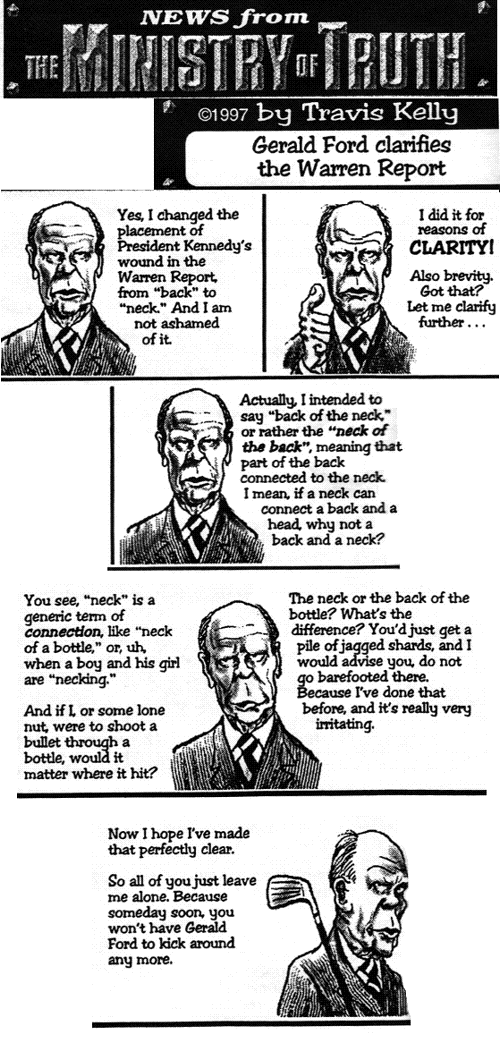
    In fact, Ford’s role on the Warren Commission is seen by many experts as a decisive factor in his rise to the top. As a Commission member, Ford altered its report in a significant way. As the Associated Press reported in 1997, “Thirty-three years ago, Gerald R. Ford took pen in hand and changed – ever so slightly – the Warren Commission’s key sentence on the place where a bullet entered John F. Kennedy’s body when he was killed in Dallas. The effect of Ford’s change was to strengthen the commission’s conclusion that a single bullet passed through Kennedy and severely wounded Texas Gov. John Connally – a crucial element in its finding that Lee Harvey Oswald was the sole gunman.”

    This modification played a seminal role in ending talk of a larger conspiracy to kill the president. Knowledge of Ford’s alteration has encouraged theorists to scrutinize the constellation of other figures who might have had a motivation to cover up the affair.

    Meanwhile, there is much more to learn about George H. W. Bush’s friend, Thomas Devine. The newly surfaced memos explain that Devine, from 1963 on, had authority from the agency to operate under commercial cover as part of an agency project code-named WUBRINY.

    Devine at that time was employed with the Wall Street boutique Train, Cabot and Associates, described in the memos as an “investment banking firm which houses and manages the [CIA] proprietary corporation WUSALINE.” These nautical names – ‘Saline’ and ‘Briny’ – or, for the Bay of Pigs invasion ‘Wave’ – are CIA cryptonyms for the programs and companies involved.

    George H.W. Bush’s own ties are amplified in the 1975 CIA memo, dated November 29, which makes it clear that he had knowledge of CIA operations prior to being named the new director of the CIA in the fall of that year.

    The 1975 memo notes that, through his relationship with Devine, “Mr George Bush [the CIA director-designate] has prior knowledge of the now terminated project WUBRINY/LPDICTUM which was involved in proprietary commercial operations in Europe.”

    The Bush documents, part of a batch of 300,000 records the CIA provided to the House Select Committee on Assassinations, were publicly released in 1998 as the result of a lawsuit, donated to a foundation, scanned into a database – and only just noticed by an independent researcher.

    Click the following to view original supporting documents [1] [2] [3]

  • Old theory, new doubt


    (from the Pittsburgh Tribune – August 25, 2006)


    Scientists at the Lawrence Livermore Laboratory studying the assassination of President John F. Kennedy have done what many thought impossible — their research suggests that the single-bullet theory is even less credible than it seems.

    And by extension, it further casts doubt on the credibility of Arlen Specter, the U.S. senator who, in another career, invented the magic bullet scenario — a tumbling, direction-changing projectile that long has defied the laws of physics and common sense.

    The Pennsylvania Republicrat, who at the time was an assistant district attorney in Philadelphia, was an assistant counsel for the Warren Commission, charged by President Lyndon Johnson with investigating the crime.

    Pat Grant, director of Livermore’s Forensic Science Center, and metallurgist Erik Randich say that key evidence such as the crime scene bullet fragments might have been misinterpreted. They contend the so-called chemical fingerprints that supposedly identified which bullets the fragments came from are anything but conclusive. Those “chemical fingerprints” are not the equivalent to the one-of-a-kind human fingerprints; they’re more like generic tire tracks.

    And because of that, the scientists say there could have been one to five bullets instead of the three supposedly fired by alleged assassin Lee Harvey Oswald. Mr. Specter’s lone-gunman theory is that much closer to being disproved.

    Librarians always should be prepared to move “Passion for Truth,” Specter’s ironically titled book about finding JFK’s single bullet, to where many believe it always should have been:

    The fiction section.

  • Challenge to lone gunman theory


    (from the Contra Costa Times)

    By Betty Mason


    LIVERMORE – More than four decades after his death, John F. Kennedy’s assassination remains the hottest cold case in U.S. history, and the clues continue to trickle in. Now Lawrence Livermore Laboratory scientists say a key piece of evidence supporting the lone gunman theory should be thrown out.

    A new look at clues gleaned from studies of crime-scene bullet fragments shows they may have been misinterpreted.

    “It basically shatters what some people call the best physical evidence around,” said chemist Pat Grant, director of the lab’s Forensic Science Center.

    Grant and Livermore Lab metallurgist Erik Randich found that the chemical “fingerprints” used to identify which bullets the fragments came from are actually more like run-of-the-mill tire tracks than one-of-a-kind fingerprints.

    “I’ve spoken with people on both sides of the conspiracy divide and there’s no question but that (Randich and Grant’s) work is going to be very difficult, if not outright impossible, to refute,” said Gary Aguilar, a San Francisco ophthalmologist and single-bullet skeptic who has studied the Kennedy assassination for more than a decade. “It looks impregnable.”

    The government’s claim that Lee Harvey Oswald alone killed Kennedy spawned a vitriolic debate between conspiracy theorists and lone gunman supporters that rages to this day.

    In 1964, the Warren Commission, established by President Lyndon B. Johnson to investigate the assassination, concluded that Oswald fired just three shots from the Texas School Book Depository in Dallas: The first missed entirely. The second passed through the president’s neck, into Texas Governor John Connally’s body under his right arm, out through his chest and then splintered his wrist and wounded his left thigh. The third fatally hit Kennedy in the head.

    Single-bullet theory
    Even though three bullets were involved, this scenario became known as the “single-bullet theory” because it requires the second bullet to account for all the nonfatal injuries to both Kennedy and Connally.

    The injuries to Kennedy’s neck and to Connally happened within a split second of each other. So either the injuries to both men came from a single bullet from Oswald or from at least two bullets from more than one shooter. Oswald’s rifle couldn’t have fired two shots in such rapid succession.

    So in order for Oswald to be the lone gunman, it had to be a single bullet.

    Skeptics and believers alike say the bullets amount to the most important piece of physical evidence for the single-bullet theory. Throwing it out is like removing a leg from a four-legged table.

    “Warren Commission defenders consider this evidence central to the single-bullet theory,” Aguilar said.

    But Grant and Randich say the bullet lead analysis was faulty. Both Randich and Grant are forensic scientists at Livermore Lab but researched the JFK case on their own time. Their work is the latest chapter in an ongoing saga.

    Lead impurities
    In the immediate aftermath of the assassination, the FBI analyzed five bullet fragments recovered from the limousine, the governor’s wrist, the president’s brain and from a hospital stretcher.

    The FBI used a technique known as “neutron activation” analysis to find the precise composition of the fragments. By determining the exact amounts of impurities in the lead, such as antimony and silver, they hoped to be able to tell which fragments came from the same bullet. But the FBI decided it couldn’t draw any conclusions from the results.

    In 1976, the U.S. House of Representatives formed an assassination committee to investigate the deaths of JFK and Martin Luther King Jr. The move was largely a response to hundreds of books, documentaries and magazine pieces questioning the government’s version of the JFK assassination, as well as public outcry following the first airing of Abraham Zapruder’s home movie of the assassination on the television show, “Good Night America.”

    The committee called in nuclear chemist Vincent Guinn, one of the world’s foremost experts on neutron activation, to reanalyze the bits of bullet lead.

    Unlike the FBI, Guinn drew a very clear conclusion. He said the antimony in the fragments clearly showed they all came from two, and only two, bullets of the type used by Oswald’s gun, which supports the Warren Commission’s lone gunman theory.

    According to Guinn, one set of fragments from the president’s brain and the limousine in front of the president had around .06 percent antimony, and all came from the bullet that killed JFK. The other set of fragments from the governor’s wrist and a nearly intact bullet found on a stretcher at the hospital had closer to .08 percent antimony and were pieces of the infamous “single bullet.”

    Based on evidence including the bullet lead, the committee concluded in 1979 that both shots had come from Oswald’s gun.

    They did not, however, rule out the possibility of a conspiracy. In fact, they strongly suspected a second shooter was present that day, but based on Guinn’s data, any second shooter had missed the target.

    Or maybe not.

    “It turns out that if you really analyze the results correctly, then the results are wrong,” said Grant.

    Fatal flaw
    Randich and Grant’s study grew out of work Randich did in 2002 that exposed a fatal flaw in the FBI’s use of bullet-lead evidence to connect suspects with crime scenes in thousands of criminal cases during the past three decades.

    The FBI claimed that like a fingerprint, each batch of lead has a unique chemical signature, so the specific amounts of impurities in a lead bullet could match it with other bullets from the same batch. For example, if bullets at a suspect’s house were found to have the same impurity signature as a bullet or fragment found at a murder scene, it was treated as evidence tying the suspect to the crime.

    Randich’s training as a metallurgist told him there was something wrong with this reasoning.

    “I realized these people could put my sons in jail with bogus science,” he said. “I thought I ought to do something about it.”

    By analyzing years of data kept by lead smelters, Randich found that batches are not unique, and bullets from different batches of bullets poured months or years apart could have the same chemical signature. And bullets poured from the start of a batch could differ slightly, but measurably, from those at the end.

    He has testified in about a dozen cases. Because of his work, courts now reject bullet-lead analysis and the FBI no longer uses it as evidence.

    JFK case problems
    The JFK case has similar problems.

    According to Guinn, the type of bullets used by Oswald happened to have highly variable amounts of antimony.

    Guinn said the variation between bullets of this type was so great that he could use it to tell individual bullets apart, even from the same batch of lead.

    Randich and Grant say that assumption is dead wrong.

    They analyzed the same type of bullets and showed that within a single bullet, there is a significant variation in impurities on a microscopic scale. The range of concentrations of impurities in each bullet is large enough to make small fragments from different parts of the same bullet have very different chemical fingerprints.

    Some of the fragments in the JFK case are so small that the differences in antimony could be explained entirely by this microscopic variation, instead of by differences between bullets, they said. Randich and Grant’s study was published in July in the Journal of Forensic Sciences.

    One to five bullets
    “We don’t know if there were two bullets,” said Randich. “There could have been two bullets, but the lead composition data shows there could be anywhere from one to five bullets.”

    The bullet found on the stretcher is missing some lead, but not enough to account for all the other fragments. So there had to be more than one bullet. But Grant and Randich say there is no way to tell how many more, at least from the bullet lead.

    Losing Guinn’s bullet-lead evidence is a major blow to the single-bullet theory.

    That evidence “knits together the core physical evidence into an airtight case against Lee Oswald,” according to a 2004 paper by Larry Sturdivan and Ken Rahn in an issue of Journal of Radioanalytical and Nuclear Chemistry that celebrated Vincent Guinn after his death. “It is, thus, the key to resolving the major controversies in the JFK assassination and putting the matter to rest,” the paper said.

    Rahn, an atmospheric chemist recently retired from the University of Rhode Island, stands by this statement and Guinn’s research despite Randich and Grant’s study.

    He says he believes it is possible that microscopic variation occurs within bullets of this type, but Grant and Randich can’t say for sure whether it happened in the JFK bullets because they didn’t analyze those particular fragments.

    Rahn thinks it is far more likely the fragments fell into two distinct groups, one with .06 percent antimony and the other with .08 percent, because they came from two distinct bullets.

    This fits the Warren Commission’s conclusion that Oswald was the lone shooter, and two of the three bullets he shot hit the occupants of the president’s limousine, Rahn said.

    Grant counters that the two groups of bullet fragments might not actually be that distinct. The margin of error associated with the antimony analysis means that, statistically, the concentrations are too close to separate into groups.

    Although Randich and Grant’s research doesn’t solve the Kennedy assassination, it certainly does weaken the case for a lone gunman.

    “In recent years, the (bullet) fragment evidence has become one of the key struts supporting the single-bullet theory,” Aguilar said. “Randich and Grant have knocked this slat out from under the theory.”