by Daniel Tencer, At: RawStory
Author: Kennedys&King
-
Edward M. Kennedy: A Multilayered Object-Lesson in Political Courage
Here’s a remarkably indirect comment by Mike Barnicle on MSNBC’s Morning Joe: “He knew that he had a certain luxury that his three brothers didn’t have.”
Translated, it means that Edward M. Kennedy, 77, the youngest of four Kennedy men for whom their father had the most ambitious and tragic hopes, did not die a violent death.
The sentimental commentaries that consumed our media in the aftermath of his death—all richly deserved—did not do justice to the underlying realities of intrigue and risk in which Ted Kennedy proved himself a hero of his time, and ours. A “managed” and timorous media will see to it that certain taboos are observed.
“There’s got to be more to it,” Ted Kennedy told Sander Vanocur of NBC News on the plane carrying Bobby Kennedy’s body to the East Coast for interment in June of 1968.
Of course there was “more to it” in the slaying of the presidential candidate—although you wouldn’t know it if the mainstream media were your only source of information.
Ted’s two older brothers had been victims of domestic political conspiracies of the most lethal sort: they were assassinated. Countless people were aware that an attempt on JFK’s life would be made. J. Edgar Hoover himself knew for months of plots to kill Kennedy—and did nothing. Bobby, who had said after Dallas that “I thought they’d get one of us, but Jack, after all he’d been through, never worried about it. I thought it would be me,” expressed his renewed sense of risk during the tumultuous 1968 campaign: “I can’t plan. Every day is like Russian roulette.”
Americans who believe that Jack and Bobby were not victims of conspiracies are at best naïve or ignorant, at worst in full-blown denial. (“It can’t happen here.”) Study the evidence.
The “heir apparent,” who had come to the Senate in a special election in 1962, was in private deeply suspicious of the forces behind the assassination of JFK, although in his new memoir True Compass, the late senator, it has been widely reported, writes that he has always accepted the lone-assassin findings of the Warren Commission.
Re-elected seven times, he would play a constructive role in some 300 pieces of major legislation. He recognized—as did many of his mentors and colleagues—that he possessed legislative qualities that Jack had never displayed, and that Bobby as a senator from New York was too impatient—not to mention anguished and distracted—to cultivate.
The Kennedyesque environment in which she found herself took an alcoholic toll on Ted’s wife Joan, and he too drank heavily—and womanized. In July of 1969 a party of Kennedy cronies and loyal female associates culminated—in circumstances that are unclear to this day—in the drowning death of Mary Jo Kopechne, who had worked tirelessly in Bobby’s 1968 campaign. Ted Kennedy, who had probably been drinking heavily, was pilloried for lying about what he had done—or had not done—to save the young woman, who was found in a car that he had allegedly been driving. He was pilloried for leaving the scene of the accident in the middle of the night and failing to contact authorities for nine hours. He was pilloried for special treatment in being charged with “leaving the scene of an accident after causing injury” and receiving a light sentence of incarceration, which was suspended. Soon thereafter, he addressed the nation in shame and regret. His political prospects had been dashed.
But his detractors wanted several pounds of flesh. “Chappaquiddick” became a term of derision for legions of Kennedy-haters in the land. Refusing to resign, the villain of this sad story returned to the Senate in a neck brace. In 1972 he decided, for reasons of his own safety, not to run for president. The forces threatening him, he said, “are kind of self-evident.” (They included Kennedy-haters in the CIA.)
Jack Kennedy had received some 400 death threats annually during his short-lived “thousand days.” Ted Kennedy in the late 1960s and through the 1970s received even more—the majority of them, no doubt, from extremists of the right including white supremacists, fundamentalists, Catholic—haters, liberal—haters, and the like. (Which political party might have fanned these fires?)
The impetus for substantial health-care reform will take strength from EMK’s courage, his energy, his compassion. As an expression of his stature and legacy, we have the testimony of Boris Kast, a Jewish refusnik whose emigration with his family to the U.S. was negotiated by EMK in the 1970s. Said Kast in an NPR interview: “He’s one of those rare people whose major role in life is to help people.”
A lion of the Senate indeed—and with his death the end of an epoch in which those responsible for the political murders of two of his brothers have never been brought to justice. The phrase national disgrace barely suffices.
H.C. Nash, a native Virginian, lives in Williamsport, Pa. He is working on a book entitled Patsy of the Ages: Lee Harvey Oswald and His Nation 46 Years Later.
-

Edward M. Kennedy
The Kennedy Brothers Edward Moore Kennedy, one of the longest serving senators in United States history and a legendary political icon, died late August 25 after struggling with brain cancer for more than a year. He was 77 years old.
Family members said Senator Kennedy lived longer than his doctor expected after his diagnosis last year. “We’ve lost the irreplaceable center of our family and joyous light in our lives, but the inspiration of his faith, optimism, and perseverance will live on in our hearts forever,” the Kennedy family said in a statement. “He loved this country and devoted his life to serving it.”
Kennedy will be buried in Arlington National Cemetary near two of this brothers, former President John F. Kennedy and former Senator Robert F. Kennedy.
President Barack Obama, whom Senator Kennedy endorsed during the 2008 Presidential race, lauded the Massachusetts Democrat for his tireless work for legilslation that changed the lives of millions. “Even though we knew this day was coming, we awaited it with no small amount of dread,” Obama said. “His extraordinary life on this Earth has come to an end. The extraordinary good that he did lives on.”
Senator Kennedy was an outspoken advocate for health care reform, long before the contentious, circus atmosphere town hall meetings of summer 2009, as demonstrated in this video (which runs 4:18).
The Kennedy family’s full statement, posted to the Senator’s official web site, is as follows:
“Edward M. Kennedy—the husband, father, grandfather, brother and uncle we loved so deeply—died late Tuesday night at home in Hyannis Port. We’ve lost the irreplaceable center of our family and joyous light in our lives, but the inspiration of his faith, optimism, and perseverance will live on in our hearts forever. We thank everyone who gave him care and support over this last year, and everyone who stood with him for so many years in his tireless march for progress toward justice, fairness and opportunity for all. He loved this country and devoted his life to serving it. He always believed that our best days were still ahead, but it’s hard to imagine any of them without him.”
In July, the Senator was named a recipient of the Presidential Medal of Freedom, the nation’s highest civilian honor. At that time he said, “”I am profoundly grateful to President Obama for this extraordinary honor. My life has been committed to the ideal of public service which President Kennedy wanted the Medal of Freedom to represent. To receive it from another President who prizes that same ideal of service and inspires so many to serve is a great privilege that moves me deeply.”
Senator Kennedy’s sister, Eunice Kennedy Shriver, died on August 11, 2009. The Senator said in a statement, “Eunice is now with God in heaven. My sister Jean and I, and our entire family, will miss her with all our hearts. I know that our parents and brothers and sisters who have gone before are filled with joy to have her by their side again.”
Edward Kennedy was first elected to the Senate in 1962, while his brother John was president.
(Click here if your browser is having trouble loading the above.)
-

CBS’s Special Relationship with the JFK Assassination
The Columbia Broadcasting System has a special relationship with the Kennedy case. For countless Americans, the horror began with the network’s reports from Dallas, culminating with an announcement by the late Walter Cronkite that JFK had died “some thirty-eight minutes ago.”
CBS has produced a number of specials on the assassination. In The Pigs Grunt, John Kelin describes the unusual circumstances surrounding the network’s four-part documentary in 1967.
Jerry Policoff wrote the revealing article on CBS and other major media called JFK: How the Media Assassinated the Real Story.
Finally, see Jim DiEugenio’s detailed exposé concerning the 1967 documentary, based on Roger Feinman’s slide presentation of documents uncovered by his 1975 lawsuit against CBS, at Consortium News.
-
Yuri Nosenko Dies
By Walter Pincus
from The Washington Post
Yuri I. Nosenko, 81, a Soviet KGB agent whose defection to the United States in 1964 and subsequent three-year harsh detention and hostile interrogation by CIA officials remains immensely controversial, died Aug. 23 under an assumed name in a Southern state, according to intelligence officials. No cause of death was reported other than “a long illness.”
Mr. Nosenko, a lieutenant colonel in the Soviet secret police and intelligence agency, personally interviewed Lee Harvey Oswald during his time in the Soviet Union from 1959 to 1962. When Mr. Nosenko defected in 1964, he provided the first information that Oswald, the accused assassin of President John F. Kennedy, was not a Soviet agent.
Senior CIA officers at the time, including James Jesus Angleton, the agency’s counterintelligence chief, and David Murphy of the Soviet division, did not believe Mr. Nosenko was a real defector and ordered his imprisonment. Mr. Nosenko had initially made inaccurate statements about his past, and some of his information conflicted with that provided by another KGB officer, Anatoly M. Golitsin, who had defected the year before. As a result, they considered him a plant sent by Moscow to confuse Washington about Oswald.
Richard Helms, then CIA director of operations, in 1966 ordered that a conclusion be reached in the Nosenko case. In 1967, after passing multiple polygraphs, Mr. Nosenko was released and in 1969 he was found to be a legitimate defector. He subsequently became a consultant to the agency, given a new identity and provided a home in an undisclosed location in the South.
Last month several senior CIA officials visited him and presented him with a ceremonial flag and a letter from CIA Director Michael Hayden honoring his service to the United States, a senior intelligence official said yesterday.
First word of his death came yesterday from Pete Earley, an author of books on the CIA who had been trying for four years to get an interview with Mr. Nosenko. Earley said Mr. Nosenko was bothered by a book released last year called Spy Wars, written by Tennent H. Bagley, a key CIA player in Mr. Nosenko’s defection and arrest. The book continued to argue that Mr. Nosenko was not a bona fide defector, but in fact was sent to cover up the KGB’s influence over Oswald.
“I was fascinated by Nosenko because in spite of the horrific things that the agency and government did to him — the torture and mental deprivation — in the only public speech that he ever gave at the CIA, he praised the United States as being the world’s best hope for humanity, condemned Communism and Moscow, and said he never regretted his defection nor held a grudge against the officials who had persecuted him,” Earley said.
During his incarceration, at Camp Perry, the CIA facility in Virginia, the agency kept Mr. Nosenko in solitary confinement in a small concrete cell. He often endured treatment involving body searches, verbal taunts, revolting food and denial of such basics as toothpaste and reading materials.
Last year, the International Spy Museum in Washington canceled a session during which Bagley was to speak, allegedly because CIA officials objected to having the Nosenko issue raised.
In his 1992 book Molehunt, author David Wise wrote, “The ‘war of defectors,’ the conflict over Golitsin and Mr. Nosenko . . . split the Agency into two camps, creating scars that had yet to heal decades later.”
Claire George, a former CIA deputy director of operations who worked in the Soviet division at the time of Mr. Nosenko’s defection, said yesterday that the handling of Mr. Nosenko “was a terrible mistake.” But George added, “You can’t be in the spy business without making mistakes.”
Yuri Ivanovich Nosenko was born in 1927, in Nikolayev, a Ukrainian town on the Black Sea.
His father, a naval engineer, rose to minister for shipbuilding under Soviet leader Nikita Khrushchev, while his mother arranged for private tutors to school Mr. Nosenko in classical Western literature from Virgil to Voltaire. He developed an attraction to western culture. Mr. Nosenko served three years in naval intelligence after his 1950 graduation from the State Institute of International Relations in Moscow. He then became a leader within the KGB’s Soviet internal security division.
According to Tom Mangold’s Cold Warrior (1991), a book about Angleton, Mr. Nosenko’s KGB career specialized in following U.S. agents posted in the Soviet Union and in recruiting turncoats from foreign intelligence services. Mangold’s book said he also oversaw blackmail operations. Mangold asserted Mr. Nosenko eventually grew angered by what he considered hypocrisies of the Soviet system and signaled to U.S. intelligence agents his wish to defect on ideological grounds. He made his first successful contact with U.S. intelligence in 1962, pleading desperation after squandering KGB funds on alcohol. He asked for $200 to repay the money. He later admitted this was a fabrication, and his request later raised doubts within the CIA about his intentions. Would he really sell out his country for $200?
But his propensity to drink was not a lie, and he was fully loaded when he met CIA officials in Geneva, where he was accompanying a diplomatic mission. He revealed key information about Soviet moles working in the embassies of Western nations as well as Russian intelligence methods. According to Mangold, he pinpointed 52 microphones planted inside the U.S. embassy in Moscow and how the Soviets avoided detection of the listening devices.
But his most stunning revelations were about Oswald, notably how the Soviet agency felt Oswald was too unstable mentally to be of much service.
None of this saved Mr. Nosenko from a bitter fate. Golitsin stoked Angleton’s increasing paranoia about double agents in the CIA and the veracity of defectors, and Mr. Nosenko soon began his 1,277 days in custody.
After Mr. Nosenko’s rehabilitation, he looked up the disgraced Angleton’s number in the phone book in 1975 to confront him.
It was a brief and fruitless exchange, with Mr. Nosenko rising in his passions and Angelton cool and adamant about his judgment.
“I have nothing more to say to you,” Angelton said.
“And Mr. Angelton,” replied Mr. Nosenko, “I have nothing further to say to you.”
-
Robert Maheu Dies at 90
Robert A. Maheu, who was a powerful aide to reclusive tycoon Howard Hughes and whose cloak-and-dagger exploits included involvement in a CIA and Mafia plot to assassinate Fidel Castro, died Aug. 4 at Desert Springs Hospital in Las Vegas. He was 90 and had cancer and heart ailments.
Mr. Maheu (pronounced MAY-hew) was a onetime FBI agent who ran a Washington company that he said carried out secret missions for the Central Intelligence Agency.
Mr. Maheu’s first jobs for Hughes in the 1950s included private-eye snooping on Hughes’s past and prospective girlfriends in Hollywood. Later, as Hughes’s chief adviser, he helped make his boss Nevada’s third-largest landowner, after the federal government and the state power company. After becoming Hughes’s director of Las Vegas operations in 1966, Mr. Maheu was the most influential member of the billionaire’s inner circle and acted as his liaison to leading political figures and the world at large.
“If he wanted someone fired, I did the firing,” Mr. Maheu wrote in his 1992 autobiography, Next to Hughes. “If he wanted something negotiated, I did the bargaining. If he had to be somewhere, I appeared in his place. I was his eyes, his ears, and his mouthpiece.”
Before he was abruptly fired in 1970, Mr. Maheu spoke with Hughes as many as 20 times a day on the telephone. But in all their years together, he never met the eccentric mogul face to face. Hughes lived in seclusion on the top floor of the Desert Inn Hotel, with only a few private aides admitted to his presence.
“He finally told me that he did not want me to see him because of the way in which he had allowed himself to deteriorate, the way in which he was living, the way he looked,” Mr. Maheu said on Larry King Live in 1992. “He felt that if I ever in fact saw him, I would never be able to represent him.”
Mr. Maheu earned $520,000 a year and was living in one of the largest houses in Las Vegas when Hughes had two other aides fire him in December 1970. In 1972, Hughes broke a long silence by speaking in a telephone news conference, seeking to prove he had nothing to do with a purported autobiography by Clifford Irving, which was later confirmed a hoax.
During that news conference, Hughes called Mr. Maheu “a no-good son of a bitch who robbed me blind.” Mr. Maheu sued him in federal court for defamation. He initially won a $2.8 million settlement from Hughes, but the decision was overturned.
The four-month trial revealed many engrossing details about Hughes’s business dealings, his political contributions and his increasingly bizarre private life. Mr. Maheu disclosed that in 1970 he delivered $100,000 to Charles G. “Bebe” Rebozo, a close friend of President Richard M. Nixon’s, in return for possible future favors for Hughes. Mr. Maheu entertained Nixon’s vice president, Spiro Agnew, on his yacht and regularly played tennis with then-Nevada Gov. Paul Laxalt (R), who became a U.S. senator.
But Hughes spread his political largess to both parties, contributing $100,000 to 1968 Democratic presidential candidate Hubert H. Humphrey. Mr. Maheu said he personally placed a briefcase containing $50,000 cash — from receipts at the Hughes-owned Silver Slipper casino — in Humphrey’s limousine. The contributions were legal at the time because they were considered private donations from an individual, not corporate contributions.
Mr. Maheu said he twice turned down requests from Hughes to arrange $1 million payments to Presidents Lyndon B. Johnson and Nixon — payable after they left office — if they would agree to stop underground nuclear testing in Nevada, where Hughes lived until moving to the Bahamas in 1970. (He died at age 70 in 1976.)
“In ’57, when I agreed to be his alter ego,” Mr. Maheu told the San Diego Union-Tribune in 1992, “I thought it would be very challenging: representing him at presidential inaugurals, handling multimillion-dollar deals in his behalf … In reality, you’re living a lie.”
Robert Aime Maheu was born Oct. 30, 1917, into a French-speaking family in Waterville, Maine. After he graduated from the College of the Holy Cross in Worcester, Mass., he analyzed aerial photographs for the Department of Agriculture before joining the FBI.
During World War II, the FBI assigned him to monitor a French spy who became a double agent and helped deceive the Nazi high command with false radio transmissions. By the mid-1950s, Mr. Maheu said he did undercover work for the CIA — “those jobs in which the agency could not officially be involved,” he wrote in his autobiography.
Recently declassified CIA files confirm that Mr. Maheu was present at a 1960 meeting in Miami Beach, Fla., between organized crime bosses Sam Giancana and Santo Trafficante Jr., as part of an abortive CIA effort to assassinate Cuban leader Fidel Castro. The plan was dropped after the failed Bay of Pigs invasion in 1961.
“If anything went wrong,” Mr. Maheu wrote in his memoir, “I was the fall guy, caught between protecting the government and protecting the mob, two armed camps that could crush me like a bug.”
After leaving Hughes, Mr. Maheu became a successful real estate investor but was admittedly careless in his bookkeeping.
“Most people, I have observed, spend 90 percent of their time scribbling notes and keeping records to justify their existence,” he said in 1974. “I prefer to use that time getting things done.”
Mr. Maheu had expensive tastes and helped found a Las Vegas chapter of a French gourmet society, and as time went on, he reveled in chances to tell of his colorful life.
His wife of 62 years, Yvette Doyon Maheu, died in 2003. A daughter also preceded him in death. Survivors include three sons; 10 grandchildren; and 10 great-grandchildren.
-
The Kennedy Assassination: Was There a Conspiracy?
from Time magazine
David Talbot
YES
On Friday, Nov. 22, 1963, Robert F. Kennedy — J.F.K.’s younger brother, Attorney General and devoted watchman — was eating lunch at Hickory Hill, his Virginia home, when he got the news from Dallas. It was his archenemy, FBI chief J. Edgar Hoover, of all people, who phoned to tell him. “The President’s been shot,” Hoover curtly said. Bobby later recalled, “I think he told me with pleasure.”For the rest of the day and night, Bobby Kennedy would wrestle with his howling grief while using whatever power was still left him to figure out what really happened in Dallas — before the new Administration settled firmly into place under the command of another political enemy, Lyndon Johnson. While the Attorney General’s aides summoned federal Marshals to surround R.F.K.’s estate (they no longer trusted the Secret Service or the FBI) — uncertain of whether the President’s brother would be the next target — Bobby feverishly gathered information. He worked the phones at Hickory Hill, talking to people who had been in the presidential motorcade; he conferred with a succession of government officials and aides while waiting for Air Force One to return with the body of his brother; he accompanied his brother’s remains to the autopsy at Bethesda Naval Hospital, where he took steps to take control of medical evidence, including the President’s brain; and he stayed coiled and awake in the White House until early the next morning. Lit up with the clarity of shock, the electricity of adrenaline, he constructed the outlines of the crime. Bobby Kennedy would become America’s first J.F.K. assassination-conspiracy theorist.
The President’s brother quickly concluded that Lee Harvey Oswald, the accused assassin, had not acted alone. And Bobby immediately suspected the CIA’s secret war on Fidel Castro as the source of the plot. At his home that Friday afternoon, Bobby confronted CIA Director John McCone, asking him point-blank whether the agency had killed J.F.K. (McCone denied it.) Later, R.F.K. ordered aides to explore a possible Mafia connection to the crime. And in a revealing phone conversation with Harry Ruiz-Williams, a trusted friend in the anti-Castro movement, Kennedy said bluntly, “One of your guys did it.” Though the CIA and the FBI were already working strenuously to portray Oswald as a communist agent, Bobby Kennedy rejected this view. Instead, he concluded Oswald was a member of the shadowy operation that was seeking to overthrow Castro.
Bobby knew that a dark alliance — the CIA, the Mafia and militant Cuban exiles — had formed to assassinate Castro and force a regime change in Havana. That’s because President Kennedy had given his brother the Cuban portfolio after the CIA’s Bay of Pigs fiasco. But Bobby, who would begin some days by dropping by the CIA’s headquarters in Langley, Va., on his way to the Justice Department, never managed to get fully in control of the agency’s sprawling, covert war on Castro. Now, he suspected, this underground world — where J.F.K. was despised for betraying the anti-Castro cause — had spawned his brother’s assassination.
As Kennedy slowly emerged from his torment over Dallas and resumed an active role in public life — running for U.S. Senator from New York in 1964 and then President in 1968 — he secretly investigated his brother’s assassination. He traveled to Mexico City, where he gathered information about Oswald’s mysterious trip there before Dallas. He met with conspiracy researcher Penn Jones Jr., a crusading Texas newspaperman, in his Senate office. He returned to the Justice Department with his ace investigator Walter Sheridan to paw through old files. He dispatched trusted associates to New Orleans to report to him on prosecutor Jim Garrison’s controversial reopening of the case. Kennedy told confidants that he himself would reopen the investigation into the assassination if he won the presidency, believing it would take the full powers of the office to do so. As Kennedy adviser Arthur Schlesinger Jr. once observed, no one of his era knew more than Bobby about “the underground streams through which so much of the actuality of American power darkly coursed: the FBI, CIA, the racketeering unions and the Mob.” But when it came to his brother’s murder, Bobby never got a chance to prove his case.
Vincent Bugliosi
NO
I have found there are 32 separate reasons for concluding there was no conspiracy. Here are just a few of them:After 44 years of investigation by thousands of researchers, not one speck of credible evidence has ever surfaced that groups such as the CIA, organized crime or the military-industrial complex were behind the assassination, only that they each had a motive. And when there is no evidence of guilt, that fact, by itself, is very strong evidence of innocence. Moreover, the very thought of members of the military-industrial complex (Joint Chiefs of Staff, captains of industry) or the CIA or organized crime actually plotting to murder the President of the U.S. is surreal, the type of thing that only belongs, if at all, in a Robert Ludlum novel.
I have found 53 pieces of evidence that point irresistibly to Lee Harvey Oswald’s guilt. For example, the murder weapon was Oswald’s; he was the only employee who fled the Texas School Book Depository after the shooting in Dealey Plaza; 45 min. later, he killed Dallas police officer J.D. Tippit; 30 min. after that, he resisted arrest and pulled his gun on the arresting officer.
What’s more, during his interrogation, Oswald’s efforts to construct a defense — which included denying that he owned the rifle in question (or any rifle at all) — turned out to be a string of provable lies, all of which show an unmistakable consciousness of guilt. Only in a fantasy world can you have 53 pieces of evidence against you and still be innocent. Conspiracy theorists are stuck with this reality.
Even assuming that the CIA or Mob or military-industrial complex decided “Let’s murder President Kennedy,” Oswald would be among the last people in the world those organizations would choose for the job. Oswald was not an expert shot and owned only a $12 mail-order rifle — both of which automatically disqualify him as a hit man. He was also a notoriously unreliable and emotionally unstable misfit who tried to commit suicide by slashing his wrists when the Soviets denied him the citizenship he sought. If the Mafia leaders, for instance, decided to kill the President of the U.S. — an act that would result in a retaliation against them of unprecedented proportions if they were discovered to be behind it — wouldn’t they use a very professional, tight-lipped assassin who had a successful track record with them, someone in whom they had the highest confidence? Would they rely on someone like Oswald to commit the biggest murder in American history?
But let’s assume, just for the sake of argument, that the CIA or Mob decided to kill Kennedy and also decided that Oswald should do the job. It still doesn’t make any sense. After Oswald shot Kennedy and left the book depository, one of two things would have happened, the less likely of which is that a car would have been waiting for him to help him escape down to Mexico or wherever.
The conspirators certainly wouldn’t want their killer to be apprehended and interrogated by the authorities. But the more likely thing by far is that the car would have driven Oswald to his death. Instead, we know that Oswald was out on the street with $13 in his pockets, attempting to flag down buses and cabs. What does that fact, alone, tell you?
Three people can keep a secret but only if two are dead. Yet we are asked to believe that in 44 years, not one word of the vast alleged conspiracy, not one syllable, has ever leaked out. Additionally, the motorcade route in Dallas, which took the President right beneath Oswald’s window, wasn’t even selected until Nov. 18, just four days before the assassination. Surely no rational person can believe a group like the CIA or the Mob would hatch its conspiracy with Oswald to kill Kennedy within only four days of the President’s trip to Dallas.
To this day, the overwhelming majority of the American people (75%) have bought into the conspiracy idea. Their reasons vary widely: general mistrust of government; the desire to imbue Kennedy’s death with deeper meaning than a random act of violence or a simple relish for intrigue. Despite the total lack of evidence, the story of a J.F.K. assassination conspiracy has captivated the nation for the past half-century and is likely to do so for many years to come.
-
Oswald “had no time to fire all Kennedy bullets”
By Tim Shipman in Washington, Sunday Telegraph
Lee Harvey Oswald could not have acted alone in assassinating President John F Kennedy, according to a new study by Italian weapons experts of the type of rifle Oswald is alleged to have used in the shootings.
In fresh tests of the Mannlicher-Carcano bolt-action weapon, supervised by the Italian army, it was found to be impossible for even an accomplished marksman to fire the shots quickly enough.
The findings will fuel continuing theories that Oswald was part of a larger conspiracy to murder the 35th American president on 22 November 1963.
The official Warren Commission inquiry into the shooting concluded the following year that Oswald was a lone gunman who fired three shots with a Carcano M91/38 bolt-action rifle in 8.3 seconds.
But when the Italian team test-fired the identical model of gun, they were unable to load and fire three shots in less than 19 seconds – suggesting that a second gunman must have been present in Dealey Plaza, central Dallas, that day.
Two of the bullets hit Kennedy, with the first – the so called “magic bullet”, ridiculed by conspiracy theorists – also wounding the governor of Texas, John B Connally, after it had struck the president.
In a further challenge to the official conclusions, the Italian team conducted two other tests at the former Carcano factory in Terni, north of Rome, where the murder weapon was made in 1940.
They fired bullets through two large pieces of meat, in an attempt to simulate the assumed path of the magic bullet. In their test, the bullet was deformed, unlike the first bullet in the Kennedy assassination, which remained largely intact.
The second bullet is thought to have missed its target. According to the commission, the third disintegrated when it hit Kennedy’s head. The new research suggests, however, that this is incompatible with the fact that Oswald was only 80 yards away, in a book depository, when he fired. The Italian tests suggest that a bullet fired from that distance would have emerged intact from Kennedy’s head, implying that the third shot must instead have come from a more distant location.
The findings will encourage conspiracy theorists who hold that Oswald could not have fired three shots in time. For each shot, he would have had to push up the gun’s bolt handle, pull the bolt backwards to eject the spent cartridge case and then forward to slide the next round into the chamber, before turning down the bolt handle to lock it in place.
Nearly seven out of 10 Americans believe that Kennedy was murdered as a result of a plot. Depending on which theory they back, the participants supposedly included any or all of the CIA, the Mafia, the Cubans, the FBI chief J Edgar Hoover, the military-industrial complex and Vice-President Lyndon B Johnson.
It is the second challenge in two months to the view of the Warren Commission that Oswald acted alone. In May, researchers at Texas A&M University argued that the ballistics evidence used to rule out a second gunman had been misinterpreted.
The findings will be a frustration to Vincent Bugliosi, the author of a 1,600-page book, also published in May, which claimed to put to rest all the conspiracy theories of the past 44 years.
The Italian findings will be hotly contested by those who believe that Oswald was a lone gunman – not least because they contradict firing tests previously conducted, using Oswald’s actual rifle, by the FBI and the US Marines, and another study by Washington police marksmen using an identical gun.
Oswald would only have needed to reload the weapon twice in the eight seconds to get off all three shots, since the time was measured only from the moment he fired the first shot. The FBI concluded that a marksman could have fired a shot at least every 2.3 seconds.
In his book, Mr Bugliosi details how after just two or three minutes’ practice with the gun in 1979, three police marksmen aiming at three targets representing Kennedy at the same distance from Oswald, got away three shots in less than eight seconds.
One marksman hit the targets twice and missed the third shot by an inch. A second shooter scored a “kill” with his second shot.
Mr Bugliosi recounts three separate ballistics tests that found that the magic bullet could have wounded Kennedy and Connally and emerged in similar condition to the real bullet. But that is unlikely to stop the Italian research fuelling another generation of conspiracy writers.
-
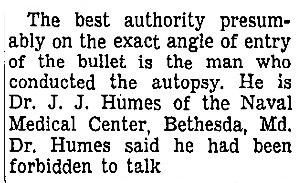
Forbidden
From The New York Times, Dec. 6, 1963, p. 18, “Kennedy Slaying is Reconstructed.”
Commission Exhibit 397