Things have to fall into place a certain way. The right cards must be dealt. But the 50th anniversary of the JFK assassination in Dallas on November 22, 2013, could become a hallmark event in a long tradition of popular street actions stretching back to the nation’s beginnings.
From Occupy Wall Street to the 1968 Chicago Police Riot, from the Cleveland Eviction Riots of 1933 all the way back to the Stamp Act Riots of 1765: This country was born and bred on the street and in defiance. And it could happen here.
I had a great chat last week with Kalle Lasn, editor of Adbusters, the international iconoclastic magazine credited with sparking Occupy Wall Street. He said he saw no reason why the JFK 50th here could not grow into an Occupy Dealey Plaza event to capture and galvanize world attention.
 |
| Illustration by Jen Sorensen |
He talked about how New York Mayor Michael Bloomberg unwittingly helped make Occupy a national movement by cracking down on it in New York. I suggested maybe Dallas is doing Bloomberg one better, by beginning to crack down on the JFK 50th a year and a half before the thing even happens.
He agreed it could be a real window of opportunity: “The fact that the city of Dallas doesn’t get it and again wants to snuff out rather than allow this wonderful freedom that the young people of America crave right now, maybe that will be a wake-up call,” he said. “Maybe they are going to see a backlash that will surprise the hell out of them.”
My writing on this issue over the last year or more has been pretty narrowly focused on the case of one man, author Robert Groden, a Kennedy conspiracy theory author now suing the city in federal court over repeated arrests for speaking and selling books in Dealey Plaza. Dallas has continued to harass Groden, even though his lawyer, Bradley Kizzia, was able to demonstrate in court that the law the city said Groden was violating did not exist and even though every judge who has dealt with the multiple tickets and arrests of Groden has declared them bogus.
In his federal lawsuit and in conversations with me, Groden asserts that the city has a sub rosa agenda. He says the city’s real reason for going after him has been to suppress his version of the JFK story because it conflicts with official Dallas dogma. The Dallas version is that it happened a long time ago; the case is closed; people need to stop talking about it.
Maybe you could almost see their point, from a very narrow and fairly stupid point of view. It’s stupid, because the ongoing conversation about the JFK assassination isn’t about Dallas. Neither the assassination nor the place where it happened belongs to Dallas. Both are creatures of global history. The 50th is only about Dallas if Dallas stupidly tries to get in the way of it.
Which is just what City Hall is doing. The city has violated longstanding policy on permits for JFK commemoration events by crafting a new type of permit for the 50th that’s clearly designed to stave off unauthorized observances. For decades, for example, the Coalition on Political Assassinations has conducted a respectful “moment of silence” on the famous “grassy knoll” in Dealey Plaza on key anniversaries.
So now the city has granted an exclusive permit to the official Sixth Floor Assassination Museum for the entire week of November 22, 2013. When COPA contacted city officials to ask for permission to do their own moment of silence, they were told that all the moments of silence for that week were already taken.
Sounds stupid? Oh, yeah! But when I spoke to Jill Beam, head of the city’s office of special events, she confirmed it. I asked why people couldn’t have two moments of silence at the same time, since they were both going to be silent anyway. I’m not trying to be funny.
She told me that the city’s software program for booking events doesn’t allow “double-booking.”
I said, “So this is a software problem?”
She said yes.
OK, look.
Here’s what’s going on. First of all, the 50th anniversary of the JFK assassination here could be nothing. Half a century is a long time. Maybe by now most people alive in the world think JFK is a clothing brand.
But given the level of interest at the precursor anniversaries like the 30th and 40th, given the ongoing rate of publication and film-making on the topic and given the consistent popularity of Dealey Plaza as a draw for international tourism, it’s more likely that Dealey Plaza on the 50th will be the focus of significant international attention, if only for that moment.
Somebody — it’s not clear who yet — has the very un-bright idea that the way for Dallas to handle that moment is by being authoritarian, exclusionary and massively uptight. In other words, if Oliver Stone, director of the 1991 movie JFK, had sent down to central casting asking for a bunch of dull-eyed right-wing stiffs, they might have sent whoever the people are behind giving the Sixth Floor that permit.
Talk about playing to your stereotype.
On the other hand, it is precisely that stereotype that could spark a reaction here far greater than anything based merely on JFK conspiracy theories. What Dallas really risks is planting its glass jaw deliciously in the path of a crushing generational left hook based on free-speech issues.
Free speech will be important on the 50th for the same reason it has been so urgently important to the Occupy movement all along: because young people in particular already think the nation’s leaders are liars. They see those liars trying to hide the ball, as in the Obama administration’s recent decision to move the upcoming G8 World Economic Summit away from the potential reach of protesters in Chicago to the militarily protected confines of Camp David.
But worse, they see those leaders as leading them by the snout to a dismal future of despair.
“The real impulse behind the Occupy movement,” Lasn said, “and I think the real impulse behind anything that may happen in Dallas next year, is that hundreds of millions of young people around the world look into a future that does not compute.
“They’re looking at a lifetime that is going to be completely different from the way their parents lived, a life of ecological crisis and political crisis and financial crisis, of not being able to pay off their loans and never having a decent job, and in the meantime having to live in a world that’s getting hotter and hotter and lousier and lousier.
“Young people of the world are waking up to the fact that if they don’t stand up and start fighting for a different kind of future, they’re not going to have a future.”
I also spoke last week with Stephen Benavides, who was one of the early organizers of Occupy Dallas. You’ll remember him: Dallas cops tossed him in jail for attacking an officer, but later a citizen video proved that the attack had gone the other way around.
Benavides told me that if events here transpire in just the right away — if Dallas continues to go hard-case on access to Dealey Plaza for the 50th — he could see something really jumping off.
“It depends on what the city does,” Benavides said, “and it depends on what everybody’s doing a year and a half from now. If they want to pose a free-speech challenge by trying to cordon off the area based on appearance or the political content of your speech or any of those kinds of things, then, hell yeah. Then there is a definite ability to organize and make that into a confrontation.”
In fact, Benavides said that if that’s how the cards are dealt a year and a half from now, “We would have a responsibility to challenge the state.”
If Lasn is right and young people look ahead to see only a path to the howling void, then civil action to change the direction of that path is the one thing that will lift them up out of despair and paralysis. And the rest of us will have a commensurate responsibility to support them.
In that sense, Dealey Plaza is a golden opportunity, capable of providing precisely the kind of flashpoint needed for real change to occur.
“The leaders of America are running scared,” Lasn said. “In Dallas they’re running scared. On Wall Street they’re running scared. It’s almost like that wonderful tipping point that could happen, when the young people of America rise up and start pushing the country to a different path.”
We saw it just beginning to rise in Occupy. It might be a little geocentric of us to think Dealey Plaza is going to be any sort of culmination, but Dealey Plaza could be one of many places and points where the movement for change picks up steam, gains courage, learns some footwork and how to throw that mean left hook.
I don’t want to be clandestine about my own hand here. I am talking to people about setting up a steering committee to prepare for a people’s action at Dealey Plaza on the 50th. I tell them the first thing I will do, once such a thing is up and running, is resign from it.
Speech is speech. Everybody must be welcome, from the Birthers to the Birchers. Lasn pointed out that the Tea Party, while coming at the problem from the other end of things, has concerns about the future that are just as deep and sincere as anything Occupy has on its mind. So I guess they have to be there, too, if they so desire.
The main thing is this. For one shining moment on November 22, 2013, Dealey Plaza has a chance to be center-stage in the history of the nation. That is something worth helping along.
by Brian Bender
At: The Boston Globe
(Click here if your browser is having trouble loading the above.)
(Click here if your browser is having trouble loading the above.)
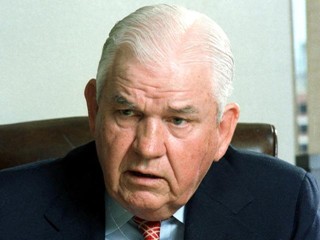
DALLAS – As district attorney of Dallas for an unprecedented 36 years, Henry Wade was the embodiment of Texas justice.
A strapping 6-footer with a square jaw and a half-chewed cigar clamped between his teeth, The Chief, as he was known, prosecuted Jack Ruby. He was the Wade in Roe v. Wade. And he compiled a conviction rate so impressive that defense attorneys ruefully called themselves the 7 Percent Club.
But now, seven years after Wade’s death, The Chief’s legacy is taking a beating.
Henry Wade
Nineteen convictions ‹ three for murder and the rest involving rape or burglary ‹ won by Wade and two successors who trained under him have been overturned after DNA evidence exonerated the defendants. About 250 more cases are under review.
No other county in America ‹ and almost no state, for that matter ‹ has freed more innocent people from prison in recent years than Dallas County, where Wade was DA from 1951 through 1986.
Current District Attorney Craig Watkins, who in 2006 became the first black elected chief prosecutor in any Texas county, said that more wrongly convicted people will go free.
“There was a cowboy kind of mentality and the reality is that kind of approach is archaic, racist, elitist and arrogant,” said Watkins, who is 40 and never worked for Wade or met him.
But some of those who knew Wade say the truth is more complicated than Watkins’ summation.
“My father was not a racist. He didn’t have a racist bone in his body,” said Kim Wade, a lawyer in his own right. “He was very competitive.”
Moreover, former colleagues ‹ and even the Innocence Project of Texas, which is spearheading the DNA tests ‹ credit Wade with preserving the evidence in every case, a practice that allowed investigations to be reopened and inmates to be freed. (His critics say, of course, that he kept the evidence for possible use in further prosecutions, not to help defendants.)
The new DA and other Wade detractors say the cases won under Wade were riddled with shoddy investigations, evidence was ignored and defense lawyers were kept in the dark. They note that the promotion system under Wade rewarded prosecutors for high conviction rates.
In the case of James Lee Woodard ‹ released in April after 27 years in prison for a murder DNA showed he didn’t commit ‹ Wade’s office withheld from defense attorneys photographs of tire tracks at the crime scene that didn’t match Woodard’s car.
“Now in hindsight, we’re finding lots of places where detectives in those cases, they kind of trimmed the corners to just get the case done,” said Michelle Moore, a Dallas County public defender and president of the Innocence Project of Texas. “Whether that’s the fault of the detectives or the DA’s, I don’t know.”
John Stickels, a University of Texas at Arlington criminology professor and a director of the Innocence Project of Texas, blames a culture of “win at all costs.”
“When someone was arrested, it was assumed they were guilty,” he said. “I think prosecutors and investigators basically ignored all evidence to the contrary and decided they were going to convict these guys.”
A Democrat, Wade was first elected DA at age 35 after three years as an assistant DA, promising to “stem the rising tide of crime.” Wade already had spent four years as an FBI agent, served in the Navy during World War II and did a stint as a local prosecutor in nearby Rockwall County, where he grew up on a farm, the son of a lawyer. Wade was one of 11 children; six of the boys went on to become lawyers.
He was elected 10 times in all. He and his cadre of assistant DAs ‹ all of them white men, early on ‹ consistently reported annual conviction rates above 90 percent. In his last 20 years as district attorney, his office won 165,000 convictions, the Dallas Morning News reported when he retired.
In the 1960s, Wade secured a murder conviction against Ruby, the Dallas nightclub owner who shot Lee Harvey Oswald after Oswald’s arrest in the assassination of President Kennedy. Ruby’s conviction was overturned on appeal, and he died before Wade could retry him.
Wade was also the defendant in the 1973 landmark Roe v. Wade Supreme Court decision legalizing abortion. The case began three years earlier when Dallas resident Norma McCorvey ‹ using the pseudonym Jane Roe ‹ sued because she couldn’t get an abortion in Texas.
Troubling cases surfaced in the 1980s, as Wade’s career was winding down.
Lenell Geter, a black engineer, was convicted of armed robbery and sentenced to life in prison. After Geter had spent more than a year behind bars, Wade agreed to a new trial, then dropped the charges in 1983 amid reports of shoddy evidence and allegations Geter was singled out because of his race.
In Wade’s final year in office, the U.S. Supreme Court overturned the death sentence of a black man, Thomas Miller-El, ruling that blacks were excluded from the jury. Cited in Miller-El’s appeal was a manual for prosecutors that Wade wrote in 1969 and was used for more than a decade. It gave instructions on how to keep minorities off juries.
A month before Wade died of Parkinson’s disease in 2001, DNA evidence was used for the first time to reverse a Dallas County conviction. David Shawn Pope, found guilty of rape in 1986, had spent 15 years in prison.
Watkins, a former defense lawyer, has since put in place a program under which prosecutors, aided by law students, are examining hundreds of old cases where convicted criminals have requested DNA testing.
Of the 19 convictions that have been overturned, all but four were won during Wade’s tenure. In two-thirds of the cases, the defendants were black men. None of the convictions that have come under review are death penalty cases.
“I think the number of examples of cases show it’s troubling,” said Nina Morrison, an attorney with the Innocence Project, a New York-based legal group affiliated with the Texas effort. “Whether it’s worse than other jurisdictions, it’s hard to say. It would be a mistake to conclude the problems in these cases are limited to Dallas or are unique to Dallas.
Former assistant prosecutor Dan Hagood said The Chief expected his assistants to be prepared, represent the state well and be careful and fair.
“Never once ‹ ever ‹ did I ever get the feeling of anything unethical,” Hagood said. He denied there was any pressure exerted from above ‹ “no `wink’ deals, no `The boss says we need to get this guy.’”
But Watkins said those who defend The Chief are “protecting a legacy.”
“Clearly it was a culture. A lot of folks don’t want to admit it. It was there,” the new DA said. “We decided to fix it.”
© 2008 MSNBC.com
by Shaila Dawan, At: NYT