Month: October 2024

  • Four Died Trying, Chapter Two

    Four Died Trying, Chapter Two


    Four Died Trying:  Jack Joins the Revolution

    I have had the opportunity to see the second part of the bold, ambitious documentary series, Four Died Trying.   Entitled “Jack Joins the Revolution”, it seems to me to be a notable achievement over which director John Kirby and producer Libby Handros should take a bow.

    It begins with Oliver Stone noting the difference in age and appearance between John Kennedy and his predecessors, Harry Truman and Dwight Eisenhower. We then cut to Robert Kennedy Jr. and he supplies an even more direct context, namely the Irish background of the Kennedy family. After all, the Irish had been colonized for 800 years.  And this is something that the Kennedy family never forgot since the British control deprived the Irish of true suffrage and political office, among  other rights– including that of property.  This domination was particularly aimed at Catholics, which was the religion of the Kennedys.  There had been rebellions and, to say the least, the Great Famine of 1845-52 was a controversial event. Ireland did not become a formal and recognized republic until 1949, and Northern Ireland remains a part of the United Kingdom.

    As Kennedy Jr. notes this is likely why, when the family migrated to America, they decided to get into state and local politics. This included both sides of the family, the Fitzgeralds and the Kennedys. Which brought them into conflict with the Boston Brahmins, represented by the union of the Lodges and Cabots from Beacon Hill.

     Joseph Kennedy,  Rose Fitzgerald’s husband and JFK’s father, was a wealthy businessman who served in several appointed national positions, including as Franklin Roosevelt’s chair of the Security and Exchange Commission. But, as author Monica Wiesak—America’s Last President—illuminates, although the father was a rich capitalist he wanted his children to have a wide ranging education. For instance the brothers Joe and Jack studied under the illustrious Harold Laski at the London School of Economics.  Laski was a radical Labor Party leader who was sympathetic to Marxism. What Laski did was to encourage independent thinking, not bordered by orthodoxies. Monica also describes Jack’s rather sickly childhood which allowed him much time to read and also to empathize with those who were suffering. 

     Joe Kennedy was appointed ambassador to England by FDR. He wanted the US to stay out of the continental war brewing between Germany  on one side and England and France. Since Roosevelt wanted to get America into the war, and Kennedy was perceived as an isolationist, Joe was removed from office in 1940.  Then Pearl Harbor happened and both Jack and his brother Joe joined the service. As brother-in-law Stephen Smith observes, they were both war heroes.  Joe died on a dangerous air mission, and Jack saved his men after a Japanese destroyer cut their PT boat in half. JFK never forgot the natives on the island who helped him: he  invited them to the White House.

    This war service helps shoehorn the film into its main theme. Kennedy served as a journalist and was at the San Francisco Conference which ushered in the United Nations.  He could have continued in that vocation.  But he decided that he wanted to actually be in a position where he could take action.  So he ran for congress and was elected at age 29.   As Wiesak states, on the domestic side he was anti-monopolist and advocated for low cost housing for veterans. 

    By the mid-fifties, he had begun to evolve into an anti-imperialist and nationalist in foreign policy. And, I must say, the research team on this project dug up films and articles that even I had not seen before in this vein. And I have spent around ten years focusing on this very topic.  

    In one instance, Kennedy states that America had now stopped being a model for the Third World.  So much so that we had given an opening on this to the USSR, which we should not have done. In another instance, he says that France was wrong not to cede any control in Indochina to the Vietnamese. He then adds that nationalism was more powerful than anti-communism.  Kennedy had the same attitude toward the countries of the Middle East.

    Appropriately, the film then cuts to David Talbot speaking about how the Dulles brothers, since they were partners at Sullivan and Cromwell, had a rather dramatically different point of view on the subject. Talbot speaks about their apogee of power under President Eisenhower.  Through an NBC special from the sixties, we see Dulles being interviewed and saying that the CIA was asked to help in Vietnam. (Whatever that was supposed to mean.). The film then contrasts Dulles with young John Kennedy.  And JFK speaks about how America should have followed the example of Indonesia, where the Dutch allowed for independence.  JFK expands on this by saying we can avoid both imperialism and communism–but only by allowing for some kind of freedom.

    Wiesak now talks about Kennedy’s landmark 1957 Algeria speech, which shocked the leaders of both political parties. And the film shows examples of the editorials which appeared, and the almost violent repercussions in newspapers like the Boston Globe and the New York Times. In fact, the latter printed direct criticism from the French about Kennedy.  Jim Douglass insightfully comments that this contest between Kennedy and the Establishment has either been forgotten or covered up by historians and the media.  Unlike Foster Dulles, Kennedy did not think you could bind the world together through treaties or by selling free enterprise in the Third World. 

    Adroitly, since Algeria was in Africa, the film now pivots to how that continent was greatly moved by Kennedy’s speech. Including how the African diplomats underwent segregation in the USA, even the ones who were in Washington to visit with him. In a real find, the film shows clips of Kennedy mentioning Africa during the campaign of 1960.  Former Secret Service agent Abraham Bolden makes an appearance and states how much this appealed to African Americans.

    We now turn to Cuba and Castro.  Wiesak comments on how Kennedy understood that America was wrong to have backed dictator Fulgencio Batista for as long and as fully as we did. In fact, the American ambassador there was the second most powerful man on the island. This strong man syndrome in American foreign policy is commented on by author Stephen Schlesinger who co-wrote the fine book, Bitter Fruit,  on the 1954 CIA overthrow in Guatemala. The pretext that Foster Dulles used, that Guatemalans now had the freedom to choose, was utterly false. It was the CIA which had now overthrown a democratically elected leader in Jacobo Arbenz and installed a dictator in Castillo Armas. The difference being that Armas would now protect the holdings of United Fruit, a client of Sullivan and Cromwell. That overthrow was followed by decades of oppression, terror and murder– which eventually took the lives of approximately  100,000 citizens. 

    In a classic vignette, CBS reporter Eric Sevareid asks Allen Dulles if he has ever engaged in acts of violence, a charge which he denies.  Dulles then jests about the tales in the media about the CIA using murder tactics and usurping power abroad.  This segues to Joseph Kennedy’s service on the Hoover Commission.  That led to the legendary Bruce/Lovett report which called for reforms to the CIA, and what Dulles had done to it.  

    This could not make for a better bridge to the ending. Before Kennedy could take office in 1961, the CIA was working to overthrow the democratically elected government of Patrice Lumumba in Congo. Dulles knew that Kennedy favored him over the Belgian colonialists. Lumumba was dead three days before Kennedy was inaugurated.

    All in all, this is an impressive achievement in both research and execution. I was privileged to see a sneak preview.  And hopefully it will be released to the public soon. It’s the kind of history that the masses should know about, and MSM hacks like Chris Wallace wish to hide. 

  • Review of Countdown 1960 – Part 2

    Review of Countdown 1960 – Part 2

    IV

    But as bad as all the above is, its not the worst part of this awful book. No, the worst part is when Wallace tries to show that the Kennedy campaign stole the 1960 election.  To do this, he does something I thought no credible author would ever do again. He trots out Judy Exner and Sy Hersh. Again, can the man be for real?  He must be the only reporter in America who is not aware that the book he is using, Hersh’s The Dark Side of Camelot, was discredited before it was even published.

    Hersh famously fell for a phony trust that was allegedly set up between the Kennedys and Marilyn Monroe by her attorney Aaron Frosch. Hersh was told, not once, but twice that the signatures were faked.  (For an analysis of this, click here https://www.kennedysandking.com/john-f-kennedy-articles/sy-hersh-falls-on-his-face-again-and-again-and-again) When experts in forgeries finally examined the papers, they proved to be forged in every way. The question later became why did Hersh, or his publisher, not do an examination first?

    But then Hersh used Exner and, as one will read above and below, that story also blew up in his face. Exner—who we will deal with soon– had now changed her story a second time.  She now said she was knowingly exchanging messages between John Kennedy and Sam Giancana. Unlike Wallace, Hersh realized Exner’s ever evolving story had credibility problems.  So Hersh now said that there was a witness to her messenger mission, namely Martin Underwood, a political operative for Mayor Richard Daley. (Hersh, pp. 304-305) 

    Like the Monroe trust BS, this also exploded in Hersh’s face.  Because when Underwood was examined under oath by the Assassination Records Review Board, he denied he did any such thing. (ARRB Final Report, p. 136) But incredibly, Wallace alludes to that part of the story again here.  For whatever reason, he does not name Underwood. (Wallace, p. 113)

    Now, still going with “pie on his face” Hersh, Wallace writes that Joseph Kennedy was involved in bootlegging operations with organized crime during Prohibition. This was disproved by author Daniel Okrent in his fine book on the era titled Last Call.  Okrent went through nearly 900 pages of FBI documents on Joe Kennedy.  These were done to clear him for the many positions he served on in government. Okrent found not one page or source who said a word about any such involvement. Joe Kennedy biographer David Nasaw discovered the same for his book, The Patriarch. But Nasaw, who had unprecedented access to Joe Kennedy’s files, also went over how Joe got so very rich. It was through stocks, real estate and, above all, the film business. As Okrent notes in his book, this mob mythology was begun in the sixties by gangsters who clearly had an agenda to smear JFK and RFK since they had made their lives so troublesome with their war against the Mob.

    Another point that Wallace sidesteps is this.  As FBI agent William Roemer explained in his book, Man Against the Mob, the Bureau had total surveillance on Giancana.  This included following him everywhere he went and having electronic wires on four dwellings that he did his business in. In Roemer’s 400 page book one will read no reference on tape to any arrangement with Joe Kennedy or the election.  Which is pretty convincing that it never happened.

    But for me, there is something even more convincing.  That is the work of professor John Binder. His landmark article “Organized Crime and the 1960 Presidential Election” first appeared in 2007 at Public Choice; it has been preserved at Research Gate. In a statistical study, Binder examined the returns for what were considered the 5 Chicago Outfit controlled wards. He discovered that there was no indication that the voting trends in those wards went up, and in some cases they declined. He also makes short work of the idea that the outfit could influence the Teamsters in that election. (Wallace, p. 214) Since Jimmy Hoffa depised the Kennedys and would not trust them with a tennis ball. After all they had already gotten rid of Hoffa’ predecessor Dave Beck.

    Thus Binder deduces that “union members in states where the Outfit operated voted less heavily Democratic than usual and therefore against JFK.” Binder concluded his essay by saying that “much of what has been written about the Outfit, the 1960 presidential  election and other events involving  the Kennedy family appears to  be historical myth”. (Here is a link to this fascinating article https://themobmuseum.org/blog/did-the-chicago-outfit-elect-john-f-kennedy-president/

    I should add one concluding note about Sy Hersh and his JFK book: Not even the MSM supported it. And  in most cases they savaged it. The most brutal and thorough review was composed by Garry Wills in The New York Review of Books on December 18, 1997. That memorable critique closed by saying it was an odd experience watching a once valued reporter destroy his reputation in a mad, and ultimately failed, mission to tear down President Kennedy–while simultaneously imploding himself. Somehow Chris Wallace missed that.

    V

    What Wallace does in trying to revive the dead corpse of Judy Exner is something I don’t even think magician David Copperfield would attempt.

    Exner first surfaced into the American consciousness for the Church Committee in 1975. At that time—and this is key– she stated that she wanted to head off wild-eyed speculation that she had ever discussed her relationships with either Sam Giancana or Johnny Roselli with John Kennedy.  She also said she knew nothing about the CIA attempts to neutralize Castro, and they were never brought up with the president.  Also, the president did not know she was seeing Giancana and Roselli. (NY Times 12/18/75, article by John Crewdson)

    She called a press conference in San Diego to say that she wanted to clear her name so as not to be implicated in “these bizarre assassination conspiracies.”  She also added that she “had no wish to sell the rest of her story to book publishers or to the news media.” (ibid) Although there were phone calls from Exner to the White House from California, no notations recorded her as a visitor to the Oval Office. (ibid). Evelyn Lincoln said the same. 

    It was revealed that when Hoover informed the White Hose of who she was, the communications stopped after March 22,1962. (Ibid)

    What is exceptional about this initial summary is that almost all of it will be radically altered over time.  And Wallace does not tell the reader about any of the revisions. She did take part in the writing of a book and Wallace quotes from it.  But that book was clearly a team operation out of agent Scott Meredith’s office with prolific Mafia writer Ovid DeMaris as co- writer.  It is important to note that DeMaris was also a big fan of FBI Director J. Edgar Hoover and a Warren Commission backer. (The Assassinations, edited by James DiEugenio and Lisa Pease, pp. 330-31). There is a salacious and unbelievable  scene in My Story placed at the Democratic Convention of 1960, one which has all the earmarks of being a fabrication. And unsurprisingly, Wallace repeats it here. (Wallace pp. 169-70; DiEugenio and Pease, pp. 332-33)       

    Not only does Wallace not tell the reader that Exner altered her story, he does not even note when it happened. It was for the February 29, 1988 issue of Peoplemagazine. And they were radical alterations. She reversed herself on everything she said in 1975. She now stated that she was seeing Giancana at Kennedy’s bidding! But further that she helped arrange meetings between Kennedy and Giancana and Kennedy and Roselli,  some of which took place at the White House!  (ibid, p. 333) If one reads the two best biographers on those two gangsters, William Brashler and Lee Server respectively, nothing like this ever came close to happening. And the idea it would happen with Bobby Kennedy as Attorney General is pure science-fiction. Exner was selling whoppers, and she was being paid tens of thousands to do so. (DiEugenio and Pease, p. 334)

    In her new and modified version, the reasons for these newly remembered meetings is in  order to cinch elections and to liquidate Castro. She specifically mentioned West Virginia at that time. Which Wallace agrees with.  Again, this shows  how poor his research is. Dan Fleming wrote a good book about that primary.  He notes that no subsequent inquiry—by the FBI, the state Attorney General, or by Senator Barry Goldwater—ever turned up any evidence of skullduggery that influenced the outcome of the election. (Fleming, Kennedy vs Humphrey: West Virginia 1960, pp. 107-12)  And unlike what Wallace tries to insinuate, Fleming interviewed literally scores of people throughout the state. He could not find any trace of any underworld figure on the ground during that primary.

    To show the reader just how bad Countdown 1960 is, Wallace mentions union leader Raymond Chafin, but he does so through author Laurence Leamer.  As far as I could detect, he does not refer to Chafin’s book Just Good Politics. Therefore Wallace twists the story of the Kennedy campaign contribution to Chafin for a get out the vote effort. Chafin originally backed Hubert Humphrey in that primary. Kennedy asked to meet with him and he told him that if he won, and then won the White House, he would give him even more than Humphrey had promised. Chafin changed his mind and asked for $3,500 to get out the vote.  Kennedy’s team misconstrued this and gave him $35.000, which he spent days delivering to other counties in the state.

    But that is not the end of the story.  Because Kennedy made good on his promise.  He summoned him to the White House after his inauguration. He was told he had 15 minutes with the president.  Kennedy countered and said Chafin would have all the time he needed.  At the end of the book, Chafin said that Kennedy ended up doing more for West Virginia than any previous president. That is quite a lot for Wallace to leave out of the story.

    In other words, Exner’s story about West Virginia is, to say the least, unfounded. But again, what Wallace leaves out is that Exner added to her story even further.  Almost ten years later, for Vanity Fair, she now said that JFK had impregnated her and she had an abortion.  Again, this is something she said the opposite of in her book. There she literally said “I didn’t have an abortion.” (DiEugenio and Pease, p. 336)

    But she then changed her story again for Hersh. For People, back in 1988, she said she was not really sure what was in the satchel that JFK gave her. Now it became 250,000 dollars in hundred dollar bills and the message was the elimination of Castro. (Hersh, pp. 303-07). To say that Exner changed her story is much too mild.  She has done a somersault from her original statements.  And the part about the elimination of Castro is an outright lie.  Because the declassified Inspector General Report on the CIA/Mafia plots to kill Castro specifically says that no president had any knowledge of them.  (Pp. 132-33)

    There is another outright lie that Exner told.  In Hersh’s book she told him that Attorney General Bobby Kennedy asked, “Are you still comfortable doing this. We want you to let us know if you don’t want to.” (Hersh, p. 308). Again, RFK is the man who had wall to wall surveillance on Giancana through both the FBI and the Justice Department. So Bobby was going to give Hoover bribery information on a mobster through the White House?  Who could believe this? 

    But Exner herself contradicted this.  In an interview she did with Larry King in 1992, she said that she never even talked to Bobby, perhaps in passing at a rally in Los Angeles.  In other words, Exner told so many lies she could not keep track of them. And this is the kind of witness that Wallace bases his book upon.  

    I could go on and on.  For example Wallace mentions the case of Florence Kater saying she had a picture of JFK leaving a girlfriend’s house at night.  The picture is not clear as to who the man is.  But Wallace attacks Kennedy for harshly scolding Kater about it in a threatening manner.  What Wallace does not reveal is this: Kater was blackmailing Kennedy.  She wanted a Modigliani painting.

    VI

    We now come to the reason for the book.  Which the author admits in his Acknowledgments. (p. 397). He says that during the January 6th Insurrection he was so disturbed  that he thought back to the elections he had covered.  He then writes that 2020 shattered the belief in acknowledging a winner and loser in a presidential campaign.  

    Wallace then makes a quantum leap in time.  He says that thinking about that day somehow reminded him of the election of 1960.  There is a slight problem here.  Wallace did not cover that election.  In fact, he was only 13 years old.  So, like much of the book, this simply does not wash. And if it did remind him of any election he covered, it should have been the 2000 election in Florida and the whole Bush v Gore phony decision commandeered by Justice Antonin Scalia and the Supreme Court. Where they halted the recount certified by the state and stopped the probability of Vice President Al Gore from winning the election.  Which it appeared he would have done since he was gaining on George W. Bush very quickly.  

    Besides the Supreme Court and its phony decision, we know that Roger Stone created a mini riot during a recount at the Steven B. Clark Government Center in downtown Miami. This was later named the Brooks Brothers riot since it was made up of Republican staffers disguised as local residents. As Chris Lehmann noted in The Nation, it was this ersatz local riot that outlined the blue print for Trump’s insurrection. (August 4, 2022) Roger Stone had been a dirty tricks impresario under Richard Nixon. In fact Stone wore a Nixon tattoo on his back. He then moved into the orbit of Donald Trump.  Stone was then part of the Stop the Steal demonstrations in Washington on the eve of the Insurrection.

    As Lehmann notes, the difference between the two is that the Florida riot worked.  That particular recount was halted and then the Supreme Court sealed the deal for the disastrous reign of George W. Bush. Which, among other things, included the deaths of about 650,000 civilians in Iraq. Even William Kristol later said that the Brooks Brothers riot let loose a buried trait in the GOP that later became dominant. (ibid)

    Also, many observers think that the whole mythology about the corruption in West Virginia began with Nixon’s operatives late in the general election.  When it looked like Nixon had lost his lead, they planted a story in the St. Louis Post Dispatch to this effect.

    So 2000 is the proper precedent for the Insurrection. Not a pile of mythology created after the fact by gangsters, Judy Exner and Sy Hersh. Wallace does not want to go there for obvious employment reasons. But also because he admits he favored Nixon in 1960. (Wallace, p. 397). He clearly did not like Kennedy.  And that carried forward to this book.  Any reporter who would stoop to using Exner and Hersh to trash JFK is too biased to be trusted.

    The best way to close this review it to quote Wallace from the MSNBC show The Beat. On October 9th, he commented on the Fox defamation lawsuit over the 2020 election. He said, “There ought to be a price to pay when you don’t tell the truth.”

    As detailed above, you just paid it Chris.

  • Review of Countdown 1960 – Part 1

    Review of Countdown 1960 – Part 1

    Whenever one thinks that the MSM cannot get any worse, or purposefully bad on the subject of John Kennedy or his assassination, another reminder arrives showing they can.  The latest example of this is Chris Wallace’s Countdown 1960.  This book, by former Fox reporter turned CNN employee Chris Wallace, is ostensibly about the race for the presidency in 1960.  I say ostensibly because anyone who knows the subject will be able to figure out what this book is really about.  And, in fact, Wallace pretty much confesses to his real intent in the acknowledgements section of the book.  That section is usually included in the front of a volume, but here its at the end. I will get to why I think that is so later.  

    I

    Like almost every writer who wants to exalt his work on this subject, Wallace begins by saying that the primary system of electing party nominees for the presidency was somehow a novelty in 1960.  And Kennedy decided to use it to original effect.  This is simply not the case. The primary system was really invented during the Progressive Era, but the first one was held before that, in 1901 in Florida. And just a few years later, 12 states were conducting them. By 1910, the practice of holding state elected delegates to cast ballots for the party winner at the convention was established. And, in fact, there was a memorable donnybrook in 1912 during the primary season between challengers Robert La Follette, Teddy Roosevelt and incumbent president William Howard Taft. And there was another memorable race as recently as 1952 between Dwight Eisenhower and Robert A. Taft.

    For me, the only notable differences in 1960 were 1.) The use of television, and 2.) The debates between Kennedy and Nixon. But the first would have happened anyway no matter who the candidates were.  It was a matter of the creeping reach and power of the broadcast media.  As for the second, this did not really establish a precedent. Because the next presidential debate did not occur until 1976. So right out of the gate, on page 3 to be exact, it can be said that Wallace is aggrandizing his subject. (As later revealed, this ties into his not so hidden agenda.)

    Another disturbing aspect of the book is the fact that Wallace and his researchers, Mitch Weiss and Lori Crim, did not seem to me to do a lot of genuine research.  In looking at the book’s reference notes, almost every one of them is to a prior book, newspaper article or periodical.  There is little that I would call new or original.  And, as I will explain later, some of the sources that Wallace uses are quite dubious; or as we shall see, in some instances, even worse than that.  These factors combine to make the book not just rather superfluous, but questionable at its foundations.

    One of the problematic areas of the book is that  very early Nixon is portrayed as an oracle on foreign policy. (p. 14) John Kennedy is portrayed as something of a cliché.  That is, the usual rich, handsome playboy portrait. (p. 17)  For example, Wallace begins by saying that Kennedy started running for the presidency in 1957, a thesis with which I would tend to disagree. (p. 2)  But if you are going to postulate such, how can any honest and objective author ignore Senator Kennedy’s great Algeria speech? Because it was made in that year. 

    Why is this both important and revelatory? There are two reasons why. First, that speech really put Kennedy on the national map. As Richard Mahoney noted, it provoked a firestorm of newspaper and periodical comments and editorials from all over the country. (JFK: Ordeal in Africa, pp. 14-16; see also, James DiEugenio, Destiny Betrayed, second edition,  pp. 25-28) That national furor ended up placing Kennedy on the cover of Time magazine, with the inside article titled “Man out Front”.  So how can that not be related to Wallace’s subject?

    The reason I think he does not include it is because that speech was a specific attack on President Eisenhower, his Secretary of State John Foster Dulles and, most relevant to Wallace’s book, on Vice President Richard Nixon. It assaulted the entire basis of their Cold War foreign policy in the Third World. Kennedy was essentially saying that America should not be backing European colonialism. We should be on the side of nationalism and independence in places like Algeria. And this was not just a matter of American idealism, but one of practicality.  He invoked what had happened three years earlier at Dien Bien Phu, where we had first backed the French empire–and it ended up in disaster. He proclaimed that what we should be doing now is assisting France to the negotiating table, in order to save that nation from civil war.  But we also should be working to free Africa. (See the anthology The Strategy of Peace, edited by Allan Nevins, pp. 65-81) 

    If one does not refer to this speech, or the trail that led Kennedy to make it, then yes, one can portray the senator as an empty Savile Row suit and Nixon as the experienced sagacious foreign policy maven. But that is simply not being accurate on the facts of the matter.  As John T. Shaw commented in JFK in the Senate, that speech made Kennedy the new voice of the Democratic party on foreign policy.  Since it challenged the prevailing orthodoxy of Eisenhower and Nixon. As Monice Wiesak wrote, this speech also made Kennedy the defacto ambassador to Africa. Because African dignitaries now began to follow him in the press and visit his office. (America’s Last President, p. 12)

    To ignore all of this is to shrink Kennedy and exalt Nixon.  If there is an historical figure who should not be exalted, it is Richard Nixon.  Because it was this Cold War monomania that first, got us into Vietnam, and then, from 1968 onward, kept us there. Until it became even more of a debacle than it had been under the French.

    II

    But there is another way that Wallace exalts Nixon. This is by minimizing the tactics he used to defeat, first Jerry Voorhees for a congressional seat, and then Helen Gahagan Douglas in a race for the senate. The latter is usually considered one of the dirtiest and most unscrupulous political races in American history. 

    Wallace spends all of one paragraph on it. (pp. 10-11)

    Which is really kind of startling.  Because illustrious author Greg Mitchell wrote a milestone book on that campaign in 1998.  It was titled Tricky Dick and the Pink Lady.  I could find no reference to that book in Wallace’s references.  In that campaign, Nixon’s team actually accused his opponent of being a conduit for Stalin. (Mitchell, p. 209) As Mitchell notes, up until that time, candidates who made anti-communism their focus usually lost.  That was not the case here. Nixon literally demagogued the issue to an almost pathological extent. As Mitchell notes:

    Republican and Democratic leaders alike interpreted the outcome as a victory for McCarthyism and a call for a dramatic surge in military spending…. Red baiting would haunt America for years, the so called national security state would evolve and endure and candidates would run and win on anti-Sovietism for decades. (ibid, xix)

    Nixon’s win seemed to demonstrate the political power of McCarthyism, which Senator Joe McCarthy had begun that same year with his famous speech in Wheeling, West Virginia. But as Mitchell proves in his first chapter, McCarthy’s speech drew heavily on the actual words of Congressman Nixon. As with Nixon, it was McCarthy’s aim to make anti-communism a political issue, to portray Democrats as not just soft on communism—Nixon actually tried this with President Truman– but in some cases as commie sympathizers. (This is one reason why Kennedy’s Algeria speech hit home, because it broke through all that Cold War boilerplate with facts and realism.)

    As Mitchell reveals—and contrary to what Wallace implies–Nixon had a lot of money in order to smear Douglas. Not only did he get large corporate contributions, but both the LA Times and the Hearst newspapers backed him. Along with Hollywood bigwigs like Cecil B. DeMille, Howard Hughes, Harry Cohn, Darryl Zanuck, Louis Mayer, Anne Baxter, John Wayne and Rosalind Russell. (Daily Beast, article by Sally Denton, November 16, 2009) Nixon also used anti-Semitism, since Douglas’ husband was Jewish. Nixon’s campaign made anonymous phone calls saying, “Did you know that she’s married to a Jew?” (ibid) But in addition to anti-Semitism, the campaign utilized racism. In the last days, thousands of postcards were mailed to white voters in suburbs, and into northern California. That postcard was emblazoned with the phony title—note the gender– “Communist League of Negro Women.”  The message was “Vote for Helen for senator.  We are with her 100%.” (ibid). Can a campaign get any more scurrilous than that? This is why Nixon had such a deservedly wretched reputation as a political hatchet man. Which somehow, and for whatever reason, Wallace wants the reader to forget.

     Nixon lied about what his agenda was both before and after this ugly race. Before it started he said–rather satirically in retrospect–there would be “no name-calling, no smears, no misrepresentations in this campaign.” (Ingrid Scobie, “Douglas v. Nixon”, History Today, November, 1992) And later, he downplayed his tactics for the campaign.  One reason the race had a lasting impact is that Nixon’s manager, the odious Murray Chotiner, became a tutor to the likes of later GOP advisors Karl Rove and Lee Atwater. 

    To relegate all this–and much more–to a single paragraph is just inexcusable.  Because, with a trick worthy of a card sharp, it hides two of the most important and unseemly aspects of Nixon’s career, his Machiavellian morality, and obsession with dirty tactics. 

    As we have seen, Nixon’s Cold War ideology would lead to a hellish ending in Indochina. His political tactics would cause Watergate. Incredibly, Wallace wants to whitewash both.

    III

    But all the above is not enough for Wallace, who is herniating himself by cosmeticizing Nixon.  He now makes a rather curious  statement:

    In 1960, America moved slowly toward racial equality, partly because of detours placed along the road to civil rights by southern governors. (pp. 23-24)

    He then adds something even more curious: Nixon supported civil rights. He uses the crisis at Little Rock’s Central High and the Civil Rights Act of 1957 as his evidence for this.  All of this relies on the ignorance of his audience to maintain even superficial credibility.

    Anyone who uses the web can find out that Eisenhower let the students at Central High be terrorized for 20 days while doing nothing. The courts had ordered nine African American students to enter Central High. Governor Orville Faubus called out the National Guard to prevent this. While this was boiling over, Eisenhower actually went on vacation to Newport, Rhode Island. He was then played for the fool by the redneck governor of the state. Faubus came to Newport and told Eisenhower he would now abide by the court ruling and withdraw the National Guard, who had worked against the students. He did not.  And the court ruled against him.  He then removed the Guard. Now the crowd had direct contact with the nine students the court had approved for attendance.

    Humiliated by Faubus and with the press now turning on him, Eisenhower had no choice but to call in federal troops.(LA Times, 3/24/1981, article by Robert Shogan.) Then he and Nixon tried to use a face saving device by submitting a weak civil rights bill to congress. They had no interest is expanding civil rights.  What they wanted to do was split the Democratic party in two: the northern liberals from the southern conservatives. Senate Majority Leader Lyndon Johnson did all he could to try and modify the bill so it would not be so polarizing to the southerners. (“The Kennedys and Civil Rights”, Part 1, by James DiEugenio) Because of this, the act ended up being little more than an advisory commission with virtually no real enforcement power.  So what Wallace is trying to sell here about Nixon on civil rights  is transparent bunk.

    But again, what he leaves out makes Wallace’s efforts worse than bunk.  The Eisenhower/Nixon team worked against civil rights. As Michael Beschloss has revealed, Eisenhower tried to convince Earl Warren not to vote for the Brown vs Board decision. And, in fact, both Eisenhower and Nixon failed to support that decision. In the 1956 Autherine Lucy case at the University of Alabama, Eisenhower let an African American student be literally run off campus, even though the court had supported her attendance. He did nothing to protect her. (Irving Bernstein Promises Kept, p. 97; Jack Bass, Unlikely Heroes, p. 64)  This was two years after Brown vs. Board.

    In a full eight years, the Eisenhower/Nixon administration filed a total of ten civil rights lawsuits.  What makes that even more startling is that six of those years were under the Brown v Board decision. Two of those lawsuits were filed on the last day of Ike’s administration. (Harry Golden, Mr. Kennedy and the Negroes, p. 104) And recall, during the Eisenhower/Nixon years, not only did you have the Brown decision, you had the Montgomery bus boycott. In other words one had some ballast to push ahead on the issue.

    Its not enough for Wallace to disguise the real facts about Eisenhower/Nixon on the issue. He now utterly distorts what Kennedy’s public stance was. He says that JFK had been silent about civil rights. (p. 24, p. 160). This is more rubbish from a book that will soon become a trash compactor. In  February of 1956 Kennedy said the following: 

    The Democratic party must not weasel on the issue….President Truman was returned to the White House in 1948 despite a firm stand on civil rights that led to a third party in the South…..We might alienate Southern support but the Supreme Court decision is the law of the land.

    It is hard to believe that Wallace’s research team missed this speech.  Why? Because Kennedy made it in New York City and the story appeared on the front page of the New York Times for February 8th.

    But in case that was not enough for Wallace, in 1957 Kennedy said the same thing.  This time he made that speech—the Brown decision must be upheld– in the heart of the confederacy:  Jackson, Mississippi. (Golden, p. 95)  As noted in the first speech, JFK made his opinion public knowing full well he would lose support in the south. Which, as Harry Golden noted, is what happened.

    One of the most bizarre things that Wallace writes is that Kennedy voted for the watered down version of the Civil Rights Act of 1957. What Wallace somehow missed completely is this: Kennedy did not want to vote for this bill at all.  As he wrote a constituent, it was because it was so weak. He had to be lobbied to vote for it by Majority Leader Lyndon Johnson.  LBJ sent two emissaries to convince him to do so, but Kennedy resisted. Johnson now personally went to Kennedy to lobby him in person.  Kennedy still was reluctant, but he was instructed by some Ivy League lawyers who said it would be better than nothing. (See Lyndon Johnson: The Exercise of Power, by Rowland Evans and Robert Novak, pp. 136-37)

    What was the result of all this back and forth?  Essentially nothing.  Because as Harris Wofford wrote in his book Of Kennedys and King, Eisenhower and Nixon resisted just about every recommendation the Civil Rights Commission—which originated with the act—made.  He should know since he was the lawyer for the agency. (p. 21)

    So the inactivity on civil rights in the fifties is clearly due to three men: Eisenhower, Nixon and Johnson. When JFK came into office, as Judge Frank Johnson said, it was like lightning.  Things changed that fast. Including going directly at those southern governors Wallace was talking about.

    Read part 2

  • Ethel Kennedy Passes

    Ethel Kennedy, widow of Robert F.Kennedy, has passed on at age 96 from the aftermath of a stroke. Read more.

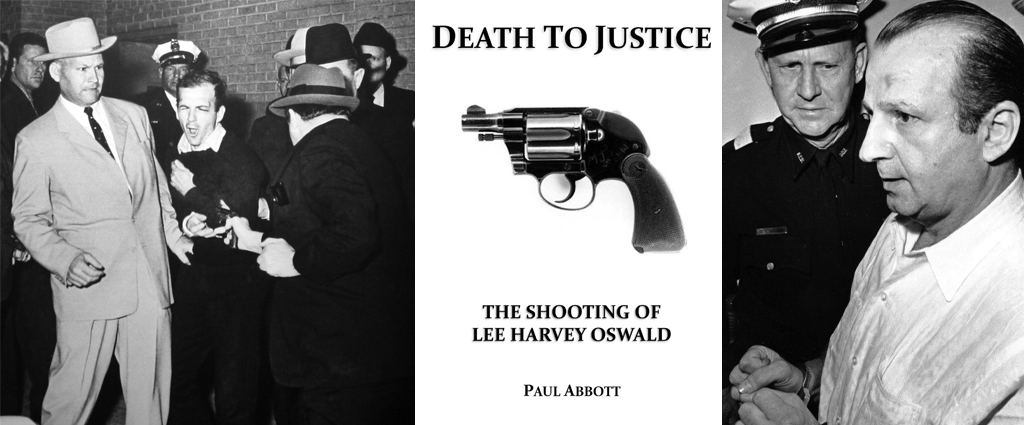
  • Death to Justice: The Shooting of Lee Harvey Oswald – Part 1

    Death to Justice: The Shooting of Lee Harvey Oswald – Part 1


    Foreward

    by Paul Bleau

    Paul Abbott and I live at opposite ends of the world – he in Australia and I in Canada. We got to know one another because of the Garrison Files. After reading some ten thousand pages of these, I knew that hidden away in this collection, there were gems that were not on the radar when it came to analyzing the JFK assassination. Just one example is how Garrison was on the trail of Latinos, with likely links to Guy Banister, who frequently escorted Oswald.

    I knew that if others went through these, they could pick up on clues I may have missed. Paul reached out and provided the community with a research booster that is an archive asset of great value: the Garrison Files Master Index. Garrison’s unfairly dismissed primary research can now be referenced with ease digitally by info ferrets.  It took Paul over a year to build the index, and he deserves our thanks.

    So, when Paul asked me to write a foreword for his book, I felt an obligation to do so. This was risky, in a way, as I refuse to plug material of mediocre quality. What if I did not like it?

    You have guessed by now that I like this book… a lot. Thousands of books have been written about the Kennedy assassination. A few classics have been written about the Tippit murder, which is often covered in more JFK-focused writings. Question to the reader: What do you know about the other murder of that weekend? In my case, it was not much. Yet it, as much as the JFK murder, has all the fingerprints of a conspiracy. It matches the JFK assassination when it comes to poor security. The elimination of Oswald sealed the lips of the most important witness. The shooter likely had assistance to get to the victim and was clearly mob-linked.

    There are many ways one can zero in on the leaders of the JFK assassination conspiracy; Work your way up the ladder around the equally suspicious prior plots to kill JFK; Find out who pulled strings with the media ineptness and the botched autopsy or the Warren Commission charade; Solve the Rosselli, Giancana murders; Figure out who Cubanized Oswald and organized his impersonations… There is a good chance that we will draw vectors pointing in the same direction to the string pullers.

    Ask yourself who organized the removal of the witness who, with his life on the line, could have revealed everything we have painstakingly come to know, suspect about him and his associations and obviously those who conspired to kill Kennedy would be the prime suspects. Yet what do we really know about this crime. Certainly, the Warren Commission’s lame explanation around a series of unfortunate mishaps that led to his unfortunate death should carry even less weight than their impeached whitewash of the JFK assassination. I mean really, two misguided lone nuts… Give me a break!

    Who were the witnesses? What did they say? What was the series of events that led this obvious ruse to obstruct justice? How could this murder have been carried out? Who are the persons of interest? This book delves into all of this and a lot more. Factually, brilliantly and clearly! 

    It is amazing how one Australian on the opposite end of the planet from Dallas can say ten times more about this murder than the FBI, CIA, Warren Commission and Dallas Police Department combined.

    The man who gave us the master index to the Garrison files has now provided us with the all-defining book around the unsolved murder of the most important witness of the twentieth century, which will stand as the go-to reference on the most ignored murder of that infamous weekend in November 1963 in Dallas and shed light coming from an ignored source on the mother of all conspiracies.

    (End of foreward by Paul Bleau)

    Read an excerpt in Part Two

  • Death to Justice: The Shooting of Lee Harvey Oswald – Part 2

    Death to Justice: The Shooting of Lee Harvey Oswald – Part 2


    CIVILIANS OVERLOOKED

    Having laid out the geography of City Hall and the Annex Building basement levels and examining the many points not guarded, therefore could be accessed through, it is now important to focus on the accounts of those present in and around the basement prior to and during Lee Oswald’s shooting.  Given there were just under three hundred statements made regarding the Oswald shooting, it will be useful to group as many present as possible into categories: citizens, law enforcement, and media. And beyond those, specific instances and locations of events. With this approach, we can focus in depth on the many narratives that took place across City Hall during the hours leading up to Oswald’s shooting. 

    The most under-represented cohort of witnesses that day were the civilian employees of both City Hall and the Dallas Police Department. While it is true that none were present to directly witness Jack Ruby shooting Oswald, their testimonies regarding the preparations for the transfer and the aftermath provide important pieces to the overall picture of the puzzle, as it were. However, other than in records of the DPD investigation and the Warren Commission, there is little to no reference to be found regarding these people and their stories – until now. 

    Below is the list of non-Police and media personnel that were at or outside City Hall that morning and who provided at least one statement to the subsequent investigations:


    Fred Bieberdorf – First Aid Attendant

    Wilford Ray Jones – Bystander

    Frances Cason – Dispatcher

    Edward Kelly – Maintenance

    Napoleon Daniels – Former police officer

    Louis McKinzie – Porter

    Nolan Dement – Bystander 

    Johnny F. Newton – Jail Clerk

    Doyle Lane – Western Union Supervisor

    Edward Pierce – Engineer

    Harold Fuqua – Parking Attendant

    Alfreadia Riggs – Porter

    Michael Hardin – Ambulance Driver

       John Servance – Head Porter


       Jerry D. Slocum – Jail Clerk


    Any reasons behind the seemingly random nature of who was and was not interviewed by which investigation remains anybody’s guess particularly when it came to who the DPD did not interview. Consider, for instance, how crucial the testimonies of Dallas locals Fred Bieberdorf, who provided Oswald with first aid after he had been shot, and Michael Hardin, who drove the ambulance that rushed Oswald to Parkland Hospital, ought to have been considered but were not taken. 

    That aside, we will first focus on a group of workers who were employed to ensure the smooth running of all infrastructure across both buildings of the City Hall complex including the basement car park. They were:

    Harold ‘Hal’ Fuqua

    Alfreadia Riggs

    Edward Kelly

    John Servance

    Louis McKinzie

    Edward Pierce

    For the porter and parking workers, their base of work was clearly the car park in the City Hall basement. Their jobs were focused on keeping the area in order, getting police personnel cars parked or ready for use and keeping the general public from parking down there – which was most prevalent when it came to jail inmate arrivals and departures. For the maintenance and engineer workers, their work would take them to all parts of both buildings including the utilities spaces across the sub-basement level. There was also a female standing with the workers who was identified as a telephone operator by the name of Ruth – surname unknown – and it is not evident what her movements were after that point. 

    Once the search of the basement began, all media personnel were apparently cleared out but the City Hall workers remained in the far eastern end of the basement where the stairs and elevators went up to the Annex Building, having already stopped work to watch the comings and goings in preparation for the transfer. To this point, Harold Fuqua even testified to the FBI of observing car trunks being opened and searched.(1)

    Edward Pierce also thought they could stay and watch the proceedings that morning up to and including Oswald’s transfer if they kept out of the way. On the face of it, this was a fair assumption given where they were all positioned: nowhere near the transfer route and out of sight of the television cameras. But they were ordered to clear out of the basement and not just for the time it took police personnel to search it. In his own testimony to the DPD, it was Reserve Officer Brock who gave these orders.(2) And presumably this was done a few minutes after he arrived in the basement for assignment at around 9:30am.

    Collectively, it is clear that the workers followed this directive by taking the service elevator up to the First Floor of the Annex Building. This was because the two public elevators had their power cut and were not functioning. Porter, Louis McKinzie, who was responsible that day for running the service elevator took the group up that way to the First Floor. From there the group would walk across to the City Hall Building to find a place to watch the transfer. Soon, Brock called for McKinzie to bring the service elevator back down so he (McKinzie) could escort, according to Brock’s own testimony to the Warren Commission, ‘one of the TV men over there, (who) wanted to go up the fourth – fifth floor to do some kind of work with the equipment there.’ Both Brock and McKinzie would corroborate that the repair man only spent a few minutes doing whatever it was he was doing up in the upper floors of the Annex Building before being brought back down by McKinzie. There is no testimony from any of the media personnel present that day to explain who this person was and what it was they were doing. After that, Brock told McKinzie to leave the service elevator locked on the First Floor and not bring it back down to the basement. McKinzie did so by locking it in place with a key, then hung it on a hook within as was common practice. In his testimony to the Warren Commission, the time was 10:00am.(3) He then walked along the hallway on the First Floor of the Annex Building to the City Hall Building. McKinzie confirmed in his testimony to the Warren Commission that there were three ‘passageways’ that connected the two buildings. They were on the First (Ground), Second and Third Floor and each could be locked with a metal, accordion-style expanding gate. Over nights and on the weekends, these gates were routinely locked so it is easy to imagine that they were in all probability locked on that day too and that is when Edward Pierce noticed as much and at least unlocked it so he and the others could get through.

    Once in the City Hall Building, the workers, not wanting to miss any of the happenings surrounding Oswald’s transfer, had stayed on the First Floor, and walked to the Commerce Street entrance. From there, behind the locked glass doors they stood and watched the activity outside on Commerce Street and waited to watch Lee Oswald be driven away. This is where Louis McKinzie would rejoin them. 

    It appears that the group stayed together in this location for up to one hour. At which point, Harold Fuqua(4) and Alfreadia Riggs(5) decided to leave to find a television to watch the coverage of the transfer instead. 

    A Circuitous Journey

    Having decided to leave the other workers at the Commerce Street entrance, Harold Fuqua and Alfreadia Riggs set off to find a television. Having both been long-serving employees of City Hall (Fuqua – 6 years, Riggs – 7 years) they would have known that the nearest television was down in the Locker Room in the sub-basement level – two floors directly below. However, given they had been ordered out of the basement as a security measure, and Oswald had still not been transferred, it is understandable that they chose to avoid taking a direct route to the Locker Room as it would have likely resulted in them being turned away or worse, in trouble.

    Instead, they retraced the way they had come with the other workers from the Annex Building. From there, they continued along the First Floor of the Annex Building to the far eastern end where the elevators and stairwell were. As McKinzie had left the service elevator locked on the First Floor, it was in position for them to walk through it and exit through the rear door and out to the fire escape and passage that led directly to the outer door. According to both Riggs and Fuqua in their testimonies to the Warren Commission, it was Riggs who used the keys that McKinzie had left hung up in the elevator to unlock the outer door. He kept them with him but said that he made sure the alleyway door was locked by shaking on the door handle. This is an important point that we will revisit later. 

    Riggs and Fuqua walked through an alleyway to Main Street and began to walk west – along the front of the Annex Building. They then came to the top of the ramp that led from the street down to the basement. This is where Officer Roy Vaughn had been standing guard for at least the last hour. And it was this point where Jack Ruby was most commonly purported as entering the basement in time to shoot Oswald. We will also revisit this location and the comings and goings of people there in more detail. However, Vaughn did confirm in his testimony that ‘some city hall janitorial’ staff approached on foot from the east (6) – which is the direction Riggs and Fuqua would have come from. And they said they stopped at the top of the ramp for only a few moments to look down into the basement before walking on. Vaughn also corroborated this. 

    Riggs and Fuqua rounded the corner of Main and Harwood Streets and stopped below the steps up to City Hall. According to Riggs, Fuqua asked him to go down the steps and check to see if ‘it would be all right for us to go down because we (they) were under the impression they had the police – had a police officer on the door.’ Riggs did so and discovered that there weren’t any officers guarding the basement entrance from there into City Hall so he turned around and told Fuqua to come down. This further reiterates the fact that all public entrances into City Hall that morning were not guarded and therefore secure. Riggs and Fuqua walked down the hallway and got as far as the door before the jail office. There they got close enough to see all of the media assembled. They turned right and headed down the corridor that led to the Records Room, Assembly Room, and the stairs down to the Locker Room. Once down there they encountered someone who was all alone. Let’s pick it up with Riggs’ recollection to the Warren Commission’s counsel, Leon Hubert with what happened next:

    Hubert:  You mean you went down into the locker room? That is where all the policemen have their lockers and there’s a recreation room and television and —

    Riggs:     Yes, sir, and television and – and there was a jail attendant down there, actually he didn’t work in the jail office, he’s not a policeman, but he works in the jail office. 

    Hubert:  What is his name? Do you know?

    Riggs:     No, sir. I really don’t. He told us that he didn’t think they were going to show it on television. He imagined they were going to run a tape and show it later on. Said, “Well, we should have stayed up there. Maybe we could have seen him when they brought him out—”

    Riggs and Fuqua testified to the Warren Commission on the same day – April 1st 1964. This was no coincidence as witnesses were organised into categories, particularly when the WC lawyers travelled to take testimonies. Riggs gave his testimony at 10:30am that day and Fuqua, at 3:55pm. Yet Counsel Hubert, who interviewed both men, did not pursue the question of the unidentified man in the Locker Room with Fuqua. But thankfully, Fuqua corroborated the encounter with the man and that he said he thought the transfer would be shown as reruns only. Yet, Hubert did not ask Fuqua if he could identify him. It can only be chalked up as another thread of questioning that was cut frustratingly early at the quick. So, we are left with some clear questions to consider: 

           Who was the man Riggs and Fuqua encountered in the Locker Room? Per Riggs’ speculation it well could have been any kind of a police officer that he saw or associated with the jail office. And this could feasibly have been any officer from reserve to patrol officer to detective – as all had reason to be there during normal times of operation. But, as we will uncover in later chapters, there is a clear candidate for who the man was that Riggs and Fuqua encountered.

           Why would the man urge Riggs and Fuqua to go somewhere else to observe Oswald’s transfer? The locker room was large enough for them all to sit and watch whatever coverage was broadcast so what was the big deal with redirecting Riggs and Fuqua away?

    Riggs bought a can of chilli from a vending machine, and he ate from it as he and Fuqua left there to go back upstairs. According to both men, they stood in the Harwood Street hallway and were there when Oswald was shot. They both would testify to not seeing it take place, just to hearing and seeing the chaos that broke out. In terms of other people mentioned so far in this book, their position was approximately a couple of metres behind cameraman, James Davidson. 

    After the shooting, Riggs and Fuqua kept out of the way but were able to note that all entrances had been sealed. When things had calmed down, Fuqua testified to the WC that he asked Captain George Lumpkin to escort he and Riggs across the basement car park to the service elevator and stairwell. None of the seven City Hall workers listed earlier in this chapter were interviewed for the Dallas Police investigation, despite being among the most accessible of people to do so. Perhaps, it was because they were all presumed to have not been in the immediate vicinity of the shooting. But Riggs and Fuqua were mentioned in others’ testimony to the DPD such as Roy Vaughn. And others in the basement hallway would have seen them to identify them if only for the uniforms Riggs and Fuqua were wearing. Yet they were still not noted and considered for interviewing. But this does not diminish the fact that their movements reinforce the point of how lax security was across multiple points of the City Hall complex. 

    The Attorney

    Dallas Attorney, Tom Howard’s law firm was situated in one of the buildings across Harwood Street from City Hall. On the morning of Oswald’s transfer, as he would have done, no doubt, many times before, he walked over to the City Jail. On this occasion, he would tell the FBI, he did so because he had received a call from someone in the jail office on behalf of someone else, presumably an inmate.(7) He was able to enter down into the basement level of City Hall from Harwood Street – down the same steps that Harold Fuqua and Alfreadia Riggs had. He did so with the intention of taking the elevator up to the Fifth Floor from the jail office. The obvious inference being that the main entrance from Harwood Street would have been locked – like the ones on Commerce and Main Streets. 

    Having walked down to the jail office, Howard testified that he did get to the elevator there and punch the button to go to the Fifth Floor. He said that he then turned to someone he presumed was a detective and asked if they were ‘fixing to take him (Oswald) out of here?’ Oddly, Howard couldn’t recall if the detective said anything in response. 

    In any event, Howard did not go up in the elevator. Instead, he found his way back out into the hallway. Soon he would notice a ‘sudden jostling and shoving among the newsmen’ and then he heard a shot. He did not see Lee Oswald or Jack Ruby or any of the shooting. Instead, according to his own words, he turned around and simply walked back along the corridor he had entered from, then out onto Harwood Street and stood on the sidewalk. There he would confer with his legal partner, Coley Sullivan, before returning over the road to their offices. 

     Using the testimony of others, we can apply some firm question marks to Howard’s one and only account of his movements in the City Hall basement in the moments prior to Oswald emerging and being shot. 

    Detective Homer McGee told both the DPD(8) and FBI investigations(9) that he was standing inside the jail office. There was an information desk and window which was opposite the elevator that faced out into the hallway. He noticed Tom Howard walk up to the window out in the hallway from either the Commerce or Harwood Street doors. Recall the layout of the basement because, even at that junction, it really was possible to access the basement level from the steps that ran down under both the Commerce and Harwood Street steps. According to McGee, Oswald then emerged from the elevator to be led out for the transfer. As that was happening, McGee said that Howard waved through the window, said that he’d seen all he’d needed to see and walked back up the hallway. Moments later, Oswald was shot. 

    Detective H. Baron Reynolds was the only other person to positively identify Tom Howard in the ‘lobby’ outside of the jail office in the moments just prior to the shooting.(10) And all Reynolds could add was that Howard was standing behind two uniformed officers. Tom Howard is just another case that exemplifies how easy the basement in City Hall was to access, right up to when Oswald was shot. However, what is even more strange about the case of Howard is the fact that, in barely a matter of hours, he would be acting as Jack Ruby’s lawyer. 

    If  Detectives McGee, and to a lesser degree, Reynolds, are to be believed, they put massive holes in Howard’s account of him being in the jail office, getting as far as the elevator, saying something to a ‘detective’ but not recalling what was said to him. So, if Howard was lying about his movements in the crucial moments prior to the shooting, the question must be asked, why? His stake in the events of the day would apparently only come into play after Ruby had shot Oswald. He and his movements were allegedly of no consequence before that point of time. He could have had genuine reason, as a defence attorney, for being at City Hall Jail. His offices were across the road and clients of his were in the jail. But the coincidence of him being there at that point in time and his saying that he had ‘seen everything he had needed to see’ before exiting certainly is curious. 

    We will revisit the matter of Tom Howard in a later chapter but while we are focusing on the vicinity of the jail office, let’s account for the two civilian clerks that were working in there on the morning of Oswald’s shooting.

    The Rest

    Johnny F. Newton(11) and Jerry D. Slocum(12) were not police officers – both were civilian clerks for the jail office. According to their testimonies, that morning was business as usual in terms of the processing of incoming and outgoing jail inmates. Neither testified to venturing away from their workstations, down to the Locker Room for instance, or that they had received any special instructions nor experienced any changes to their workplace. Only Newton would comment about the build-up of police officers and media and his impressions of the shooting aftermath. However, one of his and Slocum’s colleagues, Information Desk clerk, Melba Espinosa, according to Detective Buford Beaty, was not allowed to enter the jail office, where she worked.(13) Frustratingly and confusingly, she would be turned away near the basement car park giving her claim as one of the few people on the receiving end of any kind of strict police guard work that morning. 

    Nolan Dement was one of many civilians who had stopped on Commerce Street across from the ramp opening. It appears that the DPD chose to interview him because he had a camera, and they wanted to ascertain if he had been in the basement and taken any pictures there. He testified that he had not entered the basement and that he did not take any pictures ‘or have anything of worth for the investigation’.(14) He was one of only two bystanders who were interviewed. One can only wonder again why, if Dement was deemed important enough to interview, then why were a multitude of others who witnessed the before, during and aftermath of the shooting overlooked? The other bystander interviewed, Wilford Jones, wandered between the Main Street and Commerce Street ramp openings before and after the Oswald shooting. He was interviewed by the DPD and stated that he was near the Main Street ramp entrance before walking around City Hall to the Commerce Street entrance.(15) When the shooting took place, he walked to a nearby parking lot for no apparent reason before going back to the Main Street entrance where he saw former police officer, Napoleon Daniels, who we will focus on in a later chapter. Interestingly, he recalled then seeing Attorney Tom Howard telling reporters that he heard of the Oswald shooting while on his way home.

    The remaining civilians listed in the table earlier in this chapter will be discussed in the context of what they were interviewed for by at least one of the subsequent investigations. However, as we have already touched on, there are numerous people that witnessed the events that enveloped the shooting of Lee Oswald but were not called on for any of the investigations. So, as we continue to peel back the layer of the onion by scrutinising the many narratives that took place across Dallas City Hall on the morning of November 24, those that have lain obscured will finally be focused on to help piece together more of the overall puzzle. 

  • Randy Benson’s “The Searchers” Now Available for Free Viewing

    Randy Benson has made his documentary film The Searchers available for free on Vimeo. It is well worth watching with people like the late Cyril Wecht, Gary Aguilar, Jim DiEugenio, and the late John Judge. Read more.