Month: July 2018

  • Plaza Man: Robert Groden vs. the City of Dallas

    Plaza Man: Robert Groden vs. the City of Dallas


    When a scribe sets out to write a review he hopes to be inspired by the topic under discussion. Inspiration makes the effort fun, even poetic. The people who end up reading the review will pick up on the good vibes and we all have a swell day. I was inspired by the documentary film Plaza Man. But not by the topic. The topic of the film is really the power and influence of the Sixth Floor Museum; and, by extension, the pernicious influence of the Power Elite in the JFK case. Pretty difficult to be inspired about that kind of subject matter. Even more difficult to be inspired by the Sixth Floor’s official hit man, the late Gary Mack.

    But odd as it may seem, I was inspired by Plaza Man, a film released in 2014 by Dutch director/ writer Kasper Verkaik. And I was inspired by the continuing fight and struggle of Robert Groden. Groden is the lonely protagonist of the film, opposed to the titanic forces that make up the awesome power of the Sixth Floor Museum. That awesome force is, of course, the Power Elite of Dallas. They are the ones who always tried to deny that Dealey Plaza, the site of JFK’s assassination, was the number one tourist attraction in the Dallas/Fort Worth area. When they could deny it no longer, they then talked of razing the Texas School Book Depository building—where from, as the Warren Report told us—Lee Oswald fired at President Kennedy. When that provoked a loud public outcry, they then pooled county funds with private and corporate money in order to buy the building. In 1989, when something called the Dallas County Historical Foundation opened the renovated site as the Sixth Floor Museum, it became a monument to the—oxymoron here—efficacy of the Warren Commission. And there has been no let-up in that message since. In fact, it was after visiting this spurious museum that the late actor Bill Paxton, and author Stephen King decided to launch film and literary projects on the JFK case. (For a review of the latter, see “Stephen King and J. J. Abrams Lay an Egg”; Paxton’s brainstorm turned into the movie bomb Parkland.)

    It’s a funny thing, this JFK case. We’re almost sixty (!) years along since the disturbing event of the President’s removal; one which literally changed the world. For the worse.

    It’s almost like watching a movie. You witness some diabolical villains concocting a murder plot. You watch as a man gets murdered. You see the politicians and the media scurry about to ram home the cover-up. You watch as their paid lackeys twist the facts and rewrite documented history. You see official investigations being hijacked by men in dark suits. Everybody can smell a rat, yet they just stand by and let it happen. Then the movie ends. Whew, you think. Thank goodness that could never happen in real life!

    But it has happened. And in just that way. What makes the whole thing even more unsettling is that it’s not just some fictional saga you could turn off as you rush to get back to your happy-go-lucky “all is right with the world” philosophy.

    This is an old story, one we’ve been over countless times; a broken record. Regardless of all our efforts, we’ve essentially been relegated to being helpless spectators; at the mercy of a diabolical evil. All we can do now is watch, in muted disgust, as they continue to make a mockery of principles we once held dear. We still believe in those principles, but they’ve become an anomaly before our very eyes. They no longer apply to real life. As much as we do not like to admit it: We’ve lost. They’ve won. As Groden notes in this film, prior to 1963, he believed in the old Western movie paradigm: the guys in white hats vanquished the guys in black hats. But that did not happen in the JFK case.

    Why was that the result? Well, they have the money. They have the power. But most of all, they control the media. As Jim DiEugenio showed with the work of CBS employee Roger Feinman, the MSM wants to preserve the cover up. Even when some of their employees wanted to do otherwise, those employees were either intimidated into knuckling under, or bought off. And management then lied about it. In the face of that level of secrecy, lies and power, there’s very little the rest of us can do about it.

    For the last twenty odd years there’s been the equivalent of a Gunfight at the O.K. Corral in the JFK case. Very few people are aware of it outside the city of Dallas. In 1995, Bob Groden left his home, wife and family in Pennsylvania. Alone, he moved to Dallas from the small town of Boothwyn. His objective was to give the Warren Commission critics a voice against the Sixth Floor Museum’s unalterable promotion of the Warren Report. By that time, the Museum was well on its way to its current status of treating hundreds of thousands of people per year, at sixteen bucks a crack, to what Michael Morrissey once called the Biggest Lie of the second half of the twentieth century: namely, that Oswald killed Kennedy. When Groden arrived is when the battle was joined. This gunfight has taken place at the intersection of Houston and Elm Street. Gary Mack was firing a bazooka, tossing out grenades, scorching the earth, using psychological warfare, setting boobytraps and snares from his walled fortress with its drawbridge and moat at the museum.

    On the other hand, Robert Groden was sitting out across the street on the legendary Grassy Knoll. He was exposed, out in the open, armed only with his books, magazines and DVDs. Talk about bringing a pea shooter to a gunfight. Bob Groden showed up armed with nothing but a deck chair, a folding card table and his research, which showed that just about everything that Mack and The Sixth Floor stood for was wrong.

    I doubt that’s where Bob thought this would all lead: a David (Groden) vs. Goliath/(Mack) mismatch. After all, as depicted in this film, he and Gary used to be friends. In fact, at one time, he considered Gary his best friend. They went on vacations together and he stayed at Gary’s home. But something happened. That something was two offers of employment. Both by the Sixth Floor. One was to Groden. He was offered the directorship from a man named Robert Hayes. The salary was $235,000 per year to start. There was one qualification. Bob had to stop saying anything about that conspiracy that killed Kennedy. Bob said, well, I can’t do that. So he did not get the job. Gary Mack was offered the opportunity to replace Conover Hunt as curator. That job did not pay as much as the one offered to Groden. But it didn’t matter to Mack. He had no reservations about reversing field on just about everything he had previously said about the JFK case. So now, the former friends became enemies. As the film shows, this went as far as the Sixth Floor having the police arrest and ticket Groden many, many times. It was a Battle Royale.

    A Battle Royale? Why should it be a battle to want to know why President Kennedy was removed, or to find out why the truth continues to be so aggressively suppressed at all costs?

    Why should it be a battle to want official documents released?

    Why should it be a battle to want to allow free, open, and wide distribution of books, articles, and documentaries? Isn’t that what democracy is all about, the free flow of information? For as Groden tells us, this is something that the Sixth Floor will not do. You will not find any of his books for sale there, or for that matter, any pro-conspiracy book.

    And this phenomenon extends outward from Dallas to New York. With very few exceptions, major publishers won’t touch the topic with a ten-foot pole. Yet they will readily green-light books written by the likes of Vincent Bugliosi, Gerald Posner, and Bill O’Reilly. An outright ban of critical books would be far too obvious. So “they” have done the next best thing—they’ve herded us outward to the farthest margins of the desolate wilderness. Way out there—where you’re free to wail away to your heart’s content—but where nobody will ever hear you.

    Do you feel you want to get the good word out? Go ahead! With very few exceptions (e.g., Robert Kennedy Jr.), here are the choices available to you: vanity presses, self-publishing, or signing with a teeny-tiny, microscopic publisher. This means no marketing, little distribution, no strong shelf presence, no inclusion on best-seller lists, no major reviews, and no major TV appearances to plug the book. But, hey, at least you can brag that you have a book out!

    Unfortunately, few will ever read it. And it’s pretty much the equivalent in other media. Same with movies. Same with documentaries. Same with articles. All pretty much blocked from public scrutiny. And without even breaking a single law. It was not always like this. As Groden notes in this film, back in 1989—the year the Sixth Floor opened—he and Harry Livingstone wrote a book called High Treason. That volume sold quite well. It was on the New York Times bestseller list for weeks, rising officially to number two. But as time has gone on, the Power Elite has pulled out all the stops to make sure something like that does not happen again.

    “Look,” they yell from their fortified garret: “How many times do we have to tell you people before you get it through your democracy-loving, thick heads. YOU MUST NOT PUT THIS STUFF OUT! PERIOD!!!!!!”

    We’ve lost. They’ve won. Everywhere except in the court of public opinion. It’s sort of like watching a heavyweight prize-fight and having the guy who was knocked out declared the winner. The Power Elite says, “The public be damned! Who cares what they think?” Well, we do. And so does Bob Groden.

    Robert Groden surely did his part. As mentioned, he replied with an emphatic “NO!” when offered the top job at the museum (it would have required that he lie through his teeth). Instead, he wrote books. He spoke out whenever and wherever he could. He got ticketed 82 times. As he relates in this film: He got handcuffed; he got thrown in jail. His commitment to the cause resulted in irreparable damage to his marriage. He wasn’t around to see his small children grow up—little kids who were too terrified to pick up the phone because of constant, anonymous threats. He lost his wife to cancer in the process.

    But, as the film shows, the most frightening display of power and intimidation broke out in Dallas in 2013, on the occasion of the fiftieth anniversary of the murder of President Kennedy. The Sixth Floor got in contact with city hall. And through Mayor Mike Rawlings—a former Pizza Hut executive—they decided to take pre-emptive action to cordon off Dealey Plaza so people like Groden could not get in. Actually, Groden and like-minded persons could not even get close to the place. In one of the most egregious deprivations of first amendment freedoms in recent history, all of Dealey Plaza was blocked off, along with every street leading into it from at least two blocks away. Gary Mack and the Sixth Floor knew that, at the fiftieth, the media would descend upon Dealey Plaza in droves from all over the world. This would offer a prime opportunity for the actual facts about Kennedy’s life and death to be disseminated by all kinds of people, who they considered heretics, to the furthest reaches of the planet.

    Gary Mack and the Sixth Floor were not going to let that happen. No way, no how. They had too much invested, in time and money, in their consecration of Allen Dulles’ fairy tale that Oswald did it. Therefore, any person who wanted to be in attendance that day in the Plaza had to submit his application in advance. His or her identity would then be passed through the Department of Homeland Security for clearance; sort of like being suspected of being a member of Al Qaeda. Only then could one enter the plaza and, at that, only a certain number of people would be allowed in. Mayor Rawlings then set up carpenter’s horses that blocked every thoroughfare going into Dealey Plaza. At every point, those obstacles were backed up by literally dozens of armed policemen. The city paid 200 of them overtime to come in that day. The police were deployed in a variety of ways: on foot, in cruiser cars, and some on horseback to guard if anyone broke through. As the film shows, the effect of watching the speeches that day was that somehow John Kennedy was not killed in Dallas on that dark day in November. All that mattered was his presidency. As if the two were not connected. That is how deep the denial extends in that city. And this is how much the MSM wants a controlled and unified message on this case. Every major broadcast media outlet reported this fabricated façade with no explanation as to how it was created: by the denial of freedom of assembly and speech. When Rawlings was asked if Robert Kennedy Jr. could speak that day, he replied, “as long as he stays on message.”

    Throughout all this, Groden never threw in the towel. On the contrary. He would have been throwing in the towel had he accepted the lucrative job which he ultimately refused. Instead, that dubious honor went to Gary Mack, who gladly accepted.

    He’s the guy who won.

    Groden lost. He’s now on the sidelines with the rest of us who don’t buy the Warren Report. That is, about 70% of the public.

    Had this been a real war, being fought to the death on some blood-spattered battlefield, and Groden and I were on the side that was being decimated, soon to be defeated, I would have preferred to go down fighting to the end—with him alongside me. Had someone said to me, “Hey, do you want to come over to the side of the winners? After all, Gary Mack is on that side. He knows people. He is GUARANTEED to win! They’ve fixed it that way!” If that would have happened, I would have spit in his face and prepared for my imminent death—with a wounded Groden beside me in the trenches. That’s what this quiet, understated film is about. But remember, it is only a coincidence that the year Mel Gibson’s Braveheart was released, 1995, was the year Groden moved to Dallas.

    Imagine for a moment that all modern-day humans were gone. The humans of a far off, future era are now in charge. Their scientists and archaeologists are looking back at the people of our generation, the same way we look back upon prehistoric cavemen. They’re trying to figure us out, striving to make sense of how we lived, how we thought. They analyze our cities, our food, our clothes, our politics, our economies, our wars, our art. Then they stumble upon the JFK murder, complete with its endless cover-up, and why it was allowed to continue on and on the way it has. What would their best and brightest make of it all?

    “Seems pretty cut and dried to me. Those ancient primitives were cowards.”

    “They did not possess bravery.”

    “Their leaders, organizers, and intellectuals should have stepped forward and protested more vehemently.”

    “Shocking that something so contrived, so blatant, could be allowed to occur without anybody intervening.”

    And they would have been absolutely correct in their assessments.

    But they would not have been referring to the losers—us.

    They would have been describing the winners.

    Plaza Man would have been a great title for a movie about a super hero; a mighty masked avenger who swoops in and rights the wrongs of society; while everybody cheers him on.

    Sadly, what Plaza Man tells us, is that real life has no time—and no place—for heroes. And anybody who dares try and thwart the arch villains will get his wings clipped. In a hurry.

    Maybe that’s why Hollywood has gone bonkers with endless movies based on comic books? Maybe we’re at the point where we’re that desperate for a super hero of our very own; one who fights for us, right here in our precious little world.

    We’ve witnessed years’ worth of covert political shenanigans, and corporate-sponsored crap of every sort on a daily basis. And while we politely discuss the unfairness of it all amongst ourselves—because, hell, even a two-year old could figure that much out!—we’re helpless to do anything about it. That’s when the fearless Plaza Man would appear out of nowhere and start bopping the bad guys on the head, administering justice, and restoring our hope for humanity along the way. “Yay! Get him, Plaza Man!”

    I suppose seeing a fictional comic book hero on a movie screen is better than nothing. And I’m afraid it’s the best we’re ever going to get.

    Don’t take my word for it—just take a look at your nearest wall calendar. My, but those pages sure keep flying off, don’t they? Just like in a scene from an old movie. Plaza Man is a filmed tribute to a guy who tried to stop those pages in mid air. And it shows the price he paid for it. It’s a film that could not be made in America. We owe thanks to Dutchman Kasper Verkaik for it being made at all. We don’t agree with everything in the film (for example, the authenticity of the McCone/Rowley memo about Oswald). But that is not what this film is about. This picture is about the maddening hypocrisy of America, its denial of first amendment rights, its refusal to acknowledge high crimes and misdemeanours in the JFK case, and how that brought on the weakening and alteration of democracy. It’s the subject Jim Garrison talked about at the end of his famous Playboy interview way back in 1967. There, he was addressing the complete sell-out by the MSM on the JFK case. And the concomitant muffling of dissent in America. He referred to “the clever manipulation of the mass media” and how it was creating a “concentration camp of the mind” that promised to be very “effective in keeping the populace in line.” The New Orleans DA warned back then that America was developing into what he called a proto-fascist state; in 1980, author Bertram Gross coined the phrase “friendly fascism” and wrote a book on the subject.

    For Garrison, the alteration of our democracy would not result in the unfurling of swastikas or the organized spectacle of massive, frenzied rallies glorifying the central government. For him the test was smaller and quite simple: “What happens to the individual who dissents?” He is not physically destroyed, because that would be too obvious, too “unfriendly”. Instead, he is marginalized, harassed, intimidated, caricatured, smeared. Which, as the DA stated, has the same effect as liquidating him.

    Plaza Man illustrates just how prescient that 1967 warning was.


    View the full-length documentary


    Addendum:  several years ago, the Washington Post ran this obituary concerning CIA officer Charles A. Briggs, Sr., which states: “A notable contribution was serving as liaison for the creation of the Sixth Floor Museum in Dallas”.

  • King in the Wilderness

    King in the Wilderness


    There were three documentaries prepared for the fiftieth anniversary of Martin Luther King’s assassination: Hope and Fury was a production of NBC; I am MLK Jr. was prepared by the Viacom network;  but perhaps the most interesting of the productions was HBO’s King in the Wilderness.

    Peter Kunhardt is an experienced filmmaker who has previously produced and directed documentaries on a wide variety of historical figures like Abraham Lincoln and Richard Nixon.  Kunhardt chose to direct this production and he collaborated with a writer he knew, Chris Chuang, who had worked with on a documentary from the previous year about Warren Buffett.

    King in the Wilderness has two defining qualities that differentiate it from the other two films and from previous King documentaries I have seen.  First, it does not deal with King’s entire career—not even close. It limits itself to the last years of his life. The focus is on the time interval from the passage of the Voting Rights Act in 1965 until his death in Memphis and the following funeral in Atlanta in 1968.  Second, it does not feature the usual professional pundits as talking heads.  So, thankfully, we are spared pretentious gasbags like Dan Rather and Tom Brokaw.

    The film begins with shots of the King home in Atlanta.  We then learn that several of King’s friends and working colleagues gathered there for the anniversary of his death.  They will be the interview subjects for the film. When they appear, we see them in close-up looking directly at the camera. Thus we listen to King’s attorney Clarence Jones, his close colleague in the Southern Christian Leadership Conference (SCLC) Andrew Young, his friend the actor and singer Harry Belafonte, Dianne Nash of the Student Non-Violent Coordinating Committee (SNCC), singer and activist Joan Baez, and SCLC Chicago representative Jesse Jackson, among others.

    I should note one other distinguishing feature.  In criticizing the documentaries of actor Tom Hanks, I have written that, aesthetically, they are purely assembly line productions.  As far as the way they are made, there is nothing at all distinguishing about them. With Hanks and his company Playtone, it is almost as if stylistically acute documentaries like The Power of Nightmares and The Kid Stays in the Picture had never been made.  Kunhardt’s film is not a cornucopia of new ideas in that respect, but it does have some visual panache and interest to it.

    In fact, it begins with the viewer going behind the scenes of a news interview with King.  Sander Vanocur, NBC’s national correspondent at the time, is seen rehearsing an interview with the civil rights leader—clapboard included.  King recalls his famous “I Have a Dream” speech made during the March on Washington in August of 1963.  That speech was made in aid of passage of the Civil Rights Act of 1964.  He comments that in light of what has happened to America in the meantime, the dream he spoke about has now become something of a nightmare.  The reference points he is speaking about are, of course, the escalation of the Vietnam War, and the recurrent rioting, and accompanying fatalities, that had become so frequent by 1967.

    The film tries to elucidate some of his chagrin by depicting both sides of a taped discussion of the 1965 Watts riot between King and President Johnson. He tells the president that unless he does something to give people in the black slum areas some hope, he fears that those areas will become tinderboxes of violence. Which, as we know, they did.  Johnson did not do very much to offer any change or hope for those living in places like Watts because of his escalation of the Vietnam War—a theme to be developed later.

    The film then sketches in another dispute that King was having in this time period.  Because of these recurrent riots, and because so many of them began with an instance of police brutality, and because of the continuing violent acts by white terrorists—for instance the shooting of James Meredith during his March Against Fear in Mississippi—King began to catch some heat from what many saw as an unlikely source.

    For instance, after Meredith was wounded and hospitalized by a white man, King’s group, the SCLC, stepped in to complete the march.  But so did other groups, like the SNCC.  By 1966, Stokely Carmichael had become the leading public figure in the SNCC.  During the completion of this march, Carmichael started to use a previously unmentioned term: “Black Power”.  This signaled the beginning of a different type of approach from King’s Gandhi-inspired civil disobedience through non-violent techniques (for example, lunch counter sit-ins).  Carmichael’s message, which he deliberately made in King’s presence, was closer to what Malcolm X had been preaching in New York, and would lead to the creation of the Black Panthers in the San Francisco/Oakland area.  King was placed on the spot by Carmichael’s provocation.  He replied that, while he supported Carmichael, he did not endorse the connotations of the message. The film depicts this colloquy with the two figures standing next to each other.  Carmichael then responds by saying that he is not as committed to non-violence as Dr. King is.

    After this point is addressed, the film takes up another pressure point on the civil rights leader.  In a taped phone call between Mayor Richard Daley and President Johnson, Daley tells the president that he knows that King is not with him on the war in Vietnam.  Daley knows this since King has now turned his civil rights demonstrations north into Daley’s city of Chicago.  This was in fact in response to an issue that Bobby Kennedy had been trying to raise awareness of for years prior to this move. As Kennedy had said at the time: What good does it do for an African-American to be able to sit at a lunch counter if he doesn’t have the money to pay for the lunch?  So King and SCLC coordinator James Bevel decided to target the city of Chicago to address a more insidious pattern of racism in the north.

    To say that King was not welcome in the north understates the antipathy that awaited him in the Windy City. During his marches he was greeted with rock throwing, loud racial slurs like “Niggers go home!”, and ugly signs. For instance, one placard said, “We Want Wallace”, meaning Alabama governor George Wallace. Another, in direct opposition to Carmichael, said “White Power”.  It got so bad that King needed police protection.  Further, Daley proved a formidable counter-puncher. Understanding his past successes, he was determined not to put King in jail. And when he heard the police had placed some of his demonstrators behind bars, he immediately ordered their release.

    As Young comments, he was not so sure that King should have taken this project on at the time.  Chicago was a huge city with a very entrenched power structure.  He did not think the SCLC had the money or manpower to manage such a crusade.  King did get an agreement after several months, concerning fair housing and integration of the city work force.  Whether or not the city abided by it afterwards has been a point of controversy among scholars and writers ever since.

    Around this time, in late 1966, King decided to meet with Carmichael to discuss precisely what he meant by the phrase “Black Power”.  Carmichael and another SNCC representative, Cleveland Sellers, countered King by asking him when he was going to come out against the war in Vietnam.  Carmichael memorably said, “No Vietnamese ever called me a Nigger.”  This was a risky step. As Johnson domestic aide Joe Califano observes, LBJ thought he had some compromising information on King, which the FBI had given him.  This referenced certain sexual activities by the civil rights leader and also presumed communist influences in his camp.  But by this time, the FBI’s COINTELPRO program was in full bloom.  Consequently, J. Edgar Hoover was now using spies in King’s camp and also arranging counter-intelligence programs against these kinds of groups.

    But as the film shows, it was actually Coretta King who began to push her husband into opposing the war.  She was actually speaking out against it and demonstrating before he was.  King therefore decided to make his famous attack on Johnson’s war policy at Riverside Church in April of 1967.

    Johnson, Hoover and the MSM did not appreciate King’s stand. Newspapers openly criticized him by saying that he had now “Crossed over the Line” or he had “Bordered on Treason”, claiming this now compromised his position as a civil rights leader.  Hoover used this to play on Johnson’s feelings about King.  But in addition to these, there were people inside the civil rights movement—like Roy Wilkins—who also questioned the open attack on the White House. The break with Johnson also hurt the finances of the SCLC.  The man who had been praised for his stand on civil rights was now being attacked and vilified for his opposition to the war.

    As King had warned Johnson, the slum areas in northern cities were piles of tinder waiting to explode.  They did so in the summer of 1967. At that time, over twenty cities erupted in riots.  Some of them, for instance Newark and Detroit, were among the most deadly in American history.  The final toll was over 100 people dead.  Oddly, the film does not discuss the appointment of the Kerner Commission by Johnson. Otto Kerner was the governor of Illinois. The White House requested he form a committee to study the causes of the riots and propose solutions.  Kerner appointed a distinguished panel consisting of people like Wilkins, Mayor John Lindsay of New York, and Senator Fred Harris of Oklahoma. Their report is one of the most honest and searing documents ever written on racial tensions in America at the time.  It sold over two million copies.  Its most famous line was, “Our nation is moving toward two societies, one black, one white—separate and unequal.”  Kerner focused on poor housing and education in the slum areas, but he also pointed criticism at the media for not devoting time or empathy to these problems.

    The important thing about this presidential report was this: Johnson ignored it.  He did not even do the customary photo opportunity with the committee once the report was done. Johnson’s reaction was defined by two parameters.  First, Hoover’s talking in his ear and supplying him dirt had estranged him from King.  And now this report concurred with what King had told him after Watts.  Secondly, what Kerner was proposing was going to be expensive.  Johnson’s escalation of the war had already caused budget deficits, which he was trying to disguise with accounting tricks and borrowing from the Social Security fund.   As many have commented, the goals of Johnson’s Great Society were run aground by the war in Vietnam.

    After Johnson’s failure to act, King decided to take Bobby Kennedy’s advice about a national demonstration against poverty. RFK had told NAACP attorney Marian Edelman that a good idea would be to have a mass demonstration in Washington as had been done with the March on Washington in 1963.  Not everyone liked the idea, but King did.  King appeared on the Tonight  Show in February of 1968.  The guest host was his friend Harry Belafonte.  He talked about this problem of poverty and how it had actually gotten worse in the last four years.  He also addressed fears of his mortality by saying it was not how long a person lived but what he did with that time—a message he would more or less repeat the night before his assassination in Memphis.

    The SCLC began to design the Poor People’s March as a coalition.  It would not include just African Americans, but also Mexican Americans, Native Americans and poor whites.  King now began to talk about a coalition of the poor and to bring back ideas from FDR’s New Deal program and the proposals of Senator Huey Long—specifically, a declaration of economic rights and a guaranteed annual income.  As King said at the time, when wealthy people or corporations get these things, it’s called a subsidy; when poor people get them, it’s called a dole.

    The film now transitions to 1968 and the Memphis sanitation workers’ strike.  King was reluctant to go to Memphis, but he did.  As the film notes, King’s first appearance there ended in a riot and looting and some bad publicity from city leaders.  Because of this black eye to the SCLC, King decided he had to return. As Andrew Young comments, the Riverside Church in New York, a huge and wealthy operation, now offered him a temporary pastorship, which King turned down.  The program then shows King’s famous speech on April 3rd, the night before his assassination.

    We then cut to news stories about the assassination of Martin Luther King at the Lorraine Motel and the national wave of assassination riots that broke out afterward. Regarding the Martin Luther King assassination, Carmichael urged it on by saying: “White America killed Dr. King. We declare war on America!”  The film underplays Bobby Kennedy’s role in the Atlanta funeral that followed.  Kennedy called Coretta King after the murder, arranged to have King’s body transferred to Atlanta, and then booked dozens of rooms for incoming dignitaries to attend. We watch a film of Jackie Kennedy walking up to the church, and there is a touching black and white picture of both widows facing each other in black dresses. Wisely, Kunhardt holds on to that phofor a few seconds to expand their loss into our loss.

    The film ends with a quite pithy remark by Young.  He says, “We were not able to stay together without him.  And the movement began to fragment.”  That comment, following the picture of Jackie Kennedy and Coretta King, sums up the loss of what should have been a great decade.

    This was the best of the three documentaries and it will be available on DVD soon.

  • VICE News Botches the King Case

    VICE News Botches the King Case


    What is one to make of a scenario whereby a journalist on the “fake news” beat of a highly-capitalized upstart media empire posts material which is not only factually-challenged but actually proposes the family of slain civil rights leader Martin Luther King have been motivated by selfish money interests and are easily led? Well, anyone who is unfortunate to encounter the VICE News article “A History of the King Family’s Attempt to Clear the Name of James Earl Ray”, from January 2016, can read it for themselves and discover what to make of it on their own.1 This review will offer a contextual response.

    VICE News is a subsection of VICE Media, which in turn was an outgrowth of VICE Magazine. VICE Magazine built a cachet in the 2000s as it was distributed free of charge and available in various bars, eateries, video stores, record stores, and the like which catered to a younger hipper clientele. The magazine was glossy, slick, full-color, and relatively substantial, with most editions averaging about 100 pages. Most notably, VICE’s content specialized in an edgy cynical amorality, veering at times into exploitation, which was somehow appealing and seemingly appropriate during the dark days of the W. Bush administration.

    From modest beginnings in the 1990s, VICE Media has since become a global presence with thousands of employees, a virtual network with numerous online platforms and streaming entities largely focused on its cultivated younger demographic. VICE News was launched in 2014 as a multi-platform news and information service, partnered with HBO and enjoying a wide international presence both in content and reach. However, despite claims that VICE’s news department would apply critical scrutiny to the state of the world, at a “certain level of seriousness”,2 VICE News has received criticism for biased coverage by its reporters in Ukraine, Syria, Venezuela, and other geopolitical hotspots,3 and also has been criticized for adopting tabloid-style simplifications of complex subjects, relying on “exaggerated characters that create an extreme view of reality.”4

    A brief examination of a recent VICE News story may help identify some of the worst tendencies of this brand’s take on journalism, and also help put the article of concern in due context. A May 4, 2018 posting was titled “Trump Just Pulled Funding for Syria’s ‘White Helmets’ Rescue Group”.5 In reporting an unexpected cut in funding shortly after the White Helmets participated directly in the aftermath of a disputed “gas attack” in Syria’s Douma region, the author lists a number of familiar talking points concerning the integrity of the controversial organization, leading him to state: “Though their work has largely gained them international recognition as brave rescue workers, they’ve come under attack from a propaganda campaign pushed by Russian state media to discredit their work.”

    This assertion of a Russian state media propaganda campaign gets sourced to a December 2017 opinion article from The Guardian: “How Syria’s White Helmets Became Victims of an Online Propaganda Campaign”, written by Olivia Solon.6 Solon claims that negative publicity attached to the White Helmets is simply a collection of “half-truths” and “conspiracy theories” propagated by Russian state media and repeated uncritically by a motley group of anti-imperialists, alt-right bloggers, and malicious “Twitter bots”. Evidence of the alleged “Russian influence campaign” amounts to a review of clusters and patterns of online activity, which appears to resemble the clusters and patterns of effectively all online activity featuring breaking news and analysis. In effect, Solon herself spins a conspiracy theory, which is repeated uncritically by the VICE News writer.

    More accurately, the single article which did the most to establish awareness of the controversial aspects of the White Helmets appeared on the Alternet site in October 2016, written by Max Blumenthal.7 Blumenthal, in the guise of an actual journalist, traced the funding streams, identified the myriad organizations which directly connect to the group, and made the case that, rather than simply a neutral volunteer rescue agency, the White Helmets have a second primary task producing audio-visual evidence of presumed Syrian government atrocities, which integrates seamlessly into a larger coordinated apparatus used to shape public opinion towards a regime-change policy in Syria. The White Helmets, therefore, could be accurately described as a propaganda operation. Blumenthal noted the group operated exclusively in “rebel” zones, including areas held by UN-designated terrorist groups out-of-bounds to other NGO personnel and journalists. Blumenthal’s article was widely shared at the time and the information he presented has not been disputed. Therefore, the focus on an alleged “Russian” propaganda effort can be seen as a dubious misdirection. The VICE News author disagrees, referring to his own attempt to investigate: “The first three results for a ‘White Helmets’ search on YouTube are videos posted by RT, Russia’s state news agency.” Case closed.

    Examining this brief VICE News article, the following pattern or tendency is suggested: the journalist appears unaware of the history and context of his subject; in place of history or context, the journalist echoes an objectively biased mainstream or establishment source; the journalist is lazy and content with one side or position to a story; in the face of controversy, the journalist will employ the term “conspiracy theorist”; the journalist will refer to results from unsophisticated Google searches or cite unscientific statistical data of his own making.

    Unsurprisingly, these tendencies are also on display in the 2016 article on the King family and the civil trial. The author is Mike Pearl, whose byline is lately associated with a VICE News subject header called Can’t Handle The Truth, which often is concerned with debunking the distribution and dissemination of false information (aka “fake news”). Many of his numerous stories are innocuous renderings of current trending information, presented in the irreverent VICE style, with often snappy enticing headlines. Chronologically, the King article appeared a few days after Pearl posted his “The Ted Cruz Birther Question Just Became a Central Issue in the 2016 Campaign”, and the day before Pearl posted “Has This Microbiologist Found the Answer to Antibiotic Resistance?”. The story presumes a “stranger than fiction” approach with the tag “Martin Luther King’s son and convicted killer were on friendly terms.”

    That the author probably doesn’t know much at all about this particular story is revealed in the second sentence of the article: “(Ray) was arrested at London’s Heathrow Airport of all places …” (emphasis added). While yes, that might seem unlikely, other details of Ray’s flight are even more so, particularly the mystery of how he found the resources for his international travel and how he managed to secure the false identity he was travelling with. The author does not seem aware of either of those two pertinent issues, which factor directly in an appraisal of Ray’s position and therefore directly to the “surprising” fact the King family “briefly devoted their lives to his cause.” According to the public statements of the King family, they devoted that time in hopes of establishing a true record of the death of their husband and father (and part of that effort might, yes, “clear the name” of the designated assassin). The author assumes a more limited view—that the family “allied themselves with the legal team hell bent on freeing Ray” and were “utterly sold on the most daring claim made by any of the King conspiracy theorists: not just that Ray hadn’t acted alone, but that he wasn’t even involved.” That this “daring claim” was articulated by close associates of King in the 1970s, and was a focus of the work by the House Select Committee on Assassinations in those same years, seems to be something the author is not aware of.

    This is not surprising, as can be quickly discerned by examining the author’s sources, which appear as links dispersed across the body of the story. The first link, apparently the source of the initial paragraphs, arrives at a BBC News “On This Day” story which reprints coverage from Ray’s conviction on March 10, 19698. An “In Context” sidebar attached to the story notes that “federal authorities insisted there was no evidence of a cover-up” (which is technically true, although information from the FBI and Memphis police compiled by others seems to provide exactly such evidence), that Ray had “a fanatical hatred of black people” (strongly denied by those who knew him), and that forensic tests in 1997 on the rifle “proved inconclusive” (not exactly correct, as the testing was in fact curtailed to prevent any conclusions). So, here too is the BBC contributing its own half-truth fake news on this controversial topic.9

    The author then turns his attention to the aforementioned “hell bent legal team”, namely attorney William Pepper, with one of the most egregious slurs since Vincent Bugliosi: “Pepper, who has in recent years devoted himself to the 9/11/ truther movement …” Most anyone aware of Pepper knows that recent years had seen him finish the third of his books on the King case, represent Sirhan Sirhan in a series of extensive court challenges, and research a proposed book on political assassinations through history. Not aware of this, the author instead consults a YouTube search of his own, which discovered a talk by Pepper from 2006 as the keynote speaker at a conference titled “9-11: Revealing The Truth, Reclaiming Our Future,” where he discussed his direct experience with a government cover-up and conspiracy in the King case.10 To claim that someone is “devoted” means to “give all or most of one’s time or resources”, a standard to which a single keynote address does not apply. The author apparently does not have a dictionary, or is simply careless with language, a poor trait for a journalist. William Pepper’s own website might have served as a better indicator of what he was up to, but perhaps the YouTube searches are what VICE’s editors believe their young demographic want. Still, even on YouTube, there are many more relevant examples of Pepper’s work.11

    This is followed by the author presuming motive in a scenario he seems to know little about, influenced presumably by an opinionated news story which appeared in the Washington Post in January 1995 concerning the then current dispute between the King family and representatives of the local Park Service over the future of the King Historic District in Atlanta.12 Written by veteran Post reporter Ken Ringle, the piece takes every opportunity to question the judgment and ability of the King family while portraying their opponents as model citizens with the best intentions. The information in the article presents the viewpoints from only one side in the dispute, which should raise red flags to a trained journalist considering using it as a source. Instead, the author accepts the article’s portrayal of King family members at face value and then proceeds to sketch out his own conspiracy theory postulating that Dexter King had become focused on “ways to derive revenue from the work and likeness of his father,” and this may have motivated his interest in Pepper’s work. The author appears unaware that Pepper was friends with Martin Luther King in 1967-68, that Pepper worked directly with King on a possible third-party political campaign in late 1967, that Pepper’s work as a journalist in Vietnam in 1966 had directly influenced King’s policy of opposition to the Vietnam War, and, again, Pepper’s own interest in the conspiracy aspects of King’s death were generated by close associates of the King family in the 1970s.13

    The author proceeds with a brief summary of the 1999 civil trial in which he complains that some information presented to the court “flies wildly in the face of accepted wisdom”, wisdom which he associates with the opinions of author Hampton Sides.14 The author makes light of the civil trial verdict, and stresses the Justice Department conducted its own probe which found “no conspiracy at all”, allowing him to cue the applause line: “unsurprisingly, (this) doesn’t impress conspiracy theorists much.” The Justice Department refused to test the “weight of all relevant information” in an adversarial courtroom at the King civil trial, which belies the confidence expressed by its report.

    This is simply a terrible article, although it is not apparent that the author holds specific animosity towards the King family or William Pepper, and might instead be reflecting a personal attitude towards “conspiracy theorists” assisted by his limited grasp of the historical record. More recently, Pearl wrote about the mandated JFK document release acknowledging there is “still quite a lot of unexamined and important history there,” even as he insists there is “zero proof” Oswald was in fact a patsy.15 Nevertheless, he maintains—in a VICE kind of way—the newly released information provides a “good example of deep-state shit the public has an interest in knowing.” Which is true, but the VICE News quasi-journalist crew are not really going to be the best sources to consult.

    If there are conclusions to be reached, I would suggest they rest less with the inadequacies of the author’s journalistic practice, and more with the core function of VICE News itself. It is part of a capitalized company whose core business is to exploit the value of its consumers: a lucrative hard-to-get young demographic. VICE Media is worth an estimated $6 billion based largely on the appeal of its “brand”. It has received capitalization from Hearst, Murdoch, A&E Network, and recently $400 million from Disney and $450 million from private equity firm TPG Capital. VICE (despite its origins in Montreal) is a version of a classic American business story: the upstart winner which, when examined up close, is much less than the sum of its marketing strategies. If the journalism does not meet professional standards, it is because journalism is not the actual product VICE News is peddling.


    Notes

    1 https://www.vice.com/en_us/article/av38ab/a-history-of-the-king-familys-attempt-to-clear-the-name-of-james-earl-ray.

    2 See the Columbia Journalism Review’s “The Cult of Vice” from 2015.

    3 For example, watch this Mint News interview on how VICE often promotes official narratives.

    4 “About That VICE Charlottesville Documentary”.

    5 https://news.vice.com/en_us/article/xw7edn/trump-just-pulled-funding-for-syrian-white-helmets-rescue-group.

    6 https://www.theguardian.com/world/2017/dec/18/syria-white-helmets-conspiracy-theories. The Guardian has an established partnership with VICE Media.

    7 https://www.alternet.org/grayzone-project/how-white-helmets-became-international-heroes-while-pushing-us-military.

    8 http://news.bbc.co.uk/onthisday/hi/dates/stories/march/10/newsid_2516000/2516725.stm.

    9 According to The Guardian’s Olivia Solon, two half-truths and an incorrect assertion is certain proof of a Russian disinformation campaign.

    10 https://youtu.be/bXgPnaQKcyw?t=2703. The term “9/11 Truther” is just the latest in a long series of “conspiracy theorist” smears, often employed as a form of ridicule. That the 9/11 events were subject to a massive cover-up and that strong evidence of what might constitute a high level conspiracy—including the failure of America’s air defense systems and the CIA’s deliberate withholding of information ahead of the attacks—has been hiding in plain sight since that day.

    11 Another poor trait for a journalist is bad reading comprehension, which the author displays as he misattributes the name of Ray’s handler Raoul to the civilian shooter in back of Jim’s Grill as he summarizes Pepper’s book Orders To Kill.

    12 https://www.washingtonpost.com/archive/lifestyle/1995/01/16/whose-dream-is-it-now-the-family-of-martin-luther-king-is-battling-the-government-and-atlanta-is-losing/04369405-b416-48d7-8670-93c728146c4a/?utm_term=.bebe4720b36d.

    13 https://ratical.org/ratville/JFK/WFP020403.pdf.

    14 Hampton Sides is described as an “enemy of conspiracy theorists everywhere,” and the author links to a Newsweek article by Sides which serves as a source for many of the James Earl Ray references in his VICE News article. Sides’ 2010 book Hellhound On His Trail is reviewed here.

    15 “The JFK Conspiracy Shows Us What’s Dumb About Today’s Fake News,” Oct 28, 2017.

  • More Proof JFK Was Hit From the Front

    More Proof JFK Was Hit From the Front


    Many people are now analyzing the newly-released documents concerning the assassination of John F. Kennedy, and most are hoping to find scraps of information that will help reveal Who Done It? But some of us are still intrigued by a different puzzle: What exactly They Done.

    We continue to ponder this issue because so much of what we have been told by the government has been contradicted by key witnesses, those who were closest to the action, and whose testimony was the most detailed and specific.

    One such person is Glen Bennett, a Secret Service agent who rode in the back seat of the follow-up car just behind Kennedy on the day of the assassination. If what he said is true, then he saw something small but extraordinary—something that would mean that at least one bullet came from the front.

    SS Agent Glen Bennett at Love Field
    (Image courtesy of Vince Palamara)

    Bennett said he was looking right at Kennedy’s back at the very moment he heard a shot, a second shot, and he saw it hit.

    It’s not what Bennett saw, but when he saw it, that is key: Photographic evidence shows that if he indeed saw this strike, it had to have happened after JFK was already reacting to an earlier strike. That earlier strike—by a separate bullet—led to an obvious reaction: Kennedy seemed to be grabbing at his throat.

    And, if the throat wound is not related to the back wound—then it has to have been an entrance.


    What Bennett Said He Saw

    Bennett said he saw Kennedy hit in the back “about four inches down from the right shoulder.”

    He said it in a formal typed statement, as well as in his notes written by hand while he was on the plane returning to Washington—that is, before the autopsy, presumably before anyone else had known about that wound. The emergency room doctors in Dallas’s Parkland Memorial Hospital said they never turned the body over and were unaware of the wound. So it does seem that Bennett actually saw this strike. The relevant part of his statement:

    About thirty minutes after leaving Love Field, about 12:25 P.M., the motorcade entered an intersection and then proceeded down a grade. At this point, the well-wishers numbered but a few; the motorcade continued down this grade en route to the Trade Mart. At this point, I heard what sounded like a firecracker. I immediately looked from the right/crowd/physical area/ and looked towards the President who was seated in the right rear seat of his limousine open convertible. At the moment I looked at the back of the President I heard another firecracker noise and saw the shot hit the President about four inches down from the right shoulder. A second [sic] shot followed immediately and hit the right rear high of the President’s head. [If he heard two “firecracker” sounds earlier, the headshot has to be the third shot he heard, not the “second.” ~M.C.]  I immediately hollered “he’s hit” and …

    Promoters of the official story say Bennett could not have seen that shot because he was too far away. But you can see from the pictures that he was not so far.

    They also say such a wounding would be too small to see. Wrong again. You can perform your own experiments to see what is visible, and at what distances.

    Bennett did not describe in detail what he saw, but such a shot would look like a sudden, inward tenting in the jacket.


    When He Saw It

    I see no visible clue on films that suggests JFK is being hit in the back. It could have happened soon after the throat shot – or several seconds later, during what many described as a “flurry” when JFK was shot in the head.

    On the other hand, reactions to the first and last shots are easy to see. Evidence of the first is unambiguous at Zapruder frame 224.

    But he had to have been hit before that.The sound of the shot would have come after the bullet hit, but before JFK showed any reaction.

    A photo taken by Major Phillip L. Willis, a bystander, captures this moment. As he put it,

    “The shot caused me to squeeze the camera shutter, and I got a picture of the President as he was hit with the first shot. So instantaneous … the crowd hadn’t had time to react.”

    Willis Photo No. 5

    Nor did Glen Bennett have time to react. He is in this photo and, as you can see, his upper body is turned to the right as he watches the crowd on the north side of Elm Street. According to his statement (see above), he would not yet be looking at Kennedy.

    If he heard the same shot Willis reacted to, he still would not yet be reacting as of this moment. But, like many other witnesses, it’s possible Bennett didn’t even hear this shot. (Some didn’t even hear the second one, yet they heard more than one later, during the head wounding. But that’s another story.)

    About three seconds later, James W. Altgens, an Associated Press photographer, also took a photo of the motorcade. The strange thing is, Altgens said he took that picture almost simultaneously with what he called “the first shot.”  When questioned closely about the timing, Altgens swore that he heard no other shots or noises that could have been shots before this “first” one.

    Altgens Photo No. 6

    Glen Bennett is also in this photo. People say he is still turned to his right here, but I have trouble seeing him at all. In any case, if Bennett, like Altgens, had not heard a shot before this moment, then I would not expect him to have reacted yet.

    Jackie Kennedy apparently did not hear all the shots, and she had an explanation: the noise of the motorcycles put-put-putting. And Bennett was very close to them. (Please go here for more on the acoustical evidence, and other bewildering mysteries of this case, including the fact that Mary Moorman heard a shot for the first time when JFK’s head exploded, which she captured on her famous Polaroid photo.)


    An Attempt to Discredit Glen Bennett

    Glen Bennett was never asked to testify before any of the official investigating bodies, like the Warren Commission or the House Select Committee on Assassinations. This is no surprise. Kennedy’s own physician, George Burkley—a man who was with him in the Dallas emergency room, and at his autopsy in Washington—was also never asked to testify. Whatever Burkley witnessed gave him the impression that more than one shooter was involved in the assassination. (Please go here to see more on that.)

    Thanks to David Lifton, author of the best-selling book, Best Evidence, many assassination researchers ignore Bennett’s comments.

    Lifton—who believes that all shots came from the front, despite Connally’s back wound and other evidence—claims Bennett was lying. (See pages 77, 284-7, and 510-511 in the 1988 edition of his book). Lifton’s proof? The Willis and Altgens photographs. They both show Bennett looking off to his right.

    But Willis said he snapped his photo when the first shot was fired. How could Bennett be already facing the front at that moment? The same applies to the Altgens photo. Even if Bennett had heard the same “first” shot Altgens heard, how could he be reacting already? He would have been facing the front at the time of the second shot (the second shot he heard)—not the first.

    If I had to guess, I’d say JFK was hit in the back during the “flurry” at the end. Too bad we can’t question Bennett about it.

    Ironically, what Lifton considers proof that Bennett lied, is actually proof, though indirect, of a shot that came from the front.

  • Through a Glass Darkly: An MK-ULTRA Primer

    Through a Glass Darkly: An MK-ULTRA Primer

    mk ultra


    “What is heroic in combat is criminal in peace. Just as combat sanctions physical violence, so espionage grants license to moral violence. It is trite but true to say that they did what they did for the good of their country. Unfortunately, it is also true that it frequently didn’t work out that way.”

    ~David C. Martin, Wilderness of Mirrors


    Origins

    If I were to tell you that the United States government has performed—and is likely still performing—bizarre, mind-altering experiments on its own unwitting citizens, whose results are often catastrophically damaging and sometimes fatal, with the goal of creating pawns for its intelligence chess board, I would expect you to stop listening to me. That’s what most people do in any case. And yet the United States has a long and storied history of medical and scientific abuses against its own population which bear repeating to place its later mind-control experiments in context. Following is a cursory overview culled from a 2002 Health News Net post entitled “A History of Secret Human Experimentation”:

    In 1931, Dr. Cornelius Rhoads, under the auspices of the Rockefeller Institute for Medical Investigations, infected human subjects with cancer cells. He later established the U.S. Army Biological Warfare centers in Maryland, Utah, and Panama. Rhoads was also responsible for a battery of radiation exposure experiments perpetrated on American soldiers and civilian hospital patients.

    In 1932, the Tuskegee Syphilis Study began in segregated Alabama. Two hundred black men diagnosed with syphilis were never told about their condition, were denied treatment, and were subjected to a covert longitudinal study on the effects of the disease that lasted forty years until a local newspaper broke the story. They all subsequently died from syphilis, and their wives and children, who also became infected, were never told that they could have been treated.

    In 1935, after millions of individuals died from Pellagra over a span of two decades, the U.S. Public Health Service finally acts to stop the disease. The director of the agency admitted that researchers had known for at least twenty years that Pellagra was primarily caused by a niacin deficiency, but failed to address this since most of the deaths occurred in poverty-stricken black populations.

    In 1940, 400 prisoners in Chicago were purposely infected with malaria in order to study the effects of new and experimental drugs to combat the disease. Ironically, Nazi doctors later on trial at Nuremberg cite this American study to defend their own actions during the Holocaust.

    The United States of the late 1940s and 1950s was a product not only of unprecedented postwar power and security afforded the nation in the wake of the German and Japanese defeats, but also of the scientific proclivities of the time. We forget, I feel, just how jarringly different society was only seventy years ago. Much of the nation was still segregated, with anti-miscegenation laws firmly in place to prevent interracial couples from marrying; the sick and infirm, particularly those with mental deficiencies, were often viewed with disdain. Indeed, the words “moron” and “idiot” were both official psychiatric terms of mental competence from the postwar American eugenics movement, which remained a popular field of study among the psychological circles of the white elite. Books like B. F. Skinner’s Walden Two, published in 1948, were quite popular among America’s social planners. Preaching a rejection of any immanent extra-material element to consciousness and human emotion, Skinner believed that once certain environmental factors were correctly manipulated, human beings, and by extension, whole cultures, might be fundamentally changed. In this utopian novel, the characters behaved much the way Skinner’s rats did in his predictable laboratory experiments.

    This reductionist worldview was a major contributing factor, in my opinion, to both the prevalence and the tacit acceptance of what amounts to decades of crimes perpetrated against both domestic and foreign target populations. Figures like Skinner, Aldous Huxley, and later Robert Shockley, the Stanford professor and Bell Labs inventor of the transistor—who as late as the early 1970s was calling for a concerted reduction of the African-American population due to their “dysgenic” makeup—held the imagination of policy planners and the power elite. As Hank Albarelli Jr. notes:

    Here it should be emphasized that inevitably lurking within, near, and around all of the CIA’s early mind-control experiments was a strong element of racism that generally manifested itself through the Agency’s principle objective of establishing control over the perceived “weaker” and “less intelligent” segments of society. That the CIA’s initial mind control activities show a close kinship with many prominent characters within the racist and anti-immigration eugenics movement is no coincidence.


    Iterations and Victims

    From as early as WWII, “programmed operatives” had been an objective (though limited) of military and government intelligence agencies for a variety of reasons. Initially, from available evidence, much of which still remains redacted, we see that during the Allied struggle against Hitler’s Germany, the OSS and British intelligence were both interested in the potential to send “programmed” agents into occupied Europe. These agents, both witting and unwitting, would then deliver a predetermined message which could only be unlocked by their receiver upon the specifically encoded posthypnotic verbal or visual cue: I touch my right temple or say a phrase, and my subject divulges the message, only to then possess entirely no memory of the exchange. This ensured both that any intercepted agent placed under torture or interrogation would have no “real” memory of their intended communiqué or mission beyond their ostensible one. It also removed the threat of telegraphic or radio-transmitted communications being intercepted by Axis listening posts.

    Clark Hull, a Yale hypnosis expert, described such a process in his 1933 book, Hypnosis and Suggestibility:

    A youth of eighteen or nineteen years is brought in by my assistant. He has consented to act as subject in a research project. I stand before him and look directly into his eyes. As he tilts his head backward to look into my eyes I observe as usual the sign of considerable emotional disturbance in the beating of his carotid artery … I direct him to look steadily into my eyes and to think of nothing but sleep, to relax his muscles all over, even so much that his knees bend a little and his legs scarcely hold him up. After three or four minutes his eyes close, his head nods forward, and his breathing becomes heavy. I say, ‘Now you are falling toward me, you can’t help yourself … I catch him when well off his balance. Upon inquiry he states, in a drowsy tone, that he could not help falling forward but that he isn’t sound asleep ‘because I know everything that is going on.’

    I suspect that he is mistaken and employ the following objective test. I give him a posthypnotic suggestion that after waking he shall pick up and examine a book on my desk when I sit down in a chair, but that he won’t recall anything about why he did it. I wake him as usual with a snap of my finger … A few minutes later I sit down in the chair. He casually walks over to my desk, picks up the book, and after glancing at its title lays it down. I say, ‘Why did you look at the book?’ He answers that he just happened to notice it lying there and wondered what it was about. (Hull, Hypnosis and Suggestibility, p. 32)

    Early pioneers of this form of hypnosis included the esteemed Dr. George Estabrooks, chair of Colgate University’s department of psychology, whose 1943 book Hypnosis remains worth reading for anyone interested in the technical mechanisms whereby human beings can be unwittingly placed in a post-hypnotic suggestive state. As Estabrooks notes, there are five basic steps to the process:

    1. Covertly identify a specimen of the 20% of persons who are genetic somnambulists and easily can go to an amnesic depth of trance. Induct by a “disguised” method.
    2. While the subject is in trance, give a posthypnotic suggestion for him to become deeply hypnotized again whenever the hypnotist gives a certain cue (such as tugging the left ear lobe with the right hand).
    3. Also, give a posthypnotic suggestion which will deny the subject any conscious knowledge of this hypnosis, or any subsequent one. That causes an artificial, selective amnesia for all hypnosis events.
    4. Give a posthypnotic suggestion that nobody else can hypnotize this subject (called sealing).
    5. Give a suggestion under hypnosis that the subject will act in trance just as if awake (called waking hypnosis). (G.A. Estabrooks, Hypnosis, p. 200)

    Dr. Estabrooks also devised a means by which an individual’s personality might be altered, going so far as to insist he could warp someone’s entire convictions and political leanings for a desired result:

    We will use hypnotism to induce multiple personality. Hypnotism is the means to an end, though the technique would be impossible did we not have hypnotism at our disposal. In his normal waking state, which we will call Personality A, or PA, this individual will become a rabid communist. He will join the party, follow the party line and make himself as objectionable as possible to the authorities.

    Then we develop Personality B (PB), the secondary personality, the unconscious personality … is rabidly American and anti-communist. It has all the information possessed by Personality A, the normal personality, whereas PA does not have this advantage. My super spy plays his role as a communist in the waking state, aggressively, consistently, fearlessly. But his PB is a loyal American, and PB has all the memories of PA. As a loyal American, he will not hesitate to divulge these memories. (Estabrooks, p. 200)

    While these WWII dabblings proved interesting to those observing their curious results, it wasn’t until the early days of the Cold War that the United States government, and specifically the Central Intelligence Agency, became truly interested in the potential of harnessing the minds of both its assets and soldiers, and often its private citizenry. The United States Navy had already, as early as 1947, begun its own Project Chatter, which lasted for six years and which involved subjecting “volunteer” sailors, along with animals, to substances like the incredibly dangerous scopolamine, whose effects range from permanent dissociation and vivid recurring night terrors to complete submission to the commands and whims of a subject’s controller. As naval intelligence personnel got wind of the Nazi experiments on Jewish captives at places like the Dachau concentration camp, which involved heavy doses of mescaline and other mind-bending substances, they sought to both replicate the studies and push the investigations of their former enemies, who only two years earlier had surrendered to the Allies in the summer of 1945.

    Headed by Dr. Charles Savage, a graduate of both Yale and the Pritzker Medical School of the University of Chicago, the team used LSD procured by Swiss manufacturer Sandoz in attempts to induce psychic transformations. As Prince Ray notes in his book, Project Chatter and the Betrayal of My Father, “In one experiment Savage used five “normal” persons and fifteen depressed patients. In his report, LSD-25 a Clinical-Psychological Study (1951), he provided detailed descriptions: Case II was a 20-year-old man who was admitted to the hospital with depression. He tearfully told psychologists that his mother was going to lose her home, his sister would lose her job, and he felt useless because he couldn’t help them. He was given LSD, the dosage increased to 100 mcg.; the end result was that the patients suffered from a “schizophrenic reaction.”

    In late 1945, Operation Paperclip, the United States’ covert importation of Nazi war criminals, scientists, medical researchers, and intelligence operatives, provided a treasure trove of first-hand experience with such matters. Some were brought directly into the CIA’s payroll, like war-criminal Reinhard Gehlen, chief of the Wehrmacht’s Foreign Armies East (FHO) military intelligence unit, whose knowledge of Soviet intelligence services was sought by figures like Allen Dulles. Quite remarkable is the fact that Gehlen—who met with both President Truman and “Wild Bill” Donovan, the former head of the OSS during WWII—was instrumental in convincing the United States to pass the National Security Act of 1947, whose charter essentially laid the groundwork for the surveillance state we currently maintain. In its clauses, clandestine activities were allowed to begin without the approval of Congress or even the President, and reporting and evaluations were permitted to be indefinitely withheld if such disclosure could potentially compromise “national security.” In effect, it gave the newly christened CIA, and related agencies, almost unlimited freedom of action and partial legal immunity. And it gave Gehlen and his Nazi consorts access to millions of dollars, United States military support, and sustained their desperate hopes of finally destroying their dreaded Bolshevik nemesis, the Soviet Union. I would argue that the creation of the Cold War was in many ways as much an extension of unfulfilled Nazi aims, as it was a pragmatic Allied reaction to the realities of the postwar Manichean divide between capitalism and communism. We now know, for example, that Gehlen’s intelligence was almost entirely worthless; he vastly exaggerated Soviet intentions, underestimated their agents’ ability to penetrate West German intelligence, and personally helped escalate tensions between the burgeoning NATO countries and the Eastern bloc.

    While Gehlen and others were smuggled across the Atlantic, both by the US intelligence agencies and the Vatican—who disguised many high-level Nazi party members as Catholic priests for safe exit to places like Brazil, Paraguay, and Argentina—others remained in Europe, with many setting up shop in West Germany. At these early black sites, as author Annie Jacobsen notes:

    … the CIA teamed up with Army, Air Force and Naval Intelligence to run one of the most nefarious, classified, enhanced interrogation programs of the Cold War. The work took place inside a clandestine facility in the American zone of occupied Germany, called Camp King. The facility’s chief medical doctor was … Dr. Walter Schreiber, the former Surgeon General of the Third Reich. The activities that went on at Camp King between 1946 and the late 1950s have never been fully accounted for by either the Department of Defense or the CIA. (Lazar Berman, “CIA techniques developed by ex-Nazi doctors, author claims,” Times of Israel, 3/12/2014)


    Evolutions

    The Central Intelligence Agency, which itself had only emerged as an autonomous organization in 1947 from the remains of the OSS, didn’t waste much time in getting on the mind-altering bandwagon. In an April, 1950 memo to Rear Admiral Roscoe Hillenkoetter, then Director of the CIA, Sheffield Edwards, Chief of the Inspection and Security Staff Sheffield Edwards stressed, “In view of the extreme sensitivity of this project and its covert nature, it is deemed advisable to submit this document directly to you, rather than through the channel of the Projects Review Committee.” He continues:

    The immediate purpose of the program (Project Bluebird) is to provide interrogation teams using the cover of polygraph interrogation to provide bona fides of high potential defectors and agents, and also for the collection of incidental intelligence from such projects. A team is to be composed of three persons consisting of a doctor/psychiatrist, a polygraph/hypnotist, and a technician. (Sheffield Edwards, “Office Memorandum, Subject: Project Bluebird,” CIA-RDP83-01042R000800010003)

    Hearing rumors in the early 1950s that American prisoners of war who had returned to the United States from the Korean War were allegedly subjected to Chinese and Soviet brainwashing, the CIA was concerned that some of their nation’s military and strategic secrets could be revealed under interrogation. While much of this was anecdotal, and driven to near-hysterical levels in this height of the McCarthy Era and the Red Scare, a genuine curiosity about human nature and the limits of the mind seemed to drive some of the officers of the Central Intelligence Agency. It should be noted that later congressional probes determined this rationale was largely a cover should the program ever be exposed to the public. (“Final Report of the Select Committee to Study Governmental Operations, U.S. Senate, April 1976”) Like the Navy’s Project Chatter, team members of Bluebird frequently subjected their human guinea pigs to acid trips, mescaline dosing, and amphetamine overloads to test the limits of the human will. One of their favorites was a combination of hallucinogens and amphetamines they nicknamed “Smasher.”

    Morse Allen was one of these initial pioneers of the CIA’s exploits in psychic investigations. While pharmaceutical applications had their place, officers like Morse were interested in more esoteric means by which the human will could be bent. From 1951 onward, he took it upon himself to survey the OSS’s remaining files from the Second World War. Securing funding for a four-month crash course in the field from his superiors in the CIA’s SRS (Security Research Section). He began his apprenticeship with figures around New York like Milton Erickson, a famous stage hypnotist. Bluebird was renamed Artichoke (after the street-handle of New York gangster Ciro Terranova, the “Artichoke King”), and from August 1951 onward, this program’s controllers began testing their hypno-suggestive procedures on some of the CIA’s volunteer support staff. Walter Bedell-Smith, Eisenhower’s trusted Chief of Staff and aide de camp in WWII and now the Director of the CIA, signed off on it, along with Dr. H. Marshall Chadwell, the CIA’s Scientific Intelligence Director. Morse Allen remained in de facto control of day-by-day operations. Most, if not all, of his early test subjects were women. Hypnotizing secretaries and female aides, the architects of Artichoke were quick to extend their bizarre methods into sexually abusive favors, going so far in some cases as hypnotizing these women and post-hypnotically suggesting that they perform sexual acts on complete strangers in Washington D.C. hotel rooms and CIA office suites. (H. Albarelli Jr., A Secret Order, chapter 7) In one encounter, Morse Allen hypnotized his personal secretary and programmed her to pick up a pistol and shoot another secretary. When she came out of her hypnosis and Allen gave the post-hypnotic cue, she picked up his service pistol on his desk, turned to the other girl, without expression, and fired. The receiver slammed home with a sharp click; the gun was of course unloaded. Allen was thrilled with the potential for this exciting new technique.

    Begun officially in 1953, while Artichoke was fully operational, the CIA’s MK-ULTRA/MK-DELTA was the brainchild of Richard Helms, and served as yet another tentacle of the mind-control octopus that had gripped the imaginations of our nation’s intelligence officers. Its ostensible goals were the harassment, intimidation, and coercion of domestic (ULTRA) and foreign (DELTA) populations through the use of sociology, anthropology, radiation exposure, graphology, chemical triggering, paramilitary means, and psychiatry. (Final Report of the Select Committee to Study Governmental Operations, U.S. Senate, April 1976) Helms appointed the CIA’s notorious chief chemist, Dr. Sidney Gottlieb, as head of field operations. Gottlieb was nicknamed the Black Sorcerer by colleagues because of his obsession with concocting a plethora of exotic poisons, delivery devices, and other murderous schemes to eliminate world leaders and rival military figures. Gottlieb crafted the tube of poisoned toothpaste sent to the CIA’s station chief Larry Devlin in Leopoldville when President Eisenhower ordered the assassination of Patrice Lumumba, the progressive anti-colonial leader of the Congo. Instead, the CIA ended up kidnapping him, with the aid of Belgian intelligence and local rebels. He was later shot and dissolved in sulfuric acid. Gottlieb also designed the exploding cigars and explosive seashells which were unsuccessfully deployed—amid the dozens of other plots—to kill Fidel Castro as he partook in his two favorite leisure activities, puffing on Cohibas and free-diving on shallow reefs. As Castro once said, “If surviving assassination attempts were an Olympic event, I would win the gold medal.” (Patrick Oppmann, “Fidel Castro survived 600 assassination attempts, officials say,” CNN, 11/26/2016)

    Canada also played a tertiary role in the CIA’s burgeoning MK-ULTRA research. The CIA-sponsored and Rockefeller-funded Allen Memorial Hospital in Montreal, Quebec, was the home of one Dr. D. Ewen Cameron, and his Subproject-68. Cameron was the one-time President of both the American Psychiatric Association and the Canadian Psychiatric Association, and eventually held the title of President of the World Psychiatric Association. He delivered addresses to a global audience, was a lecturer at numerous universities and medical schools, and was considered a preeminent authority on the human psyche. Cameron was present at the Nuremberg trials, and wrote a treatise which surmised that the inherent personality of the German people was incapable of submitting to defeat and incapable of living peacefully in a post-war environment. He called for a social reconditioning of their collective psyche in order to transform their next generation into a more docile group. In a strange twist, the anecdotal testimony of former CIA pilot and intelligence officer L. Fletcher Prouty notes that Cameron later became personally acquainted with numerous Nazi exiles, whose brains he picked for medical and psychiatric advice. (Marshall Thomas, Monarch: The New Phoenix Program, chapter 16)

    Receiving personal funding from the CIA and Allen Dulles through their front organization, the Society for the Investigation of Human Ecology, Cameron became infamous for his “psychic driving” sessions. These consisted of unwitting mentally distraught patients—many were innocent housewives and children sent in for treatment of depression—being sedated and strapped into isolated gurneys on a secure upper floor of the facility, where they were not told for how long they were being detained. Then the doctor went to work in earnest; Cameron describes the process in his essay, “The Effects Upon Human Behavior of the Repetition of Verbal Signals:”

    1. The breaking down of ongoing patterns of the patient’s behavior by means of particularly intensive electroshocks (depatterning).
    2. The intensive repetition (16 hours a day for 6-7 days) of the prearranged verbal signal.
    3. During this period of intensive repetition the patient is kept in partial sensory isolation.
    4. Repression of the driving period is carried out by putting the patient, after the conclusion of the period, into continuous sleep for 7-10 days

    Cameron’s goal was to attempt a full swipe of a patient’s memory, resulting in a blank slate, which only in physical form bore any resemblance to the former person. Initially, “psychic driving” was intended to erase the memories of incurable schizophrenic patients, but the CIA saw its potential in the intelligence world and ended up paying Cameron $69,000 to further their ends from 1957-1964. In one especially severe case, a woman who was released had to be taught how to use the toilet and tie her shoes, even though she was a formerly accomplished thirty-something mother of three. She never regained her memory and only realized what had happened and who was responsible when she saw a picture of Dr. Cameron in a library book decades later, which triggered a post-traumatic breakdown and an eventual lawsuit.

    In another “treatment,” Phyllis Goldberg, a charming, attractive young nurse of nineteen, who was admitted to the Allen Memorial and Dr. Cameron, suffered an irreversible trauma that friends and family say utterly destroyed her life:

    “When she would be with us, on weekends and so on, she didn’t communicate. She laughed for no reason. Her gait was very different,” Levenson explained. “She couldn’t dress herself—she couldn’t do anything for herself.” Small moments of affection—a pat on the head between aunt and niece, for example—elicited painful reactions from Goldberg. “When you went to pat her, just as a gesture, she would cringe,” Levenson said. “That bewildered me—not realizing, or understanding, she had electric shock equipment put on her head so many times that it [remained] in her subconscious.” (Lindsay Richardson, “Their Lives were Ruined: Families of MK-ULTRA survivors planning class-action lawsuit,” Montreal CTV, 5/20/2018)

    As things progressed and more funding was secured, even stranger experiments unfolded, some bordering on the absurd. From 1955 to the mid 1960s, the CIA, using its own agents as well as assets from the Federal Bureau of Narcotics, dosed unknowing subjects in San Francisco brothels and clubs—notably in the Telegraph Hill area near North Beach—with LSD-laced cocktails. Codenamed Midnight Climax, the project was one of the dozens of subprojects under the MK-ULTRA umbrella. As part of this operation the CIA sent agent George White, who used the name “Morgan Hall” when interacting with neighbors, to San Francisco and set him up in a duplex near the bay, at 2250 Chestnut Street. They paid for him to furnish the apartment with French erotic art, lurid posters, and other enticing trinkets, and tasked him with finding a suitable accomplice to lure men in for observation. An alcoholic who kept a pitcher of martinis in his refrigerator, Hall then hired a local electronics firm to install audio bugs in the electrical outlets to complete his voyeuristic suite. “For hours Hall would sit perched on a portable toilet watching behind a two-way mirror while his employee, a drug-addicted prostitute, entertained unsuspecting visitors and slipped each one an exotic chemical or biological agent.” (John Jacobs and Bill Richards, “The Bizarre Tale of a CIA Operation,” Washington Post, 8/26/1977)

    Another notable case was the 1951 “Pont St. Esprit Incident.” Here, in a quaint French country village near the Swiss border, hundreds of people went completely insane, with an onset that was both rapid and violent. One man tried to drown himself, screaming that snakes were eating his belly. An 11-year-old tried to strangle his grandmother. Another man shouted: “I am a plane”, before jumping out of a second-floor window, breaking his legs. He then got up and carried on for 50 yards. Another saw his heart escaping through his feet and begged a doctor to put it back. Many were taken to the local asylum in straight jackets. Time Magazine wrote at the time: “Among the stricken, delirium rose: patients thrashed wildly on their beds, screaming that red flowers were blossoming from their bodies, that their heads had turned to molten lead.” (Henry Samuel, “French bread spiked with LSD in CIA experiment,” Daily Telegraph, 3/11/2010)

    Officially, the narrative involved a contaminated batch of baguettes from Roch Briand, the local bakery. Ergot, a hallucinogenic mold that develops when rye spoils—and which had been used as far back as the Eleusinian Mysteries ritual at Delphi in Ancient Greece—was blamed. Curiously, however, Pont St. Esprit was only a few miles from the world’s only manufacturing plant that produced high-grade LSD at the time: Sandoz. And also curious is a memorandum that was discovered, dating to 1975 during the Rockefeller Commission’s review of the CIA’s clandestine abuses, and which read, “Re: Pont-Saint-Esprit and F. Olson Files. SO Span/France Operation file, inclusive Olson. Intel files. Hand carry to Belin—tell him to see to it that these are buried.” (Mike Thomson, “Pont-Saint-Esprit poisoning: Did the CIA spread LSD?” BBC News, 8/23/2010)

    Frank Olson headed the CIA’s overseas experiments involving mind-altering substances. And of course “Belin” refers to David Belin, the high-profile attorney who sat on both the Warren and Rockefeller Commissions. In 1953, a CIA agent dosed Olson’s cocktail at a local bar with LSD. Two days later, Olson “jumped or fell” out of a window on the thirteenth-floor of his Manhattan hotel suite. (David Remnick, “25 Years of Nightmares,” Washington Post, 7/28/1985) Author and former Canadian Liberal Party leader, Michael Ignatieff, among others, like Olson’s son, believe Allen Dulles and Richard Helms ordered his murder, since Olson had voiced reservations about and objections to the ethics of his missions.

    Of no small concern is the fact that “since early 1954, following the death of Olson, a secret agreement between the CIA and the U.S. Department of Justice had been put in place whereby the violation of “criminal statutes” by CIA personnel would not result in Department of Justice prosecutions, if “highly classified and complex covert operations” were threatened with exposure. The agreement had been struck between CIA Chief Counsel Larry Houston and Deputy Attorney General William P. Rogers in February 1954, not long after Frank Olson’s death, and still remained solidly in place.” (H. Albarelli Jr., “Cries from the Past: Torture’s Ugly Echoes,” Truthout.org, 5/23/2010) With this agreement essentially sealing the agency from any remaining legal responsibilities following the creation and signing of the National Security Act of 1947, they were now totally exempt from oversight, and during the late 1950s and early 1960s, branched out into even weirder fields of inquiry and research. Their inquiries into the pure occult and spiritual realms of human consciousness were perhaps the most bizarre iteration of the mind-control explorations. MK-OFTEN, a still-secret and barely traceable sub-file buried in the MK-ULTRA files, mentions the Department of Defense’s use of mediums, clairvoyants, and even voodoo and Satanism. As researcher Peter Levenda notes:

    Initially, Operation MK-OFTEN was a joint CIA/Army Chemical Corps drug project, based out of Edgewood Arsenal in Maryland and using inmates of the Holmesburg State Prison in Philadelphia as test subjects. It came under the aegis of the CIA’s Office of Research and Development (ORD), which was concerned with parapsychology and the application of supernatural powers for military purposes. Later, OFTEN would become a kind of grab bag of CIA investigations into the paranormal, and would include everything from séances and witchcraft to remote viewing and exotic drugs. (Levenda, Sinister Forces, chapter 4)

    MKNAOMI, the CIA’s joint venture with the Army’s biological warfare division at Fort Detrick, which ran roughly from 1958 to the early 1970s, was the MK-digram’s final major iteration. In this program, scientists and technicians honed their abilities to deliver exotic and untraceable toxins and biological agents to unknowing victims, with a focus on agricultural poisoning, some of which likely was intended for Operation Mongoose, the CIA’s terror campaign against Cuba.

    The Agency was estimated to have spent over 3 million dollars. Items developed ranged from attaché cases rigged to disseminate an agent in the air, a cigarette rigged to disseminate an agent when lighted, a fountain pen dart launcher, an engine head bolt designed to release an agent when heated, a fluorescent light starter to activate the light and then release an agent, etc. (“Cryptonym: MKNAOMI,” Mary Ferrell Foundation)

    While Richard Nixon banned biological testing in November 1969, it is purported that substantial amounts of stockpiled neurotoxins and aggressive nerve agents were stashed away in secure facilities for years after MKNAOMI was officially terminated. (AP, “US Continues Defensive Germ Warfare Research,” New York Times, 9/7/1982)


    Revelations and Implications

    The late 1970s saw the rise of more Congressional probing into the clandestine activities of American intelligence agencies in the wake of the tumultuous 60s and the Vietnam War. When Seymour Hersh broke the story to the nation in 1975 that James Angleton’s counterintelligence outfit at the CIA had been routinely mass-surveilling American citizens’ mail, people were outraged. In the context of such probes as the Church Committee (1975), the Rockefeller Commission (1975), the House Select Committee on Assassinations (1976) and other notable, if problematic and incomplete investigations, Americans finally got a peek at the dirty deeds of their flagship intelligence agency. As the New York Times noted:

    There seemed to be nothing the Central Intelligence Agency had not considered: lobotomies, powerful drugs, hypnosis, mental telepathy, deprivation of sleep and food, subliminal suggestion, isolation, ultra-sonic sound, flashing stroboscopic lights. The agency even considered magicians and prostitutes.” (Joseph Treaster, “CIA Mind Probes Now More Benign,” New York Times, 8/71977)

    Little came of these probes, besides sensational headlines and James Angleton’s forced “retirement.” No one, to my knowledge, was charged with anything appropriate to the crimes committed, and the nation, while briefly outraged, moved on, as if they were watching a dramatic but ultimately irrelevant soap opera. In many ways, the Watergate break-in overshadowed the decades of abuse the CIA had been accused of.

    MK-ULTRA shut down “officially” in 1972. No one knows how many total victims were abused or killed, because in 1973, then-Director of Central Intelligence Richard Helms ordered all files pertaining to MK-ULTRA shredded after getting tipped off of a coming congressional interest in the project. A few boxes were not located in time, and are the sole sources we have for review. Shortly thereafter, Helms was appointed as the U.S. Ambassador to Iran, where he served for four years, only returning reluctantly in 1977 to further testify—and commit perjury—to the CIA’s role in overthrowing the government of Chile and installing the brutal dictator Augusto Pinochet. Sydney Gottlieb, MK-ULTRA’s field-coordinator, also left the United States; he took up a humanitarian position in rural India, studying leprosy among the destitute.

    The relevance of these revelations should be clear to anyone seriously interested in the Robert Kennedy assassination—to name but one bizarre case that continues to puzzle those unfamiliar with the facts surrounding the mind-control saga. Indeed, with Robert Kennedy Jr.’s now-public admission that he does not endorse the official story surrounding his father’s murder, the Washington Post recently published a piece whose headline ran, “The assassination of Bobby Kennedy: Was Sirhan hypnotized to be the fall guy?” It only took the MSM fifty years to consider this, but I suppose any progress is a positive thing in cases this sensitive.

    The official story has Senator Kennedy giving his June 5th, 1968 primary victory speech in the Embassy Room of the Ambassador Hotel in Los Angeles. He was then escorted through a hallway offstage and hurried into a large kitchen pantry to make his way into an adjacent room for a press conference. As he finished shaking hands with a busboy, 24-year old Jordanian national, Sirhan Sirhan, emerged from beside a steam-table in a crowded corner and fired a .22 caliber pistol at the senator, mortally wounding him before being restrained and arrested. He was sentenced to death, but because California overturned the death penalty, his sentence was commuted to life imprisonment.

    The problem with the story, of course, is that when Thomas Noguchi, the chief coroner for L.A. county, performed his autopsy, he determined that all four shots that struck Kennedy (one passed through his suit jacket without hitting him) came from behind, at sharp upward angles. None came from the front, which is where every single witness places Sirhan. Similarly, the fatal shot, which entered just below and behind his right ear—due to tell-tale powder burn patterns—could only have been fired from between one to a maximum three inches from the senator. This is demonstrably provable and incontrovertibly invalidates the eventual verdict of the court, which of course was based on the fact that Sirhan’s hapless defense attorney—perhaps compromised by the CIA—chose to avoid an actual examination and stipulated to the prosecution’s deeply flawed evidence. Sirhan was never closer to RFK than three feet. When he was detained, LAPD officers noted his strange calm, his glassy, placid eyes, and inability to recall anything that had just transpired. Later, during his prison visits by psychiatrists who attempted to hypnotize him, they noticed that he ranked with the most extreme strata of persons susceptible to both auto-suggestive and trance states, and would immediately become hypnotized. In one instance, he was given the posthypnotic command to climb the prison bars like a monkey once the cue was given. When awoken, and cued, he did just that, to the astonishment of his psychiatrist.

    Sirhan is not alone in the short but fascinating cases involving wrongfully accused, post-hypnotically activated victims. I will conclude with the notorious, sensational, but factually proven case involving one Palle Hardrup. Hardrup was a thirty-year old Danish man who walked into a bank in Copenhagen, robbed the teller at gunpoint, shot him when he refused to hand over the money, shot the bank manager, then:

    stood staring at his victims for a few moments as if trying to puzzle out what he had done. After putting his gun into his raincoat pocket, he unhurriedly sauntered out of the bank and rode his bicycle to his aunt’s house where he sat waiting for the police. (Perrot Phillips, “Now Go Out and Kill,” from Out of This World, vol. 6, 1978, pp. 74-5)

    The author then notes that, “The case would have ended there—if it had not been for police psychiatrist Dr. Max Schmidt. Hardrup, in his opinion, did not really fit into the accepted pattern of a murder-mad gunman. He was a weak man, certainly, and a man who could easily be led. But he did not have a strong enough killer instinct to have murdered the two men at the bank—not unless he had been influenced by some other, unknown, factor.” Dr. Schmidt pursued his investigation and discovered that Hardrup had robbed another bank for $2,000 that he had given to a man by the name of Bjorn Nielsen, who Hardrup referred to as his “guiding spirit”. Nielsen had told Hardrup that he needed the money to fund a new Danish Nazi Party.

    Nielsen was a ruthless confidence trickster who was known to have dabbled in hypnotism and the occult. He denied knowledge of Hardrup’s bank raids. But Schmidt was suspicious. Dr. Schmidt eventually administered a truth serum to Hardrup and an amazing story began to unfold. Suddenly Hardrup was describing in great detail how Nielsen had taken possession of him by hypnosis and had then manipulated him into murder. It happened that Nielsen and Hardrup had shared a cell together sometime after the end of WWII. In the spartan privacy of their cell he [Nielsen] subjected Hardrup to hypnosis and so started turning him into a robot.

    But without a confession by Nielsen it would be difficult to prove in court. Dr. Paul Rieter, chief of the psychiatric department of Copenhagen City Hospital, eventually told investigators that, in his view, Hardrup had behaved in “an abnormal, insane-like condition while deprived of his own free will by hypnotic suggestive influence.” He added, “The impulse of the criminal acts came from without.”

    To prove to the jury that this could actually happen, Dr. Rieter set up an amazing demonstration. He selected “a perfectly ordinary and gentle married woman—one of the last people who could be suspected of being capable of any crime of violence. Then, with permission from her and from the court, Rieter hypnotized her and showed the jury how it was possible to turn her into a “killer”. He kept his voice soothingly soft as he told her that her marriage was being destroyed because her husband was having an affair with another woman. But he kept repeating that her husband was in no way to blame, that he had been tricked and seduced by a viciously perverted woman.

    Dr. Rieter continued to suggest to the hypnotized woman that she would be doing a great service to the world if she eliminated this evil woman and that it would not be considered a crime at all. Rieter even suggested that the hypnotized woman would be helping to protect other innocent people from the harm done by this evil woman. Also in the courtroom was another volunteer—a woman who had agreed to act as the “evil seductress”. Rieter told his guinea pig where to find her, and he handed her a gun loaded with blanks. “You know what to do and why you have to do it,” he said. “So now wake up …”

    When the woman awoke from the trance she was obviously bewildered. She immediately stood up and searched the rows of people until she spotted the woman she had been told was the “evil seductress”. She walked over to the woman, raised the gun and fired. If the gun had been loaded with real bullets the “seductress” would have been dead.

    The jury was convinced. Nielsen was sentenced to life in prison and Hardrup was sent to a “home for psychopaths.” After a few years he was released.” (Phillips, vol. 6)

    As Lisa Pease notes in her masterful essay, “Sirhan and the RFK Assassination, Part I: The Grand Illusion”:

    Have you ever seen a master magician? Have you found yourself gasping in amazement asking half-aloud, “How did he do that?” You see a man step into a box on a hollow platform immediately hoisted into the air. Within seconds, the man you saw get into a box that still hangs in front of you appears from behind you in the audience, walking down the aisle. Your eyes have convinced you this is not possible, because you saw the man get into the box. Yet there he is, the impossible made real. The assassination of Robert F. Kennedy is also a carefully constructed illusion, designed to confuse and obfuscate. Imagine what the eyewitnesses in the crowded pantry saw. Robert Kennedy had obviously been shot, and Sirhan was firing a weapon. Sirhan must have killed Kennedy. And yet, the physical evidence does not support this conclusion. Sirhan cannot have killed Kennedy any more than the magician could be both in the box and in the audience.

    Without belaboring the point and reiterating what many have surmised, it seems almost beyond argument at this juncture in the research that Sirhan was programmed to serve as a distraction for the real assassin(s) of Senator Kennedy. Multiple eyewitnesses saw him throughout the night with the suspicious girl in the polka-dot dress, who lured him into the pantry just moments before Kennedy arrived. She was also sighted with him on numerous occasions at local gun ranges, and famously fled the scene in a hysterical giddy state with another man, shouting, “We shot him! We shot Senator Kennedy!” To this day, Sirhan continues to state he has no memory of the act, with his last conscious recollection being following the woman into the pantry and her pinching him sharply before he entered “range mode”. There, he claims, individual faces and bodies morphed into paper targets. Then he goes blank. As Pease notes, it’s possible Sirhan was firing blanks, since numerous witnesses observed burnt wads of paper being expelled from his gun and hanging in the still air.

    Thane Eugene Cesar, a young employee for Lockheed who had ties to Robert Maheu—Howard Hughes’ CIA liaison and Vegas manager—was hired only weeks before the event by Ace Security, and left in January of 1969, a month before Sirhan’s trial began. Cesar was an avowed racist and George Wallace supporter who believed Kennedy was “giving the country over to the blacks”, to paraphrase his eerie interview with Ted Charach in the 1970s. He also owned a nine-shot .22 caliber Harrington and Richardson revolver, which he falsely claimed he sold before the assassination, but which was recovered in a muddy Arkansas pond years later and matched to his receipt of sale dated after the RFK murder. (Bill Turner and Jonn Christian, The Assassination of Robert F. Kennedy, p. 166) What is remarkable about this piece of evidence is that the man who purchased the gun, Jim Yoder, told the LA police this exact story, namely that Cesar had the .22 model after the Kennedy murder, during a re-inquiry by the LAPD in 1974. In other words, the security guard following the senator into the pantry, and positioned to his right and rear, holding his arm, owned a gun almost identical to Sirhan’s. And he had misrepresented that fact. (ibid, p. 167)

    As to the other assassins, or perhaps a third gun, it is anyone’s guess. Twenty-one year old “memorabilia collector” Michael Wayne, who possessed ultra-right wing California Minuteman Keith Gilbert’s business card when later interrogated, is a person of interest. (An already-incarcerated Gilbert coincidentally had Wayne’s business card when his prison effects were examined.) As are a few other individuals who lurked in the Ambassador that day. But it’s irrelevant to the main revelation that one of the CIA’s dirty tricks from its MK-ULTRA days very likely changed the course of world history that fateful night. And the people truly behind Robert Kennedy’s death were never identified, let alone prosecuted.

    Most of the American population has never considered that night as a transformative and disturbing episode in U.S. political history. They are content to believe that, well, only crazy people who’ve watched silly movies like Conspiracy Theory and The Manchurian Candidate and even Zoolander (“Kill the Prime Minister of Malaysia Derek!”) believe in hypno-programmed assassins and mind control. If that really took place, we’d hear about it on CNN or the Rachel Maddow Show. Which truly goes to show that in the end, the nation’s own self-reinforcing ignorance has been the CIA’s supreme accomplishment. No one really needs to be implanted with electrodes or “psychically driven” these days, so complete is the deception, so smooth and without discernible facets or seams. Today, the wholesale vertical integration of the military-industrial-psychosocial control apparatus has become as polished as a diamond. In a way, the pioneers in social engineering gave the American public far too much credit; it turns out that if you give the average citizen a cell phone that lights up and beeps every half hour, a Facebook feed, and an endless stream of sensational headlines and celebrity drama, you can get away with anything, up to and including the complete and utter erosion of our democracy.
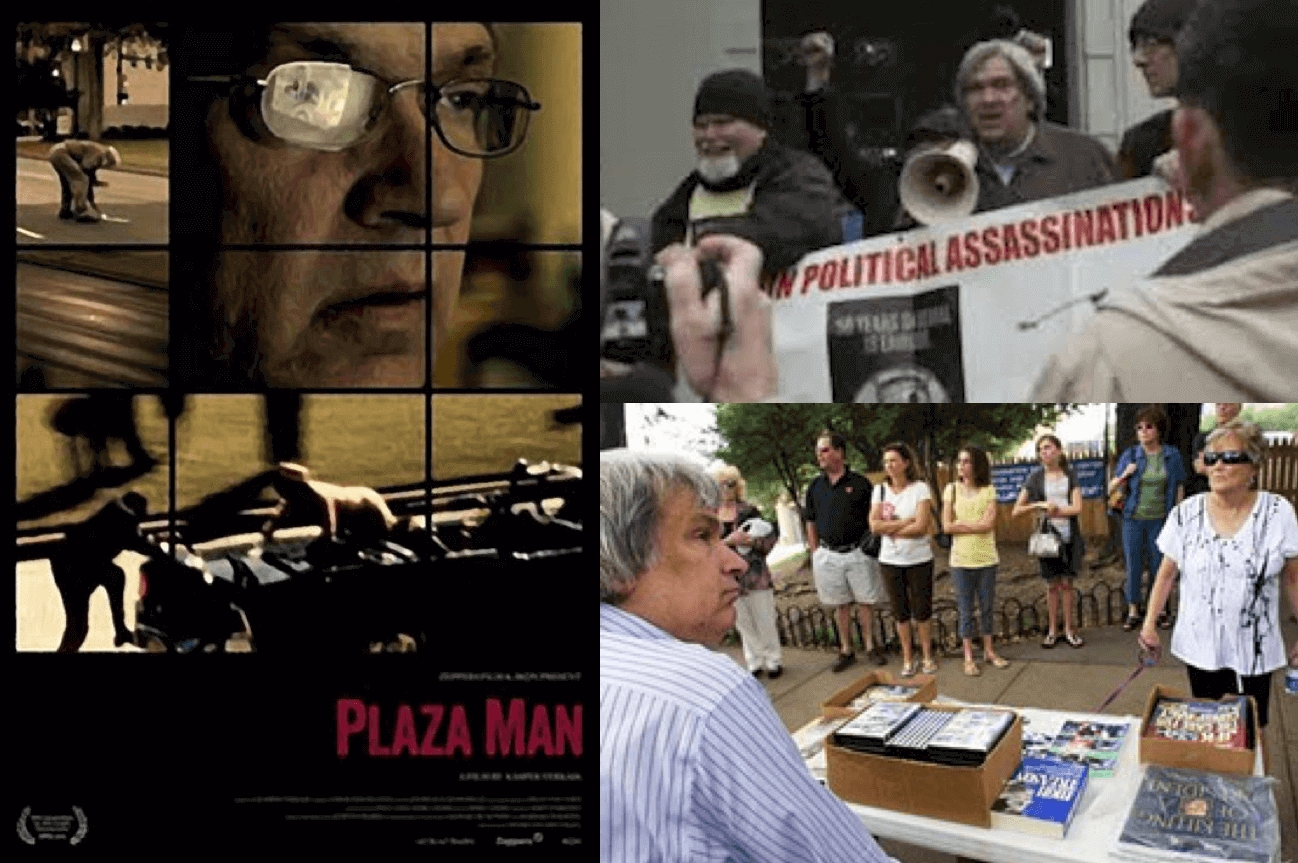
  • 2017 & 2018 JFK Releases: Progress, Issues, Recommendations

    2017 & 2018 JFK Releases: Progress, Issues, Recommendations


    (Click here if your browser is having trouble loading the above.)